Awake!, August 8, 1965
Download: PDF — Awake!, August 8, 1965
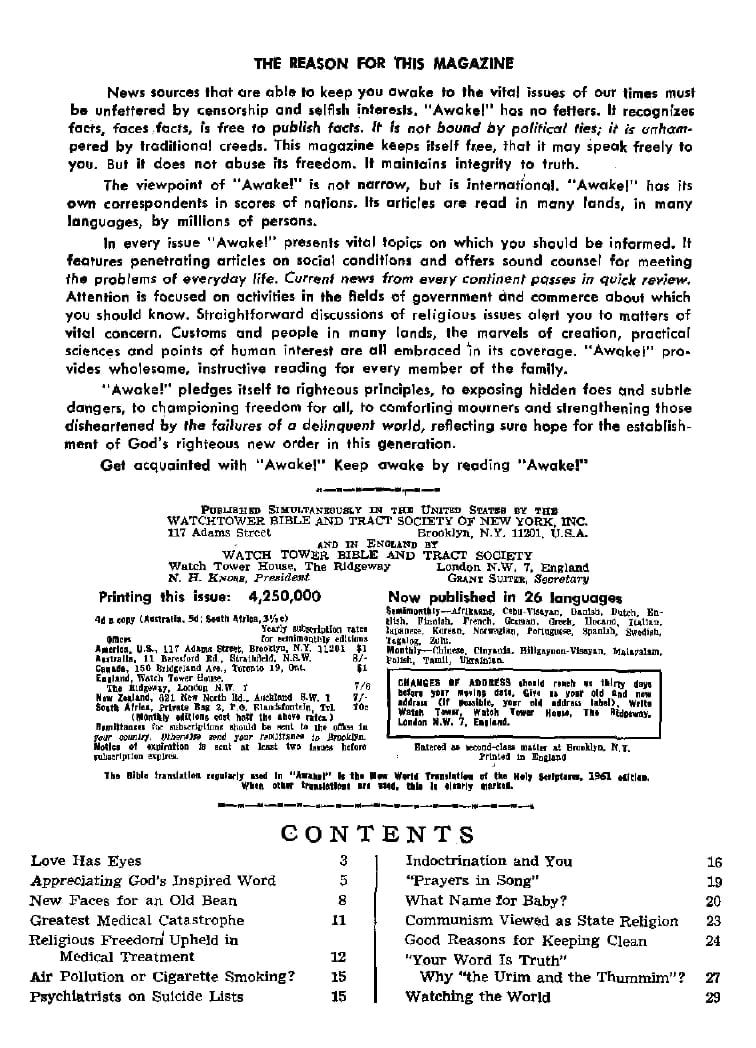
THE REASON FOR THIS MAGAZINE
News sources that are able to keep you awake to the vital issues of our times must be unfettered by censorship and selfish interest. "Awoke!" has no fetters. It recognizes facts, faces facts, is free to publish facts. It is not bound by political ties; it is unhampered by traditional creeds. This magazine keeps itself free, that it may speak freely to you. But it does not abuse its freedom. It maintains integrity to truth.
The viewpoint of "Awake!" is not narrow, but is international, "Awake!" has its own correspondents in scores of nations. Its articles are read in many lands, in many languages, by millions of persons.
In every issue "Awake!" presents vital topics on which you should be informed. It features penetrating articles on social conditions and offers sound counsel for meeting the problems of everyday life. Current news from every continent passes in quick review. Attention is focused on activities in the fields of government and commerce about which you should know. Straightforward discussions of religious issues alert you to matters of vital concern. Customs and people in many lands, the marvels of creation, practical sciences and points of human interest are all embraced in its coverage. "Awake!" provides wholesome, instructive reading for every member of the family.
"Awakel!" pledges itself to righteous principles, to exposing hidden foes and subtle dangers, to championing freedom for all, to comforting mourners and strengthening those disheartened by the failures of a delinquent world, reflecting sure hope for the establishment of God's righteous new order in this generation.
Get acquainted with "Awake!" Keep awake by reading "Awake!"
21.
PUBLISHED SIMULTANEOUS IN THE UNITED STATES BY THE
WATCHTOWER BIBLE AND TRACT SOCIETY OF NEW YORK, INC.
117 Adams Street
Brooklyn, N.Y. 11201, U.S.A.
AND IN ENGLAND
WATCH TOWER BIBLE AND TRACT SOCIETY
Watch Tower House, The Ridgeway
London N.W. 7, England
N. H. Knoan, President
GRANT Sister, Secretary
Printing this issue: 4,250,000
4d a copy (Australia, 5d; South Africa, 3½e)
Yearly subscription rates
for membership editions
August U.S. B. 117 Adams Street, Birmingham, 12181
Australia 11 Barsford Ed. St. Guildhill, 12181
$/Canada 11 Barsford Ed. St. Toronto, 19, OCL
The Highway, London N.W. 7 7/8
New Zealand, 321 New Bedford A. Attuckhill S.W. 1
The Monthly editions cost half the above rates.
Honorable members for subscriptions should be sent to the office of exchangers and your position in the organization.
July of exchangers. Rent at least two times before subscription expires.
Now published in 26 languages
Summityimany — Afrikang, Cebu Vibayan, Danubio, Dutch, Enchin, Ecuador, Fiji, Guatemala, Haiti, Indonesia, Korea, New Zealand, Portugal, Singapore, Szechuan, Tajikog, Zulh.
Switzerland, China, Ciraq, Hillgaven-Vibayan, Malaysia, Tamil, Tamil, Uruguay.
CHANGES OF ADDRESS should reach us thirty days before your moving date. Give us as your age and new address. Call us at 1-800-745-1234 or Watch Towne, Watch Towne House, The Ridgeway, London W. N. 7, England.
Entered as second-class matter at Brooklyn, N.Y.
Printed in England
The Bible translation regularly used in "Ankha" is the New World Translation of the Holy Scriptures, 1961 edition. When other translations are used, this is clearly marked.
CONT
CONTENTS
LENTS
Love Has Eyes 3
Appreciating God's Inspired Word 5
New Faces for an Old Bean 8
Greatest Medical Catastrophe 11
Medical Treatment 12
Air Pollution or Cigarette Smoking? 15
Psychiatrists on Suicide Lists 15
Indoctrination and You 16
"Prayers in Song" 19
What Name for Baby? 20
Communism Viewed as State Religion 23
Good Reasons for Keeping Clean 24
"Your Word Is Truth"
Why "the Urim and the Thummim"? 27
Watching the World 29
Volume XLVI
Number 15
LAST February there was a pair of stunned parents in the town of Haworth, New Jersey. Stunned at what? Stunned at learning that their sixteen-year-old son was picked up by the police because of operating a gambling casino right
In their own basement. Sturmred also were the parents of the some fifty teen-agers that were regular patrons of this gambling den. "They thought their children were skating, sledding or other things like that," the police chief reported.—Newsweek, March 8, 1965.
What accounted for it all? Obviously those parents had been blind to what was going on in the minds and hearts of their children. And why had they been blind to these things? Could it have been because of their lack of mature, unselfish, parental love; because of their being so concerned about their own immediate interests and pleasures that they neglected becoming confidants of their children? That could well have been.
Although there is a saying that love is blind, it is also true that love has eyes, that it helps one to see many things that he otherwise would not be able to see. It all depends upon what kind of love it is. Erotic love, based solely on physical attraction, often blinds a person, causing
him to become infatuated with one of the opposite sex. But the love that manifests itself in an unselfish interest in others is not blind, not even to their faults. It sees those faults even as others do, but it views them in a different light, sympathetically, yes, and with empathy, as if such were one's own faults. It therefore mercifully hides them from others, even as God's Word shows: "Love covers a multitude of sins." "Love covers over all transgressions." —1 Pet. 4:8; Prov. 10:12.
Since love covers over the faults of others, it is able to see the good in other persons. It does not let a few faults blind it to the good qualities in persons. It sees their possibilities, their potentials. Basically, love is inclined to be trusting—not that it is gullible—but certainly it is not unduly suspicious.—1 Cor. 13:4-8.
Love has eyes also because it is not blinded by pride, prejudice or greed. It is able to see fine qualities in others, not looking down on them because they may have a foreign accent, a different skin color or be lacking in education or "culture."
Since "God is love," he, above all else, has eyes to see the good that resides in his imperfect creatures. (1 John 4:8) He could see the loyalty of his servant Job, and so when Satan the Devil charged that very prosperous Job served God solely for what he got out of it, God took the side of Job and gave Satan free rein to prove his contention.
Job remained loyal in spite of all that Satan could do, thereby proving Satan false and God true. Satan, because of selfishness, took the wrong, the negative, view of Job; God, because of his love, took the right, the positive, view. —Job, chapters 1, 2 and 42.
Jesus Christ, the Son of God, imitated his heavenly Father in this, even as in so many other respects. Because of his love he also had eyes to see good in people, in those that his self-righteous contemporaries looked down upon and despised, such as the tax collectors, the harlots and the Samaritans. Even among the Pharisees he was able to see when one was sincere and so chose him to be his apostle to the nations, the apostle Paul.—Matt. 9:9; Luke 7:36-50; 18:10-14; 19:2-9; 1 Tim. 1:12-16.
Yes, love has eyes that see deeper than what appears merely on the surface. It can see when a person is really trying and working against odds and so gives him credit for it, not judging solely by the actual results. It can enjoy a child's or neighbor's efforts to entertain and please even though he is no virtuoso or genius. It might be said that one of the things that characterizes a really good teacher is this faculty of seeing possibilities in students because of love.
Love has eyes also in other ways. On the one hand, it sees the many opportunities that daily present themselves for doing good, for being helpful to others; and, on the other hand, it has eyes to see the many little kindnesses that others render. Are you a husband? Love will enable you to see both the many little opportunities you have to bring happiness to your wife by expressions of affection and appreciation.
tion in word and action and the many efforts of your wife to make herself and her home attractive and pleasing to you. Are you a wife? Love will help you to see and appreciate the many ways, large and small, by which your husband gives proof of his loyalty to you, and it will also make you sensitive as to the state of his health and your many opportunities of cooperating with him.
The same principle applies to parents and children and their relationships with one another. Love will enable parents to see both their many opportunities to train their children in the right way and their opportunities to spend time with them, choosing such hobbies and recreations as their children can enjoy and share. (Deut. 6:6, 7) Love enables parents to see when their children are disturbed, discontented, perplexed, troubled and heading for trouble. And love will enable children to see what sacrifices their parents are making for them and their own opportunities to be helpful to mother in the kitchen as well as in the rest of the house and to assist father in caring for the many things that he must do.
In particular does the principle that love has eyes apply to the Christian minister. It will enable him to see his many opportunities for doing good at his place of worship, such as greeting the lonely, comforting the depressed, welcoming the stranger and sharing one's Bible, Bible-study aid or songbook with one who may be without it. And it will keep him active in the field ministry, for love enables him to see the great need for spiritual food on the part of so many and will impel him to do all he can to satisfy those who are conscious of their spiritual need.—Amos 8:11; Matt. 5:3.
Truly far-reaching are applications of the principle, Love has eyes!
APPRECIATING
IT IS cozy beside the log fire. The embers glow in friendly warmth, and from time to time lively sparks shoot out into the screen. Evenings here in the mountains are cool, it is comfortable indoors, but the time has not been wasted. There has been fine opportunity for reading and study, and
INSPIRE
WORD
</div>
John Jones and family have put their time to good account. Oh, yes, let us introduce them. On the other side of the fireplace from John is his wife, Mary, and seated around in front of the fire are their three children, Mark, Ruth and Thomas. Eager students all! They are surrounded by Bible translations, which they put to good use, and other Bible-study helps. But let us move closer and listen to the conversation.
The group has just completed a family study of the Watch Tower Society's book "All Scripture Is Inspired of God and Beneficial," and John Jones is taking his family through a review of some of the high points. The discussion has turned to the comforting topic of a new order without death.
"You know," observes John, "the Revelation emphasizes this grand hope twice, both at chapter 21, verse 4, and at chapter 7, verse 17, and in each place it uses identical words, stating that God will wipe out every tear from their eyes."
It is Mark's turn to speak. "Here
the Greek Scriptures are actually giving support to the Hebrew Scriptures," he declares. "This is shown by the cross-reference in the margin of my largeprint edition of the New World Translation Bible. From Revelation 7:17 it refers us to Isaiah 25:8. Let me read it. . . . He will actually swallow up death read, and the
Lord Jehovah will certainly wipe the tears from all faces.' And see what the next verse says!-'And in that day one will certainly say: "Look! This is our God. We have hoped in him, and he will save us. This is Jehovah. We have hoped in him. Let us be joyful and rejoice in the salvation by him."'
"A wonderful promise!" exclaims Ruth. "And did you all notice in Revelation chapter 7, verse 9, that 'a great crowd' from all mankind is to share in the fulfillment? What a happy prospect—instead of tears, everlasting life on a paradise earth!"
Mother chimes in: "The thrilling thing to me is the way both Hebrew and Greek Scriptures support each other in underlining these promises. The Bible is truly a grandly harmonious book throughout, from Genesis to Revelation."
"And this grand harmony," remarks John, "is due to the Bible's outlining one theme—a theme that highlights Jehovah's great purpose."
Young Thomas asks, "What is that theme, Daddy?"
"It must be something in connection with Christ," suggests Ruth.
John Jones agrees. "Yes, it is. In fact, it is suggested in the very words that both Jesus and his forerunner, John the Baptist, used in starting out their respective ministries. Do you remember how they announced themselves?"
"I think I do," answers Mark. "Wasn't it something like, 'Repent, for the kingdom of the heavens has drawn near'?"
John commends his son: "Very good, those are the exact words at Matthew 3:2 and 4:17. But much began to be spoken concerning God's kingdom long before the days of Jesus. The Greek Scripture writers who wrote of Jesus and his ministry quoted repeatedly from the ancient Hebrew Scriptures, where prophecy upon prophecy had pointed forward to God's coming kingdom by the Messiah, Christ. In fact, the very first prophecy in the Bible is a Kingdom promise. Do you remember where we find that prophecy, Ruth?"
"Why, yes, Daddy! At Genesis 3:15."
"And, Thomas, do you remember what this prophecy tells us?"
"Yes, Dad—it is about the Seed of God's woman in heaven bruising Satan and his seed, and that includes wicked rulers and people here on earth."
"Very fine, my son. And so, through the first prophecy in the Bible, given nearly six thousand years ago, we begin to understand that God will bring forth a Seed from his wifely organization of heavenly, angelic creatures, to wipe out Satan and all his works, and reestablish righteousness in all the universe, including earth. So, how may we describe the theme of the Bible? Why, this way—the sanctification of Jehovah's name through the Kingdom Seed."
Ruth pipes up: "But, Daddy, I don't see any mention of a 'Kingdom' here in Genesis 3:15."
"True," John agrees, "but a notable 'Seed' is mentioned, and very soon in the Bible record we find many references to a Kingdom linked with this Seed."
"I suppose," comments Mark, "that the famous promise to Abraham about his seed becoming like the stars, for multitude enters into this picture."
"Yes," explains John, "and not only was Abraham promised a 'seed,' but he was told by Jehovah, here at Genesis 17: 6, that 'kings will come out of you.' That was about thirty-nine hundred years ago."
Mother adds her comment: "And we all remember Jacob's inspired promise that the scepter of kingly authority would not turn aside from Judah. That's at Genesis 49:10."
John continues: "And then, 3,000 years ago, Jehovah made a Kingdom covenant with David, saying: 'I shall certainly establish the throne of his kingdom firmly to time indefinite.' Can anyone tell me where we find those words in the Bible?"
Mark answers: "Well, I remember that Second Samuel tells of the reign of David . . ." At which Ruth Joins in: "I have it chapter 7, verse 13. Jehovah is speaking to David about his son: 'He is the one that will build a house for my name, and I shall certainly establish the throne of his kingdom firmly to time indefinite.'"
"Up to this point," father explains, "we can plainly see that the Hebrew Scriptures develop the theme of a Kingdom that will honor God's name. But do the Greek Scriptures hold to this theme?"
"Surely they must," suggests Ruth.
"And surely they do," affirms John Jones. He turns to young Thomas: "Now, Junior, you have the large first edition of
AWAKE1 the New World Translation there, and you have learned how the marginal references lead us from one scripture to other related ones.
You already have 2 Samuel 7:13 located, I see. Now, in the margin alongside, do you see a reference to the Greek Scriptures?"
"Yes, Daddy, Luke 1:33."
"Well, Thomas, that carries us through another thousand years, down to Jesus' day. Why not turn to it, and read it for us? And you may as well read verse 32 as well as verse 33."
Thomas has the place: "This is about Jesus, and it says: 'This one will be great and will be called Son of the Most High, and Jehovah God will give him the throne of David his father, and he will be king over the house of Jacob forever, and there will be no end of his kingdom.'"
Mother speaks up: "So in the light of the Greek Scriptures, the millennium-old Kingdom promise becomes clear! Jesus is the Kingdom Seed. But I wonder if the Hebrew prophets throw more light on this? For example, Luke here gives a cross-reference to Daniel 7:14."
Mark hastens to turn up the reference. "Ah, yes," he comments, "in this chapter it speaks of 'someone like a son of man.' 'Son of man'—that's one of the expressions used in the Greek Scriptures in referring to Jesus, isn't it? This is what it says: 'And to him there were given rulership and dignity and kingdom, that the peoples, national groups and languages should all serve even him. His rulership is an indefinitely lasting rulership that will not pass away, and his kingdom one that will not be brought to ruin.' That must mean an everlasting Kingdom over all mankind!"
"Very true," affirms Mary Jones. "These marginal cross-references are becoming very interesting. And here's another one—from Daniel to Revelation 11:15."
"May I read this one?" asks Thomas. His clear, young voice sounds forth: "And the seventh angel blew his trumpet. And loud voices occurred in heaven, saying: 'The kingdom of the world has become the kingdom of our Lord and of his Christ, and he will rule as king for ever and ever.'"
"Well read!" says his father. "And note that, in verse 18, the scripture tells when this happens—at a time when 'the nations became wrathful' and mankind is 'ruining the earth.' Does not this clearly indicate our day, with its world wars and earth-wide commotions?"
"With most people so afraid about the future, how glad we can be to have this real hope of the Kingdom!" exclaims Mary. "But may I carry this chain reference study just one step farther? Here, at Revelation 11:15, is a reference to Psalm 145:13. Ruth, would you read it for us? And I suggest you start from verse 10."
Ruth reads with warm expression: "All your works will laud you, O Jehovah, and your men of loving-kindness will bless you. About the glory of your kingship they will talk, and about your mightiness they will speak, to make known to the sons of men his mighty acts and the glory of the splendor of his kingship. Your kingship is a kingship for all times indefinite, and your dominion is throughout all successive generations."
Her mother takes up the psalmist's words: "The glory of the splendor of his kingship!' How those words should stir in all of us the desire to explain the wonderful truths of Jehovah's kingdom by Christ to all whom we meet!"
John Jones smiles around at his family. "This voyage of exploration through the New World Translation of the Bible has certainly been interesting," he comments. "What a marvelous unity of theme is to be found in God's Word—all the way from Genesis to Revelation!
Indeed, the promise of Genesis 3:15 concerning the 'Seed' to bruise the serpent's head is amplified progressively all the way through to Revelation. And now we live in the climactic day when Christ hurls the Devil out of heaven down to earth. Yes, right now he is getting ready to destroy the Devil's 'seed' on earth, and to throw that old serpent and his demons into the abyss. All these thrilling events, my children, you find described in the closing pages of Revelation, at 12:1-
12, and 19:11-16, and 20:1-3, Truly, we must marvel at the magnificent support the Greek Scriptures give throughout to the entire body of the Hebrew Scriptures. Indeed, our precious Bible is all one Book, inspired of God!"
A smoldering log falls to the grate, and dying embers remind the family that it is bedtime. But appetites have been whetted for further discussion on another night. Shall we at that time join John Jones and family once more at this cheerful fireside?
By "Awake!" correspondent in Hong Kong
WOULD you like to have an Oriental servant? Look around you. You may already have one, very little and very old, but very helpful. You may find him in the page you read or the ink on it, the bread on your table or the plywood tabletop under it, the wallpaper on your walls or the linoleum that meets it at the edge of the floor, the fire-fighting foam your fire department uses or the lifesaving streptomycin in your doctor's satchel. For these
are only a few of the brand-new twentieth-century faces of one of the oldest Orientals alive today, the little soybean.
This little servant of man grows on a plant that may reach from one to six feet in height. The beans or seeds, rich in protein and oil, form in long pods, a pod usually containing two or three round or oval beans. As for outward appearance, why, the soybean may come in shades of yellow, green, brown or nearly black. The soybean is at your service.
If you want the soybean's past employment references before accepting him as your servant, here is one that says, "The oil, as well as other portions of the soybean, has been credited with saving much of the Oriental population from starvation at different times." The tiny old bean has been called the "cow of China" and "meat of the fields" because it has taken the place of milk and meat in Oriental diets.
Just how much protein is there in the soybean? Many varieties contain more than 40 percent protein, the protein resembling casein (the protein from milk) more closely than any other. Nutritionally the soybean has been said to have "more protein than beef, more calcium than milk and more of a fatty substance called Lecithin than eggs."* Little wonder that in China, Korea, Japan and many other lands soybeans are the major source of protein and fat for human consumption.
In Hong Kong, where dau-fu, a coagulated curd made from soybean milk, forms a staple part of the diet of rich and poor Chinese alike, at least one doctor is known to advise non-Chinese patients suffering from blood deficiency or low blood pressure to include the common curd in their diets as a high-potency blood builder.
An Aid to Combating Disease
As a fighter against malnutrition, beriberi and pellagra, the ancient bean has taken on one of its new faces in Hong Kong, that of a specially processed soybean milk. Not that milk from the soybean is new in itself, but new scientific methods have been developed that draw more of the value from the bean, improve and smooth out the flavor and produce a modern-style soft drink that outsells all the internationally known "fizz and soda" coolers during Hong Kong's hot, humid summer.
The part that this soft drink, Vitasoy, has had in the near eradication of beriberi and pellagra, considered the biggest killers in Hong Kong before World War II, must have been a considerable one, though much credit must rightly go to a raised living standard. The fact remains that it is chiefly during the postwar years that the new drink has made protein-rich refreshment available to all, even the poorest burden-bearing coolie. The corresponding fact is that during those same years the Colony, which maintained two hospitals for beriberi and pellagra, has come to the point where many a schoolboy would not even know what beriberi was.
Migration to the West
Now then, if our little Oriental servant suits your ideas of helpfulness, maybe you would like to know where you can find him outside the Orient. You will not find it hard, because the fame and usage of the little bean that was the delight, the food and the medicine of Chinese emperors away back in the third millennium B.C.E. have spread out through all the world.
In the eighteenth and nineteenth centuries some of the seeds were taken to the Jardin des Plantes in Paris and the Royal Botanic Gardens at Kew, England, and soybean crops were grown sparsely in Europe and to a greater extent in the Balkan States and Russia. Then the seeds spread to the United States; an 1804 American record mentions cultivation of the soybean in Pennsylvania. Then the expedition ships of Commodore Perry in 1854 brought more varieties of soybeans to the United States from Japan. The United States Department of Agriculture took them up in 1898 and soybean acreages fanned out from southern to north-central states. They served as a much needed emergency crop when severe drought hit the corn-belt states in 1934.
During the two world wars the soybean plant, which had served mainly for livestock fodder and soap oil since Manchuria started exporting it on a large scale in 1908, turned a new and beneficial face to its new users in the form of edible oils to replace the drastically reduced supply of fats whose sources were cut off by war. It was largely because of this that the United States production of soybeans shot up from 17,000,000 bushels in 1931 to nearly 200,000,000 in 1943; and now each year the United States grows, mainly in the north-central states, more than 600,000 bushels, putting the country ahead of the soybeans' native land, China, in production of that versatile legume.
A Versatile Servant
With increased soybean production and easing of the need for edible oils came greater versatility, the discovery of a multitude of new faces for the ancient bean. During the mid-1930's it showed up in soap works, palrit and varnish factories, linoleum and oilcloth industries and in the inkmaker's laboratories. After that it branched out into the production of non-sputtering margarine and shortening, salad oil and dressings.
Soybean flour has become a meat binder in sausage, has given white bread improved taste and longer shelf-life as well as higher nutrition, has gone into grease-inhibiting doughnut mixes, flakier pie crusts and richer graham crackers.
Soybean grits have put more protein into pet foods, livened up cornflakes, improved the body of commercial soups and been used to make high-protein macaroni and noodles. They even helped in post-prohibition America when beer-drinking Americans found the foam on their beer falling flat. It seemed that the malt available for brewing purposes was not the same quality as pre-prohibition malt. But all they had to do was add some soybean flakes and grits, and up went the foam, the body and even the flavor.
But twentieth-century science, not content, went on to isolate soybean protein and use it to replace and improve on egg albumin as the aerating agent in delectable candies, nontoughening marshmallow toppings, melt-in-the-mouth icings that held up better in cake-top decorations and low-fat toppings, similar to whipping cream, that would whip up to three times their unwhipped volume, assume any degree of stiffness without turning to butter and keep for five to ten days at forty degrees Fahrenheit, or indefinitely if frozen.
high-protein meat substitute that can be flavored like bacon, chicken or beef, yet please the most fastidious dietitian who abhors anything that breathes any suspicion of cholesterol and any surmise of possible heart or arterial disease.
One of the latest nutritional faces of the soybean in the United States is that of a
Alongside these new technical developments the more traditional soy products of the Orient have gone into the competition to attract the appetite. Soy sauce has been a salty must on Oriental tables since over a thousand years before the Common Era. Soy sauce is made from whole beans, and its dark color and flavor are due to the processing and aging. The Japanese, who keenly enjoy their soy sauce, also export large quantities. Soy sauce is now used by many Westerners, who like it for seasoning meats, vegetables, gravies, sandwich spreads, salad dressings, as well as rice and other foods. Soy sauce is now well accepted as an ingredient in Worcestershire sauce, forming up to 30 percent of the finished product.
Then there is soybean milk. Many a Chinese has never tasted any milk other than that of the soybean. In the United States soybean milk has been fed extensively to infants allergic to cow's milk. And in Medical Science, January 10, 1957, there is an account of the treatment of infant disorders with soybean milk. Soybean developers have even produced a buttermilk-type product said to have an agreeable characteristic flavor.
Moreover, even the humble bean curd dau-fu, as common as rice in the shops of Hong Kong, has been dressed up for American and European taste in the form of omelets, stuffing in peppers and as an ingredient in salads.
In Industry
Now does it seem that our tiny Oriental servant has surely exhausted his strength by this time with all his nutritional services?
Then let us look beyond the abundance of food he sets on our tables and into the lovely grained plywood tabletop itself. The huge plywood industry that gives us big uncut, unbroken stretches of expensive, grained wood surface as a thin slice on top of a "sandwich" of less expensive woods would not be possible without powerful bonding glues to hold the "sandwich" layers together. Yes, the soybean is used even to make glue! Soybeanbase adhesives have been found to be ideally suited for use with many woods. Following on the heels of soybean glue came numerous other industrial applications, such as adhesives for washable wallpaper and emulsifiers for fruit sprays.
Look further at the fine glossy papers in your modern magazines, with their lifelike photoengravings to delight the eye. The availability of soybean protein during the development of the process for machine-coating paper from 1935 to 1944 played a large part in the development of this paper, the coatings of which must have an affinity for the ink films used in half-tone engravings.
The lecithin that is a by-product of two of the processes for manufacturing soybean oil contributed to better soap lather, paints that brush and level better, stronger and longer-lasting rubber, longer-lasting lubricants, softer leather and improvements in the manufacture and sizing of textiles.
a can of sardines, tuna or other fish product packed in soybean oil.
Soybean oil is used many ways commercially today. Perhaps you have opened up
The soybean properties that make beer foam better have also improved the firefighting properties of the foams your fire department uses to douse dangerous blazes. Yes, even the wonder drug streptomycin is cultivated in a thick broth made of soybean meal.
There seems to be no end to that for which the soybean can be used. Scientists believe there are still unknown substances in the soybean seed that can be used by man, but only through continued research may their identity and uses be known. Even now, it is said, with due credit to the Creator of this marvelous seed, that a more versatile plant than the soybean has never been known to science. If so much can be done with one plant's seed now, how much more can be done with seeds and plants in the peaceful New Order under God's kingdom!
Truly the little bean that came from the Orient has proved a devoted and versatile servant to the whole human family. And now the strange and intriguing situation has arisen where North America, the former recipient of the all-serving Oriental bean, has become its chief supplier to the world, producing more than half the world's soybean crop and sending, in a recent year, one-fourth of its exports of soybeans back to the Oriental land of Japan.
How strange, indeed, that now the West should be asking the East: "How would you like to have an Oriental servant?"
Greatest Medical Catastrophe
Writing in the New York Daily News of March 27, 1965, Dr. T. R. Van Dellen discussed influenza pandemics, or epidemics of unusual extent and severity, reporting: "There have been 31 recorded pandemics in the world since 1510; the 1918 episode was the greatest medical catastrophe in history. There were 20 million deaths within a 20-week period."
"DO YOU mean to tell me that we can't give John Doe in Room 418 a blood transfusion during or after his stomach resection, simply because he says he doesn't want
Medical Treatment
one? He can't dictate to us how we are to practice our profession!
"Yes, that is exactly what I mean to say," Dr. Wallace told his partner. "We can't operate on him in the first place, just because we think he needs surgery. We must first have his permission to do so. The same rule holds for other procedures. If his religious teachings have convinced him that it is wrong to permit someone else's blood to be put into his body, we certainly have no right to go against his express wishes in that regard."
"But isn't that an interference with our right to exercise freely our professional discretion?"
"Yes, John, I suppose it is, to a certain extent,' Dr. Wallace replied, 'but we are, of course, at liberty to refuse to perform the operation, if we think the conditions demanded by the patient are too restrictive. After all, we readily respect the wishes of another religious group which opposes abortions. The principle is just the same.'"
Thus The New Physician, May 1964, reported on a situation facing many physicians and surgeons today.
Unfortunately, however, not all in the
medical profession have proceeded in such an equitable manner. Some of them have sought court orders to force patients to submit to blood transfusions. Such was the case on May 7, 1964. Mrs. Brooks and her husband had previously
signed a document releasing their doctor and the MacNeal General Hospital from all liability that could result from not giving her blood transfusions and she was assured that they would not make any further efforts to try to get her to take blood.
In spite of these assurances the doctor, together with a number of others, including several assistant State's attorneys, appeared before the Probate Division of the Circuit Court of Cook County in Illinois, asking that a conservator be appointed for Mrs. Brooks and that he be authorized to consent to the giving of whole blood transfusions to her. A conservator was appointed who consented to the giving of blood, and the transfusions were given. This entire proceeding robbing her of her liberty was done without her knowledge or presence or the knowledge or presence of her husband or other members of her family, although, at the time, they were known to be in the hospital as visitors and readily available.
An appeal was made to this court, asking, among other things, that an order be entered expunging the original order appointing a conservator, but the trial judge refused to grant any relief. However, on appeal, the Supreme Court of Illinois ruled in favor of Mrs. Brooks and all others who may in the future want the freedom to decide what kind of medical treatment they will accept. It stated that, although the transfusion had already been given, the case was not moot, that is, not futile, not serving any practical purpose, but was indeed one of substantial public interest; that it was desirable to have an authoritative determination for the future guidance of public officials and that there was a likelihood of a future recurrence of the question.
First Amendment Prohibits Forced Blood Transfusions
In its decision the Supreme Court of Illinois made it plain that, while governmental actions cannot be proscribed on the basis of the First Amendment to the Constitution unless they were demonstrated to have a coercive effect upon the individual, it was evident that here there was such a coercive effect. Drawing on history, the Court noted the reasons why the founders of the United States were so concerned with keeping Church and State separate, which concern resulted in the First Amendment's guarantee of freedom for the individual from governmental interference with his religious beliefs and practices.
"The point at which interference therewith may be constitutionally permissible," the decision went on to say, was well illustrated by the bill establishing religious freedom in Virginia, which, among other things, stated: "To suffer the civil magistrate to intrude his powers into the field of opinion, and to restrain the profession or propagation of principles on the supposition of their ill tendency, is a dangerous fallacy which at once destroys all religious liberty' and 'it is time enough for the rightful purpose of civil government for its officers to interfere when principles break out into overt acts against peace and good order.'"
The Court's decision further showed that a forced blood transfusion could not be justified on the premise that vaccinations are made compulsory, as they are given for the purpose of preventing the spread of a dangerous disease, and there was no question about a disease spreading if Mrs. Brooks did not get a blood transfusion. Nor could it be justified, the decision held, on the basis that the law of the land forbids the religious practice of polygamy, since blood transfusion was not a question of public morals as is polygamy; and it could not be likened to the law's forbidding the handling of poisonous snakes as is practiced by some religions, since that practice is against public welfare, whereas in this case it was not a matter of public welfare.
Coming to the heart of the matter, the decision said: "Applying the constitutional guarantees and the interpretations therefor heretofore enunciated to the facts before us, we find a competent adult who has steadfastly maintained her belief that acceptance of a blood transfusion is a violation of the law of God. Knowing full well the hazards involved, she has firmly opposed acceptance of such transfusions, notifying the doctor and the hospital of her convictions and desires, and executing documents releasing both the doctor and the hospital from any civil liability which might be thought to result from a failure on the part of either to administer such transfusions . . . No overt act or affirmative act of appellants offers any clear and present danger to society—we have only a governmental agency compelling conduct offensive to appellant's religious principles.
Even though we may consider appellant's beliefs unwise, foolish or ridiculous, in the absence of an overriding danger to society we may not permit interference therewith in the form of conservatorship established in the waning hours of her life for the sole purpose of compelling her to accept medical treatment forbidden by her religious principles, and previously refused by her with full knowledge of the possible consequences. In the final analysis, what has happened here involves a judicial attempt to decide what course of action is best for a particular individual, not withstanding that individual's contrary views based upon religious convictions. Such action cannot be constitutionally countenanced." (Italics added.)
In conclusion the Supreme Court of Illinois stated that, "while the action of the circuit court herein was unquestionably well-meaning, . . . we have no recourse but to hold that it has interfered with basic constitutional rights."
Not a Matter of Suicide
Dr. Demange, in commenting on the decision of the Supreme Court of Illinois in declaring his action in the Brooks case illegal, among other things, stated: "If somebody wants to jump off a building, they have the right. You have a right to lead the type of life you want to and even choose death if you want to. On the other hand, it's my job to save lives—not let people die if there is a simple medical answer." But is the medical answer, blood transfusions, that simple and sure? According to the editor of the Medical Times, November 1964, "transfusion carries more dangers than most physicians realize."
Commenting in the same vein as Dr. Demange, Dr. E. A. Piszczerk, president of the Illinois State Medical Society, among other things, said: "Individuals have no right to commit suicide and the refusal to accept blood in such cases is almost tantamount to committing suicide." But note that expression "almost tantamount." It is not truly, absolutely tantamount or equal. In fact, no physician can be absolutely certain that the blood given will not kill the patient rather than prove lifesaving, such are the risks of transfusing blood.
This very same argument was made by the defense attorney, Mr. Riley, namely, that freedom of religion did not go to the point of allowing people to endanger their own lives. However, one of the judges, Walter V. Schaefer, far from being impressed by it, observed: "Mr. Riley, I can just see 100,000 Christian martyrs turning over in their graves when you make that statement. They had the option of worshiping Caesar or being thrown to the lions. Would you dare to argue that they were not in their right minds in making their decision to be martyrs?"
Did those Christians commit suicide? Their persecutors and ridiculers may have accused them of doing so. But let us remember that that was not the purpose of their dying, they were not tired of life, they did not want to end their existence, as does the suicide. They did not prefer death to life, but merely preferred death to being unfaithful to their religious convictions and it was their persecutors that forced this choice upon them. Mr. Riley's contention that freedom of religion does not allow a person to die for his convictions is in sharp disagreement with the words of the Founder of Christianity, Jesus Christ, for he, on one occasion, stated: "Whoever wants to save his life will lose it; but whoever loses his life for my sake will find it."—Matt. 16:25, 1950 Ed., margin.
The fact is that throughout the Holy Scriptures are found accounts concerning men of faith who had to choose between God's law and this life. When God told Abraham to offer up his son, was not God putting his law ahead of the life of Isaac to test Abraham? There were also the three Hebrews faced with the flery furnace, and Daniel faced with the lions' den; they could have avoided the threat of death, but again, God's law came first. Gen. 22:1-18; Dan. 3:1-30; 6:1-28; Heb. 11:35.
And so with Jehovah's witnesses today. It is not a matter of letting them commit suicide. It is a matter of respecting their determination to remain true, to their religious convictions and principles, as they are so plainly and repeatedly stated in the Scriptures—Gen. 9:3, 4; Lev. 17:10; Deut. 12:23; Acts 15:19, 20, 28, 29.
Pertinent in this regard are the remarks of Dr. Edward Harris, chaplain of the University of Pennsylvania, as they appeared in Surgery, Gynecology & Obstetrics, April 1959: "One other thing I should like to say that pertains to the
right of a Christian to take his own life. In terms of the Christian understanding of life we do not have such a right. Life comes to us as the gift of God and we hold it in trust to be used under God. But it does not seem to me that the question of suicide is at all pertinent to this case. The patient's decision very clearly is that he is willing to sacrifice his life for the sake of something which he holds to be more precious than life, a purpose greater than himself. And this very right has been distinguished from suicide."
Clearly, then, under the United States Constitution and particularly its First and Fourteenth Amendments, no governmental agency can presume to dictate what is best for a certain individual in the matter of medical treatments, and, in particular, not when such procedures run counter to dearly held religious convictions. For the guidance of doctors and hospitals, and for the protection of their patients, the Supreme Court of Illinois has made clear that the individual's right to choose the medical treatment he desires is safeguarded by law.
Air Pollution or Cigarette Smoking?
When the Royal College of Physicians of London published their study of smoking and lung cancer, it was pointed out that Finland, basically a rural country with virtually no air pollution, has the second-highest lung cancer death rate in Europe. Significantly, what Finland does have is a great number of heavy cigarette smokers.
Psychiatrists on Suicide Lists
"Studies in many countries have focused on the abnormally high number of suicides among physicians," reports the Medical World News magazine of July 3, 1964. On page 87 is an editorial excerpted from the British Medical Journal: "More than one in every 50 male doctors takes his own life—one out of each year at most medical schools. And 8% of all doctors' deaths under the age of 65 are from suicide—the same as from lung cancer." Then under the heading "Psychiatrists Head List," the excerpted editorial reports: "Among the specialties, psychiatry appears to yield a disproportionate number of suicides. The explanation may lie in the choosing of the specialty rather than meeting its demands, for some who take up psychiatry probably do so for morbid reasons."
INDOCTRINATION
WHAT makes a man in a Communist prison or court voluntarily make untrue statements about himself that are so damaging that he is sentenced to death? Why is it that by these confessions he completely reverses his normal behavior?
As a result of experiments performed on animals in the early part
of this century brain functions are better understood than before. Especially when applied to brainwashing techniques, many of the extraordinary and curious phenomena observed in people can be explained. For those whose profession is likely to invite attempts at thought control, the mechanics of indoctrination are interesting and can be helpful should one ever be confronted by such an episode.
Ivan Petrov Pavlov (1850-1936), a Russian biologist, found that when dogs were subjected to stresses more than their brain could handle normally an inhibitive reaction took place. This served as a protective device against brain damage. These same protective reactions appear to take place in the human brain and lay it open to suggestions no matter how absurd or foolish.
Normal brain function can be upset in many ways. Drugs can artificially cause emotional exhaustion. High fevers and fatigue contribute. The fatiguing experience of continued interrogation can bring on brain exhaustion and suggestibility. This interests the interrogator more than any
Factors That Lead to Stress
information revealed under such duress. After all, what you are supposed to "confess" is usually already decided regardless of anything you actually reveal. Mental confusion and stress can be induced by constant questioning, provided it is intense enough.
One's physical condition plays an important part in resisting brain fatigue. A person debilitated by months of starvation is a far better candidate for indoctrination than a well-fed one. This is why a period of imprisonment with an insufficient diet usually precedes any effort at indoctrination. High fevers play havoc with normal brain function, as is observed during a delirium.
Strong emotions such as fear, remorse or anger aid in bringing an exhausted brain to final collapse. Of course, depending on one's temperament, brain disturbance may be induced very simply or only after some time. A person with a phlegmatic disposition resists breakdown longer than someone high strung. Successful brainwashing cannot be performed without the arousing of very strong emotion. The emotion need not be relevant but it must be dramatic.
It is this condition that helps doctors correct hysterical disorders.
With shock treatment the brain is made to have a controlled epileptic fit. Not just one, but many may be caused in just a few days. This brings the brain to a state of complete exhaustion, so much so that recent memory patterns and attitudes can be completely eradicated and often replaced by new ones. In controlled medicine this can work to some good; but brainwashing, though employing similar methods and principles, is fundamentally destructive.
The Brain Tries to Protect Itself
When reduced to a state of brain exhaustion one is unable to maintain normal intellectual operation. Judgment will be impaired. Fortunately, under normal conditions most people can relieve what would finally end in brain debilitation by resting between ordeals and avoiding continued stress. In wartime, however, this is not always possible. Persons suffering from brain collapse and changed behavior patterns are extremely numerous among those left in continual combat duty. In wartime, whole nations believe things without question, which things if presented under normal conditions would be laughed off as ridiculous. Loss of memory is a brain protective device brought into operation as a last resort when it has no other defense left.
If the brain is stimulated beyond its capacity it develops suppressions. It is like trying to multiply a million by a million on an adding machine with a capacity of only seven figures. When final confusion intervenes, previous mental patterns may disappear and new ones may be implanted, no matter how incredible. The victim may then recover believing the implanted nonsense as unquestionable fact.
If the shock to the brain is severe enough, or over a long enough period, the brain "slate" may be wiped clean as it were. In history, we have all seen examples of kind and generous men turning into beasts, committing the most atrocious crimes against humanity. They have been duly conditioned to it by intensified stresses that the brain was unable to handle. As a protective maneuver the disturbed brain withdrew all its defenses and became highly suggestible, accepting things that it never normally would have contemplated.
Proof that emotions and the protective devices of the brain are very powerful is furnished by examples of persons who run from hospital fires, even though they have been bedridden for years. Or, consider the person who after a severe fright finds his speech restored to him.
Pavlov, by his experiments, found that the brain, in its efforts at self-protection, goes through three stages. Under stress the brain first reaches the "equivalent" stage. The subject finds that his response to trivial matters and to important matters is about the same. He doesn't feel strongly about catastrophe anymore. For him there is no black and white, but all is gray. His feelings do not vary greatly.
Then he enters the "paradoxical" phase in which small things produce greater disturbance than big things. The individual's normal behavior is reversed and, as a result, his behavior seems irrational not only to an observer but even to himself.
In the third stage, the "ultra-paradoxical," there is a complete switch from positive to negative, and from negative to positive. The victim starts to take a liking to the person (such as the interrogator and what he stands for), whom he has previously loathed, and he may hate those formerly loved. He may begin to eat formerly nauseating things with relish, and be ill when eating delicacies formerly enjoyed.
It is now that the victim can be effectively brainwashed. If he has previously aborbed Communism he can now be taught to like it. He is indoctrinated. Although the new ideas implanted at this time may diminish, they will nonetheless remain. In unusual cases, however, old ideas will persist in the brain if they have been instilled firmly enough. No known interference can dislodge them.
Contrary to common belief, it is the "normal," "average" person that is the most easily indoctrinated. Such a person is "normal" because he has been influenced already to such an extent by the community that he conforms to all its social standards, and behaves only in an "acceptable" way. His held opinions are often borrowed and usually do not come from independent intellectual thinking. Someone else, however, who has unconventional ideas and is not afraid of what others might think, is in fact much less suggestible. This is possibly one of the reasons why Jehovah's witnesses proved to be unsuitable candidates for brainwashing during the second world war.
One of the greatest dangers to one not wishing to be indoctrinated is to become involved. Interest or cooperation for one trying to protect himself against brain exhaustion and the dreadful potentialities that come with it, is a fatal mistake. Such an emotional involvement only hastens conversion. How sadly it is noted that hardened criminals, refusing to answer any questions no matter how trivial, are seldom convicted on ill-advised confessions. Those cooperating, however, have been known to have almost always finally broken down and signed the most damaging confessions, often not wholly true, to be mystified, when the seizure has passed, how they could have done such a thing.
Drums and Music as a Means of Instilling Ideas
Rhythms can also disrupt normal brain function if carried to excesses. Many persons attending a religious revivalist meeting are successfully converted by the aid of the emotional music used. Orgiastic dancing is so effective in creating hysteria and suggestibility that many religious use it to stimulate conversion. This aspect of religious phenomena was so pronounced in the Middle Ages that St. Vitus was made the patron "saint" of dancing.
Tyerman's Life of Wesley quoted by W. James in the Varieties of Religious Experience says: "Emotional occasions, especially violent ones, are extremely potent in precipitating mental re-arrangements. The sudden and explosive ways in which love, jealousy, guilt, fear, remorse or anger can seize upon one are known to everybody. Hope, happiness, security, resolve, emotions characteristic of conversion can be equally explosive. And emotions that come in this explosive way seldom leave things as they found them."
This perhaps explains one of the reasons why Lao Buddhists are so immune to conversion. They seldom get involved. Laotians have been taught that to show any emotion whatever is wrong and as a consequence, especially in religious conversion where forced efforts are not used, very few take a burning hold on a "new" religion. This is not what one might notice in persons of different religious orientation.
Inquisition Pioneered the
Way for Stalin
Any reliable history of the Catholic Inquisition would provide details of an already established technique—including all the necessary steps to sucoessful brain inhibition. Methods vary. During the inquisition one was shown torture instru ments, maybe watched persons burn alive all to increase the fear and anxiety of the victim.
Soon thereafter the brain would break down, suggestibility would result and the individual would be reduced to pliable cooperation.
Under Stalin the techniques of interrogation were perfected. Of course, a background of Catholic Inquisition was a foundation on which to build. Today bright lights might be used. Incessant question-
teless remain. Ordinary persons used to cooperating with what is socially acceptable and not being different are the most defenseless, unless some other aspect of their behavior is a strong enough prophylactic.
Humans do not break down under brainwashing techniques if they refuse to get involved. If they manage somehow not to cooperate in any way and make a conscious effort to think of something else, the
ings or filling out of endless forms day after day, arrest in the middle of the night, and so forth, all played their part in the diabolical effort to bring on brain inhibition.
What Can Be Done to Protect Yourself How can we avoid the final stage of this process where normal judgment is undermined? It is not easy. The cynics and those with a sense of humor often seem to survive best. How many soldiers signed up during the war after hearing drums and
intrusion on their normal brain function can be offset. A missionary in Shanghai prison for five years was able to maintain his emotional equilibrium by conducting Bible studies with people, all imaginary, and by continuing with the lessons until they finally matured. This may seem unusual, but if something akin to that is not done to keep the mind functioning normally, collapse will result. Others have recited mathematical tables or foreign verb declensions to stave off involvement in the offensive. One person
bands playing rhythmically at recruiting stations, only to realize next day that somehow their judgment was impaired. It was then too late.
If something is not done to prevent the brainwashing from continuing, usually the brain will become so disorganized that it will surrender protectively without any reservations. Of course, making the new ideas stay put is another matter, but even if they decrease in strength, they never-
translated well-known books into other languages to maintain normal prowess.
Many books have remarked on the incredible ability of Jehovah's witnesses to resist German indoctrination attempts during the war. A firm belief in some creed or way of life, based on an intellectual appreciation, not superstition, can, indeed, provide a formidable defense against those that would invade the God-given domain of our minds.
"PRAYERS IN SONG"
In an article entitled "Is Religion Banned from Our Schools?" Clarence W. Hall, formerly executive editor of Christian Herald and now a senior editor of the Reader's Digest, wrote: "Into the nation's patriotic songs went expressions of national dependence upon God; some of the stanzas are actually prayers in song." What is true of such "prayers in song" in the United States is, of course, true about national anthems and patriotic songs of other lands as well.—Reader's Digest, February, 1965, page 51.
What Name for Baby?
By "Awake!" correspondent in Iceland
"OH, WHAT a wonderful boy!" exclaimed Aunt Jane, clasping her hands. "Look at those ruddy cheeks—isn't he a darling! Tell me, please, what is his name?" The
young mother forgot her pride for a moment, hesitating before she answered: "Well, actually we haven't decided yet. You see, at first we wanted to call him Henry like his father, but we also thought of the name John, because it means 'Jehovah Is Gracious'; only there are so many bearing that name already."
Do you recognize the situation? Undoubtedly many parents will, to say nothing of aunts, uncles and grandparents. It can really be quite a dilemma for parents nowadays to select a good name for baby. Many names are beautiful in sound or meaning, but more often than not such names are overworked—as the name mentioned above, John, which has been bestowed on uncountable boys over the years. And the more rarely used names are in most cases not so beautiful or pleasant, and so they have not become popular. The problem of selecting names for the new generation is really a tremendous one, as can be appreciated when you think of the millions of new members born to the human family every year. Why, in the United States alone about 11,000 live babies are born every day!
for their child. Some wisely plan this beforehand, utilizing the waiting period to search for and select the boy's or girl's name they would prefer for the new family member; and, of
Now, of course, not all parents find it difficult to find a good and fitting name
course, there is no reason why this should not be planned as well as everything else in connection with baby's arrival. After all, parents know sufficiently well in advance that baby is to be expected at a certain time, and they ought to take into consideration that the name chosen for him will be both one of the first and most lasting gifts he will receive from them. Why, he is going to carry this name all his life, it being the one word representing him, standing for his personality, the sound of which will remind all his relatives and friends of him. Therefore it is just natural that parents want to exercise a little forethought, to make sure they choose a name he can be happy to bear all his life.
Origin of Names and Naming
On this background a little study of names, their origin and meaning, may well be appropriate. It is really interesting to find out what is behind the names we are giving our offspring.
It is generally agreed upon that the custom of bestowing individual names on people is universal and exists with all peoples and nations, being as ancient as mankind itself. True, some have claimed that in Africa various tribes did not name their members, and the ancient Greek historian Herodotus has been taken as authority for this; but modern authorities disclaim the theory as without foundation.
…