Awake!, June 8, 1965
Download: PDF — Awake!, June 8, 1965
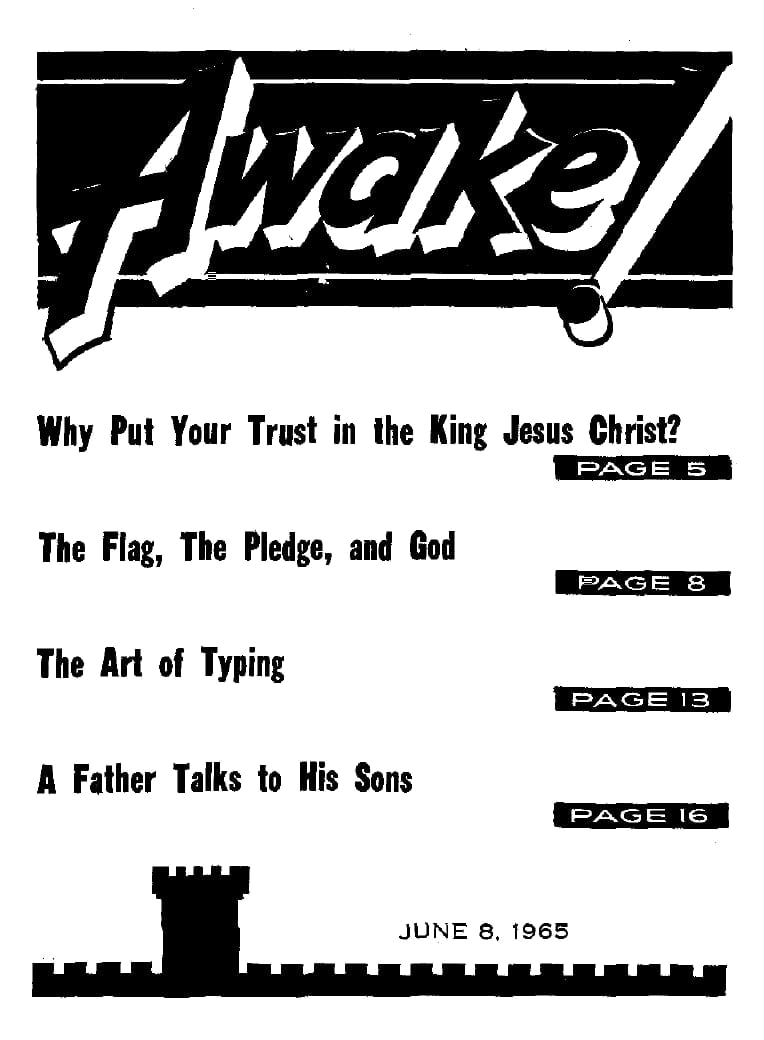
Why Put Your Trust in the King Jesus Christ? PAGE 5
The Flag, The Pledge, and God
PAGE 8
The Art of Typing
PAGE 13
A Father Talks to His Sons
PAGE 16
JUNE 8.1965
THE REASON FOR THIS MAGAZINE
News sources that are able to keep you awake to the vital issues of our times must be unfettered by censorship and selfish interests. "Awakel" has no fetters. It recognizes facts, faces facts, is free to publish facts. It is not bound by political ties; it is unhampered by traditional creeds. This magazine keeps itself free, that it may speak freely to you. But it does not abuse its freedom. It maintains integrity to truth.
The viewpoint of "Awakel" is not narrow, but is international. "Awakel" has its own correspondents in scores of nations. Its articles are read in many lands, in many languages, by millions of persons.
In every issue "Awake!" presents vital topics on which you should be informed. It features penetrating articles on social conditions and offers sound counsel for meeting
the problems of everyday life. Current news from every continent passes in quick review. Attention is focused on activities in the fields of government and commerce about which you should know. Straightforward discussions of religious issues alert you to matters of vital concern. Customs and people in many lands, the marvels of creation, practical sciences and points of human interest are all embraced in its coverage. "Awake!" provides wholesome, instructive reading for every member of the family.
"Awakel" pledges itself to righteous principles, to exposing hidden faes and subtle dangers, to championing freedom for all, to comforting mourners and strengthening those dishearmed by the failures of a delinquent world, reflecting sure hope for the establishment of God's righteous new order in this generation.
Get acquainted with "Awake!" Keep awake by reading "Awake!"
PUBLISHED SIMULTANEOUSLY IN THE UNITED STATES BY THE WATCHTOWER BIBLE AND TRACT SOCIETY OF NEW YORK, INC.
117 Adams Street Brooklyn, N.Y. 11201 U.S.A.
AND IN ENGLAND BY
WATCH TOWER BIBLE AND TRACT SOCIETY
Watch Tower House, The Ridgeway
London N.W. 7, England
N. H. Knorr, President
GRANT SURGE, Secretary
Printing this issue: 4,250,000
4d a copy (Australia, 5d; South Africa, 3½a)
Offence
Australia. 11, 17 Adelaide St. for burglary in edifice
Australia. 11, 18 Broadway St. for burglary in 1201
Now published in 26 languages
Sensitively—African, Ceylon, Ceylon-Vietnam, Dutch, English, French, French, German, Greek, Riccardo, Kullan, Luxembourg, Kovota, Norwegian, Portuguese, Spanish, Tanguy.
Tunisia, Tamil, Ciliegue, Hilippine-Vietnam, Malayalam, Polish, Tamil, Urkrainian.
CHANGES OF ADDRESS should reach us thirty days before your morning date. Give us your old and new address (additional address). Write Watch Tower, Watch Tower House, The Midway, Lawn N.W. 7, England.
Entered as second-class matter at Brooklyn, N.Y.
Printed in England
The Bible translation regularly used in "Awake!" is the New World Translation of the Holy Scriptures, 1961 edition. When other translations are used, this is clearly marked.
CONTENTS
Pursue Happiness Wisely 3
Why Put Your Trust in the King Jesus Christ? 5
The Flag, The Pledge, and God 8
The Art of Typing 13
A Father Talks to His Sons 16
A Look at Tokyo 20
Man's Losing Fight Against the Elements 24
"Your Word Is Truth"
"Jerusalem Will Be Trampled On"
—Which One? 27
Watching the World 29
Pursue Happiness Wisely
WHO does not want to be happy? The quest for happiness is one of the most widespread and earnest pursuits of man. Once he has assured himself of the bare necessities of life—food, clothing and shelter—man wants happiness.
Recognizing this deep-seated desire in man, the founding fathers of the United States republic, in their Declaration of Independence, stated: "We hold these truths self-evident, that all men are created equal, that they are endowed by their Creator with certain inalienable Rights, that among these are Life, Liberty and the pursuit of Happiness." Wisely, those men distinguished between happiness and the pursuit of happiness. They did not state that Happiness was an inalienable right as were Life and Liberty, but only the pursuit of Happiness was such a right.
All humans might be said to engage in this pursuit, yet how few realize their goal, happiness! Why? It could be because they pursue it too eagerly, or selfishly, or in a misguided way. In brief, it might be said that so many do not realize the happiness they pursue because they do not pursue it wisely.
The fact is that the more strenuously we pursue happiness the more elusive it becomes. If we reach out for it too eagerly,
it becomes a mere will-o-the-wisp. The ancient Greek philosophers known as the Epicureans might be cited as an example of the folly of pursuing happiness for its own sake. Their philosophy was that the purpose of life was its enjoyment; not necessarily alone in matters of food and drink, as do their counterparts in modern times; but also the enjoyment of the better things of life, such as friendships. But making selfish enjoyment an end in itself at last proved frustrating, as can be seen in the fact that so many of them in old age left this world by their own hand. Their living for pleasure had not brought them lasting happiness.
It may, therefore, be said that happiness is most likely to be realized as a byproduct of pursuing a wise course. In this, as in so many other matters that involve human conduct and activity, the inspired Word of God, the Holy Bible, sheds light on our paths. Thus it tells us that the possession of wisdom, which means the ability to apply knowledge in line with God's righteous principles, contributes to one's happiness: "Happy is the man that has found wisdom, and the man that gets discernment, for having it as gain is better than having silver . . . [and] gold itself. It is more precious than corals, and all other delights of yours cannot be made equal to it.
Length of days is in its right hand; in its left hand there are riches and glory. Its ways are ways of pleasantness, and all its roadways are peace. It is a tree of life to those taking hold of it, and those keeping fast hold of it are to be called happy." —Prov. 3:13-18.
Yes, man may have an inalienable right to pursue happiness, but he must pursue it wisely if he would realize it. He cannot follow a course of crass materialism, be motivated by the love of money, and expect to realize happiness. Concerning the folly of this course, the Holy Bible warns us: "Those who are determined to be rich fall into temptation and a snare and many senseless and hurtful desires, which plunge men into destruction and ruin. For the love of money is a root of all sorts of injurious things, and by reaching out for this love some have . . . stabbed themselves all over with many pains."—1 Tim. 6:9, 10.
However, pursuing happiness wisely requires not only having worthwhile goals but being modest in your ambitions and moderate in your striving. Otherwise, you may well be frustrated because of not realizing your goals, or not realizing them as soon as you would like, or you might find yourself paying such a high price as to make it a Pyrrhic victory, one not worth the price you had to pay for it. Remember, "wisdom is with the modest ones." (Prov. 11:2) There is no getting around it: 'It is a means of great gain, this godly devotion with self-sufficiency. For we have brought nothing into the world, and neither can we carry anything out. So having food and clothing, let us be content with these things.' How can you be happy if you are not even contented?—1 Tim. 6:6-8.
Today, more than ever before, men seek happiness by pursuing worldly pleasures. But the irony of that pursuit is that the
more you have the more you want. Self-indulgence does not result in happiness, any more than does heaping up mere worldly treasures. But wholesome, worthwhile pursuits can. Warmhearted, mature and intelligent families and groups of friends can spend an evening together, providing happiness for one another simply by sharing their acquired knowledge, their varied experiences and their appreciation of values. All such is pursuing happiness wisely.—Prov. 27:17.
But even here, in seeking the happiness that comes from bringing happiness to others, by sharing worthwhile things, we may not overlook the just rule, "All things, therefore, that you want men to do to you, you also must likewise do to them." If you are a married man, concentrate on making your own wife happy; do not compete with another man in trying to make his wife happy. Are you a wife? Then concentrate on making your own husband, not some other woman's husband, happy. It may not at the moment seem to be as exciting or interesting, but it is more likely to result in happiness!—Matt. 7:12.
In the final analysis, though, the greatest and most lasting happiness depends upon our relationship with our Maker, the great God Jehovah. Knowing and serving him are the most rewarding things we can do. As was prophetically written of our Exemplar in this regard, Jesus Christ: "To do your will, O my God, I have delighted." And as he showed in his Sermon on the Mount, those who are happy are those who are conscious of their spiritual need, the mild-tempered, the merciful, the pure in heart, the peaceable.—Ps. 40:8; Matt. 5:3-9.
So pursue happiness wisely; not selfishly, not too ambitiously, not too eagerly. In particular, let happiness come to you by reason of your love of God and neighbor!
Why Put Your Trust in
MANY milions of persons of this generation put their trust in Adolf Hitler, only to be bitterly disillusioned
Jesus Christ?
Others blindly put their hopes in Communist leaders, or in such dictators as Perón, Trujillo and Batista, only to regret it sadly. During World War II practically all the Western world put its trust in men who held out the hope of four freedoms for all: freedom of speech, freedom of worship, freedom from want and freedom from fear. But today there is less of such freedoms in the world than there was before World War II began, and again the hopes of men have been frustrated,
</div>
Who is this one? How does he differ from other rulers?
Why can you put your trust in this one, Jesus Christ? Because his Father, Jehovah God, has committed to him all power and authority "in heaven and on the earth." So there is just no limiting his ability to accomplish whatever he chooses. Further, there will never be any question about ending his rule because of his 'returning to his ground,' for though he died once, he is now 'living forever and ever.' No ordinary
even as was the hope that World War I would make the world safe for democracy.
Such has been the experience of men not only in modern times but ever since men began to look to human rulers and put their trust in them. How fitting therefore the counsel of the ancient inspired psalmist: "Do not put your trust in nobles, nor in the son of earthling man, to whom no salvation belongs. His spirit goes out, he goes back to his ground; in that day his thoughts do perish!"—Ps. 146:3, 4.
ruler is he, but the one of whom it is written, "the King of those who rule as kings and Lord of those who rule as lords, the one alone [of all such kings and lords] having immortality," and therefore not subject to death.—Matt. 28:18; Rev. 1:18; 1 Tim. 6:15, 16.
A ruler that will never die, endowed with all power and authority, might well cause us to fear, were it not for the fact that he excels as greatly in righteous principles and in unselfish love as he does in power and deathlessness. In striking con-
ruler in whom we can place our hope. And yet not really an exception, for today he is no mere "earthling man." He is one who, far from disillusioning those who put their trust in him, will far exceed mankind's fondest expectations. He is the God-appointed ruler of humankind, the one of whom it was foretold, "Indeed, in his name nations will hope." That one is Jesus Christ.—Matt. 12:21; Isa. 42:4, LXX.
trast with so many of the rulers of this world who exploit their subjects, this one loved his subjects so much that he impoverished himself, suffered and even died on their behalf. As he himself stated it: "The Son of man came, not to be ministered to, but to minister and to give his soul a ransom in exchange for many." Yes, as one of his followers tells us, this ruler, Jesus Christ, "emptied himself" of his existence in a Godlike form, "and took a slave's form and came to be in the likeness of men.
More than that, when he found himself in fashion as a man, he humbled himself and became obedient as far as death, yes, death on a torture stake." Could unselfish regard for one's subjects go any farther? Surely this is the King, the Ruler, in whom to put your trust!—Matt. 20:28; Phil. 2: 7, 8.
A Historical Character
Perhaps at this point someone will say, What a beautiful dream! If only it were true! But what proof is there that this Jesus Christ is truly the Son of God, that what the Bible says about him is true? Why, there are some that even deny that Jesus Christ is a historical character, that he ever existed.
But that should not surprise you. Rarely is a striking truth presented without one or more persons questioning it. As for doubling the very existence of Jesus Christ, only someone who has presupposed in his mind that there was no such person and who therefore turns a deaf ear to all the evidence available on Christ's being a historical character could hold such a position. In fact, it would be difficult to find any writing more saturated with prejudiced emotionalism than much of that which assays to prove that Jesus Christ is not a historical character.
In the first place, the four Gospels that record Jesus' life have all the earmarks of truth. They give evidence of having been written with the utmost candor, not even flattering the followers of Jesus, the very ones that recorded his life. If one were to doubt their record, he ought to ascribe a plausible motive for the writers' trying to foist such a hoax upon their fellowmen.
Not that proof of the fact of Jesus' existence depends solely upon the four Gospel accounts. No serious scholar of these matters will doubt for a moment that the apostle Paul wrote the letters to the Romans and the Corinthians as found in the Christian Greek Scriptures, and these leave no doubt as to the basic essentials of Jesus' existence. There is no question about the apostle Paul's being an intelligent man, nor about his sincerity. Well, he put such trust in Jesus Christ as the Son of God that he gave up a high position in the Jewish polity to become a bitterly persecuted follower of Jesus Christ.—2 Cor. 11:22-33; Gal. 1:13, 14.
More than that, there is the testimony of the early Talmudical accounts of Jesus, on the basis of which Klausner, a Jewish scholar, says in his Jesus of Nazareth: "It is unreasonable to question either the existence of Jesus (as certain scholars have done in the eighteenth century and in our own time) or his general character as it is depicted in the Gospels." And again, "To cast wholesale doubt on the historicity of the Synoptic Gospels becomes more impossible the more widely we study all the branches of Judaism during the period of the Second Temple."
There is also the reference by the Jewish historian Josephus in his Antiquities of the Jews, Book XX, chapter ix, paragraph 1, which tells that the high priest Ananus "assembled the sanhedrim of judges, and brought before them the brother of Jesus, who was called Christ, whose name was James," and which reference has never been challenged. Note also the testimony of the pagan Roman historian Tacitus, as found in his Annals, Book 15, paragraph 44. In telling of the persecution of the Christians, he, among other things, states: "The originator of the name, one Christus, had been executed in the reign of Tiberius by order of the Administrator Pontius Pilate." Clearly, to deny that Jesus actually existed is to "deny all historic reality," as scholar Klausner so well observes.
The Son of God
Of course, for us to put our trust in Jesus Christ he must not only be a historical character but truly be the one the Hebrew
prophets foretold, the Messiah, and be what he and his followers claimed for him, the Son of God. Was he the Son of God in a unique and direct sense, such as has
were in a boat and were threatened by a storm, "he rebuked the winds and the sea, and a great-calm set in," so that his disciples asked, "What sort of person is this, that even the winds and the sea obey him?" What sort of person? No mere son of Adam but the Son of God! On another occasion he raised from the dead his friend Lazarus,
ARTICLES IN THE NEXT ISSUE
Are Haunted Houses Hoaxes?
Transforming Deserts into Green Farms.
Making Mealtimes More Enjoyable.
not been true of anyone on earth before him or since he was on earth?—John 10: 29-39.
When You Drive, Look and See!
The answer to that question must be an unequivocal, Yes. Why? Because of the testimony of the Gospel writers, as well as of himself, which, as we have seen, bears all the carmarks of honesty and candor. Not only did his apostle Peter state to him, "You are the Christ, the Son of the living God," but Jesus himself said of himself: "I am God's Son."—Matt. 16:16; John 10:36.
Furred Acrobata of the Trestops.
That the apostle Peter knew whereof he spoke, and that Jesus was not to be charged with a vainglorious claim, is apparent from the miracles he was able to perform. Thus we read that early in his ministry "he went around throughout the whole of Galllee, teaching in their synagogues and preaching the good news of the kingdom and curing every sort of disease and every sort of infirmity among the people. . . . and they brought him all those faring badly, distressed with various diseases and torments, demon-possessed and epileptic and paralyzed persons, and he cured them." On one occasion when his disciples
who had been dead
four days.—Matt. 4:
23, 24; 8:23-27; John
11:1-44.
So there is every reason for you to put your trust in the King of kings, Jesus
Christ. Look to him to bring about righteous conditions upon the earth. He will bring forth justice to the nations, put an end to sickness, sorrow, pain and dying and cause God's will to be done upon earth as in heaven.—Isa. 42:1; Rev. 21:4; Matt. 6:10; Gen. 22:18; Gal. 3:16.
Putting your trust in him, however, means more than merely believing the foregoing evidence as true. You must exercise faith, that is, let faith move you to do something about it. As the disciple James points out, "faith without works is dead." Learn what God's will is for you by a study of his Word together with the helps God has provided in our day. Associate with others who are likewise desirous of knowing and doing God's will. And as you learn, act upon the knowledge gained, for, as Jesus said, "if you know these things, happy you are if you do them."—Jas. 2:26; John 13:17.
Putting your trust in the King Jesus Christ, you will never be disappointed but can look forward to realizing the blessings of his rule forever, even as promised you in God's Word: "The righteous themselves will possess the earth, and they will reside forever upon it."—Ps. 37:29.
WHEN General George Washington stood amidst his cold and embittered soldiers at Valley Forge, he said: "Some day men will think this liberty easy." But freedoms won have never been easy. Even those freedoms associated with the flag salute and the pledge of allegiance have been realized only after years of struggle and much sorrow.
panion magazine to arouse patriotism in the schools and emphasize the duties of citizenship. For the first time stress was placed on having the American flag wave over the nation's public schools. As the 400th anniversary of the discovery
The adoption of the flag of the United States was of slow growth. It was on June 14, 1777, that the Congress of the United States gave the flag official recognition. The flag then was composed of thirteen stripes and thirteen stars. To prevent the flag from becoming unwieldy with the addition of a stripe for each state, Congress, on July 4, 1818, passed a resolution proof America approached, the Companion staff conceived the idea of having Columbus Day, October 12, 1892, made a national holiday, by presidential proclamation. The program
viding that the stripes should remain thirteen in number in honor of the original states, and that new states should
planned on this occasion was to reach its climax in a salute to the flag, spoken in unison by schoolchildren.
Two members of the Companion staff, namely, Francis Bellamy and James B. Upham, allegedly wrote the pledge for the occasion. In its original form, it said:
"I pledge allegiance to my flag, and to the Republic for which it stands; one nation
On "Flag Day," June 14, 1943, just twenty-two years ago, the Supreme Court of the United States announced its historic decision, declaring the compulsory flag-salute laws invalid. It stated, "The flag salute may not be made compulsory for any civilian—man, woman or child—in the United States." Since that day more than 40 percent of the population of America has been born, many of whom have never heard of the Supreme Court's decision regarding the flag salute. Therefore, it seems fitting to review the events that led up to this milestone in American history.
be represented by stars. In 1960, with the addition of Hawaii, the stars reached their present number of 50.
In 1923 the words "my flag" were changed to
indivisible, with liberty and justice for all."
By presidential proclamation in 1916, June 14 has been set aside as Flag Day, an observance that since then has been celebrated throughout the United States.
The pledge of allegiance, however, dates back to 1892. In the early 1890's a campaign was conducted by the Youth's Com-
"the flag of the United States," and in 1924, the words "of America" were added. The pledge became popular. In 1907 the state of Kansas made the flag salute compulsory for public schoolchildren. Such regulations became common in many states in the years that followed.
Nationalism and Hysteria
With the rise of Adolf Hitler to power in Germany, a wave of patriotic hysteria swept the world.
During 1935 this patriotic zeal showed itself in a drive for the enforcement of State laws requiring students in all public schools to salute the American flag.
Because of widespread opposition, the 1935 drive for such laws resulted in a compulsory flag-salute statute in only one state—Massachusetts. But similar statutes had been previously passed in many states. In fact, in about half the states in America the flag salute was made a compulsory part of the public school curriculum.
When the 1935 drive stalled, attempts were made to secure the same results by an interpretation of existing laws, which, in many instances, required local boards of education or superintendents to provide a system of flag "exercises." In Pennsylvania, the attorney general construed a statute to permit local education boards in their discretion to compel teachers and pupils to submit to flag salutes on penalty of suspension.
Following the attorney general's opinion, pupils refusing to salute the flag were suspended in several districts. Similar suspensions were made from one end of the United States to the other. In Massachusetts, under the mandatory law passed in 1935, Carleton B. Nichols, an eight-year-old pupil, was suspended when he refused to salute the flag. A lower court refused a writ of mandamus, the prerogative writ to compel the School Board to reinstate the boy and fulfill its duty.
Religious Objection
In the majority if not all of these and previous cases, the ground for refusing to salute was religious. The pupils were sincere Christians. They had come from
families whose parents were Jehovan's witnesses. Like the early Christians, Jehovah's witnesses believe in obeying all human laws that do not conflict with God's laws. Saluting the flag is considered by the Witnesses to be a religious act in which they cannot conscientiously participate. They view the act to be a violation of the Second Commandment and of Christian scriptures warning against idolatry. (Ex. 20:4, 5; 1 John 5:21) Like the early Christians, their stand against the flag salute is little understood, as pointed out by the book The American Character, in the chapter "Unity and Liberty":
"Carlton Hayes pointed out long ago that the ritual of flag-worship and oath-taking in an American school is a religious observance. . . That these daily rituals are religious has been at last affirmed by the Supreme Court. . . To the overwhelming majority of the American people, the objections of the Witnesses were as unintelligible as the objections of the Christians to making a formal sacrifice to the Divine Emperor were to Trajan and Pliny."
The attitude of early Christians toward patriotic ceremonies is well recorded. For example, A History of Civilization, on page 137, says:
"To hold this motley collection of peoples in a common allegiance, to give them something like a national flag as a symbol of this unity, the emperor was defiled. . . . Simple rites of sacrifice to him were added to local religions and local rites. . . . The true Christian, then, could not bring himself to make what to an outsider was merely a decent gesture, like raising one's hat today when the flag goes by in a parade."
Also, the book Those About to Die by D. P. Mannix, on pages 135 and 137, states: "Christians . . . refused to sacrifice to the emperor's genius—roughly equivalent today to refusing to salute the flag or repeat the oath of allegiance."
Today Jehovah's witnesses, like those early Christians, maintain that to salute the flag is to perform an act of worship toward it. They hold that such devotion may be rendered only to the Supreme Being of the Universe, Jehovah God.
It might interest many Americans to know that the British do not generally salute their flag. It is to them merely a standard, the Royal Family receiving the honor bestowed on the symbol of Empire.
Persecution and the Court
A fierce controversy raged through the public school system of America in the 1930's and '40's because of the compulsory flag-salute statutes. Oftentimes the controversy was carried far beyond the schools and resulted in brutal mobbings, arson, and all other sorts of unlawful persecution, official and unofficial.
On June 8, 1940, the Supreme Court of the United States added fuel to the flames by shifting the responsibility for the enforcement or nonenforcement of the flag-salute regulations onto the individual school systems. As a result, many thousands of children were denied the right of a public school education. Terrible persecution of Jehovah's witnesses followed.
On June 1, 1940, seventy Witnesses in Odessa, Texas, were jailed and grilled through the night regarding their unwillingness to salute the flag. On June 2 all seventy were turned over to a mob of over a thousand, who chased and stoned them five miles down the railroad right-of-way. On June 22 a Witness was tarred and feathered in Parco, Wyoming. On June 29 seven of Jehovah's witnesses in Richwood, West Virginia, were forced to drink large amounts of castor oil, tied together with a police department rope and marched through and out of town. In August 1940 a Nebraska Witness was lured from his house, abducted and castrated. David R. Manwaring, professor of political science, in his book Render unto Caesar, says of this senseless persecution: "It became fashionable in many places to jail Witnesses on sight 'just in case.'" A survey by the National Office of the American Civil Liberties Union found that some 40 instances of mob violence in 44 states, involving about 1,500 men, women and children of Jehovah's witnesses, had taken place during 1940 alone. More than 9,000 arrests of Witnesses were recorded from 1940 to 1942.
Punishment was inflicted even on little children and their parents. In Grindstone, Pennsylvania, Stanley Brachna, age twelve, was knocked around by his teacher, thrown against a desk and struck. The teacher tried to force him to salute by holding up his hand. Anna Prinos, age thirteen, was whipped and choked by her principal. She was sent home with great welts on her back from beatings. There were instances where children were taken away from their parents and committed to institutions by the courts. The senseless brutality accomplished little but to thrust Jehovah's witnesses into the limelight. Their courage and integrity to Christian worship won for them many staunch admirers. In fact, no small number of their persecutors became Jehovah's witnesses as a result.
Persecution Backfired
In 1941 persecution against Jehovah's witnesses began to backfire. Newspaper editorials called for a halt to the persecution of innocent people. In its November 24, 1941, editorial, the Los Angeles Times said that
"this Flag-salute business has gone to absurd lengths and that it is time to call a halt. It is about time the State recognize that patriotism cannot be compelled by law."
The Open Forum, published by the Southern California Branch of the Civil Liberties Union, in its issue of December 13, 1941, stated:
"It is high time that we came to our senses regarding this matter of flags-saluting Jehovah's Witnesses are not disloyal Americans. In devotion to this country they exhibit as great interest certainly as the average American and probably greater. They are not given to law-breaking in general, but lead decent, orderly lives, contributing their share to the common good."
The American Civil Liberties Union then appealed to all Americans to stop the cruel persecutions directed against Jehovah's witnesses.
Historic Reversal
On June 8, 1942, three Supreme Court justices, Black, Douglas and Murphy, voluntarily took the unprecedented action of publicly declaring that they considered the 1940 "Gobitis" flag-salute case "wrongly decided." Shortly thereafter a United States District Court in West Virginia granted an injunction against the State Board of Education of West Virginia, prohibiting the enforcement of their compulsory flag-salute statute. The State appealed to the Supreme Court. Then on June 14, 1943, "Flag Day," the High Court handed down its opinion in the case. In a wellconsidered and exhaustive opinion, the Court by a vote of 6 to 3 reversed its former holding in the "Gobitis" case.* The final result is that those who have conscientious scruples against saluting the flag do not have to choose between violating their conscience and having their children deprived of their schooling.
The very fact that the Supreme Court picked Flag Day, June 14, to announce its historic reversal should be a sobering reminder to every American of the significance of this decision. This was no easy or small thing for the Court to do. For in the very midst of the second world war, the Court defended—indeed expanded upon—Constitutional freedoms. It did so despite the opposition of political authorities. It did so in behalf of an unpopular minority. And it did so in behalf of one of the most unpopular of freedoms—especially in wartime—the freedom NOT to salute the flag. By its unprecedented decision, the Supreme Court on this day, June 14, 1943,
reassured all Americans, minorities and majorities alike, that the rights for which the flag stands would be honored and protected by law.
On this same day—June 14, 1943—halfway around the world in Australia, a member of the British Commonwealth, something also very significant happened. After a two-and-a-half-year legal battle, the case Adelaide Company of Jehovah's Witnesses, Inc., v. The Commonwealth (67 C.L.R. 116, 124 [1943]) was heard in the High Court of Australia. On June 14, 1943, the Court gave a four-to-one victory to Jehovah's witnesses. The Court held that, although Jehovah's witnesses are not fervent nationalists, they are not to be deprived of their freedom. The Australian case, too, involved a reversal of the stand formerly taken by the government there. The Court ruled that Jehovah's witnesses were free to carry on their religious activity and that their work was not prejudicial to the official prosecution of the war.
A Need for Reflection
In the twenty-two years that have passed since then, a whole new generation has grown up, many of whom have never heard of this great struggle for freedom. The legal decisions of 1943 seem a long time ago. And, too, in this period many new legislators, educators and public officials have taken office. Their busy schedules may not have afforded them the opportunity to read law that dates back many years. Some of these officials may be tempted to coerce flag saluting.
In recent years, with the rise of nationalism throughout the world, there has been a noticeable crop of compulsory flag-salute laws reappearing in various states. In New York, North Dakota, New Jersey, Massachusetts and other states, officials have had to be reminded of the Supreme Court's flag decision and Constitutional law. Last year Governor Richard A.
Hughes of New Jersey wisely vetoed a bill designed to force all children in New Jersey public schools to participate in the salute to the flag and the pledge of allegiance. The bill was, on May 18, 1964, passed by the New Jersey Assembly 46-0. In his veto message, Governor Hughes said: "It ill becomes a state legislature to turn its back on the (Federal) Constitution by seeking to curtail anew the religious and civil liberties of those individual beliefs; however unorthodox, which are protected by the 1st and 14th amendments." The Massachusetts Senate, on March 15, 1965, rejected by one vote, 17-16, a bill meant to compel public schoolteachers and their pupils to pledge allegiance to the flag daily, contrary to Constitutional guarantees.
Official Control versus Free Will
The flag-salute struggle of twenty years ago culminated in what Time magazine considered a victory for religious freedom. It was a victory for freedom of conscience for all Americans, which no legislator should want to spurn or bypass. The popular American Protestant journal the Christian Century, in a favorable editorial, stated that Supreme Court Justice Jackson's freedom-of-conscience passage "should become part of the 'American Scriptures,' to be memorized and taken to heart by every patriot." A few choice sentences from Justice Jackson's opinion, which he wrote for the majority in 1943, as well as a brief expression by Justice Black, are set out below. The thoughts therein are worthy of our serious consideration. Justice Black wrote:
"Words uttered under coercion are proof of loyalty to nothing but self-interest. Love of country must spring from willing hearts and free minds . . . [and] neither our domestic tranquility in peace nor our martial effort in war depends on compelling little children to participate in a ceremony which
ends in nothing for them but a fear of spiritual condemnation."
Justice Jackson concluded as follows:
"We think the action of the local authorities in compelling the flag salute and pledge transcends constitutional limitations on their power and invades the sphere of intellect and spirit which it is the purpose of the First Amendment . . . to reserve from all official control."
"To believe that patriotism will not flourish if patriotic ceremonies are voluntary and spontaneous instead of a compulsory routine is to make an unflattering estimate of the appeal of our institutions to free minds. . . freedom to differ is not limited to things that do not matter much. That would be a mere shadow of freedom. The test of its substance is the right to differ as to things that touch the heart of the existing order. If there is any fixed star in our constitutional constellation, it is that no official, high or petty, can prescribe what shall be orthodox in politics, nationalism, religion, or other matters of opinion or force citizens to confess by word or act their faith there-in."
Concerning this fight for freedom, Professor Manwaring observed: "The legal battle over the compulsory flag salute was exclusively a Jehovah's Witness fight." But the victory is one for all Americans. With this thought in mind the American Bar Association (in its Bill of Rights Review, the 1942 summer edition) commended Jehovah's witnesses for their courageous stand for Constitutional rights during those most trying years. For it took eight long years, with six trips to the Supreme Court, plus the changing of minds of a requisite number of justices, to reach the desired end. Little wonder that A. L. Wirin, attorney for the American Civil Liberties Union, said: "In the field of religious freedom, guaranteed by the First Amendment to the United States Constitution, no group in the nation has rendered a greater service" than Jehovah's witnesses.
While the right of all Americans to freedom of conscience has been strengthened by the 1943 Supreme Court's decision, yet, as Thomas Jefferson declared, "eternal vigilance is the price of liberty."
The Art of TYPING
By "Awake!" correspondent in Uruguay
HAVE you ever received a handwritten letter that had so many illegible words in it that you had to guess at what the writer was trying to tell you? In business affairs such a letter could cause costly misunderstandings. Perhaps you felt like telling the person: "Please learn to type!"
Typing is an art that is not difficult to learn, and it makes an immense difference in the legibility and neatness of your correspondence. Writing is a form of communication, but if you cannot make yourself understood, you defeat your purpose in writing. Mastering the art of typing is worth the effort it takes. You would find it to be of great value to you not only when writing personal correspondence to friends but also when communicating with businessmen, when applying for a job, when seeking information, and so forth. There are many occasions when you would find knowledge of the art of typing valuable. Then too it is much faster than hand-writing. A letter can be written on a typewriter in a fraction of the time it takes to do it by hand.
minds of some clever inventors.
World affairs would be seriously crippled without typewriters. Business establishments, governmental offices, educational institutions, writers of newspapers and magazines and many others would be lost without it. Yet it was not so long ago that a writing machine was nothing more than an idea in the
The earliest record of a writing machine is in the British Patent Office, which received a patent application for one in 1714. Later, in 1808, an Italian inventor developed one for an Italian countess who was blind. It helped her to carry on her correspondence as well as being a source of enjoyment for her. It was in 1856 that a writing machine was developed that had the familiar basket-like arrangement of type that is basic in the design of most modern machines, but it was not until 1873 that the first of the commercially successful machines began to appear. From then down to the present time a great number of typewriter models have been produced, with constant improvements changing them gradually into the neat, smoothly operating models we have today.
Learn the Art
Notwithstanding the important role typewriters play in modern living, there are many people who do not know how to type. They may have never had the opportunity to learn this valuable art. If you are one of these and can afford to buy a typewriter, you might find it advantageous to do so. With regular practice, you can quickly learn the art.
There are many helpful instruction booklets that explain how to master the keyboard of a typewriter, and by following their instructions and practicing on a typewriter, you can soon learn to type rapidly without looking at the keys. It is to your advantage to learn the right way to type. Using two fingers or keeping your eyes shifting between your copy and the keyboard establishes a habit that will be difficult to break when you want greater efficiency.
When you see a stenographer typing speedily, she is not thinking about what keys to strike, any more than a musician thinks about what keys he should strike on a piano.
The art of typing depends to a great extent upon habit. Cultivate the right habit in the beginning and you will find that with practice you will be able to type rapidly without giving any thought to the keyboard. Your fingers will automatically locate the correct keys. In fact, if you begin thinking about which keys to press, your typing speed will most likely slow down and you will begin to make
more errors than usual.
The touch method of typing makes use of all your fingers. This, of course, contributes measurably to the great speed of writing that is possible on a
time he will find that he is giving less and less thought to these keys. Habit takes over, causing his fingers to move automatically to their assigned keys. But more is required than knowing the keyboard.
An expert typist will tell you that the secret of good typing is a continuous, even rhythm. This is what you should strive for from the beginning rather than speed. Speed will increase naturally as your ability improves, but rhythm must be consciously cultivated. Once you have made
typewriter. Ten fingers properly located on a keyboard can press more keys in a given space of time than two fingers that must move all over the keyboard. Learning the ten-finger touch technique may seem to be a bit slow at first, but with practice your speed will improve as you become more familiar with the location of the letters on the keyboard.
The essential feature of the touch system is the home keys. These are the keys upon which your fingers rest most of the time. Each finger has a certain home key assigned to it in the second from the bottom row of keys. From these home keys they move to assigned keys in the other rows. By learning what keys are assigned to each finger, a person can soon, with practice, establish the proper typing habit. In
it part of your typing technique, you will turn out more and better work than the person who has an irregular rhythm.
ing at the keyboard or at the paper upon which you are typing. This can become a bad habit that will break your typing rhythm, increase the number of your errors and slow down your typing. Each time you glance away from what you are copying, you run the chance of picking up the wrong word or line when looking back at the copy. Sometimes you may even have to stop to locate where you were on the page. So learn from the beginning to keep your eyes on what you are copying. If you are composing a letter on the typewriter, keep your eyes on what you are writing rather than on the keyboard.
It is important to resist the temptation to keep glanc-
Quality
The quality of the work you turn out with a typewriter depends upon a number of things. If you strike the keys with uneven pressure, you will have some letters that will be light and others dark.
An electric typewriter, of course, eliminates that problem. Also, if your machine is not in proper alignment, it will produce a ragged line, with some letters high and others low, some too close and others too far apart. A typewriter expert in Uruguay can tell at a glance whether a typewriter is in alignment by writing the line: "Amaranath sasesusos Oronoco initiation secedes Uruguay Philadelphia."
Even the inked ribbon can affect the quality of typewritten work. An inferior ribbon, such as one made of a poor grade of cotton, will not give a clean imprint but will cause the open spaces in such letters as "e" and "o" to fill in. If a cotton ribbon is used, make certain that it is made of only the best grade of cotton. A much superior, but more expensive, ribbon is made of silk or nylon. It will give cleaner impressions with sharper letters than cotton and last much longer.
What to Do with Errors
Learning the art of typing includes learning how to correct errors. Being imperfect, you are certain to make some errors that spoil what you have done. Rather than retype it all, you can correct the errors, if they are not extensive, without noticeably affecting the appearance of your work. Erasing, however, should be kept to a minimum, and it should not be done with a vigorous rubbing of the eraser. Short, gentle strokes in one direction should be used to avoid leaving an unsightly spot on the paper. In some instances the entire mistake does not need to be erased.
Suppose an "s" was struck instead of an "e." Rather than removing the entire letter, you need only to erase the sides of the "s," leaving the top and bottom curves and the center crossbar. An "e" will now fit beautifully on top of the "s" with hardly any indication of a correction. Now let us say that a "c" is struck when it should have been a "d" or an "o." After first lightening the letter a little by gentle strokes with an eraser, a "d" or an "o" can be superimposed on it, and the error will go unnoticed. In case an "i" is printed instead of a "t," very little needs to be done to correct the mistake. Take a razor blade and lightly scrape away the left-hand foot of the "i." The "t" will then superimpose on the "i," neatly hiding the mistake. There are a number of other ways to correct typing errors, and these can be learned with experience.
Erasure dust can become a troublesome thing if it is allowed to fall into the mechanism of a typewriter. It can cause improper operation of some of the many moving parts in the machine. Instead of erasing where the type strikes the roller or platen, move the carriage to one side as far as it will go, and then erase errors there so that the eraser dust falls outside the machine. The cleaner a typewriter is kept, the fewer repair bills you will have.
No matter whether you are a student in school, a housewife, a businessman or a common laborer, the art of typing can prove to be of great value to you. Because we live in a world in which writing plays an important part in everyday living, there are many occasions in which a knowledge of this art can be put to good use. The art of typing can be a great aid to anyone who wants his written communications to be neat in appearance and easy to read.
A Father
place is like a baby's cradle, you might say, because the baby lies smugly inside it for about nine months.
TALKS TO HIS SONS
</div>
"DADDY, why can't they bring the baby right to our house? Did Mommy have to go to the hospital for it?" asks five-year-old Bobby. This and other simple inquiries often dumbfound
parents of our modern age. What are we to say? they ask. How can we talk about sex and procreation to these little folks? For an answer, consider, for example, how a Christian father might discuss such matters with his boys.
"Bring your Bible, Bobby, and let's see if we can find an answer to your question."
While Bobby runs for his Bible, father invites his older boy, John, to sit in on the discussion. When Bobby comes back, his father opens the Bible and says: "Here is what the Bible book of Psalms [139:1, 13, 14] says about a baby inside its mother: 'O Jehovah, you have searched through me, and you know me. For you yourself produced my kidneys; you kept me screened off in the belly of my mother. I shall laud you because in a fear-inspiring way I am wonderfully made.'"
"Does that mean God makes the baby grow in Mommy's tummy?" asks wideeyed Bobby.
"No, not her stomach, Bobby, but in another place near her tummy. You see, every mother has a special place in her body, wonderfully made by God, where a new baby starts from a very tiny beginning and is protected as it keeps growing. This
After that it is big enough, so it is time for the baby to be born."
"Is that why Mommy was so fat when she left?" inquires Bobby.
"That's right. When the baby is tiny, the place where it grows is small like a balloon without any
air in it. Then as the baby gets bigger, this area stretches just like a balloon when you blow it up. But because Jehovah God arranged this wonderful miracle of birth, the place 'where the baby grows can stretch and stretch and it does not break. In the beginning it is about the size of a pear, but right before the baby is born, it is almost as big as a watermelon."
"But how does the baby get out of Mommy?" asks Bobby.
"When the baby can eat and breathe by itself it comes out of its mother through a special opening between the mother's legs. You came out of your Mommy in the same way."
"But, Daddy, how does the baby see when it is still inside Mommy, and how does it get something to eat when it is hungry?" asks Bobby with a puzzled look.
"At that stage the baby does not have to see—not until it comes out and is separated from its mother. And while the baby is inside the mother, the Creator arranged that it would be well fed through a tube or cord."
"Do you mean a cord like a string?"
as your finger and maybe twenty inches long. One end of the cord joins the baby's little tummy to its mother, and through this cord it receives the food that makes it grow. When it is born the cord is cut close to the baby's tummy, and the baby can then begin to receive milk through its own little mouth."
"Did I have a cord like that, Daddy?"
"Yes, Bobby, you did, but now all that is left is the mark in the middle of your tummy where the cord was attached."
"Oh, I think I understand now, Dad."
"Good, but you will find that other questions will come up about these things from time to time; and when they do, never hesitate to ask me. Now, why don't you go outside to play?"
"All right, Dad. Thanks."
"One thing I've often wondered about, Dad," says twelve-year-old John. "Why is sex such a hush-hush matter, and why do so many treat it as if it were a shameful thing even to talk about?"
"I'm glad you raised this point, John. It is true that there is quite a lot of confusion about how to view sex, but this is largely because people fail to consider seriously what God's Word, the Bible, has to say on the subject. There is nothing dishonorable about sex and the sex organs of man and woman. The wrong comes when sex relations between people are not in harmony with God's rules."
"So there is nothing shameful about sex when God's rules are obeyed?" asks John.
bed be without defilement,ror God will judge fornicators and adulterers.'"
"That's right. Now, let's go to the Bible and we will see how honorable this divine arrangement is. Read Hebrews 13:4, Johnny."
"So you see, Johnny, this is a very honorable arrangement that God made. It is sacred. But fornicators defile it, making it lose its purity and cleanness. Fornicators are people, men or women, who have sex relations outside of marriage, against God's rules. Those who do not live by his rules regarding sex will be judged adversely. Now turn to the apostle Paul's words at First Corinthians, chapter 7, verse two, and we read: 'Let each man have his own wife and each woman have her own husband.' This agrees with God's original purpose when he brought Eve to Adam to be his helper. Notice here at Genesis, chapter 2, verse 24, where it says: 'That is why a man will leave his father and his mother and he must stick to his wife and they must become one flesh.' From these texts we see that it's God's will for a man and his wife to stick together and to have sex relations with each other and with nobody else.'
"Here it is, Dad. It says: 'Let marriage be honorable among all, and the marriage
"Dad, maybe I'm dumb, but there is something I don't understand."
"What is that, Johnny?"
"Well, just what do you mean by sex relations?"
"This refers to an expression of love between a husband and his wife. It is a time when a husband and his wife are very close together, away from other people, and they feel very much in love with each other. It is during this time of very deep love that the husband lies close to his wife so that his male organ fits naturally into her birth canal. The husband's male sex cells go out of his body through his male organ right into his wife's birth canal. These sex cells move through the canal, and if an egg cell is there in the wife, one of her husband's male cells joins with her egg cell and it begins to grow into a baby inside the mother."
"Oh, now I understand. But, Dad, since this arrangement of God is honorable, why does it say that Adam and Eve were ashamed because of being naked after they ate the forbidden fruit?"
"The nakedness they felt was like the guilty feeling we might get if we do something wrong. But before Adam and Eve sinned, they were not ashamed, as Genesis 2:25 says: 'Both of them continued to be naked, the man and his wife, and yet they did not become ashamed.' So you see, Johnny, Jehovah God did not make any part of the human body shameful, Some internal parts of our body, such as our lungs and liver, may not seem so pretty to us, but all of our outward parts, including the sex organs, are honorable and not lacking in beauty."
"Then why do we feel ashamed when we go naked?"
"That's because Adam and Eve disobeyed God and so sin entered the world, and along with sin, immoral passion or wrong sex desire. As a result, self-respecting persons feel a measure of shame at having their private parts exposed to the view of outsiders. In fact, the Bible calls the sex organs of man and woman 'private parts.' For instance, let's read here at Exodus 20:26. You can read this, Johnny."
"It says: 'You must not go up by steps to my altar, that your private parts may not be exposed upon it.'"
manded the Israelites to destroy those wicked nations in Palestine."
"But why does God have all these rules about the sex organs?" asks John intently.
"Yes; so the sex organs are private to ourselves and to our marriage mate when we are married. They are not for display or to use by anyone else. In fact, God considers all improper use of the sex organs as unclean. It was because of fornication and other bad practices that God com-
"Because God intended for married humans to use them to multiply and bring forth children and populate the earth. Notice what God said here to Adam and Eve at Genesis 1:28: 'Be fruitful and become many and fill the earth.' So God gave man and woman organs to accomplish this holy purpose within marriage. This is why, as you grow older, changes take place in your body. When a boy becomes old enough to be a father, then the sex organs grow larger and begin to secrete a fluid called semen. It's a heavier fluid than water and, although there is not much of it, it contains a great number of tiny cells, any one of which can fertilize the egg and make it grow into a baby. So when married persons have sex relations, these tiny cells, too small to see, swim through the mother's birth canal until one of them finds the egg and unites with it. Then the egg starts to grow and becomes a baby, as I've explained before. So you see, God made the sex organs for a sacred purpose, that of passing on life. That is why they are not playthings. That is why they must be used according to God's rules."
"So God has rules on sex because of babies?"
"Yes, Johnny, that's one of the main reasons. God has rules on sex because he intended that every baby brought into the world should have both a mother and a father who would take all the responsibility of raising that child."
"That's a lot of responsibility!"
"Yes, indeed. So, what if you used the sex organs for a wrong purpose? What if you started a new life through misuse of them? You could ruin the life of a girl and ruin the life of a baby. Moreover, how could a young boy with no job and no home of his own take on the responsibility of providing for a family?
A father not only has to have a job and be financially able to support a family but he must have the maturity to be able to spend money wisely and to make the major decisions of family life. But, above all, if the sex organs are used for a wrong purpose, it means disobeying God's laws, and he will judge fornicators, as we read in the Bible."
"I see now why God has rules about sex. But, Dad, now that I understand sex better, do you think it is right to talk about such matters, say among the boys at school?"
"No, I don't. You see, it is a very personal and private matter that you would not want to discuss with just anyone, unless, of course, someone specifically asked you what the Bible teaches on such and such a subject. It is always proper to answer Bible questions. But when it comes to the matter of trying to learn something about sex and marriage, it is best that you learn it at home and not from schoolmates. I say this because so many persons today misuse the sex organs and have a corrupted view of the matter, and their minds are 'in the gutter,' as the expression goes. With so many people not loving God and not being governed by his laws on sex, it is best to keep such discussion in the home as we are doing now until you are much older."
"Dad, I have another question. Sometimes at school or after school I see boys and girls hug and kiss one another. Is it all right for a boy and a girl who like each other to do this?"
"That is not really a wise thing for unmarried persons to do, and I will tell you why. If a boy kisses a girl when none of their parents are present, and the kissing goes on for some time, he is rousing his
own sexual desire and hers. He is making love. He has embarked on the first steps of sexual expression that lead ultimately, as God intended, to sex relations. The path is just that direct. It is an old path, well marked by the experience of millions. Moreover, it is a good path. But the question for you is. When are you entitled to travel it? Not until you are married. But if you are with a girl privately and you keep on kissing, there comes a time when it is almost impossible to put on the brakes. It is even harder than eating just one potato chip out of a bowlful and then stopping right there and then with one chip. You want to eat more, and so it is with sexual desire. Maybe you will say you will never get that far, but once the nervous system is excited, it is difficult to reason. So if you cannot travel the normal path of satisfaction, then why begin travelling a course that could only lead to trouble? Even when a couple is engaged to be married, it is not advisable to become too familiar, for certain privileges are only for those who are married. So until that time, it is better to wait."
"But what about just taking a girl out someplace to get acquainted, as some of the older boys do?"
"Anytime you want to get better acquainted with a girl who loves God and his laws, you are welcome to come to the house. It is far better to bring her here when we are home than to take her out alone the way some boys do. So anytime you want to bring a friend home, mother and I will be glad to have you do that, rather than going out alone together."
"Thanks, Dad, you've helped me to solve a lot of little problems that I thought were quite big."
"I'm really pleased we've had this chat, Johnny, and anytime there is something you want to know I am always glad to answer whatever questions you may have."
you moderns call a "jet." This is a new word to me.
Monday: I am awakened by a charming young lady. She is wearing a kimono —rather modernistic I feel, and her dialect is quaint, too, but I can understand. She offers me yokam and manju, along with a tasty blend of green
shimataro.* He was absent on his tortoise for 700 years. But I have returned after only 300 years, and what a surprise it has been for me, an old samurai, to come back to Edo and find my village transformed into a hustling, bustling metropolis of steel and concrete—this modern giant that they call Tokyo!
You know, I was one of
tea. So far, so good. I feel I am in a world I can understand. I look at my traveling companions, both Japanese and highnosed foreigners, and all of them dressed foreignstyle. How has this come about? My Shogun lord distinctly ordered our people to cut themselves off completely from every contact with the outside
the samurai from Mikawa. As a young man I fought in the battle of Sekigaha-
ra, and then when my master Ieyasu, the first of the Tokugawas, moved the capital from Kyoto to Tokyo, I began to serve as one of the personal guards of the Shogun, the military ruler of the land. There were about 80,000 of us to keep law and order around Edo, and how we men of the two swords loved to boast of our exploits, 'cutting the wind with our shoulders' as we strutted through the village streets! Yes,
…