Awake!, April 22, 1965
Download: PDF — Awake!, April 22, 1965
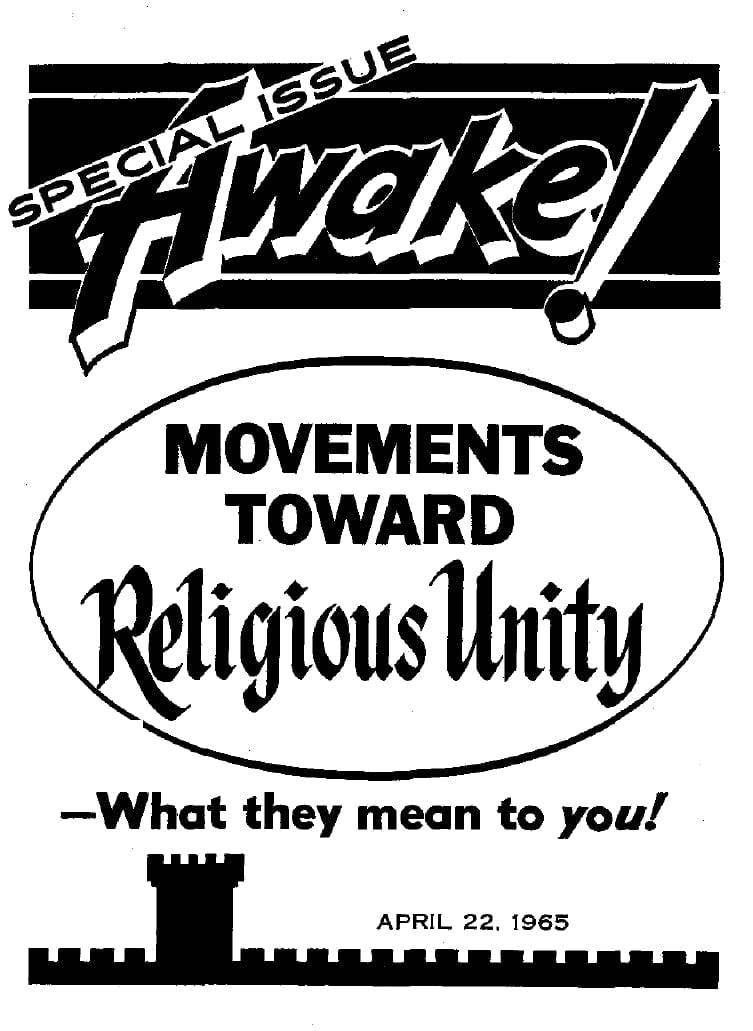
Awake!
MOVEMENTS TOWARD Religious Unity
</div>
APRIL 22, 1965
THE REASON FOR THIS MAGAZINE
News sources that are able to keep you awake to the vital issues of our times must be unfettered by censorship and selfish interests. "Awake!" has no fetters. It recognizes facts, faces facts, is free to publish facts. It is not bound by political ties; it is unharmed by traditional creeds. This magazine keeps itself free, that it may speak freely to you. But it does not abuse its freedom. It maintains integrity to truth.
The viewpoint of "Awake!" is not narrow, but is international. "Awake!" has its own correspondents in scores of nations. Its articles are read in many lands, in many languages, by millions of persons.
In every issue "Awakel" presents vital topics on which you should be informed. It features penetrating articles on social conditions and offers sound counsel for meeting the problems of everyday life. Current news from every continent passes in quick review. Attention is focused on activities in the fields of government and commerce about which you should know. Straightforward discussions of religious issues alert you to matters of vital concern. Customs and people in many lands, the marvels of creation, practical sciences and points of human interest are all embraced in its coverage. "Awakel" provides wholesome, instructive reading for every member of the family.
"Awakel" pledges itself to righteous principles, to exposing hidden foes and subtle dangers, to championing freedom for all, to comforting mourners and strengthening those disheartened by the failures of a delinquent world, reflecting sure hope for the establishment of God's righteous new order in this generation.
Get acquainted with "Awake! " Keep awake by reading "Awake! "
PUBLISHED SIMULATOUGH IN THE UNITED STATES BY THE
WATCHTOWER BIBLE AND TRACT SOCIETY OF NEW YORK, INC.
117 Adams Street
AND IN ENGLAND, N.Y. 11201, U.S.A.
WATCH TOWER BIBLE AND TRACT SOCIETY
Watch Tower House, The Ridgeway
N. H. KNORA, President
GRANT SCHOOL, Secretary
Printing this issue: 4,250,000
4d a copy (Australia, 5d; South Africa, 3 1/2c)
CARLISLE, CA University of California, Carlisle Years subscription rates
@ offices for semi-collaborations only
Australia, U.S., 117 Avenue Street, Carlisle, 11201 U.S.
Australia, 11 Newland Bd., Stirkhill, N.S.W. 8/$
Canada, 160 Bridgeway Ave, Toronto, 19 U.S.
Newbridge, London, N.W. 7 7/$
New Zealand, 933 New North Bd., Auckland, B.W. 1, 7/$
(Similarly subscription cost) shall the above rates.)
Ritamitans for subscriptions should be sent to the office
Ritamitans for subscriptions should be sent your remittance to Brooklyn
Rules of expiration should be at least seven days before
subscription expires
Now published in 26 languages
Smolenniy - Artkass, Civ.-Vlasan, Danish, Dutch, English, Finnish, German, Greek, Danoan, Italian, Japanese, Norwegian, Portuguese, Spanish, Swahili, Monthly - Chilmas, Claymas, Hillargas-Vlasan, Malagol, Polish, Tir, Ukranian.
CHANGES OF ADDRESS should reach an thirty day before your moving date. Give us your old and new address. Call 212-555-1234. Visit Watche Tower, Watche Tower House, The Ridgeway, London W. W. 7, England.
Entered as second-class matter at Brooklyn, N.Y.
Printed in England
The Bible translation regularly used in "Anavilah" is the New World Translation of the Holy Scriptures, 1961 edition. When other translations are used, this is clearly marked.
CONTENTS
The Importance of Your Worship 3
Christendom Seeks to Unite 4
Christendom Seeks Unity with the Nonchristian World 8
Religion That Is Willing to Compromise 12
Worshipers Who Would Not Compromise 16
Godly Attitude Toward People
of Other Religions 20
International Unification Now Under
Way 23
Narrow Is the Gate 28
Watching the World 30
The Importance of Your Worship
IT IS a well-established fact that all civilizations of mankind have practiced some form of worship. Although individuals may be atheists, never has a society of people been, in the strict sense of the word, atheistic. But why is it that most humans consider religion necessary?
George Washington, the first president of the United States of America, gave an interesting answer. "Religion is as necessary to reason as reason is to religion," he said. "The one cannot exist without the other. A reasoning being would lose his reason, in attempting to account for the great phenomena of nature, had he not a Supreme Being to refer to."
However, when humans become unreasonable and deny that there is a need to worship God, serious troubles result. In fact, one doctor associated with the University of Vienna said: "Modern suppression of our need for religion creates much of the frustration and tension in this atomendangored world. It kills our chance of leading happy, purposeful lives."
Yes, worship of God is vital, for it brings man close to his Maker, giving him a sense of security and purpose. In appreciation of
this the eminent statesman Daniel Webster once said: "Religion, therefore, is a necessary, indispensable element in any great human character. There is no living without it. Religion is the tie that connects man with his Creator, and holds him to his throne. If that tie is sundered or broken, he floats away a worthless atom in the universe."
Since religion represents your relationship with God, it should not be taken lightly. You should know its basis. This means that you should also know something about the current proposals to merge various religious organizations. Do you know what is required in order to unite the major religious bodies? And have you considered how these movements toward religious unity affect your worship?
Will they mean, for instance, that the beliefs you cherish are going to be compromised? And if beliefs to which you adhere are going to be altered, does that mean they were never true anyway? Would early Christians have been willing to compromise their teachings for the sake of religious unity? Can the desired unity be obtained in any other way? These questions vitally affect your life and happiness, so it is important that you give them due consideration.
"DISUNITY in the name of Christ is a scandal and a shame," lamented Time magazine. That sentiment is not new, but has been expressed by many for a long time as they see the devastating effect disunity has had on the cause of professed Christians.
This negative effect was noted by an Australian clergyman who recently stated: "We cannot reprove the sin of the world and cannot logically appeal for reconciliation among nations and races in the world when we Christians ourselves are divided." He added that "disunity becomes an even greater scandal in Overseas Missions," where competition between churches is fierce.
Catholic priest J. A. O'Brien confirmed this when he said: "The divided character of Christianity is so evident, even to the primitive peoples of New Guinea, that they have recently requested its competing emissaries to stay out. 'The ex-cannibals of the world,' says British Congregational
clergyman, the Rev. Cecil Northcott, 'are teaching us a Christian lesson: Can we not cease to be canibals among ourselves? Instead of eating together at the common table, we tend to eat one another in a kind of blasphemous competition.' 18
So extensive has this disunity become that one authority estimates there are over 270 different religions in the United States alone 13
How It Got That Way
The disintegration began soon after the death of the last apostle in the first century. Men arose in the Christian organization who were more interested in their own ideas and ways than in maintaining the truths and unity Jesus Christ initiated.
The first major split began in the fourth century, when, for all practical purposes, the Roman Empire was divided into two parts, one in the West with its center at Rome and the other in the East, governed from Constantinople (Byzantium). The churches in one part began to drift away from the churches in the other part, the Roman being influenced by Latin customs and law, the Eastern by Greek and Byzantine culture. The final, formal split came in the year 1054, when the pope of Rome, Leo IX, excommunicated the patriarch of Constantinople. The patriarch retaliated by denouncing the dogma of the Roman church as heresy.
There were further divisions in the Eastern Church, but even more in the West, where schisms that began about the twelfth century culminated in the Protestant Reformation some 400 years later. This speeded up the process of disintegration, and it has continued down to our century, resulting in the shattering of Christendom into hundreds of different religions.
There were many reasons for this proliferation of religions. The desire for political power, especially on the part of the Roman church, alienated some. The claim of primacy by the popes of Rome offended others, as did church corruption. Doctrinal differences spurred the dividing. Splinter groups were even formed due to very minor disagreements over words and ritual.
Religious persecutions and wars widened the breach, particularly the Thirty Years' War fought between Catholics and Protestants from 1618 to 1648. This violence and persecution, perpetrated by Catholics and Reformers alike, further alienated one religion from another.
Not the least of all causes of religious disunity was the cleavage caused by nationalism. Churches took on the flavor of the nation they were in, and even those of the same denomination butchered one another in time of war, just because their nationality was different.
Thus, the differences of doctrine, procedure, organization, nationality, also social and money differences, in addition to the division permitted in the churches due to skin color, completed the shredding of Christendom until it was far removed from the unity of truth and practice taught by Jesus Christ.
Efforts to Achieve Religious Union
Before the twentieth century, all efforts to bridge the gap between the major religions of Christendom failed. A notable attempt among Catholics was that of 1438 and 1439, when Pope Eugenius IV met with Patriarch Josephus II of the Eastern Church in an effort to terminate the centuries-old division; but the endeavor ended in dismal failure.
Few efforts toward unity among Protestants made progress until 1910. In that year the first major step toward some sort of union was taken at the Edinburgh, Scotland, Missionary Conference. One hundred and sixty religious bodies sent representatives to study and coordinate missionary activities. From that conference sprang three streams of activity. One was the formation of the International Missionary Council for cooperation in the missionary field. Another stream led to the Universal Christian Conference on Life and Work in Stockholm, 1925, which was concerned with the application of Christianity to social, economic and political life. The third stream was the World Conference on Faith and Order, first held at Lausanne, Switzerland, in 1927, concerned with theological and ecclesiastical questions.
From the conferences on "Life and Work," and "Faith and Order," the idea of a World Council of Churches originated. This Council was formally constituted on August 23, 1948, when representatives of 148 religious groups met at Amsterdam. Not included were the Roman Catholic Church and Orthodox churches under Russian influence, as well as many fundamentalist groups. This World Council, with headquarters in Geneva, was not a merger of church members, but was more a platform for conversation about church issues. In 1961, at New Delhi, India, twenty-two new religious groups, including Russian Orthodox, were admitted, increasing the membership to nearly 200, with parishioners totaling approximately 300,000,000. The most important result at New Delhi was the vote to unite the International Missionary Council with the World Council. Thus the three main streams of Protestant activity resulting from the Edinburgh Missionary Conference of 1910 finally met and merged. It was hailed as being of almost equal importance to the Reformation of the sixteenth century. But it did not represent real unity in worship.
Similar bridges toward unity have been built on a national level. For example, in the Philippine Islands, an important union of non-Roman Catholic churches took place in 1963, when seven denominations with a membership of about four million joined in the National Council of Churches in the Philippines.4 And similarly, in the United States, the National Council of the Churches of Christ in the U.S.A.
was formed in 1950, coordinating many of the activities of over 30 Protestant and Orthodox denominations, representing some 40,000,000 church members,5 though they do not all believe the same things.
Mergers of individual religions have also taken place. One occurred in 1925, when Presbyterian, Methodists and Congregationalists combined to form the United Church of Canada. In 1929 various Presbyterian churches merged with the Established Church of Scotland. And in 1939 a number of evangelical churches united to make up the Reformed Church of France.6
After World War II a fusion took place in India, when, in 1947, the Anglican, Congregational, Methodist and Presbyterian churches combined to form the Church of South India. 4
In Africa the winds of ecumenical effort have also gathered force. In Nigeria negotiations are in process for a uniting of Anglicans with local Methodists and Presbyterians. In Ghana four major religions are doing the same. In Zambia, after ten years of discussions, the Church of Barotseland, the United Church of Central Africa in Rhodesia, the Free Churches in the Copperbelt and the Methodist Church have agreed to combine in the United Church of Zambia, becoming the largest denomination in that country.
Canada, with a membership of about 3,800,000.
In Australia, Methodist, Presbyterian and Congregational churches are talking unity. 10 In Canada the two biggest Protestant religions, the Anglican and the United Church of Canada, are progressing with merger discussions to create the Church of
In the United States there have also been unions of various churches. The most ambitious currently is that being discussed by the Methodist Church, the Protestant Episcopal Church, the United Presbyterian Church in the U.S.A. and the United Church of Christ, representing nearly 20,000,000 members. Two other churches, the Disciples of Christ and the Evangelical United Brethren, have joined these talks that began in 1962. 12
Moves toward unity have been initiated between the Vatican and the Eastern Orthodox churches. One such was the visit of Pope Paul VI to the "Holy Land" early in 1964, for the stated purpose of healing "the breach, itself nine centuries old, between the Eastern Orthodox and the Roman branches of the Catholic Church."12 Pope Paul and the patriarch of Constantinople Athenagoras I, publicly embraced and prayed together for the unity of Christian churches.
Contacts between Catholic and Protestant churches have been increasing. Cardinal Cushing of Boston has preached in Protestant churches. In another instance a Roman Catholic priest read the litany at the ordination rites of an Episcopal priest; and Southern Baptist, Assembly of God, Methodist, Disciples of Christ, Presbyterian and Roman Catholic clergymen all marched in procession.[18] At the Ecumenical Council of the Catholic Church in 1964, common worship by Roman Catholics and noncatholics "in special circumstances" was authorized.[14] So the rush to build bridges in Christendom gathered momentum. But why this sudden compulsion in Christendom to unite?
Motives in Seeking Union
Catholic clergyman J. A. O'Brien gives the most demanding reason when he says: "With Communism striving to complete its conquest of the world by pulling the remaining free nations behind its Iron Curtain, the need for Christians to unite is imperative.
Unable to present a united front, we are losing one battle after another in the underdeveloped countries." He adds that "Islam is winning more adherents in some of the developing countries than Christianity."23
Commenting on this motive of fear, Time magazine states: "The march of Marxism, the idolatry of science, the determinism of Freud, the stigma of being a 'white man's religion,' the resurgence, with the rise of the new nations, of the 'national' religions such as Hinduism and Buddhism and Islam—all are helping herd the scattered Christians into one corral."15 Significantly, it adds: "This is not true Christian unity, but it is producing a sense of unity and a growing recognition of an urgent common need."
Yes, the principal motive for the current urge to seek unity in Christendom is fear, not a love for the pure truths of God.
Obstacles to Unity
In spite of all the current unity discussions, the hard fact remains that the obstacles in the way of genuine union are overwhelming. Realizing this, the writer of an article in The Atlantic Monthly of August 1962 stated: "Protestantism and Roman Catholicism are not simply two versions of one movement; their differences are fundamental and apparently permanent."
There are multitudes of doctrinal and organizational differences standing in the way of unity. For example, Protestant and Orthodox churches cannot accept the pope as their head. But the archbishop of Baltimore told a group of Protestants: "There certainly has not been and will not be any change in (Catholic) doctrine on the Pope's
supremacy and infallibility." Corroborating this, an item in the New York World Telegram and Sun of January 20, 1965, reported: "Pope Paul VI warned Catholics against the temptation, which he said insinuates itself 'even in those who are experts,' to weaken or deny controversial Catholic teaching for the sake of Christian unity." Yet, this is just one of a multitude of sensitive issues.
There is also the grave matter of national differences. The major religions of Christendom have not even suggested that there be an international unity of action that would take precedence over national divisions.
So while some bridges between the various religions of Christendom are being built and basic differences papered over, this is having little noticeable effect among church members. It has not united peoples of different races and nationalities in the bonds of Christian love. Mere organizational mergers that ignore unity of spirit, doctrine and practice may give an outward appearance of unity, but this is not true Christian unity.
Yet, the problem of religious disunity is much greater, for even if Christendom were successfully to obtain unity within her own realm, that would still leave the huge division that exists between Christendom and the nonchristian world. Have any results been achieved in efforts to bridge this religious gap?
REFERENCES
1 Time magazine, May 26, 1961.
2 The Uniting Church of Australia, by A. H. Wood.
3 The Saturday Evening Post, June 30, 1951.
4 The Philippine Ecumenical Review.
5 The Interchurch News, March 1962, New York, U.S.A.
6 The Manchester Guardian, January 17, 1982.
7 Church Union News, Lagos, Nigeria.
\textcircled{2} Proposed Basis of Union, Ghana Church Union Committee, 1963.
The Northern News, Zambla, December 15, 1964.
10 The Telegraph, Brisbane, Australia, November 17, 1964.
11 Time magazine. April 24, 1964.
12 Life magazine. January 17, 1964.
10 The Providence Sunday Journal, December 20, 1964.
14 The New York Times, October 7, 1964.
16 Time magazine, December 8, 1961.
CHRISTENDOM SeeksUnity
CHRISTENDOM'S efforts to unite religiously are not
limited to professedly Christian religions. The ultimate goal is the union of the many religions within Christendom and outside of it. In other words, not just Catholics and Protestants, but also Jews, Moslems, Buddhists, Hindus, Confucianists, Taolists and others—all gathered together. What efforts are being made in this direction? Upon what basis could such a union with the nonchristian world be made?
Christendom's clergy have made decided pronouncements on moving closer in association with nonchristian religions. Declared Anglican Archbishop George Appleton of Perth, Australia: "I believe God speaks through all religions, . . . In meeting men of other faiths we have the opportunity of discovering something of God's truth, love and grace so we may enlarge our own understanding." And in the United States, Deane William Ferm, dean of Mount Holyoke College Chapel, called for action: "I believe that the time has come for creative explorations between the religions of East and West."2
Actually, some explorations between religions of the East and the West have been and are under way. Consider the Third Assembly of the World Council of Churches; it opened in 1961, not in Christendom, but in New Delhi, India, the land of Hinduism. That was the first such assembly of that group in Asia. Then last year the Roman Catholic Church held its Thirty-eighth Eucharistic Congress in Bombay, India—their first such congress held in a land predominately nonchristian.
From all quarters of Christendom come words pressing for closer fellowship with
and understanding of nonchristian religions. The Roman Catholic Church has made a number of statements regarding the matter. Said the Vatican newspaper L'Osservatore Romano of September 28-29, 1964, speaking generally about all noncatholics, and in particular about Moslems: "Let us try to understand also Moslems who worship an only God, personal and rewarding, and who, with their religious meaning, are quite near us."
Published about two months later was a summary of the Roman Catholic Church's Ecumenical Council draft "On the Relation of the Church to the Non-Christian Religions." Speaking of religions that included Islam, Hinduism and Buddhism, it said: "Nothing that is true and holy in these religions the Catholic Church scorns. . . . The church, therefore, admonishes Catholics that they converse and collaborate with the followers of other religions." Thus the Roman Catholic Church finds a great deal in common with nonchristian religions, especially Islam, and requests its adherents to collaborate with followers of these religions. Not only Catholics but also Protestants are putting forth such efforts.
Efforts to Unite with Nonchristians
That movements toward unity with nonchristian religions are under way is clear from various reports, such as this one from Jerusalem: On August 6, 1964, representatives of Jordan's Christian religions joined Moslem delegates from thirty-one Arab and Moslem countries at rites marking the reopening of Islam's famed shrine, the Dome of the Rock.4
The visit to Jerusalem last year by Pope Paul VI was considered significant, especially his remarks about building in Jerusalem a permanent study center of comparative theology to promote Christian unity and better relations with the nonchristian world. Further, the pope established a special Vatican Secretariat for nonchristians.
Certainly Catholics are collaborating and meeting together more with nonchristians. For instance, here is a report from Plouaret, France: Catholics from France, Germany and Belgium prayed with Moslems from Algeria, Morocco and Tunisia in a joint Christian-Mohammed pilgrimage to the Hill of Seven Sleepers of Ephesus. 8
From Brazil come reports on the Christian-Jewish Fraternity Council, made up of Catholic, Protestant and Jewish representatives. This council, already functioning in Argentina, Uruguay and some European countries, aims "to create an atmosphere of understanding, mutual respect and fellowship among the various groups."8
When this interfaith council met in Rio de Janeiro, representatives spoke in approval of the pope's advocating a center in Jerusalem for studies in comparative theology. Declared Presbyterian cleric Anselmo Chaves: "The initiative taken by Pope Paul VI is another excellent means . . . of tightening the bonds that unite human beings who are willing to cultivate religious sentiment without discrimination
of theological creeds." Expressing the Jewish viewpoint; Rabbi Meir Macliah Melamed said: "All that depends on the Jews will be done to bring about a closer union between Jews and Christians."
From Bombay, India, comes this report: After Pope Paul VI's arrival, a meeting was held with representatives of India's religions—noncatholic Christians, the Hindus, the Moslems, the Buddhists and the Zoroastrians. Said the pope to these religious leaders: "We must come closer together. We must come together with our hearts, in mutual understanding, esteem and love."8
A side conference held in Bombay on nonchristian religions was attended by various Roman Catholic notables, among them Hans Kung, dean of the Catholic University of Tübingen, Germany. A report on this conference was published in the French newspaper Le Monde of December 5, 1964. It said: "The conclusions arrived at by this conference can be summed up as follows: 1. It is necessary to categorically reject the classic formula that has caused so much misunderstanding and which states: 'Outside the [Catholic] Church there is no hope of salvation.' 2. Christ also reveals himself to men belonging to non-Christian religions."
In harmony with that conclusion, Pope Paul VI, after returning to Rome, stated: "United also in Our thoughts and Our prayers are all Our brethren members of the various ancient non-Christian religions." This pronouncement was in keeping with the official statement drawn up at the Ecumenical Council: "The church esteems the Moslems; they adore the one God who is a living and all-powerful God, the Creator of heaven and earth. . . . They also honor Mary, His Virgin Mother. At times they even call on her with devotion."
This look at recent ecumenical efforts finds Christendom definitely seeking unity with the nonchristian world.
Not only does the pope call nonchristians "brethren," but actual fraternities have been formed with Jews, as well as more and more fellowship with Hindus, Buddhists and Moslems. But how do nonchristians view these overtures? Is there any indication that they will respond to Christendom's efforts to come closer?
View of Nonchristian Religions
Yes, there is. For, as Pope Paul said, Moslems are close to Catholics because of religious similarities, such as in the matter of giving devotion to Mary. There is a statue of Mary at one of India's best-known Catholic shrines, in Bandra, a suburb of Bombay; it is called "the universally venerated statue of our Lady of the Mount." Under the heading "Universal Shrine," a report says: "The vast throngs of devotees of all castes and creeds, Catholics, Protestants, Hindus, Muslims, Parsis and Jews . . . flock in an endless stream to offer their prayers and gifts to the Lady of the Mountain throughout the Novena and Octave of the Bandra Feast."
The general willingness of nonchristians to absorb teaching and practices of other religions also provides a basis for unity. For example, Zoroastrianism has adopted some Hindu customs and beliefs. Taolism has absorbed a great deal of foreign elements. And Hinduism, which has virtually absorbed Buddhism in India, does not require Christians to renounce Christianity in order to unite with them. In a leaflet entitled "Appeal to His Holiness the Pope," a number of India's religious officials say about Hinduism:
"It does not advocate the doctrine that salvation can be attained only by putting faith in one particular prophet or one holy book. Arya (Hindu) religion does not insist on outward conversion for attainment of salvation. According to Hindu religion a Christian need not renounce his religion and
yet attain salvation, if he follows and practices the rules of conduct, principles and doctrines as expounded in the different philosophical works of Hindu religion and if he acquires mastery over his self by self-discipline, self-control, meditation and other Yogic practices.[11]
From the way many Hindus talk, then, they are not adverse to absorbing elements of the Christian religion as long as there is no resistance to such Hindu practices as Yoga. In fact, some who teach Yoga claim: "The true Christian way of life is Yoga."12 And as Swami Maharaj puts it, "A true Christian is automatically a Hindu."13 When Hindu leader Mahatma Gandhi expressed his beliefs some years ago, it sounded as if he were part of a giant interfaith movement: "I consider myself a . . . Hindu, Christian, Muslim, Jew, Buddhist and Confucian."14
Buddhism, too, is not unwilling to absorb other teachings; in fact, it has absorbed so much already that it is a far different religion today from when it was founded. "The diffuse spiritual legacy of Buddha," reported Time magazine of December 11, 1964, "commands perhaps 300 million faithful. . . . Precisely what they are faithful to is as diverse as the cultures of Asia, for everywhere Buddhism has benignly bent and become a part of all that it has met."
So it is not surprising that a Buddhist may join one of Christendom's churches and still remain a Buddhist. A report relative to Buddhism in Japan says that a Buddhist "can belong" to one of the new religious movements, or even a Christian church, without disturbing his temple and shrine relationship."15
Additional Basis for Unity
Our review of nonchristian religion, then, reveals that there is some basis for unity. But what of Christendom's religions? Is there a similar basis for unity?
Yes, and even more so, when we examine Christendom's past readiness to accept a wide variety of pagan beliefs and practices. Roman Catholic cardinal John Henry Newman, in his book Essay on the Development of Christian Doctrine, admits:
"The rulers of the Church from early times were prepared . . . to adopt, or imitate, or sanction the existing rites and customs of the populace. . . . The use of temples, and these dedicated to particular saints, . . . incense, lamps and candles; . . holy water; asylums, holydays and seasons; use of calendars, tonsure, . . . images at a later date . . . are all of pagan origin, and sanctified by their adoption into the Church."
Today there is still this willingness on the part of religious leaders in Christendom to absorb pagan practices. An example is the acceptance of Yoga, which is a form of spiritism. A report on the 1961 meeting in New Delhi of the World Council of Churches said regarding this: "Christians should take up oriental meditation, the system of Yoga and the 'disciplined will' of Eastern teachers, said U Ba Hmyin, a Baptist leader from Burma, preaching at the opening service of the World Council of Churches."18 Such suggestions to take up Hindu Yoga also come from Catholic authorities. A Catholic Benedictine monk recommends Yoga in his church-approved book Christian Yoga.
Christendom's willingness to allow persons to join her churches and still retain pagan practices makes union with nonchristians a real possibility. In Haiti, for example, many Catholics practice a form of spiritism called Voodoolism. They can be Voodoolists and still be Catholics, so that Marcus Bach in his book Strange Altars says: "Voodoo is related to the whole broad run of Catholic teaching." And concerning Guatemala, a news report about a Mayan Indian village says: "They'll burn incense and worship pagan gods and idols. At the same time they'll pray and worship in the Santo Tomas Catholic Church."
Moreover, in Africa, Christendom's religions have often permitted tribespeople to carry on paganism and still be church members. It is quite a common thing in South-West Africa for Herero who have become church members to venerate their sacred fires. In a certain region "Christian" Herero people pray to the spirits of dead ancestors at large pagan graveside ceremonies. Many church members also still consult witch doctors. Thus, for many Africans Christianity means joining a church while largely retaining pagan beliefs and customs.
This willingness to accept paganism is the basis for unity between professed Christian and nonchristian religions. Therefore, more and more clergymen are in effect asking that the door be opened to more paganism. English clergyman Geoffrey Parrinder says, in his book The Christian Debate, Light from the East: "The claim that Christianity is a universal faith can only be maintained . . . if it is shown that it can assimilate not only Greek thought, but also that of the other religions."
Opening the doors wider for paganism may, in time, make it possible to obtain to some extent the unity that Christendom seeks with the nonchristian world. But is compromise a sound basis for religious unity? How will such compromise affect your beliefs and way of worship?
REFERENCES
2 The Christian Century, July 15, 1864.
s New York Times, November 19, 1964.
6 Bolestin Eclesiastico de Filipinas (University of Santo Tomas, Manila), December 1984.
O Globo (Rio de Janeiro), June 24, 1984.
18 The Journal of Bible and Religion, July 1964.
18 London Daily Express, November 20, 1961.
22 Los Angeles Daily News, November 18, 1954.
Religion that is willing to COMPROMISE
THERE can be no doubt that strong efforts are being made toward achieving some sort of religious unity in the world.
This desire to unite appears, on the surface, to be a noble one. However, when we probe deeper we are confronted with what must be done to achieve that unity: compromise.
This was acknowledged when, in 1963, more than 500 theologians and churchmen from all over the world, including observers from the Roman Catholic Church, gathered in Canada for a conference sponsored by the World Council of Churches. Stated one participating cleric: "An emotional commitment to compromise is necessary."
Doctrinal Compromise
In order for unity to come about, the individual churches involved must compromise basic doctrines. But for there to be compromise doctrinally, it means that beliefs formerly held as true must be watered down or even discarded altogether, because they may be objectionable to the religions with whom union is sought.
For example, do you believe that Jesus Christ was the Messiah, the Son of God, and that he was used by God to dispense truth to humankind? If so, would you be willing to give up that belief to please the Buddhist, the Confucianist, the Mohammedan or the Jew? Some clergymen already have compromised in this direction.
A report from Australia quotes the dean of Melbourne as saying the following in St. Paul's Cathedral: "God has given us glimpses of His truth through Buddha, Mohammed, and Confucius." But are you willing to say that Jesus was not the Messiah, that he was just a good man who taught moral principles and, therefore, was on the same level as Buddha, Mohammed and Confucius, as well as other pagan philosophers?
Are you ready, as a Protestant, to acknowledge the pope of Rome as your spiritual leader? You would have to do so if your church united with the Roman Catholic Church, for recently Pope Paul VI reasserted "the exercise of supreme religious authority by the Roman Catholic Pontiff against the 'Protestant and modernist mentality' that denies the need for any intermediary between man and God."
On the other hand, if you are Roman Catholic, do you believe that Jesus was born of the virgin Mary? Many Protestant clergymen do not believe this, and today even some Catholic theologians question it. Note the following: "A prominent American Jesuit has said approvingly that many Catholic intellectuals no longer accept literally the doctrine of the virgin birth but rather accept it symbolically." Such an interpretation may make Catholicism more palatable to religions that deny the virgin birth, but does this mean that this Scriptural doctrine you have believed all your life is no longer true? Would you be willing to sacrifice this Bible-based doctrine for the sake of unity?
The dilemma posed for you by doctrinal compromise cannot be pushed aside easily, for it means uniting what is supposed to be true with what was regarded as error.
Are you prepared to believe that an insect could be one of your dear departed ancestors? You may be required to do so if your religion unites with Hinduism. Do you believe that an infant should be baptized? If not, how could you in clear conscience unite with a religion that did? Do you believe that the bread and wine used in the 'Lord's Supper' is symbolic of Jesus' flesh and blood? If so, are you prepared to say that this is no longer true and accept the belief that they are changed into the literal body and blood of Christ in order to satisfy religions that believe this? Do you believe that Mary, the mother of Jesus, had other children? Then are you willing to compromise that belief in order to unite with a religion that believes she had no other, children, that she was ever virgin and the mother of God himself?
You must face up to the hard fact that unity by compromise will mean the collapse of doctrines you now hold as truth, for many of them are unacceptable to other religions and will have to be modified or abandoned if unity is to be achieved. But this would be admitting that they were no longer true! Will you do that also? In addition, how could you trust a religion that will permit you to compromise truth? Is not the foundation for belief in God integrity to truth? No, doctrinal compromise cannot but undermine real faith in God, for in combining truth with error, the truth becomes diluted and soon completely corrupted.
Bible Compromised
However, it should not surprise you that doctrinal compromises are being considered by various religions. What has paved the way for this is a compromise of far more serious proportions. It is the compromising of faith in the Bible as God's inspired Word. For many years now, clergymen of many religions have been critical of the Bible and have not upheld it as God's inspired revelation to the human family. One of many recent illustrations of this is seen in the new Sunday-school curriculum of the United Church of Canada. It brands the first eleven chapters of the Bible as "myth," declares that Moses did not cross the Red Sea, that the story of Noah is a "legend," and belittles the Bible in other ways. Thus, for all practical purposes the Bible as a basis for their faith is destroyed in the eyes of church members.
Were Roman Catholic scholars horrified by this United Church curriculum? The Toronto Daily Star reported: "Roman Catholic scholars agree with the central claim of the United Church's controversial new Sunday school curriculum—that the Bible contains many 'myths.' . . . Roman Catholic scholars, with the overwhelming majority of Protestant scholars, accept the principle that there are abundant 'mythic' elements in the Bible."
Do you want to unite with religions that have so little respect for the Bible? How can you ever be sure of truth if you do? Without God's Word as a foundation for faith the doors for error are thrown wide open, and that is exactly what has happened. Your joining in with Bible critics will not advance truth, but will only brand you as a compromiser of truth.
Moral Compromise
Many religious leaders have also compromised on moral issues of our times, particularly sexual morality.
A report from London states: "A Church of England canon challenged yesterday religious taboos against extra-marital sex and homosexual relationships. . . . Canon Rhymes said it had been argued that morality should be based on natural law." He added: "But what is natural and what is unnatural?
Much of the prejudice against homosexuality is on the ground that it is unnatural—but unnatural for whom? Certainly not for the homosexual himself."
An Episcopal chaplain at all-girl Goucher College, Baltimore, Maryland, told these students that premarital intercourse need not be "bad" but "it can be very beautiful." He also told the girls he could not tell them "whether you should or shouldn't, or even how far you should." How demoralizing for impressionable young college girls!
In condoning immoral intercourse in certain circumstances, another chaplain wrote: "Only if we are certain the sexual relationship will help more than harm our partner (in the long run as well as in the immediate encounter) will we be justified in premarital sex." This was written in the college paper!
Not all clergymen think as these do, but enough of them have such ideas so as to undermine sexual morality to a serious extent. Are you willing to go along with such religious leaders, or join with their organizations in interfaith movements? Is that the kind of instruction you want your daughter, son, wife or husband to receive? If your church is willing to compromise and merge with such religions, that is exactly what will happen.
Compromise with Politics
Not only has modern-day religion been willing to compromise doctrinally and morally, but it has also been willing to compromise with politics. What has this led to? Professed Christians have gone to war and have slaughtered their spiritual brothers from other countries, just because their nationality was different! Thus we have seen Catholic kill Catholic, Protestant kill Protestant, Jew kill Jew, as well as nonchristians killing nonchristians, on the
world's battlefields. Not only has compromising religion permitted its members to do this, but in time of war it has actually promoted this slaughter of brother by brother! The evidence of this is plain for all to see.
In Germany, for instance, a concordat was signed between the Roman Catholic Church and the Nazi rulers. Cardinal Faulhaber stated in June of 1936: "You are all witnesses to the fact that on all Sundays and holidays at the main service we pray in all churches for the Führer as we have promised in the Concordat." As a result of political compromise, "the attitude among Catholics in Germany in 1933, after the pronouncements of Bishops, changed from permissibility of supporting the Nazi government to a duty of supporting it." All the other major religions compromised as well.
In Japan, the same thing happened. All the major religions compromised with the warlords. In the book Religions in Japan we are told: "Religious bodies were being utilized to enhance nationalism and militarism. . . Money for war planes was raised by practically all religious bodies, and certain religious organizations even had their names attached to the planes. The members of religious bodies were organized into patriotic associations with their religious leaders as chairmen. . . Victory celebrations were sometimes arranged by joint action of Buddhists, Shintoists, and Christians; sometimes they were held separately. When a celebration fell on Sunday, observance was made a part of Christian church services. Prayers for victory were composed by leaders of the three religions."10
In South Vietnam recently, Buddhists and Catholics have killed one another just because their political allegiance was different. As a matter of fact, throughout Asia today, as Time magazine states, "sandaled monks with shaved heads have abandoned Buddha's command to be still and motionless and have plunged deep into politics.
. . more and more of them are busy issuing political manifestoes, organizing riots, and working for the downfall of governments."11
These are not isolated exceptions, but are the rule. All the major religions of the world have become involved in national politics. This political compromise means that the current surge toward ecumenism is an empty contradiction, for such compromise has the effect of rendering null and void any outward uniting of churches. This is so because, regardless of what form church mergers take and how many there are, the religions of Christendom and nonchristian lands alike remain hopelessly divided by national boundaries, all because of political compromise! What a tragic departure from the unity that Jesus Christ taught!
That this is the case many religious leaders admit. Martin Niemöller, West German evangelical leader, noted that, because of loyalty to their nation, the churches have justified each war in history. But he added: "Yet, I cannot imagine Jesus marching with any army."13 Also, during World War I, Rabbi Stephen S. Wise declared: "Failure of the churches and synagogues to maintain leadership over the people was the cause of the present war."18
Compromise Evident to Others
The course of compromise that religion has taken is evident to others besides religious leaders. Many laymen view with dismay the spirit of compromise and note its adverse effects. A Catholic writer said: "We are all but paralyzed by the spirit of compromise."14
ticle published in The Natal Mercury of South Africa and written by a layman. In its issue of October 30, 1964, the writer stated the following:
How evident this spirit of compromise has become can be seen in a penetrating ara The Curleton, Ottawa, Canada, September 25, 1964. p. 9.
"Is not the 'scandal' of the Church today its Laodicean coldness, its willingness to compromise, not on minor but on major and fundamental issues, its surrender to the dictates of 'the new morality'? . . . Can any organization succeed as it should if it compromises its foundations? . . . It has been said, and by a cleric, that 'we look in vain for an unequivocal affirmation that the Bible not only contains but actually constitutes the inspired and infallible Word of God.' In the light of such a pronouncement it is not difficult to understand why there is a bewildering and disturbing lack of unity on the very function of the Church. It is not the mission of the Church to provide a panacea for a pagan world that seeks solutions for its problems while it persists in rejecting Christ. Its mission is to redeem souls. It will not do this by involving itself in politics. It will not do this by organizing itself into some loose world federation, which for the sake of presenting a facade of unity temporises on the essentials of the Christian faith."
There is no question about it. It is evident to all who view the matter impartially and honestly: worldly religion has compromised doctrinally, morally and politically.
However, what of Jesus Christ? Was he willing to compromise? Were his disciples and apostles compromisers? Did the early Christians compromise their religion?
REFERENCES
1 The Globe and Mail, Toronto, Canada, July 23, 1963.
2 The Sun, Melbourne, Australia, September 30, 1983, p. 17.
8 The New York Times, November 5, 1964, p. 11.
5 Toronto Daily Star, November 4, 1964.
The Globe and Mail, Toronto, Canada, March 11, 1963, p. 10.
7 The New York Times, December 7, 1964.
The Catholic Church and Germany, Guenter Lewy (1964), pp. 43, 310.
10 Religions in Japan, W. K. Bunce (1948), pp. 37-41.
11 Time, December 11, 1964, p. 38.
12 Glasgow Herald, Glasgow, Scotland, January 30, 1962
13 New York American, October 12, 1914, p. 4.
14 Columbia, January, 1943, p. 16.
WORSHIPERS WHO
Would Not Compromise
</div>
IN STRIKING contrast to worldly religions that are willing to compromise was the
course pursued by Jesus Christ, whom so many profess to follow. He refused to compromise. Rather than make a bid for popularity by incorporating the traditions of Judaism or the religion and philosophy of the Greeks, he took an exclusive position. Plainly he said: "I am the way and the truth and the life. No one comes to the Father except through me." (John 14:6) Jesus was not interested in uniting divided Judaism of his day, but, instead, brought forth the new religion of Christianity. Underscoring his refusal to make common cause with other religions are his words: "He that is not on my side is against me, and he that does not gather with me scatters."—Matt. 9:16, 17; 12:30.
Politically Jesus remained neutral. He did not compromise his teaching about a heavenly kingdom by making common cause with the political governments of his day. "My kingdom is no part of this world," he said. And concerning his followers he reported: "They are no part of the world, just as I am no part of the world." Jesus kept separate from worldly politics and its conflicts. He would not permit the people to make him a king.—John 18:36; 17:16; 6:15.
The same must be said about Jesus' moral teaching. He did not wink at the hypocrisy and greed of the religious leaders of his day, but exposed them with righteous indignation. At the same time he set forth a higher standard of morality than had ever
been given before, especially as noted in his Sermon on the Mount.—Matt. 23:1-38; 5:1-7:29.
Nor did Jesus compromise in the face of danger as so many professed followers of his have done down to our day. Though threatened with death, he gave a fearless witness to the truth, and when one of his followers wanted to protect him by the sword, he rebuked him, saying: "All those who take the sword will perish by the sword."—Matt. 26:52; John 18:37.
Apostles Refused to Compromise
The Scriptures show that Jesus' apostles and early disciples were also unwilling to compromise. Plainly the apostles sald to the authorities of their day: "Jesus Christ the Nazarene . . . is 'the stone that was treated by you builders as of no account that has become the head of the corner.' Furthermore, there is no salvation in anyone else, for there is not another name under heaven that has been given among men by which we must get saved." They believed that Jesus was the Messiah, the Son of God, and that he alone was sent by God as mankind's Savior.—Acts 4:10-12.
These early apostles of Christ were not at all impressed by the vaunted wisdom of the Greeks, and they refused to compromise with it. They held to the inspired Word of God as their guide. That Word was their authority and adequate for all matters of teaching and conduct, even as one of them wrote: "All Scripture is inspired of God and beneficial for teaching, for reproving, for setting things straight, for disciplining in righteousness."—2 Tim.
3:16, 17; 2 Pet. 1:21.
Far from compromising to make common cause with nonchristian religions, they stressed the incompatibility of these with Christianity. Wrote one apostle of Jesus Christ to a congregation of Christians: "Do not become unevenly yoked with unbelievers. For what sharing do righteousness and lawlessness have? Or what fellowship does light have with darkness? Further, what harmony is there between Christ and Belial? Or what portion does a faithful person have with an unbeliever? And what agreement does God's temple have with idols?" How clear that true Christians were not to compromise their faith in order to unite with other religions! —2 Cor. 6:14-17.
In the matter of moral principles and chastity the Christians of apostolic times likewise showed themselves to be closely following Jesus' steps. They warned: "What! Do you not know that unrighteous persons will not inherit God's kingdom? Do not be misled. Neither fornicators, nor idolaters, nor adulterers, . . . nor men who lie with men, . . . nor drunkards, . . . will inherit God's kingdom." When a willful practicer of immorality was found to be a member of a Christian congregation, the apostle Paul gave explicit instructions: "Remove the wicked man from among yourselves"!—1 Cor. 6:9, 10; 5:13.
Even as the Christian congregation of apostolic times did not compromise its moral standards for the sake of gaining members, so it refused to compromise Christian principles in the face of danger. When commanded not to preach anymore in the name of Jesus, the apostles fearlessly said: "We must obey God as ruler rather than men." For this uncompromising stand Stephen was stoned to death, the apostle James was executed, the apostle Peter was imprisoned and, of those in Jerusalem, "all except the apostles were scattered."—Acts 5:29; 7:51-8:2; 12:1-3.
Early Christians Opposed Interfaith
Worshipers who would not compromise also include many Christians who lived immediately following the apostles. They too had high regard for the Scriptures. In fact, one historian said that their writings contained so many quotations from the Bible that, if the Christian Greek Scriptures had been lost, the greater part of them could be recovered from just their writings. 1 Far from compromising their Bible-founded beliefs with Greek philosophy that was so popular in their day, early Christians 'expressed their unfavorable criticism of it in a thousand different ways.' 2
In particular did those early Christians refuse to compromise by making common cause with other religions. They believed that they had the truth, and, unlike the other religions in the Roman Empire that were agreeable to incorporating their deities into Rome's pantheon of gods, the early Christians would not consent to such an interfaith movement. They kept separate. As one church historian observed: "To the Christian, his God could never be placed in the same category as Isis or Mithras or Augustus."3
Because early Christians would not cooperate in interfaith worship but continued to preach Bible truth, they were singled out for persecution. One historian explains: in several facts.
And first, in the proselyting ardor of the Christians. The empire was tolerant of all faiths; but it was not tolerant of a faith which taught that the gods of Rome and of all other religions were alike false, and which strove to win over all mankind to that belief.[14]
Refused to Compromise Politically
Another reason why early Christians were objects of persecution is that they refused to compromise politically by giving worshipful honors to the emperor. It is not that they wanted to be obstinate or disobedient, but they had dedicated their lives to God. To them, worship was not merely a matter of policy or convenience, but of conviction to truth and whole-souled devotion to God. For this reason they would not sprinkle incense upon the altars of the emperor or serve in his imperial armies.
This uncompromising stand brought them into conflict with the Roman authorities, for as one historian observes: "It was difficult at any time for a Roman to understand and excuse their refusal to scatter the handful of incense on the altars, that would satisfy the law and set them free." It may have appeared a small thing to offer just a pinch of incense, yet faithfulness to God was involved, and in this the early Christians would not compromise. That their Scriptural position was not understood is evidenced from the testimony of a modern history regarding them:
"Early Christianity was little understood and was regarded with little favor by those who ruled the pagan world. Pagan writers referred to it as a 'new and vicious superstition,' and to Christians as 'misguided creatures' . . . Christians refused to share certain duties of Roman citizens. The Christians were regarded as anarchists hoping to destroy the state; as pacifists who felt it a violation of their faith to enter military service. They would not hold political office. They would not worship the emperor."
The uncompromising position of early Christians may surprise some, but the historical record concerning their refusal to kill fellow humans on the battlefield is very clear. The second-century Christian Justin Martyr said: "We who formerly used to murder one another do not only now refrain from making war upon our enemies, but also, that we may not lie or deceive our examiners, willingly die confessing Christ." Yes, rather than take up arms against a fellow human creature they were willing to suffer the death penalty!
One church historian summarized the uncompromising position of the early Christians very well when he wrote:
"The early Christians took Jesus at his word, and understood his inculcations of gentleness and non-resistance in their literal sense. They closely identified their religion with peace; they strongly condemned war for the bloodshed which it involved; they appropriated to themselves the Old Testament prophecy which foretold the transformation of the weapons of war into the implements of agriculture [Isa. 2:41 . . . With one or two possible exceptions no soldier joined the Church and remained a soldier until the time of Marcus Aurelius (161-180 A.D.). Even then, refusal to serve was known to be the normal policy of the Christians—as the reproaches of Celsius (177-180 A.D.) testify. . . . The application of Jesus' teaching to the question of military service was in a way unmistakable.[76]
Morally Upright
Early Christians also refused to compromise in the matter of morals and chastity. Amid the wicked, immoral society of Rome, their conduct stood out as exemplary. Origen, Christian apologist of the third century, explained that those who wanted to join the Christian community first had to "sufficiently evince their desire towards a virtuous life" before they were accepted. He said that all "who led dissolute lives were excluded from their community." American historian John Lord observed: "We have testimony to their blameless lives, to their irreproachable morals, to their good citizenship, and to their Christian graces."10
The very fact that so many of the early Christians were willing to endure bitter persecution rather than compromise on Bible principles indirectly testifies to their outstanding morals. Persons who are self-indulgent, licentious, thieves, hypocrites, and so forth, are not likely to be the ones willing to submit to all manner of persecution, some of it utterly fiendish, rather than change their beliefs.
ed? As one historian well observed: "The application of his energies to the salvation of others at the cost of fatigue and danger to himself speaks more eloquently than any quotations can do of the Christian missionary's love for his pagan fellow-men."18
From the foregoing it can be appreciated that "in those early times there was a 'clean cut' between the Church and the world." And while from the days of the last apostle, John, until the time of Constantine in the early fourth century, there
can change such benefit
Motivated by Love
And nothing could be farther from the truth than the charge that those early Christians refused to compromise because they were "haters of the human race."11 No people gave more abundant proof of their love of humankind. For example, it is said that when a terrible pestilence "visited Alexandria, in the reign of Gallienus, A.D. 260-268, the pagans drove their friends, when stricken by the contagion, from their presence cast the half-dead in
in the early fourth century, there was a gradual weakening of the faith, the fact remains "that throughout this period . . . there was no disagreement as to what being a Christian meant and no doubt as to the persons to whom the word 'Christian' applied."13 How different it is today when it is so often impossible to distinguish a professed Christian from a nonchristian! And why is this? The compromising of Bible principles has largely been responsible!
But there is an exception. Today, as in the first century, there is a group of Chris-
from their presence, cast the man into to the streets, and refused to bury the dead; while the Christians took the diseased into their homes, nursed them with care, and, if the sufferers died, their bodies were buried with Christian rites."13
Their love was also shown by their refusal to harm their fellowman, during wartime, or at any other time. National boundaries did not divide them anymore than doctrinal, racial or social differences. Even though coming from all walks of life, they were united by a firm bond of love. "There
tiens that have refused to compromise. They, too, have been accused of being hatters of all mankind, and yet they themselves are hated even as were the early Christians. In order to render acceptable worship to God it is vital that you know about them.
REFERENCES
1 The Bible from the Beginning, P. M. Simms (1929), p. 74.
2 The Early Church and the World, C. J. Cadoux (1929), p. 493.
a The History of the Christian Church, A. R. Wilham (1957), p. 23.
a Outline of the World's History, Ancient, Medieval, and Modern, W. Swinton (1878), p. 196.
Rome, Republic and Empire (Vol. 2, The Empire)
were no strangers among the Christians; one historian noted; "they were all brothers; they called each other brother and sister . . . they knew of no distinctions." 10
Further, how could these early Christians be "haters of the human race" and yet be so diligent in trying to proselyte all mankind, especially when this was one of the chief reasons for their being persecut-
…