Awake!, April 8, 1965
Download: PDF — Awake!, April 8, 1965
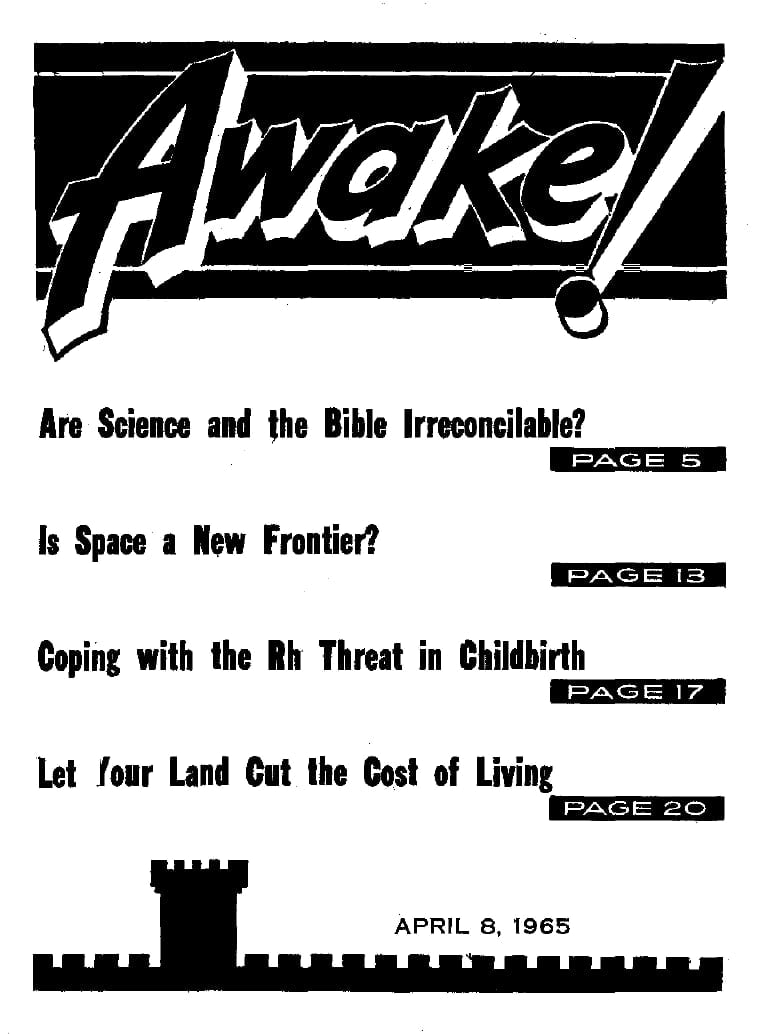
Are Science and the Bible Irreconcilable?
PAGE 5
Is Space a New Frontier?
PAGE 13
Coping with the Rh Threat in Childbirth
PAGE 17
Let Your Land Cut the Cost of Living
PAGE 20
APRIL 8,1965
THE REASON FOR THIS MAGAZINE
News sources that are able to keep you awake to the vital issues of our times be unfettered by censorship and selfish interests. "Awake!" has no fotters. It recurs facts, faces facts, is free to publish facts. It is not bound by political ties; it is but pered by traditional creeds. This magazine keeps itself free, that it may speak free, you. But it does not abuse its freedom. It maintains integrity to truth.
The viewpoint of "Awakel" is not narrow, but is international, "Awakel" ha- own correspondents in scores of nations. Its articles are read in many lands, in many languages, by millions of persons.
In every issue "Awakel" presents vital topics on which you should be Informed. It features penetrating articles on social conditions and offers sound counsel for meeting the problems of everyday life. Current news from every continent is in quick review
the problems of everyday life. Current news from every common passes in quick review. Attention is focused on activities in the fields of government and commerce about which you should know. Straightforward discussions of religious issues alert you to matters of vital concern. Customs and people in many lands, the marvels of creation, practical sciences and points of human interest are all embraced in its coverage. "Awaken" provides wholesome, instructive reading for every member of the family.
"Awakel" pledges itself to righteous principles, to exposing hidden foes and subtle dangers, to championing freedom for all, to comforting mourners and strengthening those disheartened by the failures of a delinquent world, reflecting sure hope for the establishment of God's righteous new order in this generation.
Get acquainted with "Awake!" Keep awake by reading "Awake!"
PUBLISHED SIMULTANEOUSLY IN THE UNITED STATES BY THE WATCHTOWER BIBLE AND TRACT SOCIETY OF NEW YORK, INC.
117 Adams Street
Brooklyn, N.Y. 11201, U.S.A.
AND IN ENGLAND BY
WATCH TOWER BIBLE AND TRACT SOCIETY
Watch Tower House, The Ridgeway
London N.W. 7, England
N. H. Knobbe, President
GRANT SURTEE, Secretary
Printing this issue: 4,250,000
4d a copy (Australia, 5d: South Africa, 3½s)
Offices for semimonthly editions
Australia, 11 Rewaford Ed., Birrathfield, N.R.W. 8/-
Canada, 150 Bridgeland Ave., Toronto 19, Ont. $1
England, Watch Tower House.
The Bridgeway, London N.W. 7
New Zealand, 487 New North Rd., Auckland S.W. 1 7/-.
South Africa, Private Bag 2, P.O. Elmonteln, Tel. 70c
Healthy attentive staff will help you move safely.
Realistic training.
Your country, otherwise, other your institution to Broaden.
Notice of aspiration in sent at least two liaisons before
subscription expires.
Now published in 26 languages
Summerthail- Arkansas, Cobt-Vianay, Danish, Dutch, English, Finnish, French, German, Greek, Iceland, Italian, Japanese, Keseran, Norwegian, Portuguese, Spanish, Swedish, Tagalog, Zum.
Monthly—Chinese, Clayanja, Hillgaynon-Visayan, Malayalam,
Polish, Tamil, Ukrainian.
CHANGES OF ADDRESS should remain on thirty days before your marriage date. Give as your old and new name your old address number. Write water tower, Water Tower Monroe, the Midway, London W. 7, England.
Entered as second-class matter at Brooklyn, N.T.
Printed in England
The Bible translation regularly used in "Awakir" is the New World Translation of the Holy Scriptures, 1961 edition. When other translations are used, this is clearly marked.
CONTENTS
Ambition or Legitimate Desire? 3
Are Science and the Bible Irreconcilable? 5
Palmistry's Ancient Origin 9
Peering at the Penguins 10
Is Space a New Frontier? 13
Follow the Leader 16
Coping with the Rh Threat in Childbirth 17
Let Your Land Cut the Cost of Living 20
Could You Live at a High Altitude? 24
Quake Throws Bodies out of Tombs 26
"Your Word Is Truth"
Refusing to Bow at the Altair 27
of "Good Luck"
Watching the World 29
AMBITION OR LEGITIMATE DESIRE?
IN THIS system of things the ambitious, aggressive person seems to be the one who gets ahead. On the other hand, there is a tendency to scorn those who manifest no ambition. Neither type is really appealing, but can you put your finger on the reason? The fact is that the desire to get ahead can be praiseworthy and it can also be something quite opposite. How, then, can a person get the proper balance in the matter and steer his own thinking and actions in right channels?
The desire to get ahead is so general that it crops up at every stage of one's life. Children are usually very competitive. At school the big question among many is, Who is going to get to the top of the class? In countless homes it is often a question of who is going to have his own way—father, mother, young John or Mary? At secular work there are positions and promotions for which there is keen competition. No wonder the prevailing attitude can be described as 'everyone for himself'!
An outstanding Bible example of one motivated by the spirit of selfish ambition was Joab, commander of the armies of Israel under King David. His career reveals an insatiable thirst for position and power.
The attainment of his objectives involved fierce competition, ruthless liquidation of rivals, disobedience to orders, refusal to accept reproof, yes, and even seditious conspiracy against the anointed king who had dealt with him so patiently and leniently. (2 Sam. 3:27; 18:14; 19:13; 20:9, 10; 1 Kl. 1:18, 19; 2:5) Ambition to become great, to shine above one's fellow creatures, is so like a wild, uncontrolled fire—it is never satisfied until it has destroyed everything in its path, everything, ironically, on which it depends for its own continuation.—Prov. 30:15.
The heavy cost that must be paid to satisfy selfish ambition is often overlooked until it is too late. All along the way there are disappointments, frustration and hostility inducing tensions that are destructive to health and happiness. Each reputed success falls far short of anticipation. Life tends to become a dreary succession of hollow victories, and the victor, when he gets to the top, finds that he no longer has anyone he can truly call his friend.
When on earth, Jesus Christ faithfully transmitted to his followers his Father's view on this subject. On one occasion his mother's sister, Salome, approached and asked for special privileges to be granted to her sons, James and John, in the kingdom of the heavens.
Note how the Master's well-chosen words quieted the indignation of the other disciples and set the issue at rest: "You know that the rulers of the nations lord it over them and the great men wield authority over them. This is not the way among you; but whoever wants to become great among you must be your minister [servant], and whoever wants to be first among you must be your slave."—Matt. 20:25-27.
Jesus did not deny that there would be among his joint heirs of the Kingdom those who would be "great" and "first." But in what sense? In that through hard work and devotion to the overall interest of the Christian congregation they would prove themselves capable of assuming responsibility. Quite different this from the self-promotion campaigns of worldly-minded persons who, without hesitation, use their competitors as steppingstones to greater heights.
In view of this and the Bible's condemnation of rivalries and selfish competitions, is all desire for a position of responsibility wrong? (Gal. 5:26; Eccl. 4:4) No, for the apostle Paul wrote his young fellow missionary, Timothy: "If any man is reaching out for an office of overseer, he is desirous of a fine work." (1 Tim. 3:1) So, what is the essential difference between dangerous ambition and legitimate desire to get ahead? In one word the answer is "humility." The ambitious contriver fancies himself to be worthy and capable of any office at which he aims, and is impatient to get there. Legitimate desire, on the other hand, is coupled with a humble recognition of the need to prepare and qualify oneself through hard work so as to be able to do justice to the desired office.
In school, how refreshing to meet a student who truly excels in class but modestly ascribes his success to hard work and long hours of study! What an atmosphere of peace and well-being we see in a home where wife and children are striving to improve in their respective positions, while always maintaining proper subjection to the God-ordained head of the household, the father! In secular work, how highly prized the employee who shows concern for improving the quality of his work rather than using all the shortcuts to the top position in the firm!
So, whether we occupy the role of wife or child in the home, or employee in a business firm, or member of a Christian congregation, we do well to avoid the pitfall of selfish ambition. If we would do so, we must never succumb to the impatient desire to be or to do those things for which we are neither trained nor equipped. Such ambition can lead us away on a heartless bid for position and power, ending up most often in bitter disillusionment. On the other hand, legitimate desire to progress in school, in the home, at secular work or in a congregation of Christians will move us to undergo training with all patience, while we humbly await higher direction in the matter of promotion to a position of greater responsibility.
It is very important, too, to keep in mind that the most worthwhile promotion or exaltation comes from one who cannot be deceived as to our motives, for the inspired psalmist wrote: "Do not exalt your horn [strength, power] on high. Do not speak with an arrogant neck. For neither from the east nor from the west, nor from the south is there an exalting. For God is the judge. This one he abases, and that one he exalts." (Ps. 75:5-7) His promotions carry with them peace of mind and they do not result in harm to others.
THERE exists a unique, inexhaustible book which contains all that is to be said about God and man. . . It would be just as useless to claim to understand the principles of ethics and law as to pretend to comprehend sociology, economics and even politics, if one were unfamiliar with the message contained in this book. Art and literature depend on it even more obviously. Without it, neither the sculptors of Chartres nor the mosaicists of Ravenna, neither Michelangelo, Rembrandt or El
The Bible IRRECONCILABLE?
Greco would have been the same as we know and admire them. . . . Without this book, the West would not be what it is."
Indeed, the Bible—for that is the book Daniel-Roops, member of the French Academy, is referring to in the above quotation*—has been praised by men as widely separated ideologically as Nietzsche and Pascal, not to mention Racine, Shakespeare and Goethe. Yet today many men do not believe in the Bible. Why? How is it that the book that is a "must" in any self-respecting bookcase is followed less and less as a practical and spiritual guide?
The current disbelief in the truthfulness of the Holy Scriptures should not come as a surprise. One of the penmen who wrote the Bible, Paul by name, testified nineteen hundred years before the present crucial period of time: "The inspired utterance says definitely that in later periods of time some will fall away from the faith, paying attention to misleading inspired utterances." (1 Tim. 4:1) In this so-called Age
of Reason, there is a veritable deluge of 'misleading utterances' pronounced in the name of truth.
Science also Requires Faith
Among these 'misleading utterances' that undermine people's confidence in the Bible are the hypothetical explanations taught as scientific facts. Since many of these theories contradict the Bible, thousands of people, misled by such utterances, are convinced that the Scriptures are outdated on scientific matters and that science and the Bible are irreconcilable. They fail to realize that what is taught as a scientific fact is often merely a theory requiring as much faith to believe as anything taught in the Bible.
Webster gives this definition of the noun science: "A branch of study which is concerned with observation and classification of facts, esp. with the establishment of verifiable general laws, chiefly by induction and hypotheses." (Italics ours) Two interesting points become apparent here: first, to be authentically scientific, a us covery must agree with verifiable facts; secondly, science proceeds chiefly by induction, that is, by drawing inferences, by hypothesizing or theorizing.
Now a theory or hypothesis is nothing more nor less than a considered guess, a tentative explanation that may or may not turn out to be true.
This being so, to accept a scientific theory as established truth takes belief; it takes faith. This is borne out in the following statement by André Arnal, professor at Montpellier University, France: "All intellectual activities require faith. . . . First principles and primary facts are at one time denied and at another time affirmed, and the same is true of the hypotheses which are built upon them. Moreover, the sciences, both the mathematical and natural sciences, are also based on belief. Neither do they question their starting point, nor their basic data; they accept both as self-evident. The reason why geometricians, physicists and astronomers obtain—at least most of the time—corresponding results, whereas moralists, philosophers and sociologists reach different conclusions, is that the latter discuss and question the primary notions of the problems studied, whereas the former accept without discussion or questioning the basic primary notions. It is a formal error, which has been formally exposed, to suppose that human knowledge is based on an unquestionable foundation. No research, no theory . . . exists that does not require faith."
Science worshipers are fond of saying: 'Do not believe it just because it is in the Bible.' Since scientific theories also require faith, Bible-believing Christians are within their rights in replying: 'Do not believe it just because it is taught by scientists.'
Scientific Myths
"scientific truth." Here are a few examples. Until the end of the eighteenth century, combustion or burning was explained by many strange theories. One of these, considered to be thoroughly sound, held the center of the scientific stage for over a hundred years. Two German chemists, Johann Becher followed by Georg Stahl, conceived the phlogiston theory. To quote Webster: "According to them, every combustible (phlogisticated) substance is a compound of phlogiston, and the phenomena of combustion are due to the phlogiston leaving the other constituent behind. . . Soot and coal were regarded as almost pure phlogiston, and sulphur as very rich in it. The theory produced fruitful results and held sway for a century." Held sway among whom? Among scientists. According to the French encyclopedia Larousse du XXe siècle (Twentieth Century Larousse), "phlogiston was considered to be one of the great powers of nature." The same work adds: "[French chemist] Lavoisier was the first to destroy this false interpretation of combustion, proving that the latter is a chemical combination that occurs with a great release of heat." So much for the phlogiston myth!
The fact is, human science has at all times taught some fantastic myths as
Another "scientific truth" that held for centuries was that the universe had always existed. In his book Metaphysique (Metaphysics), Paul Foulquile states the problem quite clearly as follows: "Science teaches us that the world is evolving. . . . These facts lead us to ask ourselves if the material world has always existed or how it came into existence. Only two answers to that question are possible: either matter is eternal and exists of itself, or it was created and exists through God. For a long time, philosophers accepted the eternal existence of matter and never sought the reason for its existence. The Jewish religion was the first to introduce the idea of direct creation, the divinity having been considered up until that time as the organizer of pre-existent matter."
Thus, whereas for centuries pagan religions, philosophers and scientists were teaching that matter had existed from all time, the religion of the Jews taught mankind that matter had a beginning, that it was brought into existence by an intelligent Creator. Now, in what set of holy writings was the Jewish religion "the first to introduce the idea of direct creation"? It was in the writings now preserved in the Bible and more particularly in the book of Genesis, which is precisely the part of the Scriptures most violently attacked by agnostics. The opening verse of the first chapter of Genesis states a truth that no scientist has ever been able to disprove, namely: "In the beginning God created the heavens and the earth."
These very first words of the Scriptures certify that the material universe had a beginning. Today scientists admit that matter has not always existed. Some say the universe began, three billion years ago, others put the big start at four and a half billion years back. Whichever of these figures might be correct, or whatever others might be put forward by the scientific world, the fact remains that modern-day cosmogonists accept that the universe had a beginning. They have exploded the myth of their predecessors who taught that matter was eternal and self-created. Which was right, science or the Bible? Which of them had to change its ideas and bring them up-to-date, science or the Bible? Decidedly, the Holy Scriptures have nothing to lose in being confronted with modern science, since the latter has taken centuries to discover a truth stated thousands of years ago in the opening words of Genesis.
The Origin of Life
Life has not always existed on the earth. All cosmogonists agree on that point. What they do not agree upon is how it started. Two solutions are possible: creation or spontaneous generation. In other words, either life was caused or it came about of itself. The first of these explanations is the one offered in the Bible; the second is the one put forth by atheistic scientists. That this choice is inevitable is borne out by the French Larousse encyclopedia, which states under "Biogenesis": "Obviously, if one rejects creationism, one is absolutely obliged to admit the origination and formation of living substances out of surrounding inorganic matter." But how plausible is this second theory, also called ablogenesis?
In a speech he made at the Sorbonne (Paris University) in 1864, the renowned French biologist Louis Pasteur quoted examples of the explanations put forward in support of spontaneous generation. The following is one he quoted from a famous seventeenth-century Flemish physician and alchemist, Van Helmont, who stated: "Dig a hole in a brick, fill it with ground basil grass, place a second brick so that it completely covers the hole, put the bricks in the sun, and within a few days the scent of the basil acting as a ferment will change the grass into real scorpions. . . If you stuff a dirty shirt into the hole of a vessel containing grains of wheat, the ferment from the dirty shirt, modified by the smell of the grain, will cause the grain to transform into mice after about twenty-one days."—Les plus belles pages de Pasteur (Pasteur's Finest Passages), by Robert Vallery-Radot, page 101.
To be sure, true science soon proved that animal life as complex as scorpions and mice could not generate itself spontaneously from grass or from a shirt, be it ever so dirty! However, the development of the microscope soon enabled scientists to study minute objects, and the theists among them lost no time in claiming that microorganisms came about originally by spontaneous generation.
In 1858, French scientist Pouchet delivered a speech before the French Academy of Science and claimed to have observed the appearance of life in substances previously sterilized and free from germs. Two years later, Louis Pasteur proved conclusively that the life forms observed by Pouchet sprang from undetected germs. Pasteur proved that living organisms can be generated only by preexisting living organisms. Stated otherwise, life proceeds from life and not from inanimate matter. This is in harmony with the Bible and is established by true science. The two are not irreconcilable.
Honest scientists admit they know little or nothing of how life began. In his book De la matière à la vie (From Matter to Life), French biologist Rémy Collin writes: "Science has done wonders, as our material civilization shows; but it has been unable to make life reveal its secret. After all our investigations into the field of biology, what essential truths have we learned other than what is expressed in these words: 'There are inorganic bodies and there are living beings'—nothing more than what elementary common sense tells us?' Jean Rostand, member of the French Academy, writes in his book Pensées d'un biologiste (Meditations of a Biologist): "From what we know about the exceptional characteristics of protoplasm, it seems that its origin required the occurrence of highly improbable circumstances." The same famous biologist stated even more clearly in his book entitled L'homme (Man): "About the origin of life, we know nothing."
Since scientists are unable to produce even the simplest living organisms in their laboratories and are incapable of explaining the origin of life, what right have the unbelievers among them to cast doubt on the Bible, which, by attributing the origin of life to God, is in perfect harmony with the established scientific fact that life proceeds from life?
The Bible and Evolution
The "scientific myth" that is enjoying vast popularity at the present time is the evolution theory. This doctrine has been defined as follows: "Evolution is the biological theory that living species are not fixed and distinct but variable and capable of transforming themselves from one species into another. . . . Evolutionism is the contrary of creationism, which claims that living beings had a fixed form from the start and underwent no essential modification."
Which of these explanations of the origin of the species is correct, evolution or the Bible, which states in its opening page that life forms were to multiply "according to their kinds"? Are science and the Bible irreconcilable in this important matter?
True, the evolution theory is currently believed by many scientists and educators. But popularity is no reliable touchstone. Remember how popular the phlogiston theory was among scientists for over a hundred years. What do honest scientists have to say about evolution? Here are a few quotations from French authorities:
In their monumental textbook Tratité de biologie animale (Treatise on Animal Biology), page 1160, Aron and Grassé state: "We can live in hope, but at present let us admit frankly that we know nothing of the really determining causes of the evolution of living beings." Renowned zoologist Yves Delage wrote: "I am absolutely convinced that people are or are not evolutionists, not for reasons based on natural history, but because of their philosophical opinions."
(La structure du protoplasme et de l'heredite [The Structure of Protoplasm and of Heredity], page 204) Henri Collin, member of the French Institute, admits: "The experimental proof of evolution has not been provided."
Finally, professor Louis Bounoure, of Strasbourg University, recently made this remarkable statement: "The living world only really shows us how constant the species are. . . . As a student, at the beginning of this century, I was myself subjected to the heavy yoke of evolutionist thought, but when, after much research, I discovered that evolution is an illusory and unjustified myth, I considered my duty as a scientist to fearlessly expose this theory as an error to be rejected."—Le monde et la vie (The World and Life), October 1963.
Thus it is seen that with regard to the fundamental truths concerning the origin
of matter, of life and or the species, science has produced no established facts disproving the Bible. On the contrary, reliable scientific information on these matters confirms what the Scriptures said all along. In short, the conflict is not between science and the Bible, but between the Bible and unverified and unverifiable hypotheses put forward in the name of science.
Science has at all times had its myths, of which phlogiston, the eternity of matter and spontaneous generation of life are only a few examples. These particular "scientific" myths are now dead, but others, such as evolution, are still in vogue. So why cling to myths or 'misleading utterances' and reject the Bible, that "unique, inexhaustible book that contains all that is to be said about God and man"? Why go on laboring under the illusion that science and the Bible are irreconcilable? For, of a truth, they are not.
PALMISTRY'S ANCIENT ORIGIN
Palmistry is regarded today as a branch of fortune-telling, the art of predicting future events or influences in the life of another. It is the practice of studying the lines of a person's palm and shape of his hand to try to discover his personality, especially past and future events in his life. Another name for palmistry is chiramancy, which means "hand divination." This form of divination goes back to ancient times. It was practiced in India from remote times. When the Gypsies migrated from India, they eventually spread the practice of palmistry throughout Europe and many other parts of the earth. Besides palmistry, Gypsy women employ a variety of forms of prediction, such as use of tea leaves and the use of special Tarot cards, which are claimed to go back to the magl of ancient Babylon. Palmistry also goes back to ancient Babylon or Chaldea, "Palmistry was known among the Chaldaeans, Assyrians,
APRIL 8,1965
Egyptians, and Hebrews, and was recognized by the philosophers of Plato, Aristotle and Antichus."-The New Funk & Wagnalls Encyclopedia, Vol. 25, p. 9310.
But was divination, whether by palmistry or any other means, something that Jehovah God approved of his people practicing? God's own Word, the Holy Bible, answers: "There should not be found in you anyone... who employs divination, a practicer of magic or anyone who looks for omens or a sorcerer, or one who binds others with a spell or anyone who consults a spirit medium or a professional foreteller of events." (Deut. 18:10, 11) Thus God's Word condemns the practice of any Babylonish divination and also the consulting of fortune-tellers. True Christians seek enlightenment and guidance from the Holy Scriptures, the Book of divine prophecy that shows the future of the whole human race. —Ps. 119:105; 2 Tim. 3:16, 17.
By "Awake!" correspondent in Argentina
THERE they are—penguins!" and we went scrambling down the slope of a huge, whitish-gray sand dune. We had chosen this vantage point in order to scan the beautiful York Bay area, which lies a few miles from Port Stanley in the Falkland Islands.
We wondered if it would be possible to see these curious creatures in their natural surroundings, since we were now in the autumn month of April. By this time of the year the majority of the penguins would already have left for their real home, the sea, until the return of the South Atlantic spring months of October and November. Then their rookeries would be populated again.
We had spotted penguins swimming out in the open sea as we headed south to this island group. It was amazing to observe the great speed at which they traveled, and, with no land in sight, it was evident that they were very much at home in these cold waters.
Now, atop this sand dune, we had been scanning the Bay area. For a time it looked as if we were to be disappointed, when suddenly, far down the beach, walking erect, a little black form with a strange waddle, and then another and another—Gentoo penguins!
These Gentoo one of several species of penguins that have established their rookeries around
the coasts of the Falklands, some 300 miles south off the eastern coast of Argentina. Their distinguishing mark is the thin white band that cuts
across the back of the head. They have an orange beak and big orange feet. They are considered the gentler group
They are considered the gentler group of the penguin family. Besides the charm of their timid manner, they are also known to act very slyly, especially when it comes to stealing nesting materials from their neighbors while maintaining a thoroughly innocent look.
The Jackass penguin, so called because of his peculiar braying call, has a black-and-white-striped face and pink rimmed eyes. He carries a hook on the end of his beak that can be most damaging to anyone poking around in his underground burrow. Unlike other penguins, he likes to nest underground.
No matter where the penguin rookeries are located, whether in the sheltered coves of the Gentoos or on the steep, rocky ledges of the Rockhoppers, they are very noisy communities. From a long distance one knows, from the incessant chatter of the birds and the stench of the guano or penguin dung, that he is approaching a rookery.
Why they choose the nesting places they do is a mystery. One colony of Gentoos chose a spot some 700 feet above sea level. The trip for these clumsy pedestrians would take a good part of a day, and the route is often cluttered with obstacles, such as boulders and large tussocks or clumps of coarse grass.
Only the penguins know why they prefer this to the much more direct route.
Another species, the Macaroni, also avoids the easy direct route, preferring to jump from rock to rock upward to a nesting place high on the cliffside. The whole group will follow the same path, and deep scratches in the rocks give evidence that generations of penguins have passed over the same route. The path is usually wide enough for two-lane traffic. Normally, traffic moves smoothly, but if some ambitious penguin speeds up and bumps into another, it is the signal for a general uproar, not only with the colliding ones but also with many of the onlookers coming to blows.
These penguin highways lead from the nests to the sea. Mr. and Mrs. Penguin waddle down to the water, wade In as far as their flippers, then bend forward, and away they go—like torpedoes in the water! Their flat feet become rudders and their flippers are the means of propulsion. That is why they must be full grown before they will have enough stamina for the ardors of life in the water. To get breath they leap out of the water at intervals and hurtle through the air with flippers spread wide, and then disappear for another spell below the surface. They travel fast and, though without any obvious leader, they seem to know exactly where they are heading.
Enemies
One group of Rockhoppers was observed peering over a ledge six feet above the water. The more daring ones jumped feet first. Others shied away or were pushed in by overly anxious comrades. Still other timid souls waddled down to the ledge, peered nervously over, and then wandered off in search of a less dramatic approach to the water. It surely recalled childhood days at the old swimming hole.
To protect the penguins against their greatest enemy, man, conservation laws have had to be introduced to stop the wholesale slaughter of these comical, harmless creatures for their oil, and to head off extermination of the species through harvesting too many of their eggs, which are even preferred by natives to chicken eggs. The skua, large rapacious bird of the gull family, is another enemy that enjoys a meal of penguin egg or young penguin. Often the innate politeness of the adult penguins places their eggs or their young in danger from this winged predator. When the time comes to change shifts on the nest, they indulge in a pattern of solemn and gracious bows to each other, while the eggs or the newly hatched young are left exposed. That is quite likely to be the very time when the skua swoops down from the skies to steal his dinner off the nest.
Mr. Seal also enjoys a meal of tasty penguin meat. No match for the penguin on shore, he will lie in wait close to shore as the penguin goes out for his swim. In a surprise attack he will nab the victim in his mouth, throw him high in the air with a sudden flip of his powerful neck that seems literally to pop the penguin out of his skin. Feathers and skin washed in along the coast are the telltale evidences that Mr. Seal has been dining again.
Nesting and Mating
When the surface snow gradually melts and the outlines of the old nests begin to show through, they are at once claimed and occupied. A second penguin will then approach the one on the nest and with great solemnity deposit a pebble at the feet of the occupant, following up with some ceremonious bows and a gentle little hissing sound. Until the occupant responds, strange to say, the one penguin does not yet know the sex of the other bird.
Indeed, either male or female is likely to claim the nesting spot, and either one is willing to do the job of seeking a willing mate. Once the sex is established, however, the male shows himself most attentive, bringing pebbles or other materials for completion of the nest.
There is a wide variety in types of nests to be found among the penguins. Some of
the Gentooos prefer little, round pebbles for building materials, while others use the dainty
toward us with a big twig. It stepped too close to another's nest and was poked from behind. It jumped aside, trampled another nest, and was pinched in the ribs."
Papa and mamma both take turns incubating the eggs. The baby penguins eventually put in their appearance all covered with short, gray down. Commencing life at perhaps a few ounces in weight,
NEXT ISSUE-SPECIAL! MOVEMENTS TOWARD RELIGIOUS UNITY WHAT THEY MEAN TO YOU!
diddle-dee plant or the stems of tussock grass. Some species burrow into the ground, while other hardier ones are known to breed in midwinter right on the ice.
Noise in the community at nesting time is doubtless enhanced by the fact that everyone likes to steal from his neighbors to 'feather his own nest.' Elegnor Rice Pettingill, in her Penguin Summer, describes this activity in a Gentoo colony: "There were acres of diddle-dee just at hand, but the twigs from the nests of neighbors were, apparently, more desirable. Rather than venture out of the colony, a penguin would risk blows from beaks and flippers for the sake of a secondhand twig. If a pair left a nest unguarded, it was stripped in no time, and all that was left was a bare depression containing two eggs. Some thieves did not even wait for a nest to be left unguarded but surreptitiously lifted twigs from nests while the occupants were snoozing. This seemed to require talent, better developed in some individuals than in others. If a penguin got caught, he received blows from the owner's flippers and fearful thrusts from his sharp beak. When birds returned to their nests with their loot, they laid each twig gently on the ground beside the incubating mate. One bird came
they grow rapidly by reason of their tremendous appetites. The parents predigest the
seafood and then regurgitate for the benefit of their young. When the young are about two-thirds grown they will be seen standing around in groups waiting for the adults to come back with the "groceries." Sometimes the parents will run around with the food while the youngsters chase them, making the young ones do a little work for their board.
The Exodus
Moulting time is a trying time for these flightless birds. It takes about three weeks for the Rockhoppers to replace their old finery. During this time the plumage is not waterproof, so they are restricted to land. This means no feeding and consequent displays of bad temper, which keep the colony in an uproar.
Finally the new feathers of Mister and Missus have taken on their water-repellent quality, the youngsters have grown strong enough, and the whole community with their tuxedo-like jackets are ready for travel. So down the well-worn trail they solemnly march. There they go, young and old, leaving their rookery for another season and heading for the open sea—for, after all, the sea is the real home of the penguin.
WHEN the first man-made satellite went speeding into orbit about the earth on October 4,1957,the eyes of the world turned toward space. Imaginations were fired by its mysteries, and glowing predictions were made about man's historic effort to reach for the stars. As always, a vast gulf exists between fact and imagination. Much is yet to be learned about space. In the meantime, the feverish research being done in the space program is predicted to bring many side benefits to the common man. Space enthusiasts already point to a number of these benefits.
Weather satellites are making weather predictions more accurate and are giving advance warnings of approaching storms. Navigation is being aided by satellites. Intercontinental television broadcasts and telephone calls are now possible because of them. New sensing and measuring instruments developed for the space program are helping doctors to improve their diagnostic techniques. Miniaturization of electronic parts is improving many types of instruments, making possible such things as a heart pacer for people with heart trouble. Tiny batteries developed for space
vehicles are going into wrist watches, and solar cells that get electricity from sunlight for satellites are powering portable radios. But the new things being learned about space itself may prove to be even more significant than technological benefits.
Satellites and space probes have revealed things that have changed man's views about the vast space beyond Earth's atmosphere. But much more must be learned before a manned spacecraft can be sent out there.
Space is so immense that the best human minds are unable to comprehend it. In our own galaxy there are about 100 billion stars that are stretched out over such an inconceivable distance that light, moving at a speed of 186,000 miles a second, takes 100,000 years to cross it. And this is only one of an unknown number of galaxies. Light from the most distant ones that man can see with his largest optical telescope took two billion years to reach the earth. Compared with such vastness, man's rocket accomplishments fade to insignificance. It is empty-boasting for him to talk about conquering space. With his present propulsion equipment it would require thirty-one years for him to reach the planet Neptune, and more than a lifetime for a round trip. Even if he could travel at the
speed of light, it would take him more than four years just to reach the nearest star.
Man's space efforts, limited though they are, undoubtedly will enlarge his knowledge about space and satisfy much of his curiosity about many of the bodies in our solar system.
Until now, the earth's protective atmosphere has interfered with telescopic studies of them, but with telescopes placed on satellites that circle the earth above the atmosphere, unobstructed observations can be made. Photographic space probes will also help. Pictures of the moon's surface have now been taken that are far clearer than those taken by any earthbound telescope.
Exploring New Frontiers
Whenever a new frontier opened up to man in the past, it contained many dangers that made man's exploration of it hazardous. The underwater world, for example, has opened up to man because of his diving equipment, but it is filled with dangers for him. Due to the fact that he was not made to live in water like a fish, the underwater world is hostile and alien to him. Nevertheless, he has developed equipment that makes it possible for him to explore it to even its greatest depths. The same can be said of the atmosphere.
Unlike birds, man was not created with the ability to fly but was designed to live on the ground. Despite this fact, he has opened up the atmosphere as a frontier to be explored by balloons and aircraft. As pressures at great depths of the oceans are too great for man so pressures at great altitudes are insufficient for him, causing the blood in his body to boil if he is not protected. But the hazards of high altitudes have not prevented him from flying to extremely high altitudes. The famous U-2 plane flies at an altitude of more than 14 miles, and the experimental plane X-15 has gone to 67 miles. Space capsules have carried men to an altitude of more than 100 miles. In fact, jet planes regularly take millions of people to altitudes that would kill them without protective equipment.
Special life-supporting equipment is required whether a man is traveling at 35.
000 feet or at 100 or more miles above the earth. Both altitudes are hazardous for him, but with proper equipment he is able to protect himself. However, his success in overcoming the hazards of flying and of underwater travel does not mean he can do everything, that there are no obstacles he cannot overcome. Man is not almighty; he has human limitations. In space these limitations become more clearly manifest than in any other human undertaking. Being imperfect, man constantly makes errors, but out in space there is no room for errors. Accuracy in space travel is so exacting that the tiniest miscalculation can be fatal. How easily human errors can cause expensive failures is evident from the number of rockets that have failed to function properly.
Man in Space
In view of the fine accomplishments by highly sophisticated robot spacecraft, there has been some disagreement among scientists as to the advisability of sending man into space. Doing so greatly increases the expense of exploring it. Some claim that electronic instruments are the best means for studying the moon and the planets. They regard man as a nuisance in space, the weakest component of a space project, because of the fantastic problem of keeping him alive out there. On the other hand, there are scientists that argue in favor of sending man to other planets and to the moon. They say that man's judgment, his ability to observe, answer questions and to reason as well as his decision-making capabilities cannot be replaced by instruments.
Actually, national pride is the chief motive behind the crash program to get a man on the moon. Russia and the United States are in a race to the moon for the political prestige it will bring. If it were not for this cold-war competition, it is most unlikely that American politicians would have voted to spend $20' billion to send a man to the moon for purely scientific reasons.
Before Russia surprised the world with the first man-made satellite, the American space program was crippled for lack of funds. Further space spectacles by the Russians, such as the first man in orbit, spurred the United States Congress to open up a golden floodgate for the hard-pressed program. A military factor is also behind the American program. There is the fear that Russian advancement in space technology might give them a military advantage. So opening up space as a new frontier for scientific knowledge is not the real reason for the crash space program in the United States.
The astronomical sum of $20 billion could have been used for many other things that would be of more immediate benefit to the American people, such as highways, schools, slum clearance, and so forth. It is unlikely, however, that politicians would have voted to spend that much money on such unglamorous programs that have no direct bearing on the cold war. Too many taxpayers would complain.
Hazards
The hazards that man has faced when opening up new frontiers on Earth pale to insignificance when compared with those confronting him in space. There he must contend with temperatures that range from several hundred degrees below zero to several hundred degrees above zero. Even higher temperatures must be faced upon reentering the earth's atmosphere. A manned space capsule coming in from the moon would enter the atmosphere at 35,000 feet per second, causing the protective heat shield to reach a surface temperature of 6,000° F. This is twice the temperature endured by the shield of the Mercury capsules that orbited the earth. But heat is not the only reentry hazard.
There is the danger of a spacecraft not coming in at the proper angle. This angle is an imaginary corridor that is about 300 miles wide and 40 miles deep. If the men returning from a moon trip, for example, miss this angle and come in on one that is too shallow, they will skip out of the atmosphere and go off into space again. On the other hand, if the angle of descent is too steep, they will decelerate too quickly and be crushed by an unendurable pressure that will be 350 times that of Earth's gravity. Their lives depend upon making the angle of approach just right.
The ultrahigh vacuum of space is a deadly thing to man, causing body fluids to boil and the pressure of internal gases to rupture the body. Coll tissue itself appears to evaporate in it. So if a pressure suit is punctured while a man is walking about the moon or a space capsule is penetrated by a speeding meteor, death will come in seconds.
Failure of equipment is a grave hazard that even the most melodious care in assembling cannot always prevent, as has already been revealed. It could leave the men in a spacecraft stranded on the moon or out in space, and there are no spare parts out there. A mere fingerprint on a surface to be welded during the construction of a spacecraft could cause failure of the weld.
A breakdown in radio communication with Earth and in navigational equipment would be disastrous for a spacecraft millions of miles out in space. The possibility of getting lost out there is much greater than on Earth. A space traveler trying to return to Earth must be able to locate the earth's orbit in the vast reaches of space and must also time the craft's arrival so that it reaches a spot in that orbit at the same time the earth does. If the timing is wrong, he will miss the earth and go into orbit around the sun.
Radiation is a space hazard that cannot be ignored even though instrumented space probes have indicated that it is not generally at a dangerous level. The greatest danger from it seems to be while passing through the Van Allen radiation belts around the earth and when encountering unexpected eruptions from the sun that fling streams of high-speed, energetic particles into space.
Being in a state of weightlessness over a prolonged period of time, as is necessary in space flights, appears to be a very grave hazard to man. So serious is it that it might prevent man from personally exploring this new frontier in the time period he plans. Prolonged weightlessness, like staying in bed for a long time, can cause a deterjoration of the muscles, bones and circulatory system. A softening of the skeletal structure is likely because of a loss of calcium and other minerals from the bones. It is even feared that minerals will be lost that are necessary for the nervous and electrical processes of the body. Some persons believe that it will so seriously affect a man's sensory apparatus that what he sees and hears will be unreliable and that he will be subject to illusions. It is also responsible for an excessive loss of body fluids.
Even cell division appears to be upset by weightlessness. Checking on this, the Russian cosmonaut, Col. Bykovsky, performed an experiment during his orbital flight by halting the growth, every few hours, of the rapidly formed buds of the plant Tradescantia paludosa. Studies of this plant afterward revealed that the cells that divided while the plant was in a state of weightlessness were imperfectly formed. This would become particularly noticeable in man's body on long flights. Radiation also interferes with cell division. So with both affecting the body for a long time, the parts that depend upon a high rate of cell division in order to function properly, such as the lining of the intestines. could be seriously damaged.
The physiological and psychological distresses caused by a prolonged period of weightlessness, as well as by other stresses of space travel, could affect the intellectual capacity of man in space, bringing into question his usefulness there. Some form of artificial gravity appears to be essential to prevent serious upsets in his body. But spinning the capsule to create it by means of centrifugal force does not appear to be the answer. It would subject a man's body to different pressures because the parts farthest from the center of the spinning capsule would be going at a greater speed than other parts.
The hazards of manned space flight are very many and very great. They have a direct bearing on the future of space as a new frontier for man. Whether it will eventually open up to him and become such a frontier, as men of the world envision, only time can tell. But at present there is a more urgent task for him. Before trying to solve the great problems of manned space flight, it would be much wiser for him to concentrate his intellectual talents on this task—how to cope with his social problems of war, crime and hunger here on Earth.
Follow the Leader
An observer once saw some 200 pelicans flying about twenty-five feet above the Blue Nile, each bird following the other. Suddenly the leader bounded upward but immediately resumed its course at the original altitude. Every bird following, upon reaching the spot where the leader jumped, did the same.
AWAKE.
HOW happy the two Reading, Pennsylvania, parents were that the wife had safely borne twins, two baby boys! But their joy was to be short-lived. How so? Something went wrong with the boys' blood because of the Rh factor. Although both received complete changes of blood by transfusions, the twins did not improve but died at the end of eight weeks, within a day of each other.
What is this Rh factor? How does it cause infant mortality? What can be done to combat this threat?
When physicians first began to experiment with transfusing blood from one person to another they were unable to understand why some transfusions appeared to be successful whereas others resulted in fatal complications. Gradually they discovered that all blood is not the same; blood is not the simple fluid it appears to be; it has distinct characteristics. So they classified blood according to basic groups, such as "A," "B," "AB" and "O." Then more types were discovered and these were labeled "M," "N," "R," and so forth.
Still, at times blood transfusions resulted in certain unfavorable reactions in spite of doctors' recognizing the basic groups. Then through research done with the blood of Rhesus monkeys it was found that the blood of most persons has a certain factor similar to that discovered in these monkeys, for which reason it was termed the Rh factor. Those who had this factor were termed Rh positive; those who did not were termed Rh negative. Among Caucasians 85 percent, among Negroes 93 percent, and among Mongolians from 98 to 100 percent have Rh-positive blood.
The danger in childbirth exists when the blood of the father is Rh positive and that of the mother Rh negative. Because a fetus or unborn child has its own circulation separate and distinct from that of
its mother, it is possible for the child to have the Rh-positive blood of its father whereas the mother has Rh-negative blood. When this is the case it sometimes happens that some of the Rh-positive cells of the child escape into the circulation of the mother. The two being incompatible, the presence of Rh-positive cells in the mother's Rh-negative bloodstream causes antibodies to be formed to neutralize these invaders. This results in the mother's blood building up an immunity to Rh-positive cells. The trouble arises when these antibodies in the mother's blood get into the child's circulation, for they attack the child's Rh-positive red cells, destroying them. However, this happens only once in about fifteen times where the father is Rh positive and the mother Rh negative. Still this condition, termed erythroblastosis fetalis, is sufficiently frequent to be termed "a major cause of fetal loss as well as of certain cases of cerebral palsy."
However, rarely does the Rh factor represent a threat to the first child, unless the mother previously had an abortion or a blood transfusion. But the first pregnancy may sensitize the mother's blood so that the Rh factor would present a threat to the second child. Subsequent pregnancies are likely to increase that threat.
Because of this Rh threat to normal childbirth, there has been talk of laws being passed requiring all couples desiring to marry to take an Rh test first to make sure that their blood is compatible, both either Rh positive or Rh negative, and, if not, they would not be permitted to marry.
So far nothing has come out of these proposals, and perhaps rightly so in view of the restriction of personal freedom involved compared with the number of actual cases of incompatibility.
What Can Be Done?
According to one of the leading world authorities on blood groups, "no practicable method has yet been devised for the prevention of isosensitization by pregnancy or to counteract it once it has occurred. Various claims that have been advanced in this regard have not withstood the test of critical analysis."—Eh and Hr Blood Types, A. S. Wiener (1954).
As for prevention of the Rh threat to childbirth, according to medical journals some parents have accomplished this by means of artificial insemination, semen being provided by an Rh-negative donor. However, for Christians this is tantamount to adultery and therefore cannot be countenanced by them.
Then there are reports of prevention having,been realized by means of the use of Rh-positive haptens. These haptens are a blood fraction taken from Rh-positive red cells and given orally or by injection to a woman whose blood shows a high degree or titer of immunization to the Rh factor. In one to four months the titer is down to zero, at which time a pregnancy is recommended. Upon conception treatment is resumed. Those using this method have reported perfect results. However, this involves the use of blood fractions, which is objectionable on Scriptural grounds.
to arrange to let three or four years elapse between pregnancies where there is the Rh threat. However, pregnancies do not always wait for a schedule and, besides, this method can at best provide only partial prevention.
A method that might be said to provide at least partial prevention is for parents
The most common recourse of doctors is to blood transfusion. It is quite a complicated procedure and not every hospital has qualified personnel to take care of such. Furthermore, time and again it does not successfully cope with the threat, for deaths keep occurring in spite of blood transfusions. In some cases blood has even been injected into the child before birth. Of course, the use of blood for transfusions is unacceptable to those who obey God's law as set out in the Bible at Acts 15:19, 20.
A method that is being used more and more in coping with the Rh threat to childbirth, both with and without blood transfusions, is "preterm delivery." By artificially inducing labor so that the child is born at the end of thirty-seven weeks instead of at the usual forty weeks, physicians have been able to report an improvement in survival of Rh babies. For especially serious cases, as when the mother lost a previous child because of the Rh factor, physicians have even delivered the baby from four to six weeks before the regular time and by this means have increased the survival rate from 10 to more than 50 percent. Of course, in such cases the physician must recognize that there is also the possibility of losing the child because of the extreme prematurity of its birth.
In addition to the foregoing there is what might be called the constitutional approach to this Rh threat to childbirth. This is based on the fact that in only one in fifteen cases does the mother become sensitized and that therefore the problem might be likened to an allergy. Concerning this, Wiener says: "The inordinately high proportion of instances of multiple sensitization actually encountered further supports the thesis that the constitution of the individual is decisive."
This raises the question as to what distinguishes the constitution of Rh-negative mothers who form antibodies when carrying an Rh-positive fetus from those who do not. It appears that it is the fragility of the mother's capillaries that allows the Rh-positive cells of the fetus to enter her circulation, where they cause antibodies to be formed. Is there something that can be done to make the mother's capillaries less fragile? Yes, there has been considerable experimenting done in recent years by at least one surgeon with a citrus bioflavonoid compound, made from orange pulp and rinds. Where the Rh threat exists, this has been given to mothers in the form of CVP early in pregnancy, 400 to 600 milligrams daily and continuing until delivery. In one hospital where a careful record was kept of those being given this compound and those not, it was found that, whereas preterm delivery and blood transfusions resulted in the saving of only 30.9 percent of the babies, where CVP was added the result was a saving of 75 percent of them. In spite of these striking results, in which upward of one hundred infants were involved, the surgeon pioneering this type of treatment cautions that it would be presumptuous to forecast a cure-all, since a
much larger number of patients would need to be treated before definite conclusions could be reached.—Surgery, Gynecology and Obstetrics, August 1956, January 1960.
Still others tell of marked improvement in coping with the Rh threat to childbirth by use of vitamins B, C and K and an iron solution such as Fer-in-sol, these being given the infant after birth. No doubt methods such as this and the foregoing one would receive far more attention than they do were it not that many have placed such great faith in blood transfusions more than the success of this method would appear to merit.
No question about it, at times the Rh factor does present a real threat in childbirth. However, in view of the foregoing it appears that to insist on blood transfusions to the extent of obtaining a court order to override the religious scruples of parents against such a procedure is an abuse of medical authority in more ways than one. Where parents who have such scruples are faced with this threat it may well be the course of wisdom to make the necessary arrangements to have the child born at home. While this is no longer the general practice in some places, it is interesting to note that the vast majority of babies are born at home in the ten countries that have a better survival record than the United States, where 97 percent are born in hospitals.
UNITED BY THE SAME HOPE
In Calxias, in the State of Maranhão, Brazil, one of Jehovah's witnesses overcame an objection raised by a lady's father and began a Bible study with her.
"One day," related the Witness, "the lady told me that her husband had arrived from Brasília and that I should not say anything to him, so as not to upset him. She asked me to conduct the study without letting him know. But when the opportunity to talk to him presented itself, I took courage and conducted the study in his presence. At a certain point, he smiled at his wife and said that he had this same hope in his heart, but that he did not have the courage to tell her. He fetched his copies of the Watch Tower Society's publications, saying that he also had studded in Brasília. Despite great efforts on the part of religious opponents to turn them from the Bible's truth, they are now unitedly praising Jehovah."
Let Your Land Cut the Cost of Living
FOR most families, food is the biggest item in their budget, and it grows bigger as the cost of living continues to rise. Reducing the food bill is their desire, and this can be done substantially if a family has some land around the home. In fact, even small yards can be surprisingly helpful in lowering food costs.
…