Awake!, March 22, 1965
Download: PDF — Awake!, March 22, 1965
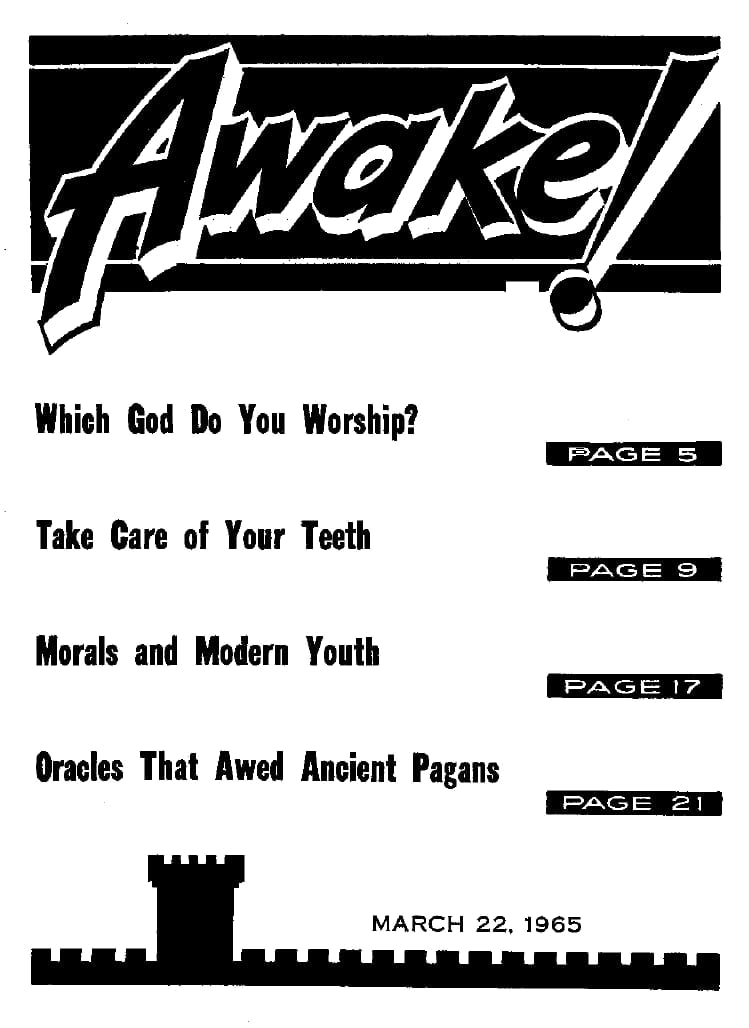
Which God Do You Worship?
PAGE 5
Take Care of Your Teeth
PAGE 9
Morals and Modern Youth
PAGE 17
Oracles That Awed Ancient Pagans
PAGE 21
MARCH 22,1965
THE REASON FOR THIS MAGAZINE
News sources that are able to keep you awake to the vital issues of our life be unfettered by censorship and selfish interests. "Awake!" has no fetters. It facts, faces facts, is free to publish facts. It is not bound by political ties; it is unnamped by traditional creeds. This magazine keeps itself free, that it may speak freely to you. But it does not abuse its freedom. It maintains integrity to truth.
The viewpoint of "Awakel" is not narrow, but is international. "Awakel" has its own correspondents in scores of nations. Its articles are read in many lands, in many languages, by millions of persons.
In every issue "Awake!" presents vital topics on which you should be informed. It features penetrating articles on social conditions and offers sound counsel for meeting the problems of everyday life. Current news from every continent passes in quick review. Attention is focused on activities in the fields of government and commerce about which you should know. Straightforward discussions of religious issues alert you to matters of vital concern. Customs and people in many lands, the marvels of creation, practical sciences and points of human interest are all embraced in its coverage. "Awake!" provides wholesome, instructive reading for every member of the family.
"Awakel!" pledges itself to righteous principles, to exposing hidden foes and subtle dangers, to championing freedom for all, to comforting mourners and strengthening those disheartened by the failures of a delinquent world, reflecting sure hope for the establishment of God's righteous new order in this generation.
Get acquainted with "Awake!" Keep awake by reading "Awake!"
PUBLISHED SIMULTANEOUSLY IN THE UNITED STATES BY THE
WATCHTOWER BIBLE AND TRACT SOCIETY OF NEW YORK, INC.
127 Adams Street
AND IN ENGLAND
WATCH TOWER BIBLE AND TRACT SOCIETY
Watch Tower House, The Ridgeway
London N.W. 7, England
N. H. KNOR, President
GRANT SCHOOL, Secretary
Printing this issue: 4,250,000
4d a copy (Australia, 3/4c, South Africa, 3/4c)
Ottawa
Ottawa, U.S., 117 Adams Street, Brooklyn, N.Y. 11201 1/4c
for semiweekly editions
Canada, 150 Bridge Avenue, Toronto, T9C 19. 01
$7/New Zealand, 823 New North Place, Ankara, S.W. I
$7/South Africa, Private Bag and Mail, Cape Town, T9C
Rentals for responses should be sent to the office in your country. Rentals please your remittance to Brooklyn in neat at least two weeks before express subscription
Now published in 26 languages
Salmethiom. — Arkhangai, Cebu-Viayan, Yapat, Dutch, Ench.
Bahrain, Kuwait, Lebanon, Maldives, Malaysia, Seychelles,
Sao Tome, Japan, New Zealand, Puglia, Spain, Swedish,
Tangkak, Tangkak, Chiang Kaw, Hilippine-Viayan, Malaysia,
Pohli, Tamil, Uzbekistan.
CHANGES OF ADDRESS should remain thirty days before your moving date. Give as your old and new addresses the same address. Mail address to Watch Tower, Watch Tower, Watch Tower. The Ridgway, London M.W. 7, England.
Entered as second-class matter at Brooklyn, N.Y.
Printed in England
The Bible translation regularly used in "Awake!" is the New World Translation of the Holy Scriptures, 1961 edition. When other translations are used, this is clearly marked.
CONTENTS
Every Treasure Has Its Price 3
Which God Do You Worship? 5
A Miracle-working "Saint" 8
Take Care of Your Teeth 9
Electricity from Steam "Down Under" 13
Nostradamus' Astrological Predictions 16
Morals and Modern Youth 17
The Picturesque Pamblemousses
Garden 20
Oracles That Awed Ancient Pagans 21
A Country Market in British Guiana 25
Specially Designed Skin
"Your Word Is Truth"
Are They Really Disco
Watching the World
Volume XLVI
Number 8
WHAT are your treasures, the things that are of great worth or value to you? They include much more than your material riches. Are not your health, your marital bliss, your liberty
many pains."—Eccl. 5:12; 1 Tim. 6:10. Underscoring these truths is the experi-
and especially opportunities to use your abilities also treasures? Yes, indeed, and each of these treasures has its price.
Obvious as this truth is, it is continually overlooked by persons, to their great harm. Either because of ignorance, selfishness or carelessness many work against their own best interests by ignoring that great truth.
Thus, many persons desire material riches and pursue them intensely, oblivious to the price they exact. A fine home is a treasure that requires or costs much in the way of taxes, insurance, upkeep and repairs. Much of the same is true regarding a fine auto or a motorboat. Thus, inspired wisdom tells us: "Sweet is the sleep of the one serving, regardless of whether it is little or much that he eats; but the plenty belonging to the rich one is not permitting him to sleep." How fitting, therefore, is the warning of the apostle Paul: "The love of money is a root of all sorts of injurious things, and by reaching out for this love some have been led astray from the faith and have stabbed themselves all over with
ence of an English bachelor clerk. He had won one of the highest prizes of all time in a soccer pool, more than £225,000, or upwards of $630,000.
But did this make him happy? No, for hardly a week had gone by before he moaned: "This is too much for a man like me. Much too much. I must be the unhappiest man in Britain."—New York Times, April 19, 1964.
Far more valuable than any such material possessions is the treasure of good health, is it not? Yet how many are unwilling to pay the price it exacts in the form of moderation and self-control! Thus, in spite of all the cumulating evidence of the harm to one's health that cigarette smoking does, Americans still consume them at the rate of more than 4,000 annually for each adult.
The treasure of marital bliss is another case in point. Today ever so many want to have this treasure, especially youth, but are unwilling to pay the price it requires. But a happy marriage does have its price. It means denying oneself many of the things one was formerly used to, not least of which is being able to do and go as one pleases without always having to consider another person.
The young married man will have less time and money for his hobbies; and his wife, for clothes and permanents. Emotionally and mentally immature, and economically insecure, no wonder that so many of today's marriages of the young folks founder in a short time. Of course, if such youths had familiarized themselves with Bible principles on the subject, they would not have so eagerly and blindly rushed into marriage.—Eph. 5:24; Col. 3:19; 1 Pet. 3:7.
One of the men who shared in founding the United States had a slogan, "Give me liberty or give me death." No question about his appreciating the treasure of liberty. But liberty taken for granted is soon lost, for which reason it has well been said, "Eternal vigilance is the price of liberty." Those willing to curtail the freedoms of others often find that they have undermined the guarantees of their own liberty.
Today political independence has accrued to more peoples than ever before, but many who have agitated for it have not been willing to pay the price It exacts, that of subordination of self-interest for the common good. More than one land is divided today for this very reason, and the current crises in other lands that have but recently gained their freedom underscores the fact that these people wanted the treasure of political independence but were not all willing to pay the price of subordinating self-interest for the national good—a failure that, no doubt, is due in part to the former rulers' having neglected to educate their colonials properly.
of added burdens, the responsibility of making weighty decisions, the exercise of self-control under stress, and so forth? Actually, as Jesus so well pointed out, "whoever wants to become great among you must be your [servant], and whoever wants to be first among you must be your slave."—Matt. 20:26, 27; 1 Tim. 3:1-7.
At times a young minister in a Christian congregation may keenly desire to be the presiding minister, which, as the Bible shows, is a noble desire. But has he given careful consideration and thought to the price such a treasure exacts in the way
This principle, that every treasure has its price, is what we should expect to find in a universe that was created by a just and wise Creator, One who said: "Whatever a man is sowing, this he will also reap." (Gal. 6:7) This, for one thing, emphasizes the wisdom of not pursuing any treasure without first considering the price it demands. Jesus said this even in regard to the treasure of Christian discipleship: "First sit down and calculate the expense." We want to be mentally, emotionally and otherwise equipped to pay the price for any worthwhile treasure if we would enjoy owning it. Otherwise, we will be like the seed that fell on rocky ground. It grew up fast but did not have what it took when the sun's heat beat upon it.—Luke 14:28; 8:6, 13.
The foregoing examples also underscore the wisdom of the Scriptural principle that "godly devotion along with self-sufficiency," or contentment, is great gain. For example, why intensely pursue extensive material treasures, since they are bound to exact a high price in upkeep and concern? And further, implied in all the foregoing is the wisdom of Jesus' words in counseling his followers to lay up treasures in heaven, for they bring great rewards and they last forever. Doing so, we can expect to have the blessing and approval of the Creator, concerning which a wise king long ago wrote: "The blessing of Jehovah—that is what makes rich, and he adds no pain with it."—1 Tim. 6:6; Prov. 10:22.
THE name of the true God all but forgotten today—appears many times in the Holy Bible. It is found in the very beginning of the Sacred Scriptures, in the second chapter of the Bible's first book. There, in Genesis 2:4, the original Hebrew in which this passage was written says: "Jehovah God made earth and heaven."
The Bible translator Rotherham sald God's name, Jehovah, "is nearly hidden" in most modern Bible translations.* Yet this Divine Name appears 6,961 times in the thirty-nine
why you may not find it in your own English translation of the Bible.
books of the Hebrew Scriptures.
Even the name "Jesus" is a form of the Hebrew word Jehoshua, which means "Jehovah is Savior." Further, a shortened form of God's name Jehovah appears in the Bible's last book, Revelation. It is a part of the famed exclamation "Hallelujah," which means "Praise Jah," or "Praise Jehovah."—Rev. 19:1-6.
A "Universal" Faith?
Thus, in the original languages in which the Bible was written, the Divine Name appears from that Sacred Book's beginning to its end. This name distinguishes the Bible's God, the true Creator, from all false gods. It is only logical, then, for you to ask why that Divine Name has been eliminated from many modern Bible translations—
One reason is that many translators disagree with the Bible's inspired writers. Consider, for example, the introduction to the Revised Standard Version of the Bible; which gives this as a reason for not using the Divine Name: "The use of any proper name for the one and only God, as though there were other gods from whom he had to be
distinguished,
. . . is entirely
inappropriate
Christian
Church."*
But the writers of the Bible used that name. Is it honest for mere translators to change what the original
writer of a work wrote, in order to insert into it their own personal ideas? Unlike the Bible's writers, these religious leaders want to ignore God's name. They want to do this specifically so worshipers of pagan "gods" will think we are all worshiping the same one. When they speak of "the universal faith of the Christian Church," they mean they think all kinds of worship are approved by the true God. They want to eliminate the distinction the Bible makes between the worshipers of the true God and the worshipers of false divinities men have imagined.
Yet, according to their own Revised Standard translation, the Holy Bible they translate clearly says: "For although there may be so-called gods in heaven or on earth—as indeed there are many 'gods' and many 'lords'—yet for us there is one God, the Father, from whom are all things and for whom we exist, and one Lord, Jesus Christ, through whom are all things and through whom we exist."—1 Cor. 8:5, 6.
Thus, there is no justification for deliberately hiding the name of the "one God, the Father," for the specific purpose of leading worshipers of the "many 'gods' and many 'lords'" into thinking that there is no difference between their man-made gods and the Creator.
Early Christians knew that true worship is not "universal," that it cannot include the false "gods" of this world. They had the Hebrew Scriptures, the first thirty-nine books of the Bible, which had been written long before the time of Jesus' earthly ministry. Early Christians knew those inspired Hebrew Scriptures, applied them, and used them as a source of their teaching. They knew that those Scriptures repeatedly stress the fact that true worship is not universal, and that the true God "Jehovah is greater than all the other gods."—Ex. 18:11.
So, despite what modern clergymen say, the "one and only God" is to be distinguished from the false "gods" of the world. He himself stressed the distinction that should be made between the true God and man-made divinities. He said: "I am Jehovah your God . . . You must never have any other gods against my face." And: "You must not mention the name of other gods. It should not be heard upon your mouth,"—Deut. 5:6, 7; Ex. 23:13.
Name Known and Used
The Creator also inspired Moses to specify: "Jehovah your God you should fear . . . You must not walk after other gods." His servant Joshua added: "You must not mention the names of their gods nor swear by them." The people responded: "It is unthinkable on our part, to leave Jehovah so as to serve other gods."—Deut. 6:13, 14; Josh. 23:7; 24:16.
Is it not equally unthinkable for modern translators of God's Word deliberately to drop his Name from their Bible translations because using that Name does not fit their preconceived ideas of what Christendom should teach? Is it not an offense to the Creator to say it is "entirely inappropriate" to use his Name? Is it not deceitful to drop God's name from the Bible for the specific purpose of persuading people who do not know him into thinking that the Bible is written about their own false gods? Is it not an insult to God for men who translate his Word to put a current theological idea ahead of what God himself has said?
Translators who do this put themselves in the same position as that in which were certain Israelites, concerning whom the Bible book of Judges says: "Thus they abandoned Jehovah the God of their fathers . . . and went following other gods from among the gods of the peoples who were all around them and they began bowing down to them, so that they offended Jehovah."—Judg. 2:12.
The Bible says that people who should have worshiped Jehovah, but who accepted false gods, committed "immoral intercourse" or, according to some translations, "played the harlot" or "went a whoring after other gods." (Judg. 2:17) Why such strong language? To emphasize the extent to which the true God considers accepting false gods to be a vile act of immoral infidelity.
God's people knew his Name, and there is no question about the extent to which they used it. They even incorporated it into geographical names that commemorated Jehovah's mighty deeds, and into the intimately personal names they gave their own children.*
So, despite the fact that some of Christendom's leaders have their own ideas about what is true doctrine, we must accept the inspired Biblical account. It says God's name is Jehovah. It shows that the worship of the true God is not a "universal" religion—that it does not take in the worship of false gods. To be really Christian we must follow Christ's example. Christ said, in prayer to his Father: "I have made your name known to them and will make it known."—John 17:26.
No Other Name Found
No other personal name for God is found in the Bible. The word "God" is not a name. It is a title. It applies equally to pagan gods such as Isis, Horus, Zeus, Mars and Venus. It also applies to a host of other false "gods" invented by men who rejected true worship. The word "Lord" is not a name. It, too, is a title. It is a title used even for members of European nobility. However, the Lord God, who created heaven and earth, may be identified by his Name. A popular desk dictionary, therefore, correctly gives as one definition of the word Lord: "The Supreme Being; Jehovah," and defines Lord of hosts as: "Jehovah as supreme over all."†
The French Catholic Encyclopédie Théologique (Theological Encyclopedia) says the name Jehovah is "God's own name in Hebrew . . . Among the Hebraists, some pronounced Jehovah, others Javoh, others Jehveh."*
Why did not everyone pronounce it the same way? Because in ancient times the Hebrews wrote only the consonants of their words, not the vowels. Since God's name was, in later times, superstitiously hidden from the common people, the vowel sounds that go with the four consonants of the Divine Name were, in time, lost. YHWH (or JHVH), the four Hebrew consonants with which this name is written, are called the Tetragrammaton. The Encyclopédie Théologique explains: "Tetragrammaton . . . term often used for the name of Jehovah, which the Hebrews, out of respect, no longer pronounce. . . . The Greeks more readily use the word Tetragrammaton, which identifies the four letters that compose the name: that is, jod, he, vau, he, נְחָב, Jehovah."†
Only Jehovah Is God
Protestant clergyman Hellmut Rosin adds: "Thus the NAME never ceases to be the source and the rule of all assertions regarding God and cannot be replaced by any 'universal designation of God.'" ‡
Rosin, who thinks it is not necessary for Christians to use the Divine Name, still argues that modern translators should always translate God's name by the same word. He insists that the word used for the Divine Name be different from the word that is used to translate Elohim, the Hebrew word for "God."
He cites the example of Bode's Indonesian translation of the Psalms, and says: "In Ps. 1:2 YHWH is rendered by Allah.
The reader's expectation to find the NAME regularly behind this term is thoroughly disappointed. For the same word (Allah) serves e.g. in Ps. 42:2-3 to translate Elohim. Thus the true God seems to be designated by Allah irrespective of the differentiation between name and title."*
Obviously there is no reason to render the title "elohim" by the same word that is used to translate Jehovah's name. But there also is no reason to change Jehovah's name to Elohim's equivalent. The Holy Scriptures say Jehovah is God.
Rosin correctly adds: "YWHH is GOD! . . . This 'self-translation' of the NAME does not mean we are entitled to put our conception of God in its place in a translation of the Scriptures. The sentence is not reversible: GOD (or what we understand by this term) is YWHH." And: "According to the Old Testament various Names of God do not exist: YWHH sh'mo! YWHH is his Name! (Ex. 15:3)."†
There is a great deal of meaning in those words. We cannot say: "Buddha is Jehovah." We cannot say: "Allah is Jehovah." We cannot say: "Brahma is Jehovah." Therefore, according to the Bible, which says Jehovah is God, we cannot say Brahma, Allah or Buddha is God! The true God does not fit in with the "universal" idea
held by many members of today's so-called "Christian religion." According to the Sacred Hebrew Scriptures, which Jesus and his apostles used as a basis for their teaching, JEHOVAH is God! He is the one of whom Jesus spoke when he taught us to pray: "Our Father in the heavens, let your name be sanctified."—Matt. 6:9.
Jesus knew the importance of serving his Father, Jehovah. One of the first-century scribes asked him: "Which commandment is first of all?" He replied by quoting Deuteronomy 6:4, 5 and Leviticus 19:18. Jesus called the first of these passages the "greatest and first commandment." It says: "Jehovah our God is one Jehovah. And you must love Jehovah your God with all your heart and all your soul and all your vital force." The second says: "You must love your fellow as yourself." Today's religions talk a great deal about the second of these commandments, but most of them ignore the one Jesus said was first: To love Jehovah ahead of everything else.—Mark 12:28-31.
It is to his Father Jehovah that Jesus spoke when he said: "I have made your name known." (John 17:26) Jehovah is Jesus' God. Is he your God? Only by accepting him can you really follow Christ. Only in this way can you really be a true Christian. If your religious organization does not talk about Him, then perhaps it is time to look to persons who do!
A Miracle-working "Saint"
Among about eight hundred rare pieces of religious art, both national and foreign, being exhibited in the National Institute of Fine Arts, in Rio de Janeiro, Brazil, is a little "saint" that works miracles. It belongs to a collection that dates back to the seventeenth century. Its history is rather unusual.
In the olden times of Brazilian history, the smugglers of gold and precious stones would hide their contraband in the body of a wooden saint that was hollow inside. As soon as this "saint" entered the smuggler's house, lo and behold, a miracle was performed—the family suddenly became wealthy! So the expression "Santinha do Pau Oco" (Saint of hollow wood) came to mean a person who was a "fraud," "hypocrite," and is so used today.
TAKE CARE OF
YOUR TEETH
</div>
FEW things contribute more to an attractive personal appearance than a clean, well-formed set of healthy teeth. That they can either make or mar the beauty of the face is obvious when a person smiles. Another reason for paying attention to dental hygiene is to avoid unpleasant breath, which can be so offensive. The teeth also facilitate speech and breathing. However, there is yet a more vital reason for caring for your teeth, and that is because they are necessary for chewing the food that you need to live.
But when this care is neglected, and food particles are allowed to cling to and stick between the teeth, you may be in for trouble. Tooth decay may start, and if it is left unattended, it will continue until finally your teeth may have to be extracted. So rather than wait until you have to struggle to eat with teeth missing, how much better to learn about their care while you still have them!
The modern epidemic of dental disease should cause you to be seriously concerned about the proper care of your teeth. In the United States alone more than nineteen out of twenty high school students have tooth decay, and an amazing 22 million persons, or nearly 13 percent of the population, are completely toothless. This includes a surprising number of young people. The situation is no better in Great Britain, where more than 40,000 schoolchildren a year are fitted with false teeth. The plague of decay has reached such proportions that a British Medical Association magazine reported that "provision of dentures for children who have not left school is becoming commonplace." Other countries also have been hit hard by the epidemic of
dental disease.
A Paradox
Despite the emphasis on brushing one's teeth and seeing a dentist regularly, tooth decay continues on the rampage. The American public pays out $2,000,000,000 a year for dental care, yet the teeth of many people are in such bad shape that, according to an estimate, it would take more than twice the present number of dentists working ten years merely to repair the backlog of tooth troubles. But what seems paradoxical is that in certain other places where toothbrushes and dentists are practically unknown, there is hardly any tooth decay at all.
For instance, a recent survey of a Nigerian village of 600 persons turned up only two small cavities, both of which were in the mouth of a little child. A similar survey of 1,085 Ethiopians revealed that those under forty years of age averaged less than one decayed, missing or filled tooth per person! This is truly remarkable when one considers that nearly 10 percent of the 2,000,000 Americans first examined for service in World War II were rejected because of missing or bad teeth. They did not have the required six or more upper teeth that would make contact with six or more lower teeth deemed necessary to handle Army food.
And these were men in the prime of life, between the ages of eighteen and thirty-five!
The teeth of Americans, however, were not always in such bad condition. Back in 1800, when there were only 100 dentists in the country and toothbrushes were either a novelty or unheard of, the teeth of people were apparently much sounder. What does this indicate? That the use of toothbrushes and the increase in number of dentists are responsible for today's unprecedented tooth decay? No. But, rather, that the diet is apparently an important factor in the health of the teeth.
The Diet's Effect on Teeth
This was mentioned in The Encyclopedia Americana, 1956 edition, Volume 26, page 322, which said: "It is possible that the so-called civilized diet has much to do with the increased incidence of caries [tooth decay] in a race which in former times was immune. In a series of several thousands of skulls which were examined, all of which dated back to an age of 200 to 300 years, caries was found to be present in some 10 per cent as against a much larger percentage (80) existing today. It is a curious and interesting fact that the condition is rare among certain isolated groups of people."
On the following page this same source made the additional observation: "Softer foods that are taken fail to afford the necessary exercise and stimulation and they do not provide, during mastication, the polishing action so important for tooth preservation. Hard foods, on the contrary, give functional stimulation and polish the teeth so that broken particles do not lodge between the teeth, thereby favoring decay and fermentation." Dentists are quick to point out that the modern diet often consists largely of cooked foods that require
little chewing, and that this is a factor in tooth decay.
Interestingly, medical men who commented on the recent surveys in Nigeria and Ethiopia also attributed the remarkable absence of tooth decay to diet. It was noted that these people did not use any sugar, sweetened baked goods, candy, carbonated soda water or refined foods common to "civilized" countries, but ate whole grains, yams, green vegetables, and the like.
The fact that diet has a vital effect on the teeth seems unquestionable. A person cannot examine the mouths of "young people who eat white bread, processed cereals and white sugar," observed one dentist, "without coming to the conclusion that a definite relationship exists between living food and healthy teeth and between processed food and decaying teeth." But why is it that certain foods are harmful to the teeth? What actually is responsible for tooth decay? Does brushing the teeth do any good?
What Causes Tooth Decay?
"The process of decay is very complex," the American Dental Association observed. "It is, in fact, so complex that we haven't isolated all the elements that would allow dental science to formulate a thorough explanation." It is known, however, that tooth decay never originates from within the teeth, but always begins on their surface. The evidence also seems to indicate that the chief factors in producing decay include mouth bacteria, food debris and dental plaque, a gelatin-like film (composed of saliva components, bacteria and other substances) that adheres to the surface of the teeth.
Although the mouth harbors vast numbers of bacteria, tests in which animals were fed by stomach tubes showed that their teeth did not decay as long as there was no food in their mouth.
Other experiments demonstrated that even if food was in the mouth, if certain strains of bacteria were not also present, tooth decay did not develop. It was also found that tooth decay could be transmitted from one animal to another by transferring decay-causing bacteria from an infected animal to a non-infected one.
Evidently with such investigations in mind Dr. Francis A. Arnold, director of the National Institute of Dental Research, reported: "Research with experimental animals suggests that tooth decay may be transmissible like other infectious diseases. Possibilities have been demonstrated that it may be infectious and transferable in humans by certain microbes found on the surfaces of the teeth." On the basis of such research it has been suggested that physical contact such as kissing could spread tooth decay.
But just how is it that bacteria and food debris cause cavities? It is presently believed that the bacteria in the film of dental plaque break down food particles to form weak acids. These acids are then held in contact with the teeth by the thin film of dental plaque, and there attack the enamel surface. However, it takes many such acid attacks on the same spot before a cavity develops. It is also interesting that research has discovered that some foods are broken down to form acids much more readily than others.
Carbohydrate foods such as sugar, candy, cola beverages, presweetened cereals and pastries are converted to acids in an especially short time, harmful amounts being produced in as little as five minutes. Thus careful studies have demonstrated that when these foods are eliminated from the diet, tooth decay is greatly reduced. This helps one to understand why cavities are such a rarity among isolated
peoples whose diet Includes a minimum of these foods.
Approaches to the Problem
This information regarding the cause of tooth decay helps one to understand how this disease might be combatted. At first, a person may conclude that the logical solution would be to eliminate from the mouth the acid-forming bacteria. But, unfortunately, antibiotics that would kill these bacteria would also destroy the many helpful bacteria in the mouth. However, in this connection it is interesting to note that about 1 percent of the population are said to possess a natural antibiotic that immunes them to tooth decay.
This is what bacteriologist Gordon E. Green reported to the American Dental Association not long ago. He said that in the saliva of these fortunate people he has found an antibacterial substance. It has been known for some time that saliva, which is slightly alkaline, is effective in neutralizing the acid formed on the teeth by the bacteria. For this reason, when saliva flow is reduced, as can happen during sickness, susceptibility to tooth decay increases. But even when saliva flow is normal, some persons' saliva affords better protection against decay than does that of others. So it is interesting that it is now thought that an antibacterial substance in the saliva may be responsible for resistance to tooth decay.
However, since the saliva of the vast majority of the population does not afford sufficient protection, and since efforts to kill mouth bacteria are not feasible, what can be done to prevent cavities? Two practical things that can be done are to reduce the amount of carbohydrate foods in the diet, and, secondly, to clean food debris from the mouth immediately after eating and before the corrosive acids have time to go to work.
Most persons will probably consider a drastic cut in carbohydrate foods unduly restrictive, yet there is a simple dietary measure that will go a long way to prevent cavities. That is to replace sugar-filled desserts and snacks, such as pastries, ice cream, soda pop, candy and the like, with fresh fruits or sliced vegetables. When an apple, piece of celery or raw carrot are eaten after a meal or for a snack, the teeth do not become filled with a lot of gooey, decay-producing debris, as is the case when cookies or cake are eaten. So by simply making a piece of fruit or raw vegetable your before-bed or in-between-meal snack rather than some sweet, you may be able to keep your mouth cavity-free.
Keep Your Teeth Clean
But since most persons inevitably succumb to a desire for sweets, the only way for them to keep teeth healthy is to clean them immediately after eating. This is especially vital for children, because they are particularly susceptible to tooth decay. Remember that the key word is IMME-DIATELY, for in as little as five minutes after eating, bacteria break down the sweets into acids, and they start attacking the teeth. True, the hard enamel surface can withstand many acid attacks, but eventually, if the teeth are not kept clean, the surface will be breached and a cavity will begin.
Rather than forbid all sweets to their children, some parents have the rule that candy and pastries may be eaten, but that the teeth must be cleaned immediately afterward. Dental experts emphasize that if one waits for thirty minutes after eating, brushing the teeth is practically useless, for most of the damage has already been done. So it is obvious that washing the teeth when rising in the morning does little more than sweeten the breath. The vital time is immediately after every time
one eats. Since this is not always convenient or possible, a good substitute is to swish water around the mouth and force it through the teeth. The important thing is to get food debris from the mouth.
So, when washing the teeth, remember that the primary purpose is to get food particles from the mouth before bacteria have a chance to form destructive acids. To accomplish this, one toothpaste is probably as good as another. In fact, for all practical purposes dentists say that a combination of salt and baking soda makes an efficient dentifrice. The key factor is the method of brushing.
Unfortunately the majority of persons fall into the habit of brushing their teeth back and forth horizontally. Instead of removing food particles, this method often forces particles between the teeth, where they become a factor in causing tooth decay. A recommended way is to brush the teeth up and down. On the upper teeth, use a wrist action, brushing downward and slightly back and forth in order to get at areas between the teeth. On the lower teeth, brush upward, using just the reverse action as when doing the upper teeth. Follow an orderly pattern, cleaning each tooth and brushing on both the cheek side and tongue side of the teeth.
You may object that you could never get your children to take such care in brushing their teeth. However, for their future welfare it is vital that you try. Healthy baby teeth will guide permanent teeth into proper place and immeasurably enhance the beauty of your child's face. So start teeth care early. Undoubtedly the best method is to watch the diet, seeing that it is rich in natural foods. Get into the habit of eating apples, celery and fresh fruit for snacks instead of candy and soda pop. Yes, you and your family can have fine teeth if you take care of them.
Electricity
STEAM
RENOWNED throughout the world for its scenic beauty, New Zealand, the most southern of the major islands of the Pacific, offers a limitless variety of attractions to those who visit its friendly shores. From majestic snow-clad mountains, to flat and rolling fertile plains. From modern bustling cities, to quiet, primitive country towns. Rugged coastline and soft-green river banks. Icy-cold, deepblue glacial lakes, and angry, hissing, superheated steam. Steam? Yes, it comes forcing its way up from the depths of the earth, from a gigantic hidden source, to provide an intriguing and sometimes breathtaking spectacle at the surface.
"DOWN
UNDER"
</div>
By "Awokel" correspondent in New Zealand
Situated a few miles north of beautiful Lake Taupo, New Zealand's largest lake, and almost in the center of the North Island, is found one of the most interesting and noisy valleys in the world, Wairakei, or "Water of Adornment," is the picturesque name given to it by the brownskinned Maori people, and it aptly describes an area of intensive hot-spring activity. Concentrated throughout the valley are clusters of bubbling mud pools and springs that periodically erupt into columns of hot water as high as fifty feet, spraying the surrounding rocks and vegetation. Minerals and silica from the underground water color the ground around the
pools white and gray and occasionally a delicate shade of pink. To the visitor it is a seemingly endless display of geysers, plopping mud craters and curious rock formations that delight the eye. Truly a natural paradise!
But a no less arresting feature of Wairakel can readily be seen as one journeys along the main Auckland to Wellington highway. He has a view of immense concrete cylinders, billowing steam hundreds of feet into the air, accompanied by a deafening roar. This is the Wairakei production area, where the vast underground hot-water system has been tapped successfully at its natural outlet and utilized in the production of that vital commodity, electricity.
To meet the rising demand for electric power in the country, the New Zealand government began searching for new energy sources and, fourteen years ago, approval was given to a scheme for the development of a power station that would use geothermal, or underground, steam to drive its turbines. Although venturesome for a small country like New Zealand, the harnessing of this energy from beneath the ground was not new. Over half a century ago a similar project was undertaken in Larderello, Italy, and was developed so successfully that today the Larderello scheme produces over two billion kilowatt-hours a year—enough to operate the entire Italian electric railway system, which does, in fact, derive two-thirds of its power from the scheme. New Zealand became the second in the world, and today geothermal power is being exploited in the United States, the Soviet Union and other countries around the globe.
Geothermal Steam Harnessed
How is the steam obtained and used? The process is surprisingly simple. First of all, a hole or bore must be drilled to release the steam, which is then conveyed at pressure through pipelines to the power station, where it expends its energy driving the turbines that produce the electric power. Drilling methods and equipment are very similar to those used in oil drilling, with some adaptations to allow for the high temperature. When a bore is sunk it releases the tremendous pressure on a quantity of superheated water, causing it to boil and produce steam. The expanding steam forces its way up the bore to the surface, where it is tapped. Although steam can be obtained at a depth of two hundred feet, production bores are much deeper, with many at Wairakel being drilled to a depth of four thousand feet—over three-quarters of a mile deep!
The actual opening of a bore is spectacular, a sight not likely to be forgotten by those who witness it. Woosh! With a steadily growing roar, water, steam and small fragments of rock are hurled high into the air, covering the surrounding ground and vegetation with a superfine dust. One bore at Wairakei erupted four hundred tons of rock and other material during the first twelve hours!
Unlike Larderello, Italy, which produces "dry" steam, large quantities of water are obtained at Wairakei along with the steam. Special equipment, called centrifugal separators, is erected at the head of the bore to separate the water from the steam. This is necessary, since only steam is used to drive the turbines. The separated water at extremely high pressure and at a temperature of well over 100 degrees Centigrade used to be released into the atmosphere through giant concrete cylinders called flash tanks. In these tanks, visible from the main highway, the superhot water was subjected to a sudden reduction in pressure and flashed immediately into steam, which billowed high into the air, accompanied by a steady thunderous roar. The now "dry" steam was fed into specially insulated pipelines and carried to the powerhouse. A strange feature of Wairakei is that the powerhouse is actually two miles from the production area, on the banks of the Waikato River. Why is this? Simply because a large supply of water is necessary to condense the spent steam, and therefore the station is closer to the river, where an adjacent pumping station provides the necessary water. At varying pressures in the main pipelines, the vapor is passed through high-, intermediate- and low-pressure turbines, which drive the power station generators, and it is at last condensed into water and discharged into the Waikato River.
The pumping station needs to provide water at approximately the rate of one gallon per minute for every kilowatt of power produced. During the winter months of 1964, the station was able to produce, on an average, somewhere between 160,000 to 175,000 kilowatts. That means that the pumping station needed to pump water from the river at 160,000 to 175,000 gallons per minute—some seven hundred tons of water every minute.
The pipelines that carry the steam to the river bank are themselves an unusual addition to the landscape. Five steel pipelines, each twenty inches in diameter, lying side by side, stretch from the production field to the power station two miles away. Peculiar sixteen-foot-high expansion loops, shaped like inverted U's, suddenly appear every 1,000 feet, as if the pipes tired of their monotonous, ground-level journey. Each of the 16,000 welded joints in the pipes was checked carefully for any leakages by X rays and radioactive isotopes flown out from Harwell, England, as the maintaining of the high pressures necessary in the pipes is dependent on perfect sealing of all the joints.
Development is moving ahead rapidly at Wairakei. Just over a year ago, engineers at Wairakei for the first time used what is known as the "flash system" to produce power from the waste superheated water that previously had escaped into the atmosphere, through the great concrete flashing cylinders. Instead of being released, the water is now subjected to the same sudden pressure decrease within a special plant, allowing about one-fifth of the previously wasted hot water to be flashed into steam and added to the mains, thus increasing the supply of steam to the generators. So, in just the short space of fourteen years since the beginning of the project, a new source of heat energy has become a vital part of the country's power system and the third-largest producer of electric power in New Zealand's North Island. Wairakei generates power continuously around the clock, giving it a total daily output that exceeds that of a similar-sized hydroelectrical station designed to work at full power for a lesser period to match the average power demand. And the end is not yet! A further stage is planned that will increase the yield to one-quarter of a million kilowatt-hours a year. How much will all this cost? The final estimate is at £24,000,000, or about $67,200,000!
The Origin of Underground Steam
Where does this useful steam come from? No one seems to know for sure how it is formed. Today, among scientists, there seems to be general agreement that up to 95 percent of geothermal steam is of meteoric origin. That means that it is based on surface water filtering down
through the crust of the earth and being heated by the earth's interior. The remaining 5 percent is said to be magmatic in nature, that is, it is given off by molten rock material within the earth. A New Zealand scientist, C. J. Banwell, has suggested that the heat flow is maintained by superhot steam separating from this molten rock and rising through fissures from as much as seven miles below the surface. At a depth of about 3,000 feet it comes into contact with surface water that has gradually filtered down and heats this water. It is this heated surface water rising again that manifests itself as hot springs and geysers at the earth's surface.
As is usually the case when embarking on a new scientific venture, many problems arise needing a solution, and the harnessing of underground steam is no exception. The biggest question facing countries using this energy is, Will the heat source last? No one it as yet certain as to whether the steam temperature will eventually drop, owing to the large quantities being drawn off. Surprisingly, evidence at hand thus far indicates that the reverse is occurring, that is, the temperature is actually increasing. For instance, in New Zealand there has been a noted increase in some areas of the Wairakel field, and in Larderello, Italy, the temperature has risen 40 degrees Centigrade in the past fifty years. It seems a reasonable deduction, in view of this, that the tapping of the steam at a certain level results in heat being drawn up from lower, hotter levels. Another problem is that of replenishment from surface water. Does it circulate quickly enough to match the rate at which the hot water is being drawn off? Only time will tell.
Minor difficulties arise too at the site. Although the great roar from discharging bores not yet connected to the pipelines still seems deafening to the Walrakei visitor, it is reduced from what it was a few years ago.
Silencers, consisting of a series of concentric pipes of increasing diameter, are now fitted to such bores, making work at the site more endurable. Traffic hazards on the main highway that runs through Wairakei are sometimes caused by great clouds of steam from the pipes, and motorists need to be cautious.
Many countries are now exploiting the steam from the depths of the earth and its use is not limited to the production of electricity. Far from it! In the cold climate of Iceland, tomatoes thrive under hothouse conditions brought about by utilizing geothermal steam. In this same land, the steam provides heating for over 45,000 homes. Kenya hatches chickens with the help of steam. In other lands its uses range from the manufacturing of paper to the production of salt and chemical byproducts. In Mexico, Japan, the United States, Chile and Russia, resourceful development of steam from down under is expanding at a fast rate, producing good effects economically and bringing added comfort to millions.
It is a vast and tremendously powerful underground hot-water system, devised with intelligence far beyond the capacity of man's small brain. An ancient psalmist attributes this source of energy to the God of the heavens when he says that in God's hand "are the inmost depths of the earth." —Ps. 95:4.
As yet, man has only opened the cover of a large book of scientific knowledge in the use of natural energy sources to aid civilization. The great stores of energy from our sun, the irresistible forces in the sea with its great tidal movements and crashing breakers—perhaps one day these too will fulfill an unexpected and vital role in man's life on his fascinating planet, along with the mysterious steam from down under.
Nostradamus' Astrological Predictions
The French astrologer commonly called Nostradamus is noted for his Centuries (1555) or astrological predictions written in verse quatrains of mystically phrased riddles. In a dedicatory letter to his son at the head of the first edition of his prophecies, the astrologer stated his purpose to "leave a memorial of me after my death, to the common benefit of mankind, concerning the things which the Divine Essence hath revealed to me by astronomical revolutions." Thus Nostradamus repeatedly linked a study of the stars with his predictions, predictions based on Babylonish astrology and which practice is condemned by God's Word, the Holy Bible. (Deut. 18:10-12; Isa. 47:13) After Nostradamus' death, others apparently wrote predictions under the name of Nostradamus. Thus the magazine Pageant for April 1963 pointed out:
"There were about 20 Nostradamuses. It became a popular term for prophets. From their works, L. Sprague d Camp once extracted 449 predictions. Of these, 18 have definitely proved to be false, events sometimes turning out exactly the opposite from what was forecast. Forty-one predictions have come true, but they were worded carefully so that they had an even chance of being fulfilled in any case. The remaining 390 predictions are just sitting there, nothing having happened yet to make them right or wrong. The first 300 years of Nostradamus's prophesying, then, have been not so good."
However, we cannot scoff at Bible prophecies, which have been fulfilled in the minutest detail because they sprang not from Babylonish astrology but from God's holy spirit. —2 Pet. 1:20, 21.
AWAKE!
THIS world's sexual morality is undergoing a profound change as a new moral code is worked out by the
youths of this age. The hush- hush, hypocritical violations of honorable sex behavior are giving ground to the brazen approach of the rising generation. Under the new code, when sex promiscuity has been indulged, there is not even a consciousness of having violated the law of God. Trial marriage, wife-swapping and divorce are considered to be the common order of things. Though the older generation stands aghast at the lengths to which the new generation is going, they are, in fact, reaping the bitter harvest of their own sowing.
MODERN YOUTH
Is it not the older generation that let down the bars and opened the way for such startling developments? When children
from broken homes throw off restraint and shock their elders, can the parents honestly say that they did not pave the way for it? And is it not from the older generation that youth has learned to smoke and drink? Is it not the older generation that has produced the movies, the TV programs and literature that feature violence and immorality and that have corrupted the thinking of youth? True, not all parents have set a bad example, but, unless they put forth
vigorous efforts to counteract these pressures toward immorality, even their children suffer the effects.
The new moral code is still in its infancy, but its fruits are already of grave concern to thoughtful persons. Sex is prominent as a topic of
thought and conversation in high school and college corridors. Out-of-wedlock pregnancies, hasty marriages, venereal disease, divorces, broken homes and emotional illnesses increase from day to day. In America alone some 7,000,000 persons
now living were born to unmarried parents. In 1963 one out of every eighteen babies was born out of wedlock. Illegitimacy is increasing at such an alarming rate that it is estimated that by 1970 there will be an additional 3,000,000 babies in this category. In Sweden at least 80 percent of all young Swedes engaged to be married indulge in premarital relations. Statistics show that more than a third of the married Swedish mothers who bore their first child in 1960 had been pregnant on their wedding day.
Another concern is the rise of venereal disease among teen-agers—diseases transmitted chiefly by sexual intercourse. According to one authority in social hygiene, venereal disease among teen-agers has ris-
en more than 400 percent in the last four years in the city of New York.
"More than half the people being reported to us with contagious venereal disease are between 15 and 24. Many are between 10 and 14," he said. Despite modern medicine, statistics reveal a rise since 1957 in the city of New York of 496 percent in syphilis cases among those under twenty-one. From the ages of twenty-one to twenty-four the rise is 613 percent! And most disturbing is the suspicion that only about 25 percent of the syphilis cases and 10 percent of the cases of gonorrhea are being reported to health authorities.
Teen-agers and even some persons much older pride themselves on their wide experience in sexual relations as well as their knowledge of how to avoid the dangers incident thereto. But here is where a little knowledge can be a great danger. The chances of contracting a disease are small, they think, and even if it happens the condition will care for itself in time. What they do not know is that one in two hundred victims of venereal disease that go untreated becomes blind, one in fifty becomes insane, one in twenty-five ends up crippled or incapacitated, and one in fifteen suffers from heart disease. Others become sterile. It is not wise to close one's eyes to the facts.
Parental Guidance
Parents, before your children get out of hand, train them up in the way that they should go! What if many of the churches have failed to uphold high Christian moral standards and have even endorsed the world's outlook? There is still God's Word of instruction, the Bible, to guide you. There you will find the fine principles that you should inculcate in your children from infancy. As you continue to train them with authoritative advice from God's guidebook, never let them out of your
mind. Firmly preside over their youthful years, watch closely their associations outside the home, be a good example to them in every situation. Without alienating their affection by acting the policeman or detective, keep track of what they do during the hours that they must necessarily spend out of your company. Interest yourself in their studies at school and offset with good Bible instruction any godless evolutionary ideas that turn up in the course of their schooling. Remember, any undermining of the Creator's position of supremacy in their minds paves the way for your children later to cast aside all authority and be guided only by their own selfish desires.
Progressively, as they grow up, set before them the Bible standard by word and by example. Caution your girl about "nice" boys with their fradulent pleadings of love, rights and freedom. Teach your young ones that love "does not behave indecently." (1 Cor. 13:5) Teach them to pride themselves on chastity. Set up safeguards for them, such as curfews, chaperons, no petting, no liquor and no improper dress. Discuss with them frankly the dangers of allowing themselves to become aroused sexually while alone in the company of someone of the opposite sex. Make clear to them that God's Word condemns not only fornication but also loose conduct, the sort of conduct that easily leads to fornication. (Gal. 5:19-21) Your children desperately need your firm direction during these most vulnerable years of their lives. Do not fail them.
The Wise Course for Youth
Single girls and boys, what about your future? Are you going to take the easy road of compliance with the corrupt thinking of the world, or are you going to exercise your God-given intelligence and prove that you are morally upright and that you have strong love for God's standard of righteousness?
Consider some of these expressions of young people who weakly drift with the wind of current immoral ideas: "If a girl reaches 20 and she is still virgin, she begins to wonder whether there's anything wrong with her as a woman." "We've discarded the idea that loss of virginity is related to degeneracy." "We may be blown to h—tomorrow or the day after. We might as well have a little fun before we go." "If two people are in love, there's nothing wrong with their
cept from them the necessary discipline that will fit you, in turn, to be a good parent. Do not lose sight of the fact that sex relations and intimacies are right only for those who are legally married. They can never be right under any other circumstances. If you never allow yourself to think otherwise, life will be more pleasant for you. To think otherwise is to invite disaster.
Your attitude toward necking and petting should be a positive one, for it is
in love, there nothing wrong with them ting should be a sleeping together,
sleeping together, provided no one gets hurt by it." That certainly is not Christian thinking, but it is the thinking of young people in the world around you.
COMING IN THE NEXT ISSUE
Are Science and the Bible Irreconcilable?
Is Space a New Frontier?
Coping with the Rh Threat in Childbirth.
Let Your Land Cut the Cost of Living.
From the God who created man, and who knows even the inmost thought of human creatures, comes the urgent warning to you: "Flee from the desires incidental to youth." (2 Tim. 2:23). Thus even he
positive one, for it is through such conduct on the part of single persons that moral convictions weaken. For you girls the policy should be "Hands off!" For you boys it should mean no dating for the sake of necking and petting. This may seem radical to you, perhaps even old-fashioned, but it is not. It is good sense. It is a protection for you. It can help you to avoid being unmutually sucked
to youth. (2 Tim 2:22) Thus, even before the wrong desires take hold of your mind, it is time to get away from those persons and places that give rise to them. It is too late when wrong thinking has been entertained to the point of motivating you to wrong actions. Always conduct yourself with others in such a way that you do not feel the need to be out of public view or away from those who know you. Seeking your recreation in company with your parents and the rest of your family will be of great aid to you in maintaining a chaste
into an act that will haunt you with its effects for the rest of your life.
This world is sick unto death, and the present moral collapse is but another powerful evidence of it. Christian youths must deport themselves in a way that is different from the world. They should not conclude that because everyone in the world engages in loose conduct, they should feel free to do it too. Christians are no part of the unbelieving world, even as Jesus was not of the world. (John 17:14) They do
course in life.
Life is ahead of you young people. Some day you may have children of your own, and you will want to see them grow up to be a joy to you and a glory to God. This should help you to understand to some extent the responsibility that your parents have now, and it should move you to acMAROH 22, 1965
not want to act like the rest of the world and so be identified by God as a part of it. If they want to enjoy life everlasting In God's righteous new system of things, they must learn to live in harmony with his upright law now. Let parents and youths unite to make that their happy goal.
By "Awake!" correspondent in Mauritius
AVE you ever seen a tree that flowers once in its lifetime, at a hundred years of age? Such a tree is only one of the colorful attractions that await a visitor to the beautiful Pamplemousses Botanical Garden on the small island of Mauritius in the Indian Ocean.
From the island's capital of Port Louis a taxi or bus will take you a short distance northeast to the village of Pamplemousses. It was early in the eighteenth century that French governors developed this site into a famous botanical garden that, for many years, was considered one of the loveliest in the world.
The garden is enclosed by an iron fence with a large artiste gate, which won a prize at the Festival of Great Britain about the middle of the last century. As you enter the garden, you follow the main road until you come to a small path on the right. This leads to a row of tallipot trees, the trees that blossom but once in their lives in Pamploumouses Garden, after having lived about a hundred years.
The name of these large, erect palm trees is derived from the Sanskrit and Hindu languages. The botanical name is Corypha umbraculifera. They are native to the moist low country of Ceylon and Malabar. They grow to a height of sixty to eighty feet, and have a straight cylindrical trunk that may be three to four feet in diameter. One of the most outstanding features of the tree is its enormous fanlike leaves, which, when crowded together, look very much like a crown laid on the top of
the trunk. A single leaf blade may be as much as sixteen feet across, and have a stout leaf-stalk fifteen feet long. When cut into strips, the leaves are used as a writing material, or can be turned into umbrellas, large fans, sunshades, and so forth.
…