Awake!, December 8, 1964
Download: PDF — Awake!, December 8, 1964
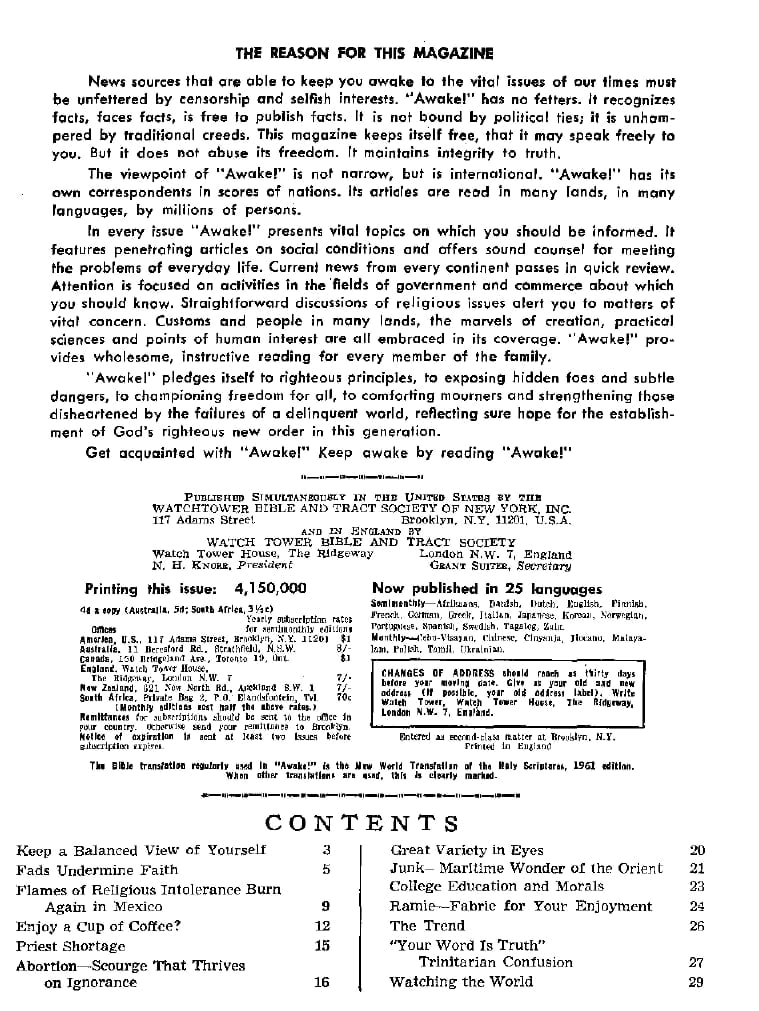
THE REASON FOR THIS MAGAZINE
News sources that are able to keep you awake to the vital issues of our times must be unfettered by censorship and selfish interests. "Awake!" has no fetters. It recognizes facts, faces facts, is free to publish facts. It is not bound by political ties; it is unhampered by traditional creeds. This magazine keeps itself free, that it may speak freely to you. But it does not abuse its freedom. It maintains integrity to truth.
The viewpoint of "Awake!" is not narrow, but is international. "Awake!" has its own correspondents in scores of nations. Its articles are read in many lands, in many languages, by millions of persons.
In every issue "Awakel" presents vital topics on which you should be informed. It features penetrating articles on social conditions and offers sound counsel for meeting the problems of everyday life. Current news from every continent passes in quick review. Attention is focused on activities in the fields of government and commerce about which you should know. Straightforward discussions of religious issues alert you to matters of vital concern. Customs and people in many lands, the marvels of creation, practical sciences and points of human interest are all embraced in its coverage. "Awakel" provides wholesome, instructive reading for every member of the family.
"Awakel" pledges itself to righteous principles, to exposing hidden foes and subtle dangers, to championing freedom for all, to comforting mourners and strengthening those disheartened by the failures of a delinquent world, reflecting sure hope for the establishment of God's righteous new order in this generation.
Get acquainted with "Awake!" Keep awake by reading "Awake!"
PUBLISHED SIMULATION BOOK IN THE UNITED STATES BY THE WATCHTOWER BIBLE AND TRACT SOCIETY OF NEW YORK, INC. 117 Adams Street Brooklyn, N.Y. 11201, U.S.A.
AND IN ENGLAND BY
WATCH TOWER BIBLE AND TRACT SOCIETY
Watch Tower House, The Ridgeway London N.W. 7, England
N. H. KNORE, President Grant Suiter, Secretary
Printing this issue: 4,150,000
4d a copy (Australia, 5d; South Africa, 3 1/2 c)
Yearly subscription rates for semi-monthly editions
Remittance for subscriptions should be sent to the office in your country. Otherwise send your remittance to Brooklyn. Notices of expiration is sent at least two issues before subscription expires.
Now published in 25 languages
Somerset - Africa/Asia, Dambil, Dutch, English, Finnish,
French, German, Greek, Italian, Japanese, Norwegian,
Norwegian, Polish, Portuguese, Spanish, Zulu,
Mediterranean, Vienna, Yugoslav, Haskan, Malayan,
Paleb, Tamil, Ukrainian.
CHANGES OF ADDRESS should reach at thirty days before your moving date. Give as your old age and new address the same address as your current address. Watch Tower, Watch Tower House, Zion Ridgeway, London N.W. 7, England.
Entered as second-class matter at Browshyn, N.Y.
Printer in England
The Bible translation regularly used in "Awake!" is the New World Translation of the Holy Scriptures, 1961 edition. When other translations are used, this is clearly marked.
CONTENTS
Keep a Balanced View of Yourself 3
Fads Undermine Faith 5
Flames of Religious Intolerance Burn Again in Mexico 9
Enjoy a Cup of Coffee? 12
Priest Shortage 15
Abortion—Scourge That Thrives on Ignorance 16
Great Variety in Eyes 20
Junk—Maritime Wonder of the Orient 21
College Education and Morals 23
Ramie—Fabric for Your Enjoyment 24
The Trend 26
"Your Word Is Truth"
Trinitarian Confusion 27
Watching the World 29 Awake!
"It is already the hour for you to awake."
—Romans 13:21
KEEP A BALANCED VIEW OF YOURSELF
WHEN something is out of balance it does not function properly. The automobile wheel that is out of balance will not get good results and may even be a danger to safety. When humans are out of balance they are not functioning properly and create difficulty for themselves and others.
perlor, since his association is not desired by others.
On the other hand, a person should not think so little of himself as to degrade himself, pulling himself down to the animal level in thinking and actions, not caring for his health or personal cleanliness. He has a responsibility toward the one who
Many factors that work against proper human balance are outside our ability to control, such as the pace of life, and political, social and economic pressures. But there is the internal factor, our own thinking and actions, that we can control. Here it is of great help to get and keep the right view of oneself. This results in greater peace of mind and better relations with others. But to produce this balance, an individual must recognize his place in God's creation. How does he fit in? How much should he think of himself? How much
created life, God, for protecting, providing and caring for himself to the best of his circumstances. To dishonor or degrade oneself is to belittle the One who created man.
What, then, is the proper viewpoint one should have of himself? It is God's viewpoint of his creation, man. His inspired Word says that he created "man in his image," and that man, as well as all of his creation, "was very good." (Gen. 1:27, 31) Humankind was also created emotionally and mentally superior to all other earthly forms of life and was to have dominion
should he think of himself? How much should he think of others?
To appreciate the correctness of having balanced view of ourselves, we need only o note how unpleasant, yes, even repugiant it is when someone displays a superior attitude toward his fellowman. The average person does not want to be around me of such disposition. Nor does this work or the best interests of the one feeling suCEMBER 8, 1964
over these.
But should that make one human feel superior to another human? No, for the Bible states: "And [God] made out of one man every nation of man, to dwell upon the entire surface of the earth." (Acts 17:26) So God informs us that, while humans are superior to animals and plant life, they are not to regard themselves as superior to others and try to lord it over them.
In addition, Isaiah 40:22, 23 declares: "There is One [God] who is dwelling above the circle of the earth, the dwellers in which are as grasshoppers, .
. . One who is reducing high officials to nothing, who has made the very judges of the earth as a mere unreality." So all men, even those in responsible positions, should remember they are mere specks in relation to vastly superior spirit creatures in heaven, and infinitesimal when compared to God.
Does one seem overly wise and important in his own eyes? He should also remember that eventually he will tumble into the yawning, hungry grave. All his wisdom and seeming superiority will come to a sudden halt. That is why God's Word says: "A live dog is better off than a dead lion." (Eccl. 9:4) How true the saying: "For you are a mist appearing for a little while and then disappearing"!—Jas. 4:14.
This demonstrates the practical wisdom of the apostle Paul's words when he said: "I tell everyone there among you not to think more of himself than it is necessary to think." (Rom. 12:3) Yes, it is necessary to think something of ourselves, but not too much. Jesus said: "You must love your neighbor as yourself." (Matt. 22:39) In proper balance, self-love is necessary to care for the body and mind God gives. But too much self-love creates imbalance.
A balanced view will humble one and work for his good. It is pride that precedes a fall, not humility! Humility enables a person to acknowledge that he is just one of many in the human family, that he must not feel superior to his fellowman. In fact, he should do 'nothing out of contentiousness or out of egotism, but with lowliness of mind considering that the others are superior to him, keeping an eye, not in personal interest upon just his own matters, but also in personal interest upon those of the others.'—Phil. 2:3, 4.
The humble person appreciates the Bible truth that shows man is imperfect, in a fallen state. As Paul said: "What then? Are we in a better position? Not at all! . . . 'There is not a righteous man, not even one,'" (Rom. 3:9, 10) Thus the humble one understands the frailties and imperfections of others and overlooks the many irritating things they do. He does not demand more of others than these can produce, because he is aware of his own imperfections. Therefore, understanding his proper place in God's eyes makes him kinder and more tolerant of his fellowman. How generous the humble! How harsh, unkind and unyielding the proud, superior-feeling ones!
Besides peace of mind, and better relations between you and your fellowman, there is another benefit that comes from keeping a balanced view of yourself. It is the greatest benefit of all: a proper standing before God. The humble know they have the need to look to God and be guided by him, but the smug, high-minded do not feel this need. However, "God opposes the haughty ones, but he gives undeserved kindness to the humble ones." (Jas. 4:6) Just as the proud and arrogant are repugnant to other humans, so they are to God. —Prov. 16:5.
No, do not think too highly of yourself nor too lowly, but humble yourself before God and man. In this way you will enjoy life and your fellow humans more. You will also be mentally prepared to listen to God when he speaks to you through his Word, adjusting your life to meet his just requirements. In that way, you can be among humble ones who look forward to living in God's righteous new order, where those who keep a balanced view of themselves will enjoy life to the full.—Ps. 37: 10, 11.
"SCENES beyond the worst horror movies unreelled without letup." Such
They dictate the way of life of many people. Some fads may seem to be harmless, but be sure you know the facts.
was the newspaper description of Seattle's Center Coliseum last August when some 14,000 teen-agers packed it out to hear England's long-haired, rock 'n' roll troupe, the Beatles. The fans, with girls outnumbering boys at least 20 to 1, reacted in such a horrendous way that a child-guidance expert in attendance warned: "Parents and adults have a lot to account for to allow this to go on."
Though many adults may only laugh at what is commonly called "Beatlemania," Christian parents realize that worldly fads and crazes such as this undermine faith and spirituality. And even adults are not immune to the faith-weakening effect of fads.
But why are fads damaging to Christian faith? What is there about them that conflicts with Biblical principles?
ago teen-agers went wild over singer Frank Sinatra; fans stormed Times Square, tearing one another's clothes off when deprived of the chance of stripping their idol. During the Elvis Presley craze, fans in Jacksonville, Florida, ripped nearly all the clothes off that rock n' roll singer. The Beatle fad has also resulted in similar, frightening loss of self-control by youths. Describing the goings-on during the Beatles' performance at the Coliseum, the Seattle Daily Times of August 22, 1964, said:
"Almost no one could hear the shaggy-haired foursome. Ear-splitting shrieks and screams rattled the buildings like the high-pitched howling of a cyclone. At least 35 girls were treated in the Coliseum's first-aid room for fainting spells or hysterics that left them helpless in their scats. Several teen-agers had to be restrained by Seattle police as they raced toward the stage with aazed, wild
Lead to Loss of Self-Control
Many fads lead to injury, both physically and spiritually, by reason of loss of self-control. This is especially noted in teen-age fads such as the craze for rock 'n' roll singers. Fads involving singers, of course, are nothing new. Some years
expressions as if in a trance.
... Deafening screams rose in a crescendo which drowned the twanging guitars and voices of the Beatles.
... Frantic girls bounced in their chairs like pop
corn. They wept, towe at their hair, clutched their throats, bit on their hands, swooned and gestured pleadingly toward their heroes."
What a shocking loss of self-control! To those comparatively few adults in attendance it was frightening. A policeman called it "unbelievable." To a child-guidance authority, Dr. Bernard Saibel, the fans' loss of self-control was a "destructive process." Attending at the request of the Seattle Daily News, he wrote his view: "The experience of being with 14,000 teen-agents to see the Beatles is unbelievable and frightening. And, believe me, it is not at all funny. . . . The hysteria and loss of control go far beyond the impact of the music. Many of those present become frantic, hostile, uncontrolled, screaming, unrecognizable beings. . . . This is not simply a release, as I at first thought it would be, but a very destructive process in which adults allow the children to be involved—allowing the children a mad, erotic world of their own without the reassuring safeguards of protection from themselves. The externals are terrifying. Normally recognizable girls behaved as if possessed by some demonic urge."
With such demonic loss of self-control, little wonder that there is physical injury! During the performance a wild fan apparently threw a rock that struck a sixteen-year-old boy on the head. Girls fainted, one suffered a heart reaction. Others trembled so badly from hysteria they had to be restrained. The hysteria was similar when the Beatles played in Australia, leaving behind an estimated one thousand casualties. One girl burst a blood vessel in her throat from screaming.
This terrifying, hysterical reaction is so typical of the fad in rock 'n' roll singers that the fans are sometimes called "screamagers." The fans scream also for Britain's other noted groups of long-haired entertainers, the Rolling Stones, the Pretty Things and the Animals. When the Animals played in New York City, a news report in the New York Times said: "They
make the more sedate Beatles look paralyzed." The frantic fans were a volcano erupting with screams, hysterics and objects hurled up onto the stage.
Is this hysterical screaming and swooning something to which Christian parents want their children to succumb? Not if they want to please God as parents under divine obligation to bring their children up "in the discipline and authoritative advice of Jehovah." (Eph. 6:4) Wisely they help their children to learn to manifest the fruitage of God's holy spirit, which includes "mildness, self-control." (Gal. 5:22, 23) They firmly steer them away from fads that undermine those traits.
Hero Worship Destructive to Faith
Frequently fads center around hero worship, turning the faddists' attention to some prominent personality. A fad may make a hero out of some movie star or a famed army general or a political leader or some sports hero or a popular entertainer or group of them. Many of these heroes do not live moral, upright lives or even profess to be Christians. Still, many are the persons who look to them as if they were saviors. But those who do so are ignoring the wise counsel of God's Word, which declares: "Do not put your trust in nobles, nor in the son of earthling man, to whom no salvation belongs." They forget that Christians are admonished not to be "boasting in men," (Ps. 146:3; 1 Cor. 3:21) They make human creatures the objects of their praise, when they should be giving it to God.—Rom. 1:21-25.
How, then, could any Christian parents allow their children to become Beatle fans? How could they allow their children to act the way hundreds of girls in New York did? At the hotel housing the Beatles the girls squeezed eight deep behind barricades, shouting, swaying and carrying signs that pledged deathless fidelity to the rich, young troubadours.
When anyone so much as ruffled a blind on the floor the Beatles were supposed to occupy, the heroworshipers let out piercing hysterical shrieks and went into a frenzy of jumping and shouting. At the Beatles' Seattle performance fans threw jelly beans at their heroes and, afterward, refused to leave, trying to get to the stage to retrieve a jelly-bean that had touched the Beatles. Some girls picked up cewt wads that had
uan raunt: it punges one into creature worship, into idolatry of humans, and brings God's disapproval, for Christians are told to "flee from idolatry." (1 Cor. 10:14) Now, rather than imitating Christ, the Model for true Christians, these faddists try to speak, dress and act like their idol.—1 Pet. 2:21.
Not Praiseworthy, Modest
Menu youths are now coming the long
Some girls picked up spit wads that had ricocheted off a Beatle. It was as if the Beatles were some kind of gods.
Not just young girls make the Beatles objects of hero worship. Whole crowds of people do. "It's incredible, absolutely incredible," says Derek Taylor, the Beatles' press officer. "Here are these four boys from Liverpool. They're rude, they're profane, they're vulgar, and they've taken over the world. It's as if they'd founded a new religion. They're completely anti-Christian."
Many youths are now copying the long hair of the Rolling Stones and the Pretty Things, which is described as "frenziedly long." The fringe extends below the eye level to give them a disheveled look. "The Rolling Stones are the worst," says a Manchester barber. "One of them looks as if he's got a feather duster on his head." Yet "everything about their appearance is studied and copied" by youths, says English writer Anthony Carthew. "We have become a very shaggy lot in England." Many are the children from five to eight years
they're so anti-Christ they shock me, which isn't an easy thing. But I'm obsessed with them. Isn't everybody? I'm obsessed with their honesty. And the people who like them most are the people who should be outraged most. In Australia, for example, each time we'd arrive at an airport, it was as if de Gaulle had landed, or better yet, the Messiah. The routes were lined solid, cripples threw away their sticks, sick people rushed up to the car as if a touch from one of the boys would
old who now clamor to look like the Beatles or the longer-haired Rolling Stones.
These faddists do not make a fine impression; in fact, the Rolling Stones themselves admit they are "a pretty horrible looking bunch." One of the managers of the Stones says: "People are always asking me if they are morons." Is that the impression you want to make?
Take a look at another fad. This is the fad, especially in the United States, of monsters. Monster hobby kits and toys sell
make them well again, old women stood watching with their grandchildren, and as we'd pass by, I could see the look on their faces. It was as if some savior had arrived and all these people were happy and relieved, as if things somehow were going to be better now."*
How destructive such a fad is to Chris-
by the millions, and youths flock to horror movies. One little girl who recently went to a horror movie was asked what she liked best. "Where they tear out a human heart," she answered. Is this what Christian parents want their children to watch? What are we to think of parents who allow their children to make a fad out of monsters, of violence and of killing? Yet thousands of children regularly read monster magazines.
"Most of our readers," says an editor of such magazines, "are between nine and twelve." Again the fad is not praiseworthy but demonic.—Phil. 4:8.
Sometimes the fad may simply not be modest; to the contrary, it attracts the attention of everyone to the one who indulges in it. This is true with some fads in women's hair styles. Christian women are told "to adorn themselves in well-arranged dress, with modesty and soundness of mind, not with styles of hair braiding and gold or pearls or very expensive garb, but in the way that befits women professing to reverence God." (1 Tim. 2:9, 10) So Christian women need to use "soundness of mind" when it comes to hair styles, lest they be victimized by an immodest fad of the day.
What, then, if a new hair style comes in vogue that is in good taste and is becoming? If that is the reason for adopting it, then there is, of course, nothing wrong with it. Any woman should keep in mind, however, that if she adopts a hair style because the first lady of the land or some other celebrity set the style and she wears it because
that prominent person is her hero or idol, then it is creature worship. It is undermining one's faith.
"sex appeal." It is the fashion. But it is not modest, and it is not something "that befits women professing to reverence God." Women who wisely avoid following those fads also avoid attracting men who have immoral desires.
Other dangers may also present themselves in selecting the clothes you are going to wear. It has become popular in many places for girls to wear skintight pants or dresses with very low necklines. It is not because these things are particularly practical or attractive, but because they have
New fads spring up constantly, fads in food, fads in books and fads in hobbies. Some may embody beneficial ideas; others are a disgrace to those who adopt them. But this is certain: Those who try to keep pace with them soon are trapped in a whirlpool of materialistic desires.
Keep in mind that the Christian does not need to do this or that just because everybody else is doing it. If most of the
children in a community adopt some clothing that glorifies some hero, dead or alive, Christian youths do not need to copy them. They know what the Bible says about the world in which they live:
"Do not be loving either the world or the things in the world. If anyone loves the world, the love of the Father is not in him; because everything in the world—the desire of the flesh and the desire of the eyes and the showy display of one's means of life—does not originate with the Father, but originates with the world. Furthermore, the world is passing away and so is its desire, but he that does the will of God remains forever."—1 John 2:15-17.
If you wish to remain forever, enjoying life eternally in God's new order of things, watch out that fads do not undermine your faith. Keep your faith strong so that you do not pass away with this world and its fads.
FLAMES
of
RELIGIOUS
INTOLERANCE
BURN AGAIN
in MEXICO
By "Awake!" correspondent in Mexico
FLAMES of religious intolerance have blazed again in Mexico, this time in Sahuayo, Michoacan State, a city of some 25,000 population located in the central part of the country. As reported in the December 8, 1963, issue of Awake!, there had been an ugly demonstration of religious hatred in the town of Los Reyes, Mexico State, on the fourth and fifth of August 1963. Now, on August 13, 1964, Sahuayo became notorious as the scene of violent intolerance.
It seemed quite a normal day for the inhabitants of Sahuayo until suddenly the calm and quiet disappeared. Groups of citizens began to form ominously, constantly growing in number and all heading toward the house at 77 Rafael Picazo Street. The mob, eventually numbering from 5,000 to 8,000 and thoroughly aroused to a dangerous pitch of religious hate, was determined to get rid of the occupants of that house. The quickest way would be to burn them out with gasoline, and there was sufficient fuel on hand to do the job.
Inside the house there were one man, five women and a six-year-old girl. They were surrounded, unable to get out, and could clearly hear the threats of the mob outside. But why did the mob want to destroy these seven people? Of what were they guilty that they should face such a horrible death? The answer given was: "They are Jehovah's witnesses in a Catholic town."
As the mob closed in on their intended victims, a small group of policemen bravely faced them and endeavored to hold them back, but they were greatly outnumbered. It looked as if it
would be only a matter of time before the inflamed mob would have its way. Suddenly three truckloads of soldiers appeared on the scene, and none too soon. The besieged Witnesses were promptly rescued and the mob was forcibly dispersed.
Who Responsible?
The people of Sahuayo and of nearby Jiquilpan are, generally speaking, friendly and hospitable. In the short space of five months six of Jehovah's witnesses had been able to arrange fifty free home Bible classes for interested persons in the area. Many of the citizens had given evidence of interest in and appreciation of the work of the Witnesses. Then why the mob? It was because the Catholic clergy had incited it. For five months they had been urging people to throw Jehovah's witnesses out of Sahuayo. They had threatened those interested persons who had consented to study the Bible with Jehovah's witnesses, and succeeded in having thirty-eight families cancel their regular Bible studies for fear of being bodily harmed. Then the Witnesses themselves began to receive indirect and direct threats.
During these months this small handful of Witnesses were subjected to mob interference on at least twenty-five occasions.
Each mob, consisting of two hundred or more, was quite evidently stirred to action by the Catholic clergy of Sahuayo and Jiquilpan. On one occasion it was some young Catholic women who intervened, urging their fellow Catholics not to be savages and not to put both their town and their religion to shame.
On the evening of August 4 at ten o'clock, just as the Witnesses were retiring
oughtly misled and propagandized, and were evidently prepared to do anything demanded by the clerical instigators.
Press Reports
The mayor, the city attorney and the local press had been kept fully informed of these developments. In particular, the newspapers of Morelia, capital of Michoacan State, published accurate reports on them. Referring to clergy pressure that
o clock, just as the Witnesses were trying to bed, someone knocked loudly at the door and demanded entry. Instead of opening the door the man of the house opened the window, and as he did so the assailant struck at him with a heavy ax. Fortunately, he missed and struck the window instead, and continued to smash at the window. At this point two neighbors armed with pistols detained the lawbreaker and turned him over to the police. From that night on, the Witnesses took special precautions. Night after night they took turns
that had induced businessmen of Sahuayo to get up a petition for the expulsion of the Witnesses on threat of having all business activity in town closed down, La Voz de Michoacán, August 18, 1964, reported: "The situation was very tense, and if the evangelists had not been evacuated, an enormous protest would have been made against what the Catholics call 'intruders,' against the authorities, closing businesses and suspending all activities." Another paper, Noticias, identified the participants in
keeping guard so as not to be taken by surprise and burned in their sleep.
Meantime the clergy continued to stir up the people. Among other things, inflammatory handbills were employed. One of these, measuring eight by twelve inches, contained the following message under a strifling headline reading "SAHUAYAN CATHOLIC": "If a traitor and enemy of the country came to your door trampling upon our flag and inviting you to do the same, and worst of all hid it under the mask of religion, saving if you do not be
the mob and their motive: "Religious intolerance of hotheaded groups of this town caused serious problems when they tried to lynch members of a religious sect known as Jehovah's witnesses, who have been harassed by Catholics incited by persons who are interested in creating problems."
Reporting on the August 13 incidents, La Vox de Michoacán had this to say: "Yesterday in the neighboring town of Sahuayo the people gathered together, estimated at about 8,000 persons, surrounded
mask of religion, saying if you tray the country you are lost, What would you do with him?" After making several such false charges against the Witnesses the handbill ended with the exhortation in large type: "Burn all the Awake! and Watchtower magazines." The publishers signed themselves "Parochial Secretary-ship for the Preservation of the Faith."
Thus it was that the mob that formed on Thursday, August 13, had been thor-
the house where the protestants lived and with cans of gasoline tried to burn them alive and finish them off with stoning. The attitude of the fanatical Catholics was at the point of causing a real tragedy, which was avoided thanks to the opportune intervention of the authorities who solicited federal troops."
These happenings were brought to the attention of and severely condemned by the civil and military authorities, as well as by the press.
Referring to this mob and tying it in with the similar mob action instigated by a Catholic priest at Los Reyes, Mexico State, La Voz de Michoacán, in an editorial by José Rodriguez Carreón, entitled "Disgrace upon Sahuyo," stated: "About the middle of last year in the town of Los Reyes, Mexico State, the local parson roused the spirit of his parishioners so that they attacked a group of Bible preachers, who had gathered in a movie theater in order to hold one of their usual assemblies. Since these religious persons are opposed to violence, they had to put up with the violent attack of these fanatics without lifting a hand to defend themselves, with the result that many of them were beaten and not a few severely wounded. Thanks to the intervention of the authorities and, perhaps, the intervention of Jehovah, the God they worship, there were no lamentable casualties caused by the uprising. Now the same ignorance of stupid persons has again fallen upon our State."
High State Officials Informed
High state officials were also fully informed of the mob's actions and its instigators. The Secretary of State of Michoacan State was prepared to give the order that sent federal troops to rescue the Witnesses and evacuate them together with their belongings to Morelia. He personally received the Witnesses on their arrival and received their report of all that had taken place in Sahuayo.
The Divisional General Felix Urieta, head of Military Zone XXI, was also present with the Secretary of State, and with him gave consideration to the whole matter when the Witnesses appeared in Morelia. At the interview with the Witnesses he promised all necessary guarantees for their future protection.
Another high official was informed about the attitude of the Catholic clergy of Sahuayo and Jiquilpan, as noted by La Voa de Michoacán: "Lawyer Enrique Estrada Aceves, President of the Supreme Court of Justice of the State, who at the time was making an inspection tour of the Court, became aware of the disgraceful action. The attitude of the people of Sahuayo was severely censured since they had shown themselves to be against our 'magna carta' which hallows the right of freedom of thought."
Behavior of Witnesses Condemns Clergy
The authorities and the press have taken note of the good behavior of the Witnesses, even when in danger from the mob. They maintained a conduct worthy of the message they bear, and this because they well know that their fight is not against flesh and blood, but, rather, "against the wicked spirit forces in the heavenly places" who, in turn, influence men to fight against the spread of freedom-giving truth. (Eph. 6: 12) The Witnesses refuse to lower themselves to the level of ignorant and intolerant opposers by retaliation or any other action that is out of harmony with Christian teaching. At the same time they are determined to go on with their peaceful work of education in behalf of multitudes of people in Sahuayo and in all Mexico who truly love righteousness.
The behavior of the Witnesses has been in striking contrast to the underhanded, behind-the-scenes activity of the clergy who hide behind mobs they have purposely stirred up to silence those whom they cannot honorably face in discussion of Bible teaching. Such cowardly action, however, has opened the eyes of many, including some in responsible governmental positions, to see the iniquity of these perpetrators of violence. The authorities are certainly to be commended for their firm action in this case.
YOU may be among the countless persons who enjoy a cup of coffee, for coffee is consumed in more than 125 countries of the world. Certain countries like it more than others. In western Europe, where about 30 percent of all coffee is consumed, many are the ardent coffee drinkers in Germany, France, the Netherlands, Sweden and Denmark. For a single country, however, most coffee is consumed in the United States, where so many persons enjoy a cup of coffee that 96 percent of all families drink coffee every da
They may know just which brand
of coffee they prefer, but many coffee drinkers scarcely realize that coffee comes from trees, and comparatively few know what part of the tree is used. And from what part of the earth did the coffee tree come? What is there about coffee that causes so many people to enjoy a cup? What about coffee and health?
Coffee starts with the seed of a strange fruit that rose out of obscurity to international distinction by sheer taste, aroma and effects appeal. But just when and how coffee began to be used by man is shrouded in legend. The tree itself is believed to be native to Abyssinia and other parts of tropical Africa. But the coffee tree was not to be limited to Africa.
From Abyssinia coffee trees were introduced into Arabia and later into Java. The coffee bean became popular. In 1615 coffee reached Italy via the Venetian traders, and a few years later the invading Turks brought coffee to Vienna. The fame of Java coffee spread, so that it came to be regarded as one of the superior coffees in
the world, and "java" came to be another name for coffee. Little wonder, then, that in 1714 the king of France, Louis
XIV, was presented with a coffee seedling from the famed island of Java. The coffee plants of the king of France flourished, so that coffee seeds were planted in every nook and cranny of the royal greenhouses.
From Europe to the West Indies
On the West Indian island of Martinique, meanwhile, was a French officer by the name of Gabriel de Clieux, who believed that excellent medicines could be made from the coffee bean. He had heard from Dutch sailors that the coffee bean was flourishing in Java. Well, what was wrong with Martinique? Nothing; it seemed to be as well suited for growing coffee as was Java. So he set out for Paris to obtain a coffee plant.
Several years later he boarded a ship bound for Martinique and with him was a coffee seedling. The plant almost died of a water shortage during the journey. "Water was lacking to such an extent," he wrote, "that for more than a month I was obliged to share my scanty ration with the plant."
Finally Martinique came into sight, the ordeal was over and the coffee seedling was planted on the island. Martinique's coffee plant multiplied with extraordinary rapidity.
Soon seedlings and cuttings from the original plant on Martinique circulated throughout the islands, to Haiti, the Dominican Republic, Jamaica, Guadeloupe, Puerto Rico and Cuba. Just sixty-five years after the introduction of coffee, Haiti was exporting annually over 80,000,000 pounds. The Dominican Republic began producing a fine grade of coffee on the steep slopes of the mountains that crisscross the island. Jamaica's crop of Blue Mountain coffee beans, dark blue in color, came to be highly regarded since they contain more flavor oils than most other beans. So from that single plant on Martinique, coffee spread throughout the West Indies.
To Latin America
But the dominance of the West Indies and Java as coffee-producing regions did not continue, for seedlings were taken eventually to Latin America. In 1728 coffee was confined in Latin America to French and Dutch Guiana. But the governor of Brazil managed to obtain a coffee seedling in a bouquet from the wife of the governor of French Guiana, and Brazil began growing coffee. For more than a hundred years now Brazil has reigned as monarch of coffee producers, followed by a number of other countries such as Colombia, El Salvador and Mexico.
Though coffee was being grown in the West Indies and in Latin America, the inhabitants of North America had not yet taken a great liking to it. In 1750 tea was the popular beverage, the colonists drinking it for breakfast, lunch and dinner. The big complaint was the British king's tax on tea importation. This resulted in a boycott
against British tea. After the dumping, in 1773, of 342 chests of tea into the Boston Harbor as a protest against the British tax on tea, a prejudice against tea drinking swept the colonies. Taking advantage of this, Dutch and French traders offered low-priced supplies of coffee to the teaboycoting colonists. The islands of Martinique, Puerto Rico and Haiti also sent coffee to North America. Over the years coffee gained in popularity, so that now the United States consumes about 70 percent of Latin America's annual crop.
Oddly enough, the country that consumes the most coffee does not grow a crop on its mainland. Only in one of the fifty States is coffee grown; that is Hawaii, where coffee has been produced since about 1825, from seeds imported from Brazil. Hawaii's crop is of superior quality and is unusual because of the absence of coffee tree disease.
The Coffee Tree
The coffee tree, a member of the madder family, has glossy, deep-green leaves. It will grow from fifteen to twenty-five feet high, although in cultivation it seldom is allowed to grow more than six to ten feet. The tree has pure-white fragrant flowers, which give place to the fruit. Putting on a colorful display, the fruit changes from green to light yellow, scarlet and deep crimson. The fruit, growing in clusters, looks like a North American cherry. Each fruit contains two seeds surrounded by a yellow pulp. These seeds, which are the coffee beans, are fairly hard, bluish gray in color. Two flat-faced beans face each other, each protected by a tough outer hull and a delicate inner covering.
Coffee trees thrive in regions with elevation of 1,000 to 4,000 feet above sea level and where the annual mean temperature is about 70 degrees Fahrenheit. The tree itself is not fully mature until about the fifth year; fruit is produced until the tree attains the age of about fifty years.
A single tree may yield ten pounds of fruit in a year, which is the equivalent of about two pounds of coffee.
In the factory coffee berries are washed, the peal softened, and a pulping machine is used to break the outer skin, ejecting the inner beans. Then they go through further processing, drying, a final hulling, polishing and sorting and are finally put into bags for shipping.
Roasting and blending is a vital part of coffee production. Roasting develops the aromatic oils that give coffee its distinctive taste. Because of blending, it is possible for scores of different brands of coffee to be found on the shelves of grocery stores. The blender uses his materials like an artist to produce a balanced and pleasing result. Combining flavors, aromas and colors, the blender strives for a product that will please the eye, stimulate the taste buds and excel in aroma.
Why They Enjoy It
People do not drink coffee for its food value. Rather, they give reasons such as the following: 'It picks me up'; 'It gives me a feeling of satisfaction'; 'It makes me feel better'; 'It tastes good'; 'It stimulates my thinking'; 'It makes my work more enjoyable'; 'I like to start the day with a warm drink' and 'It gets me going in the morning.'
Evidently the stimulating effect of coffee, derived from its caffeine content, is a basic reason for its popularity. But coffee enjoyment is a complex thing. Its inimitable bouquet, its fragrance, its compatibility with additives such as cream and sometimes spices enhance the coffee drinker's enjoyment. Coffee drinkers in cold climates enjoy the warmth and stimulation that they experience after a hot cup. Thus coffee appeal affords physical and mental
stimulation and also a difficult-to-measure psychological satisfaction.
Some coffee drinkers prefer their brew to tea not only because of flavor but because they view it as a mild stimulant to digestion, preferring it to tea for its effect. In this regard The Wise Encyclopedia of Cookery states: "In the bowels, coffee has the opposite effect to that of tea, for it stimulates peristalsis, and for many people, when drunk early in the morning, it possesses a distinctly laxative effect."
Effect on Nerves and Stomach
But for some persons coffee has adverse effects: It may upset their stomach; it may make them nervous and jittery, and thus prevent them from getting a good night's sleep. Hot controversy, in fact, has long raged over the subject of coffee and wakefulness. Many insist that drinking coffee near bedtime, even as early as dinner, keeps them awake. Others drink as much as they want within a few minutes of retiring and get to sleep at once.
Actually there is no doubt that coffee is a stimulant because of its caffeine content, one cup having from 100 to 120 milligrams of caffeine. A cup of tea, on the other hand, may have only 17 to 33 milligrams of caffeine. Caffeine quickens the heartbeat, raises blood pressure a bit and stimulates the brain. Within 20 minutes peak stimulation is attained, and it continues for about two and a half hours.
People are affected differently by caffeine. Those with high-strung nervous systems may find they cannot use it without having their nerves jangle. Others find that they get gastric upset from drinking coffee and complain of a burning in the pit of the stomach or of nausea. Actually, all caffeine-containing beverages produce a prolonged increase in the output of acid by the stomach. Seventy percent of ulcer patients in one study complained that drinking coffee either initiated or aggravated their distress.
One study made by Dr. Andrew C. Ivy of the University of Illinois indicated, however, that coffee is less likely to upset the stomach if taken with cream. Further, the volume Pharmacology in Medicine, edited by Drill, says: "Beverages containing caffeine such as coffee and Coca-Cola also increase acid secretions. The action of coffee is probably due in part to caffeine and also to irritant oils in the roasted product. Cream asserts an antagonistic effect to the stimulating effects of coffee."
One explanation, then, of why some people can drink coffee and not be overly stimulated may lie in the fact that they use a good deal of cream or milk in their coffee. The cream appears not only to counteract the stimulation but also to reduce the possibility of stomach upset and nausea. But even when taken with cream, coffee may prove too stimulating for some persons. Such persons may find that decaffeinated coffee will suit them better, since such coffee has virtually all its caffeine removed.
But what of those who enjoy coffee and who drink it regularly? They do well to keep in mind the need for moderation, because irritability and exhaustion can result from drinking excessive amounts of coffee. Some persons get fidgety when they do not get their morning cup of coffee, and others get a headache. According to Dr. E. Chester Ridgway of Cody, Wyoming, Americans are drinking so much coffee that it is bound to produce some illnesses. Some housewives, he says, indulge in one long coffee break that lasts from breakfast till late afternoon. "This may make them pretty hard to live with, and pretty intolerant and irritable with small children," the physician pointed out. All this indicates that moderation in its use is highly desirable.
Nevertheless, because of its invigorating properties coffee has long aided persons who must stay alert. And whatever the reason for one's drinking coffee, there is little doubt that millions of persons will continue to enjoy the taste, aroma and effects appeal of the seed of that strange fruit from Abyssinia.
Priest Shortage
The Ottawa Journal reports a serious shortage of priests in the Roman Catholic archdiocese of Montreal, Canada. The problem is spoken of as universal and of real concern in the Montreal area. The newspaper quotes priest Roger Marien, director of I'Ooubre de Vocations, as saying: "We have 860 priests for the diocese's 204 French-speaking parishes. If we had twice that number we would just barely have enough." According to the report, "the ideal priest-parishioner ratio is 1 to 600. In Montreal the ratio for French-speaking Catholics is one priest for every 2,051 and for the English-speaking community one for every 1,500."
In the same city of Montreal there are at least 2,041 of Jehovah's witnesses preaching
the good news of God's kingdom. Since Montreal has a population of 2,109,509, the figures indicate there is one Witness to every 1,033 persons in Montreal. As to the number of those who serve in special capacities as servants and book study conductors in the congregations of Jehovah's witnesses in Montreal, there are 268, which is one servant or study conductor for every eight Witnesses. Whereas the number of priests is one for every 2,051 French-speaking Catholics and one for every 1,500 English-speaking Catholics, the one Witness for every 1,033 persons represents the service Jehovah's witnesses are giving as ministers to people of all religions in Montreal.
Scourge That Thrives on Ignorance
IGNORANCE of the facts can deprive people of the strongest defense against danger. It can induce a false sense of security in persons even while they walk the road of sure disaster. For example, the public has been shocked by the reports on the heightening crime waves that take such a terrible toll of life—in the United States of North America alone a total of 8,400 murders a year. Public clamor everywhere calls for more positive governmental action to curb this rise of violent crime. But what of the millions of illegal deaths that take place annually throughout the world in the form of abortions? Here is a scourge that threatens a greater toll of human life than all other forms combined! It literally snuffs out young lives by the millions around the world, leaving hundreds of thousands of mothers scarred in body and mind, not to speak of the vast numbers who die with the unborn child in the abortion process.
That the abortion problem has assumed gigantic proportions is no fiction. Dr. Louis Hellman, director of the Obstetrics and Gynecology Department at Kings County Hospital, Brooklyn, New York, called it "one of the great epidemic diseases of our time." According to the statisticians, there are from one to three abortions for every
four births in the United States. In Uruguay the abortion rate is three times higher than the birth rate. In Chile it has been reported that two of every five deaths among pregnant women result directly from criminal abortions. In France for every live birth there is an abortion. In Denmark almost one-quarter of all
pregnancies end by abortion. In Buenos Aires, Argentina, one out of every six patients in the maternity ward of the Cuidadela Hospital in 1962 was being treated for injury caused by illegal abortion.
Our speaking of illegal abortions may prompt you to ask if there is such a thing as "legal abortion." Yes, in some countries, including the United States of America, Scandinavian countries and the U.S.S.R., the law of the land permits abortions in cases where the hospital authorities have determined it to be necessary to the life and health of the mother. Many United States' hospitals handle 4,000 to 5,000 such cases a year. But in each case can it really be said that it is done to preserve the life of the mother, or is it done, rather, because the full-term pregnancy might result in complications?
Why the alarming increase in abortion operations, whether "legal" or illegal"? Can it be that superficial religious teaching has failed to inculcate in people appreciation of the solemn fact that human life together with the power of procreation is viewed as something precious by the Creator himself? It would certainly seem to be so when we note that the most religious countries are those that are heavily beset by this problem of abortion.
There are those who see in abortion a way out of responsibility to pay for illicit sex relations. Others seem to think that with abortion available they can gratify unbridled sexual appetite. The majority have not been properly educated in all the physiological and psychological factors that are involved in childbirth, and in the irreparable physical and mental damage that can result from the unnatural interference with its processes. There is also great ignorance about the greedy and unprincipled persons who, without training or skill, undertake to perform a most delicate operation without guarantee of success, and only upon payment of a high fee. Very few indeed are the mothers who are properly informed on the precious stewardship with which they have been entrusted by God, the power of procreation.
The Women Involved
Perhaps you are under the impression that most abortions are performed on young unwed girls. To the contrary, statistics show nine out of ten abortion patients to be married, between the ages of 25 and 40, with three or more children. Furthermore, rather than the lower economic levels being the ones where there is the greatest disregard for the life of an unborn child, higher social and educational levels are where abortions are most common.
But why do millions of women every year violate the law and the sacredness of human life, while also risking their own lives, in order to get rid of unwanted babies? A variety of reasons are offered, all of them, be it noted, reflecting ignorance of the true value that should be placed upon life and the gift of procreation. Said one leading gynecologist and obstetrician, Dr. Keith P. Russell: "They want abortions because they're not married, because they have too many children, because they're too young—fifteen—or too old—
forty." Economic troubles are also cited as a reason.
The unwed and inexperienced girl, frightened and in desperation, feels no love for her prospective child. And as for women who already know the pleasure of having their own children, how will they treat the children they already have if they can consent to the heartless destruction of a defenseless young life? Those who offer as a reason financial inability to cope with another child surely place themselves in a reprehensible position before God, simply because they have not chosen to control their passions. They have proved themselves to be more concerned about gratifying self than about accepting the legitimate responsibility for their course. However we may view all these modes of thinking, we are forced to conclude that there is in every instance a grave lack of appreciation for God's gifts.
While it is true that many women do manage to survive this dangerous operation physically, there are few who can shed the burden of guilt, the mental scar, that will be with them to the end of their lives. Said one mother: "It sure works on your mind afterward. It just makes you feel . . . dirty. . . . I know I did wrong." Another mother reported: "When I woke up, my girl friend says I was begging God to forgive me." Now she cannot stand to see other women with their babies. "I felt like I'd killed one of my real babies," she said. And she did.
The Operation and the Risks
Unfortunately, a large number of the doctors who refuse to perform illegal abortions are actuated by the risk of losing their licences and their reputations and going to prison rather than by a well-founded conviction of the criminality of the procedure. Indeed, they will often refer a client to a doctor who will oblige. Without faith in God and in the operation of his laws, they resolve every problem in harmony with expediency.
Right or wrong does not enter into their thinking.
True, some doctors maintain a high moral standard, and are to be commended for the excellent counsel they offer to pregnant patients, counsel that all too often is ignored. Others, having performed abortions, are deeply affected by the experience. One doctor said that it goes "against the grain." "Of all the gynecological operations," said another, "that of therapeutic abortion is the one that causes me most discomfort." And this even though the abortion may have been justified by the law of the land!
While the operation is relatively simple, it is nevertheless ranked as being specially risky after the sixth week of pregnancy. The operation, known as "D. and C.", or dilatation and curettage, consists primarily of scraping the product of conception out of the uterus. During pregnancy the walls of the uterus become delicately soft and susceptible to perforation, with fatal results. The dangers of infection, uncontrolled hemorrhaging and air embolism are ever present, even when the operator is a skilled surgeon in a well-equipped hospital.
How woefully ignorant of the delicacy and balance of the human anatomy those who entrust themselves to quacks and charlatans in an operation of this type! Early in December 1955, a twenty-year-old fashion designer learned that she was from five to six weeks pregnant. The boyfriend declined to marry her, but arranged for an abortion to be performed in his apartment by a hospital attendant. The girl died. To hide the evidence they dismembered her body, wrapped the pieces in gaudy Christmas paper and disposed of it in rubbish cans along the streets of New York. A sixteen-year-old married girl did not want her first baby, so the mother arranged for an abortion. An overdose of Pentothal sodium killed the girl. The operator in this instance, a real estate salesman.
Only a few criminal abortionists apply the "D. and C." technique. Most employ other methods. A foreign substance may be introduced into the womb on the theory that the womb will then contract and expel the fetus. Some abortionists use chemicals, which usually leave the patient with ulcerated internal burns and just as pregnant as ever. Often women have to have their reproductive organs entirely removed because of the effects from such burns. Police have collected a bizarre array of items used by abortionists in their nefarious trade. Included are wire coat hangers, turkey quills, nails, knitting needles, hairpins, rattail combs, plastic bottles, pencils, slippery elm, douche tubes and even elastic bandages.
Formal education seems to provide little defense against the racket of mercenary abortionists. Even women of higher-than-average education fall prey to the false claims and promises of abortionists of every kind. Police sergeant Galindo of Los Angeles said: "We see abortionists from all walks of life—bartenders, janitors, butchers, office workers, poultrymen, real estate saesmen, machinists. They seem to think that if they can work on a lathe they can perform abortions." No wonder the police often refer to them as "mechanics" and "butchers." Some of them are just that.
The cost in human life is compounded when the mother as well as the unborn child dies under the hand of the abortionist. It is estimated that some 5,000 women die annually in this manner in the United States of America alone. In France some 20,000 die yearly as a result of postabortion complications. In England and Wales deaths from abortion rank third highest on the list of deaths from maternal causes.
Dr. Harold Jacobziner, Assistant Commissioner of the New York City Department of Health, stated that "of all the maternal deaths in New York City in 1962, over fifty percent resulted from criminal abortions." However, not even these figures tell the whole story, for it is believed that many abortion deaths are deliberately attributed to other causes.
Other Hazards
The extremely high cost of criminal abortion constitutes it extortion. While the "ethical surgeon" may charge from 75 to125 for a "D. and C." operation, the abortionist will often demand from 400 to2,000. In the United States of America alone this racket cleared an estimated 50,000,000 last year. So exorbitant are the charges that many women prefer to travel to some other country for the operation. A report from Puerto Rico states that "10,000 tourists visit the island annually, in order to obtain abortions." In Japan about one thousand abortions were performed on American women in 1962. The trip there by air costs around800 and the operation no more than $15 in a hospital.
Otherwise intelligent women try to beat the abortion racket on the notion that they can abort themselves. They resort to soap solutions, hot baths, exercises and other mechanical methods. One mother used a soap solution, only to receive severe ulcerations, which, in turn, led to pelvic infection and permanent sterility.
Another feature of the abortion racket is highlighted by Dr. M. Edward Davis when he states: "I have seen tragic instances where a young girl missed her period, became panicky and went through an unnecessary abortion attempt simply because she didn't know that there are other causes besides pregnancy which can interre with menstruation." The abortionist
lets his patient go on thinking she is pregnant so that he can bleed her of her money. Here again, proper parental training could have dispelled dangerous ignorance.
Enforcing the Law
While many authorities say abortionists should be arrested and put out of business, very little is being done about it. Police complain about not receiving the cooperation needed for such an undertaking. Only when a patient dies or is badly hurt is an abortion reported to the police. It is estimated that from 150 to 200 abortions are performed every day in Los Angeles, yet fewer than one a day are reported. The satisfied customer does not complain. The dissatisfied one dreads publicity and is reluctant to testify.
Physicians, too, when caught in the act of performing abortions, seldom, if ever, are disciplined by the medical boards unless they are convicted. And the courts are hesitant about punishing physicians. Penalties for performing an illegal abortion range as high as twenty years on the lawbooks, but in practice the sentence is light. An Indianapolis doctor who was charged with aborting three women, one of whom died, was given a suspended sentence and a fine. A prosecutor summed up the situation in these words: "There is a low rate of prosecution, a lower rate of convictions and not enough punishment to deter."
Dispelling Ignorance
While almost all religions officially condemn the practice of abortion, excepting only in cases affecting the life of the mother, the prevalence of the practice among religious people makes it evident that this has only been a measure of lip service to the Bible's view of the matter. In personal discussions with these people it becomes apparent that they often do not even know what God's Word says about protecting the life of an unborn child, unauthorized taking of human life, and God's requirement for those who would please him to accept responsibility for their children.
The matchless moral principles set forth in the Bible uphold the sanctity of human life, including that tiny manifestation in the womb of the mother. (Ex. 21:22-25) Recognition of its teaching as the God-provided Guide for man would renovate man's thinking. Inculcating its views on life's problems would develop an enlightened public opinion. No longer would it be possible for a nationwide poll to show, as did one in Britain, that more than two-thirds favored legalized abortion. Nor could it be said, as declared by Irwin D. Bloch, First Assistant State's Attorney in Chicago, that "a large segment of the population condones abortion." Law on the subject would be specific and clearcut, and its adequate enforcement would be the goal of judges and courts.
It is refreshing to learn that some informed persons have pondered the whole question sufficiently to realize that God's way is best. Against the argument that legalized abortion would clear away the criminal element of the problem, we may note the statement of Dr. Gail V. Anderson, director of obstetrics and gynecology at Los Angeles County General Hospital: "I'm not at all sure legalized abortion
…