Awake!, November 22, 1964
Download: PDF — Awake!, November 22, 1964
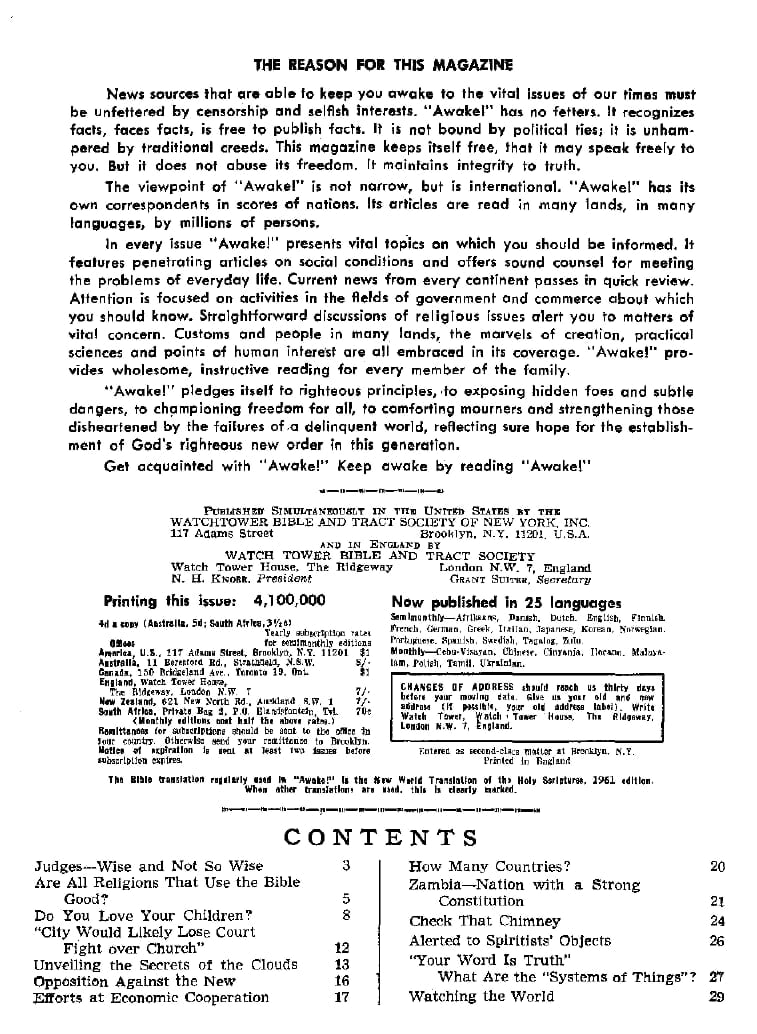
THE REASON FOR THIS MAGAZINE
News sources that are able to keep you awake to the vital issues of our times must be unfettered by censorship and selfish interests. "Awake!" has no fetters. It recognizes facts, faces facts, is free to publish facts. It is not bound by political ties; it is unhampered by traditional creeds. This magazine keeps itself free, that it may speak freely to you. But it does not abuse its freedom. It maintains integrity to truth.
The viewpoint of "Awakel" is not narrow, but is international. "Awakel" has its own correspondents in scores of nations. Its articles are read in many lands, in many languages, by millions of persons.
In every issue "Awake!" presents vital topics on which you should be informed. It features penetrating articles on social conditions and offers sound counsel for meeting the problems of everyday life. Current news from every continent passes in quick review. Attention is focused on activities in the fields of government and commerce about which you should know. Straightforward discussions of religious issues alert you to matters of vital concern. Customs and people in many lands, the marvels of creation, practical sciences and points of human interest are all embraced in its coverage. "Awake!" provides wholesome, instructive reading for every member of the family.
"Awakel" pledges itself to righteous principles, to exposing hidden foes and subtle dangers, to championing freedom for all, to comforting mourners and strengthening those disheartened by the failures of a delinquent world, reflecting sure hope for the establishment of God's righteous new order in this generation.
Get acquainted with "Awake!" Keep awake by reading "Awake!"
PUBLISHED SIMULTANEOUS IN THE UNITED STATES BY THE
WATCHTOWER BIBLE AND TRACT SOCIETY OF NEW YORK, INC.
117 Adams Street
Brooklyn, N.Y. 11201, U.S.A.
London N.W. 7, England
GRANT SUITER, Secretary
Printing this issue: 4,100,000
4d a copy (Australia, 5d; South Africa, 3½ d)
America, U.S., 117 Atlantic Street, Brooklyn, N.Y. 11201 $3
Australia, 11 Bentwood Ave., Stratford, N.S.W. $/-
Canada, 150 Brickland Ave., Toronto, 19 Ont. $1
The Bayside, Bayside Rd.
New Zealand, 621 New North Rd., Auckland R.W. 17/
South Africa, Private Bag 2. P.O. Box 700, Toul.
〈Monthly enquiries not half the above rates.)
Reliabilities for substitutions should be sent to the office in your country. Obtained need your confirmation to Brooklyn. Motions of expiration is sent at least two times before subscription expires.
Now published in 25 languages
Somaliimun — Afrikaner, Darab, Dutch, English, Finnish, French, German, Greek, Italian, Japanese, Korean, Norwegian, Swedish, Turkish, Tang, Thai, Vietnamese, Malay.
Monthly — Cebu-Vietnam, Chile, Chipahua, Dacca, Malaysia, Polish, Polish, Uruguay, Uruguai.
CHANGES OF ADDRESS should reach us thirty days before your moving sale. Give us your age and new address. Call 800-722-2222 or visit www.movingtownwatchtown.com Watch Town, Tower / Tower House. The Ridgway, London W. 7, England.
Entered as second-class matter at Brooklyn, N.Y.
Printed in England
The Bible translation regularly used in "Awake!" in the New World Translation of the Holy Saturdays, 1961 edition.
When other translations are used, this is clearly marked.
CONTENTS
Judges—Wise and Not So Wise 3
Are All Religions That Use the Bible
Good? 5
Do You Love Your Children? 8
"City Would Likely Lose Court
Fight over Church" 12
Unvelling the Secrets of the Clouds 13
Opposition Against the New 16
Efforts at Economic Cooperation 17
How Many Countries? 20
Zambia—Nation with a Strong
Constitution 21
Check That Chimney 24
Alerted to Spiritists' Objects 26
"Your Word Is Truth"
What Are the "Systems of Things"? 27
Watching the World 29
JUDGES
ciation of the Bar of the City of New York, over the lack of wise judges in the
-Wise and Not So Wise
YES, there are judges and "judges." Some are wise and, then again, some are not so wise. A wise judge is one that is well informed on the law of the land, one who is impartial, unsuaved by sedit.
United States. According to him, "too many judges are political hacks." Judicial positions are used as political
plums and pawns, as rewards for party loyalty or to get votes, with little regard for the judicial merits of the one upon whom they are bestowed. As a result, there is widespread mediocrity of judges, and
one who is imperial, unwieldy by sentiment or prejudice, one who is honest, above accepting bribes. The Bible tells that Moses, used by God as lawgiver of ancient Israel, was told to select just such sort of men for judges: "Capable men, fearing God, trustworthy men, hating unjust profit."—Ex. 18:21.
And to those men whom Moses selected he gave good advice: "When having a hearing between your brothers, you must judge with righteousness between a man and his brother or his alien resident. You must not be partial in judgment. You
is widespread mediocrity of judges, and justice often goes begging, especially in the lower courts.
Rather than being "trustworthy men, hating unjust profit," some judges are negligent, and others downright corrupt. In 1959 a California state legislative committee found that some judges took long vacations, worked short hours, refused to accept assignment to cases they found unpleasant or dull, failed to appear for scheduled trials and even took the bench while obviously under the influence of alcohol. One judge was discovered to have collected
must not be paired in judgment. You should hear the little one the same as the great one. You must not become frightened because of a man, for the judgment belongs to God." Times may have changed since Moses' day, but not the need for wise judges nor what it takes to make a wise judge.—Deut. 1:16, 17.
Underscoring the truth of the foregoing remarks is the lament recently voiced by Herbert Brownell, president of the Asso-
One judge was discovered to have collected more than $33,000 in salary for nine mornings of work in two years. Yet, despite such offenses, in nearly a hundred years there had been only two impeachment trials of judges in California.
Recently, however, action has been taken against judges who have miscarried justice. In June of 1962, New York Supreme Court Justice J. Vincent Keogh was convicted of accepting a bribe and was lat-
or sentenced to two years' imprisonment.
The sentencing judge said that "the motive for the corrupt effort to interfere with justice was venality and greed," and that Keogh's actions "cast a shadow upon the administration of justice." Less than a year later, in February 1963, another New York judge, Louis L. Friedman, was removed from the bench because of "unethical conduct."
Although God's Word instructs not to "be partial in judgment," and to "hear the little one the same as the great one," racial prejudices have caused many judges unwisely to ignore this counsel. The color of one's skin and his social status all too often affect the judgment that is rendered. Concerning this situation the New York Times of June 6, 1964, editorialized: "Incredible as it sounds, it took five years and three Supreme Court decisions for the [National Association for the Advancement of Colored People] even to get a hearing in Alabama. Once the Supreme Court of Alabama simply refused to comply with a Federal ruling; another time it held the case for more than a year without any action."
Many judges have also let sentiment or prejudice make them not so wise when Jehovah's witnesses have appeared before them concerning their right to refuse blood transfusions. Instead of "fearing God" by respecting their Scripturally founded reasons for abstaining from blood, judges have granted court orders forcing blood transfusions on Jehovah's witnesses. (Lev. 17:14; Acts 15:28, 29) For instance, in September 1963, Judge J. Skelly Wright of the United States Circuit Court of Appeals at Washington, D.C., shoved aside the legal guarantees of personal freedom and ordered that blood be administered to Mrs. Jessie Jones against her will. And just this past June the New Jersey Supreme Court
forced Mrs. Willimina Anderson to receive a blood transfusion.
In striking contrast to such unwise overruling of one's religious convictions was the course taken by Judge Bernard S. Meyer, of the New York Supreme Court. When Jacob Dilgard refused to accept blood on religious grounds, the lawyer arguing for compulsory blood transfusions said, among other things: "The Penal Law says that a person may not take his own life, and it seems to me that Jacob Sr. here is just about in the situation of taking his own life by making his decision not to accept the blood after the explanations that were made to him regarding the necessity for it."
However, Judge Meyer, who was not swayed by this emotional appeal, ruled: "I cannot agree that the final analogy which you draw is applicable, because there is always the question of judgment involved as to whether or not the medical decision is correct ... There is no question, I take it, in anybody's mind that this man has been completely competent at all times when being presented with the decision that he had to make and in making the decision that he did. That being so, I would decline to make any further order directing that blood be administered. In other words, I would deny this petition."
There is no question that it is a difficult thing for a judge to act wisely. Since there is little control over his hours, his industriousness or his thoroughness, he needs to discipline himself to keep well informed and to give his best. This includes maintaining moral strength to withstand the pressures exerted by dishonest men. He must be 'trustworthy, hating unjust profit,' but, at the same time, impartial and unprejudiced, not allowing personal feelings to affect his judgment. How apparent it is that for a judge to be truly he must make decisions in the fear of God!
Are All Religions that Use
IN MANY places in the world when a visiting minister calls at a home, the householder will say: I have my own religion, but come in anyway, for if it is the Word of God, what you say must be good. I respect all religions.'
This is a commendable attitude in that it shows interest in spiritual things and a respect for the Word of God, the Bible. However, it would be well to ask: When someone quotes scriptures and preaches from the Bible, does that always mean he is teaching the truth of God's Word? Let us look further into this matter in order to ascertain whether all religions that use the Bible are good.
The Source of Truth
Jesus Christ and his apostles accepted the Bible as the word of God and relied upon it as the truth. "Your word is truth." Jesus said in prayer to his heavenly Father. And the apostle Paul affirmed: "All Scripture is inspired of God and beneficial for teaching, for reproving, for setting things straight." So in order to determine whether ideas are true or not, one should go to the Bible to find out if they are in harmony with what it says. In this way things are set straight; one learns what is the mind of the "God of truth" on matters. —John 17:17; 2 Tim. 3:16; Ps. 31:5.
The apostle Peter, in stressing the importance of listening to God's Word, emphasized its prophetic value, and said: "You are doing well in paying attention to it as to a lamp shining in a dark place . . . For prophecy was at no time brought by man's will, but men spoke from God as they were borne along by holy spirit." There is no question about it, the Bible is inspired of God and contains the truth! —2 Pet. 1:19-21.
Do all that preach from the Bible teach the truth? How can a person know?
Misuse of the Scriptures
Is one to assume, then, that anyone who preaches with the Bible in hand and cites scriptures is preaching the truth? No, for one can misuse the Bible; he can fall to handle it aright. For this reason the apostolic encouragement is: "Do your utmost to present yourself approved to God, a workman with nothing to be ashamed of, handling the word of the truth aright." So while a person should listen when another speaks to him from the Bible, he should, at the same time, examine to make sure that what is being taught is correct. —2 Tim. 2:15; 1 Thess. 5:21.
A true minister of God will welcome this sincere examination of the message that he preaches. The account in Acts chapter seventeen indicates that the apostle Paul was pleased by such an investigation. Complimenting those who checked up on what he taught, the record says: "Now the latter [ones in Beroea] were more noble-minded than those in Thessalonica, for they received the word with the greatest eagerness of mind, carefully examining the Scriptures daily as to whether these things were so. Therefore many of them became believers."—Acts 17:11, 12.
Yes, the Beroeans knew that just the quoting of scriptures did not make Paul's teaching right. They wanted to be sure that it was not just the Word of God being used, but that Paul was actually teaching the truth as set forth in that Word.
It is vital that you follow this same noble example of the Beroeans. Why so? Because there is the possibility that the one who may speak to you from the Bible will twist the Scriptures, applying them in such a way as to propagate false ideas.
An outstanding example, to show that what a person says cannot always be accepted merely because he quotes from the Bible, is found in the account in Matthew chapter four. There it says: "Then the Devil took [Jesus] along into the holy city, and he stationed him upon the battlement of the temple and said to him: If you are a son of God, hurl yourself down; for it is written [in the Bible at Psalm 91:11, 12], "He will give his angels a charge concerning you, and they will carry you on their hands, that you may at no time strike your foot against a stone."" —Matt. 4:5, 6.
Now, what did Jesus do when Satan quoted the scripture from Psalm 91:11, 12 and tried to induce Jesus to commit suicide by hurling himself from the battlement of the temple? Did he reason: 'Well, that is the Word of God and so it is proper that I should pay attention to what Satan says and follow this teaching?' By no means! He realized that the Devil's knowing and quoting the Scriptures did not make his teaching right. Scriptures can be misused, and Jesus showed that this is what Satan was doing when he answered: "Again it is written, 'You must not put Jehovah your God to the test.'"—Matt. 4:7.
Therefore, it should not surprise us that even today there are false teachers who, like Satan the Devil, twist the Scriptures. "Satan himself keeps transforming himself into an angel of light," the apostle Paul observed, and "it is therefore nothing great if his ministers also keep transforming themselves into ministers of righteousness." And the apostle Peter noted that in the inspired Greek Scriptures there "are some things hard to understand, which the untaught and unsteady are twisting, as they do also the rest of the Scriptures, to their own destruction." Yes, the penalty for those who misapply and twist the Scriptures is death.—2 Cor. 11:13-15; 2 Pet. 3:16.
Due to the terrible consequences of misusing the Scriptures, there is every need to be alert and to test to make sure that what you are being taught is the truth of God's Word. The apostle John impresses this responsibility upon truth seekers in his warning: "Beloved ones, do not believe every inspired expression, but test the inspired expressions to see whether they originate with God, because many false prophets have gone forth into the world." —1 John 4:1.
Not All Religion Is Good
So it is apparent that one's being brought up in a particular religion and reading the Bible regularly does not in itself make his worship pleasing to God. Many in the first century belonged to Judaism, and Scripture reading was their habit. The apostle Paul noted that, in the synagogues, the Bible was "read aloud every Sabbath." And on one occasion Jesus Christ told some Jews: "You are searching the Scriptures, because you think that by means of them you will have everlasting life." Yet, despite their regular Bible reading, those Jews opposed the ministry of Jesus and the apostles and fought fiercely to stop them from preaching Scriptural truths to the people.—Acts 13:27; John 5:39.
But why did those Bible-reading Jews oppose the truth? Why were their beliefs out of harmony with God and his Son? Jesus explained when he said to them: "You have made the word of God invalid because of your tradition."
Yes, the Jews misapplied and twisted the Scriptures to suit their own convenience and wishes. For this reason Jesus applied the words of Jehovah's prophet Isaiah to them: "This people honors me with their lips, yet their heart is far removed from me. It is in vain that they keep worshiping me, because they teach commands of men as doctrines."—Matt. 15:1-9.
In particular, those Jews desired release from political bondage to Rome, and they longed for the coming of the promised Messiah to accomplish this. This was their fervent wish, and even though the Scriptures clearly showed that their Messiah must first come as a sacrificial lamb to provide a ransom, they had eyes only for the prophecies relative to his second presence in Kingdom power. So when Scriptural evidence was presented that Jesus was actually the Messiah, they stubbornly refused to examine it, and even plotted his death.—Dan. 7:13, 14; Isa. 7:14; 9:6; 53: 3-12; Mic. 5:2.
After Jesus was put to death, many zealous Jewish religionists continued in their persecution of his followers. One such Jew wrote: "You, of course, heard about my conduct formerly in Judaism, that to the point of excess I kept on persecuting the congregation of God and devastating it, and I was making greater progress in Judaism than many of my own age in my race, as I was far more zealous for the traditions of my fathers." This man was Saul of Tarsus. Although Bible reading was a regular feature of Judaism, traditions had blinded Saul to an accurate understanding of the Scriptures.—Gal. 1:13, 14; Rom. 10:2.
It is noteworthy, however, that when Saul heard Bible truths explained by Ananias of Damascus, he did not say: 'Well, I
have my own religion, and what's good enough for my father is good enough for me.' No, but he realized that merely having and reading the Bible were not sufficient—accurate knowledge and understanding were also necessary. So on examining the Scriptural evidence, Saul changed his religion and became a footstep follower of Christ, known as the apostle Paul.
What to Do
Should someone call at your house with Bible in hand, then what should you do? The wise and kind thing would be to listen to the message he brings. Ask questions and endeavor to ascertain whether he is actually teaching the truth of God's Word. Do not hesitate to take the noble course of the Beroeans and check up on what is said. If the Jews had done this in the first century, rather than stubbornly clinging to their traditional views, they would not have rejected the Messiah. Today there is the danger of making a similar tragic mistake. Bible prophecies relative to Christ's second presence are now in the course of fulfillment, and it is to your everlasting welfare to understand their meaning properly.—Matt. 24:3-14; Luke 21:7-32; 2 Tim. 3:1-5; 2 Pet. 3:3, 4.
But if it seems to you that the caller is twisting or misapplying the Scriptures, do not abruptly turn him away. That is not the Christian thing to do, for his very life depends upon obtaining an accurate understanding of the truth. So follow the Christian example of Priscilla and Aquila, who, after listening to Apollos preach from the Bible, "took him into their company and expounded the way of God more correctly to him." Yes, not only is it our obligation to make sure of what is right, but we are obligated to assist others to know the truth also.--Acts 18:26.
THE ability to have children is one of the most pleasurable gifts the Creator has given mankind. They can be a source of genuine happiness to parents. Their sunny dispositions, trusting
matures, ever-present curiosity, boundless energies and deep affection are qualities that make them truly lovable. When small, their chubby hands invite hugs, blow kisses to you and cling to you with affectionate dependence. When there are children, marriage takes on greater meaning. But while it is natural for parents to love their children, you must realize, if you are a parent, that there are many ways you can fail to manifest love while imagining that you are loving them.
It has been said that children should be seen and not heard. In our day, however, they are definitely seen, heard and often greatly feared, bringing sorrow and anxiety to their parents. Very frequently this situation is traceable to the fact that some parents, thinking that they are loving their children and wanting to make them happy, excessively indulge and spoil them, only to find that they become even more demanding and troublesome.—Prov. 17:21.
Many parents are confused as to their proper role by reason of the great volume of "expert," though contradictory, advice.
The greatest authority, however, is the Creator himself; and his counsel remains unchanged and dependable, for the principles he established are as workable today as when first given. He counsels parents to spend much time with their children, building up moral values and disciplining them in righteousness while the children are still in the tender and formative years. He recognizes that the foolishness peculiar to youths is but the inheritance of imperfect
tendencies from the parents, and that the rod of correction or parental authority has to be exercised to drive it away. Children will rarely grow up to be good on their own. They have to be trained to conform to godly principles.—Prov. 22:6, 15.
Spend Time with Them
When the people of Israel were a people for God's own name, the care of their young ones was no small matter in His eyes. Parents were commanded to supply not only for the physical but, more importantly, for the spiritual needs of their children, and this on a daily basis. (Deut. 6: 6-9) The main responsibility for such training was placed on the shoulders of the father, and his role is just as important in this atomic age. He cannot treat this obligation lightly without inviting sorrow. One who constantly meets his child's questions with: "Why ask me? Go ask your mother," reveals a reluctance to assume his proper place in the household, and he must answer to God for such neglect. He may even have to answer to the local law authorities when his child becomes delinquent.
On the other hand, those who truly love their children will gladly undertake the job of training them, drawing upon the able assistance of their wives.
Since the hours a man has to spend with his family are so limited, he must make the time he does have with them count. By always being kind and approachable, he establishes a lasting place in the hearts of the children, and they eagerly look forward to his homecoming. Nor does he disappoint them on such occasions on the pretext of fatigue after the day's work. He understands their need of constant assurances of his love for them. He makes their problems his problems. When they want to have some toy fixed, or to get answers to their questions, he does not turn them away with: "Don't you see I'm busy?" He knows that his role of father, properly discharged, is vital to their proper emotional development.
Children also need the love, warmth and association of their mothers, if they are to learn to be sympathetic, understanding and compassionate. Since they must of necessity spend so much time with her, the influence for good or bad that she has over them is immeasurable. If she selfishly packs them off to the movies or out onto the streets or into someone else's home, they will tend to become indifferent and unloving toward her in later life. But when she shows herself ever ready to lend a sympathetic ear to their little problems, they will love her for it. Everyday happenings around the home, such as cleaning, cooking and plans for marketing, can become real springboards for daily sessions of training that are the more effective in that they are not recognized by the youngsters as actual training.
The test of how much genuine love and interest the parents have in their children is in they spend their leisure time. Is
it with or away from their children? Many parents in Western lands adopt the custom of hiring baby-sitters to care for their children while they go out for an evening of relaxation. Now, surely every couple enjoys an occasional evening on their own, but when baby-sitting arrangements become a habit, it is time for serious reflection. When parents go out to have their fun away from the children they are in fact demonstrating that they want to be rid of their children for a time. How much more loving and mature on their part to schedule and engage in programs of relaxation that can include the entire family, thus drawing the family even closer together! When a couple marry, they forfeit certain freedoms of bachelorhood for each other's company. So, too, parents must relinquish certain freedoms of childless couples for the rewarding companionship of their children.
Practice What You Teach
Loving parents also make use of the time spent with children to inculcate in them godly principles for practical use in the future. Those preschool years are the only ones during which they can mold and shape the young intellects without distraction from outside influences. It is important to realize that demonstration is a vital factor in teaching. If principles are to be understood and applied by the child, he must see them practiced by his parents. If the child is to be honest and truthful, he must be truthfully dealt with at all times—no lies, not even "white ones." If he is to respect the privacy and possessions of others, his also must be respected. Only when they hear "I'm sorry," "Please" or "May I?" from their parents will children be encouraged to imitate such a considerate attitude toward others. During the six days of the week they should see the same Mom and Dad that they see at the place of worship on Sundays, if they are to be truly consistent and not hypocrites when they grow up.
Literal gifts should not be so frequent as to become commonplace, and the children should be aided to understand that gifts are not given from selfish motives, such as bribery for good behavior, or expecting something in return. Gift-giving should be out of love and appreciation. It follows that the gifts themselves should be practical and sensible, and not just useless, shiny baubles. Thus children begin to learn about and appreciate the gifts of the Creator, including the priceless one of life itself.
Responsibility for themselves and their actions is something that children should be taught at an early stage. They need to be trained to pick up and put away their toys, clothing, and so forth, and to take the just consequences of their treatment of other people. And since it is work, not play, that breeds responsibility, they should be assigned jobs to do in and around the home. Only when they have learned the value of hard work can playtime be really appreciated by them. It should be noted that in countries where children seldom have time for play they usually grow up to be dependable and responsible adults. Those, on the other hand, with too much idle time, much of it on their own or in company with other juveniles, get into trouble and resent being asked to engage in any useful occupation. The child who is trained to be responsible will have more self-respect and more respect for others also.
If parents will encourage their children to work for and earn the things they really want, the youngsters will attach much greater value to them. A boy whose heart is set on getting a bicycle will appreciate it all the more and give it the better care if he has to save for it out of his own
funds. Contrariwise, something easily acquired is also lightly esteemed. Wise parents will enjoy the satisfaction of knowing that they did not rob their child of the pride he can feel in doing things for himself.
The most valuable training that parents can give their young ones is to afford them the right example in relationship to God especially in the matter of prayer. Parents cannot pass this responsibility on to others. They must shoulder it themselves. And for this training to be truly effective, prayer must be a united, daily, family occurrence. Children who observe their parents humbly approaching God for mercy and guidance will be encouraged to duplicate their course with happy results. Prayerful children are not likely to be problem children.
Discipline with Love
Often admonition and reason will not suffice for children. Sometimes only physical punishment will adequately impress a lesson. In all fairness to the child he should know what to expect for disobedience. Children of inconsistent parents are kept wondering whether the parents really mean what they say. If from experience the child learns that his parents mean exactly what they say, then he will the more quickly obey and respect parental wishes. Parents, of course, do not have to go to the other extreme of having rules like the laws of the Medes and Persians, which never, changed. For best results they should operate in accord with the just principles set out in the Bible.
Punishment, whether physical or otherwise, must always be just, commensurate with the wrong committed. It will tend to be unduly severe if administered while under the undue influence of anger. The child should clearly understand why there is punishment. Parents must be united in ciscipilining their offspring.
It is useless for one parent to be firm while the other is weak, for one to punish while the other consoles. This only awakens in children the idea that they can pit one against the other, dividing parental forces to their own advantage. Especially the oversympathetic mother must be on guard against undermining the firm action of the father, for in doing so she may be endangering the maintenance of proper law enforcement in the household.
Parents will not want to be harsh, overcritical, or expecting more than the child can give. Fathers in particular are admonished not to be 'irritating their children, but to go on bringing them up in the discipline and authoritative advice of Jehovah.' (Eph. 6:4) After all, they are still children and should be treated as such. A wise father will call to mind how badly he felt when, as a boy, he was unjustly or excessively punished. The more frequent penalty for disobedience is likely to be, not corporal punishment, but, rather, denial of some special treat or privilege. Such a denial does not involve anything essential to the child's health and physical well-being, but it does bring home to the young mind the need for adhering to parental rule.
One person has likened a child's mind to a bank—whatever you put in, you get back in ten years, with interest. Loving parents will, therefore, be concerned about what they allow to be poured into the minds of their children. They will want to deposit good, clean thoughts and just principles that will in the future bring them dividends as they observe their children grow into mature and godly men and women. It is therefore appropriate to supervise the television programs and movies watched by their children, as well as the radio programs heard by them. Books will
be carefully selected. Above all, they will want to make sure that the companionships of their children are such as will not tear down all the good training received in the home. The minds of their young ones should be viewed as a garden plot. Good seed should be sown and given opportunity to take root and produce healthy plants before being exposed to the ravages of weeds.
For parents who show more concern for amassing material goods and supposed future security for their children than for their mental and spiritual well-being, there is the authoritative advice voiced by Jesus: "Stop being anxious about your souls as to what you will eat or what you will drink, or about your bodies as to what you will wear. Does not the soul mean more than food and the body than clothing?" "Man must live, not on bread alone, but on every utterance coming forth through Jehovah's mouth." (Matt. 6:25; 4:4) How important, indeed, to furnish your children with a training that will enable them to 'go on progressing in wisdom and in physical growth and in favor with God and man'!—Luke 2:52.
Do not feel that it takes too much time and attention, or that it is beyond you. With the right mental attitude, born of your sense of proper responsibility toward your children, you can be a real companion and educator of your children. In your increased dealings with them you will encounter much of natural comedy and the element of surprise. It will thrill you to see them make progress. It will bring a deep sense of satisfaction to know that you have started them off right on life's difficult pathway. And unlike neglected children, yours will continue to value and seek your companionship even as you grow old—a fitting reward for your genuine love for your children!
"CITYWOULD LIKELY LOSE COURT FIGHT OVER CHURCH"
HIS remarkable headline appeared in the Victoria Daily Times, Victoria, British Columbia, Canada, on June 12, 1964.
But why would the City want to fight over a church? At a time when lawlessness and delinquency are serious world problems, how could responsible city fathers try to fight an institution that can have an important influence in overcoming such difficulties?
The place of worship in question was a proposed Kingdom Hall of Jehovah's witnesses, which the Victoria congregation desired to build on a lot on Joan Crescent, near Fort Street. The Advisory Planning Commission of the City of Victoria had recommended that the building be permitted both because it was structurally suitable and because of the good experience it had had with Jehovah's witnesses when an earlier Kingdom Hall was built. The Planning Commission said in its report to City Council: "The applicants indicate their willingness to cooperate fully with the City with the aim of creating a development which will blend with the residential character of the district. Based on the experience in dealing with this body when the Shelbourne Street Church was in the planning stage, the Commission feels confident that they will fulfill their promise."
In spite of this recommendation the City Council twice turned down the application. A third application for a permit was made in June 1964, and this time the careful preparation and the appearance of the Society's attorney made it clear that legal proceedings were contemplated if necessary. The Victoria Daily Times warned: "Victoria may be heading for the national spotlight as the next battleground in the Jehovah's Witnesses sect's battle for religious freedom. The stage may have been set this morning for an encounter in the courts."
With this possibility facing it, the City Council called in its legal adviser, Mr. Terence O'Grady, Q.C. The brief for Jehovah's witnesses showed that the zoning regulations state: "Churches shall be permitted on approval of the application and plans by the City Council." Some City officials seemed anxious to refuse the approval, as they had done on two previous applications.
any court battle with the Jehovah's Witnesses over its right to build a church on Joan Crescent.
"He said the city's bylaw was clearly discriminatory and, in his opinion, would be thrown out by the courts if taken there by the sect. In addition, he said council would inevitably be tarred as an opponent of civil and religious rights . . . "there is no doubt in my mind this section (of the bylaw) is completely invalid."
The Victoria Daily Times reported the discussion in its issue of June 12, 1964: "City solicitor T. P. O'Grady Thursday warned Victoria city council it stood an excellent chance of losing
The Times report continues with Mr. O'Grady's comments: "He also gave aldermen a simple warning of the side effects of any court battle with the sect. 'You are dealing here with an applicant—and I must be candid—that has demonstrated itself a determined litigant which the courts have viewed with sympathetic eyes because of the civil rights aspect.
"Anyone who chooses to enter the lists in court against them is apt to be painted in the colors of a person opposed to civil rights."
It is certainly refreshing to see a lawyer of this kind speak up so clearly and honestly in favor of what is right regardless of what the City Council may have preferred.
In spite of Mr. O'Grady's good advice the City Council delayed till July 10, by which time the congregation of Jehovah's witnesses had submitted formal plans and demanded the permit. Formal demand for the permit is the last step before going to court. Would the City fight the permit? Or would it do what is right and what its own legal adviser indicated?
The Times report gives the answer in a headline: "SECT WINS OKAY FOR NEW CHURCH."
"Victoria city council Thursday threw in the towel in its fight to prevent the Jebovah's Witnesses sect from building a church on property it owns on Joan Crescent . . . aldermen voted in favour of permitting the church subject to the usual approval of building plans by the city inspection department."
The good reputation that Jehovah's witnesses have built both with the Planning Commission and with the courts of Canada all helped to overrule local prejudice and to achieve a fair and just result. Jehovah promised his servants, "I shall make you people to be a name and a praise among all the peoples of the earth." (Zeph. 3:20) How glad earnest Christians can be to see in these matters how faithfully Jehovah fulfills his promises!
UNVEILING THE SECRETS OF The Clouds
By "Awake!" correspondent in Morocco
HAVE you ever
plain on your
back and watched
fluffy clouds move
lazily across the
sky? It is a fascinating sight. Clouds
have a distinctive
beauty and grace,
and their constant movements make the sky an ever-changing wonder. But man's feelings toward clouds vary greatly. In times of drought people have prayed for them and anxiously watched for them to appear on the horizon. On the other hand, during times of flooding they have longed for them to move on.
Although clouds are a common sight, the average person knows very little about them. Some persons look at them with fear, thinking that gods cause the storms that accompany clouds or that a witch doctor has the power to cause them to form and bring rain. But what about yourself? Do you know what clouds are, how they are formed and how a thundercloud differs from other types of clouds?
It was toward the end of the nineteenth century that scientists proved that visible droplets of water can form in the air only
when they put something around which they can form. In the laboratory pure water vapor was mixed with pure air, but when this mixture was cooled to the point where condensation normally would take place no condensation occurred. In other words, no clouds formed. A slight change in this experiment, however, produced striking results. Upon their injecting tiny dust particles into this cooled mixture of water vapor and air, a cloud was formed. Now, what does this prove? That clouds consist of tiny droplets of water that condense around particles of dust.
the specks of dust that can be seen floating in the air when a shaft of bright sunlight enters a room? Ordinarily you do not see those specks because they are so small, but in a dimly lit room a bright ray of sunlight can make them very noticeable.
Most of the dust floating in the atmosphere comes from the earth. Winds are constantly sweeping up fine, dry particles of soil into the atmosphere. Volcanic ash from eruptions and smoke particles from natural and man-made fires all contribute to the dust existing in the air. Some of it also comes from outer space. Millions of meteors bombard our atmosphere every day, only to burn out and leave their debris scattered in the air.
Formation of Clouds
The action of the air has much to do with the formation of clouds. Air at lower levels is warmer and lighter than air at higher levels, with the result that the lower air rises.
As it does, it creates powerful upmoving currents. This warm air carries with it a great amount of invisible water vapor that it had absorbed as water evaporated from bodies of water and moist earth. When the air currents reach the cold upper levels of the atmosphere, they cool. Unable to bear their water burden any longer, they give it up as countless millions of tiny globules of water condense around specks of dust. Thus the rising column of moist, warm air becomes one of the many types of clouds. Now, when this air does not rise, but is cooled at the ground level, the result is fog. Fog is nothing more than a lowflying cloud.
As might be expected, different circumstances can cause different types of clouds to form. Back in 1803 a British chemist, who was a keen student of clouds, gave Latin names to the different types of cloud formations. His names are still in use internationally. Clouds of fine, fibrous texture he called cirrus, which, in Latin, means "a tuft of hair." These are high clouds of generally white appearance that are arranged in bands. They are the loftiest and fastest moving of all types of clouds, reaching an altitude of ten miles and speeds of perhaps seventy-five miles per hour. When looking at such clouds, did you ever have the disquieting sensation that you were flying or sliding under them at high speed? The fast movement of such clouds is the cause of this sensation. You can experience the same sensation when watching clouds move swiftly past the moon at nighttime.
take on very interesting shapes, forming giant mounds, domes, towers and, to imaginative persons, the shapes of men and animals. They are surprisingly heavy. A big one can weigh as much as 100,000 tons. The most frequent altitude for these clouds is between 3,200 and 6,500 feet.
Cumulus means "a pile" in Latin, and the name is aptly applied to cloud formations that are great billowy masses piled on top of one another like whipped cream. That is the way they appear when you fly above them in an airplane. Such clouds
To the type of clouds that form a thick layer that spreads over a great area, the Latin word stratus has been given. The word means "a layer." Because these clouds are spread out to such a great extent, no meaningful figure can be given as to their weight. They float from a few hundred feet above the ground to an altitude of two or three thousand feet. They are simply a high-level fog. The stratus, cumulus and cirrus clouds are the main cloud formations, but there are many variations of these principal types that are given other designations.
The Thundercloud
The great masses of ominously black clouds that we often see on the horizon and that quickly spread over the sky are known as thunderclouds or cumulonimbus. The blinding flashes of lightning, deafening claps of thunder and torrential downfall of rain that accompany them give a person a feeling of smallness and weakness. The thundercloud is so impressive that some people have, for ages, associated some of their gods with the thunder it produces. The book Standard Dictionary of Folklore, Mythology and Legend states: "Thunder was conceived as a powerful god by the ancient Peruvians. White llamas were sacrificed to him and sites struck by lightning became sacred. Today the thunder god is still worshipped in Peru and Bolivia as Santiago (Saint James) who has taken in most of his attributes."
A thundercloud is born when warm air near the ground surges upward in a great current. It speeds upward until the cold temperatures of high altitudes transform its water vapor into billions of tiny water droplets.
A cloud is formed that grows with great rapidity. A current of air rushes up into the newly formed thundercloud at a speed of about sixty miles per hour. This air turbulence is characteristic of a thundercloud. Because of such air action you may, at times, feel a strong breeze before the storm starts. Here in Morocco, as in many other countries, a breeze in the wintertime often indicates that rain is coming, and soon. Sometimes the current of air flowing into the thundercloud is sufficiently strong to counteract the wind that is pushing the clouds. This results in a calm before the storm.
A well-developed thundercloud can push its massive head as high as 39,000 to 49,000 feet. In such clouds almost all kinds of weather are manifested—rain, snow, hail, wind and lightning. As the storm begins, lightning flashes across the sky, followed by a clap of thunder. The clouds light up intermittently like an old, defective neon sign, and then comes the rain. What a downpour that can be! It can drench an area of a few miles with 100,000 tons of water in a matter of minutes.
It was during the years 1946 and 1947 that scientists showed that the thundercloud is more than just a mass of water droplets. Instead, it has a complex structure. Its interior might be compared to an immense honeycomb, for it is made up of many cells or units that are separated from one another by walls of comparatively calm cloud. A large thundercloud may spread out over a distance of 250 miles, but within are these many cells that may be only three miles wide. Actually, each of the cells makes its own storm, and each produces its own lightning, thunder and rain. Many of them may be raining at the same time. Some may be just beginning, while others are in the middle of their
rain cycle, and still others are finishing the cycle.
The last stage of a thunderstorm is marked by a gentle drizzle that lets you know that the rain is about over. At this point the thundercloud develops its familiar anvil-shaped top. With this understanding of how a thundercloud is constructed, a person should feel free of any superstitious fear of it. A thundercloud is not an evil spirit or a god. Instead, it is a very natural thing that automatically takes place in the atmosphere when conditions are right.
Droplets of Water
Clouds are great collections of water droplets. Since water is much denser than air, you may wonder how great cloud formations that weigh hundreds of thousands of tons because of the water in them can float on the air. It would seem that the water droplets that form the clouds would fall, and so they do, but because of their small size and the air resistance they encounter, they fall very slowly. Very little progress is made by them as they fall because of upward movements of air that push them up. When enough of them finally get together to form a large raindrop there is sufficient weight to overcome this upward action of air currents.
What actually causes rain is still one of the most perplexing problems that confront the scientists who study clouds. It is not easy to explain how perhaps a hundred million droplets of water come together in a cloud to form a raindrop. Neither is it clear why these droplets that form clouds do not form raindrops in all clouds.
One of the theories that attempts to explain the formation of raindrops claims that many clouds fly high in the atmosphere, with the result that their tops have temperatures below minus 1 0\circ C .
Here a great many droplets become supercooled, which means that somehow they are cooled well below the normal freezing point of 0\circ C or 3 2\circ F . When supercooled, the droplets are in a very sensitive state. The freezing of just a few droplets will cause the others in the cloud to freeze. From this discovery began the experiments of seeding clouds with dry ice or silver iodide crystals. When this was done in 1946 with a supercooled cloud at 14,000 feet to confirm the laboratory experiment, the cloud turned into a snowstorm.
It is theorized that rain begins when some of the ice crystals in high-flying clouds pick up supercooled droplets that cause them to grow in size. When they reach warmer air, they melt and cause raindrops. This theory, however, does not explain the heavy rains in tropical regions. The clouds there are too warm to contain supercooled droplets and ice crystals. Another theory claims that some droplets are
larger than others and begin to fall, and as they do they pick up other droplets until they become large enough to fall to earth as raindrops. Regardless of the many theories that attempt to explain the formation of raindrops, the fact remains that clouds drop refreshing rains upon the earth that beautify it and benefit mankind. They are part of a marvelous cycle that has functioned smoothly ever since it was started long ago by the Creator.
Despite intense scientific study, there is much that has yet to be learned about clouds. The Biblical question that was true in the days of Job, more than 1,600 years before the Common Era, is still true today. "Indeed, who can understand the cloud layers?" (Job 36:29) No one among men fully understands them. Yet because some of the secrets about clouds have been unveiled you can look at them with greater understanding and appreciation of the important role they play in making our home, the earth, a beautiful and fruitful place.
Opposition Against the New
When a new invention came out, especially during the seventeenth through the nineteenth centuries, those who believed their business or trade was endangered would fight against the new. If laws failed to stop the new, the opposers would take direct, even violent action, as L. Sprague de Camp in The Heroic Age of American Invention; "Charcoal burners destroyed Dudley's coke furnace in the 1620s. When the French physicist Denis Papin undertook in the 1690s to build a boat driven by paddle wheels, a mob of Rhine soldiers destroyed the boat and would have lynched Papin if they could have caught him. In the 1820s, Scottish compositors secretly battered the stereotype plates invented by Gobert Gad and ruined the inventor.
some Englishmen tried to set up water-powered sawmills, such as were known on the Continent since Roman times. Mobs of hand sawyers, fearing that their bulging muscles would become obsolete, destroyed the mills. During the same period, other mobs wrecked Hargreaves' spinning jenies and Thimmonier's sewing machines. Sailing-vessel captains rammed Fulton's steamboats in hope of putting him out of business. Steam-locomotive drivers sabotaged the electric locomotive invented by the Scotsman Robert Davidson in 1838. Charles Welch, an inventor of coal-mining machines in the late nineteenth century, had to stand guard over his machines with a gun to keep the coal miners from wrecking them." Even in the twentieth century, strikes to thwart automation are common.
AWAKE!
EFFORTS AT
ECONOMIC
</div>
COOPERATION
</div>
COOPERATION, of one form or another, is as old as the human family. A husband and wife working together to build a home and family unit are cooperating. When several families joined together to clear land or to build homes, they worked together in cooperation. Nations cooperate when they work in alliances and leagues for a common purpose.
It can be said, then, that cooperation is the uniting together for joint operation or action. However, a fundamental part of truly beneficial cooperation is that it must be based on the free will of those involved, that is, the joining together for a common purpose must be voluntary.
As society expanded and the economies of nations grew more complex, efforts at economic cooperation among individuals were seen to be advisable in many lands. No longer did the overwhelming majority of the people live on the land, grow their own crops or build much of what they needed. The "Industrial Revolution" of a century ago, especially, pulled many off the farm and into the city, away from their source of food and supply. This had a breaking-up effect on the old social order of things and, in many instances, industrial workmen and peasants alike became very poor, especially in Europe. One of the consequences was an extensive emigration from many European countries, with most of the emigrants going to America. From Sweden alone over 120,000 emigrated between the years of 1861 and 1870.
NOVEMBER 22,1964
Modern Cooperative
Movement Begins
The living conditions of the poorer classes gave rise to many hoped-for remedies. Socialistic doctrines began to appear. Labor movements arose for the protection of workers. At this time, too, the first economic cooperatives, in the modern sense, began to appear.
One category of cooperatives, called consumer cooperatives, were organizations begun by individuals grouping together so as to purchase the goods and services they needed in larger quantities, thus effecting a saving to each member. These consumer cooperatives operated for the benefit of the average consumer, or buyer. They provided household items, food, fuel and other supplies. Later they extended their activity to cover services such as medical care, housing, credit, as well as other items. At times, cooperatives specialized in one line. On other occasions they combined several lines together.
Other cooperatives were formed, called producer cooperatives, for the benefit of the members who produced products for sale on the market. They helped in the production and marketing of the workers' goods in one or in several fields, such as factories, mills and farms.
It is held that in Rochdale, England, the first modern cooperative really began. There, in 1844, twenty-eight weavers opened a small shop. With a modest beginning of £28 in capital, they purchased a small stock of flour, oatmeal, butter, sugar and candles for the use of their members.
The objective was to acquire jointly, and as cheaply as possible, such things as they needed in the way of food, clothing and household items. Despite this small beginning, the society prospered. So successful was it that it provided a basis for other cooperative societies that came later.
Interesting are the principles agreed to by "The Rochdale Equitable Pioneers," as they were called. (1) Membership was to be open, with no restriction as to race, sex, religion, politics or other affiliation. (2) Democratic control was to exist, with one vote per member regardless of the amount of capital each invested. This would prevent the wealthy from dominating by having more capital invested. (3) Limited interest was returned on the capital they invested, so no huge profits would be taken out. (4) The savings made from the business were to be distributed periodically back to the members on the basis of their patronage. They would receive a refund in precise proportion to their purchases at the society's store. (5) The cooperative would be neutral in politics, religion and other matters. (6) All transactions were to be made on a cash basis, with ample provision made for depreciation and reserves. The goods would be sold at current prices, which would have the effect of keeping other merchants from charging too much for their wares. Finally, (7) the cooperative would provide information and education continually on the principles and practices of cooperation.
Generally speaking, the cooperatives in most countries have held to these principles, with variations due to local circumstances. However, in totalitarian lands this has not been the case, for there membership is often compulsory and has much to do with politics.
In Sweden, for example, laborers were legally forbidden to form organizations of any sort, but in time the government had to retract such laws. A Swedish writer, Axel Gjöres, a former cabinet minister, said that cooperation "sprang from the people themselves, was born out of the pressing needs of the lower strata to better their everyday conditions and fostered by the growing understanding of the necessity of organized cooperation and the demands of such cooperation."
After Rochdale, cooperative societies soon sprang up in many countries. However, in some it was a difficult proposition.
After tough resistance, cooperative societies got going in Scandinavia in the 1860's. One of the first was a consumers' association at Stavanger, Norway. It came to be called the "Bag Association" because its members had to bring their own bags when they picked up the goods they ordered, which goods were distributed on certain days. In Sweden the small associations were combined into a joint cooperative society in 1899. Since that time it has grown to be one of the country's largest employers, with more than 20,000 employees. Over one-third of Sweden's population now buys their goods through the cooperative association, popularly called "Konsum," and the cooperative is responsible for 14 percent of the general retail and 26 percent of the foodstuff trade. In Sweden the cooperative movement has even taken over manufacturing plants to produce some of its goods, thus uniting the consumer and producer cooperative ideas. Additionally, the cooperative runs many restaurants, correspondence schools, insurance businesses and even motion picture production! Little did the Rochdale group realize how their small beginning would develop into the huge business establishment now seen in Sweden!
In Denmark opposition was also strong, but in 1852 the first really cooperative association was formed, the "Fuel Association" in Copenhagen. It had as its objective the buying of fuel wholesale for distribution among its members.
And so, country by country, the idea of cooperative associations spread, until today there are thousands of cooperatives of various types in many countries with membership running in the tens of millions of persons.
Keeping Market in Check
Cooperative movement supporters say that a foremost objective of the association in modern society is to keep private enterprises in check so these do not charge higher prices. This has meant that in some places the cooperative societies have begun factories of their own and have produced certain goods for sale at lower prices, thus compelling private enterprise to follow suit to meet the competition.
Another check resulted when in many instances the rule that only members were allowed to make purchases was dropped, and anyone was permitted to buy, although only members received a refund at the end of the year.
Another principle of the Rochdale society that has been altered somewhat is the one calling for cash purchases. In recent years many members have been granted credit for some items.
For any cooperative to be of benefit and act as a market check it must operate efficiently and purposefully. Otherwise, consumers would not be able to buy at reasonable rates and would be better off dealing with private enterprises. Of this need a Swedish cooperator, Albin Johansson, retired chief manager of the Cooperative Society of Sweden, had this to say: "A cooperative business that is being managed in a rational way, but is inferior to private businesses in the way of technical organization and rational use of its capital, is of no use to consumers but rather to their disadvantage. It is better that
there be no cooperative business than one that is miserably managed."
Disappointments
Private business enterprises are, of course, expected by their owners to make profits, as shareholders are principally concerned with income. The stated objective of the cooperative establishment is not providing profits on invested capital, but supplying, in the best and cheapest way, that which people need for their use. Spokesmen for cooperatives assert that, if carried on in the right way, the cooperative will never be able to develop into an institution that exploits and impoverishes citizens, but would promote their prosperity. They claim that this movement is the one that comes nearest to the ideal. Many times, however, they have been frustrated and disappointed.
One source of danger has been the baffling winds of politics. The pioneers of cooperation had said that "man was created for freedom and free cooperation," and added that "the government must not, through its legislation, hinder the citizens from, individually or in cooperation, looking after their own interests within the boundaries of justice and morals." But in many countries, such as Germany under the Third Reich, the cooperative movement was squashed. It was incorporated by the Nazis into the Labor Front, and its independence and freedom of movement were lost. Hence, the cooperative failed to exist in the true sense.
…