Awake!, November 8, 1964
Download: PDF — Awake!, November 8, 1964
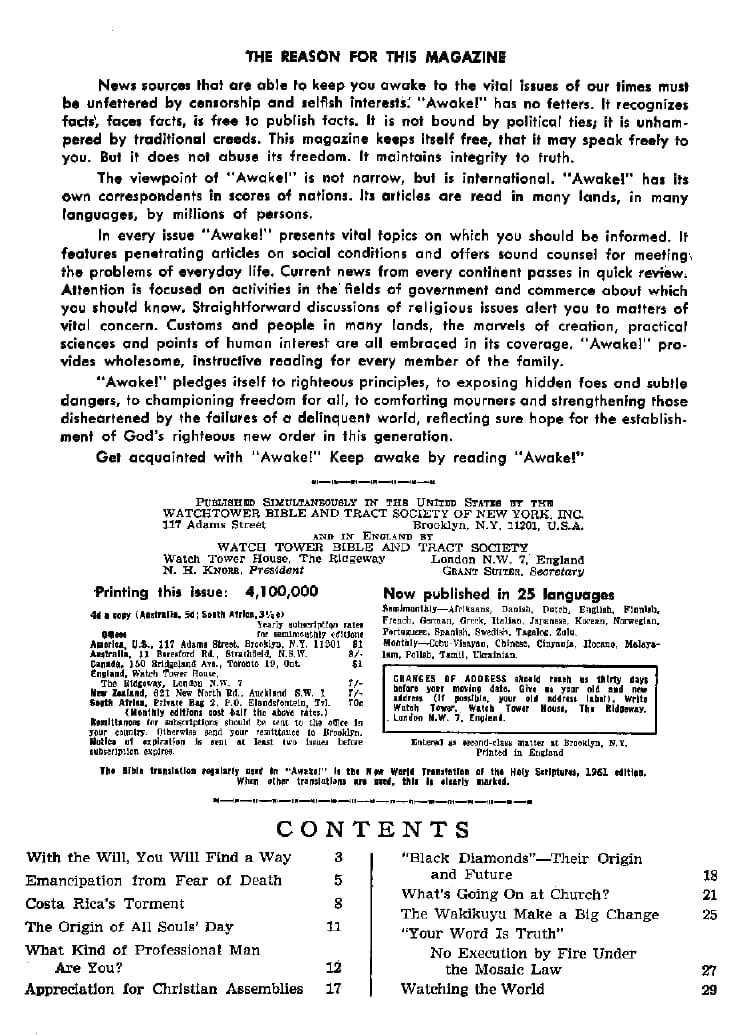
THE REASON FOR THIS MAGAZINE
News sources that are able to keep you awake to the vital issues of our times must be unfettered by censorship and selfish interests. "Awake!" has no fetters. It recognizes facts; faces facts, is free to publish facts. It is not bound by political ties; it is unhampered by traditional creeds. This magazine keeps itself free, that it may speak freely to you. But it does not abuse its freedom. It maintains integrity to truth.
The viewpoint of "Awake!" is not narrow, but is international. "Awake!" has its own correspondents in scores of nations. Its articles are read in many lands, in many languages, by millions of persons.
In every issue "Awakel" presents vital topics on which you should be informed. It features penetrating articles on social conditions and offers sound counsel for meetings the problems of everyday life. Current news from every continent passes in quick review. Attention is focused on activities in the fields of government and commerce about which you should know. Straightforward discussions of religious issues alert you to matters of vital concern. Customs and people in many lands, the marvels of creation, practical sciences and points of human interest are all embraced in its coverage. "Awakel" provides wholesome, instructive reading for every member of the family.
"Awakel" pledges itself to righteous principles, to exposing hidden faes and subtle dangers, to championing freedom for all, to comforting mourners and strengthening those disheartened by the failures of a delinquent world, reflecting sure hope for the establishment of God's righteous new order in this generation.
Get acquainted with "Awake!" Keep awake by reading "Awake!"
PUBLISHED SIMULATBOUSLY IN THE UNITED STATES BY THE WATCHTOWER BIBLE AND TRACT SOCIETY OF NEW YORK, INC.
117 Adams Street
Brooklyn, N.Y. 1201, U.S.A.
WATCH TOWER BIBLE AND TRACT SOCIETY
Watch Tower House, The Ridgeway N. H. KNORE, President
London N.W. 7. England
GRANT SUTTER. Secretary
Printing this issue: 4,100,000
4d a copy (Australia, 5d; South Africa, 3½s)
Yearly subscription rates
for semiannually offered
subscription U.S., B. S., 117 Adams Street, Brisbane, Q. B. 1101 1101
Australia, 11 Beresford Rd., Strafford, N.S.W. 81
Australia, 130 Bridgford Ave., Toronto, 19 Oc. 10
The Bidway, London, W. 7 7
New Zealand, 621 New North Rd., Auckland, S.W. 1
The Monthly subscription cost $41 (the above rates)
Resultatons for advertisements should be sent to the office.
Resultatons for advertisements should be sent to the office.
Holiday excursion is at East Auckland before
subscription expires.
Now published in 25 languages
Salmamiani—Afghanistan, Bangladesh, Botswana, English, Finland, French, German, Greece, Hellenic, Japan, Kazakhstan, New西兰, Nigerian, Poland, Russian, Tajik, Tahala, Turkey.
Menthol—Diazinia, China, Chihuahua, Honduras, Meloylam, Polish, Falken, Ukraine.
CHANGES OF ADDRESS should result in thirty days before your moving date. Give an old and new address to the person you want to move. Watch Tower, Watch Tower House, The Ridgeway, London M.W. 7, Englewood.
Entered as second-class matter at Brooklyn, N.Y. Printed in England
The Bible translation regularly used in "Awakers" is the New World Translation of the Holy Scriptures, 1961 edition. When other translations are used, this is clearly marked.
CONTENTS
With the Will, You Will Find a Way 3
Emancipation from Fear of Death 5
Costa Rica's Torment 8
The Origin of All Souls' Day 11
What Kind of Professional Man
Are You? 12
Appreciation for Christian Assemblies 17
"Black Diamonds"—Their Origin
and Future 18
What's Going On at Church? 21
The Wakikuyu Make a Big Change 25
"Your Word Is Truth"
No Execution by Fire Under
the Mosaic Law 27
Watching the World 29
WITH THE Will. YOU WILL FIND A Way
as you do not know what your life will be tomorrow. . . . Instead, you ought to say: 'If Jehovah wills, we shall live and also do this or that."—Jas, 4: 13-15.
PEOPLE generally are able to do what they really want to do. When there is a strong enough will to accomplish some-
The importance of considering Jehovah's will in matters is illustrated in the case of the conquering king of Greece, Alexander the Great. Although having but
thing, usually a way is found to do it. Obstacles may appear insurmountable, like unscalable mountains, but with faith and determination these mountainlike barriers can be removed. Jesus Christ showed this when he said: 'If you have faith the size of a mustard grain, you will say to this mountain, 'Transfer from here to there,' and it will transfer, and nothing will be impossible for you.'—Matt, 17:20.
Think of that! With determination and strong faith in God, you will find the way to overcome seemingly impossible oba small army, Alexander was able to overcome many superior forces. He finally crushed the Fourth World Power, Persia, and its mighty army of 1,000,000 warriors at the battle of Gaugamela with only 47,000 men. Interestingly, however, there was one notable project in which Alexander the Great failed, and that was in his efforts to make Babylon a great city again, to serve as his world capital. Regardless of how strong his will was in this matter, he was bound to be unsuccessful in finding a way to carry out his plans. Why? Because many before God had made
stacles. You will be able to accomplish that to which you set your mind. This, of course, will be possible only if your will is in harmony with God's will. The Christian disciple James, a half brother of Jesus Christ, made this clear when he wrote: "Come, now, you who say: 'Today or tomorrow we will journey to this city and will spend a year there, and we will engage in business and make profits,' where-
many years before, God had prophesied: "Babylon . . . must be as when God overthrew Sodom and Gomorrah. She will never be inhabited, nor will she reside for generation after generation."—Isa. 13:19, 20.
This certainly emphasizes the importance of finding out what God's will is, for one is certain to fail if his efforts are in conflict with God's purposes. On the other
hand, if what you desire with all of your might to do is in harmony with his will, God gives the assurance in his Word that he will help you to do it.
For instance, if it is your strong desire to break the tobacco habit, to refrain from overindulgence in alcoholic beverages, to curb loose moral habits or to resist some other temptation, God will assist you. You must first exercise the will, but then He promises that "he will not let you be tempted beyond what you can bear, but along with the temptation he will also make the way out in order for you to be able to endure it." Yes, if you have the will, with the help of God you will find the way to overcome temptation!—1 Cor. 10:13.
If you truly have the will, you will also find the way to serve God actively, regardless of the obstacles or opposition. The Christian apostle Paul found this to be true, and so wrote: "For all things I have the strength by virtue of him who imparts power to me." Especially is strength given to those whose will it is to obey God's command to preach the good news of the Kingdom. Paul readily acknowledged this, saying: "The Lord stood near me and infused power into me, that through me the preaching might be fully accomplished." —Phil. 4:13; 2 Tim. 4:17; 2 Cor. 4:7.
Do you have the will to serve God? If so, you will find the way. Nothing, no, not anything, including Satan the Devil and his demons, will be able to stop you. Consider the example of twenty-year-old Susan Comstock, who lives in upper New York State. Since birth she has had cerebral palsy. She can neither talk nor walk, yet Susan has been a regular publisher of the good news of God's kingdom for years, and recently has even shared in the full-time
ministry! Having the will to serve God, she found the way.
This is how she does it. A name is chosen from the local directory and a letter along with two magazines is sent to the individual. Later a follow-up letter is sent, and those who show interest are visited by local ministers who can call personally. Susan has an electric typewriter, and she accomplishes a great deal of work with the two fingers on her left hand, the only ones she can use. During the three months she spent in the full-time ministry recently, she averaged 81.7 hours, 109.7 magazines, 18 follow-up letters, and she conducts three Bible studies through the mail!
While it is true that Susan cannot talk, nevertheless, she also has found a way to share in congregational meetings. For example, in the Theocratic Ministry School, a meeting where persons are provided with the opportunity to improve their ministerial ability by delivering short demonstration sermons, two persons set the stage for Susan's talk by mentioning a letter received from her in answer to a Bible question. Then one of them reads Susan's letter that contains her sermon.
A ministerial servant in Susan's congregation writes: "Her love for the truth helps the rest of us in the congregation to appreciate that we, who have it much easier, can also serve Jehovah." Yes, no matter what the obstacles or opposition, whether it be a physical handicap, opposed relatives, oppressive governments or even the inherited weaknesses of the sinful flesh, the person who wants with all of his heart to serve Jehovah will find the way. Remember, Jesus said that with faith "nothing will be impossible for you."
EMANCIPATION
EMANCIPA
from
FEAR
OF DEATH
</div>
Does fear of death enslave you?
How can you gain your freedom?
WHY did a Nigerian magistrate stop a trial and order policemen to search the courtroom for dreaded fetish objects? Why did some Liberian Christians perform an act of idolatry when threatened by soldiers with fixed bayonets? Why do Ga tribesmen of Ghana make ugly scars on their faces? Why did a critically ill American woman consent to a blood transfusion even though she knew that God's law forbids this use of blood? Fear of death!
Everywhere one sees this powerful slavemaster. Those enslaved by it are in every land. Are you also one of "those who for fear of death [are] subject to slavery all through their lives"? Maybe you are inclined to reply as the Jews did to Jesus: "Never have we been slaves to anybody!" But as doers of sin they were slaves of sin. Ignorantly, they were in bondage to an unseen master, the Devil, whose lies they believed and whose will they obeyed. Just so today fear of death enslaves those who have been misled as to the cause of death and the true state of the dead, those who expect to suffer eternal torments in a fiery hell or purgatory, those who are afraid of the dead, those who worship the dead and those who compromise right principles because they are afraid to die.—Heb.
2:15; John 8:33.
The witch doctors and juju priests of Africa capitalize on the fear of death. This fear holds captive those Ibibios of Nigeria who live in dread of ibok and ekpo retaliation. It enslaves Yorubas who fear Egungun masqueraders. It is the basis of superstitions among other African tribes. It underlies customs such as the all-night "wakes" of the West Indies and numerous strange and horrible funeral rites of other lands. This explains why people will slave to pay fabulous amounts for a so-called "honorable" burial. Apart from its enslaving material effects, this fear often prevents people from taking up true religion because of concern about 'what kind of burial they will have' if they leave the traditional church. How can such ones be emancipated from this enslaving fear of death?
Jesus said, "You will know the truth, and the truth will set you free."—John 8:32.
What Death Is
From the Bible we learn that God's original purpose was for his perfect earthly children to enjoy life forever. He blessed the first human couple; he wanted them to extend the paradise garden earth-wide, without ever dying. How did death enter? It was man's disobedience that brought the sentence of death. (Gen. 3:19) By inheritance from our first parent, sin and death have passed on to all Adam's children. (Rom. 5:12) Thus it came about that all men die.
But do we have to submit to slavery all through our life because of fear of death or fear of the dead?
No; not if we know the truth. Fear of the dead is based on lies from which people get the idea that a man becomes more powerful after his death and can harm those who neglect or dishonor the dead. The truth is that the dead are unconscious, know nothing. God's Word says at Ecclesiastes 9:5, 6: "For the living are conscious that they will die; but as for the dead, they are conscious of nothing at all . . . their love and their hate and their jealousy have already perished." Why fear them? Isaiah 26:14 says: "They are dead; they will not live. Impotent in death, they will not rise up." This is the truth, from the Bible, God's Word. Do you believe it? Most of the Jews were never set free, because they did not believe the truth. Jesus told them: "If I speak truth, why is it you do not believe me? He that is from God listens to the sayings of God. This is why you do not listen, because you are not from God." God's truth can set you free!—John 8:46, 47.
Satan's lies and leadings keep people in slavery. "That one was a manslayer when he began, and he did not stand fast in the truth, because truth is not in him." From the very beginning of his rebellious course he has been causing death among mankind. He is "the one having the means to cause death, that is, the Devil." In addition to our inherited sin, the means the Devil uses include his invisible organization of demons as well as practicers of black magic, witch doctors, juju priests, cruel dictators, world wars, and so on. This does not mean that Satan can just reach out and kill any person he wants to. Jehovah God protects those who belong to him, and that is why true worship has survived on earth till now. But we live in imperfect flesh in a wicked system of things; "time and unforeseen occurrence befall them all," true worshipers as well as others. Moreover, Jehovah permits persecution to come
to all his people and even death to some of them, "in order to do a refining work," to test their integrity, and to prove the Devil a liar when he said that under pressure all men would turn against God. —John 8:44; Heb. 2:14; Eccl. 9:11; Dan. 11:35.
How Freed from Fear of Death
Life is sweet, and naturally no one wants to die. But is it true that "everything that a man has he will give in behalf of his soul" or life? Satan said so. (Job 2:4) On the other hand, Jesus Christ said: "Whoever wants to save his soul will lose it; but whoever loses his soul for my sake will find it." This issue involves the integrity of human creatures who owe their lives and exclusive devotion to the Creator. When faced with danger or even death, which side do you support by the decision you make? Would you violate God's law on blood if a doctor assured you that a transfusion would save your life? In case proper medical treatment is unavailing or unavailable, would you resort to fetish or demonic cures or to so-called "faith healing"? Would you violate your conscience and compromise Christian integrity under pressure? If you would, then you, too, say: "Everything that a man has he will give in behalf of his soul." Our present life is valuable, but it is not worth the price of integrity. It is not worth canceling out all hope for eternal life in a perfect world now so near. As Jesus said: "What benefit will it be to a man if he gains the whole world but forfeits his soul? or what will a man give in exchange for his soul?" "He that is fond of his soul destroys it, but he that hates his soul in this world will safeguard it for everlasting life." —Matt. 16:25, 26; John 12:25.
Hundreds of Christians in Liberia endured brutal treatment and threats of death because they refused to worship an idol.
Like faithful witnesses of God in times past, they "were tortured because they would not accept release by some ransom," such as by compromising saluting a State image so as to escape punishment and possible death. They had the faith of Shadrach, Meshach and Abednego, who told King Nebuchadnezzar: "If it is to be, our God whom we are serving is able to rescue us. Out of the burning fiery furnace and out of your hand, O king, he will rescue us. But if not, let it become known to you, O king, that your gods are not the ones we are serving, and the image of gold that you have set up we will not worship."
—Heb. 11:35; Dan. 3:17, 18.
Not only was God able to rescue, and did rescue them from the burning fire, but he can also resurrect us if we die faithful to him. He resurrected his Son Jesus Christ, concerning whom the apostle Paul wrote to the Hebrews: "Therefore, since the 'young children' are sharers of blood and flesh, he also similarly partook of the same things, that through his death he might bring to nothing the one having the means to cause death, that is, the Devil; and that he might emancipate all those who for fear of death were subject to slavery all through their lives."—Heb. 2: 14, 15.
Jesus partook of flesh and blood, became a perfect man. He knew and taught the truth about the cause of death, the state of the dead and the hope of a resurrection. He did not live his life in slavery due to fear of death. Satan the Devil was permitted to use the means to cause death to Jesus, but Jesus faced death courageously.
He maintained his integrity down to the end. He did not forfeit his soul by compromise. So God resurrected Jesus. By his sacrificial death, Jesus could nullify the death that Satan can inflict on us. As an immortal spirit creature in heaven, and as one who is now ruling in his kingdom, Jesus has the means to destroy the Devil and end forever his wicked power over mankind. He is thus the great Emancipator or Liberator of mankind. By faith in the provision for life made through him those who all their lives have been enslaved out of fear of death can be emancipated from that fear now.
Jehovah God commands those who want freedom to get out of the false religious systems of Babylon the Great, which continue to teach Satan's lies about the dead. Separate yourselves from those who would use the fear of death to hold you in slavery all your life. Quit touching unclean things connected with worship of the dead. Quit seeking fellowship with people who practice idolatry, whether this is promoted by the State or by the religions of Christendom or pagandom. Hold a good conscience. Hold your integrity.—2 Cor. 6: 17; Rev. 18:4; Job 27:5.
You can have the hope now of being freed entirely from death, either through resurrection or in passing through the end of this system of things alive into paradise restored, a perfect new system of things. "If the Son sets you free, you will be actually free" from the fear of death. It is your opportunity now to learn "the truth, and the truth will set you free." —John 8:36, 32.
SOMETIMES I wonder if a sudden dramatic natural catastrophe might not be easier to bear. Our day-by-day turment appears undramatic, but the suffering, distress and harassment are just as real as any sudden disaster,' said Guillermo Castro, governor of San José Province, Costa Rica. The immediate cause for the torment referred to is the combination of ash and black sand that fills the air incessantly, and has become a source of constant invitation to the population. No place in all of central Costa Rica seems to be clear of this "fallout." It seems in through closed doors and windows, even when they are taped; it makes it impossible to hang out a wash; it gets into people's clothing, their hair and even their food. Cars parked in the streets, merchandise in the stores, everything soon gallers a thick layer of dust. It clogs sewers; it eats away meta) rainpipes; it shortens the life of all kinds of machinery; it interferes with the flow of drinking water through municipal filtration plants.
But where does it all come from? That is no mystery; for everyone in Costa Rica knows the source of the trouble. However, it is a trouble that cannot be cured at the source—thus far at least. The culprit is
Mount Irazia, a volcano situated some seventeen miles to the northeast of the capital, San José. It suddenly roused from a twenty-year siege and started its eruptions on March 13, 1963. No ordinary volcano this, as may be gathered from Governor Castro's plain. Unlike other volcanoes, it does not explode and erupt liquid lava and get it oil over with. It is called a "dry" volcano. It has plenty of gasses and multian rock, but, as these near the surface of the crater, rainwater and ground water cool off the lava before it can overflow. Instead, the water is turned into steam, which shoots out of the crater in great thunder, forcing clouds of ash and black sand, dislodged from the sides of the crater, as high as 26,000 feet into the air. This is what is carried by the winds into every corner of Costa Rica as well as into neighboring countries, and rains down upon the countryside with much damage to property and dispositions.
Calamity at Cartago
This same seagrue produced calamity for the people of Cartagua, a city of 50,000 population in central Costa Rica, located just below Mount Teich. It happened on the night of December 9, 1963. Heavy rains fell that night, increasing in the early morning hours to the intensity of a tropical storm.
Deep drifts of ash on the sides of the mountain soaked up a maximum of rainwater, but, when the saturation point was reached, the sodden ash began sliding down the slope and into the ash-clogged Reventado River. The great weight of the added water and ash swept before it the tons of ash that had accumulated in the river's bed and bore it along down the moun-
ly sent one million dollars in cash to replace the wrecked homes, and later sent a group of Navy Seabees to help construct defenses against future floods.
Other damage to property throughout Costa Rica has been extensive, though less spectacular. Since the current eruptions began, thousands of tons of the "fallout" have drifted over valuable farmlands, causing millions of dollars of damage to crops
tain toward Cartago. Huge boulders weighing tons, trees, wildlife—everything in its path was carried along. As the onrushing flood smashed into the small settlements near Cartago, it tore houses from their foundations and carried them down the valley in a deluge of mud, rocks and debris.
One survivor reported: 'We heard rumblings from the volcano. The winds were whistling more strongly all the time. The rain came. There were frightening noises. It was terrible. I don't want to pass another night here for anything in the
and livestock. The chemical constituents of the ash, such as silicon, iron, calcium, aluminum and magnesium, are, in small quantity, really most beneficial to the lush, fertile farmlands of the country. In large doses they have a lethal effect. Thousands of acres have been covered over and all plant life killed off. The country's milk production is down 20 percent, its sugar production down 25 percent, as a result of this plague. Fruits and vegetables are in short supply, pushing up prices by 100 percent, in some cases.
world." Another, who lost husband and child, described her experience this way: "The wind was very strong and it was raining hard. When we opened the door we were forced out by the wind and the rain. We fell down. I lost my small son. My husband disappeared. We were all drowning. I couldn't see anyone. Suddenly someone helped me." The fire department's prompt report to the capital stated tersely: "This is really terrible. The houses are jammed together at the edge of the street and it is
Perhaps the greatest worry to Costa Rica is the effect of this lethal shower upon its coffee farms, about one-quarter of which lie in the path of the falling ash. Coffee is a 48-million annual business and accounts for one-half of the total exports. It has been estimated that during the first two years of eruptions by Mount Irazu the country will have sustained a loss to the coffee crop alone of something like30 million. Experts claim that, even if the eruptions were to cease tomorrow, it
feared that there are people in them. There were people in some of them. Houses had been carried away bodily or filled with mud. Mammoth rocks were strewn about like pebbles. A wide swath of the city's suburb had been cut away.
The losses at Cartago were reported as twelve dead, three hundred injured, and over 500 homes destroyed. The government immediately dispatched such help as it could provide. The United States prompt-
would take anywhere from six months to three years to restore the land that has been desolated. Coffee growers explain that when the ash is falling during the flowering season it interferes with proper pollination and so cuts down the yield.
During the rainy season from May to December the situation is somewhat more tolerable for the population. Afternoon rains wash away the accumulated ash and clear the air momentarily. But for the other five months of the year the ash just builds higher and higher.
Women wear veils to protect their hair from the gritty "fallout." When wind direction and heavy eruptions combine to drop extra-thick clouds of ash, people simply have to cover their eyes and try to carry on as usual.
How Much Longer?
The uncertainty about how long the eruptions will continue has had an ominous effect upon the country's economy as a whole. Construction work has virtually come to a standstill. Sales have declined. Damage to buildings from the weight of fallen ash has been noted. The government, doing what it can to alleviate the situation, has had to pour hundreds of thousands of dollars into the job of cleaning up—an apparently endless task. More than 100,000 tons of the ash have had to be removed from the streets of San José, the capital, during an eighteen-month period. But generous assistance from neighbor countries has been a ray of light piercing the gloom.
Under such trying conditions the minds of many turn to wondering why all this misfortune has come upon them. Religious leaders have encouraged the view that the people are really being punished by God for their sins. But reasonable persons look around at other lands and cannot quite see that Costa Ricans are any more blameworthy than other peoples. A little reflection would also show them that the volcanic ash, like ordinary rainfall, comes alike upon the good and the bad. This certainly rules out the idea that God is sending these conditions as a punishment, for the patriarch Abraham could declare with confidence: "It is unthinkable of you that you are acting in this manner to put to death the righteous man with the wicked one so that it has to occur with the righteous man as it does with the wicked! It is unthinkable of you. Is the Judge of all the
earth not going to do what is right?"—Gen. 18:25.
When Jesus was ministering among the Jews, it is evident that he encountered the same idea, fostered by the religious leaders of that time, namely, that calamities were punishments from God. He set the question at rest and pointed to the yet future time of punishment from God, for the record at Luke 13:1-5 tells us: "At that very season there were certain ones present that reported to him about the Galileans whose blood Pilate had mixed with their sacrifices. So in reply to them he said: 'Do you imagine that these Galileans were proved worse sinners than all other Galileans because they have suffered these things? No, indeed, I tell you; but, unless you repent, you will all likewise be destroyed. Or those eighteen upon whom the tower in Siloam fell, thereby killing them, do you imagine that they were proved greater debtors than all other men inhabiting Jerusalem? No, indeed, I tell you; but, unless you repent, you will all be destroyed in the same way.'"
So Costa Ricans and all other peoples can take comfort and warning from the knowledge that God is not causing their present distress but that it is at the battle of Armageddon that he will punish the wicked with annihilation. Meanwhile, and until he does take such final action in the near future, it is a fact that "time and unforeseen occurrence befall" all men. (Eccl. 9:11) Those who today prove themselves worthy of survival of Armageddon's storm will live in a new system of things in which they will receive divine instruction and protection against volcanic eruptions, storms and weather hazards of the future. There will be no more torment, for Jehovah has decreed that nothing will do any harm or cause any ruin in all the earthly realm of his kingdom.—Isa. 11:9.
The Origin of All Souls' Day
HAT legends of the flood of Noah's day are found in every part of the earth and among nearly all peoples is common knowledge. Further, that they are of such a nature as to indicate a common source is also well known. However, what is not so well known is that the religious holiday All Souls' Day has its roots in the pagan worship of the dead, harking back almost to the time of the Flood.
From the evidence at hand it is clear that originally this festival commemorated the destruction of those of humankind who perished at the time of the Flood. According to the Genesis account, the Deluge began on the seventeenth day of the second month, or about the beginning of November on our present calendar. "In the six hundredth year of Noah's life, in the second month, on the seventeenth day of the month, on this day all the springs of the vast watery deep were broken open."—Gen. 7:11.
Conclusive evidence regarding this was gathered by Richard Halliburton and was published in Professor Piazzl-Smyth's Life and Work, Volume 2. Among other things, Halliburton had the following to say:
"The festival of the dead, or feast of ancestors, . . . is now or was formerly observed at or near the beginning of November by the Peruvians, the Hindus, the Pacific Islanders, the people of the Tonga Islands, the Australians, the ancient Persians, the ancient Egyptians and the northern nations of Europe, and continued for three days among the Japanese, the Hindus, the Australians, the ancient Romans . . .
"Wherever the Roman Catholic Church exists, solemn mass for All Souls is said on the 2nd of November, and on that day the gay Parisians, exchanging the boulevard for the cemetery, lunch at the graves of their relatives and hold unconsciously their 'feast of ancestors' on the very same day that savages in the far-distant quarters of the globe observe, in a similar manner, their festival of the dead. Even the Church of England, which rejects All Souls, . . . clings to All Saints, which is clearly a relic of primeval heathenism . . . The month in which [the Peruvian
festival of the dead] occurs, says Rivero, is called 'aya marca,' from Aya, a 'corpse,' and marca, 'carrying in arms,' because they celebrated the solemn festival of the dead with tears, hugulous songs and plaintive music; and it was customary to visit the tombs of relatives, and to leave in them food and drink. It is worthy of remark that this feast was celebrated among the ancient Peruvians at the same period and on the same day that Christians solemnize their commemoration of the dead—2nd November. . . .
"The month of November was formerly called in Persia, the month of the angel of death.' In spite of the calendar having been changed, the festival took place at the same time as in Peru...
"The startling fact that this feast was celebrated among the ancient Peruvians at the same period, and on the same day that Christians solemnize the commemoration of the dead (2nd November), at once drew my attention . . .
"The festival of the dead was held [by Mexicans] on the seventeenth of November, and was regulated by Pleiades. It began at sunset, and at midnight, as the constellation approached its zenith, a human victim . . . was offered up to avert the dread calamity which they believed impended over the human race. They had a tradition that, at that time, the world had been previously destroyed, and they dreaded that a similar catastrophe at the end of a cycle would annihilate the human race."
In support of the foregoing are the observations made by Colonel John Garnier in his book The Worship of the Dead or the Origin and Nature of Pagan Idolatry.
How a religious belief such as this could have permeated the religions of people around the world has puzzled many, but it is made clear by the Bible. The Scriptures explain that, over a century after the flood of Noah's day, when some of the descendants of the Deluge survivors turned to false religious practices, Jehovah God confused their language and they scattered to other lands. Wherever they went, they took their religion with them—religion disapproved by God.—Gen. 11: 19.
What kind of PROFESSIONAL MAN are you?
THE doctor's telephone rang. A representative of a drug company
was on the wire. Would the doctor be willing to try out a certain drug on one hundred patients and report the results? For doing so he would receive 4,000. That would have been the easiest4,000 the doctor had ever earned. Did he accept?
No, Dr. Edward Adelson, blood specialist of Washington, D.C., refused the offer. Why? Because, as he himself said: "Had I taken the 4,000 I would have been either dishonest or stupid. I know what Wallace Labs want. If the4,000 interests me even at the subconscious level, it becomes to my advantage to have the results come out well." Instead of accepting the offer, he reported it to the United States government.1
The foregoing news item may be said to illustrate the challenges that professional people, such as doctors, have to meet at times. By reason of their education and training they almost invariably have many advantages over persons engaged in other pursuits; in particular do they enjoy a high degree of public trust and respect. To them, therefore, the principle that Jesus
of Nazareth uttered on one occasion may also be said to apply: "Indeed, everyone to whom much was given, much will be demanded of him; and the one whom people put in charge of much, they will demand
more than usual of him."—Luke 12:48.
That the application of this principle to the professions is generally recognized is apparent from the comprehensive definition of "profession" as used here: "A calling requiring specialized knowledge and often long and intensive preparation including instruction in skills and methods, . . . maintaining by force of organization or concerted opinion high standards of achievement and conduct, committing its members to continued study and to a kind of work which has for its prime purpose the rendering of a public service."—Webster's Third New International Dictionary.
However, human nature being what it is, it should not be surprising that at times professional men fail to measure up to the standard set for them or that they may have set for themselves. They are faced with peculiar temptations, have greater challenges to meet, more subtle snares against which to be on guard. As a poet once expressed it: "Never a treasure without a following shade of care; never a power without the lurk of a subtle snare."
Among the questions that the professional man might well ask himself are these: Am I sufficiently humanitarian, that is, truly sympathetic, toward those whom I serve?
Do I have adequate skills? Am I open-minded? Do I practice what I preach? When there is a conflict of interests, how do I decide?
Sufficiently Humanitarian, Sympathetic?
There are times when you as a professional man should be "objective." That is, there are times when you should not get emotionally involved; as when, for example, you are evaluating the merits of certain stocks and bonds. But you should be humanitarian, become emotionally involved, have empathy and sympathy, fellow feeling, when dealing with your patients.
Unfortunately, the modern trend toward medical specialties is also a trend from the humanitarian to the experimental treatment of patients. Young medical specialists, we are told, become enamored by their skills and scientific gadgets and as a result 'their interest in human creatures eventually diminishes, and the application of their science becomes more and more narrow.' Thereby they overlook the fact that the art of medicine is based on man's sympathetic nature and his instinctive "desire to help those in sorrow, need and sickness," which has been termed "the priceless ingredient in the care of the sick." According to the editor of Medical World News, there should be more stress on this aspect of the medical profession in their publications.2
The experimenting doctor looks at his patient with the aid of his instruments, but that is not enough. As a professor of clinical medicine at the University of Oregon Medical School has well expressed it, when going "about making a diagnosis and undertaking treatment, he must not only look at the patient with the cold knowledge of medical science but must see, with warmth and human understanding, the whole situation—the patient, the disease,
the family, the environmental setting, and the relationships of them all." s
In particular must the surgeon be alert to be humanitarian. As pointed out by W. N. Firor, a leading United States surgeon:
"When surgery is considered primarily as a scientific discipline, every patient tends to be looked upon as an object for experimentation. This attitude is utterly impersonal and objective. . . . When surgery is approached primarily as a branch of the healing art, the most durable satisfaction results. . . . The greatest reward that comes to a surgeon is . . . simply the realization that he has been able to help people back to health, and in the process has been a counselor and a friend."
The greatest professional man that ever lived, Jesus of Nazareth, excelled not only in teaching pure religion but also in curing mental and physical ills. Although he had infinite power at his disposal, that did not cause him to become coldly objective toward those who came to him for help. No, he manifested deep concern for them. What a fine example to follow!
No wonder that a veteran leading American psychiatrist was able to write about this Jesus of Nazareth:
"If you were to take the sum total of all the authoritative articles ever written by the most qualified of psychologists and psychiatrists on the subject of mental hygiene—if you were to combine them and refine them and cleave out the excess verbage—if you were to take the whole of the meat and none of the parsley, and if you were to have these unadulterated bits of pure scientific knowledge concisely expressed by the most capable of living poets, you would have an awkward and incomplete summation of the Sermon on the Mount. And it would suffer immeasurably through comparison."6
Adequately Skilled?
Second only to having the right mental attitude toward your profession is adequate skill therein. As a professional man you should be qualified to do the work for which you get paid and for which you occupy a position of trust.
Of course, it is not expected that any physician or surgeon know everything, but he should be honest, know his limitations, do his best and ever be willing to learn.
That there are serious lacks in this regard is no professional secret. Thus, back in 1959, the director of the American College of Surgeons reported that one of the world's most distinguished surgeons had told him that at least half of his practice "consists of attempts to correct the bad results of surgery undertaken . . . by doctors inadequately trained in this field."18
And just last year a book very critical of the medical profession in Canada was published, giving the results of eight years of investigation conducted at the request of the Canadian College of General Practice. According to the press, "many senior members of the profession said privately they felt these criticisms were justified." To quote one of them, the report "is a serious study of an important area of medical practice. . . . It points out that some general practitioners are better than others, an observation that is not surprising, but what really hurts is the proportion of general practitioners who are categorized as below acceptable standards of competence." According to this book, The General Practitioner, by Dr. Clute, 28 percent of the Ontario family physicians studied were "incompetent and a potential danger to their patients."
Helping to understand the peculiar snare the professional man has to guard against in this matter are the words of Dr. Alton Ochsner, described as "one of the world's great physicians":
"The fact that we are physicians tends to make us prima donnas. Doctors get more credit than they deserve. I have always felt that most patients would get well regardless of what I have done for them. . . When I realize that, it helps me keep my perspective. Every Monday . . . we have a meeting . . . at which time there is a critical discussion of performance during the week. Errors are pointed out on a blackboard. It is a headshrinking hour. It's easy otherwise for young doctors to get into the habit of offering excuses. Only by critical self-evaluation can a doctor keep his feet on the ground."18
Open-minded?
By reason of greater learning acquired over long years of study, internship and practice, you as a professional man may be peculiarly susceptible to becoming opinionated instead of remaining open-minded regarding what is new or that which involves just plain good sense. What a danger this may represent can be seen from the fact that Fleming's discovery of penicillin might well have been lost to humankind had not World War II brought with it a great demand for antibacterial remedies. England's opinionated medical profession simply refused to believe that mold could be an antibiotic!
Yes, being open-minded makes for progress and the dropping of fallacious theories and practices, but being opinionated slows down both. To cite another instance: There was the open-minded eminent surgeon who became convinced that patients, after an operation or after childbirth, should soon start to move around. What success did he have in convincing his colleagues in the United States? As Dr. Walter Alvarez, one of America's leading physicians, tells it: "It took seven years of effort even to get some doctors to let him come to a meeting and tell them what he had found. They would not let him speak before a society, and no medical editor would publish his paper. It was only after nine years that Dr. Leithauser could induce the editor of a medical journal to publish his paper in which he said nothing had gone wrong with the persons who had been allowed to dangle their legs right away, and no disaster had happened to those who were allowed to walk around on the third or fourth day."9
Then again, for years and years the medical profession has ridiculed "unorthodox" theories as to the causes of cancer. But now, according to the "most comprehensive survey on the causes and prevention of cancer ever issued by the World Health Organization," not only cigarette smoking and air pollution are implicated, but also "overeating, excessive consumption of alcohol, sunbathing, lipstick, and artificial colors and flavors in food"—some of the very things that many unorthodox practitioners had also implicated.[19]
Practice What You Preach?
If you are a professional man who is familiar with the Bible you will know that the words of Jesus of Nazareth, "All the things they tell you, do and observe, but do not do according to their deeds, for they say but do not perform," were about the religious leaders of his day. But have you ever thought how that might fit your work? Yes, consistency is also required of you, for do you not give advice as well as medicine, and should not your advice be backed up by a good example? Surely! —Matt. 23:2, 3.
Illustrating this point is the incident Dwight Eisenhower relates in his recently published autobiography. While recovering from his heart attack he was visited one morning by four of his heart specialists. "They earnestly counseled me to avoid tobacco in all its forms. I listened to them politely and attentively. Then noting that all four of them were smoking, I remarked pointedly that I had used no tobacco for more than six years, and wondered why I should be in bed with a heart attack while they were up and working, apparently hale and hearty."14
Of course, there was more than one answer to Eisenhower's question. He may have quit smoking too late; and those four doctors may well be victims of heart attacks even before they get as old as Eisenhower was. But the fact remains that those doctors were setting a poor example for their patient. If anyone should take his health seriously, it should be the doctor, for how can he expect his patients to take his advice seriously if he does not practice what he preaches?
NOVEMBER 8.1964
In striking contrast to those four doctors is one of the world's leading heart specialists, Paul Dudley White. He keeps preaching, Take a lot of exercise to keep the heart strong, and he practices what he preaches. At seventy-seven years he keeps his heart in good condition by taking long walks, chopping wood, mowing lawns, riding a bicycle, and so forth. His advice carries weight!
Succumbing to the "Love of Money"
The Bible tells us that "the love of money is a root of all sorts of injurious things," and the professional man's love of money is no exception to that rule. It also brings forth injurious things. Not that a profession should not be financially remunerative; it should be. After all, the professional man has made a considerable investment in education and training and he renders valuable services. But if you cannot adequately provide for yourself and your family and at the same time carry on your profession according to the rule of 'doing to others as you would have them do to you,' then would it not be better for you to seek some other means of gaining a livelihood?—1 Tim. 6:10; Matt. 7:12.
Love of money is responsible for such unethical practices or "injurious things" as fee-splitting and performing unnecessary operations, although the latter might at times be due to lack of knowledge or experience.
As Dr. Benge Atlee, emeritus professor of obstetrics and gynecology, Dalhousie University, said in discussing the weaknesses of surgeons in a popular Canadian magazine: "Surgeons are human: they, too, like money." But when a surgeon considers the trust placed in him as well as the harm he can do by unnecessary operations, he should exercise a far greater restraint on his love of money than the average person is required to do.
An extreme example of self-interest at the expense of patient interest was furnished by three gynecologists in southern Italy. All three showed up to handle a certain childbirth case in their hospital, but they could agree neither on the manner of delivery nor on whose patient the woman was, and so they fought it out with their fists. Afterward a midwife delivered the baby as the three gynecologists nursed a broken leg, internal injuries and head wounds.
Then there was the Silver Spring, Maryland, physician who was indicted for reporting drug data without making any tests. His reports were so uniformly favorable that they aroused the suspicions of the government officials. Apparently he did not care at all what harm these drugs might do because of being used due to his false favorable reports.
Obviously, not all professional men are as careful to maintain their integrity as was Dr. Adelson, who turned down the offer of an easy 4,000. In fact, the same report that told of his action also told that the government was investigating six doctors who had accepted from2,500 to 12,000 to test drugs. And only as recently as March 1964 the professional journal GP commented on the American Medical Association's acceptance of10 million from six leading tobacco companies to do research on the subject of tobacco and health.
Not a few in the medical profession raised questioning eyebrows when they heard that this medical association, which for years had refused to accept any tobacco advertising in any of its professional journals, had now accepted a gift of such magnitude from such a source and for such a purpose.
Even if the American Medical Association does not know what it is doing, the tobacco companies making such a gift certainly do. They are gambling that, at least on the subconscious if not also on the conscious level, the money will influence the findings made by those whose salaries are paid by their gift. For are there not professional men in the employ of the tobacco companies who keep insisting, in spite of the worldwide mountain of evidence that keeps getting ever higher, that the case against cigarettes causing cancer has still not been conclusively proved?
Inspired Bible prophecy indicates that in these last days there would be an increase in lawlessness and greed, even as is apparent from a letter published in the Medical World News of April 26, 1963: "As a practicing MD for thirty-six years, I am disgusted and fed up with the attitudes of many physicians. The doctors, it seems by and large, instead of dedicating themselves to service and humanity, are worshiping the call of the golden fleece and are totally unmindful of what their real function should properly be. They have their noses in the air and use their positions to seek status. Yes, I am fed up with the profession as a whole. For the masses, the National Health Service in England provides an excellent opportunity for the little man to avail himself of medical care without separating himself from his meager life's savings to enrich a group more intent on exploitation than on service to humanity."
The strike of doctors in the Canadian province of Saskatchewan two years ago and the one occurring in Belgium in April 1964 are other indications that the abovequoted physician may not be wrong.
AWAKE!
But there are also the other kind. In fact, a dean at one of the leading medical schools in the United States avers that, by and large, the "humanitarian viewpoint is typical of the medical student" and that he is service motivated.
The man that measures up to the demands of his profession, that meets its challenges, appreciates that there are more valuable things in life than material rewards and physical ease and that service to mankind is far more likely to bring with it more happiness than more money. Such men will testify to the fact that, though their profession may be financially remunerative, its greatest rewards are the inner satisfaction of rendering service and the expressions of gratitude received from others.
The foregoing facts furnish food for thought for all readers of Awake! whether professional men or not. To the extent that you have opportunity to serve others, ask yourself: Am I sufficiently sympathetic toward others? adequately skilled? open-minded? Do I practice what I preach? When there is a conflict of interests, do I decide in favor of love of money or in favor of love of neighbor?
Such self-examination is profitable for everyone, no matter what his line of work.
REFERENCES
1 New York Herald Tribune, February 23, 1964.
2 Medical News News, January 17, 1964.
3 Listen to Leaders in Medicine, Love and Childers, p. 99.
4 Ibid., p. 182.
5 A Few Buttons Missing—The Case Book of a Psychiatrist, Flisher, p. 273.
6 New York Herald Tribune, February 29, 1963.
7 Toronto, Canada, Daily Star, March 20, 1963.
8 Medical World News, February 16, 1962.
9 Los Angeles, California, Times, June 24, 1962.
10 Medical World News, January 17, 1964.
11 Mandate for Change, D. Elsenhower, p. 539.
O ATTEND an assembly in Bombay, India, many Witnesses came from distant parts of this vast land, from villages in the south and villages in the far north. One family came all the way from Nepal, in the Himalayas. For them it was a four-day journey, starting off through snowdrifts and coming down into tropical heat. At the assembly there were Witnesses speaking nine different languages. Talks, delivered in English, were translated so that those persons speaking Bengali, Hindi, Kanarese, Malayalam, Marathi, Tamil, Telugu and Urdu could hear what was said from the platform. At the close of the public talk, an interested man told a Witness: "I've heard Billy Graham, and I've heard Dr. Stanley Jones, but I never heard anything so convincing as that." Another Witness told how an Englishwoman sitting next to her said that she had heard of Jehovah's witnesses but had been warned not to listen to them. Now she expressed her sorrow that she had not listened to them before,
stating that for years this is just what she had been longing for.
Paraguay had seventeen delegates attending the "Everlasting Good News" Assembly in the United States. Inspired by the returning conventioners, Jehovah's witnesses in Paraguay began to save diligently for the national assembly, scheduled for December 1963. Young Witnesses saved up too. One thirteen-year-old Witness opened a bank account to be certain not to spend what money she made by selling pastry and fruit, so eagerly did she desire to get to the assembly. So unusual was this course for a youngster in Paraguay that, when she made a small bank deposit one day, the bank manager asked her the reason for the account. On being told that it was to enable her to attend the assembly of Jehovah's witnesses in the capital city some 275 miles away, he was so impressed that he reached into his pocket, pulled out a matching amount of money and said, "Here, I want to help you get there."
-their ORIGIN and FUTURE
WATCHING the flickering flames of an open fireplace, did you ever realize that you were observing one of the marvels of creation? Before your eyes a rock was being transformed from its normal state into energy with which to heat your room. And yet this is just one of dozens of practical uses for this amazing and versatile substance we call coal.
By means of this same energy that is being released in your fireplace huge factories are operated, ships are pushed across the open seas, and long railroad trains across the plains. As its by-products we have coal gas, coke, coal tar and ammonia, and from coal tar alone we receive such varied products as road tar, mothballs, lysol, paints and varnishes, dyes and anesthetics. No wonder Ralph Waldo Emerson once said of coal, "We may call it black diamonds. Every basket is power and civilization." But just what is coal? What is its origin and what of its future for mankind?
It is just within the last two hundred years that coal has become so important to us all. The invention of the steam engine and the subsequent great Industrial Revolution in Great Britain created an ever-increasing demand for a cheap source of energy. One of such sources proved to be coal. However, it is probable that even centuries before Christ, the Chinese knew and exploited coal. Much later Marco Polo (1280) mentioned it as one of the curiosities he found when he visited China. The
Greek philosopher Theophrastus (c. 350 B.C.) knew of coal and called it anthrax, a name from which our word anthracite is derived. In his treatise "On Stones" he mentioned fossil substances "that are called coals, which kindle and burn like woodcoals. . . . They are used by the smiths." Later, when the Romans invaded Gaul, they were struck by the fact that "flammable earth" was being excavated from the mountains. So it is evident that even though it was not used in great quantities as it is today, nevertheless, coal has been used as a source of energy for many centuries.
Origin of the Coal
One of the remarkable features of coal is that it is found in seams or layers of extraordinary extensiveness, to compare with their slight thickness. It is a fact that a seam several feet thick may extend over an area of hundreds of square miles. However, scarcely any coal seam consists of pure coal; each is interlaid with many impurities, including shale. Even in coal itself there are many varied forms, ranging from brown coal or lignite, through bituminous coal, to the hardest variety, anthracite. It is often very difficult to distinguish between coal, peat, coaly rock and some bituminous shale, but clear distinctions must be made by law, since in many countries coal, when discovered, belongs to the State, but shale and coaly rock do not.
In attempts to classify coal accurately, thin samples of it are examined under the microscope, so that by as early as 1830 it was discovered that certain samples of coal contained definite vegetable structures. From this it was rightly concluded that the coal had been formed from vegetable matter, and that the essential differences between types of coal were due to differences in the parent plant materials.
fication and the degree to which it will go. Time alone is not all-important.
It is interesting to note the climatic and atmospheric conditions that are believed to have existed in this period of earth's history, known as the Carboniferous period. A study of plant fossils contained in the coal has shown that the climate at that time must have been one that was very favorable to plant growth, because of the
Further studies have led to the theory that coal is the end product in the decomposition in swampy land of certain organic materials, chiefly trees and plants. Ordinarily this could result in the formation of a peat bed. However, as earth, sand and mud continued to be deposited on top of this organic material, it would be subjected to greater and greater pressure, thus compressing it until the final product would be a form of coal. Thus, whereas the thickness of the original peat bed may have
enormous masses of plant debris preserved since then. Extremes in cold or drought could not have existed, since either of these would have obstructed plant growth. Also, the climate apparently was very uniform over the entire globe, and it is generally believed that it was warm or even tropical. The finding of certain fern fossils that reveal a direct relationship to recent fern families of tropical countries is taken by some as evidence of a tropical climate in the Carboniferous period. Confirming this is the fact that annual rings are ab-
been measured in feet, the resulting coal seam is measured in inches. So, to produce a coal seam several feet thick might have required an original peat bed hundreds of feet deep.
During the process of formation these layers of organic material might be subjected to great earth movements due to volcanoes and earthquakes. Thus the deposits would become tilted, faulted, folded and contorted. Moreover, being comparatively soft, these vegetable layers would
sent in the woods of the Carboniferous trees. These must have grown in a climate suitable for uniform and continuous growth, and such a climate exists only in tropical countries having plenty of moisture. So it is generally believed that a climate with seasonal changes of temperature and moisture could not have existed during the coal-forming era. The question arises then: Just when in the history of the earth could this have taken place?
undergo great physical and chemical changes as a result of the tremendous pressures involved as well as the heat generated by these pressures. In time this would result in the formation of coal in its different forms. This process in which vegetable matter becomes converted into coal is known as coalification. It can be appreciated that there are a number of factors that contribute to the rate of coali-
proved science has shown that prior to the global flood of Noah's day such a condition, a uniform, warm and moist climate, did exist for thousands of years after the creation of plant life on the third creative day or period. (Gen. 1:9-13) On the other hand, scientists claim that the Carboniferous period ended some 200 million years ago, so how can these discrepancies be harmonized?
"Coal in Six Weeks"
Of interest on this point is a notice that appeared in the New York Times of June 11, 1963, page 3, under the heading "Australian scientists make brown coal in six weeks." It read: "Australian scientists have made brown coal in six weeks by boiling wood in a strong acid. Dr. S. Sternhall told a coal science conference that a team of scientists of which he was a member produced a substance chemically indistinguishable from brown coal mined in Victoria State." While it is true that brown coal is a long way from being anthracite, nevertheless, the experiment is sufficient to show that under certain ideal conditions coal may be produced in a much shorter time than was previously believed possible by scientists.
…