Awake!, October 22, 1964
Download: PDF — Awake!, October 22, 1964
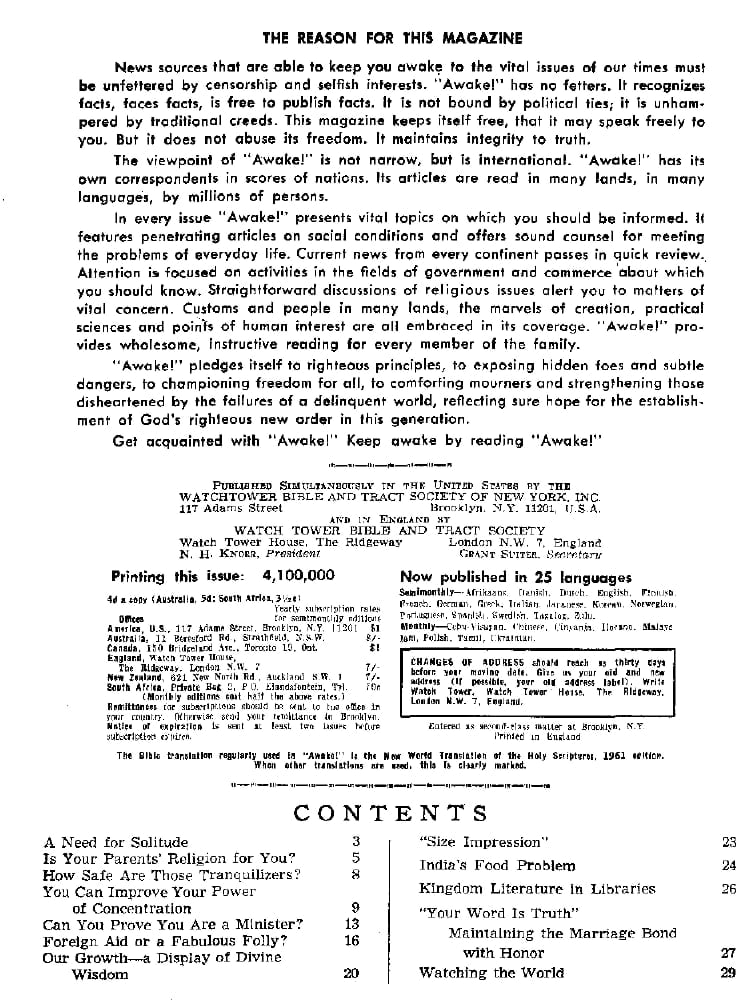
THE REASON FOR THIS MAGAZINE
News sources that are able to keep you awake to the vital issues of our times must be unfettered by censorship and selfish interests. "Awake!" has no fetters. It recognizes facts, faces facts, is free to publish facts. It is not bound by political ties; it is unhampered by traditional creeds. This magazine keeps itself free, that it may speak freely to you. But it does not abuse its freedom. It maintains integrity to truth.
The viewpoint of "Awake!" is not narrow, but is international. "Awake!" has its own correspondents in scores of nations. Its articles are read in many lands, in many languages, by millions of persons.
In every issue "Awake!" presents vital topics on which you should be informed. It features penetrating articles on social conditions and offers sound counsel for meeting the problems of everyday life. Current news from every continent passes in quick review. Attention is focused on activities in the fields of government and commerce about which you should know. Straightforward discussions of religious issues alert you to matters of vital concern. Customs and people in many lands, the marvels of creation, practical sciences and points of human interest are all embraced in its coverage. "Awake!" provides wholesome, instructive reading for every member of the family.
"Awaket!" pledges itself to righteous principles, to exposing hidden foes and subtle dangers, to championing freedom for all, to comforting mourners and strengthening those disheartened by the failures of a delinquent world, reflecting sure hope for the establishment of God's righteous new order in this generation.
Get acquainted with "Awake!" Keep awake by reading "Awake!"
11111111111111111111111111111111111111111111111111111111111111111111111111111111111111111111111111111
PUBLISHED SIMULTANEOUSLY IN THE UNITED STATES BY THE WATCHTOWER BIBLE AND TRACT SOCIETY OF NEW YORK, INC.
117 Adams Street
Brooklyn, N.Y. 11201, U.S.A.
AND IN ENGLAND BY
WATCH TOWER BIBLE AND TRACT SOCIETY
N. H. KNOR, President
London N.W. 7, England
GRANT SUITER. Secretary
Printing this issue: 4,100,000
4d a copy (Australia, 5d: South Africa, 3/2e)
Office
America, U.S., 117 Adame Street, Brooklyn, N.Y. [1201]
Australia, 11, Benedict Rd., Stratford, N.S.W.
Canada, 11, Victoria Street, Toronto, 10, Oct.
The Midway, Lennox N.W. 17
New Zealand, 621 New North Ed., Auckland N.W. 17
South Africa, Private Bag S. P.O. Blantonton, Tx. 10n
(Monthly mailings can be sent the above rates.)
Nonimmunity you are nonimmunity should be sent to two offices in your country. Otherwise your residence in Brooklyn. Matters of expiration is sent at least two hours before subscriptions close.
Now published in 25 languages
Salmonti (M) - Mizanine, Gnish, Dutch, English, French, German, Greek, Hebian, Japanese, Korean, Newerweg
Bernard, French, German, Italian, Japanese, Zahi.
Mestnyi - Czuba Vusjan, Gnish, Georgian, Malay, Malay, Polish, Turkish, Uzman.
CHANGES OF ADDRESS should reach as thirty days before your marital date. Bite into your old and new addresses and add the new address. Watch Tower, Watch Tower Hostess, The Ringway, London W. 7, England.
Entered as second-class matter at Brooklyn, N.Y.
Printed in England
The Bible translation regularly used in "Anakol" is the New World Translation of the Holy Scriptures, 1961 edition. When other translations are used, this is clearly marked.
CONTENTS
A Need for Solitude 3
Is Your Parents' Religion for You? 5
How Safe Are Those Tranquilizers? 8
You Can Improve Your Power
of Concentration 9
Can You Prove You Are a Minister? 13
Foreign Aid or a Fabulous Folly? 16
Our Growth—a Display of Divine
Wisdom 20
"Size Impression" 23
India's Food Problem 24
Kingdom Literature in Libraries 26
"Your Word Is Truth"
Maintaining the Marriage Bond
with Honor 27
Watching the World 29
Number 20
A Need for SOLITUDE
"I've never been alone in my life," said a young married woman. "Oh—I've been alone in the apartment when Bill was at work, before young Bill came. But there was always housework to do, always somebody barging in for coffee. And a radio going—just as there was at home, with my brothers and sisters. Someday I'd love to go to a motel, all by myself, and park my car—and just sit there, all afternoon—and go to sleep by myself when I felt tired—and wake up with nobody there but me." This woman was twenty-six years old, lovely and intelligent, yet as far as she could remember she had never been alone, not even for a single hour. Imagine living for twenty-six years and never really owning or having sixty minutes all to oneself! Still hers is not an isolated case. Not having time for oneself is a common complaint of this generation.
A mother of five children, returning from a weekend in the country, remarked: "Every so often I just have to get away and be by myself." A man, pointing to a corner room of a five-room house, said: "That's mine. I lock myself in there when
I want to be alone." A poor woman living in a tenement stated: "I throw my apron
over my head when I want solitude; it is all that I can get." There is nothing peculiar about these people. They are revealing a basic need that is so often neglected—the need for solitude, the need for
being alone.
A life without moments of solitude is like a family that is never alone, but that entertains and conducts parties morning, noon and night, seven days a week. Company is a good thing every now and then, but there is a time when it is necessary to shut the door. Yet even that is no guarantee of being alone nowadays. A simple push of a doorbell and, presto, the world that was just shut out is in again. A turn of a switch and the radio shouts its presence; turn another knob and you not only hear it but see it through television.
Life is crowded. It moves fast and furiously, and man needs time to evaluate the events that flash by. Solitude furnishes a refreshing letup to mental powers cluttered with daily cares. It allows a person time to catch up, to see where he has been, what he is doing and where he is going. It provides the mind moments for necessary reflection.
To the Christian, interludes of solitude are no indication of selfish individualism. Rather, they provide opportunities for dedicated men to better fit themselves to take the message of God to the multitudes.
Therefore, it is not surprising to read in the Bible that Jesus Christ withdrew to the wilderness for forty days and forty nights before launching into his ministerial career. Often during his ministry he sought solitude as a relief from the crowds. In the mountains and the gardens he prayed.—Luke 4:42; 6:12; 22:39-41.
There are many examples in the Bible of godly men who sought solitude at times. Jehovah first spoke to Moses in the lonely recesses of Mount Horeb and then he used him to lead Israel. Jehovah spoke to Elijah in a mountain cave. John the Baptist resorted to the desert wilderness near the Jordan River. These men knew the need for solitude and used it to their advantage and to the glory of God.
The modern world is far more confused and clamorous than the world of such prophets of God. Therefore, there is not less but more need for those who are to speak God's words to learn the meaning of deliberate withdrawal from time to time. They may not have to go for long periods into a physical wilderness, as did John and Jesus, but they do need to create in the midst of a crowded life spaces for reflection, for some private thinking in solitude.
A good use of solitude is to count our blessings. Not stopping for reflection may develop in one an unappreciative heart, a hardened attitude toward life. Being alone affords one the opportunity to open his heart to appreciations never attained in rushing crowds. Away from men we often see their worth, and can appreciate the need for one another. And we will recall this when we are again among them. The psalmist David produced some of his loveliest psalms in solitude, psalms of gratitude.
Silence has a purging and a restoring power. In solitude man can see himself as
he really is. He can sense his own weakness and grasp in part the majesty of God. Silence tends to wash away bitterness in a mind trained to apply Christian principles. A sweet peace often follows, with health and strength as a result.
In solitude, especially if you are out in the open beholding the wonders of creation and listening to its soothing rhythms, your body relaxes. It is a health-giving experience. When the silence of solitude goes to work on it, a mind cluttered with telephone calls, appointments and demanding schedules soon begins to wash out the confusion and the nonessentials of life.
Opportunities to be alone and undisturbed are no longer easy to find. Offices are noisy with typewriters banging away. There are laughter and chatter. The suburbs are alive with the sounds of the power lawn mower, the automobile and the airplane. Homes are pressed closer together, and they are not soundproof. Today opportunities for solitude have to be made. They do not come naturally.
People have grown so accustomed to the clamor of human activity that they accept it as inescapable. In fact, many have come to regard thoughtful solitude as unnatural. When left alone at home they surround themselves with magazines, novels, radios, televisions and what have you. But to enjoy the sunset for more than five minutes leaves them with a sense of guilt. They consider that idling away their time.
The Bible, on the other hand, reminds us that beyond this frenzied world with its telephones, sleeping pills and crises lies more, much more for man to know. There is God, his purposes, and a peace that passes all understanding. A mind fortified with a knowledge of God will find solitude for meditating on these truths a sheer pleasure. A basic need of man is thus fulfilled.
Is YOUR PARENTS' RELIGION
A MIDDLE-AGED lady smiled at the minister of Jehovah's witnesses who had called at her door and stated matter-of-factly: "You know, I am a Catholic. My parents and grandparents were Catholics, and so it is my wish to
remain one until the day of my death."
The sentiments expressed by this sincere person are not confined to Catholics. In fact, the majority of persons of other denominations in Christendom firmly hold to the religion of their parents. In addition, millions of Buddhists, Hindus and members of other non-Christian faiths steadfastly support their parents' beliefs, many even considering it a sin against their ancestors to change their religion.
Obedience to What Extent?
Are these hundreds of millions of people right? Is it wrong to change from the religion of your parents? On the other hand, is it necessary for all to leave their parents' religion and take up a different belief? What is the well-balanced and Scriptural view? We would like to invite you to reason with us from the Holy Bible on the subject for a few minutes.
In our times, when many children are "disobedient to parents, unthankful, disloyal," it is a pleasure to meet those who have a healthy respect for their parents. (2 Tim. 3:2) The Bible, in fact, specifically commands such respect when it says, at Ephesians 6:1, 2: "Children, obedient to your parents in union with the Lord, for this is righteous: 'Honor your father
Your worship is a life-and-death matter. Can you safely entrust the selection of your religion to your parents?
and your mother." That this command is not limited merely to underage children is shown by Proverbs 23:22: "Listen to your father who caused your birth, and do not despise your mother just because she has grown old."
However, does this mean that a person is obligated to follow everything his parents believe in, regardless of whether the beliefs are right or wrong? No, this could not be the correct understanding, since the scripture quoted above says: "Be obedient to your parents in union with the Lord." What does this mean? It means that we can safely obey our parents in all things only if they are in complete harmony with the true God and all his teachings as found in the Bible. If they are not thus "In union with the Lord," then, of course, God would not require us to follow them in a course out of harmony with him.
To prove further that the obedience referred to here is conditional, let us read on in the same chapter of Ephesians, verses five and six.
Here the Bible writer is talking to slaves or employees and he urges them: "Be obedient to those who are your masters in a fleshly sense." Does this mean that such employees must give their masters unquestioning obedience, regardless of right or wrong? Obviously not, for the writer goes on to say that this should be done "as to the Christ, . . . doing the will of God whole-souled." An employee could not follow his master's bidding in wrongdoing and at the same time be doing God's will. Thus the obedience is relative, taking into consideration God's will and the Bible-trained conscience of the individual.
Applying the same reasoning to our discussion, it follows logically that, if one's parents do not practice true worship, it would be improper to imitate them as far as the matter of worship is concerned. That is why, instead of criticizing those in his day who had left their parents' religion, the apostle Peter spoke approvingly of them, saying: "You were delivered from your fruitless form of conduct received by tradition from your forefathers." (1 Pet. 1:18) The ancestors referred to by Peter claimed to worship God and kept Jewish traditions meticulously; yet it was necessary for sincere Jews to change their religion and leave behind such family traditions in order to embrace Christianity.
When Parents Are God-fearing
Let us pursue this matter a little farther and consider the position of a person whose parents are God-fearing and have the true religion of the Bible. Even in this case it does not mean he must follow his parents blindly or unquestioningly. It may be true that they have the right religion, but still his obedience to them must be based on sound reasoning and a clear understanding. Blindly following anyone is
dangerous, even if that person is right, since the one following has no sound basis for his faith and can easily be stumbled when problems arise or when his beliefs are questioned.
Going back for a moment to Ephesians chapter 6, let us take a look at verse four. Speaking now to parents, the writer says: "You, fathers, . . . go on bringing them up in the discipline and authoritative advice of Jehovah." To do this, more than mere blind submissiveness must be instilled in the child's mind. Parents must teach their children God's Word, helping them to reason on its basic teachings and fine principles.
In addition, Peter says that as a Christian you must be "always ready to make a defense before everyone that demands of you a reason for the hope in you." (1 Pet. 3:15) How could a person do this if he were just following his parents without question? He could not. Hence the Scriptural advice is to "make sure of all things; hold fast to what is fine."—1 Thess. 5:21.
Just as with those taking the lead in true worship, children should have this view of the religion of their parents: "As you contemplate how their conduct turns out imitate their faith." (Heb. 13:7) Yes, it is the right faith and conduct of God-fearing parents that should be imitated. Incidentally, think of the weighty responsibility this puts on parents who do have the true faith, to continue in it, maintain good conduct and inculcate it in their children!
Some Bible Examples
It follows, therefore, that, if parents are not in harmony with the truth found in God's Word or are not exemplifying right conduct in certain respects, their works should not be imitated. We have many examples in the Bible of those who refused to follow the religion of their parents and yet were blessed for this by God.
Even the very first human parents, Adam and Eve, set a poor example for their sons Cain, Abel and Seth to follow. Abel chose not to go along with their apostate course and, because of this, he is mentioned in the Bible with approval and will get from God the reward of resurrection and opportunities of life. If they had been your father and mother, would you have followed Adam and Eve's course unquestioningly, or would you have made your own decision, as Abel did?—Heb. 11:4.
Abraham is called "the father of all those having faith" and so is one whose example we could well copy. (Rom. 4:11) However, did you know that this man did not follow the religion of his father Terah? Terah was a worshiper of Babylonish false gods, but Abraham worshipped Jehovah. Some years after the Israelites entered the land of Canaan, their leader Joshua drew attention to this fact regarding their common forefather by saying: "It was on the other side of the River that your forefathers dwelt a long time ago, Terah the father of Abraham and the father of Nahor, and they used to serve other gods." Then, encouraging them to leave behind these false gods, he continued: "Remove the gods that your forefathers served on the other side of the River and in Egypt, and serve Jehovah. Now if it is bad in your eyes to serve Jehovah, choose for yourselves today whom you will serve, whether the gods that your forefathers . . . served or the gods of the Amorites in whose land you are dwelling. But as for me and my household, we shall serve Jehovah." Obviously, it would not have been right for the Israelites to hold to the religion of any pagan forefathers at that time. —Josh. 24:2, 14, 15.
We have other examples too, such as Jonathan, who refused to join his father
Saul in a hate campaign against God's servant David. (1 Sam. 23:16-18) King Hezekiah of Judah spoke of his predecessors in this way: "Our fathers have acted unfaithfully and have done what was bad in the eyes of Jehovah our God, so that they left him." (2 Chron. 29:6) He then took a course opposite to his parents and instituted vigorous religious reforms in the land.
Did you realize too that every one of the twelve apostles of Jesus Christ left his parents' religion, which was Judaism, to become a Christian? The apostle Paul is the most outstanding example of this, since, while following the religion of his parents, he violently persecuted true Christians, sincerely believing he was right. However, when shown the wrongness of his course, he gladly changed religions. Would you have done the same, or would you have stuck to the religion into which you were born?—Phil. 3:4-7.
Some, however, insisted on following the course of their fathers even though they knew their parents did not have God's approval. Rehoboam, the son of Solomon, is an apt illustration of this. Instead of making reforms in Israel and rejecting the bad example set by his father in his later years, he told the people he would continue his father's policies as to rulership. Listen to his words: "And now my father, for his part, loaded upon you a heavy yoke; but I, for my part, shall add to your yoke. My father, for his part, chastised you with whips, but I, for my part, shall chastise you with scourges." Because of this, Rehoboam lost God's favor and ten out of twelve tribes rebelled against him, thus dividing the nation. Certainly we would not want to make the same mistake Rehoboam did because of rigidly holding to our parents' teachings!—1 Ki. 12:11.
Individual Decision Required
Of course, it would not be difficult to determine whether you should follow your parents' way of worship if they were flagrantly practicing evil, such as several of the examples just mentioned. However, your parents may be sincere, devoted people who live clean lives and attend religious ceremonies regularly. How is it possible then to be sure that your parents have the right religion approved by God? The only way is to make an objective study of God's Word the Bible and compare your parents' religion with it.
First of all, it will help you much if you will realize that sincerity or good motives alone do not make a person right. Remember how Saul, who became the apostle Paul, sincerely thought he was right in persecuting the early Christians. Your parents may sincerely believe they have the truth and you also may strongly feel as they do; however, unless you can prove the correctness of those beliefs from the Scriptures, no amount of religious fervor or sincerity will make them right. In fact, misguided religious zeal has often led to fanaticism and has closed men's minds to any other teachings, which is extremely dangerous.
The fact that you have read this article up to this point shows that you have an inquiring and a reasoning mind. This being so, you will be happy to do the same as certain men and women did in the Macedonian town of Beroea when the apostle Paul preached Christianity to them. They did not go to extremes. They neither rejected Paul's message because it was new and different from their own religion, nor did they gullibly swallow every word Paul said to them. They listened carefully with an open mind. In fact, Acts 17:11 says that "they received the word with the greatest eagerness of mind." Then the record shows that they went to "carefully examining the Scriptures daily as to whether these things were so." Yes, this is the correct way to approach the subject of religion, with an open, unprejudiced mind, yet with proper care, proving everything by Scripture.
Have you made such an examination of your parents' religion? Are you familiar with God's Word the Bible? Can you be sure that your parents have the right religion, and, if so, can you prove it to others? If your answer to these questions is No, we would like to urge you to read and study the Bible and find out what the true religion is. Any of Jehovah's witnesses in your area will be glad to assist you in your Bible research if you so desire and will be happy to answer any questions you may have.
Thus, whether your parents have the right religion or not, an accurate knowledge of Bible doctrines is vitally needed. Then you will be well qualified to make the right choice of religion and to stand with approval before the God of truth, Jehovah.
HOW SAFE ARE THOSE tranquilizers?
Sales of tranquilizers have sky-rocketed in recent years, and at the same time there has been considerable intensive study of what, if any, undesirable side effects they may have. For the most part, medical researchers have felt that they were invaluable in treating mental patients, and that the side effects were minimal. Recently, however, it was reported that one-third of those who had received tranquilizing drugs for prolonged periods were found to have liver abnormalities, and it is reported that the United States Food and Drug Administration had ordered that two tranquilizers be taken off the market, for reasons of safety.
You Can Improve Your Power
WHEN you sit in an easy chair with the intention of studying some material that is heavy in thought content, do you
Concentration
</div>
find that your mind persists in drifting to other things? Do you suddenly remember that you must make a note about something you want to do tomorrow? Do you get up to make a telephone call, sharpen your pencil, get something to eat or do any number of other things that come to your mind while you are studying? Or, after
you have read a few pages, do you fall asleep? If this has been
you fall asleep? If this has your experience, you need to improve your power of concentration.
Concentration is the act of controlling your attention by focusing your mind upon one thing, which might be a talk, a book or a problem. It entails the elimination of all mental images foreign to your train of thought.
For many people this is very difficult to do; yet they can achieve this ability by knowing what would help them to concentrate.
of the times you have read gripping novels or something about a favorite hobby. Did you have trouble in concentrating? On the contrary, you were oblivious to all else. Noises and other disturbances did not bother you. Even if you were asked to do something, your response probably was little more than a grunt, with the request quickly forgotten. In view of the fact that you have no trouble in concentrating on material that deeply interests you, you need to stimulate interest in the things on which you have trouble in concentrating.
Importance of Interest
Concentration comes naturally and without effort when you are intensely interested in what you are listening to or studying. Your mind does not wander. You do not mechanically read page after page without getting the sense of what is written. Think
Chances are there are many things in which you have never cultivated an interest. If you had to study about them, lack of interest would cause your mind to wander to other
things. But by exercising a determination to cultivate an interest in them, you would be able to keep your mind focused. There is nothing within your ability to understand in which you cannot develop a powerful interest if you really want to. What helps you to do this is looking for an interesting viewpoint of the subject.
Something as commonplace as a simple stone can be made an object of intense interest. Its composition, its formation, its atomic structure or how it got where you found it can make the stone a source of interest.
So with other subjects. Look for an interesting viewpoint, or perhaps the answer to a question you have about it. This helps you to cultivate interest, and then concentration comes naturally.
Oftentimes if you make believe that you have interest in a subject the mind will open up sufficiently for you to become genuinely interested. Writers use this method of creating interest when they receive assignments to write on subjects that had not previously appealed to them. Self-generated interest can get you more deeply involved in the subject so that a real interest develops. Concentration is then no problem. Looking at the subject from different viewpoints, arguing with yourself about it and thinking about it will all help to raise your interest level.
Other Aids to Concentration
In addition to cultivating interest, there are a number of things that can be done to help focus your mind on a subject and to keep it there. A position that suggests work is much better for concentration than one that suggests a feeling of laziness. Sit erect at a desk or table where you are accustomed to working. Trying to study while lying on a bed or sitting in an easy chair is not conducive to concentration, because the mind associates such positions with relaxation, not work. The tendency to become drowsy is greater in those positions. Some persons like to study in the evening dressed in their pajamas, but this may be unwise. Putting on pajamas is the customary preliminary for going to bed. It conditions you for sleep. Instead of being able to focus your attention on your study material, you may fall asleep over it.
When you begin studying be determined to resist the temptation to look up when
there is a noise or when someone enters the room. Letting such things distract you interferes with your concentration. Since noises can make concentration on meaty reading matter difficult, it is best to study in quiet surroundings. Although some persons like to have a radio on when they study, you will find concentration easier with it off.
By establishing the habit of promptly focusing your mind on your study material, you will find that concentration will come easier for you than if you dawdled over trifling preliminaries that give you excuses for putting off your studying. Once you get started do not permit thoughts of other things you could do to enter your mind and interrupt your thinking. Put off making phone calls, getting something to eat, and so forth, until your study period is over. Resist the temptation to do anything but study during the period you set aside for that purpose.
Setting goals is a practice that greatly aids concentration. A long-term goal stimulates you to apply your mental energies to achieve it. Without the goal you would lack an incentive that stimulates intense interest and the ability to concentrate. If you casually read a book or even a magazine article that has material that challenges your thinking, you will have a much more difficult time keeping your mind on it without a goal than if you read the material with a goal in mind. For example, you will find it far easier to concentrate on an article that explains a difficult passage in the Bible when you are seeking the answer to a question someone has asked you than if you read it casually with no objective in mind. Your goal will be finding the answer to the question, and that is an incentive to concentration on the material.
Short-term goals also are aids to concentration. They result from breaking up a long-term goal into shorter and more manageable ones. This holds true with the studying of a single book or even a magazine article. Take an overall look at the book or article, noting its principal features, which, in the case of a book, would be its chapter headings. After noting how the chapters support the subject, set to work on short goals by studying the details in the chapters and between subheadings. Fit the details into the overall objective of the book or article. This active thinking on the material will help you to keep your mind on it.
Note-taking is a valuable aid to concentration. It is a definite response to what you are reading, and, therefore, helps you to keep your attention focused on the material. When wrestling with a problem or preparing a talk or doing some other form of creative thinking, you can improve your concentration by taking a piece of paper and a pencil and writing down key thoughts as they come to your mind. You will find that, as you think on a subject, the ideas you write down tend to bring to mind associated thoughts or information stored away in your mind. As note-taking aids you to concentrate when studying written material, so it helps you to concentrate when listening to someone give a talk.
There is often greater difficulty in concentrating on the spoken word than on the written word, for the simple reason that you think much faster than a person speaks. Because the brain goes at high speed, it is tempted to take excursions while a speaker is speaking at a relatively slow speed. The excursions soon destroy your concentration on the talk by causing you to lose its coherence. Of course, a speaker that fails to give a coherent talk is partially responsible for the difficulty. He is obligated to help his audience concentrate by developing his talk logically and coherently.
An illustration of how you can keep your mind focused on a talk is the fable about the turtle and the rabbit that ran a race. The turtle won because the speedy rabbit fell asleep. Your mind is like the fast-moving rabbit, and the speaker is like the plodding turtle. Unless you keep your mind centered on what the speaker says, your mind will take too many excursions and fall asleep. When the speaker concludes, you will not know what he said. You need to use up your mental speed in a constructive manner.
As the speaker moves along the course of his talk like the fabled turtle, your mind, like the fast rabbit, should use up its excess speed by circling what the speaker says, viewing it from different angles. It should run ahead and try to determine the path the talk appears to be taking, and then it should run back and examine the path over which it has traveled. Concentration on the talk can be greatly improved by using the mind's superior speed in this manner. It will be so busy thinking about what is being said that there will be no inclination to take excursions into unrelated fields of thought, provided that the speaker is giving a coherent talk.
Familiarity Impedes Concentration
When your interest is sparked in something new, you have little difficulty focusing your attention on it. For example, persons whose interest in the Bible is kindled by the amazing promises God has made of a new era of peace have no difficulty in concentrating on Bible study articles and books that bring truths to their attention that are startlingly new to them. In many instances their initial enthusiasm sparks such intense interest that they can concentrate on this material for hours at a time with no difficulty. As familiarity with the information grows, however, concentration can become more difficult because the element of newness is no longer there to hold the attention.
The mind tends to wander.
Realization of the value and importance of the material you are studying can help to maintain the level of interest necessary to overcome the dulling influence of familiarity. Thinking of ways you can use the information also helps you to concentrate. Here is where having long-term and short-term goals are important. In the
instructions, for example, is certain to forget them in a matter of minutes. But concentration improves your power to remember.
ARTICLES IN THE NEXT ISSUE
By your cultivating the habit of paying close attention when you listen, when you read and in your observation of things, concentration will become easier for you. You will have less difficulty with your
Emancipation from Fear of Death.
Costa Rica's Torment.
What Kind of Professional Man Are You?
case of our illustration about Bible study, an article that contains no new material will not cause a person's mind to wander if he regards it as valuable review material for helping him to achieve the goal of being an effective teacher of God's Word of truth. Oftentimes familiar material is presented from a new viewpoint that makes it fresh, and if the reader thinks from this viewpoint while he studies the material, his familiarity with the information will not dull his interest and weaken his power of concentration.
What's Going On at Church?
Improve Concentration
Concentration is an important factor in the learning process. You should exert your utmost effort to develop your ability to use it. If you want to grow in knowledge, you must improve your ability to focus your attention upon the things you read and hear. The rewards are well worth the effort and self-discipline it requires. No doubt you know from experience that things to which you have given only passing notice do not stay long in your memory. The person who only half listens to
mind's taking excursions. Habit is like a path that becomes deeper, wider and more clearly marked every time it is used, making travel over it easier. So it is with
the habit of concentrating. It can replace the habit of letting your mind wander. The cultivation of good mental habits is not easy, but it is within your ability if you make the effort. Thereby your mind will be made more receptive and retentive of new knowledge.
Make it a daily practice to look for interesting viewpoints in subjects in which you have not been particularly interested. This will help you to establish a valuable habit that will serve you well when you are faced with studying something that requires a great amount of thought. By habit you will look for a viewpoint that will spark your interest and cause you to focus all your attention on it.
Because we live in an intellectual age in which the value of knowledge is appreciated, the opportunities to learn are great. But to make progress in whatever you seek to learn, you must discipline your mind to concentrate. Improve your power of concentration so that you may gain the valuable knowledge and thinking ability that is vital to your welfare in this twentieth century.
can you Prove you are a MINISTER?
MORE persons than ever before in the United States say they are ordained ministers. The reason for this is that the number of religious organizations and churches has grown, to some extent due to the many splinter groups of larger denominations springing up.
The ministers of these various groups claim that they are entitled to recognition under the draft laws of the country
and to exemption from selective service because of their ministerial classification.
How does the government of the United States feel about it? Whom does the Supreme Court consider to be a minister? How have other courts in the land ruled on the matter?
Recognition as a Minister
Under the Universal Military Training and Service Act, the government considers a minister to be one who, as his regular and customary vocation, preaches and teaches the principles of a religious organization of which he is a member. It does not include a person who irregularly preaches and teaches.
The Supreme Court of the United States, in its decision of November 30, 1953, in the case of Dickinson vs. United States, gave this view: "The ministerial exemption, as was pointed out in the Senate Report accompanying the 1948 Act, is a narrow one, intended for the leaders of the various religious faiths and not for the members generally.' . . Certainly all members of a religious organization or
sect are not entitled to the exemption by reason of their membership, even though in their belief each is a minister."
In this same opinion, the Supreme Court added: "On the other hand, a legitimate minister cannot be, for the purposes of the Act, unfrocked simply because all the members of his sect base an exemption claim on the dogma of its faith. That would leave a
congregation without a cleric. Each registrant must satisfy the Act's rigid criteria for the exemption. Preaching and teaching the principles of one's sect, if performed part-time or half-time, occasionally or irregularly, are insufficient . . . These activities must be regularly performed. They must, as the statute reads, comprise the registrant's 'vocation.' And since the ministerial exemption is a matter of legislative grace, the selective service registrant bears the burden of clearly establishing a right to the exemption."
Secular Employment
What the Supreme Court then stated is of great interest: "The statutory definition of a 'regular or duly ordained minister' does not preclude all secular employment. Many preachers, including those in the more traditional and orthodox sects, may not be blessed with congregations or parishes capable of paying them a living wage. A statutory ban on all secular work would mete out draft exemptions with an uneven hand, to the detriment of those who minister to the poor and thus need some secular work in order to survive."
In this Dickinson case the Supreme Court had before it the consideration of a man who was clearly serving in the ministry as his vocation, being a "Pioneer Minister" as well as the presiding minister of a congregation of Jehovah's witnesses. The Court thus established his right to exemption from selective service, since he qualified under its definition of a minister of religion, having made the ministry his vocation. The fact that he worked part time to support himself did not disqualify him from ministerial status.
On November 26, 1958, a different court, the United States Court of Appeals for the Fifth Circuit, had before it the case of another one of Jehovah's witnesses. He was not a "Pioneer Minister," but was steadily employed in secular work, earning about $50 a week. In this case, Wiggins vs. United States, the Circuit Court ruled that although Wiggins had full-time secular employment, he was entitled to exemption as a regular or duly ordained minister of religion because he "stood in the relation of a religious leader to other members of Jehovah's Witnesses. He was recognized as such by individual members and by the governing body of Jehovah's Witnesses. The defendant's selective service file shows numerous uncontradicted certificates and letters of individual members that support Wiggins' account of his religious activities."
The Court said: "Ministers of Jehovah's Witnesses are not paid a salary, furnished a parsonage, or even given funds for necessary expenses to carry on their ministerial work. As pointed out, they have no choice except to engage in secular pursuits in order to obtain funds to make the ministry their vocation. The Act does not define a minister in terms of one who is paid for ministerial work, has a diploma and a license, preaches and teaches primarily in a church. The test under the Act
is not whether a minister is paid for his ministry but whether, as a vocation, regularly, not occasionally, he teaches and preaches the principles of his religion."
The Court noted that Wiggins was a Congregation Book Study Conductor, presiding over this group at Bible study meetings. It noted that he regularly attended assemblies of Christian ministers where he had official duties. The Court also took cognizance of the fact that he preached regularly before the congregation, and that he spent approximately 40 hours a month in various features of the ministry, such as preaching from door to door, in Biblical research and study, conducting weekly meetings of the congregation, and reading summary material at such meetings.
Although Wiggins spent about one-fourth of the amount of time monthly in the ministry as he did in his secular employment, the Court stated: "It is not the sole or necessarily conducive factor. Some allowance must be made for ministers who are gainfully employed simply because they are not paid for their religious ministry. If they must work, they should not be penalized for working steadily. A young man such as Wiggins could hardly work less than forty hours a week as crane operator and hold on to his job."
The Vital Factor
The vital factor here was that the young man had made the ministry his vocation. His life revolved around his ministry, and his secular employment was only a means to sustain him as he pursued his primary vocation, that of the ministry.
That is just what the Court maintained. It said: "He regarded this endeavor as his chief purpose in life, the secular employment being incidental. He has shown that he stood in the relation of a religious leader to other members of his faith, in a capacity comparable to that of an assistant pastor.
He has shown that he performed his religious duties regularly, without allowing his secular work to interfere with his religious work. We hold that a crane operator working a forty-hour week may be a minister in Jehovah's Witnesses and entitled to the ministerial exemption under the Selective Service Act, although spending only forty hours a month on religious duties."
The Court is to be commended for this forthright position. One who claims to be a minister must place it first in his life. It cannot be a side line. He cannot be one who merely makes an appearance at his place of worship for a short time on one day of the week. He must produce In order to satisfy the requirements of the draft law in the United States and must be in a position to file proof of this ministerial activity.
No Exemption
It is not surprising, then, to learn of another decision by the same United States Court of Appeals for the Fifth Circuit, on July 10, 1964. Again it had before it the case of one of Jehovah's witnesses. However, on this occasion the Court ruled that the defendant was not entitled to the exemption allowed by the law. In refusing the exemption the Court said that one "must have the ministry as his vocation," and that his "religious affairs must occupy a substantial part of [his] time and they must be carried on with regularity," and that he "must stand in the relation of a minister to a congregation or in an equivalent relation as a recognized leader of a group of lesser members of his faith."
This decision of the Court was entirely consistent with its 1958 ruling in the Wiggins case. It said that it was "sympathetic with the position taken by Jehovah's Witnesses: some allowance must be made for religious leaders who engage in secular work only because they are not paid for their religious ministry." But in this case the Court was forced to conclude that the registrant was not entitled to exemption because he admitted that farming was his primary vocation, that it "came first with him."
The Court noted that the defendant "made no showing that he ever conducted any teaching or preaching activities before the . . . congregation of which he is a member or of any congregation. His alleged ministerial activities consisted of his own studying, and his occasionally passing out pamphlets, occasionally going from house to house, and occasionally assisting in small Bible study classes." It then quoted a different court in another case, stating: "A position of leadership in the congregation assumes greater significance in determining whether exemption should be given when the time spent in ministry is undetermined, irregular or insignificant."
These decisions of the United States Court of Appeals for the Fifth District are of great consequence. They recognize one's ministerial status even though he may be required to engage in greater or lesser amounts of secular work to sustain himself. They make clear that the all-important factor that determined whether exemption was granted was whether the ministry was one's primary purpose in life, yes, his vocation. Was his life centered around his ministerial activity? If it was not, then ministerial status was denied. If it was, ministerial classification and accompanying deferment from selective service was granted by this court.
FEW, if any, financial projects in the history of mankind have matched America's foreign aid program of the last twenty years. More than 103 billion* (103,916,000,-000) of the Unit-
America, however, is not alone in aiding the underdeveloped nations of the world. The Soviet Union, the United Kingdom, France and many other nations
all have bilateral aid programs. In March of 1963 the best estimate was that Russia had put up about $12 billion in foreign aid since World War II. It must be remembered that she was in no position to help any-
ed States taxpayers' money from 1946 to 1963 was spent on foreign aid of one kind or another. Rarely has a single undertaking seen so much waste and frustration, bungles and blunders, frivolities and failures as this one. America's foreign aid program has been called the most widely misjudged, the most hotly controversial, and yet one of the most critical major strands in the fabric of America's policy toward the world.
Asia, Europe, Africa and Latin America have all received aid. By 1963 the list of recipient countries and ethnic groups had grown to 112, leaving only a few countries in the whole "free world" that were not receiving some sort of United States assistance. Places many Americans never heard of, such as Chad, Gabon, Niger, Senegal, Dahomey, have received millions of dollars in American aid, without the average taxpayer's knowing how the money was being spent.
body except herself immediately after the war. Many of her investments abroad have gone sour. Some were downright disasters.
From 1951 to 1961 the United Kingdom contributed in assistance to the less developed countries
some $2.46 billion (£880 million). Some 90 percent of the bilateral aid went to members of the Commonwealth. The Sudan, Libya, Jordan, Turkey and Yugoslavia have been among the non-Commonwealth recipients.
France, too, has contributed her share of capital to the less developed nations. As with the British, the major share of French assistance has gone to those countries with whom she has special links.
Since the aid programs of other nations are much more modest in comparison to that of the United States, it is appropriate to ask, How does the United States compare with the other nations in commanding the gratitude and loyalty of beneficiary nations? Has the United States received dividends of goodwill and favorable world opinion commensurate with its enormous expenditure? A number of Americans are a little more than curious as to what has happened to their money. After all, $100 billion in taxes is nothing to be sneezed at.
Perhaps this illustration will help Mr. John Q. Public to understand the enormity of 100 billion. If you were to give your wife a billion dollars and told her she could spend it at a rate of1,000 per day, she would not be back in nearly 3,000 years to ask you for more money. To spend $100 billion at the same rate would take over 279,000 years!
Since World War II the United States has spent more than twice the assessed valuation, real and otherwise, of America's thirteen largest cities: New York, Chicago, Los Angeles, Detroit, Philadelphia, Houston, Baltimore, Washington, Cleveland, Milwaukee, St. Louis, Boston and San Francisco. In other words, the United States has given to the world in the last twenty-two years twice the equivalent of its thirteen largest cities, according to the 1960 census.
Many Americans believe that the foreign aid program has served the United States well. These supporters maintain that massive infusions of the dollar have saved western Europe against the march of communism following World War II. These also believe that American dollars and guns kept Greece and Turkey from direct infiltration by Moscow. Some argue that the mighty flow of dollars out of America has stimulated the American economy and has kept it from lagging. Recent surveys show that many Americans still think that a limited foreign aid is a good thing.
However, foreign aid has its critics, and they are growing in number. These say that someday foreign aid may be judged as one of the great follies in the story of nations. United States Representative Otto E. Passman said: "My contention is that foreign aid is a complete and dismal failure."
Purpose and History of Aid
The major objective of the foreign aid program of the United States as announced is to accelerate economic growth in underdeveloped countries, on the grounds that the existence of poverty-stricken nations will ultimately affect the security, peace and freedom of the American people. It is also desired to demonstrate to the underdeveloped nations and to the world that a high standard of living can be achieved by means of free enterprise and a democratic political system. It is also hoped that aided independent governments will not become hostile to the West and will remain neutral or take the side of the West in case of a major war.
In formulating the aims of foreign aid the United States has avoided any blunt statement that it is designed to combat communism, or "buy friends" and influence people. Poland and Yugoslavia, nations unequivocally Communist that have received American foreign aid, are pointed to as examples of America's good intentions.
The foreign aid program of America dates back to the 1940s. It included such plans of assistance as the Marshall Plan, through which western European countries were given assistance in reconstructing their economies following World War II. America invested some $13 billion to restore war-ravaged Europe and keep it from going Communist. All but 14 percent of those billions was in outright grants.
Europe as well as Japan responded to aid and quickly climbed to new heights of prosperity. America benefited from this prosperity. Her exports to western Europe more than doubled between 1953 and 1962. America's exports to Japan tripled between 1950 and 1962. A recent study of thirty-two countries outside Latin America, receiving about 80 percent of all American aid and surplus food assistance between 1957 and 1962, revealed that total imports from the United States rose about four and a half times as fast as economic aid.
America's total assets, abroad have increased at a faster pace than the balance-of-payments deficit. Reports show that at the end of 1962 American assets, private and public, exceeded total liabilities to foreigners by $27 billion. Also, some 600,000 American workers are employed directly or indirectly, because of the demand for goods financed by aid. This in part is the good side of aid.
A Closer Look at Aid
Despite the fact that purchasing power has created markets and a measure of prosperity for some nations, the overall aid picture is not an altogether pleasant one, however. Authors Andrew Tully and Milton Britten in their book Where Did Your Money Go? say that over the years, foreign aid has been plagued by so much "perfunctory, careless and ill-informed spending that it is a near miracle it has not been destroyed by the outrage of Main Street. From Iraq to Korea, it sometimes has seemed that Uncle Sam was spending his dollars in a kind of desperation, as though he was afraid they would go out of style." They report that "in South Korea, the taxpayers paid the salaries and expenses of a corps of American experts dispatched to teach the Koreans how to grow more rice. And yet the per-acre production of rice in Korea was already many times the per-acre production in Louisiana, where modern methods were used."
They write that, at one time or another, foreign aid "paid for free airplane excursions for thousands of Arabs visiting the Moslem shrine at Mecca. Financed a fifteen-mile, six-lane highway connecting the Portuguese capital of Lisbon with the gambling resort of Estoril. Paid for a 'psychological' project in the Netherlands for the purpose of studying the behavior of the
Dutch. Built a silica plant in Formosa at the cost of more than $150,000, which operated for thirty days and then closed down because of a lack of silica. Built four wheat-flour mills in South Korea although no wheat was grown in that country at the time. Paid the tuition costs and living expenses for the sons of hundreds of wealthy Iranians attending American universities and colleges. Built an Italian village that nobody could be persuaded to live in."
In Cambodia American aid paid 34 million for a road that needed major repairs or complete rebuilding before it was completed. At the same time a highly publicized10-million Russian-financed 500-bed gift hospital was found to be built in part with materials bought with American foreign aid dollars.
Since 1954 Americans have dumped $365 million into Cambodia. With what political effect? In 1963 Cambodia's Prince Shanouk said: "Should we be obliged one day to choose between [Red] China and the others, we would without hesitation choose . . . the People's Republic [Communist] of China. . . . If we do not side with the Communists in 1963 we will have to do so in 1965 or 1966. This is inevitable."
In Peru, American taxpayers' dollars built a 15-million road that wound up on the side of a Peruvian mountain in the middle of nowhere. After the road was built, presumably to open isolated areas for farming, the soil was found too poor to grow anything. A14-million relief program was so badly handled that, out of a total of 106,000 tons of grain, only 5,028 tons were actually distributed free to the hungry.
Through 1963 almost 415 million have been emptied into Jordan. Some60 million are pumped into Jordan yearly. A reaction of a Britisher, who had recently come up from Kenya to manage a British-run bank in Jordan, was: "My word, $60 million a year!
How do you [Americans] manage to spend all that money and have so little to show for it? Why, in East Africa we could have had a paradise for that!" But Jordan is far from being a paradise.
Through fiscal 1963 America managed to pour 807 million into Gamal Abdel Nasser's United Arab Republic. Egypt receives some224 million a year and spends $150 million of that amount a year in its war on Yemen. The United States, therefore, is placed in the position of financing Egypt's war.
One purpose of aid to Indonesia was to stabilize that nation's economy. Indonesia sapped the Communist bloc for about 1.7 billion in cumulative commitments and the United States for804 million in economic aid and some 77 million in military assistance. America even granted that nation a17 million "emergency" loan. Yet that same week Indonesia announced that she was going to spend $20 million to buy three plush United States jet airliners. United States Representative Minshall said: "We got hoodwinked." As for Indonesia's loyalty and gratitude for aid, President Sukarno predicted that Indonesia would see the day when "the old established forces" (the West) would collapse.
In Korea, America spent more than 3.3 billion in military aid and2.1 billion in economic aid between 1945 and 1963. After the Korean war, racketeers carted off much of the 80 million worth of surplus material. In a 1962 report to the American Congress the General Accounting Office said that1.2 billion spent by the United States in Korea from 1957 to 1961 had actually stunted economic growth and encouraged corruption.
Over a period of ten years neutral India has received some 5 billion in American aid. Yet when she wanted a900-million loan over a period of fourteen years toward the cost of building the Bokaro steel mill,
America turned down the idea. The basic complaint was that the project was "socialistic," even though the mill was to be publicly owned and would eventually pay for itself in savings. At the same time America sees nothing wrong in giving $2.5 billion to Communist Yugoslavia, millions to Communist Poland, and even does business with Russia directly. Little wonder nations find American methods hard to understand.
In 1961 a $20-billion venture called Alliance for Progress was launched in Latin America. Many Latins, however, failed to understand that this was not another one of Uncle Sam's giveaways, but that aid would be predicated on efforts within the countries themselves to initiate the reforms that would make the use of the aid meaningful. So after two years only seven of the nineteen countries had yet submitted blueprints for effective use of the money available to them. By December, 1963, nobody really had any new ideas about what should be done about Latin America.
This, of course, is not the whole story about American foreign aid. As Spruille Braden, former United States Ambassador and Assistant Secretary of State, said: "It would take volumes to describe adequately the vast and unending evils of foreign aid." He said: "It encourages communism and foments collectivism and socialism all over the globe." He called the program 'intolerable and immoral," and expressed a wish that someday it will be taken off the already overloaded backs of Americans.
Whatever might be said, pro or con, about American foreign aid, or the aid of any other nation, this much appears certain, that it has become an integral part of foreign relations, a weapon of expediency in short-range diplomacy, a powerful persuasive force to nations, yet without any clear-cut global evidence of its ultimate worth.
OUR GROWTH--
DISPLAY OF DIVINE WISDOM
</div>
By "Awake!" correspondent in Panama
EVOLUTION has been credited by many for our being alive. On the other hand, the Creator has been acknowledged by some for our existence. To whom do you give
the credit? Really, to whom is the credit due for the marvelous way in which we grew and came to be?
Interest in finding the true answers was stimulated by a small card announcing the arrival of a looked-forward-to baby, which prompted a visit to the hospital. In this instance, it was to the Panama Hospital, located in a pretty, easily accessible residential district of Panama City. The friendly, easy manner of this institution made us feel welcome, and we immediately went down the sparkling corridors to the nursery.
Since the rules of this ward permit parents the privilege of becoming acquainted with their precious heritage right from the beginning, we found mother and baby together in the room. Mother's lovely brown eyes beamed affectionately on her cherished bundle of life as it stretched, squirmed, wiggled, squinted its eyes, twisted, and relaxed into quietness, interrupted only by the fast ups and downs of its little tummy. Every crease, every fold, every detail of its entire body, including the unusual indentation in one earlobe, had been carefully scrutinized by mother. Her sincere smile was a revealing expression of a deep-seated satisfaction
that concluded a nine-month period of expectation of this desired infant. Producing this baby was one of the grandest accomplishments of her life—this she admitted. But to accept credit for more than her privilege of motherhood, she refused to do.
…