Awake!, September 22, 1964
Download: PDF — Awake!, September 22, 1964
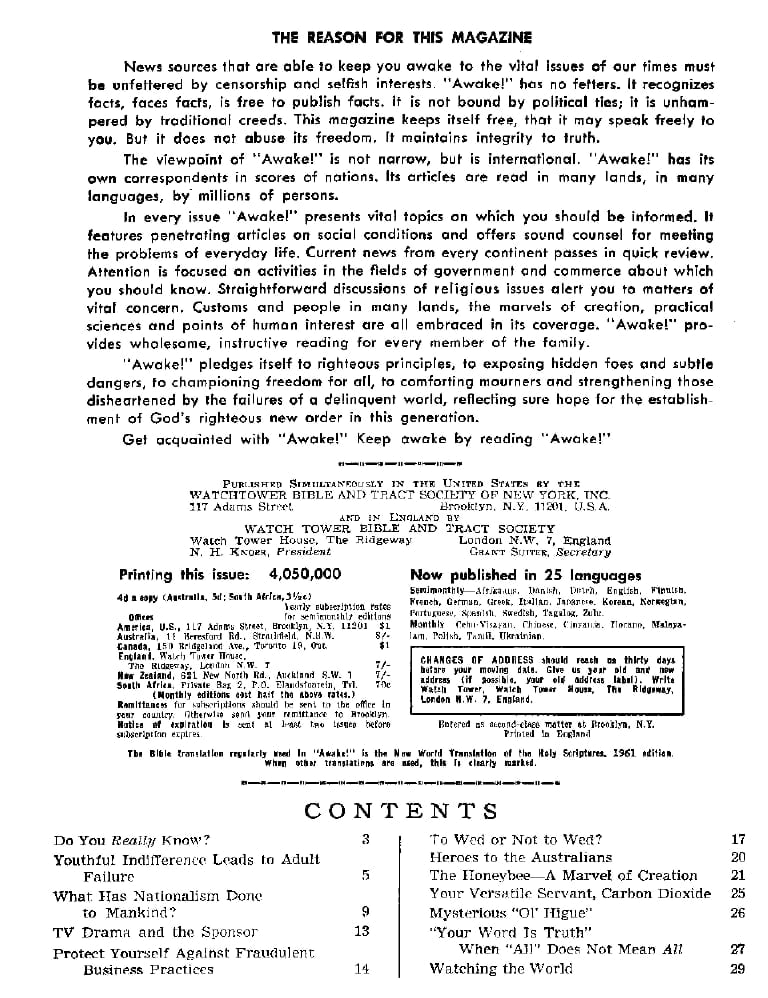
THE REASON FOR THIS MAGAZINE
News sources that are able to keep you awake to the vital issues of our times must be unfettered by censorship and selfish interests. "Awake!" has no fetters. It recognizes facts, faces facts, is free to publish facts. It is not bound by political ties; it is unhampered by traditional creeds. This magazine keeps itself free, that it may speak freely to you. But it does not abuse its freedom. It maintains integrity to truth.
The viewpoint of "Awake!" is not narrow, but is international. "Awake!" has its own correspondents in scores of nations. Its articles are read in many lands, in many languages, by millions of persons.
In every issue "Awake!" presents vital topics on which you should be informed. It features penetrating articles on social conditions and offers sound counsel for meeting the problems of everyday life. Current news from every continent passes in quick review. Attention is focused on activities in the fields of government and commerce about which you should know. Straightforward discussions of religious issues alert you to matters of vital concern. Customs and people in many lands, the marvels of creation, practical sciences and points of human interest are all embraced in its coverage. "Awake!" provides wholesome, instructive reading for every member of the family.
"Awakel!" pledges itself to righteous principles, to exposing hidden foes and subtle dangers, to championing freedom for all, to comforting mourners and strengthening those disheartened by the failures of a delinquent world, reflecting sure hope for the establishment of God's righteous new order in this generation.
Get acquainted with "Awake!" Keep awake by reading "Awake!"
PUBLISHED SIMILARLY IN THE UNITED STATES BY THE
WATCHTOWER BIBLE AND TRACT SOCIETY OF NEW YORK, INC.
117 Adams Street
BROOKLYN, N.Y. 11201, U.S.A.
AND IN ENGLAND
WATCH TOWER BIBLE AND TRACT SOCIETY
Watch Tower House, The Ridgeway
London N.W. 7, England
N. H. KNORE, President
GAST SUTTER, Secretary
Printing this issue: 4,050,000
4d m copy (Australia, 15d. South Africa, 35c)
Officers
America, U.S. 117 Annex Street, Brooklyn, N.Y. 12201 S. 11
New Zealand, New South Wales, W. 7
South Africa, Private House, South Africa, 70c
Remittances for subscriptions should be sent to the office in your country and your remittance to the embassy in your country is sent at all. No fees before subscriptions.
Now published in 25 languages
Summarismly—Africanus, Denish, Dutch, English, Finnish,
French, German, Greek, French, Japanese, Korean, Norwegian,
Polish, Portuguese, Russian, Zulu.
Monthly—Cenizan, Chinese, Floracan, Malayan,
Malish, Polish, Ukrainian.
CHARGES OF ADDRESS should reach on thirty days before your moving date. Give us your age and new address. We will add an addition to your address. Watch Tumor Mounte, The Ridgeway, London W. N. 7, England.
Entered as second-class matter at Brooklyn, N.Y. Printed in England
The Bible translation regularly used in "Askai" is the New World Translation of the Holy Scriptures, 1961 edition. When other translations are used, this is clearly marked.
CONTENTS
Do You Really Know? 3
Youthful Indifference Leads to Adult
Failure 5
What Has Nationalism Done
to Mankind? 9
TV Drama and the Sponsor 13
Protect Yourself Against Fraudulent
Business Practices 14
To Wed or Not to Wed? 17
Heroes to the Australians 20
The Honeybee—A Marvel of Creation 21
Your Versatile Servant, Carbon Dioxide 25
Mysterious "Ol Higue" 26
"Your Word Is Truth"
When "All" Does Not Mean All 27
Watching the World 29
Do You Really Know?
THE more a wise person learns, the more he realizes how much more there is to know. He appreciates how limited his knowledge really is, and that in a lifetime of seventy or eighty years one can only scratch the surface of the things there are to learn. He also realizes that many things men accept as fact today may be corrected with an increase of knowledge tomorrow. This keeps him from being dogmatic and from manifesting that irritating "know-it-all" attitude.
Generally it is the person that has only a smattering of knowledge that develops this attitude. It is particularly a characteristic of many youths today. They learn a little, and then think they know it all. Their newfound knowledge puffs them up, causing them to consider their parents and other older folks to be "old fogies." Unfortunately many persons carry this "know-it-all" attitude over into adult life.
Such persons will go to great ends to give the appearance of knowing. Have you ever had the occasion to ask for directions, and, instead of the person simply saying he did not know, he directed you on a wildgoose chase? Certainly it is annoying when individuals give misleading information simply to give the appearance of being well informed. But it can be more than
annoying; it can at times cause great suffering and heartache.
In California not long ago attractive eight-year-old Linda Epping died after being under the care of a chiropractor who claimed he could cure her cancerous eye with medicines and manipulation. "I can cure your child without surgery," the Eppings report that he said. He collected $700; but Linda suffered terribly and died about a month later. Regardless of whether he was sincere or not, the chiropractor did not really know; he had no real evidence to support his claim. So in an unprecedented ruling, he was convicted of second-degree murder and sentenced to imprisonment for five years to life.
Certainly it is unloving and can even be criminal to propagate information you are unsure of. A person should therefore think before speaking: "Do I really know this is true? What evidence do I have that it is? Could it be only hearsay?" How much better it would be to admit you do not know for sure than to make dogmatic assertions simply because you feel something to be true!
You may even have a basis for your contention, but that does not necessarily mean it is correct. Due to inadequate methods of observation, faulty experiments or insufficlient knowledge, men sometimes reach different conclusions.
These are printed in reputable books and magazines, and conflicting ideas are thus presented. So, can you truthfully say you really know for sure, even when you have a reputable source for your information?
A mature, wise person will take into consideration that the conclusions of men are at times incorrect. He will therefore not be dogmatic. He will be reasonable, and will recognize that there may be more to the subject than just what he has heard or read. For instance, one person may have learned from authoritative sources that the queen honeybee mates with only one drone bee on her mating flight. Yet another person may have read the Scientific American of April 1964, which says that she mates "successively with several drones (on the wing)." There are endless similar examples of where observations and studies made by learned men yield different conclusions.
Another thing to consider is that many persons in this world are interested in furthering their own ends, and so endeavor to keep up the appearance of knowing it all when they really do not. In certain parts of the world, for instance, whole communities have been misinformed, and often exploited, by those who only pretend to know. In some of such places the literate person is considered practically infallible. Everything he says is believed without question, because, as it is said, 'He reads the book.' This is true particularly in certain African countries; but, surprisingly, quite similar conditions exist in places where nearly everyone is literate.
In the Western world the pronouncements of men of science are likewise viewed as almost infallible. When a scientist makes an announcement, observed Anthony Standen in his book Science Is a
Sacred Cow, "he may not be understood, but at least he is certain to be believed. No one ever doubts what is said by a scientist." Just as many Africans gullibly accept the word of the man who 'reads the book,' so the general public parrots the sayings of scientists as though they were gospel truth.
For instance, on April 3 the British anthropologist, Louis Leakey, made the announcement that in Tanganyika, East Africa, he had found an ancestor of man who lived 1,820,000 years ago. On the basis of merely a few fragments of bone he and his associates arrived at this conclusion. The public quickly pick up this information and propagate it as though it were fact. Already, at the New York World's Fair, Leakey's discovery of a claimed ancestor of man, made just five years ago, is set out for millions to see. The visitors are told that this creature lived 1,750,000 years ago.
In all probability most of those visiting this exhibit will believe what they read. But where is the evidence that man lived that long ago? It is based only on the guesswork of prejudiced men who disbelieve the Bible account of creation. Actually, the recorded history of man only goes back about 6,000 years, and soon after that an advanced civilization appears suddenly. There is no reliable archaeological evidence that man has been on the earth any longer than that.
You can therefore appreciate that, when you hear or read something, it is necessary to weigh the evidence. Always keep in mind that human authorities are subject to error, and that sometimes they are even dishonest. So whenever there is a conflict between what men say and what God says in his infallible Word the Bible, you should "let God be found true, though every man be found a liar."—Rom. 3:3, 4.
WHEN the family automobile is wrecked and the passengers are in the hospital, it is too late to take to heart what your father said about obeying traffic laws. After such a calamity you may regret that you were indifferent to the counsel and warnings you received. But the harm has already been done. The situation is similar when a girl ignores her parents' counsel on proper conduct, only to learn that she is to become mother to an illegitimate baby. With some 250,000 unmarried girls in the United States bearing babies each year, one can be sure that many of them regret that they were indifferent to parental instruction.
Although many younger persons may not realize it now, the effects of youthful indifference are certain to be felt later on in life. Such indifference is almost certain to lead to trouble and, in many instances, even death. Therefore, it is vitally important to heed the advice of the inspired Bible proverb: "A wise person will listen and take in more instruction, and a man of understanding is the one who acquires skillful direction."—Prov. 1:5.
To be successful in life a person needs to pay attention to instruction when he is young. It is not wise to take an indifferent, "know-it-all" attitude. Accomplished musicians, skilled surgeons and outstanding physicists listened and took keen interest in their professions while they were young. This laid the foundation for their
success later on in life. In the same way you can show yourselves to be wise if you also listen to Instruction in your youth. Only by doing so will you be prepared to lead successful adult lives.
It would be wise, therefore, to examine yourself. Do you listen to what who are older and more experienced have to say? Or do you call them "old fogies" because you feel that their outlook on life is outdated? For instance, what attitude do you take toward affairs around the home?
Around the Home
Your home is a training center to prepare you for adult life. Here habits and behavior patterns are formed that will be either beneficial or detrimental to you when you grow up. They will determine whether you will develop into a mature, respectable man or woman, or will remain childish and immature in your ways. Certainly a fully grown adult who still acts like a baby is a failure! So ask yourself: "Is my attitude toward affairs around the home preparing me for a successful adult life? Am I listening and taking in instruction?"
Consider the matter of neatness and cleanliness. Most parents try to teach their children to pick up after themselves, to make their bed, and to keep their clothes clean. But all too often it goes in one ear and out the other. The children continue to leave things around for others to pick up.
Do you find yourself doing that? Consider what such indifference will lead to.
The boy who was careless grows up to be a man who is messy and disorderly. Then, with behavior patterns and habits firmly set, he finds it extremely difficult to make a change. As a result, he makes a very poor impression on others with whom he comes in contact. Prospective employers turn him away, because they do not want sloppy, disorganized workers. So he fails to get a good job, or is fired from the one he does get.
If such a person convinces someone to marry him, then what? Though he may have put his best foot forward during courtship, he soon slips back to his sloppy, indifferent ways. To the disillusioned mate this becomes a continual source of friction and vexation—a marital sore spot. How many marriages have broken up because one of the partners could no longer stand the dirtiness and sloppiness of the other! This is a fact. Failure in marriage has been experienced by many persons, because, in their youth, they were indifferent to the urgings of their parents to be neat and clean.
Then there is the matter of punctuality being on time for meals and other appointments. Does mother have to call you time and time again before you come to supper, or in order to get you up for breakfast? Tardiness can become a habit difficult to break. Later on in life, the one who is constantly late for work, or who continually makes her marriage partner wait, is in for trouble. Indifferently turning a deaf ear to instruction can lead to such difficulty. So how much better it is to make punctuality a habit while you are young, and thus lay the foundation for a successful adult life!
You may have observed how babies howl and scream at any hour of the night and expect to be waited on, and that they do not perform any useful chores around the house. But as a child grows older, is it not right that it should accept some responsibilities? Instead of always expecting to be waited on, should it not take the initiative to do things for others? Would you not say that failure to consider the welfare and happiness of other members of the household is evidence that one is still a baby?
It is obvious that the immature traits of babyhood will not make for adult success.
Surprisingly, however, many youths retain this characteristic of babyhood. In some homes when parents ask their children to do the dishes, set the table, mow the lawn or perform some other household work, they pretend not to hear. Others make excuses and look for a way to avoid responsibilities. But consider what such indifference can lead to.
A person who is indifferent when he is young will have a difficult time functioning as a part of a smooth-working organization later on in life. Because he never learned to work and cooperate with other household members, he will find that he always has trouble when working along with others. Nor will he be trained to observe what needs to be done, or have the gumption to get up and do it. Not only will this be a handicap in secular employment, but think of the trouble it can cause when one has a home of his own.
A husband is likely to be displeased because his wife never learned to cook well, keep house or organize household affairs. And a wife will be unhappy because her husband fails to cooperate with her in keeping the home attractive and well cared for. Then, too, it will be impossible for a parent to tell his children, "This is how we used to do it at home," because he never did. How much better to avoid all this by learning to take an interest in your home and its affairs now!
In School
School is another vital training center in which youths do well to take an interest. Some appreciate the importance of education, but in other cases parents practically have to force their children to go to school. As you well know, there are those who make every effort to take in knowledge, while others are interested only in recesses, lunch periods and perhaps physical education class where they can get out and play. Rather than being indifferent toward education, the Bible proverb says that "a wise person will listen and take in more instruction," and thereby acquire "skillful direction."—Prov. 1:5.
Many youths lack interest in school because they feel that they will never use the information being taught. But actually this is a shortsighted view, for practically every subject in school requires one to do reading and writing, and ability in these things directly affects one's success in life. A poor reader, for example, fails to take in the necessary information on which to base correct decisions. And how well one writes will make either a favorable or an unfavorable impression on others. So do not let an indifferent attitude prevent you from learning to read and write well.
This is not to say that mathematics, history, biology and other subjects are not valuable in themselves. They are. For instance, being able to figure interest rates and add a column of figures quickly is a protection these days; thousands of persons are regularly being cheated because they do not know how. In addition, mathematics exercises the brain, strengthening it to think clearly. Without such use the brain, just like an unexercised muscle, will become weak and unable to function as it should. You will find it very difficult to get along in adult life with a weak, "flabby" brain!
A knowledge of history will give you invaluable background and insight into human experience. By knowing what happened to peoples and civilizations of the past, you will be in a better position to handle present-day problems and make wise decisions. A knowledge of the sciences, such as biology, chemistry and physics, will acquaint you with the marvelous laws by which both animate and inanimate things are governed. Besides the many other applications you might make of it, this knowledge will also enable you to have a better appreciation of the wisdom and power of the mighty Creator who is responsible for the order that everywhere exists.—Rom. 1:20.
So, rather than take an indifferent attitude toward school, take an interest in it. Listen and take in more instruction. Acquire skillful direction. Have in mind future secular employment when you select subjects. If possible, learn some craft or trade. If, like Jesus Christ, you want to pursue the ministry as your career, remember that many full-time ministers have been able to support themselves in the preaching work as a result of learning some trade while they were young.—Acts 18:1-4.
Toward Wise Counsel
The early years of life should be happy years. However, many youths apparently feel that listening to instruction and counsel will interfere with their happiness. But this is not true. The counsel that a wise youth receives not only will enable him to walk in a way that will bring pleasure and satisfaction, but it will ward off calamity as well.
There is a warning against mere pleasure-seeking and self-indulgence during one's youth contained in the inspired Bible book of Ecclesiastes, where it is recorded: "Rejoice, young man, in your youth, and let your heart do you good in the days of your young manhood, and walk in the ways of your heart and in the things seen by your eyes.
[If you do this, what then?] But know that on account of all these the true God will bring you into judgment. So remove vexation from your heart, and ward off calamity from your flesh."—Eccl. 11:9, 10.
Your course during the time of youth will not be marred by its resulting in disappointment and calamity if you accept wise counsel and instruction and do not follow your deceptive heart and the selfish desire of the eyes for merely a good time. If you "bring your heart to discipline and your ear to the sayings of knowledge," and walk according to righteous principles, you will not suffer vexation and agitation of heart. You will not be plagued by anxiety, or troubled over whether you did the wrong thing or not; but, instead, you will ward off any bad consequences from your flesh, and will receive a favorable judgment from God.—Prov. 23:12.
On the other hand, calamity is certain to strike if you cast caution and wise counsel to the wind. You may not be able to see how failure to listen can be harmful, but neither could the child that was told not to play in the street foresee the car that swept around the corner and struck it dead. So pay attention and heed counsel, because a calamity just as deadly can quickly overtake you.
Your parents or other spiritual advisers may tell you not to attend immoral movies, watch suggestive and violent television programs or read sex-stimulating literature. Now, such counsel may seem unduly restrictive to you, as prohibition on playing in the street seems to others. But do not conclude that your parents are "old fogies" who are out of touch with things, for, to the contrary, they realize that such programs and literature will not do your
heart good. They will not remove eventual vexation, but, rather, will stimulate and agitate you in a way that can, in time, lead you into trouble.
Similarly, your parents may give you counsel and even place certain restrictions on you relative to your association with the opposite sex. Certain forms of dancing may be prohibited, or they may not permit you to associate with a person who is not a member of the Christian congregation and with whom they are not acquainted. Even if they approve of your companion, they may not allow the two of you to go out unchaperoned. What attitude will you take toward such counsel? Will you be indifferent, and feel justified in ignoring it because so many youths of this old world are free of such restrictions? While you are yet a youthful person, is this the way to "ward off calamity from your flesh"?
Those older than you can foresee what can develop when members of the opposite sex are in close contact or are alone with one another. What may have been meant to be only a kiss or two leads to heavy necking, petting, and then fornication—a violation of God's law and adverse judgment by Him! "But it will not happen to me," you say. Yet it is happening to a quarter million girls who become unwed mothers in the United States every year, not to speak of the hundreds of thousands of others who have illegal abortions every year. And it can happen to you!
So you youths, show yourselves to be wise. Rid yourselves of the apathetic, indifferent attitude characteristic of so many younger people today. Cooperate with your parents. Get a good education while you are in school. Pay attention to the counsel of God's Word. Heed the inspired Bible proverb to "listen and take in more instruction." So doing, you will lay the foundation for success in the years to come.
HOW greatly peace is desired by the masses of mankind! For centuries it has been longed for; but it has continued to be but a dream. Hatred and bloodshed have continued to be the harsh realities.
Our twentieth century has seen the most sickening demonstration of man's animosity toward his fellowman. In two world wars tens of millions of humans have been slaughtered and malmed. That animosity has not ceased, but continues unabated in this year of 1964. Differences in race, religion and social status have contributed to the animosity. However, one of the greatest divisive factors of all is nationalism, that is, the exaltation of one nation above all others, giving it supreme loyalty.
Well-known British historian Arnold J. Toynbee defines nationalism in this way: "It is a state of mind in which we give our paramount political loyalty to one fraction of the human race—to the particular tribe of which we happen to be tribesmen. In so far as we are captured by this ideology, we hold that the highest political good for us is our own nation's sovereign independence; that our nation has a moral right to exercise its sovereignty according to what it believes to be its own national interests, whatever consequences this may entail for the foreign majority of the human race; and that our duty, as citizens of our country, is to support our country, right or wrong."—New York Times Magazine, November 3, 1963, page 23.
Results of Nationalism
What has been the result? What has nationalism produced for the human race? Note Toynbee's words in this respect. He said that nationalism has resulted in giving "our paramount political loyalty to one fraction of the human race." He noted that this is done "whatever consequences this may entail for the foreign majority of the human race," and that one supports his country "right or wrong."
He further commented on nationalism's results in these words: "The surface of this tiny planet is broken up politically into the territories of over one hundred sovereign independent states. The number of these political splinters of humanity has nearly doubled since the end of World War II. This does not make sense. Nor does it make sense that each of these should retain a sovereign right to jeopardize the human race's chance of survival by making war. . . . How absurd it is, then, that the survival of the human race should be endangered by our loyalty to these ephemeral political creations. After all, we have to be human beings before we can be American human beings or Liberian human beings or Japanese human beings.
Our humanity is a more basic fact than our nationality. If the human race goes down the drain, all human nations will go with it. It follows, surely, that our loyalty to the human race should be paramount."
But are men primarily concerned with the human race? On this matter Ivo Duchacek in his book Conflict and Cooperation Among Nations says: "Nationalism divides humanity into mutually intolerant units. As a result people think as Americans, Russians, Chinese, Egyptians or Peruvians first, and as human beings second—if at all."
So the failure to recognize people first as members of the human race has split the world into a host of opposing factions, the leaders of which claim that the paramount loyalty of subject peoples belongs to the State, "right or wrong." All too frequently this has been "wrong," and people have supported wicked, corrupt leaders in the name of nationalism.
This has been true especially in our time, with frightful consequences. The idea of nation first, "right or wrong," has been directly responsible for intelligent, industrious people turning en masse to a state of mind that would put the barbarians of ancient times to shame. Lying, stealing, rape and murder have been tolerated in the name of nationalism, "for God and country."
A tragic example of this in recent years was the degrading of many of the German people during the Hitler regime, all in the name of the "fatherland."
Thousands, yes, millions of intelligent people permitted themselves to be used by Hitler to overrun other nations and bring great harm to millions of innocent men, women and children. People of other nationalities died in wholesale numbers, many in horrendous death factories, to satisfy the lust for power and blood of a few
political rulers. These fantastic crimes were condoned because they were done in the name of the nation, in this case the Third Reich.
That nationalism could degrade humans to such an extent was noted by Eugene Cardinal Tissier in a letter to the archbishop of Paris, dated June 11, 1940, as published by the Italian magazine Il Mondo. Tissier said: "The Fascist and Hitler ideology has so affected the conscience of our young people that they will not shrink back from committing murder of any knd." It was not much different in Russia under Stalin or in Japan during World War II under the warlords. Even the Anglo-Saxons wiped out hundreds of thousands of innocent women and children in massive air bombings. And all these things have been the direct result of putting nation first, "right or wrong," and of putting humanity a very poor second, "if at all."
Nationalism Takes Precedence
How powerful a force nationalism is can be seen by the fact that these horrible things have been done to other humans just because their nationality was different. Thus, nationalism grinds underfoot any uniting forces and proves more powerful, even when it results in harm or loss of life to others. It takes precedence over other factors that might work for the good of all people.
One might think that at least racial similarities could thwart nationalism and prevent it from running wild, but this is rarely the case. Being of the same race is of no help when nationalism is involved. This can be seen in our time when whites kill whites during wartime, when dark-colored peoples kill other dark-colored peoples, and when yellow-skinned individuals kill other yellow-skinned individuals.
One's social standing means nothing and is also crushed by nationalism in time of crisis. The wealthy of one land butcher the wealthy of another because their nationality differs. The poor of one nation do not think it wrong to kill the poor of another when national interests are involved, "right or wrong." The learned of one land hurt the learned of another, as do the illiterate, all for the sake of nationalism!
Have the churches been able to stem the tide of nationalism? Absolutely not. As a matter of fact, the religions of Christendom and Heathendom alike promote it. The Manchester Guardian of December 4, 1958, says in this regard: "It is clear that a too slick identification of Christianity with nationalism has done the Christian cause lasting harm, for which we are paying heavily just now in many ways . . . they [the churches] have drifted into a position that has been summarised in the proposition: All war is wrong. This war is a righteous war. With God all things are possible."
To appease the minds of thinking persons who wonder how God could possibly bless both sides in war when mass slaughter of millions of innocent people is involved, the religions of all worldly nations have taken refuge in the contradictory position that, while "war is wrong," yet the war that "our" side fights is a "righteous war." On both sides the identical reasoning is presented to the people by religious leaders. If anyone asks how this could be, the pathetic answer is: "With God all things are possible." So, tragically, the churches have totally failed to unite men, but have aided the division of humanity. Yet, how can the thinking person believe for a moment that God would condone Catholic killing Catholic, Protestant killing Protestant, Buddhist killing Buddhist, and so forth, just because this is done in the name of nationalism?
Nationalism's Deeper Significance
SEPTEMBER 22,1964
All the immense power that nationalism exercises brings us to another fact: nationalism has become something far more than just a matter of loyalty to a nation; it has taken on a religious aspect.
It is interesting to note what the Catholic historian Carlton Hayes said on this subject: 'Nationalism, viewed as a religion, has much in common with other great religious systems of the past. It has, for example, a god, who is either the patron or the personification of one's patrie, one's fatherland, and one's national state. . . . On his own national god the modern religious nationalist is conscious of dependence. Of His powerful help he feels the need. In Him he recognises the source of his own perfection and happiness. To Him, in a strictly religious sense, he subjects himself. . . . To the modern national state, as to the medieval church, is attributable an ideal, a mission. . . . The nation is conceived of as eternal, and the deaths of her loyal sons do but add to her undying fame and glory. . . . The ritual of modern nationalism is simpler than that of certain other great historic religions, probably because sufficient time has not yet elapsed for its elaboration, but, considering its youthfulness, it is already fairly well developed. Nationalism's chief symbol of faith and central object of worship is the flag, and curious liturgical forms have been devised for 'saluting' the flag, for 'dipping' the flag, for 'lowering' the flag, and for 'hoisting' the flag. Men bare their heads when the flag passes by; and in praise of the flag poets write odes and children sing hymns. . . . 'My country, right or wrong, my country!' Thus responds the faithful nationalist to the magisterial call of his religion, and thereby he intends nothing dubious or immoral. He is merely making a subtle distinction between governmental officials who may go wrong and a nation which, from the inherent nature of things, must ever be right."—What Americans Believe and How They Worship, by J.
Paul Williams, pages 359, 360.
In many cases this attitude has led to physical harm to those who do not want to participate in such activities that are really of a religious nature. In one country secondary-school students in many areas are asked to kneel down before the country's flag, kiss it with their lips and repeat an oath of allegiance to it. Although there is no actual law that requires this, yet it is a practice so widespread throughout that country that school authorities usually demand it and say that the children cannot graduate unless they perform this act. In other countries, too, brutal physical persecution has accompanied similar demands. All this in the name of nationalism!
Some religious groups are themselves strongly nationalistic. The Sokka Gakkai religion of Japan, for example, has as one of its main goals the capturing of political control in the country. In other countries religious involvement may not go so far, but, nevertheless, the various religions give their country their utmost support, whether the country is "right or wrong" in what it is doing. They subordinate their creeds to the nationalistic creed, showing that the religion of nationalism is stronger than their own.
Even the "Red religion" of communism cannot counteract nationalism. The Communist ideology is, in fact, a religion with which those in authority in Russia, China and other Communist countries indoctrinate their people from the cradle to the grave. Marx, Lenin and others are looked to as veritable messiahs. A missionary zeal is often demonstrated in taking this political creed to others. Yet, even the religion of communism has not been able to overcome the more dominating religion of nationalism, for today we see the Communist "empire" being split into nationalistic groupings, with China, Yugoslavia, Albania and other Communist countries rendering more obedience to nationalism than to international communism!
Nationalism a "Disease"
So intense have the divisions of the human race become due to nationalism that historian Toynbee has written: "Nationalism is a mental disease of Western origin which seems to have infected the whole human race."—New York Times Magazine, August 7, 1960, page 56.
That disease has poisoned the thinking of people toward their fellow humans. It has prevented the sharing of the fruits of the earth with those in need. It has thwarted man's efforts to achieve peace. It has proved to be, not a blessing, but a curse.
God and Nationalism
The Creator of man, Jehovah God, never purposed that nationalism be the supreme loyalty of humans. Jesus showed this when he said: "You must love Jehovah your God with your whole heart and with your whole soul and with your whole mind. This is the greatest and first commandment."—Matt. 22:37, 38.
Those who put loyalty to God first also obey what Jesus next said: "The second, like it, is this, 'You must love your neighbor as yourself.'" (Matt. 22:39) One who thus loves his neighbor will not allow national differences to cause division. No, loyal servants of God work toward uniting the human family, not dividing it by putting nationalism first.-Luke 10:29-37.
The wonderful result of putting loyalty to God and man in correct order is as the prophet Micah foretold: "They will have to beat their swords into plowshares and their spears into pruning shears. They will not lift up sword, nation against nation, neither will they learn war any more."
(Mic. 4:3) Today, in 1964, hundreds of thousands of persons who love Jehovah and their fellowmen are already living as Micah foretold!
God, in his Word, the Holy Bible, also shows what will happen to those who, rather than giving their worship to him and showing love for their fellowmen, choose to be worshipers of the political systems of the world. They will lose God's favor and the hope of everlasting life. Why? Because they worship what Satan controls! This means enmity with God.—2 Cor. 4:4; Jas. 4:4.
Jesus recognized the Devil as the ruler of this present system of things, for the Devil "showed him [Jesus] all the kingdoms of the world and their glory, and he said to him: 'All these things I will give you if you fall down and do an act of worship to me.'" (Matt. 4:8, 9) The Bible book of Revelation, using the symbol of a wild beast to describe the combination of all the visible political systems, also shows Satan as their ruler: "And the dragon [Satan] gave the beast its power and its throne and great authority." (Rev. 13:2; 12:9) That is why Jesus rejected Satan's offer. He would not engage in false worship. Neither will God's servants worship Satan or the systems he controls, for in so doing they would be practicing false religion, thereby violating Jesus' command to worship God whole-souled.
The Bible also shows, as Toynbee has noted, that nationalism is particularly of Western origin. Revelation uses the symbol of a two-horned beast to represent the dual world power that promotes nationalism, Britain and America. This dual world power is said to put "under compulsion all persons, the small and the great, and the rich and the poor, and the free and the slaves, . . . that nobody might be able to buy or sell except a person having the mark . . . of the wild beast." (Rev. 13:11, 12, 16, 17) So pressure is applied to compel all to give total support to nationalism.
What does all this mean to you? It means that you, as well as every living person, are confronted with a life-and-death issue. It is this: Will you be pressured into giving your worship to one or the other of the political systems of the earth, ascribing to it a loyalty that supersedes your devotion to God? Will you allow yourself to be turned into a hater of your fellowman? Or will you give supreme loyalty to the One who is Sovereign of the Universe, while showing due respect for the political authorities tolerated by Him? Will you show love to men of all nations in harmony with his Word?
Soon God will utterly destroy Satan, his beastly political systems that have so hurt mankind, and those who worship them. (Rev. 19:19-21) But God will preserve alive those who put loyalty to him first. Such ones he will let live in his righteous paradise earth. There true peace and love among all peoples will exist. Peace will no longer be but a dream, but it will be a happy reality, for those who live in God's new order will forever be freed from the curse of nationalism!—Ps. 37:29; Rev. 21:3, 4.
tv drama and the sponsor
What effect does the sponsor have on the plot and action of a TV drama? Quite a bit, says Newton N. Minow, former chairman of the Federal Communications Commission. He says, for instance, that an auto sponsor would not want a drama with an auto accident, and a razor blade company would hardly sponsor a drama featuring a bearded hero. The physician in a television drama had better not order a patient to stop smoking—not if a cigarette company sponsors the show.
walked into a meat market and ordered two chickens. The butcher weighed them at 7 pounds and 8 ounces. Yet, when they were reweighed, they were found to be only a little over five pounds!
A television repair firm, advertising "bargain" prices for servicing, replaced three tubes in a television set and charged $12.62. What was wrong with that? Two of the tubes replaced were good ones!
A steel plant employee, proud of the fact that he had never had an unpaid debt in his life, was waiting for a bus in front of his plant. Someone in the crowd showed him an attractive ring for his wife, offered to let him have it on "approval" for just 10 and, if his wife did not like it, to give him back his10 the next day. The steel worker quickly scribbled his name on a "receipt." Only later did he find out he had signed a contract binding him to pay an additional $300 for a ring worth much less.
A fish market had flounder to sell. But instead of selling the lowly flounder at their proper price, the market passed them off as epicurean English fillets of gray sole, at double the price!
These disreputable business practices did not go unnoticed, for the proper authorities were notified and suitable action was taken. In the case of the overwelghed
chickens and also
that of the television repair shop, the customers were actually law-enforcement agents sent out to investigate such fraudulent business practices.
However, many who perpetrate fraud do not get caught. These operators strike anyone and anywhere, with increasing frequency. This is not to say that the problem is the same in all countries or even in different areas within a country. In some places it is normal to haggle over prices. In others, the prices are preset. In smaller communities, where shop owners may be known to you for a lifetime or may even be close relatives, you can have much more confidence in them, so the problem is not so great. But in most large cities and towns, especially in the larger industrial nations, the problem of fraudulent business practices is ever present.
How is it possible for so many people to be taken in by dishonest business practices? The answer is that almost always those defrauded were guilty of a common human failing; they did not take the time to investigate the offer or claim, or to check with other knowledgeable persons or agencies. They just did not ask enough questions!
Shopping with Care
Since a primary reason for persons' being cheated is their lack of attentiveness, it could be said that paying attention is the road to prevention of much fraud. For example, when in a market buying items that must be weighed, such as meat, stand where you can watch both the scale and the clerk's hands.
Just this meager attention will often exert a strong effect on the person doing the weighing. He is more likely to do the job accurately. If the clerk presses up against the scale with his body, ask to have it reweighed. If the scale and its indicator and weighing surface cannot be viewed because other items are stacked around it, then call this to the attention of the proprietor. Honest businessmen will not object to your exercise of caution. If someone does object, it might be a signal for you to be even more wary when buying at that place.
To get the most from your purchase of packaged goods, do not judge the contents of the package by its looks alone. Check the "net weight" or "net contents" statement on the package. Modern packaging methods can make a package with less contents look larger than one containing more, though both cost the same.
When paying for your purchases, and especially where you have many items, count the number of items and check this against the sales slip the clerk gives you. This will prevent the adding of an extra charge for an item you did not receive.
If you own a car and stop at a gasoline station to make a purchase, it is usually best to get out of the car. Check the gallon indicator on the pump to see that it starts at zero. Look to see that the stick used to measure the oil is pressed all the way down and that you look at the measurement yourself to see if you need more oil. But if you remain in your car, doing such things will not be so easy and you become a target for cheating or carelessness.
or attendant. Count it! Shortchanging is still one of the most common ways to cheat a customer, accidentally or deliberately.
No matter what you buy, the principle of being alert to what is going on is a sound one. Especially is this so in regard to the change you get back from a clerk
Household Products
Much advertising for household items is honest and aids those interested in buying a particular product, but some is deceptive. One type of advertising to be wary of is "bait" advertising, where an item is advertised to sell at an extremely low price. But when you go to the store they are "all out of it," and offer you a more expensive model. In one instance, a couple saw an advertisement for a low-priced item, got to the store before it opened in the morning, yet the store was "all out of it!"
Be alert to "switch-selling," where the item you ordered and paid for is not the one that is delivered to your home. If this happens to you, and you do not want what was delivered, notify the dealer immediately, and do not use the item. Also, dealers at times sell appliances "as is," that is, just as they are in the store. They may be slightly damaged, scratched, or display models that have been used to some extent. If you agree to buy one of these, find out what condition it is in and whether the usual guarantees for new models apply to these slightly damaged or used ones.
Some dealers give free delivery on products you buy. Others charge for each delivery. Hence, find out whether the price of the product includes delivery to your home. Further, find out if the price includes installation, if that is necessary, and perhaps even service. Extra charges, including inflated finance, delivery or installation charges, when added to a "bargain," may bring the price well above a better model of the same product.
Services and Repairs
Just as care should be exercised in the buying of a product, so should it be in the servicing or repairing of what you have.
A vital part of getting the most for your money here is to know your dealer or repair service. Nothing will give you better satisfaction than being familiar with the merchant with whom you are dealing, one who has a good reputation.
Beware of the repairman who says he will repair a product for a certain price, but who later informs you that he has done much more work on it and thus it will cost you much more than his original verbal estimate. How can you protect yourself against this practice? Get an advance estimate on the repairs needed and have him put it in writing for you. This estimate should include the statement that no additional charges will be made without your consent.
Do not put much reliance on verbal promises where major work is to be done, such as home repairs amounting to hundreds or thousands of dollars. Get competitive bids and insist that any contract contain a description of the repairs or improvements and the total cost of the work, including financing charges if that is the way it is to be paid for. Before you sign, look out for fine-print clauses that might water down the protection you are looking for. If the job is sizable, have a lawyer check the contract. Also, never sign a completion certificate until the work is actually finished the way the contract calls for.
When renting homes or apartments it would be well to ascertain what services and repairs the lease entitles you to, if any. Often a lease gives you little more than the right of occupancy as long as you pay your rent promptly. Check to see if the lease includes periodic painting, garbage disposal, parking, repairs of plumbing and other fixtures, heating and other services.
Points to Remember
In this day when there is much cheating, stealing and defrauding, it pays to be careful. It will help you get the most for your money and will help keep those you deal with more honest, since they will tend to be more careful when they see you are a cautious buyer. In summary, keep in mind the following points when buying a product or service:
Be alert to what is happening. Keep your eyes on the scale. Count your change.
Take time to read carefully. If an item bears a label or has a guarantee, it is for your protection; find out what it says. If you are asked to sign anything, read it carefully first—and do not skip over the fine print.
Ask questions. Find out whether you must pay additional fees for delivery, installation and servicing. When credit is involved, be sure you know what the total cost will be. If you are renting an apartment, ask about painting, repairs and utilities. But do not leave the promises in verbal form.
Get it in writing. This also applies to estimates for services and repair work.
It will also pay you to become acquainted with the reputation of the firm with which you plan to do business. If in doubt, you can check with an agency such as the Better Business Bureau or the Chamber of Commerce. They are established to serve you.
So, principally, it depends on you. As one law enforcement authority said: "The most effective protection against fraud and deception, of course, is an alert and wary consumer."
does not give it in marriage will do better." But Paul does not leave his reader facing the question as a dilemma. He explains himself. A thorough reading of the portion of the Bible where his words appear reveals that the thought the
MANY long years have passed since English poet George Herbert cautioned that one should never advise another 'to marry or to go to war.' Was the poet
apostle had in mind was the maintaining of one's freedom, physical and mental, so as to have a fuller share in Christian activities.
An unmarried person who has such a goal in life and who can keep himself free from constantly distracting thoughts concerning marriage does well to hold on to his single
thinking of the possibility of fatal consequences in these two ventures? If so, he was not far wrong, for the outcome of an ill-advised marriage may prove quite as disastrous for one as the effects of war. No wonder many serious-minded men and women ponder at length before deciding whether to wed or not to wed.
Aside from the sensible viewpoint of being judicious in the choice of a suitable mate, there are other factors that cause young marriageable people to stop and weigh matters seriously before deciding to
state. But the single man whose thoughts dwell on seeking companionship with the opposite sex is not "settled in his heart," as Paul says. So, "Let them marry." 1 Cor. 7:36-38.
Another Side of the Question
However, it is not only single persons who have to face up to this question of marriage. Around the earth there are millions of ostensibly "married" persons who are not married at all. They have merely come together by mutual consent and live
weight matters so secure to wed. There are those who, approaching the age when most young people face this question, have previously determined to dedicate their lives in the pursuit of some endeavor where marriage may be an encumbrance. Young Christian ministers, for instance, may recall the words of the apostle Paul, who said: "He also that gives his virginity in marriage does well, but he that
as if married, but without the benefit of any legal ceremony to establish their relationship. Many of these people have lived this way for years and tens of years, have raised their families and appear to enjoy recognition and acceptance in the community, yet they are still pondering the question, "To wed or not to wed?" Regardless of the community's closing its eyes to this practice, those who find themselves in such
an illicit relationship do well to go about adjusting their affairs quickly.
There should be no hesitation on their part, for, in this case, not to wed may well prove fatal. Most people living in this consensual relationship know that they are doing wrong. They know that their conduct is not approved by God and self-respecting mankind, and their conscience pricks them. Why, then, do they not wed?
Getting a marriage license in some lands is not easy. It may involve the use of considerable time, energy, influence and money. Although the services of marriage officers are generally said to be free, things often do not turn out this way. Marriage candidates have to present a number of documents, such as birth certificates, identification papers, tax clearance and voting and selective service documents. Obtaining these documents may prove to be quite difficult and may involve either the payment of a number of fees to public officials and employees or long hours and even days of waiting around in crowded offices where uninfluential people generally receive the minimum attention. All this tends to scare and discourage candidates for marriage. Many never begin the procedure; others do and then quit.
But these circumstances provide no excuse for taking up illicit relationships in lieu of an honorable marriage. One who claims to be a Christian must remember that Jesus commanded: "Pay back, therefore, Caesar's things to Caesar." (Matt. 22:21) Most of the documents normally required for the performance of a civil marriage ceremony are among the things that human governments require their citizens to be in possession of at all times and not only on special occasions. A Christian should, therefore, be complying with these requirements for the sake of conscience. It may require time and patience to be able to do this, but if one uses foresight and
considers his plans for the future he will have the necessary time available. And, even when marriage is the immediate goal, one should remember that "love . . . endures all things." (1 Cor. 13:4, 7) Certainly if a woman is worth having for a wife she is worth waiting for. Some feel they are 'too much in love' to wait. Their love must be the kind Shakespeare had in mind when he said, "But love is blind, and lovers cannot see the pretty follies that themselves commit." But when true, principled love is involved, it will not be disgraced by foolish and immoral acts.
Another reason why many people fail to take steps to legalize their union is that they believe a civil ceremony is incomplete. Religious leaders have taught them that those who are not married ecclesiastically do not have God's blessing on their union. Yet no religious service is allowed them unless it conforms to demands of the church, including the payment of a handsome fee to the religious dignitary. Since many of the prospective brides and grooms do not feel either religiously or financially inclined to submit, they end up with no marriage at all and live in fornication. But to allow this to impede one from having a proper and honorable marriage is to misunderstand completely what a true marriage is. Whether a religious organization regards a civil union performed by an authorized person as being "nonsacramental" or not is of no consequence. There is no mention of sacramental marriages in the Bible. What is important is the sincere effort of the mates themselves to comply with the laws of Jehovah God regarding marriage, thus meriting the blessing and guidance of man's Creator. If those who marry wish to have a religious ceremony in connection with their wedding, that is their right, but such a ceremony is by no means essential to a proper, happy and honorable marriage.
Many consensual relationships begin between persons who are too young to marry. Almost all lands require that underage youths desiring to marry have the legal consent of their parents. Often this consent is not forthcoming and these young people take things into their own hands and set up housekeeping. Their flouting of Jehovah's laws with regard to 'honoring their father and mother' is in itself a grave enough error. But to add to this the shame of living in fornication, whether they do this for the purpose of badgering their parents into consenting to a legal marriage or not, makes things much more serious. If a marriage is approached honorably, a mate is chosen with good judgment and one has the maturity and the means to take on such a responsibility, there would seldom be serious objections on the part of the parents. But even when there are objections in the case of minors, this is no reason for children to be dishonoring their parents by rank rebellion against the God-given authority they wield. If children are going to marry while still under age, they should do so not only with the consent but also with the commendation of their parents.
One of the most beautiful marriages mentioned in the Bible is that of Isaac and Rebekah. It was arranged with the full consent of the fathers of both, though Isaac was already a grown man. It was a happy and successful marriage, enjoyed the blessing of Jehovah, and it remained unbroken until death. Young persons do well to let older and more mature ones, especially parents, give them guidance in such matters, and more so when the judgment of those more mature persons is based on a knowledge of the principles governing marriage found in the Bible.—Gen. 24:1-67.
Selfish Motives
Up to this point the reasons that we have discussed for the existence of intimate relationships between the unwed have, to some degree, involved the attitude of other persons or groups. But many of such relationships are strictly consensual (meaning, "existing or made by mere mutual consent"). Lack of parental control, improper environment and numberless other causes lead to loose conduct and premarital sexual relations. Once started on this course, the couple sees no need for anything more solid and begins to build a family out of the relationship. Oh, there may be a promise to marry at a later date, but that soon becomes a "sore spot" in the conversation. The truth is that in many cases women as well as men are perfectly happy to keep things as they are. It is a strange thing. They claim to be very much in love with each other, are extremely jealous of each other's conduct and just as faithful to the relationship as many married persons are. But the thought of being tied down to a legal marriage or wearing a wedding ring simply does not attract them.
There is an extremely suspicious withholding of true love in all of this. Strange things go on in the minds of people living under these circumstances. 'If I get married,' thinks the man, 'my wife will want to live in a nice home, buy furniture and fine clothes. Then, suppose things do not work out. There will be divorce costs and she will take half of everything. Or suppose I should die. Why, she would have all of it!' The woman, too, has her peculiar thoughts. She may not have much in a consensual arrangement but, she feels, at least she holds on to her freedom to pack up and leave if she does not get the treatment she wishes. How blind, and how foolish for her to fail to realize that the man she lives with can do exactly the same thing with even greater ease!
The whole thing is nothing more than a temporary and shaky arrangement based, not on love, but on fear, with each one holding the unwed state over the other's head like a club — "If you don't behave, I pull out."
To allow these circumstances to prevail throughout one's life is to renounce the blessings and the happiness that a proper marriage affords. How can a man say that he truly loves a woman if he is unwilling to share with her all that he has? Even though his possessions may be the most meager, love would demand that he give her at least the self-respect with which to present herself publicly as an honorably married woman. A man's own self-respect would make him wish to present his wife publicly with due pride. Regarding the virtuous woman and capable wife King Lemuel said: "In her the heart of her owner has put trust . . . Her owner is someone known in the gates, when he sits down with the older men of the land. Her sons have risen up and proceeded to pronounce her happy; her owner rises up, and he praises her." These privileges cannot be enjoyed outside the realm of honorable marriage.—Prov. 31:11, 23, 28.
…