Awake!, July 8, 1964
Download: PDF — Awake!, July 8, 1964
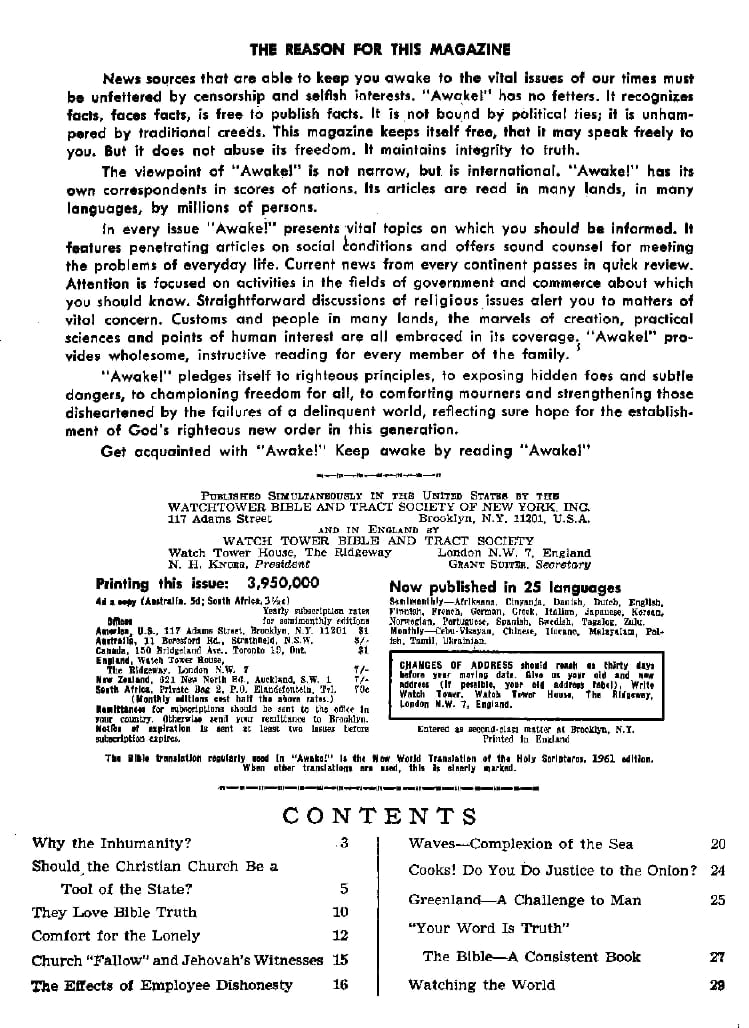
THE REASON FOR THIS MAGAZINE
News sources that are able to keep you awake to the vital issues of our times must be unfettered by censorship and selfish interests. "Awaken!" no fetters. It recognizes facts, faces facts, is free to publish facts. It is not bound by political ties; it is unhampered by traditional creeds. This magazine keeps itself free, that it may speak freely to you. But it does not abuse its freedom. It maintains integrity to truth.
The viewpoint of "Awake!" is not narrow, but is international, "Awake!" has its own correspondents in scores of nations. Its articles are read in many lands, in many languages, by millions of persons.
In every issue "Awake!" presents vital topics on which you should be informed. It features penetrating articles on social conditions and offers sound counsel for meeting the problems of everyday life. Current news from every continent passes in quick review. Attention is focused on activities in the fields of government and commerce about which you should know. Straightforward discussions of religious issues alert you to matters of vital concern. Customs and people in many lands, the marvels of creation, practical sciences and points of human interest are all embraced in its coverage, "Awake!" provides wholesome, instructive reading for every member of the family.
"Awakel" pledges itself to righteous principles, to exposing hidden foes and subtle dangers, to championing freedom for all, to comforting mourners and strengthening those disheartened by the failures of a delinquent world, reflecting sure hope for the establishment of God's righteous new order in this generation.
Get acquainted with "Awake!" Keep awake by reading "Awake!"
22 — — — — —
PUBLISHED SIMULTANEOUSLY IN THE UNITED STATES BY THE
WATCHTOWER BIBLE AND TRACT SOCIETY OF NEW YORK, ING.
117 Adams Street
Brooklyn, N.Y. 11201, U.S.A.
AND IN ENGLAND
WATCH TOWER BIBLE AND TRACT SOCIETY
Watch Tower House, The Ridgeway
London N.W. 7, England
N. H. Kruhn, President
GRANT SON, Secretary
Printing this issue: 3,950,000
4d a copy (Australia, 5d; South Africa, 3/2e)
subscription rates
for semiannual refillations
Canada, 117 Bridgeway, Montreal, QC 1
Canada, 115 Bridgeway, Toronto, 10, 101
New Zealand, 923 North New York, Auckland, S.W. 1
South Africa, Private Jake B. P.U. Blantondale, Tr. 70
Rentitances for subscriptions should be sent to the office in your country and send your realization to Brooklyn.
Rentitances is sent at least two weeks before subscription expires.
Sainiwanwu — Arkansas, Cincinnati, Darwin, Dubai, English, French, German, Greek, Italian, Japanese, Korean, Spanish, Swedish, South African, South African, Tuskegee, Polish, Mumbai — Chelsea, Chicago, Chinese, Malaysia, Polish, Tumil, Tunis
CHANGES OF ADDRESS should remain on thirty days before year marital date. Alive on year old and new children must be registered with Watch Tower, Watch Tower House, The Ridgeway, London M.W. 7, England.
Entered as second-class matter at Brooklyn, N.Y.
Printed in England
The Bible translation regularly used in "Awakzi" is the New World Translation of the Holy Scriptures, 1961 edition. When other translations are used, this is shortly marked.
CONTENTS
Why the Inhumanity? 3
Should the Christian Church Be a
Tool of the State? 5
They Love Bible Truth 10
Comfort for the Lonely 12
Church "Fallow" and Jehovah's Witnesses 15
The Effects of Employee Dishonesty 16
Waves—Complexion of the Sea 20
Cooks! Do You Do Justice to the Onion? 24
Greenland—A Challenge to Man 25
"Your Word Is Truth"
The Bible—A Consistent Book 27
Watching the World 29
"AUSCHWITZ Comes to Life Again." Thus the New York Times Magazine introduced its report on the Auschwitz trials currently taking place in West Germany. For the past five years the German government had been collecting evidence against twenty-one German SS men and one trusty or in-
mate who became an alide, and now was bringing them to trial. "The charges range over every imaginable crime and some beyond imagining," the report said.
But might not the entire Nazi program for the "Final Solution," the extermination of the Jews of Europe, be termed "beyond imagining"? That the Nazi regime should have built a veritable city at Auschwitz, factories and all, to exploit Jewish labor and to exterminate Jews by the million does indeed stagger the imagination. And what about the industrialists who so readily cooperated with Hitler in this diabolical business, as so graphically portrayed in Hochhuth's The Deputy?
However, this incomprehensible inhumanity was not limited to those who accepted the Nazi ideology either voluntarily or under compulsion. Not only were there some, such as the Vatican, that remained silent about it all, but some preferred to
have matters that way. As veteran newspaperman I. F. Stone says in his Weekly, March 9, 1964:
"I remember as a young newspaper man the coldness one encountered in the [U.S.] State
Department on the subject of refugees and the inhumanity with which the British turned away
from Palestine boatloads of Jews fleeing from Hitler's ovens; two, the Stroma and the Patria, sank with their human cargoes. Last October 12 [1963] the State Department released a volume of diplomatic papers from the year 1943 (Vol. 1: General) in which two painful stories are disclosed. One (at page 134) is a British Embassy memorandum expressing fear lest the Germans 'change over from the policy of extermination to one of extrusion [sending Jews out of the country], and aim as they did before the war at embarrassing other countries by flooding them with alien immigrants.' In the other painful story Stone relates how the U.S. Chiefs of Staff objected to moving 4,500 from Spain to North Africa lest this "cause resentment on the part of the Arab population." Comments Stone: "In all the great capitals, political expedition came before humanity."
Just how far political expediency can come ahead of humanity was nowhere more shockingly portrayed than with the bombing of the city of Dresden, Germany. Because of its being without military installations, it had become a haven of refugees, swelling its population to 1,250,000. After the bombing the city had less than one-third as many inhabitants, and German estimates of the number killed ranged between 120,000 and 150,000, or about as many as perished by atomic bombs in Nagasaki and Hiroshima put together. Eleven square miles were wiped out and more than 24,000 of Dresden's 28,000 houses in the heart of the city were destroyed.
Regarding this incident Chester Manly in The UN Record states: "On the night of February 13, 1945, Dresden, in eastern Germany, a city of museums, cathedrals and hospitals, was devastated by 2,000 American and British heavy bombers. The city, containing no important military targets, was swollen with refugees from the Russian armies advancing from the east and from the mounting intensity of the bombing attacks in the west."
The bombing was carried out in three waves: the first at nine at night, the next three hours later, and the third about noon the next day. The heavy bombers, loaded with incendiary bombs, poured a veritable Gehenna on the hapless population. And not content with dropping liquid fire on the population, fighter planes swooped down to machine-gun fleeing victims, women, children and all. No wonder that one British official in telling about it within the past year, in November 1963, entitles his article "Apocalypse at Dresden. The Long-suppressed Story of the Worst Massacre in the History of the World." According to him, "if the British Commonwealth and the United States last a thousand years, men may say that this was their darkest hour."
And what was the purpose of it all? According to some authorities, to impress Stalin; according to propaganda reports, to break the morale of the German people, but this it failed to do. However, it did create such a public uproar that Churchill and his advisers announced that no more such bombings would take place.
Why all such incomprehensible inhumanity? Because of political expediency? No doubt that does account for most of it, for expediency is defined as "conducive to special advantage rather than what is universally right." But how is it possible for men to go to such extremes? Because of the tendency of fallen man to evil unless checked by the enlightenment and motivation provided by the Word of God. Without divine guidance men readily become "like unreasoning animals born naturally to be caught and destroyed."—2 Pet. 2:12.
Goading men on in their inhumanity is none other than Satan the Devil, especially since 1914. Fulfillment of Bible prophecy shows that since that time Satan and his demons have been cast down to the earth. With what result? "Woe for the earth and for the sea, because the Devil has come down to you, having great anger, knowing he has a short period of time." But take cheer, for that also means that before long the prophetic words will apply: "Come, you people, behold the activities of Jehovah, how he has set astonishing events on the earth. He is making wars to cease to the extremity of the earth."—Rev. 12:12; Ps. 46:8, 9.
Even now there is a class of people who have kept themselves clear of inhumanities. They are the ones who are seeking instruction from Jehovah and who are walking in his ways. They have already beaten their swords into plowshares and their spears into pruning shears.' It might well be that you received this copy of Awake! from one of these.—Isa. 2:3, 4.
Christian Church
BE A TOOL OF THE STATE?
</div>
AS A lover of what is right you prize highly the freedom to follow the dictates of your conscience. And if you happen to have strong religious convictions you may value your religious freedom even more highly. However, the fact that at present you may be enjoying these freedoms does not of itself make certain that you will enjoy them tomorrow.
Why not? Because today autocratic and often Godless governments are spreading and are making ever more demands. In their lust for power they seek to coerce religious organizations to compromise their principles and to make them subservient to the State. Is a church justified in thus yielding for the sake of its continued existence?
That Christians have obligations both to God and to their governments Jesus made clear when he said: "Pay back Caesar's things to Caesar, but God's things to God." But suppose there is a clash between the two, as when Caesar or the State demands what God explicitly claims for himself, or the State demands that one do what God plainly forbids, then what? Who is to determine just what belongs to the State and what to God? Whom is one to obey? Scripture and logic would seem to dictate that Jehovah God is the one to determine what belongs to whom. This is the way the apostles understood it, for, when faced with this issue, they replied: "We must
How far should Christian subjection to the State go? Who decides its limit?
obey God as ruler rather than men." —Mark 12:17; Acts 5:29.
However, since the time of so-called Constantine the Great, professedly Christian organizations have yielded and given to Caesar or the State that which belongs only to God, thereby becoming Caesar's tools. Perhaps no more glaring example of this can be found today than that of the leading branches of Christendom residing in the Soviet Union. In particular has the Russian Orthodox Church become the veritable tool of not only a Caesar but an avowedly atheistic Caesar, the Godless Russian Communistic government. And painted with the same brush are the satellite Orthodox Nationalist churches. The role all these play is well symbolized by the Kremlin with its cathedrals and fortresses.
The fact is that ever since 1721, during the rule of Peter the Great, the Russian Orthodox Church has been the abject tool of the Russian government. Beginning with that year, it was the czar that appointed from among Orthodox prelates the handful of men that made up the Holy Governing Synod of the Russian church, which body replaced the office of Patriarch abolished by Peter the Great. More than that, the czar also had a 'lay' representative on the Synod, the Ober-Procutor, and no action of the Synod could receive the czar's approval without the intermediation of this official.
Peter thus made doubly certain that the Russian church would be run according to the czar's wishes.
For almost two hundred years the czars held this viselike grip on the church. Its hierarchy rolled in wealth and was even more reactionary at times than were the czars, while drunkenness and other misconduct on the part of the priests were common. Remember Rasputin.* As a young Russian professor of literature, himself a "believer," put it to a Life correspondent: "In the old days Orthodoxy fought every liberal movement in Russia, from the emancipation of the serfs to the democratic revolutions of 1905 and 1917. It even excommunicated Tolstoy, that man of God." (September 14, 1959) During this time crass ignorance and superstition were fostered and especially the worship of holy pictures known as "icons."
The Patriarchs Tikhon and Sergei
Then came the revolution of 1917. The downfall of the czar and the establishment of the provisional government made possible the return of patriarchal church government and the election of a patriarch, Tikhon. But then the Soviets, who were a minority, seized the government and at once took drastic action against religion, secularizing marriage, grabbing church property and nationalizing the schools.
The patriarch Tikhon at first condemned these acts as "the work of Satan" and excommunicated the perpetrators, telling them that for it they would "suffer the fire of Gehenna in the life to come"; at
the same time warning his people to have nothing to do with the Communists. When it appeared the Communists were here to stay, Tikhon changed his position from opposition to strict neutrality, and then, after having been imprisoned for a year, did an about-face, acknowledged his "errors" and pledged his allegiance and that of his church to the Soviet regime. Thereby he took the first step toward making his church again a tool of the State.
Patriarch Tikhon, who had been elected in 1917, imprisoned in 1922 and released in 1923, died in 1925 and was succeeded by Sergei, but not as a patriarch, no election being possible. Sergei started out well, for in a letter to his clergy he stated, among other things:
"One of the results of the Revolution consists in freeing the Church from all political and national tasks, and we assuredly cannot surrender that advantage. . . We firmly promise that to the degree it depends upon our authority, we will not henceforth permit the Church to find itself involved in any political adventure whatever, and will not tolerate anyone to hide his own political aspirations under the Church name."*
Truly a high-sounding statement that Sergei did not intend his church to be Caesar's tool. But when the State applied pressure on the one hand and made an attractive offer on the other hand, Sergei did an about-face. As a result, a year after writing that bold letter, he issued a Declaration* in which he expressed the very opposite sentiments:
"Let us raise our grateful prayers to the Lord who has been so gracious to our holy Church. Let us also express, in behalf of the entire nation, our gratitude to the Soviet Government for this attention to the spiritual welfare of the Orthodox population . . .
We wish to remain Orthodox and at the same time to recognize the Soviet Union as our civil Fatherland whose joys and successes are our joys and successes, and whose misfortunes are our misfortunes. Every blow directed against the Union, .
. . we acknowlledge as a blow directed against us."
Many of the bishops in exile as well as some within Russia protested this Declaration whereby so obviously the church became the tool of the Soviet Caesar. Those protesting inside Russia were gradually apprehended by the secret police and their places, filled by bishops willing to cooperate with the Soviet regime. That Sergei clearly appreciated the alternative that faced him is plain from the following statement that also appeared in that Declaration: "Only arm-chair visionaries can suppose that such an immense community as our Orthodox Church, with all its organizations, may peacefully exist in this country, hiding itself from the government." But did Christ promise his followers a peaceful existence, or that they would have tribulation?—John 16:33.
How total this sellout to the State was can be seen from the fact that from this time on all official Russian Orthodox Church history conforms to Soviet policy. An example of this is Sergei's denial, as reported in the Russian press, of there being any religious persecution in Russia; "In the Soviet Union no religious persecution has ever occurred, nor does it now exist. Churches are not closed by governmental order but because of the will of the people. The reports concerning cruelties of the agents of the Soviet government in relation to certain priests . . . are lies." Another example is its zealous support of the 'Stalin cult,' referring to him as "The Defender of the Faithful," "Our Common Father," and so forth.
Shortly after Germany invaded Russia in June 1941 the Orthodox Church rallied to the cause of the Soviet, declaring: "The Church of Christ blesses all Orthodox who are defending the frontiers of our Fatherland." Its head, from then on until
he died in 1944, issued twenty-three proclamations urging his people to support the war. He and other church leaders collected large sums of money to help finance the war. For all this support Stalin permitted the calling of the Russian Council or Sobor, which permission he granted at a historic meeting of Stalin, Sergei and two other prelates and which resulted in a far-reaching "concordat." The Council, which elected Sergei patriarch—something he had been in fact but not in name all the time—was but a rubber-stamp affair consisting of only a handful of prelates favorable to him.
Alexel's Role
Sergei was succeeded by Alexel, under whose rule the Orthodox Church of Russia has continued as a Soviet tool, wholeheartedly supporting the war until its close. The Soviet regime still passes on the qualifications of every holder of an office in the Orthodox Church, from the patriarch on down to the lowliest priest; exceeding even the demands of the Nazis, who concerned themselves with the politics of only the higher church officials of the Roman Catholic Church. Every church service still begins with a prayer for the blessing of the Presidium of the Communist party of the U.S.S.R. With the coming of peace the church has given all-out support to Red Russia's "peace movement" in pulpit and church press. In fact, the church echoes the Soviet propaganda line on every major international issue. And the fiction of no religious persecution is still dutifully mouthed.
Recent evidence that Russian Orthodoxy is a Soviet tool appeared in the New York Times, October 2, 1963, under the heading, "Soviet Eye on Vatican." It told that "Orthodox Moves for Reconciliation with Rome Parallel Political Line. The Orthodox Church's offer to enter into a dialogue with the Roman Catholic Church is an ecclesiastical counterpart of Moscow's recent 'campaign of smiles' aimed at rapproachment with the West."
Even as the Soviet regime has expansionist ambitions, so the patriarch of Russia has ambitions to become leader among the dozen and more Eastern Orthodox Churches and to have Moscow become the "third Rome," and it is in the interest of the Soviet regime to support him in these ambitions. He has already coerced the Orthodox heads in satellite countries to look to him instead of to the ecumenical patriarch at Constantinople, who is "first among equals." Thus the Russian delegates to the first Pan-Orthodox meeting at the Isle of Rhodes in 1961 tried, in vain, to have the honor given the ecumenical patriarch bypassed and to inject political peace appeals, Soviet inspired, into the resolutions.
All the Eastern Orthodox Churches, except the Greek, met again in 1963 at the same place. In reporting on that meeting a press report stated: "The most serious rift in Orthodoxy divides the Russian and Eastern European Churches from the other Orthodox Churches. The Russian Church appears to wish to restore the position of pre-eminence it enjoyed in the days of the czars." The report also stated that the real problem of the Middle East churches, small but ancient, is their penetration by the Russian Orthodox Church.—New York Times, September 27, 29, 1963.
Most fittingly, therefore, Matthew Spinka, an authority on Russian church affairs, wrote:
political power into satellite Orthodox countries. It has become the significant and conspicuous feature of his term in office."
The Russian Orthodox Church is indeed the tool of the Godless Communist Soviet regime. True, its former heads, Tikhon and Sergei, at first struggled against having their church play this role, but in the end each did an about-face because of pressures and inducements. What good is a professedly Christian organization when it becomes a tool of Caesar, and a Godless Caesar at that, one whose goals are world conquest and the wiping out of all religion? God and Christ can use only those bearing right fruits.—Matt. 21:43; John 15:2, 6.
"The present Patriarch Alexei has voluntarily continued the policy of cooperation with the state. He has deliberately made his Church the tool of the government. This is particularly evident from his service rendered to the state in the expansion of its
Witnesses in Russia No State Tools
According to reports, the leading Protestant organizations in Russia follow the same course of cooperation with the Communistic Soviet regime that the Russian Orthodox Church does, even as do the Roman Catholic Churches. They have the benefit of being registered by the government in return for repeating Soviet propaganda, such as that there is no religious persecution in Russia and that the Soviet regime is sincerely advocating world peace. Evidently all these agree with the former Orthodox patriarch Sergei that only armchair visionaries would try to carry on in Russia without coming to terms with the Soviet regime. But there are exceptions that are proving that even in Godless Communistic Russia sincere worship can be carried on. In particular have Jehovah's witnesses there demonstrated that a religious community can carry on without becoming a Soviet Caesar's tool, and they have done so by going "underground."
Even as Jehovah's witnesses refused to compromise or come to terms with Hitler, the Godless Nazi Caesar, so they have refused to come to terms with Stalin and Khrushchev, the Godless Communistic Caesars.
While they have had to suffer much for taking this course and have had to carry on underground, they have kept a clear conscience and can hope to be rewarded by their God Jehovah in his due time. As Jesus foretold: "Shall not God cause justice to be done for his chosen ones who cry out to him day and night, even though he is long-suffering toward them? I tell you, He will cause justice to be done to them speedily. Nevertheless, when the Son of man arrives, will he really find the faith on the earth?" —Luke 18:7, 8; see also John 15:17-19.
What is more, even at the present time their course of action has not been without rewards, as can be seen from what Walter Kolarz says about them in his book Religion in the Soviet Union. While obviously not impressed with the beliefs of Jehovah's witnesses, he does accurately tell how they were able to breach the Iron Curtain, by Russian prisoners in German concentration camps becoming converted by Witnesses also in these camps and by Russia's taking over lands in which there were Witnesses. In regard to their activities and persecutions he has, among other things, the following to say:
"In 1957, the Soviet authorities started a nationwide campaign against the 'Witnesses.' The body primarily in charge of it was the Committee for State Security, the notorious KGB, the successor of the MVD which carried out the anti-Jehovist operations in the forties . . . Specifically, political charges against the 'Witnesses' concerned their refusal to participate in elections or serve in the army, . . . and their boycott of the appeals of the World Peace Council. They assert that no international body in the world could prevent war nor bring universal peace against God's will, and so the peace movement is a wicked thing.
"Truth and fiction are closely intermingled in the Soviet accusations, but one is outstandingly ludicrous, namely, that 'Jehovists' were racialists who accepted the nazi philosophy of a master-race. . . In fact, far
from being radicalists, the 'Witnesses' are more internationally-minded than the communists, for they do not recognize any natural and racial barriers among themselves. They consider themselves part of 'Jehovah's Nation of Worshipers' to which their undivided loyalty belongs. . . . Only the future will show whether Khrushchev has been more successful in fighting the 'Jehovist' danger than were either Hitler or Stalin.
What a contrast the course of Jehovah's witnesses in Russia presents to that taken by the Orthodox, Roman Catholic and major Protestant churches, such as the Lutherans and the Baptists! If the few thousands of Jehovah's witnesses have been able to accomplish all this, what could these others have accomplished with their many millions if their leaders had taken a fearless, uncompromising and integrity-keeping stand and kept separate from this system of things, if they had refused to yield to Caesar's demands to give him what belongs to God alone, if they had refused to become tools of the Godless Soviet Caesar?
According to the Word of God, all religious organizations that thus become political tools, as were the religions of ancient Babylon, are a part of "Babylon the Great," the world empire of false religion. More than that, God's Word at Revelation 17:15-18 shows that all such religious organizations, as part of Babylon the Great, will perish at the hands of the very Caesars with whom they consort.
Has your church compromised its principles for the sake of popularity, convenience or to avoid persecution? Has it come to terms with Caesar at the cost of failing to pay back to God what belongs to God? If so, then it is part of Babylon the Great and the call also applies to you: "Get out of her, my people, if you do not want to share with her in her sins, and if you do not want to receive part of her plagues."—Rev. 18:4.
DO PEOPLE in your neighborhood enjoy listening to Bible teachings? Do they welcome a discussion of God's Word with their neighbors? If you live in the so-called "progressive" lands of Christendom, particularly in certain parts of Europe or North America, it is very likely that the majority do not. While so many in those areas profess to be Bible lovers, so few will even take a few moments to discuss the Bible with their neighbors. You may therefore be surprised to learn that the situation is quite different in Africa.
By "Awake!" correspondent in Sierra Leone
In many parts of Africa it is not unusual for most of the people in a small village to gather around to listen to a visitor who has come to speak to them about the Bible. Yes, many Africans welcome a discussion of God's Word, and allow its truths to sink into their hearts. Their love of Bible truth has resulted in many of them becoming dedicated, footstep followers of Jesus Christ.
While it is true that many Africans are Christians in name only, which is so of people wherever you go, others make many sacrifices and endure much abuse in order to remain faithful to Christian principles. This is true of many persons who have recently been contacted with Bible truth in the small West African country of Sierra Leone. Their faith has often proved exemplary.
Bible Truth Taken Seriously
For example, not long ago one of the missionaries of Jehovah's witnesses started a Bible study with an African tribesman who lived in a small village about seven miles outside the town of Makeni. Since farm work was urgent, the Bible study
was arranged for seven o'clock each
morning. However, due to his keen interest the study was soon extended to two hours in length instead of just one.
After a few studies it was explained to this interested man that congregation meetings were held in a town seven miles away. What a joy it was to see him at the public lecture the following Sunday afternoon! He had walked the seven miles to attend. Afterward, different ones remarked how they enjoyed themselves in the ministry that morning. To their amazement this newly interested person was present at the meeting for field ministry the following Sunday. He had left his home at five o'clock in the morning in order to share in the house-to-house ministry!
Soon this interested person expressed his desire to attend all the meetings. He was even willing to give up farming in order to be near the Kingdom Hall. He learned a new trade, baking, which occupation enabled him to leave the farm and be closer to the meetings.
After completing studies in the Bible-study aid "Let God Be True," he expressed his desire to be baptized. After baptism he enrolled as a vacation pioneer minister, and six months later he entered the regular full-time ministry. He is now conducting seven Bible studies of his own, and one has already started to share in the ministry with him.
Responsive Hearts
Especially have persons of the Kissi tribe shown response to Bible truth in Sierra Leone.
In 1959 a Kissi-speaking minister and his wire were sent to me small town of Koindu in Kissi-speaking territory, and it was not long before a handful of interested young men started attending the weekly Bible studies arranged in the home of this minister. Due to his zeal and enthusiasm the town chief began to show considerable interest in the work. He not only attu led some of the meetings, but even gave a plot of land for building a Kingdom Hall.
In course of time literacy classes were arranged to help these humble folks to read and write, and eventually upward of 300 were attending them. During this time a new congregation was formed, and about twenty of the Kissi people took up the ministry. In the next three years the increase came by leaps and bounds. More than fifty ministers are now associated with the original congregation, and two other congregations have also been formed. Many of those who are ministerial servants in these congregations learned to read and write in the literacy classes.
The love of these people for Bible truth is shown by their zeal in sharing the wonderful things they have learned with others. More than fifteen of those in the original congregation in Koindu are full-time ministers, and more than twelve others are serving as full-time ministers in nearby congregations. That their love is genuine is evidenced by the courage these people have manifested in the face of bitter persecution.
Exemplary Courage
When a group of men in a village not far from Koindu became interested in the Bible and started attending meetings regularly, the headman of the bush society led an assault against them early last year. Although these newly interested persons had long been members of this bush or
"poro" society, they now refused to take part in its demonic rites. Because they chose instead to obey the true God Jehovah, they were beaten, tied in chains in the bush, and in other ways physically abused. In addition, their homes were burned down and their property was confiscated. During all this the paramount chief not only did not interfere, but even encouraged his people in their abuse of these men. Yet despite all that they suffered, these Christians remained steadfast in their stand for true worship.
When their Christian brothers learned what had happened to them, the matter was immediately reported to the police and a group of policemen were sent to investigate. Upon arriving, the police found that the culprits had run away and taken cover in the bush. However, the paramount chief and other influential ones who were largely responsible for all the trouble were taken into custody and held several days pending trial. Later, they were released on bail.
At the trial those responsible were severely reprimanded, and the paramount chief was deprived of his position. The people in the entire district became acquainted with what happened and, as a result, they all have great respect for Jehovah's witnesses. Meeting attendance in the large new Kingdom Hall in Koindu has zoomed to amazing new peaks. Although there are only a few more than fifty of Jehovah's witnesses associated there, due to the faithfulness shown in the face of opposition more than 300 have been in attendance at the meetings.
What a grand witness is being given to the praise of Jehovah God due to the love that many African people are showing for Bible truth! Certainly there are many persons living in the Western lands of Christendom that can learn from the example of these Bible-loving Africans.
COMFORT ForThe
NOT many years ago a young couple with their two children moved from a small town in Minnesota, where they grew up together, to a suburb of Chicago, Illinois, in America. How thrilled they were over the
How turned they were over the prospect of living in a city! But
being isolated from old friends and familiar places, the unexpected happened. The wife became terribly lonesome. "I was so lonely," she says, "I hated to wake up in the morning. . . . I'd sit in the kitchen all morning and drink coffee and cry so much that I'd use up five handkerchiefs. I was really disorganized."
For some reason many small town and country folk seem to believe that the very size of a big city and the versatility of
fully empty inside—all alone and without hope.
Loneliness is no respecter of persons. It afflicts old and young alike. Most people have the inner strength to face the affliction and to throw it off, at least to some extent. But a few need help. And it is the privilege and duty of a Christian to offer to such persons comfort and aid. The Christian apostle Paul wrote: "Blessed be the God and Father of our Lord Jesus
its life are guarantees against loneliness. But nothing could be farther from the truth. The cold steel and concrete canyons of the big cities practically echo with loneliness. Their beer halls, taverns, restaurants and theaters are quite literally packed with lonely people. In 1960 there were 2,000 bodies of adult New Yorkers that went unclaimed at the city morgue. There is much truth in the old cliché that the loneliest place on earth is New York City's Times Square on a New Year's Eve.
Christ, the Father of tender mercies and the God of all comfort, who comforts us in all our tribulation, that we may be able to comfort those in any sort of tribulation through the comfort with which we ourselves are being comforted by God." (2 Cor. 1:3, 4) So there is comfort for the lonely.
However, many people are lonely and are not aware of it. Yet often their loneliness causes them to behave in a manner that is disturbing to others and to themselves. Some of these lonely people retreat
Big cities can be lonely places.
What is loneliness and what are its effects? Why do people get lonely and what can be done about it?
Loneliness is a longing to be with a loved one, to be understood, to be loved, to feel wanted, needed and cared for, yet without anyone or any way to feed these very basic appetites. It leaves one fright-
into a shell of dreamy self-concern; others put on a protective armor of critical hostility and bitterness. Some become impostors; they pretend to be somebody else. Others develop obsessions, not only compulsive eating and drinking, two of the most familiar devices used to compensate for loneliness, but sometimes compulsive sleeping or reading.
At present the effects of loneliness as an emotional disease are not fully known. Doctors do know, however, that it can serve as the hidden cause of all sorts of depression, panic, anger or vague uneasiness. It is often an underlying cause of alcoholism, drug addiction, juvenile delinquency and marital unfaithfulness. Dr. Eric P. Mosse, prominent New York psychoanalyst, said: "I think all mental disease as a whole stems very much from the problem of loneliness." The Salvation Army noted that loneliness is sixth on the list of reasons for suicide. Perhaps even more shocking is the fact that most of the other reasons are directly or indirectly related to loneliness.
Cause of Loneliness
Why do people get lonely? Because they were not made to live by themselves, or to be by themselves for any great length of time. Isolation in a physical and spiritual sense brings on loneliness.
Solving the problem of loneliness, however, is not simply a matter of surrounding oneself with people. If this were the case, there would be no lonely people in big cities, but the reverse is true. Some of the loneliest people in the world are right in the middle of the crowd. The problem is not simply people, but the need to communicate. Failure to communicate is one of the basic reasons for loneliness.
Loneliness may stem from other factors, too—from a sense of not being loved or cared for. Old and young delinquents, as many social workers know only too well, are generally unloved and thwarted people. What many of these lonely people want is simply a sense of belonging somewhere or to someone.
Loneliness is one of the greatest problems among the aged. The most common cause is neglect, even when living with relatives, but more often when living in
an institution. Older people tend to feel outdated, deliberately cut off by those from whom they expect love and friendship. The changed attitudes of families toward parents and grandparents in recent years has resulted in increased loneliness among the aged. In too many cases older people no longer occupy a place of affection and respect in the family circle as they once did.
Dangers of Loneliness
With young people loneliness altogether too often leads to immorality. A lonely girl returning night after night to her one- or two-room apartment becomes desperate for companionship. At first she may try watching television or listening to the radio, but in time the loneliness presses in again. She may dash out into the street in search of a familiar face, or wander off to an airport to watch people. Loneliness might drive a young man into a bar, where lonely people generally gather. Night after night these same people sit side by side on rows of stools, chatting together, exchanging boredom for loneliness. The danger is that once lonely people find a listening ear, or get a taste of friendship, they will do almost anything to keep it. Thus they become easy targets for seduction.
But sex is not the answer to loneliness. Sex is being used, nevertheless, as a tranquilizer by too many anxious, lonely and depressed souls.
Frequently the lonely are maneuvered into a hurried marriage. "Have you tried marriage?" someone will say. "It's the sensible thing to do. No more returning to an empty room." So, many marry whoever comes along just to keep from being alone, but even married persons do not spend all their waking hours together. Marriages based on nothing but a desire to escape from loneliness seldom bring real contentment.
Having someone with whom to live can definitely help to conquer loneliness—if that someone is the right sort of person. But more is needed than simply being with someone.
Solving the Problem of Loneliness
The first thing for a lonely person to do is to make up his mind that he does not have to be lonely. The second thing to do is to stop pitying himself for the state that he is in and start doing something about it. Black thoughts only sadden, not gladden one. The way to enjoy life is to share it with others and not to engulf it with sorrows.
Altogether too often lonely people do what they should not; they withdraw timidly into isolation. This only brings on greater loneliness. Or they think they can wash away their affliction with alcoholic beverages. But when the effect of alcohol wears off, the person usually finds himself lonelier and more depressed than ever.
What can and should be done? Rather than being an isolationist, avail yourself of opportunities to be with people. Not just any people, but people whom you know, people with whom you have something in common, so you will feel free to converse. If others do not at first invite you to join their company, take the initiative and invite them to join yours. Of course, this is not the whole answer.
There are persons who are constantly with others, even with persons with whom they have much in common, but they fail to communicate and so suffer loneliness. Are you one of such persons? If so, you have only yourself to blame. But rather than bemoaning your loneliness, remedy it. Show an interest in those around you. Listen to what they have to say and share in the conversation. Remember worthwhile things that you read and see, and
share them with others. Be willing to give a little and the loneliness will begin to go.
A lonely wife told about her loneliness after having moved to a new neighborhood. Her husband's work kept him away from Monday to Friday. It took this woman six unhappy months to learn that a sense of belonging is something she had to create for herself. "It dawned on me at last," she said. "So I got on my feet and stopped thinking about myself and started to work hard . . . I've been working hard ever since." Work helps.
Having nothing to do can bring on loneliness. To enjoy life, keep active. What especially counts is if we do satisfying work. Just running around and looking busy does not bring satisfaction. An old adage says: "A windmill twirling its arms all day is admirable only when it has corn to grind." Useful activity has a way of curing loneliness. Those whose work benefits those around them rarely find that they are alone and unloved. Active people, those who are busy helping others, seldom are lonely.
Now, you may be a person who does not suffer from loneliness. Nevertheless, there is much that you can do to be a comfort to the ones who are lonely. You can give them a big boost by creating in them a feeling of usefulness, a sense of being needed and wanted. These emotions maintain and intensify the desire to live. You can share a little friendly conversation with those who appear to be withdrawn; it will add a bright spot to their day. Watch for opportunities to invite older folks to do things with you. At first you may have to insist that they come along, because they may feel reluctant to do so. They may think that they are imposing on your privacy, but they will be grateful for your concern. Christian sons and daughters should bear in mind the command: "Honor your father and your mother'; which is the first command with a promise: "That it may go well with you and you may endure a long time on the earth."
—Eph. 6:2, 3.
Spiritual Comfort for the Lonely
The most outstanding remedy for combating loneliness is faith and love of the true God Jehovah. Lonely people as a rule are filled with deep fear and distrust. They must learn to give and receive love. This all people can do once they come to appreciate what the Christian apostle John wrote at 1 John 4:16-21. He said that "God is love," that "there is no fear in love, but perfect love throws fear outside," that "as for us, we love, because he [God] first loved us," that "the one who loves God should be loving his brother also." When lonely people once learn and believe that God loves them, loneliness loses its grip. Christians can always turn to God in prayer with confidence that God will hear them, because he cares for them. —1 Pet. 5:7.
This does not mean that a devoted Christian may not get lonely at times. He may. But he does not have to succumb to loneliness, that is, prolonged periods of depressed aloneness. He has his Christian brothers with whom he can and should associate regularly. He has the most useful and satisfying work that can be done in
the Christian ministry. (Heb. 10:24, 25; 1 Cor. 10:58) The truth is that a person with real faith in God and real zeal for true worship is helped to avoid any extended periods of loneliness because of his deep spiritual attachment to something outside of himself, namely, God and his visible organization of true Christians.
Of course, loneliness and being alone are not the same. Solitude is a state of being geographically alone, whereas loneliness is an emotional condition. It is not only good but necessary for people to be alone at times. Jesus Christ sought after lonely places. (Matt. 14:13; Mark 1:35; Luke 4:42) Being alone affords one the opportunity to open the heart to appreciations never seen in rushing crowds. It makes possible the quiet contemplation of our blessings. It gives man a chance to wash out the inside. Silence has a purging and restoring power. Aloneness is good as long as it is not an escape from reality, as long as it is not overdone, and as long as it is wanted.
But even, when one is alone through no choice of his own, it is most comforting to know that those who are children of God are not without someone who loves them, someone to whom they can turn. For God has said: "I will by no means leave you nor by any means forsake you."—Heb. 13:5.
Church "Fallow" and Jehovah's Witnesses
The religious magazine Varitija, issue No. 3, 1963, contained an article by Engineer Arvo Aho entitled "The Layman—the Church 'Fallow,'" in which the following was stated: "It is generally accepted that the duty of the Church is to be an ambassador for God. People used to come to the Church, but now the Church must go to the people. . . so in the eyes of the layman the Church seems to be, if not living only to itself, at least surprisingly self-centered, self-warming and empty. . . The layman must be trained for his service. In this modern world one has to explain the basis for what one believes, and it would be embarrassing if one did not know anything. . . We laymen are strangely incompetent in this respect. We may have sat for years in Bible circles and know the Bible by heart, but still we come off second best in a discussion with Jehovah's witnesses."
AN ASSISTANT bank cashier, who was a lover of horses, was Indicted in February of this year for stealing more than one million dollars from the bank that employed him. Obviously he was a thief who deserved to be prosecuted, but what about the employee in a department store, a factory or office who carries away merchandise from his place of work? Is that not also thievery?
Strange as it may seem, a growing number of employees do not think they are stealing when they walk off with company merchandise. They think of themselves as honest people who would never dream of burglarizing a store or a home. They would not countenance shoplifting. Yet they think nothing of carrying home from their place of work manufactured products without paying for them. Is there any real difference between taking merchandise or money that belongs to a corporation and burglarizing a private home, perhaps a home of a company executive?
In 1958 the president of an American firm said that his employees were taking home goods that were worth two and a half million dollars. Such noncash items make up 75 to 80 percent of all items that employees in the United States steal from their employers. The practice is carried on so extensively that American business is losing two billion dollars a year. This stealing is done, not by professional criminals, but by common people who, to all outward appearances, are honest, upright pillars of their communities. What is wrong with their moral standards that they can justify such thievery?
Employee dishonesty has manifested itself in many countries. In the Netherlands an official was arrested for embezzling about $56,000 while he was chancellor of the Dutch joint mission to
the North Atlantic Treaty Organization In the Soviet Union three store managers, two warehouse managers and the chief of the shoe department of a children's department store were jailed for embezzling $62,000 worth of shoes. In Yugoslavia the arrest of employees for thievery has become commonplace; all over the country managers and officials of commercial enterprises have been hauled off to jail. So the employee dishonesty existing in the United States is not peculiar to that country.
Crippling Effect
As a life-destroying disease works unseen within a human body, sapping vital energies until the body dies, so dishonest employees sap the vital strength of the business that provides them their livellhood.
They cripple its ability to operate at a profit, and this leads to its destruction.
In highly competitive businesses many companies operate on a very low margin of profit. Thieving employees do not have to steal much to reduce that margin to the vanishing point. For example, a company with a profit ratio of 2.5 percent must sell merchandise worth 4,000 to cover the loss of100 in stolen goods. When the loss to employee theft runs into the thousands of dollars, the results can be disastrous to the company. This was the case with a company that manufactured television sets and radios. In a period of six months thieving employees made off with 100,000 radio and television tubes and about 700 complete television sets. When the thieves were apprehended approximately $100,000 worth of merchandise was recovered. But the company was hurt badly by this employee dishonesty, and it gradually died. The dishonesty of those employees not only put it out of business but put them out of employment.
Estimates have been made that employee dishonesty causes from 3 to 7 percent of all business failures. The figure is much higher for mercantile failures. In a recent 10-year period, it was estimated that one-third of such failures were due to stealing by employees.
The difference employee stealing makes in a company's profits was revealed by a large drug firm. It calculated that its drug inventory shortage came to $2 million, with 75 percent of the shortage being due to employee theft. By eliminating this theft, the firm claimed that its profits would increase approximately 6 percent.
By stealing, the employee harms himself as a consumer as well as an employee. To compensate for their losses, companies must charge the consumer higher prices. Reduced profits because of the thefts mean decreased earnings for the worker, perhaps even unemployment. When theft is eliminated by the management of a company, the consequent rise in profits can mean an economically stronger company, a raise in pay for the workers and better worker morale.
What Is Stolen
There is little that dishonest employees will not take from their employers. Every year department stores are relieved of 15 million in cash and115 million in merchandise. Companies that manufacture electronic parts, cosmetics, drugs and other small items are particularly vulnerable to employee theft. But size does not stop the thieves.
A department store employee managed to steal twenty-eight refrigerators, fourteen gas ranges and other bulky kitchen hardware. A machinery plant was relieved of 16,000 worth of pipe, brass, copper and steel by trusted employees who sold the metal to scrap dealers. The manager of the carpet department of a large store stole carpets from the store and sold them to the store's customers at a reduced rate. Tin plate packed in large wooden boxes was stolen by the employees of another large company. The corporation calculated that its losses totaled about250,000. Over a 14-month period in a Chicago meat-packing plant employees stole $30,000 worth of meat. So it goes in industry after industry and store after store.
In most instances small merchandise is carried away secreted in lunch pails, handbags and clothing of employees. In some instances it is thrown into bushes near windows and picked up later. A bowlingball bag was used by one employee to steal brass ingots from his place of work. He publicized his enthusiasm over bowling and could be seen going home three nights a week with his bowling-ball bag, but the bag contained brass ingots rather than a ball.
He stole $15,000 worth of brass in this manner every year for five years.
When large items are stolen, several employees in different departments usually work together. It is estimated that 50 percent of employee crimes involve collusions.
Why They Steal
Most thieving employees rationalize their actions so they do not regard themselves as criminals. When an employee first embezzles money from his employer, he tells himself that he is not stealing but only borrowing the money. In due time, he tells himself, he will repay the money. Usually the money is never repaid. In one case a bank teller "borrowed money" from the bank to gamble in the hope of getting what he felt he needed to meet his living expenses. Gambling losses soon had him owing the bank $30,000. He became frightened and fled, but was soon arrested.
In some instances the trusted employee continues this "borrowing" for a number of years. A woman in a building and loan association who was highly respected in her community did this for twenty-three years. The amount she embezzled reached the astounding figure of nearly $3,000,-000. This was a serious economic shock to her community. She injured herself, her employer and her friends who had their money in the association.
A common rationalization by thieving employees is that the firm "owes it to me." An employee might feel that he is worth more than he is being paid, so he salves his conscience by telling himself that what he steals is due him. Still other employees rationalize by saying, "Everybody else is doing it." So they think it is all right for them to steal from the company. This is certain to be their thinking when they see their superior helping himself to company property. In one instance the manager of a department store used company paint
and its maintenance men to redo the interior of his home. Seeing this, the employees began helping themselves to merchandise. In a few years their thefts grew to the point where, in one year, the store lost $200,000 worth of goods.
Gambling and extravagant living standards appear to be principal factors contributing to employee dishonesty. Some companies blame gambling for 75 percent of their losses from employee dishonesty. An otherwise honest employee is pushed by gambling debts to the point where he feels forced to steal. Another employee who has "borrowed money" from his company resorts to gambling to replace what he took, but his losses mount, and he takes still more money. Taking increasingly large amounts of money also is done by the employee who seeks a life of affluence so as to impress his neighbors and associates.
Some dishonest employees rationalize that taking office supplies, merchandise and equipment from a company is all right because the company is rich and can afford to stand the loss. But no matter how rich the company may be, when a great number of employees have that attitude, the losses are damaging to it.
The chief reason for not taking money is actually a moral one. No matter how rich an employer might be, it is morally wrong for an employee to take what does not belong to him. He violates the trust that is put in him. The spread of his attitude among the working people of a nation can degenerate the morals of the nation, producing social disorganization. It acts like a destructive disease.
Usually the thieving employee lives in constant fear of being exposed. For this reason he manifests exceptional diligence in his work. Very often he is the first employee to be at work in the morning and the last to leave in the evening. He might even eat his lunch at his desk. If he has manipulated financial or inventory records, he is fearful that someone might examine them too closely when he is not present.
Management Responsibility
A certain amount of responsibility rests upon company management. Too many employers fail to institute adequate controls, to discourage
trols to discourage thieving. They also fail to protect themselves fully, by in
nitsky, a private investigator, stated in the booklet How to Stop Pilferage in Business and Industry: "By playing down the guilt of the industrial felon, by confusing company pride with duty towards society, Management has probably turned loose more thieves to prey on business than all the penitentiaries in the United States put to
ARTICLES IN THE NEXT ISSUE
Can You Accept the Whole Bible?
gether. . . . It is this impersonal approach to theft, this 'slap on the unjust' policy
selves truly by insurance. They might bond those who handle cash but not those who handle merchant-
The Imprint of Phallicism upon Christendom.
What's Back of the Racial Strife?
Refrigeration in the Tropics.
dise. On this point Norman Jaspan, who heads a company that specializes in uncovering employee dishonesty, states in his book Thief in the White Collar: "Despite the gravity of the situation, only between ten and fifteen per cent of the nation's manufacturers, wholesalers and retailers have bothered to bond their employees
on the wrist pony, which stamps Management as the real force behind the climb in industrial
thievery today... In 6 out of 12 cases the offenders are fired, but not prosecuted."
The spread of employee dishonesty reveals a degeneration of public thinking and morality. It reveals that a great number of people who profess to live by high religious standards of morality do not do so in actual fact. The effect of this dishonesty
against theft. . . It is not uncommon to find a firm's treasurer, a man who never stole a penny, to be covered by honesty insurance, while thirty other employees, none of whom are bonded, are systematically stealing $3,000 a week in merchandise."
Some managements take the attitude that employee theft is inevitable, so they write off such thefts as one of the costs of doing business. This attitude, of course, is an encouragement to employee dishonesty. It is best for the company and for the em-
is entirely bad. It lowers employee morale; it creates distrust; it weakens a company's position in its struggle for economic existence; and it degenerates the employee so that he sees no wrong in doing other unlawful acts.
The economic health of a company and the continuance of employment for its workers depend in large measure upon the moral integrity of its employees.
Employee dishonesty cannot be justified under any circumstances. No amount of
ployees when a management takes an aggressive position toward employee dishonesty, making determined efforts to stamp it out.
Too many companies do no more than fire thieving employees, which may encourage dishonesty. A company should prosecute its thieving employees instead of turning them loose to prey upon other companies. Regarding this Charles RudJULY 8, 1964
rationalization can make it right. Those who have been ensnared by it should give heed to the Bible's wise command: "Let the stealer steal no more." (Eph. 4:28) Honesty brings a clear conscience and is essential for having good relations with God. No matter what other people do, a lover of God cannot forsake Scriptural moral standards. He will refuse to succumb to the disease of employee dishonesty.
IT WAS just after 6 a.m. and the islands were coming to life. Most islanders were still sleeping, while women in the shore houses began preparing breakfast, their husbands on the beach getting ready for the day's work. Suddenly the men looked up, the women stopped moving in their kitchens—all was quiet. The sound of the surf had stopped! The unnatural void drew all open eyes to the sea. Why, it was withdrawing, uncovering beach that they had never seen, leaving stranded fish flopping on the sand! Gleefully, many rushed to explore this newfound beach and pick up the helpless fish; others ran the opposite direction to reach high ground, screaming "Tsunami!"
…