Awake!, May 22, 1964
Download: PDF — Awake!, May 22, 1964
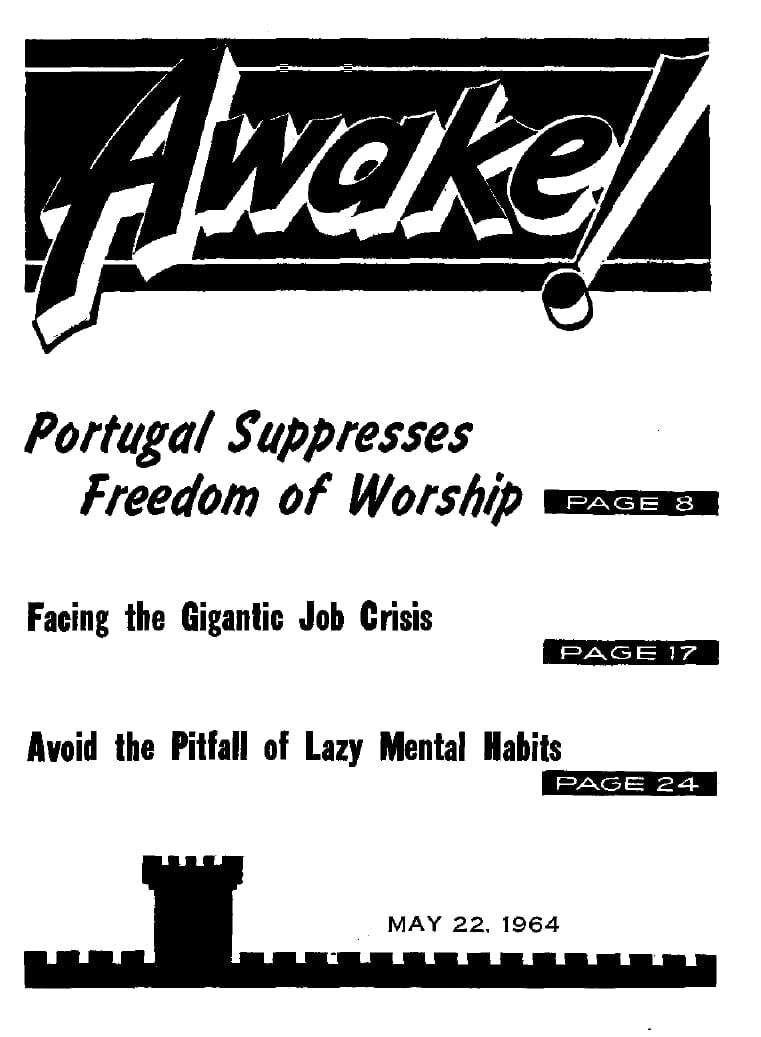
Portugal Suppresses Freedom of Worship PAGE 8
Facing the Gigantic Job Crisis
PAGE17
Avoid the Pitfall of Lazy Mental Habits
PAGE 24
MAY 22,1964
THE REASON FOR THIS MAGAZINE
News sources that are able to keep you awake to the vital issues of our times must be unfettered by censorship and selfish interests. "Awakel" no fatters. It recognizes facts, faces facts, is free to publish facts. It is not bound by political ties; it is unhampered by traditional creeds. This magazine keeps itself free, that it may speak freely to you. But it does not abuse its freedom. It maintains integrity to truth.
The viewpoint of "Awakel" is not narrow, but is international. "Awakel" has its own correspondents in scores of nations. Its articles are read in many lands, in many languages, by millions of persons.
In every issue "Awakel!" presents vital topics on which you should be informed. It features penetrating articles on social conditions and offers sound counsel for meeting the problems of everyday life. Current news from every continent passes in quick review. Attention is focused on activities in the fields of government and commerce about which you should know. Straightforward discussions of religious issues alert you to matters of vital concern. Customs and people in many lands, the marvels of creation, practical sciences and points of human interest are all embraced in its coverage. "Awakel!" provides wholesome, instructive reading for every member of the family.
"Awakel!" pledges itself to righteous principles, to exposing hidden foes and subtle dangers, to championing freedom for all, to comforting mourners and strengthening those disheartened by the failures of a delinquent world, reflecting sure hope for the establishment of God's righteous new order in this generation.
Get acquainted with "Awake!" Keep awake by reading "Awake!"
PUBLISHED SIMULTANEOUSLY IN THE UNITED STATES BY THE
WATCHTOWER EBIBLE AND TRACT SOCIETY OF NEW YORK, INC.
117 Adams Street
Brooklyn, N.Y. 11201, U.S.A.
N. H. KNOER, President
London N.W. 7, England
GRANT SUITER, Secretary
Printing this issue: 3,950,000
4d a copy (Australia, 5d; South Africa, 3 1/2 e)
UNITED
Australia, 11, Birmingham Rd., Stratford, N.W. $1
Australia, 130 Bridgland Ave., Toronto, 10, U.K. $1
188 Broadway, Dundee N.W. 17-7
New Zealand, 821 North West Bd, Auckland, S.W. 17-7
South Africa. Private Bag 3, P.O. Blackstone, Tvl. 70c
(Markleigh coaches cost half the above rates.)
Rentitations for subscriptions should be sent to the office in your country. Otherwise send your remittance to Brooklyn. Notes of expiration is sent at least two weeks before subscription expires.
Now published in 25 languages
British, French, German, Greek, Italian, Japanese, Korean,
Norwegian, Portuguese, Spanish, Swedish, Tanguy, Polish,
Tamil, Tamil, Ukrainian.
CHANGES OF ADDRESS should remain on thirty days before your rental date. Give an age and new address to the tenant. Call Water Tower House, The Ridgeway, London W. W. 7, England.
Entered as second-class matter at Brooklyn, N.T.
Printed in England
The Bible translation regularly used in "Ankara" is the New World Translation of the Holy Scriptures, 1961 edition. When other translations are used, this book is clearly marked.
11 12 13 14 15 16 17 18 19 20 21 22 23 24 25 26 27 28 29 30 31 32 33 34 35 36 37 38 39 40 41 42 43 44 45 46 47 48 49 50 51 52 53 54 55 56 57 58 59 60 61 62 63 64 65 66 67 68 69 70 71 72 73 74 75 76 77 78 79 80 81 82 83 84 85 86 87 88 89 90 91 92 93 94 95 96 97 98 99 100
CONTENTS
Are You Whole-souled
in Work and Worship?
The Need for a Durable Peace
Portugal Suppresses Freedom
of Worship
Facing the Gigantic Job Crisis
Panama's Changing Scene
Nurse Makes Practical Use of
Lifesaving Knowledge 23
Avoid the Pitfall of Lazy
Mental Habits 24
"Your Word Is Truth"
Principal "Proofs" of the Trinity 27
IT WAS an early ARE YOU
souled manner Give
summer day in an eastern United States city. Tents were being erected for a convention of Christian ministers soon to be held. The men doing the actual labor were
themselves Christian ministers who had arrived early to help to get things ready for their convention, and they went at their work energetically, whole-souled. The tent company representative that was di-
saved manners
it your undivided attention; put your heart into it. That is the advice that the Christian apostle Paul gave to Christian slaves in his day:
"Whatever you are
doing, work at it whole-souled as to Jehovah, and not to men."—Col. 3:23.
The apostle here used the Greek word psyché, from which comes the word "psychology" and which Greek root means
recting the work was in no small way impressed by their spirit of cooperation. He observed, with a sense of humor: "You can tell these men are working for nothing. Men who work for money don't work that hard."
He was right, but not altogether. Those men were working for nothing, but only as far as money was concerned. What caused them to work the way they did? Their love for Jehovah God and for their fellowmen, especially for their fellow Christians. They were devoted dedicated
"soul"; also the preposition "ek," meaning "out of" or "from." He was urging those slaves to work with their whole being or soul. To work at something whole-souled means doing all you can, doing it as well as you can and doing it from (ek) the right motive, as a matter of conscience, seeking to please God and not men.
Why be whole-souled in your work? For one reason, you cannot do anything when you are dead: "All that your hand finds to do, do with your very power, for there is no power nor devotion nor knowledge nor
Christians. They were devoted, dedicated men. Apparently working at a thing wholesouled is the exception rather than the rule or it would not elicit such a comment as the foregoing. But should this be so?
Do you have work to do, honest work that accomplishes some useful purpose in addition to providing yourself with a livelihood? If so, then go at it in a whole- MAY 22, 1964
is no work not devising nor knowledge nor wisdom in Sheol [the common grave of mankind], the place to which you are going." Yes, appreciation of life itself should make you want to be whole-souled in your work.—Eccl. 9:10.
Further, you owe it to your employer to be whole-souled in your work. Remember, the apostle was first addressing slaves
that doubtless were working for pagan masters or owners.
You are under obligation because of receiving a wage or salary to work whole-souled at what you have contracted to do. To the extent that you fail to do so you are not living up to your agreement.
More than that, you owe it to yourself to be whole-souled in your work. Your self-respect suffers when you follow the lines of least resistance rather than disciplining yourself and making yourself do what you are supposed to do. The human heart, due to its selfish bent, is prone to want to get away with as much as it can. This may take the form of coming late and quitting early—if one can get away with it! Or it may take the form of working for oneself when one is supposed to be working for one's employer. Or it may be just plain loafing. But how sheepish one feels when one is discovered loafing on the job!—Gen. 8:21.
If you are interested in success you will want to work whole-souled, with all your heart. Thus we read regarding Hezekiah, king of Judah in the eighth century B.C.E.: "Hezekiah . . . continued to do what was good and right and faithful before Jehovah his God. And in every work that he started in the service of the house of the true God and in the law and in the commandment to search for his God, it was with all his heart that he acted, and he proved successful."—2 Chron. 31:20, 21.
The record of Hezekiah points up another area wherein you should be whole-souled, namely, that of religion. You may be whole-souled in your work of making a living but are you also whole-souled in your worship? Here there is prevalent even less whole-souled effort. At least that is the implication of certain observations made by a spokesman for the world's most numerous religion, a leading United States
Roman Catholic theologian, who is professor of canon law at the Catholic University in Washington, D.C.
He was discussing the proposed liturgy reform, which, according to those who have to do with it, may take from five to eight years to be put into effect. According to him these liturgy changes will mark "the real beginning of reform within the Church," for the liturgy "affects the single occasion when Catholics come together every week, the Sunday morning mass. It confronts what has been called the 'Sunday morning crisis.'" And why is the Sunday morning mass the 'Sunday morning crisis?' To quote him, because of "the congregations that are unmoved or indifferent," and the "rites, that are routine or unintelligible."—New York Times, February 17, 1964.
What about your worship and that of your church? Is it whole-souled or do its religious leaders also complain about the indifference of their flocks? If you are to please God, it is important to be associated with those who give God the kind of worship that pleases him.
Yet, even if you are already associated with those who are known for their whole-souled worship, be sure that it is not only the organization but also you who are whole-souled. For example, when you assemble with the rest of the congregation for Bible study, and comments are invited, give consideration to the others present, freely volunteering to express yourself on the material being considered, rather than sitting back and waiting for someone else to do it. (Heb. 10:24, 25) When it comes to preaching publicly the truths of the Bible, too, be one who is whole-souled, rather than one who simply does enough to say he had a part.
Yes, whatever you are doing, do it whole-souled as to Jehovah.
THE NEED FOR A DURABLE PEACE
ANYONE who has become informed on the Man faces the greatest urgency of his existence. What can be done about it?
awful power of nuclear weapons will readily agree that the need for a durable peace is greater today than at any time in human history. In times past conventional weapons never threatened the existence of the entire human race as nuclear weapons do today. Mankind was able to survive the wars of the past, despite the heavy toll they took in human lives, but if an all-out nuclear war were to be fought, there are sound reasons for questioning whether man could survive.
Shocking estimates have been made of the carnage that would be caused by the first phase of a nuclear war. Experts in England estimated that approximately 200 million people would perish and that one billion others would die from the effects of radiation. The Soviet strategist Major General Nicolai A. Talensky observed: "A nuclear-rocket war, even without the use of chemical and biological weapons, will lead to the destruction of whole countries and peoples. Immense expanses will be contaminated with a lethal dose of radiation. The mortal danger from radioactive fall-out threatens not only the peoples of the belligerent countries but the whole population of our planet."
covering the secrets of how to manufacture nuclear weapons, the need for a durable peace becomes ever more urgent. The spread of nuclear weapons to more and more countries creates the ever greater possibility of nuclear war. Despite disarmament conferences, the path the nations appear to be following heads in that direction.
With the continued development and stockpiling of even more destructive weapons than those now possessed by the East and the West, and with other nations dis-
Peace Record
Disconcerting is the peace record man has made. If this record is used as a basis for guessing what the nations will do in the future, it appears that there is little hope of their avoiding a clash with nuclear weapons.
In the New York Times of April 14, 1963, it was pointed out that "in all the centuries of recorded history the world has known only 292 years of peace. Such were the findings of a Norwegian scientist who applied an electronic computer to the study of conflicts throughout history." It was estimated that during this time there were 14,531 wars. The article points out that these figures were reported in 1960. From that date until the spring of 1963 there were 22 wars, bringing the total to 14,553. Since then still more wars have broken out.
From the ending of World War II to date there has not been one year of peace. Somewhere in the world, fighting has been going on. Regarding this the New York Times goes on to say: "Since the end of the Second World War our planet has experienced not less than 21 fair-sized wars.
To these may be added some 30 or more minor revolts, civil wars and other relatively small conflicts, for a total of more than 50." This gives a higher yearly average of wars than the calculated average back through recorded history. Despite our advanced civilization, man today is less peaceful than his ancestors were. This fact is far from comforting in view of the weapons of mass destruction he now possesses.
The twentieth century has seen mankind advance technologically at a fantastic rate. From the horse and buggy, he has advanced to speedy automobiles, super-sonic planes and astonishingly fast rockets. He has harnessed the atom and concentrated light into thin, powerful beams that burn through diamonds. Notwithstanding these great achievements in such a short period of time, man has not learned how to live together in peace. Not one year in this remarkable twentieth century has been peaceful.
War-contributing Factors
With almost two-thirds of the human race living in conditions of extreme poverty and illiteracy, efforts to establish a durable peace are hampered. Hungry and illiterate people are easily aroused to violent action, and there are certain nations that have made such uprisings a part of their political strategy. Efforts to attain world peace can make little headway with such factors working against it.
Nationalism is another force that contributes to the continued existence of wars. It divides mankind and pits the divided groups against one another. On this point the book Conflict and Cooperation Among Nations by Ivo Duchacek observes: "Nationalism may be defined as 'a state of
mind in which the supreme loyalty of the individuals is felt to be due to the nation-state'. . . . Nationalism divides humanity into mutually intolerant units. As a result people think as Americans, Russians, Chinese, Egyptians or Peruvians first, and as human beings second—if at all."
Durable peace is not possible when mankind is divided into numerous nationalistic groups that are constantly contending with one another. It cannot exist when these groups selfishly seek their own interests rather than the interests of mankind as a whole. It has been this very thing that has hampered the United Nations in carrying out many of its objectives. Representatives come to the United Nations to get all they can but to give as little as possible. Selfishness is not the road to peace. Neither is racial hatred.
A rising tide of racism is stirring people into a turmoil in many parts of the earth. Cultivating hatred for other people because of racial differences makes the attaining of world peace even more remote than it is because of nationalistic differences. Turning one race against another race is not uniting mankind. It is not overcoming the obstacles to peace. How can there be peace when men hate, oppress and even kill because of race hatred? By separating into national and then into racial groups mankind is increasing the difficulty of establishing a durable peace.
Peace Will Come
Notwithstanding the seemingly bleak prospect for the future, a durable peace will come, but not by the hand of man. More than 4,000 years of history have shown that man is not a peacemaker. His peace pacts, disarmament conferences and international peace agencies have failed to establish peace. But man's failure as a peacemaker does not mean a durable peace will never be realized.
Long ago man's Creator inspired his prophets to foretell that he would bring a durable peace to mankind. He showed that he is capable of doing this by the powerful way he dealt with human affairs in times past. It was with a mighty hand, for example, that he delivered the Israelites from Egyptian slavery. That same mighty hand can deliver mankind from enslavement to war. "He is making wars to cease to the extremity of the earth. The bow he breaks apart and does cut the spear in pieces." (Ps. 46:9) The bow, spear and sword were used for millenniums as weapons of war and therefore became symbols of all types of war weapons. By "breaking the bow" and "cutting the spear" the Almighty God brings an end to war. He makes disarmament a reality. He has the power to do this and to bring about the changes that are necessary for establishing a durable peace.
There must be a change in human thinking before peace can become a permanent reality. It is from the minds of men that wars are given birth. Greed for territorial expansion, intolerance toward other nationalities and races, selfish ambition for power, nationalistic pride and a disregard for the welfare of others are causes of war, and they come from wrong thinking. Changing this thinking and causing people to put on a new personality that is peaceful and loving rather than belligerent and hateful is the way to a durable peace. The elevating truths of Jehovah God's written Word do that very thing. Unfortunately many people who have the Bible and who even read it do not permit its truths to transform their thinking. They do not permit its principles to guide their lives. Those
fashioned after this system of things, but be transformed by making your mind over, that you may prove to yourselves the good and acceptable and perfect will of God." —Rom. 12:2.
who are receptive to its instructions, however, heed the command: "Quit being
Only a small minority of mankind has shown a willingness to permit God's Word to transform their thinking so that it can be said of them that they have beaten "their swords into plowshares and their spears into pruning shears." (Mic. 4:3) With the vast majority of mankind refusing to make this necessary transformation in thinking, a bigger change must be made for world peace to be realized.
Demonstrating what big change is necessary and his power to do it, Jehovah God swept from the face of the earth the wicked generation of Noah's time. Only by taking such drastic action with the present wicked generation can durable peace become a reality. He has expressed his purpose to do this at the coming "war of the great day of God the Almighty." (Rev. 16:14) For this reason one of his prophets urges us: "Seek righteousness, seek meekness. Probably you may be concealed in the day of Jehovah's anger."—Zeph. 2:3.
By means of his own government, the kingdom for which Christians pray, Jehovah God will usher in an era of justice and righteous rule. He caused one of his prophets to foretell: "To the abundance of the princely rule and to peace there will be no end."—Isa. 9:7.
So we can see that, while from the viewpoint of man's efforts a durable peace appears quite hopeless, from the viewpoint of God's promises it is a certainty. Whatever he purposes he never fails
to do. With confidence we can look forward to peace. Ps. 37:11.
where a small group of Jehovah's witnesses and their friends were peacefully studying the Bible. The home was thoroughly searched, and Bibles and Bible literature were confiscated. All present were put under arrest and herded off to the local police station. There these
FREEDOM of worship is one of the fundamental liberties granted by all enlightened nations. But when it is taken for granted, it is easily lost. Suppression of freedom at first usually affects only "unpopular minorities," but soon large sections of the population find that their liberty is gone.
Recognizing this danger, freedom-loving people in all nations have sought to protect their freedom by law, and those who have been the victims of religious persecution have been willing to face deprivation, prison bonds and even death in order to preserve their God-given right to worship. As a result of this continuous struggle, freedom of worship is enjoyed throughout a large part of the world today. But there are exceptions.
One such is Portugal and its overseas provinces. During recent months the Portuguese police have hounded private citizens, invaded their homes, ransacked personal belongings and arrested persons who simply possessed or were caught reading or discussing the Bible.
Homes Invaded, Bibles Seized
On the evening of August 21, 1963, five policemen with guns in hand broke into a private home in the town of Aveiro,
Christians, including a yearold baby, were held until four o'clock the next morning, at
which time the police finally decided to let the children go home. The rest were kept until five o'clock in the afternoon, when they were formally charged with holding illegal meetings and released to await trial.
At the trial it was clearly shown that Jehovah's witnesses are in no way connected with any political movement to undermine the Portuguese government, and that throughout the free world they are recognized as a legitimate Christian organization. It was made plain that at the time their privacy was invaded by the police they were merely holding a Bible study class, as Jehovah's witnesses do openly in all countries where there is freedom of worship. The evidence presented to this effect was irrefutable.
However, nearly a month after listening to the case, the judge declared that the ten Witnesses involved were guilty. He sent Mr. and Mrs. António dos Santos Beirão, parents of a one-year-old baby and a thirteen-year-old daughter, to prison, and gave the other eight Witnesses suspended sentences with a probation of two years. In an effort to scare them into forsaking their worship of God, he warned that if during their probation period they were caught meeting together to study the Bible they would be immediately sent to jail.
This is not just an isolated incident, but throughout Portugal and its territories non-Catholics are hounded by the police. In every way possible the police have threatened Christians to refrain from speaking about God's Word to others, and to stop holding Bible study meetings. This apparently is part of a nationwide effort to suppress freedom of worship.
Maria Emilia Soares da Costa, who lives in the small town of Castelo Branco, reports that last October 25 she began to observe that she was being followed by several men. Two weeks later she was stopped and asked for her name and identification. The following day she was told by the same inquisitor to report to the police station. There Maria was ordered to stop holding Bible studies with people, and was threatened with arrest if she did not obey.
A few days later, on November 14, the police broke into her room while she was yet undressed. This is the way she describes what happened: "There came a knock on my door at 9:15 in the morning. The owner of the house where I live opened the door and there were three men from the secret police asking for me. They said they wanted to enter my room, and I asked the owner of the house to tell them to wait a minute as I was not dressed, as I had just gotten out of bed. These men did not give me time to dress but entered the room immediately. They entered without asking permission or without identifying themselves and began to search my little room, opening all the drawers and taking everything out of them. They confiscated any and all literature that I had. I was then
taken to police headquarters and questioned for hours."
Mrs. Carlotta Purificação was also confronted by the police. She was cleaning the steps of the apartment house where she lives when they identified themselves and proceeded to search her home. They turned up the bed, opened all the drawers and went through personal belongings. In one room they found a supply of Bible literature, including thirty-five Catholic Bibles that had the seal of approval of the Vatican in Rome. Not only did they take these Bibles, but they hauled away everything in the room, even the wastepaper. This has proved to be standard procedure in some places. In several private homes where Jehovah's witnesses meet to study the Bible, everything, including Catholic Bibles and the furniture, has been taken, and even after months of protests and inquiries nothing has been returned.
The Portuguese Post Office has also taken measures to suppress the circulation of the Bible in Portugal. Packages consisting entirely of Bibles that have been sent from one town to another by registered mail have been seized. When inquiry is made as to what has happened to these Bibles, no satisfactory reply is given.
Especially has discriminatory action been taken against Jehovah's witnesses. In February 1962, a communication was issued to all post offices prohibiting the circulation of their Bible literature through the mail. There has been no official notice to this effect by the government, and the public is not under the impression that the literature of Jehovah's witnesses is banned. However, on the basis of the above-mentioned communication, large quantities of Bibles and Bible literature have been seized and cut up and burned, and thousands of subscribers for The Watchtower and Awake! have been denied the right to receive their magazines through the mail.
Freedom of Worship Guaranteed
Certainly the vast majority of freedom-loving Portuguese people are not in favor of this suppression of liberty. It casts them and their nation in a bad light before the free nations of the world, which grant private citizens the right to worship according to the dictates of their conscience. At the same time it undermines the promises of their own Constitution, thus endangering the personal liberty of all the Portuguese people.
The recent efforts of the police to stamp out freedom of worship are clearly in violation of the assurances embodied in the Constitution of the Portuguese Republic. This guarantee of citizens' rights was drawn up under the direction of the Portuguese Prime Minister Dr. António de Oliveira Salazar early in his administration, and became effective April 11, 1933. Now, after more than thirty years of guiding the affairs of the Portuguese people, it might be asked whether Prime Minister Salazar is still in favor of granting his people the freedoms guaranteed in the Portuguese Constitution.
According to Chapter II, Article 8, of that Constitution, it is assured that
"Portuguese citizens shall enjoy the following rights, liberties and individual guarantees:
I) The right to life and personal safety;
III. Liberty and inviolability of religious beliefs and practises, on the ground of holding which nobody may be persecuted, deprived of a right or exempted from any obligation or civic duty . . .
IV) The free expression of thought in any form;
V) Freedom of teaching; . . .
XIV) Freedom of meeting and association."
Although Portugal is predominantly a Catholic country, and according to the concordat with the Vatican in 1940 the Roman Catholic Church has a role as counselor in "education and civilization," Chapter X, Article 46, of the Constitution nevertheless promises:
"The State shall also ensure freedom of worship and organization for all other religious faiths practised on Portuguese territory, their outward manifestations being regulated by law, and it may grant juridical personality to associations constituted in conformity with the creeds in question."
These certainly are noble guarantees, but are anything more than pleasant-sounding words? Will Prime Minister Salazar defend the constitutional rights of non-Catholic citizens who have been denied freedom of worship? These are burning questions to which freedom-loving people world wide want an answer.
It is appreciated that these are trying times in the history of the Portuguese Republic. This has resulted in many peoples' attention being turned toward Portugal to see how she resolves her problems. Therefore, it will certainly not be to Portugal's credit to be found persecuting Jehovah's witnesses, for informed people throughout the world know Jehovah's witnesses to be peace-loving Christians who remain separate from political controversies. They are not political agitators.
Misrepresentation Stirs Up Persecution
Nevertheless, shortly after the outbreak of violence in Portugal's overseas province of Angola in southwest Africa early in 1961, Jehovah's witnesses began to be accused of being involved in acts of terrorism against the Portuguese. As has been the case many times before, the Roman Catholic Church took a leading hand in this misrepresentation.
The Catholic journal, O Apostolado (The Apostolate), of Luanda, Angola, carried an article on May 6, 1961, denouncing the publications of Jehovah's witnesses as instruments of subversion. "It is urgent to check the poison and repress the wave that prepared the crime," it said. "You should search in Lisbon for the origin of such pamphlets which come here without indication of the sender.
And you must, without delay, keep down the distribution of these criminal written satires."
It was about six weeks later that Jehovah's witnesses in Luanda were brutally mistreated. On June 25, while they were peacefully gathered together studying the Bible, the military police with fixed bayonets suddenly broke into a meeting of Jehovah's witnesses. The women and children were sent home, but the men were packed off to prison, where they were held without being given treatment for the bayonet wounds inflicted by the police.
Quickly this program of misrepresentation spread to Portugal itself. For example, the Catholic magazine Voz do Sado (Voice of Sado), in its September 1961 issue, vilified Jehovah's witnesses, saying: "They are false witnesses. Delinquents that need the police; sick people that need the Julio de Matos [a mental hospital]; ill with a black mist of error. . . . we call attention of our authorities to put a stop to so much provocative and ominous seeds of doctrines that are everything but nationalistic, because they divide the Portuguese at a time when everything should unite them. Men of authority on the banks of the Sado [river], open your eyes while there is time; and . . . expel these new enemies of the unity and peace of the Portuguese."
When this flood of false propaganda flowed into Portugal, Portuguese officials began to interfere with the Christian activities of Jehovah's witnesses. In the town of Evora, some fifty miles southeast of Lisbon, the full-time minister Horacio Armaldo Duarte was called into the local headquarters of the secret police for questioning. There he was shown pictures of dismembered Portuguese soldiers in Angola, and the accusation was made that Jehovah's witnesses were responsible.
Shortly afterward, Rui Encarnacao, one of Jehovah's witnesses living in Beja, a small town not many miles south of Evora, was also picked up by the police for questioning. He was suspected of being a Communist. From then on the police began to follow him and his wife daily, watching their every move. Interference in the work of Jehovah's witnesses now became widespread.
Persecution in Tourist Center
Through the summer months of 1961 the secret police followed Artur Canaveira as he went about his ministerial activities in the picturesque tourist center of Setúbal, just a few miles south of Lisbon. Although they were unable to uncover any reliable evidence that he was a Communist, or was in any way involved in subversive activity, the secret police, nevertheless, arrested him in September of that year. During the following months he was subjected to interrogations and vicious beatings in an effort to make him admit that he was a Communist.
The interrogations always took place at night when resistance is lowest. Four or five agents would shoot questions at him at the same time, so that before he could answer one question another had been asked. This procedure was intended to confuse him. However, when Artur continued to answer truthfully about the nature of his activities, the police resorted to giving him brutal beatings. A radio was always kept handy to drown out the screams that might result from this treatment.
For three months these night sessions with the secret police went on, unknown to the tourists outside who were visiting the famous coastal town of Setúbal. The proceedings were, in fact, not even known to Artur's friends, for he was held incommunicado. Finally he was transferred to the prison at Caxias. On January 22, 1962, without their producing any evidence that he was a Communist, he was released without any charge being made against him.
It is only due to gross misrepresentation that Jehovah's witnesses are accused of being Communists. They are Christian footstep followers of Jesus Christ, and are, therefore, in no way, shape or form connected with anything communistic. In fact, in antichristian lands the work of Jehovah's witnesses is banned, and they are forced to carry on their activity underground. Even the Diário Da Manha (Morning Daily) of December 3, 1962, one of Lisbon's leading morning newspapers, reported on this mistreatment under the headline "Religious Persecution in the U.S.S.R." The article read:
"Moscow, 2—Some members of the sect 'Jehovah's Witnesses' were condemned to prison after a five-day trial which took place in Omsk, Siberia, announced the Tass agency. This agency stated that the accused were considered 'enemies of the Soviet state.'
"The trial took place at the request of the inhabitants of the city, the agency emphasized.
"The leader of the sect, one Ivan Ossossov, was sentenced to seven years in prison. In his home were discovered many copies of the Jehovah's Witnesses' journal published in Brooklyn. Ossossov was accused of sending information about the U.S.S.R. to the headquarters of the movement in the United States.—E.P."
Foreign Businessmen Expelled
When Artur Canaveira was released from prison without any charges made against him, it appeared that the authorities were convinced that Jehovah's witnesses were in no way connected with politics. However, just four days later, on January 26, 1962, three foreign businessmen and their wives, Englishmen and Americans, were called to the headquarters of the secret police in Lisbon to present their passports. These couples, Mr. and
Mrs. Britten, Piccone and Beveridge, had been residents in Portugal for seven, four and two years respectively. They were now given just thirty days to pack up and leave the country.
When inquiry was made as to the reason for their expulsion from Portugal, the businessmen were told it was because of talking to others about their religion. This could no longer be tolerated, for, it was claimed, Portuguese citizens would be influenced by this preaching not to take up arms to fight for their country. The authorities referred to a recent incident where a young Portuguese man had refused military service, and asserted that they were responsible for his actions. However, it was pointed out that each individual is responsible before Almighty God to act in accord with his Bible-trained conscience. One person cannot be held accountable for what another conscientiously refuses to do.
Christian Conscience
At the same time it was shown that true Christians cannot refrain from obeying the Scriptural command to speak Bible truth to others, regardless of the effect that that message may have on hearers. "I charge thee before God and Jesus Christ," the Catholic Douay Bible reads at 2 Timothy 4:1, 2: "Preach the word." Therefore, a nation that claims to be Christian cannot properly prohibit the preaching of the Word of God. Neither can it properly suppress the freedom of its citizens to worship God in accord with the teachings of that inspired Word.
From the days when the Prince of Peace Jesus Christ walked the earth, there have been numerous Christians who have refused to bear arms against their fellowman. To carry on carnal warfare against peoples of other races and nationalities, among whom lived some of their Christian brothers, violated their conscience.
Early Christians could not reconcile engaging in war with Jesus' command to "love one another just as I have loved you." (John 15:12; 13:34, 35) Therefore, they conscientiously refused to participate in the military conflicts of the secular powers.
The well-known early Christian historian Justin Martyr, whom Catholics claim as one of their "church fathers," said in his first Apology, written A.D. 153: "And we who were formerly used to murder one another do not only now refrain from making war upon our enemies, but also that we may not lie nor deceive our examiners, willingly die confession Christ." And in his Dialogue with Trypha, a Jew (A.D. 155-160), Justin declared: "We who were filled with war, and mutual slaughter, and every wickedness, have each through the whole earth changed our warlike weapons,—our swords into ploughshares, and our spears into implements of tillage."
Origen, another famous "church father," who lived a century later, made the same point. According to H. Ingli James in the book Treasury of the Christian World, pages 368 and 369, Origen said: "The Christian Church cannot engage in war against any nation. They have learned from their Leader that they are children of peace.' In that period many Christians were martyred for refusing military service. On March 12, 295, Maximilian, the son of a famous Roman veteran, was called upon to serve in the Roman army and he refused, simply saying: 'I am a Christian.'"
In this twentieth century, there are still Christians who, because of conscience, cannot engage in the world's military conflicts. Therefore, enlightened nations honor this conscientious objection. Will Portugal grant her citizens this freedom?
Brutal Treatment in Prison8
In recent months several young men have been imprisoned in Portugal because of their refusal to serve in the army. In an effort to make these men capitulate and put on the military uniform, their clothes were taken from them last winter, and they were made to spend months in only their shorts in the cold, damp prison. In addition, they were brutally beaten; one being knocked unconscious and left to lie on the ground for several hours. Another was beaten on the back of his hands until they were all bloody because he would not pick up a gun. These are things that are known.
From time to time such information leaks out of prison. On January 20 of this year a message from one of Jehovah's witnesses was smuggled out of a jail in the town of Penamacar in the province of Beira Baixa. He had written on a piece of scrap paper: "On the 3rd of January, 1964, from 10:30 until 12, more or less, I was beaten and obliged to hold a rifle in a high position and they hit me when I was unable to hold the gun up because my arms hurt me. They struck my hands to make me lift up the gun and hit me in the stomach with their fists and slapped me on the face, kicked me in the shins and struck me behind the ears with a pistol. All this because I would not salute the flag, and this treatment has not ended yet. They say they will make me salute the flag and that I shouldn't think that I won't. But, if the Almighty gives me strength, even if they beat me to death, I will not swear obedience unless it is to Jehovah God, through Jesus Christ."
Obedience to God
Jehovah's witnesses refuse to pledge allegiance to the flag and to take up arms but not because they are opposed to the governments under which they live. It is a matter of public record throughout the world that Jehovah's witnesses are among the most law-abiding citizens.
Never have they, nor will they, take part in any activity designed to subvert a government, nor will they become criminals and work against society. Government officials never need fear that Jehovah's witnesses will endeavor to interfere with the patriotic or nationalistic programs of their nation.
It is only because Jehovah's witnesses
cret police called at the home of Manuel Almeida in Lisbon, demanding all Bible literature. Although having no warrant to enter or search, they took away many of his belongings. Later, the police began to call upon friends of Mr. Almeida, evidently obtaining their names from his private correspondence. At each place they demanded all religious literature in the house and warned the inhabitants that they would be arrested if they were found
desire to obey the laws of God found in the Bible that individually they refuse to participate in patriotic ceremonies and military conflicts of the nations. In this they imitate early Christians, who rendered "Caesar's things to Caesar, but God's things to God." (Mark 12:17) Yes, at all times they seek to remain in submission to the Caesar governments of the world, in obedience to God's command to be "in subjection to the superior authorities." —Rom. 13:1.
So while Jehovah's witnesses respect
studying the Bible. On inquiring if friends could visit her home, Mrs. Antonio Mateus was told by the police it was permissible, but if they were caught reading the Bible they would suffer the consequences.
In the town of Caldas da Rainha, just north of Lisbon, Alexandre Cardosa Veiga, his wife and José Fernandes Lourengo received the following written order from the police early in January, 1963:
MINISTRY OF THE INTERIOR POLICE OF PUBLIC SECURITY OF THE DISTRICT OF LETRIA
government officials and their decrees, they, at the same time, remember to 'pay God's things back to God.' Their life and allegiance belong to God, for they have solemnly promised these to Him. Thus, when the requirements of God and worldly nations conflict, Jehovah's witnesses must answer as did Peter and the other apostles of Jesus Christ: "We must obey God as ruler rather than men."—Acts 5:29.
Several times in recent months letters dealing with these matters have been sent
Section of Caldas da Rainha
ORDER OF NOTIFICATION
Diamantino Alves Gomes, Lieutenant of the army and commander of the section of the Police of Public Security of Caldas da Rainha.
I order any authorized agent, that has seen me sign this declaration, to notify with all legal formalities, [name of one of the above] residing at [their address] Town of Caldas da Rainha Borough of Caldas da Rainha, that
he cannot continue to exercise his activities of reading the Bible, Jehovah Witness or
dealing with these matters have been sent to responsible officials in the Portuguese government, but no response has been received other than an increase of persecution.
Bible Reading Prohibited
A few weeks after the three British and American businessmen and their wives were expelled in February of 1962, the se-
any other of religious character, and besides this to promote, to establish, organize or direct associations of an international character such as the one he has said he belongs to . . .
On January 30, three weeks after the above written notice was issued, Mr. Veiga, who is sixty-nine years old, and Mr. Lourengo were imprisoned in cold prison cells, the younger man not even being given a bed on which to sleep or blankets with which to cover himself.
They were held three days, and when they were released, those with whom they studied the Bible were called down to the police station and were told that they could no longer study with them.
Persecution Increases
During 1963 persecution progressively worsened. On October 14, in Luanda, Angola, Portuguese citizens Manuel da Silva and Manuel Acácio dos Santos were arrested and imprisoned. The following month, on November 26, they were joined in prison by Manuel Gongalves Vieira. But why were these men arrested and put in prison? What was the charge against them? There was none. No official written notice as to their offense was issued. The entire proceedings were illegal and the authorities in Angola are endeavoring to keep them quiet.
When Mr. Vieira was summoned to appear at the headquarters of the International Police and Defense of the State last November 26, he reports being informed by the chief of the brigade, Mr. Varatójo: "There is the chance that you will be put out of this province because there is a dispatch from the Governor General, Lieutenant Colonel Silvio Silvério Marques, dated the twenty-second of October, that bans the sect of Jehovah's witnesses in Angola." When he told Varatójo that he had never heard of such a notice, Vieira said that Varatójo "took a mimeographed paper from his desk and read to me a few lines saying that Jehovah's witnesses were banned from Angola."
Varatôjo then told Vieira he would have to sign a declaration promising to renounce all activities in connection with Jehovah's witnesses, or otherwise go to prison. When Vieira refused to be intimidated into renouncing his religious convictions, he was immediately thrown into prison. He was thereby separated from his wife and two children, even as Mr. Silva had been six weeks before. Despite the fact that Mrs. Vieira was expecting her third child in two weeks (it arrived on December 10), Mr. Vieira was put in solitary confinement and held there for nearly two months.
All during this time the men were held without charge. Although their wives tried time and again to obtain an explanation for their imprisonment, they either received no reply or were given conflicting stories. The situation caused many hardships for these women, forcing them to look for charity in order that their families might eat and have a place to sleep.
Finally, on January 23, the chief of the brigade summoned the three prisoners and informed them that the governor of the province had decided that they would have to leave Angola. They were told they would have forty-five days to arrange their affairs and go. However, it was not until nearly a month later that they were finally released from prison. Why the delay? It seems that after announcing the decision to railroad these Witnesses and their families out of the country, the officials found among Manuel da Silva's possessions some correspondence that indicated that these illegal proceedings might be exposed to public attention. This worried them, causing them concern as to what to do. So it was not until February 21 that the three men were at last released.
At the time of this writing officials were hoping to get these Witnesses and their families out of Angola without any publication of the incident. The entire proceedings have been illegal. Governor General Marques' order banning Jehovah's witnesses is illegal and unconstitutional, and, for that reason, has been kept a secret.
Imprisoning innocent Portuguese citizens and holding them in confinement for over four months without charge is also illegal, and is a flagrant miscarriage of justice.
In evidence of the shady nature of these dealings, no official bulletin concerning the arrest, imprisonment or deportation has been issued. Everything has been verbal. When Mr. Vieira asked the director of the International Police in Luanda, Anibal São José Lopes, why no written notice of these things had been given, instead of answering the question he changed the subject. A formal protest to the governor of Angola by those ordered to leave has not even been acknowledged. It is evident that Angolan officials want to keep the matter quiet.
Do You Approve?
How can this treatment of Portuguese citizens be harmonized with the guarantee of "freedom of worship and organization for all other religious faiths [besides Catholics] practised on Portuguese territory"? It cannot! The facts are evident that this freedom promised in Portugal's Constitution is now being suppressed! Non-Catholics are not allowed to study the Bible, nor are they free to worship God according to the dictates of their conscience. Rather, they are being hounded by the police, threatened, misrepresented, brutally mistreated, and women and children are deprived of livelihood when their husbands and fathers are locked up in prisons and held without charge.
This treatment cannot be excused by asserting that non-Catholic Christians such as Jehovah's witnesses are not entitled to the freedoms guaranteed by the Constitution because they have not obtained the legal approval of the government. For many years Jehovah's witnesses have sought to gain legal recognition, but Portuguese officials have refused to reply to their requests. Why? No reason has been
given. Do you admire a government that promises "freedom of worship and organization to all other religious faiths," and then refuses to recognize non-Catholic religions to be religious faiths?
Certainly for a government to promise religious freedom to its peoples and then to carry on such a program of ruthless persecution of law-abiding Christians is unjust. But what can you do on behalf of the victims of this persecution?
Rulers of all lands have long been sensitive to what people of other nations think of them and their country. At times they may not even be aware of the extreme injustice and brutality of their subordinates who have taken the law into their own hands. You can inform Prime Minister Salazar that you feel outraged at the religious persecution that has reached inquisitional proportions in his country. Give him the opportunity to act in defense of religious liberty in Portugal.
Address your protest to: Your Excellency Professor António de Oliveira Salazar, President of the Council, National Assembly, Lisbon, Portugal; also to: Your Excellency Almirante Américo Tomás, President of the Republic, Praça Afonso Albuquerque, Lisbon, Portugal; and to the Portuguese ambassador in your country, or if there is no ambassador, to the principal diplomatic representative from Portugal.
Facing the Gigantic
UNEMPLOYMENT is a problem around the world, and in America it is fast becoming the nation's No.1 problem. The perplexing paradox in the United States is
that there appears to exist a semblance of prosperity while the country's unemployment rate is at an all-time high. The United
States Bureau of Labor Statistics estimated that in January,1964,some 67,228,000 people were employed;4,565,000 were unemployed.
In other words, the figures above mean that at present one out of every fifteen workers in the United States cannot find a job, despite efforts by the government and private corporations to improve the unemployment situation. And what is perhaps even more ominous is the fact that there is no sure prospect of immediate improvement in sight.
The expansion of automation and its jobeliminating factors, at a time when an increase in population is demanding more jobs, is being blamed for much of America's unemployment difficulty. At the last count, according to U.S. President Lyndon Johnson's Council of Economic Advisers, automation is eliminating jobs at the rate of 2,000,000 a year, which is about 40,000 jobs a week. President Johnson himself said that by 1970 the United States will be able "to match the output of the 1960s with 22 million fewer workers." (New York Times, January 3) This job elimination is taking place at a time when young people are swarming into the labor
market in greater numbers than ever before in the nation's history.
This is especially significant since the unemployment rate is highest among those
under twenty years of age,
the unskilled, the uneducated and the nonwhite.
Recent detailed studies indicated that there are approximately 338,000 available males between the ages of 14 and 24 in the United States who are just not participating in the labor force for want of work.
Compared with Other Nations
In some other places the employment picture is more optimistic. For example, in Great Britain the rate of unemployment is only 2.4 percent, 1.9 percent in France, 1.1 percent in Japan, 4.3 percent in Italy and 1 percent in West Germany. These are 1960 adjusted figures, compiled when the United States rate was 5.6 percent.
Great Britain, France and these other nations are also confronted with problems of automation, education, training and physical limitations of the unemployed. Still they seem to have the situation more firmly in hand. In France, for example, 200,000 refugees from Algeria have been absorbed into the labor force. In Great Britain a drop in manufacturing jobs has been more than made up by a rise in other work. Western Europe has faced the population's drift from the farm to the city. It has also had a relative decline in manufacturing jobs and a growth of whitecollar work.
Yet there has been nearly full employment.
In West Germany unskilled Turks and Italians and Spaniards have been drawn into the country to meet the nation's insatiable hunger for more labor. At present there are approximately 40,000 Turkish workers in West Germany, 286,000 Italians and 116,000 Greeks. Three years ago there were almost 350,000 Italians and hardly any Turks. A German Ford company spokesman said that its some 4,000 Turkish workmen were able to match the performance of local employees after three or four months. The workers produced no serious social problems.
Among some Americans automation is considered a curse, but in West Germany it is looked upon by many as an unqualified blessing. The replacement of workers by machines in West Germany is spreading rapidly. Currently 1,500,000 jobs, equivalent to nearly 10 percent of the labor force, are being taken over annually by automated machines.
The economies of West Germany, France and Great Britain have been expanding as fast and even faster than in the United States, and considerably faster in relation to the growth of their labor force. Their range of skills is no greater than in America, though a few, such as Sweden, have policies for moving people to jobs, and others, such as Britain and France, have aggressive programs of moving industries to "distressed areas." In general, however, it seems that their rate of expansion is what has created their full employment. At least, that is what some economists think.
Available Work
The fact that there is a large number of unemployed in America does not mean that there are no jobs to be found anywhere. Director Robert C. Goodwin of the United
States Bureau of Employment Security says that there is still substantial demand for workers in certain types and skills, but they tend to be pretty high up in the scale of skilled requirements. In July of 1963 the Bureau listed 11,784 professional job openings that public employment offices were unable to fill from within the state, and which were put in interstate clearance. The largest numbers were engineers, teachers and nurses. There were other jobs too, but they were not as plentiful.
Jobs naturally are harder to come by when unemployment is high and competition for them is keen. Even so, much of the increase in time between jobs often stems from the inability or the unwillingness of unemployed individuals to make earnest effort or preparation to land a job. Educators, government officials and businessmen all say that many people remain jobless simply because they expect others to find work for them, or they do not know how to prepare themselves for the interview. Many unemployed individuals are reluctant to move to areas where employment is available. Personnel officers state that most people do a very poor job of selling themselves. They either do not know where to look for work, or what to say when they do find an opening. It is obvious that a great many unemployed persons need to know what they must do to prepare themselves for the task of job seeking.
What Can Be Done
Today's unemployed can benefit themselves immensely by doing one or more of four basic things: (1) attend a school that will teach them how to approach an employer, or equip them with a trade that is in demand; (2) seek employment in a field other than their own trade or profession; (3) move to an area where there is work, or (4) create employment for themselves.
The first two suggestions are in reach of almost every unemployed individual in many places, and their end is rewarding. Bear in mind that jobs are more exacting today than they were fifteen or even ten years ago—and they are more exacting than the greatest number of the unemployed force is equipped to perform. Schooling will help, since many of the long-term unemployed are marginal groups who lack education, training or physical abilities. President Johnson's Task Force on Manpower Conservation has concluded that "one-third of all young men in the nation turning 18 would be found unqualified if they were to be examined for induction into the armed forces." One-half of these men would be rejected because they could not qualify on the mental test, the report stated. The lack of education of the nation's youth is highlighted by the commission's findings that 40 percent of the mental rejectees never went beyond grammar school. Four out of five did not finish high school. A closer look at these rejectees reveals that 31 percent did not have jobs. Their rate of unemployment was four times that of other young men of comparable age. The majority of those working had jobs requiring the least skill, providing the lowest earnings and involving the greatest vulnerability to unemployment. There is no escaping the fact that these unemployed must be trained before they can be absorbed completely into the labor force.
Schooling does help. One report stated that of 1,000 unemployed and underemployed who took a three-hour course on creative job-search techniques provided by a retraining school, 700 found gainful employment, although most of them had been unemployed for two months or more. Many of the participants who found that they had obsolete skills accepted lesser paying jobs and sought the retraining necessary to restore them to working positions commensurate with their potential.
Moving to a place where there are jobs might be difficult to do if one is married and has a family. Nevertheless, it might be the wisest thing to do. Moving is never easy, not even under normal circumstances, but it has been done and is being done by job seekers daily.
The fourth suggestion, of course, is possible if one has a trade and is a hustler; he can find odd jobs here and there to keep him going. There is always carpenter, mechanical and office work to be done. There is a chance of turning a hobby into a paying job. It will not hurt to try.
"Help Wanted" Agencies
Private and government "help wanted" agencies are in abundance. Many of them deal with specialized help. Go to the agency that can serve your needs. The private employment agent is the in-between man with the right qualifications to supply the right worker for the job, the right job for the worker. Business and industry use his service. So why don't you?
A part-time job might serve your needs while you spend the extra time looking for the work you really want. In that case it should pay you to investigate the many opportunities for employment offered by firms that specialize in placing temporary office workers. Check the "help wanted" columns in your local newspaper.
Leave no stone unturned. Advertise your need to as many people as possible. Do not let disappointment discourage you. You can defeat your unemployment problem.
PANAMA'S CHANGING SCENE
THE Republic of Panama occupies the entire isthmus of that name connecting Central and South America, lying between the Caribbean Sea on the north and the Pacific Ocean on the south. It is one of the six Central or Middle American States. under Spanish rule (from 1538) became independent (Nov. 28, 1821), joined
the Great Colombian Confederation from which it seceded (Nov. 3, 1903) and became an independent Republic. . . . Panama is roughly the size of South Carolina. At the narrowest and lowest
point, the canal bisects the country." So stated The World Almanac.
Hurriedly I was gleaning a few facts about the country of my assignment as a missionary. The source of information continued: "Spanish is the official language and its use is compulsory." That jerked me to my senses with a sudden start. Yes, I had studied basic Spanish and loved it for its beauty and rhythm; but English was my native tongue and any other language would be difficult, at least for a time, since I had been reared in a section where only English is spoken. Meditating on the possibilities, I began considering the assets with which man was endowed by an all-wise and loving Creator, and realized that speech itself was one of His gifts. A tongue, a throat and marvelously constructed vocal cords! Surely if I but tried I could make myself understandable, and at the same time be enriched by a new life and a new home to which knowing another language
…