Awake!, May 8, 1964
Download: PDF — Awake!, May 8, 1964
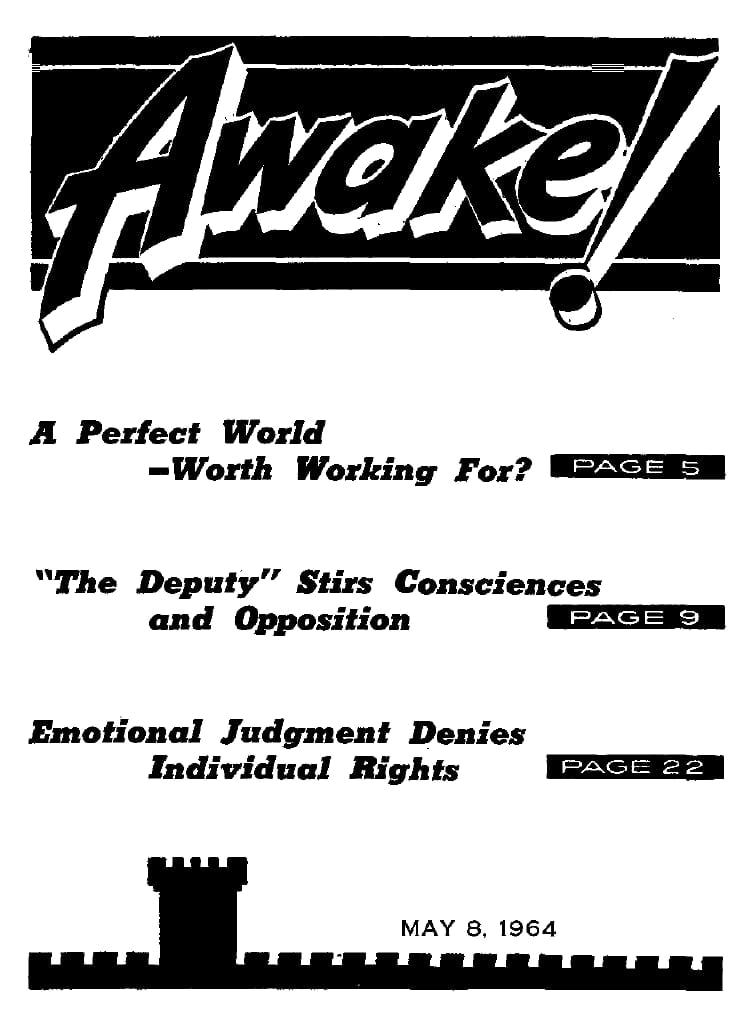
A Perfect World
-Worth Working For? PAGE 5
"The Deputy" Stirs Consciences
and Opposition
PAGE 9
Emotional Judgment Denies Individual Rights
PAGE 22
MAY 8,1964
THE REASON FOR THIS MAGAZINE
News sources that are able to keep you awake to the vital issues of our times must be unfettered by censorship and selfish interest. "Awaken!" has no fetters. It recognizes facts, faces facts, is free to publish facts. It is not bound by political ties; it is unhampered by traditional creeds. This magazine keeps itself free, that it may speak freely to you. But it does not abuse its freedom. It maintains integrity to truth.
The viewpoint of "Awake!" is not narrow, but is international. "Awake!" has its own correspondents in scores of nations. Its articles are read in many lands, in many languages, by millions of persons.
In every issue "Awakel" presents vital topics on which you should be informed. It features penetrating articles on social conditions and offers sound counsel for meeting the problems of everyday life. Current news from every continent passes in quick review. Attention is focused on activities in the fields of government and commerce about which you should know. Straightforward discussions of religious issues alert you to matters of vital concern. Customs and people in many lands, the marvels of creation, practical sciences and points of human interest are all embraced in its coverage. "Awakel" provides wholesome, instructive reading for every member of the family.
"Awakel" pledges itself to righteous principles, to exposing hidden foes and subite dangers, to championing freedom for all, to comforting mourners and strengthening those disheartened by the failures of a delinquent world, reflecting sure hope for the establishment of God's righteous new order in this generation.
Get acquainted with "Awake!" Keep awake by reading "Awake!"
4.1.1
PUBLISHED MANUALLY IN THE UNITED STATES BY THE
WATCHTOWER BIBLE AND TRACT SOCIETY OF NEW YORK, INC.
117 Adams Street
AND IN ENGLAND
BROOKLYN, N.Y. 112H, U.S.A.
WATCH TOWER BIBLE AND TRACT SOCIETY
Watch Tower House, The Ridgeway
London N.W. 7, England
N. H. KNORR, President
GRANT SUSES, Secretary
Printing this issue: 3,900,000
4d a copy (Australia, 5d; South Afran, 3½c)
4d a copy (Australia), 2d South Africa
Tertiary subscription rates
for non-education students
U.S. 127, Admiral Street, St. Louis, 1204
Australia, 11 Borefield Ed., Stainfield, N.S.W.
$8/
Canada, 157 Borefield Ed., Toronto, T6 W.1
$14/
England, 158 Twickenham Ed., Toronto, T6 W.7
$7/
New Zealand, 163 New South Bd., Auckland, S.W. 1
$7/
$7/
(Monthly editions cost half the above price)
Remittances for subscriptions should be sent to the office in country where you must your remittance to develop.
Expiration is August at least two weeks before subscription expires.
Southeastern – Arkansas, China, Chile, Danish, Dutch, English, French, German, German, Greece, Italian, Japan, Japanese, Korea
Midwestern – Illinois, Indiana, Louisiana, Sweden, Tajikag, Tajikag
Mid-Atlantic – Cobia, Brazil, Chinese, Hexagon, Malaysia, Polish, Tamil, Iranian
CHANGES OF ADDRESS should reach us thirty days before your moving date. Give us your old and new address, and we will send you a new address. Watch Tower, Watch Tower House, The Ridgeway, London W. M. 7, England.
Entered as second-class matter at Brooklyn, N.Y.
Printed in England
The Blake translation regularly used in "Awaken!" Is the New World Translation of the Holy Scriptures, 1961 edition. When other translations are used, this is clearly marked.
CONTENTS
So You Feel
Sorry for Yourself 3
A Perfect World—Worth Working For? 5
"The Deputy" Stirs Consciences and
Opposition 9
The Nazi-Vatican Concordat 18
Oath Ceremonies Dublous 21
Emotional Judgment Denies
Individual Rights 22
New Center for Kingdom Work in
Curaçao 26
"Your Word Is Truth"
The Apostle Paul's Writership
Vindicated 27
Watching the World 29
London, England, May 8, 1964
Volume XLV
Number 9
WHEN you see posters showing children hopelessly crippled by infantile paralysis or muscular dystrophy, do you not feel sorry for them? Most people do. It is natural that one's sympathies are stirred when a fellow human is delivered a severe blow, especially when it appears that it is through no fault of the one afflicted.
Even man's Creator, Jehovah God, feels sorry for the downtrodden and oppressed. "During all their distress it was distressing to him," his Word says. (Isa. 63:9) And his only-begotten Son Jesus Christ had this same feeling for people. The Bible says that "on seeing the crowds he felt pity [that is, sympathetic sorrow] for them, because they were skinned and thrown about like sheep without a shepherd." —Matt. 9:36.
While you too may feel sorry for others, even as Jesus did, it is only to be expected that you would also feel sorry for yourself at times. Perhaps you have been deprived of a loved one in death, lost your possessions in a natural disaster, or have been severely injured, crippled or disfigured. Such tragedies are indeed heavy blows. You would feel compassion for others who suffered in this way, so that it is not surprising that you feel sorry for yourself when experiencing the same things.
It is proper to have self-love, for only if you do can you fulfill the Bible instruction to love your neighbor as yourself. (Matt. 22:39) However, does this justify indulging in excessive self-pity if some misfortune should be encountered? Is this the loving thing to do, the
thing that will make you feel better?
That feeling sorry for oneself can result in much unhappiness is seen from the example of the Israelites, who nursed self-pity while wandering in the wilderness. They felt sorry for themselves, for instance, because of their monotonous diet. "How we remember the fish that we used to eat in Egypt for nothing, the cucumbers and the watermelons and the leeks and the onions and the garlic! But now our soul is dried away. Our eyes are on nothing at all except the manna." How miserable they made themselves!—Num. 11:5, 6.
As a result, even Moses, their stalwart leader, began to pity himself. Appealing to God, he said: "Why have you caused evil to your servant, . . . in placing the load of all this people upon me? I am not able, I by myself, to carry all this people, because they are too heavy for me. So if this is the way you are doing to me, please kill me off altogether."—Num.
11:11, 14, 15.
Perhaps at times you also succumb to feeling sorry for yourself. How easy it is to arrive at the end of a hard day, tired and loaded down with self-pity! 'Look how easy Mrs. Jones has it. She has a maid, nice clothes, plenty of time and money for entertainment.' 'Poor me,' you may be prone to moan. This can come to characterize your entire outlook on life. 'No one has the problems that I have,' you may convince yourself.
Youngsters especially are given to feeling sorry for themselves. Perhaps you recall that as a child you often sulked when not granted privileges you desired, or when things did not go the way you thought they should. But even now you may often indulge excessively in self-pity. This certainly is unloving. Why so?
To illustrate: If a friend should experience a misfortune and is feeling sorry for himself, do you feed his self-pity by telling him what a terrible blow he has been dealt, day after day impressing on him the enormity of his troubles and how badly off he is? Would not this only make him feel worse? So while making clear that you feel sorry for him, do you not, at the same time, try to cheer him up by directing his attention to the prospects for the future, to the things in life that he can still look forward to? This certainly is the loving thing to do.
You should at least, then, be as loving and considerate of yourself. True, you may have been dealt a heavy blow, and naturally feel sympathetic sorrow for yourself. This is proper. But centering attentions on one's own misfortune, indulging in self-pity to the point that it dominates your thinking, will make neither yourself nor those with whom you associate happy. It is not the loving thing or the right thing to do.
Rather than feeding your sorrow through self-pity, how much better it is to take inventory of the blessings you possess and be thankful for these! Just because things appear glum now does not mean that they will not improve if an effort is made. Be optimistic. Look for opportunities to be useful and of help to others. Are there not many persons worse off than you?
Certainly there are, and it is encouraging to observe how many of these persons do not allow self-pity to turn them into moreose recluses or sour introverts. Instead, they are happy, well-adjusted persons, who not only are pleasant to be around, but are an inspiration to others. This is because they have turned their attention away from themselves and their own unfortunate circumstances to some worthwhile work or to helping others. They find happiness because they do this. (Acts 20:35) You can and should do the same.
Consider, as an example, the blind war veteran who not long ago became interested in the Bible and desired to be a minister. Did he feel sorry for himself, immersing himself in self-pity because he could not see to read, an apparently prohibitive handicap to becoming a minister? Not at all! He regularly attended Bible instruction classes and, in addition, spent long hours listening to Bible discussions and discourses, which he had tape-recorded. Due to his diligence, after a year of study he was appointed as presiding minister over a congregation. Although he has to store all the material in his mind, he gives well-prepared, instructive discourses.
There are countless similar examples where people have not allowed self-pity to shove them into unhappy seclusion. While it is natural to have compassion for yourself, to indulge excessively in self-pity is unloving and unkind. It should be avoided. Yes, for your own sake as well as that of others, stop feeling sorry for yourself!
A PERFECT WORLD
-Worth Working For?
</div>
"Perfect monotony" say some. But do you know the true meaning of the Bible's promise of a perfect world?
HOW do you feel about the world you live in, that is, this framework of surroundings and conditions that has been built up on this earth and of which mankind is an inseparable part? Most persons admit its flaws, and everywhere we see a continual striving for improvement in the whole framework of human conditions. Man plainly would like something better. And yet, let the idea of a perfect world produced through divine power and arrangement be mentioned and, surprisingly, many will reject it, not merely as unfeasible but even as undesirable. The rejecters view it as a world robbed of all freshness and variety, a world reduced to boring sameness and stale monotony, a world people by "look-alikes" and "know-it-alls," equally talented and identically gifted, all doing the same things in the same way. But why?
The answer is rather simple. They probably have never ascertained the real meaning of the word "perfection" in either its Biblical sense or its common usage, or else they fail to apply this real meaning in a logical way. According to their concept, whatever is perfect is so in an absolute sense, that is, its perfection must be all-embracing and can know no limitations. Therefore they reason that whatever one perfect creature could do every other perfect creature could do, and do it equally well.
Now, before reaching for a dictionary, stop and think for a while about the ways in which the word "perfect" is commonly
used and you will see why this concept of perfection is wrong. Take, for example, the expression "a perfect circle." By that is meant a circle in which every point on its circumference is exactly the same distance from the circle's center. The circle is perfect. True, but its perfection is certainly a very limited thing and is restricted to just that one narrow sense of the points on its circumference always being perfectly equidistant from its center. It has no right angles; it is not a square and never could be. A wooden peg might be perfectly round and yet it would never perfectly fill a square hole, would it? So perfection can know limitations.
Likewise when the poet James Russell Lowell wrote, "What is so rare as a day in June? Then, if ever, come perfect days," he doubtless had in mind the mild sunny weather, the azure-blue skies, the blossoming of flowers that characterize that month in the Northern Hemisphere. But he did not mean that June's summery days had packed in them all the delights and beauties of the year's four seasons. They would not likely contain the pure beauty of freshly fallen snow, or the loveliness of autumn colors, nor even the stimulating freshness of early spring. Their perfection would not be an all-embracing one.
Purpose Plays Its Part
The point drawn from these simple illustrations is this: That perfection is usually a relative quality and that a thing is perfect according to, or in relation to, the purpose for which it is intended by its designer or producer, or the use to which it is put by its receiver or user.
A synthetically produced commercial diamond may be "perfect" for use in an electric drill, but it would not be so in an engagement ring, for it is "perfect" only in the sense of its diamond-hardness. Likewise, perfect ball bearings would go fine in an automobile, but for building a house they could never compare with ordinary cement blocks. Thus, purpose governs perfection and determines its scope or its limitations.
That perfection can have this relative quality is borne out by dictionary definitions. Note these among those listed under the word "perfect" in Webster's Third New International Dictionary: "Complete"; "entirely without fault or defect: meeting supreme standards of excellence: flawless"; "satisfying all requirements"; "lacking in no essential detail: fully developed." Reasonably, there must be someone who decides when completion is reached, someone who sets the standards of excellence, who makes the requirements to be satisfied, and determines what details are essential.
Perfection in the Bible
In the Bible the words in the Hebrew and Greek languages that translators have rendered as "perfect" in our English versions also carry this same basic meaning of that which is "complete, total or flawless." But the Bible aids us much more than this, for it alone provides the true measuring rod for determining perfection. It does this by setting forth for us the divine purpose of the One to whom Moses sang at Deuteronomy 32:3, 4: "For I shall declare the name of Jehovah. Do you attribute greatness to our God! The Rock, perfect is his activity, for all his ways are justice." Yes, only Jehovah God is perfect
in the absolute, all-embracing sense of the word, being without limitation in his ability, power and wisdom, and uniting in himself all desirable qualities to a supreme degree. He is rightfully the great Determiner of perfection in harmony with his own purposes and interests. Note how his Word bears this out and shows perfection's true meaning.
One of Jehovah's inspired prophets, Ezekiel, directed these words through an earthly prince to a one-time spiritual son of God: "You are sealing up a pattern, full of wisdom and perfect in beauty. In Eden, the garden of God, you proved to be. . . You were faultless in your ways from the day of your being created until unrighteousness was found in you." (Ezek. 28:12-15) This "covering cherub" was perfect by virtue of being God's creation and was perfectly fitted for the assignment given him as guardian over the original human pair on earth. But when he assumed his perfection to be limitless and sought to usurp Jehovah's rightful sovereignty he became a miserable misfit and, as time and the test have shown, a perfect failure.
In contrast, God's chief Son, The Word, who was the very beginning of God's perfect works of creation, acknowledged that his perfection did not qualify him to stand as an equal with his Father or to be the Almighty God, and so we read: "Although he was existing in God's form, [he] gave no consideration to a seizure, namely, that he should be equal to God." (Phil. 2:6) Even his perfection, though inferior to none except that of his Father, was subject to enlargement. For this reason the writer of Hebrews 5:8, 9 says: "Although he was a Son, he learned obedience from the things he suffered; and after he had been made perfect he became responsible for everlasting salvation to all those obeying him." To be perfect for his position as High Priest of God he first had to pass the test of integrity.
Earthly Perfection and Its Loss
The Bible shows that this earth was originally a planet of perfection. Still, at the time of man's creation, only one part of it was gardenlike and the rest was left for man to subdue as a "do-it-yourself" project. (Gen. 1:28) Nevertheless, when the Creator viewed it he found it "very good"; it satisfied his perfect requirements. —Gen. 1:31.
The first human pair were part of this planetary perfection. The woman was perfectly suited for being a mother and a complementary companion for her husband. He was perfectly fitted to exercise headship in carrying out their Creator's purpose for them and the earth. But the woman sinned, or, as the Hebrew language of the Bible puts it, "missed the mark," when she tried to assume her husband's perfect qualities and act as her own head in an action that did despite to her Creator's expressed will. The man likewise missed the mark by following her erroneous lead. —Gen. 3:1-6.
"Then they were never perfect!" some say. "According to whose standards and requirements?" we ask. Remember, their perfection was relative—related to their Creator's will and purpose. He did not limit or restrict their perfection to just a perfect body and a perfect brain, but he extended to them the privilege of free will. Their being perfect or complete according to his standards required that they be able to choose. Had they been lacking in the ability to take either of the two courses before them, that of obedience or that of disobedience, then they would have been imperfect, not perfect, according to God's own purpose. Not an automatic, mechanical, matter-of-course worship and service, but a reasoned, willing service springing
spontaneously from a loving heart—that was what Jehovah God desired.—Deut. 30: 15, 16.
Man's fall from perfection resulted from his bringing wrong thoughts into his mind. (Jas. 1:14, 15) Even as a perfect machine would suffer damage if misused or run on bad fuel, so man's perfect mind and body thereafter suffered deterioration. A world of imperfection has resulted, one filled with flaws, deficient, unsatisfactory to God and to man. Man's dissatisfaction is evidenced by a continual state of change and the search for improvement; God's dissatisfaction will be displayed at the worldwide war of Armageddon.
The World Ahead
Now a perfect world is drawing near, a perfect framework of earthly surroundings in which man will live. The steps necessary to assure its realization have been and are being taken by man's Creator, who says by his prophet Isaiah, "I have even spoken it; I shall also bring it in. I have formed it, I shall also do it." (Isa. 46:11) His Word shows he will bring about this wonderful change regarding mankind by a perfect government under the immediate supervision of his own Son, a government that will robe this earth in beauty and, over a span of ten centuries, produce a perfect human society, a world free from fault or flaw.—Isa. 9:6, 7; Rev. 20:6; 21:3, 4.
Not monotony but, rather, excellence stretching out in all directions and in an unending variety of ways is what that perfect world will mean. No "World's Fair" could begin to compare with what the whole earth will then display as men and women express their varying talents and tastes in the widest possible scope of expression: in architecture, landscaping, home decoration, styles of furniture, artistry, music, craftsmanship, and even invention.
The perfection of those lovers of righteousness will not make them stereotypes of identical personality nor will it rule out some excelling in certain lines while others excel in others. The animal kingdom is part of Jehovah's perfect workmanship. Still, the hippopotamus' huge girth, which so perfectly adapts him to river life, certainly does not equip him for imitating the nimble squirrel in scampering up trees, does it? Look, too, at the countless myriads of designs, colors and scents in earth's flowers, all perfect products from the hand of their grand Maker. Thus, with humans, their
physical structure, their mental makeup will allow for their excelling in different directions or pursuits. Perfection will not require that every woman
these things.—John 4:6, 7; Matt. 4:2;
Luke 8:22-24.
Just as perfect humans will not be omnipotent, they will likewise not be omniscient, "know-it-alls." Their perfection does not require that they know all that their Creator knows, nor all that his heavenly sons know, and in their paradise earth conversation will not be stifled by everybody's knowing what everybody else knows. Their appetite for learning will never grow stale as each new acquisition of knowledge opens up still wider vistas for their exploring minds. Scientists today admit that
IN THE NEXT ISSUE
PORTUGAL SUPPRESSES
FREEDOM OF WORSHIP
BE SURE TO READ IT!
singer be able to hit "E" above high "C, " or that all men be able to sing tenor and bass equally well.
Variety, change, contrast, all these are compatible with perfection and will surely abound in God's perfect world. The simple and the complex will still be there, the plain and the fancy, the sour and the sweet, the rough and the smooth, the meadows and the woods, the mountains and the valleys. While famine and extreme tiredness or exhaustion will be things of the past, yet perfect humans will still feel stimulated to partake of food and drink by the normal physical sensations of hunger and thirst. Though their powers of endurance and strength will reach far beyond present limits, yet they will still enjoy a rest after hard work and their sleep will still be sweet. God's Son during his sojourn as a perfect man on earth experienced all
when, by laborious research, they finally find the key to open one door in some field of knowledge, on the other side they invariably find a dozen other
doors each waiting to be unlocked. No daily living in God's perfect world will never be humdrum as is so much of today's modern living.
Would such a world be worth working for? Why, men have died for far less. Surely it will be worth your while to investigate the evidence of its certain realization and to learn what will be required of you to attain to life in it. Study God's Word, for "the law of Jehovah is perfect, bringing back the soul. The reminder of Jehovah is trustworthy, making the inexperienced one wise." (Ps. 19:7) Then, rather than imitate this failing world of mankind as it vainly struggles to lift itself by 'tugging at its own bootstraps', humbly turn to the God of Perfection and to his King-Son and High Priest of salvation and apply for the privilege of forming part of the perfect world of their making.
"The Deputy STIRS CONSCIENCES and OPPOSITION
"A DEPUTY of Christ Who sees these things and nonetheless permits reasons of state to seal his lips . . . that Pope is—a criminal!"
Those lines, referring to the failure of Pope Pius XII to speak out against the slaughter of millions of Jews, help explain why The Deputy, both in book and in play form, has become the literary sensation of the postwar era. Also known as The Representative and The Vicar—all translating the German Der Stollvertreter—it has made its author, Rolf Hochhuth, one of the most respected as well as one of the most hated men in all Europe.
However, he blames not only Pope Plus XII, but all others who failed to protest. He singles out the pope for severest censure only because of his claim to be the vicar or deputy of Christ and because of his position as head of the Roman Catholic Church. On every hand The Deputy is stirring consciences and opposition.
At its original West Berlin premiere both the author and producer received a stormy ovation at the conclusion of the play.
Currently, at its New York showing there is terrific applause at the end of each scene, and many curtain calls at its end.
However, regarding its Paris premiere we are told: "A fight broke out . . . At least seven persons were injured and thirty were temporarily detained. . . Early in the second act, a young man in the audience began to shout, then several youths leaped onto the stage and fought with the actors and then with the police who sought to expel the demonstrators. The stage was finally cleared but each time the troupe resumed a new demonstration broke out somewhere in the hall. This continued almost to the play's end."—New York Times, Dec. 31, 1963.
In the play a young priest pleads futilely with the pope to intervene on behalf of the Jews
When the play opened in New York late in February this year, among the demonstrators against it were fifteen members of the American Nazi Party, decked out in storm troopers' uniforms and wearing red armbands on which were embroidered white swastikas.
Among those in the forefront in criticizing the play is none other than the present pope, Paul VI. Just before he became pope he criticized the play as an "artificial manipulation of facts to fit a preconceived idea."
Since then he has lashed out twice against The Deputy; once during his visit to the Holy Land and more recently, on March 12, when he defended Pius XII against "unjust and ungrateful outcries of blame and accusation." "If evils without number and without measure devastated humanity, it cannot be imputed to cowardice, disinterest or egoism of the Pope," he protested.
Favorable Roman Catholic Comment
Strangely, not all Roman Catholics agree with their pope that The Deputy 'artificially manipulates the facts to fit a preconceived idea.' Far from it! In fact, not a few highly placed Catholic clergy as well as laity speak well or highly of the play.
Thus while Cardinal Spellman of New York bitterly assailed the play as "outrageous, . . . slanderous . . . divisive," Cardinal Cushing of Boston said, "I don't think it would do any harm for any intelligent person to see this play." Regarding the book, a prominent member of the Dominican Order, Willehart Eckert, said: "This book is fascinating . . . through the honesty of Hochhuth's struggle and the absolute sincerity of his spirit." Distinguished German author Ursula Von Kardoff wrote regarding it: "Though I am a Catholic, I am for him. . . . There are episodes in this play, and they are reinforced by stage directions, that make our National Socialist past live again in a way that takes your breath away. . . . His play hits its target dead center, it forces us to look this Gorgon,* this monster in the face."
Then there is Friedrich Heer, distinguished Catholic historian and lecturer in European history at the University of
Vienna. He has written at length in defense of The Deputy and, among other things, he states:
"Pius XII treated me personally, with the greatest friendliness, kindness and cordiality. . . . but I have to confess that all Catholies, from the highest to the lowest—priests, chaplains, laymen (anti-Semitic to this day)—are co-responsible for the mass murder of the Jews. Not only the thousands of baptized, confirmed and religiously wedded Christians who took a direct part in the mass murders. . . . Not only the bishops who, as in Poland and Hungary, drew up anti-Semitic pastoral letters and permitted their publication . . . We have present[ed] to us the frightful failure of Rome from 1933 to 1945."
Also, there is Roman Catholic theologian Dr. Gokben of Lingen/Ems, Germany, who wrote the author:
"Since I consider the attacks made upon you by certain groups of Federal German Catholics on account of your play as exaggerated and unjustified, I feel compelled to take this means of expressing to you my appreciation and admiration for your work. I rejoice that you have dared to scatter the artificial mists which have been raised to obscure the past. The Pope's silence about these crimes was and remains painful to me. On July 21, 1943, at a clerical conference, I sharply criticized the Pope's silence, after an eye-witness had given me an unforgettable detailed description of the mass execution of Jewish persons. . . . Your work has a cleansing and liberating effect, and gives grounds for hope for the future."
Among the oldest and most telling defenses of the thesis of this play by a Roman Catholic authority is that by Gordor Zahn, professor of sociology at the Romar Catholic University of Loyola, Chicago, Illinois. He did much research in Germany for his book, German Catholics and Hitler's Wars, and therefore might be said to be peculiarly fitted to judge The Deputy Writing in the Roman Catholic art journal, The Critic, October-November, 1963 he stated, among other things:
"The official spokesmen for German Catholicism have concentrated on attacking the motives and the qualifications of the author instead of addressing themselves to a factual refutation of his thesis—assuming, of course, that a refutation is at all possible.
. . Hochhuth's thesis is generally valid, but, in some instances, overstated. . . . The strongest point about Der Stellvertreter is its impressive historical accuracy. A forty-five page appendix—in itself most unusual for a literary effort of this kind—cites and discusses the documentary and secondary sources upon which the author has based his characterizations and from which many of the events portrayed were selected. The principal foundations upon which his thesis rests are established beyond reasonable doubt: (1) Plus did not issue a public protest against the murder factories established by the Nazis; and (2) he did know of their existence and had, in fact, been the object of repeated appeals that he make such a protest. . . . In these respects, then, the play is simply not open to serious challenge, and the dilemma it presents is sharply drawn and troubling in the extreme. It is scandalous, to say the least, that most of those who have mounted the assault against the play and its author have failed to address themselves to the overriding historical fact that cannot be denied and should not be ignored: that the leading spokesmen of the Catholic Church, in Germany and in Rome, permitted themselves to be maneuvered into a position where the Church could become a silent witness to genocide."
Act One, "The Mission"
the book, The Deputy, consists of five acts and eleven scenes and would take some seven hours to present. Obviously, in its play form of some two and a half hours, much is left out. However, both book and play do justice to the basic point the author is making, namely, that Pius XII was acquainted with what was going on and that, although he secretly helped the Jews, he studiously avoided offending Hitler and his Nazi regime by making a definite protest against the persecution of the Jews and the Nazis' program of "The Final Solution," the Endlösung.*
The first scene of Act One takes place in the reception room of the papal legation in Berlin, where we hear a discussion between its chief, the Nuncio, and his newlyarrived-from-Rome underling, a somewhat youthful Jesuit priest, Riccardo Fontana. Riccardo is greatly disturbed because the Church is not protesting the persecution of the Jews.
Their lengthy discussion on what the Church or the pope should or could not do is rudely interrupted by the forcible entry of SS Lieutenant Gerstein (a bona fide historical character), who insists on being heard: "Your Excellency, a message for the Vatican. It will not bear a single day's delay, not a single hour. I have come from Poland—from Belzec and . . . every single day in those places, ten thousand Jews, more than ten thousand, are being murdered, put to death with gas . . ."
The Nuncio objects: "For God's sake,
Jews in Warsaw being rounded up for shipment to gas chambers (Based on actual photograph)
hold your tongue!
Tell that to Herr Hitler, not to me. Leave this place. In the German Government's view I am not authorized to say a word about these—these conditions in Poland."
As the dialogue continues Gerstein urbdurens himself: "Listen, . . . I . . . must tell you about it. So far they've been running the gas chambers on carbon monoxide, common exhaust gas. But many times the motors will not start. In Belzec recently I had to watch—this was on August 20—while the victims waited two hours and forty-nine minutes until the gas came on. Seven hundred and fifty persons in each of four chambers—each room with a volume of sixty cubic yards—three thousand human beings. Some pray, some weep, some shriek. The majority keep silent. The gassing operation takes twenty-five minutes. Now they want it speeded up, and so they've brought me in for consultation. I am an engineer and medical man. (Screams) I will not do it! I will not do it!
"Like marble columns the naked corpses stand. You can tell the families, even after death convulsed in locked embrace—with hooks they're pulled apart. Jews have to do the job. Ukrainians lash them with whips . . . Bodies of dead children. . .
Ovens used by Nazis to burn bodies of those that had been killed; some had not yet been completely burned (From photograph)
Mothers, all stripped, babies at their breasts."
The Nuncio starts to leave: "Enough—I cannot listen any more." But Gerstein continues his pleading: "The Holy Father must take action, must speak for the world's conscience. . . . Your Excellency, the Vatican has made a pact with Hitler! . . . When will you tear up the Concordat?" Throughout this scene young Jesuit Riccardo betrays his sympathy for the Jews. It ends with a monk muttering: "What a tale! It's true, they're Jews, but still . . ."
In the final scene of Act One, which takes place in Gerstein's home, we see Riccardo visiting him and pledging to go to the pope to protest the slaughter of the Jews. He is confident that the pope will speak out and that Hitler will listen to the pope. But not Gerstein. He reminds Riccardo that since 1938 Pius has done no more than merely look on.
Acts Two and Three
True to his word, Riccardo returns to Rome, and in Act Two we find him trying to enlist his father's aid. The elder Fontana, wealthy and high in Vatican circles, is a favorite of Pius XII even as is his son Riccardo. The son tells that he has greetings from a friend who asked why Pius did not back up the Bishop of Munster, Galen, when he spoke out against Hitler's wiping out the feeble-minded. "And my question was: Why had Galen not also come forth to defend the Jews? Because the mentally ill were [Catholics]? That's an ugly question, Father, let's admit it."
His father tries to assure him that "Once reasons of state permit . . .," to which he replies, "Then not a single Jew will be alive in Poland, Germany, France or Holland!" When his father insists that the pope's heart is with the victims, his son retorts: "But his voice? Where is his voice? . . . The Pope does not see the vic-
Bodies that the Nazis had been unable to burn before arrival of Allied troops (From photograph)
tims; Hitler does not see them." His father objects to his mentioning "Pius XII and Hitler in the same breath." But Riccardo scornfully states: "Confederates have to put up with that, Father. Have they not made a pact with one another?" He later explodes: "A deputy of Christ who sees these things and nonetheless permits reasons of state to seal his lips—who wastes even one day in the thought, hesitates for even an hour to lift his anguished voice in one anathema to chill the blood of every last man on earth—that Pope is—a criminal!"
A cardinal calls at the home and enters into the discussion. In the course of the conversation he betrays his fond hope that this war will "bring the old Continent closer to realization of the ancient dream of a Holy Roman Empire."
Act Three, which is in three scenes, illustrates the plight of the more than 1,200 Jews of Rome who failed to escape or to find refuge in some monastery. In Scene One we see a Jewish family apprehended, to the cruel disillusionment of the mother who thought it could never happen in Rome because of the presence of the pope. Scene Two depicts a monastery, where it
comes out that it is not only a haven for Jews but also for deserters, Communists and royalists.
There are several guests present and the subject of conversation is the Gestapo roundup of the Jews in Rome. God is repeatedly brought into the discussion, as when SS Gerstein says to a cardinal: "God would not be God if he used Hitler." And when the cardinal asks him what are the
chances of a rebellion in Germany, he replies negatively: "Alas, Your Eminence, a few defenseless people—pastors, socialists, communists, Jehovah's Witnesses—yes. In September they hanged one hundred-eighty on a single day."** Scene Three takes place at the Gestapo headquarters in Rome, where Nazi cruelty reaches its lowest point, its nadir, in its treatment of the Jews.
Act Four, "Il Gran Rifiuto"
Act Four, entitled "The Grand Refusal," takes place in a Vatican throne room. It is the climax of the play, when at last Riccardo gets to confront the pope with his plea for the Jews, only to be bitterly disillusioned. Before Riccardo appears, however, there are lengthy discussions of papal finances; among other things, Allied advances were making it advisable to sell certain stocks. Pius also indignantly denies the rumor that he had threatened or intended to protest against the deportation of the Jews from Rome.
And finally the confrontation. Fius is very flowery and wordy and Riccardo very tactful, but eventually they come to the point.
Riccardo exclaims: "In Poland one million eight hundred thousand Jews have been slaughtered! . . . God cannot wish Your Holiness to ignore it!" To which Pius indignantly replies: "Ignore!" We do not intend to account for our actions to Riccardo Fontana. . . ."
During this heated discussion an abbot enters from whom Plus learns the source of the rumor that he would protest. "Herr von Kessel at the German Embassy called
cardinal to reply for him: "Criminal folly! Get out!" But Riccardo replies: "Folly? No, Your Holiness. The King of Denmark, a defenseless man, threatened Hitler that he would wear this star, along with every member of his house, if the Jews in Denmark were forced to wear it. They were not forced. When will the Vatican at last act so that we priests can once again own without shame that we are servants of that Church which holds brotherly love as its first commandment!" With that he leaves
on me secretly at dawn and asked that His Excellency, the Bishop [Hudal], threaten
the German commandant with a forthcoming protest from Your Holiness." Plus is relieved to find that it was a German official and not one of his bishops that suggested or originated the rumor.
Pius then dictates a proclamation. ostensi-
to join the Jews being shipped to Auschwitz.
In the closing moments of this Act Four, Pius XII is heard declaiming: "As the flowers in the countryside wait beneath winter's mantle of snow for the warm breezes of spring, so the Jews must wait, praying and trusting that the hour of heavy-
bly protesting against the deportation of the Jews but dealing only in generalities. This causes Riccardo to say to him: "Your Holiness, what you have set your name to grants Hitler unrestricted license to go on treating the Jews as he has always done."
In righteous indignation Riccardo had
enly comfort will come."
Act Five, "Auschwitz"
Act Five, "Auschwitz"
Five consists of soliloquies by several Jews en route to Auschwitz on their fate and their doubling God because of it. Scene Two shows Jews arriving in Auschwitz with Catholic priest Riccardo among
pinned upon himself the yellow Star of David, shocking the pope. But Riccardo tells him: "I shall wear this star until Your Holiness proclaims before the determines the fate of the Jews com-world a curse upon the man who slaughters ing to Auschwitz, whether at once to Europe's Jews like cattle!" The pope is the gas chambers or first a period of made speechless by this outburst, causing a slavery, and who boasts because God
Hitter leaving Catholic Cathedral in Munich, as published in "The Catholic Herald" of England, May 5, 1939
priest, receives among them. In this scene he has a lengthy discussion with an atheistic, one-time Catholic priest, the camp doctor, who
has not sent a thunderbolt to kill him.
"What gives priests the right to look down on the SS? We are the Dominicans of the technological age. It is not mere accident that so many of my kind, the leaders, come from good Catholic homes. . . Hitler, Goebbels, Bormann, Kaltenbrunner . . . Höss. . . studied for the priesthood. . . A civilization that commits its children's souls into the safeguard of a Church responsible for the Inquisition comes to the end that it deserves. . . Your Church was the first to show that you can burn men just like coke."
In Scene Three, among other violence, Riccardo is slain while trying to kill the atheistic taunting camp doctor with a pistol he had picked up, and Gerstein is arrested, he having betrayed his sympathies for the Jews.
Before the final curtain falls on the play, two radio announcements are heard. One tells that Hitler's ambassador to the Vatican, Weizsäcker, wrote his chief the following:
"Although the Pope is said to have been importuned from various quarters, he has not allowed himself to be carried away into making any demonstrative statements against the deportations of the Jews. Although he must expect our enemies to resent this attitude on his part, he has nevertheless done all he could, in this delicate question as in other matters, not to prejudice relationships with the German government."
The second announcement tells:
"And so the gas chambers continued to work for a full year more. In summer of 1944 the so-called daily quota of exterminations reached its maximum. On November 26, 1944, Himmler ordered the crematoria to be blown up. Two months later the last prisoners in Auschwitz were freed by Russian soldiers."
The Guilt of Silence
But perhaps someone will say, 'All the foregoing is merely taken from a play, a piece of fiction.' A play? Yes, but a piece of fiction? No. As previously noted, a number of Catholic authorities vouch for the historical accuracy of the play. And "to demonstrate that as far as possible I adhered to the facts," as the author says, he gives sixty-six pages of documentation (American edition). His array of facts is also impressively buttressed by an article written by Guenther Lewy, entitled "Pius XII, the Jews and the German Catholic Church," which appeared in Commentary, February 1964, pages 23-35, and which is documented by 102 sources.
The silence of Pius XII cannot be justified on any grounds. It was wholly inexcusable. He remained silent in spite of full knowledge of what was taking place and in spite of the efforts of U.S. president Roosevelt's representatives and other diplomats to get him to speak out against this monstrous crime.
As Catholic Gordon Zahn well states:
"The question which should claim top priority is this: is it not the duty of the Church and its responsible leaders at all times—in season and out of season," as the saying goes—to speak out against all major violations of its moral law, regardless of who the violators might be, regardless of what penalties she and her members might have to suffer for giving expression to the conscience of humankind? . . . The 'injury' to the reputation of Plus XII, the 'embarrassment' or even the 'indignity' Hochhuth's work might constitute for the Church should not be permitted to obscure the inescapable validity of its essential historical facts, and the propriety—if not indeed the absolute urgency—of the 'moral-behavioral' problem it so effectively states."
That "duty" devolved primarily on Pius XII.
Further, Pius XII had a working agreement with Hitler. This obligated him to speak out, to protest, to threaten to tear up the Concordat when his partner acted so shamefully.
And in particular did Pius XII, as the head of the Roman Catholic Church and as the claimed Deputy or Vicar of Christ, have the obligation to excommunicate Hitler if he did not desist from his wholesale slaughter of the Jews, for Hitler was baptized and reared a Roman Catholic and he himself never left the Catholic church although his Nazi party brought pressure to bear to have functionaries quit their churches. In 1949 Pius XII ordered the excommunication of all Catholics that were Communist Party members and supporters. Was not what Hitler was doing far worse than being simply a Communist Party member?
Those Who Spoke Out
There is, however, a class of people that did speak out against Hitler, unequivocally, boldly and that world wide, both inside and outside of Nazi Germany, and they are those mentioned in Act Three, Scene Two, of "The Deputy" (page 13 [3], namely, the witnesses of Jehovah. On October 7, 1934, Witness congregations all over the world sent Hitler a cablegram reading:
"Your ill-treatment of Jehovah's witnesses shocks all good people of earth and dishonors God's name. Refrain from further persecuting Jehovah's witnesses; otherwise God will destroy you and your Nazi party."
More than that, on the same date all congregations of the Witnesses within Germany met and passed a Resolution that they sent to the German government. In it they stated their allegiance to Jehovah God and his Word, protested against the persecution of Jehovah's witnesses and notified the Nazi government:
"At any cost we will obey God's commandments, will meet together for the study of His Word, and will worship and serve him as he has commanded. If your government or officers do violence to us because we are obeying God, then our blood will be upon you and you will answer to Almighty God."
Then, though they were forced underground and some ten thousand were put in concentration camps and prisons, they continued faithful to Jehovah. Time and again they organized "blitzes," as when on Saturday, December 12, 1936, between five and seven p.m., in all big cities in Germany they scattered copies of a Resolution passed in September in Lucerne; and on June 20, 1937, there was a large distribution by thousands of Witnesses throughout Germany of a protesting "Open Letter."
From 1933 onward in particular their international magazine, The Golden Age, kept exposing the Nazi terror, year after year. Thus in its October 9, 1935, issue, reporting on "One Year of Nazi Terror," it gave the numbers murdered, imprisoned and sent to concentration camps. The following year it had such articles as "All Germany Worships a Murderer," and "Nazi Robbery of the Jews." In 1937 it featured, among other things, an article headed "German Jews Law-abiding." In 1938 it told of discrimination against Jews throughout Germany, of intolerance, and the persecution of the Jews. In 1939 articles told of "Fliendishness at Sachsenhausen," where Jews were being clubbed to death, and of the pogrom of November 10, 1938. Among other articles to appear in subsequent years were "Abuse of Jews," "End of Jews in Germany," "Terrible Plight of Hungarian Jews." More than that, so long as Jehovah's witnesses in Germany were able to do so they went out of their way to befriend the Jews, ignoring the ordered boycotts and sharing their food with them.
Why Did Pius XII Remain Silent?
As Catholic historian Heer observes, "When he wished, as in connection with the two bombardments of Rome, Pius XII could act astonishingly fast." He also spoke out strongly condemning Russia's attack on Finland in 1939.
When, in 1944, it appeared that the Allies would win the war, Pius XII in his Christmas message spoke out in behalf of the German people lest Allied peace terms be too hard on the Nazis.
History further records that Plus XII spoke out urging clemency for the Japanese leaders who had been condemned to death by an international tribunal at Tokyo.* As reported by the Official Polish Press Agency, July 20, 1946, Pius also interceded on behalf of Greiser, German administrator of occupied Poland and responsible for the death of more than a million Poles, Jews and non-Jews. Official circles in Poland termed Plus XII's appeal "stupettying." L'Ordre de Paris, October 4, 1946, reports that Von Papen, second as Nazi only to Hitler, owed his escape from the moose at Nuremberg to intervention by Plus; although later a German denazification court not so susceptible to Pius' influence sentenced Von Papen to eight years at hard labor.
Then why did Pius XII fail to speak out in behalf of the millions of Jews being exterminated? Did anti-Semitism have something to do with it? It could be, for in 1941 the Holy See stated that it had no objection to Marshall Petain's policy of subjecting the Jews to discriminatory legislation. Then, too, the fact that he was a polished, cultured diplomat instead of a born fighter might have had a bearing on it. And so might the fact that he was a lover of things German. In fact, although Italian he was known as "the German Pope." The language of his household was German and so was his secretary.—Newsweek, March 2, 1964.
Did Pius XII fail to speak out because it might have endangered the Vatican? That is what Archbishop Vagnozzi, United States Apostolic Delegate, claimed: "If the
Holy Father had excited in some way the fury of Hitler, he might have decided in one day to arrest the Pope, to arrest the bishops, to stop all the work of the church." (New York Times, March 21, 1964) But as Roman Catholic Gordon Zahn so well noted above, Christ's church has the obligation to speak out regardless of the consequences. That it might have been effective is shown by Hitler's stopping his euthanasia program when the Bishop of Münster, single-handed, spoke out against it. And were not the nuncios in Slovakia and Romania effective in protesting against the deportation of the Jews?
More compelling than all the foregoing reasons seem to be those of a political nature. As Catholic historian Heer points out: "Pope Pius XII . . . was not well disposed toward democracy, as he himself admitted to Heinrich Bruning, and not a few members of the Curia." Pius XII mortally feared the advance of Russia's armies and hoped to keep Hitler as the sword of the Church. How well the two worked together can be seen from the way the Jesuits followed Nazis in their invasion of Poland and Russia.
Above all else, Pius cast longing eyes back to the time of the Holy Roman Empire of the Germanic Nation, when rulers were crowned and uncrowned by the pope. As already noted in the play, some of his cardinals were of the same frame of mind, and this was also the goal of the Nazis. The New York Times of February 17, 1940, reported: "The German war aims were outlined tonight as a re-establishment of the Holy Roman Empire by the [Roman Catholic priest] Dr. Edmund A. Walsh, regent of the Foreign Service School of [Catholic] Georgetown University. . . . Dr. Walsh said that he had heard Adolf Hitler say that the Holy Roman Empire, which was a Germanic empire, must be re-established." Without doubt, this common tie, more than anything else, accounted for the extreme reluctance of Plus XII to criticize Hitler and his Nazis regardless of what they might do, even to imprisoning Catholic priests in Germany because they dared to pray for the Jews.
Consciences Stirred
While the foregoing highlights the guilt of one man, it would be a mistake to overlook the responsibility of the rest of Christendom. As Albert Schweizer stated in a
Church, and a Christian readiness to accept criticism. Instead of bristling when attacked, it should rather answer: peccavi, I have sinned."
Yes, it appears that all too few consciences have been stirred by all of this. As Catholic Gordon Zahn well notes: "In all of this there is one soul-chilling fact that must be recognized; to the extent that Catholics—whether in Germany or in America or anywhere else—are prepared to reject this play and its conclusions
letter to the author of The Deputy: "Our failure made all of us participants in the guilt of those days. After all, the failure was not that of the Catholic Church alone, but that of the Protestant Church as well. The Catholic Church bears the great guilt, for it was an organized, supra-national power in a position to do something, whereas the Protestant Church was an unorganized, impotent, national power. But it, too, became guilty, by simply accepting the terrible, inhuman fact of the persecution of the Jews. The failure was that of
they make it all too clear that, were the circumstances to repeat themselves, it could happen again."
In fact, the same is happening again, although not to the same degree. Churches, Catholic and Protestant, compromise and cooperate with totalitarian governments, keeping silent regarding their injustices and outrageous treatment of minorities, for the sake of safety.
What does all this mean? That the professedly Christian organizations of Christendom are anything but Christian. They
philosophy, of free thought, as well."
Speaking for Protestantism, Niemöller as far back as 1947 stated in the book Of Guilt and Hope: "I think we Christians belonging to the Confessional Church have all the reasons for saying: 'My fault, my grievous fault.' . . . We preferred to keep quiet. We most certainly are not without guilt."
And speaking for Roman Catholics, Joseph Featherstone states: "Above all, one would expect humility from the German
London are anything but Christian. They play along with the world; they are part of the world that is alienated from God. In fact, all such are part of "Babylon the Great," the world empire of false religion. To all who would sincerely follow in the footsteps of Jesus Christ the call is, "Get out of her, my people, if you do not want to share with her in her sins, and if you do not want to receive part of her plagues. For her sins have massed together clear up to heaven, and God has called her acts of injustice to mind."—Rev. 18:2, 4, 5.
THE NAZI-VATICAN CONCORDAT
IN A forceful way, The Deputy is making people painfully aware of the monstrous nature of the crimes perpetrated by the Nazi regime. And as they view these it becomes difficult for them to understand how anyone, especially a religious organization professing to belong to Jesus Christ, the Prince of Peace, would want to enter into a pact of mutual cooperation with such a regime.
Yet that is exactly what took place on July 20, 1933, when Cardinal Pacelli, who
AWAKE!
later became Pope Plus XII, acting on behalf of Pius XI, the head of the Roman Catholic Church, and Von Papen, acting on behalf of Hitler and the German Reich, signed a concordat or solemn covenant for mutual cooperation. It was ratified by their superiors and became effective September 10 of the same year.
The Nazi-Vatican concordat was patterned closely after the one made with Mussolini (1929), and gave the Roman Catholic Church in Germany many distinct advantages. For one thing, it guaranteed her "the freedom of the profes-
teaching of the Catholic religion in the elementary, vocational, secondary and superior schools shall be a regular subject and shall be given in conformity with the principles of the Catholic Church." (Articles 19, 21) The Catholic Church was also granted the right to establish and continue to operate parochial schools, and for its religious orders to found and direct private
Cardinal Pacelli (center), then Secretary of State for the Vatican, and German Vice-Chancellor Franz von Papen (left) sign Concordat in 1933
sion and public exercise of the Catholic Religion."* (Article 1) It guaranteed the Catholic Church freedom of communication between the Vatican and its bishops, clergy and lay members in Germany and between bishops and other diocesan officials and their flocks. (Article 4) It also guaranteed all Catholic ecclesiastics the same protection in the exercise of their duties that is given the employees of the State (Article 5), and forbade the wearing of Catholic religious garb by any unauthorized persons. (Article 10) It granted legal recognition to various Catholic organizations and secured the property rights of the Church. (Articles 13, 17) It further gave assurance that "the Faculties of Catholic Theology in the Universities of the State shall be preserved," and that "the
schools. (Articles 23, 25)
And finally,
"in public hospitals,
prisons and other similar institutions,
the Church shall be admitted."—Article 28.
Church gained by this Concordat; in fact, two-thirds of its thirty-four articles were favorable to it or presented no restrictions. On the basis of these alone, the Vatican and the Catholic Church in Germany could well compliment themselves on what they had gained.
But what about the remaining Articles? When we examine these, what do we find? That with the pope's approval the Nazi regime gained no few vital advantages for itself. To begin with, there is Article 11, which provided that "the present diocesan organization . . . of the Catholic Church in Germany shall be preserved." However, the erection of new dioceses or new ecclesiastical provinces had to be approved by either the State or the Reich, depending upon how much territory they involved.
Article 14 granted the Nazis the right to interfere even far more seriously in Church affairs.
It recognized the right of the Church to appoint its own officials, but only "in principle." For one thing, it required that ordinary priests must be German citizens and must have received their theological training either in German institutions or in those at Rome. More than that, this Article stipulated that "before releasing Bulls of nominations of archbishops, bishops or coadjutors cum jure successiones or any prelature nulis, the name of the persons are to be made known to the Reichstatshalter* of the respective State so as to assure that there are no objections to him of a general political character." Further, that "before the publication of the nomination the strictest secrecy shall be preserved with respect to the person under consideration."
And before any such high church officials could take possession of their dioceses they had to place in the hands of the Nazi regime the following oath of allegiance: "Before God and on the Holy Gospels, I swear and promise, as is proper to a bishop, allegiance to the German Reich and to the State of——I will try, in the exercise of the holy ministry entrusted to me, to ward off all harm that might threaten [the German State]."—Article 16.
Article 21 required that in Catholic religious instruction there was to be stress on the "duties toward the nation and civic and social duties," whereas Article 22 required that "the designation of teachers of religion shall be governed by mutual agreement between the Bishops and the Government of the particular State." By these articles nationalism and politics were injected into the religious instruction of youth and at the same time the government made sure that those teaching were acceptable to it.
The Concordat in Article 27 further assured Hitler's Nazi regime of the Nazification of the practice of the Catholic religion in the armed force, for it read, in part: "The direction of the spiritual assistance to the Army belongs to the Military Bishop. His ecclesiastical nomination shall be made by the Holy See after the latter has been in communication with the Government of the Reich in order to name a suitable person. The ecclesiastical nominations of the military chaplains . . . shall be made by the Military Bishop, after having consulted the competent authority of the Reich."
Not content with the Nazification of the clerical and teaching personnel of the Catholic Church, this Concordat, in Article 30, provided for the inculcation of Nazism in the German people every time they went to church to hear a sermon preached:
…