Awake!, February 8, 1964
Download: PDF — Awake!, February 8, 1964
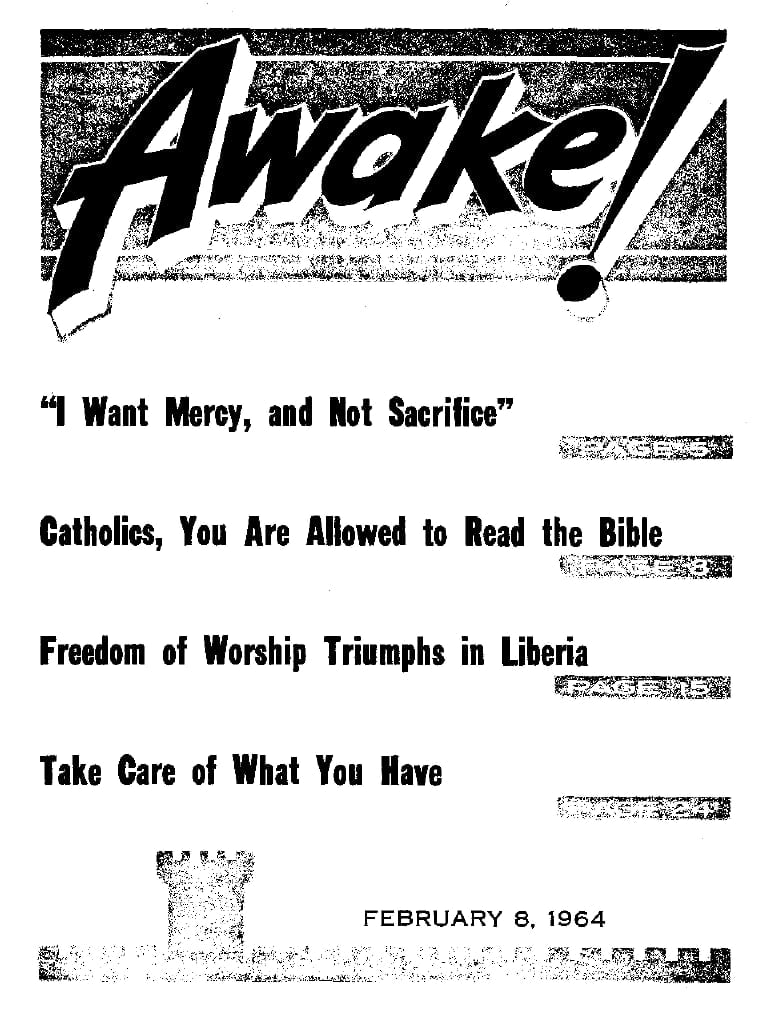
"I Want Mercy, and Not Sacrifice"
Catholics, You Are Allowed to Read the Bible
Freedom of Worship Triumphs in Liberia
Take Care of What You Have
FEBRUARY 8, 1964
THE REASON FOR THIS MAGAZINE
News sources that are able to keep you awake to the vital issues of our times must be unfettered by censorship and selfish interests. "Awakel" has no fetters. It recognizes facts, faces facts, is free to publish facts. It is not bound by political ties; it is unhampered by traditional creeds. This magazine keeps itself free, that it may speak freely to you. But it does not abuse its freedom. It maintains integrity to truth.
The viewpoint of "Awakel" is not narrow, but is international. "Awakel" has its own correspondents in scores of nations. Its articles are read in many lands, in many languages, by millions of persons.
In every issue "Awake!" presents vital topics on which you should be informed. It features penetrating articles on social conditions and offers sound counsel for meeting the problems of everyday life. Current news from every continent passes in quick review. Attention is focused on activities in the fields of government and commerce about which you should know. Straightforward discussions of religious issues alert you to matters of vital concern. Customs and people in many lands, the marvels of creation, practical sciences and points of human interest are all embraced in its coverage. "Awake!" provides wholesome, instructive reading for every member of the family.
"Awakel" pledges itself to righteous principles, to exposing hidden foes and subtle dangers, to championing freedom for all, to comforting mourners and strengthening those disheartened by the failures of a delinquent world, reflecting sure hope for the establishment of God's righteous new order in this generation.
Get acquainted with "Awake!" Keep awake by reading "Awake!"
PUBLISHED SIMULTANEOUSLY IN THE UNITED STATES BY THE
WATCHTOWER BIBLE AND TRACT SOCIETY OF NEW YORK, INC.
117 Adams Street
AND IN ENGLAND WITH
WATCH TOWER BIBLE AND TRACT SOCIETY
Watch Tower House, The Ridgeway
N. H. Knox, President
GRANT SUTER, Secretary
Printing this issue: 3,800,000
44 x copies (Australia, 5d; South Africa, 35c)
for subscription sales
for office use
America, U.S., 117 Adams Street, Brooklyn, N.Y. 11203. $1
Canada, 117 Broadway, Toronto, ON. 416
New Zealand, 232 New North Road, Auckland, S.W. 1
South Africa, 117 Broadway, Cape Town, T. 76
(Always edition) half the above rates)
Remittances for subscriptions ground in cash to the offices
of expatriates and your relatives in Brooklyn.
Rates of expatriates go at least five times before
subscription expires.
Now published in 25 languages
Swimming - Y-Arkansas, Ucrania, Danmark, Danish, French, English.
French, German, Greece, Italian, Hungary, Korea, Iran.
English, French, German, Greece, Italian, Hungary, Korea, Iran.
Monthly - Coca-Cola, Chile, Iran, Japan, Pakistan,
Tunnel, Ucrania.
CHANGES OF ADDRESS should remain for thirty days before your moving date. Give on your old and new address. Call the Town Tower House, The Ridgeway, London W. N. 7, England.
Entered as second-class matter at Brooklyn, N.K.
Printed in England
The Bible translation regularly used in "Awakti" is the New World Translation of the Holy Scriptures, 1961 edition. When other translations are used, this is clearly marked.
CONTENTS
A Sense of Humor Makes Sense! 3
"I Want Mercy, and Not Sacrifice" 5
Catholics, You Are Allowed to Read
the Bible 8
Heeding a Friend's Advice 14
Freedom of Worship Triumphs
in Liberia 15
New York World's Fair Nears
Its Opening Day 20
Anthem Singers a Disciplinary Problem 23
Take Care of What You Have 24
"Your Word Is Truth"
No Longer Slaves to Sin 27
Watching the World 29
Volume XLV
London, England, February 8, 1964
Number 3
THE possession of a sense of humor makes sense. It has ever been rewarding. What was the king's jester of olden times but a man with a keen sense of humor, and did he not get well paid for it in more ways than one? And today, do not comedians and humorists earn large salaries? Why, one writer of humorous lines for popular comedians earns half a million dollars a year, and that for writing but three to four minutes of dialogue each week. No question about it, a keen sense of humor is rewarding financially.
A sense of humor is also rewarding in other respects. It contributes to good relations with others, helps you to win friends and to keep them. It has a salutary effect upon both mind and body, helping one to have peace of mind, health and happiness. Why, just smiling has a beneficial effect upon the nervous system. Try it right now. SMILE! Do you not at once feel better? Well has it been written: "A joyful heart has a good effect on the countenance." "A heart that is joyful does good as a curer."—Prov. 15:13; 17:22.
The great Creator, Jehovah God, may be said to have a sense of humor. Does not his Word, the Bible, tell us that he is "the happy God," and that he made man in his image? If man, who is in God's image, has a sense of humor or the capacity for humor, then God himself must also have a sense of humor. As one evidence of it,
just look at the playful antics of kittens, cubs and puppies. Surely for their Creator to put such playful instincts in animals he must have a sense of humor himself. 1 Tim. 1:11.
The Bible character, the strong man Samson, repeatedly manifested a sense of humor. What a huge joke Samson played on his foes when they thought they had him secure within their walled city of Gaza! Far from its great bolted doors keeping him in, he took those doors, together with their posts, and carried them atop a hill before Hebron, some forty miles away! His sense of humor is also seen in his teasing Delilah as to the secret of his strength. Judg. 16:1-15.
Without doubt Samson's sense of humor helped to lighten the great burden that was his of taking "the lead in saving Israel out of the hand of the Philistines," waging a one-man war against them, as it were. That a sense of humor can help in this way is apparent from what Abraham Lincoln, American president of a century ago, once said: "With the fearful strain that is on me night and day"—he was directing a life-and-death struggle for the survival of his nation—"if I did not laugh I should die."
Though of very serious mien, he deliberately injected humor into situations so as to relieve the strain.—Judg. 13:5.
Well has it been said that "for health and constant enjoyment of life, give me a keen and ever present sense of humor; it is the next best thing to an abiding faith in providence." Not, however, that a sense of humor can take the place of an abiding faith in providence, that is, in God's care and protection. Not at all, One of America's foremost humorists, Mark Twain, demonstrated the fallacy of that philosophy. His sense of humor made him famous, but he let it serve in the place of an abiding faith in God, and so in the end he became a very bitter and unhappy man.
Regardless of the role you play in life, to have a sense of humor makes sense. It will help you to level out the "mole hills" of the daily petty annoyances, mishaps, inconveniences and frustrations that come your way instead of making mountains out of them. A sense of humor might be said to be a form of empathy or fellow feeling. Even as this enables you to "weep with people who weep," so a sense of humor will enable you to 'laugh with people who laugh,' and that though the joke may be on yourself. A sense of humor might therefore be said to enable one to turn loss into profit.—Rom. 12:15.
speaking, humor is wholesome, indicates a love of humanity and a certain amount of broad-mindedness and insight. Because of this a distinction is made between wit and humor. Wit is of the head; humor, more of the heart, although it also involves the head. Wit laughs at people, as when it ridicules them or plays "practical jokes" on them. Humor laughs with people, because it loves them and enjoys seeing them happy, even at the cost of one's own vanity. Thus the Scottish historian wrote: "True humor springs not more from the head than from the heart.—It is not contempt; its essence is love.—It issues not in laughter, but in still smiles, which lie far deeper."
To be able to laugh when you yourself are the victim of a ludicrous situation is a good sign. It shows that you do not have too high an opinion of yourself, that you do not take yourself too seriously, are not vain or overly sensitive. Of course, there is more than one kind of humor. Strictly
As with everything else, humor has its fit times and places. That is why we are told by wise Solomon that there is "a time to weep and a time to laugh; a time to wail and a time to skip about." (Eccl. 3:4) Humor for its own sake has no place in a public Bible lecture, a funeral discourse or at the celebration of the Lord's supper or evening meal. Neither is humor fitting when reproof is administered, by either the reprover or the one reproved. The force of it is lost when humor enters into the situation. Then is the time for all, especially the recipient of the reproof, to be serious, grave, sober, taking to heart the reproof. Any other attitude would be tantamount to belittling the correction.—Heb. 12:5.
With some, humor comes naturally. Like Samson, they seem to have been born with a keen sense of it. With others, it comes less readily. If you are among the latter, put forth an effort to cultivate it. Let your heart go out to your fellowman and try to see the amusing aspect of life's little vicissitudes. Smile! for a sense of humor makes sense!
MANY persons depend upon sacrifices they offer to God to gain his favor. They conclude that all they need to do is to give financial support to their church, to contribute to charity, to help build hospitals, orphanages and like institutions. After considerable personal and financial sacrifice, they are startled by the statement of Jesus
Christ at Matthew 9:13 that God wants mercy, and not sacrifice.
Sacrifices did gain God's favor in times past. Was not God pleased with the sacrifices
of righteous men such as Abel,
Noah, Job, Abraham and others mentioned
in the Bible? Certainly! Did he not prescribe for his chosen people Israel to offer sacrifices to him daily? Yes! And was it not Jehovah God himself who arranged for and accepted the sacrifice of his dear Son? Are not Christians commanded "to offer up spiritual sacrifices acceptable to God"? All true!—1 Pet. 2:5.
fices as in obeying the voice of Jehovah? Look! To obey is better than a sacrifice." For one's sacrifice to be accepted, one must know and obey God's commands. As Jesus said, one must "go, then, and learn what this means, 'I want mercy, and not sacrifice.'"
But God wants more than the mere sacrifice. Unless the offerer has real love for God and for his fellowman, God rejects the sacrifice. Overzealous King Saul of ancient Israel unmercifully decreed the death penalty for his son because of his unintentional violation of an oath. But later Saul himself deliberately disobeyed Jehovah's explicit instructions to devote everything of Amalek to destruction. Instead, Saul spared the best animals "for the purpose of sacrificing to Jehovah," as he rationalized. To unmerciful, disobedient Saul, Jehovah said: "Does Jehovah have as much delight in burnt offerings and sacri-
1 Sam. 15:15, 22;
Matt. 9:13.
In Jesus' day the Pharisees needed to learn that lesson. They despised tax collectors and the common people whom they called sinners. So they condemned Jesus because he with tax collectors and sinners in the home of Matthew Levi. In the same way today some proud clergymen scoff at true Christians who follow the example of Jesus in mingling with the common people in their homes. But the common people respond as gladly today as they did in Jesus' day, and this angers the clergy. One priest, while admitting that Jehovah's witnesses are increasing rapidly in New York, scornfully remarked that 'most of their converts are from the poorer districts, among the colored population and Puerto Ricans.' How like the Pharisees who did not appreciate that Jesus came 'to call, not righteous people [such as they imagined they were], but sinners'!
Unlike King David, who felt empathy for his hungry fellow warriors, the unmerciful but sacrifice-conscious Pharisees were offended when Jesus' disciples got hungry and started to pluck heads of grain and to eat on the sabbath. Horrors! Why, their Talmudic regulations even said that a plaster might not be worn on a wound on the sabbath because if it improved the wound that would be unlawful work.
A fractured bone could not be treated on the sabbath, unless the person's very life was at stake. How unmerciful! As then, so today some people have a tendency to push love and mercy aside. They are quick to criticize others while ignoring their own shortcomings. They are quick to condemn even though often they have faults far more serious than the ones they are finding in others. To such ones Jesus' rebuke should hit home: "However, if you had understood what this means, 'I want mercy, and not sacrifice,' you would not have condemned the guiltless ones."—Matt. 12: 1-7.
Repeatedly God warned the Israelites that he took more delight in justice, righteousness and mercy than in numerous sacrifices. "Of what benefit to me is the multitude of your sacrifices?" said Jehovah. Nor does the costliness of a sacrifice impress God. "What does this matter to me," asked Jehovah, "that you bring in even frankincense from Sheba and the good cane from the land far away? The whole burnt offerings of you people serve for no pleasure, and your very sacrifices have not been gratifying to me." Rather, why not "learn to do good; search for justice; set right the oppressor; render judgment for the fatherless boy; plead the cause of the widow"? "For in loving-kindness I have taken delight, and not in sacrifice; and in the knowledge of God rather than in whole burnt offerings." Clearly, God wants "mercy, and not sacrifice."—Isa. 1:11; Jer. 6:20; Isa. 1:17; Hos. 6:6.
What Is Mercy?
But what is mercy? It is compassionate treatment of the unfortunate; kindly treatment; pity. Jesus commended a Samaritan who showed mercy to an unfortunate
neighbor. (Luke 10:30-37) It is the disposition to forgive, as demonstrated by the master who canceled his slave's enormous debt. (Matt. 18:23-27) Mercy is kindness beyond what justice requires, beyond what can be claimed or expected. It is the withholding of just censure or punishment, as in the case of the loving father of the prodigal son. (Luke 15:11-32) Its root words denote "pain of heart" and thus it implies a sympathetic sense of the suffering on another by which the heart is affected. It is this quality of mercy that differentiates Jehovah from all demon gods of the pagans. Jehovah's mercy makes him adorable to us. It makes us want to cling to him and to love him. Because of his mercy we feel free to approach him in our weakness and imperfectness and yet feel assured that we are heard and understood. The way Jehovah expresses his mercy proves to us that he is love. Naturally, God wants us to show mercy to our fellowman.
Opportunities to Show Mercy
And life is full of opportunities to do so. A most important way to demonstrate mercy is by making use of every opportunity to inform others how they too can receive God's mercy. If we appreciate God's mercy we can best show it by using our time, energy and means to publish the good news of Jehovah's kingdom. No sacrifice a person might be inclined to offer, such as a money contribution to a door-to-door minister who is "doing a good work," can take the place of personal participation in this ministry of mercy. True mercy considers more than one's physical circumstances; it gives attention to one's spiritual welfare.
Mercy can also be demonstrated by kind deeds. In the Bible we read of an early Christian woman, Dorcas, who "abounded in good deeds and gifts of mercy," and of Cornelius, who is approvingly referred to as one who "made many gifts of mercy to the people."
(Acts 9:36; 10:2) Christians must be careful not to come short in respect of deeds of mercy. They should be careful not to overlook opportunities to lend a helping hand to their brothers who may have need of material things, or to visit a fellow Christian who is sick at home or in a hospital. While we must "always offer to God a sacrifice of praise," such sacrifice does not relieve a Christian of the need to show mercy. Some activities do not show up on one's record of preaching, such as efforts to recover a former preaching companion, or conducting a home Bible study with a newly baptized member of the congregation, or teaching an illiterate wife to read the Bible. But they are deeds of mercy, and one should not neglect them while striving for a fine preaching record. The Christian apostle Paul advised: "Do not forget the doing of good and the sharing of things with others, for with such sacrifices God is well pleased." If we remember that 'God wants mercy, and not sacrifice,' we will not overlook opportunities to show mercy to members of our family, to fellow ministers in the congregation and to others in general.—Heb. 13:16.
Many mistakes in life can be covered over by the quality of mercy. To the extent that we are thrown into close association with others, to that extent opportunities arise for manifesting this loving quality that God wants. A son breaks his father's tools, but asks to be forgiven. In moments of weakness a husband might mistreat his wife, or the wife her husband. There is regret, then forgiveness and mercy. A fellow Christian feels sorry over some misdeed. Do we have the disposition to forgive? We must not become weary of exercising forgiveness. The apostle Peter
thought that there should be a limit to the number of times he should show mercy to an erring brother, say, seven times. Jesus replied: "I say to you, not, Up to seven times, but, Up to seventy-seven times." Through mercy we will lovingly cover a multitude of others' sins; through mercy we cheerfully bear the burdens that the weak make for themselves and others. Forgiveness and mercy can bring domestic quietness, which is surely better "than a house full of the sacrifices of quarrelling." —Matt. 18:22; Prov. 17:1; 1 Pet. 4:8; Rom. 15:1.
While making numerous and costly religious sacrifices today, people of the world generally lack mercy. Cold and loveless, they lack fellow feeling and understanding, as did the Pharisees of Jesus' day. Like the apostates of ancient Israel, they forget God's Word, which says: "To carry on righteousness and judgment is more preferable to Jehovah than sacrifice." (Prov. 21:3) God commands us to show mercy today, not only by charitable gifts and everyday acts of kindness, but by informing our neighbors of God's merciful way of salvation. "To obey is better than a sacrifice." Why follow in the course of this world, which prefers to sacrifice than to show mercy? At the coming war of Armageddon, this world will have its judgment without mercy, according to the rule at James 2:13. But the merciful never need fear Jehovah's judgment. Rather, "happy are the merciful, since they will be shown mercy," to enjoy life in the coming new order of righteousness.—Matt. 5:7.
Do you desire to be shown mercy? Then be like God—love mercy. The Bible shows that Jehovah "is gracious and merciful, slow to anger and great in loving-kindness." "Go, then, and learn what this means, 'I want mercy, and not sacrifice.'"—Ps. 145:8; Matt. 9:13.
Catholics
YOU ARE ALLOWED TO READ THE BIBLE
</div>
"TO KNOW nothing of the Scriptures is to know nothing of Christ."1 So said Catholic "Saint" Jerome, fourth- and fifth-century Latin "church father," hailed by Pope Pius XII as "the greatest of the Doctors in Bible teaching."2 So convinced was Jerome of the importance of studying the Bible that he also wrote: "If there is anything in this life that sustains the wise man and moves him to keep a serene mind amid the tribulations and upheavals of the world, it is, I am convinced, first and foremost, meditation on the Scriptures and knowledge of them."a
That this was not an isolated view is attested to by a church-approved Catholic work in the following terms: "This veneration of the Holy Scriptures is to be found in all the early Fathers. The numerous translations made in order to put them into the hands of the faithful, the considerable textual criticism that dates from that time, particularly by Origen and Saint Jerome, provide glaring proof of the literary activity that went on in the early centuries, and indicate irrefutably that the Bible occupied a special place in the minds of the Christians. Moreover, most of the writings of the Fathers are homiletic commentaries of the Scriptures."4
Since the early "church fathers" unanimously recognized the value of the Holy Scriptures, how is it that in many countries Catholics still regard the Bible as a "Protestant book" and therefore as forbidden reading? To answer that question, we shall need to review a few pages of church history.
The Bible in Living Languages
The large portion of the Holy Scriptures commonly called the Old Testament was originally written in Hebrew, with a few small sections in Aramaic. As Hebrew passed away as a generally living language, those Jews who spoke only the common or koine Greek, popularized by the armies of Alexander the Great, felt the need of a translation of the Hebrew Scriptures in the international language of the day. To meet their needs, during the third and second centuries before Christ, the Greek Septuagint Version was produced. This translation into a vulgar, international tongue, was later used and quoted by Christ's apostles and disciples, and the latter used this same widely understood language for their own writings, commonly called the New Testament.
It follows that no one idiom could claim to be the exclusive, holy, sacrosanct language of the Bible. Now, the Catholic Church recognizes that the Holy Scriptures are inspired by God. A Catholic work states to that effect: "The Council of Trent declared both holy and canonical all the books of the Bible because they were dictated by the Holy Spirit and therefore God is their author." Therefore, the church of Rome admits that God himself moved with the times and had his Word written in living languages. Since, while under inspiration, the apostles quoted the Greek Septuagint Version of the Hebrew Scriptures, it can be inferred that God approved of the principle of having his Word translated from a dead or little-used tongue into a living or commonly used one.
In the course of time, koiné Greek itself did not suffice to keep the Word of God understandable to the common people. Although Greek was the language spoken around the greater part of the Mediterranean seacoast, the inhabitants farther inland still spoke their native idioms. As Christianity spread, these peoples required the Scriptures in their common tongue. Thus, during the first few centuries after Christ, translations appeared in Syriac, Coptic and other Egyptian dialects, Gallic, Gothic and different local tongues. The rise of another important language is alluded to in the Scriptures themselves, which speak of the inscription placed above Jesus' head as being "written in Hebrew, in Greek, and in Latin."—John 19:20, Catholic Douay Version.
Latin was the official language of the Roman Empire and was spread among the conquered peoples by the Roman soldiers. The legionnaires did hot speak late or classical Latin, but they spread a popular, colloquial form, called Vulgar Latin. As the occupied peoples and the Romans themselves learned about Christ, they needed a
translation of the Scriptures in the only tongue they understood. So it came about that during the second, third and fourth centuries, many different translations were made into Latin. A Catholic reference work says the following concerning these "Old Latin versions": "Both types [African and European] use the same popular Latin, with its peculiarities of vocabulary, spelling and syntax, its incorrect, vulgar and even coarse speech." They were obviously popular translations made for the common people.
Toward the end of the fourth century Jerome, encouraged by Damasus, the first bishop of Rome to adopt the title Pontifex Maximus (Supreme Pontiff), previously borne by the pagan Roman emperors, set to work first to revise the best of the Old Latin versions and later to translate the whole Bible into Latin directly from the original Hebrew and Greek. He completed his work A.D. 404 or 405. Although Jerome's translation was in better Latin than the Old Latin versions, it was still written in a language understandable to the literate public. This fact is reflected in the name by which his version eventually came to be known—the "Vulgate" (from editio vulgata), meaning the common or popular edition of the Scriptures.
The full significance of the appearance of this common-language Bible sponsored by Pope Damasus I can be measured by the following extract from a Catholic work, which states: "Greek was the original language used by the Church: the missionaries of the first and second generations of Christians preached in Greek, the books of the New Testament were written in Greek, the apostolic Fathers and the apologists composed their works in Greek, the language used in the liturgy was originally Greek, and in religious meetings, the sacred writings were read in Greek. . . The Church in Rome used the Greek language until the middle of the 3rd century."
It might be added that as late as A.D. 325, the sessions of the First Council of Nicaea were held, not in Latin, but in Greek, and the Nicene Creed, which has been termed the "unshakable basis" of the Catholic faith, was drawn up in the Greek language, not in Latin.
It is a known fact that many of the early "church fathers" considered the translators of the Greek Septuagint Version of the Hebrew Scriptures as inspired, and what is known as the New Testament was, of course, written in Greek from the start. Consequently, if any language deserved to be considered by Christians as the exclusive tongue for the liturgy and the Bible, it was Greek, not Latin. But neither God nor the early Christians considered any one language as sacrosanct, and credit must be given to the early "church fathers" for moving with the times and having the Bible translated into a living language: Latin, for those speaking and reading Latin.
Interestingly, a Catholic reference book points out that the Pharisees were the ones who opposed the translation of the Bible into the vulgar or common tongues. This book states: "From the second century forward, the Pharisees built up a system of cultural isolation for Judaism. They began surrounding the Hebrew text of the Old Testament with a respect that in our view was exaggerated, and they neglected the books, like Wisdom, that had originally been written in Greek; they even went so far as to consider that it was an evil day that the Law had been written in [translated into] Greek." Another Catholic work makes a similar reproach with regard to the Scribes: "The Scribes were determined to protect the Torah, and to that end they applied themselves with untiring zeal to erecting 'a hedge all around' it, in accordance with the recommendation
made by the Elders of the Great Synagogue. (Pirqe Aboth, I, I) . . . The Law of Moses, the legitimate pride of Israel, risked becoming a private domain of which they jealously held the key.[110]
The foregoing shows: first, that God himself inspired his penmen to write in the living language of their times; secondly, that the early "church fathers" favored keeping the Bible alive in the vulgar or popular tongues of their day; thirdly, that the Latin Vulgate was not originally a dead-language version for the exclusive use of the clergy, but a popular edition in what was then a modern-day idiom; fourthly, that opposition to Bible translation in a desire to keep the Scriptures as the exclusive domain of the clergy was a trait of the Scribes and Pharisees. How, then, did it come about that for centuries the Roman Catholic Church forbade any Bible reading "in the vulgar tongue," that is, in anything but Latin, which had become a dead language?
How the Bible Became a "Prohibited Book"
There were several reasons why the ecclesiastical authorities of the Roman Catholic Church changed their attitude toward the Bible's being kept alive in languages understood by the common people, and why, for centuries, they restricted the use of the Scriptures to the clergy.
One factor was the rivalry between Rome and Constantinople that began developing in the fourth century and culminated in the schism of A.D. 1054 between Roman Catholicism and the Orthodox Church. An authorized Catholic reference work explains the origin of this split as follows: "It started by a struggle for domination between old Rome and Constantinople, New Rome, the latter having been chosen by Constantine as his capital in 330. By virtue of this, the bishop of Constantinople required the Council held in that city in 381 to grant his see special honor, second only to that of the bishop of Rome; this was granted him by Canon 3 of this Council."
The promotion of this Eastern prelate to the rank of Patriarch of Constantinople sowed the seeds of rivalry that led to the schism between the Eastern and Western churches of Christendom.
It was in this contest of rivalry between Rome and Constantinople that Damasus, the then bishop of Rome, encouraged Jerome (in 383) to revise the Old Latin versions and produce a standard version of the Bible in Latin. The Eastern church used the Greek language for its liturgy and it possessed the whole Bible in Greek, the "Old Testament" in the Septuagint and the "New Testament" in the original Greek. This placed the Western church at a disadvantage, since its liturgical language was Latin. Damasus, who five years earlier had accepted the title of Pontifex Maximus, was anxious to justify his claims to that title and apparently saw the need to produce a version of the Scriptures that would compete with the Greek text used by his rival in Constantinople.
True, the Latin Vulgate did not immediately become popular, even among the succeeding bishops of Rome, and many years passed before it was recognized throughout the whole of the Western church as the official version of the Scriptures. Nevertheless, it is a historic fact that it was conceived just two years after the rivalry began between the bishops of Rome and Constantinople. That later bishops of Rome should have adopted the Vulgate as the official Bible of the Catholic Church and made Latin the sacred language of the liturgy, insisting upon the use of Latin centuries after it had become a dead language, can better be understood in the light of the rivalry between the
Eastern (Greek) and Western (Latin) churches.
Commenting on the use of language in the struggle between the two divisions of early Christendom, historian Arnold J. Toynbee states the following in A Study of History: "In encountering the local impulse to make use of vernacular languages for liturgical purposes instead of Latin, the Roman Church had conceded to the Croats permission to translate the liturgy into their own language, probably because in this frontier district Rome found herself faced with the competition of her Eastern Orthodox rival, who, so far from insisting on her non-Greek converts accepting Greek as their liturgical language, showed a politic generosity in translating her liturgy into many tongues." Rome, on the contrary, by insisting on the use of Latin throughout the length and breadth of her religious empire, intended to assert her supremacy over her Eastern rival.
Another reason for venerating the Latin language and for preventing the common people from reading the Bible in their common idioms was the Roman Church's desire to assert her spiritual authority over the "faithful" inside Western Christendom. If she admitted that the Scriptures contained the complete revelation of God's will and purpose, and continued making the Bible available to the "faithful" in their common languages, she would risk losing her hold over the flock. To counteract this danger, the Roman ecclesiastical authorities claimed that God had committed into their hands the sacred "trust" of traditions that complete the divine revelation. A Jesuit author outlines this claim in the following terms: "The divine revelation, even that expressed in the Scriptures, has been committed to a faithful community, the living Church; this raises the vital question of the relationship between the Bible, Tradition and the Church.
. . . This added light [in the Scriptures], once given, joins and completes the treasure of Tradition. . . . The same Spirit that inspired the Scriptures dwells in those who are responsible for faithfully transmitting the trust of the Revelation. Therefore the Scriptures are entirely dependent upon Tradition [author's italics]. 112
Another Catholic work states the matter even more clearly, when it says: "Tradition is the most normal canal by which all the teaching of the faith reaches mankind
hibited Books" drawn up by order of the Council of Trent.
A.D. 1816: "Experience has proved that, owing to the rashness of men, more harm than benefit arises from the Sacred Scriptures when published in the language of the common people."—Statement by Pope Plus VII.
Catholic author Daniel-Rops, member of the French Academy, sums up the situation as follows: "By giving back to the Book its supremacy and its renown, Lut
the teaching of the faith reaches humankind. Use of the New Testament Scriptures came later. They do not contain the complete trust, all the faith, and their use is not essential."13 Since many of these traditions (e.g., worship of the Virgin Mary, prayers to the "saints," veneration of reliics, indulgences, purgatory, and so forth) are nowhere to be found in the Scriptures, it obviously became dangerous to allow the common people to read the Bible.
These different factors help to explain the following official statements by the Ro-
ther and the other Reformers committed the inexpiable error of separating it from the Tradition that had safeguarded its text and had contributed so much to its understanding. Once it became the only source of faith and of spiritual life for man, the Bible afforded the means for doing without the Church, her social organization, Tradition and the Hierarchy. The Catholic Church measured the danger of this break in the historical evolution of the Christian message and of this individualization of belief. She reacted through
man authorities:
A.D. 1229: "We forbid the laity to have in their possession any copy of the books of the Old and New Testament, except the Psalter, and such portions of them as are contained in the Breviary, or the Hours of the Virgin; and we most strictly forbid even these works in the vulgar tongue." —Council of Toulouse, Canon 14.
A.D. 1246: "You will see to it that all just and legal means are used to prevent the hottest of exposing theological books.
the protective measures taken by the Council of Trent, which, among other things, forbade the faithful from reading versions of the Holy Scriptures in common languages unless they had been approved by the Church and contained commentaries in line with Catholic Tradition. . . . It became commonplace to hear people repeat that 'the Bible is on the Index' and that 'a Catholic should not read the Bible.'" Yet the same author, writing in 1955, states a few pages farther on:
larry from possessing theological books, even in Latin, and the clergy from possessing them in the vulgar tongue."—Council of Béziers, Canon 36.
A.D. 1562: "If the sacred books be permitted in the vulgar tongue indiscriminately, more harm than utility arises therefrom."—"Ten Rules Concerning Pro-
"Read the Bible" is what the Catholic Church now tells its sons to do."14 How did this change come about?
The Revival of Bible Reading
Among Catholics
In the early nineteenth century, Pope Leo XII stated in a bull to the Catholic clergy in Ireland: "It is no secret to you, venerable brethren, that a certain society, vulgarly called the Bible Society, is audaciously dispreading itself through the whole world.
. . . This society has collected all its forces, and directs every means to one object:—to the translation, or rather to the perversion, of the Bible into the vernacular languages of all nations."
Similar condemnations of the Protestant Bible societies were made by Popes Gregory XVI (1831-1846) and Pius IX (1846-1878). But fulminating against these societies did not prevent them from distributing millions of copies of the Bible in hundreds of languages, so that by the end of the nineteenth century Protestant editions of the Scriptures were beginning to circulate even among the Catholics, since Catholic editions in the common languages either were nonexistent or too expensive. In view of this situation, Rome found it necessary to begin distributing her own translations of the Bible, duly annotated with comments designed to reconcile the Scriptures with Catholic dogma and tradition.
In 1893, Pope Leo XIII published his Encyclical Letter Providentissimus Deus on the study of the Holy Scriptures. In 1907, Pope Pius X wrote a letter to the head of the Saint Jerome Association (a Catholic Bible distributing agency) encouraging him to "clear away the prejudiced idea that the Church is opposed to the reading of the Holy Scriptures in the vulgar tongue."15 In 1920, on the 1500th anniversary of the death of Jerome, Pope Benedict XV published his Encyclical Letter Spiritus Paraclitus in which he exhorted "all the sons of the Church, and especially the clergy, to respect the Holy Scriptures and to read them plausely."16
Finally, in 1943, Pope Pius XII published his Encyclical Letter Divino affante Spiritu, hailed by the bishop of Namur, Belgium, as "a breath of fresh air, of
ozone after the storm."17 In it, the pope stated: "May the Bishops apply themselves to increase and perfect this veneration [for Holy Scripture] among the faithful entrusted into their care, by encouraging all efforts put forth by men filled with apostolic zeal, whose praiseworthy object is to create and maintain among Catholics a knowledge and a love of the Holy Books. May they therefore grant their favor and support to the pious associations whose purpose is to distribute among the faithful printed copies of the Bible, particularly the Gospels, and who endeavor with much zeal to introduce into Christian families the habit of reading the Bible daily with respect and devoutness."18
In this same encyclical, Plus XII expressed the following wish: "Let the priests . . . show the truthfulness of Christian doctrine by words drawn from the Holy Books." And in the same vein, Jesuit professor Paul Henry, of the Paris Catholic Institute, writes: "Scripture is normative [establishes an authoritative standard] for the life, the worship, the morals and the theological doctrine of the Church. Normative, not in the sense that everything revealed or desired by God is explicitly written in Scripture, but inasmuch as nothing done or taught infallibly by the Church can be contrary to Scripture [italics ours]."
Catholics, the foregoing shows that you are now allowed to read the Bible! Several heads of your church have said so in authoritative letters written to the bishops throughout the entire world. Your church also says that, although it possesses traditions in addition to the Scriptures, nothing it teaches can be contrary to the Scriptures and that your priests should be able to prove the truthfulness of Catholic dogma by quoting Scripture. Put this claim to the test. Obtain a copy of the Bible.
Read it! Study it! Ask questions! Accept the assistance of those zealous men and women whose praiseworthy purpose is to help you understand God's purposes. One such man or woman, filled with apostolic zeal, brought you this magazine.
REFERENCES*
1 Comm. in Isaiah—Jerome, prologus, PL. XXIV,
col. 17.
2 Encyclical "Divino affiante Spiritu"—Plus XII, Part L § 3.
Comm. in Ep. ad Ephemos—Jerome, prologus, PL.
XXVI, col. 439.
Dictionnaire de la Bible—F. Vigouroux, 1926 edition.
Preface, p. XLI.
a Introduction a la Bible—Robert and Feuillet, 2d edition 1959, Vol. I, p. 31.
6 Initiation Biblique—Robert and Tricot, 3d edition
1854, p. 418.
7 Dudd, p. 417.
All these works carry the official "Imprimatur" of the ecclesiastical authorities of the Roman Catholic Church.
Apologétique—Brillant and Nédoncellé, 1939 edition, p. 581.
9 Initiation Biblique—Robert and Tricot, 3d edition 1954, p. 405.
10 Introduction a la Bible—Robert and Feuillet, 2d edition 1950, Vol. II, p. 67.
11 Apologétique—Brilliant and Nedoncelle, 1989 edition, p. 701.
12 Paul Henry, S.J., professor at the Paris Catholic Institute, writing in Initiation Biblique—Robert and Tricot, 3d edition 1954, pp. 963, 971.
13 Dictionnaire de la Bible—F. Vigouroux, under
"Tradition."
14 Quesst-os que la Bibler (What Is the Bible?)
—Daniel-Rops, 1955 edition, pp. 6, 7, 8.
15 Letter to Cardinal Cassetta, Qui pdm, dated January 21, 1907 : Plus X. Acta IV. pp. 23-25.
10 Encyclical "Spiritus Paraceltus"—Benedict XV, Aota Ap. Sedes XII (1920), pp. 385-422.
17 Preface by Mgr. Andre-Marie Churue, bishop of Namur, to booklet Encyclique sur les études bibliques, 1945. Editions universitaires, Brussels.
15 Encyclical "Divoino afflante Spiritu"—Plus XII, Part II, § 5.
19 Ibid.
20 Initiation Biblique—Robert and Tricot, 3d edition 1954, p. 973.
Heeding a Friend's Advice
A dedicated Christian in Michigan recounts how he learned God's truth: "Seven years ago, during the course of my employment aboard the Great Lakes one ships, I undertook to determine for myself if a man should have a religion and, if so, which one of the many. In an effort to obtain answers to many questions I contacted a number of clergymen. From these encounters I learned one thing—the fact that I was not the only one confused. So the whole subject of religion was laid aside until one day our ship put into port on Lake Erie and the fireman on my shift quit.
"When the replacement fireman came aboard, there was some doubt as to whether or not he could handle such a back-breaking job as that of hand-firing the ship's rollers, due to his slight build. However, by demonstration he convinced us that he was indeed a very good fireman. Since he had been away from such hard physical work for some time he required help until he could get into shape. Whenever I could leave the engine room I would go into the firehold and help him out. I soon learned that he was interested in the Bible and had an unusual knowledge of its contents. I turned back his first efforts to explain some things by telling him, with a cynical tone of voice, that if he thought
he could convince me on these religious issues, when the learned men of the clergy had failed to do so, he had another thought coming.
"We would shovel the furnaces full and then discuss religious issues, referring to the Bible and other books he had. This went on shift after shift. My efforts to convince him that he was just as confused as myself and the clergymen I knew were frustrated by his quiet, confident explanation of Bible truths. This frustration soon turned to interest and, with this interest and our further study, I came to realize that this was indeed the truth. The end of the shipping season arrived, and the ship was laid up for the winter. The sailors departed. Prior to parting, my new friend advised me that it I wanted to learn more of the truth I should seek out and associate with Jehovah's witnesses. As my family and I moved from place to place I never forgot the things that ship's fireman taught me. Upon moving to upper Michigan three years later, I sought out the Kingdom-Hall. An invitation to a home Bible study was accepted, which led to my dedication. As I recall, seven years ago those clergymen failed to impart Bible understanding, but in contrast Jehovah enabled a humble fireman to teach others life-giving truth."
AWAKE!
Freedom of Worship in Liberia
By "Awake!" correspondent in Liberia
IN MARCH 1963 the world was shocked by reports of the breakup of a peaceful religious assembly of Jehovah's witnesses convened at Gbarnga, Liberia. After being herded to a military compound, the Witnesses, foreigners and citizens alike, for three days were subjected to all manner of brutal mistreatment by soldiers because they refused to violate their Christian consciences and worshipfully salute the flag. The following month all foreign nationals who were Jehovah's witnesses, including missionaries, were told to leave the country. A detailed report of the incident appeared in Awake! of August 8, 1963, following publication of an open letter of protest to President Tubman by the president of the Watch Tower Bible and Tract Society.
About four months after the publication of the aforementioned article, or in December 1963, a delegation of Jehovah's witnesses traveled to Monrovia, Liberia, to discuss with Liberian President W. V. S. Tubman the matter of religious liberty for Jehovah's witnesses in that republic.
Several questions pressed for satisfactory answers. Would Jehovah's witnesses be allowed to show respect for the Liberian flag by standing quietly before it and not be forced to salute it idolatrously? Would these Christians be able to preach and teach the Bible, free from molestation, and
hold peaceful meetings and assemblies without the likelihood of invasion by soldiers? Would restrictions on building Kingdom Halls be lifted?
During the interim from the breakup of the assembly to the discussion of these questions with President Tubman something of significance took place.
Liberia Flooded with Protests
When the facts about the assembly breakup and the brutal persecution became public knowledge, thousands of persons who deplored this transgression of basic human rights were stirred to write letters of protest to the President of Liberia. Liberian embassies and consulates in many countries were also flooded with inquiries, protests and explanations that Jehovah's witnesses are peace-loving Christians whose Bible-based religious views present no threat to established authority.
With the spotlight of such worldwide indignation turned on his country, Liberian President Tubman, in a speech on August 14, 1963, explained that his Government "deplores, abhors and deprecates brutality and maltreatment of people under any circumstances, and when the matter [of the Gbarnga incident] was brought to its attention and the guilt of those involved was established, they were punished because they violated the law in manhandling and brutalizing citizens and foreigners." He further stated that he was making a personal investigation of the affair and that "Jehovah's witnesses, as a sect, are welcome in this country, but they will be required to conform to the law requiring all persons to salute the flag when it is being hoisted or lowered at ceremonies in their sight or keep away from such ceremonies."
In response to Mr. Tubman's statement that Jehovah's witnesses were welcome in Liberia, a question was propounded at a news conference: Did this mean that missionaries of Jehovah's witnesses could now enter Liberia? As reported by The Listener Daily of September 13, 1963, "Mr. Tubman said if an individual has been deported from a country, he cannot re-enter that country without special permission. However, he added, new Jehovah's Witness missionaries could come to Liberia."
These words proved heartening to local Witnesses. During those months they kept remembering statements by government officials that all who had refused to salute at Gbarnga were to be prosecuted. This caused many Witnesses to scatter throughout the country, and meetings were held in private homes. But now the President's remarks seemed to indicate that Liberia was moving toward freedom of worship for Jehovah's witnesses. In some communities Witnesses began preaching from house to house as before. Frequently they were welcomed warmly by hospitable Liberians who love the Bible and who appreciated the good work of the Witnesses. But some local authorities viewed the Witnesses as subversive and had told them they could not preach. Freedom of worship could not flourish in such a climate of uncertainty and apprehension.
Interview with President Tubman
Late in November Liberian President Tubman wired M. G. Henschel at the Watch Tower Society's headquarters in
Brooklyn, New York, and agreed to receive a delegation of Jehovah's witnesses to discuss missionary activity and the flag issue. M. G. Henschel, a director of said Society, was more than mildly interested in the matter, as he had personally experienced persecution at Gbarnga. Soon thereafter the former presiding minister of Jehovah's witnesses in Liberia, together with his assistant and the Society's representative in charge of its work in Nigeria, arrived in Monrovia and were joined by M. G. Henschel.
The first meeting with President Tubman was short but cordial. The President welcomed back the missionaries, including one who had been asked to leave Liberia in April. Due to an oversight in making note of the appointment, the President requested that the delegation return the following day. The friendly atmosphere was conducive to a feeling of optimism.
Scriptural Teachings Beneficial
When the interview was finally convened, the Society's director thanked the President of Liberia for the opportunity to clear the air regarding Jehovah's witnesses and to explain that they are not subversive and that their work is in no way political. Jehovah's witnesses, he explained, represent an international organization preaching God's kingdom in 194 lands. As sincere Christians their interest is in helping people to understand the Bible.
Reference was made to the President's speech of August 14 in which he pointed out that Christians had to be subject to secular authority according to the Bible book of Romans, chapter 13. Literature of the Society was then presented and portions thereof noted as evidence that people were being taught to obey governments and to pay taxes. Henschel also spoke to the President about the urgency of our times, the imminent end of this system of things and the Bible hope of salvation into a new order thereafter.
A personalized copy of the New World Translation of the Holy Scriptures was then presented to President Tubman, himself a lay preacher and frequent guest speaker at different churches.
The two members of the delegation who had spent many years in Liberia then told about the practical results of the Society's work among the Liberian people. Hundreds of Liberians had been trained as ministers and spiritual counselors and had gained an enviable reputation for honesty and dependability, being much sought after by employers. As Bible classes expanded, Kingdom Halls had been built. Literacy classes were functioning throughout the Republic, a local language reading primer had been published, and many Liberians had been taught to read and write.
Witness Woodworth Mills of Nigeria told President Tubman that the 37,000 Witnesses there enjoy a fine Christian reputation, as acknowledged by Nigerian President Azikiwe. There are no problems in schools, and huge assemblies are held without need of policemen. The good results achieved in all countries in West Africa proved that knowledge of the Scriptures is truly beneficial for Africans.
The Society's director introduced a new Bible teaching aid, "This Good News of the Kingdom" printed in the local Kissi language. Its use in connection with the English edition was explained in aiding persons to learn to read English, Liberia's official language.
Why Objections to Saluting
After a newspaper reporter was permitted to sit in on the interview, M. G. Henschel explained that he had not come to complain about the treatment meted out at Gbarnga. Suffering for true Christianity was something to be expected, he said, and there was no anger because of this.
The Watch Tower Society director was happy to note that Liberia's Constitution and Bill of Rights guaranteed freedom of worship, not every country having such fine provisions. In carrying on their worship, Jehovah's witnesses were not asking for any special preference over other religions; they were merely doing what the Bible commands. At Exodus 20:1-6 God says he demands exclusive devotion. He commands his worshipers not to bow down to or worship any image or idol. This interpretation of the Ten Commandments was held by Shadrach, Meshach and Abednego in Daniel, chapter 3—an account well known to President Tubman, one of his given names being Shadrach. Other scriptures were quoted by Henschel to show that Christians must shun idolatry. (1 Cor. 10:14; 1 John 5:21) Whereas some may not regard a flag as an idol, Jehovah's witnesses regard a flag salute the same way as the Hebrews in Babylon regarded bowing down to Nebuchadnezzar's image.
In conclusion Henschel summed up: 'We certainly respect the flag, but we want to be excused from performing toward it an act we conscientiously believe to be an act of worship forbidden in the Bible. Will the Government allow Jehovah's witnesses to worship according to their consciences? Our worship is neither immoral nor dangerous to the State. In other countries Jehovah's witnesses have been able to stand quietly before the flag during flag-salute ceremonies as a sufficient display of respect. Will the Government of Liberia be willing to grant Jehovah's witnesses these same privileges that they enjoy elsewhere? May we carry on our meetings in our places of worship? May we hold our assemblies and preach from door to door without molestation? May the Watch Tower missionaries reenter Liberia and continue to help the Liberian people?'
President Favors Tolerance
Having listened intently to the delegation, President Tubman admitted that he had known of the activities of the Watch Tower Society for a long time, a group of his townspeople having attended Zion's Watch Tower Bible classes when he was just a boy. In good humor he related that the flag law in Liberia was proposed by a clergyman and the first person apprehended for violating it was the 80-year-old father of the cleric. President Tubman reaffirmed his strong belief in freedom of worship, conscience and religion.
The Government, he enthused, welcomes all religions, especially Christian ones. The President jovially related about his receiving visits by Jehovah's witnesses. "They preached to me, and I listened. Jehovah's witnesses—they know their Bible very well. They tried to convert me, but I told them I'm too old to change now!" "I do not believe that Jehovah's witnesses are subversive or are trying to overthrow the government," Mr. Tubman added.
As to Gbarnga: "I Am Sorry!"
Regarding the ill-treatment of the Witnesses at Gbarnga, President Tubman condemned the incident as "an outrage," "iniquitous," and "wicked." He said those responsible for the affair had been punished, and added, "I am sorry this thing happened!"
M. G. Henschel once again assured the president that Jehovah's witnesses had not come to complain about personal abuses. "We do not hold anything personal against those who abused us at Gbarnga, Mr. President." "Were you at Gbarnga?" the President asked with surprise. "Yes," replied Henschel, "I was in detention from Sunday until Tuesday with all the others. We all underwent the same experience. The soldiers made no difference between foreigners and Liberians. I was struck on the back
with a rifle butt and made to sit all Sunday night, and I had my share along with John Charuk here and all the others. But we feel no hatred, no animosity. When I was released I tried to think: 'Now, what good can I see in these soldiers? Is there something kind I can think of them?' and I found it possible to compliment Lieutenant Warner for the mercy and compassion he had shown for the young babies, of whom there were many. Jehovah's witnesses feel no anger about the personal abuse they had to suffer. And even there at Gbarnga while we were undergoing this treatment there were no derogatory words, but we stood quietly and showed respect for the flag."
President Tubman said for the third time, "I am sorry!" He went on to say that the Government has nothing against Jehovah's witnesses, "They are welcome here just as any other sect of Christians; their missionaries can carry on their work." Asked whether this applied to the missionaries told to leave the country in April, the President replied, "Yes, they will be welcome."
May Witnesses Stand but Not Salute?
After earnestly describing the deep religious convictions of Jehovah's witnesses and the matter of conscience, Henschel once again brought up the crucial point of the interview. 'Mr. President, since the law requires respect for the flag, would it be all right if Jehovah's witnesses just stand quietly in respect for the flag and not be required to give the military salute or take part in the ceremony?'
President Tubman replied to this effect: 'The law stipulates that every person shall show respect to the flag when it is being raised or lowered with ceremony. The term "respect" is subject to interpretation. If I am present when the flag is being hoisted or lowered with ceremony, I do not salute.
I stand at attention and take off my hat. I am not the interpreter of the law, but I think that civilians are not required to give the military salute. But I will consult with the Secretary of the Interior and the Secretary of Defense.'
'Regarding the fear you say that some have to attend your religious services,' continued the President, 'I would say that this is a very undesirable situation and I will take steps to remedy it. There is no reason why you should not be able to build your churches and have services in them. Your services should have the same protection of the law. If there are some officials who do not have the right understanding, I will make an announcement that will put matters right.'
Popular Reaction
A lengthy report of the interview was published in The Liberian Age of December 6, noting that President Tubman had showed much sympathy toward the delegation. An editorial stated: "We sincerely hope that the meeting yesterday between President Tubman and a delegation of Jehovah's Witnesses will go a long way, if not all the way, in cleaning up any possible misunderstanding or doubt that may be existing with regard to the right of religious organisations and individuals to practice their religious beliefs under the constitution of the Republic." The Gbarnga incident was lamented, and those who had taken the law into their own hands were condemned. Mentioned also were the many letters of strong protest received from many parts of the world, which undoubtedly had a profound effect on Liberia.
Many Liberians greeted the returned missionaries with emotions ranging from utter disbelief to fervent hugs. During the week the interview took place the Kingdom Hall in Monrovia was filled with those anxious to hear talks of encouragement by the delegates.
Presidential Order
A few days later the Executive Circular, issued by the President of Liberia, notified citizens as follows:
"Delegated representatives of Jehovah's Witnesses having come to Monrovia, met and discussed with me the incident that arose in Gbaranga between the Commissioner and Jehovah's Witnesses in March of this year, and I having assured these representatives that Government deprecates the outrageous acts of violence and mistreatment by soldiers of the Liberian National Guard toward Jehovah's Witnesses, and that the Defense Department has been authorized to investigate the matter with a view of ascertaining and administering discipline and punishment to all who participated in such maltreatment of Jehovah's Witnesses, the representatives of Jehovah's Witnesses assured me that their members would pay respect to the national flag when it is being hoisted or lowered at ceremonies by standing at attention.
…