Awake!, January 22, 1964
Download: PDF — Awake!, January 22, 1964
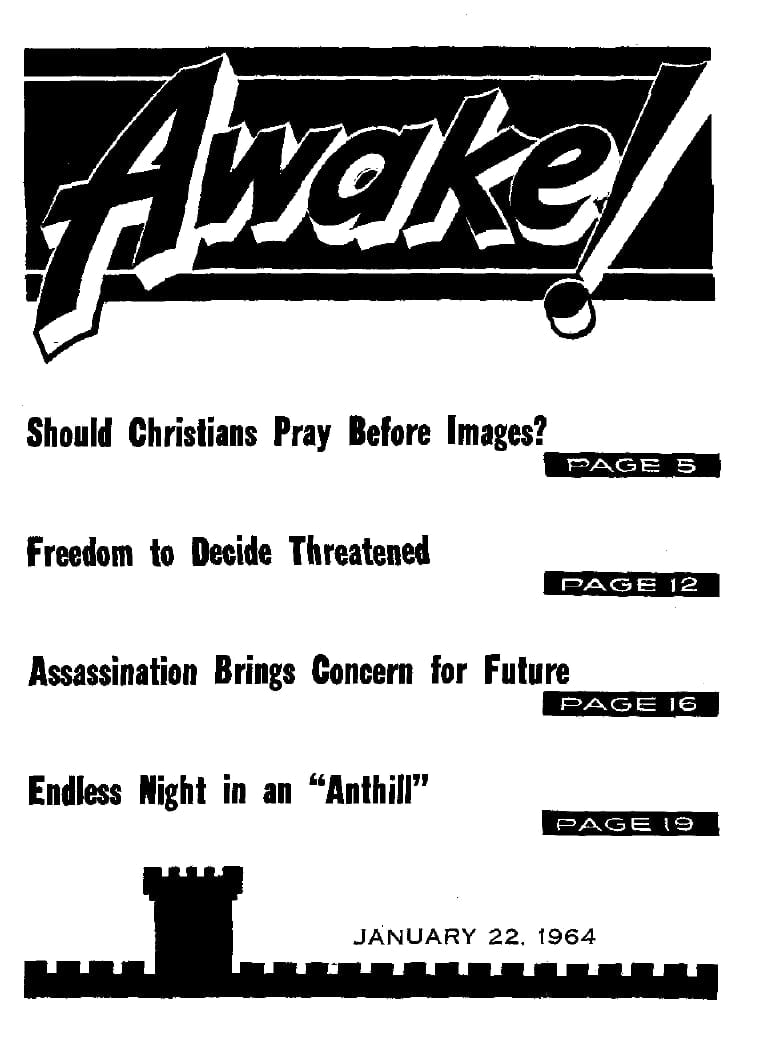
Should Christians Pray Before Images?
PAGE 5
Freedom to Decide Threatened
PAGE 12
Assassination Brings Concern for Future
PAGE 16
Endless Night in an "Anthill"
PAGE19
JANUARY 22.1964
THE REASON FOR THIS MAGAZINE
News sources that are able to keep you awake to the vital issues of our times must be unfettered by censorship and selfish interests. "Awake!" has no fetters. It recognizes facts, faces facts, is free to publish facts. It is not bound by political ties; it is unhampered by traditional creeds. This magazine keeps itself free, that it may speak freely to you. But it does not abuse its freedom. It maintains integrity to truth.
The viewpoint of "Awake!" is not narrow, but is international. "Awake!" has its own correspondents in scores of nations. Its articles are read in many lands, in many languages, by millions of persons.
In every issue "Awake!" presents vital topics on which you should be informed. It features penetrating articles on social conditions and offers sound counsel for meeting the problems of everyday life. Current news from every continent passes in quick review. Attention is focused on activities In the fields of government and commerce about which you should know. Straightforward discussions of religious issues alert you to matters of vital concern. Customs and people in many lands, the marvels of creation, practical sciences and points of human interest are all embraced in its coverage. "Awake!" provides wholesome, instructive reading for every member of the family.
"Awakel" pledges itself to righteous principles, to exposing hidden foes and subtle dangers, to championing freedom for all, to comforting mourners and strengthening those disheartened by the failures of a delinquent world, reflecting sure hope for the establishment of God's righteous new order in this generation.
Get acquainted with "Awake!" Keep awake by reading "Awake!"
PUBLISHED SIMULTANEOUSLY IN THE UNITED STATES BY THE
WATCHTOWER BIBLE AND TRACT SOCIETY OF NEW YORK, INC.
117 Adams Street
Brooklyn, N.Y. 11201, U.S.A.
Watch Tower House, The Ridgeway N. H. KNONE, President
London N.W. 7, England
GRANI SUTTER. Secretory
Printing this issue: 3,800,000
4d a year (Australia, 5d South Africa, 35c)
Offices
$650 for subscription rates
for semi-annual editions
America, U.S., 117 Adams Street, Brooklyn, N.Y. 11201 51
Canada, 1050 Broadway, Toronto, ON 1906 61
New Zealand, 621 New South Wales, Auckland, S.W. 71
South Africa, Private Bank, Cape Town, 760
Humidities for subscriptions should be sent to the office in
Now published in 25 languages
Senthithamu—Arkhanda, Chyana, Tamil, Dutch, English,
French, German, Greek, German, Italian, Japanese, Korean,
Nepalese, Portuguese, Russian, Swedish, Tamil, Polish,
Norwegian, Uzbek, Chinese, Iranian, Malayalam, Kolk.
Tamil, Tamil, Uzbek.
CHANGES OF ADDRESS should reach in thirty days before your room mat is given. Else as your old and new mat should be changed. Please contact West Tower, West Tower House. The Ridgeway, London W. 7, England.
Entered as second-class matter at Brooklyn, N.Y.
Printed in England
The Bible translation regularly used in "Awshe" is the New World Translation of the Holy Scriptures, 1961 edition. When other translations are used, this is clearly marked.
CONTENTS
Self-Indulgence Is Self-Defeating 3
Should Christians Pray Before Images? 5
Strange Leaf Movement 10
Far-reaching Effects of
the Incidental Witness 11
Freedom to Decide Threatened 12
Advising School Boards 15
Assassination Brings
Concern for Future 16
The Tormenting Boredom 18
Endless Night in an "Anthill" 19
Salty but Sweet 22
"Paying Attention" Stressed
at Gilead Graduation 25
"Your Word Is Truth"
"Turn Down the False Stories" 27
Watching the World 29
Self-Indulgence IS Self-Defeating
nity; man cannot get away with it. Man is not like one of the lower animals. God created man in his image,
"LET there be eating and drinking, for tomorrow we shall die." That is the way certain ones felt about things more than 2,500 years ago, and, judging by their actions, that is the way many feel about
gave him a mind, a moral sense and a free will and endowed man with the capacity to govern his body. He was not to have
his instincts govern his mind. Self-indulgence goes contrary to God's purpose for man and so is bound to be self-defeating.—Gal. 6:7.
This was well illustrated in the case of
things today. Because of the uncertainty of the future, because for them tomorrow may never come or tomorrow they shall die, they go in for self-indulgence. But in doing so they are deceiving themselves, for self-indulgence is self-defeating.—Isa. 22:13; 1 Cor. 15:32.
Self-indulgence is defined as "excessive or unrestrained gratification of one's appetites, desires or whims." Why is it self-defeating? For more than one good reason. It is self-defeating, first of all, because it beyond what is reasonable beyond
the two sons of Israel's high priest, Eli, who were so given to self-indulgence that they respected neither God's worshipers nor God himself. First Samuel 2:12-17 tells of the insatiable greed of these men who, as underpriests, should have been setting a better example for Israel. According to the Law, when a man offered a communion sacrifice to Jehovah the priest was to receive the right shoulder and breast of the animal, the fat was to be offered up to God and the rest of the animal was the portion of the offertor.
goes beyond what is reasonable, beyond what is right; it simply does not make sense. It is an expression of selfishness when one lives to eat instead of eating to live. It is self-defeating because "God is not one to be mocked. For whatever a man is sowing, this he will also reap." Though Godless men try ever so hard to deny it, the laws of the universe make sense, and man cannot break God's laws with impu-
portion of the offerer. But self-indulging Hophni and Phinehas were not satisfied with this. While the sacrifice was being boiled, an attendant of the priest was sent with his three-pronged fork to thrust it into the cooking pot, and "anything that the fork might bring up the priest would take for himself," thus depriving the offerer. Not only that, but they were so voracious that they could not even wait until
the God for whom they claimed to officiate had received the offering of fat, which was his portion.
They craved roasted meat rather than boiled meat, so they tried to get it raw. The one offering the sacrifice would object: "Let them be sure to make the fat smoke first of all." But the answer was, "No, but you should give it now; and, if not, I shall have to take it by force!" Self-indulgence in this case caused these men to treat Jehovah with gross disrespect.
Self-indulgence is also self-defeating because it brings one into bondage, and the grosser the self-indulgence the more bitter the bondage. Illustrating this principle is the life of the French king, Louis XV, father of Louis XVI, who was guillotined during the French Revolution. Louis XV blithely passed over his self-indulgence with the statement, "Après nous le déluge" (After us the deluge), and that deluge did come, the French Revolution. Of him it is written that "it would be difficult to mention the name of any European king whose private life shows such a record of vice unredeemed by higher aims of any kind."
Yet it was not that he was lacking in intellect, for he could see through the clever ways of Voltaire, who deceived so many others, including the king of Prussia. On the other hand, one of his mistresses, Madame de Pompadour, exercised such great power that she was instrumental in having the Jesuits, who were favored by the king, banished from France. So it is that a noted historian comments concerning the king: "Self-indulgence is sure to sap every element of moral strength, and to take away from genius itself all power except to sharpen the stings of self-reproach." And the latter days of Louis XV were indeed such that he could say, "I have no delight in them."—Eccl. 12:1.
frustration rather than contentment. If you always want to enjoy your meals, stop eating short of feeling full. The same principle applies to the nuptial pleasures. Moderation and self-control both before and after marriage result in the greater happiness. But self-indulgence, lawful or unlawful, will lead to frustration, if not also to pain and shame.—Prov. 7:22, 23.
Self-indulgence is also self-defeating because it leads to a feeling of emptiness and
An ever-increasing form of self-indulgence today is the tobacco habit. That it also is self-defeating a physician tells: "On a purely hedonistic [pleasure] basis, one has no doubt that, over the years, the pleasures of not smoking are greater than the pleasures of smoking. Tobacco produces more tensions than it relieves. It blunts the senses of smell and taste," and so forth.
Another human weakness in which self-indulgence is self-defeating is in seeking out praise, in having itching ears for compliments. One who is hungry for praise and who sounds his own praise or seeks to elicit it from others will always find himself wanting to hear more than he gets to hear. Feeding his appetite for praise only makes him hungry for more; like the American confection that used to be advertised, "The more you eat the more you want." Wisely, the Word of God counsels us against searching out or indulging in our own praise.—Prov. 25:27; 27:2.
The same principle applies to one's love of ease. The more one indulges himself as to laziness, the less he does, the less he wants to do and the more effort it is to do anything at all. So much so that the wise man says the lazy one will not even lift his hand to his mouth to eat!—Prov. 19:24.
No question about it, self-indulgence is self-defeating. As the foregoing examples show, it is subject to the law of diminishing returns. Happy is the one whose appetites and desires are his servants, not his masters.
DO YOU pray before religious images? Millions of persons do so regularly, bowing, they are told, not to the image, but to the "saint" whom it represents and who can intercede with God on their behalf.
But did you know that one of the leading Christian "saints," or holy ones, refused to let a man bow before him?
Peter, Jesus' apostle, better known to millions as "Saint Peter," brought a knowledge of Christianity to Cornelius, the Roman military officer who
became the first non-Jewish convert to Christianity. Out of respect for Peter, and for the God whom Peter represented, Cornelius fell down before him. Though it may surprise many persons who are used to bowing before images of the "saints," Peter did not approve of this. He said: "Rise; I myself am also a man." If that sounds strange to you, read it in your own Bible in Acts, chapter 10, verses 25 and 26.
final judgment and the establishment of a righteous new order? Persons who are in the habit of bowing before images of "saints" would
Would you fall to your knees if an angel brought you a special message from God? if he told you that Christ had chosen you to write one of the inspired books of the Sacred Scriptures? if he gave you a vision of future events, and foretold the world's
think it quite proper, not only because of the angel's high position, but also because of the amazing message he brought from God.
Yet, when the apostle John received such a revelation, and twice fell down before the angel to worship, the angel each time warned: "Be careful! Do not do that! All I am is a fellow slave of you and of your brothers . . . Worship God." That is recorded in your own Bible at Revelation (Apocalypse) 19:10 and 22:9.
The principle illustrated by these two examples is that holy men, and even angels, are only God's servants, his creatures; and that men should neither bow before nor give even relative worship to them, but should worship only the Creator.
Giving What Is God's to Another Yet when people pray before an
image, the worship, at best, is directed to the person the image represents—a person who usually had neither the position Peter had nor the authority that belonged to the angel who brought the revelation to John. Or, in the case of poorly educated persons, the worship may be directed to the image itself. Worship given images should, instead, have been given to God. This is what Exodus, chapter 20, verses 4 and 5, means when it says that images should not be bowed down to or served, "because I Jehovah your God am a God exacting exclusive devotion." Or, as other versions say: "Because I am Jehovah your God, a jealous God."—Crampon (French), edition of 1905.
The Creator of all things has a right to demand our "exclusive devotion," since it is to him that we owe our very lives. He has a right to demand that this devotion be given only to him, and not even in part to others of his creatures, or to images of them made by lowly men. As a husband has a right to expect his wife's faithfulness, so the Creator of all mankind is justified in expecting his creatures to worship Him alone, without bestowing elsewhere what is rightfully his.
Thus, Tertullian, a noted "church father," wrote about the year 200: "It constituted theft fraud, methinks, if any take that which is another's, or deny to another his due; and in truth fraud committed against man is a sin of the highest rank. But idolatry defraudeth God, denying Him His own honours, and bestowing them upon others, so that with fraud it joineth insult likewise."
Tertullian was correct in considering it both fraud and an insult to God to give what is His to others. In his day Christians did not bow before images, nor pray to "saints," but both these practices fall into the category Tertullian condemned, since the worship and the prayers are said, at best, only to the creature the image represents.
Images Absent
Tertullian was not the only early "church father" who left written proof that early Christians scrupulously followed the Scriptural commands against bowing before images. Origen, writing in the first half of the third century, said: "But the Jews and the Christians hold in horror the temples and idols, because it is written in their law: 'You shall adore and fear only the Lord your God, and you shall serve him only . . .' And they are ready to die, rather than to stain by impiety the pure worship they render to the only true God."
Some persons contend that images and idols differ, but Origen showed that Christians used no statues at all in their worship, when he said: "The statues and the gifts that please God are not the works of craftsmen, they are the virtues that the Divine Word forms in us, and by which we imitate the firstborn of all creatures, the model of justice, of temperance, of force, of wisdom and of all the virtues . . ." And: "With that we are, I think, justified of the reproach that Celsius makes that we have neither statues, nor altars nor temples."
In view of such historical proof that early Christians did not bow before images, the British Library of Fathers (a collection of Christendom's early writers) says: "The assertions in Tertullian, Origen and Minucius especially, are too distinct to be evaded; they attest a state of the Church very different from that of modern Rome; so could not men have spoken, had the use of images been such as the Deuteronicene Council [which, in 787, approved the use of images] would have it."4
Dictionnaire des Religions (Dictionary of the Religions) adds: "Images seem to have been completely absent from primitive Christianity, probably because they seemed to be closely associated with pagan worship; one finds, however, in the catacombs some sculptures and paintings, representing Christian symbols or the Christ and Good Shepherd."16
Thus, in earliest times, prayers were addressed neither to images, nor to the persons the images represent. Instead, they were addressed only to God, through Christ. The Holy Scriptures never mention Jesus' apostles praying before images, and these statements by Tertullian and Origen show that the apostles' pure example was followed longer than many persons want to believe.
The Catholic Encyclopedia admits that this opposition to images continued for some time.
It cites Canon 36 of the Synod of Elvira ("a general synod of the Church of Spain" about the year 300), which decreed: "It is ordained that pictures are not to be in churches, so that that which is worshipped and adored shall not be painted on walls." Though this encyclopedia contends that pictures were in use by that time in Spain, it also admits that other bishops of the period similarly "disapproved of the growing cult of images." It says: "Eusebius of Caesarea, the Father of Church History (d. 340), must be counted among the enemies of icons [images]." Eusebius called them a "heathen custom" and, as this Catholic publication admits, wrote "many arguments to persuade Constantine's sister Constantia not to keep a statue of our Lord." 6
It says that Epiphanius of Salamis, who died in 403, "tore down a curtain in a church in Palestine because it had a picture of Christ or a saint." And it adds that "in at least one province of the Church (Central Syria) Christian art developed to a great perfection while it systematically rejected all representation of the human figure." The Library of Fathers adds: "Coming then to later times, we find the first sacred use in Churches, not of statues but of pictures, and those not of Martyrs, but of Martyrdoms. They are not memorials of individuals, but painted histories of sufferings for Christ's sake, to animate Christians . . ."
These were not nearly so apt to be worshiped as are modern images, which are not of events, but of persons. The danger of idolizing creatures and of giving them worship that should go to the Creator becomes much greater when paintings or statues of persons are long seen in churches.
his apostles prayed before images. Jesus' prayers were simple, addressed directly to the Father. After his ascension, the apostles prayed the same way, addressing their prayer: "Sovereign Lord, you are the One who made the heaven and the earth and the sea and all the things in them . . .." Prayers on behalf of the apostle Paul were also addressed to God, and not through an intermediary "saint," for Paul asked the Roman Christians to exert themselves "in prayers to God for me." Thus, the earliest Christians, those closest to Christ, set the example of praying to God, but not to or through a "saint." It is a sound example to follow.—Acts 4:24; Rom. 15:30.
Where Originated
Only a casual reading of the Sacred Scriptures will show that neither Jesus nor
Neither in the Gospels, which tell of Jesus' life, nor in the book of the Acts of the Apostles, nor in the epistles or letters Christ's disciples wrote to numerous early congregations, nor in any other part of the inspired Bible is there any indication that first-century Christians made any use of images in their worship.
Then where did such a practice start? Apparently it did not start in Jerusalem, where the first-century church had its governing body; nor in the communities in North Africa that produced noted early writers. Rather, the French priest Martigny wrote in Dictionnaire des Antiquités Chrétiennes (Dictionary of Christian Antiquities): "We should however record here a general observation that is suggested to us by Dr. Müller in his Manuel d'Archéologie [Archaeological Manual], namely that the opinions of the first Christians varied considerably as to the use and the worship of images, according to the character of each nation. Rome always tended to favor the beaux arts, and she was the first to promote their development, while in Africa Tertullian, Saint Augustine, Saint Clement of Alexandria seem to have been rather against them, probably as a result of the natural ruggedness of the African race."
However, at that time Rome was a pagan city, filled with images and idols. It is not a particularly sound recommendation for image worship to think that this change occurred there.
The Catholic Encyclopedia says that in the fourth century "Christian Roman citizens in the East offered gifts, incense, even prayers (!) to the statues of the emperor" and "paid elaborate reverence to an empty throne as his symbol," and did so "with no suspicion of anything like idolatry." That they could do so with no suspicion of idolatry shows how far they had fallen from the worship established by Jesus and his apostles, whose worship never went to images, never was given to men, was not given even to angels, but was reserved only for God.
The Danger of Image Worship
France's leading encyclopedia says that in the seventh century "images representing the divine persons, the martyrs and the saints had become, in the East . . . the object of a superstitious cult whose excesses shocked many pious souls."10 In 726 Emperor Leo III forbade any image except that of Christ to be put in churches. At first the images were suspended very high, to keep people from kissing them. Later, all worship, public or private, of images was forbidden, and their complete destruction was ordered. The outcome was that, while the Roman church continued to use statues, Eastern Orthodox groups stuck with flat paintings.11
The Roman Catholic position was established by the Council of Trent (1545-1583), which justified the use of images, saying that the honor given to them is "relative," that it goes to the person the image represents. Even this, however, is not acceptable to persons who believe the
inspired Scriptures and who follow the apostles' example.
This worship is directed to the person the image represents, and to whom the worshiper prays. Or, the image itself may take on a kind of personality. It receives special honor, and worshipers believe it is perhaps worth a trip to go pray before the particular image, since prayers said before it are considered somehow to be more efficacious. The true Christian may worship in neither of these two ways, since he must follow the Biblical example of not bowing before apostles, nor even before angels, but only to God.
Remember that Satan's goal was to turn all mankind away from "exclusive devotion" to the One True God. Sometimes he used obvious methods; at other times far more subtle ones. First-century Christians in the city of Corinth, for example, gave special honor to Paul, Apollos and Cephas, disciples of Christ, rather than giving it to God himself. Paul knew this was wrong. He warned: "What, then, is Apollos? Yes, what is Paul? Ministers through whom you became believers, even as the Lord granted each one. I planted, Apollos watered, but God kept making it grow; so that neither is he that plants anything nor is he that waters, but God who makes it grow." Thus, special honor should not be given even to an apostle, but only to God! —1 Cor. 3:5-7.
Praying to Myths
But even if the "relative" worship given to images really did go "to the originals they represent," these originals were not always men of faith in God.
Sometimes the worship goes to myths—and at times even pagan myths at that! It is recognized that the lives of many of the "saints" were not as presented in the stories honoring them. Prior to the eleventh century "saints" were named as much by popular acclaim, and through the folklore that grew up around them, as by their genuine acts of faith.
As recently as February 14, 1861, the Vatican's Sacred Congregation of Rites ordered Saint Philomena, especially honored throughout a great part of Italy, stricken from the roll of Catholic saints. In Naples and devout southern Italy, Philomena was considered one of the most important saints, and she had been venerated for a century and a half. Yet the Congregation of Rites said it was "proved historically that this name did not belong to any saint."12 Thus, thousands, perhaps millions of persons had long prayed to this "saint" that never existed.
How to Pray
Jesus said how to reach God. He said nothing about going even through "saints" who really existed. Rather, he said: "You, however, when you pray, go into your private room and, after shutting your door, pray to your Father who is in secret; then your Father who looks on in secret will repay you." (Matt. 6:6) To whom did he say to pray? To the Father!
The apostle Paul followed Jesus' example. He said: "I bend my knees to the Father, to whom every family in heaven and on earth owes its name." (Eph. 3:14, 15) Paul did not say we have freeness of speech and confident approach to God because of going through a "saint" who intercedes for us. Instead, he said it is through "the Christ, Jesus our Lord," that "we have this freeness of speech and an approach with confidence through our faith in him."—Eph. 3:11, 12.
Paul further showed that Christ is our merciful intercessor, when he said: "For we have as high priest, not one who cannot sympathize with our weaknesses, but one who has been tested in all respects like ourselves, but without sin. Let us, therefore,
approach with freeness of speech to the throne of undeserved kindness, that we may obtain mercy and find undeserved kindness for help at the right time."—Heb. 4:15, 16.
But,' you may ask, 'couldn't I still go through Saint So-and-so?' That is a logical question for persons who have long been taught to use "saints" as intercessors. But the inspired apostle John answers: No.
If the persons the Bible calls "saints" were to intercede for us, John had an excellent opportunity to say so. He wrote five inspired Bible books some sixty-five years after Jesus' death, and after the eleven other apostles had already died. No doubt many of the Christians in Corinth, Ephesus, Philippi and Colossae whom the apostle Paul called "saints" or "holy ones" when he wrote to those congregations between the years 55 and 61 had also died.
Yet John, writing about the year 98, did not say to pray to these dead holy ones. He said nothing about their being "intercessors" between God and men. Rather, he said, "we have a helper with the Father, Jesus Christ, a righteous one." (1 John 2:1) Who is the helper? The "saint" for whom you were named? No, according to the inspired apostle John, the helper is Christ himself. With such a highly placed helper, you have no need of any other.
Paul wrote: "For there is one God, and one mediator between God and men, a man Christ Jesus." (1 Tim. 2:5) Note carefully: "One mediator." Not many; not several; only one. Who is that mediator? Not Mary, not a "saint," not any other human, but Christ. He is the one mediator between God and men, and therefore the only one through whom we can go if we want our prayers to be heard by God.
The apostles were true Christians. They recognized the extent of Christ's authority, and the scope of his love. They had more faith in his capacity and in his sympathy as intercessor than do persons who say we must have other intercessors, and should pray to them before their images to have them intercede for us with God.
Whenever and wherever this practice of praying to other "intercessors" before images was started, the simple fact remains that this custom is not found in the Bible. True Christians will remember that neither Jesus nor his apostles prayed before images, and that bowing before such images is never approved in the Sacred Scriptures. They will remember that the living apostle Peter himself (not just an image of him) forbade Cornelius to bow before him, and that the angel who brought John an astounding revelation from God told that apostle: "Be careful! Do not do that!"
The Christian recognizes that if Godly men were not to bow before living apostles, or living angels, he has far less reason to bow before carved or painted images of them. The first Christians' worship never went to images, never to men, was not given even to angels, but was reserved only for God. True Christians, even today, must follow that example. They know that the Creator deserves their "exclusive devotion." Thus, they will not bow before any
image, or any man, or even an angel. But they will do what the angel told John: "Worship GOD."—Rev. 22:9.
You can have confidence in the apostles' example, and in that of the earliest Christians, who prayed to God through Christ. You can have confidence in Jesus' own promise to his faithful servants: "Whatever it is that you ask in my name, I will do this, in order that the Father may be glorified in connection with the Son." —John 14:13.
Thus, prayers said properly, in Jesus' own name, by persons who follow God's instructions and serve Him, will be heard. Other intercessors are not needed.
SOURCES
1 Tortullian, De Idoliatria (Of Inquiry), Chapter I. Dodgson's translation published in "A Library of Fathers of the Holy Catholic Church," Oxford, 1842.
Fathers of the Holy Catholic Church," Oxford, 1842.
2 Origen, Contre Celse (Against Celsus), Book 7, sec.
tion 64. French translation by de Gourey, Paris, 1786.
9 Same, Book 8, sections 17 and 20.
4 Library of Fathers (Volume on Tertullian), page 110.
5 Dictionnaire des Religions, by E. Royston Fike.
French adaptation by Serge Hutin, Paris, 1954, page 158.
e The Catholic Encyclopedia, New York, 1910, Volume 7, page 649.
7 Library of Fathers (Tertullian), page 112.
8 Liottonnaire des Antiquites Chrétiennes (Dictionary
9 Christian Antiquities) by Huntley, Doris, 1875
Dictionnaire des Inscriptions Critiques (Dictionary of Christian Antiquities). by Martigny, Paris, 1885, pages 293, 294.
a The Catholic Encyclopedia, Volume 7. page 667.
10 Larousse de XXe Siècle, Paris, 1931, Volume 4,
page 7.
11 Les Monuments Detruits de l'Art Français, by Louis Réau, Paris, 1959, pages 19, 20.
12 Associated Press, Rome, April 19, 1961.
STRANGE LEAF MOVEMENT
Did you know that many leaves or leaflets change their position during the night from that of the day? If a plant with its leaves in the night position has been anesthetized with ether, it may be brought into the light without response. Similarly, if it is treated with ether while it is in its day position, it may be placed in the dark without a change to its night position resulting. One of the most remarkable of these plants with leaf movement is the Sensitive Plant (Mimosa pudica), which not only has sleep movements but exhibits irritability to a greater degree than any other of the many plants that are sensitive. If one of the leaflets of the Sensitive Plant is touched, they will all quickly fold, droop on the leafstalk, the leafstalk also drooping. The leaf will stay in this folded position for a considerable time; only after fully recovering from the shock will it open again. Should a leaf be given a strong stimulus, such as rough handling, the irritation is transmitted to other leaves at quite a distance above the one stimulated, while the lower leaves remain undisturbed. Naturally the Sensitive Plant has often been the subject of studies, but the mechanism of its movements is still not fully understood.
FAR-REACHING EFFECTS OF THE INCIDENTAL WITNESS
"THE TRUTH HAS SET US FREE"
One of Jehovah's witnesses who was baptized in 1963, shortly after being discharged from the United States Air Force, relates how he learned and reacted to the Bible truth: 'In 1959 the Air Force assigned me to duty at a radar site in Alhuquerque, New Mexico. At that time I had only heard the name 'Jehovah's witnesses' and had no idea that the real truth of God's Word resided anywhere other than with the fundamentalist organization with which I had been associating for several years. My wife was reared a Catholic and on several occasions had had Witnesses call at her family's door, but she had refused to show any interest. Our Protestant-Catholic marriage combination certainly did not provide an ideal situation religiously. But we had agreed before marrying that we would never argue religion. Discuss it, yes, but no arguments. There had been little discussion until I arrived at the above-mentioned assignment and was introduced to the truth there by one of my fellow workers.
"I immediately became interested in the things he told me that the Bible taught concerning the soul, hellfire, and the trinity. I was sure that he was wrong but was still willing to hear why he believed the way he did. I accepted a copy of 'Let God Be True' and began to study it with my wife. A short time later my friend was discharged from the service and my wife and I were left alone with our studies. I had refused offers of a home Bible study, wishing rather to prove to myself what the truth really was concerning these and other doctrines. At times I became obsessed with the idea of proving Jehovah's witnesses wrong. I made frequent trips to the public library to examine concordances for information dealing with the soul, hoping to find at least one instance of misrepresentation. Before long my wife began to take a keen interest also. In 1960 we sent for a subscription for The Watchtower. Several times I went to one of the Kingdom Halls to get more literature to study, and each time I went I would refuse to accept a home Bible study, even refusing to give our name. We insisted on finding from the literature itself whether this was the truth or not.
"By the spring of 1961 my wife had decided that, since it was necessary to give something
up for Lent, she would give up her religion. She had prayed much to God and said many rosaries in the hope that God would show her that her religion was right. But she, too, found that the Bible did not agree with the many teachings of her church.
"In March, 1962, I was transferred to a radar site in Texas. After more than two years of study on our own we were convinced that Jehovah's witnesses had the truth. Up to this point we had never attended a meeting of Jehovah's witnesses and decided it was about time. A Bible study was started with us, and we have been attending meetings since that time. We can truthfully say that the truth has set us free."
STUDIES MULTIPLY
♦ A Witness, studying at a hospital in Massachusetts, reported: "An incidental witness to one of my classmates stretched to a two-hour period in which she asked many questions. At the end she agreed to a study, so I gave her the booklet 'This Good News of the Kingdom.' The following day was our first study, and to my surprise she had read the booklet through and had written down questions she wanted answered. At the end of the study, she requested a Bible, the book From Paradise Lost to Paradise Regained and the book 'Let God Be True.' At the next study, she told me she had read the 'Good News' booklet again, the booklet 'Look! I Am Making All Things New' twice, both magazines from cover to cover, all the Paradise book and had started 'Let God Be True.' She also had written to her flancé and told him some of the things she was learning and arranged for me to talk to him. He was very interested, and we talked for three hours. He also agreed to a study. He then witnessed to the people he works with, and one of them has expressed a desire to sit in on his study.
"That is not all. A short time later another of my classmates approached me and asked questions. I have also been able to start a study with her. Two days later a third classmate approached me for a discussion of the Bible, and this, too, ended with her agreeing to a Bible study. So in less than four weeks, an incidental witness has resulted in four Bible studies and a fifth person showing interest."
IF, AS an adult in full control of your mental faculties, you refused the advice of a doctor, what would you think if that doctor persuaded the courts to seize you and forced you to take his suggested treatment against your will?
FREEDOM
TO
DECIDE
In addition, what would you think if this treatment also violated your deepest religious convictions?
the legal guarantees of personal freedom, granted the order to administer blood against the will of Mrs. Jones.
The patient was denied the right to refuse medical treatment she did not want. Both Mrs. Jones
Such a thing as a competent adult's being forced to take medical
treatment against his will and in violation of his religious convictions would be unheard of, at least in a land where there is freedom, you would quickly conclude.
But this very violation of personal and religious freedom has happened recently!
How It Happened
On September 17, 1963, twenty-five year-old Mrs. Jessie Jones, in full control of her mental faculties, lay critically ill at Georgetown University Hospital, Washington, D.C. When doctors recommended a blood transfusion, she refused on religious and medical grounds. Did they respect her decision, as any patient has the right to expect a doctor to do? No!
Instead, attending physicians called the hospital's attorneys, who applied for a court order that would authorize them to overrule the decision of Mrs. Jones. This petition, properly, was rejected by District Court Judge J. Tamm. However, the hospital attorneys next went to Judge J. Skelly Wright of the United States Circuit Court of Appeals, who, shoving aside
and her husband had persisted in their refusal to accept a blood transfusion. Mrs. Jones told
When the patient and her husband had made their decision, the court had no legal right to enter the area of conscientious religious responsibility and take upon itself the prerogative to decide for Mrs. Jones what she should or should not do religiously and medically. As stated in the court case styled United States v. Bullard: "Man's relation to his God was made no concern of the state. He was granted the right to worship as he pleased and to answer to no man for the verity of his religious views."
Yet the court decided that this adult was a "total hospital responsibility." This meant that the hospital was free to administer the treatment it wanted regardless of the wishes of the patient. But this adult and her husband are not slaves in a slave state. They are not chattels. They have the right to take the responsibility for their decision, which they were both prepared to do. The patient and her husband asked for and were willing to sign a statement releasing the hospital from any liability in the event of an unfavorable reaction due to Mrs. Jones' not taking a transfusion.
Constitution Violated
The Constitution of the United States guarantees Mrs. Jones the right to the free exercise of her religion, which in her case includes the right to do as the Bible states at Acts chapter 15, verses 20 and 29, 'to abstain from blood.' The court order forcing blood upon her is a violation of the First Amendment to the Constitution, which amendment is part of the Bill of Rights. The intent of this First Amendment is clearly defined by a quotation from the Virginia Bill of Rights, which states: "All men are equally entitled to the free exercise of religion, according to the dictates of conscience, unpunished and unrestrained by the magistrates, unless, under color of religion, any man disturb the peace and happiness of society."
Not until society itself is threatened is there any basis for denying an individual the freedom of his conscience. Note the words of the Virginia Statute for Religious Freedom drafted by Thomas Jefferson, in which its preamble defines religious freedom: "To suffer the civil magistrate to intrude his powers into the field of opinion . . . is a dangerous fallacy, which at once destroys all religious liberty." It adds: "It is time enough for the rightful purposes of civil government for its officers to interfere when principles break out into
overt acts against peace and good order."
Mrs. Jones did not commit any act that would disturb the peace and good order of society. Hence, there was no legal basis for official interference, because the public interest was in no way threatened by her actions. Her decision could affect only herself.
A citizen's religious liberties are thus protected by the Constitution except when one's actions are a clear and present danger to the public welfare.
Now it seems that we should add another exception: A person's liberty is protected except if his views dare to be in conflict with the opinions of some doctors! Are you willing to accept medical treatment on those terms? Willing or not, you may find that you are forced to submit.
If you disagree with the State, the Constitution will protect you. If you disagree with the federal government, the Constitution will protect you. But according to this court order, if you disagree with a doctor or a hospital, then the Constitution cannot protect your individual liberties!
However, there is nothing in the Constitution of the United States that creates such an exception just because a person happens to disagree with the recommendation of doctors.
The Bill of Rights is like a rock of Gibraltar protecting the liberties of the individual against majority opinion, legislative opinion and even
judicial opinion. Why should a woman now have her liberties removed and her conscience and body invaded because certain medical men do not agree with her views? Are they more powerful than the Constitution?
JANUARY 22,1964
The ill-advised decisions of the doctors and judge were no doubt well meant, but, as the late Mr. Justice Brandeis once stated: "The greatest dangers to liberty lurk in insidious encroachment by men of zeal, well-meaning but without understanding."
Right of Final Decision
The science of medicine and surgery has made enormous advances, true. But it has not yet been able to ensure an absolutely correct diagnosis in all cases. There is always the area of the unknown in medical decisions. That is why the adult has been guaranteed the right of final decision. It is his life and he has the right to determine finally whether or not he wants any particular treatment or operation to be performed on his body. Up until now this legal right to decide for oneself has never been questioned. But Judge Wright's order has challenged this right.
That a blood transfusion is a serious operation that the individual should have the right to accept or refuse is established by the facts of the best surgical information available. The book Complications in Surgery and Their Management, by Doctors Artz and Hardy, states: "The annual mortality from only three complications of blood transfusion (hemolytic reactions, overload and serum hepatitis) is computed to be 16,500. Although some assumptions used in arriving at this figure may be challenged, one cannot dispute the fact that there is a tremendous loss of life and induced illness from this procedure, which is intended to be therapeutic. In terms of disability and loss of life the sequelae of blood transfusions rival some of our major public health problems." Time magazine of November 30, 1962, said: "A transfusion of the wrong kind of blood can kill as surely as a shot through the head."
right of the patient to elect which of the two risks he will assume.
So while there is a risk if the patient refuses a transfusion, there is also a risk if the patient accepts it. There is no assurance either way. The point is that it is the
No Due Process of Law
Mrs. Jones, as a free citizen of the United States, has been deprived of her liberty by the invasion of her person without due process of law. This is contrary to the Fifth Amendment of the Constitution, which states that a person shall not "be deprived of life, liberty or property, without due process of law." Her most precious property is her own body and she should have the right to make decisions concerning it. However, because of the court order issued by Judge Wright she has been deprived of that right! The decision was made for her and the court handed her over to the private agency, the hospital, whose will was imposed upon her contrary to her own will! Mrs. Jones was put in a position of servitude to that private agency despite the protection of the Fifth Amendment.
This is completely out of harmony with the relationship of a doctor to his patient, which is purely contractual. The patient employs the doctor. The doctor is not the master, but is the employee. Yet, in this case, the court reversed the procedure and the doctor was made the master. The patient had no say in the treatment imposed upon her. Mrs. Jones lost the contractual right belonging to a free citizen. She was assaulted against her will by her former employees, and the court encouraged it!
In Bonaer v, Moran it states: "We think there can be no doubt that a surgical operation is a technical battery, regardless of its results, and is excusable only when there is express or implied consent by the patient; or, stated somewhat differently, the surgeon is liable in damages if the operation is unauthorized." Yes, any action taken against the body of an individual without authority becomes technical battery.
Implications
Once people of supposed superior intelligence begin to impose their will on other citizens because they feel they must do their thinking for them, then society is no longer in a free state, but is in a slave state. The precedent created in this court order in substituting medical discretion for individual rights is an ugly threat to the liberty of many.
If professional medical opinion now can be permitted to invade the area of private decision, then other consequences can easily follow. For example, it is well known that many Roman Catholics would forbid the abortion of a pregnant woman, even though continuation of normal pregnancy might result in her death. Are the courts now prepared to order Catholic mothers to be aborted against their will at the option of their physicians?
Sterilization could conceivably prevent some families from having more children than they can support. Are the courts prepared to enforce sterilization on the recommendation of doctors?
Other groups, such as Christian Scientists, do not believe in accepting medical treatment. Are the courts prepared to declare all these people second-class citizens and place them in servitude to a doctor?
actions such as the court order issued by Judge Wright in the case of Mrs. Jones. This was warned against years ago when the courts began permitting the taking away of children from their parents for the purpose of giving them blood transfusions. It was only a short step from this to using the same procedure on adults. It is also just a short step to further erosion of other liberties.
Jehovah's witnesses have long called attention to the fact that the rights of the individual can be worn away gradually by
Many Shocked
Many have expressed shock and dismay at this court order of Judge Wright forcing an adult to take medical treatment not wanted. The Washington Star of September 22, 1963, said: "The recent case of Judge J. Skelly Wright vs. Mrs. Jessie Jones gets into an area in which the angels might fear to tread . . . At a time in which a 'wall of separation' between church and state forbids even the recital of a nondenominational prayer in a public school, how can this invasion of Mrs. Jones' religious beliefs by an agent of the state be justified? Suppose a man has a brain tumor from which the doctors say he will surely die without an operation. The man refuses to consent to the operation. Would Judge Wright sign an order for the operation to be performed in spite of the man's objection?"
The action taken by Georgetown University Hospital physicians against Mrs. Jones pursuant to an order issued by Judge J. Skelly Wright is shocking indeed. This invasion of individual freedom bodies ill for the society that permits it.
ADVISING SCHOOL BOARDS
The following Associated Press dispatch appeared in the Bismarck (North Dakota) Tribune: "Atty. Gen, Helgi Johanneson advised North Dakota school officials Monday that pupils whose religion forbids it cannot be forced to salute the flag or join in singing the national anthem."
ASSASSINATION Brings Concern for Future THE wave of shock and horror that swept throughout the world at the assassination of United States President John F. Kennedy was quickly followed by
THE wave of shock and horror that swept throughout the world at the assassination of United States President John F. Kennedy was quickly followed by one of concern. There was concern over the trend toward violence and concern over possible changes in policy resulting from the installing of the new president, Lyndon B. Johnson.
One political leader expressed this concern by saying: "The nation has sustained a staggering loss, the significance of which is stupendous." The enormity of the crime and its possible consequences caused Speaker of the House of Representatives John W. McCormack, next in line for the presidency, to exclaim: "My God! My God! What are we coming to?"
Again and again this question was asked, especially in view of the fact that the accused assassin was himself quickly murdered before being brought to trial.
A deep uneasiness was felt the world over, for these events were considered things that could not happen in the United States. The utter disregard for established law and order shocked and stunned many in foreign lands, as well as in America. Typical was the remark of one South American who said: "It can't be true, it can't be true. Things like that don't happen in America."
But it had happened. The very violence that the president had so often spoken against had taken his life and the life of the accused assassin.
Changes Coming?
What comes next for the United States? Which direction will her foreign and domestic policies take? The great concern of other nations in this regard was understandable, since the United States exercises a tremendous influence in international affairs. Many reflected the sentiments of a United States senator who said: "This will have an unimaginable effect upon this country and the world. Much of our thinking will have to be redone."
Adding to this concern over the future was the fact that a presidential election is scheduled for the United States in November. Uncertainty over who would emerge victorious in this forthcoming election was more pronounced than ever. A new administration, a possible new political party in power, would mean changes in policies and attitudes. Hence governments all over the world anxiously await the unfolding of events in the United States during the remainder of this year.
That there would be no immediate changes of great magnitude until the next election President Johnson himself made clear. He stated he would continue the basic foreign and domestic policies of the late President Kennedy. This would mean that in foreign policy the United States would be committed to continuing the war In South Vietnam against the Communist Vietcong.
It would mean that the United States would continue to stand firm on maintaining the freedom of West Berlin. A Cuba free from Communist control is also considered part of fundamental United States policy that would remain unchanged.
What about relations between the United States and the Soviet Union? Both countries have publicly announced their desire to maintain peaceful relations and to increase contacts in political, economic and cultural areas so that world tension might gradually be lessened.
One source of tension on the international scene that was not likely to be lessened was in connection with Communist China. Soon after the death of President Kennedy the Chinese Communists denounced his policies and also those of the new president. It became apparent quickly that little or no improvement in relations with Communist China could be expected in the near future.
In domestic United States policies the new president has declared his intent to continue efforts in civil rights legislation to ensure equal opportunity for all, regardless of race or color. As for space projects, President Johnson was expected to support the program of attempting to send a man to the moon within the next decade. Policies toward other domestic issues, such as taxes, federal spending, business and the labor community, were also expected to continue along the same lines that President Kennedy had taken.
Yet, that there would be changes, few doubted. No two personalities are exactly the same. Different likes and dislikes based on different backgrounds, education, training and experience are bound to manifest themselves in time. There had already been differences in viewpoints on some matters before. There were likely to be
differences on other matters as time went on. Some observers expected changes ultimately in the close circle of cabinet members and advisors. But these changes are expected to be gradual so as not to upset the balance of the nation.
Violent Trend to Continue?
The assassination of a president and the subsequent murder of his accused assassin in one stunning weekend last November was a shocking demonstration of how deep the trend toward violence and disregard for God's laws has become. It was appalling to see the breakdown of law and order.
This violent mood is not new. At least it is not new to those who have been aware of world events and their significance in recent times. Since World War I there has been a trend toward violence in international and national affairs. This has become especially pronounced in the last few decades. In the United States, for example, statistics of the Federal Bureau of Investigation clearly show that major criminal acts have been on a sharp increase in recent years. These major crimes are increasing about three or four times as fast as the population increase.
This trend is not peculiar to just one country, but is evident throughout the world. Time and again law enforcement authorities have expressed dismay and alarm over this trend toward lawlessness and violence, especially among the young. The president's accused assassin was himself young, being only twenty-four years of age.
Can we expect an early remedy for this sickening situation from the viewpoint of what man will be able to do? The record of recent times would indicate a clear No. A noted psychiatrist confirmed the likelihood of this trend continuing. When discussing the assassination, he stated: "We live in times which are so terrible that to kill is not abnormal.
That's what one does, that's what we teach our children. That's why we sell so many guns next Christmas again, millions of dollars worth of guns because we want to tell them that's the way to do it." He added: "I think this is a pattern that is now, shall I say, in the air, and I for one believe it is as contagious as the measles. And for that reason, I think this thing will have further effects."
This conclusion is in complete harmony with what the Christian apostle Paul said of our times: "But know this, that in the last days critical times hard to deal with will be here." (2 Tim. 3:1) Paul also indicated that the trend was to continue by saying, in verse 13: "But wicked men and impostors will advance from bad to worse, misleading and being misled." Yes, the Bible foretold this violent trend more than 1900 years ago!
An Early Remedy
Does this mean there is no remedy? By no means! While from the human viewpoint the situation is without solution, from God's viewpoint an early remedy is assured!
It should bring great comfort and hope to all lovers of law and order to know that the Bible foretold not only the violent trend of our times, but its final elimination as well! At this critical point in world affairs, the words of Jesus Christ take on added meaning: "But as these things start
to occur, raise yourselves erect and lift your heads up, because your deliverance is getting near." (Luke 21:28) Yes, deliverance from violence and sorrow is guaranteed for the near future!
How? By what means? By the annihilation of wickedness, and that at God's own hands. At that time, now so near, God will once again take complete control of all earth's affairs by means of the heavenly kingdom for which Christians are taught to pray. Under this rule administered by the permanent ruler Jesus Christ, God "will wipe out every tear from their eyes, and death will be no more, neither will mourning nor outcry nor pain be any more. The former things have passed away."—Rev. 21:3, 4.
Under God's kingdom the administration of peace, prosperity and life will continue forever, because that administration will have as ruler one who is immortal, one who can never die. For this reason we can see why the inspired psalmist cautioned: "Do not put your trust in nobles, nor in the son of earthling man, to whom no salvation belongs. His spirit goes out, he goes back to his ground; in that day his thoughts do perish."—Ps, 146:3, 4.
Yes, lovers of law and order look to God's kingdom as the final remedy for this world's distressing conditions. Under that kingdom violence will never again mar this globe, but mankind "will indeed find their exquisite delight in the abundance of peace."—Ps. 37:11.
THE TORMENTING BOREDOM
The boredom that a man feels when he is doing necessary though uninteresting work is as nothing in comparison with the boredom that he feels when he has nothing constructive to do with his days. And boredom is like the ancient water torture: the minutes fall drop by drop on the mind until sanity trembles.—The Royal Bank of Canada Monthly Letter, October, 1963.
ENDLESS NIGHT In An "Anthill"
By "Awake!" correspondent in Northern Rhodesia
HAVE you ever wondered what it would be like if day failed to dawn; if the sun never broke through the darkness of night? How would you feel living in endless darkness? Would you be satisfied if the only time you saw light was on your wedding day when you could enjoy the light of day just for a fleeting moment and then return to your life in eternal darkness, never to see daylight again? Such is the life and sunless world of the "white ant" in his "anthill."
Home of the "White Ant"
Home for the "white ant" is the anthill, more correctly called a termitary. Of course, there are anthills and ANTHILLS! In some lands they are just a few inches high. In the Cape Peninsula, South Africa, there are many about two feet high and two feet in diameter. These are called the Black Mound Termitary. In Australia, around Port Darwin, the country is studded with the Compass Mounds, which are about twelve feet high and ten feet in length, lying in a north-to-south direction possibly to avoid the heat of the sun. South of the Sahara desert on the African
When we speak of the "white ant" we really mean the termite, as this is the name given the insect in scientific study. While ants are found in all parts of the world, the "white ants" abound particularly in the tropics, though some are found in other places.
continent there are some 396 species of termites, each one with its individual home.
Then there is the Macrotermes Goliath. What is that? It is just a fancy name for an "anthill" found in Northern Rhodesia, Nyasaland, parts of Kenya, Katanga and on up into Angola. As the name suggests, these are skyscrapers, as far as anthills are concerned. Some of them are forty feet high (more than four times as tall as the Biblical Goliath), and thirty to forty feet in diameter. They provide shelter for millions of these little creatures who love darkness. Some naturalists say that they are hundreds or even thousands of years old, and they have concluded that the original builders vacated these giants, after which new colonies of termites took over and made them their homes to this day. Just try digging out a portion of one of these "anthills" and you will find many small cavities with "white ants" scurrying here and there in search of the darkness of their home. You may also come across their amazing little fungus gardens, which they plant, cultivate, irrigate, fertilize and then reap as food for their young, and all this without help. These are busy homes, with each member of the family having his own particular tasks to perform. Sometimes one home has as many as a million inhabitants.
Could you imagine man with all his ingenuity and modern, mechanical machinery making a Matterhorn? Would he be able to build a mountain 14,000 feet high? By comparison this is the feat of the "white ant," which is just one-fifth of an inch long! The weight of the soil in some of the larger "anthills" is over 11,000 tons. So large are they that roads and railways have been cut through the middle of them. When the runway of Southern Rhodesia's Bulawayo airport was being constructed, some 20,000 tons of "anthill" soil had to be removed. The builder or farmer who wants to clear his land of these giant homes finds that it costs as much to do this as it does to clear the bush surrounding them.
…