Awake!, August 22, 1963
Download: PDF — Awake!, August 22, 1963
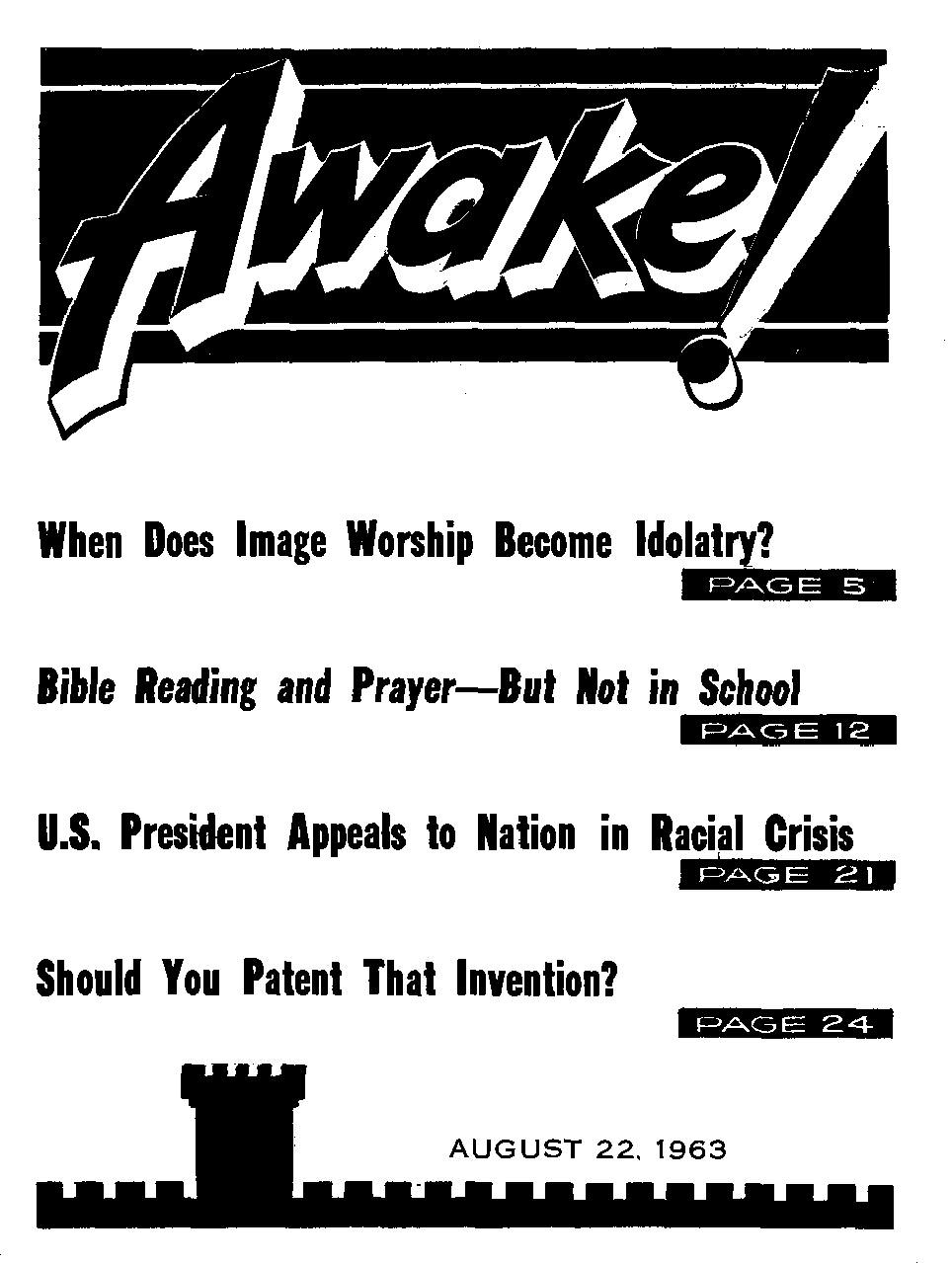
When Does Image Worship Become Idolatry?
PAGE 5
Bible Reading and Prayer—But Not in School
PAGE 12
U.S. President Appeals to Nation in Racial Crisis
PAG EE I
Should You Patent That Invention?
AUGUST 22. 1963
THE MISSION OF THIS JOURNAL
Newssources that are able to keep you awake to the vital issuer of 6iil times must be unfettered by censorship and selfish interests. "Awake!” has no fetters. It recognizes facts, faces facts, is free to publish facts. It is not bound by political ambitions ar obligations; it is unhampered by advertisers whose toes must not be trodden on; it is unprejudiced by traditional creeds. This journal keeps itself free that it may speak freely to you. But it does not abuse its freedom. It maintains integrity to truth.
"Awake!” uses the regular news channels, but is not dependent on them, its awn correspondents are an all continents, in scores of notions. From the four corners of the earth their uncensored, on-the-scenes reports come to you through these columns. This journal's viewpoint is not narrow, but is international. It is read in many nations, in many languages, by persons af all ages. Through its pages many, fields of knowledge pass in review—government, commerce, religion, history, geography, science, social conditions, natural vyonders—why, its coverage is as broad as the earth and as high as the heavens.
“Awake!” pledges itself ta righteous principles, to exposing hidden foes and subtle dangers, to championing freedom far all, to comforting mourners and strengthening those disheartened by the failures of a delinquent world, reflecting sure hope for the establishment of a righteous New World.
Get acquainted with "Awoke!” Keep awake by reading "Awake!"
M !■ Ml w He
Published Simultaneously in the United States by the WATCHTOWER BIBLE AND TRACT SOCIETY OF NEW YORK, INC, 117 Adams Street Brooklyn 1, N. Y., U. S. A.
and in England by WATCH TOWER BIBLE AND TRACT SOCIETY
Watch Tower House, The Ridgeway London N.W. 7, England
N, H. Knorr, President Gbant Suiter, Setiretary
Printing this issue; 3,800,000 4d a copy (Australia, 5tf; South Africa, S’/aC)
“Awake!" Jt publlihrt In the following 25 FlMdtdBC UaaftttneeB far Bubscrtpthna should be Rent to the office
Sea I monthly—Afrikaans, Clnyanjs, D&iilBh, Dutch, En- in yuur country. Otherwise send your remittance to
giWi, French, German, Greek, Italian, Japanese, London, Notice Of aapltatlon Is sent at least two issuep
Norwegian, PorUJgiiese, Spanish, Swedish, Tagalog, Zulu, before sutatfiptlDTi expiree.
Monthly—<3ebu*ViM?iran, rhiiicie, Tlocano, Korean, Malayalam, Pntish, Tamil. Ukrainian. Yearly subscription Ofltew for semimonthly edl
America, U.S., 117 Adama St, Brooklyn 1, X Y. Australia, 11 Beresford Rd.. StratMteld, X.S.W, Canada, 150 Bridgeland Are., Toronto 10, Out. England, Watch Tower Uoitse, The Ridgeway, London N.W, 7 Hew Zealand. Nr-w North Rd., AuekUud, S,Wr 1 South Africa, Private Bag 2, P.O. Elioiisfnnt.eln, Tri. Monthly editl^iN cost half the above rates.
rales
tlone
$1
8/-$1
7/
7/’
fOe Entered as second-class matter at Brooklyn, N.Y. Primed In England
CHANGES OF ADDRESS should reach us thirty days before your moving date, Give us your old antf new address (If possible, your old address label). Write Watch Tower, Watch Tower House, The RldQmwa.y, Loudon N.W. 7, England.
The Bible translation used in ‘‘Awake I" Is the New World Translation of the Holy Scriptures, 1961 edition When other translations are nud the following symbols wilt appear behind the citations:
AS - American Slumlord Version AT - An American Translation AV - Authorized Version (1611'1 Da I N. DarLy’s version
-Qy - Catholic Douay version £D - The Emphatic DLaglutt JP — Jewish Publication Sne. Le - Isaac Letter's version
Mo —James Moffatt's Ferdon Ro - J. B. liotherbam’s version RS - Revised Standard Verdon
Yp — Robert YouhrS version
CONTENTS
Wrong with the Crowd or Right Alone? 3 When Does Image Worship
Become Idolatry?
Altars to Gods Named “Unknown”
South America’s Stimulating
Beverage: Mate
Bible Reading and Prayer
-But Not in School
Health Hazards in the Tropics
Only Family Function Left?
U.S. President Appeals to Nation
In Racial Crisis
Should You Patent That Invention?
“Your Word Is Truth”
Is Jehovah God Omnipresent?
Watching the World
ON OCCASION evidence comes to light proving the majority to be wrong.
When this happens, what will you do? Will you choose to be wrong with the crowd, or will you stand alone for what you know to be right?
It is easier, and often profitable materially, to go along with the crowd in a passive way; whereas to deviate from the popular course of the majority may mean ridicule, ostracism and perhaps even physical abuse. This prospect terrifies many people into the mold of conformity. To soothe their consciences they may rationalize that since so many are doing what is wrong, it could not be so bad. They may even cite evidence and arguments, which in their hearts they know are not conclusive, in an effort to condone their actions.
Last summer the noted Mayo professor emeritus Walter C. Alvarez pointed to this failing of many doctors. Writing in an editorial in the journal Modem Medicine, August 6, 1962, he said: “Today we doctors tend to follow the leader. For instance: probably all of us with any education know that penicillin has no effect on the virus of colds; also that the widespread giving of penicillin is giving rise to serious trouble with penicillin-resistant staph, but because today practically every physician gives penicillin the minute he sees someone with the sniffles, every young doctor starting out in practice follows suit.”
Similarly, leading physicians have also pointed to the danger in the popular medical practice of giving blood transfusions. In fact, reports from the Department of Health, Education and Welfare, cited by
Dr. Max M. Simon in the New York Times of September 11, 1962, revealed that in the United States blood transfusions were responsible for the death of some 16,500 persons in 1961. “It is really hard to understand,” observed Dr. Alvarez, "why thousands of us doctors keep ordering transfusions—for patients who are not in shock and not in any great danger.” Evidently it is because they find it much easier to follow the medical practice of the majority than to stand alone for what is right!
In his editorial, Dr. Alvarez illustrated “how impossible it is for many a physician to 'say or write anything that would cause him to depart from the ‘party line*.” He told how the great European physiologist Dr. R. Magnus some years ago “reported that denervated smooth muscle does not contract rhythmically. This statement
promptly went into all of our textbooks on physiology, and I imagine it is still there.”
However, Dr. Alvarez explained that when he took the trouble to read in German all of Magnus’ long papers, he found that later, when Magnus “improved his technic, he obtained denervated muscle that contracted rhythmically.” Dr. Alvarez even found the place where Magnus “apologized for his earlier mistake.”
One would think that a person informed of the error would be anxious to make a correction. But not so. Dr. Alvarez said that when he “showed this statement to a professor of physiology who could read the original German, he refused to change the quotation in his textbook; he admitted that he would much prefer to be wrong with the crowd than right and alone.”
But this attitude is not limited to the medical field. It permeates every phase of life. Few persons have the backbone to stand up for what is right when it is not popular. A little pressure of public opinion, or from persons of influence, and people will often choose to be wrong with the crowd instead of taking the side of truth and righteousness.
The Saturday Evening Post of June 8 reports concerning the efforts of the district attorney of New Orleans, Louisiana, to enforce the laws against gambling, prostitution and other vices so prevalent in one section of the city. Since the many places of ill-repute there are a tourist attraction, and thus furnish a chief source of revenue to the city, tremendous pressure is being exerted to prevent the cleanup. The complaint of one cab driver is typical: “Somebody’s gotta stop that guy.”
However, a well-known New Orleans madam named Norma did not sound so alarmed. She explained: “I’ve seen D.A.’s become ex-D.A.’s, and police chiefs become ex-police chiefs, and mayors become exmayors. But I’ve never become an exmadam.”
It is this same pressure of the crowd that sweeps many youngsters into the whirlpool of juvenile delinquency. Just as with their elders, they find it much easier to go along with others in wrongdoing than to resist and stand up for what is right.
The situation is similar when it comes to matters involving religion. When the Jews accused Jesus, the Roman governor Pontius Pilate investigated the charges and reported: “I find no fault in him.” Pilate knew Jesus was innocent and “kept on seeking how to release him.” But when the crowd put the pressure on, Pilate succumbed and had Jesus put to death. He chose to be wrong with the crowd instead of right and alone.—John 19:1-16.
While it is true that the majority are not always wrong, when it comes to practicing the true religion, Jesus showed that in this old world they would be. “Broad and spacious is the road leading off into destruction, and many are the ones going in through it,” he said. Jesus also pointed to the fact that the majority of the people “took no note” when Noah preached to them, and, for that reason, “the flood came and swept them all away." He warned that it would be the same at this time, when God promises to bring a similar destruction.—Matt. 7:13, 14; 24: 37-39; 2 Pet. 2:5.
This raises the questions: What will you do when you are shown from the Scriptures that many popular creeds and teachings of Christendom are false? How will you react when you learn that the human soul is not immortal, that hell is not a place of fire, and that the Bible does not teach a trinity? Will you prefer to go along with the popular misconceptions, or will you stand alone for what you know to be right? Your decision involves your life.
IMAGE WORSHIP J
WE LEAVE Paris behind and head out into the French provinces. Passing Versailles and its famed palace, we continue on southwest toward Chartres, a religious center since before the time of Christ. When this town is still a few miles away, the spires of its distant twelfth-century cathedral seem slowly to rise out of the fields of gently waving wheat. Thousands of tourists route their French trip this way to admire the cathedral’s amazingly well-preserved twelfth- and thirteenth-century stained-glass windows. Pictures on at least seven of these windows depict the struggle against idolatry. In these pictures Roman Catholic “saints” destroy idols and refuse to worship before them; idols fall due to the faith and the preaching of the “saints.”
Many Protestants, who often consider the images before which Catholics pray to be idols, may be surprised at seeing this. But any well-informed Catholic knows that his church views idols as despicable, and considers idolatry to be a grave sin. He views idols as pagan, satanic and representations of heathen gods; while he considers his images to be sacred aids to worship and representations of “saints”—of persons who, because of their holiness, were much nearer to God than he is, and who may even have been noted for their activity in destroying pagan idols.
idol or image?
However, the words “idol" and “image" have the same origin. “Idol" comes from the Greek word eidolon, which simply means “image.” A famous French Catholic theological encyclopedia says: “Idol in general means image, figure, representation.”1 A many-volumed French dictionary adds that “idolatry signifies nothing else, etymologically speaking, than the worship of images.”2 Thus the book of Bible texts “Make Sur&of AU Things” properly defines idolatry as the "veneration, excessive love, worship or adoration of any made image, idol, representation or symbol of anything."
God’s servants were warned against such veneration. In the Ten Commandments
God gave to Moses, He said regarding their worship, at Exodus 20:4, 5:* “You must not make for yourself a carved image or a form like anything that is in the heavens above or that is on the earth underneath or that is in the waters under the earth. You must not bow down to them nor be
* Catholic lists normally eliminate this commandment, considering It as a part of the first commandment: 11 Tou must not have any other Gods against my face." To keep ten, they divide the final commandment against covetousness, making the ninth commandment condemn desiring your fellowman's house, and the tenth condemn desiring his wife. However, the Catholic translation by Crampon disagrees. He says, in a footnote on Exodus 2fkYI. that rounder ifcg the wsTTiTirdniTneiit to be against adoring other gods, and the second to forbid adoring "God through Images" "seems more natural and better supported by the context.” induced to serve them, because I Jehovah your God am a God exacting exclusive devotion."
The fact that images should not be given special service or special honor is supported by Roman Catholic translations of the Bible. For example, the French translation by the Catholic priest Crampon says: “You must not bow down before them, and must not serve them.” And the French Catholic translation by Glaire says: “You must neither adore them nor honor them: for I am the one who is the Lord your strong God."
A footnote in English-language editions of the Catholic Douay version says that what is condemned are images that are “made to be adored and served,” “or are worshipped with divine honour.” Thus, even according to this Catholic definition, images can easily become idols—depending upon the honor the worshipers give them.
There is nothing wrong with images as such—with pictures, photographs, sculptures or statues. The danger comes when people ,bow or pray before them. When people worship before an image, the particular image can take on a special value in the worshiper’s mind. This is evident when crowds are seen praying before a certain image, and not before another image of the same “saint” in the same church. Persons who use images to honor “saints” claim such worship is bad only if it replaces the worship of God. However, if part of the worship goes to the image, or even to the “saint” it represents, then not all of it is going to God. He is not getting the exclusive devotion about which he spoke when he forbade bowing before images.
The ease with which worshiping images, or worshiping men, or even worshiping angels, can become idolatry is shown by Migne’s monumental French Catholic theological encylopedia (3 series totaling 168 volumes), which says that some authorities believe idolatry started with the worship of angels. “First they were given a little respect, based on the excellence of their nature and on the aid we get from them; then they were given a worship inferior to that which is due God; finally they were worshipped without relation to God.”8 If the worship of holy angels could lead to idolatry, then the worship of even holy humans, whom the Scriptures say are “lower than angels,” could lead to the same end.—Heb. 2:7.
Throughout the earth “primitive” peoples use images as an essential part of their religion. God’s true servants, however, do not do so. It is true that God’s people in Bible times had images, but they did not bow before them, except when they fell victim to despised idolatry. Cherubim were placed on the ark of the testimony, but the people did not worship before them. Lions and bulls were included in the decoration inside the temple at Jerusalem, yet the people did not bow before them. Carved bulls supported the huge basin in the temple courtyard, but they were not objects before which people worshiped. In fact, God’s chosen people considered this such a serious danger that they made very few images. Thus a footnote by Vignouroux in Glaire’s Catholic Bible translation says: “The command not to make statues was so well observed, except in the cases of idolatry, that strictly speaking, no real Jewish art exists.”4
The First Christians
Not only did faithful Hebrews realize the importance of not bowing before images, but so did early Christians. They viewed it as idolatry, since it meant bowing before a man-made thing, instead of only before God. The Biblical vocabulary (Vocabulaire BibZi^ue) published under the direction of Jean-Jacques Von Allmen, says, on page 127: “Paul gives an explanation of Idolatry that merits the greatest attention. (Rom. 1:18-25) It is not, as is often thought, a sort of first stage or infancy of religion, from which would come, by a development or evolution, the so-called superior, spiritualist and monotheistic forms; it is on the contrary the result of a fall, a perversion of the original and authentic knowledge of God.”
History clearly shows that the first Christians, with their authentic knowledge of God, did not pray before images. M’CIin-tock and Strong’s Cyclopedia says it was the very lack of images among early Christians that brought upon them the “charge of atheism.”’ Apparently the pagans could not imagine the Christians’ being able to worship a God they could not see. Is not the thinking of those who contend images should be used to keep the worshiper’s mind on the object of his prayers thus closer to the thinking of the pagans than to that of the earliest Christians?
The first Christians, like the Jews, considered worship before images to be a form of idolatry, which they shunned in all its forms. The noted “Church father” Tertul-lian, in a vigorous attack on idolatry, referred to “the many shapes in which idolatry in all its breadth must be foreshunned. For in many ways it overthroweth the servants of God, and that not only when unrecognized but also when disguised.”—De Idololatria> chap. II.
In a statement that would certainly include the worship of human creatures, even of faithful creatures whom the apostle called “holy ones” or “saints,” Tertul-lian said: “Human error therefore wor-shippeth all things, save the Creator Himself of all things. The images of these are idols: the consecration of those images idolatry.” He declared that we must “shun like a pestilence every breath of it even afar off, not only in those things of which we have before spoken, but in the whole range of human superstition, (whether in the service of its own gods, or of dead men, or of kings,) ... ”8
The type of Image worship now practiced in Christendom had not yet developed in Tertullian’s day, so is not specifically mentioned by him. Yet the Holy Scriptures show that special honor is not to be given to Individuals—not even to one of Jesus’ twelve apostles! When Cornelius fell at the apostle Peter’s feet and did obeisance to him, Peter said: “Rise; I myself am also a man.” (Acts 10:26) And images do come under Tertullian’s heading “of dead men” —the persons the images represent, and who often are of a lesser stature than was Peter.
That at least some people have gone too far in their use of images, making veritable idols out of them, is obvious. In the year 599 Bishop Serenus of Marseilles, France, was so disturbed by the way he saw images being worshiped that he ordered that they be destroyed from all the churches of his diocese. Pope Gregory the Great wrote him: “I praise this, that you were zealous, that nothing made with hands should be worshipped.”7 But he added that the images should not be destroyed, since they enable illiterate persons to read on church walls the things they could not read in books. However, the images continue to carry far more significance than merely illustrating Biblical or Catholic history. They are addressed by name, decked with flowers, bowed before, paraded in the streets and continue to receive, at least at times, as much honor as the pagans gave their idols. In the eighth century Greek Catholic priests went so far in their belief that the images had taken on a value of their own that they scraped their “miraculous” paintings and served the chips in the communion wine given the worshipers.8
Special Honor
The Roman Catholic Church’s position was stated by the Council of Trent, which said the images are not adored the way idols are, “as if the Divinity resided in them, or as if we would ask them a favor, or put our confidence in them, as the pagans do their idols.”0 But can it really be said that confidence is not placed in the image—if not in theory, at least in practice?
When a particular image is termed “miraculous,” then confidence is placed in the particular image, in violation of the Scriptural commands and the early Christian example. Further, it is common to hear people speak of the worship, not just of a certain “saint,” but of a certain image. Cards at the church of Saint Augustin in Rome say of an image there: “The celebration in honor of this religious image is held the seeded Sunday of October under the name of the Maternity of the Most Holy Mary.” Exactly what is honored? Mary? No, as the *cards say, it is “this religious image.”
It 1s evident in the cathedral at Chartres, already mentioned, that worshipers consider some images more important than others. A small book, Les Trois NotreDame de la Cath&irale de Chartres (The Three Our-Ladies of the Chartres Cathedral) by the Canon Yves Delaporte, sold in the shops around the cathedral, says: “Perhaps there is no other monument as rich in images of the Holy Virgin as the Chartres cathedral [this book lists 175 of them]. But these images, sculptured, painted or appearing on the stained glass windows, are not equally famous. ... Only three are the object of a real worship: Our Lady of the Crypt, Our Lady of the Pillar and Our Lady of the ‘Belle Verriere’.” This Catholic book proves conclusively that people consider the particular image before which they bow to be important, and that it is not just a reminder of the person to whom the worshiper prays, but that the image itself has an importance in their mind. It says, on page 45, that the image “Our Lady of the Pillar” “still existed in the eighteenth century but it had lost its fame as an object of worship; it was before the Virgin of Wastin des Feugerets [another image] that people came to pray.”
Chartres’ most famous image, however, was “Our Lady of the Crypt.” The most shocking fact is that this image was long believed originally to have been a Druid idol. Catholic Canon Estienne claimed, m 1682, that the pagan Druids had worshiped before it “more than three or four hundred years” before Christ. Others disagree with him, but the fact that prayers intended for the Supreme God could be said before what was thought to have been a pagan idol shows that little distinction was made between “images” on one hand, and idols on the other.
“Supernatural” Origins
The Catholic Encyclopedia criticizes the excesses of image worship in the East in the eighth century. It says the image “seems to have been in some sort the channel through which the saint was approached,” and “seems to have had a kind of personality of its own, inasmuch as certain pictures were specially efficacious for certain graces.” We have seen that, in many cases at least, the same holds true today.
However, the Encyclopedia says: “If so much reverence was paid to ordinary images ‘made with hands,’ how much more was given to the miraculous ones ‘not made with hands.’ Of these there were many that had descended miraculously from heaven.”10 The Encyclopedia criticizes the excessive reverence paid to these images in those ancient days, but even in modern times particular images have gained importance in the people’s mind through local legends that attribute “miraculous” origins to them.
Such legends were not discouraged by local priests who saw pilgrimages to their church grow as people came to worship before the image. An example is found in the booklet still sold in the chapel of Notre-Dame-sur-Vire, near Saint-Ld, France, which tells of the miraculous discovery of an image seen there. The booklet says this small image was caught in a fourteenthcentury fishermen’s net, and that it provided such a resistance that it stopped their boat’s downstream progress. When finally they gut to the bank and threw the net on the shore, the shock broke the image in two. But, “oh wonder!” the booklet says, “there under their amazed eyes, the two parts came closer, rejoined and welded themselves together.”" The crack, without the thinnest trace of mortar, this church booklet says, can still be seen. This story certainly is not included in this booklet to discourage the giving of special attention to this particular image. The authorities who honor such pamphlets with their church’s imprimatur cannot be surprised when readers ask if religious leaders who made no protest against such legends have not soiled their churches with idolatry.
The same chapel has a second image for which a miraculous origin has been claimed. The booklet says a sheep, despite the sheepdog’s bite, returned regularly to a spot where there was so little grass that it got only a few sprigs a day to eat. Yet it was by far the “fattest” of the flock. The shepherd’s curiosity prompted him to dig an immense hole there, and at the bottom he found an image of Mary. It is not impossible, the booklet says, “that imagination somewhat embellished this marvelous story." But it adds: “The fact is there, certain and undeniable; the statue exists, object of the worship and of the veneration of several generations for twenty leagues [50 miles] around.”"
What does it say has been venerated? Mary? No, it says it is “the statue” itself!
This booklet, bearing its church’s imprimatur, further shows that such images receive special honor when it says young married couples “go down to the Chapel to place their union under the protection of Our Lady on the Vire.”11 Under whose protection? Mary’s? No, but under the image’s protection. Mary is not named “Our Lady on the Vire”—the image is!
Magic Charms
Further, images often are not viewed as representations of holy persons to be worshiped, but are viewed (as pagan idols also are) as magic charms, used to gain special favors. This is shown by the church-approved history La Vie Religieuse au Temps de Saint Louis (Religious Life in Saint Louis’ Time), which says: “If they did not fulfill their mission,the saints sometimes suffered the public’s anger. Thus, at Rodez [in south-central France], the images of the saints were driven on horseback after the service and, when it stormed, beaten and covered with insults.”1-
Is this the way “images” are supposed to be used? It is not the way God’s chosen people of ancient times used them—they bowed before no images. It is not the way first-century Christians would have used them—they viewed special honor given to images as despised idolatry. Remember, the word “idol” comes from the Greek eidolon, the word for “image.” So any difference between an “image” and an “idol” depends only on the use to which the image is put.
Thus a prime question is: How is it used? An ornamental or educational painting or statue before which no one bows is not an idol. But when a person kisses the toe of the image of St. Peter that is in the Vatican (or a copy of that image), but does not do the same before other images purported to represent Peter, is he doing this because of Peter, or because of the particular image? When a man buys a Saint Christopher’s medal and puts it on his car, does he think: ‘Now I’ll think of Saint Christopher’ ? Or does he think: ‘Now I have the medal’? If having the medal makes even a slight difference, if in his mind having the medal with Christopher’s image on it has changed something, then the medal itself has value in his eyes. He is, in the words of the Council of Trent, among those who “would ask them a favor, or put our confidence in them, as the pagans do with their idols.”
And persons who use idols are, according to Jesus, in dangerous company. He put them among “those who practice spiritism and the fornicators and the murderers” and among the others who will be cast out, and have no part in his new world of righteousness. (Rev. 22<15) How much better it, is to stay clear of all trace of image worship, and, as Tertullian said, to shun “every breath of it even afar off”! Thus one should pray, not before an image of a “saint,” but the way Jesus said to pray— directly to the Father, in the Son’s name. Jesus said to pray: “Our Father in the heavens . . .,” and: "Whatever it is that you ask in my name, I will do this.” No other persons have the right, or even the possibility, to be intercessors for you. The inspired Scriptures are clear on this when they definitely say: “For there is one God, and one mediator between God and men [not a ‘saint’ before whose image people bow, but], a man Christ Jesus.”—Matt. 6: 9; John 14:13, 1 Tim. 2:5.
SOURCES
i Encyclopedic Thdologigue, Mlgne, published at Fetlt-Montrouge, France, 1850, First Series, Vol. 34, col. 1253.
2 Grand Dictionnaire Universel du XIX’ Siicle, Vol. 9*. p. 574.
2 Encgalopedie Thdologique, First Series. Vol. 2, cols. 789, 790.
4 La Sainte Bible, Glaire and Vlgnouroux, Faris, 1924, footnote on Deuteronomy 4:16.
a M’CUntock & Strong’s Cycloptedia, Vol. 4. p. 303. s Tertuliian, De Idololatrius, chaps. II, IV, XIII.
Dodgson's translation, published in “A Library of Fathers of the Holy Catholic Church,” Oxford, 1842. ■
t Library of Fathers (volume on Tertuliian), p. 114. s Les Monuments Ditruits de I'Art Francois, by Louis R4au, Paris, 1959, p. 20.
a Dictionnaire des Religions, by E. Royston Pike, quotation from French adaptation by Serge Huttn. Paris, 1954, p. 158.
io The Catholic Encyclopedia, New York, 1910 Vol. 7. p. 668.
11 iYotre-Ltame-sur-Vire, by R. P. Lemaltre, Bayeux, France, 1945. pp. 8, 10, 12-15, 32.
is La Vie Religieuse an Temps de Saint Louis, by Germaine Maillet, Paris 1954, p, 155, ftn. 2.
Altars to Gods Named “Unknown”
When the apostle Paul was in ancient Athens, he saw an altar on which had been Inscribed “To an Unknown God,” (Acts 17:231 Not long after the time when Paul was in Athens, the city was visited by a wandering philosopher known as Apollonius of Tyana, who is reported to have said: “It is a much greater proof of wisdom and sobriety to speak well of all the gods, especially at Athens, where altars are set up in honor even of unknown gods.” When the geographer Pausanias visited Athens in the second century A.D., he reported in his Description of Greece that on the road from the Phaleron Bay harbor to the city he had observed “altars of the gods named Unknown, and of heroes.” He also speaks of “an altar of Unknown Gods” at Olympia. A similar altar was discovered m 1909 at Pergamum in the precincts of the temple of Demeter. And in Rome on the Palatine Hill is an altar, dating from about 100 B.C., with the inscription Sew deo sen deivae sacfrum], “Sacred to a god or goddess.”—Light from the Ancient Past, by Jack Finegan, pp. 276, 277; also The Bible Was Right, by Hugh Schonfleld, chap. 34.
Sy “Awak«l" correspondent in
Brazil
MATE
WHEN think-JJling of the ■Iworld’s most
popular stimulating beverages, many persons will list only tea, coffee and cocoa. But if one lives in South America, he will probably add to the list mate. Coffee, of course, is also used considerably in South America, but matt is basically a South American drink and is used extensively throughout this continent. Matt, in fact, is used almost everywhere in Brazil, where it is served as the popular drink called chimarrao.
From where is matt obtained? From the leaves and green shoots of certain species of holly, which are dried and ground. This plant is a shrub or small tree with smooth, shiny leaves about four inches in length. The fine stems are cut, then the green leaves are broken off and tied in bundles. These are transported to a place for parching and drying. After this the mate leaves are ground to a fine powder.
Just what is Brazil’s chimarrao? A Brazilian might make this stimulating beverage this way: First, he gets a' gourd, called a cuia, which grows on the calabash tree. When it is dry it becomes hollow. He cuts off the narrow end and makes a cup of it. Since the demand is very great, cuia growers have developed a good business, some of them painting beautiful scenes and decorations on the gourds.
Great care is now used in making the chimarrao. The mate maker fills the cuia two-thirds full of ground matt leaves, gives it a few quick shakes to form a crest and adds a little cold water. After the matt has absorbed the cold water, freshly boiling water is poured into it. The chimarrao is now ready.
Now comes the straw. A special metal straw is used for sucking up the matt. The end that
Is Inserted Into the cuia of hot matt is shaped like a shallow scoop with fine 7 slevellke holes that strain and filter the beverage as it is being drawn through the strawlike tube.
Traditionally the matt maker drinks from the gourd first. Then he fills it up again with boiling water and passes it to the next person to his right, when sitting in a circle of friends. This continues until all are served. Having all persons drink from the same straw is said to symbolize friendship, peace and unity. The latest hygiene teachings, however, advise that each person use his own straw, which he should take with him.
While chimarrao is quite common in the cities, it is still more familiar and a part of daily life in the interior among farmers and livestock raisers. The South American cowboy or gaucho spends much of his leisure time sipping chimarrao, and many families spend several hours a day drinking it.
Why is mate viewed as so refreshing and restorative in its effects? The main reason may be its content of theine or caffeine, which is also the source of the stimulating effect of coffee, tea and cocoa.
Some persons become so addicted to chimarrao that they arise every morning about five o'clock and drink for two hours untH they go to work. During that time they consume several kettlefuls of hot water. They are usually so accustomed to the drink that if they failed to have it, they would suffer from a bad headache all day. Others would rather miss a meal than miss chimarrao. After having early morning chimarrao, many do not eat until midday.
When Jehovah's witnesses preach from house to house, they are often invited to have a chimarrao. This affords an excellent opportunity to discuss the more invigorating good news of God’s kingdom to attentive listeners. Nevertheless, Jehovah’s witnesses do not have the time to ait for hours sipping mate, nor do they drink it to such an extent that they become addicted to it. Being well-balanced, they drink chimarrao without allowing it to interfere with Bible study and attending Christian meetings. Wherever they live, if true Christians use stimulating beverages, whether matt, coffee or tea, they do so in moderation, choosing the right time and place.
! BIBLE READING Ai PRAYER
HERE is the place for religious exercises such as the recitation of prayers? Does it belong in public schools? That is the question
the
United States Supreme Court recently pondered and answered with an emphatic, Not in public schools!
In an 8 to 1 opinion handed down June 17, 1963, the American high court set
.'8«!
by asking that their children be excused from catechism classes.
In England the law provides for public schools to have religious exercises such as Bible reading and prayer, but there is provision for a pupil to be excused. As to the cases that came before the United States Supreme Court, there was also provision in the law for a child to be excused. Why, then, did the Court rule out
forth the reasons why religious exercises
do not belong in public schools. What will be the effect of this ruling? What about using* the Bible for teaching in schools? How should Christians view such a decision? Those who live in countries where religious exercises'Sre permitted in schools can also learn something from this historic legal case.
Countries, of course, differ considerably in regard to religious exercises in school. In some state-church countries the state runs the schools, and compulsory religious exercises are often required of some or all the students. Under the agreement Franco made with the Vatican, for instance, “the Church regained its place in the national budget. It insists on baptizing all children and has made the catechism obligatory in
Bible reading and prayer? The Court decided that the basic issue hinged on the First Amendment to the United States Constitution: “Congress shall make no law
respecting an establishment of religion or prohibiting the free exercise thereof.”
Establishment Clause Violated
The majority opinion of the Court said: “In the light of the history of the First Amendment and of our cases interpreting and applying its requirements, we hold that the practices at issue and the laws requiring them are unconstitutional under the establishment clause.” Thus the Court held that prayer and Bible reading as they were practiced were religious exercises and so could not be sponsored by state law.
The attorney representing the State of Pennsylvania contended that the exercises were held only for moral value. But Chief
state schools."' Thus “in
Spain the spirit of Catholicism is so militant in the national schools that even the Communists prefer not to advertise their dissidence
Justice Earl Warren asked him: “If the state required 1 children to say the Lord’s Prayer, would you say that was constitutional?” His answer: “I would make a dis-
tinction between prayer as a formal religious act and Bible reading as a nonreligious act aimed at teaching morality.’”
The attorney for the city of Baltimore, Maryland, however, defended both Bible reading and prayer as not constituting a “religious act.” He said the purpose was to calm the pupils. In the Pennsylvania case the deputy attorney general for the state claimed Bible reading in school was not a “religious practice.” But he closed his argument with a counterclaim that “ripping out this practice would express hostility to religion.”3
The reaction to the Court decision prohibiting prayer and Bible reading as public school requirements was varied. Protestants in general hailed the ruling as keeping church and state separate. Some Protestant leaders protested. Evangelist Billy Graham lamented: “I can see God being driven from our lives. ... I don’t believe that a small minority should rule the majority of the people; 80 per cent of Americans want prayer.”4 The National Council of Churches, however, said the decision served as a reminder that “teaching for religious commitment is the responsibility of the home and the community of faith . . . rather than the public schools,”3 Jewish opinion in general was favorable. The loudest protests came from Roman Catholics. Three cardinals in the United States deplored the ruling, even though Catholic parochial schools are not affected by the decision. Cardinal Cushing of Boston even urged an amendment to the Constitution to allow devotional reading of the Bible in public schools.6
The Two Cases
The decision actually involved two cases. In one, the Schempp case, a family in Pennsylvania opposed the state law requiring reading by one of the students of ten verses in the Bible. Then students were asked to stand and join in repeating the Lord’s Prayer. Participation in the exercises was voluntary, and students could be excused. But the Schempp family, of Unitarian faith, decided it would adversely affect the children, causing them to be viewed as “odd balls,” if they asked to be excused.
The second case involved the ruling of a Baltimore, Maryland, school board that required Bible reading “and/or the Lord’s Prayer" at the opening of the school. The case was brought by Mrs. Madalyn Murray and her son, both professed atheists. It was said that the son was subject to taunts and physical assault in school because of his having objected to the exercises.
In the Court’s 8 to 1 decision, the lone dissenter was Justice Potter Stewart, who based his dissent on the fact that there was no proof of coercion. He felt the issue was whether or not pressure was brought to bear on the pupils to participate. In both cases there was provision for the students to be excused, but they did not avail themselves of the provision. The dissenting justice, however, did see in the state law “the dangers of coercion.” Despite the provision for excusal, he said such dangers are greater in the schoolroom than in adult situations.
Position of Neutrality
Besides the Court’s majority opinion, written by Justice Tom C. Clark, there were three concurring opinions, all joining Justice Clark’s views but adding more observations. The Clark opinion discussed the religious background of the United States, how the “Founding Fathers believed devotedly that there was a God,” how “only last year an official survey of the country indicated that 64 per cent of our people have church membership” and how “today authorities list 83 separate religious bodies, each with memberships exceeding 50,-000, existing among our people, as well as Innumerable smaller groups.”1 What is to be the role of government in a country with such deeply ingrained religious beliefs? The Court said it must be absolutely neutral, and quoted Judge Alphonzo Taft: “The Government is neutral, and while protecting all, it prefers none, and it disparages none.”
Does this position of neutrality toward religion apply just to the Federal government or also to the state government? Justice Clark said that the establishment clause of the First Amendment “has been made wholly applicable to the states by the 14th Amendment,” adding that this was done “twenty-three years ago, in Cantwell v. Connecticut "t It was in the Cantwell case, he said, that the interrelationship of the establishment clause and the free exercise clause was “first touched upon by Mr. Justice Roberts,” who said the clauses’ inhibition of laws had a “double aspect.” That is, “on the one hand, it forestalls compulsion by law of the acceptance of any creed or the practice of any form of worship. . . . On the other hand, it safeguards the free exercise of the cho-. sen form of religion.”
How did the Court view the fact that students could be excused from the religious exercises? Justice Clark wrote: “Nor are these required exercises mitigated by the fact that individual students may absent themselves upon parental request, for that fact furnishes no defense to a claim of unconstitutionality under the establishment clause. . . . Further it is no defense to urge that the religious practices here
-"The full text of all the opinions In the Sckempp and Murray cases appears In The United States Law Wee); of June 18, 1963. The full text of the Clark opinion and Stewart’s dissent appears In the New York Times of June 18, 1963.
f The Cantwetl case Involved one of Jehovah’1 witnesses who. while presenting Bible truths that expose false religious beliefs, was arrested and charged under a state law with disturbing the peace and not having a permit to obtain contributions for Bible literature. The Supreme Court upheld the right of Jehovah’1 witnesses to preach without interference. may be relatively minor encroachments <hi the First Amendment, The breach of neutrality that is today a trickling stream may all too soon become a raging torrent and, in the words of Madison, ‘it is proper to take alarm at the first experiment on our liberties.’ ”
Bible Not Outlawed for Schools
The Court’s decision prohibited religious exercises in public schools but allowed for an objective study of religions and of the Bible.
What of the argument that the majority prefer having the religious exercises in school? The Court stated: “While the free exercise clause clearly prohibits the use of state action to deny the right of free exercise to anyone, it has never meant that a majority could use the machinery of the state to practice its beliefs. Such a contention was effectively answered by Mr. Justice Jackson for the Court in West Virginia Board of Education v. Barnette."1 Justice Jackson had said: “The very purpose of a Bill of Rights was to withdraw certain subjects from the vicissitudes of political controversy, to place them beyond the reach of majorities and officials. . . , One’s right to . . . freedom of worship ,.. may not be submitted to vote.”
Hie Clark opinion concluded: “The place of religion in our society is an exalted one, achieved through a long tradition of reliance on the home, the church and the inviolable citadel of the individual heart and mind. We have come to recognize through bitter experience that it is not within the power of government to invade that citadel.___In the relationship between man and religion, the state is firmly committed to a position of neutrality."
A Catholic Justice Concurs
A most interesting aspect of the decision is this fact: Though Roman Catholics were the most vocal in opposing it, yet it was Justice Brennan, the only Roman Catholic on the Supreme Court, who wrote the longest opinion opposing the religious exercises. His opinion, seventy-seven pages long, viewed the exercises as violating both clauses of the First Amendment Said Justice Brennan: “While it is my view that not every involvement of religion in public life is unconstitutional, I consider the exercises at bar a form of involvement which clearly violates the Establishment Clause.”
Even with the excusal provision this Roman Catholic justice believed the exercises violated the free exercise of religion clause. He wrote:
“The excusal procedure itself necessarily operates jn such a way as to infringe the rights of free exercise of those children who wish to be excused. We have held in Barnette and Torcaso, respectively, that a State may require neither public school students nor candidates for an office of public trust to profess beliefs offensive to religious principles. By the same token the State could not constitutionally require a student to profess publicly his disbelief as the prerequisite to the exercise of his constitutional right of abstention, . . .
"Thus the excusal provision in its operation subjects them to a cruel dilemma. In consequence, even devout children may well avoid claiming their rights and simply continue to participate in exercises distasteful to them because of an understanding reluctance to be stigmatized as atheists or nonconformists simply on the basis of their request. Such reluctance to seek exemption seems all the more likely in view of the fact that children are disinclined at this age to step out of line or to flout ‘peer-group norms'. . . . The excusal procedure seems to me to operate in such a way as to discourage
the free exercise of religion on the part of those who might wish to utilize it, thereby rendering it unconstitutional in an additional and quite distinct respect.”
Effect of Decision
Justice Brennan touched on this when he quoted an Ohio governor who vetoed a compulsory Bible-reading bill in 1925, saying: “It is my belief that religious teaching in our homes, Sunday schools, churches, by the good mothers, fathers and ministers of Ohio is far preferable to compulsory teaching of religion by the state. The spirit of our federal and state constitutions from the beginning . . . [has] been to leave religious instruction to the discretion of parents.”
And how does the decision stand in the light of the Holy Bible? For true Christians it merely underscores what the Bible clearly teaches—that it is the parents' responsibility to teach their children true worship. This is made clear not only in the Hebrew Scriptures but in the Christian Greek Scriptures, where fathers are told: “Go on bringing them up in the discipline and authoritative, advice of Jehovah.” (Eph. 6:4; Deut. 6:6, 7) Christians are not to sidestep their God-given responsibility, trying to turn it over to schools or the state. God gave it to you parents. He holds you responsible, even if schools where you live have Bible reading. Rather than talk against a court decision that places the responsibility for religious training where God has already placed it, Christian parents will talk Bible truths, to put in the minds of their children the “authoritative advice” of Jehovah God.
REFERENCES
i Bates, Selisiaus Liberty; An Inquiry.
a Blanshard, Freedom uud Catholic Power in Spain and Portugal,
6 Look, June 18, 1963.
4 New York Journal-American, June 18, 1963.
s New York Times, Juno 18, 1963.
a New York Times, June 19, 1963.
He8 faz
By uAwalt»r cWMPMtdonl Brazil
FOR the many millions of people living in tropical lands, good health depends to a great extent upon their efforts to avoid parasites. These tiny enemies of human health sneak into human bodies and proceed to do a damaging work that might not become evident for quite some time. Although they are a constant danger to tropical residents, there is no reason to let them create fear about living in the tropics. Like other tropical
health hazards, they can be avoided by sensible precautions.
Parasites live at the expense of other creatures who become unwilling hosts to them. Some will gradually kill their hosts, while others will live in them for many years without making their presence especially evident. For the person who lives in the tropics, it is important to know the means parasites use to get into them and how to protect themselves.
Amoebas
Possibly the most widespread of all parasitic infections is that caused by amoebas. People of the tropics are very familiar with this microscopic animal that inhabits. freshwater and sometimes moist earth. One of the varieties that is harmful to man does not confine its activities to the tropics, however. It flourishes as far north as the Arctic Circle. In the temperate climate of the United States approximately 10 to 20 percent of the people are infected with this variety of amoeba.
One of the principal means by which people become infected with amoebas is by drinking contaminated water. Rainwater that drains from amoeba-infested land carries amoebas into reservoirs, streams and wells. From reservoirs they can be carried throughout the water system of a city. Unless such water is boiled before it is drunk, the person drinking it will be putting amoebas into his body; here they will multiply and they may eventually ruin his health. Uncooked fruits and vegetables are another avenue for amoeba infection. For the sake of safety most raw fruits and vegetables should not be eaten in tropical lands. Fruits and vegetables that can be peeled are safe, provided that amoebas are not transferred by one’s hands to the peeled food or that the fruit or vegetable is not washed in amoeba-infested water.
Due to the prevalence of amoebas in those lands amoebic infection is very easy to get unless great care is constantly exercised to drink only boiled and filtered water and to eat only vegetables and fruits that can be peeled or cooked-
In some persons amoebas will cause dysentery, while in others they will cause only mild diarrhea or no bowel disturbance at all. There are instances when amoeba infection produces only mild symptoms or perhaps none at all until serious liver damage has been done. Unless these tiny enemies to human health are destroyed soon after they enter the intestines, they will multiply and spread throughout the body, taking up residence in the liver, lungs, kidneys and other organs. Once they get into these organs, it is very difficult to get rid of them. Some types of amoebas will feed on red blood corpuscles and cause anemia.
Worms
Estimates have been made that throughout the world there are 800 million people harboring some kind of parasitic worm. Some are flat and others are round, with sizes that vary all the way from microscopic worms to those that are as much as thirty or more feet long.
Best known among the flat tape worms is the one that uses beef cattle as an intermediate host. It has many segments to its body that break off and pass away with human bowel movements. When the body wastes of a person who is infected with this tapeworm are deposited on pasturelands, the segments manage to wiggle for some distance from where they were deposited and then liberate the eggs they contain. As grazing cattle eat the grass around this spot they pick up the eggs. Once inside an animal, the eggs release larvae or baby tapeworms that bore through the intestinal wall and work their way into the muscles of the animal. There the worms wait until the animal is eaten. The person who eats the meat of this animal while it is either raw or rare will swallow the baby tapeworms. In his small intestine they will grow into mature tapeworms. Although the small intestine is only about fifteen feet long, these tapeworms can grow to tremendous lengths. The best protection against them is to follow a policy of never eating meat that is not well cooked.
Eating raw pork, such as pork that has been smoked or pickied, can also be a mean? by which a person can get a tapeworm. Pork tapeworms fasten themselves in place by securing twenty-five to fifty hooks in the intestinal wall. Claims have been made that this worm can live for more than thirty-five years if no effort is made to get rid of it. Each year it lays over one hundred million eggs.
Raw fish is the source of still another tapeworm. People get it when they eat salted, smoked or frozen freshwater fish that is uncooked. Raw salmon, which is popular in Japan, can also contain baby tapeworms that are waiting for someone to eat the meat. The same can be said of salted roes that are used as caviar. The worms grow to maturity in the human intestines. The cycle for it is kept going when untreated human wastes are dumped into a lake or a river. Sometimes a fish tapeworm will reach a length of thirty feet in a man and will have hundreds of segments to its body. To safeguard a person’s health from this worm, he should eat freshwater fish only after it has been thoroughly cooked. The most effective drugs for getting rid of the fish tapeworm as well as other types of tapeworm are very toxic and should, therefore, be administered only under careful medical supervision.
A parasitic worm that is common to the Middle East, the Far East, Africa, the West Indies and South America is known as Bilharzia. It belongs to the order of flat worms known as flukes. The larvae or offspring of this worm inhabit freshwaters where they use snails as an Intermediate host.
When a person bathes, washes clothes or in some otht>r way immerses his bare skin in water that has the Bilharzia larvae swimming in it, the larvae may pierce his skin and burrow into his body. As it does this it produces an itch. There is a lake in Brazil that is' so infested with these larvae that it is often referred to by bathers as the "Itch Lake.”
Once the larvae of this parasite get inside the human bo iy, they migrate to the liver, where they proceed to ruin the health of their unwilling host. Sometimes they will settle in the urinary bladder and in other, parts of the urinary tract. The sensible precaution against this parasitic worm is to stay cut of freshwater where it is known to exis;. Any water taken from an infested lake should be boiled before it is used, as that wvll kill the larvae.
Round Worms
A round worm that infects pigs and that produces larvae that settle in the muscles of the animal causes a sickness known as trichinosis. In the small intestine of the person who eats infected pork the larva grows into a mature worm and within a week’s time is proc .icing larvae of its own. These work their way into the muscles of the body. They aka become lodged in the brain and the he^'t. The best protection against them is to be certain that all pork is well cooked before it is eaten. Large pieces should have prolonged cooking to make certain that i he center is heated sufficiently to kill the parasite.
A small hookworm, less than one-half inch long, can cause anemia because its diet consists mainly of blood. Its eggs reach the ground through human excrement and here they hatch in warm, moist soil. A bare foot stepping on this infected ground will be attacked by the larvae.
After piercing the skin they are carried by the bloodstream to the lungs, where they climb up to the throat and are swallowed into the stomach. From the stomach they enter the upper part of the small intestine, where they take up residence and grow into mature worms. They feed upon the small amounts of blood they cause to flow by nipping the intestinal wall. A large number of these worms can cause so much bleeding that a person can develop anemia. There are certain drugs that can be used to get rid of them, but without treatment they will live in a person for as much as fourteen years. Their secretions tend to poison the body.
The parasitic whipworm enters the human body in a different manner. Its eggs enter through the mouth when a person eats raw vegetables that have been grown in soil infected with them. Children get them by playing in dirt that contains them and then putting their dirty fingers in their mouth. Persons who are severely infected have chronic dysentery and anemia. Eventually the worms may cause their death.
Ascariasis results from drinking water or eating vegetables that have the eggs of a parasite known as Ascaris lumbricoides. It grows in the intestinal tract into a large round worm that resembles an earthworm. When there is a great number of these large worms, they can cause intestinal obstruction, perforation of the intestine, blockage of the bile duct, and they might even invade the liver. Care in what a person drinks and in what he eats is again the best protection against becoming host to this parasite.
The well-known ailment called elephantiasis is the result of a parasitic worm that uses mosquitoes as an intermediate host. The larva grows into a worm in the mosquito that has picked it up from the blood of an infected person. The mosquito then Infects another person with it Usually the worm causes no harm, but in some cases tt Modes the means the body has for draining the lymph or colorless fluid of the body. This blockage causes the soft connective tissue under the skin to swell with water and fibers of scar tissue. Eventually the infected part can swell to a gigantic size. The person is then said to have elephantiasis.
How to Avoid Parasites
Because mosquitoes can carry diseases such as malaria as well as the parasite that causes elephantiasis, suitable protection from them should be sought. Nearby breeding places should be destroyed if possible. Where this cannot be done, certain incenses can be burned to discourage them, and liquid repellents can be rubbed on the skin that will keep them away for a limited time. At night a person should always sleep under a mosquito net.
An essential precaution against tropical health hazards is never to drink untreated water from a creek, river, lake or unused well. Such water is not safe, as it may contain amoebas, the eggs of parasitic worms or dangerous disease germs. In the event that such water must be used, boil it. This will destroy the eggs as Well as disease germs and amoebas. Amoebas cannot endure heat. For this reason boiled drinking water that has been filtered is the best protection against amoebas and other water-borne parasites. The boiled water should be stored in clean, tightly stoppered containers to protect it from contamination. Distilled water kept in this manner is also safe to use. Even city water can be dangerous, as it can become contaminated by amoebas and the eggs of parasitic worms that are carried into reservoirs by rainwater draining off contaminated land.
When a person is offered a drink of contaminated water he should politely refuse it It is far better for him to remain thirsty for awhile than to ruin his health with parasites. In the event that he is traveling and pure water is not available,, he can safely drink hot coffee and tea, as these popular beverages require the water used in them to be boiled.
…