Awake!, January 8, 1963
Download: PDF — Awake!, January 8, 1963
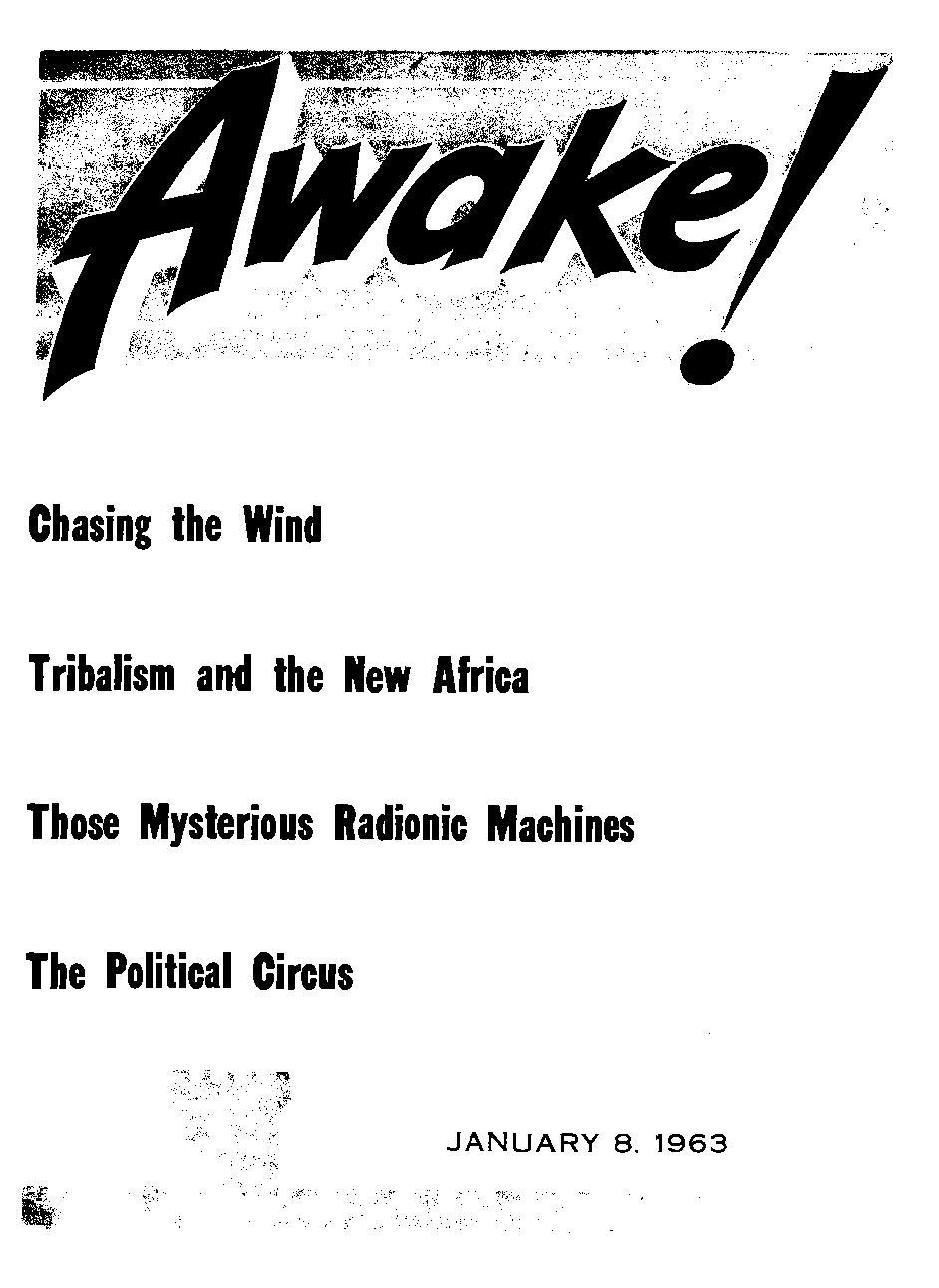
Chasing the Wind
Tribalism and the New Africa
Those Mysterious Radionic Machines
The Political Circus
JANUARY 8. 1963
THE MISSION OF THIS JOURNAL
News sources that ore able to keep you awake to the vital issues of our times must be unfettered by censorship and selfish interests. "Awake!" has no fetters. It recognizes facts, faces facts, is free to publish facts. It is not bound by political ambitions or obligations; it is unhampered by advertisers whose toes must not be trodden on; it is unprejudiced by traditional creeds. This journal keeps itself free that it may speak freely to you. But it does not obuse its freedom. It maintains integrity to truth.
"Awake!" uses the regular news channels, but Is not dependent on them. Its own correspondents are on all continents, in scores af notions. From the four corners of the earth their uncensored, on-the-scenes reports come to you through these columns. This journal’s viewpoint is not narrow, but is international. It is read in many nations, in many languages, by persons of al! ages. Through its pages many fields of knowledge pass in review—government, commerce, religion, history, geography, science, social conditions, natural wonders—why, its coverage is as broad as the earth and as high as the heavens.
"Awake!" pledges itself to righteous principles, to exposing hidden foes and subtle dangers, to championing freedom for all, to comforting mourners and strengthening those disheartened by the failures of o delinquent world, reflecting sure hope for the establishment of a righteous New World.
Get acquainted with "Awake!” Keep awoke by reading "Awake!”
Published Simultaneously in the United States by the WATCHTOWER BIBLE AND TRACT SOCIETY OF NEW YORK, INC. 117 Adams Street Brooklyn 1, N. Y., U. S. A.
and in England by
WATCH TOWER BIBLE Watch Tower House, The Ridgeway N. H. Knorb. President
Printing this issue; 3,700,000 4d a “Awake:1' is publhhai in the following 25 language*: Semimonthly - Afrikaner. Cinyunja, [Mnlwii, Dutch. Eti-glttib, Finnish, French, Cierman, Greek, Italian, Jajinnow, Norweffi^n. Portugufrie. Spanish, Swedish. TuRJilog. Zulu. Monthly ■ -CeTju-Visayan, rhinrtfi, Tlcwtano, Korean, Malayalam. Polish, Tamil, Ukrainian.
■ Yearly subscrliitiun rates
Offices for semimonthly editions
America, U.S., 117 Adams St, Brooklyn 1, N.Y. $1 Australia, 11 Beresford Rd., Strathflold, N.S.W,
Caiiatla, 150 Bridgi-land Ave., Toronto 11?, Ont.
England. Watcli iinarr Mouse,
The Hitlueway, l.oiulun N.W, 7
flew Zealand, 621 New North Bd., Auckland, S.W. 1
Sontb Africa, I'i’Jvatc Bag I' 0, Elitndsfnntein, Tvl. 70c Monthly editions coat half the ahove rates.
AND TRACT SOCIETY
London N.W. 7, England Grant Suiter. Secreiarj/
copy (Australia, 5d; South Africa, 3!/2c> Remittance* for fflibseriptJomi should he sent ti’i (he nftloe in your country. Otherwise send your remit! aur-i* Io London. Notice of expiration is sent at leiht Luu isnu^ before subscription expires.
CHANGES OF ADDRESS should reach is tflirty days before your moving date. Give us your old and new address <lf possible, your old address label). Write Watch Tower, Watch Tower House, The Ridgeway, London N.W. 7, England.
Entered as second-class matter of. Brooklyn, N.Y.
Printed J n Engl and
The Bible translation used In “Awake!” Is the New World Translation of the Holy Scriptures. 1961 edition When other translation* are used the fol lowing symbols will appear behind the citations;
AS A merle mi Htanduni Vcrsiep AT - An American Translation AV • Authorized Version (1 fill I Da ,1. N. Durhy’s version
Dy - Catholic Tkouay version ED The fhniihuLje Dlaglntt JP -• Jcwinli Publication Sue. Le - li-.aue Luder's version
Mo • .’amen Moffatt's version Ro J. B. Rotherham's v,Tainn RS1 — Rev l.'ied iil Arida rd Version Ygf •• Hubert Younifs version
CONTENTS
The Beauty of Self-Control
Chasing the Wind
Tribalism and the New Africa
Those Mysterious Radionic Machines
Witnessing Despite Disability
The Political Circus
Hie Roach Comes Under Suspicion
Vancouver’s Brush, with Typhoon Frieda 21
The Art of Giving Advice
Unique Gilead School
Graduates 37th Class
"Your Word Is Truth”
Is Jesus Jehovah? (Part 2)
Watching the World
Volume XLIV London, England, January 8, 1963 Number 1
A MARK of beauty in a person of spiritual maturity is his ability to govern himself. His power to exercise self-control over his emotions and his fleshly desires is as pleasing to see as physical beauty.
SEIF-CONTROL
By giving in to the flesh, you show that you are the slave of your fleshly desires rather than the master of them. With each failure to resist, your power of selfcontrol becomes weaker. On the other hand, with
In fact, association with him can be much more enjoyable than with a person who has physical beauty but an ugly disposition.
Saul, one of the kings of ancient Israel, was a tall and strikingly handsome man, but his ugly personality detracted from his physical beauty. It made association with him exceedingly unpleasant. On one occasion he angrily flung a spear at his own son while in a fit of uncontrolled rage. As king he was a mighty man, but anyone in his kingdom who was able to exercise self-control was a better man than he. “He that is slow to anger is better than a mighty man, and he that is controlling his spirit than the one capturing a city.”—Prov. 16:32.
Developing control over your emotions and fleshly desires rather than permitting them to control you requires a great amount of effort. Often it is necessary to put up a stupendous struggle with yourself to resist succumbing to the seemingly overpowering attraction of a fleshly temptation. Your better judgment says No to a wrong desire, but your flesh cries out Yes. each victory, your power of self-control becomes stronger.
Persons who lack self-restraint spend their lives wrestling with problems and difficulties that are of their own making. The alcoholic ruins his family relationship, his ability to earn a living as well as his health because he fails to control his desire for alcohol. The immoral person creates for himself severe emotional and marital problems and also lays himself open to contracting crippling venereal diseases because of his failure to maintain control of his passions. The glutton overtaxes his system and eventually suffers from numerous health problems because he does not keep in check his desire for tasty food. The smoker invites serious physical ailments because he lacks the will power to resist the cravings of the tobacco habit. These and many other difficulties people create for themselves by not developing selfdiscipline.
In order to exercise self-control over fleshly desires, especially when strongly tempted, you must have a solid reason for not giving in to them. It must be something you can cling to when you argue with yourself against succumbing to a wrong desire, something that says convincingly why you must not do what the flesh urges. In the matter of morals, respect for divine moral standards can be that needed anchor for the soul.
Community moral standards or knowledge of the physical harm that can be done by incontinence are not strong enough to provide a sturdy anchor to hold to when temptation is tugging at you like the pull of a powerful tide. They do not give to you the armor that is strong enough to protect you against your own weaknesses. On the other hand, respect for divinely given moral standards does provide that armor.
On one occasion the apostle Paul said: “I browbeat my body and lead it as a slave, that, after I have preached to others, I myself should not become disapproved somehow.” (1 Cor. 9:27) Paul knew the moral standards that God had given to man. They were an anchor for him when he battled fleshly desires, giving him a firm reason for resisting those desires. They helped him to exercise control over his body so that it did not succeed in making him its slave, causing him to become disapproved in the eyes of God. To maintain control of it he had to browbeat his body by being like a bully toward it. He did not physically mistreat it as do ascetics, but he had to act in an overbearing manner toward it as a master toward a slave in order to keep its desires under control.
Paul’s method can help you to exercise self-control. You too can lead your body as a slave, being the master of its desires, if you have the same respect Paul had for divine moral standards and the same concern about becoming disapproved by God. When confronted with moral temptations remember his inspired statement: “Do not be misled. Neither fornicators, nor idolaters, nor adulterers, nor men kept for unnatural purposes, nor men who lie with men, nor thieves, nor greedy persons, nor drunkards, nor revilers, nor extortioners will inherit God’s kingdom.” (1 Cor. 6:9, 10) Look at the temptations as a choice between a moment of fleshly pleasure and the loss of God’s kingdom. Which means more to you?
You must have an objective in your life that is stronger than any fleshly temptation in order to be able to resist wrong desires. Eternal life in God’s kingdom can be that objective. A keen desire for it can give you a strong incentive to win in your battle for self-control.
What you permit your mind to dwell on can contribute measurably to your strength or will power. Instead of weakening your resistance by allowing it to dwell upon a wrong desire, focus it on your objective in life and upon upbuilding things. Keep it out of the sink of moral uncleanness. —Phil. 4:8.
There is a sense of strength in the Christian who has learned to exercise self-control. It makes him an inspiration to those who know him well. Unlike King Saul, his association is upbuilding and pleasurable. In obedience to the Scriptures, he has learned how “to get possession of his own vessel in sanctification and honor,” whether it be in the matter of eating, drinking, morals, emotions or any other thing. (1 Thess. 4:4) Can you say as much for yourself? If you are able to maintain self-control under the pressure of temptation or the pressure of anger, you possess one of the distinguishing marks of beauty that bring pleasure to the eyes of God and of righteous men,
Is there any hope for world peace?
Are people misplacing their trust for realizing peace and security?
WITH nuclear-armed nations teetering on the brink of an atomic holocaust, the keenest hope of the people is for world peace. Their earnest desire is to see the nations disarm and to find peaceable means for settling their differences. For many decades efforts have been made by the nations to establish world peace, but to no avail. Now, with the very existence of civilization threatened by great stockpiles of nuclear weapons, it appears that the people have been chasing the wind in their pursuit of world peace.
In the East and the West the destructive power that has been built up is frightening to contemplate. Each has enough power to make a wasteland of the other. According to The Atlantic of September, 1962, the United States is now armed with “the equivalent of ten tons of TNT for every man, woman and child on earth.” Add to this the destructive power stockpiled by the East and it can be seen that the world has a fantastic potential for destruction. It is an awful testimony to the utter failure of man’s peace efforts.
The people who have trusted in the peace agencies of the world appear like men who might senselessly run about trying to catch the wind. Their hope and trust in human schemes for peace have come to nothing. They have reached out in hope of peace but have embraced emp-r ... .
Nations in which they trusted have failed them. International peace conferences outside these agencies have produced nothing but disappointing results. Like the ten-tribe kingdom of ancient Israel, called Ephraim in the days of the prophet Hosea, they misplace their trust.
Feeding on Wind
The people of the ten-tribe kingdom of Israel fed their hopes on help coming to them from Egypt and Assyria, but their hopes failed to materialize. It was as if they had been feeding their hopes on the emptiness of wind. Hosea pointed this out by saying: “Ephraim is feeding on wind and chasing after the east wind all day long.” (Hos. 12:1) In Palestine an east wind would be a hot, dry wind. This parching wind was like the unstable counsels and empty hopes in which the people of Israel trusted. By saying that they were chasing after the east wind, Hosea well depicted their folly of trusting in counsels and prophets that promised help from Egypt and Assyria. “Ephraim proves to be like a simple-minded dove without heart. To Egypt they have called; to Assyria they have gone.”—Hos. 7:11.
tiness. The renowned peace agencies such
There was no substance to the mouth-
as the League of Nations and the United
ings of false prophets who assured Israel
that nothing unpleasant would happen to her. Their prophecies were vain and empty, like wind. Regarding such prophets Jeremiah said: “ ‘For the house of Israel and the house of Judah have positively dealt treacherously with me,’ is the utterance of Jehovah. ‘They have denied Jehovah, and they keep saying, “He is not. And upon us no calamity will come, and no sword or famine shall we see." And the prophets themselves become a wind, and the word is not in them. That is how it will he done to them.’ " (Jer. 5:11-13) Instead of putting their trust in Egypt and Assyria, they should have heeded God’s warning and put their trust in him.
Their hopes would have had substance if they had placed them in Jehovah God rather than in the military might of worldly nations and the croakings of false prophets. They would not have experienced calamity, As Jehovah foretold, so it came to be: “A sword will certainly whirl about in [Ephraim’s] cities and make an end of his bars and devour because of their counsels." (Hos. 11:6) The sword of Assyria, in which Ephraim had hoped for help, swept through their cities, bringing destruction instead of help. That ten-tribe kingdom fell to the Assyrians and the people were taken away into captivity. Egypt also failed the trust they had placed in her. Thus Hosea’s words proved correct—they had indeed been chasing the wind.
Misplaced Trust
In this twentieth century the people of Christendom are very much like the people of the ten-tribe kingdom of Israel. They too are misplacing their hope and trust for security. Like the Israelites, they are looking to worldly governments and agencies to bring them security and peace instead of looking to Jehovah. After decades of failure of these agencies to bring peace and now with the world facing the growing threat of atomic war, it should be evident to them that they have misplaced their trust, but they fail to see it.
Many religious leaders persist in looking to worldly agencies for security and peace, just as the Israelites looked to Assyria and Egypt. The New York State Council of Churches, for example, said: “We affirm our confidence in the United Nations as an instrument for world peace and urge it be supported and strengthened. Because of our Christian faith we work for the day when all nations will reject war as an instrument of international policy.”1 It is fine to hope for such a day, but working for it through worldly agencies that have a consistent record of failures is hardly the way to realize it.
As God warned the ten-tribe kingdom that he would bring disaster upon them because they had turned their backs on him and did not place their hope and trust in him, so he has warned the world of our day. It too is faced with disaster for the same reason, and, like the ten-tribe kingdom, it will reap a stormwind of destruction. “For it is wind that they keep sowing, and a stormwind is what they will reap.” (Hos. 8:7) That disaster will come, not by the hand of man, but by the hand of God. The Bible book of Revelation speaks of it as “the war of the great day of God the Almighty.” (Rev. 16:14) At that time the powers of this world will be broken and God’s kingdom will exercise uninterrupted rule of the earth. This was foretold by the prophet Daniel. “In the days of those kings the God of heaven will set up a kingdom that will never be brought to ruin. And the kingdom itself will not be passed on to any other people. It will crush and put an end to all these kingdoms, and it itself will stand to times indefinite.”—Dan. 2:44.
The war of the great day of God the Almighty will be disastrous for the present earthly system of things, just as the war God caused to come upon the ten-tribe kingdom proved to be disastrous for it. Although people may say, as did the Israelites, "no calamity will come,” it will come without fail. “ ‘Therefore keep yourselves in expectation of me,’ is the utterance of Jehovah, 'till the day of my rising up to the booty, for my judicial decision is to gather nations, for me to collect together kingdoms, in order to pour out upon them my denunciation, all my burning anger; for by the fire of my zeal all the earth will be devoured.’ ”—Zeph. 3:8.
Trust in Jehovah
A person’s trust should be in Jehovah God, not in men and human agencies. Jeremiah pointed this out when he said: “This is what Jehovah has said: ‘Cursed is the able-bodied man who puts his trust in earthling man and actually makes flesh his arm, and whose heart turns away from Jehovah himself. Blessed is the able-bodied man who puts his trust in Jehovah, and whose confidence Jehovah has become.’ ” —Jer. 17:5, 7.
Are not people today doing what Jeremiah said not to do when they place their hope for world peace and security in the United Nations or in worldly governments? Are they not making earthling man their trust instead of God? Jesus Christ, whom many of them claim to follow, did not do this. He did not trust in the armed might of Rome for security. He did not look to political governments to bring peace. Instead, he told his followers to pray for God’s kingdom to come and for his will to be done on earth. He directed their hope and trust to the kingdom of God. Like Jeremiah and other faithful prophets, he looked to Jehovah as man’s real help.
Good advice is given in the Psalms when we are told: “Do not put your trust in nobles, nor in the son of earthling man, to whom no salvation belongs. Happy is the one who has the God of Jacob for his help, whose hope is in Jehovah his God.” (Ps. 146:3, 5) Hezekiah did not chase the wind when he made Jehovah his help at the time Jerusalem was threatened by the Assyrians after they had destroyed the ten-tribe kingdom. He prayed: “O Jehovah our God, save us, please, out of his hand, that all the kingdoms of the earth may know that you, O Jehovah, are God alone.” (2 Ki. 19:19) Because Hezekiah trusted in him, he saved Judah from the hands of the Assyrians, whereas the ten-tribe kingdom, which did not place its trust in him, was overrun.
Trust in Jehovah is never misplaced. It is never like chasing the wind. Whatever he has promised to do, he does without fail. He has promised to bring permanent world peace by means of his kingdom, and this is certain despite the present threat to civilization that man has created. “In his days the righteous one will sprout, and the abundance of peace until the moon is no more.” (Ps. 72:7) We have the assurance of Jehovah God that whatever he purposes will be done.—Isa. 55:11.
It is most unwise for anyone today to be like the ten-tribe kingdom that chased the wind because it trusted in the arm of flesh rather than in Jehovah its God. To place hope and trust in the world’s peace agencies and peace efforts is as empty of good results as chasing the wind. Instead of hoping in the obviously ineffective peace efforts of the world, a person would be wise to trust in the kingdom of God. It will succeed in what man has failed to do.
TUBAL rule is indeed a force in Africa, constituting a problem to the many new African governments striving to maintain national unity. What is tribalism’s position to be in this new Africa? What effect has the impact of Western civilization had on it?
For centuries before the advent of white domination, Africa was ruled by tribes that were continually fighting. Much of this warfare was provoked by tribes that
TRIBALISM
Ry llAwflk«r' correspondent in Liberia
made profits out of the sale of subjugated enemies as slaves. When colonial powers took over, they drew boundary lines, but these had little effect on the African. Now new African governments have inherited European-imposed boundaries enclosing powerful tribes.
Will the new Western-indoctrinated governments be able to function democratically in the midst of tribal systems? Some fear that if powerful tribes make up political parties, civil war may eventually result among peoples who are more tribal than nationalistic in outlook. After the Congo became independent, for instance, certain tribes rejected the authority of a central government and reverted to tribal rule, and savage warfare occurred. Consequently some African leaders prefer strong one-party rule or rule by decree for at least limited periods.
In the new Africa, therefore, nationalism has been built up through anthems and flags and the fanning of desires to become strong like nations on other continents. This is reflected in the reviving of names of ancient African empires such as Mali and Ghana.
In Liberia, for 115 years an independent republic, pride in being a “Liberian” has grown rapidly in recent years among peoples of various ethnological backgrounds. Formerly, it is true, the government had to put down tribal uprisings, but peace has prevailed for several decades as proof that tribes do expand loyalties nationally under governments composed exclusively of Africans. It is the hope of some African leaders such as Dr. Kwame Nkrumah, president of Ghana, that black nationalism will melt away political and tribal barriers to form a United States of Africa.
Tribal Society
Tribalism in Africa has been likened to a great striped umbrella under which every tribesman can find shelter. Whatever the predicament, a tribesman knows that help in keeping with tribal rules must come from fellow tribesmen. In many countries of the world the unemployed and elderly receive checks in a cold, impersonal way. In tribalism humaneness is on the person-to-person level. Although help may not always be given in the spirit of a warming love, the opportunity for it is there. Fellow feeling is thus enjoined, reminding one of the tribal Israelites, who were told: “You must not take vengeance nor have a grudge against the sons of your people; and you must love your fellow as yourself.”—Lev. 19:18.
A native caught stealing will often say he belongs to another tribe in an effort to preserve the reputation of his own tribe. The family circle is a remarkably tight
Effect of Western Culture
In many villages life goes on much the same as it did a century ago. The hoe is still the main farm implement. Though a great respect has been kindled for the white man’s medicine and art of healing, especially in the field of infant care and during epidemics, tribesmen contend that for certain ailments only “country medicine” prepared by native herbalists will work. Dr. George W. Harley, who spent many years in Liberia, states that in curing ninety-eight diseases, native methods are, in sixty-five instances, rational, and in thirty-three, magical.
More and more tribal peoples are appreciating the advantages of education and are sending their children to schools. In cooperation with UNESCO a program in fundamental education has been pursued in Liberia to teach villagers about disease germs, sanitation, improved house construction, crop cultivation and other things designed to raise living standards.
As a result of Western education a good many young Africans have repudiated ancient customs, such as circumcision of young girls and offering sacrifices to ancestors, and have sought to choose wives for themselves instead of accepting brides chosen and paid for by their families. In Southern Rhodesia girls are rebelling against what they call a “humiliating masculine racket,” the payment of cattle as lobola, bride price, for them as if they were mere goods and chattels.
Such insubordination to tribal law has been resented by tribal elders, and they chafe under governments that uphold the right of individual tribesmen to break away from custom. The old people bemoan the instability brought into marriages by Western influences and point out that under tribalism broken marriages were few. But tribalism continues to flourish in rural areas where life is simple, food plentiful and tribal discipline can be enforced.
Influence of Christendom’s Religions
Deeply rooted customs and superstitions are not easily removed, even among Africans who are nominal Christians. A Catholic priest has referred to Christianity in Africa as being only “skin deep.” In order to make it easier for natives to become Christians, some missions in Liberia have allowed polygamists to join the church and be baptized, although forbidding them to take communion. Even exceptions to this rule appear to be made.
As African nationalism has surged ahead, the religious influence of Christendom has steadily declined. Although Africa has imitated Western culture to a considerable degree, there is resistance to going all the way, and the “African personality” is coming to the fore. Certain features of tribalism, dances, costumes and certain traditions, perhaps once considered with disdain by educated Africans, are now somewhat glorified as the sacred heritage of African culture. Many sects have sprung up, distinctively African, with leaders claiming visions, power to prophesy, power to work miracles, power to heal.
Christendom’s plight in Africa is due largely to the failure of its professing Christians, both in Africa and in the Western world, to practice Christianity. Tribal peoples were told it was wrong to fight one another, but later they were asked to help the white man fight other white men. Reports from Central Africa tell of converts returning to tribal animism, the belief that animals, trees, rocks and other natural objects have indwelling spirits; some missions are closing. For every three converts made to Christianity in Africa, seven are made to Islam. As reported in the Liberian Age, Bishop Howells of Lagos recently expressed great concern over the decline of the “Christian Movement” In Nigeria during the past decade.
City Life and "Waking Sickness”
COMING IN THE NEXT ISSUE
• The Way to Delight God.
* These Headed the Church.
* Tell It with Pictures.
* What You Can Do About Tension.
Many present-day African officials are imbued with the spirit of building a new Africa replete with factories, hospitals, universities, highways and modem cities. The development of the new Africa in these directions depends partly on their skill and largely on the morale of the ordinary tribesman to work harder and pay more taxes. As tribal peoples in recent years have streamed into African cities, a new problem has been created, the disorder of rapid social change sometimes called Africa’s “Waking Sickness.”
City life is so different. The tribesman now works for money; his fields and animals are gone. Relatives on whom he used to depend are absent; standards, customs and laws are different. Drowned in a sea of peoples speaking different languages, he feels lost'and unimportant. The problems are different. A job and suitable living quarters are needed, and rent now has to be paid and all food purchased. Stealing and fighting bring police and jails. Gone now are the tribal elders.
Children are left behind as the wife goes out to work, and the struggling family is endangered by new diseases, tuberculosis and malnutrition. Children exposed to slum delinquency become hard to manage and lose respect for elders and tribal customs. Despairing fathers turn to drink, their patriarchal authority treated with contempt by juveniles who learn to gamble and to pick up habits of slothfulness and idleness. Girls turn to prostitution; venereal diseases increase. The news of city life reaches the ears of young men back in the villages, and soon only the old people are left to work the farms.
This social disorder is felt most acutely in large African cities that have doubled or tripled in size in little more than a decade. Sociologists refer to it as normless-ness, a kind of chaos. Describing the situation, diplomat George Kennan said;
“Wherever the authority of the past ceases to be the great and reliable reference book of human problems; wherever, above all, the experience of the father be-
Comes irrelevant to the trials and searchings of the son—-there the foundations of man's inner health and stability begin to Crumble. These, unfortunately, are the marks of an era of rapid technological and social change.”
Whether living in cities or in tribal villages, the need for Africans, as well as mankind everywhere, is a guide by which to live. This guide must set matters straight regarding how Almighty God wants man to live, regarding marriage, how to rear children and how to avoid the pitfalls of the inexperienced. That Guide is the Holy Bible. Though Christendom’s religions have failed to live by God’s Word, there is no need for the sincere African to despair. Thousands of Africans today who have declared themselves for Jehovah God and his kingdom are in fact living by that Word, having freed themselves of false religion, superstitions and magic. Despite the crosscurrents of tribalism and nationalism, they have learned to live in peace and by the high standards of conduct that God requires of true Christians.
Radionics is constd- THOSE ered either quackery
or a mystery by many ’ J/1
persons. This is because the elabo- [/ U
rate machines used to diagnose 9 and treat disease work for some operators but not for others. Both those who call radionics quackery and those who call it a mystery point to Dr. Albert Abrams and his strange “Abrams’ Box,” said to be based on his theory that each disease has its own vibratory rate or its own radiation and that each drug possesses the same radiation as that of the disease it cures. How did this controversial machine work?
The apparatus first invented by Dr. Abrams was a complicated affair. It was connected by a metal cord to the forehead of a healthy person, whose abdomen was percussed or tapped to obtain a diagnosis of the patient’s complaint; only one drop of the patient’s blood was placed in the machine. Not that blood was necessary, since Dr. Abrams is said to have professed ability to diagnose merely from specimens of handwriting.
In time, innumerable other machines along the lines of Dr. Abrams’ device came into existence, claims for which were made that they could treat as well as diagnose disease. Those who call these devices quackery say that the machines are “scientific absurdities” and write much as D. H. Rawcliffe does in his book ZZ/usions and Delusions of the Supernatural and the Occult:
“Such 'machines’ as Abrams' reflexophone and oscilloclast, Wigglesworth’s pathoclast and Boyd's emanometer are scientific absurdities. Wigglesworth’s model, for example, is purportedly designed to pick up the patient's 'high frequency radiations’, amplify them and transmit them back ‘in inverted phase1 as a curative measure. 'Radiations of disease’ are thus claimed to be ‘damped out’! There is no need to comment on such facile theorising. Provision is also made on this
'k-Ab/OMC
MACH/MS
apparatus for 'colour therapists'. The instruction manual which is sold with this apparatus reads like an adolescent’s dream of the future, and one can only suspect that these and other similar machines are constructed with the principal aim of fraudulently obtaining money from gullible or suggestible practitioners and patients. . . .
“Such machines as the above mostly rely for their ‘operation’ upon an alleged sensation of adhesion or friction felt by the palm of the hand in contact with a metal or vulcanised plate. In the case of convinced believers in the 'electronic reaction theory’ such sensations are undoubtedly subjective, being brought about through expectation and suggestion. Most professional users, however, can be properly classified as conscious frauds, and the fees charged by many of them in America and England leave no doubt of the motive behind their use." —Pp. 365-366.
The Radionie Machine on Trial
A charge of fraud was brought against an inventor and manufacturer of a radionic device not long ago in a British court The plaintiff was a woman who purchased a “Delawarr radionic instrument” for the purpose of diagnosing and treating. In explaining why she had brought the case to court she said: “There are no rays and no radiation from it such as I was assured of when 1 bought it, 1 brought this case tor that reason and hope I have proved it to other people who have either bought boxes or intended to do so, I believe this box to be a fake as sincerely as Mr. de la Warr believes it to be genuine.” She claimed that the machine was not only a fraud but that she got into a “very bad state” of nerves trying to make the machine operate.
Since the trial lasted more than ten days, there were many newspaper reports on it, such as those in the London Daily Telegraph and Morning Post of June 28, 29, 30 and July 1, 6 and 19, 1960. One of these reports said concerning the machine that was brought into the courtroom: “It is claimed that illness in human beings or animals can be diagnosed and treated at long distance. The existence of ‘The Box’ in other forms has been known in this country for many years.” The news item pointed out that it was first experimented with by an American, Dr. Abrams, and that now a Radionics Association of Great Britain has been formed.
Many witnesses appeared on behalf of the defendant. One witness, a radionics practitioner in Dublin, said that he used the machine for diagnosing but that now he uses hair rather than spots of blood for diagnosing. The defendant’s wife also testified, the newspaper reporting: “She [said] she specialised in treating patients rather than in developing machines. ,.. She said that in operating the instrument she was detecting the forcefields which surrounded every living object. She tuned herself to whatever she was endeavouring to detect. The instrument was an aid to the operator, aiding him to get recognition to the thought.”
A number of doctors testified for the defense, one of them explaining his theory of how the machine works: “It is an application of Einstein’s unlfied-field theory and Eddington’s fundamental theory. The operative force is that which gives direction of light. The only name which can be given is energy, the force which passes between two masses and enables one to affect the other." Counsel for the plaintiff, crossexamining this witness, asked: “Are you a mystic?" His answer: “I am."
The judge, in deciding the case, said: “I am certainly not deciding that the box does in fact work, either in diagnosis or treatment.” He said that, whatever the merits or demerits of the radionic theory, there was one point he wanted “to put as kindly as possible.” It was this: “It is unquestionable that it [the theory] involves a good deal of exaggerated and extravagant statements about the system and people connected with it.” As to the machine, the judge declared that “nobody had suggested they knew how it works.” In fact, he said: “It does not seem to matter at all how you use it. For contact with the patient, blood could be used, hair, a signature. More remarkable of all, according to one practitioner, ‘It doesn’t matter if you have got the wrong blood. “A” could be diagnosed and treated by using “B’s" blood, providing the operator was thinking about “A." ’ ”—London Daily Telegraph and Morning Post, July 19, 1960.
The judge pointed out that he believed the defendant to be sincere and that the testimony of witnesses who apparently had success with the machine could not be ignored. The judge said the plaintiff could not make the machine work now but that in evidence she had said: “The colder the weather, the rarer the sticks.” The word “stick” described the method in which the radionic operator’s finger “stuck” on the box’s rubber bar, supposedly indicating correct diagnosis. The plaintiff also admitted: “One day the box would come alive and I would get a real stick.” The judge said this evidence was a little difficult to reconcile with her claim that she never got a stick at all. He dismissed charges against the defendant.
Reference to Primitive Ouija Boards
In his decision, according to the July 19, 1960, news report, “the Judge said it [the radionic device] was not an invention wholly of Mr. de la Warr’s. It had its ancestry, and he referred to equipment used in America and to an elastic rubbing board used by ‘some wild tribe in the Sudan.’ ” The inventor denied, however, that his idea came from a “rubbing board oracle” used by the medicine men and witch doctors of the tribes of the Sudan. Nonetheless, there is some resemblance to African-style ouija boards. According to anthropologist William Howells, in his book The Heathens: Primitive Man and Religions, there is a jungle variant of the ouija board idea, but it is restricted to yes and no. He says the African tribe, the Azandas, resort to it all the time and that it is a miniature wooden table together with another piece of wood the size of the tabletop, which is slid around by means of an upright handle. He writes:
"The juice or soft meat of a certain fruit is put on the table top, and the opposite part is moistened, put over it and pushed back and forth. Such is the quality of the juice and the two pieces of wood that the upper piece either goes on gliding smoothly over the lower, or else it sticks quite tightly so that it cannot be pushed back and forth and has to be pulled off. The worker simply asks the board a question, telling it to stick for ‘yes’ and slide for ‘no,’ It usually acts definitely, either sliding smoothly or sticking promptly and so it gives the impression that it knows what it is saying and has no doubt in its mind.”
By way of comparison, the following is a description of the way one radionic device, the Radioclast, works: “The ‘doctor,’ dipping his hands in talcum powder, begins a rhythmic stroking of the little blackplate with one hand, turning dials and knobs with the other. At a point where the controls are 'tuned in’ to the disease afflicting the patient, he is supposed to feel a resistance to his stroking, due to the effects of the ‘vibrations’ on the glass plate.”2
Reference to Extrasensory Perception
There is more than a reference to African ouija boards. It is often stressed that the mind of the operator is vital for success. Significant is the following news item concerning the manufacturer of the radionic device involved in the British court case: “In general, he added, he agreed with a quotation from a magazine that the whole of his work was ‘more akin to clairvoyance and telepathy and extrasensory perception than to anything else.’ ”—London Daily Telegraph and Morning Post, June 28,1960.
The facts brought out in the British trial confirm the view of many observers that radionic machines, when they work, depend upon ESP, Hence British physician Kenneth Walker writes in his book The Extra-Sensory Mind:
“Personally I regard both the methods and the results as being usually psychic in origin and as only very indirectly connected with the physical apparatus employed. ... As the clairvoyant sometimes uses a crystal for the purpose of anchoring his attention, as the soothsayers of an earlier age gazed at the entrails of a recently slain animal, so does the clairvoyant practitioner in this Age of Science require for a similar purpose an elaborate piece of machinery.”
Though it cannot be dogmatically said that all radionics practitioners are mystics, extrasensory perceivers or mediums, there is sufficient evidence to warn the Christian that the “mystery” behind radionics may well be spiritism. The “practice of spiritism,” whether for diagnosing or healing or anything else, is condemned by God’s Word, the Holy Bible.—Gal. 5:19-21; Deut. 18:9-14.
^t^JilneAAing.
WOMAN witness of Jehovah in Illinois had been a regular publisher, putting Ln about ten hours a month in the Kingdom ministry. Then she became ill, having difficulty with her limbs that made it hard to walk. "As time went on,” she relates, "I became hospitalized' aod underwent several operations, with no improvement. I became spiritually weak also. Then one day the thought came to me about telephoning and witnessing in this manner, but that was too expensive. Finally, not knowing which way to turn, I gave up doing anything about the ministry. I went on this way for several years, not having any fellowship with the congregation, as I was now completely bedfast. Then, in 1961, Jehovah opened the way for me.
“The congregation servant, along with another brother and sister, called on me to see what could be done to aid' me—this at a time when I had just about given up all hope of seeing the new world. They encouraged me for about an hour; then we prayed and the brothers left, assuring me that I would see them again very soon. The congregation servant furnished me with some out-of-town expiration slips, and another brought me a supply of postage stamps, stationery and other writing materials. I was now ready to start writing letters, witnessing about God's kingdom to people I had never seen.
"I do not use a typewriter but write all letters by hand. Many times I am writing letters as early as six in the morning, and then it is necessary to bandage my hands during the night to keep them from swelling. Jehovah has really blessed my efforts, and now I have a six-month average of 2.6 books, 8.8 booklets, 93.1 hours, 1.3 subscriptions, 47.8 magazines, 37 back-calls and one Bible study, “I now talk of Jehovah’s kingdom to anyone who comes into the house, such as plumbers, doctors, interior decorators, insurance men or anyone who comes by. I obtain some names for writing letters from death notices in the newspaper and write encouraging letters to the survivors. I wrote one woman whose husband had just died, sending her, along with a letter, the tract Hope for the Dead. I stated that the letter brings more than sympathy; it brings a message from Jehovah God, who is the Source of life. In a few weeks I received a letter from this woman’s son telling me how much his mother and he had appreciated my letter; it said in part:
" 'You do not know me nor do you know my mother, yet several days ago we received your extremely kind, thoughtful and helpful letter concerning the death of my father. In any event, though I do not know how you became aware of my father's passing, we both want you to know how grateful we are for your kindness. It takes considerable time to write a letter by hand and it can become quite tiring, I understand this and am even more grateful. It was most considerate of you to take that time to offer help to people you don’t even know. Though you did not mention any financial matters, I would be very happy if you would please accept this very small offering [of $5] to your place of worship. Again, thank you very much. You are most certainly a kind and thoughtful person,’
“I immediately sent him a subscription for both The Watchtower and Awake’, along with a 'back-call’ letter. Again I received a kind acknowledgment from the man, who wrote: ‘I would like to tell you that I most certainly have been receiving your magazines and have enjoyed them very mueh. ... I know how long it takes to write a letter by hand and it can often be quite tiring. This, as well as the contents of your letter, impressed me very deeply and I am most grateful. I want to tell you that I think your work, the time and effort you spend and your thoughtfulness are wonderful expressions of true and genuine love. Again, many, many thanks.’
“Even though I am bedfast, I am a happy person, serving the happy God, Jehovah.”
This Witness increased her happiness by vacation pioneering in a recent month. This was made possible in part by the brothers who contributed toward her writing supplies, one brother bringing her three large boxes of envelopes. Her ministerial report for the month she vacation pioneered was 144 hours, 134 magazines, 7 books, 21 booklets, 55 back-calls and one Bible study. Her being alert to every opportunity, along with the kind cooperation of the brothers, has made it possible for her to do much more Kingdom witnessing than the ten hours she averaged before her disability.
er candidates, Kennedy back-slapped and pumped the hands of factory workers. In Michigan George Romney rode comic animals, slid down a fireman’s pole, peeled potatoes and tried to shake hands with everyone he met on the street. With brass bands, searchlights, pretty girls, stirring rallies and blaring sound cars, the candidates did their utmost to attract public attention to themselves.
Because many of the things the candidates
WITH outstretched hands and toothy smiles candidates in the recent American elections mingled with the common people for several weeks before the election day of November 6, making a grand effort to woo their support. Across the nation they put on an eye-catching and ear-filling show that reminded some observers of a three-ring circus.
The candidates went through all the traditional antics to catch attention. Some were photographed with Indians and others with bathing beauties or factory workers. Rotund Mike DiSalle of Ohio was shown running with a football on a playground among children dressed in football clothes. Evan Huffman of Iowa was photographed on water skis and Claude Pepper of Florida was shown trying to shake hands with a bathing beauty as she sped past on water skis. In California Richard Nixon and Edmund Brown hugged and kissed babies, toured canneries and visited factories, shaking hands with everyone. Brown danced a Mexican square dance while, on the other side of the nation, Ted Kennedy, the president’s younger brother, danced an Irish jig. Like the othdid would not normally be done by them, they created a false image of themselves in the public eye. Although some are millionaires who are far above the average person on the social ladder, they tried to create among the common people the impression that they are one of them. They knew that people are more likely to vote for a candidate who is of their kind and experiences their problems. Such efforts to create a false public image is a common practice in politics.
The public received a brief glimpse behind the smiling masks of Mike DiSalle and Richard Nixon when they expressed their bitterness over losing the elections. DiSalle issued a vituperative statement against the newspapers that opposed him and an angry denunciation of his victorious opponent. Richard Nixon also spoke acidly of his opponent and denounced the press. Regarding him the New York Times stated: “What was most obvious about Nixon, particularly to the press, . . . was his preoccupation with the machinery of politics. Everything seemed to be contrived, even the appearance of naturalness. ... He seemed bold and elaborately objective in public, but in private seemed less composed, even uneasy and disturbingly introspective. This was the root of his trouble with the reporters: not that they were refusing to report what he said but that they were insisting on reporting all the rest of the picture—not only the words but the techniques, not only the public posture but the private posture, not only the lines of the play but the elaborate stage directions.”
Significance of the Elections
At stake in the elections were thirty-nine seats in the Senate, thirty-five governorships, 435 seats in the House of Representatives and various state offices. With candidates from the two major parties contending for these offices, the outcome of the elections was certain to have a significant effect on the influence each party would have on the national picture.
Usually these elections in the middle of the four-year presidential term cause a loss of congressional seats for the party in power. That makes it difficult for the president to get through Congress the bills he wants passed. Eisenhower had this problem when he had to work with a Congress that was predominantly Democratic. Some persons consider this a good thing, as it acts as a check on the president. Thus far President Kennedy has not had to face a Congress dominated by the opposite party.
Both the House of Representatives and the Senate had more Democrats than Republicans before the midterm elections began, and President Kennedy was anxious to increase this advantage to his party. Eisenhower took him to task for this, saying, in a political speech favoring Republican candidate Nixon; ‘‘What does he want? One party government?” While Eisenhower was president, he campaigned for a Republican Congress in 1958. He wanted the same kind of advantage Kennedy was seeking.
If the Democrats could maintain their position in Congress or strengthen it, Kennedy could take that as voter support for his administration. It might also be considered as a sign pointing to victory for him when he runs for a second term in 1964.
For the Republicans, these elections will be a strong factor in their selection of a candidate to run against President Kennedy. The Republican candidate that comes out strong in these midterm elections stands a good chance of being their champion in 1964. It was, therefore, with keen interest that both parties waited for the results.
How Conducted
This election ran true to the customary form of politics. What that form is was described by a Republican candidate who said, as reported by the New York Times of October 19, 1962: “The general rule in politics has become deals, graft, corruption, payoffs, bribes, expedient actions, immoral actions, petty conceits, conniving, bargaining, slanders, character assassinations and even libels.”
Gubernatorial candidates in Pennsylvania heaped abuse upon one another in one of the State’s most savage campaigns. William Scranton accused his opponent of the rawest kind of hypocrisy and the boldest of lies in accusing him of racial and religious prejudice. He also charged that Dilworth “fought tooth and nail to protect grafters and corrupters.”
In California, Nixon was accused by the Democratic state chairman of condoning the dirtiest gubernatorial campaign in the recent history of California. He was charged with using faked photographs of his opponent, Edmund Brown, to support his charge that Brown was soft on communism. The Democrats, on the other hand, started a whispering campaign that made bad implications about a Ioan to Nixon’s brother. Both of these character-damaging devices—faked photographs and whispering campaigns—are familiar instruments in politics.
In New York, Nelson Rockefeller charged that his opponent had “contempt for plain facts and simple truths.’’ Candidate Senator Jacob Javits, also of New York, said that he was “always amazed at the limits to which some candidates will go ... by making reckless charges both unprincipled and unsubstantiated.” Senator Homer Capehart of Indiana flatly accused his opponent of calling him a liar. On one occasion, when flushed with anger, he grasped Birch Bayh by the lapels of his coat, but an onlooker rushed up to prevent a fight between the candidates.
Boston politician Charles lanello did not feel abashed about running for reelection although he was in jail serving a sentence of one year for larceny. Another Massachusetts candidate who had been behind bars was Thomas Lane. He served a prison sentence of four months for income-tax evasion.
Before the election took place, Republicans in Chicago claimed that they had found hundreds of “ghost voters.” These are names of dead persons or persons with false addresses. This is a political stunt of long standing.
Eisenhower and Kennedy
Former President Eisenhower stomped vigorously in behalf of Republican candidates, and President Kennedy campaigned with equal vigor for Democratic candidates. It seemed as if both were running for election. The intense campaigning of these two national figures gave these midterm elections special distinction.
Kennedy flew about the country, attending rallies and giving speeches. When he came to Baltimore, the largest political crowd in the history of that city gave him a rousing greeting. He did not overlook his young brother who was running for the Senate in Massachusetts. His support and prestige as president was thrown behind this political neophyte. Because of his family tie with President Kennedy, it was with good reason that Teddy told the voters that he had “a voice that will be heard in Washington.” Many people found this distasteful, as it smacked of nepotism. Commenting on it, Time magazine of September 28, 1962, spoke of a “fretful feeling that there are too many Kennedys doing too many things too conspicuously and achieving too much power.”
When President Kennedy arrived in Indiana to lend support to Democratic candidate Birch Bayh, Jr., he made a sharp attack on the Republican candidate, Senator Homer Capehart For some time Cape-hart had been urging a blockade or armed invasion of Cuba. Criticizing this, Kennedy said: “This is no time for rash and irresponsible talk. 'This is the time for men who talk softly and carry a big stick.” He went on to praise candidate Bayh as a man who would never join “those selfappointed generals and admirals who want to send someone else’s son to war.” A week or so later Kennedy made his momentous announcement to the nation of the Cuban blockade. Some Republicans accused him of timing the blockade to win voter support for the Democrats in the elections.
Results
On November 6, 1962, fifty million voters turned out to cast their votes. This number of voters is considered good for a midterm election. In many respects the results were surprising, although no decisive change in the position of either party was made and no clear trend was indicated.
Contrary to what was expected, the Democrats held down their loss of power in Congress. This was a reversal of what usually happens to the party in power. By gaining four seats in the Senate, the Democrats increased their numerical advantage over the Republicans there by approximately two to one. Small as the gain was, the fact that the Democrats made it instead of losing seats was considered a personal victory for President Kennedy.
Offsetting to some extent their gain of four seats in the Senate are the four seats they lost in the House of Representatives. Since there will be two seats less in the 88th Congress, this loss meant a gain of only two seats for the Republicans. Being one of the smallest losses in the House by the party in power since 1934, this too was taken as a victory for the Democrats.
Although there was a draw by the two parties in the number of governorships, each gaining and losing six, the Republicans are viewed as the party that came out on top in the gubernatorial races. They won the big industrial states of New York, Pennsylvania, Michigan and Ohio.
The shadow of the coming presidential elections in 1964 was cast over these midterm elections. How some of the candidates fared now would determine their prospects then. Nixon’s loss, for example, definitely puts him out of the presidential race. Rockefeller, on the other hand, is a strong Republican contender in view of his reelection as governor of New York State. The victories of George Romney, William Scranton, Mark Hatfield and Robert Taft put their names well up on the list as possible Republican candidates for high offices in 1964.
Ticket splitting produced strange combinations of a Democratic governor and a Republican senator or a Republican governor and a Democratic senator. Pennsylvania, Ohio and Oklahoma elected Republican governors but Democratic senators. In Michigan, Republican George Romney was made the head of a state administration that has Democrats in all the other elective offices. The opposite is the case in Iowa, where Governor Harold Hughes is a Democrat surrounded with Republican officials.
A big surprise was the election of a Democratic governor in Vermont, the first in 108 years. Equally astonishing was the Republican victory in Oklahoma, where their candidate became the first Republican governor in the history of that state.
Notable successes were had by Negro candidates. For the first time in fifty years a Negro was elected to the state Senate of Georgia. There were also some firsts for Negroes in Massachusetts and Connecticut, where members of their race were elected to state offices for the first time. In California, a Negro won the distinction of being the first Negro west of the Mississippi to win a seat in the United States House of Representatives. These are only a few of the surprising results of this midterm election.
Like previous elections, this one revealed the seamy side of politics and how unprincipled candidates can become. Viewing this, a person might well be inclined to question the wisdom of becoming morally responsible for putting such men in office. But now that the show is over the political parties will begin laying plank and forming strategy for the greater show in 1964,
BORTUNATELY most cockroaches prefer to live outdoors and feed on vegetation or organic debris, so that less than one percent of roach species are pests to men. But the less-than-one percent that do not mind taking up residence in buildings can multiply fantastically. Pest-control men not long ago fumigated a four-room apartment in Texas and swept out an estimated 125,000 cockroaches!
Over the years these pesty roaches, with few exceptions, have been exempt from blame for specific outbreaks of disease. But in the last four or five years in particular a number of authorities have indicted the cockroach as a possible disease carrier. Say Drs. Louis M. Roth and Edwin R. Willis, formerly of the United States Army Quartermaster Research Center: “There is no question about the ability of cockroaches to carry pathogens in or about their bodies." Their report, published by the Smithsonian Institution, points out that some of the common species have been captured in sewers, cesspools and septic tanks and have been found traveling from these haunts into buildings, where they may enter kitchens.
What diseases has the cockroach been suspected of transmitting? Tuberculosis, cholera, typhoid and intestinal disorders are some of the human diseases. Roaches are also under suspicion for transferring polio viruses to human food. The above-mentioned report said that cockroaches may naturally harbor four strains of poliomyelitis virus. It also pointed out that roaches can harbor about forty species of pathogenic bacteria, the eggs of seven species of pathogenic worms and three species of Protozoa pathogenic to man.
Now the pesty roach comes under suspicion for transmitting infectious hepatitis. The Medical World News magazine of June 8, 1962, told of the findings of entomologist Dr. I. Barry Tarshls, whose suspicions come from the result of cockroach-control studies at a Long Beach, California, housing project:
"The 712-unit project, which was found to have roach infestation in 95 percent of its apartments, had been a focus of hepatitis: in 1959, 32 per cent of its residents suffered from the disease. About that time, Dr. Tarshis instituted a successful cockroach-control program in the project. During the following two years, infectious hepatitis incidence dropped to 3 per cent, while during the same period hepatitis cases in surrounding Los Angeles County more than doubled. It has been shown that cockroaches can be infected with polio and several other viruses, Dr. Tarshis points out. It is 'highly probable’ that the insects can also be infected with, and become a carrier of, the infectious hepatitis virus.”
Suspicion
Whether the suspicions will be definitely confirmed or not, the pesty roaches do roam over garbage and other debris with no discrimination and they may then wander about kitchens during the night. So the roach may be leaving behind, not only an unpleasant odor, but also disease. There is good enough reason, then, to employ reasonable methods of control and sanitation.
…