Awake!, August 22, 1961
Download: PDF — Awake!, August 22, 1961
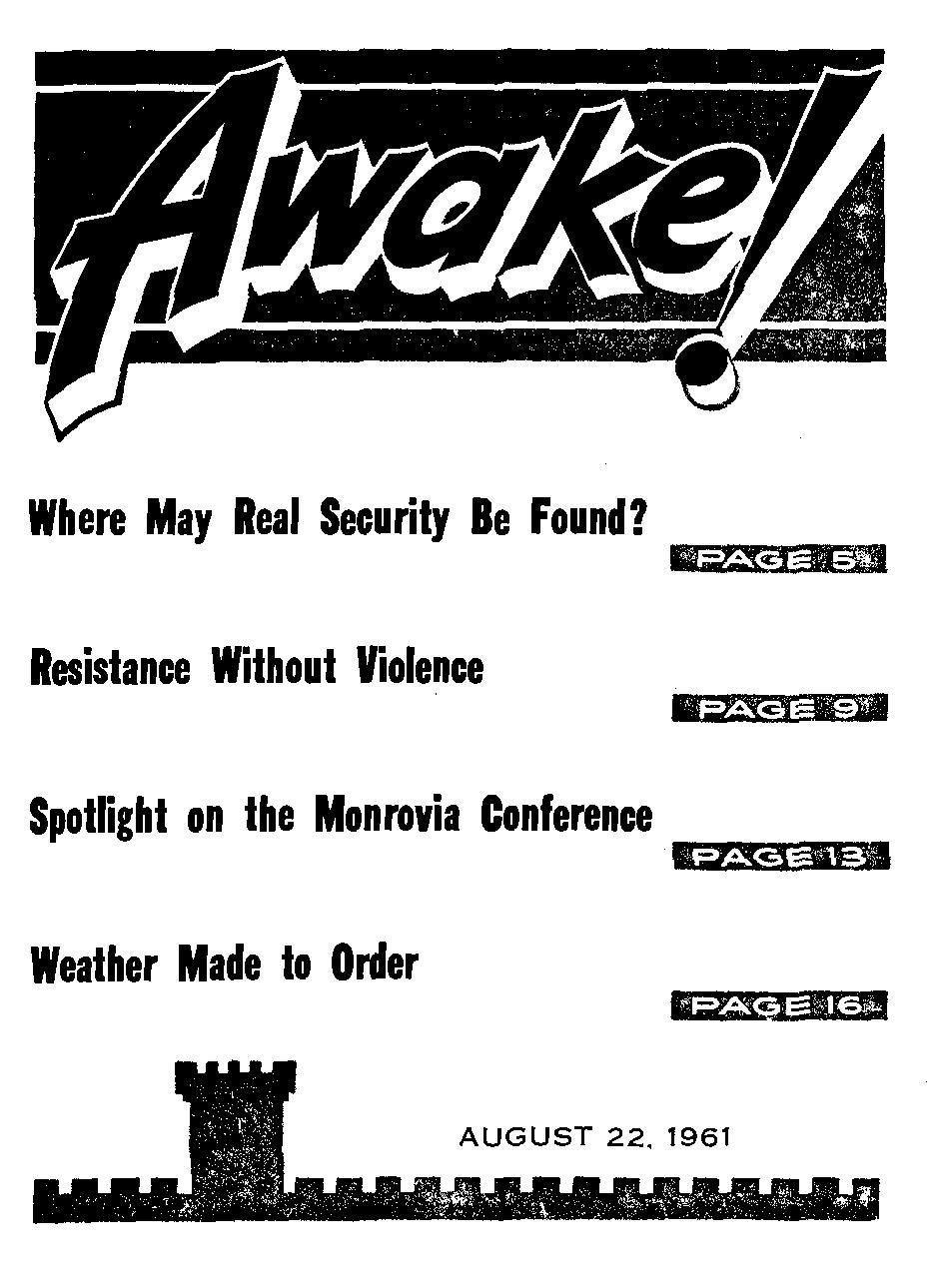
Where May Real Security Be Found?
Resistance Without Violence
Spotlight on the Monrovia Conference
PAG&13
Weather Made to Order
"PAGE16^
THE MISSION OF THIS JOURNAL
News sources that are able to keep you awake to the vital frtufcl Of our times must be unfettered by censorship and selfish interests* “Awake!” has no fetters, it recognizes facts, faces facts, is free to publish facts* If is not bound by political ambitions or obligations; it is unhampered by advertisers whose toes must nat be trodden on; it is unprejudiced by traditional creeds* This journal keeps itself free that it may speak freely to you. But it does not abuse its freedom. It maintains integrity to truth*
“AwakeP1 uses the regular news channels, but is not dependent on them* Its own correspondents ore on all continents, in scores of notions* From the four corners af the earth their uncensored, on-the-scenes reports come to you through these columns. This journal’s viewpoint is not narrow, but is international. It is read in many nations, in many languages, by persons of all ages. Through its pages many fields of knowledge pass in review—government, commerce, religion, history, geography, science, social conditions, natural wonders—why, its coverage is as broad as the earth and as high as the heavens*
"Awake!” pledges itself to righteous principles, to exposing hidden foes and subtle dangers, to championing freedom for all, to comforting mourners and strengthening those disheartened by the failures of a delinquent world, reflecting sure hope for the establishment of o righteous New World.
Get acquainted with "Awake!” Keep awake by reading "Awake!"
Published Simultaneously in the United States by the
WATCHTOWER BIBLE AND TRACT SOCIETY OF NEW YORK. INC. 117 Adams Street Brooklyn 1, New York. U.S.A.
and in England by WATCH TOWER BIBLE AND TRACT SOCIETY
Watch Tower House, The Ridgeway London N.W. 7, England
N. H. Knokr. President Grant Suiter, Secretary
Printing this issue: 3,250,000 Ad ft
copy (Australia, 5d; South Africa, SVac)
^Awakg!" Is published In the following 23 languages: Semimonthly "-Afrikaans. CinyanJu. Danish, Dutch, English, Finnish, French, German. Greek, Italian, Japanese, Norwegian, Portuguese, Spanish, Swedlrfi, Tagaluft, Zulu. Monthly- -Cebu - V Isayan, ] locano, Korean. Malaya la m * Polish, Ukrainian.
Yearly sutler iDtlnn rates
(Ktlees for semi monthly editions
America, 11.$., 117 Adams BL. Brooklyn 1, N.I V Aistralla, 11 Be restart . fitrathfleid, N.S.W.
Canada, ifio Bri;Inland Are.. Toronto 19, Ont
England, Watch Tower House,
The Ridgeway. London N.W. 7
New Zealand* 021 New North Rd., Auckland, 'S.W. 1 7/* Soith Africa, Private Bag, Elandsfontetn, TvL 70e
Monthly editions cost half the above rates.
Henlttanecs tor subBcrlntfons In your country. Otherwise London. Notice of expiration before subi-crintion expires.
should be rent to the office send your remittance to la Bent nt Je&st two issue?
CHANGES OF ADDRESS should reach us thirty days before your moving (fate. Give is yagr old and new add res j (if possible, your old address label). Watch Tower, Watch Tower House, The RI die way, London N.W. 7, England.
Entered as second-class matter at Brooklyn* N.Y. Printed Id England
The Bible translation osed In “Awake!” fi the New World Translation of the Holy Scriptures. When other translations are used the following symbol; will appear behind the citations:
j15 - American Standard Version AT - An American Translation AV” — AiJthijrii'.ei! Version (1011) jju - J- N- Duitiy's veraiou
- Catholic Douay version EjD - The Lmphutic Diaslolt Jp ~ Jewjsli Publication frioc. Ltd - Isaac Leaser's version
xifo - Jampft Mnffatt's version Ro - J. B- Rutlierham's version RS - BevLed Standard Version Iff - Ronert Young’s version
CONTENTS
You Benefit by Being Neat
Where May Real Security Be Found?
Mardi Gras Rooted in Magic
Resistance Without Violence
Easily Believed Lies
Spotlight on the Monrovia Conference
Prayer: Senator versus Chaplain
Weather Made to Order
Disaster on "Hill of River Water”
Parents and Children
Zen
"Why Evolution Is Believed”
"Your Word Is Truth”
When Is the “Acceptable Time”?
Watching the World
fgS
WHY not enjoy the benefits of neatness and orderliness? Those who do have found great
NEAT
and such de junking promotes greater freedom from cares and aids neatness. A letter written to The Listener tells of one man’s joy in this regard: “I have been collecting things almost ever since I can remember. . . , They have gone with me from house to house, but now ... I have got rid of them. A
er efficiency, emotional contentment and happiness. All it takes is a little thoughtfulness, a little time, a little care. The results are amazingly beneficial.
Neatness should begin at home. If the outside or inside of a home is unsightly or disorderly, it casts an unfavorable reflection upon the occupants of that home. Orderliness, on the other hand, reflects favorably on all members of a family and also on any organization of which they may be a part.
Neatness also saves time and lightens household cares. Disorder and untidiness are wasteful of energy. Cluttered-up drawers and closets rob one of much time when something needs to be found. Disorderly closets bulging with things that will seldom if ever be used also irritate the nerves. How many closets bulge with stored-away things that might more profitably be discarded or given to others who could use them!
A spring or fall cleanup campaign often clears out items that may really he junk, great van came and took them all away. ... In the past I have found it so hard to throw things away. That shabby leather strap . . . that picture I thought so beautiful so many years ago . . . the amount of rubbish! . . . They have gone in such quantities that we found it advisable to tip the junkmen to take them all away. I feel better and younger without them."
But many things are needed and used from time to time. Where are they stored? Many places are often used as storage sites —attics, basements, spare rooms, front and back porches, back yards, garages, automobile storage compartments and even stairways. What is the condition of these places? Are they neat and orderly? Too often they are in a state of disarray. Trying to find something in such an attic, for instance, can be a most frustrating experience. But if boxes are clearly labeled as to contents and orderly arranged, storage places can be kept tidy.
There is a most vital benefit in orderliness that is sometimes overlooked: the avoidance of hazards. Stairways cluttered with objects are hazards. Though experienced family members may be able to hurdle such obstacles, outsiders may not be as successful. People often fall over something on a stairway and end up with broken bones or worse. Scrap paper, old oily rags and open paint buckets can be a fire hazard. Neatness and orderliness can thus save not only one’s home and property but also one’s health and life.
Enjoying the benefits of neatness calls for family co-operation. A husband who throws magazines, newspapers and other things around adds to his wife’s work and may well be irritating her. The tidy person hangs up clothes and puts away shoes and socks. Strewn about the room, they are a source of constant personal embarrassment when others come in. It shows a lack of respect for other members of the household who like a pleasant atmosphere and who are also embarrassed when they bring friends in and find the wife’s or husband’s clothing thrown about the room.
You will get more done in neat, orderly surroundings than when things are not neat. Disorder produces depression or tension and causes distraction. At your place of work or study keep tools, equipment, books, papers, drawers and file cabinets in an orderly way. Discussing the matter of greater efficiency through orderliness, the volume This is the Way to Study says: “While your chief object should be to establish a workshop suggestive of the use to which you are going to put it, it is also important that it be neat, pleasant, and colorful. You will do better work in cheerful surroundings than you will in a drab and unpleasant work room. Why this is we do not know. Perhaps pictures on the walls, curtains on the windows, an orderly arrangement of the furniture, and a clean and neat condition of things produce an unconscious feeling of satisfaction, relaxing tensions that interfere with the best mental work. . . . Depressing surroundings do nothing for the brainworker, except to slow him down.”
A neat personal appearance also contributes to one’s well-being and reflects well upon one. Having one’s clothes pressed, shoes shined, hair combed and pockets not overly loaded contributes to a neat appearance. Disorder in a woman’s pocketbook often comes to light when something has to be taken out in a hurry. The businessman or minister who carries a brief case needs to be certain it is in an orderly condition. The minister wants to imitate Jehovah God, “for God is a God, not of disorder, but of peace.” So he heeds the divine principle: “Let all things take place decently and by arrangement.” —1 Cor. 14:33, 40.
Enjoy the benefits of neatness by making it a continual process. This avoids time-consuming tidying-up campaigns every few weeks. Day by day be orderly. Put things back in their places after using them. All members of the family should know where things properly belong.
Parents should teach their children neatness. Let them clean up after themselves. Teach children to keep their rooms neat, to clean the bathtub after use, to put things away after using them.
Though we should strive for general neatness, we must remember that even good practices can be pushed to extremes. Guard against making a fetish of neatness, for fussiness builds up tension among all members of a household. Fussiness can be as annoying as sloppiness. Be neat, not fussy.
Put neatness to work, serving you, not enslaving you. It will pay for itself every hour of the day, bringing benefits in personal relationships, personal efficiency, safety, contentment and happiness.
x WHERE MAY REAL ,
ecurl
a rar&^
talT!
[X^vefyffhe his own
find it you havS-ta^ know where to look, but where can it be
in the days of Judah, it seems that no one
found in this modem world that lives by the code of survival of the fittest? How can there be any sense of security when people |n all nations are lacking in moral principles? Instead of living like civilized humans, they act like savage animals that continually fight among themselves and prey upon one another. How can there be any feeling of safety when you must constantly be on the watch to avoid being cheated or having things stolen? How can there be peace of mind when there are people who seek to take advantage of you and still others that put your life in jeopardy?
From general appearances the world seems to be without upright men, men of loving-kindness in whose presence you would feel secure. Its disregard for moral principles creates a condition that is similar to what existed in the ancient kingdom of Judah. Regarding this the prophet Micah said: “The man of loving-kindness has perished from the earth, and among mankind there is no upright one. All of them, for bloodshed they lie in wait. They hunt,
Can anyone feel secure in this morally corrupt world? What security is possible now and in the future?
k I J;
can be trusted, often not even those in one’s own family. Self-interest seems to destroy natural family affection. What the prophet goes on to say about Judah could well be said regarding the world today, especially apostate Christendom: “Do not put your faith in a companion. Do not put your trust in a confidential friend. From her who is lying in your bosom guard the openings of your mouth. For a son is despising a father; a daughter is rising up against her mother; a daughterin-law against her mother-in-law; a man’s enemies are the men of his household.”—Mic. 7:2, 5, 6.
The insecurity that is experienced because of the world’s mad, selfish scramble for material possessions, riches and personal advancement has been augmented by the awful power of atomic weapons and the bad relations among nations. Nevertheless, a sense of security can be had today that brings peace of mind and hope for the future.
Source of Real Security
Most people fail to find security because they look in the wrong places for it. It cannot be found by looking to political leaders, men of science or Christendom’s clergy. All are part of this world and manifest its* spirit. The clergy talk about moral principles but give their support and blessings to political leaders who have no regard for such principles. They preach the Christian gospel of peace but bless weapons of war and support international wars. How can such men who have made themselves an integral part of this corrupt world be a source of security? How can they give what they do not possess themselves?
To find real security it is necessary to turn to a source that is outside this worldly system of things, that is no part of it. Jehovah God, man's Creator, is that source. Being the Supreme Sovereign, he has complete security himself and is able to give security to those who look to him as the source of it.
In times of trial he gives strength to those trusting in him. He becomes a stronghold to them. “Jehovah is good, a stronghold in the day of distress. And he is cognizant of those seeking refuge in him.” Although he permits persecution to come upon Christians in order to try them, his spirit strengthens them in their distress, helping them to stand firm. He notices those seeking him and is readily found by them. “God is for us a refuge and strength, a help that is readily to be found during distresses.”—Nah. 1:7; Ps. 46:1.
Because of his strengthening spirit, trusting Christians have a sense of security that dispels fear of men. It enables them to stand before prejudiced judges and rulers without fear. Regardless of how they may be threatened or mistreated because of their faith, they will not break integrity to God. They will stand firm as a rock. An example of this is the experience of Jehovah’s witnesses in Nazi concentration camps and now in Communist prisons. They refuse to renounce their faith in exchange for their freedom or their lives.
During such times of distress the one who seeks refuge in Jehovah feels secure because he knows that he is assured of a resurrection if his enemies kill him. The harm they may do to him is only temporary. This knowledge gave early Christians a sense of security when they faced the wild beasts of Roman arenas. They knew that Jehovah is faithful to those trusting in him.
The apostle Paul tells of the sense of security he felt in Jehovah when he was at Ephesus in Asia Minor. It appears that he was compelled to face wild beasts there that put his life in danger. He felt secure in the knowledge of Jehovah’s promise of the resurrection. Since God had more work for Paul, he did not permit Paul’s enemies to kill him at that time. “For we do not wish you to be ignorant, brothers, about the tribulation that happened to us in the province of Asia, that we were under extreme pressure beyond our strength, so that we were very uncertain even of our lives. In fact, we felt within ourselves that we had received the sentence of death. This was that we might have our trust, not in ourselves, but in the God who raises up the dead.”—2 Cor. 1:8, 9.
Security can also be found in Jehovah’s truth. It is a protective shield that safeguards the mind from being brainwashed by the corrupt ideologies and vain philosophies of the world. It is a protection from worldly reasoning that would lead a Christian in the world’s path of opposition to God. It is a defense against religious falsehoods that imprison people to empty superstitions and to an unnecessary fear of religious leaders. This is the truth that
Jesus said would make people free.—John 8:32.
New System of Things
Jehovah’s new system of things involves the provision he has made for human salvation, the establishment of a unifying government for earth that will insure peace, the enthroning of a king of his choosing that will rule in righteousness and the building up of a theocratic organization for unifying dedicated Christians. Those who seek refuge in Jehovah as a stronghold must come within this new system of things. They must exercise faith in its provisions for bringing life and peace to mankind.
The people who already have come within the new system of things and found security there form a new-world society of dedicated Christians, They have separated from the world by refusing to participate in its political activities, its schemes for world domination or world peace and in its violent differences. Because they, like Jesus, take no part in the political affairs of this world, they are not responsible for the unscriptural actions taken by worldly leaders and governments. They live as a new-world society that acknowledges Christ as rightful Ruler of earth and that looks forward to the security of the righteous new order that will come by means of his kingdom.
These people live m peace and unity world-wide. National barriers, race and language do not break that unity. Because they obey Jesus’ command to “love one another,” you have no reason to feel unsafe in their presence. Unlike in the old-world society, your life is respected in the New World society.—John 13:34.
Since the high principles of God’s Word guide the New World society of Jehovah’s faithful witnesses, there is no uneasy feeling of distrust in it. When you come among them you are not associating with thieves, cheats and liars, but with trustworthy people, men of loving-kindness. Your possessions are safe with them, and you can expect to be treated honestly and uprightly. Here among these dedicated people of God in his new system of things, you can find real security now.
Hope for the Future
Within Jehovah’s new system of things can be found a hope for future security on earth that brings great peace of mind and a sense of safety today. That security will come by means of God’s kingdom. It is a real security that is certain despite today’s threats of nuclear extinction.
In that new order of divine making, all peoples will live in perpetual security from attacks by fellow humans or by wild beasts. A prophecy that was spoken to Jehovah’s covenant people of ancient times will then be true even of their physical circumstances. “They will no longer become something to plunder for the nations; and as regards the wild beast of the earth, it will not devour them, and they will actually dwell in security, without anyone to make them tremble.”—Ezek. 34:28.
To get the security Jehovah provides requires you to be instructed in Scriptural truths, in God’s purposes, that you may have a basis for absolute trust in him. It requires you to walk with God by following a course of obedience to his commands and laws, having faith in his promises. It requires you to work in unity with the many dedicated Christians who already have sought refuge in him.
A sense of real security can be had now, but you must seek it where it can be found. You must look to Jehovah. You must seek it in his new system of things. There you can find safety and peace of mind “under the very shadow of the Almighty One.”—Ps. 91:1.
Mardi Gras Rooted in Magic
MAGIC IN N0I8E
• “In the case of the Mardi Gras,” states the Swiss Lexicon, Vol. 3, p. 247, “heathen customs (Greek, Roman, German) have been joined with Christian customs. . . . The usage of instruments to make noise during the parade was originally intended not only to drive away evil spirits but also to awaken spirits which would bestow blessings.”
“MAGIC DEMONIC DOINGS”
• The following items are from the volume German Mar di Gras Customs, by Adolf Spamer, authority on Germany and its folklore: “From the very earliest days, masquerading has also included making the face unrecognizable by smearing it with paint or by putting on a mask, phantoms. Without such a change In facial characteristics the mask would remain human and the desired demonic and magic compulsion would be missing. . . . While the ‘phantom’ shows a frozen, icy smile, the wooden masks are designed to characterize more than to frighten, yet many other masks show demonic-devilish facial contortions. . . .
"The original type of mask, reminiscent at quick glance of the related forms of Polynesia and Central Africa, are still seen in Lotschen-tai (in the Wallis Canton of Switzerland). . . . This original purpose of masquerade and masking still appears in the customs of remote mountain valleys: the one dressed as a demon actually be< mes a demon and possesses thereby magic powers. . . . Although the entire week of Mardi Gras celebrations
/ / / ?
/ / ) / / / / ) f / I / / / / /
'l /
used to be filled with such magic demonic / doings all over Germany, yet today only remnants of this old custom are still existent, -a custom whose basis goes back to almost I one and a half thousand years.” /
MAGICAL FIRE
• “On the first Sunday during Lent, on / Invocabit Sunday, sometimes known tn certain j sections as Disk or Torch Sunday, an old • Mardi Gras custom becomes apparent espe- . ci ally in Western and Southern Germany, / that of lighting fires and torches. ... So the / old Mardi Gras includes magical fire which ■ is a defensive as well as at the same time an awakening action of magic productivity.”
ROOTS NOT PULLED UP
♦ “Mardi Gras is the term for an old, widely-held custom of early spring, and just like all pre-Christian customs of folklore must be tested as to strength in its fight with the Christian Church, which attempted to introduce it into its ecclesiastical year after attempts to destroy it had been proven futile. From the Church fathers on, from Tertullian, Chrysostom, Jerome and Augustine, throughout the entire Middle Ages, the Church fought against the noisy and degenerating masquerading carried on by the people. . . . Lutheranism was first successful to any great degree in causing Protestant Germany to do away with or at least to reduce the Mardi Gras customs, calling them a heathen-pa pal degenerating of the folk and a ’great abomination in the sight of God’. ... In 1687, the city council of Zittau banned the arranging for or the carrying out of all Mardi Gras parades, dances and banquets, so that, as history records it, ‘the old heathen Mardi Gras doings, allowed by the Papacy up until that time, should be finally brought to an end’. . . , But the renewed flare-up of th.' Mardi Gras doings ... is indicative of the vitality of these old customs.”
•FIGHT OF FRIGHTENED MEN*
* "The pre-Christian Mardi Gras was ... a period of wild enchantment at the threshold between the two seasons. In the fight traced back to our very beginning against the winterlike powers of death and destruction, the hope in the productivity of summer was mingled, the summer whose coming one attempted to insure through various kinds of defensive and alluring magical tactics. These customs . . appear to have been solidified into a set form of cult early in the German era, as expressed in parades, races and demonic masquerade dances . . . and which to an extent had to do with belief in the dead. . . . Here and there, even today, the nonsense of all this foolishness flickers through as a desperate fight of frightened human souls striving for life and happiness.”
ON April 29, 1961, 826 persons sat down in front of Scotland Yard in London and refused to move despite threats of arrest. “The demonstrators,” said The Sunday Times, “made no attempt to resist They sat in the roadway, and when police picked them up, they went limp and had to be lifted bodily into vans.” This was a typical demonstration of passive resistance, a method of protesting that has grown in popularity in recent years. Since it is puzzling to the average person, especially because it advocates the use of nonviolence against force,
dents began a nonviolent demonstration by sitting at lunch counters that were reserved for white persons. This was in a section of the United. States where the races are segregated. Their demonstration spread into an organized movement of passive resistance at lunch counters in six states and twenty cities, later including washrooms, libraries, beaches and other public facilities.
Arrests and violent opposition brought suffering to these Negro resisters, but that was
you may be interested in some of the reasoning behind it and how a Christian should view it.
By their act of civil disobedience, the demonstrators in Britain were endeavoring to focus public attention on their opposition to nuclear weapons. It may seem strange that a group of people should conclude that the best way to voice their protestations is by breaking a law, but that is one of the basic methods of passive resistance. The object is to get publicity. That is why demonstrators in Scotland and the United States have invited arrest by trying to board nuclear submarines.
American Negroes have turned to passive resistance as a more effective way to fight racial segregation than violent resistance. On February 1, 1960, Negro stuwhat they expected, and it helped to publicize their grievances. Reporting on their conduct, The Christian Century stated: “When lighted cigarettes were thrust down the collars of Negro students sitting at dime-store lunch counters in Nashville, Tennessee, when the sit-downers were reviled and spit upon, they did not strike back and they did not run away.” By suffering violence, but not retaliating with violence, the students hoped to swing public sympathy in their favor by causing their opposers to appear intolerant and cruel.
Negro resisters in South Africa succeeded in this when a cry of protest arose all over the world against the violent action used on them by the South African government. The sympathies of the world were for the resisters, much to the embarrassment of their rulers. These African demonstrators accomplished their aim as far as favorable publicity is concerned, but they did not accomplish their principal objective of changing the hearts of the men in power into being more liberal toward them.
Reasoning Behind Passive Resistance
The reasoning of nonviolent resisters is that by bringing suffering upon themselves instead of causing others to suffer, the conscience of their oppressors will be stirred, causing a change in treatment. Dr. William Nelson, vice-president of Howard’s School of Religion, put it this way: “The object is to convert, not by making someone else suffer, but by suffering yourself. The very sight of that suffering will draw attention to the problem.” Besides impressing on the rulers the urgency of their problem, the passive resisters hope to embarrass their rulers by attracting world attention to the suffering they are causing.
In the reasoning of passive demonstrators can be seen the influence of the philosophy of Mahatma Gandhi, the Indian leader who became famous through passive resistance. He astounded the world by fighting force with nonviolence, first in South Africa and later in India. His idea was that suffering brought upon one’s self for a cause was far more effective than causing someone else to suffer, as when demonstrators resort to violence. Thus the resister must be the one that suffers, not those whom he is resisting. Gandhi’s passive resistance movement was called Satyagraha, and regarding it Leo Kuper states in his book Passive Resistance in South Africa: “The effect of Satyagraha is thus to set both oppressive laws and force at nought. ... In relation to this force, the passive resister has so subjected himself to ascetic discipline that the range of effective sanctions is greatly reduced, and the hurt he sustains is a means toward the much desired self-purification. The mechanism of change in Satyagraha is not the embarrassment or coercion of the government, as in the first type of passive resistance, but a change of heart in the rulers, their conversion through the suffering of the subordinates,”
Disobedience and Aon-co-operation
Civil disobedience is the method of nonviolent protesting that is commonly used. The resisters invite arrest by violating a law. This they may do en masse to overwhelm the penal facilities of the civil authorities as well as to attract publicity to themselves. When 20,000 Africans milled around the police station on the outskirts of Johannesburg, South Africa, inviting arrest because of not having their hated passbooks, the police could not arrest and imprison that immense crowd. Neither could the authorities at Evaton, another South African town, imprison the 70,000 passive resisters that gathered there. Usually civil authorities are baffled by such large crowds of nonviolent demonstrators.
Small groups of resisters are another matter. They usually are arrested and jailed when they are guilty of civil disobedience. This punishment they bring upon themselves makes them martyrs to their cause and gives them a certain amount of prestige among their associates. Their suffering is a dramatic way of bringing to the attention of the authorities and of the public their pleas for a change in official policy.
Another method of nonviolent resistance is by non-co-operation with the rulers. This requires good organization among a large number of resisters whose services are needed by the government. The loss of their services forcefully brings to the attention of the officials the need to consider the protests of the resisters. A similar method of nonviolent resistance is boycott. When a large number of persons are organized to participate in a boycott, economic damage can be done to force oppressors to change their policies. This was used successfully by Negroes in Montgomery, Alabama, to help force the desegregation of municipal buses.
Bow Effective
There is some question as to the effectiveness of passive resistance. In the case of Mahatma Gandhi, it helped free India from British rule, and in the southern part of the United States it has helped to bring about some concessions in the segregation issue there. But its effectiveness depends to a great extent upon the type of government and the temperament of the rulers against which it is used. In a liberal nation where there is freedom of the press, it may have a measure of success, but what could it possibly accomplish under despotic rulers or under rulers that stubbornly refuse to consider the protests of a minority no matter how much they may suffer? Cruel rulers will not be moved by the suffering of passive resisters.
In some societies any act of civil disobedience is considered an act of rebellion and is punished harshly and ruthlessly. The number of people involved makes little difference. In fact, the more there are the more convinced a despotic ruler becomes that the passive demonstration is inimical to the interests of his rule.
How could the suffering of passive resisters move despotic rulers to compassion when such rulers are hardened to human suffering? When hundreds of thousands of people have been made to suffer, why should they be moved to compassion by the suffering of a few thousand nonviolent demonstrators? Did the suffering of millions of persons in Nazi concentration camps change the hearts of the Nazi leaders? It seems evident that the reasoning behind passive resistance is weak when an authoritarian state is involved.
Note what Leo Kuper states about this in his book Passive Resistance in South Africa: “There is no historical warrant for the basic assumption in Satyagraha ‘that the sight of suffering on the part of multitudes of people will melt the heart of the aggressor and induce him to desist from his course of violence.’ . . . There is no doubt that the threshold of indifference to extreme forms of suffering may be very high indeed. We must therefore question Gandhi’s belief that conversion by the suffering of others is universally effective.”
The publicity that passive resistance also depends upon for its effectiveness cannot be relied on in a state where the rulers control the press. They would not permit the suffering of passive demonstrators to be publicized. Instead of accomplishing their aim of attracting public attention to their cause or of melting the stony hearts of their rulers, such demonstrators would be ushered quietly off to prisons or concentration camps. Their self-sacrificing would not have accomplished a thing for their cause.
Another factor that bears on the success of nonviolent demonstrations is the willingness of the demonstrators to submit to increased or prolonged suffering. A large number of people may be willing to participate in a demonstration of civil disobedience when the penalty may be a suspended sentence or a short period in jail, but when the penalty becomes extreme, there is very likely to be less enthusiasm for self-sacrifice.
Contrary to the reasoning of passive resisters, the rulers in South Africa were not conscience-stricken or moved to have a change of heart when passive resisters flllafl, the prisons. Instead, they enacted laws That provided a penalty of five years iij prison and a fine of £500 for any kind of resistance. Commenting on the effect of this severe penalty, The Christian Century remarked: “It takes a brave or a very foolish man to risk such a penalty for simply standing where he is not supposed to be. Sooner or later he is going to resort to action he feels will not be wasted.’’
Christian's Position
The growing popularity of nonviolent demonstrations against oppressive restrictions or against nuclear weapons that threaten the existence of mankind confronts a Christian with a problem. Should he participate in such demonstrations? Since the purposes that demonstrators seek to achieve by nonviolent protests are not necessarily contrary to Scriptural principles and since clergymen take part in them, you may be inclined to conclude that participation in such demonstrations is the Christian thing to do, but is it?
When Jesus Christ was on earth he set the example for Christians to follow. In fact, it is written: “Christ suffered for you, leaving you a model for you to follow his steps closely." (1 Pet. 2:21) Although the Roman government was very oppressive in its policies toward the Jews, we do not read about Jesus’ organizing a violent or nonviolent demonstration in protest. Neither do we read about any effort on his part to demonstrate against slavery, which was generally practiced in those days. Study carefully the record of his life and you will find no mention of his attempting to reform the Roman government or the customs of that time.
The policy that Jesus followed was that of strict separateness from the political affairs of the world. He came to earth to do the will of his Father, not to become embroiled in heated political differences and struggles for emancipation. He confined his energies to preaching and teaching the life-giving truths of God’s Word, and he expected his followers to follow his example. On one occasion he said: “They are no part of the world just as I am no part of the world.”—John 17:16.
In view of the position that Jesus took, how can Christians today involve themselves in protest demonstrations and still be following his footsteps closely? How can they participate in movements to reform customs or political policies and still keep separate from the world as Jesus did? When a Christian is arrested or made to suffer, it should be for keeping integrity to God, not for civil disobedience in a protest demonstration. “If someone because of conscience toward God bears up under afflictions and suffers unjustly, this is an agreeable thing. For what merit is there in it if, when you are sinning and being struck blows, you endure it? But if, when you are doing good and you suffer, you endure it, this is a thing agreeable with God.”—1 Pet. 2:19, 20.
Although nonviolent resistance may have some limited successes in liberal lands, it is an ineffectual instrument for world reform. A Christian would be most unwise to permit it to distract him from the means God has chosen for changing the policies and customs of the world’s political states. Instead of becoming involved in political and racial demonstrations, he does better by “seeking first the kingdom [of God] and his righteousness.” —Matt 6:33.
EASILY BELIEVED LIEB
A frequently repeated lie is easier to believe than a seldom-heard truth.
Monrovia was quiet, a solemn atmosphere prevailing. Previous radio announcements had called attention to this day, April 14, 1961. Printed proclamations by the government were posted along the streets appealing to all religious leaders, bishops, priests, deacons, evangelists, and the laity of all religions to assemble
SPOTLIGHT
ON THE
MONROVIA
gasy Republic, Mauritania, Niger, Senegal, Somalia, Tunisia, and Upper Volta were alio present.
Why had they come? To attend a conference
of independent Afri-
can states. Africa, like a sleeping giant, had awakened from her
age-long slumber. Many African states
.__ „ _____ „ _ T , have attained inde-
CONFERENCE^nd™ and problems have arisen,
themselves in their respective edifices of worship on this day with prayer and fasting. But why an appeal for prayer and fasting? An
Ky fhraktl" eoVtelpondant in Jliba't'ia
problems of unity, security, peace, co-operation and leadership. The radio and press hailed the conference as historic, the largest
event of far-reaching importance was soon to take place in Monrovia, and divine guidance was sought for its success.
During the following days radio and press played up the event. Sometime later flags, bunting and palm branches began to gaily decorate the city. Expectancy was in the air!
On May 7 police sirens began to wail throughout the day. What was happening? The heads of nineteen independent African states from the Sahara to the Congo were arriving. The prime minister of the Federation of Nigeria, Sir Abubaka Tafewa Balewa, had arrived. President Sylvanis Olympic of Togo was here. The prime minister of Sierra Leone, Sir Milton Mar-gai, had come. The heads of government of the Cameroons, Central African Republic, Chad, Congo Republic, Dahomey, Ethiopia, Gabon, Ivory Coast, Libya, Mala-and most important conference of independent African states to take place on African soil. President Leopold Senghor of Senegal declared: “For the first time in Africa’s six-thousand-year history African leaders of twenty independent states have met to consider solely the problem of Africa.”
Plana for “New World Order”
Many African leaders see widening horizons. They foresee freedom from European domination and the African as boss from the Mediterranean Sea to the Cape of South Africa. Many feel that the hour has come for Africa to rise to greatness and assume world leadership. President Tubman of Liberia, in his keynote address, stated that Africa was once the cradle of world civilization and could again become a pivot for a “new world order.” Who would assume leadership in building this
new Africa? President Tubman stated that, the idea of one nation being first among African states would be destructive to African unity and peace. Rather, he urged that all states, large and small, should co-operate in good neighborliness as equal partners. By doing so they could set a new pattern of social and political behavior and thus help to bring order to the present world disorder.
Somewhat disturbing to the delegates was the fact that Ghana, Guinea, Morocco, United Arab Republic and Mali were not present. Why had they not come? Some months previous these had met in Casablanca and there discussed the problems of African unity and peace. Their belief was that such could be attained only by a union of all African states under one leadership and not by each state maintaining its political identity while trying to co-operate with others in an economic, technical and cultural way as the Monrovia powers favor.
Accomplishment
For four days the conference met in Monrovia’s beautiful city hall. Outside waved the flags of each state, and a huge map of Africa carried the slogans, “All Africa Must Be Free,” and, “One for All, All for One.” What had the conference resolved and proposed? They reaffirmed their faith in the United Nations and said they would take joint action through that instrument in working toward world peace.
They proposed that a technical commission of experts be set up within three months to meet in Dakar, Senegal, to work out detailed plans for economic, educational, cultural, scientific and technical co-operation as well as improving transportation and communications between the states. To overcome the language barrier, effort is to be made to teach French and English to citizens of all African countries.
The conference heads declared that the fight of their brothers in Angola, Mozambique, Algeria, South-West Africa and South Africa was their fight also, and that technical and moral support would be given them. As for South Africa, its continued policy of apartheid was declared to be open declaration of war against the black race, and they said that practical and effective measures would be taken to bring South Africa to her knees. All states were called on to apply immediate political and economic sanctions, collectively and individually, against the government of South Africa.
A spokesman for the Angolan People’s Union addressed the conference, charging Portuguese colonial oppression in Angola. He declared that Angolans have no rights of representation and participation in the executive, legislative and judicial organs of government, that there was no development of democratic expression, such as political parties, trade unions, or youth or women’s movements. All such movements are organized in absolute secrecy, he said.
Although conference members are pledged not to interfere in the domestic affairs of each other, it was held that this applied only to states already independent and sovereign, therefore rejecting Portuguese claims to Angola as a “province” of Portugal. The conference did pledge “their wholehearted material and moral support to the Africans in Angola in their struggle for autonomy.”
With reference to the Congo, the twenty heads of African states reaffirmed “faith in the United Nations as the only organization which is best adapted to achieve a real solution to the Congo problem.” However, the conference noted the past “weaknesses and mistakes of the U.N. in its work” in the Congo.
Without referring to any specific country, the Monrovia powers called upon African states to “desist from such activities as the hasty recognition of break-away regimes in the Republic of the Congo, and generally from taking sides with rival groups in any form or manner.” This seemed to be a direct challenge to the Casablanca powers, which have all recognized the Stanleyville regime of Gizenga as the only legitimate government of the Congo.
The nuclear powers were called upon to bring about a cessation of nuclear stockpiling and explosions. Particularly was France singled out to give assurances that she will not explode any more nuclear devices in Africa.
Machinery was set up to take care of differences between the African states and peacefully solve any territorial disputes. When the conference ended, all expressed satisfaction and looked forward to the next meeting, to be held in Lagos, Nigeria.
Reaction to the conference was quick. Some hailed it as a real step toward unity and peace. Still others condemned it. President Kwame Nkrumah of Ghana spoke against it, declaring that the present political boundaries of the independent states were carved out by the colonialists and that no African solidarity and peace could come by each one maintaining its political identity. Rather, all vestiges of colonializ-ing must be. removed from Africa, he said, and all these states would have to give up their sovereignty and merge into a union of African states. Nkrumah stated that he would continue to work toward this end.
NEXT ISSUE
• How Long Can I Hope to Live?
0 Totalitarian inquisition Revived in Spain.
• Caution! Your Credit Is Good.
• Nitrogen—Life’s Indispensable Element.
• How God Kept Israel a People Apart.
Will the African’s desire for unity lead to disunity? Will his desire for peace result in dividing Africa into two blocs with each struggling for mastery? Time will tell.
While peoples strive through conferences and political efforts to bring about unity, Jehovah’s witnesses in the New World society are already united—and that in Africa! Whether they be Zulu or Xhosa of the South, the Cibemba of the Rhodesias, the Yoruba of Nigeria, the Twi of Ghana, the Kpelle of Liberia, the Kissi of Guinea, or the Egyptian of Egypt, all are one. There is no division among them. This is because they have accepted Jehovah God as sovereign and they advocate no political government or alliance as the answer to Africa’s problems, but only God’s kingdom under his Son as the government to rule, unite and bring peace, life and blessings to obedient men.—Isa. 9:7.
Prayer: Senator versus Chaplain
Indicative of the fact that a United States senator, a “layman,” may know more about prayer than the chaplain paid by the government to offer prayers
is the following resolution that a senator presented to his colleagues:
“Resolved: That the Chaplain of the Senate be respectfully requested hereafter to pray to and supplicate Almighty God in our behalf, and not to lecture him, inform him what to do, or state to him, under the pretense of prayer, his
(the said Chaplain’s) opinion in reference to his duty as the Almighty, and that the said Chaplain be further requested, as aforesaid, not, under the form of prayer, to lecture the Senate in relation to questions before the body.”—Church
and State in the United States, Stokes, Vol. 3.
IMAGINE ordering clear skies for Sunday and rain for Monday and getting them! That may sound a bit fantastic to some people, but not to meteorologists interested in climate control. Captain Howard T. Orville, who for four years headed former president Eisenhower’s Advisory Committee on Weather Control, says weather control will be a reality in twenty or possibly fewer years. Dr. Joseph Kaplan, head of the United States Committee for the International Geophysical Year, declared: “Control by man of the earth’s weather and temperature is within the realm of practicality now.”
As yet man cannot produce large amounts of rainfall in the natural atmosphere whenever and wherever he chooses. But he can and has produced both snow and rain in copious quantities. In the early 1950’s American farmers and water-power companies in the western part of the United States were paying from $3,000,000 to $5,000,000 annually to cloud-seeding concerns in an effort to increase rainfall.
In the few years since it was found possible to control or modify weather to an appreciable degree, the cloud-seeding industry has expanded into an $8,000,000-a-year business. Commercial cloud-seeding companies now regularly “water” some 200,000,000 acres of grazing and farm land at two to twenty cents an acre. Today made-to-order snowstorms are created to insure good skiing, and thunderstorms are formed to prevent drought. During the winter months, with man’s help, mountains are covered with heavy falls of snow to make sure that there will be plenty of water in the spring to turn the turbines of big power plants. A United States presidential Advisory Committee on Weather Control reported that five out of six of man’s efforts to produce rain succeeded, that rain increases of from 9 to 18 percent above normal have been due to human efforts at rain making. Other reports show that California is ahead $50,000,000 a year from man’s rain making, and that the Midwest states are reaping at crop time $40 for every $1 that they are paying rain makers.
So Mark Twain’s statement that everybody talks about the weather but nobody does anything about it is no longer true. There are a number of people doing plenty about it; some are even making the weather their life’s work. They are devoting themselves to weather forecasting and weather control.
If man were able to control tornadoes, typhoons and hurricanes effectively, there is no question that such control could be a blessing, Think what a saving this would be in lives and property! In 1900 a hurricane claimed 6,000 lives at Galveston, Texas. As recently as 1935, 400 persons lost their lives when a hurricane hit the Florida Keys. In India, in 1876, a hurricane produced an inundation in which more than 100,000 were killed.
If heavy thunderstorms could be controlled, $275,000,000 worth of property a year in the United States could be saved. If freezing rain, snow and sleet that stall surface traffic and damage communication lines might be reduced by control, think of the savings here! Adequate control would mean the diverting or the dissipating of heavy snowstorms, such as hit New York city in December, 1947, and in the early months of this year. In addition to the inconvenience suffered, these storms cost taxpayers millions of dollars for snow removal. Control would halt hailstorms that wreck crops and do away with droughts, such as the one in 1934 that cost the United States an estimated $5,000,000,000. Fog banks that delay airline flights, smog that plagues cities and rain that ruins the farmer’s hay crop would all be in the past. Dust-bowl areas and desert lands would gradually be transformed into fertile crop-productive lands, thus reducing famines the world over. Forest fires, which destroy an average of 16,000,000 acres of timber yearly in the United States, would be curbed. Fruit grower^ and outdoor-sports promoters could all benefit by weather control.
The Weather
Earth’s weather, for the most part, is brewed in the comparatively “thin,” eightmile-deep layer of the lower atmosphere, by an exquisite balance of cosmic and terrestrial forces. High overhead, the atmosphere, like a glass roof of a giant greenhouse, traps the heat of the day and prevents it from escaping into outer space at night. This heat balance, together with the rotation of the earth, propels the night ocean currents and the great rivers of air that determine what kind of day it has been and what kind of day it will be tomorrow. Like a huge engine driven by the sun, the hot air goes up from the equator and is drawn toward the poles. The cold air from the poles rushes downward and heads for the equator. Within this over-all interchange are many movements, often sudden concentrations of energy that break out into thunderstorms, tornadoes, typhoons and hurricanes. Some researchers believe violent weather, particularly thunderstorms, occurs when the delicate electrical balance between the earth and the ionosphere is disturbed. The storms, they say, restore the balance.
How to change the weather and change it safely with a full understanding of the global implications is the problem. With imperfect knowledge it is quite possible to have weather changes boomerang. The massive efforts under way to harness climate could precipitate droughts, initiate violent storms or bring on glaciers and huge ice floes. Despite these warnings, however, the race to master the weather accelerates among nations of the world.
Methods of Control
Modern man has the tools for understanding and controlling weather to some extent. For example, at present the best-known method of starting a rain or thunderstorm or “modifying” a cloud is probably by “seeding.” The method is called “seeding” because it calls for introducing into the cloud certain particles that collect moisture and fall to the ground as rain or snow. This method got its start about fourteen years ago when Dr. Vincent Schaefer breathed heavily into a familytype deep freezer. His warm breath in the cold formed a little cloud. He then dropped a piece of dry ice into the freezer, intending to make it colder. As the dry ice passed through the cloud a miniature snowstorm occurred. This miniature snowstorm set Schaefer’s brain to working. Soon he was up in an airplane scattering dry ice grains in the clouds, and on earth observers watched man produce real precipitation for the first time. Dr. Schaefer actually exercised control over the atmosphere! This experiment proved that man could, to an extent, either produce rain or make the clouds disappear if he pleased.
The most efficient agents to make a cloud disgorge snow were found to be silver iodide and cerium oxide. In the cold clouds, 12,000 to 14,000 feet up, the tiny particles of silver iodide, nuclei so small that 10,000 of them would be the equivalent of a grain of salt, are sown. The seeding seems to make the droplets merge and grow big rapidly so that the cloud does not have to grow tall in order to form rain. According to United States Naval Institute Proceedings (July, 1951), seeding experiments carried out in one day, when two ounces of silver iodide augmented by less than sixty pounds of dry ice were used, resulted in a total rainfall of 800,000,000 tons. This is approximately equivalent to 200,000,000,000 gallons of water! Dr. Irving Langmuir, Nobel prize winner in chemistry, estimated that only two hundred pounds of silver iodide would be required to seed the earth’s entire atmosphere.
The seeding system cannot be made to work at will. Weather conditions must be favorable. Thought must be given to cloud type, available moisture, temperature in the upper cloud (the upper portion of the cloud must be well below 10 degrees Fahrenheit), wind flow and numerous other factors. Equally as important are knowledge, skill and experience in using a seeding agent. Only small amounts are needed to produce precipitation. It is very simple to overseed a cloud. In the case of overseeding, the cloud usually disappears and the seeding actually prevents the cloud from giving the rain that might otherwise have formed and fallen.
By seeding the cloud, when all factors are just right, man merely duplicates what takes place in nature. The updrafts pick up tiny particles of dust from the earth’s surface or salt from the oceans. These enter the clouds. There infinitesimal cloud droplets begin to cling to them. Soon a small ice crystal is formed. When enough droplets cling to the ice crystals—and it is estimated that it takes a million to make a normal-size snowflake—they become heavy enough to fall. If the air in the lower portion of the cloud is warm enough, the snowflakes melt and fall as raindrops or they may be swept earthward by the downdrafts.
Lightning and Hurricane Control
Ways to control violent lightning storms, which start about four hundred devastating forest fires every year in the United States, are being studied. To weaken or shorten these storms, the threatening clouds are seeded with silver iodide to bring rain. If rain comes, the cloud is dissipated before it grows big enough to generate much lightning. This has yet to be tried on a large scale, however.
Plans are under way to tame hurricanes. Dr. R. H. Simpson, an aviation weather specialist, says hurricanes spend energy at the rate of 500,000,000,000,000 horsepower a second, which is the equivalent of “several thousand atomic bombs per second.” During a ten-day period a hurricane liberates heat equal to about ten million atomic bombs. So Dr. Jerome Spar, research associate professor of meteorology, believes it doubtful that exploding an atomic bomb would have any effect on a hurricane. The bomb does not have enough punch to reverse the vast forces in nature. An atomic explosion “might” prevent a baby hurricane from development, he said. But, he warned, the explosion might also “cause a worse storm. The best guess is that there would be no effect.”
Hurricanes grow by “feeding” on the warm water over which they move. It is believed that if hurricanes can be spotted in their early stages by earth satellites equipped with sensitive photoelectric cells that report to earth on earth’s entire cloud system, then it might be possible to break up the hurricane into small thunderstorms by seeding the clouds with silver iodide.
Other weathermen have suggested spreading oil over a large area of the sea and setting it afire, believing that such a maneuver might cause hurricanes to dissipate. Some scientists have suggested spreading a colored dye in a checkerboard pattern over the ocean to change the reflection pattern and thus interrupt the feeding of a hurricane. But none of these methods have been tried on a large scale.
Dr. F. W. Reichelderfer, a leading weatherman, believes that a tornado’s energy might be released by cloud seeding, if the seeding is done before the destructive funnel clouds are formed. Other scientists have suggested building giant windmills with 150-foot windmill blades. These presumably would control the weather over semiarid regions. Dr. Werner Spilger estimated that ten such windmills, each powered by a 5,000-horsepower motor, would free Los Angeles of its smog problem.
Changes from Coal and Dams
The polar icecaps and their freezing temperatures are breeding places for much of the world’s weather. Scientists have charted gigantic bands of wind forty miles high that crown the poles during winter nights. The cold weather coming from these parts may soon be drastically modified by huge engineering projects made possible by nuclear power. Some engineers talk about trimming mountains and melting icecaps. Others speak of sprinkling sunlight-absorbing coal dust, lampblack and other color pigments in a thin layer over snow and ice. This would bring about a great thaw. In Alaska the method has already been used to extend the growing season by several weeks in the spring and fall. The Russians reportedly have been using such methods to grow vegetables, flowers and grasses on experimental farms above the Arctic Circle.
According to one report, Soviet engineer Arkady Borisovich Markin proposed to build a dam that would stretch forty-six miles across the Bering Strait. He told a team of international scientists and engineers that the cold Arctic Ocean water could be pumped out by huge atomic-powered pumping stations and be replaced with warm water from the Pacific Ocean. This fantastic proposal, if carried out, would no doubt change the weather on an intercontinental scale. Many parts of the United States would become desert wastelands. Temperatures in Sweden, Scotland and Moscow would rise ten degrees or so. New York city would be under thirty to forty feet of water, depending on how much of the glaciers would melt. Russia would have a 3,000-mile ice-free Arctic coast line and Siberia would become habitable.
But the largest-scale weather control of all time is being carried out by man quite unwittingly. This he is doing by upsetting nature’s balance of carbon dioxide. The present amount of carbon dioxide in the atmosphere is about 2 percent. However, man by burning coal and oil is adding to this amount daily. If it reaches 15 percent the average temperature would become high enough to melt the polar icecap, which would bring vast climate changes world-wide.
On the other hand, if man were to explode two thousand hydrogen bombs in the next twenty years, Dr. Edward Teller, the “father” of the hydrogen bomb, says, there would be enough radioactive dust aloft to lower the earth’s normal air temperature by 15 degrees and bring on an ice age.
So future possibilities are legion. The road to weather control, however, is slow and difficult. Many suggestions are purely theoretical. Some methods used now are even crude and primitive. The possibility of man’s controlling climate on a worldwide scale is slight indeed. And as for his proposed weather projects, none of them are weekend jobs.
rpHURSDAY, May 25, * * - - -
I 1961, dawned bright
and clear over Singapore, <
promising to be just another sweltering day
section of the city called Bukit Ho Swee it proved to be the blackest day of their lives. This was the day Bukit Ho Swee, meaning “Hill of River Water,” became the scene of Singapore’s worst fire disaster—a fire that in its destructive fury left in its wake four dead, scores of in-
…