Awake!, July 8, 1961
Download: PDF — Awake!, July 8, 1961
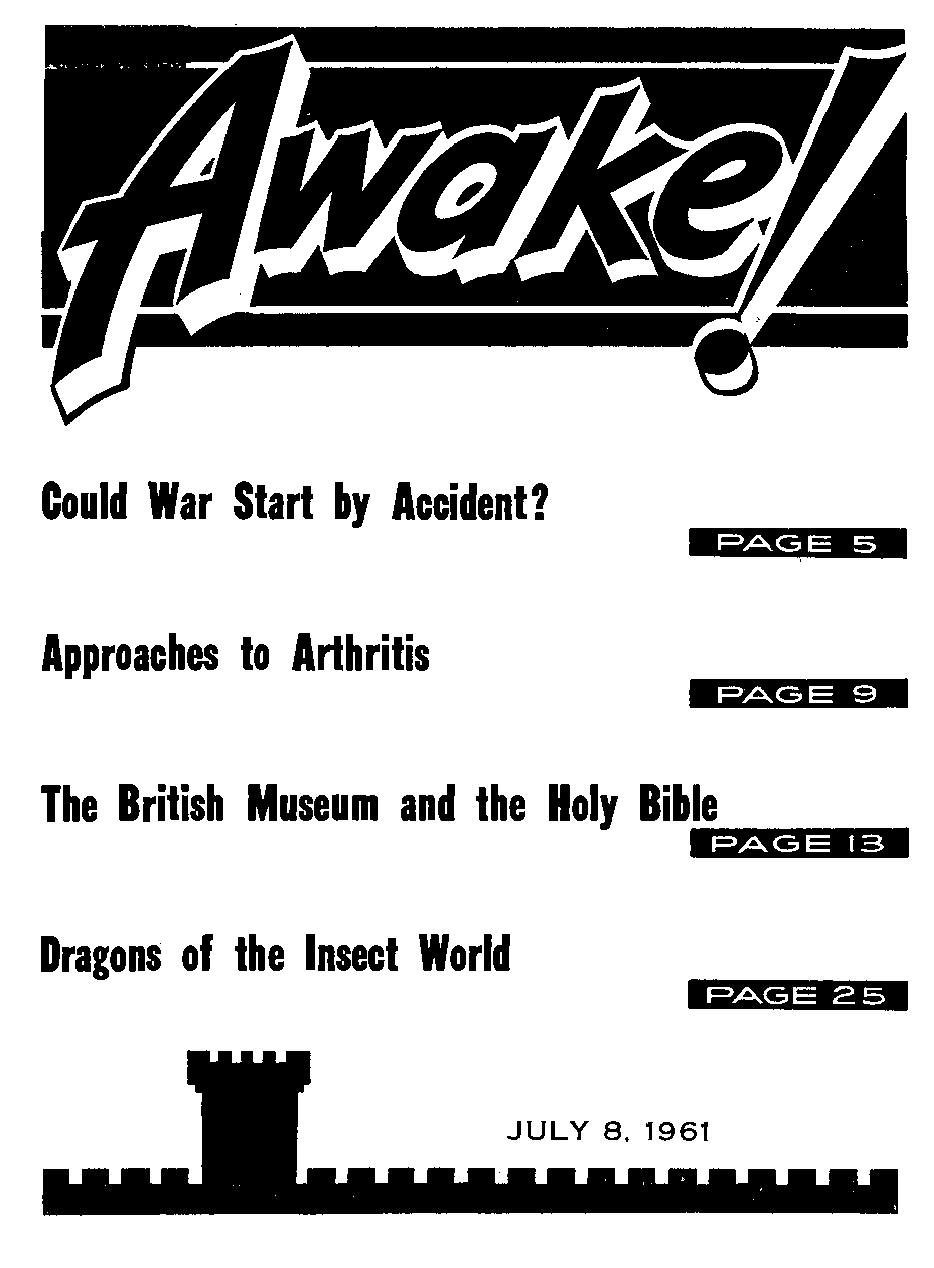
Could War Start by Accident?
PAGE 5
Approaches to Arthritis
PAGE 9
The British Museum and the Holy Bible
PAGE 13
Dragons of the Insect World
PAGE 25
JULY 8. 1961
THE MISSION OF THIS JOURNAL
News sources that are able to keep you awake to the vital Issuei of aw times must be unfettered by censorship and selfish interests. ''Awake!*' has no fetters. It recognizes facts, faces facts, is free to publish facts. It is not bound by political ambitions or obligations; it is unhampered by advertisers whose toes must not be trodden on; it is unprejudiced by traditional creeds. This journal keeps itself free that it may speak freely to you. But it does not abuse its freedom. It maintains integrity to truth.
“Awake!” uses the regular news channels, but is naf dependent on them. Its own correspondents are on all continents, in scores of nations. From the four corners of the earth their uncensored, on-the-scenes reports come to you through these columns. This journal's viewpoint is not narrow, but is international. It is read in many nations, in many languages, by persons of all ages. Through its pages many fields of knowledge pass in review—government, commerce, religion, history, geography, science, social conditions, natural wonders—why, its coverage is as broad as the earth and as high as the heavens.
“Awake!" pledges itself to righteous principles, to exposing hidden foes and subtle dangers, to championing freedom for all, to comforting mourners and strengthening those disheartened by the failures of a delinquent world, reflecting sure hope for the establishment of a righteous New World.
Get acquainted with “Awake!” Keep awake by reading “Awake!"
Un Uli m
Published Simultaneously in the United States rt tub WATCHTOWER BIBLE AND TRACT SOCIETY OF NEW YORK, INC. 117 Adams Street Brooklyn 1, New York. U.S.A.
and in England by watch TOWER BIBLE AND tract SOCIETY Watch Tower House, The Ridgeway London N.W. 7, England
N. H. Knore, President Grant Suitrh, Secretary
Print inn this issue: 3,250,000 4d a copy (Australia, 5d; South Africa, 3J/2c)
"Awake!” is publHked In th* followlnp 23 langmu: Semimonthly—Afrikaans, Cinyanja, Danish, Dutch, Hng-llah, Finnish, French, German. Gwh, Italian, Japanese, Norwesian, PortujrucHe, Spanish, Swedish, TaKUloij, Zulu. Monthly—Cebu-Vlsayan, liocano, Korean, llalayalam, Polish, Ukrainian.
Yearly subscription rat® for semimonthly editions
America, U.S., 117 Adama St., Brooklyn 1, NX $1 Australia, 11 Beresford Rd, Strathfleld, N.8.W. 8/-
Canada. 150 Bridgeland Aye., Toronto 10, Out Enlland, Watch Tower House,
The Ridgeway, London N.W. 7 7/-
New Zealand. C21 New North Rd., Auckland, fl.ff. 1 7/-Saith Africa. Private Bag, Elandsfcmtein, Tri. 70c
Monthly editions cost halt the above ratas.
Remittances for ssihscrjptlcms should be Rent Ln the office In your country. Otherwise send your remittance to London. Notice of expiration 1« gent at least two Issues before .subscription expires.
CHANGES OF ADDRESS should roach us thirty days before your moving data. Give us your old and new adfreu (If possible, your old addies* labaf). Watch Tower, Watch Tower House, The Rldpeway, lm. don N.W. 7, England,
Entered as second-class matter at Brooklyn. N.T. Printed In England
The Bible translation osef In "Awake!" Ji the New World Translation of the Holy SeMptues. When other translations are used tbs followlap symbols will appear behind the citations:
AS — Ameritafl Standard Version A? - An American Translation AV - Authorized Version (1611'1 JJa - J. N. Darby’s version
Dy - Calholta Douay verrim ED- The Emphatic Diaglott JP — Jewish Publication &oe. Le - Isaac Leeecr'& vfirriou
.Mo — James Moffatt's vejrion Ro — J. B. Rotherham’a version RS — Revised Standard Version Yff - Robert Young’s ver.sfcu
CONTENTS
Do You Give Encouragement?
Could War Start by Accident?
Approaches to Arthritis
Inoffensive
The British Museum and the Holy Bible 13
Our Modem Inconveniences
Germ-killing Power of Wine
South Africa Leaves the Commonwealth 21
Accuracy in Daily Speech
Dragons of the Insect World
“Your Word Is Truth”
A “Better Resurrection”—for
Whom and in What Way?
Watching the World
DO
YOU
GIVE
that, through two unchangeable things in which it is impossible
THE natural tendency is to think in terms of needing encoura g em e n t. It is better to think in terms of giving encouragement. This is the happier way. “There is more happiness in giving than there is in receiving,” declared the Lord Jesus Christ. (Acts 20:35) Do you enjoy the happiness of giving encouragement?
But is the giving of encouragement for all persons? Is it not the main obligation of the employer, the teacher and the person in position of oversight? The fact is: Everyone has the obligation to give encouragement, and certainly all Christians.
Jehovah God sets the example in encouragement. He encourages all his servants to faithfulness. He gives encouragement by his Holy Word, the Bible. In this Book are numerous examples of faithful men, and their fine examples inspire the Christian to similar faithfulness. Realizing the need for encouragement, the Most High God once told the overseer Moses: “Commission Joshua and encourage him and strengthen him, because he is the one to pass over before this people.”—Deut. 3:28.
Jehovah caused the various Bible writers to give encouragement. Wrote Peter, for instance: “I am writing you in few words, to give encouragement.” (1 Pet. 5: 12) The writer of the book of Hebrews states: “God . . . stepped in with an oath, in order
for God to lie, we who have fled to the refuge may have strong encnnraga. ment to lay hold on the hope set before ns ” (Heb. 6:17, 18) So Jehovah is the Great Encourager.
Paul, the apostle of Jesus Christ, was always encouraging. Concerning Paul and Barnabas, the disciple Luke wrote: “They returned to Lystra and to Iconium and to Antioch, strengthening the souls of the disciples, encouraging them to remain in the faith.”—Acts 14:21, 22.
The giving of encouragement is appreciated. How the early Christians appreciated the encouraging letter sent to the Christian congregations by the governing body! “After reading it,” says the Bible account, “they rejoiced over the encouragement.” —Acts 15:31.
When we encourage someone we give him courage, increase his hope and confidence or urge him on in a good work. So giving encouragement is something for all Christians, as the apostle Paul showed when he exhorted the brothers to attend congregational meetings: “Not forsaking the gathering of ourselves together, as some have the custom, but encouraging one another, and all the more so as you behold the day drawing near.”—Heb. 10: 25.
How evident that no Christian has the right to be discouraging! Discouragement saps vitality. Discouragement is spiritual chloroform that stifles activity. If one is given a strong enough dose of discouragement, he tends to give up and say, ‘What’s the use of even trying?1 Encouragement, on the other hand, has a powerfully stimulating effect, spurring one on to do one’s best. Each Christian should consider his obligation regarding “encouraging one another.”
Those in positions of oversight must especially be alert to the giving of encourage: ment. The Chief Overseer, Jesus Christ, sets the example for Christian overseers. When he found it necessary to give reproof and counsel to certain congregations, he was not discouraging. The Chief Overseer is always encouraging. When he reproved the congregation in Ephesus, he said: “I hold this against you, that you have left the love you had at first.” Yet the Chief Overseer encouraged them: “I know your deeds, and your hard work and endurance, and that you cannot bear evil men.” To the congregation at Pergamum he said: “I have a few things against you.” Yet before this reproof, fine encouragement was given: “I know where yoij are dwelling, that is, where the throne of Satan is, and yet you keep on holding fast my name, and you did not deny your faith in me.” The congregation at Thyatira was counseled for wrong influence by women, but there was also encouragement: “I know your deeds, and your love and faith and ministry and endurance, and that your deeds of late are more than those formerly.” Other congregations were reproved, yet this was done in an encouraging way, to stimulate the spiritually weak ones to wake up and “become watchful.”—Rev. 2:4, 2, 14, 13, 20, 19; 3:2.
Seeing that the Chief Overseer gives encouragement, all those in positions of oversight in God’s organization will want to be like their Universal Servant, the Lord Jesus Christ. True, it may be that another person is not working for one, since he is a servant of God, but words of commendation and encouragement are very much appreciated. Usually there is something about which to give encouragement. It may be a good service report for the month, although sometimes it may be good only in one special feature. There is a time for commendation and encouragement regarding meeting attendance, commenting at meetings and caring for Kingdom Halls.
But let us always remember that encouragement should flow the other way too; that is, toward the overseer. There are many opportunities for those in the Christian congregation to encourage those in positions of oversight. Expressions of appreciation are encouraging. Yes, “encouraging one another” means that no one is excluded from receiving encouragement.
Encouragement should also flow both ways between employers and employees, teachers and students, husbands and wives. Though the employer, teacher and husband have special responsibilities regarding encouragement, yet every employee, student and wife can give more thought to giving encouragement, since encouragement should flow in both directions. “Let each of us,” declares the apostle Paul, “please his neighbor in what is good for his upbuilding.”—Rom. 15:2.
Let Christians, then, be “encouraging one another.” Give thought as to how you can be encouraging. Keep always in mind the example of every Christian’s Universal Servant, Jesus Christ, and the Great En-courager, Jehovah God. Ask yourself: Do I give encouragement?
If so, how great would be the destruction? What hope would there be for the future?
T3E world has been likened to a powder keg with the burning fuse quickly nearing its end. The danger is real and it is growing. It must be faced, for it affects everyone. Indicating that people are not really awake to the danger of today’s situation, columnist David Lawrence wrote recently: “Today a balance of power has been augmented by a balance of terror. Any minute a mistake can be made, and a war started. The danger faced by mankind today is incredible. It defies description. But the paradox is that peoples have not really been awakened to it."
The very existence of civilization is threatened, and voices now call for the awakening of the peoples to this fact. Earlier this year a group associated with the National Planning Association urged the American president to “tell the country the stark, the unvarnished truth about the national emergency.” United States Senator Thomas J. Dodd criticized the government for the “hush-hush that surrounds the neutron bomb.” He said that “to keep the facts of life on the nuclear age from the American people is foolish and potentially dangerous.”
Under the present circumstances it Is only natural and right that a person be concerned about the future. What are the chances that a war might begin? Could it start by accident? What would it mean to you and your family? Would there be a possibility for survival? How great would be the destruction? Is there any solid hope for the future in view of the world’s present instability?
Arms Race Creates Danger
The nations today are feverishly engaged in a frantic arms race. In order to assure their ability to annihilate totally they spend an estimated $14 million an hour, well over $100 billion a year in creating and producing fiendish weapons of destruction almost too frightful to describe. As a result, former United States president Dwight D. Eisenhower said that “weapons have now come upon the scene that make war as we have understood it in the past a complete absurdity and really impossible and preposterous. They mean, in short—if used in the profusion that prophets sometimes predict—really the destruction of civilization as we know it.” Under these circumstances no one wants war. According to Russian Premier Nikita
Khrushchev, "Only madmen and maniacs launch calls for a new world war.”
Just how dangerous are weapons? Is it an exaggeration to say that they can wipe out civilization? Hydrogen bombs now range in explosive power up to more than twenty megatons, with talk of having thermonuclear weapons up to many times that power. A megaton is a term referring to explosive power equal to 1,000,000 tons of TNT. As of last year it was estimated that the United States and Russia possessed thermonuclear weapons equal to about 30 billion tons of TNT, or about ten tons of TNT for every person on earth.
Such tremendous potential for destruction is ever increasing and. it causes many knowledgeable persons to quake with fear at the prospect of what could happen. In a speech last fall Dr. Hugh Keenleyside, former Canadian diplomat and United Nations administrator, warned of the terrible force of nuclear weapons. He said that, according to an estimate, seven properly placed bombs would completely destroy England, and that undenied reports say the United States has 75,000 bombs and is producing 20,000 more of them a year. Russia was assumed to have at least an equal number.
Emphasizing the warning, Dr. Keenleyside said: "If there are still any persons who doubt the danger of nuclear bombing perhaps we should recite again the old statistics. The bombs dropped on Hiroshima and Nagasaki were the equivalent in explosive force of 20,000 tons of TNT. A single 20-megaton hydrogen bomb, the same type of bomb which is produced now, is roughly equal to 1,000 Hiroshima bombs, or is greater in power than the total of explosive energy previously released in the whole history of mankind including that released in the First and Second World Wars. And we are now told that when we get the cobalt bomb we shall have a weapon that will make the hydrogen bomb seem like a firecracker. We are indeed a lovable species.”
To appreciate the "balance of terror” one must realize that the nations have the ability to deliver these bombs thousands of miles with great accuracy. Not only do they have the ability, but we are told they are ready for virtually instant firing. In his new book Soviet Space Technology Alfred J. Zaehringer estimates that Russia has 100 to 200 international ballistic missiles implanted on bases and that they are “mostly aimed at America.” According to Premier Khrushchev, 250 of these weapons are being produced each year.
In view of the situation one can appreciate why Khrushchev would say that only a madman or maniac would deliberately embark upon an atomic war. “The danger of suicide is too great for any country to stake its existence upon the dubious results of such a war,” declared former U.S. Army Chief of Staff Maxwell D. Taylor. Thus it is hoped that the fear of devastating retaliation will eliminate the possibility of some nation starting a war. This brings us to the burning question of the day, which affects the lives of everyone on earth, and that is: Will this mutual deterrence in the form of devastating retaliatory power create a stable world where peace will flourish? Or will this arrangement prove to be basically unstable? “If it [does],” it was recently said, “and if we follow this path to its end, it is likely that we will perish.”—Community o/ Fear (1960).
The Foolishness of the Arms Race
It is becoming ever clearer that the way to preserve the peace is not by preparing for war. Why, if we were to copy the nations in attaining peace with our neighbor it would mean we would have to go out and buy a revolver, and then our neighbor would have to go out and buy a revolver. Then we would have to put our finger on the trigger and hold our revolver at our neighbor’s head, and he would have to put, his finger on the trigger and hold his revolver at our head—then we would have peace! At least that is what world leaders would have us believe by their course of action. How foolish this arms race that has created such a ridiculous, terrifying situation!
Premier Khrushchev expressed the fear that in this nervous, tension-ridden world “even those who might not wish to touch off a war could press the wrong button out of sheer fright,” Chief of U.S. Naval Operations Admiral Arleigh A. Burke said that this stand off in nuclear striking power could continue “for generations,” and we would have to learn to live with the possibility “of some madman pressing the button” that would “wipe out the Northern Hemisphere.”
Paralyzing fear clutches at the hearts of many who come to realize that one mistake could mean a planetary disaster. Newsweek magazine of March 20, 1961, after a brief discussion of the perils of the arms race, concluded: “A world caught up in the nuclear race makes it clear that the search for security through armaments has been in vain. . . . The problem which has begun to haunt the world with increasing urgency is how to keep it from blowing up.”
A War Could Start by Accident
Nobody wants war, but the pursuit of such a foolish course by the nations has created a situation where a war by accident is not only recognized as possible, but, by increasing numbers of persons, as probable. “These are ghastly speculations, but public opinion has no right to close its eyes to the increasing possibility that an alldestructive nuclear war can break out without anybody deciding to start it,” so summed up an article in the magazine Bulletin of the Atomic Scientists.
Charles Orlando Porter, former democratic congressman from Oregon, illustrated it this way: “If you place six chimpanzees in a small room with a couple of baskets of live hand grenades, a minor catastrophe is inevitable. If you place error-prone human beings in proximity to thousands of nuclear weapons, a major catastrophe is inevitable and the triggering of an all-out war is probable.”
Commenting on retired British army officer C. N. Barclay’s article, “Can World War III Start by Mistake?” Porter disagreed with the conclusion that “the real danger lies in the future when many countries may possess nuclear weapons.” Porter contended: “The cards are stacked now for vast destruction and death. The facts, simple and undisputed, add up, in my opinion, to World War III in the very near future as the result of an unauthorized or accidental nuclear explosion. This is the war nobody wants and everybody fears. The facts can be stated in a few words. First, thousands of nuclear weapons, many of unthinkable power, exist today. Second, almost all of them are ready for instant detonation. Third, their custodians are human beings.”
As Russia and the United States vie for territory and prestige, tensions build up, nerves become worn to a frazzle, and the chances increase that a faulty alarm signal or an accidental nuclear explosion will cause someone to press the button sending forth retaliatory missiles that would spark a nuclear war. Already planes loaded with hydrogen bombs have been flushed into the air because a flock of gulls, meteorites, and even the rising moon were mistaken on radar screens for approaching missiles.
Indicating the existing danger, the New York Times of April 5, 1961, carried the front-page headlines “M’Namara Urges Steps to Prevent False-Alarm War.” The article pointed out the danger that an ambiguous warning signal might set off a false alarm that could lead to nuclear war.
Last summer French president De Gaulle described the situation: “Two camps are set up, face to face, under conditions such that it depends solely on Moscow or Washington whether or not a large part of humanity is wiped out in a few hours.” Consider that in a few years many nations may have nucleah weapons, then instead of two camps having annihilatory power there will be many. An upstart dictator of a small country would then be able to threaten large nations with a missile attack. Like it or not, the chances are all too great that an unbalanced “madman” or “maniac” will get into control and precipitate a nuclear war. 'rhe pages of history indicate that such a possibility amounts to almost an inevitability.
The Only Hope for the Future
Some foresee that the selfish pursuit of men for power will drive mankind off the face of the earth. Such ones say our only hope for protection against nuclear war and future survival is to burrow deep within the earth. A report of last year on what the arms race may lead to said: “If the arms race continues, as it probably will, its future pattern seems clear in broad outline. . . . Eventually most human life will be underground, confronted by arsenals capable of destroying all life over the land areas of the earth.”
However, God meant for man to live on the earth, not in it. He made earth as man’s home to be taken care of and cultivated to a state of paradisaic beauty, not to be ruined and burned to a cinder by hydrogen and cobalt bombs. Selfish, power-greedy men, if allowed to pursue their present course, would undoubtedly bring this earth to total ruin, annihilating every living creature on it. Be assured this will never happen. Almighty God’s faithful promise is that he will step in and interfere with man’s suicidal race. He will “bring to ruin those ruining the earth.” —Rev. 11:18.
The evidence should convince any reasoning person that mankind has reached a time of trouble unparalleled in human history. It is comparable with the days of Noah. Even Nikita Khrushchev’s mind was turned to that time when he spoke last summer concerning Noah’s ark. He said that the risk of total disaster from nuclear warfare could be compared with the flood of Noah’s day. Jesus Christ, who was not simply using picturesque language but who knew what he was talking about, clearly identified this time of unprecedented trouble, and also drew a parallel to Noah’s day. He said: As in the days of Noah, when “they took no note until the flood came and swept them all away, so the presence of the Son of man will be.”—Matt. 24: 37, 39.
Bible prophecy clearly identifies this generation as the one meant for a destruction comparable to the flood of Noah’s day. It will not be a destruction brought by man’s nuclear weapons but by Jehovah God, who will sweep from the earth all wickedness and preserve alive all those trusting in him. So place your hope in Jehovah and his promise of survival! Yes, “be in the fear of Jehovah all day long. For in that case there will exist a future and your hope will not be cut off.”—Prov. 23:17,18.
medicine.” And correctly so, for it was applied to a condition marked by hot, red, swollen and pain
;;THE greatest challenge in the health
I field today is arthritis and rheumatism," we are told. It is said to affect from 15 to 20 percent of the world's population. It is “the No. 1 crippier” and “the most widespread chronic disease in the United States."1 It causes more disability than all types of accidents. Close to a hundred million workdays are lost yearly due to it, more than the toll taken by any other disease with the exception of mental illness.
Each year arthritis claims some 300,000 new victims in the United States, and more than 200,000 are permanently disabled. More persons suffer from it than from cancer, heart disease, tuberculosis and diabetes combined. Farmers appear to be especially susceptible, 23 percent being afflicted. It is also estimated that from 90 to 97 percent of those above sixty years suffer from it, at least to some extent.
History
It is claimed that arthritis is older than the human race, in view of the condition of the fossils of certain prehistoric animals. It is also said to be the oldest known disease of humans, and that i.iay well be, in view of its marks on so many mummies of the ancient Egyptians.
The very term “arthritis,” meaning “inflammation of the joints,” was used in the
ARTHRITIS
fifth century before Christ, in the days of Hippocrates, “the father of
ful joints. The more common name, rheumatism, was first used by one physician Galen in the second century of our Common Era. The root of the word meant a discharge
or flux or “humor," which was believed to flow from the brain to various cavities of the body, causing pain. Because these fluids were believed to drop into these cavities the disease was also known as gout, from gutta, meaning “to drop.”
Some four centuries after the noted Galen came Alexander of Tralles, who wrote at length on arthritis. Then a millennium later came Paracelsus, a veritable authority on the subject, according to some. Since then each century has seen outstanding physicians keenly interested in arthritis. About a century ago an Irish physician first used the combined form “rheumatic arthritis,” the most severe form today being known as “rheumatoid arthritis.” In modern times arthritis appears to have become more baffling and so we find one of the leading physicians of a previous generation, Sir William Osler, saying: “When an arthritic comes in the front door I want to go out the back door.”
Description
According to some authorities there are fifty important forms of arthritis and a hundred variations of these. The three most common forms are osteoarthritis, rheumatoid arthritis and gout. Among other forms of arthritis are bursitis, fibrositis and lumbago, while some also include neuralgia, neuritis and sciatica. Without a doubt there is much confusion as to diagnosing arthritis, especially as to what type, even specialists at times being hard put to identify it properly and often even what capable practitioners diagnose as arthritis is proved not to be so by a specialist in the field of diagnosis.
Osteoarthritis is the most common form and accounts for upward of 50 percent of all cases in the United States. The term is generally agreed to be a misnomer, as the prefix “osteo” means bone and it is not a disease of the bone. A more accurate term would be “degenerative joint disease.” Usually it comes on quite gradually, apparently a part of the aging process, and only in its later stages it becomes painful. It particularly affects the joints sustaining weight, such as the hips and the knees, and is comparatively rare in persons under forty years of age.
Rheumatoid arthritis, about half as prevalent as the degenerative joint disease, represents the greatest challenge as regards arthritic ills. In it there are “abnormal changes of varying degrees in the connective tissues.” Joints, tendons and/or muscles become swollen, tender, hot, red, and, above all, very painful. So sensitive do these parts of the body become that at times the very weight of a bed sheet causes excruciating pain. It appears mostly between twenty-five and fifty years of age, and three out of four victims are women. After sixty years, however, the incidence in the two sexes is the same. Peculiarly, in the type that affects the spine, ten out of eleven victims are men.
Characteristic lumps often appear, especially at the elbows. Often the knuckles swell up, whereas in other forms the end joints of the fingers are affected. In longstanding cases every joint in the body may become involved. Muscles gradually weaken and waste away and the skin becomes shiny and smooth. Loss of weight, fatigue and weakness generally go with it. In recent years it is becoming more common among young children, and it is known as Still’s disease.
Far less common than rheumatoid arthritis is gout. In it the kidneys are obviously involved or affected and nineteen out of every twenty suffering with it are men. It appears most commonly between the ages of thirty and fifty and makes itself felt by swelling of the joints, in particular the big toe.
Causes
Among the most controversial aspects of arthritis is the question of causes. Says orthodox medicine: “At present, science knows neither the cause nor the cure for arthritis.” One of its researchers recently said: “Sometimes I feel I know everything about arthritis but its cause and cure.” One specialist put the problem like this: “Like the proverbial blind men, we comprehend only small portions of the elephant. It may be that when we know more about it, we shall discover that there is no elephant at all.”
On one thing, however, there does seem to be general agreement, namely, that a predisposition to arthritis is inherited, for the incidence among the relatives of one having it is six times the average. Stress is also a factor to be considered, and among the local causes are “housemaid’s knee,” “tennis elbow” and “golfer’s arm.” In the most common form of arthritis age is a large factor, also obesity. Since three out of four having the more severe kind are women, sex must play an important role. Controversial is the part that metabolism plays as well as smoking tobacco.
Some attach great importance to psychosomatic factors. But whether these are the cause or the result may be open to question. Thus one report tells that the person most likely to have the severe type of arthritis is likely to be stem, strict with himself and others, stoical, devoted to serving others and deeply concerned with high moral principles. “They seem to have an ever-present desire to do the right thing and a need to live by the Golden Rule. They are meticulous, perfectionistic and over-anticipatory." (Today’s Health, September, 1957) Interestingly, introverts seem more likely to get this type of arthritis, and, on the other hand, arthritis in general is practically unknown among the insane. There further seems to be considerable evidence that severe emotional stress, such as the loss of a mate, triggers rheumatoid arthritis.
Approaches to Cure
As prevalent as arthritis is and as incurable as it has been pronounced to be, it seems incredible that philanthropic foundations would quarrel over who should do the helping, yet that is exactly what happened in 1958 when the National Foundation for Infantile Paralysis added arthritis to its list of diseases to combat and could not come to an agreement with the Arthritis and Rheumatism Foundation. Said a report: “U.S. medicine last week witnessed the strange spectacle of two large, wellmeaning foundations fighting over which has the franchise to help the sick in a large and serious disease field.”
The allopathic approach, that of orthodox medicine, while insisting that neither cause nor cure are known, offers hope by means of rest, drugs, reduction of weight in obesity, physical therapy or exercise, proper application of heat and psychotherapy. Among the drugs used are aspirin, colchicine, gold salts and hormones. The latter, however, are being used less and less, as they do not cure and often have harmful side effects.
Another approach to arthritis is chiropractic, which tells of cures in well over 50 percent of the cases treated. According to its spokesmen, arthritis results from a disturbance of the assimilative and eliminative processes of the body and the best way to remove these disturbances is by adjustment of the spine so as to permit the nerves to function in the best possible manner.
The homeopathic view is that arthritis is caused by “too much food and/or unsuitable food,” among the latter being too much citrus fruit, especially in cold climates. It considers it adding insult to injury to load the body with toxic painkillers. Homeopathy also holds that each case has its own symptoms requiring its own approach and so prescribes for individual cases, not for diseases. Specific for arthritis are some eighty homeopathic remedies, among the leading ones being Byronia and Rhus. Tox.
Then there is the approach of the osteopaths, which may be said to lie halfway between the allopaths and the chiropractors. Osteopathic doctors who specialize in arthritis make use of drugs, diet, exercise, heat, and so forth. However, above all, they stress the need of restoring normal function by correcting postural imbalance through manipulation, by means of osteopathic treatments.
“Common Sense?* and Vitamins
Common Sense and Arthritis is the name of a recent best seller in the United States. Written by a layman, its basic theory is that arthritis is caused by fat starvation and so the adding of fats to the diet, in particular taking cod-liver oil in orange juice, will cure arthritis. The author also holds that certain foods work against fats, such as strongly acid fruit juices and carbonated water, and that certain foods, such as sweets, absorb or bum up fats and therefore should be shunned. To aid the body in assimilating fats one should not drink cold water with meals, all drinks should at least be of room temperature, with milk instead of coffee being suggested. The order of eating one’s food is also held important: start the meal with bread and butter and only toward the end of the meal take liquids. Additionally, proper elimination is stressed, and the large sweet Bermuda onion is recommended as an aid in this respect.
Vitamins receive much stress by certain advocates of the nature method in dealing with arthritis. They in particular recommend vitamins C and P, and for certain types of arthritis vitamins B12 and E. Certain raw foods and natural vitamins are therefore prescribed by these. In general “radical blood-purifying and vitalitybuilding measures” are urged, which includes avoiding artificial sweets and refined foods.
The Combination Approach
Perhaps the most unusual approach to arthritis is that of Dr. Bernard Aschner, world-famous rheumatologist, endocrinologist and gynecologist. Says he: “The most successful cures of arthritis [require a] combination of the earlier with the modern medical system.” A member of many leading medical societies, and in practice for some fifty years, he takes strong exception to the modern orthodox approach to arthritis, holds that one hundred years ago doctors did better in treating it than they do now and that much can be learned from primitive medicine men and from folk medicine and lay healers.
Aschner holds that arthritis is caused by impurities in the blood, due to overeating, constipation, indigestion, obesity, heavy smoking, fullness of blood and, in the case of women, impure blood due to menstrual malfunction or premature menopause. Among the means he recommends to get rid of these impurities is sweating, raising rashes and blisters on the skin, vomiting and laxatives. Important also, according to him, are certain medicines, including herbs, proper diet (especially to combat obesity), exercise, rest and, in the case of women, normalizing menstrual function if at all possible,—Arthritis Can Be Cured, Aschner.
While there are more approaches to arthritis, the foregoing are the more' common and more representative. May they prove of some help to the arthritic reader until God’s new world arrives when, we are assured, there will be no more pain, no more arthritis.—Rev. 21:4.
INOFFENSIVE
• Writer Harry Golden is quoted in Life magazine of October 6, 1958, as saying: "If I were faced today with the decision my ancestors faced—become a Christian or die—I would pick a church fast. There is nothing to offend me in the modern church. The minister gives a talk on juvenile delinquency one week, reviews a movie next week, then everyone goes downstairs and plays Bingo. The first part of a church they build nowadays is the kitchen,’’
^BRITISH MUSEUM
itfvlll £Bible
By "Awake!" correspondent in Britain
IF YOU are interested in seeing the past unfold before your very eyes, then visit the British Museum. Especially interesting are the many exhibits confirming or illuminating Bible events, giving us a better idea of its background, its reliability and its preservation.
The museum itself is a great grime-encrusted building with a many-columned ■ facade, which was completed according to the design of Sir Robert Smirke in 1852.
Come join me for a tour. Up the steps and through the revolving doors we go. Upon entering we turn left immediately and start in the Roman Gallery. At the far end, on the right, are the Caesars of Rome. The second one from the end is Augustus, who had the decree sent out for all people to register in their native city; thus Jesus came to be born in Bethlehem instead of Nazareth. Not far away is Titus, who led the Roman armies to the destruction of Jerusalem A.D. 70, an event foretold by Jesus decades earlier.
From here we go into the Assyrian Transept, easily recognized by the massive winged and human-headed bulls and lions from a palace near Nineveh. In the very center of the floor stands the famous “Black Obelisk.” On each of its four sides are five rows of sculpture depicting various scenes. The second panel from the top shows Jehu, king of Israel, paying over tribute to the Assyrian king. Another Bible character, Hazael of Damascus, is mentioned in the text around the base of the obelisk.
Continuing on into the Southern Egyptian Gallery and passing severed large sarcophagi, the Rosetta
Stone, prominently placed in the center, next attracts our attention. This was the key that unlocked the hieroglyphic writing of the Egyptian priests seen at the top. In the middle is the demotic writing of the common people and at the bottom is the Greek, which could be read quite easily and proved to be a repetition of each of the other two portions above. The inscription was drawn up in 195 B.C.E. in honor of Pharaoh Ptolemy Epiphanes. At the top a group of signs with a line drawn all around in oblongfashion can be seen. That is called a cartouche; it contained the name of the king.
Turn left near the massive head and shoulders of Rameses II into what is called the Nimrud Central Salon; it almost appears to be part of the Egyptian section. Nearby is a tall slab with a rounded top. It is described as the stele of Shalmaneser III. It mentions the names of both Ahab, king of Israel, and Ben-hadad, king of Syria. That these two kings were in league is evident from the Bible. (1 Ki. 20:31-34; 22:1) Passing between the two-winged human-headed colossi on our left into the Nimrud Gallery, we turn right through a small doorway into the Assyrian Salon and cross to the far right comer where the celebrated bas-relief of the siege of Lachish brings to mind another event recorded in God’s Word. (2 Chron. 32:9) The inscription in front of the king reads:
“Sennacherib, king of all, king of Assyria, sat in his armchair, and the spoil of La-chish passed before him.”
The Elgin Room
Retracing our steps, we turn toward the Elgin Room. In the intervening anteroom we are drawn to an excellent model, on the right, of the Acropolis in Athens, Greece. Upon this long mass of rock stood the Parthenon, a model of which stands opposite us. Look carefully in the far comer of the Acropolis model, away from the central hill itself, and you will see a little hump marked “Areopagus.” This is the place where the apostle Paul preached to the Athenians. What a view he had! You can just see him stretching out his hand toward all those pagan temples and saying: “The God that made the world and all the things in it . . . does not dwell in handmade temples.”—Acts 17:24.
Entering the Elgin Room, we note the frieze from the Parthenon running right round the wall. We move on to our left into the Ephesus Room. No directions are needed to find the great column drums, which are the main feature. They come from the Temple of Diana at Ephesus unearthed in 1869. One of the seven wonders of the ancient world, it had more than one hundred columns, each standing over fifty-five feet high. One of these drums alone, the sculptured one on the left, is six feet high and twenty feet in circumference. With its gleaming marble the temple formed a proud center of pagan worship and magnificence.—Acts 19:27.
The Egyptian Rooms
We return once more, through the Elgin Room and anteroom to the large statue of Rameses n. Turning left, we proceed right down the Northern Egyptian Gallery, past a colossal arm from a statue of Thothmes UI, which reminds us of the words of Ezekiel 30:21: “Son of man, the arm of Pharaoh the king of Egypt I shall certainly break, and, look! it will not be bound up at all in order to give it healing.” At the end of the gallery we ascend the northwest staircase and enter the Second Egyptian Room on our left at the top.
What an unusual sight! Egyptian mummies everywhere. The last verse in Genesis tells us that Joseph died and was embalmed and put in a coffin. How accurate the Bible is in reflecting the right background of local life for each land and period! Passing through the Third Egyptian Room filled with many papyri, including the famous Book of the Dead, we enter the Fourth Room. Immediately to our left, in the first wall-case, are some Egyptian bricks in one of which the straw can clearly be seen. (Ex. 5:7, 10-12) A little farther on, wall-cases 141 and 142, are several wooden models of granaries, one with seven compartments, another with three, complete with sliding doors. In making provision for the seven years of famine Joseph must have become very familiar with granaries like these. Not far away is a case of Egyptian metal mirrors. That central one has been polished to show us how effective they could be. “Effective” is the right word. Imagine the women servants making a pile of these for melting down so that the basin and stand could be made for the tabernacle!—Ex. 38:8, footnote.
Turn to the right into the Sixth Egyptian Room and right again, stopping at the third wall-case. Examine the signet rings displayed in the lower section and inscribed with the names of various Pharaohs. It was a ring similar to these that Pharaoh placed upon Joseph’s hand when he promoted him. (Gen. 41:41, 42) Returning to the Fourth Room, \tfe pass through into the Fifth, to the right. Along one entire side are arrayed many statuettes of Egyptian gods. The ten plagues humiliated several of those included here, for they were proved completely powerless.
In the next room, the Babylonian, are exhibited many of the finds from the royal tombs at Ur of the Chaldees, once the home of Abraham. The high degree of workmanship impresses us with the realization that here was a civilization of great brilliance.
The Room of Writing
From the Maya landing we walk through the Prehistoric Room into the Room of Writing. The first wall-case traces the development of the alphabet from the picto-graphic scripts. Note especially the sherd of pottery near the top-left center of the case. This is one of the eighteen Lachish Letters discovered in 1935. These ostraca confirm the Bible record mentioning fire signals (Jer. 6:1) and Lachish’s neighboring town of Azekah (Jer. 34:7), and, above all, they use the four Hebrew letters mb’ (YHWH) of the name of God, Yahweh or Jehovah.
The second case shows the development of the cuneiform script, and in the following cases many clay tablets, barrels and prisms are on view. In case four, at the top right, is the Taylor prism recording the siege of Jerusalem by Sennacherib, king of Assyria.—2 Kings 19:1-37.
In the fifth case are some of the famous creation and deluge tablets. The sixth case, at bottom left, contains a model clay liver used for purposes of divination. (Ezek. 21:21) Case eight exhibits a clay tablet in its original clay envelope, and just below you can see several of the Tell el ‘Amama tablets that give evidence of the Israelite invasion of Canaan under Joshua. The last case contains a clay cylinder mentioning Belshazzar, the king that Bible critics for many years said was a myth. It is the third exhibit from the left, on the bottom row. It is interesting to note that oaths were taken in the joint names of Nabonidus and Belshazzar, emphasizing the latter’s authority in the empire.
Crossing the room we have our eye taken by an unusual wall in the corner built entirely of bricks stamped with inscriptions of various Assyrian and Babylonian kings, including Nebuchadnezzar. Next to them is a cast of the famous black stele of Hammurabi, containing one of the most detailed sets of ancient laws known. Though some scholars have argued that the Mosaic law was derived from this code, a comparison shows it is purely civil but that the Mosaic law is morally higher, more humane and with the will of God seen everywhere behind its decrees.
Next we examine the many cylinder seals in two wall-cases. Each cylinder has a little scene round it; when a clay tablet had been completed the writer would roll his seal over the soft surface, leaving the scene imprinted as his signature. Notice in the first case near the center of the second row that very large Maltese cross. Yes, the cross was frequently used by pagans. In the next case look at the third row, the fourth seal along from the left. You can see at the top the emblem of the god Ashur with three heads on one body. This representation of an Assyrian trinity on a seal was found by A. H. Layard in the ruins of an Assyrian palace.
In the last corner of the Room of Writing is a cast of the Siloam inscription, which reminds us of the tunnel from which it came, made by Hezekiah to bring water up into Jerusalem. (2 Ki. 20:20) Close by is a cast of the Moabite stone, which mentions the name Jehovah.
From here we descend to the long and handsome King’s Library. At the far end are two fine manuscripts. The large one in Hebrew, very clearly written in the tenth century A.D., has interesting marginal notes; those at the sides are called the Lesser Massorah, those at the top and bottom are the Greater Massorah, The smaller manuscript in Syriac contains the Pentateuch and is the most important witness for the Peshitta version.
The Bible Room
Entering the Manuscript Salon we notice a case against the wall on our left entitled “Alcuin Bible." This revision of the Latin Vulgate was made by one Alcuin of York, then Abbot of Tours, and has fine miniatures and illuminated initials. Continuing into the bay, on the left we notice in the far comer a rather indistinct sign reading “Bible Room.’’ In here we find copies of all the principal English versions, from the earlier Wycliffe version in the •center case through to the original edition of the Authorized or King James Version of 1611. Early Anglo-Saxon versions are displayed here too. Leaving this little room and following the wall right round to our left again, we next notice the "Lindisfarne Gospels," written about A.D. 700 in Northumbria. The whole manuscript, with its ornamentation of a very high artistic quality, is now thought to be the work of one man, Eadf rith of Lindisfarne.
On through the door to the left we cross to the large central case. Here are the famous articles of Magna Charta and the Bulls of Pope Innocent in. Close to the Number 1 do you see the bold title? “King John becomes a vassal of the Pope, 1214.” The letters of John are given in the Bull whereby he surrendered his kingdoms to the Roman Catholic Church.
As we turn to leave look to your left. That strong burglar-proof steel cabinet arrests our gaze; it is so different from all the other wooden cases we have seen. Why so? Draw back the curtain over the glass. Yes, here they are! Two of the greatest extant Bible manuscripts right beneath our interested eye—Codex Sinaiticus and Codex Alexandrinus. A fitting conclusion to our tour indeed! Can you imagine the Si-naitic manuscript lying in a waste basket in lonely St. Catherine’s Monastery deep in the Sinai peninsula? That is where keen-eyed Constantine Tischendorf found it, only just in time to prevent one of the greatest Bible treasures from being destroyed. Years later, Tischendorf returned and found the greater part of the manuscript and here it is now, all the way from the fourth century A.D. The Alexandrine, next to it, is of the fifth century, and was presented to King Charles I of England in 1627, just too late to be of use in the preparation of the Authorized Version.
Leaving the Manuscript Salon by the only other door we have not yet used, we walk through the Grenville Library and emerge again in the Entrance Hall, We cross the Colonnade and pause at the top of the steps. Is it not amazing that we today can travel in two hours through all those dim, distant scenes? It helps us to visualize them better. It also gives us wonderful additional proof of the accuracy of the Bible. Our faith in God, of course, rests on things greater than the things the eye can see, for “all flesh is as vegetation, and all its glory is as a flower of the vegetation; the vegetation becomes withered, and the flower falls off, but the word spoken by Jehovah endures forever.”—1 Pet. 1: 24, 25.
was personal advantage. Little hauled into the city by train failed
wonder the union has been something less
to make it. A slowdown hit business in
than a happy one.
One hot summer day in 1959 mechanization played an unkind trick on 500,000 New Yorkers who will long remember it. In the sweltering heat crucial electric cables burned out, paralyzing five square miles of the city. Air conditioners and refrigerators stopped and television sets stood speechless. For twelve hours repair crews labored to mend the breaks. Dozens of extra police cars crisscrossed the darkened streets to discourage crime. As the power gradually began to return, half a million city folk breathed a sigh of relief. Willing to forgive, they nevertheless find it hard to forget.
Then last January automation became the culprit. Harbor tugs sported highly efficient diesel engines that theoretically could get along with two less men per boat. When the railroads that own the tugs tried to put the theory into practice, 664 maritime workers went on strike. Picket lines appeared at strategic locations and some of the railroads had to shut down.
More than 100,000 annoyed commuters were forced to find another way home or stay in hotels. Food and cargo normally general. The public was distressed to see that a handful of the working force could tie up the City’s life and bring inconvenience and hardship to millions. Experts predict that automation will be doing more of this in the future. According to one report, in the next five years white-collar job losses due to automation will reach 4,000,000. To cope with these problems the American secretary of labor on April 20, 1961, set up the Office of Automation and Manpower.
Trapped
Hardly was the tugboat strike over when the skies dropped an estimated 40,000,000 tons of snow on New York city. Strings of motorists sat trapped in their multihorsepowered cars. Doctors and ambulances were unable to reach the sick. Milk and fuel deliveries faltered. An emergency milk supply program had to be set up. Empty furnaces produced no heat Giant airplanes were grounded as airports closed. Retail sales dropped and railroads worried about staggering losses. Blocked roads and power failures virtually paralyzed the suburbs. As Operation Snow Shovel proceeded, 6,193 motorists received summonses for defying Mayor Wagner’s auto ban. In turn three car dealers later sued the Mayor and the City for $250,000 m losses resulting from the ban. All this resulted from a snowstorm that was heavy but not a record.
The sedate New York Times lamented: “We are the slaves of machines: country life, like life in cities, is wedded to electric generators, telephone wires, delivery trucks, gas mains, far-hauled fuel.” In less convenient eras, milk was just a bam away, wood was handy to the stove and mother made her own homemade bread. The larder bulged with home-canned fruits and vegetables, not forgetting the smokehouse and root cellar. When summoned, the family doctor ventured out on snow-covered lanes confident of his one-horse-powered sleigh.
Strangulation by Auto
Now that the horseless carriage has topped the one-million mark in vehicular murder it is taking on the strangulation of whole cities. London, Los Angeles and New York are among the alarmed. Businessmen know customers will come to town regardless of car fumes, smoke, fog and smog, but traffic-glutted streets are something else. Air commuters especially feel cheated. After fighting their own battle with ticket reservations and plane delays they manage to save precious time coming by jet. Unfortunately, much of the time gained is painfully forfeited on the ground in city traffic. It may be that science will come to the rescue, as Simeon Stylites suggested in The Christian Century: “We have entered a 'disposable era’: disposable dishes, disposable tablecloths, disposable cups. It has even been prophesied that we may in the future be able to unjam traffic jams by having disposable automobiles.” Small cars are becoming popular. Maybe that is a step in the right direction.
But the hapless fact is that lawn mowers and can openers are getting bigger while autos are getting smaller. Now power mowers are cutting down operators along with the grass. According to Albert Maisel, in a year’s time hospitals in one city treated over 1,000 victims of power mowers. He adds: “As we install more and more appliances, overloaded wiring systems touch off increasing thousands of fires. In our kitchens, filled with electric stoves, broilers, dishwashers, food mixers, can openers and knife sharpeners, accidents now total more than three million a year. Do-it-yourself-ism, insurance men report, results in 600,000 injuries a year. We fall from roofs and ladders, mash and lacerate ourselves with power tools.” It seems our yen for gadgets has opened up a whole new field of “accident-inviting hazards.”
With all the gadgets, what does the mechanized housewife do with all her “spare time”? Some say mother is no better off than before, as any time gained is absorbed by community projects. This means she is busier than ever. In her article “Nothing Works but Me," C. S. Jennison gives another answer: “I can honestly say that I have experienced no real problem in putting my leisure to good advantage. I simply spend the hours saved by half of the helpful gadgets coping with the other half that aren’t functioning. Now and then, I find myself wondering just who is working for whom, but I try not to brood about it.”
"The Ghetto"
You may have heard some of those unkind things people have said about housing projects resembling a ghetto. What they meant was that people of the same general income, background and experience are lumped together where they cannot conveniently draw on the varied experience and education of other citizens. What i&more, many city apartments have "cardboard” walls. At least it seems that way to people living next door to a thumping hi-fi set or a boisterous party. Many an urbanite has thought to himself: “How great it would be to move to the suburbs!”
Now what do you suppose people are saying about life in suburbia? “Too many cardboard walls and too much like a ghetto.” Youngsters trying to sleep have little insulation from the televiewing and entertaining going on in the living room. If that is overlooked, the “ghetto” label is not. Peter Wyden explained what is happening, writing in The Saturday Evening Post: “As more parents quit cities, usually ‘for the children’s sake,’ more kids come to live in. neatly manicured, fumeless, pleasantly monotonous bedroom towns where there are almost no old people, no poor, no childless, no Negroes, either many Jewish families or none; no sidewalks, no places to explore except by mother-chauffeured car; no houses or incomes too much different from those of their parents ... In most of these green and gracious places everybody’s business is everybody else’s business, and attitudes are as contagious as flu.”
Illustrating the problems of suburban living, the “absentee father,” who spends so much time at business and commuting, leaves the burden of child training to mother. This gives girls a warped view of what a woman’s role is and hinders boys from learning how to be men. For such and other valid reasons a noticeable migration is taking place from suburbia back to the city.
Motion Sickness
Our love for mobility presents unusual problems. Business organizations like executives who can pull up roots and move at the drop of a new branch office. Thanks to this “executive mobility” whole families can trade in their old acquaintances for new ones every few years.
Then there is a similar phenomena called “social mobility.” Jhan and June Robbins referred to it recently in Reader’s Digest. It seems that young couples are traveling in social circles far different from the conservative ways of their parents. Cocktail parties and barbecues are the thing today, but as Jhan and June said, “Social mobility also makes it hard to form lasting friendships that sustain social and moral values. When today’s young mothers were girls, their mothers had close friends and confidantes who would lend furniture, recipes or ‘spell you out’ in nursing a sick child. Today, in a society where people move around so much, enduring female friendships seem a thing of the past.”
Last, but not least, marriage to machines is changing the very personality of the people. Edward Stein told readers of The Christian Century: “Ours is a time in which we have learned to make machines so much like man in their behavior that they seem almost human. They can calculate, respond, make decisions, run factories, pilot airplanes. . . . Another more subtle and more insidious fact of our day is that in many respects humans are beginning to act like machines. We are in critical ways tending to let ourselves become depersonalized—machine-like in our attitudes 'and behavior. Setting aside the possibility of atomic annihilation, the very real and equally devastating specter of a spiritual leukemia is before us—an inner attrition of man as man, as person . . .
“As our lives speed up, our very mobility serves to depersonalize us. The person in the car in the traffic lane next to us recedes into a mere wheeled obstacle. The pedestrian in the crosswalk represents nothing more than a frustrating pause on the road. Our relations with our families and neighbors are often fleeting and impersonal. Speed is overvalued. Time is equated with money. Soon people become things to us. A thou becomes an it. A cashier becomes a hand-with-money, the clerk becomes a voice-with-answers, the wife a cook-with-sex, the child a nuisance-with-need. The parent acquires in the eyes of his child the dubious status of a disturbing break in the television routine.” Apparently modem man has a bad case of motion sickness. Now at last some are slowing down enough to ask where they are going and why.
Recently a committee of the American Association for the Advancement of Science warned fellow scientists that with each increase of power, “the problem of directing its use toward beneficial ends becomes more complex, the consequences of failure more disastrous, and the time for decision more brief.” The committee declared that “in the last few years the disparity between scientific progress and the resolution of the social issues which it has evoked has become even greater. What was once merely a gap now threatens to become a major discontinuity which may disrupt the history of man.”
Yes, the marriage of convenience has come a long way, perhaps too far. Pushbutton missiles launched from the other side of the earth could excavate mankind’s grave within the hour. Machines that were supposed to lift burdens have helped to place a fearful one on mankind. A world that grasped any invention that would give a little more time to live at last has found one that they fear may give it no time at all.
Germ-killing Power of Wine
IEPORTS showing that wine has a penicillin-like action on bacteria have re-Icently appeared. What does wine possess that gives it death-dealing power over germs? Is the whole secret in Its alcoholic content? Apparently not, for Professor Salvatore P. Lucia of the University of California School of Medicine writes in Wine as Food and Medicine: “In comparing the effects of wine with water containing the same amount of alcohol, it has been demonstrated that the bactericidal action of wine is three times greater than that of water containing a similar concentration of alcohol.’’
…