Awake!, June 22, 1961
Download: PDF — Awake!, June 22, 1961
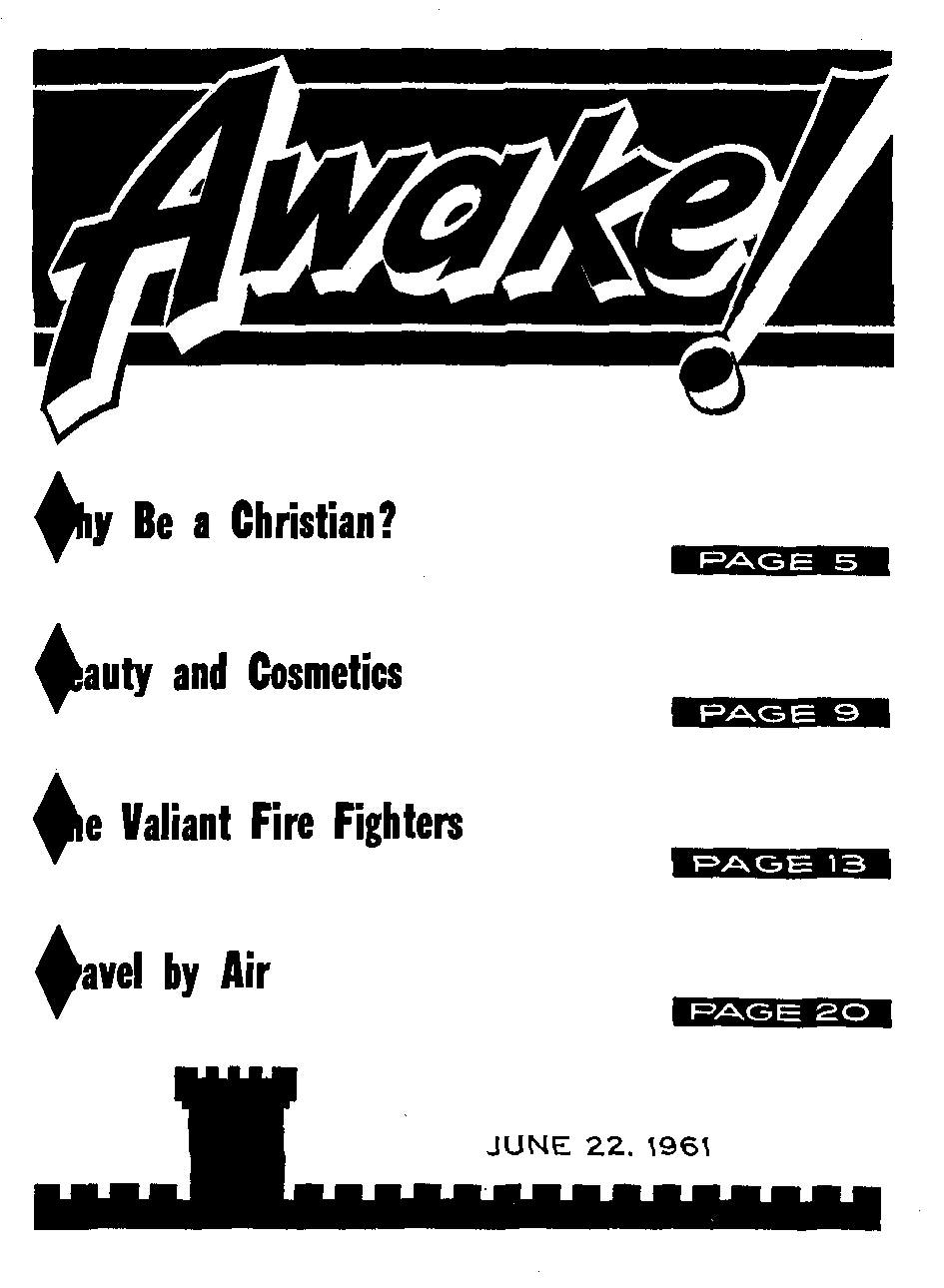
Aauty and Cosmetics
PAGE 9
Ale Valiant Fire Fighters
PAGE 13
Aavel by
Air
PAGE 20
JUNE 22. 1961
THE MISSION OF THIS JOURNAl
Newt sources that are able to keep yau awake to the vital issues Of bur times must be unfettered by censorship and selfish interests. "Awake!” has no fetters. It recognizes facts, faces facts, is free to publish facts, it is not bound by political ambitions ar obligations; it Is unhampered by advertisers whose toes must not be trodden on; it is unprejudiced by traditional creeds. This journal keeps itself free that it may speak freely to you. But it does not abuse its freedom. It maintains integrity to truth.
"Awake!” uses the regular news channels, but is not dependent on them. Its own correspondents are on all continents, in scores of nations. From the four corners of the earth their uncensored, on-the-scenes reports come to you through these columns. This journal's viewpoint Is not narrow, but is international. It is reod in many nations, in many languages, by persons of oil ages. Through its pages many fields of knowledge pass In review—government, commerce, religion, history, geography, science, social conditions, natural wonders—why, its coverage is as broad as the earth and as high as the heavens.
"Awoke!” pledges Itself to righteous principles, to exposing hidden foes and subtle dangers, to championing freedom for all, to comforting mourners and strengthening those disheartened by the failures of o delinquent world, reflecting sure hope for the establishment af a righteous New World.
Get acquainted with "Awake!” Keep awake by reading “Awake!"
Published Simultaneously in tub United States by the WATCHTOWER BIBLE AND TRACT SOCIETY OF NEW YORK, INC.
117 Adams Street
and in England
Brooklyn 1, New York. U.S.A.
WATCH TOWER BIBLE Watch Tower House. The Ridgeway N. H. Knorr, President
Printing this issue: 3.200,000 4d a
"Awake!” h piblkhed In ttc fallowing 23 lanijii|e»: Semimonthly—Afrikaans, Clnyanja, Danish, Dutch, English, Finnish, French, German, Greek, Italian, Japanese, Narwcgisn, Portuguese, Spa nigh, Swedish, Tagalog, Zulu. Monthly Cebu-Vfeayan, I Iwano, Korean, Malayalam, Palish, Ukrainian.
AND
copy
Offices
yearly subscription rntea
for semi monthly
America, U.S,, 11? Adams St, Brooklyn 1, N.Y, Australia, 11 Beresford Rd., StratiiMd, XS.W.
Canada, 150 Bridgeland Ave., Toronto 18, Ont.
England, Watch Tower House, The Ridgeway, London N.W, 7
New Zealand, 621 Now North Rd., Auckland, S.W. South Africa, Private Beg, Elandafontcin, Tvl.
Monthly editions cost half the above ratea.
The Bible translation ised fn “Awake!”
editions
$1
V-
7/-TOc
BY tract society
London N.W. 7. England
Grant Suiter, Secretary
(Australia, 6d
Remittances for subscriptions in your country. Otherwise London, Notice of expiration befoic subscription expires.
South Africa, 3J/2c)
ithonld he ."ent to the office wnd your remittance to
is sent at least two issues
CHANGES OF ADDRESS shoild reach us thirty days before year moving date. Give is yoir old and new addran (if possible, year old ad drew label). Watch Towff, Watch Tower Hone, The Ridgway, London N.W. 7, England.
Entered as second-claes matter at Brooklyn, ff.Y.
... Printed tn England
Whfifi other translations are
AS - American Standard Venlon AT - An American Translation AV - Authorised Verdun (1611) Bo - J. N. Darby’s version .
...... Now World Translation of the Holy Scriptures, following symbols wHJ ------ .......
Is the
Dj/ - Catholic Dauay version - The Emphatic Diaglott JP - Jawlsh Publication Soc. - Isaac Leeser'a TErsira
appear -
Po J2S -
Y <7 -
hehitid the eitatlm:
James Moffatt's Torsion J, B. RotlK-rhain’H version Ateriaed Standard Version Koberc YoLirjg'ls version
CONTENTS
Moral Support—Do You Give It?
Why Be a Christian?
Beauty and Cosmetics
The Valiant Fire Fighters
Television Conies to Central Africa
Travel by Air
Reading Time
Defeating Death in the High Alps
“Aimless Research”
“Your Word Is Truth”
Working at That for Which We Pray 27
Watching the World
W asm a young minister was delivering a Bible lecture. Then suddenly his mind went blank, and for a seemingly endless two or three seconds he groped in confusion until he collected his thoughts. Thereafter, for the rest of his discourse, he strove valiantly to regain his confidence and poise.
What had happened? In scanning the faces in his audience he noticed a poker-face expression of apparent indifference on the part of one whose judgment he respected. That was enough to throw him off balance. The remedy, of course, is for him to learn to be less impressionable and to have more self-control, more power of concentration. But there is also a lesson in this true-life incident for all listeners, namely, that their attitude, as expressed by their faces, their interest or lack of interest, can make it easier or harder for a speaker.
Giving a helping hand, as it were, under such conditions is termed giving moral support. By it we assure another of our good will, that he has friends, those that love him and that are interested in his making good. It is but another example of the power of love and the value of empathy.
Because it is not good for man to be alone, either physically or emotionally, we have an obligation to our fellow man in this respect. A man would be alone, even in a crowd, if none were favorably disposed toward him. He would be without moral support.
True, a dedicated Christian is never really alone; he has support from God’s Word and God’s spirit, and he can always talk with God in prayer. With these aids he can endure, even when isolated from others. Jesus Christ did. At the time of his betrayal and death, when the moral support of others would have been most welcome, they fled. It is important to appreciate our obligation to give moral support, in line with the Scriptural injunctions: “You must love your fellow as yourself.” “All things, therefore, that you want men to do to you, you also must likewise do to them.”—Lev. 19:18; Matt. 7:12.
Ttie obligation to give moral support enters into all our relations. We owe it, for example, to the one for whom we work, our employer, foreman or overseer. He may not be able to get all the co-operation he is entitled to and would like to have, but to the extent that we go beyond the minimum required of us we are giving him moral support. Today the trend is to be niggardly in giving such moral support, which is to be expected in view of what Bible prophecy has to say about our critical times.—2 Tim. 3:1-5.
Of course, it also works the other way. A good employer, foreman or overseer will give moral support to those working for him. In what ways? He can do this by showing consideration in assigning tasks, in not expecting the same from each one, in not being harsh. And especially can he give moral support by expressing appreciation for good effort or for work well done.
Moral support is also what husbands and wives owe each other. “Love builds up,” we are told, and each should build up the other. A husband can build up his wife by consideration and respect, by appreciation, praise and compliments. Especially should he do so when he notes that she is feeling low; then a little praise for her efforts or on her appearance will be like refreshing water to a thirsty soul. In such ways the husband will be heeding the counsel to love his wife as he does his own body.—1 Cor. 8:1; Eph. 5:28.
Not that wives do not owe moral support to their husbands. They do. A wife can build up her husband by showing respect, by being tactful, by complying with his wishes. Knowing that he has competition all day long, she will not give him further competition when he gets home but will give him co-operation instead. Manifesting “godly devotion along with self-sufficiency” is another way in which wives can give their husbands moral'support.—1 Tim. 6:6.
The parent-child relationship furnishes another rich field for giving mutual moral support. Modem youths are woefully lacking in this respect. Though unable to support themselves and lacking in knowledge, they presume to rule the roost by taking advantage of the fondness of their parents for them. They choose to ignore the debt of respect and obedience they owe their parents. Not that parents need their children, but because parents love their children, the children can make them happy. Even Jehovah God says that: “Be wise, my son, and make my heart rejoice, that I may make a reply to him that is taunting me.”—Prov. 27:11; Eph. 6:1-3.
And again the converse is true: parents owe moral support to their children. Sincere words of commendation and encouragement for proper conduct, good work done, or unselfishness expressed, give moral support. Above all, setting a proper example does so, for children instinctively want to look up to their parents.
Many other examples of the value of moral support might be cited, such as in the relations between the member of a Christian congregation and his overseer, and the man on the street and the peace officer. And is not this why there is always a cheering squad at a scholastic football game? In giving moral support, let us give generously, and without adding a price tag to it!
The Bible tells us that shortly after the Israelites crossed the Red Sea they were attacked by the Amalekites. So long as Moses kept his hands lifted up his people were victorious. As they became weary, Aaron and Hur supported Moses’ arms, thus assuring victory. (Ex. 17:8-13) In the battle of life, in the fight of faith, we can help others gain the victory by giving them moral support. As a wise king long ago expressed it: “As apples of gold in silver carvings is a word spoken at the right time for it.” “A word at its right time is 0 how good!”—Prov. 25:11; 15:23.
Why I*** /
SOME professions promise prestige, others fame and fortune, but Christianity holds forth none of these as immediate rewards for having followed in the footsteps of Jesus Christ. Instead of fame, the Christian apostle Paul says: “We have become as the refuse of the world, the offscouring of all things, and we are so now.” Instead of glory, Paul declares Christians have become fools for Christ’s sake. Instead of having strength, they are weak. Instead of honor, they are held in dishonor. ■ They are often hungry, thirsty, naked, a people knocked about and homeless, unwelcomed in the world and of whom the world is not worthy.—1 Cor. 4:10-13.
Yet, despite this unpleasant outlook, a great crowd of people today are taking, up the Christian religion. They are aware of the hard life that lies before them, but this does not deter them.
Jesus Christ, the founder of Christianity, did not promise those who would follow him a life of ease. He assured them that Christianity was a narrow road of hard knocks, that they would no doubt be reviled, persecuted and defamed, even as he was. “In fact, all those desiring to live with godly devotion in association with Christ Jesus will also be persecuted,” said Paul. —2 Tim. 3:12.
Before leaving the earth Jesus told his disciples that such would be the case. He said: “These things I command you, that you love one another. If the world hates you, you know that it has hated me before it hated you. If you were part of the world, the world would be fond of what is its own. Now because you are no part of the
Chrisfianify provides, t
none con afford to reject S
Consider f/ie facts. Count the cost. f
inaffinmsMKMMaBiiMMiCMSRMMMeaaianMMemMMMeS
world, but I have chosen you out of the world, on this account the world hates you. Bear in mind the word I said to you, A slave is not greater than his master. If they have persecuted me, they will persecute you also; if they have observed my word, they will observe yours also.” (John 15:17-20) Jesus spelled out no life of ease for his followers. Their reception would be a cool one, even as his was. But Jesus also knew that this would not be a deterring factor to one who sincerely desired to become a Christian. The power of Christianity is unto salvation and it is strong enough to win over all obstacles, as Jesus himself so perfectly proved.
When a certain scribe said to Jesus: “Teacher, I will follow you wherever you are about to go,” Jesus replied: “Foxes have dens and birds of heaven have roosts, but the Son of man has nowhere to lay down his head.” In substance Jesus was saying to the man, ‘Sir, are you willing to give up your comfortable surroundings to follow me?’ Then, as today, there were more who wanted to receive the benefits of Christianity than there were persons who were willing to sacrifice something for them.—Matt. 8:19, 20.
To his disciples Jesus said: “If anyone wants to come after me, let him disown himself and pick up his torture stake and follow me continually.” (Matt. 16:24) This meant setting aside selfish ambitions, putting true worship first in one’s life. Some might have been willing to follow him a day or two, but to “pick up his torture stake and follow [him] continually,” well, that was asking too much of them, so they thought. The torture stake represents the suffering and shame or torture that must be endured as a follower, not only today or tdmorrow, but this week, next week, continually. No, a Christian’s life is not an easy one and there are not many willing to disown themselves for the sake of Christ or life itself.—Matt. 19:29.
Reasons for Becoming a Christian
Why do some become Christians? Of Jesus it is written: “For the joy that was set before him he endured a torture stake, despising shame, and has sat down at the right hand of the throne of God.” Jesus found joy in doing God’s will. “To do your will, O my God, I have delighted.” Christians who follow Jesus’ footsteps closely experience this same joy and satisfaction in serving God.—Heb. 12:2; Ps. 40:8.
In addition to happiness and contentment, Christianity gives one peace, because it is of the God of peace. In this chaotic world a rewarding peace is a tremendous force to attract people to Christianity. The apostle Paul urges Christians to rejoice in the Lord and not to be anxious over anything, “but in everything by prayer and supplication along with thanksgiving let your petitions be made known to God, and the peace of God that excels all thought will guard your hearts and your mental powers by means of Christ Jesus.” Outside the Christian congregation true peace cannot be found. —Phil. 4:4-7.
Yet there is an even more impelling reason why individuals take hold of Christianity. What is that? The fact that Jesus Christ is the Son of God, the One sent forth into the world by God and who set the pattern that men must follow in order to please God. With a sincere desire to do the will of their God and Father in heaven, persons out of all races and tongues exert themselves to walk in Jesus’ footsteps. —Luke 1:32; 1 Pet. 2:21.
The Power of Christianity
The magnetic power of Christianity is in its message. “My sheep listen to my voice, and I know them, and they follow me. And I give them everlasting life, and they will by no means ever be destroyed.” (John 10:27, 28) The voice of the Good Shepherd, Jesus Christ, carries with it drawing power. He who speaks from the heart is able to reach hearts; he who is lowly will uplift; he who is all love will inspire love in others; he whose soul is great will strengthen the weak and lonely. This Jesus Christ did; this the Christian message does. People who are of good will toward God listen to the Christian message and are revitalized by it. They find peace, joy and hope in it. These are the ones that become Christ’s followers—Christians.
The Christian message is the message of the Kingdom. Jesus wished neither to be the restorer of fallen worldly kingdoms nor the conqueror of hostile realms of his day. He was not of this world, his kingdom was not of this world, and his followers are not of this world. Concerning his followers he said: “They are no part of the world just as I am no part of the world.” (John 17:14) This fact has a liberating effect, an appeal which draws men into the Christian fold.—John 18:36.
Jesus advocated God’s kingdom as the only hope for mankind. Therefore he cared nothing for worldly power or its glory. He taught his followers to be of the same disposition that he was toward this world. This fact has been a great safeguard and a source of great freedom to them. It has freed them from religious and traditional holidays and their burdens. It has released them from the strains of worldly bickerings and political strifes. Some religious leaders complain that the Christian religion in the modern period “is otherworldly, escapist and irrelevant to the problems of this life.” Not so! The Christian religion is following the Christian principle of separateness from this world. Christendom’s religions have ignored this principle and have allied themselves with this world, becoming its close friend, thus an enemy of God. (Jas. 4:4) Such unchristian alignment has involved them in wars and revolutions, in political and social squabbles. So much have Christendom’s religions become a part of this world that the two are now indistinguishable. Jesus freed his people from such madness by making them advocates of the kingdom of God. “Keep on, then, seeking first the kingdom and his righteousness,” was his wise counsel, and all necessary things pertaining to life will be added to you. This too has an appealing ring to men of righteousness.—Matt. 6:33.
The Kingdom Hope
The kingdom Jesus proclaimed and taught his followers to pray for has nothing in common with the kingdoms of this world. His kingdom is destined to abolish the kingdoms of the earth. The kingdom of heaven, which is one, will supplant the kingdoms of the earth, which are many. No longer will there be on earth kings and subjects, masters and slaves, rich and poor. The citizens of God’s kingdom will form one family, and life under that kingdom will be abundant, as Jesus promised.—John 10:10,-Dan. 2:44.
It was the hope of living in or under that kingdom that stirred the hearts of many to become Christians. Not understanding the kingdom to be heavenly, the apostles asked Jesus before he ascended into the heavens: “Master, are you restoring the kingdom to Israel at this time?” Jesus told them that a world-wide witness work would have to be carried on first. The foundation of the Kingdom, however, was laid back there in A.D. 33. And the apostles and disciples of Jesus Christ, the King of the kingdom, became its representatives and ambassadors substituting for Christ, begging men to “become reconciled to God.” Hope in the kingdom of God became a powerful force, attracting men to become Christian witnesses of the Most High.—Acts 1:6-8; 2 Cor. 5:20.
The kingdom is not the forgotten dream of a handful of Jews who lived two thousand years ago; it has not become a thing of antiquity, a dead memory, a madness that is past, as some have charged. The kingdom is of today, of tomorrow, of all time to come, a reality. Since its establishment in the heavens A.D. 1914, every dedicated servant of God may contribute toward the proclamation of this fact. Jesus said: “This good news of the kingdom will be preached in all the inhabited earth for the purpose of a witness to all the nations, and then the accomplished end will come." —Matt. 24:14.
The announcement may not strike you as a new one, and the message indeed seems old, since Jesus, when on earth, called for men to “repent, for the kingdom of the heavens has drawn near,” he being the King of the Kingdom in their midst. But the Kingdom, as a fact, in its establishment and accomplishment in the heavens as it now stands, is new, fresh, born but forty-seven years ago; it is still growing. Like a great tree or a growing mountain, it is destined to fill the whole earth. And every time a man makes an effort to subject himself or a woman herself to its authority, this fact becomes added evidence confirming the Kingdom’s existence and realty. It becomes an added reason for proclaiming the Kingdom’s perpetual holiness and superiority over all kingdoms on earth. It is another reason for becoming a Christian.-—Matt. 4:17; Dan. 2:37.
The Kingdom’s establishment is evidence that a new world is at hand, a world where life and peace will be without end. God-fearing people want to live in that world; that is why they become Christians. There is no other way to salvation. Jesus made this fact clear when he said: “I am the way and the truth and the life. No one comes to the Father except through me.” (John 14:6) The apostle John tells us that the world we now live in is “passing away and so is its desire, but he that does the will of God remains forever.” To remain forever, one must live forever. Jesus gives promise of this possibility, saying: “For this is the will of my Father, that everyone that beholds the Son and exercises faith in him should have everlasting life.” “Most truly I say to you, He that believes has everlasting life.” “He that feeds on this bread will live forever.” “The sayings that I have spoken to you are spirit and are life.” In the words of some officers in Jesus’ day: “Never has another man spoken like this.” His is a powerful, irresistible, unmistakable message about life everlasting. It inspires conviction and wins people to the side of Christianity to this very day.—1 John 2:17; John 6:40, 47, 58, 63; 7:46.
High Moral Standards
Christian principles and the religion’s high standard of moral living are also attracting forces to the cause of Christianity. The apostle Paul admonishes Christians to deaden their body members respecting “fornication, uncleanness, sexual appetite, hurtful desire, and covetousness, which is idolatry.” He urges them to put away “wrath, anger, injuriousness, abusive speech, and obscene talk” out of their mouths, and for them not to be lying to one another, to strip off the old personality with its practices, and to clothe themselves with the new personality, which through accurate knowledge is being renewed according to the image of Christ. (Col. 3:5-11) Christianity provides the principles for an all-clean Christian society. This is also an attracting force to all people who want to live decently according to God’s arrangement.
These high standards are admittedly not seen in Christendom, because Christendom is not Christian but worldly—pagan. However, these high standards are practiced today in the New World society of Jehovah’s witnesses. Within the New World society Christian principles are enforced. The fruits of Christian living are felt, to the blessing of all who become its members.
Christianity assures hope of everlasting life in a righteous new world; it creates a oneness that brings peace; it provides the principles that make for pleasant associations; it satisfies man’s desire to serve God. It therefore provides the only sensible course to take in these critical times. Are not these reasons enough for becoming a Christian?
Come to me, all you who are toiling and loaded down, and J will refresh you. Take my yoke upon you and become my disciples, for
I am mild-tempered and lowly in heart, and you will find refreshment for your souls. For my yoke is kindly and my load is light.—Matt. 11:28-30.
namely, spiritual ways.—Matt. 22:39; ICor. 11:7-9.
L>
' AND
OSMETFCS
Do not misunderstand; it is good to look nice, but overemphasis on this to the exclusion of spiritual values is certainly not wise. Women who concentrate on physical beauty, to the exclusion of building up the qualities of the mind and heart, find they have a harder time holding on to their husbands. While it is a lift to a man’s ego to have a pretty wife, other things are important to him too. He wants his woman to be a good companion, a kind mother, a capable cook, a charming hostess and a reasonable housekeeper. Perhaps, above all else, he wants her to be spiritually-minded. These are the things that endear a woman to a man, not just looks. --1 Pet. 3:1-4.
FOR a woman to possess beauty is to her a rare source of happiness indeed. But she would be terribly mistaken to think that physical beauty alone is enough. A beautiful face and a lovely form are a big help, but they are not absolutely necessary for getting along in life. It takes more than good looks. Talent and ability, alonj, with a large measure of spirituality, are far more essential.
There is nothing wrong in wanting to be physically beautiful, however. Nature teaches us that our God loves beauty. Basically, the desire to be beautiful is an expression of his royal law of love—the love of neighbor and the love of self. Since woman was created for the sake of the man, as the Bible teaches, her inborn desire is to please him, so that he, in turn, will care for her. Being beautiful is a woman’s way of showing the man that he has made a right choice or that she cares for him. But outward beauty in itself will not please man for long. A woman must have other ways of showing that she cares,
European and Oriental women who seem to be less conscious of physical beauty but work hard at developing a quiet and mild spirit appear to do much better at holding their husbands than women in other parts of the world who ignore or neglect these qualities; at least, divorce figures would seem to indicate this.
However, much can be said about physical beauty and what cosmetics have done to enhance the beauty of women. Unfortunately, the use of cosmetics has been carried to such extremes that all too often the results, instead of adding to a woman’s attractiveness, do quite the opposite. If some women only knew where to stop and used cosmetics in moderation and sensibly they might succeed in accomplishing the result that is the primary reason for cosmetics, which is to beautify.
While many women who are plain or lack lovely skins or complexions may be able to improve their appearance by an artistic use of cosmetics, still there are many more who are far more attractive without make-up of any sort, yet who conceal their natural beauty, their lovely skins and complexions and alter their features by the liberal or over-use of cosmetics merely because it is the present fashion to do so. This, of course, is an objectionable feature of cosmetics. However, the users and not the product are to be blamed for such indiscretion.
Intelligent men and women have never viewed cheap painting and thoughtless powdering as a substitute for natural beauty. Beauty is more than a simple putting on of creams and powders. Take the face, for example. Nine times out of ten your face is the part of your body that people see first. And more often than not, it is your face that makes the first impression, and it is that impression that counts most with many people. They seem to remember it the longest. Girls from twelve to fourteen have a wholesome, natural appearance without the application of any cosmetic whatsoever. In fact, make-up often detracts from beauty rather than enhancing it in youth. Youthful faces radiate a freshness without make-up. They really do not need it.
Changing Beauty
The face, however, changes with age. For one thing, it takes on interest. And an interesting face is just as important as a beautiful one. A beautiful face is not always one with perfect features, but more often one that reflects a responding heart. Think of the beauty wrapped up in a single smile! And how beautiful are the eyes that shine! What beauty and excitement there are in laughter! So a little outward beauty and a whole lot of inner glow for an appreciation of life are what make the face truly beautiful.
But even beautiful features, such as our eyes, nose and lips, which are given to us at birth, must not be neglected but cared for or else they lose their luster and natural beauty. A woman past the age of thirty-five can make her eyes sparkle with as much interest as her daughter, if she tries. Her skin may not be as youthful as her daughter’s, but it can be just as fresh with a little care. As she grows older, her remaining beautiful will necessitate a little more attention and a change in make-up, if cosmetics are used. Women in their sixties often find that they appear most charming in shades of a cameo pink. The dark tones against a light skin make them look harsh and old. But regardless of age, too much make-up cheapens one’s appearance. It indicates “no background.’’ No make-up at all is better than too much or the wrong kind. People of taste prefer you to look like yourself. Men, especially, do not like their women to look made up. They want their women to appear naturally beautiful.
A right application of make-up can do much for the face. It can make a long nose look short or a short nose look long. It can make a chin appear larger or smaller, make the eyes seem brighter and the lips more inviting. It can also make a face of any shape look almost oval, which is the classical standard for facial beauty. Powder bases can put color into sallow skin, take the pink out of skin that looks flushed, cover over “blotches," disguise veins, freckles, large pores and blend all the areas of a face into a pleasant single tone.
Make-up can be a boost to a woman’s morale. For example, in England during World War II cosmetics were declared a luxury. Lipstick became scarce. When lipstick was again provided, work output increased and women’s whole general attitude is said to have changed for the better.
Fact or Fiction?
Cosmetics can do many things, but not all that advertisers claim for them. In recent years some preparations have been misrepresented as skin foods and tonics. Others have been advertised as “contour creams” for bust development or bust reducing, wrinkle eradicators and “deep pore” cleansers. Some make elaborate promises. “Is it difficult for you to charm the man you want? Then try our lipstick and he is yours.” “Has your husband’s love for you faded? Use our beauty cream and he will love you with a love that will keep you eternally young and lovely.” “Are you without a job? No wonder, look at your hands! Use our hand lotion and the job is yours.” And so on, ad nauseam, read the advertisements.
It is amazing how many otherwise intelligent people are taken in by such slogans. When S. L. Mayhem, executive vicepresident of the Toilet Goods Association, was asked why women were so gullible about the absurd claims and prices of cosmetics, the executive replied in a single word—“hope.” For there is always hope that what is said might be true. If a $5 jar of cream does not perform the miracle, there is always hope that the $10 or the $25 jar might. Some of these exotic creams are worth their weight in gold, for they sell for $50, $20 and $15 an ounce! “Women seem to want the snob appeal of high-priced cosmetics,” says one report. A cream that has been on the market for sixty years is said not to be a top seller today simply because it is not expensive enough.
So far there is no evidence whatever that any of the creams, cheap or expensive, have erased a single wrinkle or slowed down the aging process one bit. As for the ingredients that go into these creams, basically they are about the same. Generally, they are made of lanolin or of an inexpensive oil base that softens and soothes the skin. The most expensive varieties do no more. The major difference is in the perfume used and in the shape and quality of the jar—not the cream. The plain, simple truth is that milady will not become one mite more beautiful nor will her skin be benefited any more by using expensive creams than by the use of ordinary cold creams. The beneficial results obtained are mainly in the stimulation brought about by the massaging when applied and not so much by the cream itself.
Women who pass the age of thirty begin to think they look like wrecks, because advertisers say so. Their scheme is to get women believing that only special preparations can save them, that their priceless asset is their soft, beautiful skin. It is a fact that attractive women in their thirties and forties have kept their good complexions either through avoidance of, or in spite of, these “miracle” preparations.
Actually there is no such thing as a “skin food.” Skin specialists state that a balanced diet, plenty of exercise, relaxation and sleep will do more for your skin than all the high-priced creams in the world. If you have skin blemishes that you wish corrected, then see a skin specialist, not a salesman.
Tips and Dangers
In recent years dangerous cosmetics have almost completely vanished, but there are still a few things that it is good to know about some of them. For example, hair bleach is essentially hydrogen peroxide. Extensive use of peroxide often leaves the hair dry and brittle. Such hair is difficult to manage and is curl resistant to cold-wave solutions. Veronica L. Conley, according to Consumer Bulletin, warned that long-continued use of hydrogen peroxide is likely to cause progressive damage to the hair shaft.
Laboratory experiments have disclosed that some of the substances in hair sprays can cause cancer-like growths in rats and mice. Their effect on humans is still not known. Three Missouri doctors have discovered two cases where the lymph nodes were inflamed and the patients became ill from inhaling aerosol hair sprays.
Some manufacturers make durability claims for their brands of lipstick. “Keep bright lively color on your lips 24 hours a day.” Tests have proved that the color of these brands after a few hours showed wear. For satisfactory results they had to be reapplied about as frequently as those for which no special durability claims are made.
Lipstick dyes and chemicals can cause either primary irritation or allergic reaction in the form of dryness, blistering, peeling or swelling to some users. It would be wise to discontinue the use of any brand that causes lip irritation or swelling. It has been found that individual differences in method of application, as well as the condition of the lips, influence the results obtained as much as the quality of the product itself.
Recently New York manufacturers have capitalized on dihydroxyacetone, a chemical that gives skin that sun-tan look. Manufacturers have combined this chemical with alcohol and perfume and are selling it at from $3 to $5 a bottle as a "no-sun” tan lotion. It tans merely the upper layer of skin, and the color lasts for about ten days. Some persons have complained, however, that their skin gets blotched from the product. So use care.
Press-on nail color for fingernails that does away with delicate brushwork, smears, spills, sealers and removers, and so forth, according to a manufacturer’s guarantee, is supposed to “last three times as long as liquid polish.” The product is rated better than nail polish, but some women say it softens their nails or splits the ends.
Such things as “royal jelly,” a substance from bees’ glands, that are supposed to act as “rejuvenators,” and are called “fabulously effective,” actually have no proved therapeutic or restorative powers whatsoever. The only effective jolt received is from the inflated prices and not from the jelly. As Barron’s magazine pointed out: “Since only about 100 milligrams is needed in an ounce of facial cream, the added cost of an ordinary size jar is only about 20c, yet it has been established as a luxury item and creams containing it sell as high as $15 a jar.”
Many manufacturers claim that their brands include a foundation cream, which makes a light application of vanishing cream preceding the powdering unnecessary. Tests made of these products showed that for good results a base cream was still needed. Eleanore King, a Hollywood beauty consultant, said: “In eleven years of intense perusal of my students’ skins, I saw no more than five that I thought looked better without a base.” In face powders, as with many other products, price is not a reliable guide to quality. A relatively low 39c, %-ounce cake of powder was found to be of very high quality. But who would suspect it at that price?
How many beauty preparations does one need? The average girl does not need many and certainly she does not need fancy preparations. Choose a product and not a fancy package. Read labels, look for seals of approval, stick to proved, tested products with reliable names. They need not be costly. Buy in small jars first until you have found what is right for you. Above all, for real beauty accent your inner charm, that “secret person of the heart.”—1 Pet. 3:4.
There is little doubt that cosmetics will continue to find an eager market—to the joy of many and the dismay of some. Depending on personal taste, yes, even religion, some will approve of a few of the products and frown on the rest; others love them all.
iH
q 7 ALT A NT” is the right V word, for it means 'stouthearted; brave; courageous.” If any deserve that designation it is the fire fighters, for theirs has well been termed “the most dangerous of peacetime professions.” Far more dangerous than contending with such foes of humankind and society as disease and crime is warring with the enemy Fire.
Thus in January of this year a wall collapsed on twenty firemen fighting a blaze in Chicago, Illinois, of which number nine were crushed to death and others suffered severe injuries. During the previous November a similar accident caused the death of three firemen and injured eleven others in a downtown New York city fire. In the Texas City, Texas, 1947 conflagration the entire volunteer fire department was wiped out, and a few years before, an explosion in the harbor of Bombay took the lives of forty firemen. For the past hundred years in New York city an average of ten firemen have lost their lives annually. And each year one fireman out of eight receives injuries, some 1,500 out of a force of 12,000.
Just who were the first fire fighters is not known. What is definitely known is that fire fighting goes back at least to the time of the ancient Greeks and Romans. As far back as 200 B.C., a Greek invented a machine for pumping water at fires.
ttowems^it that* with the fading out of'their civilizations, fire fighting also fad-
KjC?'
Y ed out. During the Dark Ages fire was otftisidered an expression of divine disfavor, some-filing to be combated by prayers, relics and statues of “saints.”
Modern fire fighting really
got its start with “The Great Fire” of London, in 1666, which began on September 2 and lasted for five days. It turned into ashes 373 acres of the city, including 13,200 dwellings and upward of a hundred chapels, churches, libraries, hospitals and suchlike buildings, not to say anything of the destruction of bridges and city gates. This jolted the Londoners into action. Men now gave thought to training in fire fighting and rescue operations, how to use ladders and other fire equipment, which now began to be manufactured. The following year saw the beginning of fire insurance.
Fire Fighting
Fire fighting has a fascination all its own, which accounts for the fact that many a man prefers it as a profession to some other that may be more rewarding financially and less hazardous. This fascination also accounts for the existence of fire buffs, the enthusiasts who not only like to watch fire fighting but who at times pitch in and help. New York city’s best-known fire buff was none other than its Mayor LaGuardia.
About a hundred years ago, when the New York city fire department first got its start, it advertised for “'strong, able, discreet, honest and sober men.” But not to be overlooked are the requirements of courage, intelligence, quick reflexes, steady nerves and stamina. Firemen must be able to work hard at a fire over long stretches of time and in almost unbearable conditions. A fireman never knows what he might run up against. But this he does know: “No two fires are ever alike.” In the Maine forest fires of 1947, which destroyed hundreds of square miles of timber, firemen fought for eight days with but fourteen hours of sleep.
The senior officer in charge of a fire must be a chemist, an engineer, a mechanic and an electrician all in one, and his men also, to a lesser extent. At a large fire he must have the qualifications of a general, know where to place his men, the dangers involved, where the water should be applied, when to pull the men out before walls collapse, and, above all, be able to think and act quickly. As has well been said, speed is the essence of fire fighting.
The fire fighters have three basic duties to perform at a fire: First and most important is the saving of lives; never should the saving of property come ahead of the saving of lives. Secondly comes the containing of the fire, or keeping it from spreading, from getting out of control and turning into a conflagration. And then comes the extinguishing of the fire itself by attacking it as closely as humanly possible.
A fire requires three indispensable factors: heat, fuel and oxygen. Remove any of the three and the fire goes out. So firemen proceed along these lines. The simplest and most frequently used method is to cut down the heat by means of water. However, when oil or other inflammable liquids are burning, water merely spreads the flames and so the attempt is made to cut off the oxygen by means of chemical foam or various kinds of “fog.”
The third method, that ot removing the fuel, is practical only in very small or very large fires. Tossing a burning mattress out of a window is one way of removing fuel from a fire, thus starving it. In a great city conflagration or large forest fire efforts are made to contain the fire by means of a “break,” which in a city fire may mean dynamiting buildings in the wake of the fire and in a forest fire may require a “scorched earth” effort.
In New York city it takes six months of probationary training to become a fireman. The first eight weeks of this period are spent in four courses or units of two weeks each. During the first, the “Proby,” as he is called, is instructed in the theoretical aspects of fire fighting. In addition to policy as to conduct he is taught such basic things as simple hydraulics, chemistry of fire fighting, first aid and fire prevention.
The next two weeks he works with the Ladder Unit. There he learns how to use the various ladders and climbing devices, such millenniums-old equipment as ax, claw and hook as well as such modern equipment as electric saw, drill and acetylene torch. The third two weeks he spends with the Engine Unit and learns how to handle hoses, and so forth. The final two weeks summarize the course as well as providing experience in simulated and actual fire and smoke situations. If he passes the examination at the end of this term he is assigned to a fire company to complete his probationary period. If he is found satisfactory by his superiors he becomes a permanent member of the city’s fire department, beginning at Fourth Grade, automatically advancing one grade each year until the first, with each increase enjoying also an increase in salary.
Modern Aids
The public press keeps on reporting on the valor of the fire fighters. It would seem that out of sheer appreciation, if not also from economic considerations, they would also be given the full benefit of modem inventions. But not so. It appears to be the exception rather than the rule, at least as far as the United States is concerned. This is particularly true as regards the use of “fog,” “wet water,” “wet water fog,” and “foam fog.”
By "fog” is meant a stream of water broken up by a certain type of nozzle so that it becomes like a cloud of coarse mist. This is a solid cloud of mist and not the umbrellalike spray of a garden hose. With such a nozzle much can be done with comparatively little water, as it gently settles on the fire instead of running off.
As for “wet water,” this is ordinary water to which a certain chemical has been added, making it “wetter.” This decreases the surface tension of the water so that it penetrates rather than running off. A duck cannot swim for long in wet water; it soon becomes as waterlogged as a chicken in water. When the fog method is applied to ' wet water it becomes especially effective, in fact, from seven to ten times that of ordinary water. And a tank containing from 500 to 1,000 gallons of such “wet water” applied with fog nozzles is adequate for 99 percent of the fires that the average city fire department has to cope with.
More than that, it has been found that when “wet water fog” is applied to one room it not only puts out the flames in that room but has a “remote control” or “indirect extinguishing action” on fires in adjoining rooms and floors; seemingly incredible, but nevertheless proved true time and again. Further, this "wet water fog,” or any “fog,” can be applied from Ij-inch hoses instead of the regulation 2|-inch hoses. The smaller hose being preconnected, it is ready for use as soon as the fire truck reaches the fire—a most important consideration since "all fires start small” and the “first five minutes are worth the next five hours.”—Disaster on Your Doorstep, Paul W. Kearney.
IN THE NEXT ISSUE
Q Could War Start by Accident?
* Approaches to Arthritis.
* Do You Give Encouragement!
• The British Museum.
• South Africa Leaves the Commonwealth.
For gasoline and other liquid fires there is a variation of this, the “fog foam,” produced by adding three gallons of a certain chemical to each 100 gallons of water. Crash trucks supplied with this solution are standard equipment at Idlewild, La Guardia and such airports. And another modem device not supplied nearly as much as it should be to the valiant fire fighters is the gas or smoke mask. As has well been observed, it makes as much sense to send firemen into smoke-filled houses without gas masks as it would to send them to a fire barefooted! The Miami fire department has a mask for each fire fighter and for years has not had a single fireman overcome by smoke.
Certainly the valiant fire fighters deserve all the help they can get from modem science in fighting fire, and it does seem unfortunate, yes, ununderstandable that this should be the exception rather than the rule. But perhaps that is expecting too much under present imperfect and selfish conditions.
Yet there is co-operation that everyone can give. Take proper precautions to prevent fires. Keep electric wires and fixtures in good repair; do not be careless with matches; when you light a fire, watch it and keep it under control. Any fire fighter will agree that a little prevention on your part is worth more than all the protection that he can give.
Bp "Awake!” correepondent in Southern Rhodesia
ELEVISION has come to Central Africa! Last November thousands of Rhodesians throughout Salisbury saw the prime minister of the Federation of Rhodesia and Ny-asaland, Sir Roy
Welensky, inaugurate the new television service. “As you can imagine, this is quite a pleasure to me,” he said, “and a very considerable one to be speaking to you from the first television station to be established in the Federation, and I share with you that pride we feel on this occasion. There are not many countries as young as ours which can include television amongst the facilities they offer the people.”
It was Sir Roy Welensky who, in 1954, as Federal Minister of Posts and Telegraphs, had steered a bill through the Federal Parliament that opened the way for a possible television service. On that occasion, referring to the inclusion of a provision for television in the act, he said: “This may be thought to some to be unduly optimistic. But I hope my claim that it is merely farsighted will be justified in time.” And so it proved to be.
Radio broadcasting in the Central African territories had been a local affair until the forming of the Federation in September, 1953, but from then on the Federal government gradually undertook the responsibilities of operating the service, setting up a Commission of Inquiry in 1955 to consider the possibilities of a central broadcasting control. This resulted in the establishing of the Federal Broadcasting Corporation of Rhodesia and Nyasaland, which took over the responsibility for radio broadcasting in the Central African territories in February, 1958. Matters concerning television now moved on apace.
) The first official announcement
of government approval came in May, 1959, when the FBC invit-
ed applications from persons who wished to be associated with the Corporation in the operation of a television service. It was intended that the service would follow the lines of the arrangement in Great Britain, where the government-established Independent Television
Authority leases time to private “programme contractors” who obtain their revenue by selling advertising. The FBC would in a similar manner lease time to the successful contractor, but would act in a controlling and advisory capacity. The contractor would be required to advance the initial cost of erecting transmitting stations, but ownership would be vested in the FBC, which would also have control over the programs to ensure that high standards and good taste were maintained. As in Britain, the service would be commercial, to provide revenue for the contractor. One important condition was that the contractor would be willing to extend television coverage to the Federation’s main centers of population within a reasonable time. Television in Central Africa was on its way.
SHixed Reception of Announcements
Now that television was a certainty, public reaction was immediate and interesting. How would television affect the traditional pattern of life in the Rhodesias, with its accent on family associations, hospitality to friends and strangers alike, its love of the great outdoors and the numerous sporting events carried on the year round due to the ideal weather conditions? How would it affect the rising generation of future Rhodesians? Would it retard or add to the present increasing divorce rate in the Federation—the third highest in the world? And of still greater import to those concerned with the multiracial aspect, how would it affect the African peoples who form the vast majority of the population in Central Africa?
A newspaper comment summarized what must have been the thought in the minds of many at the time: “In all quarters it is accepted that TV can be a great boon. But there is widespread conviction that television must come to the Federation only with the adequate safeguards against the abuses which have accompanied it in some other countries.” (Sunday Mail) The article went on to quote expressions from a cross section of the population on the possible effects of television on Rhodesian life. Varied opinions came from some of those responsible for the education of Rhodesian youth. The hope that it would widen the viewpoint of Rhodesian children was expressed by a senior official of the Federal Ministry of Education who said: “In our schools TV will be a wonderful thing.'TV will give our children a window to the world. It is needed here more than in any country I can think of.”
An adviser on technical education to the Southern Rhodesia Government was quoted as saying that while he recognized the great aid that television would be to widening and stimulating the minds of the youngsters of the Rhodesias, who were rather shut off from the world at large, he also added: “I don’t want their imaginations stimulated as television is stimulating American youngsters. There, as I have seen, television is a menace to social life. We don’t want that here.”
The impact that television would have on the multiracial situation prompted further views. A spokesman of the Southern Rhodesia Department of Native Affairs observed: “The influence of television on Africans with their unsophisticated minds and emotional natures is going to be tremendous. Who can tell what effect it will have? The impact will be all the more powerful because of the novelty and the magic of the medium to the African mind.” On the other hand a more optimistic view was expressed in the Evening Standard: “Television can bring great blessings. . . . Nothing could more quickly spread education and enlightenment among the backward majority of our people.”
Some even thought it might help the divorce situation. The October 25, 1958, issue of the Sunday Mail carried an article entitled “T.V. Is the Antidote to a Marriage Killer.” Drawing attention to the unenviable position that the Federation holds in the world divorce stakes, the article quoted authorities as pinpointing the cause to be boredom. “Foolish wives. Tired husbands. Meaningless sundowners. Flaccid conversation. Lots of acquaintances and few friends. Work hard all day and then what to do?” Hence the heavy drinking, family rows and broken homes. It went on to quote an English housewife from the Nuffield Foundation report on “Television and the Child” as saying: “Television holds us together. Before we had television it was very difficult to keep my husband contented. Television keeps husbands at home.” Would it have the same effect on Rhodesian homes? Time alone would tell.
The Contract Is Placed
The FBC’s invitation attracted competitive applications from some of the world’s most influential television interests. Commenting on this, the Evening Standard said: “That some of the financially strongest and technically most experienced television operators in the world should have applied to run the Federation’s television services is most encouraging.” Careful consideration was given to the proposals submitted and it was not until September, 1959, that the successful contractors, Rhodesia TeleVision Ltd., were awarded a fifteen-year contract.
The contract provided for television services to begin in Salisbury, the capital city of the Federation, as soon as possible, and then to be extended to Bulawayo in the south and Kitwe, on the Copperbelt, in the north. The international transmission system was to be used with a definition of 625 lines to a picture. This would provide a much higher quality picture than in Britain (405 lines) or in the United States (525 lines). Programs would be for four hours in the evenings to begin with, while the FBC would remain as watchdog over news broadcasts to see that news was impartial and unbiased. Most of the programs would come from overseas, but provision was made in the contract for a definite percentage of local talent to be used. Time would be made available for any school or other noncommercial programs that the FBC would want to initiate. At this stage it was estimated that the limit of reception would be fifty-five miles from the station, enough to cover the heavily populated areas.
The boom was now on. Sales of radios had been lagging during the protracted negotiations, but now all dealers reported enquiries and advance orders for television sets. The scramble for the limited advertising time began, with South African manufacturers taking the lead. An FBC survey revealed that approximately 8,000 homes would be wanting television sets to start with, and it was estimated that 50,000 sets would be needed in the first five years. Salisbury’s leading hotels announced plans to include TV sets in bedrooms. By the opening night 3,000 sets had been sold.
The public were given an opportunity to have a financial interest in their own television services through a £400,000 ($1,120,000) issue of two-shilling nonvoting shares; holdings to range from a minimum of £10 ($28.00) to a maximum of £5,000 ($14,000). The list opened on June 15, 1960—closing almost at once oversubscribed more than thirteen times! A ballot was necessary to assign the shares. When dealings in the shares began later they rocketed to seven shillings ($.98) a share! Rhodesians seemed confident that television was coming to stay.
Work pushed ahead on what was to be one of the most modernly equipped television stations in the world. Successful tests were made late in August, 1960, and regular fixed transmissions for testing purposes began in October. On November 14, the opening night, an estimated 40,000 Rhodesians saw the Federation’s prime minister, Sir Roy Welensky, inaugurate their own television service. Television had come to Central Africa!
Reactions and Early Results
During the week following the first telecast, reports started to pour in of good reception in towns from eighty to a hundred miles from Salisbury. Aerial masts thirty-five to sixty-five feet in height aided in this; some enthusiasts even reported receiving faint pictures from telecasts in Italy and Greece! Later, news came of a fairly clear picture being received at Vila Pery, a town in Mozambique over two hundred miles distant from the Salisbury transmitter.
For the next few weeks Rhodesians spent their evenings either in front of their own sets, or in front of the sets of their friends. Everyone was anxious to experience what to the vast majority was something new. As the programs became familiar there were the inevitable bouquets and brickbats, but television had caught on and the rush for television sets continued. Local entertainment was immediately affected. Hotels that used to put on a cinema show for their patrons after supper reported a sharp falling off in attendances. Reviewing the situation six weeks after the first telecast, the Evening Standard commented: “Already in many homes TV has become a habit. . . . That may or may not be a good thing. But we are convinced that more people are spending more time at home of an evening than was the case two months ago.” This was confirmed when members of the City Council were informed at a meeting in January, 1961, that cinema takings had dropped since the advent of television.
With local entertainment limited and tending to be expensive, Rhodesians in the past had certainly been strong in their support of lending libraries, but even these have suffered. Said the owner of one such library that has carried on a successful business for twelve years: “Our business has been so badly hit by TV that we’re seriously thinking of closing down. People who used to read five or more books a week now only take perhaps one.”
From the beginning educational authorities have been alert to the possibilities of using television in schools, and it was reported in the press that television for European, Asian, Coloured and African schools was scheduled for June, 1961. About twenty-five programs, each lasting twenty minutes, would be televised each term. Schools outside the present television area would receive films for screening with ordinary projectors. With arrangements well in hand for expanding service, it was hoped that television would be available in Bulawayo by June, 1961, and in Kitwe by the end of the year.
Coming at a time when the Federation is being profoundly affected by the political unrest within and without its borders, a report in the Rhodesia Herald a short while after the beginning of the nightly telecasts is of interest: “Every night for the past two weeks crowds of good-humoured Africans have been enjoying themselves in the Highfield cocktail lounge —watching television. Once in front of the sets they are not interested in politics, constitutional reviews or anything else . . . would be trouble-makers are finding the TV is one of the most powerful forces they have ever been up against.”
Just as the coming of television has affected the lives, homes, habits and thinking of people in every country of the world where it is established, so it is bound to have a profound effect on the traditional pattern of life in the Rhodesias, and will be an immense factor in influencing public opinion. To what extent it will be for good or bad the future alone will tell. As the director-general of the FBC himself put it: “TV is something not good or bad in itself; it is the use we make of it that matters.” Yes, television has come to Central Africa, and it has come to stay.
iaBiefig-ttKSse^>ersons who hav^F flames/^om 1946 through the first half
an honest fear or some anxiety about travel by air? If so, this is not at all unusual. The fact is that almost all the mil
lions of passengers flown on airliners show signs of anxiety or fear in one way or another while in the air. Being quite new to mankind, considering how long the horse, cart and boat have been with us, air travel poses the problem of how to get people accustomed to it.
…