Awake!, April 8, 1960
Download: PDF — Awake!, April 8, 1960
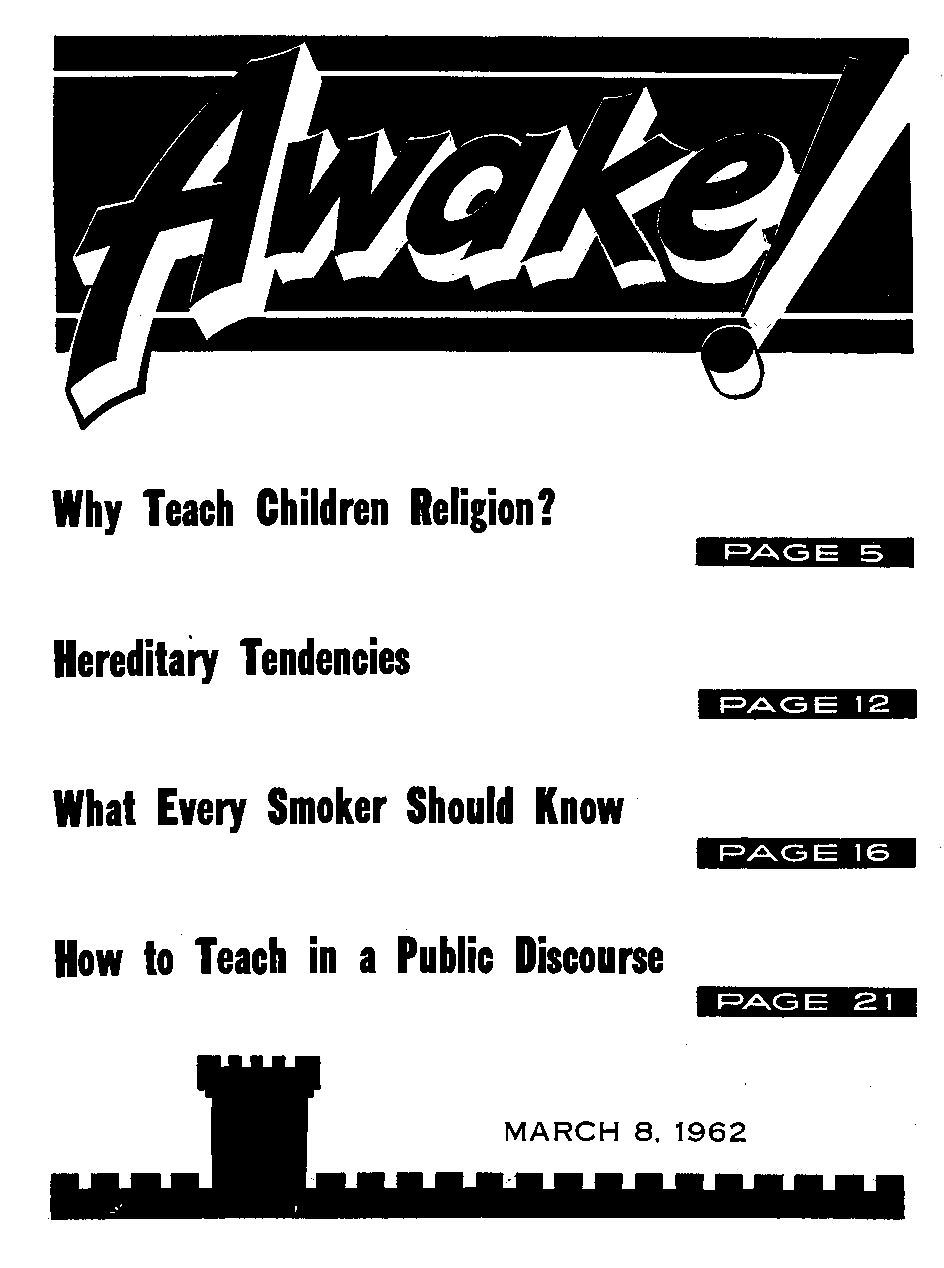
Why Teach Children Religion?
PAGE 5
Hereditary Tendencies
PAGE 12
What Every Smoker Should Know
PAGE 16
How to Teach in a Public Discourse
MARCH 8, 1962
THE MISSION OF THIS JOURNAL
News sources that are able to keep you awake to the vital Issues of our times must be unfettered by censorship and selfish interests. "Awake!” has no fetters. It recognizes facts, faces facts, is free to publish facts. It is not bound by political ambitions or obligations; it is unhampered by advertisers whose toes must not be trodden on; it is unprejudiced by traditional creeds. This journal keeps itself free that it may speak freely to you. But it does not abuse its freedom. It maintains integrity to truth.
"Awake!" uses the regular news channels, but is not dependent on them. Its awn correspondents are on all continents, in scores of nations. From the four corners of the earth their uncensored, an-the-scenes reports come to you through these columns. This journal's viewpoint is not narrow, but is international. It is read in many nations, in many languages, by persons of all ages. Through its pages many fields of knowledge pass in review—government, commerce, religion, history, geography, science, social conditions, natural wonders—why, its coverage is os broad as the earth ond as high os the heavens.
“Awake!” pledges itself to righteous principles, to exposing hidden foes and subtle dangers, to championing freedom far all, ta comforting mourners and strengthening those disheartened by the failures of a delinquent world, reflecting sure hope for the establishment of o righteous New World.
Get acquainted with “Awake!” Keep awake by reading " Awoke!"
—W bi T mi i_b Published Simultaneously in the United States by the WATCHTOWER BIBLE AND TRACT SOCIETY OF NEW YORK, INC.
117 Adams Street Brooklyn 1, New York, U.S.A.
and in England by WATCH TOWER BIBLE AND TRACT SOCIETY Watch Tower House, The Ridgeway London N.W. 7t England
N. H. Knom, President Grant Suites, Secretary
Printing this issue: 3,300,000 4d A copy (Australia, 5d; South Africa; 3J/ac)
“Awake?' It pibltihed In the following 25
Remlttanra for xatecriptloiis should be sent to the often in your country. Otherwise send your remltLanee to London. Notice of nutrition la sent at least two Imqm before autucrlptlou expires.
CHANGES OF ADDRESS should ruth at tfcirty dayi before year uovlni date. Give us year old and new address (If possible, your old addrats label!. Watch Tower, Watch Tower House, The Bldpeway, London N.W. 7, England.
Entered an second-class matter at Brooklyn, N.Y.
Printed In England
Semimonthly—Afrikaans, Clnyatija, Danlab, Dutch, Eng* llah, Finnish, French, German, Greek, Italian, Japauen, Norwegian. Portuguese, t-parish, Swedish, Tagalog, Zulu. Monthly—Cebu-Vlaayan. Chinese, Uocano, Korean; Mak' jalam, Polish, Tam 11, Ukrainian.
Yearly subscription rates
Offlm for semtmonthlj editions
Anerlos, U.S.. 117 Adama St., Brooklyn 1, N.Y. fl AKitrnll^ 11 Beresford Rd., gtralhfleld, N.8.W. 8/-
Canada, 150 Bridgeland Ave., Toronto 19, Ont. |1 England, Watch Tower House,
The Ridgeway, London N.W. 7 7/-
N«w Zealand. 621 New North Rd.. Auckland, 8.W. 1 ?/-SMth Africa, Private Bag, Elandsfonteln. Tri. 70e Monthly edllluna cost half Lhe above rates.
The Bible translation ised In “Awakol” Ie the Now World Translation of the Holy Serlptarce, 1941 edition. When ether translations are used the following symbols will appear behind the citations:
AS - American Standard Version AT — An American Translation AY - Authorized Version (1611) £>£ - J. N, Darby's version
Dv - Catholic Douay vurzlDn J?D - The Emphatic Diaglott JP - Jewish Publication Boe. Le - Isaac Lweer’a version
Mo — Jamcg Moffatt's vendee Bo - J. B. Rotherham's version RS " Bcrised Standard Verdon Yp - Robert Young’s version
CONTENTS
Do You Have Questions?
“Sheer Mediocrity”
Why Teach Children Religion?
Kenya's Calamitous Famine
Finding a Way
Hereditary Tendencies
The Barber Pole
What Every Smoker Should Know
Evolution as a Creed
How to Teach in a Public Discourse
Philippine Witnesses Manifest
God’s Spirit
Geneva—an International Center
“Your Word Is Truth”
Baptism with Holy Spirit
Watching the World
Volume XL1II London, England, March 8, 1962 Numbar B
Almost everyone has. And for most questions there are ready-made an- J swers, such as are * found in dictionaries, encyclopedias, cookbooks and “Do-It-Yourself*
YOU
HAVE
QUESTIONS
books. But there are also many other basic,
(Deut.
and understanding on your part before the eyes of the peoples who will hear of all these regulations, and they will certainly say, ‘This great nation is undoubtedly a wise and understanding people.’ ” 4:5, 6) Even today it is
perplexing questions or problems for which these books do not have the an
swers. Among such are: What is our origin, purpose and destiny? What is right and what is wrong in regard to human relations, especially between the sexes? What ethics should govern business and professional practice? By what principles should we act in a given situation, especially when it involves the welfare of many persons and there are conflicting opinions?
Who could possibly be better qualified
true that those who listen to God and obey him are a wise
and understanding people.
Jehovah God has made his Word readily available to us in the Holy Bible and has seen to it that it has been distributed more extensively than any other book in human history. However, it is not enough merely to have this Guide in our possession. We must make use of it, consult it, study it and apply to our lives the principles given therein. It does indeed contain the answers
to answer our questions concerning life than the Source of life and Creator of all things? What standard of right conduct could possibly be better than that established by God? None! Said the psalmist: "Your word is a lamp to my foot, and a light to my roadway.” (Ps. 119:105) And Moses, shortly before his death, told the nation of Israel: “See, I have taught you regulations and judicial decisions, just as Jehovah my God has commanded me, for you to do . . . And you must keep and do them, because this is wisdom on your part
to the basic questions noted above as well as all others of like import.
But, as all who have tried to use this Guide have discovered, the answers do not always lie on the surface. In fact, it was expressly written in such a way that we would need help to understand it and find the answers to our questions and problems. Where can that help be found, and what proof is there that it can give us the right answers from the Bible?—Acts 8: 30, 31.
That help can be found in the New World society of Jehovah’s witnesses. Proof that it is able to find the right answers in the Bible is seen by the unity in teaching and in action of its members, by their moral strength and integrity-keeping course, by their happiness and spiritual prosperity, by their keeping clean and manifesting love in a corrupt and strife-torn world. Theirs is the unison that the prophet Isaiah foretold would mark God’s servants. Theirs is the love that Jesus said would enable all to identify his followers; they are “fitly united in the same mind and in the same line of thought,” as counseled by the apostle Paul.—Isa. 52:8; John 13:34, 35; ICor. 1:10.
That more and more persons are appreciating this fact is being recognized by disinterested or objective observers, such as the London Sunday Times, one of England’s leading newspapers, which, in its issue of July 30, 1961, among other things had the following to say shortly after the assembly of Jehovah’s witnesses was held at Twickenham:
“ ‘I tried seven different churches and none of them could answer my questions,’ said an elderly lady in the Twickenham Rugby ground cafeteria, ‘When I met the Witnesses I found they could give me an answer. They showed me the Bible had an answer for everything.’
“The strength of such answers was impressively demonstrated last week when over 20,000 Witnesses—representing about two-fifths of the number in the whole country and expected to rise to a final 40,000 today—gathered daily in the stadium for their semiannual international assembly.”
Then, after giving many statistics regarding the assembly organization, the Times went on to say; “To the outsider, this sheer competence would appear one of the Witnesses’ two main strengths. For a spiritual body they have one of the best temporal organizations in the world. . . . But behind everything a Witness does lies a Scriptural reason. Indeed, their one basic tenet is recognition of the Bible as wholly, literally and exclusively true. And in this appears to lie their second strength; they can produce an answer to all questions.”
Do you have questions or problems? Consult God’s Word, and when Jehovah’s witnesses call at your door, accept the assistance they offer in pointing out in your Bible the answers that God gives.
<
gt; A news report in the New York Times of December 12, 1960, said: "A Protestant Episcopal priest defied the laws of his church yesterday by refusing to read from the pulpit a pastoral letter issued by the Episcopal House of Bishops. The letter affirmed that in essence the Apostles and Nicene Creeds were as valid in the twentieth century as they were centuries ago. In his sermon at St George's Church. . . the Rev. Edward O. Miller described the document as full of ‘pious religious jargon' couched in ‘archaic language’ and ‘double talk.’ ‘It Is a piece of sheer mediocrity in a world looking to the church for a voice that is relevant and under-standing,’ he declared. ... He observed that the Episcopal Bishops should have asked if the creeds were needed since 'an imposed creedal orthodoxy is not enough for today.’ In a spot check of parishioners at the church no one could be found who disputed his rector’s point of view.”
DO PARENTS have the right to teach their children religion? Should they teach them religion, or is it unfair to impose religious beliefs on them before they grow old enough to choose their own church or even to consider the arguments of those who say, “There is no God’*?
In recent years, when atheistic philosophies have become widespread and religion has become merely a social feature of the lives of many, the
Basis of the Question
Whether in Communist lands or in nominally democratic countries, the issue is seen to involve much more than guarantees of freedom. It hinges on the matter of belief in God. If all men truly believed in God—if they believed that he is the Creator, the Life-giver, without whom man cannot live —there would be no more question about the propriety of teaching children religion and insisting on
argument has been frequently heard that earnest religious instruction of children may in reality be an injustice to those children. ‘Give the child experience first,’ say the exponents of this philosophy. ‘Later let him decide whether he wants a religion.’ Others feel that some religious instruction is proper but that the parents should not seek to impose their own beliefs where the life of the child is involved.
Adopting this line of reasoning, certain American courts have ruled that local authorities have the right, when they believe that a child’s life is endangered by the religious stand of its parents, to remove the youngster from the custody of the parents and administer whatever medical aid they deem necessary to save its life. But there are many who look with grave apprehension on this move to invade the home and deprive competent parents of the exercise of their own discretion in caring for their children.
obedience to its teachings than there would be about providing the child with food and drink to sustain its physical-life.—Ps. 36: 9; Matt. 4:4.
There is no less reason to believe in God in this twentieth century than there was in centuries past. It is just as true today as it was in the days of the apostle Paul that God’s “invisible qualities are clearly seen from the world’s creation onward, because they are perceived by the things made, even his eternal power and Godship, so that they are inexcusable.” (Rom. 1: 20) It is still true, as it was in the days of King David, that “the heavens are declaring the glory of God; and of the work of his hands the expanse is telling.” (Ps. 19: 1) True science has not disproved the existence of God; rather it has brought to light a vast storehouse of knowledge that testifies to the fact that the universe is masterfully designed, that there must be a great intelligent Personage who is back of it all. So when we consider the matter of teaching our children religion and requiring their obedience to its precepts, our first concern is to know what He says about it.
God-given Responsibility
What he says is unmistakably dear. To those who worshiped him centuries before Jesus’ earthly ministry, he said: “You must love Jehovah your God with all your heart and all your soul and all your vital force. And these words that I am commanding you today must prove to be on your heart; and you must inculcate them in your son and speak of them when you sit in your house and when you walk on the road and when you lie down and when you get up.” (Deut. 6:4-7) And to Christians the command is given: “Fathers, do not be irritating your children, but go on bringing them up in the discipline and authoritative advice of Jehovah.” (Eph. 6:4) There is no thought here of postponing religious instruction for later years. God himself places upon the parents the responsibility to teach their children in matters of worship, and that is a responsibility of which no man can relieve them.
Upon parents devolves the obligation to care for the children they bring into the world, to provide for them physically, mentally and morally. They must see that they have, not only food to eat, but also proper education. Yet how can it possibly be reasoned that they have fulfilled this obligation when they instruct them as to proper relations with their fellowman and fail to teach them the love of God? Is it more important for the child to learn to say “Thank you” to humans who show kindness than it is for him to learn to express his gratitude to the One who gives men life and all that is needed to sustain it? Is it more important for him to show respect for mere men than to manifest devotion to God? Will the child be properly conducting himself when he obeys men, even though he ignores the law of God? Of course not!
It is God’s Word the Bible that contains the righteous principles that all men need to guide them. To instill those righteous principles into the mind of a child is to bless the child with the good that inevitably flows from keeping those principles. They are a safeguard in this ungodly world, protecting the child from lawless influences and from harm. The parents too benefit, as the Bible says: “The one becoming father to a wise one will also rejoice in him. Your father and your mother will rejoice, and she that gave birth to you will be joyful.”—Prov. 23:24, 25.
The Dangers in Waiting
However, not all parents provide their children with religious instruction in their early years. Some deliberately postpone it; others simply neglect it.
Those who put off religious instruction for the future usually do not have strong religious convictions themselves. Yet, at a White House Conference on Child Health and Protection some years ago, a group of nationally known physicians, psychiatrists, sociologists, psychologists, statesmen and educators summarized their findings in a Children’s Charter covering nineteen points, the first of which is this: “For every child spiritual and moral training to help him to stand firm under the pressure of life." Yes, spiritual training is important for children. As the conference recommended: “Wholehearted recognition and appreciation of the fundamental place of religion in the development of culture should be given by all who deal with children.” This Charter, let it be understood, was adopted, not by a group of religious educators, but by a group of specialists in all fields of child welfare.
Children who have been properly instructed in God’s Word are not beset by the fears and doubts, the frustrations and insecurity of the world around them. They do not become bewildered or feel alone in time of trial, but are courageous because they feel the closeness of God. Having trust in God as a stabilizing influence, they do not readily succumb to mental and emotional breakdowns. They do not react as do others, with violence and hate, but are moved by deep-seated love. Parents who have the best interests of their children at heart will, therefore, equip themselves to provide the religious instruction that produces these good fruits, just as they inform themselves on other aspects of child care in order to provide proper physical attention.
We cannot wait until children are in their teens to give them this religious training. From infancy their minds reach out for information. If we do not supply it, others will. Their outlook on life will begin to take shape, whether we mold it for good or allow someone else to turn it to bad.
At a very tender age children today are exposed to secularism, which is the philosophy that religion is to be excluded from consideration. Dr. Ken Hutcheson, pastor of Lakeview Baptist Church in San Antonio, Texas, said: “The trend of American courts for public schools is definitely away from the spiritual and toward secularism.” With the establishment of secularism as the guiding philosophy of the public schools, “teachers may (and many do) teach against the Bible,” Dr. Hutcheson pointed out, “but they are discouraged, and in some places, forbidden to defend it." Evolution is pushed to the fore as the answer to the origin of man, and belief in creation by God is labeled mythology. Therefore, it is important for parents to fortify their children spiritually before sending them to school. This means starting to teach them religion just as soon as they start to learn. To send a child to face these atheistic ideologies without first instructing him of their hidden dangers is like turning him out into the streets without warning of the perils of cars and trucks. The results can be disastrous.
Early years without religious instruction can result in a ruined life of lasting regret. Without proper guidance it is all too easy for young people to find themselves sucked into a whirlpool of immorality or involved in crime. It may be true that their parents thought they had given them the necessary guidance. They taught them not to lie or steal or commit fornication. Yet nearly every youth who has ever done these things had been told they were wrong. Telling a child is not enough. If we leave God out of the picture we rob our children of the most important reason for obeying these commandments. If we do not teach these things in the name of God, whose commands they are, we encourage our children to rely on men and to accept the example of those around them. When they begin to realize that other people lie and steal and commit fornication, they come to the conclusion that it is all right just as long as they do not get caught. Even when parents teach their children that these moral standards originate with God, they must prove by their own course of conduct that they believe it, because actions speak louder than words. How foolish it would be to postpone such vital instruction, until “later”! It may be too late.
Nor is it enough for parents simply to make religious training available to their children without insisting that they follow through on it. Good habits do not develop automatically; they are the result of discipline. “Train up a boy according to the way for him; even when he grows old he will not turn aside from it." “But a boy let on the loose will be causing his mother shame.”—Prov. 22:6; 29:15.
When Life Is at Stake
What, though, of the case where the child’s life is at stake? Well, what do you think of Abraham? Though Isaac was the son of his old age and greatly loved by him, in obedience to God’s command Abraham was willing to offer up this only son in sacrifice. It was not that he had no love for the boy; he did. Yet he knew that God’s commands came first. At the same time he “reckoned that God was able to raise him up even from the dead.” (Heb. 11:1719) Was he right? Modern-day judges, if they had been on the scene, might have wanted to seize custody of Isaac, saying that Abraham was taking his religion too far. But God approved of Abraham’s course; he had the instance recorded in his Word and recommends it as an example of faith.
A similar circumstance frequently arises in our day when Christian parents, out of respect for the divine law on the sanctity of blood, refuse to consent to blood transfusions for their children. (Acts 15:28, 29) Frequently well-meaning but misguided individuals try to overrule the parents’ decision and gain custody of the child so it can be given a transfusion. In so doing they show that they are not persons of faith as was Abraham; they put more confidence in man than they do in God. The fact of the matter is that such persons are misguided, not only religiously, but also medically. Blood transfusions are the fashion of the day, but viewpoints on what is proper medical treatment constantly change. Reputable doctors in many parts of the world have made it clear that the giving of a transfusion is fraught with dangers that can destroy life, and there are many medical authorities who plainly state that other forms of treatment are much safer and are to be preferred when at all possible.1 So, is a parent who refuses a blood transfusion and requests that the doctor cooperate by giving other treatment endangering the life of his child? Not at all! Rather, by obedience to the law of God, who is the Life-giver, he protects his offspring from unintended present harm and preserves its prospects for eternal life.
ARTICLES IN THE NEXT ISSUE
What Your Thank Can Do.
i Ta Religion Dying?
Freedom of Worahlp in the Schoolroom. ft» Body Build and Your Health.
The Versatile Pineapple.
Living as we do in the period that the Bible identifies as the “last days” of this old world, we cannot afford to be indecisive in the matter of worship. We hurt ourselves if we evade the issue; more than that, we endanger the life prospects of our children if we fail to bring them up “in the discipline and authoritative advice of Jehovah.” When the now-near destruction of the ungodly world takes place in the “war of the great day of God the Almighty,” young, unresponsible children will share the fate of their parents. (Rev. 16:14; Ezek. 9:5-7) Will yours survive because of your faithfulness? As a result of their early training, will those children of yours who have grown up be found in the ways of righteousness and be blessed with deliverance? How happy parents are today when their children respond to their instruction from the Bible and lead lives that are a glory to God! But how much happier they will be to find them among the survivors in God’s everlasting new world of righteousness! What a grand reward for their faithfulness in teaching their children the ways of God!
KENYA Is suffering from its worst famine of the century. More than half the African population here is suffering from food shortages and malnutrition, Half a million Africans are actually starving. Though the government is working diligently to feed the starving, there are great difficulties; and other calamities have intensified the famine.
What has happen e d? First,
herds were rapidly becoming a wilderness; and the cattle, vainly searching for food, were becoming emaciated. As the water holes dried up, more and more cattle were dying. Not only domestic animals suffered heavily, but also Kenya’s teeming wildlife, one of its great tourist attractions.
The tragic plight of these beautiful creatures touched the hearts of animal lovers, as they
drought. Since Kenya’s economy is mainly agricultural, rainfall is of critical importance. The initial indication that trouble was in store came with the failure of the “short rains’’ toward the end of 1960. The effects of this rainfall deficiency soon became evident during the warm and dry spell from December to March, as crops failed to mature. By the end of March all were anxiously awaiting the start of the “long rains,” but hopes were soon dashed when once again the rains failed. Over most areas of Kenya the April rainfall was only about 50 percent of the average, and May reports were ‘unseasonably dry.’
Anxiety mounted as the months passed. The sky remained cloudless, and under the blazing equatorial sun the vegetation shriveled up. Flying over vast areas of the central plains, one could see only the brown desolation of near-desert conditions. The lives of millions of Africans depend on good pasturage for their cattle, particularly the nomadic Masai tribe. Yet the vast plains over which they roam with their drove along the roads and saw the carcasses of hundreds of victims of the drought lying by the roadsides. In Nairobi’s popular National Park hundreds of animals were dying of hunger and thirst, A “water for wild animals” fund was launched by the director of the national parks, and there was a generous response, so that water was piped to three different points and carted to two others.
So desperate was the situation that one farmer was reported to be shooting seventy head a day to prevent drought-crazed wild animals’ taking precious water from a borehole supply where the cattle had only a few weeks’ water left. Doubtless he was not the only person who felt he was forced to take such drastic measures to protect his own herd.
Plight Womens
This tragic condition was further aggravated by a plague of army worms, which invaded what was left of crops and pasturage. These caterpillars are well named because they collect in vast armies and, like the invasion of an army, they desolate the land. Any green vegetation that survived the drought soon disappeared before the advance of this voracious army.
After months of prolonged drought conditions, the “short rains” due in October were desperately needed. When they came, instead of bringing relief, they struck another deadly blow. The rains came with such force and so continuously that the parched land soon became saturated and could absorb no more. Exceptionally heavy were the downpours on the slopes of Mount Kenya and the Aberdare Mountains. The rainfall figures for this area for October were more than double the highest ever recorded for this month, and records go back fifty years. As these torrential rains drained off into the Tana River, it soon burst its banks, inundating the countryside for miles around.
Summing up the situation, an editorial in the East African Standard spoke of the “crowning paradox of misfortune.” After so much famine caused by drought and pests of the drought, rivers burst their banks and floods cut off villages, starting more famine. Further intensifying famine conditions was the threat of flooding waters to carry away topsoil that was left unprotected by shriveled-up grass and vegetation. And the remaining cattle in large areas have faced extinction by dysentery.
Reports came in from all over the country concerning the critical situation facing the people. Towns and villages were cut off by the rising waters. Pictures appeared in newspapers in which only the roofs of huts were visible above the waters, with the villagers perched on the rooftops.
Airlift to Starving People
The government, already faced with the stupendous task of providing for about half a million people who are facing death by slow starvation, now had to make immediate provisions for those marooned by the floods and unable to get supplies of food. “A sea of mud,” said one report, “is keeping people away from food supplies, so food must be taken to them.” But how? Road and rail transport had been brought to a standstill.
Units of Britain’s military forces in Kenya played a large part in the relief work. Giant airplanes dropped supplies daily in the hard-hit areas. More than three million pounds of maize were airlifted to starving people. Helicopters were also used. When one helicopter landed at Machakos, it was surrounded by desperately hungry crowds. After half an hour of trying to keep the crowds in restraint, the police had to use tear gas to prevent damage to the aircraft.
In one naval operation, landing craft were used to sail up the Tana River with food supplies. Their engines made slow progress against the flood-swollen waters. On one occasion only skillful maneuvering avoided a head-on collision with the entire roof of a hut. After an arduous and adventurous journey, they safely reached their destination at Garsen and unloaded their precious food cargoes.
Damage done by the floods has been estimated at an enormous figure, and it will be a long time before the country recovers from this disaster.
People Everywhere Affected?
In itself the situation in Kenya is a fullblown calamity for the people. But how many others are touched by it? The majority are so swallowed up with their own problems that they seldom give more than a passing glance to news of distress else- . where. Others, with softer hearts, may use some of their resources to send relief supplies. Yet could it be that, not merely a few, but all mankind are affected by the plight of the people in Kenya?
The fact is that there are dire food shortages, not merely in Kenya, but “in one place after another.” (Matt. 24:7) For example, a news report in January, 1961, stated that more than 5,000 persons in Tibet died of starvation as a result of acute famine caused by drought. And in 1958 some parents in famine-stricken North Bengal, India, sold their children for seventy cents apiece to save them from starvation and to raise money for their own food. Just a few years ago in drought-stricken northern Brazil mobs demonstrated against hunger; prices skyrocketed in towns and villages so that a bunch of carrots costing 30 cruzeiros (about 20 cents) in Rio de Janeiro was selling for as much as 150 cruzeiros (about $1). And note this report in Time magazine of December 1, 1961: “One Hong Kong resident had gone to China in 1958 because T wanted to work for my country’; last week he fled back to Hong Kong and reported, ‘There was no meat, and fish only once a week. You had to get up at 2 and 3 in the morning to stand in line for your ration of rice, fruit, vegetables, and . . . even then they were not always available.’ ”
"The hunger of mankind today is a very real plague, the basic social calamity of our time,” reported Dr. Robert White-Stevens of the Nutrition Research Section of Lederle Laboratories, in a talk to the State Agricultural Commissioners in the United States. “Between 75 and 85 percent of the people of this earth are right now in poverty and misery for lack of food. . . . The geography of hunger is worldwide and all pervading, and the shadow of its hand falls across our land as it does across all lands. ... As it now stands, better than 50 percent of the world’s population is slowly starving or being exposed to death. Twenty-five percent, or half the remainder, are on the edge of bare subsistence."
In view of the fact that these food shortages “in one place after another” are accompanied by the other events foretold by Jesus in his prophecy concerning the time for the end of this wicked world and the incoming of God’s righteous new world, serious students of the Bible who, instead of becoming swallowed up in their own personal difficulties, have stopped to consider the entire world situation in the light of God’s Word find reason to do as the Lord Jesus himself commanded: “As these things start to occur, raise yourselves erect and lift your heads up, because your deliverance is getting near.”—Luke 21:28.
binding a 7&)ay
While studying the Bible with an elderly man in Florida, one of Jehovah's witnesses offered him a subscription for The Watchtower on a contribution of one dollar. He said that he would subscribe as soon as he received his government check. Upon receiving his check, he expressed disappointment upon learning that the government had severely cut the amount, so that he could hardly afford the necessities of life and could not get The Watchtower subscription. However, noting
a number of soda pop bottles around the house, the Witness asked: “Do you really want the subscription?’’ He replied "Yes.” So the Witness suggested that 1 they gather all the empty bottles and bring them to the store to see if enough
money could be raised for the subscription. The amount obtained was $1.30—more than enough. Very happy with his subscription, the man told the Witness: “You people really mean business.”
HEREDJHARY
Jenaenciek'
IVE us another ten or twenty
VT years, and you’ll see salmon like you never saw before,” said Professor (of Fisheries) Lauren R. Donaldson of the University of Washington, who for thirty-one years has been applying the principles of genetics to his research with fish and has developed the small rainbow trout into giant six-pounders. He was speaking of the Chinook salmon, with which he is presently experimenting to increase their hereditary vigor, meatiness and quick maturing.
In 1948 eggs were first hatched in tanks on the University campus, and in due course fingerlings swam from Lake Union out into the Pacific. When, true to salmon instinct, specimens of successive years return to their birthplace, they are identified by clippings of their belly fins.
In 1955 there was a revolutionary result when, after three years, back came full-grown salmon of this species, which normally mature in four years. From the best forty-eight of these, eggs were hatched and the hatchlings nursed to fingerlings before release. Three years later a startling proportion of them, several hundred times the normal, returned. The fastgrowing trait had been established. And so every three years fingerlings are raised from the eggs of the best females fertilized with the sperm of the best males. In this manner it is expected to develop a race of “supersalmon” for the northeast Pacific.
f '
Life Begets Life
Twenty-three centuries ago Aristotle accepted the general belief of his time that plants and even complex animal life, like fleas, mosquitoes and snails, arise spontaneously from decaying matter. This belief in spontaneous generation was shared even by eminent naturalists until the nineteenth century. However, the Dutch scientist Leeuwenhoek, “the father of microscopy,” had discovered microorganisms in the seventeenth century, after the invention of the microscope. He found that seminal fluid swarmed with “animalcules,” now called sperms or spermatozoa. In the nineteenth century the great experimenter Louis Pasteur convinced even the most skeptical that the spark of life can be kindled only by life itself. More recently Oscar Hertwig observed in sea urchins that fertilization involves the union of the sperm nucleus with that of the egg. The corresponding process in plants is by means of pollen and ovules.
The process of reproduction occurs in different organisms in a bewildering variety of apparently quite different ways. In asexual or vegetative reproduction the body of the parent is divided into two or more parts and each part grows into a new individual. This is well illustrated in the potato. Far commoner, both among animals and plants, is sexual reproduction.
Like Begets Like
In these words, “Like begets like,” is stated the universal law among all kinds of living things, both animals and plants. Though this phenomenon, known as heredity, is familiar to all, it took a very long time and much deliberate study before even the essential facts “Awake!" were grasped. Scientific correspondent
study of it could arise in South Africa only out of knowledge of the basic facts of biology, particularly those concerned with reproduction and the means by which living matter reproduces itself.
Linnaeus, the Swedish botanist and classifier of plants, artificially crossed different varieties and species of plants and observed that the hybrid offspring combined the characteristics of both. Last century the experiments of Gregor Mendel, in the monastery garden at Brunn, Austria (now Brno, Czechoslovakia), went to the root of the matter of heredity.
Mendel experimented with garden peas and studied seven different pairs of characteristics, like tallness and dwarfness, green and yellow ripe seeds, smooth and wrinkled coats, and so on. His success was due to wise choice of material and his avoiding complexities by at first confining his attention to a single factor at a time, such as the flower color. The results of his experiments can be seen clearly in the diagram herewith, where the “parents" are purebred plants and Fi and F- are the first and second “filial” generations respectively. In this diagram we can substitute Y (yellow) for T and G (green) for D, also S (smooth) for T and W (wrinkled) for D, and get two more exactly similar diagrams, for Mendel found that precisely the same pattern held for yellow and green seeds, smooth and wrinkled coats, and so on. As to any given trait, hybrids showed the characteristic of only one of the pair, not a compromise in characteristics, and this Mendel called "dominant.” The apparently lost characteristic, which reappeared when hybrids were crossed, he called “recessive.”
Mendel suggested that a germ cell or gamete of hybrids carries one characteristic or the other of the parents but never both, this being called “purity of the gamete.” Also, where two alternate characteristics are present, half the germ cells in the hybrid would receive one characteristic and half the alternate characteristic. This separation of characteristics is spoken of as segregation. Segregation and the resultant purity of the gamete are the two fundamental postulates in the Mendelian theory of heredity. Thus the germ cells of the hybrid would be as pure as the original purebred parents, but each hybrid would have both tall carriers and dwarf carriers.
When two such hybrids are crossed, there would be four possibilities : (1) a pure tall individual, if a tail-carrying male cell unites with a tail-carrying female cell; (2, 3) a hybrid, if a tail-carrying male cell and a dwarf-carrying female cell unite, or if a dwarf-carrying male cell and a tailcarrying female cell unite; and (4) a pure dwarf individual, if a dwarf-carrying male cell unites with a dwarf-carrying female cell. This is exactly the result Mendel obtained, the proportion 1:2:1 showing fairly exactly in, say, hundreds of cases. Since Mendel’s time many workers have carried out experiments with both plants and animals, and in a great many cases obtained results very similar to his. Hence his conclusions are accepted as fundamentally correct.
Animal-breeding
Mendel’s discovery has completely revolutionized stockbreeding. When a desirable trait is found, in animal or plant, a very few crossing experiments suffice to show whether it is inherited according to “Mendel’s laws.” If so inherited, a pure-breeding strain can be established in minimum time, at a minimum cost, and with almost absolute certainty. Traits can also be separated or brought together with almost any desired combination by making the necessary crosses.
In this way genetic principles are utilized in animal-breeding and plant cultivation. This utilization of genetic principles and the application of the laws of heredity have conferred many apparent benefits on the human race. In such matters as milk production, the quality of pork, the weight of cattle and the length of wool on a sheep’s back, heredity exercises a far greater influence than feeding.
Knowledge of dog-breeding has reached such a pitch that a new breed can be rapidly developed to order, true to the desired shape, size and color. The breeding of cattle is a fascinating story: there are now hundreds of breeds, from jet black to white, some hornless, others with horns long or short, curved or straight. In shape they range from the heavy, well-rounded body of the beef animal, sometimes weighing as much as 2,000 pounds, to the rather lean and angular dairy cow. The three main types of horses range from the heavy draught animals through the tough, shaggy types to the slender, fleet-footed varieties, Breeding of racehorses is both fascinating and commercially profitable.
Inbreeding or the mating of relatives, which is common to plants that reproduce by self-pollination, is often used by livestock breeders to preserve the merits of a highly admired ancestor long dead. Most breeders regard inbreeding as dangerous, but some, regarding their animals as particularly good, have dared to inbreed. Some have had apparently good success.
Selection of Plants
In the inbreeding of corn it has been observed that deterioration sets in in the first generation and that many inbred lines become so weak that it is difficult for them to propagate. However, intercrossing of inbred lines restores vigor in the next generation.
Horticulture is, for many people, a captivating and relaxing occupation. As one enthusiast says: “Your chief joy in your garden will not be in the vegetables that you eat, nor in the flowers that you pick, but in the satisfaction of causing things to grow. You will enjoy the companionship of things that are real and clean. You will come to know the common and little things. Just to have handled the new earth, and to have sown the seed, and to have thought about the garden at morning and at night—this is worth the effort. You have come nearer to Nature.”
In the forefront of horticulture stands Luther Burbank, who claimed, “I shall be contented if, because of me, there shall be better fruits and fairer flowers,” He worked four years to develop a smooth, mealy, good-sized potato, reasonably free from insect plagues. The resultant Burbank potato, which has added millions to the wealth of his native land, the United States, was bred by using the best plants of successive generations. This is breeding by selection.
His usual method, however, was hybridization, that is, crossing different plants or different species of the same plant to obtain new varieties. For fifty years he experimented with thousands of different kinds of plants and hundreds of thousands of individual plants, developing a long series of “new varieties” in flowers, fruits, grasses, grains and vegetables. Among these are the beautiful Shasta daisy, the plunicot (cross between plum and apricot), the wonderberry (raspberry and dewberry), and the white blackberry. He took sixteen years to breed the thorny desert cactus to a thornless producer of nutritive food for man and beast, capable, as he believed, of turning arid desert into rich pasture and feeding twice earth’s present population.
Burbank claimed that everything he did was based on common sense, skill, judgment and patience. His phenomenal success was due, in large measure, to his keen eye for discovering one exceptional plant or “sport” among thousands. He could perceive the slightest variation in plant qualities, which were apparently visible to no other man.
Burbank’s efforts were not directed at acquiring money, and he says of his work: “One more grain on the head of wheat, rye, barley, oats or rice; one more kernel of corn to the ear; one more potato to the hill or peach, pear, plum, orange or nut to the tree would add millions of bushels to the world’s supply, millions of dollars to the world’s wealth, not for one year only but as a permanent legacy. That is what I am trying to do.”
Prospects
The all-wise Creator made man out of the earth for the earth, and required from him wise dominion over the lower animals. Man had to cultivate and take care of his Paradise home. The proper performance of these duties would give him much pleasure.
Today we stand at the portals of the new world that Jehovah God is creating. In that new world, under the guidance of the Creator, with the right conditions prevailing on earth and with man using his knowledge of genetics in proper exercise of his dominion over the animals and to subdue the earth, not for selfish exploitation, but for the glory of God, “the earth itself will certainly give its produce.” The entire earth will be turned into a delightful paradise.—Ps. 67:6,
Yes, in a thousand years you will see plants and animals, a whole paradise earth, such as you have never seen before!
The Berber Pole
• “There are several accounts of the origin of the barber pole,” says L. Sherman Trusty in The Art and Science of Barb ering. “Probably the most reliable story is that the pole originated when blood-letting was the most typical service of the barber. The two spiral ribbons painted around the pole were symbolic of the two bandages used in bloodletting. One ribbon represented the bandage bound around the arm before the surgery was performed, and the other one afterwards. The true colors of the barber emblem are white and red. Red, white and blue are widely used in America. This is due partly to the fact that the national flag has these colors. But red and white are regarded by most authorities as the true colors of the barber pole.
• "Another interpretation of the colors of the barber pole is that red was symbolic of blood, blue of the veins, and white of the bandage. ... All three of these colors were used in England. A statute required the barbers to use blue and white and the surgeons to use red. . . . Barbers began the practice of surgery about 110 A.D. The official termination of their surgical practices is 1745. The clergy and barbers severed relations in 1163. This was occasioned by an edict issued by Pope Alexander III forbidding the clergy to practice surgery on the grounds that it was sacrilegious to draw blood from the human body."
Although tobacco sales slumped after the first appearance of cancer warnings in the early part of the 1950’s, they have been climbing steadily for the past six or seven years. In the United States, for example, $7.5 billion was spent for tobacco in 1960. This is $500 million more than what was spent in 1959. The 489 billion cigarettes sold in 1960 is an increase of about 25 percent over what was sold in 1955.
This was encouraging news to the tobacco industry, but does the marked increase in tobacco consumption mean that smoking is now considered safe?
IF YOU are a smoker, do you find that filter-tip cigarettes lack the taste of the nonfiltered variety? Chances are you do, because filters take out some of the things that contribute to a cigarette’s taste. But why do you stay with the new filter-tip varieties when nonfiltered cigarettes are tastier and possibly more satisfying for you? Is it because you are concerned about your health? Have the frequent reports about tobacco tars as being a suspected cause of lung cancer worried you?
For a number of years dire warnings have been Issued from time to time about the dangers of smoking. For many smokers they have been very disturbing, even frightening. To counter the warnings the tobacco industry has flooded the market with filter-tip brands and deluged the public with persuasive advertising to allay their fears. Apparently the efforts of the industry have been successful.
Opinions of Health Authorities V. < Smokers find little consolation from the agencies that look out for public health. Despite the great increase in cigarette filters, more and more health agencies and physicians are issuing warnings about the dangers of smoking. The Canadian Medical Association made its position known for the first time in June, 1961. It said; “The weight of evidence at present implicates cigaret smoking as the principal causative factor in the increased incidence of lung cancer,'’ The Medical Officer of Health of London, England, warned: “It is my duty to warn all cigarette smokers that there is now conclusive evidence that they are running a greater risk of contracting cancer than nonsmokers. The risk mounts with the number of cigarettes smoked. Giving up smoking reduces the risk.”
Concurring with this view is the Surgeon General of the Public Health Service in the United States. He is reported by the New York Times of November 27, 1959, as saying that the Public Health Service “believes that the following statements are justified by studies to date: (1) The weight of evidence at present implicates smoking as the principal etiological [causative] factor in the increased incidence of lung cancer. (2) Cigarette smoking particularly is associated with an increased chance of developing lung cancer. (3) Stopping cigarette smoking even after long exposure is beneficial. (4) No method of treating tobacco or filtering the smoke has been demonstrated to be effective in materially reducing or eliminating the hazard of lung cancer. (5) The nonsmoker has a lower incidence of lung cancer than the smoker in all controlled studies, whether analyzed in terms of rural areas, urban regions, industrial occupations or sex. (6) Persons who have never smoked at all (cigarettes, cigars or pipe) have the best chance of escaping lung cancer. (7) Unless the use of tobacco can be made safe, the individual person’s risk of lung cancer can best be reduced by the elimination of smoking.”
With these leaders in public health is the American Cancer Society. Expressing its position, it said: “The board now believes that it has a . . . responsibility both to the medical profession and to the general public to state that in its judgment the clinical, epidemiologic, experimental, chemical and pathologic evidence presented by the many studies which have been reported in recent years indicates beyond reasonable doubt that cigarette smoking is the major cause of the unprecedented increase in lung cancer.” In harmony with this view is the American Medical Association, which no longer will permit cigarette advertising in its journals.
The president of the American Heart Association expressed the opinion that there is strong evidence indicating that smoking contributes to the development of coronary heart disease. Dr. A. Carlton Ernstene said: “Up to the present, a number of medical studies have been made, nearly all demonstrating a statistical association between heavy cigarette smoking and mortality or morbidity (illness) from coronary heart disease. . . . Death rates from coronary heart disease in middleaged men were found to be from 50 to 150 percent higher among heavy cigarette smokers than among those who do not smoke. This statistical association does not prove that heavy cigarette smoking causes coronary heart disease, but the data strongly suggest that heavy cigarette smoking may contribute to or accelerate the development of coronary heart disease or its complications.”
To these health authorities could be added the voices of many noted physicians in various parts of the world. But to all that has been said on the subject the tobacco industry gives stout denials. Dr. Clarence Cook Little of the Tobacco Industry Research Committee insists that “statistical association does not prove cause and effect.” Although the statistics on smoking and cancer may not provide absolute proof that smoking is responsible, they do give circumstantial evidence that is sufficiently strong to convince leading medical men in many countries.
On the matter of statistical material the magazine Consumer Reports made this observation: “In 1854, during an epidemic of cholera in London, John Snow, a statistician, recognized the statistical association between cases of cholera and the drinking of water supplied by one of London’s many water companies. Dr. Snow inferred from his observations that a harmful substance causing cholera must have been transmitted by the particular water company. When his recommendations about water supply were carried into effect, the disease was controlled, although the cause, the bacterium of cholera, was not discovered until 40 years later.” It would have been a serious mistake for the people to continue drinking the water because the statistical material did not give absolute proof that water was the cause of the disease. The same can be said for smoking and the statistical material that relates it with cancer and heart disease.
The position being taken by the American Cancer Society is that tobacco should be considered guilty upon the basis of the incriminating evidence gathered thus far. “With human lives at stake,” it stated, “smoking cannot be considered as innocent until proved guilty.”
Effect on Body
When you inhale deeply the smoke from a cigarette, 90 percent of the entire weight of the smoke will be absorbed by your lungs. The smoke contains several colorless gases in addition to tars and other substances. One of the gases is carbon monoxide, with which the hemoglobin of your blood links in preference to the oxygen present in the lungs. Because the blood does not give up carbon monoxide to the tissues, the hemoglobin molecules do not readily get rid of their passenger so they can pick up oxygen for the body. Thus the number of hemoglobin molecules for carrying vitally needed oxygen is reduced. One pack of cigarettes smoked within a period of seven hours results in a carbon monoxide saturation of the blood of from 5 to 10 percent. It is this cutting down on the oxygen supply that contributes to an athlete’s lowered efficiency when he smokes.
Another ingredient of tobacco smoke is a poisonous alkaloid known as nicotine. With an average cigarette approximately three milligrams of nicotine enters your mouth, making a total of sixty milligrams for twenty cigarettes. If you took this amount of nicotine into your body in one dose it would kill you by paralyzing your organs of respiration. By taking it in small doses the body is able to build up a tolerance for it and is able to dispose of it. Ab might be suspected, this poisonous alkaloid has a detrimental effect on the body.
Nicotine affects principally the nerve ganglia. These are the relay stations in the nerve circuits that control the various parts of the body. At first it stimulates and then quickly depresses, causing a partial blocking of nerve impulses. This is why smoking slows the reaction time of athletes. The stimulating action of nicotine is what makes some persons feel pepped up by a smoke.
It has been found that nicotine causes the heart to work harder without increasing the oxygen supply proportionately. By your smoking one cigarette, your heartbeat will increase as much as twenty beats per minute, and your blood pressure goes up. This can cause anginal pain. Heavy smoking has been singled out by some prominent doctors, including the famous heart specialist who treated Dwight Eisenhower, as a contributing causative factor for atherosclerosis, coronary thrombosis and thrombosis of the brain.
Smoking causes a noticeable decrease in skin temperature. This is due to the action of nicotine on the blood vessels, causing them to constrict so less blood flows through them. The skin temperature of your toes and fingertips can drop as much as six degrees while you are smoking. This can develop into a serious disease.
Buerger’s disease is a painful affliction that is confined almost entirely to smokers: It involves the death of the tissues in the fingers and toes for lack of blood. If the patient stops smoking, he usually recovers; but if he does not stop, gangrene sets in, making it necessary to amputate his extremities. In some cases the frightful grip of the tobacco habit is so great that the victim of Buerger’s disease prefers to have his legs amputated rather than give up smoking.
The chronic cough of the smoker is usually due to irritation of his air passages. In many persons the coughing damages the lung tissue by causing a rupture of the small air sacs of the lungs. These fuse to form larger sacs, reducing the efficiency of the lung. The result is the barrel-chest disease known as emphysema. It is believed by some doctors to be more common today than lung cancer. The condition is rarely found in persons who never smoke.
The most-publicized effect that smoking has on the body is that of causing lung cancer. According to the American Cancer Society, a smoker of less than one pack of cigarettes a day has one chance in thirty-six of getting lung cancer. The smoker of two packs or more has one chance in ten, whereas the nonsmoker has one chance in 270. Because pipe and cigar smokers do not usually inhale the smoke, they suffer more from mouth and lip cancer than lung cancer.
What is in tobacco smoke that causes the formation of cancer has not, as yet, been absolutely determined. That there may be several substances is indicated by the experiments of Dr. Ernest L. Wynder. He has found six hydrogen-carbon compounds in tobacco tar that produce cancer on the backs of mice. If they can cause cancer in mice they can most likely cause it in humans.
Stop Smoking
The many bad effects smoking has on the human body, including the shortening of a smoker’s life-span by about ten years, are concrete reasons for stopping the habit. But that is easier said than done. Withdrawal pains and addictive desire for tobacco makes stopping extremely difficult for a heavy smoker. His chest pains him frightfully; there are cramps in his legs; his arms throb; he cannot sleep at night; he becomes extremely irritable and nervous; and all he can think about is having a smoke.
The best way to break the smoking habit is to stop abruptly. Tapering off merely prolongs the agony, making it more difficult to stop. Throw away all your smoking paraphernalia so it will not tempt you, and announce to your friends that you have stopped. This obligates you to prove to them that you are sufficiently strong-willed to do it. But your resolve to stop will crumble unless you plant firmly in your mind solid reasons for quitting. Whenever you feel the urge to smoke think about these reasons.
The crucial period is the first day and a half after you stop. This is when the withdrawal symptoms are the strongest, with the craving for a cigarette becoming greatest toward the end of the first twenty-four or thirty-six hours. After that the craving sharply and steadily declines. For several weeks and even months thereafter you will experience intermittent and progressively less acute cravings for tobacco.
If you allow a single exception to your resolution, you will lose all the progress made to that point You will have to start all over again. Until you have broken away entirely from the strangling clutches of the habit, avoid as much as possible the association of people who smoke. Seeing them smoke and smelling the smoke can weaken your resistance.
When you feel the urge to smoke, concentrate on breathing rhythmically. It will give you something to do at that crucial moment By breaking the habit of interrupting your breathing cycle to light up a cigarette, you can help break the smoking habit. Get a drink of water and go for a walk in the fresh air if possible. In place of the cigarettes you customarily carried, have some hard candy, gum, peanuts or raisins. They will give your hands something to do when you feel lost without a cigarette to keep your hands busy. You might also eat small chunks of apple.
Probably you will begin to gain weight, but this usually adjusts itself after a few months. Smoking tends to weaken the natural hunger contractions of the stomach, lessening your desire for food. This and the dulling effect smoking has on the sense of taste and smell explain in part why some people are able to keep their weight down by smoking. These factors limit their interest in food. Self-control at the dinner table is a much wiser method for keeping your weight down than smoking,
Christian View of Smoking
Having a religious reason for stopping the tobacco habit can be your greatest help to victory. It can supply the strong incentive needed for fortifying your determination during the times when the urge to smoke seems intolerable.
The Scriptural command is for a Christian to “know how to get possession of his own vessel in sanctification and honor.” (1 Thess. 4:4) But the person who smokes does not have full possession or control of his body and its desires. He has relinquished control to a sense-satisfying habit that brings no honor to the Creator of the human body. Impairing its proper functions, ruining its organs and shortening its life dishonors the Creator and shows no appreciation for his marvelous handiwork. He is dishonored when men abuse their bodies in their frenzied quest for pleasure.
…