Awake!, November 22, 1959
Download: PDF — Awake!, November 22, 1959
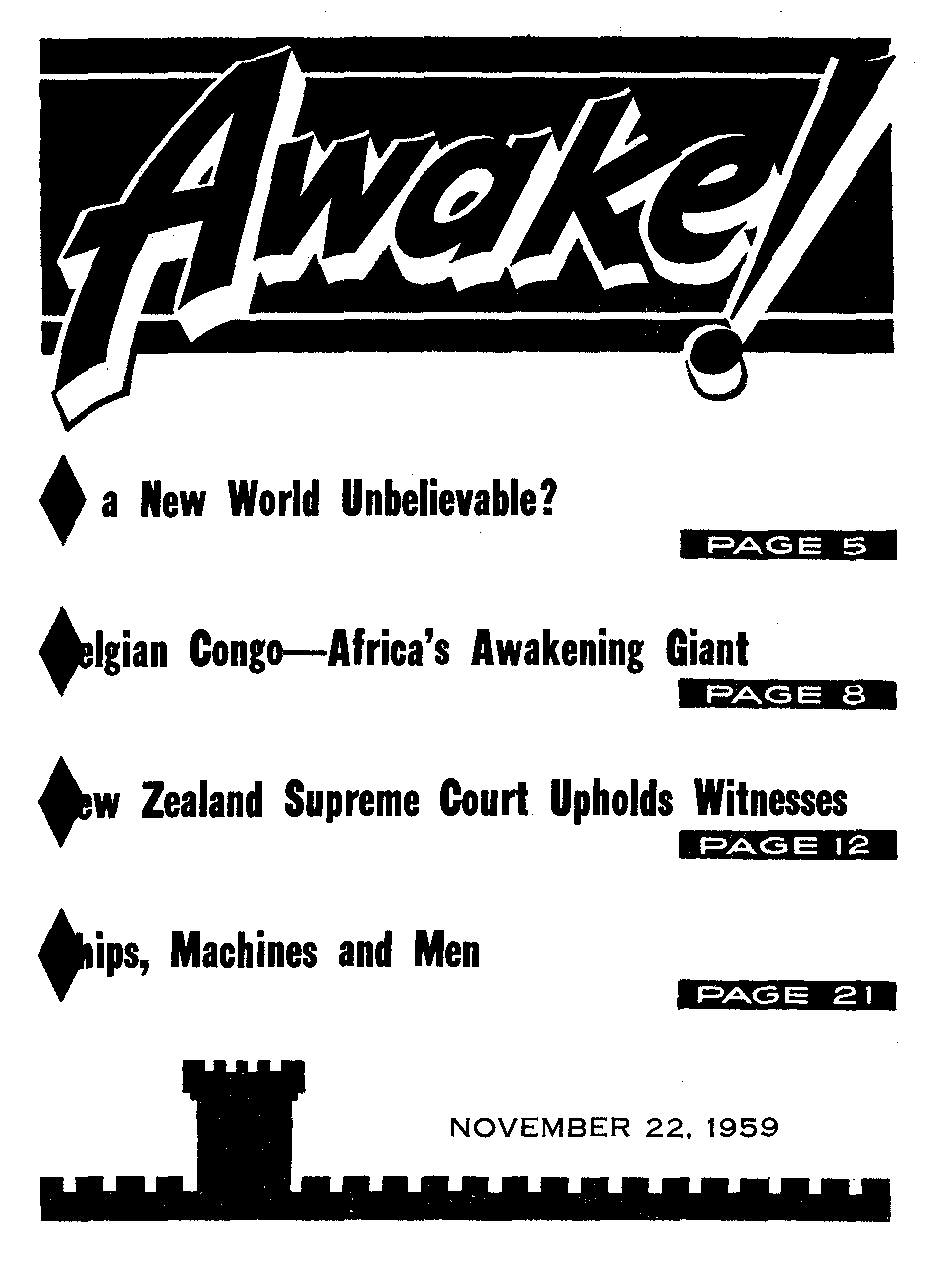
Igian Congo—Africa’s Awakening Giant
PAGE S
Zealand Supreme Court Upholds Witnesses
PAGE 12
ips,
Machines and Men
PAGE 21
NOVEMBER 22. 1959
THE MISSfON OF THIS JOURNAL
Newt sources that are able to keep you awake to the vital Issue* of out times must be unfettered by censorship and selfish interests. “Awake!" ha* no fetters. It recognizes facts, faces facts, is free to publish facts. It is not bound by political ambitions or obligations; it is unhampered by advertisers whose toes must not be trodden on; it is unprejudiced by traditional creed*. This journal keeps itself free that it may speak freely to you. But it does not abuse its freedom. It maintains integrity to truth.
" Awake!'1 uses the regular news channels, but is not dependent on them, Ils own correspondents are on all continents, in scores of nations. From the four corners of the earth their uncensored, on-the-scenes reports come to you through these columns. This journal's viewpoint is not narrow, but is international. It i* read in many nations, in many languages, by persons of all ages. Through its pages many fields of knowledge pass in review—government, commerce, religion, history, geography, science, social conditions, natural wanders—why, its coverage is as broad as the earth and as high as the heavens.
"Awake!" pledges itself to righteous principles, to exposing hidden foe* and subtle dangers, to championing freedom for all, to comforting mourners and strengthening those disheartened by the failures of a delinquent world, reflecting sure hope for the establishment of a righteous New World.
Get acquainted with "AwakeI" Keep awake by reading "Awokel"
Published Simultaneously in the United States by the WATCHTOWER BIBLE AND TRACT SOCIETY OF NEW YORK, INC. 117 Adams Street Brooklyn 1, N.Y,, U.S.A*
and in England by WATCH TOWER BIBLE AND TRACT SOCIETY
Watch Tower House, The Ridgeway London. N.W. 7. England
N. H, Knorr. President Grant Suitkb, Secretary
Printing this iaaue: 2,950,000
“Awake!” Is P*bl|jh<d In the to Having 21 lantaMU.1 StmifflantMy—Afrikaans, Dart Lull, Dutch, English, Finnish, French, German, Greek, Italian, Japanese, Norwegian, Portuguese. Spanish, Swedish, TagaloR.
Monthly-—Clnyanja, Indonesian, Korean, Pol lab, Ukrainian, Zulu,
Yearly subscription rates
Of! tea tor semimonthly editions
Amr lea, U.S., 117 Adams St,, Brooklyn 1, N.Y. >1 Airtrail a, 11 Beresford Rd,, S trathfleld, N.B.Wr
CanadA, 150 Bridgeland Are , Toronto Id, Ont.
England, Watch Tower House,
The Ridgeway. London N.W. 7
KeW Zealand, «21 New North Rd., Auckland, 8.W. i 7/-*«ith Africa, Private Bag. P.O. Etandrfcmtejn, TtL 7/-
Monthly editions cort halt the above rates.
4d a copy (Australia, 5d>
ReiilttaMes for subscriptions should be sent to the offlea in your country. Otherwise send your remittance to London. Notice of expiration Is sent al least two tones before flubficrlptfon ciptree.
CHANGES OF ADDRESS ihoild reach w thirty dtp befera year moving data. Give ni yoor old and naw ad drill (If poMlbla, yoar old addrm labil). Watch Tower, Watch Tower Heave. The Ridgeway, Lindon N.W. 7, England.
Entered as second-cl us to alter at Brooklyn, N.Y, Printed in England
New World Translation of the Holy Sertptme* ..... behind the citations:
- James Moffatts version
- J. B. Rotherhams vatsloo
- Revised Standard Venrton
- Robert Young's version
the
The Bible tramlatlw* iKd In “Awake!” ft
When other tranilatfonc an
med th*
follmrlm tyaiboli will
appear
.48
- American Standard Version
Dy -ED -
Catholic Douay version
Mo
AT
- An American Translation
The Emphatic Diaglott
AV
— Authorized Version (Iflll)
JF -
Jewish Publication &oc,
Da
— J. N. Darby’s version
Le -
Isaac Leeser’a version
Y<f
CONTENTS
Receiving with Appreciation
Is a New World Unbelievable?
Belgian Congo—Africa’s Awakening Giant
"On the Side of Immaturity”
New Zealand Supreme Court Upholds
Witnesses
What a Wonderful Gift—Air to Breathe! 17
Aerodynamic Marvels
Ships, Machines and Men—at Work in
Modern Docks
Italy’s “Pentagon"
“East Is East” “Your Word Is Truth”
A Loving God Destroy His Children?
Watching the World
HAPPINESS is determined to a large extent by our receiving with appreciation. Unthankful and unappreciative people are not happy. How could they be? If one is unthankful, he is likely to be discontented and among those who are “complainers about their lot in life.” —Jude 16.
It is not surprising that many persons are victims of unhappiness, discontent and complaining, since so many persons are unthankful toward the Source of our greatest blessings, Jehovah God. Yes, we have come to the time, the “last days,” when the apostle of Christ said that men would be “without gratitude.” Since there is widespread ingratitude to the great Giver, we can readily understand why so many persons receive goodness at the hands of their fellow man without appreciation. —2 Tim. 3:2.
One may show sincere appreciation by reciprocal kindness. Said the Lord Jesus: “Practice giving, and people will give to you.” There is also the matter of the heart moving the mouth to express the gratitude that one inwardly feels.—Luke 6:38.
Children should be trained to receive with appreciation at an early age. It is easy enough when one is young to overlook appreciation. Commenting on his own experience as a youth, Dr. Albert Schweitzer wrote in his Memoirs of Childhood and Youth: “I am haunted by an oppressive consciousness of the little gratitude I really showed [people] while I was young. How many of them have said farewell to life without my having made clear to them what it meant to me to receive from them so much kindness or so much care! . . . Down to my twentieth year, and even later still, I did not exert myself sufficiently to express the gratitude which was really in my heart.”
So kindnesses should not be taken for granted. Do you have precious privileges? These also should not be taken for granted. Do not let the regular enjoyment of them blunt your appreciation. Show appreciation by proper use of privileges. Do not abuse them. Be moderate in all your ways. One may regularly receive transportation through the kindness of a person with an automobile. There is a danger that the regularity of the kindness may dull one’s appreciative response. Guard against assuming that appreciation, once expressed, is now permanently understood and need not be expressed again.
How can a dulling of appreciation for privileges and kindnesses be detected? There are symptoms of discontent and complaint. The Israelites in the wilderness, for example, murmured against the miraculous manna provided by God. They received this gift from God regularly. In time they lost their appreciation: “The mixed crowd that was in the midst of them expressed selfish longing, and the sons of Israel too began to weep again and say: ‘Who will give us meat to eat? How we remember the fish that we used to eat in Egypt for nothing, the cucumbers and the watermelons and the leaks and the onions and the garlic! But now our soul is dried away. Our eyes are on nothing at all except the manna.” Now how did this lack of appreciation manifest itself in a most serious way? “The people kept speaking against God and Moses: ‘Why have you brought us up out of Egypt to die in the wilderness? For there is no bread and no water, and our soul has become disgusted with the contemptible bread.’ ’’—Num. 11: 4-6; 21:5.
So receiving without appreciation can lead even to speaking against God. Christians want to bless God. They are taught to be thankful for the gifts that come from God’s hands through his Son. By regular expressions of thankfulness the Christian guards against complaining against God. “In connection with everything give thanks.”—1 Thess. 5:18; Eph. 5:20.
No matter what our status in life, we have much for which to be thankful. The Bible tells us how ten lepers once came to Jesus Christ, saying: “Jesus, Instructor, have mercy on us!” Jesus healed them. Yet how many received this great mercy and kindness from God through his Son with appreciation? Only one, a Samaritan. This one fell upon his face at Jesus' feet, thanking him and “glorifying God with a loud voice.” This one person who expressed his thankfulness must have received with appreciation even while he was a leper. In his diseased state he had much for which to be thankful; and so when this big thing happened in his life—the miraculous healing^—he did not receive it without appreciation.—Luke 17:12-18.
Every day'in our life should be a day of thankfulness. The true Christian does not limit his thankfulness to special occasions or special days. Take, for example, America’s “Thanksgiving Day.” Does it set the right pattern for daily thankfulness? Are the celebrants of this day primarily thinking of God or of themselves? Are they showing thankfulness to God by overeating and overdrinking? If they were really thankful to God, they would feel a sense of obligation to do something in return. When we appreciate' what someone has done for us, we feel attached to that person. But does this world or its masses of “Thanksgiving Day” celebrants feel attached to God? Why, the masses of Christendom do not even want to acknowledge their dependence upon God. They want to feel free and independent. Having attained what they view as success by their own brawn and brain, they feel no need to thank God.
Christendom’s masses are not only ungrateful for the natural mercies of God but they also depreciate the gift of God’s Son, the kingdom of God and the messengers of that kingdom. Those who really receive with appreciation should be glad to hear the Word of God, glad to learn of the glorious good news of the established kingdom. In spuming the Kingdom good news, the masses show their true heart condition, that this is true of them: “Although they knew God, they did not glorify him as God nor did they thank him.” —Rom. 1:21.
So God will wipe out this world of people “without gratitude." Do not copy this world in its ingratitude. Always receive, from man and from God, with appreciation. This is the way of happiness.
Is a New World Unbelievable?
Vjunbelievabl^ ■ ^ eXclaimedFufhiko, She could" perhaps be excused for saving this, for it was the first time she had looked up at Tokyo Tower. However, it was real, for there it stood, all 333 meters of it. Moreover, if someone had told Fumiko’s mother and father, when they were her age, that someday they would sit in the parlor at home and watch swmo or baseball through the telecasts from Tokyo Tower’s antenna, they too would have exclaimed, “Unbelievable!” But no longer can they say this, for television has become everyday fare to them. And if Fumiko’s family could once say, “Unbelievable!" what would the knights of Edo have said a hundred years ago had someone told them that so tall a giant as Tokyo Tower would someday grace the Kanto plain?
Let us climb even farther back through history to the days when the daimyo ruled, and the Genji and Heiki clans were fighting it out. Supposing we could have told those warriors that someday men would replace their glittering swords and spears with hollow sticks that could shoot death out over
kilometer or more, do you suppose < ;they would have said? A i vocal “Unbeliev-
^J-jy^TeI*y The idea of the . Aiodem gun would have Mssemed preposterous to 'fi ^iem. However, now the cannon, the tank, the jet biplane and finally thfe yj&BM have come, so that ; ' .-death and annihilation Can be projected to any
-r ' Place in the world in a time. Our forebears of a years' back wbuld have exclaimed, “Unbelievable!” We who live in the latter part of the twentieth century are compelled to say, “Believable—and utterly horrible!"
When face to face with the unheard-of, or when told of something not yet experienced, man is always inclined to exclaim, “Unbelievable!” Indeed, many of the great scientific discoveries of history have excited this comment, and in some cases newly discovered facts of science or new inventions have met with bitter opposition from those who preferred not to believe. When man began to emerge from the “dark ages” and to discover that the earth was round, and not flat, the Roman Catholic Church preached against it. When Galileo invented the telescope in the early seventeenth century, learned “fathers," fearful of the new discoveries, refused to look through it, and preached sermons to the text, “Ye men of Galilee, why stand ye gazing up into heaven?” However, despite the unbelief of the clerics, the trie-scope was a fact, and the discovery that the earth was a planet among sister planets was also true.
When the “iron horse” or locomotive appeared in the nineteenth century to compete with the fleshly horse, there were some who declared it was possessed of a demon. However, unbelievable or believable, demonized or not, the locomotive has spearheaded more that a hundred years of industrial and economic development, and has enabled millions to take in the pleasures, as well as the discomforts, of travel throughout the continents. Would our ancestors of Tokugawa times have believed this possible? Certainly not! Nor would Magellan’s men, who toiled for years at sea to circumnavigate the globe, have believed that jet planes would someday circle the earth in forty-eight hours’ flying time.
Natures “Unbelievable^''
Nature itself is full of the unbelievable. Unless he were told of it, what diner on the succulent eel would believe that there is such a thing as the electric eel? However, if he visited South American rivers and grabbed one of these slimy creatures, both the desire for dinner and the disbelief might be shocked out of his system with a 700-volt punch! Moreover, recent research has brought forth the “unbelievable” discovery that the electric eel uses electric impulses, much as man uses radar, to detect the presence of objects in the water many feet removed from the eel. Do you say, “Unbelievable”? It may be unbelievable, but it is true, and modem naval men would give millions of dollars to know the secret of the eel's “radar” system.
Like the electric eel’s “batteries" and “radar,” many wonders of earth outdate man by millenniums, and yet man is only now beginning to fathom their secrets and copy them in his modem inventions. Radar in the eel and sonar in the bat, jet propulsion in the squid, the pin-point navigation system of the migrant bird, the helicopter-like flight of the hummingbird and the air-conditioning system of t^e beehive are only a few of the wonders of nature that have become “modem inventions” of science, even though they existed in the animal world long before the creation of man. All of this makes it believable that a Master Intellect, a mind far greater than man’s, thought out and brought forth these marvels that fill all nature. Moreover, this same Master Intellect placed in nature all the astounding resources and forces from which the inventions of modem man originate. The great pity is that man uses these wonders first for destruction, instead of for construction.
Does someone still say, “Unbelievable that a Master Intellect, an almighty God, created it all”? However vigorously the atheist and agnostic may cry “Unbelievable!” all the facts unite to answer back: “Believable and indisputably true!”
Believe Bible’s Record of the Future
Jehovah God, the Master Designer and Builder, is also the Master Author. Even more wonderful than all the glorious creations in nature, and the uses to which natural resources are put in bringing forth modem inventions, is the incomparable record contained in God’s Book. The title of that Book? It is called the Holy Bible. It is the most scientific book on earth today. It is the only scientific book that does not need to be rewritten every ten or twenty years, to bring it up to date with latest research. Though it started to be recorded 3,500 years ago, all its parts are still as reliable, and today they are even more valuable to us than in the day the Master Author inspired men to write this book. Do some say, “Unbelievable”? If they will make the effort to study the Bible, they too win be compelled to say, “Entirely believable and true!”
As an example, take the prophecies of the Bible. Many moderns glibly parrot the word “Unbelievable!” when they are told of the global tragedy of Armageddon that is about to befall mankind. It is the same “Unbelievable!” that the self-satisfied world of Noah’s day parroted when God’s prophecy warned of the approaching flood. However, who was right on that occasion? “By faith Noah, after being given divine warning of things not yet beheld, showed godly fear and constructed an ark for the saving of his household, and through this faith he condemned the world, and he became an heir of the righteousness which is according to faith.” (Heb. 11:7) The unbelievers found a watery grave.
When Ezekiel, Jeremiah and others prophesied the destruction of apostate Jerusalem, the wicked populace refused to believe. (Jer. 26:8, 9; 28:10, 11) However, those prophecies came true with unerring accuracy, even to the restoration of a remnant of the Jews to Jerusalem exactly seventy years later. (Jer. 25:11) Afterward the restored Jerusalem again became apostate. Jesus prophesied concerning its destruction, but the populace professed disbelief, mocking him on the torture stake: “Bah! you would-be thrower-down of the temple.” (Matt. 24:1, 2; Mark 14:58; 15: 29) However, as Jesus prophesied, Jerusalem was destroyed by the Roman army A.D. 70, over a million unbelievers perishing.
As it throws its searching beams down into this twentieth century, Bible prophecy again undergoes remarkable fulfillment in the catastrophic events of the nuclear age, including the power struggle between the communistic “king of the north” and the democratic “king of the south.” (Luke 21: 25, 26; Dan. chapter 11) It tells that we stand at the threshold of the complete elimination of all the wicked from the earth, in Jehovah’s war of Armageddon. Though no Bible prophecy has ever yet failed of fulfillment, "wise’’ ignoramuses continue to cry, “Unbelievable!” Bible prophecy thunders back in answer that “by the word of God” this entire wicked world of the space age will suffer destruc-? tion. Its fiery demise is just as certain as the annihilation that befell the corrupt world of Noah’s day and the two apostate cities of Jerusalem. (2 Pet. 3:3-7) Nor will the most hypocritical system of all, the bloodguilty Christendom that has indulged in every crime that is unchristian, escape Jehovah’S judgment. (Jer. 7:12-15; 14:13-15) Unbelievable? You may live to see these prophecies come true, just as every previous page of Bible prophecy has had its certain fulfillment.
Throughout history, men faced with some innovation, with a new experience or with Bible prophecy, have been inclined to cry, “Unbelievable!” How often has the unbelievable tqyned out to be true! Unbelievable as all the wonders of modem scientific development would seem to men of a few years ago, these wonders are now with us, as tangible proof that they are true. Unbelievable as Bible prophecies have sounded to some who first heard them, they have always come true with astounding accuracy. Now these same prophecies point unerringly, not only to the destruction of the entire wicked system that now controls the earth, but also to the establishment of an earth-wide society of peace and happiness. That great change is in the immediate future. Fumiko, her father and mother, and countless other persons of good will, now have opportunity to study the Bible with Jehovah’s witnesses, to learn of these great wonders yet in store for mankind, and to say, "Belieyable and true!” Marvels yet unheard of are about to unfold before the eyes of God-fearing men.
fgffcauHzAe/tistf
Shjjfa
breadth of the country is the mighty Congo River with its many tributaries. This giant of rivers can be likened to the backbone of the Congo. Concerning it the stilloperative Congo Basin Treaty of 1885 defines “that the trade of all nations shall enjoy complete freedom” over the wide area watered by the Congo River and its affluents, including Lake Tanganyika. The Congo River is not only the greatest river , _ in Africa, but also the world’s second largest, being exceeded only by the Amazon of South America.
SAJF^ 1 “AV/AKEF" CORRESPONDENT NORTHERN RHODESFA
The Congo River discharges almost four times as much water into the Atlantic as does the Mississippi into the Gulf of Mexico. Though not as long as the Nile, it boasts of some 2,900 miles, rising remotely in Northern Rhodesia. It has more
TIE Belgian Congo truly is a giant, a giant both in size and in natural resources. With its more than 900,000 square miles, it is one third as large as Australia, more than three times as large as Texas and seventy-six times as big as its mother country, Belgium. From the map you can see that it lies right in the heart of Africa, extending from its twenty-five-mile shore line on the Atlantic Ocean on the west to Tanganyika on the east, and from the Sudan on the north to Northern Rhodesia on the south. It extends from about 5° north to about 12° south of the equator.
The British explorers David Livingstone and H. M. Stanley figured prominently in the history of the Congo. Then how did the Congo become a Belgian colony? Due to the astuteness, we are told, of King Leopold II of Belgium. Politically the Belgian Congo is divided into six provinces, and ever since its inception it Jras been administered by a governor-general. -
Transversing the entire length and than 4,000 islands, fifty of which are more than ten miles long. To what extent waterways are a feature of this territory can be seen from the fact that it has upward of 15,000 navigable miles, giving berth and passage to 3,400 vessels.
Lying as it does within the equatorial zone, it is not surprising that most of the Belgian Congo is hot. Due to its ample rainfall and many waterways there is a certain amount of humidity, but one gets acclimatized after a while. Evidence of this is seen in the 107,000 Europeans of many nationalities that live in the country. As regards seasons, there is no winter or summer but, rather, dry and rainy seasons. In that part of the Congo south of the equator the rains commence early in October and finish at the end of April, with dry periods in between. These southern provinces are best suited for Europeans.
Over 13,000,000 native Africans live in this vast land, most of them being Bantus. Other races represented are the Sudanics, NiJotics and the Hamitics. A knowledge of Swahili, which is spoken by all natives who have had contact with the Arabs, will be very useful to the traveler, although he will run up. against many local native languages and dialects. The predominant religion is Roman Catholic.
To the tourist or visiting businessman the Congo offers a variety of modem modes of travel. It is served by excellent overseas and internal air routes and by 3,254 miles of railways. While some of the provinces maintain but limited road transport facilities, others have extensive public auto transport services, carrying passengers, baggage and mail over a network exceeding 6,250 miles. Congo travelers have 85,000 miles of roads to use, some of the chief ones being equal to European standards.
Nature's Attractions
The national parks of Central Africa are some of the most remarkable attractions in the world, combining as they do both abundant wildlife with magnificent scenery. Four of the most beautiful of these parks are located within a radius of just 180 miles. Within one of these, the Queen Elisabeth Park, there are some eighty extinct volcanic craters, seven of which contain water, while the others are the homes of game and are forested or covered with thick bush. The same attractions are to be found in the Albert National park, a gorilla and game sanctuary. This park, which, in 1935, was enlarged to a million acres, lies along the western shores of Lake Edward and stretches northward past a range romantically styled the “Mountains of the Moon.” Here all species of flora can be seen, from equatorial varieties to high-altitude plants. This park extends southward to the volcanoes of the Kivu, two of which are still active. From safe points of vantage it is possible to get a good view of these craters through the veils of sulphur gases and molten lava.
Safari! To many this word means merely a journey, but to others it means hunting. In the extreme north the plains of the Congo are full of buffaloes, wart hogs, elephants and even lions. In the estuary of the Semliki River, near Lake Albert, crocodiles and hippopotamuses abound. Farther south we have antelope as well as wild hogs and river hogs, and then, reaching the Luama region, we enter the leopard country.
Licenses are necessary for hunting. The white rhinoceros, the okapi, gorilla and a few other species are strictly protected from hunting. But to many persons, hunting with a camera is more exciting and satisfying, and, it might be added, certainly more in keeping with Scriptural principles and man’s God-given dominion over the lower animals, all of which rule out taking the life of lower animals for sport. The cardinal rule for camera hunting is: Get as close as you possibly can to your prey, which can still be at a safe distance if you have telephoto lens on your camera. Besides animal shots there are other things of interest for the photographer, such as the famous Watutsi and Batwa dancers at Kisenyi, and, in the Ituri Forest, the pygmies in their natural state.
Leopoldville and the “Capital of Copped’
The capital of the Belgian Congo is Leopoldville, a fine modern-looking city with bright shops and adequate recreational facilities. Here, as in all the principal centers, there are government schools for the European children, as well as missionary schools operated with government support for the others. Twenty thousand Europeans live in this city along with 350,000 Africans. Though over two hundred miles inland, and land-locked, Leopoldville is a busy port, complete with docks and cranes, it being the downstream terminal for the heavy river traffic. It has a strong continental atmosphere, with its sidewalk cafes and its national tongues of Flemish and French. Right across the Congo River from Leopoldville lies Brazzaville, the onetime capital of French Equatorial Africa.
While Leopoldville is the political capital, Elisabethville is termed by some the “Capital of Copper.’’ It originated and was developed owing to the discovery of important copper fields and was built on the site called Lubumbashi (after the name of a river flowing nearby). Elisabethville was founded in 1910 when the railroad from Rhodesia reached the area.
Today the city gives the appearance of a rich resort town, having a pleasant climate and residential districts surrounded by flower gardens. The average temperature is 69 degrees Fahrenheit. Compared to the rest of the Congo the climate of Elisabethville is relatively dry. It has good hotels, a music academy, museum, zoo, and so forth, being indeed a well-appointed city. The European population is 14,250, the African, 171,000. Nearby are the Lofoi Waterfalls. These drop in a single stream from a height of 1,115 feet, making them the highest vertical waterfalls in Africa, though not comparing with the mighty Victoria falls in width or flow of water.
The Awakening Giant
The Belgian Congo is a rich country. True, it has to import many manufactured items, such as clothing, motor vehicles and machinery, as well as coal and petrol, or gasoline, but its exports far outstrip its imports. Coffee, gum, cocoa, coconuts and coconut oil, rubber, palm oil, skins, timber and ivory are among the products exported in quantity. But the big export business is in minerals, with copper at the top of the list. Other minerals include gold, tin, manganese, zinc, cobalt and diamonds from the province of Kasai. Included also must be radium from uranium ores, and silver. The annual output of gold is more than 11,000 kilograms (a kilogram is 2.2 pounds), and the annual diamond output is 12.5 million industrial carats and 600,000 carats in gem stones.
As for agricultural products, these include tea, quinine, maize and pyrethrum. Areas ftee from the tsetse fly are suitable for cattle raising, and there are 386,000 head of European and nearly a half million head of native-breed cattle. These form the basis of a thriving dairy industry.
Focusing attention on the awakening of the Belgian Congo giant was the headline that appeared in the Rhodesian newspaper, The Northern News, May 15, 1959: “Congo Africans Move from Dark Ages into Atomic World.’’ Among other things, the article stated: “Belgium has established two multi-racial universities, one at Leopoldville and the other at Elisabethville. African students are leaping from the dark ages of the witch doctor into the atomic future. For next month the first nuclear reactor on the African continent will start producing radio-isotopes at the Lovanium University.’’ The government is aiming for eventual political independence for the Africans, although it “has refused to set any. time limit, or give any indication of its time-table for independence.”
Yes, the Congo, which just eighty years ago was an unknown territory of vast forests, seemingly countless rivers and streams, and teeming with animal and insect life of every description, is, today, if the plans of the administrators are fulfilled, due to become one of the most advanced of the African territories. Nearly 14 percent of the four hundred million pounds (upward of $1 billion), to be spent in the second ten-year plan for the Congo, will go into the effort to make life easier and more prosperous for the African small holders. Economic planners are placing the main emphasis on aiding the millions of Africans living in the rural areas.
Livingstone, Stanley and others may have discovered the Congo, but today the twentieth-century planners are harnessing the many potentialities of this vast land. In view for the Congo River is a giant hydroelectric project that is awaiting final decision from Brussels. “An African Ruhr May Transfigure Belgian Congo,” is the way one newspaper headlined the striking report in which it was pointed out that the proposed Inga project to harness the water of the mighty Congo River would dwarf the Egyptian Aswan Dam and the huge Zambezi River power plant at Kariba. Engineers say Inga’s power potential is at least 25 million kilowatts, more than twenty times that of Kariba. It would be located between Leopoldville and the port of Matadi.—The Northern News, May 12, 1959.
In view of all the foregoing it can truly be said that the Belgian Congo is an African giant that is awakening. Because of this, technicians and other people of skilled trades are very welcome. The Office of Colonization (OFCO, 12, rue du Grand Cerf, Brussels) readily supplies information to would-be immigrants.
At the time of this writing religious liberty has not yet been extended in the Congo to that body of Christians known as Jehovah’s witnesses. Nevertheless, they are active, and in Leopoldville six congregations of African witnesses function, and their persistency and faithfulness has won for them some recognition and permission to hold meetings. An evidence of the prosperity of their rapidly growing organization was that 1,417 attended a special talk on April 5, and over 1,500 attended the celebration of Christ’s death, or the Memorial, on March 23 of this year.
As the Belgian Congo awakens to industrialization and economic activity, it is to be hoped that many of its inhabitants will benefit from a far more important awakening—to the significance of our times and the fulfillment of Bible prophecies. Doing so, they may hope to be among that “great crowd” from many nations and tongues who will be blessed with everlasting life in happiness in Jehovah God’s new world of righteousness.
“On the Side
<L Discussing the bulk of Hollywood-made motion pictures and their effect on minds, H. A. Overstreet says in The Mature Mind: “What Hollywood discovered—by rule of thumb and box-office returns—was that the sure-fire way to attract people (or at least, most of the people most of the time) is to give them compensatory illusions. Motion pictures bqpame the big business through which unsatisfied men, women, and adolescents in unprecedented numbers were granted a daydream fulfillment of their hopes. The motion picture did not aim to make these unsatisfied people go forth and take positive action to solve their own problems. It aimed to give them a dream that was in Itself so thrilling in comparison with reality that they
Immaturity”
would return, and return again, for further hours of dreamtag. So fixed has this moneymaking formula become that even novels and dramas of stature and integrity come out of the movie-mill something other than they were: they come out revised to fit the daydreams of the unsatisfied immature.
<[ “Fulfillment by fantasy: this is the pattern of psychological immaturity. Fulfillment by a rational, sustained program of action: this'is the pattern of psychological maturity. To an overwhelming extent, the Hollywood formula has been on the side of immaturity. . . , Hollywood, in short, has a vested interest in escapism. Inevitably, therefore, it has a vested interest in emotional immaturity.”
UPHOLDS WITNESSES
By “Awake!” eorreipondent in New Zealand
E fundamental freedoms of speech, ssembly and worship for minority groups in New Zealand were made more secure recently when the Supreme Court ruled that Jehovah’s witnesses are entitled to use public war memorial halls for the purpose of holding Bible lectures.
Following this significant decision on August 21, 1959, newspapers throughout the Dominion carried two- and three-column headlines proclaiming: “War Memorials Are for Use of All, Says Judge’’; “Jehovah’s Witnesses Can Use Memorial Halls, Judge Says”; "Freedom of Worship—Jehovah’s Witnesses Given Use of Hall.”
Here is the story behind this civil liberties case involving the Watch Tower Bible and Tract Society of Pennsylvania and the Mt. Roskill Borough Council, Auckland. In January, 1958, Jehovah's witnesses applied for the use of the Levin and District War Memorial Hall to hold a three-day Christian assembly. The Levin Borough Council was agreeable to this until the local Returned Services’ Association voiced a strong disapproval. The Association requested a lead from its Dominion executive committee, and on January 31, 1958,
a resolution was passed by the New Zealand R.S.A. It stated that “a War Memo-k rial is sacred to the memory of those who served their country in time of peril,” and continued with an E emotion-charged appeal for their members to endeavor to influence those controlling such buildings to
& deny their use to Jehovah's witness-es, wh°> it sa*d> had been declared juT subversive back in 1940. However, they
failed to mention that that decision, being unfounded and unproved, had been revoked.
The complete text of that resolution was published extensively by the press throughout New Zealand as was a reply by the Watch Tower Society. Urged on by the resolution, the Levin R.S.A. requested the Borough Council to reconsider its decision to let the war memorial hall to Jehovah’s witnesses. The Council gave way to the R.S.A., and the contract was broken. The papers widely publicized the action of both Levin bodies, and many letters of protest from Jehovah’s witnesses were sent to the mayor.
In the meantime the R.S.A. circulated its resolution. Unwisely, many public officials allowed their eyeglasses of fairness, justice and tolerance to become smoked over by the fire of the R.S.A. and they barred Jehovah’szwitnesses from using war memorial halls. The Mt. Roskill Borough Council was sent a copy of the resolution on February 24, 1958, and on April 3 the council notified the R.S.A. that a resolution had been passed prohibiting Jehovah’s witnesses from using the war, memorial hall. One council went so far as to say on its application for hire that the memorial hall would not be let to Jehovah's witnesses. While a few councils resisted the pressure of the R.S.A., many others followed the course of discrimination.
If this continued it would mean that scores of memorial halls would be closed to Jehovah’s witnesses. What could be done? Should the narrow, prejudiced views of a few men be allowed to influence responsible councils to deny the Witnesses their freedom to have Christian assemblies in public halls for the purpose of hearing Bible lectures?
Test in Court
It was decided that such an important issue should be tested in the courts. The basis for a test case began July 8, 1958, when the Society made application to use the Mt. Roskill War Memorial Hall for a Bible lecture. The Council turned down the application. Legal aid was engaged, and on December 18, 1958, the Mt. Roskill Borough Council was advised of the Society's action against it. Before this case was heard another borough council broke its contract, as the Levin Council had done, with the result that the Society brought an injunction case against the Huntly Borough Council in April of this year. However, the Supreme Court ruled in favor of the Council, and Jehovah’s witnesses were compelled to make other arrangements for their assembly in Huntly. This aroused more interest in the controversy and it became a matter of public debate.
At the hearing of the case in May the Society’s lawyer, F. H. Haigh, argued: “This ban can be regarded as nothing less than fantastic and there is not the slightest justification for deciding that what persons did during World War II should be the test in 1958 regarding their rights with some utilitarian war memorial. The Council’s action is a denial of natural justice brought about by unjustified discrimination.’’
Freedom Upheld
After certain procedural matters had been cleared up with the help of the Court, the decision in the case was handed down by Justice T. A. Gresson in the Supreme Court of New Zealand, Northern Judicial District, Auckland Registry, on August 21, 1959. It said: “This Hall. . . was financed by public subscription and grant from the defendant Council, which the Government subsidised in accordance with its policy of helping to finance War Memorial Community Centres. It was a condition of the subsidy ‘That the project be vested in the territorial local authority to ensure that the Memorial will always be available for the use of all sections of the community.’ ”
The judgment showed that Jehovah’s witnesses had used the hall in question for public Bible lectures three different times in 1956 and 1957 and that “on each occasion these lectures took place without incident or disorder of any kind.”
Justice Gresson observed: “It is not seriously disputed that in refusing plaintiff the use of the Hall the Borough Council was acting in deference to the wishes of the New Zealand Returned Services’ Association. It was doubtless greatly influenced by the fact that on the 24th October, 1940, the plaintiff body has been declared a ‘subversive organisation’ by the Attorney-General.
“On the 8th May, 1941, the Attorney-General modified his original declaration so, as to permit Jehovah’s Witnesses to hold meetings for the study of the Bible, prayer or worship ... On the 27th March, 1945, while the war was still in progress, the original declaration that Jehovah’s Witnesses were a subversive organisation was revoked.
“The plaintiff body was thus allowed to hold its religious meetings in New Zealand for the greater part of the Second World War, and it has incurred no subversive stigma during the past fourteen years.”
Commenting on the beliefs and practices of Jehovah’s witnesses and the right of individuals to choose their own beliefs, Justice Gresson cited several legal authorities, including four judgments involving the Witnesses in England, Australia and Canada, and said: “Its ideology .,. stresses the absolute and exclusive personal relation of the individual to the Deity without human intermediation or intervention. ... Its attitude towards martial strife is one of strict neutrality ... it is important to record that Jehovah’s Witnesses did not engage in overt hostile acts, and their attitude towards military service was dictated by their conscience and their religious beliefs. ... As Latham, C. J., has pointed out; ‘The religion of the majority can look after itself. ... It is the religion or absence of religion of minorities, and in particular of unpopular minorities, which require the protection of the law.’ ”
He pinpointed the issues on which the decision rested when he said: “The Minister of Lands vested the land upon which the Memorial Hall is erected in the Mayor, Councilors and Citizens of the Borough of Mt. Roskill for recreation purposes . . . and in trust for that purpose. . . . The defendant Council thus holds the land as a trustee for a special purpose and is not entitled to deal with it as though it held the land as an absolute owner. ..,
“The power to regulate admission would, in my view, include the power to prohibit admission on reasonable grounds, but legitimate regulation of admission must not degenerate into a mere means of discrimination or hindrance in the way of one class' from which other classes are free.... The Act shows quite conclusively that the administering body shall not so deal with the reserve that the public are excluded from free access thereto, and it is at least arguable that if public Bible reading can be regarded in the wide sense as ‘recreation,’ then in refusing plaintiff permission to use the Memorial Hall for this innocuous purpose, the defendant Council discriminated unjustly against it and infringed the spirit, if not the letter, of this Section. ...
“There is, however, another and in my view stronger ground upon which I prefer to base my judgment. The defendant Council accepted the subsidy ... on trust that the Memorial Community Centre would always be available for the use of all sections of the community, and maintained on as wide a community basis as is practicable. It cannot be disputed that the citizens of the Borough who are Jehovah’s Witnesses comprise a lawful section of the community, and, though in a relative minority, they must, in my view, enjoy the same legal rights and bear the same legal obligations as members of the Returned Services’ Association. In declining to allow the plaintiff the use of the Hall, the defendant Council in my view acted in breach of the wide terms of this trust.. . .
“In these circumstances I make the following declaration: ‘That the Watch Tower Bible and Tract Society and/or . . . are entitled to have access to the Mt. Roskill War Memorial Hall for the purpose of holding Bible lectures, at such reasonable times and upon such reasonable conditions as the defendant Council shall impose.’ ”
Victory Brings Loud Repercussions
The wires of the New Zealand Press Association were hot with the news of the victory for Jehovah’s witnesses, and the next day all daily newspapers in both the North and South Islands carried the report. A few papers gave a thorough coverage of this outstanding decision, but the majority omitted the favorable comments respectfully made by Justice Gresson about Jehovah’s witnesses. The victory caused great rejoicing among the Witnesses, but what would be the attitude of the R.S.A. to this stinging defeat in the New Zealand Supreme Court?
The first published comment came from Palmerston North in a lengthy, two-column editorial in the Times of August 25. It remarked in part: “Though it will leave returned servicemen aghast and seem at least regrettable to most New Zealanders, there is now no doubt of the legal right of Jehovah’s Witnesses to share in the use of War Memoi’ial Halls where these have been built with funds subscribed by the public and subsidised by the Government. ...
“It would be inconsistent with the principles of freedom . . . that any section of the community, however controversial its beliefs, should be excluded from the use of public amenities to which it had contributed by way of taxes. Such exclusion would be a moral wrong on the part of the community.
“While admitting this, we would like to add our emphatic opinion that the Jehovah’s Witnesses are themselves perpetuating a moral wrong in their unduly assertive insistence on their rights.’’
Judging from comments made continually to Jehovah’s witnesses, it is evident that hundreds of returned servicemen are opposed to the policy of the R.S.A., and there are thousands of other fair-minded people in New Zealand who, although not agreeing with the beliefs of the Witnesses, uphold their rights and express admiration for their fearless stand.
Thus, under the heading “Humble Pie Week at the Road Board,” the biweekly Waiheke Resident (Auckland) of August 31 said: “Mr. Justice Gresson gave a decision regarding religious discrimination by local bodies that has rocked our benighted members, all eight of them.,.. The Board, like a lot of weak-willed local bodies up and down the country, scurried to obey the R.S.A. when it told them that Jehovah’s Witnesses were not to be allowed the use of Memorial Halls. Mr. Gresson says the Witnesses have as many rights as the R.S.A; So the Road Board must now open the Waiheke Memorial Hall to the Witnesses or openly flout the law as they flouted the democratic rights of the Witnesses. Now the Witnesses can worship their God in their own way without being subjected to the tyranny of the Waiheke Road Board.”
Also on Monday, August 31, in the twr, where the R.S.A. stirred up the controversy, the Levin Chronicle reported: “The Levin Borough Council would have no option other than to grant the use of the Memorial Hall to Jehovah's Witnesses if an application was made. This opinion was given by the Mayor, Mr. E. W. Wise, when asked for his comments. , . .
“Reference to the recent court decision was made at the quarterly meeting of the Levin R.S.A. Should the occasion arise where the Jehovah’s Witnesses wanted the Memorial Hall, would it be let to them? the member asked. The secretary replied: ‘We’ve no option now.’ Another question was: Did the decision apply to all memorial halls? The secretary replied that he considered it did.”
Then came an unexpected turn of events. On September 2 the Manawatu Standard carried the two-column headline “R.S.A. Wants Government to Amend Regulations.” The article stated: “The New Zealand Returned Services’ Association is to make representations to the Government to amend the regulations to enable controlling authorities to prohibit the use of war memorials by organisations which have been declared subversive. This decision was made at a meeting of the Dominion executive committee of the R.S.A. last night after considering the recent Supreme Court judgment allowing Jehovah’s Witnesses to have access to the Mt. Ros-kill war memorial hall.”
In the same item there was an official statement of the R.S.A. accusing Jehovah’s witnesses of ‘impeding the defence of the country’ and saying they "did their best to subvert others from so doing.”
The reply of the Society’s branch office to these false charges was printed in the New Zealand Herald of September 5. It' protested against the move of the RJS.A. to nullify the effects of the decision of the Supreme Court, pointing out that hundreds of returned servicemen and their families would be included among those discriminated against. The article showed that Jehovah’s witnesses have never been proved guilty of subversion, but their position has always been one of strict neutrality. As evidence of the well-established position of Jehovah’s witnesses, it quoted from their book "Let God Be True” which says: ‘It is wrong for Christians to be subversive and (to engage in subversive activities. Jehovah’s witnesses do not oppose the desire of any person to serve in the armed forces. Nor do they oppose the efforts of any nation to raise an army by conscripting its manpower.’ Jehovah witnesses are a law-abiding people, who follow the command of the Lord Jesus: “Pay back Caesar’s things to Caesar, but God’s things to God.”—Luke 20:25.
For many years Jehovah's witnesses have been using all types of halls, including war memorials, without any trouble. Even a number of local R.S.A. groups were renting their private halls to the Witnesses. Then suddenly in January, 1958, the Dominion executive committee threw a bombshell at Jehovah’s witnesses by passing an unjust resolution asking public officials to discriminate against them. Since then it has not ceased throwing verbal and printed hand grenades at the Society.
ASK FOR THE NEXT ISSUE
• It is said that there are now more than one million ipecies of plants and animals. How waa it possible for Noah to get all the different kinds of animal* and fowl* into the ark? How did the variety of animal and plant life originate? Don’t mis* the article "They Produce ‘According to Their Kinda? ” • Few housewives realize that the cabinet under the kitchen sink may contain a dozen different poisons. What is the most common killer of children among household commodities? What should parents know about pot* ions to safeguard their children? B# sure to read "Doctor, My Child Swallowed Poison!” Boxing has come into the spotlight, “Awake!" turning it on boxing's many fac* eta. What stands revealed? What is the danger to participants? In the light of Bible principles, how is a Christian to view box. ing? You will want to read the article "Spotlight on Boxing."
Because Jehovah’s witnesses have appealed to the courts of law to protect their civil liberties some say that the Witnesses are “perpetuating a moral wrong in their unduly assertive insistence on their rights.” But is it a moral wrong to avail oneself of the freedoms guaranteed by law? Is it wrong to take steps to safeguard the rights of freedom of speech, freedom of assembly and freedom of worship? In many communities public war memorial halls are the only ones available or suitable for certain assemblies of Jehovah’s witnesses, and in applying for these Jehovah’s witnesses are asking only for what they are entitled to have as citizens.
This momentous decision of the Supreme Court has made the basic freedoms of speech* assembly and worship more firm in this land, not only for Jehovah’s witnesses but for all people, especially the minorities. Jehovah’s witnesses are very grateful for the equitable decision that establishes these rights and they urge all to respect and act in harmony with that decision. They are determined to stand uncompromisingly for the Christian principles of the Bible and to continue preaching the good news that God’s kingdom, the kingdom of heaven, is now established and is the only hope for mankind.
<^4T Howrefreshing that deep
11 breath of air!”
Maybe it was the first thing you were conscious of this morning when you were awakened, and, stretching, arose to meet whatever the day might bring. But did you consider where it came from and why it is here? What is it like, and how do we use it—this air that we breathe? Or were you so preoccupied with news reports of the inventions and tests of the scientists, or the strain of this age of materialism, or, in general, the demands of life that you thought nothing of it? But you are glad that you kept on breathing, are you not?
It is true, we are in the “space age.” Our very life seems stepped up to a startling, unprecedented pace. Yesterday’s most fantastic dreams are today’s realities. Vocabularies are swelling with new words. Advertising is geared to ‘finding one’s orbit.’ Sound, heat, and “controllability” barriers of the atmosphere have been either overcome or reduced to mere “areas of difficulty.” Sputniks, Pioneers, Explorers, Vanguards and others have made their contributions, and, instrumented as they are, are aiding in fields of scientific research. Successful launching of these satellites has been followed by efforts to retrieve them, and even to man them, first with one of the canine family, then with monkeys and mice. Now the recently named National Aeronautics and Space Administration has selected seven test pilots, one of whom will be chosen for a space flight perhaps in 1960. As early as 1957 a thirty-two-hour flight “to pave the way for space travel and to determine man’s adaptability to live in space” was made by an Air Force major who soared at an altitude of nineteen miles above the earth. The officer in charge of the experiment said that the trip proved that men can live outside the earth’s atmosphere “by taking their own atmosphere with them.” So while ideas hitherto labeled ridiculous, such as staking out claims on Mars, booking passage to the Mcon, ox going to Venus this summer, do not seem so farfetched these days as in bygone years, nevertheless, the need for air to breathe on the proposed instruments ■ of conveyance, these little rocketed capsules, is pinpointed and is admittedly great.
We cannot escape it: if we are to continue living as human creatures we must breathe. And there is one satellite that has been in orbit for undisclosed millenniums of time, is still in orbit, and, according to the very highest Authority, will always remain in orbit; and it is surrounded by an atmosphere that man can breathe. It is more than just coincidental that it is this “space-traveling” earth that we live on!
Earth’s Atmosphere and
the Air We Breathe
Gaseous, thin, highly elastic, easily set in motion, and apparently nonexistent on a calm, sunny day, the atmosphere is confined to out planet by gravity. This very force, in view of man’s difficulty in making space ships to overcome it, seems to Invite us not to be too anxious about leaving this planet; but rather; to tarry, carefully consider, and appreciate how truly wonderful its atmosphere really is. Its very abundance bespeaks the generosity of a loving Creator, and the dependence of all plant and animal life upon it indicates the consideration of an all-wise Workman, A very brief record, kept through the ages, bears eloquent testimony of its creation, saying: “And God went on to say: ‘Letan expanse come to be in between the waters and let a dividing occur between the waters and the waters.’ Then God proceeded to make the expanse and to make a division between the waters that should be beneath the expanse and the waters that should be above the expanse. And it came to be so.’’ (Gen. 1:6, 7) This happened on the second day of preparing this earth for man’s home. By the end of the sixth creative day, this expanse or firmament or atmosphere had been clarified of its carbon vapors and had become just right for earth’s caretaker, man, to breathe. The exact thickness of this vast dome of air about us is not known definitely, but, according to some authorities, there is evidence that it extends for several hundred miles beyond earth’s surface.
Here at the crust of our satellite we find ourselves at the very bottom of the sea of atmosphere, this mixture of gases divided into seventy-eight parts, by volume, of nitrogen, twenty-one parts of oxygen (so essential to life), and one part of water vapor, inert gases and carbon dioxide. This' air that we breathe—tasteless, odorless, invisible—is the lower layer, the troposphere, of the marvelous, globe-encircling atmosphere, and extends, it is said, from four miles above the earth at the poles to eleven miles at the equator. These miles of it, plus the miles in the “blue yonder” of other layers of atmosphere—the stratosphere, mesosphere, and ionosphere—cause a tremendous pressure, namely, fifteen pounds per square inch at sea level; however, this pressure is exerted equally in all directions and, due to the internal pressure oi the human body, is not felt. So we breathe with delightful ease. Easily compressed, the air at earth’s surface is of greater density than at higher altitudes. Temperature decreases from the equator to the poles and from earth’s surface upward to the top of the troposphere. Could we ever doubt that it is an especially prepared medium peculiar to our earth?
The Breathing Process
How can we avail ourselves of its benefits, taking in its oxygen, so vital for life? It is in answer to this question that one of life's many interesting processes holds our attention; a process set in motion by none other than the great Creator who made the atmosphere, and who proceeded to “blow into his [Adam’s, the first man’s] nostrils the breath of life.” (Gen. 2:7) Individually, we humans, so ’wonderfully made in a fear-inspiring way,’ from birth to death, minute after minute, day after day, year after year, whether awake or asleep, whether conscious or unconscious, continue to benefit from that process as we breathe.~Ps. 139:14.
Observation and analysis of the procedure fills one with awe and wonder. When an anxiously awaited newborn baby arrives, his little lungs are solid, for he has not used them yet; but they are there, ready to unfold and expand if he is normal. The crucial moment arrives! He is now an independent individual! Will he be able to 'breathe? Either the cold air that now surrounds him or the carbon dioxide accumulating in his own body stimulates the tiny brain, and that welcome, waited-for cry is heard. The mouth opened, the air rushes in to fill the lungs, at least partially, and the breathing process, now set in motion, is off to a good start. From then on, as long as he lives, his lungs will never be completely empty of air. As he grows and is allowed to cry, within reason, his lung power develops more and more. Sometimes he may go into a “tantrum,” holding his breath until he gets some attention, either in the form of a dash of cold water in the face, a quick slap on the provided place, or his own bewilderment as he “comes to,” regaining consciousness. Wonderful, is it not, that even if he should become unconscious for the lack of air, the accumulated carbon dioxide in his blood stream will “ring the bell” and the impulse sent to the brain will start him breathing again!
The organs of respiration, so marvelously correlated, function throughout the life span of the individual in a most fascinating manner. That it might be strained of dust, tempered to more nearly body temperature, moistened to just the right degree, the air passes through specially prepared passageways. The external nostrils, lined with hair, start this conditioning, filtering process. From there' on through the nasal cavities (and is it not nice that there are two, in case one does not function for some reason?), over the pharynx, through the trachea, bronchi, and lungs to the very tiniest air cells, the vigil is never relaxed. The fibrous, muscular windpipe, the bronchial tubes and the bronchioles are lined with mucous membrane, and on the inner surfaces with mucus bristling with minute, lashlike processes called cilia, which vibrate with an upward and outward movement expelling any invader that becomes entangled in the viscid secretion.
After reaching the lungs (whose function was so graphically set forth in Awake! of June 8, 1952), the air, amounting to some four hundred cubic feet daily, or the entire volume of a seven-and-a-half-foot cube, is channeled through the fine tubes or bronchioles into the air cells covered with capillaries. Here, where the amount of surface exposed to the air has been so greatly increased that it is estimated to be one hundred times greater than that of the entire body, is where the carbon dioxide of the blood is exchanged for the oxygen of the air. By contraction of the chest muscles the impure air is pushed out, or expired, and the partial vacuum created is ready for the next breath forced in by atmospheric pressure. And how we are stimulated! Does anything more exciting take place in the scientist’s laboratories?
Let us remember, too, that from the time we come into the world, whether we are rich or poor, we continue to inhale and exhale. Suppose that we had to pay, oh say, one cent for every breath. It is generally accepted that during the first year we breathe forty-four times a minute, that is if we are in normal health but not exercising at all. Our lowest possible cost for that first year would be $231,164. By the fifth year this rate of intake has been cut to twenty-six times per minute; but even so, that would amount to $136,656 annually. Gradually this figure tapers off and somewhere between the ages of fifteen and twenty-five this filling and partial unfilling of the lungs attains and from then on maintains the average, normal standard of eighteen times per minute—costing $94,608 per annum. But imagine—living a life without exercise! What parent could be happy to see its child just breathing but never exercising other parts of its body? Where is the adult that never does anything to increase the rate of respiration? Do not forget, though, if we were paying for it we would have to add to the above figures for all exercise—and for any illness or any stimulus that would increase the heartbeat, for the ratio of pulsation and breathing is one to four. How much "extracurricular” breathing could we afford; or, for that matter, how long would our salaries let us keep on living? Surely we must thank Jehovah that the air is free! By breathing deeply, expanding the lungs to their greatest capacity, more waste material can be expelled and we will feel more refreshed; and it costs no more to breathe deeply than to take just a shallow breath.
…