Awake!, August 22, 1959
Download: PDF — Awake!, August 22, 1959
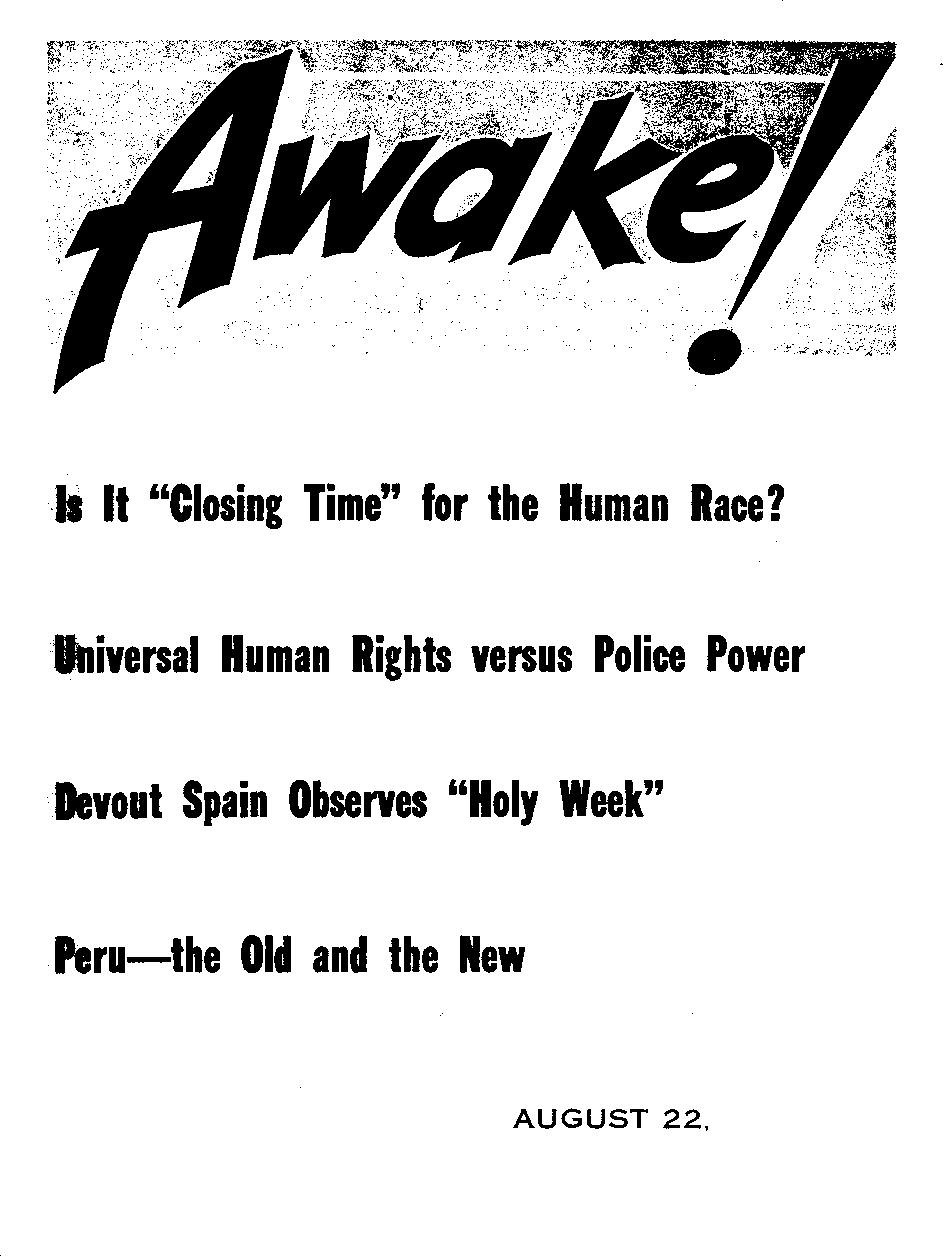
Is It “Closing Time” for the Numan Race?
Universal Human Rights versus Police Power
Devout Spain Observes “Holy Week”
Peru—the Old and the New
AUGUST 22,
THE MISSION OF THIS JOURNAL
News sources that are able to keep you awake to the vital Issues of our times must be unfettered by censorship and selfish interests. “Awake!" has no fetters. It recognizes facts, faces facts, is free to publish facts. It Is not bound by political ambitions or obligations; it is unhampered by advertisers whose toes must not be trodden on; it is unprejudiced by traditional creeds. This journal keeps Itself free that it may speak freely to you. But It does not abuse its freedom. It maintains integrity to truth.
"Awake!” uses the regular news channels, but is not dependent on them. Its own correspondents are on all continents, tn scores of nations. From the four corners of the earth their uncensored, on-the-scene* reports come to you through these columns. This journal's viewpoint is not narrow, but is International. It is read in many nations, in many languages, by persons of all ages. Through its pages many fields of knowledge pass in review—government, commerce, religion, history, geography, science, social conditions, natural wonders—why, its coverage is as broad as the earth and as high as the heavens.
"Awake!” pledges itself to righteous principles, to exposing hidden foes and subtle dangers, to championing freedom for all, to comforting mourners and strengthening those disheartened by the failures of a delinquent world, reflecting sure hope for the establishment of a righteous New World.
Get acquainted with “Awake!" Keep awake by reading "Awake!"
Published Simultaneously in the United States by the WATCHTOWER BIBLE AND TRACT SOCIETY OF NEW YORK, INC. 117 Adams Street Brooklyn 1T N. Y., U. S. A*
and in Enoland by WATCH TOWER BIBLE AND TRACT SOCIETY
Watch Tower House, The Ridgeway N. H. Know, Preaidenf
Printing this issue: 2,850,000 '•torfil'’ h rMMM lit fnWtwiai 19 lug IfflllfltMtftly—Afrikaans, Dtniah, Dutch, English, Finti-rrcudi. German, Greek, Italian, Japanese, Nocwe-EltD, Portugusve, Spanish, Swedish, Tagalog.
-Clnranja, Indonesian, Ukrainian, Zulu
Yearly subscription ratal Mfoti for aemimouthly editions
Amita, U.S., 117 Arfama 01, Brooklja 1, N.Y. 11 Aectralls, 11 Bererfort Bd„ BUathfleld, N.B.W. 8/-
Caaada, 150 BridgeUnd An., Toronto 18, Ont |1 England, Witch Tower House,
Kb BWipWr Loudon N.W. 7 7/-
Mv Inland, 831 New North Rd., Auckland, 8.W. 1 7/-SHtb AfrEn, Private Bag, P.O. Eiaodsfonteln,, TtL 7/-Mocthly ecilticns cost half the above ratea,
London N.W. 7, England Grant Suiter, Secretary
4d a copy
Rawlttanui fop ftitocriplicns should be lent to the office in your country. Ottarwlsa send ytrnr remittance to London. Notice of upiratlaa ta sent at least two lames before subscription expires.
CHANGES OF ADDRESS ihonld reach is thirty day* before jour moving data. Ghi u year old and new addrra (It goulble, jrtwr th addmw libel). Watch Tawil W*teh Tower Nome, The Ridgeway, Leaden N.W. 7, England
Entered as second-class matter at Brooklyn, N.Y, Printed in England
The ilMt tramlatlM vsad la "Awiker h the Naw World Translation of tie Holy Serlgturnt. When otter tramlatlefti ar» wH th« following tjwboli will appear tehlad the ettationa:
AS — American Standard Version AT - An American Translation AV — AuUwched Version (1011) Da - J. N. Darbys reraion
Dy — Catholic Donay version — The Emphatic Diaglott JP — JetrisD Publication Soc. De - Isaac Lreeer’s version
Afo — Jarnos Moffatt's version Ao — J. B. Rotherham's version RS — Revised Standard Version Ytr — Robert Young's version
CONTENTS
Will Sincerity Alone Flease God?
Is It "Closing Time" for the
Human Race?
Universal Human Rights versus
Police Power
"Living off the Fat of the Land”
"Tin-Can Island” Comes to Life
Spikes on Its Tail
Rolling Across the River
Devout Spain Observes “Holy Week”
Peru—the Old and the New “Your Word Is Truth”
Making the Earth a Perfect Paradise
Watching the World
________WILI_____ jgnnrrrttit Alone
PLEASE GOD?
A PERSON may be genuinely sincere, free from hypocrisy, completely honest and still be very wrong. The Scriptures state: “There exists a way that Is upright before a man, but the ways of death are the end of it afterward.” So sincerity by itself is not enough to please God.—Prov. 14:12.
Saul of Tarsus sincerely thought he was doing the right thing when he persecuted the Christian congregation. It took a blinding revelation from Jesus Christ to set Saul straight As a sincere Pharisee he was not pleasing to God. “Formerly I was a blasphemer and a persecutor and an insolent man,” he says. “Nevertheless, I was shown mercy, because I was ignorant and acted with a lack of faith.”—1 Tim. 1:13.
Many Russians sincerely believe in communism and are ready to give their lives for it, but who in the Western world is ready to accept communism on the basis of Russian sincerity? It is not enough.
Many persons today think that to win God’s approval sincerity is all that is required. Recently a person remarked about Billy Graham: “Billy certainly does no harm and—who knows?—he may do some good, but at least he is sincere.” Principles of right and wrong are set aside and sincerity is looked upon as the sum total of Christianity. But is it?
Jesus told of a time when people would kill Christians, thinking sincerely that they would be doing God a favor. Will God approve of their evil deeds simply because of their sincerity? Hardly. In his sermon on the mountain Jesus said: “Many will say to me in that day: 'Master, Master, did we not prophesy in your name, and expel demons in your name, and perform many powerful works in your name?’ And yet then I will confess to them: I never knew you at all. Get away from me, you workers of lawlessness.” According to this, neither sincerity nor powerful works are enough. What is required ?—Matt. 7:22,23.
Paul wrote of those who were sincere but incorrect: “I bear them witness that they have a zeal for God; but not according to accurate knowledge.” A primary requirement is an accurate knowledge of God’s will. Jesus said: “The one doing the will of my Father” is the one that will be rewarded.—Rom. 10:2; Matt. 7:21.
What is God’s will? “What doth Jehovah require of thee, but to do justly, and to love kindness, and to walk humbly with thy God?” A sincere person, when shown from the Bible that he is wrong, with all sincerity seeks to right his course. This is the genuine mark of sincerity that brings the smile of approval from God.—Mic. 6:8, AB.
HUMAN RAGE?)
T3B morningr'of November 1, 1952, the birth of ’: a new monster made an astounding incursion into the lives and thoughts of men everywhere. That morning a
group of specialists huddled be- it of hind reinforced barriers to watch .
rnnu ichuuk,™ uo.xi.icio lu naiM. . ftfcal possibilities.’ The distin-
the event take place. Tension dewroitSp guished scientist Dr. Vannevar /Bush remarked that it was pos-
mounted as the seconds were-; counted off—5, 4, 3, 2, 1—then a terrifying blast and a flash of light surpassing anything ever seen by the human eye rocked the earth. The fireball bulged and raced upward. In two minutes it soared to over 40,000 feet and spread three and a quarter miles in diameter. The clouds above and the sea around were lit pp as at noonday. The sands and coral beneath were seared away. The device that triggered the monster to reality momentarily developed at its heart a temperature ranging from 150 to 200 million degrees centigrade! The expanding gases of the fireball heated to 100 million degrees.
For minutes trained men stood motionless as they watched their creation with awe and despair. What a fearful monster to bring forth! The cone of the fireball went up to a maximum altitude of twenty-five miles and spread its mushroomlike head out a hundred miles. Below on earth was the terrifying truth. Elugelab Island at Eniwetok had vaporized. A milewide crater, 175 feet deep, was all that was left of the target area. Responsible men, who felt the significance of the event,
! not the beginningeftWend
. . z '/>/ ' ®°r the human race? The late
of Ofc j professor Albert Einstein was
Moved to say: ‘Annihilation of , ^wy life on earth has been
brought within the range of tech-
'i sible now to turn the clock of civ-ilizatfoh back 1,000 years and deliver “the woi4d again to barbarism and pestilence.” Atomic Energy Commissioner Thomas E. Murrah declared: “It may be the incomprehensible and inscrutable will of God to make* the twentieth century ‘closing time’ forthe human race.”
Some men envisioned the monster as “the apocalyptic weapon.” When let loose it would kill, “not by the thousands or the millions, but by the hundreds of millions. Neither man nor beast, nor fowl nor fish would be spared its devastation.” Others saw it to be the “watchdog” of the “free world” against aggressors. Who would dare make war in face of so great a threat? What a means of insuring the peace and security of the world!
Retaliatory power, soon thereafter, was hailed as the "only sane policy for the world.” And the new creation, the H-bomb, became the “big stick” with which men had hoped to enforce the peace. Militarists and politicians began to cry out: ‘Our only hope is to create new and greater deterrents to Soviet aggression. What we need is weapon superiority!’ Soon frightened people everywhere were heard taking up the chant Scientists were ushered into the role of saviors of the world. And at a hurried pace new monsters were brought forth.
Parade of Monsters
During World War n the block-buster, with its twenty tons of destruction, was regarded as a most frightful weapon; then came Hiroshima and the A-bomb with its equivalent of 20,000 tons of devastation. The year 1952 brought the H-bomb with its equivalent of 5,000,000 tons of terror. Since then, H-bombs with the potential of over 40,000,000 tons of TNT charge have been reported exploded and are now being stockpiled.
In 1950 it would have taken forty-five A-bombs to destroy New York city. Today it would take just one H-bomb. While the world is endeavoring to absorb the terrible truth about such monstrous weapons and learn to live with its fears of them, atomic scientists are discussing an even more hideous monster, the C-bomb. By placing a hydrogen device in a casing of cobalt, they say, they can make today’s H-bomb explosions seem like firecrackers. The C-bomb, however, is admittedly too dangerous for even nuclear scientists to fool with. Atomic nations already have on hand the means to exterminate the human race completely. They can make a good educated guess as to the number of H-bombs it would take to bring about total world catastrophe—to scatter the human family to the four winds in a matter of seconds. But where is the world’s security? Where is the peace that these monstrous weapons were to insure? Is it “closing time” for the human race?
Western nuclear supremacy, in which so much trust was placed, was, at best, only temporary. Barely nine months after the United States fired its H-bomb the Russians exploded a hydrogen device of their own. That which was to stand for security has become a unique, unchallengeable instrument of insecurity. Anxieties and tensions, as a result, have heightened, not diminished. And the war of nerves has entered a new apprehensive phase. The so-called “sane policy” of retaliatory power has been turned into a mad arms’ race, thrusting an indescribable burden on taxpayers and subjecting them to all kinds of suffering. Each atomic power nation hopes that the enormous potentialities of these destructive monsters will serve as a deterrent to any would-be aggressor, for such weapons make it certain that there will be no winner in modem warfare. Atomic nations are in fear that they will some day bury each other in nuclear destruction. They say the end is at hand.
Need for Revaluation
While men quake at the nuclear monsters they have wrought, these same men seem to be completely oblivious to the significance of greater demonstrations of power exploding before their eyes every day. Some of these violent eruptions have been seen to rise 100,000 miles. Compare that with the H-bomb’s cone that reached only some twenty-five miles. Yet few men put confidence in the One who has made such demonstrations of power possible. Of course, these are solar explosions taking place some 93,000,000 miles away from our earth. Astronomically speaking, however, that is a stone’s throw from our planet, a very short distance. Minutes after such eruptions on the sun, our earth is affected by the shower of cosmic rays that hit it. They penetrate the earth’s atmosphere and everything and everybody, and there is nothing we can do about it.
A few years ago a solar flame shot up some 80,000 miles. Minutes later there was a sudden blotting out of radio communication for a period of several minutes. These blackouts can last many hours. The sun’s brief activity scales all man’s explosive, destructive efforts down to size. And if we were to bring together the sum total of man's destructive power and compare it with what is continuously happening on the sun, we would come to realize that his efforts do not amount to too much after all
It may be well for us to make just such a study and reflect on what goes on around us in the universe. It has a humbling, deflating effect. It serves as a good reminder that our efforts are not as great or as vital to our existence as we might think. It may help us to see that ballistic security is not really security at all, and thus aid us to channel our hope and trust in a more dependable direction. For example, exactly how long do you think the human race would last if the sun were not to shine? In about three days our earth would become a lifeless ball. So whoever it is that cares for the sun also cares for our earth. Thus we learn that our lives depend on much more than the possession of nuclear weapons.
None of us created the earth, and, as is obvious, none of us sustains the world in its existence. Centuries before man the animals, birds, fish and plant life got along very well without our help. For life and for the things that keep us alive we are dependent. Faithful Job did not try to dodge this humbling knowledge, but came right out in the open and said: “Naked I came out of my mother’s belly and naked shall I return there. Jehovah himself has given and Jehovah himself has taken away. Let the name of Jehovah continue to be blessed.” Job acknowledged his dependence on a Source higher than this earth for his existence. He gave God praise and not man. —Job 1:21.
The world does not want to face this humbling knowledge and tries to skirt it There are ways that it can. Thoughts of dependence may be escaped by fleeing to the materialistic theories of evolution and atheism. Such persons want to free themselves of all responsibility to a Supreme Being. They want to feel independent. Others may find an escape by burying themselves in a drive for power, property or for prestige and in this way attain a measure of so-called independence and security. There are those who try to escape the whole issue by drinking or drugging themselves into a state of mental numbness. And others escape from reality by immersing themselves in their families, pleasures, hobbies, anything to forget, anything to get away from the horror of depending on they know not what. But do what they will, there is always that reminder, that inescapable consciousness of dependence.
Men Are but Grasshoppers
Depending on God and putting trust in his power to sustain and protect is what brings peace to the hearts of men of faith in this day of destructive monsters. Perhaps atomic and hydrogen bombs are monumental achievements, but, asks the New York Times, “What is an atomic bomb compared with the earth’s crust when it twitches like a cow or a horse that wrinkles its skin to rid itself of flies?” Why, the Assam quake in 1950 equaled the power of 1,100,000 atom bombs or 1,100 theoretical hydrogen bombs! Yet that eruption is nothing in power to compare with that which the Maker of the atom will release at Armageddon when He shakes terribly this whole earth.
There is much talk about using the power of the atom to make rain and convert desert lands into productive gardens. Thus men hope to exist independent of nature’s ways and laws. But the truth is that even a moderate rainstorm releases energy at a rate equivalent to several hundred atom bombs a minute. How many bombs would it take to bring about a good drenching rainstorm or to keep the earth watered day by day? The great dust storms of the 1930's in the United States raised clouds with a billion times the dust concentration of an atomic cloud without perceptible effect on rainfall. Yet the watering of our earth goes on almost unnoticed by man. The Creator does all things so effortlessly. What demonstration of power in the flood of Noah's day! How unmatchable Jehovah’s power when he parted the Red Sea and provided for his nation to go through on dry land! How utterly puny the efforts of men are when compared to the works of the Almighty!
Man launches a satellite of a few tons into space and it stays in orbit for a few days; the world is astonished and quivers at the demonstration of such power. But Jehovah launched into space the sun, which is a thousand times as massive as Jupiter, the largest planet in the solar system, and more than a million times the volume of the earth. He launched our earth and moon and giant stars such as Betelguese in the constellation of Orion, which is nearly a million times the volume of the sun, and he keeps them all in perfect orbit. And who is there on earth that marvels at his so great power?
Man is considered very wise when he builds larger telescopes and can count a few more thousands of the untold billions of stars in the heavens. Yet there are whole galaxies that man can barely see even with his telescopes. “Raise your eyes high up and see. Who has created these things? It is the One who is bringing forth the army of them even by number, all of whom he calls even by name.” The psalmist wrote: “He is counting the number of the stars; all of them he calls by name. Our Lord Is great and is abundant in power; his understanding is beyond recounting.”—Isa. 40:26; Ps. 147:4,5.
Jehovah does not lose track of things, as man so frequently does. He cares for all life. He knows our earth and man upon it. He knows what you are doing, however important or unimportant you may feel in this world. He knows your thoughts and the intentions of your heart. Even down to the tiny forms of life, Jehovah is aware of them all. Nothing escapes his sight. He knows of the monstrous weapons that faithless men have brought forth in these last days. That is why there is no reason to fear, if we put faith in Jehovah. We know: “Many are the plans in the heart of a man, but the counsel of Jehovah is what will stand.”—Prov. 19:21.
Jehovah is God Almighty. The prophet Isaiah said of God's view of the nations: “Look! The nations are as a drop from a bucket; and as the film of dust on the scales they have been accounted. ... All the nations are as something nonexistent in front of him; as nothing and an unreality they have been accounted to him. . . . There is One who is dwelling above the circle of the earth, the dwellers in which are as grasshoppers.” Comparatively speaking, man is a mere grasshopper in Jehovah’s sight. All man’s threats of ruining God’s earth with his H-bombs can be compared to the twittering of a grasshopper. “To Jehovah belong the earth and that which fills it, the productive land and those dwelling in it” He will continue to care for his earth regardless of what men do.—Isa. 40:12-22; Ps. 24:1.
Properly Evaluating Our Situation
Christ Jesus, who knew the universe and his relation to it better than any man before or since his day, gladly admitted his dependence on the Creator, Jehovah. Said Jesus: “I do nothing of my own initiative, but just as the Father taught me I speak these things.” This dependence on God, Jesus taught his disciples, saying: "Never be anxious and say: *What are we to eat?’ or, 'What are we to drink?’ or, ‘What are we to put on?’. . . For your heavenly Father knows you need all these things.” Some years later his apostle Paul told the men of Athens that God "gives to all persons life and breath and all things,” that God "decreed the appointed seasons and the set limits of the dwelling of men, for them to seek God.”—John 8:28, 29; Matt. 6:31,32; Acts 17:25-27.
So creation round about us is cause for renewed faith in Jehovah, that our ultimate destiny does not depend upon the whims of men who toy with and threaten annihilation with nuclear bombs. Just as Jehovah cares for the birds of heaven that do not sow seed or reap or gather into storehouses, and just as he cares for the lilies of the field that do not toil or spin, so he will continue to care for righteous mankind on earth. Are they not worth more than birds and lilies?
Creation, at hand, truly is an opportunity to see the hand of God at work and an occasion to commit ourselves to Him and his care. When we trust Jehovah implicitly we will not fear. It is the fear of man that brings anxiety and doubt for the future. So "trust in Jehovah with all your heart and do not lean upon your own understanding. In all your ways take notice of him, and he himself will make your paths straight. Do not become wise in your own eyes. Fear Jehovah and turn away from bad.”—Prov.3:5-7;Ps.l46;3-6.
Having Jehovah as our confidence and trust in this day of monstrous weapons has a steadying and a soothing effect His promises are an assurance that not all is lost, that nothing has gone unnoticed by him, that he has everything under complete control. He gives us his word that he has firmly established the earth, that he did not create it simply for nothing but formed it to be inhabited. (Isa. 45:18) This promise strikes out any possibility of the earth’s ever being laid waste by nuclear weapons. Instead of allowing men to destroy the earth, Jehovah says that he will "bring to ruin those ruining the earth.” It is "closing time,” not for the human race, but for the wicked schemers who plot the ruining of the earth with their deadly weapons.—Rev. 11:18.
Instead of bringing to a close the human race, Jehovah has made provision for the race to go on living. He sent his Son Jesus Christ to redeem men from sin and death. Through the life of Jesus Christ, Jehovah has proved beyond all doubt that righteous mankind will not perish off the earth, regardless of what men might devise or do. The human race Is here to stay, but not so the wicked. It is “closing time” for them. At the battle of Armageddon Jehovah will bring to an end the wicked and their activity. However, he will come to the rescue of righteous men everywhere and open to them a new world of peace and life.
This knowledge should free us of the anxieties of life and fear. It should create in us a courage to speak God’s truth. If Jehovah is our hiding place "and underneath are the everlasting arms,” what reason is there for fear? “If God is for us, who will be against us?” With this assurance and faith, let us lift up our heads and rejoice! "Say among the nations: 'Jehovah himself has become king. The productive land also becomes firmly established so that it cannot be made to totter.’ ” Let the heavens and earth remind us that we are continuously being cared for by a loving God, that we are dependent on him for our existence.—Deut. 33:27; Rom. 8:31; Ps. 96:10.
flag salute opinion was
\UNIVERSAL ^HUMAN^I
UNIVERSAL I DKUT^ human rights V IVIVlIl I are the jewels of the Philippine Constitution. These are protected by the Bill of Rights. Universal human rights must be protected against all encroachments by the police power of the State. This was the high light of the oral argument before the Supreme Court of the Philippines on May 15, 1959, by Hayden C. Covington, general counsel
for Jehovah’s witnesses and the Watch Tower Bible and Tract Society, and a wellknown American constitutional lawyer.
What events led up to the dramatic contest between human rights and police power of the State? What brought Covington to the Philippines? Why did the Supreme Court permit an alien attorney to appear personally and argue before the Court In behalf of universal human rights?
The specific issue involved was the refusal of children of Jehovah’s witnesses in the Philippines to participate in the compulsory salute to the flag, singing of the national anthem and the reciting of the patriotic pledge. Upon what grounds was the children’s conscientious objection based? Upon the law of God found in the Bible, prohibiting God’s servants from making images of anything in the heavens above, or the earth beneath or in the waters, and from bowing down to such images or serving them.—Ex. 20:4, 5;
1 Cor. 10:14; 1 John5:21.
Nlneteen Years of Controversy
The controversy in the Philippines over the compulsory flag salute began in 1940. That year the late Secretary of Justice
Jose Abad Santos promulgated an opinion that children in public schools could be compelled to salute the flag. For failure to do so children could be expelled from school.
The compulsory
based on the 1940 decision of the Supreme Court of the United States in the case of
Minersville v. Gobitis. The carrying out of this opinion by the Department of Education, particularly after liberation in 1945, resulted in expulsion of many children of Jehovah’s witnesses from the public schools. In the meantime, the United States Supreme Court had reversed its previous decision in the now-famous Barnette decision in June, 1943. In 1948, Secretary of Justice Roman Ozaeta caused a new opinion to be published. This was in harmony with the majority decision in the Barnette case. Children of Jehovah’s witnesses were thereafter allowed back in school.
In 1951, however, Secretary of Justice Jose P. Bengson, in a burst of nationalistic sentiment, chose to repudiate the majority ruling in the Barnette case. He issued an opinion that children in public schools could lawfully be compelled to participate in the flag-salute ceremony. The Department of Education implemented this opinion. Again the children of Jehovah’s witnesses were expelled from school for refusing to violate their Christian conscience.
Parents of children who were attending an elementary school in Malacampa, Ca-miling, Tarlac, contested the Department of Education’s action. A petition was filed in the local Court of First Instance to restrain school authorities from enforcing their flag-salute regulation against the children of Jehovah’s witnesses. The court refused to accept jurisdiction. A petition was then filed in the Supreme Court requesting that the lower court be ordered to accept jurisdiction and hear the case on its merits. Additionally, the Supreme Court was requested to issue a preliminary Injunction restraining the secretary of education and other school officials from expelling the children of Jehovah’s witnesses until a judicial decision could be rendered on the merits of the case. The Supreme Court granted the petition. Again the children of Jehovah’s witnesses went back to school. The flag-salute ceremony continued. It suffered no interruption, and the regular school program was not disturbed in any way by Jehovah’s witnesses.
Framing Mischief by Law
Since there was already a flag ceremony being conducted in the public schools, there was no need to introduce legislation to bring a flag ceremony into operation there —not unless there was an ulterior motive. Later events clearly indicated that there was a motive to “framing trouble by decree.” (Ps. 94:20) In 1955, a bill was introduced in the Philippine Senate. It proposed the holding of a flag ceremony in all educational institutions in the Philippines, both public and private. This would mean that if the children of the Witnesses would be expelled because of their refusal to participate in the flag ceremony, they could not get an education in the Philippines. All schools would be barred to them.
Certainly this is “framing trouble by decree.” The ceremony was to include the playing or singing erf the Philippine national anthem. This bill was approved on June 11, 1955, and signed into law by the late President Ramdn Magsaysay.
The secretary of education then issued Department Order No. 8, Series of 1955, requiring the flag ceremony to be conducted every day in public schools and also in private schools. The ceremony was to include the salute to the flag, the singing of the national anthem and the recitation of the patriotic pledge. This nullified the injunction granted by the Supreme Court. Again the Witnesses’ children were expelled from school. They had to start all over again in their legal fight to preserve their right of worship.
On behalf of the expelled children, K. V. Faylona, Esquire, counsel for Jehovah's witnesses in the Philippines, wrote a letter to the secretary of education in which he clearly set forth the reason why Jehovah's witnesses refuse to salute the flag, sing the national anthem and recite the patriotic pledge. He requested administrative relief on their behalf from the requirements of the flag ceremony. In reply the secretary of education stated there was no relief that he could grant. Thereupon Faylona filed a petition in the Court of First Instance at Masbate, the capital city of Mas-bate Province. The petition requested judicial relief for Jehovah’s witnesses from being compelled to violate their religious belief. A similar petition was filed in the Court of First Instance of Roxas city. Both courts ruled against Jehovah’s witnesses by upholding the right of the police power of the State to compel the children of the Witnesses to participate in the flag ceremony in violation of their Christian conscience. Both decisions were appealed to the Supreme Court. The Masbate case was set for oral argument on May 15,1959. It was styled Gerona v. Secretary of Education.
Covington Invited to Explain
Faylona was deeply concerned over the problem of explaining to the Court why Jehovah’s witnesses refuse to salute the flag. This seemed to be the big question in the minds of prominent and intellectual people who spoke to him about the case. He was sure it would also be the big question in the minds of the justices who would hear the argument. Not being one of Jehovah’s witnesses himself, he felt that he could not speak with the authority and conviction of one who is a member of the faith. On this point he appealed to Hayden C. Covington in New York, who is a lawyer and also one of Jehovah’s witnesses, and requested him to come to the Philippines to appear personally before the Supreme Court, if the justices would grant him permission to do so. Covington agreed, and the Court granted the desired permission. The oral argument took place before the Supreme Court on May 15, 1959, in Baguid city, the summer capital of the Philippines, located In the mountains of Benguet about 130 miles from Manila.
After being introduced to the Court by Faylona, Covington pointed out that the trial court did not take any evidence, that it decided the case upon the pleadings and it found that all the facts pleaded in the case were admitted. Therefore, there was no question on the facts. The facts stated in the Record must, therefore, be accepted as absolutely true. Covington further stated: “Our purpose in being here is to help this Court do justice in this most important question which involves what we consider to be a universal right of man for freedom of speech and worship of God.” He then set forth the high lights of his argument and stated he would come back and elaborate on each point The high lights were:
1. That the law is unconstitutional as applied.
2. A statement explaining why Jehovah’s witnesses refuse to salute the flag, sing the national anthem and recite the patriotic pledge.
3. That it is not for the Court or the secretary of education to say what is religious and what is not religious.
4. That the clear and present danger rule is applicable in this case.
5. That the allegation of the respond-ents-appellees that there is a distinction between the Constitution of the United States and that of the Philippines is a distinction without a difference.
6. That the provisions of the Bill of Rights in the Philippines are to be viewed on a higher plane than the police power of the State because the Bill of Rights guarantees freedom of worship and of speech.
7. That the Constitution of the Philippines guarantees the right of parents to direct the education of their children and this right is one that must receive the aid and support of the government.
Elaborating on the seven points, Covington said: “We are not attacking the law on its face, but we are contending that the law is unconstitutional as construed and applied against the appellants. To compel the children of the appellants to perform these acts would constitute a breach of freedom of worship. We do not question the respect to be shown to the flag, but it is the manner in which it is sought to compel respect against which we are contending. Any law which requires an individual to salute the flag becomes unconstitutional if it compels one to do so against his religious belief.”
A Religious Act for Jehovah's Witnesses
Justice Angelo Bautista asked Covington what is wrong with the flag salute and why it is that Jehovah’s witnesses do not want to salute the flag. Covington explained that refusal is based on the second of the Ten Commandments found in the Bible at Exodus 20:3-5. He said:
“The flag is an image or representation of the State and flags contain representations of things in the heavens, such as stars, and things on earth and under the water. Jehovah’s witnesses believe that the salute to the flag is a religious act performed before an image of the State. It may not be religious to you, or to the secretary of education, or some other person, but it is to Jehovah’s witnesses and, in determining this controversy, we must look at the matter through their eyes. Even if they are in the minority, the right to practice what they think is religious must be upheld. The most precious jewels of the Constitution are the freedoms of worship, press and speech. If these are removed, good government perishes. As stated by Voltaire, T may hate what you say, but I will defend to death your right to say it.’ ’’
In answer to further questions by the same justice, Covington made the following observations: “The words in the dictionary clearly establish that the salute to the flag is an act of veneration, adoration, worship. It is not for the Court, or the secretary of education, to say what is religious. If a person wants to salute the flag, he has a right to do so, but when police power is used to compel a Christian, dedicated to God, to violate his conscience, such compulsion is unconstitutional. It should be kept in mind that the police power of the State on one hand and freedom of speech and religion on the other hand should be balanced, pie justices and the secretary of education may have their religious convictions, but when they leave home and take up their duties as servants of the State, they must leave their religious prejudices and robes at home.”
When the justice asked what the objection was to the singing of the national anthem, since it is not a symbol and not necessarily done before an image, Covington replied: “The objection is that it constitutes a prayer by the one who is singing. That violates the conscience of the individual.”
Chief Justice Ricardo Paras inquired whether freedom of speech would authorize libel or slander. Covington replied that the law guarantees freedom of speech and press, but that a person who abuses that freedom through libel or slander should be punished. But in the instant case there is no abuse of freedom of speech or press, only a refusal to participate in an act that is religious. The act is a respectful act, not seditious, not disloyal. The Witnesses would like merely to exercise their religious freedom as guaranteed by the Constitution.
The question of clear and present danger to the State was raised by Justice Angelo Bautista. He wanted to know whether the refusal of the children to salute the flag might lead to other acts of refusal—acts that might undermine discipline and cause a lack of respect for authority and even cause others to neglect their duties and obligations toward the State. Covington replied in substance: It is not proper for the Court to go outside the record and speculate on dangers that may or may not occur in the future. Otherwise, there could be no end of speculation and a person could be judged on the basis of conditions or facts that do not actually exist but that are assumed will be in existence at some time in the future. It is the burden of the State to prove that clear and present danger exists in this case. The State has not done so. In fact, the State has agreed with the appellants that no dear and present danger exists In this case. No danger exists and no disloyalty has been proved.
Justice Reyes then inquired whether the salute to the flag by military personnel could be construed as a religious act. Covington pointed out that it is a religious act when performed by one of Jehovah’s witnesses. He said that, assuming one of Jehovah’s witnesses to be in the army, the time and the place do not matter. If one of Jehovah’s witnesses was being faithful to his covenant, he would not be in the army. But assuming that he became one of the Witnesses while in the army, the salute would still be a religious act to him. He could be punished, however, or even shot for not obeying. He has no constitutional rights to refuse to obey the order of his superior. When a man enters the armed forces, Covington said, he takes off his civilian clothes and he loses all his civil rights. A soldier does not have any civil rights. He is under military law. He is not protected by constitutional rights.
No Danger to State
Chief Justice Paras advised Covington that his time was nearly exhausted. Then Covington concluded with two more points. He said: "There is nothing more serious which is involved in this case than there is in eating meat on Friday. If the Government were to pass a law making it compulsory for school children to eat meat on Friday on the grounds that meat is good for their health and that proteins are necessary to build strong bodies , . ., such a law could not be enforced against sincere Roman Catholics who conscientiously object to eating meat on Friday because of their religious conviction. It would be a violation of their freedom of worship to compel them to eat meat on Friday. Refusing to eat meat on Friday would constitute no clear and present danger to the State. This is exactly the same as refusing to salute the flag because of conscientious objections.
"If the flag-salute law and regulation were to be held as constitutional, Jehovah’s witnesses would be prevented from obtaining an education in the country, inasmuch as the law and regulation apply to both public and private schools. The only way they could have an education is to leave the country. We do not think It was ever the intention of Congress to compel Jehovah’s witnesses to leave the country in order to obtain an education. There is not one word either In the Act or in the regulation to make it compulsory to salute the flag. That was the last thing Congress had in mind. The thing that made it compulsory was the act of the secretary of education.”
Faylona then arose and gave the Court a brief but comprehensive history of the flag-salute controversy. He pointed out, too, that when the members of the Senate were discussing Bill No. 1265, the objections of Jehovah’s witnesses were considered and one senator made the statement that under the Philippine Constitution it was very doubtful whether children could be compelled to salute if their conscientious objections were based on religious training and belief. Then Faylona closed by saying: “I respectfully submit to the Court that a Jehovah’s witness who refuses to salute the flag, but obeys the laws of his country, is a better citizen than he who salutes the flag, but disobeys the laws of his country?’
The solicitor general’s office was represented by Attorney Quiazon, who argued that there were provisions of the Constitution that limited the exercise of the liberties guaranteed by the Bill of Rights. But at no time did he specifically state what those limiting provisions in the Constitution were. Some of the justices probed deeply into this argument. One asked him to draw the line between constitutional rights and the police power of the State. Others asked such questions as: Is religion higher than police power? Would you hold to your view even if it violate^ freedom of worship? If a father is a member of the organization of Jehovah’s witnesses, is it his duty and right to teach his child hft religion? Was it not stated that the Bill of Rights limits the power of the government? Supposing instead of saluting they were required to kneel in front of the flag, what do you say to this? When Justice Concepcion asked, “Whom do you think is the better citizen, the man who is lawabiding, but who refuses to salute the flag because of his religious conviction, or the man who does not obey the law, but salutes the flag?” Quiazon replied, “The one who obeys the law.”
Following this, the secretary of education requested permission to speak to the court. He was granted ten minutes. In an impassioned speech, the secretary of education made no point that had not already been covered by the lawyer from the solicitor general’s office. He was not questioned by the justices.
Nationwide Interest and Publicity
Seldom has any one case created so much interest on a nationwide scale. The courtroom itself was a scene of intense interest. The justices sat in informal style on either side of a long table with the chief justice presiding at one end and the lawyers arguing at the other end. A crowd of more than two hundred persons packed out the courtroom. Among them was a good representation of law students, lawyers and other professionals, as well as Jehovah’s witnesses. Excellent order was maintained. It was most obvious to all in attendance that the justices were giving their undivided attention to the argument.
The nation as a whole took the same interest This was shown by the newspaper publicity, amounting to a total of 319 column inches. Nearly every newspaper with wide circulation covered the story of Covington’s arrival and the arguments before the Supreme Court. The Manila Bulletin and the Philippine News Service sent their own reporters to interview Covington, The news was carried by radio and it was even mentioned by one of the quiz programs on the evening of May 14 on TV-Channel 3, Manila (one of the largest TV stations in the Philippines), on the program “Race with the Bell.” A contestant was asked: “Who is the American lawyer now in the Philippines who came here purposely to defend the case of Jehovah’s witnesses in the Supreme Court for their refusal to salute the flag?” The participant was able to answer the question correctly.
Without exception, the newspapers gave fair and comprehensive reports on the issue involved and the arguments in support of both sides of the case. This was no clash of foreign interest against Filipino interest, It involved the human rights of Filipino children to exercise their way of worship In harmony with the Bill of Rights and free from unlawful invasion by the police power of the State. The independence and sovereignty of the Philippines was recognized and admitted and the Court was not considered bound by the American Barnette decision. The appeal to the Court was on the basis of the Philippine Constitution. The newspapers took note of this and highlighted the fact that the rights of Filipino children were being defended.
The Manila Times of May 15,1959, quoted Covington as saying: “We are, defending this case not only on behalf of the children of Jehovah’s witnesses, but also for the liberty of every Filipino citizen to worship God according to the dictates of his the appellants that no dear and present danger exists In this case. No danger exists and no disloyalty has been proved.
Justice Reyes then inquired whether the salute to the flag by military personnel could be construed as a religious act. Covington pointed out that it is a religious act when performed by one of Jehovah’s witnesses. He said that, assuming one of Jehovah’s witnesses to be in the army, the time and the place do not matter. If one of Jehovah’s witnesses was being faithful to his covenant, he would not be in the army. But assuming that he became one of the Witnesses while in the army, the salute would still be a religious act to him. He could be punished, however, or even shot for not obeying. He has no constitutional rights to refuse to obey the order of his superior. When a man enters the armed forces, Covington said, he takes off his civilian clothes and he loses all his civil rights. A soldier does not have any civil rights. He is under military law. He is not protected by constitutional rights.
No Danger to State
Chief Justice Paras advised Covington that his time was nearly exhausted. Then Covington concluded with two more points. He said: "There is nothing more serious which is involved in this case than there is in eating meat on Friday. If the Government were to pass a law making it compulsory for school children to eat meat on Friday on the grounds that meat is good for their health and that proteins are necessary to build strong bodies , . ., such a law could not be enforced against sincere Roman Catholics who conscientiously object to eating meat on Friday because of their religious conviction. It would be a violation of their freedom of worship to compel them to eat meat on Friday. Refusing to eat meat on Friday would constitute no clear and present danger to the State. This is exactly the same as refusing to salute the flag because of conscientious objections.
"If the flag-salute law and regulation were to be held as constitutional, Jehovah’s witnesses would be prevented from obtaining an education in the country, inasmuch as the law and regulation apply to both public and private schools. The only way they could have an education is to leave the country. We do not think It was ever the intention of Congress to compel Jehovah’s witnesses to leave the country in order to obtain an education. There is not one word either In the Act or in the regulation to make it compulsory to salute the flag. That was the last thing Congress had in mind. The thing that made it compulsory was the act of the secretary of education.”
Faylona then arose and gave the Court a brief but comprehensive history of the flag-salute controversy. He pointed out, too, that when the members of the Senate were discussing Bill No. 1265, the objections of Jehovah’s witnesses were considered and one senator made the statement that under the Philippine Constitution it was very doubtful whether children could be compelled to salute if their conscientious objections were based on religious training and belief. Then Faylona closed by saying: “I respectfully submit to the Court that a Jehovah’s witness who refuses to salute the flag, but obeys the laws of his country, is a better citizen than he who salutes the flag, but disobeys the laws of his country?’
The solicitor general’s office was represented by Attorney Quiazon, who argued that there were provisions of the Constitution that limited the exercise of the liberties guaranteed by the Bill of Rights. But at no time did he specifically state what those limiting provisions in the Constitution were. Some of the justices probed deep-
Niuafoo, 4 one of the most famous of all the South Sea islands, is in the news again, Niuafoo? Perhaps you know it better under its adopted name of ‘‘Tin-Can Island,” the northern outpost of the Tongan Island Kingdom, independent kingdom of the South Pacific. Lying though it does on the direct shipping lane between the Fiji Islands and Western Samoa, for almost twelve years little was heard of this fertile and beautiful island. Now, since last September, it has come to life again with the return of some two hundred of its former inhabitants after an absence of twelve years.
As Niuafoo it has no particular claim to fame, either for size or population. In fact, it is comparatively small, for even at its largest some years ago it could only boast an area of some twelve square miles within its three- to four-mile diameter. Its largest population of 1,306 was not outstanding either. As “Tin-Can Island,” however, the story is different.
Known since 1616, when it was first discovered by the Dutch navigators Schouten and Lemaire, it received its rise to world fame during the 1920’s. At that time the island was inhabited by about one thousand native Tongans and a few European traders. So it was not considered important enough to have regular mail ships call, especially since it had no good anchorage close to shore. Only infrequent visits were made by small island trading vessels, while the big mail ships sailed right on by the island without ever stopping. Being thus deprived of regular mail, and goaded by an earlier failure to send mail by rocket delivery to passing ships, one of the traders decided to swim the mile to where the mail
boats passed, thus to dispatch and receive mail regularly.
Supported by an airtight bamboo pole,
By "Awai,t" numpendtni in accompanied by Tongan
men who were believed to
have beaten off any chance sharks, and towing a tin can wrapped in grease paper which contained the mail, the trader commenced the island’s regular mail service to and from the mail steamers. As a ship slowed down to pass the swimmers, buckets would be lowered from the deck to pick up the outgoing mail, and the incoming mail would be thrown overboard in forty-pound biscuit tins to be towed ashore.
This unique delivery became known around the world and people sent letters addressed to themselves or friends to be posted from “Tin-Can.” Sixpence was sent with each letter, half of which was retained by the trader, the other half for postage. Up until 1939, because of the demands of philatelists, the “Tin-Can Mail” grew enormously before being interrupted by World War n. In all, at least 118 of such swimming trips were made, the weather and seas apparently seldom permitting the use of canoes.
A Massive Volcano
“Tin-Can” also made the news oh a number of other occasions through a series of volcanic eruptions In fact, the whole island is a massive volcano rising out of the sea. The main old crater contains a beautiful green mineral lake with two miniature volcanos in the center. The lake, or “Vahi Lahi” (Big Water), as the Tongans call it, covers a quarter of the island’s area. There are other similar but smaller lakes, some with hot springs, and the people develop wonderfully clean skins from bathing in their mineral waters.
Niuafoo’s first recorded volcanic eruption, in 1856, was a serious one in which a whole village was destroyed. This and the long serie^ of other violent eruptions since, especially the 1929 upheaval, have devastated about one fifth of the island, leaving it under a blanket of lava.
Finally, the last eruption, in 1946, destroyed the largest settlement of Angaha, so the population was ordered to evacuate the island. The village’s church, post office, government buildings and stores were completely demolished by lava, but fortunately there was no loss of life. At the first rumblings of the volcano the people had very sensibly taken immediate heed and fled to the higher ground at the edge of the old crater, thus all saving their lives.
A total of 1,258 of the population were evacuated to another island to the extreme south of the Kingdom. After some months just a few returned to work two of the island’s large copra plantations. Despite the danger, they were loathe to abandon the rich land, which is reputed to produce the largest coconuts in the world.
The last mail dispatch, called “Tin-Can Last Covers,” after the 1946 eruption, was sent out on December 21, 1946. The postmaster canceled each stamp with his own name, appointment and date in his own handwriting—a truly unique cancellation! Such covers are very rare and
valuable today. Now “Tin-
Can,” after twelve' years of virtual a b a n d o n-ment, Is Inhabited again. For many years the evacuees longed to return to their fertile island home, and finally, because no further upheavals had occurred since 1946, the Tongan government gave permission for them to return at their own risk. Thus last September saw more than two hundred people crowded on the deck of a 600-ton interisland vessel en route to Niuafoo. Cows, dogs, pigs, horses, goats and chickens all huddled together on deck for the three days and nights of the voyage of 400 miles. What a fever of excitement prevailed on that trip! A brand-new start had to be made. They were to be set on the beach with no homes to occupy, no water to drink (only the juice from young coconuts) and just enough food to, last until the next ship brought stores.
Home Again
As the ship neared its destination, a look at the radar screen showed clearly that Niuafoo is volcanic, not a coral atoll. No reefs skirt the island; it climbs straight out of the sea. The ship’s echo depth sounder recorded very deep water right up to the beach. Fortunately, the day was calm and the ship could be brought close to shore before anchoring. This was very necessary because the horses and cows had to be swum ashore.
As we were to see, swimming cattle ashore is quite an event. First a rope sling is tied under the animal, and each leg js tied securely to prevent too much kicking. As soon as the slack is taken up by the winch, the animal in panic begins to kick violently, but immediately when all four legs leave the deck it be
comes absolutely still, seemingly petrified with fear. More frantic kicking now as it lands in the water, until a Tongan boy dives in beside the animal and releases it from the sling. Now, to bring it to shore the boy swims at its head.
At one point too many at once were released, and oft they headed in all directions, some straight out to sea. Good-natured pandemonium reigned—people running along the deck, shouting, laughing; boys diving in and swimming after them. Finally the ship’s launch was sent to the rescue and all the animals were brought safely to shore.
What remarkable swimmers these Tongans are! I have seen them at the main port of Nukualofa. At the departure of some of the big tourist ships they swarm all around the vessel in the water, heedless of sharks, ship’s propellers or fatigue. Small boys, some certainly no older than seven, hide aboard ship and, as it pulls away from the wharf, they appear all along its side and leap or dive, squealing with delight, into the water. High up on the lifeboats some of these youngsters stand, making sure all eyes are on them, and then plunge head-first over the side. Up they come to the surface, exploding with laughter, and then swim along with the ship until it gathers speed and leaves them waving from the water astern. Here now at Niuafoo, swimming cattle ashore, they were truly in their element.
After the cattle came the unloading of stores, and some of us took the opportunity to go ashore for some sight-seeing. As the launch neared the landing we could see the busy scene in detail. A humming, excited atmosphere prevailed as though all were on a grand picnic. Everyone seemed caught up with the spirit of adventure. Stores were being carried up the beach. Family groups were organizing. Women were busy plaiting coconut palm fronds into mats and blinds with which rough temporary shelters were being made. And here, right at the beach, the butchers were busy. Not that they had planned on it particularly, but a big pig had come to grief when its snout had been crushed by a falling crate on the ship, and now nere it was, already cleaned, quartered and ready for the oven pit being energetically dug in the earth. Not a mishap by any means, but a wonderful excuse lor a feast Everyone seemed delighted.
We wanted to see the island. So, leaving the bustle of the beach, we began a two-mile climb through groves of coconut trees and across lava fields toward the top of the main crater. Our path took us, not straight up, but diagonally across the volcano's sloping side, through cool, lush groves of coconuts and fems and across open lava fields, sweltering hot in the afternoon sun. We were surprised to see that the lava flows, rather than coming from over the rim of the main crater, seemed to have burst out at several points along the hillside we were following and had then pushed all before them into the ocean.
Among our obliging guides were several young boys who vied with one another to keep us well supplied with the huge green drinking coconuts, each one holding a good half gallon of the cool, semisweet Juice. As soon as we showed signs of feeling the heat they would be off for the tup of the nearest coconut palm, much as a telephone linesman climbs his telephone pole, but without the helpful equipment. Bred to it, they make it seem almost as easy as walking.
A Sea Within an Ocean
At last we reached the top of the main crater. What a sight! Almost unexpectedly the peculiar beauty of Niuafoo burst before us. From this point on the crater’s rim, sheer cliffs fell hundreds of feet before us to the sparkling emerald lake below. For three square miles the beautiful mineral waters fill the crater, and here and there miniature island volcanos and small islets, green and lush, dot the lake’s surface. Here lies a sea within an ocean, so calm and protected from the restless Pacific outside. At the far side of the is> land the crater's protective walls dip slightly and we could see the Pacific’s dark-blue swell, vividly contrasting with the lovely green of the lake. To either side of us giant coconut palms reach high, like great sentinels guarding the peace of the scene before us. Truly it is a beautiful sight.
No wonder the people are so very happy. Here they are, home again. And what a home indeed! Besides the awe-inspiring fields of black lava stretching in some directions as far as the eye can see, there Is the rest of the hilly island, so fertile with its thousands upon thousands of coconut palms, rich green forest ferns, trees and dense undergrowth. What a thrilling time the children have of exploring their new home and watching it being restored to its original state by their parents! Already plans to build a small town and settle down to the old way of life have been put into operation and are well advanced.
Yes, these things can certainly make one happy, but for how long? There remains the fear that some day soon their island home, a monster volcano, might erupt again with even greater destructive fuiy. The fear was there in the old days when the first question asked visiting sailors was: “Is Lofia smoking?” As long as Lofia and other volcano islands to the south were giving off smoke they knew Niuafoo to be safe. It is still the same; they can never feel really free of apprehension.
What greater happiness, then, will be theirs to learn, as some of their fellow Tongans on other islands are doing, of the paradise soon to be spread over all this earth, of the Edenic beauty that will be restored in every place, where “they shall sit every man under his vine and under his fig-tree; and none shall make them afraid.” They have returned to Niuafoo. Yet a far greater return awaits obedient mankind soon to a permanent paradise on earth under God’s kingdom.—Mic. 4:4, AS.
Spikes on Its Tail
C. Spikes on an animal’s tail might not seem practical, but practical it is for a lizard of Africa. "The spike-tailed lizards of Africa,’’ says Nature Parade, "dig burrows and crawl in head-first. The tail, with its bristling, bony armament, is then bent across the entrance to the burrow, and thus forms an impassable barrier. Few animals find it worth while to attack the spike-tail when it is at home."
…