Awake!, July 22, 1959
Download: PDF — Awake!, July 22, 1959
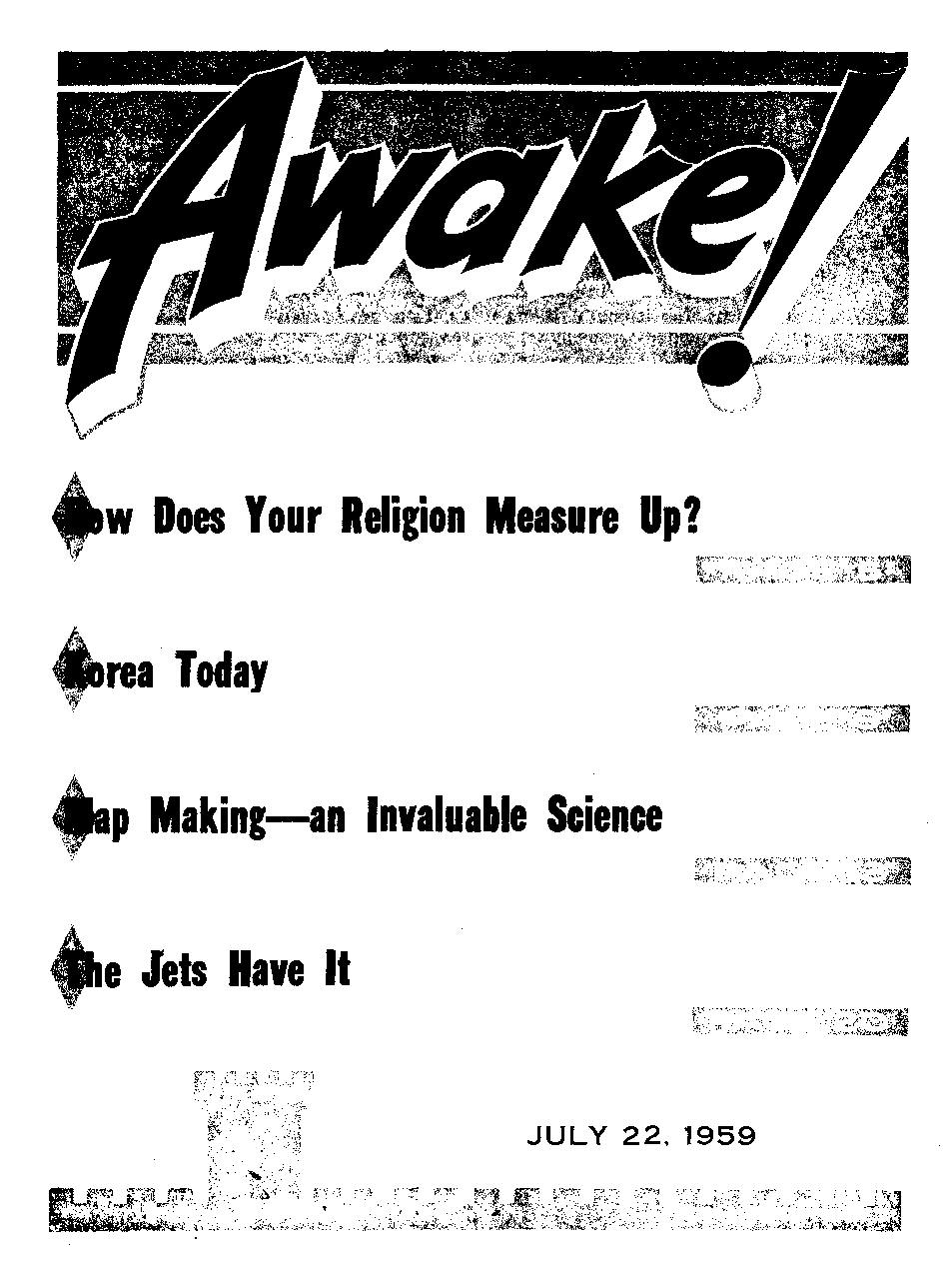
4bw Does Your Religion Measure Up?
V
tf
#rea Today flap Making—an Invaluable Science
e Jets Have It
THE MISSION OF THIS JOURNAL
News source* that are able to keep you awake to the vital Itsuet of our time* must be unfettered by ceniorship and selfish Interest*. "Awake I” has no fetters, (t recognizes facte, faces facte, is free to publish facts. It t* not bound by political ambitions or obligations} it Is unhampered by advertisers whose toes must not be trodden on; It is unprejudiced by traditional creeds. This journal keeps itself free that it may speak freely to you. But it doe* not abuse it* freedom. It maintain* integrity to truth.
"Awake!" uses the regular news channels, but Is not dependent on them. Ite own correspondents are on all continents, in scores of nations. From the four corners of the earth their uncensored, on-the-scene* reports come to you through these columns. This journal's viewpoint is not narrow, but is international. It is read in many nations, in many languages, by persons of ail ages. Through its pages many fields of knowledge pass in review—government, commerce, religion, history, geography, science, social conditions, natural wonders—why, its coverage is as broad as the darth and as high as the heavens.
"Awakei" pledge* itself ta righteous principles, to exposing hidden foes and subtle dangers, to championing freedom for all, to comforting mourners and strengthening those disheartened by the failures of a delinquent world, reflecting sure hope for the establishment of a righteous New World.
Get acquainted with “Awake!" Keep awake by reading "Awake!”
WATCHTOWER BIBLE AND TRACT SOCIETY OF NEW YORK* INC. 117 Adams Street Brooklyn 1, N. U. S, A>
and in England by WATCH TOWER BIBLE AND TRACT SOCIETY Watch Tower House. The Ridgeway London N.W. 7* England
N. H. Knonl Preairfant Grant Suiter, Secretary
Printing this issue: 2.860,000
‘Awefcfi1" Is P»brtsherf fit «• 19 tertfwfw.-
(monthly—Afrikaans Dauirii, Dutch, English, Finn-Uh, French, OrmiTt. Greek, Italian, Japanese. Norat" ri&ti, rortu^utK. Spanish, Swfidish, Tagaloa, MMthly—Clny&nji, Indcpetiaib (Jkrofaten, Zulu
Yearly BObficriptlfm rates
IfltM tor eemliaanthly editions
An«rl». U.S,, 117 Adame st., Brooklyn 1, N.Y. SI Antral la, 11 By-eflford BtntM»ldr N.B.W. 8/* Ctnad*. 15f) Bfldgelwid Are., Twffifo IK, Ont *1
Enflaai, Watch Tower House,
The Rldgewfiy, Loudoa N. W- 7 7/-
Raw Zotlmd, 621 New North Auckland, S.W. 1 T/’ South AfrlM, Private Bag, Elandsfooteln, Tri. ?/-
Monthly editions cost half the above rates.
4d a copy
ItaWttaiMW for wrbwrriptiiwi.Y should be te the office ta your country. Otherwise send your remittance tg London. Not it* »f ex pl rat Ion la sent at least two tauee before subscription expires.
CHANGES OF ADDRESS 4„ld rewh m thirty days tafdre year aiMlm data, sire us yow eld tad saw Hdr«u (If poMibla, jftur old tddms libel). Witofc lower, Watch Tower Hoot. Tira RIHewiy, London M-W. 7* England
Entered as second‘Class matter at Brooklyn, N.Y. Printed id England
The Bltft trenslath* tied In "Awake!'* is the New world Translation of the Koly Sorlptine. When other tramlatlone ore reed the following symbols will appear btb|n< the citation*:
AS — American Standard Verafnn AT - An American Translation AY - Authorized Version (1«1B Da - X N. Darby’s rerslon
Di/ - Catholic Dtmay vereion ED - The Emphatic DiMlott JP -- Jewish Publication Stx?. Le - Isaac Leeter's veretai
Jfo - James Moffatt’s version J, B. Butherhiui’fl nrricui RS - Rented Standard Version y<7 — Robert Young's version
CONTENTS
The Appeal of Moral Corruption
How Does Your Religion Measure Vp?
Korea Today
Map Making—an Invaluable Science
A Dictator on Tria!
Anticlericalism in Spain
The Jets Have It
"A Religious Observance"
Christian Love Triumphs
Making Charcoal
“Your Word Is Truth”
A Ransom for How Many?
Watching the World
THE presence of moral corruption in a society is not the sign of a healthy society but the sign of a sick one. Its spread produces ever greater problems that make peaceful living difficult; crime increases, violence grows, more and more families are broken up because of marriage failures, social diseases rise, contentions and injustices multiply. Living in such a society becomes precarious. This is the type of society that exists world-wide today.
Commenting on the bad fruits it is producing among children, especially in the United States, Judge Samuel Leibowitz stated: “We are fast approaching the time when this nation will have over 2,000,000 persons who have appeared in juvenile courts. Although our child population has increased only 25 percent from 1948 to 1957, appearances before juvenile courts have increased almost 150 percent in the same period. This is a shocking situation.’* —New York Times, February 13, 1959.
The situation is the outward evidence of the moral corruption that exists in modem society.
Despite its bad fruits moral corruption has sales appeal. It sells books, magazines and dramas. More often than not the theme of a popular story is moral corruption. In glaring lights and colorful posters theaters stress the immoral features of the movies they show in order to increase sales at the box office. Publishers of many magazines make moral corruption prominent in their cover illustrations.
Murder, sadism, beastliness and almost every form of moral degeneracy are served to this generation as entertainment by TV, movie, stage and literature. How can such themes have an upbuilding effect upon either young or old? Regarding TV presentations the Senate Subcommittee to Investigate Juvenile Delinquency said in its report, as published in U.S. News <£ World Report: “Television, available at a flick of a knob and combining visual and audible aspects into a ‘live’ story, has a greater impact upon its child audience.” “Life is cheap; death, suffering, sadism and brutality are subjects of callous indifference and judges, lawyers and law-enforcement officers are too often dishonest, incompetent and stupid. The manner and frequency with which crime through this medium is brought before the eyes and ears of American children indicates inadequate regard for psychological and social consequences.” “Repeated exposures to scenes of crime and violence may well blunt and callous human sensitivity to, and sympathy for, human suffering and distress.”
There are, of course, dramas and works of literature that do not depend upon moral corruption to sell them. These leave a more constructive impression upon the minds of people than those that do depend upon it. But the fact that so many people respond to the appeal of moral corruption is significant. It shows how the world thinks. It should not be surprising, therefore, that unlawful acts are committed by children who copy what they see adults doing.
Since fleshly tendencies are not inclined naturally toward good morals, there is a certain fascination in seeing or reading stories in which people throw aside moral restraints. But by feeding the mind upon such things how can a person build up resistance to the wrong desires of the flesh? How can it help him maintain a high standard of morals?
Because immorality is a common thing in the world, that does not mean it should be glorified in literature, on the stage and on the screen. It is something to be deplored, not built up as a box-office attraction. Playing up violations of God’s laws gives the impression that the committing of such sins is the thing to do and that to resist them is being old fashioned or Victorian.
If the people of this world had respected God’s laws, its society would not be morally and spiritually sick. It would not have the social problems of love triangles that result in heartaches and often violence, of broken families, of child crime and adult crime, of social diseases, of caring for thousands of illegitimate children, of criminal violence and of war. The good principles and laws set down in God’s Word are the basis for a healthy society, a society that produces good fruit. Personal moral standards that disregard the standards set down by God can lead only to trouble. The bad fruits now being reaped by the present world society are clear evidence of it.
Persons who recognize the wisdom in the moral principles of God’s Word see how important those principles are for man’s well-being. Christians of the first century were such persons. Many of them thought and acted as the world did before they became Christians, but then they changed. Regarding this change one of them said: “Yes, among them we all at one time conducted ourselves in harmony with- the desires of our flesh, doing the things the flesh and the thoughts willed, and we were naturally children of wrath even as the rest.” (Eph. 2:3) Another one said: “The time that has passed by is sufficient for you to have worked out the will of the nations when you proceeded in deeds of loose conduct, lusts, excesses with wine, revelries, drinking matches, and idolatries that are without legal restraint.” (1 Pet. 4:3) The legal restraint of God’s laws on conduct is needed just as much today as it was back there.
Moral corruption has an appeal because of the weakness of human flesh. A person should, therefore, be careful when selecting literature and dramas. Why should he leave himself open to having his moral integrity weakened by low-grade entertainment?
The Bible gives good advice when it says: “Whatever things are true, whatever things are of serious concern, whatever things are righteous, whatever things are chaste, whatever things are lovable, whatever things are well, spoken of, whatever virtue there is and whatever praiseworthy thing there is, continue considering these things.” (Phil. 4:8) When a person does that he strengthens his capability to resist base fleshly weaknesses that lead to moral corruption. “God is not one to be mocked. For whatever a man is sowing, this he will also reap.”—Gal. 6:7.
HOW DOES RELIGION MEASURE ZUP?
God'* Word loll* u* to "molt* >uro ol all thing*; hold fmt to what t* right.” (1 That*. 5: JI) To htlp you to do that i* tho purpoio of what follow*. ^7^,
A BRIGHT and eager youth had just recently finished his high school term. At his first place of employment he came in touch with a new and interesting religion—new as far as he was concerned. He found its message so reasonable and inspiring that before long he left the religion of his parents and was baptized in that faith. This so distressed his orthodox parents that they insisted he have an examination by a psychiatrist.
Trying to ascertain just what caused this youth to change his religion, the psychiatrist asked him about his school studies. It turned out that he had won a scholarship. Friends? He had some good ones. What about girls? They were all right; in fact, some were very nice. After a few more such questions the psychiatrist asked in desperation: “Then whatever made you get mixed up in that crazy religion?” Answered the youth: “That’s where you’ve got it all wrong, doctor. I was all mixed up before I got in touch with it. It straightened me out.” And to prove his point he began to ask the psychiatrist questions.
The result of it all was that the psychiatrist reported to his parents: “There’s absolutely nothing wrong with your son. He’s perfectly O.K. But what I would like to know is what caused you two to get so disturbed about your son changing his religion?” Today this young man is a missionary in Africa.
This points up the controversial nature of religion. It is a subject more often associated with emotion than । with reason. However; since there is nothing that has more far-reaching effects than the kind of religion we have, we should be
willing to reason soberly on the subject. Unless we are willing to accept the Hindu point of view that all religions are all right, we must admit that not all the some thousand religions of Christendom, not to say anything regarding all those of the Eastern world, are true and right.
Religion may be said to be the means by which one recognizes the object of worship. It will hardly be disputed that religion should do five basic things for us: (1) reveal to us the name and personality of the One worshiped; (2) reveal his purposes regarding the earth and man; (3) reveal what is required of man in relation to his God and his fellow man; (4) furnish the impetus, desire and will to do what God requires; (5) and finally, impart strength to do what God requires.
The Creator
The religion that is truly based upon the Bible, the Word of God, meets all those requirements. It reveals to us God as the creator of “earth and heaven,*’ with whom “is the source of life." Regarding his name he states: “I am Jehovah. That is my name; and to anyone else I shall not give my own glory, neither my praise to graven Images.” That name, appearing upward of 6,823 times in the Hebrew Scriptures, is a Hebrew word of four letters and is therefore termed the tetragrammaton. It literally means “he causes to be.” That name is most fitting, for he, indeed, has caused all things that exist to be.—Gen. 2:4; Ps. 36: 9; Isa. 42:8.
What are his attributes or basic qualities or characteristics? His Word shows that they are power, wisdom, justice and love. The universe gives overwhelming testimony to his great power. Fittingly he appeared to Abraham and others “as God Almighty.” Well could He ask that patriarch; “Is anything too extraordinary for Jehovah?”—Ex. 6:3; Gen. 18:14; Rom. 1: 20.
Another attribute of God is wisdom, regarding which his grand, majestic and beautiful universe also gives eloquent testimony. God’s wisdom is not only to be seen from his material universe but also in his principles, laws and record of dealings as made known in his Word. No wonder the apostle Paul, who was familiar with these could rapturously exclaim: “Oh the depth of God’s riches and wisdom and knowledge! . . . who has come to know Jehovah’s mind, or who has become his counselor?”—Rom. 11:33,34.
At once both satisfying and yet fearinspiring is God’s justice, another of his basic qualities. As Moses sang: “The Rock, perfect is his activity, for all his ways are justice. A God of faithfulness, with whom there is no injustice; righteous and upright is he,” We may therefore rest assured that a teaching that is repugnant to justice cannot he true of him, nor be taught in his Word.—Deut-32:4.
In striking contrast to the cruel characteristics of so many man-made gods, the God of the Bible is the very personification of love: “God is love,” we read. He delights in loving-kindness and mercy. As he proclaimed to Mases: “Jehovah, Jehovah, a God merciful and gracious, slow to anger and abundant in loving-kindness and truth.” Yes, he “loved the world [of mankind] so much that he gave his only-begotten Son, in order that everyone exercising faith in him might not be destroyed but have everlasting life.”—1 John 4:8; Ex. 34:6; John3:16.
Does your religion measure up to the first of these requirements by revealing such a God to you?
His Purposes
As to the “why” of things, our origin, purpose of existence and our ultimate destiny, scientists admit that they do not know, and philosophers can but speculate. However, the religion truly based on the Bible does acquaint us with these all-important truths.
It shows that God created the earth to be man's lasting home, not “to totter to time indefinite, nor forever,” but for ail time “to be inhabited.” (Ps. 104:5; Isa. 45:18) It further shows that God created man “out of dust from the ground” and breathed “into his nostrils the breath of life, and the man came to be a living soul.” Man was made in the image and likeness of God, we also are told, this meaning, not a physical image and likeness, but that man was given a measure of God’s four attributes of power, wisdom, justice and love, and in that man was given dominion over the lower animals. Additionally, man was mandated to fill the earth with offspring and to “subdue” it, make it all like the paradise in which he found himself. To test mankind's appreciation and worthiness of God's goodness they were commanded not to eat of the fruit of a certain tree.—Gen. 2:7; 1:26-28; 2:17.
However, it was not long before man and woman betrayed their lack of appreciation by permitting themselves to be seduced by an unfaithful spirit creature or angel and thus lost their paradise home as well as their right to life. God did not at once destroy the rebels and create others, because, for one thing, he had begun his great rest day, which rest God’s Word shows is continuing down to the present time. But more important still, the unfaithful angel, now termed Satan and Devil, taunted God that he could turn all other creatures away from God. To prove Satan a liar and God supreme it required that Satan be let live to attempt to prove his boast. More than that, the deflection of our first parents raised the question as to who was to blame, God or they. Letting them live and bear children and then having these face the same test would show whether or not keeping integrity toward God was possible. All this is made clear especially in the book of Job and fully vindicates God for letting suffering and wickedness continue.
Down through the centuries faithful men have proved God true and the Devil a malicious liar, and so in the very near future God will put an end to suffering and wickedness. Then the earth will reflect the marvelous attributes of the Creator: “They will not do any harm or cause any ruin in all my holy mountain; because the earth will certainly be filled with the knowledge of Jehovah as the waters are covering the very sea.” Then God “will wipe out every tear from their eyes, and death will be no more, neither will mourning nor outcry nor pain be any more.”—Isa. 11:9; Rev. 21:4.
Thus we see that God’s Word effectively silences the carping of the ancient and modern atheistic and agnostic philosophers who insist that the presence of evil in the earth proves that there is no God worthy of our worship. They say that either he is weak and unable to stop it or he does not want to stop it and therefore is lacking in justice and love. That God could have a good reason for permitting it and that its existence is for but a brief moment, as God reckons time, is the solution to the enigma that never dawned upon those worldly-wise men; yet that is exactly what the Bible shows.
Does your religion give you such a logical explanation of the permission of evil, one that satisfies both mind and heart?
Knowing and Doing the Divine Will for Vs
What is the divine will for us? Jesus summed it up in the two great commandments: “You must love Jehovah your God with your whole heart and with your whole soul and with your whole mind and with your whole strength,” and “you must love your neighbor as yourself.” To love God is to keep his commandments, among which are to make one’s dedication, to undergo baptism and to lead morally clean lives. And whenever Caesar’s commands conflict with God’s we must remember the apostolic principle: “We must obey God as ruler rather than men,"—Mark 12:29-31; Acts 5:29.
For Jesus that divine will included preaching. As he told Pilate: “For this purpose I have been born and for this purpose I have come into the world, that I should bear witness to the truth.” His followers are to do the same. That is why he sent forth the twelve and later the seventy and why he gave, apparently to an assembly of five hundred, the parting admonition: “Go therefore and make disciples of people of all the nations.” The best way this can be done today is by co-operating with others so that “this good news of the kingdom will be preached in all the inhabited earth for the purpose of a witness to all the nations.”—John 18:37; Matt 28: 19; 1 Cor. 15:6; Matt. 24:14.
God does not leave it up to us individually to interpret what his will is for us. He has ever had spokesmen or organizational channels of communication to transmit his will to men, such as Noah, the nation of Israel, Jesus Christ and the body of apostles and older men at Jerusalem. Today there is a New World society of Jehovah’s witnesses that stands ready to help all who sincerely want to know and ao the divine will. With it is found the “faithful and discreet slave” body of anointed Christians that takes the lead, even as Jesus foretold.—Matt. 24:45-47.
Does your religion so clearly and fully make known the divine will for individuals today?
Coming to the fourth requirement, we find that the truly Bible-based religion gives us the incentive, impetus and will to do the divine will. For one thing, it shows that doing it is most wise, as it means peace of mind and happiness now and everlasting life in God’s new world of righteousness. (Matt. 11:28-30; Rom. 6:23) What an incentive to do the divine will! Further, it makes us feel the obligation to do the divine will by driving home the fact that Jehovah is our Sovereign, Lawgiver, Life-giver and Owner. We are indebted to him for everything as long as we live on his earth, and the only way we can have a clear conscience is to acknowledge that debt by obeying his commands, by doing his will. (Mal. 1:6) Above all, the true religion shows that love for God and appreciation of all that he has unselfishly done for us should make us eager to do the divine will. Love begets love. (1 Chron 29:14; 1 John 5:3) Yes, the logic, the rightness and the beauty of Bible-based religion gives us the incentive, impetus and will to do the divine will. Does your religion measure up in this respect?
And finally, the Bible-based religion gives strength to do the divine will and to endure in doing it. This comes from a knowledge and understanding of and faith in God’s Word, which “is alive and exerts power.” It shows us our privilege of prayer, how to pray, what to pray for and what we must do to have our prayers answered. It helps us to receive God’s holy spirit by means of which we can have strength for all things. And it brings us in touch with the above-identified channel God is using at the present time, and with fellow Christians, both further aiding us to do and to keep on doing the divine will.—Heb. 4:12; Zech. 4:6.
Proof that this Bible-based religion does indeed give persons the incentive and impetus to do and to endure in doing God’s will is seen on every hand. It is seen in the fact that there was an increase of 9.8 percent in Kingdom proclaimers in 1958 over 1957, for a monthly average of 717,088. It is seen in the fact that they devoted more than 110 million hours to the preaching work. It is also seen in the fact that in eight lands behind the Iron Curtain more than 95,000 Witnesses have kept integrity, refusing to compromise and continuing active in their ministry, resulting in an increase of 21 percent in their ranks. It was seen in their 1958 Divine Will International Assembly held in New York at which close to 200,000 Witnesses from 123 lands joined in worship of Jehovah and in receiving knowledge of the divine will and the incentive and the strength to do it.
Does your religion measure up also in these respects?
I REIMEMBER Seoul as it was in 1949-50. It was a whole city overflowing with refugees from the Communist North, but its residents were full of hopes and aspirations. The Korean people had been liberated in 1945 from forty years of occupation by the Japanese, and by authority of the United Nations had their very own government established as the Republic of Korea, October 15,1948. Suddenly, on June 25, 1950, North Korea invaded South Korea, and the ravaging of a country began on a scale probably unequaled in this twentieth century.
The city of Seoul was 60 percent destroyed, while in the key downtown section 80 percent destruction was estimated. Some 40,000 homes were completely wiped out. Communications were all but gone and public works were rendered almost totally ineffective. Memory of a walk through the streets of Seoul in December of 1951 is still vivid. The debris had been cleaned up. The bricks were piled neatly by the streets. But this seemed only to emphasize the desolation. Only about one fifth of the former population was still in the city. There was almost no transportation. The quiet seemed abnormal until it was broken occasionally by the rumble of the big guns from the front. The war was still going on then.
What about Seoul today? It is hard to realize that this bustling, changing, progressing city of Seoul today is the same place it was then. There are now 1,700,000 residents in the city. Some 60,000 homes have been rebuilt. The main thoroughfares have been repaired and the city has plans now for asphalting the side streets and narrow winding alleys that make up most of Seoul’s passageways. The scars of war are for the most part concealed.
It used to be that most of the businesses closed up after dark. The streets of downtown Seoul at night were gloomy and there was little pedestrian traffic after things closed down. Electricity was rationed and there was none for advertising purposes. Now all that is different. Flashing neon lights have come to Seoul. It leaves a cheerful effect on the populace to see the colorful displays downtown now.
Perhaps the biggest difference in the city is transportation. Streetcar service has been increased and extended. Buses are available for every part of the city and suburbs. These buses are made of locally fashioned bodies mounted on former military truck chassis. In Seoul, Pusarf, Taegu and a few other cities a familiar sight has become the Hapsung or group-taxi, which follows a prescribed route. These small vehicles are patterned after the American Willys Station Wagon, but are a bit smaller. It is not unusual to see thirteen persons jammed into these taxis. A passenger may go anywhere along the route for twenty cents. One company making these vehicles did not see why it could not go its American counterpart one better, so on all its vehicles one can see a large easy-to-see chrome-plated casting mounted on the hood reading, "6-Wheel Drive.” These Hapsung taxis have done as much as anything to make life more convenient in the capital city. During the* rush hours all forms of travel are crowded to the limit
Korea’s people are more on the move now than ever before, especially the women. In prewar times the women were more confined to the area of their homes. Now it is easier to go and come. Noticeable in the past five years has been the trend in women’s clothing toward Western styles. Beauty shops giving permanents are found everywhere. The cosmetic business is booming. Many Western customs are being absorbed. Also, the crime rate has increased and Korea is meeting teen-age delinquency for the first time on a large scale.
Plastic, nylon and vinyl have in recent years changed the shape and color of the household utensils. Chopsticks used to be fashioned of wood or brass or silver. Now plastic chopsticks are as common as wooden ones used to be. The old-fashioned oiled-paper umbrella has been replaced by the vinyl-covered bamboo frame. In the larger cities the ladies still use the pojaegl (large kerchief) to carry large purchases, but until it is needed to wrap up a clumsy bundle it is kept inside a bright colorful vinyl bag Or purse. In prewar Korea one seldom saw the ladies carrying purses. The kerchiefwrapped bundle had been the custom for centuries.
Economic Stabilization
The Korean war, 1950-1953, left the country with more than a million dead, including both military and civilian. Property damage was estimated at upward of $3 billion. More than half the transportation facilities of the nation were destroyed, as was 40 percent of the marine transportation. Throughout the country 600,000 homes had been destroyed.
To absorb and overcome the economic shock was a monumental task and one that Korea was unable to meet witnout outside help. It has received that help from the United Nations and from the United States in particular.
The bulk of assistance to Korea has come directly from the United States. More than $2 billion has been given to the Republic since the beginning of the Korean war. An undisclosed amount, but believed to be at least equal to the economic aid, has also been given in the form of military aid. Korea maintains the second-largest armed force in the free world and fourth in the entire world. Manifestly this could not be maintained without United States aid. Since the United States began assisting its allies in World War II, it has given more aid to Korea than any other single country.
The agency that directs the United States’ huge aid program in Korea is the Office of Economic Coordinator (OEC), which is under the State Department’s International Cooperation Administration. The OEC declared that conditions had been returned to prewar levels. Generally speaking, Koreans’ living conditions equal those of 1949-50 in almost every field except housing.
Now the emphasis is being placed on financing such projects as thermal and hydroelectric plants to alleviate the power shortage. One of the world’s largest fertilizer plants is nearingcompletlon in Chong-ju. Part of the nation’s needs are being produced in a paper , mill, new cement factories and a plate-glass factory—all built with United States aid. Effort is being directed to capitalize on Korea’s fishing industry so that it can export more marine products to bolster its own economy. The backbone of its economy is agriculture. Flood control measures are being undertaken. Reforestation of its denuded mountains is a huge undertaking that has j'ust begun. It has been estimated that at its present rate of consumption Korea’s few remaining forests would be exhausted within fifteen years.
The protection of the remaining forests required the changing of the home-heating fuel that has prevailed for centuries. The Koreans have used wood to burn in their under-the-floor fire pots. Now a briquette of coal that is circular with nineteen holes punched in it for air vents is used instead. In cities an ordinance against the use of wood as a fuel prevails.
When one compares present conditions with those of wartime, there is much progress. But still there is much hardship for the average Korean. Estimating Korea’s labor force to be 8.2 million and combining unemployment estimates with underemployment, the total unemployment is about 25 percent of the working force. Salaries are insufficient to support an entire family. Thousands of families live day by day, depending on their income for the day to buy the food they eat in the evening. Most families must be content with one or two rooms, with the kitchen either a lean-to or in many cases out of doors. If a home owner has three rooms, chances are that at least one is rented out to another family.
Inflation, if not checked, has been considerably slowed down. Prices now are about the same as they were a year ago.
Theaters have been built in almost every neighborhood. People have more money for recreation now than in the war years. In the large cities one can see a foreign movie in Cinemascope if he wishes.
While plans for repairing the water system of Seoul and other cities are under way, it still is a fact that only 25 to 30 percent of the people of Seoul have access to purified treated water. Two treatment plants, an intake tower and a booster pumping station all are nearing completion, and Seoul’s water problem will soon be much improved.
Education and Reunification
School# have had an early priority in rehabilitation programs. In the city of Seoul alone there are 188 public and private high schools and ninety-two elementary schools. Still schools are overcrowded. Plans for increasing classrooms are under way. It is hoped that within a few years the use of entrance examinations for middle and high schools to select only the better students can be abolished so all can have equal opportunity of attending schools.
What about Korea’s role in the family of nations? She has had eleven years’ experience now and knows what she needs to survive. Korea is a child of the United Nations. The great powers have their ideas of the precarious road Korea must follow, Korea, however, stands pat on her own policies.
Much has appeared in the public press about the United Nations recommendation to unify Korea through U.N.-sponsored elections. No one issue is so important to Koreans in general as reunification of their divided country. On November 12, 1958, the United Nations Main Political Committee voted 52 to 9 in favor of a resolution calling for free elections in Korea. It was the eleventh straight year such a resolution was passed. It has little chance of succeeding. The conditions Communist North Korea places on the elections are such that the Republic of Korea could never agree. North Korea has less than one third of the total population, yet it demands equal representation in the legislature that would then adopt a constitution for the whole of Korea. Even then conditions would have to be such that North Korea could rig the results to suit its own needs.
The Republic of Korea has long maintained that the proposed free elections be held only in the Communist North. All elections since 1948 in South Korea have been under the observation of the United Nations Commission for Unification and Rehabilitation of Korea. Therefore, Korea’s stand is that U.N.-sponsored elections have already been held here. The government spokesman, Oh Chae-Kyung, director of the Office of Public Information, made clear Korea’s stand in an article, saying: “Any suggestion that this Government will consent to nationwide elections before unification is totally incorrect.” Korea would insist that the people of North Korea elect in a U.N.-supervised election a proportionate number of representatives to the already existing National Assembly. Blank nationwide elections prior to unification would, in Korea’s view, mean subscribing to the dissolving of its own established sovereignty. The Korean Republic in its editorial said flatly: “We are not about to accept any such abridgement of our sovereignty."
The Armistice
The Korean government did not sign the armistice that ended the fighting in Korea. It merely agreed that it would not interfere with the armistice between the U.N. forces and the Communist forces for a period of 180 days. That period ended early in 1954. Now the Koreans want the armistice scrapped. They did succeed in getting the U.N. side to void the portion prohibiting arms build-up in Korea, because the Communist North was using it as a screen to build up its own strength while the U.N. was adhering to the agreement Korea would like to see the rest of it scrapped. In the official view the armistice is not only the longest armistice in history, but the greatest farce in history. Koreans resent the meetings with the Communists at Panmunjom, because the Communists use it for a propaganda sounding board.
Korea does not agree with the United States policy of containment of communism. She believes that territories swallowed up by the Reds must be liberated, particularly North Korea, and she believes this can be done without risk of nuclear conflict. In commenting on this subject, the Korean Republic, January 6,1959, stated editorially: “The way to peace and a better world can come only when America realizes the fallacy of containment, for our time. May this be the year of such realization and the beginning of victory.”
Religion
Religion is flourishing in the Republic of Korea today. Buddhism is the largest, with 3,000,000 adherents; all sects of Christianity are lumped together to comprise the second-largest group, with over 1,000,000 members. Most of the remaining population have no formal religion, but do follow Confucianism and observe rites and 'customs in honor of their ancestors. Protestant and Catholic groups hail Korea as the most fruitful field in the Orient.
Amidst all this, 3,456 faithful witnesses of Jehovah are preaching to their fellow citizens the good news of Jehovah’s established kingdom under his reigning Son, Jesus Christ. Ninety congregations and groups of these practicers of true worship are to be found scattered throughout South Korea. More and more people of good will are finding peace and comfort in God’s promise of a righteous new world.
Man today, with all his advanced scientific techniques, finds restoration of the scorched earth a slow and painful process. True restoration of the earth, no matter how it be ruined by mankind, will be accomplished in the true sense during the thousand-year reign of Jesus Christ following Armageddon now near.
AN INVALUABLE SCIENCE
BY AWAKEI" CORRESPONDENT IN
HEN you look at a map, do you ever stop to think just how it is made? Have you ever wondered just how the map maker was able to represent accurately and proportionately so many details on his map, despite its covering hundreds of miles, perhaps a whole country or even the whole earth? The way in which the science of map making, or cartography as it is also called, has been developed is truly cause for wonder.
It would be difficult to fix definitely when man first began to use maps. No doubt from the very beginning sketches of some kind were employed to represent the earth’s surface. But it is supposed that these were deficient in true geographical value because of mistaken concepts concerning the earth. To the ancient Greek philosopher Homer the earth was a disc surrounded by a mighty river, the ocean being simply a current that completely encircled the earth.
Early Map Making _
When was the first map of the world made? It is believed to have been made in the sixth century B.C. by the Greek philosopher Anaximander. It was circular and showed the known lands of the earth around the Aegean Sea at the center, and surrounded by the ocean.
It was not until Aristotle of the fourth century B.C. that scientific geography began to come to the fore. He demonstrated the theory of an earth with a spherical form.
One of the most famous maps of ancient times was drawn by the Greek geographer Eratosthenes about 200 B.C. It represented the known world and was the first to have transverse parallel lines to show equal latitudes. The geographer also supplied some meridians of longitude, although they were irregularly spaced.
Map making, as we know it today, owes much to Hipparchus of the second century B.C. He is attributed with the invention of trigonometry, an essential for gaining facts for cartography.
In the Middle Ages progress leading to the development of mathematical cartography came to a standstill in Christendom, though not in the Islamic world. Due to an unreasonable literal interpretation of the Holy Scriptures some clergymen held that the theory of a round earth was heresy. Yet the prophet Isaiah, some seven hundred years before Christ, wrote: “There is One who is dwelling above the circle of the earth.”—Isa. 40:22,
Many have been the developments, direct and indirect, leading to modern cartography. To name a few: the development of movable type in the fifteenth century, the' discovery of the Americas, the voyages by Magellan and other navigators, the findings in astronomy by Copernicus and the solution to the problem of how to create a fiat map that would compensate for the curved surface of the earth. How was this problem solved?
It was Gerhardus Mercator that attacked the problem. In 1568 this Flemish geographer devised a system in which the north-south meridians were made parallel from pole to pole and every degree of latitude from the equator to the poles was lengthened in the same proportion as the meridians had been distorted to make them straight lines. This distorted distance but kept directions correct. The Mercator Projection surpassed all others in utility; and now, almost four hundred years later, the projection he developed is still extensively used.
Intricacies of Modern Cartography
Today map making with its many fine techniques and precision instruments is a near perfect science. For “horizontal control" whole nations have been marked off in a network of triangulations. The points of origin of these have been determined with great care, being fixed in longitude and latitude. These points, known as datum points or fundamentals, are places where there are few or no unfavorable conditions. In North America “the datum" is located in Kansas at a place established in 1927 and known as Meade’s Ranch. This ‘'datum" is used by the United States, Canada and Mexico and is to be used in the Caribbean and Central American areas. To check the accuracy and trueness of these datum points or fundamentals astronomical observations are made. In order to have markers for the network of triangles that are constructed from these fundamentals or datum points, concrete posts containing a plaque with explanatory information are located at the vertices of the triangles. Once this basic “horizontal control” is determined then a supplementary horizontal control is added. This is done by forming or constructing a minor network of triangles to the above-mentioned. The purpose of these Is for filling in details.
To determine certain elevations above sea level a cartographer must establish a “vertical control” To obtain this he must first obtain the average sea level by an instrument called a mareograph. After this he can determine elevations of his previously placed concrete posts. Much is involved in establishing “horizontal control” and “vertical control"; only some of the basic information has here been discussed. However, once these have been established the cartographer is ready to go to work, gather information, make his mathematical calculations and proceed with the actual map work.
For maps of small areas information can be gathered with comparatively little equipment Usually a surveyor’s transit and a measure are the essential instruments. However, for maps of larger areas and greater accuracy, aerial photos are almost a necessity. According to Frederick Gutierrez Braun, director of the Geographical Institute of Costa Rica, no really accurate map can be made without aerial photos. So for up-to-date and accurate map making, helicopters, airplanes and precision cameras are needed.
Back at the office, the cartographer uses other instruments to translate his photos to map scale. Upon completion of the mapping process, the cartographer is ready to make his map reproductions in color.
Mistakes, Changes and Progress
Despite the great degree of accuracy of modern maps, embarrassing errors crop up now and then. According to one of America’s noted cartographers, Richard Edes Harrison, many of these mistakes rest on a common foundation. “A great many embarrassing mistakes,” he says, “could be avoided if map makers had at least a nodding acquaintance with geography, the mother science of cartography." He tells about an expensive error on a map of Southwest Asia, published by a noted Institution and distributed in the millions, that showed the Kabul River passing "into the headwaters of the Kunduz River, flowing into the Amu Darya and winding up in the Aral Sea without once diminishing its width—an error that could not have been made by anyone with an elementary geographical knowledge of the region."
Maps are constantly being brought up to date. New communities are established, some change names and some are abandoned. New highways appear. Wars change boundaries. Even earthquakes may cause a map revision. An earthquake near Dixie Valley, Nevada, pushed snow-capped peaks upward and dropped the valley floor. So there are many reasons why the map maker’s work is never completely done. "Less than half the area of the United States is adequately mapped,” says Science Digest, "and the entire job won’t be completed for at least half a century. Only two states— Massachusetts and Rhode Island—are completely mapped.”
Valuable Purposes of Maps
Some persons may feel that the great sums of money and technical knowledge needed for cartography are unwarranted when it comes to putting a few lines on a piece of paper. However, the great value of maps more than justifies the expense and effort in their production. Through use of maps a motorist can travel thousands of miles in places he has never known or seen and yet arrive exactly at his destination. Many persons consult maps to find the general location of a city, lake, mountain or country. For such information a highly accurate map is not necessary. However, a very accurate map will give detailed facts and information, such as the location of a river, a waterfall, railroads, highways, the height of a mountain, the depth of the ocean and land contour. So maps are invaluable to the navigator, pilot, prospector, geologist, construction engineer and, of course, the motorist.
COMING IN THE NEXT ISSUE
• Did you know that ovary Chrittian, re. oardleso of oscular occupation, ahoUlft Oleo be 1 minioter? How con you qualify? Look for the article “Whit Requirement! for the Ministry?"
• Read an eyewitneea account of the wont flood disaster in Uruguayan history.
• You con take precaution* to ovoid need, less I y ehortenlnq your life. Read about it in the article “Why Take a Chance?"
To understand the value of a map consider this example: A highway is proposed to connect two different cities. Were it not for a map, an engineer would have to conduct a series of costly explorations over the land before he could even sketch a proposed route. Even then he is liable not to pick the best route. But with an accurate map in large scale it would be a relatively easy matter to fix the ideal route. In Costa Rica the government, in road building alone, has saved hundreds of thousands of colones by having at its disposal good maps.
To the Bible student information given as to geographical locations will enhance appreciation of Bible events and terms. For example, Revelation 16:16 refers to Har-Magedon or Armageddon. This term is framed with evident reference to the "Mountain of Megiddo.” According to a Bible map Megiddo overlooked the pass through the mountains between the plains of Sharon to the southwest and the plains of the valley of Esdraelon to the northeast. Anyone controlling the pass was in position to be victorious in battle. Seeing the location on a map helps one fix in mind background information to the term Armageddon.
Cartography is ancient. In recent times it has become a very accurate science. Today it provides much invaluable information to many people and nations.
OMlY in human history have
the
people, afflicted by a despotic dictator, had the privilege of obtaining justice by trial of the same dictator. It happened in Colombia. G. Rojas Pinilla, ex-president and ex-dictator, was put on trial before the Senate of his country.
G. Rojas Pinilla, the ex-commander of the Colombian forces participating as part of the United Nations forces in the Korean war, served as president of Colombia for a period । of four years, 1953 to 1957. On May 10, 1957, he was forced into exile by a civilian-student revolution. After a period of exile in the Canary Islands, Pinilla returned to Colombia in the latter part of 1958, upon receiving a guarantee of justice by Ueras Camargo, the new president.
On December 3, 1958, a plot to assassinate government leaders, along with further subversive moves, was discovered and attributed to the returned ex-dictator. As a result he was placed in custody and sent under guard aboard a Colombian navy vessel in the Caribbean Sea. {lere Rojas Pinilla remained till his recall on January 21, 1959, to face the government charges in Senate session.
A Senate verdict of guilty could result in his loss of political rights and his being sent to the Supreme Court for trial on criminal charges. A civil court verdict of guilty could result in various penalties, fflRHth Pinilla even finding himself in prison.
Though many charges have been placed against Pinilla, ■ -..the n^wspapaa»E7 Tierkpo of Bo-got Af said editori-
ally on January -x:;;3,959: “That
—t-Ke moral question—is the primary reaSM^BOto^Ms trial. The rest may be details of secondary importance, minor things or great failings. But the essence of all is found in that crime of indignity, that means so much and represents so much to a republic that has always had the rectitude of its rulers as a standard, their nobleness as an example, their honesty as a fertile teaching.*’ President of the Senate, Edgardo Mano-tas Wilches, said: “In a democracy like the one re-established in Colombia, the right of defense is sacred. . . . Colombia is setting a magnificent example for the continent.” (El Tiempo, January 26,1959) The present government leaders hope to carry out the trial of Rojas Pinilla completely according to the Constitution of Colombia. So it could well be an example to the South American continent and to all the world.
The trial began with the reading of a mountain of indictments against the exdictator. On the first day, seven hours were spent reading thirty-two documents. General Pinilla and his defense counsel had a right to answer any of the charges made as they were read. The reading of the declarations and accusations lasted for four complete sessions of the Senate and part of the fifth. The charges were many and varied. They ranged from misuse of government power to falsification of incometax returns as to sources of income. Another charge was that of smuggling cattle into the country for personal gain, using government power to facilitate the smuggling.
Personal Gain
Following the reading of the charges, the senators had the right to question Pinilla. The first session of questions was lively indeed, as one senator asked sjxty-three questions in sixty minutes. They were pointedly directed at Pinilla's financial dealings while he was president. It was pointed out that his income, as reported on his tax returns, rocketed from 49,000 pesos to 2,000,000 pesos in four years! How was this financial marvel accomplished? the ex-dictator was asked. “Gifts from Colombians and foreigners,” he replied, adding that gifts of personal property increased in value and were, in turn, sold. Much time was spent considering Pinilla’s transactions involving large farms for sums of money as high as 700,000 pesos. Commenting bn this, El Siglo of January 29, 1959, said:
“The tedious reading of extensive documents of the proceedings now in progress against Rojas Pinilla in the Senate, has served to refresh in the minds of Colombians the memory of the dishonest systems that prevailed'during the rule of tyranny. From all those documents emerges vividly portrayed the figure of a ruler given to business deals and favoring his family and friends through State measures dependent upon his decision.”
Following the charges concerning financial dealings while in office, attention was suddenly turned to the mysterious death of the Liberal leader, Jorge Eliecer Gaitan. Dr. Gaitan was murdered April 9,1948; at the time of writing the murderer has not been apprehended. The Liberal senators put very pointed questions to Pinilia concerning the killing. However, Rojas Pinilla consistently refused to comment on the murder.
Government prosecutor Dr. Uribe Prada, citing parts of the Constitution, began a detailed listing of the specific charges against the ex-dictator. One charge was that he had consolidated the legislative, judicial and executive branches of the government under his dictatorial power. This was contrary to the strict division of these branches of government as listed in the Constitution, Misusing the power of administration of justice was another charge. His relations with the banking organizations were also mentioned as misuse of the presidential office. Charges and countercharges were made. But from all this, the noteworthy benefit was mentioned in the editorial called “Freedom to Hear” appearing in El Colombiano of Medellin, Colombia, of February 1,1959-. “In the trial now in progress against Rojas Pinilla in the Congress of the Republic, the judges are not the only ones interested. Public opinion must also have complete knowledge as to what takes place and what is said. Freedom to hear whatever may be useful in elucidating facts now under investigation and even others upon which light can be shed, should not be stifled as in times past.”
General Pinilla was unable to answer satisfactorily questions about a company he and his son formed and about their payment of taxes or even keeping company books.
The Ex-Dictator’s Defense
After the charges of personal enrichment, the time came for the defense. A lawyer for General Pinilla, Daniel Valois Arce, took up the task of defending the ex-dictator, doing so eloquently in a passionate speech. The gist of his argument was that Pinilla was being judged by the effect and not the cause. He argued that all the horrible conditions had merely come about as the result of the bloody presidential term of Dr. Gdmez, the president before Pinilla. After explaining in detail the terrible conditions that existed under the Gomez regime, Dr. Valois went so far as to compare Rojas Pinilla with Julius Caesar and Simon Bolivar. It was a melodramatic scene; but the newspapers pointed out that the figures showing personal enrichment spoke far more eloquently than the dramatic efforts of the defense lawyers.
Dr. Carlos V. Rey, the second defense lawyer, then began an exposition for the ex-dictator’s defense. This lasted for many four-hour Senate sessions. Because of his lengthy speech, the defense lawyer became ill. The hearings were postponed for several days. By this time the hearings had consumed more than a month, and the senators were becoming increasingly agitated because of the slow progress and the pressure of other government work.
Next came the opportunity for exchanging charges on the part of the accusing senators and the defense lawyers. The exdictator decided to take charge of defense arguments personally. He made a lengthy speech that covered the time of several sessions. He restated many past arguments made by his lawyers. He maintained that the charges against him were without foundation. Pinilla repeatedly pointed to progressive steps in the development of Colombia during his presidency. However, many times his statements caused the audience in the Senate gallery to burst out with laughter and jeers. Repeatedly Pinilla charged that past presidents were to blame for conditions that developed during his presidency. In defense the ex-dictator declared: “The banks loaned more money to [ex-president] Gdmez than to me.”
Rojas Pinilla next recounted his life history, especially the events that led to his becoming president. Speaking of the time when he was a military officer in the city of Cali, during a rebellion on April 9,1948, Rojas Pinilla said he made the following statement to a new group of recruits when ordering them against the people: “As you don’t know how to aim yet, you should direct your aim at the stomach, so that if it happens that you change your aim then undoubtedly you will not miss.” The statement caused a sensation in the newspapers, arousing anger against Pinilla’s cruelty. During Pinilla’s long exposition, many heated exchanges took place, both sides making charges of lying.
The trial had begun on January 22; now it was March 10, and it was hoped that Pinilla would end his defense. But then the ex-president, after his many hours of speech-making, became ill. When medical reports proved he had a heart condition along with diabetes, the hearings were repeatedly postponed. Then Pinilla’s defense lawyer became ill, and the hearings came to a standstill. Finally, after considering Pinilla’s medical reports, sessions were set by the senators; but both Pinilla and his lawyer failed to arrive for the hearing. So they lost the right to terminate the defense speech.
The Climax (
It came March 18. After seven hours of secret session, the Senate, at 1:15 a.m., found Rojas Pinilla guilty on two charges. The first charge was that of violating the Constitution, the vote for “guilty” being 62 to 4. The second charge was that of misusing the presidential office for personal gain. The Senate found him guilty on this charge by a vote of 65 to 1.
A committee was formed to determine the sentence. This was delivered and approved April 1, after eight hours’ deliberation, by a vote of 44 to 17. The ex-dictator’s sentence included: (1) The loss of the right to be elected or to elect others to public office. (2) The loss of military rank and official honors. (3) The ineligibility to exercise guardianship appointed by courts. (4) The Ineligibility to serve in the armed forces.
(5) The ineligibility to retain the rights, jobs, offices or grades previously held.
After more than two months and more than ninety hours of speech-making, the trial of the ex-dictator ended. That phase of the political trial is history, and the future will tell if he will be tried before a civil court for more serious crimes.
What is the attitude of the Colombian people? At first the trial was a sensation and on the lips of everyone, but the interest soon faded. Yes, they remember the trial and the horrible events of the preceding years, but now they are more concerned with their existence at this moment. As the Correa of Medellin, Colombia, summed up the events on April 5, 1959: “With the sentencing of the accused, another chapter in the history of Colombia is brought to a close; for the first time an ex-president of the republic is sentenced by the Senate, acting as a court of justice, to be deprived of political rights, after a lengthy trial that lasted almost three months and was full of action.*’
Yes, the world watched and felt tt, bad received an example of democratic justice. But true Christians remember the significance of Proverbs 29:2: “When the righteous become many, the people rejoice; but when anyone wicked bears rule, the people sigh,” They look farther than to the courts of man for justice. They put their trust in the kingdom of God for justice, peace, tranquillity and new-world conditions free of present-day widespread hunger, sickness and corruption.
Anticlericalism in Spain
C In his recent book The Yoke and the Arrows, Herbert L, Matthews, one of the editors of the New York Times, gives a report on Spain: “The popular belief that the Church has wealth in excess of fits] needs and that it fattens on the country’s revenues while the people lead harsh and hungry lives has contributed to the extraordinary force of Spanish anti-clericalism. . . . Anti-clericalism in Spain far antedates the blrtit of Karl Marx- ■- . . Whenever in modern times the bayonets that guarded the Monarchy and Church were removed, there was a terrible popular outburst. Church burnings and the killing of priests and nuris, in their modern phase, go back to 1835, a century before the latest Civil War. . . . The hierarchy today devolves from the Counter Reformation, when the Catholic Church in Spain was saved by its close alliance to the throne and by a rigid censorship that kept the peasantry ignorant as well as poor. Through its grip on education (only temporarily interrupted by the Second Republic), the Church has sought to inculcate qualities of obedience, acceptance of the established
order, suspicion of modernity... . The Church , ., has at most times in its history concerned itself too much with material possessions.,.. <L "A student of Spain can only be amazed and heartsick at seeing generation after generation of the Spanish clergy repeating the same mistakes and building up the same forces of hatred that take such a terrible toll when the lid blows off. As of today, it is Generalisstewj Fvassn. 'Kha ’id,,
and I met few Spaniards who denied that when he dies there is going to be another explosion of anti-clericalism. . . . The Roman Catholic Church is stronger today in Spain than ever before, and it always was strong. . . . Censorship today means infinitely more in this age of newspapers, radio, movies and books than it did then, and control of education means much more in an age when nearly everybody is educated. Moreover, Ferdinand and Isabel dominated the Church. Franco certainly does not do so, as the Concordat shows. What the Caudillo does is to protect the Ctvivcb., axwl IS. tsA Vrlnig
…