Awake!, September 22, 1958
Download: PDF — Awake!, September 22, 1958
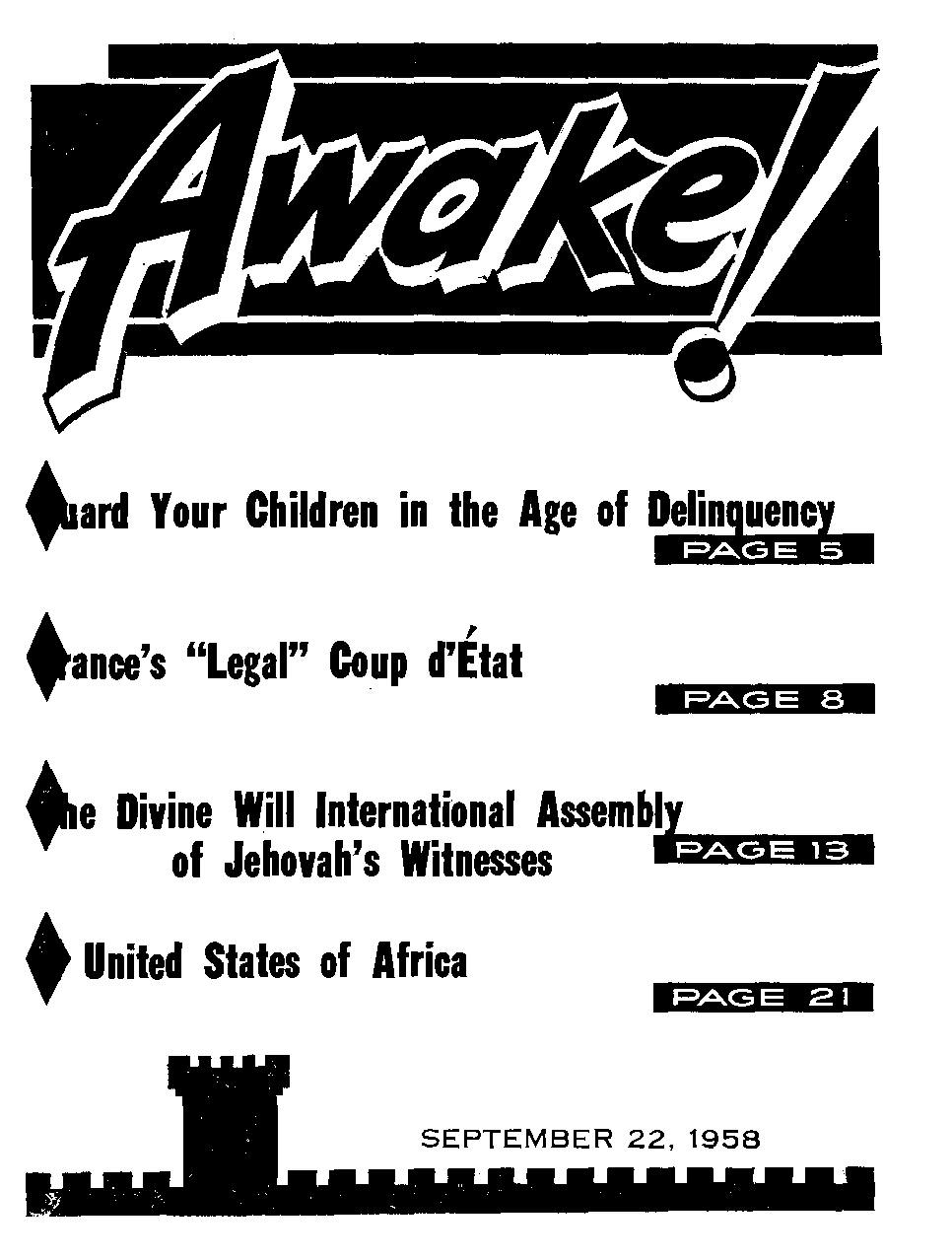
ard Your Children in the Age of Delinquency
PAGE 5
Rance’s “Legal” Coup d’Etat
4he Divine Will International Assembly of Jehovah’s Witnesses ®
PAGE 13
United States of Africa
THE MISSION OF THIS JOURNAL
News source* that are able to keep you awake to the vital Issue* of our times must be unfettered by censorship and selfish interests. "Awake!" has no fetters. It recognizes facts, faces facts, is free to publish fact*. It Is not bound by political ambition* or obligations; it is unhampered by advertiser* whose toes must not be trodden on; it is unpre|udlced by traditional creed*. This journal keep* itself free that it may speak freely to you. But it does not abuse its freedom. It maintains integrity to truth.
“AwakeI” use* the regular new* channels, but is not dependent on them, its own correspondent* ore on all continents, in scares of nations. From the four corners of the earth their uncensored, on-the-scenes reports come to you through these columns. This journal's viewpoint is not narrow, but is international. It is read in many nations, in many languages, by persons of all oges. Through its pages many fields of knowledge pass In review—government, commerce, religion, history, geography, science, social conditions, natural wonders—why, its coverage is as broad as the earth and os high os the heavens.
"Awake!" pledges itself to righteous principles, to exposing hidden foes and subtle dangers, to championing freedom for oil, to comforting mourners and strengthening those disheartened by the failures of a delinquent world, reflecting sure hope for the establishment of a righteous New World.
Get acquainted with "Awake!" Keep awake by reading "Awake!"
■ IM W H ■
PUBUSHBD SHMIMONTHLT EY
WATCHTOWER BIBLE AND TRACT SOCIETY OF NEW YORK, INC 117 Adams Street Brooklyn 1, N.Y.f U.S.A.
N. H. Knobs, Grant Suiter, Secretary
Printing this Issue: 2,800,000
Five cents a copy
“Awake!’1 It punished In the follwFnt 19 hnguagii: Semimonthly—Afrikaans, Danish, Dutch, English, Finnish, French, German, Greek, Italian, Japanese, NorweKlan, Portuguese, Spanish, Swedish, Tagalog.
Monthly—Cinyanja, Indonesian, Ukrainian, Zulu.
Yearly subscription rates Officii Tor nemimmthly editions
America, U.S., 117 Adams St, Brooklyn 1, N.Y. SI Antral la, 11 Bereirnnl Rd., strath field, N 8.W.
Canaria. 150 Bridgeland Are., Toronto Ont 51 England, 34 Craven Terrace, London W. 2
New Zealand, 621 New North Rd., Auckland B.W. 1
South Africa, Private Bag, ElamMcratain, Tri. 7/-Monthly editions coat half Uic above rata.
ReiHttanea* tor •ubscripUcma should bo sent to the oflta in your country. Otherwise send yuur remittance to Brooklyn. Notice of captation la sent at least two issues before subscription exjdm.
CHANGES OF ADDRESS rtoild roach » thirty days before yoer moving data. Ghl is yor aid and new iddrets (if poulkle, ycir eld arfireu latel>, Write Watohtrnr, 117 Adama Street, Brooklyn 1, New York. U.S.A.
Knteral « second'C-Uuta matter at Brooklyn, N. T. Printed In U.S.A.
The Bible translation ised in "Awake!” If the New Werl! Trimlrtlen ef the Hniy Stfirfi'M. When other tranilatlM, ire lied the followlnl ejmhoti wilt irdht behind th, cltltloni:
AS — American 8 Laniard Version AT — An American Translation AV ” Authorised Version (J611) Da — j, N. Darby's veralon
Dy *- C&thullc Dmiay teralon £D — Ite Emphatic Dlaglotl JP - Jewish Publication Soc. Le — Isaac Letter's Terrion
2tfO - James Moffatt's version
— J. B. Rotherham'n version
— Revised Standard Version yp - Robert Young’s version
CONTENTS
The Demagogue Has an Ax to Grind! 3 Guard Your Children in the
Age of Delinquency
Astronomy and the Bible
France's “Legal” Coup d’Stat
Salad Oil from Sunflowers
The Divine Will International Assembly
of Jehovah’s Witnesses
World Traveler Looks at Marriage
A United States of Africa
Secret Operations
“Your Word Is Truth”
Why a Thousand for Solomon and
Only One for Christians?
Jehovah’s Witnesses Preach in
All the Earth—Belgium
Watching the World
truant from school, as
little boys are sometimes wont to do. In his
wandering he met a man who needed help to grind an ax. This man flattered the little fellow so much that he gladly turned the grindstone while the man sharpened his ax. Turning that grindstone got very wearying and the lad got blisters on his hands; but because of the flattery he had received he continued turning the wheel until the ax had been fully sharpened. And then what did the little chap get for his pains? A stern rebuke for being a truant and a warning to be off to school! Ever since, the expression “having an ax to grind” has meant “having a secret or selfish purpose to serve.”
The demagogue is a politician with an ax to grind. It may be wealth, or power, or a messianic complex; but, whatever its nature, it is selfish. The word “demagogue” comes from two Greek roots meaning “people” and “leading.” Originally it had a favorable connotation, but today it has an invidious or repugnant one, being used to denote “one skilled in arousing the prejudices and passions of the populace by rhetoric, sensational charges, specious arguments, catchwords, cajolery, etc.; especially, a political speaker or leader who seeks thus to make capital of social discontent and incite the populace, usually in the name of some popular cause, in order to gain political influence or office.”—Webster’s New International Dictionary, Unabridged.
The demagogue understands human nature, but had no inborn or instinctive love of people. Like the man with the ax to grind, he considers them merely as tools or dupes whom he can use to serve his ends. His success highlights one of the greatest weaknesses of democracy, the fact that the majority that rules is easily swayed by appeals to passions, prejudices or love of selfish gain. Flattery, implied or expressed, is one of his most effective weapons. However, the people themselves must share the blame with the demagogue in that they allow selfishness to rob them of perspective. A demagogue is a leader of the people—leading them around by the nose—with their consent!
Some four centuries ago there lived an Italian politician by the name of Machia-veil!* He brazenly advocated the policy of deliberately making all morality subservient to political ends. The book in which he enunciated this philosopy, Il Principe (“The Prince”), might well be termed the Bible of demagogues.
Demagogues there had been, however, long before Machiavelli’s time. In fact, one of King David’s sons, Absalom, was one. Concerning him the Bible states that he stood by the gate when people came to his father the king with grievances and ‘kept stealing the hearts of the people’ by such expressions as: “Oh that I were appointed judge in the land, that to me every man might come that happens to have a legal case or judgment! Then I should certainly do justice to him.” Absalom’s making insurrection against his father King David and his defiling of his father’s concubines bear eloquent testimony to his ambition and lack of principle.—2 Sam. 15: 1-6.
And when we come to think of it, did not Satan start out as a demagogue? Did he not invent a grievance for Eve and then play on her passions for his own selfish purposes, to have others worship him and to show himself equal, if not superior, to his Creator? He most surely did, as the Scriptural record at Genesis, chapter three, Job, chapters one and two, Ezekiel, chapter twenty-eight, and Matthew, chapter four, all so clearly show.
Coming to modern times, there was Adolf Hitler, perhaps the greatest demagogue of all human history. He “showed his political gift by his correct appraisal of the masses whose passions and fears he raised to a fever pitch by his oratory against democracy, the Jews and foreign powers.” About the same time in the United States there was one Huey P. Long, a greedy politician who made “himself a Presidential possibility with his Share-the-Wealth platform promising $5,000 to every family,” and limiting the incomes of the rich. Still more recently there was the demagogue Joseph R. McCarthy. In his lust for power he irreparably harmed countless innocent persons. He played on the people’s fear of communism and vaunted his Catholicism—“seldom misses Sunday mass.”
At the present time there also are demagogues. They can be seen in almost every democracy. In the United States they include those whose only qualification is their Mormon or Catholic religion, a union card or their stand on the race issue: in the South, for segregation; in the North, for integration. Typical is one Adam Powell, Negro representative to Congress from New York’s Harlem section and Baptist clergyman. He is so rabid that even the National Association for the Advancement of Colored People has branded him as a racist. At present he is facing an indictment for tax evasion. Three of his secretaries have previously been indicted on various charges. As for his representing his constituents in Congress, Newsweek, June 2, 1958, states: “He has the worst record of absenteeism of any member of the house. . . . But he never lets slip an opportunity to assail discrimination against the Negro." As long as the race issue outweighs every other one, just so long will demagogue Powell represent Harlem in Congress, on the rare occasions that he is present.
So long as democracies remain, demagogues will come and go. Someday, however, there will come a better form of government for the peoples of earth, one under the direct supervision of Jehovah God, a theocracy. There will be no demagogues then, but until that time let all men of good will beware of the flattering demagogues who exploit grievances and appeal to passions and prejudices, because the demagogue has an ax to grind!
THE SPACE AGE BRINGS WITH IT NOT ONLY FEARS OF NUCLEAR HOLOCAUSTS AND RACE ANNIHILATION; IT ALSO BRINGS TO MANY FEARS AS TO THE FUTURE OF THEIR CHILDREN. YET CHILDREN MAY BE TRAINED FOB A BRIGHT AND WONDERFUL FUTURE.
By -‘AHAKE!" com in JAPAN
warned newsreporters: “Don’t ever wan-
elinquents Rounded Up by Police,
EVEN Out of Every Thousand Are Found to Be Delinquents,” “820 To-
“Teen-Agers Stage Sex Orgies,” “2 Boys, 5 and 6, Kill Eight-Month-Old Girl.” So ran some of the headlines in Tokyo newspapers. Once upon a time, crime used to be the exclusive field of adults, but now youth bids fair to outdo the most hardened of old-time criminals.
So serious has the situation become that reformatories for youthful delinquents are packed full. As reported by the Asahi Shimbun on April 18,1958, the Tokyo Medical Reformatory is crowded beyond capacity and hence it is easy to break out. The institution had just experienced its fourth breakout since January.
On one night alone Tokyo police rounded up 820 minors on charges ranging from loitering to theft and immoral conduct. More than half were high school students, and they included twenty-eight girls. The police committed thirteen minors whom they considered incorrigibles to juvenile consultation centers and sent the rest home after a reprimand and lecture.
Each summer the Shonan beaches become more notorious for the lawless packs of teen-agers that gamble and riot through the night and pick fights with bathers by day. The local superintendent of police der away from your escorting police officers. Anything could happen to you. No policeman ever patrols that area alone.”
With some, delinquency seems to start at a tender age. Take, for example, the two boys aged five and six of Kaseda City, Kagoshima prefecture, who lashed an eightmonth-old girl with a rope and dragged her to her death in a lonely ditch. The boys told the police it was all a prank.
In Explanation
Investigating the sharp rise in juvenile delinquency, Tokyo’s Metropolitan Education Board found that roughly 0.7 percent of school children between the ages of thirteen and fifteen are delinquent. The board blamed poor family environment for about one third of the cases, association with other delinquents for one quarter of the cases, and low IQ or physical defects for the remainder. Of 3,443 problem children, 2,640 were boys and 803 were girls. The board said there was no apparent connection between delinquency and the family’s wealth or poverty.
Judge Shinichiro Sato, deputy chief of the Tokyo Domestic Relations Court, has charged the increase in juvenile crime to the turbulent times in which present teenagers spent their childhood. He says that Japan’s defeat in the last war completely shattered the foundation of loyalties of the old Japan. The judge believes that one very serious weakness is the lack of a religious background. He cites Western democracy as having Christianity as its basis, whereas in Japan Buddhism has long lost its moral influence on the people, confining its function to funeral rites. Shintoism, he says, is too busy trying to regain the prestige it lost after the war, and its contact with the people is restricted to wedding ceremonies.
However, lands that claim Christianity as their religion are striving desperately with the same problem. London, a headquarters of Protestantism, can no longer claim the distinction of being the world’s most law-abiding city. In 1957 London reported a 14-percent increase in crime, and one quarter of those arrested were under twenty-one years of age. Religion is said to be reviving in New York city. And so is juvenile crime. New York’s 23,000-man police force has been ordered to wage all-out war on juvenile gangs, numbering at least 8,000 members.
A Chicago father, lamenting the murder of his six-year-old daughter, blamed the society that produced the murderer, rather than the murderer. Indeed, the society of so-called “Christian” countries appears to be as inadequate as that of Buddhist countries in meeting the threat of delinquency. There is something wrong with society world-wide.
The Tokyo Education Board has called for corrections in society. It mentioned the need for an atmosphere of warmth and affection for children at home, at school and within the community. Both the Education Board and Judge Sato spoke of the need for discipline. Actually, they were echoing what the Bible admonishes concerning love and discipline in the proper rearing of children. (Eph. 6:1-4) And this brings us to the crux of the whole matter: the need for a world-wide society based on proved Bible principles.
Bible prophecy shows accurately that present-day society is in the “last days” just preceding its destruction: “But know this, that in the last days critical times hard to deal with will be here. For men will be lovers of themselves,... disobedient to parents, without gratitude, with no loving-kindness, having no natural affection, . . . without self-control, fierce, without love of goodness.” The Bible also shows the underlying reason for this delinquency: “Woe for the earth and for the sea, because the Devil has come down to you, having great anger, knowing he has a short period of time.”—2 Tim. 3:1-5; Rev. 12:12.
There you have it! That powerful, invisible spirit, the Devil, is trying to lead all mankind into delinquency, and into destruction with him. Even apostate Christendom, preoccupied with nuclear bombs instead of God’s Word, has been swept into the whirlpool of delinquents. Is there a way of escape? There is! Just as “bad associations spoil useful habits,” so there is in the earth today a New World society that builds good associations and useful Bible habits among all its members. (1 Cor, 15:33) This New World society of Jehovah’s witnesses provides proper Bible instruction, acting as a bulwark against modern-day delinquency. Consider some of this instruction.
Jesus admonished: “You must love your neighbor as yourself.” (Matt. 22:39) And what closer neighbor do we have than our own children? How important that we give them an intimate place in our lives, and that we serve as their companions, friends and guides! The Bible counsels parents: “You must love Jehovah your God with all your heart and all your soul and all your vital force. And these words that I am commanding you today must prove to be on your heart, and you must inculcate them in your son and speak of them when you sit in your house and when you walk on the road and when you lie down and when you get up.*’ (Deut. 6:5-7) This means a life of companionship with one’s children, teaching them Bible principles at home from the tenderest age, taking them to assemblies and meetings of God’s people regularly, and in God’s service.
As part of this training, correction also is necessary. “Foolishness is tied up with the heart of a boy; the rod of discipline is what will remove it far from him.” A good spanking when called for, or the denying of some expected treat when he misbehaves, will bring home to the child’s heart respect for parental authority. It will discipline him in the right way, and “even when he grows old he will not turn aside from it.” “Do not hold back discipline from the mere boy. In case you beat him with the rod, he will not die.” (Prov. 22:15, 6; 23:13) Why, even mother bear gives her cub a resounding slap with her paw when he steps out of line I
The New World society of Jehovah’s witnesses is a happy family of more than 700,000 members, in all nations, all of them brothers, having love and warm affection Cor one another. Parents and children whn walk in association with this society find a sure protection against the delinquencies of the old-world society. Moreover, when Jehovah God, through Christ Jesus, shortly destroys the delinquent old-world society, those of the New World society, together with their obedient children, will survive into God’s new world, which will clothe earth with peace, joy and everlasting blessings. No delinquents in that new world, Cor everything that breathes will praise Jehovah God!—1 John 2:17; Isa. 11:9; Ps. 150:6.
uW/ionomy and tfte
ft Writing in Modem Science and Christian Faith, Peter W. Stoner, chairman of the department of mathematics and astronomy, Pasadena City College, California, says: “If Genesis is only a book of human origin and its allusions to astronomy reflect the knowledge extant at the time of writing, we would expect it to be full of gross scientific errors. ... A careful study of the fact and well-established hypotheses of astronomy reveals a striking consistency with the outline of origins found in the first chapter of Genesis. This agreement has not always existed. In fact, thirty-five years ago astronomy and the account of creation as recorded in the first chapter of Genesis differed in many points. . . . But year after year advances were made in science which resulted in an improved agreement between Genesis and astronomy. Within the past generation not a single instance is known where astronomy that has once agreed with Genesis has later reversed Itself so as to disagree....
ft “Although Genesis was written thousands of years ago, every reference to astronomy in this first chapter is corroborated by the best of our present scientific information. And yet we note that books of astronomy, written 25 years ago or more, are full of serious errors and anything written more than a few hundred years ago would be suitable only for the entertainment of the reader. It obviously would have been impossible thousands of years ago for men to have possessed all the scientific knowledge which was required to write this first chapter of Genesis.
Only the builder of a house can. tell with complete accuracy the details of its hidden construction. Only the Creator of the universe, the earth, and the life upon It could have told thousands of years ago the nature and process of that creation.”
‘’Stance’s "LEGAL" Coupd'Etat
BY AWAKE!" CORRESPONDENT IN FRANCE
44*Ti HERE are forc-1 e s at work
among the French people that reveal deep discontent. VZ faut que <;a change!1 (‘There must be a change!’) is an expression to be found on the lips of many Frenchmen of all classes. . . . With such movements [communism and Poujad-ism] afoot, anything could happen.” So said Awake! in its issue of April 8, 1956.
On May 13,1958, something did happen. Let me explain.
Ferment in General Assembly
For the nineteenth time since the start of the Fourth Republic in 1947, France was without a government. Premier Felix Gaillard had resigned on April 16, after being defeated the previous night in the National Assembly by 321 votes to 255. It followed a debate that saw the strange spectacle of the Right trying to outdo the Communists in criticizing American policy, and finally joining with them to bring down the government.
The issue was the future of French troops stationed in Tunisia. This question had come to a head with the French bombing of a Tunisian frontier village that had obviously been used as a haven for Algerian nationalist guerrilla fighters. (The Tunisian government had made no secret of its support of the Algerian independence movement.) The question had been brought before the U.N. Security Council by both the Tunisian and French governments. The latter had agreed to suspend discussion of the matter until an Anglo-American “good offices” mission had tried to find a basis for renewed contact between France and Tunisia. Such a basis had supposedly been found in the proposition that French troops be withdrawn from all their Tunisian bases, with the exception of Bi-zerte, and that the Tunisian-Algerian frontier be guarded, possibly by an international force similar to the one used intheMiddleEast. Anxious to preserve good relations with the Arabs, President Eisenhower had warned France that if she failed to reach agreement with Tunisia and the dispute came back to the U.N. Security Council, she should not count on United States support. This was regarded by the Communists as “intervention” in French affairs, and by the Right as an outright “injunction.” Gaullist deputy Jacques Soustelle cried out in the National Assembly: “Where is French policy decided? If in Washington, what are we doing here?” Prime Minister Gaillard called these extremist attitudes “xenophobia” (hatred of foreigners), but the big word did not save him. The debate that sealed his fate will go down as one of the most anti-American in French parliamentary history.
So France was once again without a government. Catholic Georges Bidault tried his hand at forming a new one, but got no farther than his own Popular Republican party, who refused to back him in his rigid Algerian policy. Next came Rene Pleven, member of a small left-of-center party, who asked for “full powers” for one year, but quit when the Socialists refused to sit in the same government with the right-wing Independents. President Coty asked him to try again, which he did, but this time the Radicals, a Center group, refused to go along with Pleven’s choice of a defense minister known to favor a “tough” Algerian policy. Coty then asked three different Radicals to try to end the crisis, but they refused. At last Pierre Pflimlin, a Catholic Popular Republican, agreed to try to form a government. However, his reputation of having liberal ideas on the future of Algeria brought him the opposition of the Independents and the Gaullist Social Republicans, so that there were some doubts as to whether he would receive the necessary majority in the National Assembly.
By now France had been without a government for four weeks. But, as the quarrelsome French deputies were soon to leam, events have an obstinate habit of continuing while politicians are fussing over this or that nicety of parliamentary intrigue.
Algerian Crisis Develops
The mere mention of the name Pflimlin of the M.R.P. (Popular Republicans) produced a wave of opposition among the Europeans in Algeria, including some elements of the French army. They could not forget that Catholic M.R.P. ministers (Georges Bidault and Robert Schuman) had conducted France’s foreign policy from 1944 to 1954, and that during this period the way was paved for the loss of Indochina, Morocco and Tunisia. Was Algeria to follow?
On May 12, the day before Pflimlin was due to seek investiture from the National Assembly in Paris, a tract printed by an association of “Patriotic Catholics” was widely distributed in Algiers, calling upon the Europeans to “write letters of protest to the priest of your parish, to the archbishop of your diocese or to any other re* ligious authority who may be able to efficiently combat the scandal of France being betrayed under the mask of religion.” (Le Monde, May 13, 1958) What a strange thing for Catholics to campaign against “brother” Catholics! Yet not so strange, really. When so-called Christians start meddling in politics, they are bound to get mixed up in its fights and brawls.
Seventeen patriotic associations, organized into a “Committee of Vigilance,” called upon the people of Algiers to go on strike at three o’clock in the afternoon of May 13 and to stage a mass meeting on the Plateau des Glieres to protest against the investiture of Pflimlin’s “government of abandonment.” The people were also Invited by veterans’ organizations to a rally three hours later at the war memorial as a demonstration against the killing by the F.L-N. (Algerian nationalist army) of three French soldiers who had been taken prisoner. The French army authorities were due to take part in this latter manifestation.
The long and costly war in Indochina had left the French army feeling frustrated, humiliated and very bitter toward, the Paris politicians, whose mess it felt the whole affair was. Still smarting from this, the anny was thrown into the explosive North African situation, only to be further humiliated by the politicians’ handling of the Tunisian, Moroccan and Suez crises. In this context, Algeria became an affaire d’honneur for the French army. And the thought of again being “doublecrossed” by Paris, whose governmental comings and goings did little to inspire confidence, led many French officers to adopt a defiant attitude toward the regime of the Fourth French Republic, In this they were joined by many of the 1,300,000 Europeans living in Algeria, many of whom were born there, and who feared that their abandonment by France would mean their being swallowed up by the 8,700,000 Moslems. Such, then, was the conjuncture that led to revolt.
The Algiers Revolt
At 7:15 p.m., on May 13, I switched on my radio and tuned in to France-I to listen to "Paris vous parte” the regular evening news feature program. I was curious to know if Pflimlin had managed to scrape together a majority in the National Assembly, or if France was still without a government. The speaker announced that the debate was still on and that the vote would probably not take place until late that night or early the following morning. Hie microphone was then switched over to Algiers for an on-the-spot report on the situation there. It was known that a protest strike against Pflimlin’s investiture had been called for and that mass demonstrations had been organized. How were things going across the Mediterranean?
The radio reporter in Algiers mentioned that the call for the general strike at 3 p.m. had been successful and that at 3:30 p.m. young demonstrators had ransacked the American Information Agency on the rue Michelet. The mass political meeting on the Plateau des Glieres had been put back to 5 p.m., just one hour before the military ceremony was due to take place at the war memorial. The speaker described what had taken place at the political rally. The only violence had been verbal, directed against the formation of the Pflimlin government.
But this rally had spilled across to the war memorial, where the military ceremony was due to take place. The microphone picked up the voice of the crowd, which now numbered several tens of thousands, singing the “Marseillaise” and acclaiming the military leaders who had just arrived. The commentator was silent while the bugle sounded out the French “Last Post.” Again the "Marseillaise” was sung and then, suddenly, the speaker broke in to say that something seemed to be happening at the top of the monumental stone staircase called the Forum, in front of the modem French Ministry for Algeria building.
In an amazed voice he said that students were using an army truck to batter down the gates of the ministry building, while the meager security forces on hand, after having thrown a few tear-gas bombs, seemed to look on powerlessly. He described how the students broke into the building and began to appear at the windows of the lower stories. His voice turned from amazement to disgust as he reported that the students seemed to occupy the whole building and were throwing documents, papers and files out of the windows, while the crowd below looked on with stupefaction. The radio commentator voiced the opinion that this was not a general riot but a very serious irresponsible action on the part of students, who would surely be punished by the competent authorities. However, as if doubting his own words, he added that the “student” who seemed to be leading the young rioters was wearing a military parachutist’s uniform!
Tilings were serious. The army took power in Algiers and proclaimed a Committee of Public Safety (a reference to the revolutionary committee that held the executive power in France from 1793 to 1795, under the National Convention). They called on Rene Coty, the French president, to permit the forming of a revolutionary government of public safety in Paris. Up to then no mention had been made of General de Gaulle.
Back in Paris
In Paris—you guessed it—the French deputies at the National Assembly were still squabbling, and continued to do so until 1:15 a.m. the following morning. At that early (or late) hour, seven deputies still had some oratorical fiddling to do while Algeria burned! Prime minister-designate Pflimlin had had enough. Warning the deputies that the nation was on the brink of civil war, he called upon them to act with responsibility. “France must have a government within the next few hours!" he said. By 3:20 that morning it had one. Pflimlin had been made prime minister by 274 votes to 129, the Communists abstaining. The right-wing Poujadists, Independents and Gaullist Social Republicans voted against him, and so did a few rightist Radicals.
The investiture of Pflimlin seemed to take the Algerian Committee of Public Safety by complete surprise. On Wednesday evening, May 14, I listened to “Paris vous parle” which featured the last “normal” broadcast report from Algiers before Radio-Alger was taken over by the army. One of the reporters stated that the leaders of the revolt were “hesitant now that the second phase of the operation has failed in Paris. After learning that Pflimlin had been invested, several colonels left the room where they were deliberating, shouting, ‘We’re sunk!’ ”
It is a matter of speculation as to what would have happened if the “second phase” (the defeat of Pflimlin In the National Assembly) had not failed. Many commentators do not hesitate to claim that the power vacancy in Paris would have opened the way for an out-and-out military coup d’etat. France’s big weekly news-picture magazine, Paris-Match, stated in its issue of June 14: “It is an open secret that the parachutists were just a hair’s-breadth from landing in France," Explaining in the June issue of La Nef why he, an Independent, had voted for Pflimlin, Paul Reynaud spoke of the possibility of a coup de main in Paris by parachutists from Algeria. And according to Le Monde of June 10, Ex-President Vincent Auriol expressed the same fear in an interview with the widely read English weekly News of the World.
But whether these fears were justified or not, one significant fact is clear from all the press reports, namely, that the leaders of the Algiers coup began mentioning General de Gaulle only after they had learned that Pflimlin had not been defeated in the National Assembly. Would they have called upon him, and under what conditions, if their “second phase” had succeeded? That will probably become one of those burning questions in French history, like “What would have happened if Napoleon had not lost the battle of Waterloo?”
De Gaulle Makes a Comeback
At any rate, after twenty-four hours of anxiety, the colonels who thought they were “sunk” were floating again, either on the same boat or on a different one. For on the afternoon of Thursday, May 15, General de Gaulle issued his historic statement: “I am ready to assume the powers of the Republic.” From then on, whatever had been the previous intentions of the Algiers revolt, it now became the spearhead of the campaign for a return to power of De Gaulle.
During the days that followed, committees of public safety sprang up all over Algeria, and even in France itself. On Saturday, May 24, the Algiers revolt spread to Corsica, where the parachutists took over, unresisted by the Paris governments security forces. If he had doubted it before, Pflimlin now knew for certain that he could count for support neither on the security troops nor on the army. Four days later he resigned. The day of his resignation, tens of thousands of people marched
down a Paris boulevard with banners carrying the slogan “Vive la Rtyubliquc!”
The following day President Coty declared in a message to the National Assembly: “We are now on the brink of civil war. . . . With the homeland and the Republic in peril, I have turned towards the most illustrious of Frenchmen.’' Three days later General de Gaulle came into power. The National Assembly, by 329 votes to 224, gave him full powers for six months and authority to organize a national referendum on constitutional reforms. If it was a coup d’etat, at least it had the originality of being a “legal" one!
What now? At this juncture it is difficult to tell. The French language contains no exact equivalent of the expression “wait and see.” Pity! Because if it existed, probably millions of Frenchmen would be using it right now!
Salad Oil from Sunflowers
By “A*ak«!” coire*pond«ni in Canada
I HE sunflower is a native of the Americas, it growing wild in the Great Plains region of the middle west of the United States. It is the state flower of Kansas, and in times past the American Indian used it as a food. It was transplanted to European lands in the Sixteenth century and brought back to the Americas as a cultivated plant in the nineteenth century. It Ib well named, for when in full bloom its bright yellow flowers, some aa much as a foot in diameter, do suggest the radiant sun.
'j? For many years the sunflower served in the United States mostly as chicken feed or as 8 decorative plant, its height ranging from three to fifteen feet or more, well serving to hide old fences or other unsightly spots on American farms, as well as serving as a windbreak. Some use its leaves for fodder, others make a yellow dye from its flowers and more and more the seeds serve as a confection to be nibbled at, either plain, salted or sweetened.
*j,’ Though Russia long led in the commercial production of the sunflower, her lead in recent years is being narrowed by its great increase in other lands. Making particularly rapid strides in this regard are Some of the Latin-American lands, such as Argentina, Chile and Paraguay, And among the countries that have more recently turned to the production of sunflower seed, and that for the purpose of oil, is Canada.
Primarily it was the demand for oil during World War II that started the Canadian farmer to cultivate, among other oil-bearing seeds, the sunflower. This has resulted in the building of ever-larger special refineries, so that now the sunflower has become one of the leading annual crops of the southern portion of the province of Manitoba. Its black fertile fields are peculiarly suited to producing large quantities of sunflower seed. The farmer delivers his threshed seed to the elevator, after which the seeds are cleaned, dried, hulled and cooked to extract the oil.
The oil is processed and refined so that it is free from all impurities and is colorless and tasteless. Being easily digested, it is ideal for both cooking and trying. And in that it can be heated to higher temperatures than most oils or fats without smoking or burning, it is preferred for deep-fat frying. In the Canadian market it is considered superior to both soybean and cottonseed oil.
Canadians also make good use of two byproducts of sunflower oil. Sunflower meal serves as a very valuable livestock feed. In fact, some claim that it is a protein food of such high quality that it should be used only for human consumption. And from the hulls Canadian scientists have perfected a specialty fuel in the form of logs four inches in diameter, 12i inches long and weighing about 7i pounds. Made by very high compression, these are clean to handle, have far less ash and produce more heat than either coal or lignite, a peatlike brown coal.
■$? Thus the common lowly sunflower not only supplies man’s basic need for fat but also feeds his cattle and helps to keep him warm in the winter or to cook his meals!
fj
INTERNATIONAL ASSEMBLY
JEHOVAH’S TCHESSEj
N THE greatest outpouring of humanity ever recorded here for a single meeting, a turnout that exceeded their expectations b y some 50,000—a record of 253,922 Jehovah’s witnesses yesterday jam-packed Yankee Stadium, the Polo Grounds and areas adjoining both ball parks for the final session of their eight-day Divine Will International Assembly.” Thus the New York Daily News, August 4, 1958, began its report on public lecture “God’s Kingdom Rules —Is the World’s End Near?” given by N. H. Knorr, president of the Watch Tower Society, August 3, at 3 p.m.
What did that assembled throng hear? In a manner that was clear and forceful was presented the good news that “only the best government in the universe is good enough for this earth.” "Oh, therefore, let all men of good will turn now to God for earth’s government!” Knorr appealed.
That public lecture was indeed a fitting climax to the eight-day Divine Will assembly for which New York’s two largest ball parks had been procured and transformed into mammoth Kingdom Halls. In each the 1958 yeartext of Jehovah’s witnesses, “As for me, in my integrity I shall walk,” was prominently displayed, and each had a beautiful canopied speaker’s platform in the center of colorful flower gardens.
Yankee Stadium had been signed up back in September, 1956. However, in view of previous assemblies it was certain that more space would be needed. But where could it be found? True, the Polo Grounds was close by, but baseball schedules were so arranged that either one or the other ball park was being used. Then late in 1957 the team using the Polo Grounds was transferred to San Francisco, and so for the first time it was possible to have the use of both ball parks at the same time!
Tremendous advance preparations had to be made for feeding, housing and otherwise caring for the large crowd that was expected; not to say anything of the preparing and the printing of literature to be used and released at the convention and the work involved in the preparation of talks and demonstrations that were to be given. Spacious accommodations for preconvention activity were had at the new Watchtower building at 77 Sands Street.
In all, 123 lands were represented. Well over 100,000 came from the United States and upward of 15,000 from Canada. Some five thousand came from Europe and hundreds from each of the other continents. The majority came by private auto; many came by special buses and trains. Sixty-five chartered planes and two chartered ships brought still others.
The Convention Program
The Divine Will assembly resulted in a great witness to Jehovah’s name and kingdom, and it served to give God’s people a better understanding and appreciation of the divine will for them. It certainly accomplished its purpose.
Close to a hundred hours of Bible lectures, demonstrations and reports from missionaries and others from many parts of the world were given. With but few exceptions everything was presented twice, once at each stadium. During the four forenoons that were set apart for field ministry, programs were presented at New Rockland Palace for the instruction of those serving in special capacities, such as branch servants, missionaries, special pioneers, public relations servants, etc. During these same forenoons sixty-four programs of upward of two hours each were presented in twenty different languages. For the benefit of the deaf the programs were translated into sign language.
Outstanding Features
While the entire program was filled with highly interesting and informative material, some features were more outstanding. Among such must be listed the eleven times that N. H. Knorr, president, and the six times that F. W. Franz, vice-president, spoke to the entire assembly. The very first day had an outstanding feature, the graduation of the thirty-first class of Gilead. Its 103 students had come from sixty-four different lands. The graduation program included farewell counsel by the instructors of Gilead School, by the servant in charge of Kingdom Farm and by Franz and Knorr, the latter giving an extended talk on the subject “Stay by These Things,” based on 1 Timothy 4:16. After that the diplomas were handed out.
In the evening of the first day the entire program was presented by these students. In addition to presenting many different scenes illustrating life at Gilead School, interesting experiences were related. A number of students were dressed in their native costumes, helping to make the program as colorful as it was interesting and profitable.
Of particular interest also was the stirring keynote speech delivered on Monday by the president, entitled “Signs and Wonders in the Time of the End.” Based on Isaiah 8:18, it told how among the signs and wonders of our day are Jesus Christ and his anointed followers on earth. Yes, and even this very assembly was a “wonder.”
Highlighting the educational program of Jehovah’s witnesses among illiterate peo-pie was Knorr’s talk on Tuesday, at the end of which he released the Spanish booklet Learn to Read and Write. Such a reading aid had already been produced for African witnesses, and others are to follow so that all witnesses of Jehovah will be able to read and write.
Outstanding on Wednesday, first of all, was the immersion. After the talk on baptism 7,136 gave public expression of having dedicated themselves to do Jehovah’s will. In the afternoon N. H. Knorr spoke on “Down with the Old—Up with the New!” in which he emphasized that the United Nations would fail even as did its predecessor, but the new world will be set up and men of good will are going to survive into it. At its dose he released Volume IV of the New World Translation of the Hebrew Scriptures, containing the books of Isaiah, Jeremiah and Lamentations.
The release of another new publication, From Paradise Lost to Paradise Regained, proved to be the outstanding feature of Thursday's program. This most beautiful Bible-study aid is printed in large type, is profusely illustrated, and is in simple language for the benefit of those unfamiliar with Bible truth.
Two other program features yet deserve particular mention. One of these was the calk by N. H. Knorr “Let Your Will Come to Pass,” at the end of which he released the Bible-study aid "Your WiU Be Done on Earth". The other was the closing talk by Knorr Sunday afternoon. He began by briefly reviewing the things learned and received during the past eight days. He touched on the progress of the work world-wide, and then told of plans for expansion. Current building plans include new headquarters offices for Germany, England and France, and an addition to the Bethel home to house the workers at Brooklyn, and also an educational center where full-time ministers will be invited for a ten-month training course. Further, it is planned to bring in the overseers of the various congregations for an intensive one-month training course at Gilead Bible School and large branch offices.
The Resolution
Without doubt one of the most thrilling features of the entire eight days was the occasion of the adopting of the Resolution on Friday afternoon, by 194,418 witnesses of Jehovah- In it they resolved faithfulness to Jehovah and separateness from the world down to the end of this old system of things.
Leading up to this was the talk by F. W. Franz on “Why This Convention Should Resolve.” Therein he exposed as false shepherds the faithless, compromising clergy of Christendom. Leading to his climax he described the present assembly as “a supreme occasion to make a united statement of how we stand toward the world situation; what our enlightened understanding of God’s will is and what our united purpose is for the future in discharging our God-given commission.”
The Resolution, as read by N. H. Knorr, “resolved that . . . we deplore the fact that the inspired written Word of the Universal Sovereign is ignored, . , , That, in love for his human creation, Jehovah God has willed ... a righteous new world . . . That in the year 1914 he installed his loyal Son, the glorified Jesus Christ, to be King in the heavens and destroy all the enemies of God and man, . . . That, since A.D. 1914, the evidences have continued to multiply in proof that God’s kingdom now reigns from the heavens, . . . THAT the nations are now on judgment before Jehovah God the Supreme Judge,... That, figuratively speaking, we have beaten our swords into plowshares . . . and, although of so many nationalities, we will not lift
-against one aubthi&r, because we .• • are Christian brothers, . . . We will continue to obey God rathef than men,.... so that we rpay be accounted worthy of being Ushered into God’s everlasting new world after Armageddon, there ... to do his will forever and ever.” The unanimous adoption of this Resolution was marked by thunderous applause.
Underscoring the unique position of Jehovah’s witnesses, as noted in the Resolution, was the report given on “Behind the Iron Curtain” by A. Rutimann of Switzerland. He told of the steady increase taking place in Iron Curtain countries and read interesting reports from Hungary, Czechoslovakia, Poland and Russia. Particularly in Poland is the work of the witnesses increasing, that country ranking third in number of witnesses, being exceeded only by the United States and West Germany.
Indicative of theof interest tort-1)
found in Poland, one witness found in one apartment, house of eighteen apartments all eighteen families wanting to have home Bible studies, .More than that, they themselves suggested coming together in six. groups of three families each so as to lighten the burden of the witness. And most; surprising was a tape recording of some songs and of a message of love from witnesses in Russia, where the work is banned, which had been brought out under extreme difficulty and risk of loss of liberty.
Coneention Departments
In spite of Its size the. Divine Will assembly functioned smoothly. Its organization consisted of twenty-four departments staffed by some 40,000 volunteer workers. The rooming department began functioning three months before the assembly be-
(.Wetertft™-tt was operated by volunteer workers
gan and continued until the last day. The attendant department required thousands of attendants or ushers, who also aided in taking the count for each session.
There were departments for supplying literature, Bibles, etc., for directing the field ministry. Providing for physical comforts were the refreshment department, which had stands in all parts of both stadiums, and the cafeteria department, which served hundreds of thousands of meals at nominal cost and in record time, (All fulltime ministers received their meals free.) Then for emergencies, minor injuries and suchlike there was a large first-aid department well staffed by various types of physicians and trained nurses. Among the hard workers were also those serving in the installation, trucking and cleaning departments.
Some five hundred horns were among the equipment used by the public-address department. The public relations department kept newspapers posted and arranged for a number of radio and TV programs.
Convention Facets,
So as to be able to come some witnesses scrimped and saved for five years; others worked overtime or sold possessions. Some, from England, France, Colombia, Nicaragua and the Virgin Islands, sold their homes or other real estate so as to have the means to come. '
Some came even though there had just been a death in the family; even though the birth of a child was expected! They came though blind, on crutches and in wheel chairs.
Especially happy was Peter Vanderhae-gen, missionary in Indonesia. He kept hoping, even though the current revolution had isolated him on the island of Sulawesi for six months just prior to the assembly. Then a sudden landing of government forces changed things. Being able to persuade government officials of his neutrality and his urgent need to attend this assembly, he was provided with free boat passage to the nearest airport for his 14,500-mile trip to the assembly. Though four days late, Peter felt that even just half of such a convention was worth it all!
What Others Thought
When their boat stopped at the Fiji Islands the 212 witnesses aboard were met by five busloads of Fijian witnesses who treated them to a buffet dinner. Their fellow passengers could not understand it ‘You never saw those people before? You mean that just because you belong to the same religion makes you so close to them?”
A certain bus driver had been taking a load of witnesses to and from the assembly each day. One day another was taking his place, to whom he was heard to say: “You’ll have a day like you never had before. No grumbling, no shoving, , . . never saw anything like it before!”
And that was also the consensus of the press, which, on the whole, fairly reported on the assembly. Thus the New York Times, August 1, 1958, had, among other things, the following to say under the heading “Witnesses Styled City’s Best Guests”: “180,000 at World Assembly Win Praise for Courtesy, Quietude and Neatness. New York has been host for the last six days to its biggest and in all likelihood its best-behaved convention.... Whatever New Yorkers may think of the Witnesses’ theology, they are unanimous in agreeing that the Witnesses’ conduct has been exemplary. , . . Royal Ryan, executive vice president of the New York Convention and Visitors Bureau termed the witnesses ‘an asset to the community.’ He described their behavior as ‘out of this world.’ ”
For a detailed report on this assembly see the 1958 Report of the Divine WiU International Assembly of Jehovah’s Witnesses, consisting of 128 pages.
8S6Z
Thirty-tai Graduating Class of the Watchtower Bible School of Gifeai
Left to right: Front rows Hani.f0praa.otcx ML, Mathew, S.., SinnanlUal, CL, Seki,. F,, Ogawa* K.., Nir., Y.r Ramires. G„ JLiaa®, ML, Velaw* duea, C.X, Ralte, J,. Second row: Procter, L,, Noll, 8., Ahmi, T., Barrena,, M'..f Lee, SL, Kwrossii, J&, Law, L, WHk«, G., Fayad, M, VJeddah, G-., Nantah, B., Tiainen, E, Third raw: Franssone, A., Van ®jK, M., Parsons, J'.,. Small, St, Samayoa. A*. William®, F., .Wepeh-er, P,, Dute.Bg, S.., Voungw, M., Mendoza, M-, Dower. J,, Ayinta, A,, Kawhe, I. Fourth row; Chantraboon, B*, Mumby, R., Ng, IX,' Camp* M bell, »., Ibarra, C„ Itty, A., Raunholm, u.. Acarah, D., De Leon, &, Heatley, L,, McLwekle, I., Liang, F.-, Letonja, H; Fifth rows AktoemL A.,, Joly, A., Kobrosssi, F., Samuelsen, T,, Cnttte, A., Damaa. L,, Abraham,- H,, Souaa, J,., FaJllco, M., Dower, L.., Miller, J., Gorden, E., Caati-gKoni, I. Sixth raws Gavino, P,, Small, A., DarviXle, B;, Mensah, J„ Heiberg, L., Lamb, W., Salango. F., Morales, R,f Snow, F,, Beldamme, A,, Gohl, O..h Wuttke, .ft., Kealoha, It., Sanchez, R. Seventh row: Judge, B,t Campbell, 1’., Jones, C.., Hardjopranoto, F, Hm1», N„ Boyle, X, jotane* son, S,8 HMH, C.e Noll, X, Letonja, A., Gumbo, KamaA, 'T., Wihtame, A... Kron void, B. El^feth rows Ibbott, X, lAUktanen,. H.. BichaM« son, IS., Peel, IK, Zbyhit, ML, Mtsmby, J.., Teunisiwn, C„ Woiclwhowski., IX,. Graicben, H..(, Tfainen, M,« Fiayad, A., xomtga, B..., Fstjlkum,-K.( Seddon, G.
' J... ... . . ... . iV '■ . ■■. ■ ■■■■
WORLD traveler Hendrik de Leeuw recently made an examination of unhappy marriages and of the dominant role that luaiiy women have arrogated to themselves in many households. In his hook Woman: The Dominant Sex, he says: “No other country in the world has such a large percentage of unsatisfactory family relationships as the United States/’ In pinpointing the reasons for this he cites as most significant the fact that “the average American family concerns itself more with trying to accumulate, or grab more, but less with any improvement in its spiritual existence.”
■ Traveler De Leeuw finds that the great amount of worldly education often given to women in America has not been such a blessing after all. He points to Pearl Buck's famous statement: “The root of the discontent in American women Is that they are too well educated. They do not need college education. . » . The present higher education is unfortunate. It has led American women into having ideas which they can never realize when they come to maturity/’
Success in marriage, says the writertraveler, depends largely on a man’s marrying with the right attitude: "There is one especial condition that makes for increased happiness in marriage and that is when there is no chance of having sexual relations with any other woman than one's own wife.”
As to woman’s dominant role in many households, traveler De Leeuw puts the blame squarely on the husband who “has abdicated his position in the family in favor of a domineering matriarch.” The result has been disastrous for happiness: “Never before in American history has our land possessed such a high percentage of cowed males who, as one well-known authority expressed it, 'endure their lives in mute docility and die mercilessly with ulcers and high blood pressure/ ” The husband’s failure to fulfill his role, he writes, “not only must be blamed for the growth of America’s matriarchate but for the unsatisfactory relations existing between woman and man.”
However, writer De Leeuw does not absolve women of all the blame, for he finds it truly significant that marriages of Ameri-
can men with foreign women have been unusually successful.
Speaking of French women as an example, he says: “In spite of having won equal rights with men for their sex, French women never forget that they are females, and feminine first and human afterwards/* This contrasts, he says, with the attitude of many American women, “who feel that just because they are women, they should be treated by men as something special, and on a pedestal at that"
In Britain the traveler-writer finds marital relations generally more successful than in America and that "people over there do not make such a fuss over, or fetish of, a Miss This or That, nor shower such almost hysterical adulation on their lovelies as we are wont to do over here. By the same token our Ameri* can girls , . , are often treated like the Belles of the Ball, and have to be assured and reassured how wonderful they are, whereas the average British girl is not that spoiled/’
Contrasting foreign women with American women, he feels he has found a most significant factor in the more materialistic attitude of the latter. It seems, he says, “that American women are too much obsessed by externals, as if the only way to hold on to their sweethearts, boy friends and husbands is through looks, hairdo, facial make-up, and other feminine artifices.” But again men are largely to blame, for through the commercialism and advertisers they have ins tilled this concept into the women.
“It cannot be stressed too strongly/’ traveler De Leeuw concludes, "that the British hubby is still being regarded as the head of the household—as it should be in well-regulated families. . . . The rank and file American husband, on the other hand, clams up on the slightest provocation, while their bossy wives not only do most of the powwowing but in a great many cases Insist in doing their husbands’ thinking as well. To repeat, the British father ... is still the head of the British household, and his home is still his castle, a fact the English wife does not fail to tell him often. In America, it is no exaggeration to say, it is man’s or the husband’s fault that his castle is run by women, and that Mom, more often than not, wears the armor plate and the pants.”
AWAKE!
OROCCO, Liberia, Ghana, Tunisia, Arab Republic, Sudan, Ethiopia and Libya have this message for the world: “Hands off Africa! Africa must be free!” This historic move toward a United States of Africa was expressed at an eightday conference of leaders from these independent African states met in Ghana’s Parliament House on the west coast of this vast continent.
The aim of this first Pan-African Conference to be held on African soil, as stated by Ghana’s prime minister, Dr. Kwame Nkrumah, is that of ‘forging closer links of friendship, brotherhood, co-operation and solidarity within and, in promoting our foreign relations, endeavoring to seek the friendship of all and enmity of none.’
Initial Spark
England’s Lord Chief Justice Mansfield in the Somerset case back in 1772 struck the spark that set off the black national movement when he said: “As soon as any slave sets his toot on English ground he becomes free.” With so many slaves freed in England it was only a few years later that the first national home for Negroes was established at Sierra Leone, considered a colonial asylum by most Africans. Fed by the abolition of slave trade and emancipation, Sierra Leone became the home of descendants of African slaves known as Creoles, and produced the first full-blooded African to act as chief justice in a British colony.
American colonization societies followed suit with an aim to create an independent sovereign state of Negroes on the African continent and succeeded in establishing four main settlements along the Liberian coast. July 26,1847, twelve representatives of three settlements gathered in convention at Monrovia and signed a Declaration of Independence under their flag bearing “The Lone Star.” Taking advantage of American aid, this first independent black republic in Africa surpassed the Creoles in the art of self-government and made big strides in development during the years of World War II when Liberia’s President Tubman made use of the revenue from export duty on rubber shipped to the United States. At that time Roberts Field Airport was established as well as a seaplane base. Roads for military purposes were built and a postal and telecommunications system was developed. The Firestone Company contributes some 25 percent of its gross profits to Liberia and recently the Christie Liberia Mining Company agreed to share profits on a 50-50 basis.
Whispers from Afar
“Africa for the Africans at home and abroad” was the slogan of a more definite movement inaugurated irf America in the 1920's by a Jamaican, M. A. Garvey. But Garvey’s “Black Zionism” campaign took on a dangerous, fanatical racial character aimed at promoting a spirit of pride in building a Negro kingdom of pure blacks. Booker T. Washington, famous American Negro writer and educator, said: “In all things purely social we can be as separate as the five fingers, and yet one as the hand in all things essential to material progress.” Dr. W. E. B. DuBois, Afro-American scholar, considered this idea a “tame submission” though he was against Garvey’s plan of transporting American Negroes to Africa. DuBois took a middle position in advocating self-government for Africans in Africa along a path of nonviolent, positive action. And here lies the real foundation for Pan-Africanism, which today aims at a federation of self-governing states on a regional basis, leading ultimately to the creation of a United States of Africa.
In the face of the power and guns of Europe and America it was Dr. DuBois’ hope to sit down hand in hand with colored groups and across the council table to learn of each other, our conditions, our aspirations, our chance for concerted thought and action, that “out of this there might come not race war and opposition, but broader co-operation with the white rulers of the world, and a chance for peaceful and accelerated development of black folk.” The feeling on the part of the African is that he has been molded and influenced by his race, color, economic and social position to such an extent that oppression has become a tradition, his culture, and that “the Negro’s fundamental loyalty is, therefore, to himself.”
…