Awake!, September 22, 1957
Download: PDF — Awake!, September 22, 1957
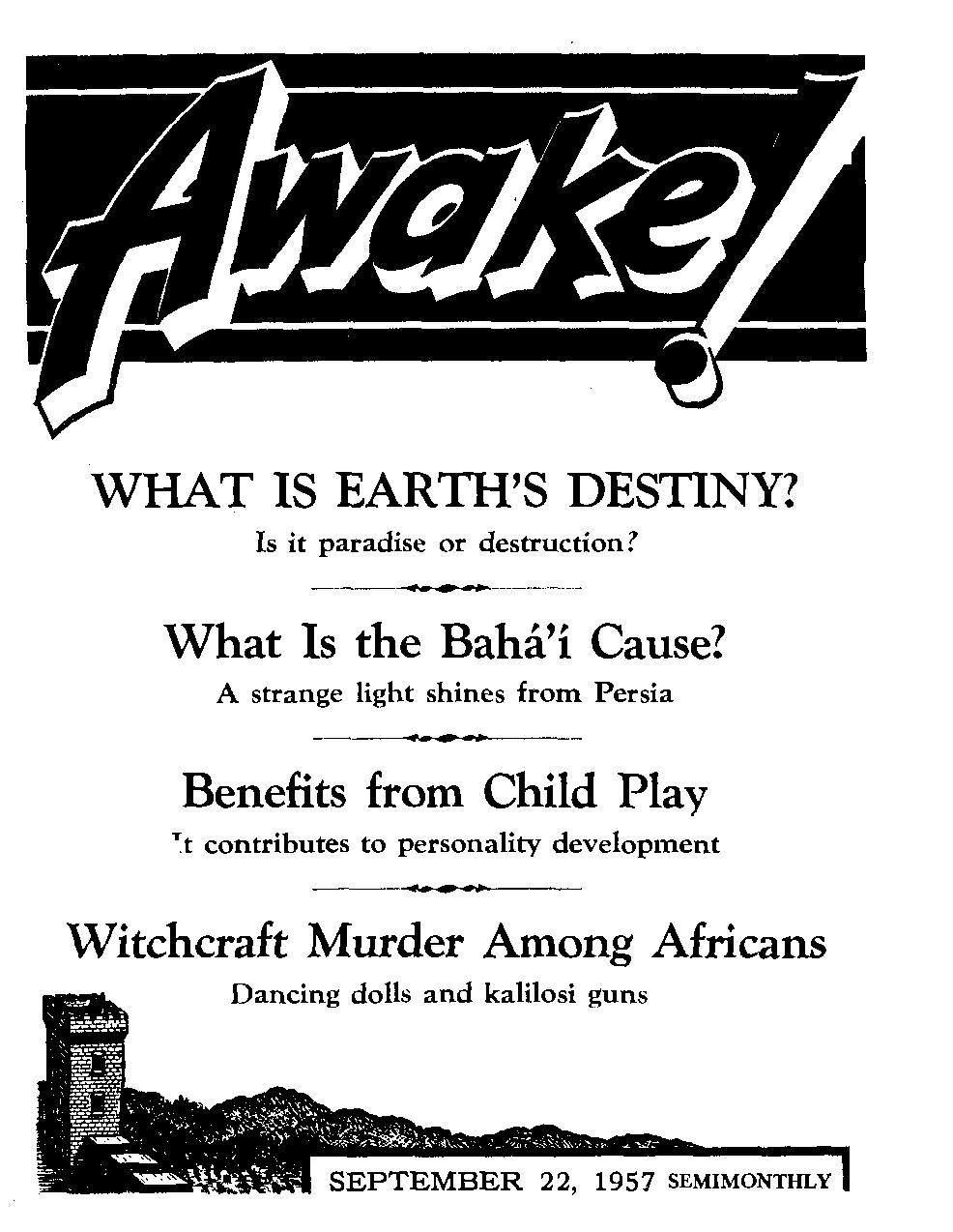
WHAT IS EARTH’S DESTINY?
Is it paradise or destruction?
What Is the Baha’i Cause?
A strange light shines from Persia
Benefits from Child Play
Tt contributes to personality development
- — ' ■—
Witchcraft Murder Among Africans
Dancing dolls and kalilosi guns
SEPTEMBER 22, 1957 semimonthly
THE MISSION OF THIS JOURNAL
News sources that are able to keep you awake to the vital Issues of our times must be unfettered by censorship and selfish interests. “Awake I” has no fetters. It recognizes facts, faces facts, Is free to publish facts. It is not bound by political ambitions or obligations; it is unhampered by advertisers whose toes must not be trodden on; It Is unprejudiced by traditional creeds. This journal keeps itself free that it may speak freely to you. But it does not abuse its freedom. It maintains integrity to truth.
"Awake!” uses the regular news channels, but Is not dependent on them. Its own correspondents are on all continents, in scores of nations. From the four corners of the earth their uncensored, on-the-scenes reports come to you through these columns. This journal's viewpoint is not narrow, but is international. It is read in many nations, in many languages, by persons of all ages. Through its pages many fields o£ knowledge pass in review—government, commerce, religion, history, geography, science, social conditions, natural wonders—why, its coverage is as broad as the earth and as high as the heavens.
"Awake!” pledges itself to righteous principles, to exposing hidden foes and subtle dangers, to championing freedom for all, to comforting mourners and strengthening those disheartened by the failures of a delinquent world, reflecting sure hope for the establishment of a righteous New World.
Get acquainted with “Awake!” Keep awake by reading "AwakeI”
Published Semimonthly By WATCHTOWER BIBLE AND TRACT SOCIETY OF NEW YORK, INC. 117 Adams Street, Brooklyn 1, New York, U. S. A.
N. H. Knorr. President Grant Stitkr, Secretary
Printino thi* issue: 2,450,000
Othw liniMpsi in whlrt “AwiU!” |, piblhhtt: Semimonthly—Afrikaans, Finnish, French, German* <htek, Holiandieli, Iulian, NofwealiD, Spanish, ttiredlBh.
■tmthly—DanMb Indonesian, Japanese, Pnftufu&ae, Ukrainian.
Year!; pihscrtptl&n rate*
Oflcta fen' ttinlmonililF editions
U.S., 117 Adama St., Brooklyn 1, N.Y. $L Autralia, 11 Beresford Rd., StHlWld, N.S.W. &/-Caaiii, 150 BrldgtUnd Ave., Tcffunto 10, Ont 11 Englui* Crnran Terrace, Limdon, W. 2 7/-
New Zaaltnd, G.P.O. Bex 30, WelllncUra, C. 1 7/-Snth AfrlM, Private Baj, Elandrfonuto, Tvl. 7/'
Monthly edrtl«» net half the ib«a rate*.
Five cent* a copy
IhmHtftncA? should be unt to office In your evun-trr In compliance with regulaUoEK to guirsntee safe deliver; of money, Remlttanctfi are accepted at Brooklyn from countries where no office Is Incited, by InlemUoml money order only. Subsodptlon mtea in different cuunlriBS are hero st*Led in local currency, Not Im af ap|ratl«t (with renewal blank) is sent at least two Issues before subscript! un expires. Chaapo of nHrgit when sent to our office may be expected effective within one month. Bend your old as veil fia new addren.
Entered as second-elm matter st Brooklyn N.Y.. Printed in U.S.A.
CONTENTS
The Wonder of Growth
What Is the Bah&’i Cause?
What Is Earth’s Destiny?
Salesmanship at the Summit
The United States Fertile Soil for
A President Falls
Heathen Missionaries
The Way It Began
Goings On in Apedom
Church Drives Are Reaping More
Witchcraft Murder Among Africans
“Your Word Is Truth”
Bull Cures Rheumatism
Why Did Mary Die?
Benefits from Child Flay
Gilead Graduates Its 29th Class
The Public Mind
Do You Know?
Underground Giant Rocks Mexico
Watching the World
XX/VER three thousand years ago a seed no larger than a baby’s thumbnail fell to the ground. In the moist soil it germinated and sent forth a shoot. As cells continued to multiply the shoot became a young tree. Its bark thickened, its trunk grew sturdier, its top reached toward the sky. That tree today is a forest giant standing 272 feet tall with a trunk thirty-six feet in diameter and bark two feet thick.
How did this immense tree come from such a small seed? What was it that caused the cells in that seed to multiply? What force directed the process so that some cells formed the trunk, some the bark, others the branches, and still others the needles of this giant sequoia? Why did the cells group in such a way so as to make this tree different from a tree of another kind? What determines this difference, and how did that determining factor come to be? Science still seeks the answers.
naei of growth
Growth is a wonder that has perplexed mankind for ages. Men have watched it and marveled.
What is especially amazing is the pattern it follows. Seeds from each kind of tree always produce trees of the same kind. A redwood does not produce a eucalyptus, nor does an apple tree produce an orange tree. The respective seeds always produce trees of the same general shape, the same kind of wood and the same type of leaves. It seems as if the multiplying cells follow a master pattern that is locked within each family kind.
The same is true in living creatures. The growth of each kind from a formless egg cell follows a definite pattern. Thus humans reproduce humans, cats reproduce cats and cows reproduce cows. Each family kind has its own fixed pattern.
But how did the great variety of patterns come to be? How did they get locked in the cells of each kind of creature? Who determined what shape, size and color of creature the master pattern would cause multiplying cells to produce?
Take, for example, a human egg cell. Thirty hours after fertilization by a microscopic male sperm it separates into two cells. At 50 hours there are four cells, and at 60 there are eight. The wonder of growth thus begins, following a specific pattern. It will not conclude until another human creature has reached maturity.
Now, what is it that causes these multiplying cells to form themselves into arms, legs, fingers, and so forth? What causes them to form bones of different shapes and sizes and to leave cavities and holes at the precise places where needed? Can it be said that they have a knowledge of engineering to do these things? What directs other cells to form two eyes with optically correct lenses? Can it be said that they have a knowledge of optics that makes it possible for them to design and produce these light-sensitive organs? What about those that form the ears? Have they been instructed in acoustics? And what about those that make the heart? Have they been educated in the principles of pump making? The same questions could be asked about other organs of the body. Each must be fashioned by dumb cells according to a certain design.
There can be no doubt about it. This is evidence that growth is not haphazard. It follows well-established patterns, patterns that testify to careful thinking by a great intelligence.
We can rightly ask, then, Who is the one that determined what pattern multiplying cells would follow to produce a man from an egg cell? Who is the one that decided what specialized organs man would need, how they should be designed, how they should function, how they should repair themselves and how they should be protected in the body? Who is the one that established the laws of growth and determined what life forms multiplying cells should produce ?
There can be but one answer—Almighty God.
What man’s power of reason tells him from watching the wonder of growth is confirmed by the Bible. A living, intelligent Creator of infinite wisdom set the process of growth into motion according to patterns he established. Regarding this One, whose name is Jehovah, the Bible says: “Thus saith Jehovah, thy Redeemer, and he that formed thee from the womb: I am Jehovah, that maketh all things; that stretcheth forth the heavens alone; that spreadeth abroad the earth.” “I have made the earth, the men and the beasts that are upon the face of the earth, by my .great power and by my outstretched arm; and I give it unto whom it seemeth right unto me.”—Isaiah 44:24; Jeremiah 27:5, Am. Stan. Ver.
Here is the master Designer and Maker of the wonders we see in living things. He is the One who purposed that the growth of plants and creatures should follow cer-tained fixed patterns. This explains why cells can automatically form into a beautifully engineered optical instrument called the eye; or into a delicately designed filter called the kidney; or into an intricate thinking and memory mechanism called the brain. Dumb cells produce what God designed.
Whether a person looks at a human body and marvels at how this beautifully shaped organism could come from a small egg cell, or whether he looks at a majestic sequoia tree and wonders how it could have come from a seed no larger than a baby’s thumbnail, he has before him living evidence of an invisible Creator.—Romans 1:20.
When a man unites what he learns from the marvels in God’s creations with the information found in the Bible, he has the building blocks of faith. His understanding then opens up like the pulling away of curtains from a picture window. Before him is a clear view of his relationship to his Creator and of God’s purposes for the earth and for man. With this understanding he begins a new kind of growth, a growth toward spiritual maturity.
i WHAT IS
EARTH'S . _ DESTINY
Thi* earth supplies man with food, clothing and shelter. Will it always be hie home or will eomeday an act of God or nature destroy it?
ALL Religions Prophesy Flaming End for Earth Which Would Come If Our Sun Blows Up.” Thus read the heading of a syndicated article by a leading New York astronomer, Kenneth Heuer. He next quoted from the Bible: “The day of the Lord will come as a thief in the night; in which the heavens shall pass away with a great noise, and the elements shall melt with fervent heat, the earth also and the works that are therein shall be burned up.” Mr. Heuer goes on to say: “It is a notable fact that all religions have prophesied a flaming end to the kingdom of man.”
In his book The End o/ the World, after telling of many of the prophecies made about the world’s end, astronomer Heuer lists various possibilities. Among these are: an act of God, collision with a comet, the near approach of the moon; the sun cooling off, another star or planet colliding or coming too close to : the earth.
One of the latest theories advanced as to how this earth will end is that it will be caused by solar evolution. “A few billion years from now our sun is bound to expand into a red super-gradually engulfing in its slowly
swelling body the system of inner planets to which it once gave birth.”—Scientific Monthly, December, 1953.
Representative of the assurance that someday this earth will end is the theory expressed by Donald H. Menzel, director of Harvard Observatory: “I cannot bring myself to believe that the universe is a perpetual-motion machine, effectively manufacturing energy from nothing. Without such a miracle, the present state of the cosmos appears to be temporary. Someday the cosmic fuel will give out and the sun will grow cold along with the other stars.”—The Atlantic Monthly, December, 1955.
All such theories about the certainty of the earth’s end call to mind a point made . by Heuer. Philosophically he observes that "the ideas of science are changing, and it may be that just when the sun is supposed to stop ‘burning’ a new theory will be invented, and the sun will continue to shine.” In fact, some such theory has already been advanced by certain scientists. According to it stars flying through space attract enough hydrogen so as to replenish what energy they have lost because of radiation. The hydrogen itself, in this theory, is held to come into being as space expands.
God’s Purpose Regarding the Earth
What is the destiny of this earth? Will it come to an end by some so-called natural means? or by man’s destructive works? or will God-destroy it by fire? Is it true that the Bible prophesies a flaming end for this earth?
Since the orderly arrangement of the vast universe as well as that prevailing upon the earth argues intelligent design we accept the Scriptural explanation that “in the beginning God created the heaven and the earth.’’ (Genesis 1:1) Being an intelligent Creator, Jehovah had a purpose in creating this planet. And since he endowed us with intelligence and ability to reason we properly can expect that he would give us information regarding that purpose. Has he? Yes. Where? In his Word, the Bible.
In that Word we learn of God’s purpose regarding the earth and man in his command to the first human pair: “Be fruitful and become many and fill the earth and subdue it, and have in subjection” the lower animals. Yes, God created the earth "not in vain, he formed it to be inhabited.” —Genesis 1:28, New World Trans.; Isaiah 45:18.
Misunderstanding of Scriptures
As Bible chronology shows, it was about six thousand years ago that God placed man and woman in the garden of Eden. But far from seeing earth’s destiny practically realized after all that time we see just the opposite. We see countless square miles of scorched deserts or areas covered with ice and snow, which are most inhospitable to man. While man has subdued some parts of the earth he has desolated other parts, as noted by city slums, war ruins and land laid waste owing to dust storms and soil erosion because of improper farming methods.
As for man himself, he has lost dominion over the lower animals, many of them being his mortal enemies and he having caused others to become extinct. And as for his own mind and body, far from being perfect and having the prospect of endless life, as did the first human pair, man today is sinful, depraved and at war with his fellow man. He is also mentally and physically sick, crowding hospitals and mental institutions and hastening to his grave after his proverbial threescore years and ten. Can it be that because of this sorry state of affairs upon the earth God changed his mind as to earth’s destiny and decreed that it will be destroyed, by some natural phenomena, by man’s hands or by some miraculous act on his part?
That is what many orthodox religions teach and that is why some scientists state that all religions teach a flaming end for this planet. However, such individuals overlook the many plain statements of the Scriptures showing that the earth will endure forever, to time indefinite. Thus we are told that “one generation passeth away, and another generation cometh: but the earth abideth for ever.” “And he built his sanctuary like high palaces, like the earth whieh he hath established for ever.” —Ecclesiastes 1:4; Psalm 78:69.
In further support thereof note that God's Word promises a Kingdom rule by God’s Son for this earth that will never end: “Of the increase of his government and peace there shall be no end.” Yes, the kingdom that God will set up shall never be destroyed but “it shall stand for ever.” —Isaiah 9:7; Daniel 2:44.
Perhaps some reader now asks, What about the expression “the end of the world,” found so often in the Scriptures, and such prophecies as speak of the earth and its elements being burned up? How can these seemingly conflicting texts be harmonized? In view of the plain Scriptural statements and powerful reasons arguing for the enduring quality of this earth we must conclude that such references do not apply to the literal earth. And this fact becomes apparent as we examine such references and especially the original Greek words used.—Matthew 24:3; 2 Peter 3:7, 10.
Thus 2 Peter 3:7 tells not only of the earth’s being burned up but also of the heavens’ being consumed. Since the Bible tells us that God’s throne is in the heavens, we know that those heavens certainly will not pass away and so the reference must be to a symbolic or figurative heavens. And if the heavens are figurative we must conclude that the earth referred to also is a figurative, not a literal one.
A case in point is Peter’s words in the context telling of the world of Noah’s day perishing. What did end back there was truly a world, an aion or “system of things,” a kosmos or orderly arrangement or organization upon the earth, but not the literal earth, the planet itself. In fact, frequently we find the term “earth” used in a figurative sense, as when we read; “Let all the earth fear the Lord,” Certainly the literal earth or planet cannot fear Jehovah, but the people upon it can and must if they would gain life.—Psalm 33:8; 2 Peter 3:6,7.
God’s Destiny for This Earth
Yet to Be Realized
The Scriptures show that the Creator, Jehovah, is almighty and all-wise. Therefore none can successfully interfere with his purposes. He can always be relied upon, for, as he says of himself, “I, Jehovah, change not.” And says he regarding his purposes: “I have spoken, I will also bring it to pass; I have purposed, I will also do it.”—Malachi 3:6; Isaiah 46:11, Am. Stan. Ver.
It will yet take a thousand years to realize earth’s glorious destiny. Of course, first of all God will rid the earth of all who would corrupt or destroy it. This he will do at the ‘battle of Armageddon.’ In it all wicked humans will be destroyed and Satan and his demons cast into an abyss of deathlike inactivity.—Revelation 16; 14, 16; 20:1-3.
Those who love God and righteousness may be spared to pass through a cleansing cataclysm onto a cleansed earth. These survivors with their offspring will subdue this earth, transforming it into a glorious paradise. Then those still in the memorial tombs will hear the voice of the Son of God and come forth to a resurrection of judgment—John 5:28, 29, New World Trans.
That Kingdom rule will gradually restore obedient ones of mankind to mental, moral and physical perfection. Concerning that time we read that God “will wipe out every tear from their eyes, and death will be no more, neither will mourning nor outcry nor pain be any more."—Revelation 21:4, New World Trans.
Hie United States *7e%tlle Soli ^ot 4fea.tken Mlsslonatles
<1 Dr. Tracey Jones, Jr., a former missionary to China and Malaya, told a National Conference of Missions of the women’s division of Christian service that Asia-born religions look upon the United States as fertile ground for their missionary efforts. He added that they are gaining converts and building temples in the United States.
Gibbon Turns Scientist
GOINGS ON
ape found
C Zoologist Ivan Sanderson recently reported that he took a gibbon with him all over Malaya. The gibbon ate at a table, made its own bed and even turned bug collector. The bugs with uncanny ability. In fact, Sanderson gives the ape full credit for “the systematic collection of several thousand species of insects.” All these insects “would never have been found." lie says, "by any human collector.”
Dinner with a Gorilla Family
<L The New York Daily News of April 2, 1957.
reported: “Rosalie Osborne, 22, said today she believes she may be the only girl in the world who has lunched with a family of mountain gorillas. On a 4-month safari in the Uganda-Belgian Congo, Miss Osborne found a gorilla family lunching on bamboo shoots at the edge of a forest clearing. Sitting down, she opened her pack and began her own lunch. . . . The only notice the gorillas took was to post a sentry.”
Marauding Monkey Vindicated
C In New York a little rhesus monkey espaped from a pet shop and was at large for six weeks. Roaming about in lower Manhattan, the monkey raided fruit stores. What did the shoplifting simian do with its rich booty of bananas, avocados and eggplants? A man who lived in a penthouse apartment opposite the pet shop from which the monkey escaped said he saw the monkey handing fruit through the wire mesh to some fifty female monkeys caged in a shed on the pet shop roof! When police asked fruit dealers about the marauding monkey one proprietor of a large fruit store said: “We're not complaining. He doesn’t do any damage. People are much worse at stealing than he is; at least he’s entertaining.”
Chimpanzee Dabbles at Modern Art
<L The Baltimore Museum of Art recently purchased an abstract painting for $1,000. The Baltimore News Post then printed a picture of it alongside a painting by a six-year-old schoolgirl. It was a kind of joke on abstract impressionist art; the public had the none-too-easy task of guessing which was the $1,000 creation. When the director of the Baltimore Zoo learned of this he decided to heighten the fun. He ventured to say that Betsy, a seven-year-old chimpanzee at the zoo, could do a better job than either of the published paintings. Ever since 1953, he said, Betsy had given up normal simian diversions and had taken up painting. When the newspaper published the three paintings Betsy’s fame grew. People thronged to see her at work in her studio at the Baltimore Zoo. There they watched Betsy dabble at painting in her unique manner: she uses fingers, hands, elbows, feet, tongue and anything else that may add to the fullness of her artistic vision. The zoo director said that an art museum official called the ape’s abstract paintings good enough for gallery display. About 500 people turned out to view Betsy's first show. Seventeen of the chimpanzee works of art quickly sold for prices as high as $50, Soon after the simian paintings started to sell, a group of human artists vigorously protested the public display. Could it be, thought the zoo director, that the human artists were afraid that Betsy was making a monkey out of them?
A young New Yorker had this sign printed on his shoeshine box: “One shoe shined free."
watte I” sorr*»pontJ»-nU in Nyasaland and Northern Rhadwia
I^OR long years Africa has been termed the “Dark Continent.” For the extent to which this name is still fitting the blame must primarily rest upon demonism, occultism or native spiritualism. Yes, in Africa witchcraft and sorcery still are prevalent, in spite of all the efforts of modern civilization to combat it. Just how deep some Africans are steeped in demonism can be seen from two reports recently received from Awake! correspondents in Nyasaland and in Northern Rhodesia.
In Nyasaland fear of the power of witches is recognized as being so real that there recently an African, Jackson Frank, was exonerated by the high court at Port Herald for killing a witch. The facts, in brief, are these: Jackson, upon hearing of the death of his brother, had returned to his native village. His cousin, a witch, who had been their guardian, refused to tell him what caused the death of his brother and also refused to brew beer in behalf of the dead brother, ds is the local custom.
Concerned about the repose of his brother’s spirit, Jackson began to brew the beer himself. His cousin, noting this, accused him of impertinence and told him: “It is this impertinence that is finishing you one by one.” She also threatened: “You will not see today’s sun.” Jackson left her, but, after pandering over the meaning of her words for about an hour, he returned and shot her in the stomach with an arrow and then hit her over the head with a hoe. She died from these injuries. The high court acquitted Jackson. It ruled that he had acted in self-defense, since he fully believed that the witch had caused the death of his brother, as she had claimed, awl that therefore it was a case of his killing her before she killed him also. —Nyasaland Times, December 28, 1956.
Kaliloai Guns and Dancing Dolls
The witchcraft trials held at Mongu, the capital of Barotseland, the British Protectorate near the source of the Zambesi River in South Central Africa, had ari entirely different outcome. These trials have attracted the interest not only of the people of Barotseland but also of the entire population of Central Africa.
It all began when an African, believing that his mother-in-law, who had the reputation of being a witch, had caused the death of his five children, hired a sorcerer to kill her. The sorcerer gave the man a primitive weapon known as a "kafflosi" gun, which at sunrise he was to shoot at the sun. This, he was assured, would kill the witch. He followed these instructions but afterward was surprised to discover that the sorcerer had shot his mother-in-law with a regular shotgun. As a result,
both men were arrested and charged with murder.
This trial touched off an investigation that uncovered eleven similar murders. By the middle of January the court was faced with hearing some hundred cases of witchcraft In each instance it appeared to be a case of wanting to exterminate a witch by resorting to witchcraft!
Incidentally, the law recognizes a difference between witchcraft and sorcery, a difference, however, which seems more theoretical than factual: “Witchcraft in the specialized sense is inherent, uncontrollable power to work evil mainly through relatives. Sorcery is acquired power to work evil by manipulating ordinary substances [such as the “kalilosi” gun] so that they are activated by new forces.”
According to a Criminal Investigations Department officer, anyone in African Society who killed by unnatural and secret means was considered a witch doctor, and Africans believe that witch doctors turn themselves into animals to do their deeds. He said Africans firmly believed a “familiar" had to live on humans. Once an African has such a “familiar" or spirit accomplice, that person must go on allowing his “familiar” to kill people in order that he himself will not be killed. What a demonic delusion!
As to the equipment of a witch doctor a reporter for the Northern News states: “Besides the ‘kalilosi’ guns, the collection of trade tools of the African witch doctor are human skulls filled with a greyish mess . . . , the partial skeleton of an African baby, a jar of human fat, weird little ‘dancing dolls,' diviners’ bowls and rattles containing human bones, feather headdresses and animal skin costumes, and animals’ tails with which the owners claimed to direct the lightning.”
It is said that not many Europeans have seen these weird “dancing dolls,” little statues, obscenely fashioned and ornamented with feathers. The true witch doctor Is said to be able to make these dolls dance, and he uses these to cast spells upon his enemies. Even the African messengers for the government, who did much of the investigation in connection with the witch trials, were said to fear the dancing dolls found in the collection of witchcraft items.
Each case of witchcraft was tried according to the provincial law. The murder charges were tried in the capital city of Mongu. From January 14 to early February the place of trial was surrounded by a crowd of a thousand Africans deeply concerned about the outcome. In the more than one hundred cases tried sentences varied fro!in the fine of a few English pounds to six years’ imprisonment, even as prescribed under the Witchcraft Ordinance. Five Africans were sentenced to death because of their part in witchcraft murders.
The practice of witchcraft, however, is so widespread that it is impossible to enforce the law fully against it. According to “Witchcraft and British Colonial Law,” an article written by one G. St. Orde Browne, “punitive action must obviously be confined to those cases which for some reason attract attention; any attempt to stamp out the whole practice by means of police measures would involve a task of immense difficulty and doubtful advisability. The various laws thus reflect the aspects of witchcraft which have given most trouble in the country; . . . murder and malicious injury are the prominent features.”
Some Getting Free
It is of interest to note that one group of Africans is trying to free the people from the fear of witchcraft in Barotse-land. This group is reported to be a semi-religious one and calls itself the Society of Twelve. It has built temples in discreet places to which it invites witch doctors there to turn over the tools of their practice and become "cleansed.” They have succeeded in collecting a considerable amount of witchcraft paraphernalia.
It appears that the Africans so readily submit to witchcraft because of their ignorance of the causes of sickness and death. To them these are mysteries and so they attribute them to unseen powers working through someone. The man who paid the sorcerer to kill his witch mother-in-law felt no remorse. She deserved to die —had she not killed his five children? In common with others he believed that she had used the spirits of dead persons to bewitch the living. Believing that one witch brought upon him trouble, sickness and death, he hires another witch to destroy the offending witch!
The influence of witchcraft continues to be felt by the majority of Africans, and that in spite of the fact that many of them profess to be Christians. The sects of Christendom have not helped these to leave behind their charms, rituals, customs and beliefs in witchcraft. Many things affect their daily lives and they live in constant dread of an evil spell being put upon them. The fact that the missionaries teach them that they have a soul that lives on after death no doubt plays a major role in their holding on to their fear of departed spirits.
The 1,500 African witnesses of Jehovah in Barotseland have no fear of spells or witches. They know for a certainty that “the living know that they shall die: but the dead know not any thing”; and that "there is no work, nor device, nor knowledge, nor wisdom, in the grave.”—Ecclesiastes 9:5, 10.
They also know that "the name of Jehovah is a strong tower; the righteous runneth into it, and is safe.” So they fear neither man nor demon. And knowing that Jehovah tolerates no rivalry they do not try to mix demonism with their Scriptural form of worship but give Jehovah exclusive devotion. They touch no unclean thing, but keep themselves separate from the world.—Proverbs 18:10, Am. Stan. Ver.
Thus Jehovah’s witnesses in all parts of the world engage in the same pure worship and have a clean New World society to which they can wholeheartedly invite all lovers of righteousness, looking forward to the time when “the earth shall be full of the knowledge of Jehovah, as the waters cover the sea.”—Isaiah 11:9, Am. Stan. Ver.
WHAT DO THEY READ?
<L When, some while ago, a Canadian hewspaper wanted to see whether anyone was reading stories on the Korean war, it ran the same dispatch on the front page three days in a row. Not a single reader phoned to check the '‘error.’’ But the editors report that when a comic strip or feature column is dropped or repeated the switchboard is deluged with calls from irate readers.
Bull Cures Rheumatism
<f Former Mayor Frank Martin of Gainesville, Georgia, says he had a bad case of rheumatism until recently. His cure took place at a cattle auction. A Brahma bull broke loose and headed straight for the former mayor. The next thing Martin knew was that he had scaled some seemingly insurmountable barriers and was hanging from a rafter. In Martin’s own words: "I haven’t been troubled with rheumatism since.” The cure: one runaway bull.
throughout life. He learns to walk by falling down and picking himself up; that things red hot
HY children love to play has been a topic of intense interest to men of all ages. Parents generally believe child play to be a waste of. ■ time, an outlet for sui^>£ plus energy. Edueato^b|, zv, have looked upon play shock absorber before the real living begins, “an interlude between periods of real accomplishment.” others have viewed play as “an unconscious preparation for adult life.”
But not until recent years have psychol-Dgists and educators come to appreciate how much is related to play. They have come to realize that play activities not only lay a strong physical foundation for the child but also contribute greatly to the many aspects of personality development.
“If we really understood what play is,” enjoyment from healthful outdoor exercise.
said an educator, “we would be stirred by the scope of its educational possibilities.” Play, instead of being a waste of time, is time well spent, because it is a valuable part of growing up. It is an important process of life itself.
Children are born imitators. They usually duplicate or interpret what they see happening around them. In their play they create with what they have at hand. And to them their world is just as real as ours. Montaigne said that games to children are not play to them; they must be judged as their serious actions.
Free play is a vital part of the child's educational process. By the trial-and-error method the little one gathers in knowledge find he continues to learn in this way should not be touched; that it takes much skill to be able to run up and down stairs. Nevertheless, growing up is fun. It is all play for children. But it is the natural way for them to develop a pleasing personality and the ability to adjust satisfactorily to the world in which they live.
Playing helps the child to gain mastery over his own body, to do things calling for muscular and motor co-ordination, to feel at ease in his surroundings and to secure
Play is a child’s way of learning and expressing himself. It has been said that “the time when the child has no masters is the time when he learns the most and the quickest.” A teacher commented on children’s ability to learn in early years. She said: “When we compare the amount of knowledge acquired before a child is six years old with that learnt in after years, we are astonished at his precocity.” During most of his impressionable years his tutor is mainly play. -
A child’s play life is entirely independent of racial, religious and national prejudices. In fact, when at play children are not aware of nor do they pay any attention to sex. If they do it is only because adults have overemphasized the subject. Overaccenting sex- has caused some children to become sex-conscious. A reported case of this is related by a psychologist. A father asked his son, who had just come home from his first day in school, how the first day had gone. The boy said: “School was ail right—only they ask too many questions. First they asked me where you were born, and I told them. Then they asked me where mother was born, and I told them. But when, they asked me where I was born, I had to tell a lie. I wasn’t going to tell them I was born in a woman’s hospital and have them think I was a sissy, so I told them I was born in Yankee Stadium.” However, to an average child sex distinctions have no meaning. Children would never be conscious of sex if it were not that adults harp on it so much.
Play—a Quality Builder
Right kind of play builds consideration for others, generosity and ability to cooperate in mutual undertakings. Children should therefore be taught to play alone as well as with others. The this is mine” attitude soon disappears when children are made to share things in common.
Very early in life, perhaps in the first year of play, the child learns that it must give and take, a lesson retained throughout the rest of its life. These lessons come to a child in his simplest play contacts with other children if he practices being fair and honest in his dealings with his playmates. Parents should remember that from the very beginning they must insist upon the child’s observance of high and decent principles of living, or else the child will turn into a ‘'terror.”
Wholesome playing helps the child to relax and to enjoy life. His interest in a project is real, because play is real to him. The child’s interest and enthusiasm tend to increase his enjoyment even in the things that he himself calls work. But play should never be work. Play should serve as an early introduction to rhythm, to the arts and the handicrafts. Thus from very early years of a child’s life a foundation on which a rich cultural life may grow can have its beginning. Parents who want their children to be masters, as adults, of recreations that involve a high degree of skill should therefore have them begin early to learn those activities.
A Player, Not a Spectator
Some mothers complain about their children being fidgety, irritable and distract-ible. A little thoughtful guidance can remedy this. Restless children are generally those with active personalities. Critics attribute their restlessness to the fact that the world around them is a world full of constant, brief stimulations, where radio and television programs are changed every ten or fifteen minutes, where motion pictures and automobiles accustom them to constantly and rapidly shifting scenes, where all the life about them is conducive to distractibility and tension.
In this whirlpool of emotion children indulge in or are confined to spectator-play and other forms of passive recreation. The excitement is provided while they remain a passive spectator. Since the child is merely a spectator and not a participant he soon wearies of these games. The child inust be active. If parents select play materials that stimulate the child to selfactivity rather than make him a passive onlooker, he will rid himself of his fidgetiness. If this is not done, it may be that in later years the child will want to continue as a spectator and not a worker. And, the world knows, there are far too many young people with that temperament right now.
A restless environment does not tend to produce rich, dynamic personalities, nor does it develop creative abilities that find expression in socially constructive behavior. Nor does it make for training that produces healthy boys and girls who enrich the community life and culture of which they form a part.
Acquiring Knowledge
The natural play of children gives rise to many problems, and every problem situation affords opportunity for mental development. The whole world of beauty and information is new to an eager, exploring young mind. And the first explorations are the child’s first lessons. Experts assert that children learn what they choose to learn and that they prefer to go their own way in acquiring this knowledge. To use a figure of speech, they love to open a can with their own knife, even though they damage their little fingers by the process.
Play stimulates the mind. It can be used to teach the child good habits of orderliness, cleanliness, co-operation and respect for the property and feelings of others. Children soon learn that their playroom must be tidy at the end of the day, that toys should not be strewn throughout the house. They also come to recognize which toys belong to each member of the family.
Play teaches the child self-control. It develops his ability to face difficulties and problems and master them. Play also builds up his power of concentration as well as his creative powers, thus enabling the child to feel a measure of confidence that he can cope with life’s demands. Without these feelings of inner harmony, happiness cannot be attained, nor can a genuine satisfaction be derived from living.
Self-control may be learned when he plays with a picture puzzle or when blockbuilding, playthings that cannot be successfully manipulated by impulsive uncontrolled movements. These toys in their silent way offer incentives to quiet selfcontrol. A child learns self-control when he has to wait his turn for a toy. Ability to concentrate is an asset to any individual, and a child can learn this by specially selected toys, toys that demand a measure of skill and patience. Well-chosen toys may give surprise and pleasure to their little owners, or they may inspire love and devotion, or they may stimulate to activity or originality. So a proper selection of toys is important to the child’s upbuilding.
Animal Friends
The values of animal friends to children are so many that it is difficult to think of them all. Perhaps the most important is the joy of the child as he plays with his friends of the animal kingdom. Playing with them teaches the child respect for life. The child gains an understanding of reproduction, as he sees his pets bearing offspring. This teaches him an appreciation for parenthood and the cleanness of the sex instinct.
When children play with animals they automatically develop a kindness about them. Even the roughest little boy in the neighborhood is known to become kind as he is trained to handle and to be responsible for the care of animal friends.
Children also learn to control themselves and to become more quiet, not from discipline enforced by a teacher or parent, but because they want to get doser to their pets, and because they must be quiet to see what the animals do. Children learn to be dean just by watching animals keep themselves and their young clean. They learn proper housing, ventilation, the need for dean food and sanitation.
So it is true, when we really understand what play is we are stirred by the scope of its educational possibilities. It is no doubt God’s delightful way of having children gradually and happily awaken to the realities of life.
The Public
“Where’s That Guy?”
-g Writing in Harper’s magazine, Oliver Jensen says in ‘‘The Persuasive Roger Baldwin": "One day in 1921, Baldwin sent Dr. Holmes and Norman Thomas to test an antiSocialist ordinance in Mount Vernon, New York. They took a stand on a street corner, together with several others, and Dr, Holmes in his fine minister’s voice began to read aloud the Declaration of Independence. He had got only to the truths the signers felt were so self-evident, including ‘the right of the people to alter or abolish’ their government, when the group was arrested. ‘I didn’t say that,’ protested Dr. Holmes as he was led away. ‘Thomas Jefferson said it.’ ‘Where’s that guy?’' demanded the policeman. ‘We’ll get him too.’ ”
Advanced Education
'8? In its issue of December, 1954, Scientific American told about the results of a quiz given to fifteen candidates for doctorate degrees. The quiz, prepared by Harry J. Fuller, a professor at the University of Illinois, consisted of ten names, which the graduate students were to identify. Of the fifteen candi-dates, only ten could identify the Koran; only seven knew who Plato was; only six could describe the Renaissance, only five the Reformation, only two the Magna Carta and only one the Medici family. One student who had graduated from a large state university scored a zero, failing to give any acceptable answers. "Perhaps," said Professor Fuller, "we are overtraining both undergraduates and graduate students to the detriment of their education.”
Not Well Informed
'jj In 1949 the editor of the New York Times conducted a survey and found out something surprising: only one out of every four persons could be considered reasonably well informed, and even then they had large areas of ignorance. In 1955 Lester Markel, Sunday editor of the New York Times, told the Women’s City Club of the many “disturbing reports” about the lack of knowledge among large numbers of people. "For example,” he declared, “it is said that three out of ten voters are unaware of almost every major program in foreign affairs; that only twenty out of every hundred voters can be considered reasonably well-informed. And I suspect that the figures on knowledge about municipal affairs must be even more disheartening.” —New York Times, October 21, 1955.
“Hopelessly Illiterate”
■g Many impartial observers have come to the conclusion that American college students have studied almost everything but the Bible. Not too long ago a college professor admitted this. In an address before his colleagues Dr. A. C. Howell of the University of North Carolina said: "The conclusion is surely inescapable that if the average Joe College or his sister wants to study the Bible, he has the opportunity. But, when we look at his crowded curriculum of required courses, majors, minors, languages, mathematics, sciences, social science and English composition, we find that Joe College has precious little of his time left to devote to such purely humanistic electives as the Bible.” In their knowledge of the Bible, concludes Dr. Howell, American college students are "hopelessly illiterate.” —Richmond News-Leader, November 17, 1951,
By “AwakeI” correipcndenf in Mexico j
NE of nature's underground giants, an j earthquake, rocked Mexico's 2,000 miles, i from Guatemala to the United States, on 5 July 28 at 2; 40 a.m, After a visit of but one J hundred seconds this underground giant had 5 left behind seventy-nine dead, hundreds in- 5 lured, crumpled buildings hnd millions of dol- ? laps In damage. J
< As one of Mexico City's four and a half 3 million residents described it: “We were first 5 awakened In our fourth-story room by tne j rocking of the house. The clattering Venetian 5 blinds were swinging far abreast of the win- J dows and then crashing back against the i walls. The whole building seemed to be sway- 5 ing more than a foot and I began to wonder i if it would ever stop! What should we do? I Get under the bed? Or under a crossbeam 5 in the center of the house?1’ J
< This certainly was no ordinary tremor. At J daybreak we learned that it had been one J of the mightiest earthquakes in our hiatory 5 and that it had registered ten degrees in its J center and seven In Mexico City. Later esti- ? mates told that this Underground giant had 5 unloosed 10,000 times more energy than the < recent March 22 earthquake of San Francisco, i
Repeatedly headlined in the press was the J crashing to the ground of Mexico's gilded an- 5 gel of independence from its 155-foot ironj- < mental perch. Office buildings, theaters and J apartment buildings here and there had also 5 toppled over, while others appeared as though J they would do so with the slightest vibration. J Twenty-three movie houses were closed as J toeing unsafe; three of them wUl have to be s demolished entirely. J
The major calamity occurred in a swanky ? new five-story apartment House, It collapsed J like an accordion, leaving 33 dead in its rub* ? ble. After 23 hours in this tomb one woman J was rescued, but cried for death upon learn- 5 ing that her husband and the babe she still ? held in her arms were dead, if
<L Reports from other cities in the 154-000 J' square miles in the quake belt indicate that j! Mexico’s capital city was the hardest hit. The i[ official number of casualties (at the time of J1 this writing) stands now at 79 with 64 dead j! in Mexico City alone, where there also were J 657 that required medical attention. These fig- J ures, however, are still incomplete as picks, shovels and bulldozers continue to dig into the debris.
<L You wonder why Mexico City was not completely destroyed in view of the severity of this quake? Well, first of all because the city is built over an ancient lake that now has formed underground rivers and swamps. These act as a cushion between deep underground disturbances and the surface. Without this cushion the city doubtless would have been leveled. And secondly, because the earthquake occurred at dawn's earliest hour, when people were still at home, asleep.
<[ The national observatory reported 67 more tremors following the earthquake. Although Mexico has a number of tremors each year, another of such magnitude is not expected to come soon. It takes time, it is said, for the earth’s pressure to build up the amount of energy expended by such a quake.
<[ Asa result of this quake there is a general cry for a weltsucpervised TecfinKttuc.UoV* 5^-gram of modern buildings patterned after the hydraulic foundation design of those in Tokyo, Japan, Mexico City’s Latin American Building was constructed in this way and it floated unharmed through the quake like a giant Steel ship.
41 The New York Herald Tribune, July 29, 1957, editorialized: “Earthquakes are probably the most frightening manifestation of nature's violence." With all others, terra Anna always stands as a refuge. But, as reporter Bert Quint of Mexico City put it, “It is most surprising to feel that the ground that is al ways W shakes, yew leel
<[ Now, four days after the shock, Mexico’s millions have returned to normalcy, although it will be many moons before they will stop talking about the time an underground giant so thoroughly rocked Mexico,
C In events such as this one Jehovah's witnesses see fulfillment of Jesus’ prophecy that "there will be great earthquakes ... in one place after another." Indeed, in recent years these have been more frequent than ever before, furnishing part of "the sign" that we are nearing the end of this old wicked system of things and the beginning of a new world of righteousness.—Luke 21:11, New World Trans.
WHAT IS THE
CAUSE?
A GLEAMING ninesided temple in Wilmette, Illinois, is the pride of a people who call themselves Baha’is. But why a ninesided temple with nine pylons or towers, nine arches and a surrounding park with nine sides, nine avenues and nine gateways?
The number nine is sacred among the Baha’is. It represents the nine major religions of the world. The Baha’is preach oneness of all religion, believing that all the great religions are of divine origin and are but “facets of one truth.” The merging of all religions into one is symbolized in their temple by the “merging of circle into circle, and circle within circle,” as well as by the respective symbols of the different religions.
This unusual faith has twelve basic principles upon which it lays great stress. They are: “Ilie oneness of mankind. Independent investigation of truth. The foundation of all religions is one. Religion must be the cause of unity. Religion must be in accord with science and reason. Equality between men and women. Prejudice of all kinds must be forgotten. Universal peace. Universal education. Spiritual solution of the economic problem. Universal language. An international tribunal.”
To people who are disturbed over the world's political, religious and racial discord these principles are desirable, as some of them are decidedly needed by the world. By . using them as the attraction the Baha’i Cause has succeeded in drawing people from many nations into its movement.
The Baha’i Cause is not an American movement but rather Persian, with roots in the Islamic faith. It had its be-
ginning with the Babis, who were followers of Mirza ‘Ali Muhammed. In 1844 he proclaimed himself the Bab, which means the Gate, and said that he was "the Primal Point from which have been generated all created things ... the Countenance of God Whose splendor can never be obscured, the Light of God Whose radiance can never fade.” The Baha’is consider him as one of many human manifestations of God.
They speak of the Bab as “The ‘Qa’im’ . , . promised to the Shi'ahs, the ‘Mihdi . . . awaited by the Sunnis, the ‘Return of John the Baptist’ expected by the Christians, the ‘Cshidar-Mah’i referred to in the Zoroastrian scriptures, the ‘Return of Elijah’ anticipated by the Jews.”
Two years after the Bab was executed by a Persian firing squad a mentally unbalanced follower tried to assassinate the Shah, Persia’s ruler. This brought a wave of fierce persecution on the Babi community. They were subjected to unspeakable cruelties, which nearly disintegrated the movement. A new leader was badly needed.
SEPTEMBER 28, 1957
He was found in MirzA Husayn *Ali# an ardent followers of the B&b. His ministry began in 1853. He decided that he was the new manifestation of God, and in 1863 he declared himself as such in the Garden of RldvAn on the outskirts of Baghdad. He was one of twenty-five Babis who claimed to be the “Chosen of God,” the “Promised One of all the prophets/' the one the BAb said would come. He was known to the Babis as Baha’u’llah (pronounced Baha-O-llah). The name means “Glory of God.” He abrogated or canceled the law identified with the Bab of 1844 and began a new dispensation. The Babis accepted his claims and gave him the same devotion they had given the Bab,
A Man of Many Titles
As is so often the case with selfproclaimed manifestations of God, Baha-’u’UAh was not a bit backward in speaking of himself in superlative terms. It was con-sideredproperthatheshould use such titles as: the “Lord of Lords,” the “Most Great Name,” the “Ancient Beauty,” the “Pen of the Most High/’ the “Hidden Name,” the “Most Great Light/’ the “All-Highest Horizon,” the “Most Great Ocean,” and so on. What a contrast this is to Christ, who did not exalt himself with high-sounding titles or lead people in the path of creature worship!
The followers of the Baha’i Cause firmly believe that Baha’u’llah was the incarnation of Israel’s Lord of Hosts, the Christians’ returned Christ, Hinduism’s tenth avatAr or reincarnation of Krishna, Buddhism’s fifth Buddha and Zoroastrianism’s Shah-Bahram.
Of all the conglomerate titles given to BahA’u’HAh it is interesting that it should be claimed that Jesus referred to him as the “Prince of this World.” When Jesus said, at John 14:30, that “the prince of this world cometh, and hath nothing In me” he was speaking about the prince of darkness, Satan, the archdeceiver. Regarding him Jesus said, at John 12:31: “Now is the judgment of this world: now shall the prince of this world be cast out.”
It is doubtful that this fact will disturb the Baha’is, as they do not believe in the existence of evil or in wicked spirit forces. In their opinion a man is bad merely because the higher side of his nature is undeveloped, which means evil is but a “lesser degree of good—the undeveloped state.”
This view lends itself admirably to the wicked designs of the one who the Bible says, at Revelation 12:9 (New World Trans.), is “misleading the entire inhabited earth.” The French poet Baudelaire truly said: “The neatest trick of the devil is to convince us that he does not exist.” Such men fall easy prey to the Devil's machinations. They gullibly swallow vain philosophies of men and the claims of selfappointed prophets. They would do well to open their eyes and heed Christ’s warning that many false prophets and false Christs would arise and deceive many.
Like other agnostics the Baha’is consider God to be undefinable and beyond comprehension. They do not believe he can be considered as an answering, living intelligence as is revealed in the Bible. To them he is vague and intangible and can be worshiped only through his “Manifestation.” They deny, however, that they worship the human personality of Baha'u’-llah. According to J. E. Esslemont, a Baha’i authority, it is “the Glory of God manifest through that personality” that they worship and concentrate on in prayer.
All Religions One
The Baha’is believe their cause is giving to mankind new moral standards and virtues that will eventually bring about “the
organic and spiritual unity of the whole body of nations.” For this aim to be accomplished they urge people to take a broad and approving view of all religions. To them all the great religions are of divine origin and differ only in nonessentials. They are considered as merely different stages along the same path of truth, and their founders were all “bearers of authentic messages from God.” But how could the true God be the author of contradicting messages? How could he have sponsored religions that lead men away from him and his clean, undefiled worship? In spite of what is claimed, differences in worship definitely exist in more than nonessentials.
The Baha’i Cause makes the mistake of considering religion as more of a philosophy for living rather than as a system of worship. Instead of man’s supreme obligation being the 'attaining of a good character or of promoting concord and harmony,’ it is the giving of undefiled worship to his Creator. Divine truth does not flow through religions that direct man’s worship to other gods and that exalt men.
Even though the Baha’is believe the founders of the various religions were infallible, they say the teaching of each was for the age in which it was given and was abrogated by the next leader. They think the “Revelation” of Baha’u’llah cancels all that went before it.
Why should a truth once given be canceled? Does truth change with the whims of mankind? Should not men of every age adjust themselves to the unchanging truths of God rather than expect those truths to change? Since God required undefiled worship in ancient times does He not require it today? Has He changed so that any manner of worship is approved by him just as long as human unity results? The Baha’is would like to think he has, but the Bible states the eternal truth that God changes not.—Malachi 3:6.
Fanaticism
Although fanaticism does not appear to have a place in the Baha’i Cause today it did exist among its early members. Two examples might be mentioned. One was in connection with Siyyid IsmA‘11. Regarding him Shoghi Effendi, the present leader of the Baha’i Cause, said: “Unable, at length, to contain the ocean of love that surged within his soul, he ... betook himself, one day, to the banks of the river, on the road to Kazimayn, performed his ablutions, lay down on his back, with his face turned towards Baghdad, severed his throat with a razor, laid the razor upon his breast, and expired.” Now that seems like a very strange way to express one’s love.
Other followers of Baha’u’llah desired to show their love in the same way, but he restrained them. This was not because he disapproved of such action, however, for he spoke approvingly of what Isma'il did. He said: “No blood has, till now, been poured upon the earth as pure as the blood he shed.” Did not Baha’u’llah think the Bab’s blood was just as pure? And what about Christ’s blood?
Another example that might be mentioned is that of Nabil, who was closely associated with Baha’u’llah for many years. When Baha’u’llah died Nabil promptly committed suicide by drowning himself in the sea. If Baha’u’llah had truly been a manifestation of God and a perfect mirror of divine truth, why would well-indoctrinated followers show such fanaticism?
Spiritism
As wicked spirit forces hoodwinked people in ancient times by causing them to believe that human souls can survive death of the body and can be contacted by the living, so they have induced the BahA’is to believe the same lie. BahA’u’llah said that when the soul leaves the body it “will continue to progress until it attaineth the presence of God.” This is a flat contradiction of what God revealed through the Hebrew prophet Ezekiel, who said that the soul dies, Baha’u’llah thus contradicts the Bible but agrees with the superstitious beliefs found world-wide in false religion.
When speaking about spiritistic communication the BahA’i authority Esslemont said: “Those whose spiritual faculties are as yet undeveloped are unconscious of this vital connection, but as one’s faculties develop, communication with those beyond the veil gradually becomes more conscious and definite.”
Like disobedient King Saul the Baha’is who seek contact with what they believe to be souls of the dead are in actual fact communicating with wicked spirit forces impersonating the dead. Because they refuse to recognize the existence of such forces they come easy victims of spiritistic deception.—1 Chronicles 10:13, 14.
These forces have continually tried to blind man to his inherently sinful and imperfect condition and to the need of Christ’s sin-atoning sacrifice. It is not surprising, therefore, to find that the BahA’i Cause has succumbed to these efforts. It rejects original sin as something “intelligence cannot accept” and turns to a fable such as evolution.
Esslemont claims that sectarianism is impossible within the Baha’i community, but yet the “impossible” has happened. Division does exist. Not all followers of BahA’li’llAh see eye to eye and have continued to submit to the authority of the BahA’i administrative bodies known as Spiritual Assemblies and to the oversight exercised from Haifa, Palestine, by Shoghi Effendi, who replaced Baha’u’llah’s son Abdu’l-Baha. As groups in other religions broke away from an organization to form different sects, so has a group of Baha’is broken away from the organization under Shogni Effendi to form one of their own. They operate under the leadership of The New History Foundation, which sponsors a youth movement called The Caravan of East and West.
Since the Baha’is cannot maintain unity within their own ranks, how can they expect to establish unity among the world’s nations and religions?
…