Awake!, August 22, 1957
Download: PDF — Awake!, August 22, 1957
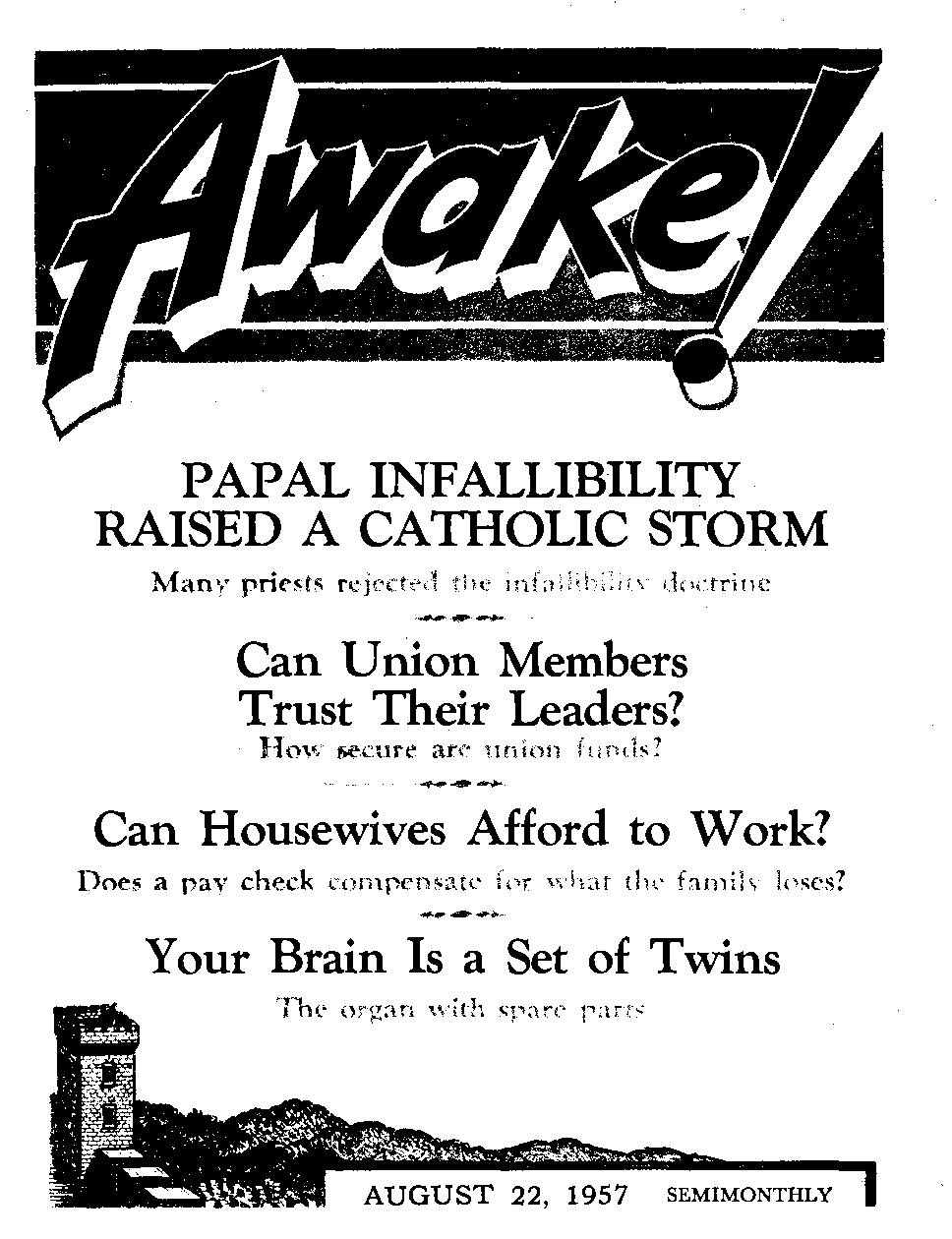
PAPAL INFALLIBILITY RAISED A CATHOLIC STORM
Many priests rejected the infaH«b.Uiv doctrine
Can Union Members Trust Their Leaders? How secure are union funds? .....
Can Housewives Afford to Work?
Does a pav check compensate tor whar the famils loses?
Your Brain Is a Set of Twins
THE MISSION OF THIS JOURNAL
News'Sources that are able io keep you awake to the vital issues of our times must be unfettered by censorship and selfish Interests. "Awake 1” has no fetters. It recognizes facte, faces facte. Is free to publish facte. It is not bound by political ambitions or obligations; it Is unhampered by advertisers whose toes must not be trodden on; it is unprejudiced by traditional creeds. This Journal keeps itself free that it may speak freely to you. But it does not abuse its freedom. It maintains integrity to truth.
“Awake 1" uses the regular news channels, but is not dependent on them. Its own correspondents are on all continents, in scores of nations. From the four corners of the earth their uncensored, on-the-scenes reports come to you through these columns. This Journal's viewpoint is not narrow, but is international. It is read in many nations, In many languages, by persons of all ages. Through Ite pages many fields of knowledge pass in review—government, commerce, religion, history, geography, science, social conditions, natural wonders—why, its coverage is as broad as the earth and as high as the heavens.
“Awake I” pledges itself to righteous principles, to exposing hidden foes and subtle dangers, to championing freedom for all, to comforting mourners and strengthening those disheartened by the failures of a delinquent world, reflecting sure hope for the establishment of a righteous New World.
Get acquainted with “Awake!” Keep awake by reading “Awake!”
Published Semimonthly By
WATCHTOWER BIBLE AND TRACT SOCIETY OF NEW YORK. INC. 11T Adams Street, Brooklyn 1, New York, U. S. A. N. H. Knohb, President Grant Suitib, Secretary
Printing this issue: 2,400,000
Otkr tingaagn In which "Awake!” I» g< bl Shed: Semlwawthly—Africans. Finnish, French, German, Greek, Hciaudlsb, Italian, Norw^ian, Spanlah, tnvedBh.
■ onHIy-—Danish, ludcnealan, Japanese, Portuguese, Ckrelnlan.
Yearly subscrlpUcu rates
Bffiw lor semimonthly edftlune
Awtrlu, U.S., 117 Adams St., Brooklyn 1, N.Y. fl Ailtrilla, 11 Beresford Rd.. Sirathfleld N.S.W. 8/-Canada, 150 Bridgeland Are.. Toronto 10, Ont. JI Eni land, 84 Craren Terrace, London, W. 3 7/-
New inland, G.P-0, Bos 30, Wellington, C. 1 7/-Snth Africa, Private Bag, Elandsfonteln, Tri. 7/-
Nontbly edition ent half He akoee rates.
Five cents a copy
Hem I Han ms .should be sent to office in rear country iri compliance with regulations to guarantee safe delivery of money. Bemlttanees are accepted al Brooklyn from countries where no office Is located, by International money order only. Subscription rains In different countries are here stated In local currency. Notion of ei plrat Ion (with renewal blank) la rent at least two issues before subscription espires. Change of nddnu whan went to our office may be eipwled effective within one mentli. Semi your old as well as new address.
Entered as second-class mailer at Brooklyn, N. Y. Printed In U.S.A.
CONTENTS
Harmful and Helpful Fears
Papal Infallibility Raised a
Catholic Storm
Kawerau, the Paper Town
Can Union Members Trust Their Leaders? 9 ‘‘Unneeded Transfusions’’
Can Housewives Afford to Work?
How Fast Does the Deer Fly Fly?
Gooney Birds Baffle Biologists
Your Brain Is a Set of Twins
Politicians on Record!
About Books
Babel’s Tower in the Legends of
Mankind
The Times We Live In
“Your Word Is Truth”
Who Was the Twelfth Apostle?
Jehovah’s Witnesses Preach In All the
Earth—Sweden
Watching the World
harmful helpful
HAT does it take to throw a peaceful crowd into wild-eyed hysteria? Just one thing—fear. A frightened shout of “Fire!” will stampede it like a herd of terrified cattle.
Because of its infectious nature some authorities consider fear to be mankind’s most contagious disease. Along this line of thought Science Digest of July, 1951, said that science “has discovered by laboratory studies that fear is even more contagious than the most communicable disease. Tests show that just being near a fear-ridden person will cause you to be vaguely fearful without knowing why. And recent studies at the University of California show that you can be instantly affected merely by listening to the voice recordings of anxiety-ridden persons.”
When this disease sweeps through a nation as it does a crowd reason is pushed aside, logic is forgotten and moral principles are ignored. The end results can be a frightful war. Knowledge of this is a constant worry to men in authority. Yet fears in the East and the West continue to mount dangerously. If they reach the point of unreasoning hysteria, this world will become an atomic nightmare. Hence, the chief thing men have to fear is fear itself.
It is not difficult to see how fear can drive a crowd into hysterical acts of violence when its effects on an individual are considered. It has been found that even mild fear will interfere with a person’s mental processes. He will not be able to think properly. That is the reason a fear-striken crowd can destroy and kill without an instant’s hesitation. Their thinking is wrong.
Under extreme fear a person can even forget his name or lose consciousness. There was a case in Britain where a particularly frightening scene in a movie had to be cut out because it had caused a number of spectators to collapse in an unconscious state.
But fear can do yet more. It can cause complete paralysis and instant death. Examples of this would be persons who have died after being bitten by a nonpoisonous snake. It was nothing more than fear that killed them.
Since fear can do these things to an individual, think what it can do to many people, to even a nation. Little wonder is it that fear is classed as a deadly disease. Note the observation Science Digest made on its ill effects: “Indeed, fear and anxiety can produce plenty of physical havoc even in comparatively mild forms. And as they increase in intensity, they develop a wallop that can be as deadly as the most lethal poison. First, there is a terrific spasm that contracts the blood vessels; then violent contraction of the heart; after this, complete paralysis and death.”
It must not be assumed, however, that fear always has ill effects, for that is not so. If a person drives a car it is for his own good to cultivate the fear of passing on a curve. There is also fear of the law, and that is good for the community as a whole. Another fear, a very important one, that should be cultivated is the fear of God. When a person cultivates this fear he will not turn away to other gods. He will not forsake his Creator for dumb idols. That is why the Bible says: “The fear of Jehovah is the beginning of wisdom.”—Psalm 111:10, Am. Stan. Ver.
Those who love Jehovah God are those who fear him rather than men. Even though worldly governments want them to give to Caesar what belongs to God they refuse to compromise. God comes first. No matter how much a government may persecute them to force a compromise they will not break integrity to God.
Jesus foretold that the world would have no love for such ones. He said: “If you were part of the world, the world would be fond of what is its own. Now because you are no part of the world, but I have chosen you out of the world, on this account the world hates you."—John 15:19, New World Trans.
This hatred could strike fear in the Christian if it were not for his love of God. By means of it he is able to overcome the fear of worldly persecution. It is written: “There is no fear in love, but perfect love throws fear outside.”—1 John 4:18, New World Trans,
A person can develop this attitude by exercising love for God above everything else. Then he will not experience the damaging fears that plague mankind in general. He will not cower in fear of despotic rulers and compromise Christian principles. Because his fear will be for God and his trust will be in that Supreme One, he will enjoy peace of mind in a fear-ridden world. He will have freedom from the damaging type of fear that is an enemy of mankind. The fear of God therefore can be considered as a friend. Its possession is indeed “the beginning of wisdom.”
/PACE DCS/
<■ If you are inclined to think that a dog’s life in the United States is rough, you should see what dogs are going through in Russia. According to the Mother Goose stories, it is the cow that jumps over the moon. If Russian scientists have any say-so in the matter, it will be the dog and not the cow that will be the first to scale the moon. The trade union paper Trud announced that the Russians had taken two dogs and sent them in separate rockets to a height of 68.31 miles. The dogs were sealed in glass cases containing oxygen. At differing heights the cases were ejected automatically from the rockets and the animals parachuted safely back to earth. The dog will go farther into space than man will ever go. That is the opinion of Dr. Lee de Forest, the man who invented the radio tube. He predicts that man will never reach the moon. Says Dr. De Forest, Man is Inherently an earthly creature and only his scientific imagination will ever make him a planetary emigrant. He suggests that man concentrate his greatest efforts to improving existing conditions on earth, and, a science writer adds, “leave all this space travel to the dog.”
THE dogma of the pope’s infallibility did indeed raise a storm among Catholic theologians and prelates. It did to such an extent that some broke away to form the sect of “Old Catholics.’’
As for the dogma of infallibility, its .closing paragraph states; “Faithfully adhering to the tradition handed down ... we teach and define it to be a doctrine divinely revealed, that, when the Roman pontiff speaks ex cathedra, that is, when in the exercise of his office of pastor and teacher of all Christians, and in virtue of his supreme apostolic authority, he defines that a doctrine of faith or morals is to be held by the universal Church, he possesses, through the divine assistance promised to him in the blessed Peter, that infallibility with which the divine Redeemer willed his Church to be endowed, in defining a doctrine of faith and morals; and therefore that such definitions of the Roman pontiff are irreform-able of themselves, and not by force of the consent of the Church thereto.”—Rome, July 18, 1870.1
During the course of the proceedings some 775 different prelates and theologians were at one time or another present at the council. Among these were forty-seven cardinals and 117 archbishops.2 When the real
‘j Why did cardinals, archbishops \ \ and other Catholic prelates pro- \ *i test the Infallibility doctrine ? \
rtoWcW
purpose of the council was revealed to them a storm of protest arose, and that even though they had been placed under a vow of secrecy.3 Every land had its noted theologians and prelates who were strongly opposed to defining this dogma.2
Who Opposed?
If the defining of the dogma of infallibility had depended upon the merits of the scholarship of those in favor of it, the dogma would have died at birth. How so? Because, as expressed in one of the series of letters on the inside workings of the council, which were published at the time in Germany under the pseudonym “Quiri-nus”: “The predilection for the Infallibility theory is in precise proportion to the ignorance of its advocates.”1
Thus we note first of all the opinion England’s foremost Catholic scholar, Lord Acton, had of Pope Pius IX; intellectually inferior to his predecessor and with no knowledge whatever of theological matters. “Nobody feels that the pope will think less of him because he knows nothing at all,”8
On the one hand, the pope’s most ardent supporters were the Italian prelates with the least learning. On the other hand, among those opposed was the archbishop of Paris, Darboy, “a learned, conscientious and respected prelate.”* Also opposed were Bishop Du-panloup of Orleans, who had refused higher offices in the chtirch and who “was without question one of the ablest French bishops of his day,”7 and the cardinal archbishop of Prague, Schwarzenberg, for more than forty years “the leading churchman in Austria,” even though no friend of church politics.8
Also opposed was Prince-archbishop Rauscher ®f Vienna, who did so much for the Catholic Church in Austria that he is described as a “providential personality.” Further, there was Bishop Strossmayer, doctor of theology at the leading Croatian university, of whom we are told: “At the Vatican Council he was one of the most notable opponents of papal infallibility, and distinguished himself as a speaker.”8
Another learned opponent to infallibility was Bishop Hefele of Germany. “He was one of the most prominent bishops of the opposition minority. He even published the reason for the stand he had taken” in Naples, 1870, as did others also, since such could not be published in Rome itself.10
Archbishop Kenrick of St. Louis, Missouri, who had made “a profound impression” at the First Baltimore Plenary Council “by his logical keenness and great erudition,” was dogmatically opposed to the dogma.11 Newman, later made cardinal, also opposed it. He finally submitted even though he was ‘unable to reconcile it with well-ascertained historical facts.’13 In the end most of the opponents took this course in preference to being excommunicated.
The most outspoken theologian opposed to infallibility was Johann Dollinger, professor of religion at Munich University and leading German Catholic scholar of his generation. Under the pen name of Janus he wrote the book The Pope and the Council, in which he showed how untenable this dogma was in the light of church history and the Bible.
Opposition to Defining the Dogma
Why did so many oppose the infallibility dogma? There was objection because the council was not truly ecumenical. Those favoring infallibility were preferred. As a result Italian Catholics had four times the representation that the Germans and the French had.18 The very fact that a bare majority was to be sufficient to define the dogma further made the proceedings not truly ecumenical. Nor was the council free in action. The various committees and commissions were packed with Italian prelates in favor of infallibility.3
Coercive measures were also used. The prelates were continually reminded that their expenses were paid by the pope. One Chaldean patriarch had to resign because he had made a speech against the dogma. Others were penalized in other ways. To the wavering ones various inducements were held out: papal dispensations and fifteen cardinal’s hats were waiting to be bestowed.3
The debates were hamstrung by arbitrary rules of procedure. All discussion was in Latin, and not all had kept up with their Latin. Besides, Latin spoken by a German was quite different from Latin spoken by an Italian. Opponents were accused of heresy as though infallibility had already been made a dogma.3
Then there were those who opposed the infallibility dogma on what might be termed practical grounds. Some opposed it because it would widen the breach between Catholics and Protestants. Others opposed because of the fear that it would make rulers suspect the loyalty of their Catholic subjects. Subsequent facts show that these considerations were sound.3
Historical and Scriptural Grounds
The opposing prelates raised especially strong objections on the basis of the facts of religious history. Thus DOllinger stated that ‘'for thirteen centuries an incomprehensible silence on this fundamental article reigned through the whole Church history.” Bishop Hefele said that for thirty years he had sought proof of papal infallibility and had been unable to find it.:;
Archbishop Kenrick showed that Boniface VIII had claimed that all mankind was subject to him because of sin. But in 1788 five leading Roman Catholic universities denied that this was a teaching of the Catholic Church. Pope Honorius I had “taught things that cannot be reconciled with sound doctrine.” Not only had infallibility not been taught before in any catechism or document for public worship, Kenrick further pointed out, but for centuries the church had allowed it to be condemned. Proof of this was to be found in Bousset’s Exposition of the Faith, which expressly denies papal infallibility, and which had the approbation of Pope Innocent XI. Kenrick concluded: “It is no matter of faith to believe that the pope is in himself infallible.”14
How much of a reversal this dogma represented is to be seen by what appeared in Keenan’s Controversial Catechism for many, many years: “Q. Must not Catholics believe the pope himself to be infallible? A. This is a Protestant invention, it is no article of the Catholic faith; no decision of his can bind on pain of heresy, unless it be received and enforced by the teaching body, that is, by the bishops of the Church.”15 What had been a ‘Protestant invention’ before 1870 suddenly became a "doctrine divinely revealed,” so that all who opposed it were cursed!
Dollinger, in his book The Pope and the Council, gives many examples of contradictions of “infallible” popes, noting those also mentioned by Archbishop Kenrick. Among the others he mentions are the following: “Both Innocent I and Gelasius I . . . declared it to be so indispensable for infants to receive communion, that those who die without it go straight to hell. A thousand years later the Council of Trent anathematized this doctrine.” “In contrast to Pope Pelagius who had declared . . , the indispensable necessity of the invocation of the Trinity in baptism, Nicholas I assured the Bulgarians that baptism in the name of Christ alone was sufficient.”
“Celestine III tried to loosen the marriage tie by declaring it dissolved if either party became heretical. Innocent II annulled this decision, and Hadrian VI called Celestine a heretic for giving it.”
Pope Sixtus V, in his bull, declared that the edition of the Bible that had been corrected by his own hand “must be received as the only true and genuine one, under pain of excommunication, every change, even of a single word, being under anathema. But it soon appeared that it was full of blunders, some two thousand of them introduced by the pope himself.” So “copies were called in, manuscripts corrected and the printer was blamed,” at the instance of Cardinal Bellarmine.
And finally, there were the arguments that Kenrick and others based on the Scriptures. They insisted that Christ had not given Peter anything that he had not also given the other apostles, that while Peter had been preferred he had not been given supremacy over the other apostles. They also showed that the great majority of the “church fathers” did not apply Matthew 16:18 to Peter. Of eighty-five leading ones only seventeen held that Peter was the rock on which Christ built his church, whereas forty-four held that it was the truth that Jesus spoke, while sixteen believed the rock to be Jesus himself. Kenrick also argued that there is no Scriptural basis for holding that any human could be infallible. "The apostles were promised that they would not err, but “God only is infallible.”14
Surely these facts regarding a single incident in the history of the Catholic Church, and that in modern times, are sufficient to disprove her claim to be the one true church Christ established.
REFERENCES:
’McClintock and Strong’s Cj/cIoptEdio. Vol. 4, p. 575.
’ The CatftoHc Enciiclo-getlfa. Vol. 15. pp. 304,
J Lord Aston, by Hlm-melfarb, pp. 35-128. ,
* Letters from Rome on the Council, by Qulrtnus. p. 143.
‘ Lora Acton, p. 29.
e The Catholic Encyclo
pedia, Vol. 4, p. 6M.
IIbid., Vol. 5, p. 202.
• Ibid., Vol. 13, p. 596.
’ /bid., Vol, 14, p. 316.
“ /bid.. Vol. 7, pp. 191. 192.
a /bid., Vol. B, p, 61B.
12 Lora Acton, p. 156.
Dictionary of Religious Knowledge, by Abbott, p. 292.
” Inside the Vatican Council, by Kenrick.
“ /newts the Church of Rome, by Cusack, p. 82.
By “Awake!” correspondent in New Zeafand
■HOUGH a small country, New Zealand boasts the world’s largest man-made forest and the fourth-large st newsprint mill. This all came about through foresight and recommendations dating back to 1925, when an English visitor suggested that the 350,000-acre pumice plateau on the Kaingaroa plains be planted with pine trees.
11115 huge area of land had previously been covered with a sparse growth of tussock and had been of little value to the country’s dairy industry, as the pumice soil drained too easily to allow grass to grow as profusely as it does in other parts of New Zealand.
4? Government enterprise soon had the treeplanting project under way, using the exotic pine, Radlata, which since has proved to be a great asset to the country. Research as to the adaptability of this pine proved that from it could be made pulp and newsprint equal to the best in the world. The pumice soil on the Kaingaroa plains produced a dense and quick-growing forest, and with proper reforestation a continual yearly output of 23,000,000 cubic feet of timber is assured.
V Problems of milling were overcome by granting the timber rights to a private company. This company was heavily subsidized by the government to make possible the erection of a newsprint mill. At first the company had difficulty in deciding where to locate it. This, however, was decided for them several months after their incorporation in 1952, when geothermal steam was located along the Ta-rawera River on the east coast of New Zealand’s North Island. The river site is an ideal location for a mill, and by using underground steam it is expected to save 50,000 tons of coal each year.
The location is known as Kawerau. A town of “mushroom” growth, which is of international interest to the newsprint world, bears the same name. Here a $35,000,000 newsprint mill has now been constructed, together with groundwood pulp and chemical pulp mills. The paper machine, which is reputed to be the fastest in the world, will turn out 2,000 feet of newsprint a minute, or 75,000 tons of newsprint a year in its round-the-clock operations. Additionally, the plant will produce 72,000,000 board feet of sawn timber and upward of 50,000 tons of chemical pulp each year. Sawdust and bark, together with other mill wastes, are being used for fuel.
Little .did the native Maori of centuries past dream that the plains on which they fought their tribal wars and the small warm pools in which they bathed would someday grow such a magnificent forest and produce the steam power for New Zealand’s greatest industrial enterprise. Nor did the men that labored for $1.25 a day in planting the forest foresee the vast fruits of their labor.
A visitor’s suggestion gave birth to this huge enterprise that has blossomed to the enrichment of a nation. This well-planned exotic forest, with its evenly spaced trees that have grown to maturity in twenty-five years, is a joy to behold. How quickly the earth can be put to constructive use! What a joy when under the righteous rule of God’s kingdom the whole earth will thus be restored to ita full productiveness under direction of the greatest of all gardeners, Jehovah the almighty God!
CAN UNION MEMBERS TRUST THEIR LEADERS?
HERE is our money going? That is the big question union members are asking their leaders. Some receive satisfactory answers; many others do not.
They have good reason to be concerned. Recent Senate investigations have uncovered fraud, extortion, thievery and gangster rule among a disturbing number of union leaders.
The present investigations are being conducted by the Senate Select Committee on Improper Activities in the labor or management field. It is under the chairmanship of Senator John L. McClellan of Arkansas. What his committee is uncovering is similar to what was turned up by other Senate committees.
When the special subcommittee on Education and Labor, for example, held hearings in Detroit, Los Angeles and Washington, D.C., it found loose administration of many union welfare funds, as well as dictation by union leaders. It also found evidence that union members, in some cases, were receiving 50 percent less in benefits than were being paid for by employers.
Then there was the committee under Senator Douglas that concentrated on the welfare funds. What it found was very disquieting to union members. It turned up a case in the Laundry Workers Union, where an insurance broker helped himself to $900,000 in premiums from union members and then split this sum with the secretary-treasurer of the union. In another case they found the head of several locals in Chicago was squandering union money on travel, entertainment, gifts and so forth. He was living high on money entrusted to him by union members.
The New York investigations ordered by former Governor Dewey were prompted by what was found in Local 32-E of the Building Service Employees International Union. It seems that the president, Thomas E. Lewis, had been freely spending money from the union's welfare fund, not only on himself, but on his friends as well. This revelation came after Lewis was found murdered by a hired gunman.
As the New York investigations progressed many other instances of embezzlement by union officials turned up. A sample of one is the case of a local president in the Retail, Wholesale and Department Store Union, who admitted that during a period of almost three years he and his assistant had taken from the welfare fund almost as much as the entire membership received in benefits.
New York investigators also found racketeering in the Distillery Workers Union. Reporting on this the New York Times of April 11,1955, said: "A new scandal came to light yesterday in the racket-tainted Distillery Workers Union, A.F.L. . . . The union’s former secretary-treasurer, Sol Ci-lento, already is under indictment for welfare fund racketeering. He is awaiting trial with two notorious gangsters ... on charges of having received $299,000 in welfare kickbacks in two years.” This close association of union leaders with gangsters is not uncommon, and may explain the murder of Thomas E. Lewis.
Corruption in the Teamsters Union
During the current investigations by the Senate committee under McClellan it has been found that money from Teamsters Union funds have been going not only into the pockets of some Teamsters’ officials but also into the pockets of underworld characters. Uere is what Time magazine of March 11,1957, said on this point: “The Teamsters’ Western Boss Frank Brewster, who came to power as Dave Beck’s first lieutenant (and followed Beck as Chairman of the union’s Western Conference), was described as having ordered a $3,900 Teamster loan to a Seattle racketeer for opening a tavern and gambling joint in Spokane. Brewster was also identified as having okayed a $17,000 union loan to help get another Seattle gambler out from under a federal tax lien.”
Brewster’s personal interests were also financed with union money. They provided him with box seats at West Coast horseracing tracks. They helped him satisfy his desire for race horses, fine clothes and beautiful homes. They paid for the travel and hotel expenses of a horse trainer who was handling his horses. They also paid a jockey who rode for him. Money entrusted to his care by hard-working teamsters permitted him to live extravagantly.
Should this misuse of union money upset union members, then what was done by the Teamsters’ president, Dave Beck, ought to make them sick. Here is what Robert F. Kennedy, chief counsel of the Senate Select Committee, said: “We have information . . . that Mr. Dave Beck took large sums of money from the Teamsters Union in Seattle, Washington, and used them for his own personal benefit.”
Beck has been accused of taking at least $300,000 of union money for personal use. He also has been charged with buying property next to a Teamster building in Seattle for $39,000 and then selling it to the union for $135,000.
There is also the incident of the memorial fund that was established for the widow of an honored union official. It was formed by contributions from Teamsters locals. Beck was accused of having personally profited from this fund by selling some mortgages to it at full-face value, which mortages he bought at a discount. He neglected to inform the widow of the full details in this sale. The transaction brought him and one of his business partners a neat profit of over $11,000.
Another transaction mentioned in the hearings was the selling of Beck’s $163,000 mansion to the Teamsters Union. Some of the construction costs, by the way, had been paid for by the union. Beck sold the house with an agreement that permits him to live in it free, with taxes and expenses paid by the Teamsters. The furnishings, which he continues to use, were also sold to the union.
These are only a few of the many serious charges made against the president of the Teamsters Union. Instead of denying them and presenting proof to support his denial, Beck has refused to answer the charges. Because of his obstinate refusal to co-operate with the investigating committee Senator McClellan was moved to say: “This witness, in my opinion, has shown utter contempt for this Committee, for the Congress of the United States and for his Government.” “Mr. Beck has shown flagrant disregard and disrespect for honest and reputable unionism and for the best interests and welfare of the laboring people of his country. Above all, he has shown arrogant contempt for the million and a half members, the honest laboring people in the Teamsters Union.”
Members Are Angered
Many of these laboring people are not very happy over the way their funds have been mishandled. This was shown in New York city at a meeting of Local 804. Reporting on the meeting the New York Times of April 1,1957, said: “Angry members of Local 804 of the International Brotherhood of Teamsters overwhelmingly vetoed yesterday a request by their officers for a $l-a-month dues increase. . . . Uncomplimentary references to Dave Beck, the union’s international president now under investigation by a United States Senate labor-management committee, were shouted from the floor. The local’s officers were accused of 'outlandish living.’ ... At the meeting here, rank-and-file teamsters made it clear they were taking some new looks at the union leadership.”
Other locals are expressing similar indignation and lack of trust in their leaders. One hanged a crude image of Beck. Another instructed its delegate to vote against Beck in the Teamsters’ September convention, and another won a court order forcing its officials to turn their records over to a bank for temporary custodianship. On May 14 the Teamsters’ largest district council, representing more than 125,000 members, heard a resolution demanding Beck’s resignation.
Complaints against union leadens are pouring into McClellan’s committee by the thousands. They come not only from teamsters but from members in many other unions. Of the thirty thousand letters received in the first month of hearings, about seventy-five percent were sent by average union members.
These letters accuse union leaders not only of helping themselves to union funds but of electing themselves to office; of not holding elections in many years; of threatening and beating members who protest their unlawful actions, and of receiving payoffs from employers under threats of crippling strikes.
Reports that appeared in the New York Times well illustrate this last charge. One was regarding two officials of the Teamsters Union who sought to extort $64,000 from members of a dairymen’s organization under threat of labor trouble in transporting milk. The other concerned an official of the Ornamental Iron Workers Union and a leader in the Heavy and General Construction Laborers Union. These men were indicted for attempting to extort $15,-000 from a construction contractor on the threat of work stoppage and labor trouble.
It should not be concluded, however, that labor racketeering exists in all unions. Senator McClellan expressed belief that the management of most unions is above reproach. Nevertheless, the corruption found thus far is bound to disturb union members. It is bound to cast suspicion upon their leaders as a whole.
Efforts to Clean Out Corruption
Definite effort is being made by the A.F.L.-C.I.O. to clean up its ranks. It has formed an Ethical Practices Committee to investigate and take action against corrupt union leaders. This committee has already accused three unions of being controlled or influenced by racketeers, and gave them 90 days to clean up or be expelled from the A.F.L.-C.I.O. federation. It also drew up an indictment against Beck that resulted in his being ousted as vice-president of the A.F.L.-C.I.O. Shortly thereafter he announced his intentions not to run for re-election as president of the Teamsters Union.
The responsibility to clean up labor rests upon labor itself rather than the government. George Meany, president of the A.F.L.-C.I.O., pointed out this fact when he said: “We have no intention of waiting for the public authorities to act in order that we may act on our own law of trade union ethics. That is our job and we are going to do it.” If they fail to do it they will undoubtedly be in for trouble with the government. In fact, special legislation
is already being discussed to give the government tighter control over labor unions.
It is the determination of responsible union leaders as well as the government to eliminate labor racketeering. President Eisenhower expressed this determination when he said:
“Labor racketeering, like corruption anywhere, is an abomination which must be eliminated if and whenever it occurs ... The American working man and woman deserve from labor leadership high standards of trust and fidelity. ... In the area of union welfare and pension plans, the Administration has, since 1954, repeatedly made specific legislative recommendations for the registration, reporting and disclosure of these plans. This legislation, I earnestly believe, should be enacted as speedily as possible.”
An effort in that regard was made last year by Senator Douglas, who introduced a bill that would require all union welfare and pension funds with more than a hundred persons to send a report to a regulating agency. The report would have to give detailed operations of the fund, the receipts, the reserves and the expenditures.
The bill would also require union officials to supply each union member with a condensed version of this report.
Without doubt union leaders should be required to give periodic financial reports to the membership. As it is now, many leaders do not do this. There have been cases where union officials did not even bother to keep books, but mixed union money right in with their own.
It is generally conceded that definite safeguards of union funds must be established in all labor unions. There must also be safeguards against union dictatorship and the denial of honest elections, as well as safeguards for employer protection against union extortion and strong-arm methods.
How extensive the labor-union cleanup must be will become clearer as the Senate Select Committee under McClellan continues its investigation. It appears at present that the committee has just scratched the surface. Much is yet to be uncovered. In any event, labor management has a big job ahead of it. It must restore the confidence of rank-and-file members in their leaders.
UNNEEDED TRANSFUSIONS
Under the above heading Today’s Health, January, 1957, a magazine published by the American Medical Association, had the following to say: “Many blood transfusions during surgery may not be needed at all, a pathologist says. He used Injections of radioactive iodine to learn quickly the amount of circulating blood. Sixty-one percent of 300 seriously ill or post-surgery patients tested this way were found to have normal whole blood volumes. They were people who might ordinarily have been given a transfusion, Dr. William Freeman told the American Society of Clinical Pathologists. Still other people actually had excessive amounts of whole blood or essential components. He concludes that blood transfusions would have been wasted in 75 percent of the 300 patients.0 Another doctor, writing in the public press on these same findings, stressed also the harm that such unneeded transfusions might cause: “In cases of arteriosclerosis or impaired heart, addition of superfluous amounts of blood can even at times cause death by exerting excessive pressure on the artery walls. This might overstrain the heart.”
HOUSEWIVES
bygone
NE out of
years a married woma
every
children
three persons being employed today in the United States is a woman. Almost three fourths of the woman’s working force (about 16,000,000) are or have been married.
Over 2,500,000 of them have preschool-aged children and another 6,500,000 have going to school. Nearly four out of five of the women with families contribute to their support. One out of five carries the total family load.
The demand for women workers has been growing rapidly. The United States Bureau of the Census predicts that the number of women employed will reach 29,395,000 by 1975, Other authorities say that soon women will be asked to fill new jobs—jobs they have little opportunity of obtaining today. Right now, according to the Women’s Bureau of the United States Department of Labor, there are at least 600,000 clerical workers needed in business. A recent issue of Woman's Home
Companion stated that Manpower Incorporated, a service bureau, “is so hungry for woman-power that it gives its present workers dishes and other premiums for sending in their neighbors and friends.”
Requests for housekeepers run into the thousands, but there is seldom an applicant. Women no longer want to do housework, These jobs simply go begging. In
had no alternative. It was housework or else.
Studies show that even though women generally enjoy better health and longer life, the absentee rate for women in employment is approximately twice that of men. Reasons for the high rate of absenteeism are many, but most of them have to do with pressures and frustration caused from leading a dual or split life. Many women at work remain divided between their responsibility to their husbands, children and home and their obligations to their secular employers. Older women especially find it difficult to be flexible and adaptable to two lives.
It is a strain for them to switch from mamma to Mrs. Cartwright, secretary, and back again to mamma in the evening. Also, women who have been married for many years tend to be set in their ways, and taking orders and criticism from younger supervisors, who can at times be overbearing, is not easy. Trying to do two jobs in one day can become wearisome, especially so if you try to keep up former standards of housekeeping. You might find yourself worn to a frazzle, more irritable and unpleasant as a companion than before. And if you let things slide, a disordered house might irritate or frustrate you and give you a guilt complex.
AUGUST Wlt 1957
You may nave good health, but Is it good enough to hold down two jobs for any length of time? Remember, the greater amount of housework will be waiting for you when you return home. True, your husband might help with the dishes, cooking, etc.; but you might find out that he does not exactly relish doing dishes after a hard day’s work, that he married you for the nourishing soups and stews you once cooked and for the cakes and pies you once baked, that warmed-over, canned and slapped-together meals are not his idea of living a married life. Play it safe. Consult your husband before and after getting a Job. It may be that he does not like the idea. Anyway, wives cannot be too careful. A wrong move might spoil a happy marriage.
Coat of Working Out
Another thing to consider is the cost of working. In face of rising prices and the dwindling dollar it may cost you, especially if you have small children, more to work out than for you to stay at home. There are some women who are financially fixed but who work after marriage and children to prevent themselves from becoming bored with life. But most of these mothers can afford professional tutors for their children and maids to care for the house. There are others who pursue a course of self-development and training. As a rule, though, expenses for these workers are higher than their take-home pay. Most women, however, cannot afford to work just for the sake of working. They must at least break even.
How much must a woman earn to meet expenses? The answer, of course, depends on many things. In her brilliant article “The Married Woman Goes Back to Work’’ Mary Scott Welch says: “Your additional personal expenses will probably include a more extensive (or more expensive) wardrobe than you need at home, the cost of maintaining that wardrobe (dry cleaning, shoe repair, nylon replacement), beauty care (no time to do it yourself), transportation costs, contributions to office collections, dub or union dues, telephone calls and lunch hours (both what you eat and what you buy when you’re window-shopping from twelve to one). Additional household expenses can be substantial.”
She points out that if you have a sitter or a maid you are committed to earning about half again as much as you pay her, simply to break even. In most cases you cannot deduct from your income tax any part of what you pay out to sitters or housekeepers. Whatever you earn will be taxed on top of your husband’s income. “To be absolutely realistic,” she says, “you should add up all the hidden costs that may be entailed in your working, then figure out how much you wiil have to earn in order to pay these costs plus your income tax. If your expenses will be $50 a week, and your husband’s income will put your whole pay check into the 30 percent bracket, you’ll need a salary of $71.50 to break even.”—Woman’s Home Companion, October, 1956.
One husband writes: “Mamma took a job, but it didn’t pay at all. We all learned a costly lesson. Eight months after she began working, we had saved only $275—less than a fourth of our goal. More than mamma’s basic expenses, such as withholding tax, monthly commutation, and lunch money, the little items nibbled away at her purse.” Further, he says that the food cost more and that they did not eat so well, that neither suppers nor tempers were the same, that even the children became quarrelsome and showed a trend toward selfishness. So mamma and papa began to count the cost of mamma’s job and its blessings. They decided that there were more rewards in life than in riches or in keeping up appearances or In matching homes and appliances with the Joneses.
Consider the Children
Homemaking includes child training. This can be not only exhausting, timeconsuming and demanding of physical and mental prowess, but costly. While you work will you be satisfied to leave your child with just anyone? Not if you love your child. The complication may be lessened if there is a competent grandmother handy to take over the job. But rarely do parents make enough to hire professional help. There are exceptions, of course.
Most minimum-time mothers agree that child care suffers when mothers work out. Despite “scientific” advances, the only way to bring up children is the old-fashioned “do-it-yourself” system. The modem theory that a wife can work and care for a home and rear a family simultaneously looks fine on paper, but seldom does it work in practice. The losses are in human values, therefore not easily read in statistics, unless parents wish to associate juvenile delinquency with working mothers. Molding a child is a slow, delicate, continuous process. It cannot wait for 8:30 p.m., when mother is through with her work. At that late hour the little “twig” is too tired to be bent and nighttime is no time for mother to be gardening.
Being a home executive may not be highly valued by society, including the wife, but it is the greatest role women can possibly fill if it is done right. When you consider the many roles at which every housewife must be proficient, you will find that it calls for more diversified talents than most executives need to run a business. A wife is not just keeping house, she is making a home; and every home needs a mother. The wife is not just minding children, she is rearing the next generation. As important as mothering is, it should come first. Proper child training by the parents is also a divine command.
Some wives have managed to work and at the same time prove themselves excellent mothers. Their job, they say, revitalizes them, gives them added energy. It has made them happier, leaving with them a satisfaction of being needed and appreciated. Yet not all wives have found it so. Many would prefer to be at home if their dollar was not absolutely needed. Therefore, it is left up to each woman to decide whether she can afford to work. But in making your decision, remember there is much more to consider than what to do with the extra pay check.
4/our ToJf Poa5 ike Peet *71% *7l%?
<L Some time ago a scientist wrote in the Journal of the New York Entomological Society that the fastest living thing known to man is the deer hot fly. He aaid that the deer bot fly has flown as fast as 818 miles an hour! The supersonic flight of an Insect amazed no small number of people. Apparently it provoked only intense skepticism on the part of a professor at the University of Alberta. He made some studies of insects himself; and Popular Science ot May, 1957, reported on his findings: “The story about the deer fly that streaks 820 mph belongs in the book of scientific tall tales, along with the one about the bumblebee not being able to fly at all. Top speed for insects is 35 mph in a short sprint, 27 mph in steady flight. That’s what Dr. Brian Hocking, professor of entomology at the University of Alberta, found after measuring the power output, efficiency, and fuel (nectar, that is) capacity of a number of insects. Common insects don’t even come close to the theoretical top.”
AJLORS call it the gooney bird because of its clownlike appearance on the ground. __I The name seems to have stuck. Really a type of albatross, the gooney bird is no clown in the air! Small wonder, it has a seven-foot wing spread and is the picture of grace, reminding one of the utmost in aircraft design. Like an airplane, the gooney bird runs to get up flying speed, takes off into the wind, retracts its landing gear when air-borne, lands into the wind and needs a long run to reduce speed.
'gf Favorite airports of the gooney birds are two small islands in the Pacific Ocean known as the Midway Islands. But one of them is also a military airport of the United States government. Gooney birds sailing leisurely across aircraft runways can make it quite harrowing for a pilot about to land. In fact, collisions with gooney birds have cost the government thousands of dollars in plane damage, especially to propellers and wing flaps. So the government decided to induce the gooney birds to change airports, to move from Sand Island to uninhabited Eastern Island. Two biologists arrived to do the work of changing the birds’ minds about airports.
When the biologists arrived the birds were sitting on their nests. The female lays one egg and both male and female take turns sitting on it The first scheme of the biologists was to smoke the birds off the island. They lit several daylight flares. Orange smoke wafted its sulphurous way over a group of goonies. The goonies were profoundly unimpressed. “No birds moved,” was the entry in the biologists' official report
'B Next they set a truck tire on fire. Foulsmelling smoke enveloped a group of nesting birds, some of which were within six feet of the flaming tire. The birds were undisturbed. None left.
'B The biologists now turned to making noise. They had riflemen fire over a concentration of nesting birds. After a few rounds it was quite clear the riflemen were wasting time and bullets. One black gooney sat on an egg three feet from a rifle muzzle and was perfectly content to stay put. The baffled biologists next ordered a marine detachment to open fire with mortars. Earth-shaking explosions followed. “Birds no more distant than 200 feet continued to sleep,” was the official report, “and none of those nearer were seen to move away.”
if.' Perhaps the bazookas could at least wake up the birds. Fifty rounds of bazooka fire should have impressed any bird, but not the goonies! Even the birds sitting on eggs within range of the backlash, though they had their feathers ruffled, did not budge.
T Still baffled, the biologists decided to use their secret weapon—ultra-high frequency noise. They would drive the goonies to madness or to less sonic surroundings. A signal generator, amplifier and speaker were set up. Frightful sounds from 20 to 20,000 cycles poured forth. Still “no birds left the area,” was the biologists’ report.
'B Really in desperation, the biologists decided to hatch a diabolical plot. Kill the birds? No, “the American people would not stand for it,” they said. So they would just snatch eggs. This operation was carried out and some hundred goonies lost their eggs. But the birds kept right on sitting—for one day, for two days, for three days, for four days. Finally after an average of four days the goonies left their nests. The result of Operation Egg Snatch was inconclusive, and the biologists’ report said concerning the eggless goonies: “We could not be certain any of these birds left the island.”
’B The birds seemed to have won the day. Egg snatching has been limited to birds nesting on and alongside runways. Pilots have been instructed to obviate collisions by using a "short field takeoff”—a short run and a quick climb to take the plane safely above the 200-foot zone in which the birds prefer to fly. The birds baffled the biologists; and now peaceful coexistence, at least temporarily, has been worked out.
Your Brain Is a Set of Twins
TRANGE as the expression “Your brain is a set of twins” may seem, its implications are sound. We do have a duplicate set in our brain, especially as concerns the forebrain or cerebrum, or the “new brain,” as some like to call it.
That the brain is divided into two hemispheres and separated by a distinctive tissue man has known ever since he peered into a broken skull. Some twenty-three hundred years ago Hippocrates, the “father of medicine,” observed that the brain is the center of emotions, of sense perception and of knowledge and wisdom. But it has been only in modem times that man has learned to associate certain parts of the brain with certain faculties, assigning a definite place, for example, to speech.
A Duplicate Set
Likewise it has been only a little more than a century ago that knowledge of the brain increased to the extent of our learning that in many respects the two hemispheres of the brain duplicate each other, Man discovered that there are two centers for comprehending things seen, two centers for understanding the spoken word, two centers for forming speech sounds, two different centers for the actual utterance of speech by tongue and lips, etc.
tion
It was also discovered that the right side of the brain controls the left side of the body and the left side the right. Thus in most right-handed persons the speech is controlled by an area in the left part of the brain. And now it is known that the one side of the brain is used from the time of birth on, while the other side lies more or less dormant. How was this fact discovered?
For years it had been noted that a stroke of apoplexy or a brain injury often resulted in some form of “aphasia,” defined as “loss of func-of communication because of brain injury.” Others suffered from a peculiar form of paralysis, while still others were afflicted by both aphasia and paralysis. As regards communicating one’s thoughts, some would be able to utter only a few stereotyped expressions; others had difficulty forming simple sentences; others again had difficulty in pronouncing the words aright, and then again some at the least inducement would let out a jargon of incoherent sounds or of words that did not make sense.
And not only would speech be affected but musical skills, ability to write, etc. Especially would one or more of the three senses, hearing, seeing and feeling, be involved. In such cases spoken words would be meaningless, or colors did not exist for them, or they would be unable to use their fingers. In one modern work on the subject fifty pages are devoted to the various kinds of symptoms.
As varied as were the symptoms, just that erratic were the cures. A few fully recovered, others recovered in one respect or another, and still others failed to show any improvement. And all these varied outcomes developed regardless of what doctors did or did not do. Why should some recover from a brain injury when there is no such thing as healing or replacing of nerve cells? It was this fact that caused certain doctors, especially Dr, Henschen of Sweden, some forty years ago, and Dr. Nielsen of the United States, within the past decade, to conclude that the brain hemispheres duplicated each other, that only one part was used and that the remedy lay in re-education by making use of the uninjured half or twin of the brain.
Concerning this re-education process Dr. Nielsen stated: “You follow the same principles that you would use in teaching a Chinaman to speak English when you don’t know how to speak Chinese. You use a combination of pantomime, demonstration and dear, distinct pronunciation, plus cheerfulness and infinite patience. You don’t yell at the patient. He can hear you but he can’t understand you.” And again: “You don’t waste time trying to re-educate the impaired side. That area isn’t there any more and you can’t bring it back.”—Saturday Evening Post, December 11, 1948.
A number of textbooks have been published by Nielsen and others for those who would like to undertake this re-educational therapy that restores speech, sense perception and use of the limbs and especially the hands and fingers. The patients had invariably lost some of their ability to make practical judgment, to remember, to concentrate and to take the initiative. That is why we are told that “much of the effort of the staff was devoted to rehabilitate the confidence of their silent patients.”
Striking Examples
A fifty-seven-year-old tire dealer had been hit on the head with a blackjack by a burglar. As a result all he could say was “No,” and that for eight months. After that he improved so that in the end he had a vocabulary of at least a thousand words.
Among other cases reported are the following: A very bright young man, injured during the war by bullets entering his brain, had part of his body paralyzed, while mentally he seemed to be an idiot. By patient, cheerful therapy, in which he was shown how to move his lips, tongue and jaw, at the end of six months he was able to pronounce the vowels. From then on he progressed so fast that at the end of another six months he was able to tackle college textbooks.
One war-injured man was so depressed by reason of his handicaps that he repeatedly tried to commit suicide. It took many weeks of fifteen-minutes-a-day coaching before he could utter a single vowel, but at the end of thirteen months he was pronounced fully cured.
An executive of a large business corporation was so disabled mentally as a result of a mishap that when a therapist tried to help him all he could do was to shake his head and weep. It took a long time before he was able voluntarily to move a little finger, but once able to do that he manifested “a terrific burst of co-operation” and was cured after ten months.
One patient tried so hard at first that sweat literally poured down his face and he had to be told to take it less seriously. But one aphasia victim, upon learning what was required of him, was not interested. Pills, yes; but long hard work, no.
In addition to helping victims of aphasia, those unable to communicate their thoughts, victims of agnosia, those unable to make sense out of what they see or hear, have been cured. Thus an artist who had lost his ability to recognize various colors was so cured that he could resume his art work. Similarly a pianist who had lost his skill to play the piano had it restored to him so that he could continue as a musician. A seamstress, no longer able to sew because of a brain injury, which lack of co-ordination of movements is termed apraxia, was likewise helped by reason of such therapy.
Cutting Out Half of the Brain
Because of the foregoing facts it has been said that half of our brain is a spare, although it would be perhaps more accurate to liken our brain to our two kidneys than to a spare tire on an auto. Just how true this is can be seen from a case reported in Science Digest, April, 1954. Two boys had been suffering from very severe epileptic fits, or seizures, as they are called. It was known that these seizures were due to accidents that had injured the brain. As a case of last resort, all other remedies failing, the injured half of the brain was removed in each instance. The result? Not only did the boys fully recover from their epilepsy, but their dispositions changed from being problem children to models of behavior. Even the intelligence quotient of one rose considerably. In their case it appears that the injured side prevented the other half from functioning properly.
Hundreds of sufferers have been helped, and there are many needing help; the government estimated there are 400,000 in the United States. It appears that 25 percent can be fully cured and at least 50 percent cured to the extent that they could again lead useful lives. At present there is a crying need for more therapists to undertake this kind of work.
However, regardless of what men may or may not be able to do, Christians know that in God’s due time he will, by means of his kingdom, cure not only all cases of aphasia but also all cases of other ailments, for his promise is that he will make an end to all tears, pain and death.—Revelation 21:4.
Politicians on Record!
< The "dickybird” was a mechanical marvel of the last U.S. election campaign.
It is simply a pocket-sized, battery-nm wire recorder, about the size of a folding camera. But this small German-made gadget may revolutionize the journalistic and political professions. This small recorder, nicknamed “dickybird” from the twittering sounds it makes as the wire runs backward, can take a speech of up to two hours and play it back immediately. It was used by a New York Twnes reporter throughout Mr. Nixon’s thirty-two-state political tour. The idea is to make it easy for newsmen to tell the public what happened, but it will also end all charges that the politician was “misquoted.” For example, it would have settled the issue over what former president Truman said in Italy last year, or what Vice-President Nixon actually said in the 1952 and 1954 campaigns. As a result, aome politicians take a dim view of this electronic marvel. One said: “It's going to put a lot of us out of business.”
Abounds u/itk jUttacfe
C Donald H. Menzel, director of Harvard Observatory, writing in The Atlantic: Monthly, November, 1955, said: “If we admit miracles into the world of science, then our universe is full of them. Every step in the development of the cosmos from star to man borders on the miraculous. For the world must have had built into it, from the very start, the potentiality not only for the building of planets but also for the building of men.” But is it not as difficult to believe that the universe had that potentiality built into it from the start as it is to recognize the existence of the Creator who built this marvelous universe and made man, not through a developing evolution, but through his own power?
RECOMMENDATION FOR BOOKS < Richard de Bury, who lived during the fourteenth century, was a scholar and collector of books. His recommendation of books as teachers is still noteworthy: '‘Books are masters who instruct us without words or anger, without bread or money. If you approach them, they are not asleep. If you seek them, they do not hide, if you blunder, they do not scold, if you are ignorant, they do not laugh at you?’
…