Awake!, January 8, 1957
Download: PDF — Awake!, January 8, 1957
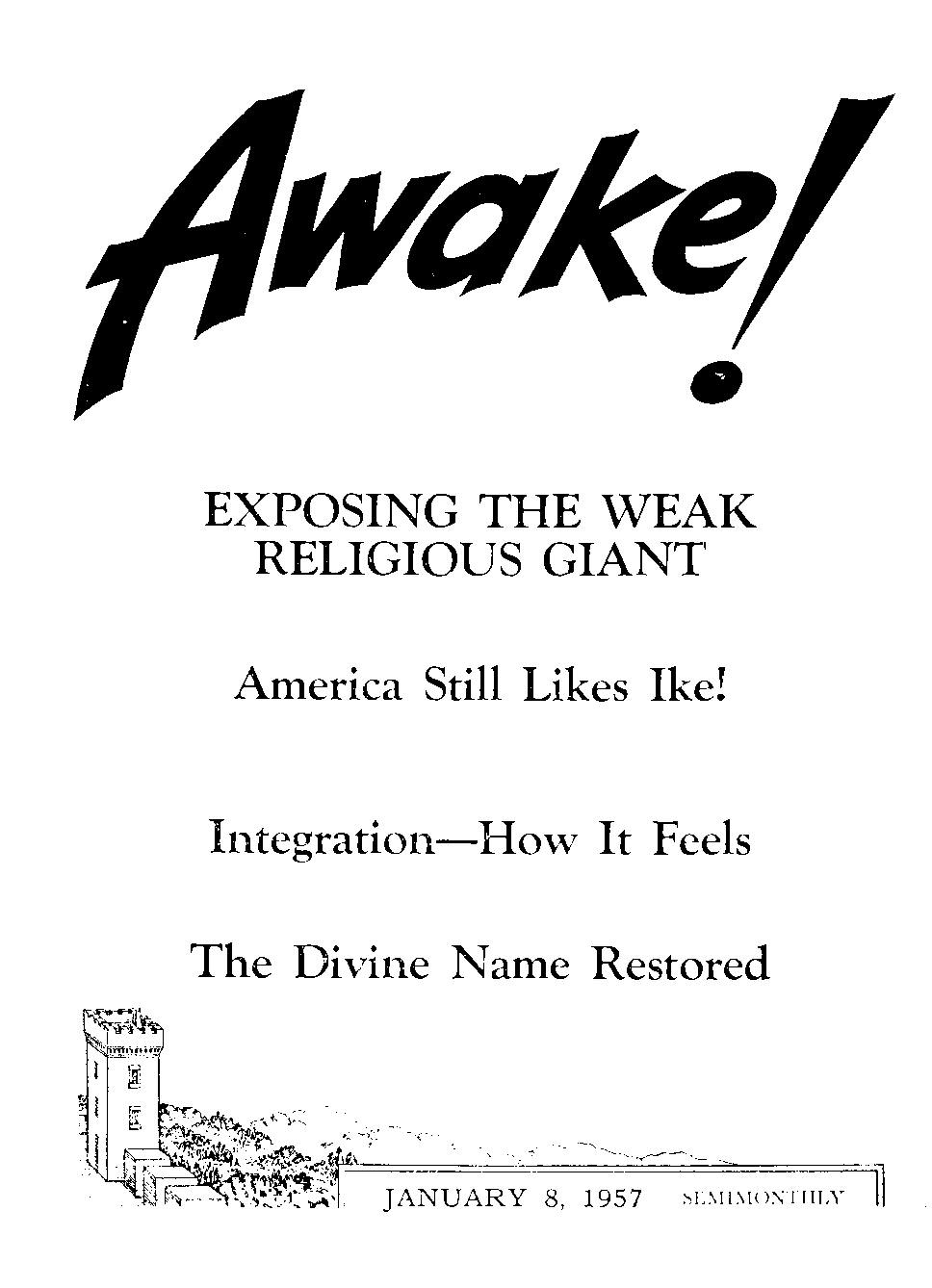
EXPOSING THE WEAK RELIGIOUS GIANT
America Still Likes Ike!
Integration—How It Feels
The Divine Name Restored
THE MISSION OF THIS JOURNAL
News sources that are able to keep you awake to the vital issues of. our timba must he unfettered by censorship and selfish interests. “Awake 1” has no tetters. It recognizes facts, faces facts, is free to publish facta. It is not bound by political ambitions or obligations; it Is unhampered by advertisers whose toes must not be broaden on; it is unprejudiced by traditional creeds. This journal keeps itself free that it may speak freely to you. But it does not abuse, its freedom. It maintains integrity to truth.
“Awake 1” uses the regular news channels, but is not dependent on then^ Its own correspondents are on all continents, in scores of nations. From the four corners of the earth their uncensored, on-the-scenes reports come to you through these columns. This journal’s viewpoint is not narrow, but is international. It is read in many nations, In many languages, by perBona of ail ages. Through its pages many fields of knowledge pass in review—government, commerce, religion, history, geography, science, social conditions, natural wonders—why, its cover' age is as broad as the earth and as high as the heavens.
“Awake I” pledges itself to righteous principles, to exposing hidden foes and subtle dangers, to championing freedom for all, to comforting mourners and strengthening those disheartened by the failures of a delinquent world, reflecting sure hope for the establishment of a righteous New World.
Get acquainted With “Awake!” Keep awake by reading “Awake!"
Pusushbo SairrsrwrHtr Br
WATCHTOWER BIBLE AND TRACT SOCIETY OF NEW Y’OftK. INC.
117 Adams Street, Brooklyn 1, New York, U. S. A. N. H. Knobs. President GsiNt Sun™, Secrvtory
Printing this Issue: 2,050,000
Odw lineaefM Ie whkh "Awikil" h. eatlhSM: SHtfMMtMr—Alrlkuns, Finnish, /resell, Anntir, ureeft, Holland l^h, Halim, Norwegian, Hpankb. Swtdlih,
MnWr—Daahh, ituanui, Portutuege, Ukrainian.
Tetri, suhwrlutlon rerea
Heu tre Mmlmonihly pHtiona
«e«lH. U.S., 117 Adams St., Brertlyn 1. N.T. *1 Antral la, 11 Bareslmd Hd., Strattintld, N.si.W. 8/* CmiIb, ISO Bridgelinii Are., Torocto 10. Oct. *1 Efland, 31 Craven Terrace. Ijmdori w. 2 t/.
M(« G.P.O. Box 30. Welllsstao. C. 1 th
South Afrha, Prirale Bit, ElnuMsiiein, T>1. tj-
Mrerttily UHI«ment 1n« th* atom ratal.
Five tents a copy
HeeiHinw should be acai io oMIh k rrur cwia-IU tn compliance with irgutatlocs to Guarantee ante ttaUrerr rf moder. BenrilUneea ar, accepted at Brooklyn horn' cpunlrks where Qu office la located. By Inifftutlsnal money tinier only. Subuslptltm rate, la different countris ar, here ata tret In local ctmrencr Mallee of eaelrallea (with renewal hlanlc) la sent at lead, two insure before aubsiilollon expires. Ctieafi ef liitrea when wot u> our office may tn ertneetert efferttre wltlrhr one nmrrih. Sew. your old as veil a, new address.
Entered u ncond-dMa matter at Brenklrn, N.T.
Printed la U.S.A,
CONTENTS
Are You Really Awake?
Exposing the Weak Religious Giant
Size Exaggerated
Unable to Defend Self
America Still Likes Ike!
Democrats Take Congress
Integration—How It Feels
Hate and Fear
Women Were Made to Please
The Dangers ot an Atomic War
What New Year’s Day Do You Keep? 21
The Art of Tea Tasting
Greenland—An Old Real Estate Trick 24
When Humans Fail
“Your Word Is Truth’'
The Divine Name Restored
Jehovah’s Witnesses Preach in Ail the Earth—-Panama
Do You Know ?
Watching the World
SOME people look at the title of this magazine and indignantly reply: Tm awake; why offer it to me?” But are they really awake? Are you? Many people are awake to the latest neighborhood gossip or to the newspapers’ latest scandals, but are you awake to the urgency of our times and to the fulfillment of vita! prophecies?
With so many sources of conflicting information today, it is difficult to keep from being misled. How can you keep from that? By having reliable facts backed up by the Supreme Creator, the Sovereign of the universe, Jehovah God. Because it accepts his Word this magazine can help you stay awake today.
It is true that there is more knowledge now than ever before, but Paul spoke of those who would be “always learning and yet never able to come to an accurate knowledge of truth.” Certainly that describes much of the world today. Who can explain the reason for present difficulties? Who can show the way out? Only those who are willing to put aside their own learning and accept God’s wisdom can do so. Are you willing to do it? Then Awake! will be pleased to help.—2 Timothy 3:7, New World Trans.
Why is this alertness so important now? Because we are living when Bible prophecies are being fulfilled. Few people really are awake to this fact. Yet the Scriptures foretold World War I, man’s failure to bring peace, the failure of the League of Nations, its reappearance as the United Nations, and even its eventual end. They foretold the increasing persecution of true Christians, the falling away from right doctrine that ’ is evident today, and the preaching of the good news of God’s kingdom earth-wide. They said that in one generation this would happen. And, amazingly, it has happened in our generation!
Are you awake to these facts? They are recorded at Matthew 24, and the League of Nations is described under the symbol of a beast at Revelation 17:8. They are things that God has said. Your religious leaders never taught them to you? Then, indeed, it is time to wake up and find out why! In doing this you will also learn the happy fact that real peace is near, and how it will come.
It is surprising, but true, that not everyone likes what the Bible says for today. Some people do not like the way the Bible differs from much of what is taught in today’s religion. And instead of correcting religion, they merely dislike the Bible’s statements. But for people who want facts,
Awake! offers Its services. Its articles are true. It faces facts. It puts reliability ahead of popularity. But, then, so did Jesus and his disciples! If you are like the first-century Christians, and want facts even when they hurt, then Awake! is for you.
It hopes to stir you to deeper thought, to personal investigation, to intelligent discussion, and, yes, to a more wide-awake view of the reasons for today’s troubled conditions and of their outcome, as foretold in God’s Word, the Bible.
SUPPOSE you had to walk alone at night along a dark street on which a number of pedestrians had recently been attacked. You, no doubt, would proceed with due caution, would you not? Of course, if you had at your side a giant nine feet three inches tall, as was the Russian giant exhibited in London back in 1905, you most likely would feel quite safe.
But would you truly have reason to feel safe? Not necessarily. Why not? Because giant in size does not always mean giant in strength. In fact, more often than not, physical giants do not have proportionate strength. We are also told that they are often mentally weak and lack courage; are easily led morally and have poor control over their members, being clumsy, irritable and moody. They also have a tendency to advertise themselves as being larger than they actually are.
All of this is in striking contrast with dwarfs and midgets, who seem to be compensated by exceptional mental and physical health. History records a curious assembly of giants and dwarfs that a certain seventeenth-century empress of Austria brought together from all parts of Germany. The caretakers had worried about the fate of the dwarfs among the giants, but instead of the giants’ harming the dwarfs the dwarfs so annoyed the giants that the giants complained with tears in their eyes, and so sentinels had to be brought to protect the big creatures.
Why should this have been the case? Because giants, as a rule, are freaks suffering from h disease known as gigantism, caused by overactivity of the pituitary or growth gland, frequently induced by a tiny tumor. Because this exaggerated activity is not uniform the bones may grow very
large, but not the muscles. Usually the heart is not equal to the added strain and so the pulse is either very fast or extremely feeble and slow. Frequently giants are impotent, short-lived and succumb to diabetes.
Among the world’s religious giants is the Roman Catholic organization, which claims to be the largest of them all. According to the Roman Catholic Register of Denver, Colorado, July 4, 1954, this giant has a membership of 472 million, or about one fifth of earth’s population. Since he also claims to be the one true church Christ established, it would seem that those men of good will who have sought safety in the company of this giant are very wise. But are they? Not if that giant is not what he seems to be. What are the facts?
Size Exaggerated
The facts show that this religious giant has seven glaring weaknesses, being very much like the weak physical giants. And should anyone feel offended at the facts herein presented let him note that it would be far more logical to take offense at the ones responsible for the facts rather than at the ones bringing the facts to his attention.
As a first weakness we note that this giant has greatly exaggerated his size. Thus, according to the Allentown, Pennsylvania, Evening Chronicle, March 3, 1952, the much vaunted "thousand churches of •Rome” are only 643, and of these 501 are in operation, the rest being closed. And inasmuch as this giant counts as members all infants as soon as they are “christened,” instead of counting only those "confirmed,” he exaggerates his size at least 15 percent.
Then again, according to the New York Times, June 19, 1955, the Roman Catholic Canon CwJe YwAds that anyone “christened” a Catholic remains one unless he is officially banned from his church by the proper ecclesiastical authorities. That this means still further exaggeration is apparent from the results, of a poll made by a Catholic chaplain during World War n, as reported in the Catholic magazine America, January 29, 1944.
This chaplain found that of 164 Catholics that had entered his hospital sixteen had invalid marriages; eight nominally Catholic would have absolutely nothing to do with him; twenty-six had not been to mass for one and a half to eighteen years and four had not even made their first communion. This would indicate that of the grown male Catholic population in the United States, one third were not even Catholics nominally. This religious giant greatly exaggerates his size.
Weakness of Mind and Body
Cas. aJsa ■m&I vA rriigiuus 'grarft that, like most physical giants, he is mentally weak, easily led, and that he has more bone than muscle, in that his members are also weak ? It can.
Proof of his mental weakness can be seen in his being an imitator rather than a leader. This is a very serious weakness, for it means that what he will do depends upon what others do. Thus, for example, The Catholic Encyclopedia states that it was because Europe was being flooded by Protestant Bibles in the common tongue that the Catholic Church found it necessary to produce the Douay Bible in 1610. It failed to grasp the people’s need for God’s Word.
The same is true today, 350 years later. Thus the Christian Century, October 26, 1955, quoted Chilean priest Munoz as saying: "To defend ourselves from Protestantism ... we should print around 500,000 Bibles to be sold at a very low price. This TTfost ’ue ftune soon." Mier lour centuries this giant wakes up to the Chileans’ urgent need for God’s Word!
With the mind’s giving such evidence of weakness, is it any wonder, then, that the body, the muscles, the members, are likewise found to be very weak? Our Sunday Visitor, April 11, 1954, tells of only 28 percent of Catholics having "ever done anything to win a convert to their religion.” When a group of Mexicans in Texas, most of whom were theoretically Catholics, Were asked if they had ever heard of the Gospel, ninety percent answered No. —Time, October 31, 1955.
Could we imagine Jesus and his apostles exaggerating the fruits of their labors? Or imitating their enemies ? Or could we think that 90 percent of the early Christians had never heard of the good news of God’s kingdom? Or that most of them had never seen any of the scrolls of the Hebrew Scriptures, when Luke tells us that the Beroeans searched the Scriptures daily? (Acts 17:11) Is not all this further proof of the weakness of this religious giant?
Lacking Courage a Third Weakness
Do the facts show that this religious giant is also lacking in courage? They do. Thus, when leading American Catholics petitioned the pope to excommunicate Hitler the pope ignored their petition even though Hitler was proceeding from one diabolical crime to another.
Instead of excommunicating murderous dictators, this giant made concordats with them, pledging them support in return for special favors. Thus by a concordat signed between the Vatican and Spain in August, 1953, the political chief has the final say as to who will be* appointed a Catholic bishop in Spain. In return only the Catholic Church has full religious freedom.
Since their head is so ready to compromise, is it any wonder that the Catholic layman behind the Iron Curtain likewise readily compromises?'It is therefore not surprising to note the words of a Catholic columnist, as published in a leading newspaper of Guatemala City, Nuestro Diorio, February 16, 1956: "We Catholics lack integrity, The courage to face the enemy is totally lacking in us. We are not capable of defending our religion . .. because of a faint-hearted spirit.”
Easily Led Morally
A fourth common weakness of giants, as we have noted, is that they are easily led morally. Does this also apply to the world's largest religious giant? It does. The Catholic Encyclopedia has the following to say regarding the respective popes: Pope John XII of the tenth century “was a coarse and immoral man, whose life was such that the Lateral) was spoken of as a brothel and the moral corruption of Rome became the subject of general odium,” Of Benedict IX of the eleventh century we read, again in The Catholic Encyclopedia, that he was “a disgrace to the Chair of St. Peter.” And of Leo X, who lived when the Reformation began, it is said that he had an “insatiable love of pleasure” and that he "gave himself up unrestrainedly to amusements,” even attending obscene plays.
And according to A Complete History of the Popes of Rome, by Catholic historian De Cormenin, Pope Hadrian VI, who followed Leo X, in a letter to the Diet of Nuremberg bemoaned "the corruption of the morals of the Roman Pontiffs,” and said that the contagion had spread from the pontiffs to the prelates to the monks, “so that now it would be difficult to find a single priest who was exempt from simony, robbery, adultery and sodomy.” In fact, down to the present century, the morals of the Roman clergy have been a scandal time and again in Latin-American lands.
Further, note the answer of the Homiletic and Pastoral Review, January, 1948, to a priest’s question: “Would it be a violation of legal justice for a medical doctor not to include all his income in his tax returns?” “No, it would not be a Violation of legal justice. Since income tax rates are high, some [Catholic] moralists teach that a person who conceals a third or a fourth of the real value of taxable property is not guilty of a legal injustice.”
How different from all this was the sterling honesty preached and practiced by Jesus and his apostles! They were not influenced by the moral tenor of the times but were lights, showing men what was right and what was wrong. Surely in this respect the religious giant also shows himself extremely weak and not the church established by Christ.
Lacking in Control of Members
A fifth weakness of giants is their inability to exercise self-control; they are often clumsy, irritable and despondent. Would this also be true of the religious giant here being considered? Let us see. Archbishop Kenrick of St. Louis, one of the some 765 prelates in attendance at the Vatican Council of 1870, which declared the pope infallible, when he spoke ex cathedra, said regarding this council that it “was turned into a theological arena, the partisans of opposite opinions exchanging blows back and forth with the hot temper that is more common in theologians than in bishops though not becoming in either.” And one third of those who had been called absented themselves from the final vote, the dogma being passed by a vote of 533 to 2. x
And as for the laity, an Irish historian and biographer writing in Life magazine, March 16, 1953, reported that in Ireland only 25 percent of the men marry under thirty-four years, in spite of all the preaching by the church that the Irish should marry and raise large families. The population of Ireland keeps on growing smaller and smaller.
And the New York Times, October 11, 1954, told of 5,000 pilgrims from Holland, Austria, Switzerland and Geimany flocking to a spurious shrine in Germany, in spite of the threat of excommunication. In New Orleans the local archbishop early in 1956 had ordered racial integration, only to postpone it at least a year because of the opposition by his flock.
Surely this lack of control of his members is another very serious weakness of the religious giant. To use another analogy, of what good is a large army if so many of its officers and soldiers refuse to obey orders?
Unable to Defend Self
We have seen that in one instance an assembly of giants begged for protection from dwarfs; and so, likewise, we find this world’s largest religious giant unable to protect himself from his opponents, even though they be dwarfs.
Unable to protect himself, he enlists the arbitrary use of secular power. Thus, although Spain is 99.9-percent Catholic, it is necessary for the state to protect that 99.9 percent by discriminating against the .1 of one percent that are tiny dwarfs by comparison. And in Quebec, Canada, a Catholic premier not Long ago had a law passed making the activity of Jehovah’s witnesses illegal, although the Catholics outnumber the witnesses some 3,000 to one. A giant 3,000 times as large as the dwarf and yet seeking illegally to restrain the dwarf!
A further proof of the inability of this giant to protect himself is his resorting to such foul means as murder, mob action and boycott, even as a boxer would rain foul blows upon his opponent if lacking in skill or strength. Yes, by resorting to any and all such tactics this religious giant is cravenly admitting his weakness: the weakness of being unable to combat ideas with ideas, logic with logic and Scripture with Scripture. Early Christians used only the “sword of the spirit,” God’s Word; no carnal weapons.
Spiritually Impotent
The seventh interesting parallel between the physical and religious giants relates to the impotence of the former, who are unable to have offspring. In this respect such giants may be said to be like certain religious leaders Jesus mentioned who traversed land and sea to make one convert, who, when made, was worse off than he had been before. Can this charge also be laid to the world's.largest religious giant? It can.
A classic example is Mexico. Thus a Catholic writer of the times tells of the difference in the Mexican Indians that the coming of the Spaniards brought about. “If formerly the Indians committed wrong they did so secretly, but now they have learned not only to do it without shame but even boastingly. Formerly the Indians dared not to steal; now they have become bandits. Before the Spaniards came to the villages, the houses were without doors, nor was there any fear of losing anything though all should go away to church. Now, not even the doors and locks are sufficient protection.”—Quoted in Religious Aspects 0/ the Conquest of Mexico, Professor Braden, Northwestern University, Evanston, Illinois.
And coming close to the present day, the late American Catholic Bishop Noll once said: “Nearly all the evils of society prevail most where we Catholics live. ... In areas where the population is 80 percent Protestant, the family life is most wholesome, and the divorce rate is low." And this is in keeping with other damaging facts, such as the prevalence of licensed prostitution In Roman Catholic lands and the high percentage of illegitimate births, accounting for 20 to 75 percent of all births in Central and South American lands, all of which are predominantly Roman Catholic. Surely, therefore, so far as Christian fruitage is concerned, this religious giant is lamentably weak, impotent in fact!
In view of all the foregoing it might well be asked, What accounts for this religious organization’s being so large and yet so weak? Among the reasons that might be given is the stressing of quantity and size instead of quality and strength. Another reason is the appealing to and feeding of the emotions instead of appealing to and feeding the reasoning faculties. An especially vital factor is the stress on the fear of purgatory and hell as a motivating force instead of stressing love of God and love of one’s fellow man. And, doubtless, most important of all reasons for this weakness is the failure to study and to teach God’s Word and to practice its precepts.
From these seven weaknesses and their obvious causes it is very apparent that this religious giant could not be the church that Christ established and that it is foolish for men of good will to look to it for protection. So, men of good will, separate yourselves from this pitifully weak religious giantlike organization. Study God’s Word with those who are following the example of the early Christians and who are bringing these facts to your attention. Learn of all the blessings Jehovah has in store for those who love him with their whole heart, mind, soul and strength and who love their neighbors as themselves: endless life in God’s paradisaic new world. True, the numbers of this group of earnest Christian witnesses of Jehovah may seem small, even dwarflike, but you need not fear, for “if God is for us, who can be against us?”—Romans 8:31, New World Trans., margin.
Adlai Stevenson, the Democratic party’s candidate for president of the United States, was limited in the attack he could make on the
How the U.S- presidential campaign progressed, why it went the way W did, and what it means far the future.
★★★★★★★★★★★★★★★★★★
Republican candidate, Dwight D. Eisenhower. Adlai knew that the people liked Ike, yet his job was to convince them that Ike and his Republican administration should be replaced by a Democratic one.
This was not an easy job.
Stevenson had already been soundly defeated by President Eisenhower in the 1952 campaign. It was obvious that a personal attack on the popular president would not be successful. Also, the Republican “peace and prosperity” slogan looked good. How would Adlai go about trying to overcome these obstacles and win the election?
He had to make his attack on the vice-presidential candidate, on Ike’s health and on the policies of Eisenhower’s assistants and administration—but not on the integrity of the popular president himself.
The theme that Mr. Stevenson hit again and again was that Mr. Eisenhower had been “a parttime” president who “is not master in his own house.” Stevenson bucked the Republicans’ “peace and prosperity” slogan with the contention that peace was not so sure nor prosperity so evident as the Republicans claimed. Seeking a good peace issue, like Ike’s I-will-go-to-Ko-rea talk in 1952, Stevenson said the hydrogen bomb tests should be ended, and that the draft might “be ended at the earliest possible moment consistent with national safety.”
The attack on the president’s health seemed to lose much of its punch in view of Eisenhower’s appearance of glowing good health during the campaign. The proposals regarding the hydrogen bomb generated considerable talk, but little real national enthusiasm, since most people seemed to think this was a matter for the experts and not one they could decide individually. The proposal regarding the draft left Stevenson open to the charge of advocating weaker national defense. The White House called it “loose talk ... hurtful to America’s security interests.” None of these issues really seemed strong enough to remove the Republican president from his position of national leadership.
Peace and Civil Rights
When peace collapsed in the Middle East and in Hungary, Stevenson called on all Democratic candidates to join him in “hammering home the lessons of the Middle Eastern debacle,” which he blamed on “the ill-considered and mistaken policies of the administration,” But actually the worsening world situation strengthened the president, not Mr. Stevenson. The administration’s efforts for a cease-fire in EJgypt dramatized Eisenhower’s peacemaker role, and many voters seemed to think that if war did come the experienced general would be the best man to see the nation through.
Both the Democrats and the Republicans went lightly on the politically delicate civil rights question. On one occasion, though, in Little Rock, Arkansas, Stevenson came out squarely in support of the Supreme Court’s school integration decision. There was a moment of tense silence, then strong applause. Yet the Republicans seem to have benefited most from the civil rights issue. The fact that the Supreme Court ruling on desegregation came during a Republican administration helped prompt a heavy Negro vote for Eisenhower, and therefore away from Stevenson and the Democrats.
Stevenson labored endlessly to perfect his speeches. He lowered his tone, campaigned harder and tried to get closer to the people than he had done in 1952.
Meanwhile, Stevenson’s running mate, Senator Kefauver, was in a popularity contest of his own. He made the campaignings ist campaign in all U.S. history! He traveled 54,000 miles, gave 450 speeches in 250 places and shook an estimated 100,000 hands! If that hand-shaking figure sounds astronomical, it is dwarfed by his associates’ very questionable claim that they counted him shake 5,595 hands in one hour at a Flint, Michigan, factory gate!
Despite all the Democrats could do, Eisenhower was far ahead in the popularity campaign. Almost every public opinion poll put him in the lead. The Saturday Evening Post said: “It’s never ‘time for a change’ unless what you’ve got is pretty bad and what you’re likely to get from a change promises to be a lot better.”
Apparently the people did not think that what they had was very bad or that the change would be much better.
The Windup
In the campaign’s windup Stevenson said the crisis in world affairs had stemmed from President Eisenhower’s “part-time conduct” in office. He asked whether the nation was prepared to accept Richard M. Nixon to guard the hydrogen bomb, to represent America before the world, and to serve as Commander in Chief of the armed forces. He said: “Every piece of scientific evidence we have, every lesson of history and experience, indicates that a Republican victory tomorrow would mean that Richard M. Nixon would probably be President of this country within the next four years.”
The Republicans took a different tack. They ended their campaign with an hourlong election-eve television program on which Nixon said the people of the United States are “getting the kind of government they want,” an honest government under which they can make a good living, which provides security and can keep the peace. He asked that Eisenhower be given the chance to finish what he h$d started.
The Landslide
Apparently the people agreed. They gave Dwight D„ Eisenhower a resounding vote of confidence, cutting across party lines, voting habits and long-standing political traditions. Eisenhower took the entire northeast, captured Midwest farm lands, shattered Democratic hopes on the Pacific Coast and cracked the solid South even deeper than he had done in 1952. Even Louisiana, Democratic since 1876, and not given a second glance by political observers, voted for him!
Strongly Democratic Jersey City went Republican for the first time in thirty-six years. Democratic Chicago, and even Montgomery, Alabama, the birthplace of the Confederacy, voted for him—the first time a Republican has won an election there since the reconstruction that followed the Civil War. The southern states of Kentucky, West Virginia, Virginia and even Kefauver’s home state of Tennessee chose Ike. A total of forty-one of the forty-eight states voted to return him to the presidency /or another four-year term.
Only in the Midwestern farm states did Eisenhower lag behind his 1952 victory, but he still won each of those states except Missouri. Despite the Democrats’ strong appeal for the farm vote, many farm areas turned toward Eisenhower rather than away from him. Peace was the dominant theme, and in the glow of the Eisenhower personality most of the other issues melted.
Twenty-two minutes alter the New York polls closed the New York Daily Mirror went to press with the headline: “Ike Wins!” When only a fifth of the vote had been counted the cautious New York Times proclaimed: “Eisenhower Wins in a Sweep.” An hour and a half after the first results came in Stevenson was working on his concession speech, though, typically, he polished and rewrote it until after midnight.
In all, Eisenhower received thirty-six million votes to Stevenann’s, twftwty-sxx. million, making the figure 58 percent for Eisenhower, 42 for Stevenson. The thirty-six million votes Eisenhower received gave him the greatest popular vote in United States’ history and the second-greatest plurality as well.
Democrats Take Congress
But despite Eisenhower’s personal victory, he failed to carry his party into power Since 1848 no president had failed to carry with him at least one house of Congress. But in 1956 the people chose a Republican president and a Democratic congress, Eisenhower, though one of the strongest political figures in United States’ history, had not successfully convinced the people that he had made the party over into his own image. As a result, he must deal with a Congress organized by the opposition.
It is argued that a Democratic congress and. a. mmiA Vrve’m
peace. Under normal condition^ this may be true, but this time it may not be as important as both parties have tried to make it seem. The differences between Elsenhower Republicanism and the moderate Democrats are narrow, and, generally speaking, Eisenhower had less trouble with the Democratic-controlled 84th Congress than with the Republican-controlled 83rd. Now that his prestige is at a new peak, he may be able to do even better with the 85fh.
However, there is another difficulty. The President’s own party is well aware of the fact that the Constitution forbids him from running for a thir(i term. This being true, Republicans who aspire to succeed him may soon be expected to start exerting themselves. Some of these aspirants will be right-wing Republicans who disagree with many of Eisenhower’s policies. Whether the president’s desire to have consider-afcj>e ■say in Yne nomination ot his successor will keep these members of his party in line is doubtful, in view of their past opposition to his policies.
Thus, as the 1956 election fades into history, the politicians of both parties already are looking to I960 and beyond. After the campaign was over Senator Kefauver was asked why he was shaking hands with American Airlines personnel. He replied: “I have to keep in practice.”
A lot of practicing can be expected between now and I960.
/j/iT&A dressinK I went to breakfast. W^r MZv For my little brother Timmy, who is three, it was just another day. For Cathy, who is twelve, it promised to be a day of fun. Cathy was entering her last year at the all-Negro grade school. Bpt for me it was something new. Something to dread. The time had come when I, along with a few other boys and girls, was to enter an all-white school.
Integration.
I had only read about it when it happened in other Southern States. Now integration had come to our state. Our town. In other places where there was to be integration there had been violence.
Mother, at breakfast, was just as nervous as-1 was. "I don’t want anything to happen to Peggy," Mother said.
“I don’t want anything to happen to Peggy either,” Father said. “I don’t want anything to happen to any of the-children. Why should anything happen? This is a peaceful town. We never had any trouble in this town. Never had a bit of trouble.”
“But that man has been around," Mother could not forget. "He has called from door to door among the white people.” Then, too, there was a booklet some people had.
“What a horrid booklet!" Cathy remembered. I remembered too. On the cover it showed three Negro men with their arms around two white girls. One of the Negroes was kissing one of the girls. "Mongrel” was the name of the booklet.
“Why should that man stir up any trouble?” Father did not believe he could stir up the people. “I pay taxes in this county. I’m a citizen. Why shouldn’t my children go to the school nearest home? Why should they have to go a long way off?”
I said: "Margaret Steiner said that that man told her parents that if we Negroes went to the white school they’d better not let their children inix with us, or they might want to marry us.”
Father scowled hard over the top of his coffee cup. “You are not going to school to get a husband. You are going to get an education,"
Breakfast passed very quickly. Then it was time to go. Father and some other of the neighbor men drove us down to school. Mother rode along. Timmy came too. Timmy had heard us talk about the segregationist doing bad things. He wanted to see what the "bad man” would do.
The First Day
No one talked as we drove near the school. We could see white people standing around. Not all of them were students. They were waiting, just waiting, “I’m scared,” I confessed. “I wish those people wouldn’t look at us so hard.”
The other students in our car were scared too. Mother hugged Timmy very tight. She tried not to look to the right or to the left. Father encouraged us to show that we had grits, as he said.
Father brought the car to a stop at the front entrance. There were white people standing all around, Alvina, my closest neighbor, who is fifteen, looked at me and I looked at her. “Now keep your chin up,” Father encouraged. “Remember that none of you children were forced to do this. This is your own choosing. Just show them that you’ve got grits.”
My knees felt shaky, but we got out of the car. We walked down the sidewalk a half-dozen steps. I got more nervous with each step. I could feel the tension mounting. Somebody shouted. Then it seemed that everyt^dy was shouting. Several young boys, maybe ten or eleven years old, walked up and down the sidewalk shouting: “We don’t want integrated schools. Go home, niggers. No niggers allowed. Go home, coons.” Cars began to drive past the school with signs on them saying things like that—“Open season on coons,” "Go back to Africa.” I was in the lead. One of the small boys walked up and rudely put one of the signs in my face.
We began to walk up the steps. My best friend, Sue, who is sixteen, walked up beside me. We walked together. When we got about halfway up the steps, the people became suddenly quiet. .They looked at us as if we were strange animals. I thought we would never reach the top of the steps. How I wanted to turn and run! How I wanted to run back to the car and go home!
But once inside the front door I felt a little better. We were all glad to get in. Ricky, who is fourteen, said: “Wow, I’m glad that’s over!”
The students in here seemed friendlier. Some of them smiled at us. At least no one said any harsh words.
We walked up the hall and stopped near the office, hardly knowing what to do. I had my back turned toward the crowded hall. Suddenly someone was pulling my hair. I think it was a girl. Just then the bell rang and everybody tore away.
We could go to our first class now. Was I glad to sit down! And it was a very wonderful sight to see Tony, who is sixteen and a senior, going to class with me.
Tony and I sat in seats across from each other. We began to talk about how the people had acted. We wondered if they were going to do the same thing every day. The white students were coming into the room. Some of them came over to where we were sitting. They introduced themselves and asked us our names. They asked us how old we were, what grades we were in and what sort of things we were interested in, such as class subjects. One of the girls, named Betty, asked me how I thought
yet.” Betty said: 'Tm sorry things have to be this way.”
Then there were reporters in the room. When the teacher ehtered a film was made. We finally settled down and the teacher called the roll. After that she stood up and talked to us. She told us, meaning the white students mostly, to stay out of the crowd, because that made it look worse. She told Tony and me how sorry she was about the •way the people were acting. She hoped that everything would change in a few days. I knew immediately that I was going to like her.
Except for a few smart words that I heard once in a while, the rest of the day went smoothly. In every class the teachers treated me without the least bit of prejudice. I kept meeting more and more nice students. But some of the students would not look at me, as if to say, “In a few days you won’t be here.”
But as the day wore to its end that fear Thad felt returned to gnaw at my nerves. The three-thirty bell rang. I looked everywhere frantically for one of the other Negro students. But the halls were solid rivers of white faces. I would have to go out and face the crowd alone.
How I did it I’ll never know. As soon as I stepped out the door they yelled: “Here they come!” I walked down the steps not looking at anyone. Our parents were waiting, but they had to wait all the way at the top of the hill.
Somehow we made it through the ugly, jeering faces. When we were all accounted for we started home. There was much talk now. Each student was trying to tell his parents what had happened. I told Father and Mother I didn't believe I could stand a second day of this. That was the way the other students felt.
The Second Day
I awoke the second morning feeling the same way I had the first, only worse. Now I knew what it was like for Integration to come to our town. But I went on anyway. Almost all the other Negro students did too.
This day there were more people, more signs, and a new name. A new segregationist was in town. I, had heard the name before. The Sunday before school started there had been talk of this man. He was really here now. He was going to do all he could to get us out of the school. I heard most of the rumors from the students in school. I guess I heard so much that day that I could write a whole book. In every classroom the students were talking about him. Their opinions were not very much in his favor. Some said they thought he was ignorant. Some wished he would go home and leave us alone. Some said they thought the people who were following him were just plain silly. Many were surprised to see their friends on the outside taking part in the activity. Everyone that wanted it to turn out all right had hoped the situation would get better. But now that the man with the soft but powerful voice was here, it was bound to grow worse.
The more they talked about it, the worse I felt. I had never known so much fear. Just to think of trying to go on with it made me shiver. There was no use trying to concentrate on my lessons. All I could think of was that angry mob outside, waiting and waiting for the three-thirty bell. It was strange. It was like some bad dream. All of a sudden these people, who had pretended to be our friends, were really in their hearts full of hatred and deceit.
The Third Day and Violence
The third day I shall never forget. It was the day the fire really started to bum. In the early morning we received a phone call. The police told us that there were a good many people standing around the school, but if we wanted to, to come to school anyway. Our parents were really undecided. I didn’t think I could stand another day of it, for sure. But finally we decided to go.
When we drove down to the school there were people everywhere. Never had I seen so many people in this small town. Not even when there was a parade. As soon as they saw our cars coming down the hill they shouted, “Here they come!” Some shouted to the reporters, “Get their pictures!” I was so scared I gripped my jaws as hard as I could to fight back the tears. I wanted to go home. I told my father and mother so.
Father circled the school. We saw one of the town officials. Father asked him whether or not he thought we should go in. Mr. Thomas assured us that we should go in, and not give up. He said we could enter a side door,
I liked that very much—I mean going in at the side door. Anything just to get away from those cruel and vicious-looking people.
Inside there was a great decrease in attendance, which was made up for by the big increase on the outside. There were girls picketing now. They were carrying signs against the principal, saying, “Out with the niggers or out with the principal.” He, the principal, was going through an awful lot. He had been wonderful in everything. His kindness encouraged us a lot.
Nothing went right that day. Negro passers-by were attacked in the streets. A white man tripped a Negro woman, and then a white woman beat her with a bottle. It was not safe for any Negro to walk anywhere in town.
Coming back from lunch one of the Negro students was attacked by a white woman. When he tried to protect himself one of the young boys who should have been in school jumped in the fight and started a terrific one. Both boys were taken to jail. Later on a Negro girl was beaten in front of the School. There was another fight, and more confusion. Things were getting worse every minute. I was afraid even to walk down the hall. Newspapermen were everywhere. They were interviewing us, taking pictures, making television films, the whole school was crawling alive with them. Never had my mind been in such a whirl. My head ached. I felt weak and sick all the way througn.
About an hour before school was out the clerk came around to all the rooms and told us Negro students that we were to be taken home. We were met by the sheriff. He said that the crowd was getting very angry. There was no telling what they might try to do. The sheriff herded us together and loaded us into squad cars. As we passed by the crowd shouted: “You’d better take the niggers home before we kill them.” They would have really loved to kill us.
Bate and Fear
All my life I had been taught to love everyone, no matter what race he belonged to. Every man was created equal. I believed this as a teaching of the Bible. But I could see, in a way I shall never forget, that these people and the ones everywhere like them had other ideas. They still wanted to think of our race as slaves. They were trying to keep us that way. With a leader with as much force as the segregationist had to make them madder, they would surely win this battle.
As night neared on the third day, the town was filled with people. The segregationist was going to speak. The quiet of the night was suddenly broken by loud shouts and cheering. From where we lived above the town we knew the man was speaking. The noise went on until a late hour.
And the next day there were greater crowds than ever on the outside and fewer
students inside. Fear and more fear welled up in me. Everywhere I turned I could see them. Their faces were marked with hate. The police force was very small. How could it handle all these hating people? More fights and arrests. More reporters. More people. More fear.
After school that afternoon one of the cars that some of us rode in was showered with rocks, the young deputy sheriff that was driving us was really disgusted. He had been in the war against those who believed in keeping some people inferior. He had fought for his country and these people. This was what he came home to.
That night we rode through town to get a glimpse of another disgusting sight. A great mob had formed in the square. The segregationist was to make another speech. To see mothers bring their small children out in all of this confusion and teach them to hate was a sorrowful sight. Some of the children were not old enough to walk. Those that were were taking part in what was going on. Many of the children did not have shoes. Their hair was uncombed. Their clothes were dirty and ill-kept. I heard one of the citizens remark, "These poor people, they don’t know what they’re doing.”
Then there was a minister praying, He was asking God to keep the race white. Other men were calling out “Amen!” and praying too, and drowning out each other as at a camp meeting. The preacher prayed for God to protect the segregationist. “Be lovely, be happy, be careful, and stay under the hahd of Almighty God, and be at tonight’s meeting,” he prayed. How could anyone say such things?
The weekend came at last. But the mob kept growing in hate and in numbers. Any Negro would be attacked on sight. Men, women and teen-agers began to rock cars of Negroes who were passing through from other states. They broke car windows.
They beat on cars. They tried to enter the cars and drag the occupants out. I couldn’t believe it. It was all a dream. But it was happening, and happening fast. We did not know at what hour they might surround the hill we lived on and start burning all the Negro homes. A once peaceful and friendly town had turned into a horrible, living nightmare. Help would have to be sent for. Help was sent for, but it was hard to get.
Citizens, State Troopers, National Guard
The next night things came to a climax. All of a sudden a very surprising thing happened. A group of the townsmen, knowing that the law could not or would not do anything, made up their minds to restore order. They organized themselves. They stepped out before the angry mob. They were armed with guns and tear gas. They told the mob to break it up.
The mob stood still for a moment. Then someone shouted, “Let’s get the nigger lovers!” The mob started toward the men. A tear gas bomb went off. This scattered them for a while. But it only brought them back shouting, “Kill the nigger lovers, Take their guns!” A very brave man gave the order and another bomb was let off. There was a terrible commotion and a great deal of shouting. Everyone knew that there was going to be bloodshed.
Then the shouting was drowned out by sirens. The State Troopers had finally arrived. What if they had been just a few minutes later?
The whole town square was surrounded. Finally all was peaceful again.
Early the next morning the National Guard rolled into our town. Big tanks, first-aid trucks, jeeps carrying dozens of men, big trucks carrying artillery, even a helicopter and a plane—all of this just because a few of us Negro girls and boys started to go to the white school.
Even this did not stop the segregationist, nor did his followers stop. On that night even more people came. Then the most vicious thing1 happened. A Negro soldier that had returned home recently from the service was attacked. I was no longer afraid but angry. Angry at those people who were letting their cruel and vicious thinking get the better of them. From now on I felt like fighting back instead of being afraid,
When the second week of school rolled around, I, along with my friends, walked into the school protected by guards who stood near the school with guns. There was still picketing, but before the day was over that was cut out. Once I saw two young boys who carried signs on the sidewalk picked up by policemen and carried off to jail. Things were beginning to change. The crisis of mob rule was passed. Our town Wied vmder the awtol saase toAi-tary rule. Our homes and the homes of white citizens who had been threatened were under guard. Young guards passed by in jeeps every day.
No more outsiders and curiosity seekers were allowed in town. Roadblocks were set up. You either had to have important business in town or be a resident before the guards would let you in. Young people were no longer permitted on the streets late at night.
In a few days the enrollment came up to normal, except for a few students who transferred to other schools. Almost all of us Negro students stayed. Things were finally coming around to what I suppose is normal.
The Scars of Integration
Although our town seems to be peaceful and quiet again, it is not the same. Once we had friendly white neighbors, but they are Teo totYgac tYteridVj’. Qraite out town was friendly, but it is not any more- The crisis has left a strained and sorrowful feeling. The memory stirs in everyone’s mind of how one man can agitate quiet people until they turn into raging, shameless mobs. In our town men in uniform have had to flash bayonets and aim artillery at the people to restore order.
School moves peacefully along, now, but the campaign to get us out, in defiance of the law, is not stoqpetL Lt gpes. an. and. on.. Crosses have been burned in the fields or open places outside of town. On weekends white men parade our street, itching to provoke us, making our lives a terror. There are questions I wonder about that no one seems to know the answer to.
If things had not started off like this maybe we would not feel this way. As it is, we cannot forget. Even Timmy will not forget.
Maybe if the school had been integrated a few years before, it would not be this way now. Maybe by the time Cathy is ready to go to high school it will be different for her. I hope so.
But for now you cannot help feeling this way. Not if you are a girl of fifteen, and eager for friendship, and have to live in such a strange, strained way, almost all to yourself in the midst of a sea of white faces. The teachers try very hard to be kind and understanding. But sometimes toe toae'n&rs ‘wui as'K a question in class and some of the white students will not know the answer, and finally the teacher will ask me, and if I happen to know the answer and give it, the white students will whisper to one another.
The other Negro students feel the same way. When there are school parties we have to stay to ourselves. We feel left out and not wanted. We don’t feel at home. We don’t have as much fun as we used to. We vAiYviys 'witsYi t were sumewnerc e’ise.
Is this the way, I wonder, that everyone feels when he must go through integration ?
l*AOf TO PtfKSV
LMOST all women desire to please, but many of them believe that making themselves attractive is what will please men. But dress alone will not do it. Not that men are hard to please, rather it is because men are more on the lookout for a companion than for a beauty queen. Shakespeare said: “Kindness in women, not their beauteous looks, shall win my love.” And the fineness of woman is her manner.
Generally, publicized beauties are the very last choice that a man of taste would take for a wife. After the first year, married people rarely think of each other’s features, whether they are beautiful or otherwise. But they never fail to be aware of each other’s manner and temperament. It is with this thought in mind that the wise man says: “Grace is deceitful, and beauty is vain; but a woman that feareth Jehovah, she shall be praised. Give her of the fruit of her hands; and let her works praise her in the gates.”—Proverbs 31:2931, Am, Stan. Ver.
That women were created with a charm and the certainty to please can be seen in their qualities and willing desire to be agreeable and submissive to men. But riot all women see that their happiness lies in giving out pleasure to all as a lamp does light and as : fire does heat. It takes just a ’ little female radiance to light up a whole house. A thing as simple as a woman’s smile has been the making of many a man. A cheerful face can be as inspiring as a beautiful day and warm the house with happiness.
When choosing a mate men generally ask themselves, Is she
a happy person? Is she openhearted, gener-dus and unsophisticated? Is she friendly and good-tempered? Is she sympathetic, humble-minded, grateful, kind? Is she self-forgetful? The more a woman forgets herself the more she will please others. But very seldom, if ever, do men ask, What can she do? Rather they inquire, What can she be? Can she be friendly? Can she be happy? Can she be tidy, sympathetic, understanding, kind? A good part of why a man delights to be with a woman is the joy and constant pleasure she brings him. And how can a woman better make others happy than by being cheerful and happy herself? The happy are those who bestow happiness. And “a man that hath friends must shew himself friendly.”—Proverbs 18:24.
Outward actions have a tendency to call for a corresponding emotion. A smile seems to beget a smile; a scowl, a scowl. Even a forced smile has a way of bringing brighter thoughts to the mind, thus cheering up the countenance. Canaries are kept in the house because they sing and appear happy. By their cheerfulness they cheer up their surroundings. So it is with husband and wife—a good laugh, a song, a cheery remark make all the difference in the world.
But how often do we try to be our best, wear our velvet, so to speak, among strangers? We appear bright and gay to outsiders, yet at home to those nearest and dearest to us we let down our guard and think that anything will do. This is a tragic mistake. Try wearing your velvet indoors at home. Give those nearest to you the chief benefit of your gentleness. Be your best to those whom you love and you will most likely not disappoint others.
An Intelligent Companion
Music and other accomplishments are learned as a means of pleasing, but it is doubtful if anything makes a woman more delightful than a well-cultivated mind. She should take an interest in the happenings of the day, be an earnest reader of good literature, and in every way fit herself for giving intellectual pleasure. Empty-headed men may become terrified at women whose brain has not been allowed to die for want of use, but these women have their reward in knowing that thoughtful, educated men enjoy their association and feel greatly relieved in not having to talk down to them.
An intelligent woman continues to be a brigtit, winsome companion in the family circle long after the beauty of youth has faded. A husband can count on her to give just observations, good opinions, sincere and gentle encouragement. This she can do because she is amiable and sensible. There are men who would give up the battle altogether and become utterly reckless at a strategic moment were it not for the wife's influence. Often when men doubt how to act in matters of importance they turn to a woman for discussion, because a wise woman has the understanding of the heart, which is oftentimes better than that of the head.
And too, some women have deeper and softer religious convictions than men, and it is an exceptional privilege for a Christian wife to make the life of her believing or unbelieving husband more spiritual, richer in deeds of love, than it was before she married him. Her husband will be indebted to her if she practices her Christianity as the apostles Peter and Paul advise:
“In like manner, you wives, be in subjection to your own husbands, in order that, if any are not obedient to the word, they may be won without a word through the conduct of their wives, because of having been eyewitnesses of your chaste conduct together with deep respect. And do not let your adornment be that of the external braiding of the hair and of the putting on of gold ornaments or the wearing of outer garments, but let ft be the secret person of the heart in the incorruptible apparel of the quiet and mild spirit, which is of great value in the eyes of God." —1 Peter 3:1-4, New World Trans,
The sweet and modest influence for good that a wife should seek to exercise over her husband will never be reached by sharp, bitter words, or by fits of sullen pride, or by the assumption of masterful airs, or by dictatorial lecturing. Nothing is more distasteful and abhorrent to men than any of these things in a woman; nothing will snatch all power out of her hands so quickly as any of these things. Favor will be won by gracious looks, by tender acts of love, by soft persuasive words, by gentle kindness and deep understanding. The ornament of meekness, the jewels of faith, the veil of modesty, these are the things that win eternal dearness, ----
Women are especially capable of giving sympathy and affection. To express these takes time and energy, but when rightly performed they are the glory of womanhood. If milady is concerned with her face, let her remember that no cosmetic beautifies as much as an unselfish temper. Beauty and accomplishments, says Chesterfield, ought never to be depreciated, especially by those who have them not, but they cannot give as much pleasure as unselfishness, good temper, patience and sympathy.
The Ornament of Love
Woman’s fairest ornament is love. This love will prevent her from being disagreeable in little things. It will help her to realize that they are not all-important. With her the kind greeting, the quick glance of sympathy, the show of courtesy, the display of love that is not jealous, does not brag, does not behave indecently, does not think evil, does not become provoked, does not keep account of the injury; that bears all things, believes all things, hopes all things, endures all things—these make a woman precious.—1 Corinthians 13:4-7.
As the corruption of the best often becomes the very worst, so a woman who by nature is lovingly adapted to please may become intensely disagreeable if she perverts her talents. If her dress is untidy, if she has no scrupulous regard for personal cleanliness, if her manner is brusque or her temper sulky, if she cannot read aloud distinctly, if her voice is loud and crude, and if she can talk of nothing but spiteful gossip or the delinquencies of others, if she is supercritical of others and unforgiving, if she is incapable of sympathizing with the serious pursuits of men, then such a woman will hardly please.
To please does not mean an unconditional surrender of oneself; rather it means giving the good of oneself to others. There is no greater gift that a woman can bestow than for her to use her energy to sway others to do good, to diffuse around her an atmosphere of cheerfulness, godliness, truthfulness and generosity. This is not simply for those who have great talent, nor Is it entirely a matter of great energy; rather it is for all “women professing to reverence God.” It is more a kindness than a gift.
So if a woman has learned the art of doing 4ittle kindnesses, this is great in the eyes of both God and man.
No Miracle Carburetors
C In an article about fuels the December 22 Issue of this magazine quoted from the September issue of JfecAanir Illustrated about a carburetor supposed to give mileages of from forty to fifty miles a gallon. Now the December issue of Mechanic Illustrated explains that this information was given as a joke and was meant as ridicule of the perennial claims about miracle carburetors, and continues: “Companies such as GM, Ford and Chrysler would like nothing better than to bp able to advertise truthfully that their cars definitely give better gasoline mileage than the competition. If they could do this, sales would skyrocket—but the sad truth is, they can’t. So let me point out that any guy with a $2 gadget to double your gas mileage isn’t a dedicated genius but a pretty sharp peddler. Ford Engineering alone has almost 8,000 employees. Add this to GM's and Chrysler’s engineers and you’d have enough people to populate a fair-sized city. Every possible avenue for better gas economy has been explored and they have tested every single gadget that makes claims for better mileage. The manufacturers don’t give a d---about
the oil companies—they're in the automobile business. So rest assured that the carburetor you get on your new car is as good as these boys can put together, from an economic standpoint.”
…