Awake!, December 8, 1956
Download: PDF — Awake!, December 8, 1956
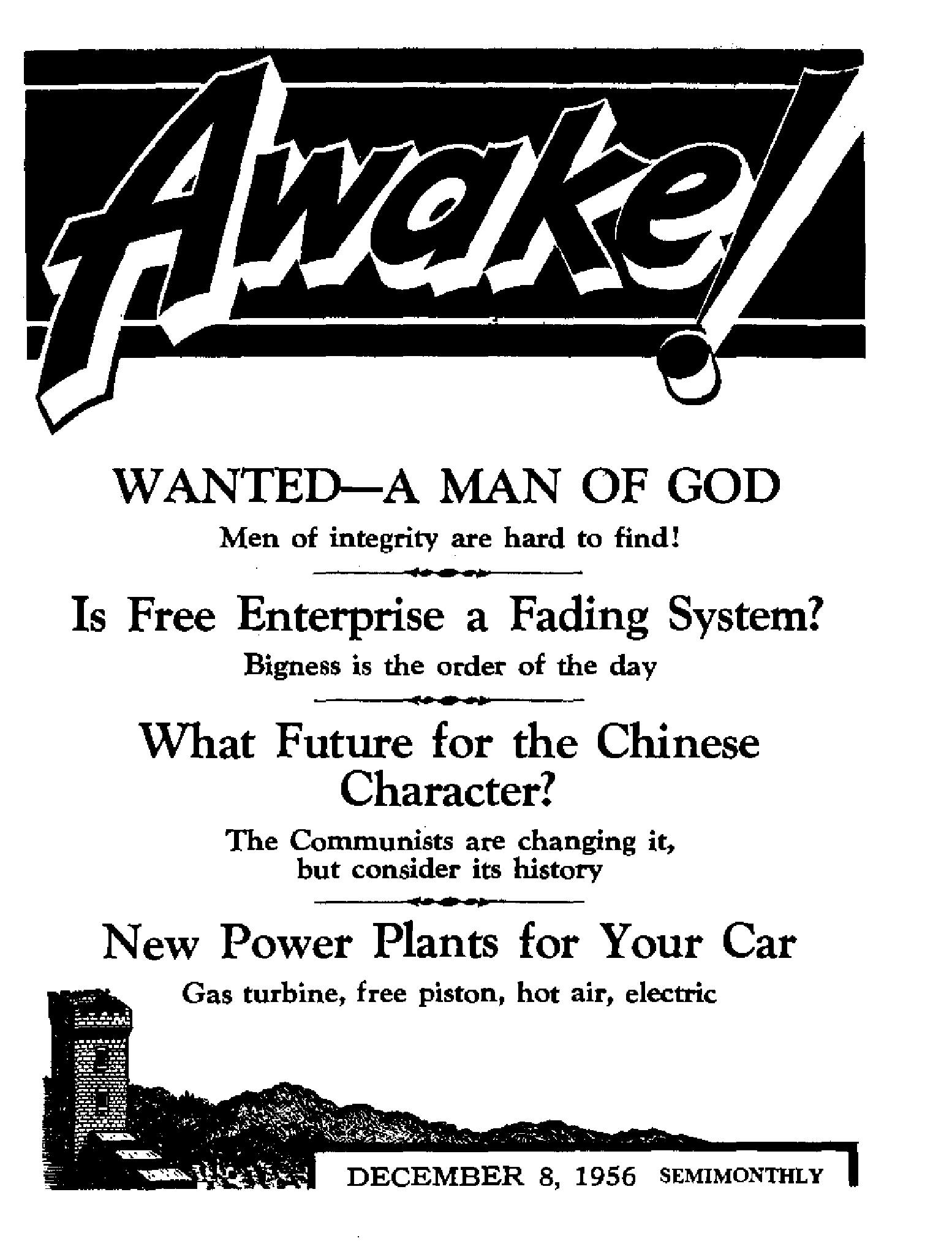
DECEMBER 8, 1956 semimonthly
THE MISSION OF THIS JOURNAL
News sources that are able to keep you awake io the vital issues of our times must be unfettered by censorship and selfish interests. "AwakeJ” has no fetters. It recognizes facts, faces facts, is free to publish facts. It is not bound by political ambitions or obligations; it is unhampered by advertisers whose toes must not be trodden on; it is unprejudiced by traditional creeds. This journal keeps itself free that it may speak freely io you. But it does not abuse its freedom. It maintains integrity to truth.
“Awake!’* uses the regular news channels, but is not dependent on them. Its own correspondents are on all continents, in scores of nations. From the four corners of the earth their uncensored, on-the-scenes reports come io you through these columns. This Journal’s viewpoint is not narrow, but is international. It is read in many nations, in many languages, by persons of all ages. Through its pages many fields of knowledge pass in review—government, commerce, religion, history, geography, science, social conditions, natural wonders—why, its coverage is as broad as the earth and as high as the heavens.
"Awake 1” pledges itself to righteous principles, to exposing hidden foes and subtle dangers, to championing freedom for all, to comforting mourners and strengthening those disheartened by the failures of a delinquent world, reflecting sure hope for the establishment of a righteous New World.
Get acquainted with ‘‘Awake!" Keep awake by reading “Awake!”
Publish so Semimonthly By
WATCHTOWER BIBLE AND TRACT SOCIETY OF NEW YORK, INC.
117 Adams Street, Brooklyn 1, New York, U. S. A. N. H. Kkoib. President Ga* nt Sutm, Secretary
Printing thie Issue: 2,000,000
SUv l»iu«u In which "Awihc!” H pchllihU: SemjneitKy—AfrikuiiB, Finnish, French, Germtu, HolltwHsh* ItallKDj Norrtflic, Bpmlsb, Swedish. Mntbly—Danish, Or«k, Japanese, Portuguese, likriiafaci.
T«rly eubtcrWUoii
QfltM for Bemimunthlr editions
Amrlti, U.S., 117 Ad*m* St., Brooklyn 1, NX 11
Ailtrillt, 11 Beresford Bd., N.S.ff- 8/-
Cihaft, 160 Bridseland Are., Fvrk Boid P.O.,
Toronto 10, Ontario <1
Er*Ibi4i 34 CmYen Timet, London W. 2 7/-
ZMlMd, O.P.O. Box 30, Welltnston, C. 1 T/* SMtf* Htlu, Private E>*Dd»JmUln, TSI T/* Monthly edition* cert half the Um rato*.
F/ve a C0px
ResIttinM) should be sent to offtce in your ctmn-try fn compliance with refulatlom to guaroutoe life delirejy ot nouer, Bemiitances are accepted kt Brooklyn from countrfa where m> rfftce la located, by International money order only. Subscription rates in different countries are here stated In local tWHDt?. Notice af tutplntlon (with reortral btenK) ts sent at least two lows before subscription expires. Chants <1 aldrin when sent to our office may be expected effective vKhin one oontb- fiend your old u well u new address.
ii eec<xrf-ri» natter at Bpuoklra N. } Printed in U.S.A.
CONTENTS
Civilization’s Greatest Shortage
Wanted—A Man of God
Another Reason for Not Smoking
Chemical Food Additives Dangerous
Is Free Enterprise a Fading System?
TV in the Insurance Office
Court Corrects Church on Divorce
What Future for the Chinese Character? 13
News for "RH” Parents
Misery at Marcinelle
Marvels of the Telephone Age
New Power Plants for Your Car
Protection from Burglars
"Your Word Is Truth"
Pagan Symbols in Catholic Worship
Jehovah's Witnesses Preach in All
the Earth—The Philippine Republic
Playing Clergyman
Do You Know?
Watching the World
civiuzzkt^on's
This twentieth-century civilization is in sad shape. It is not just the threat of an atomic war. It is the way millions of people have to live. More than one half of earth’s population is short on food, starving slowly but surely. More than one third of earth's Inhabitants are seriously affected by the housing shortage. Other millions have no decent clothing. With earth’s population increasing by tens of millions, what does the future hold? Can a larger population be fed, clothed and sheltered?
To find out what a civilization with a larger population might be short on, four professors of the California Institute of Technology recently made what they called “a speculative projection” into the twenty-first century. What did they find?
The professors found that earth’s population will increase from today’s 2,600,-000,000 to some 6,700,000,000 in a hundred years. The living standards then? The professors firmly believe that technology can feed, clothe and shelter all these people adequately. They foresaw only one rawmaterial shortage—brain power. “The critical limiting factor on the world’s resources,” said Professor John Weir, “is not materials, energy or food but brain power."—New York Times, May 21, 1956.
A brief look at a past civilization will be enlightening. Was the critical need of ancient Rome brain power? From that civilization’s ruins—its temples, its homes, its amphitheaters—we know it had brain power. Its woeful shortage was something else.
The Bible gives us information as to what that civilization lacked. A Christian apostle, describing the people of that time, said they were filled “with all unrighteousness, wickedness, coveteousness, injuriousness, being full of envy, murder, strife, deceit, malicious disposition, being whisperers, backbiters, haters of God, insolent, haughty, self-assuming, inventors of injurious things, disobedient to parents, without understanding, false to agreements, having no natural affection, merciless.” —Romans 1:29-31, New World Trans.
In concluding his discussion of the ancient Roman civilization, historian John Lord writes: “Of what value was the cultivation of nature, or a splendid material civilization, or great armies, or an unrivaled jurisprudence, or the triumph of
energy and skill, when the moral health was completely undermined? ... No form of civilization, however brilliant and lauded, could arrest decay and ruin when public and private virtue had fled.” Historian Lord, in other words, asks, Of what value is a civilization with plenty of brain power but woefully short on moral power?
What of this modem civilization? Is its crying need more brain power? The California professors themselves answer. Reported the New York Times of May 22, 1956: “The Californians are convinced that even in the present state of our knowledge there is no scientific and technologic reason why half the world should be on the verge of starvation or why there should be so much misery and poverty and disease in backward regions.” This civilization, the professors admit, has enough brain power to provide adequately for its population. Something else is lacking.
A recent book underscores this lack. The book Night Raider of the Atlantic is the account of Otto Kretschmer, Germany’s most successful U-boat commander during World War II. With his amazing ability he sank, in just 18 months, 350,000 tons of Allied shipping. The book indicates that the commander was under Hitler’s spell and that he was'not a Nazi. When war broke out he was even disappointed Britain was to be the enemy and not Russia, but that did not prevent him from fighting the British with all his brain power. Summarizing the philosophy of the commander, a review of the book said: “It did not matter to him for whom he went to sea in his U-boat as long as he was allowed to sail it. To this reviewer he seems not so much a descendant of the knights of old as the model of the ‘fanatical professional,’ a type neither limited to the Germans nor to the military profession. The greatest asset of persons of this type is their competence, efficiency and persistence; their most serious drawback their ability to operate in a moral vacuum.”
So it is with all kinds of people today, rulers, statesmen, politicians, scientists and average citizens; they have brains but operate in a moral vacuum. They lack moral power.
With moral power there would be no political graft, no criminals, no wars. Think of the hundreds of billions of dollars spent on atomic weapons, armies, navies, air forces, guided missiles, spies and secret police! There alone is represented more than enough money to shelter adequately the world’s population. Not long ago President Eisenhower said that the cost of one destroyer equals homes for 8,000 people. The president explained: “This world in arms is spending ... the sweat of its laborers, the genius of its scientists, the hopes of its children.” Does this sound as if the world neqds brain power? No, civilization’s greatest shortage is not brain power but moral power.
Of what value, then, is an atomic civilization that uses its arts more for kitting than for living? Of what value is a jet-propelled civilization when it moves itself to action with selfishness instead of love? Of what value is an electronic civilization when it operates in a moral vacuum? Men may answer in various ways, but God’s Word answers that such a civilization is only fit for destruction. God wiped out one world without moral power in Noah’s day. He can do it again and will at the impending war of Armageddon. This will make way for the new world of God’s promise, of which the Bible says: “There are new heavens and a new earth that we are awaiting according to his promise, and in these righteousness is to dwell.”—2 Peter 3:13, New \\’orld Trans.
Lovers of righteousness who long for a civilization with moral power can thus be assured that God’s new world will have it.
WANTED e
A MAN OF GOD
Wisdom, integrity, justice and love require more than merely physical strength. Yet they are the things that identify real men. How do you measure up? Are you man enough to be a real man of God?
JEHOVAH God commanded his prophet Jeremiah to search the city of Jerusalem thoroughly to see if he could find a certain man. The city was crowded with men of the ordinary type. Jeremiah was asked to find a man who was honest, who loved truth and justice, who practiced kindness and walked humbly with God. This was not an easy assignment.—Jeremiah 5:1, Am. Stan. Ver.; Micah 6:8.
What was difficult to locate in Jerusalem seven centuries before Christ is not much easier to find today, even among the so-called enlightened nations of Christendom. The fact is that while the earth is teeming with male creatures, there is a definite shortage of real true men.
Right now it is difficult for nations to find men with proper physical development for their armies. The draft board officials are alarmed over the poor physical condition of those called before them and the large number that must be rejected as unfit for military training. As one official remarked: "Boys and hobblealongs can be got, but where are the men?"
If there is a scarcity of men with physical qualifications, then how much more difficult is it to find men with moral measurements that fit them for God’s army or service as his Christian witnesses? Where can a man be found that will qualify as a preacher of righteousness, one who will stand up and war "against the machinations of the Devil”? Jesus said that “the Father is looking for such kind to worship him.” Jeremiah searched for such men in Jerusalem before it fell to the Babylonians in 607 B.C. Today Jehovah’s witnesses are seeking for such men to aid them to turn from the world’s way before this world is destroyed in the battle of Armageddon. Stouthearted, honest, peace-loving, truthtelling men are the kind God has promised to preserve through the war of Armageddon into his new world of righteousness.—Ephesians 6:11; John 4:23, New World Trans.
The Frame Is Not the Man
What makes a man? Is it merely a large muscular frame, an athletic ability? Some of the greatest men that ever lived were not athletic at all. Many of the world’s greatest soldiers were little men. On the other hand, a very Goliath-like body, development is not the man at all, if these highest qualities of man’s make-up are missing. The apostle Paul shows the inner man to be the greater—the real man: “Be training yourself with godly devotion as your aim. For bodily training is beneficial for a little, but godly devotion is beneficial for all things, as it holds promise of the life now and that which is to come.” The man Christ Jesus was not known for his perfect body, but for his qualities of love, mercy and justice, for his wisdom and love for God and man. His loyalty to principle and truth earned him official public reference as “the man!”—1 Timothy 4:7, 8; John 19:5, New World Trans.
When people see a handsome man with a good physique, we often hear them say, “He’s such a fine man!” But after a brief conversation with him, their opinion changes. Why? Because his words are childish; he has never cultivated the powers of his mind, and we are disappointed in such a one. We want that good-looking muscular frame to embody a mind filled with the wisdom, justice, love and other endearing qualities that God gave man. We like to see a man whom the lust of power will not corrupt, whom the spoils of office cannot buy, a man who possesses opinion and will power, who loves humility and will not fie. These are the building blocks of true men.
How to Judge a Man
God values a man for what he is, not for what he has. Oftentimes men judge men by what they have. They place a price on him as being worth so much a year. They determine his value by the size of his house, the number of servants he has, the type of car he drives, the thickness of his wallet and bankbook and suchlike outward circumstances.
There is a story told of a Persian prince that well illustrates such worldly foolishness. Dressed as a poor man, this prince went to a feast When he arrived and came near the table the attendants promptly tossed him out—they would have none of his kind. Then the prince dressed himself in his royal robe and jewels and returned to the feast. “Welcome, my lord," the attendants said' as soon as he arrived. “Take this chair, please. What would your heart desire to eat?" The prince stripped off his robe and threw it at the guests. “Feed my robes, feed my jewels!” he shouted. "It is these that you welcome and not me!”
Eliab, the son of Jesse, by all human standards qualified as a man for the kingship of Israel, but God rejected him. To Samuel Jehovah said: “Do not look at his appearance and at the height of his stature, for I have rejected him. For not the way man sees [is the way God sees], because mere man sees what appears to the eyes, but, as for Jehovah, he sees what the heart is.” To qualify as a man before God the creature must have a good heart.—1 Samuel 16:7, New World Trans.
What is a man without a heart or conscience? The Bible shows such a man to be worse than a brute beast. “The ox know-eth his owner, and the ass his master’s crib; but Israel doth not know, my people doth not consider.” Peter likened heartless, indulgent, law-defying, daring, self-willed men to “unreasoning animals born naturally to be caught and destroyed.” —Isaiah 1:3, Am. Stan. Ver.; 2 Peter 2; 9-22, New World Trans.
A man really cannot consider himself a man if he does not have any feeling for others. If he is cold and hard within, if his faith is gone and hope is lost, the man is dead. A Christian is under obligation to be warm and affectionate toward his brothers. He is to be loving and forgiving, a man with a heart and a man of his word: “For out of the abundance of the heart the mouth speaks.” The Christian gentleman has the strength of ten men, because his heart is pure, his motive is right, just and true.—Matthew 12:34, New World Trans.
A modern writer asks: “What is it to be a gentleman?” He answers; "Is it to be
honest, to be gentle, to be generous, to be brave, to be wise; and, possessing all these qualities, to exercise them in the most graceful outward manner? Ought a gentleman to be a good son, a true husband, an honest father? Ought his life to be decent, his bills paid, his tastes to be high and elegant, his aims in life to be noble? Yes, he should be all these, and somewhat more; and these all men can be, and women, too.” The Christian fulfills this description.
Master over His Passions
A true man is the master of his body. He is lord over its desires and passions. He is aware that the body is a proper servant but a very bad master; so he constantly keeps it under control and brings it into subjection. Paul said of himself: “I browbeat my body and lead it as a slave, that, after I have preached to others, I myself should not become disapproved somehow?’ —1 Corinthians 9:27, New World Trans.
A man must have his passions under control. A man who thus disciplines his body and its desires is able to say No to temptation and lead his frame about like a slave. The fact that man can do just that is why he can be called a man in God's image, the highest and noblest of God's earthly creatures.
Men were made to be courageous too, and not cowardly. They were made to face unpleasantness and sacrifice with great courage. To Joshua Jehovah said: "Only be courageous and very strong.” Men who run away from duty and shirk responsibility and seek after a life of ease and enjoyment can hardly measure up to the stature of the perfect man, Jesus Christ.—Joshua 1:7, New World Trans.
The test of manhood is the ability to deny oneself in the present for the sake of the future, to be able to give up the seen for the unseen. Jesus showed this when he said to his disciples: “If anyone wants to come after me, let him disown himself and pick up his torture stake and follow me continually.” To follow the Master when you are strong and unwearied is easy, but to Jceep up the pursuit, refusing to lie down and give up after you are tired and weak, as Gideon’s three hundred men were when pursuing the Midianites, this takes a man. Such ones who refuse to give up will receive from Christ the praise, “Well done, good slave!”—Matthew 16:24; Luke 19:17, New World Trans.
The New World society today, like Jeremiah of old, is on the lookout for real men —men who are ready to meet God's standard as genuine footstep followers of Jesus Christ: “For, indeed, the Father is looking for such kind to worship him.” “Mark the perfect man, and behold the upright; for there is a happy end to the man of peace.” —John 4:23, New World Trans.; Psalm 37:37, Am. Stan. Ver.
■flnoikat XaaJon Afot Smoking
<t According to four physicians from the Massachusetts Memorial Hospital, there is a connection between smoking and a serious lung ailment known as pulmonary emphysema. This ailment is marked by an unnatural swelling and breaking of the tiny air sacs in the lungs. Since it is a rather common lung ailment and “causes a great deal of disability and may even be fatal, smoking may be even more hazardous than has been hitherto recognized.” A study on more than 40 patients having this ailment showed that none of them had shown unusual lung symptoms before the age of 40, and none of them had other diseases that could account for their symptoms. But all of them had been heavy smokers of cigarettes. —Science Digest, March, 1956.
CHEMICAL FOOD ADDITIVES DANGEROUS
L HE harm that chemicals in food can cause T was graphically reviewed by the Spring*
field, Massachusetts, Daily News, January 25, 1955. It told how terror struck in the little French village of Pont-Saint-E sprit on August 18, 1951.
A- healthy and strong young man died after hours of convulsions, during which he had to be tied*to his bed. “A mother had to be separated from her ll-year-oid son; both armed with kitchen knives were trying to cut each other's throat. Mme. Martha Toulouse ran like a madwoman to throw herself in the Rhone River, crying that she was followed by a herd of fantastic animals. Madame Rieu was caught by the leg as she tried to jump out of a window.
"Three others attempted suicide. Hallucinated victims—screaming about assassins, ghost fires and prehistoric animals—were carted off in ambulances.” And, "in all, five people died and two hundred were hospitalized within the next week. Some wound up in psychiatric clinics, wrapped in strait jackets.” < And the cause? After three years of vain search a Swedish chemical company wrote that it might have been caused by a product made by them and used in flour to keep bread from becoming moldy. This product was “a combination of mercury and organic elements with a great fungicide power.” Bread made from flour containing this product was fed by scientists to white mice, which died at once and from the same symptoms. Thus the mystery of the “Devil’s Bread,” as it was called, was solved.
Yes, apparently, selfish men are ever ready to trifle with the health of their neighbors if they profit financially by it. Thus in January, 1956, the United States government confiscated two freight carloads of lettuce that had been sent from California to the A & P stores in New York city, because it was unfit for human consumption, having been sprayed with a poison, endrin.
Nor is this the only risk of insecticides. DDT and chlordan often get into meat and cows’1' milk. A leading authority on the subject, Dr. Morton S. Biskind, writing in a medical journal in 1953, blamed DDT for the increase in cancer and nervous ailments and especially for the appearance of symptoms of hitherto unknown diseases in both man and domestic animals.
J. J. Delaney, a New York congressman, writing in the American Magazine, July, 1951, showed that as much as 69 parts of DDT per million were found in fat meat whereas the safe maximum is but 5 ppm. Tests have also shown that as much as 44 ppm of chlordan was found in cream, and chlordan is five times as poisonous as DDT. Mr. Delaney is working on laws that would protect the consumer.
For years those fighting harmful chemicals in food have warned that these might cause mental illness, and that chemicals might cause cancer. Under the heading "Cancer Is Traced to Food Additives” the New York Times, August 21, 1956, said:
"A symposium of the International Union Against Cancer . . . meeting in Rome acknowledged that food additives created a ‘serious public health problem.' They unanimously recognized the ‘urgent necessity of international collaboration for the protection of mankind’ ‘against such hazards as cancerproducing food additives.’ The participants in the symposium also acknowledged that food additives were only one part of a vast problem of environmental cancer, which includes occupational and lung cancers." it also was stated that "no food additives should be used unless specifically permitted by legislation based on lists of substances that have been proved innocuous after stringent laboratory tests.”
Condemned as cancer producing were certain food preservatives; certain mineral oils and parafines used to coat milk containers; food sterilization by radiation; estrogens (hormone pellets inserted in animals to put on weight); certain detergents used in cleaning food containers, and especially food dyes. In fact they stated that no food dye at present met "agreed criteria of safety.” Just ten days before this report was made a United States court had banned three dyes as being potentially harmful.
Since all these chemical insecticides and food additives are the boasted discoveries of modern science, it certainly does indicate that, because of selfishness in man, modern science does harm as well as good.
years should be enough to convince even the most* skeptical person that industry
ment and things smaller in size are not so effective or so praiseworthy.
based on old-time simplicity is continuing to shrink and fade. Little shops no longer can secure those things that the people want and need. Automobiles, massive machines, refrigerators, etc., are not products of the simplicity enjoyed a generation ago.
The functional, organizational characteristic of the present system that can provide those things physical and intangible that are highly regarded is complex in make-up and gigantic in scope. Without big corporations, the people cannot have a great many of the things they want and consider vital to survival In the prevailing complicated system.
So the spotlight is on bigness, big business, big corporations, big organizations. And since the dangers of bigness, in terms of concentrated power, are no longer beyond governmental control, because of antitrust laws and the increased power of labor, a semblance of security persists; in fact, the people feel quite lost in wonder at the thought of living in the midst of a forest of giants.
Bigness is in style and admired for size. People seem to take great pride in pointing to the biggest building, the tallest pole, the largest boat, the longest highway, the fastest plane—things that are spoken of in superlatives—as if big things are more effective and speak of greater accomplish-
Superlatives, however, are seductive to man. They do not tell the whole story. The fact remains that there is no relationship between biggest and best, the smallest and the worst. Each product of man or of nature carries its own innate capacity and value for its most effective size. The values of size, therefore, are relative.
The free enterprise system was meant to grow up like a great forest. Not only are there trees one and two centuries old towering a hundred feet overhead, but underneath them is another level of trees growing half as high, filling in the spaces where the sunlight was not being used by the larger trees. Then below these is another order of trees filling in the unoccupied places in the more humble positions. And below them are the shrubs and beneath them are the berry bushes and the smaller plants, some only a few feet high; and still underneath these is a whole population of flowers that get their sunshine and do their year’s work early in the spring before the leaves are out on the trees and while the sun can shine through. Then down on the ground and on the tree trunks are mosses and lichens and other life. In one great forest a whole variety of plants live in an element of freedom to compete and survive. And each category does survive, for each one has its place. So was the free ■ enterprise system to function.
Sometimes it is thought that trees overhead are more enduring and that smaller plants below are transient. Not so. Some ground plants are older than the giants above them. Barring accident, there are ground plants that flourish for hundreds of years. So mankind’s choice under the free enterprise system was not to be between big’business and little business, but of normal distribution, just as large and small trees^oexist. in a primeval hardwood forest. That business that is most effective when big, like the giant Redwood trees, should remain big. A business that is most effective if middle-sized, like the birch and the dogwood tree, should remain middlesized, and that which is most effective if small should remain small; each respecting the functions of the other. Size, then, should be no greater than is necessary for the general good. When size begins to sacrifice the general good to cravings for dominance, eminence, power, ambition or wealth, then the whole system is set aflame.
Danger of Size
Once big business becomes entrenched, individual freedom is greatly curtailed. It has a determined tendency to dominate situations and people. It begins to dictate its will and enforce its power. If influence or power is applied to curb the activities of an individual or business, then such power becomes detrimental to the welfare of mankind. Today, with many industries concentrated in the power of a few men, factions are many. The files of the United States Department of Justice are filled with complaints of small businessmen. Big powers have been known to restrict production on useful products, withhold new products and fence in and block off new developments. General Electric has been guilty several times of antitrust violations, and a whole mountain of complaints is brought against General Motors and other giant manufacturers.
The free enterprise system works its best when business is scattered into many hands. This is the philosophy of the Sherman Act, which declares that power in the hands of a few is dangerous. The act is-directed against big business. It has been amended and strengthened under various presidents; in most instances fear of big business and of its abuses of power was what was behind the drive to make the act stronger, more inclusive, the penalties more severe. The Sherman Act says in part that “industrial power should be scattered into many hands so that the fortunes of the'people will not be dependent on the whim or caprice, the political prejudices, the emotional stability of a few selfappointed men,”
Warnings Against Bigness
At the time the Federal Trade Commission was established, in 1914, a joint committee told Congress: “The concentration of wealth, money and property in the United States under the control and in the hands of a few individuals or great corporations has grown to such an enormous extent that unless checked it will ultimately threaten the perpetuity of our institutions.” In 1951, the Federal Trade Commission similarly stated: “If nothing is done to check the growth in concentration, either the giant corporations will ultimately take over the country, or the government will be impelled to step in and impose some form of direct regulation.”
These warnings are just as applicable today as the day they were issued, even more so. Today industrial and financial power is concentrated; free and vigorous competition among small business is stifled. How can small independent firms compete with multibillion-dollar corporations? In the United States, for example, "one com-
pany has 100 per cent of the virgin aluminum business, three companies control 86 per cent of the automobile output, three companies manufacture 90 per cent of the cans used, three companies produce 80 per cent of all our cigarettes, four companies turn out 100 per cent of the com binders, two companies dominate 95 per cent of our plate glass.” These are forbidding figures. Less than a handful of companies dominate an entire industry. Entire markets are held in the power of three or four men.
The ultimate expression of such concentration is power;, and great power in the hands of a few men is dangerous. Powerful monopolies can come into existence only by the destruction of individual and economic freedom, and can perpetuate themselves only by the continued suppression of such freedoms. The ultimate danger of unchecked power is the prospect that it might eventually dominate the entire society and suppress all freedom.
The few at the top, chiefs of gigantic companies, sit, as it were, on the peak of a high mountain with only a faint visibility over the vast plain of employees under them. They are farther removed from the vast population under their control than are the mayors and legislators over the millions of people in cities such as Detroit, Chicago or Philadelphia. Still they must render decisions that directly affect their lives. The worker Ilves to a great degree at the mercy of a few, and can also suffer greatly because of their possible lack of judgment It is frightening to contemplate the consequences of misplaced power and it becomes doubly so when one understands the weakness and insecurity of man.
For the free enterprise system to live it must include both big and small companies in the places where they do the most good. The best results of the system come when the individual has as much freedom as possible. This means that individuals in both big and small business must be free from government dictation and from fear of big business heads. It means also that in order for small business to prosper it must be free from control by outside financial interests or big competitors, suppliers or customers. Individuals must be free to work and live like the smaller plants of a great forest, each contributing his share to the good of the other and to the progress and prosperity of the system as a whole.
With greater freedom to adjust and explore, small business has greater advantages to try out new ideas and attitudes, which it would be rash for big business to consider until they have been well proved. Thus instead of big business’ suppressing new inventions or curtailing new discoveries it would hand them down to smaller firms, who could manage without too great a loss. In this way both little and big industries were meant to benefit and prosper from such experience under the free enterprise system.
TV in the Insurance Office
•j? The very day after the Italian luxury liner Andrea Doria was rammed and sank in. the Atlantic ofl New York, Johnson & Higgins, Insurance brokers, forwarded checks for $2,165,859 for their part of the loss of the ship. How could they give such rapid service? A spokesman explained that payments were made as rapidly as possible once it was determined that the ship was “an absolute, total loss/' And “there's no doubt the ship was lost,” he eaid. “After all, I saw her sink on television yesterday.”
Couri Corrects Church on Divorce
By “Awake!” correspondent tn Eflypt
(("IMPORTANT Principle in the Divorce of I Christians.” "The Laws of the Holy Gospel Are the Only Ones to Be Applied.” Thus Al Ahram, a widely circulated Egyptian newspaper, headed Its June 1 discussion of an important Egyptian court case. Strange as it may sound, the secular court’s decision was simply thatemembers of the Coptic Orthodox Church must be?bound by Christian principles!
*8 To understand what happened, you will have to know that until December 31, 1955, Egypt had two court systems to deal with personal status. One was a Moslem court and the other was a "Christian” court set up by the Coptic church, the predominating nonMoslem church in Egypt.
Much corruption and bribery had been found in both judicial systems. Two religious judges of the Moslem court had been convicted of graft and sentenced to imprisonment at hard labor. Protests against the Coptic system had reached the point where youths kidnaped the patriarch, and where later, on September 20, 1955, a young Coptic man had tried to murder him. The next day the Egyptian Council of Ministers decreed that the religious courts be abolished and integrated with the national courts.
U Beginning January 1, 1956, all matters of personal status were to be heard by the national courts (Section of Personal Status). Moslems were to be judged according to teachings of the Koran and Christians by Christian rules. This is where the trouble came in. The Coptic church had been operating under its own rules rather than conforming to what was written in God’s inspired Word, the Bible. *1? In the particular case at issue, a man asked for a divorce from his wife, since they had been living apart for more than three years. The Coptic rules would have granted it, but the secular court rejected his appeal on the grounds that the rules of the Christian law, under which the decision is to be given, are set out in the Holy Gospel, which entirely forbids divorce except on grounds of fornication.
T The court quoted from Mark 10:7-12 the statement that the two who are married are to be one flesh, that no man is to put them apart, that whoever divorces his wife and marries another commits adultery, and that if a woman, after divorcing her husband, marries another, she commits adultery, it also quoted from 1 Corinthians 7:11 the statement that if the wife does depart she must remain single or else make up again with her husband, and that the husband should not leave his wife.
The court was quoted as saying that the law of the Coptic church "contained reasons for divorce neither directly nor indirectly mentioned in the Holy Gospel which is the only authority for Christians in the establishment of the rules for the marriage tie.” And also, "the Court, having been entrusted with the duty of applying the law of both parties, which is the Christian law that decisively forbids divorce except on grounds of fornication, cannot comply with the appellant's request for divorce in which he bases himself upon the separation that he endeavored to prolong for futile reasons having absolutely no bearing on the grounds of fornication."
So we have the novel situation of the Court of Appeal, presided over by a Moslem judge assisted by two Christian judges, recognizing and ruling in accordance with the high principles of the Bible, though in conflict with the Coptic patriarchate. By its action the secular court has condemned as un-Christian religious leaders who had abandoned the Master’s clear-cut rule: “Everyone divorcing his wife except on account of fornication makes her a subject for adultery.”—Matthew 5:32, New World Trans.
‘j? While the court has recently called attention to the Coptic church’s ignoring of God's Word, Jehovah’s witnesses, for many years now, have been calling attention to the same thing, and have been helping sincere Coptic people to see the difference between what their church has taught and the noble Christian principles that are recorded in the pure Word of the living God Jehovah. The result is that an organization of more than 300 Christian ministers has grown in Egypt to help many more to understand their Bibles and to see the shortcomings of false worship and the value of the true.
WHAT FUTURE FOR THE
By “AwnfttT correspondent in Hong Kong
HINESE writing is one of the oldest forms of calligraphy known to man. While to many a westerner the
characters are merely a fascinating artistic design decorating his favorite downtown Chinese restaurant, adding a strange oriental touch to his evening’s entertainment, to that vast nation that forms one fifth of the world’s population these quaint characters play a much more important role. They make it possible for all literate Chinese to understand each other when their widely varying dialects make speech unintelligible. It is no uncommon thing to see two Chinese from different provinces rapt in conversation and deftly outlining with the finger of one hand on the palm of the other a character to explain something that the tongue cannot convey.
Learning characters is, however, no mean accomplishment. To those used to a simple alphabet of only twenty-six letters the task of memorizing a collection of 47,000 characters seems herculean. What, they ask, is the origin of all these complex signs? Why cannot the Chinese find some simpler and more efficient method of writing?
During the autumn of 1955 opinion and comment on these oft-discussed questions were excited in all those interested in the Chinese language. In Peking, capital city of Communist China, a conference was concluded at
which a proposal was adopted to do away with the existing form of writing and substitute for it an alphabetic system. To remove the involved and intricate characters and teach to future generations a simple alphabet will, the Communists claim, bring greater literacy to the masses. This has raised a storm of contradiction in noncommunist circles. They accuse the scheme of being just another Communist ruse to get possession of the minds of the people. True, they say, more people may be able to read, but, on the other hand, they quickly point out, the only literature available will be that which has passed the eagle censorship of the Communist blue pencil. The vast wealth of the Chinese heritage of literature and the history of the past four thousand years, everything that has contributed to the culture of the Chinese people, will be a closed book to future generations; the building of the China of tomorrow will be entirely severed from yesterday, for that most vital cement will be gone—the Chinese character.
The Origin of Chinese Characters
Chinese characters traditionally had their beginning in the third millennium B.C., when the great Yellow Emperor, Huang Ti, commanded his minister, Chang Kit, to seek a system of writing that would adequately convey ideas. After a careful study of objects, trees, mountains, rivers, animals, etc., Chang Kit produced a series of pictographs that portrayed as nearly as possible the objects they were representing. Being as simple as a child’s drawing his ideographs were quickly understood. For instance, “mountain” was represented by a group of craggy points, thus A, and the well, precious to the agriculturally-minded peasant, was depicted as a dot set in surrounding squares, #, show-
ing the communal sharing of a well by eight neighboring plot owners. Other familiar signs were the sun, jifc, moon, yuefc, and man with his two legs, A jen. Then, when ideas inspired by common objects were exhausted, further strokes were added to existing characters that made new suggestions. Examples of this are very interesting: sun, which had come to be drawn as a circle with a dot, was placed above the line of a horizon, o , and so dawn was expressed. Today the character for dawn is still A tan.
“Sun,” G jih, shining through "tree,” mu; thus & tung, meant “east.” Today the character is drawn thus, tung.
"Fields,” H Fien, divided by lines, I Chiang, meant “boundaries” and still does.
"Men,” A jen, with one mouth, 5 kou, meant “agree”; thus a" ho. This character is another that has retained its original form and today is one of three characters used to write the name of the United Nations, W cf W Lien Ho Kuo.
The Chow Dynasty, 1122-221 B.C., brought a change in writing. The era of simplicity gave place to a period of highly ornate characters. Scribes gave rein to their individual artistry, and characters, although undoubtedly beautiful to many an educated eye, became too embellished for efficient daily use. A standardizing of the national written language was therefore begun during the reign of Emperor Chin, 221-206 B.C., and continued until an accepted speedy style of writing called ky shu arrived. This is now the modern form. Nevertheless, beauty was not sacrificed entirely on the altar of expediency; the brush came into use in the course of this period, and it is the brush, properly held in the experienced hand, that produces the balanced combination of fine and thick strokes and gentle upsweeps that make the Chinese character the tracery of art that it is.
Conveying Abstract Ideas
This long period of time also saw adjustments and additions to Chang Kit’s system of written language. A means had to be found to convey the thousands of abstract ideas, observations, sentiments and conceptions of life important to all literature and philosophy, which hitherto had been incapable of expression. Four methods of increasing the vocabulary began to be practiced.
First, a number of characters were selected for their usefulness in making combination characters; some were abbreviated, others not. For example, the script for “water,” A shut, became > ; “grass,” & ts’ao, became Tt ; “man,” A jen, became 4 . Other examples of unabbreviated script are “mouth,” a fc’ou; “girl," ic nu, depicting the favorite cross-legged posture of the woman when sitting; “talk,” > yen (note the words represented by the lines issuing from the mouth); and “earth,” ±. t>u. These characters became known as 'radicals.’ Then a character was taken and compounded with one or more radicals. Each combination would retain the phonetic sound of the chosen character, but the meaning would be determined by the radicals. The following may be helpful examples.
Af fong as a lone phonetic means “square.” Combined with “woman,” £, it means "hinder,” W. (Do we detect a sly note of humor here? Did the Chinese believe that a woman within the area of any square could spell only hindrance?)
Fong with "word” radical, , means “Inquire”; fong with “earth” radical, j#, means “neighborhood”; fong with “man” radical, <&, means "imitate”; fong with “grass” radical, means “fragrance”; fong with “gate” radical, S, means “room.” Each time the character has the same pronunciation, fong, but each word has its own distinguishing tone, so that to the accustomed ear there is no confusion in identifying the meaning.
A second means of increasing the number of "characters was by employing another principle in combinations. This time two characters of different sounds were joined together to produce a third with an entirely new sound. So “roof,” mien, sheltering a girl, ■fc nu, indicating her safety, has come to mean "peace,” S aw. Likewise “man,” A fen, plus his word, > yen, indicates “trust” or “belief,” ft ftsin. How fine were some of the ideas of the old Chinese! And, if they hoped that the shelter of home would spell “peace,” and a man’s word would be his trusty bond, how disappointed they would be in the world of today!
A third method changed the meaning of single characters entirely. Therefore, because of still retaining exactly the form and sound, the meaning of the character as it was being particularly used could only be determined by the context. In English we have many examples of this, as in the instance of “train,” meaning that which is trailed and also to discipline or instruct.
Yet a fourth method was found by giving one character different sounds and therewith different meanings.
Need for Simplification
With the passage of time the language of signs that had begun as a series of simple pictographs had developed into a collection of characters unparalleled by any other language. In the eighteenth century, during the reign of Emperor Kang Hsi of the Ching Dynasty, the famous Chinese dictionary appeared, which bore the name of the emperor. In this dictionary 47,000 characters were listed and defined, together with an explanation of the use of combinations. As an aside it is interesting to note that this dictionary was first published in 1716, and so preceded Doctor Samuel Johnson’s noted English Dictionary of 1755 by several decades.
Be that as it may, the prospective student of Chinese may comfort himself with the fact that by far the greater number of these characters are not in daily use. The average dictionary used in modem schools and colleges contains approximately 10,000 characters, and the daily newspapers have a mere 5,000 characters current in their fonts. Between five and ten thousand characters are generally considered sufficient to enable a person to be well read.
Nevertheless, no one is going to pretend that building an average Chinese vocabulary is any easy matter. School children spend many diligent hours day after day, for years, in their efforts to retain memory of the necessary characters, some of which have as many as twenty-nine separate strokes. It would seem that some means of simplifying the task would be very welcome. Since China became a republic after the 1911 revolution many efforts have been made by scholars and educationalists to solve the problem. To the time of writing the problem has not reached its solution.
The Chinese, who have a strong attachment for the old characters, do not want their abolition in favor of a Western alphabet. Their ancient and picturesque characters are an integral part of their national heritage. Many feel that to sell them would be to sell China.
On the other hand, if the Communist government is to make a success of its administration it must find some way to relieve the heavy burden of mass illiteracy and enable China to step in pace with the modem progressive world of today. In the broadcast from Radio Peking on March 16, 1956, Vice-Premier Chen Yi is reported to have said that 78 percent of the Chinese people cannot read or write. To a government faced with such an arduous task it would probably be of little moment if the majority of the peasantry was not educated to read its past history and literature—they are unable to do so anyway— if they could only be taught speedily to keep abreast of current affairs.
DECEMBER 8, 1956
One practical point in favor of a romanized alphabet is the fact that businesses conducted solely in the Chinese language are unable to use modern office equipment such as typewriters, which have long been indispensable in all efficient offices of most other countries. A Chinese typewriter does exist, a heavy, cumbersome affair, but it seems to be more a curio than an article of general use. For this as well as trade reasons many offices in the larger cities of China have for many years found it more practical to use the English language.
A second point in favor of a romanized alphabet is the facility with which an English-style dictionary can be used. When consulting a Chinese dictionary for the meaning of a character the inquirer must first determine the radical of the character, then check with the table of radicals at the front or back of the dictionary to discover the section that lists the characters related to each other by the common radical. Turning to this section he must now count the number of strokes his character has additionally added to the radical. He must then hunt for the listed characters that are grouped together because of having a common number of strokes as well as the radical. Running his finger down the list he will eventually find his character— provided he was fortunate in determining the right radical in the first place. If he made a mistake he must go back to the beginning and start again.
Incidentally, on January 1, 1956, the Watchtower Bible and Tract Society was happy to release the first copy of the Watchtower magazine in Chinese characters. The subscriptions that have steadily flowed into the Hong Kong branch office from all round the globe since that date have revealed that, problematic though they may be, the ancient Chinese characters are playing their part in bringing up-to-the-minute truth to many more thousands of the earth’s teeming millions.
Hews for “RH” Parents
C A United Press dispatch recently released had the following news fur parents where one is RH positive and the other negative. Among other things it stated: "Pills made from orange pulp and rinds may ensure a safe and normal birth for the twenty-thousand RH factor babies born in the United States each year. The pills, known as CVP and containing a citrus bioflavonoid compound, apparently have enabled twenty RH negative women whose husbands are RH positive to give birth to normal babies. None of the newborn children required the complete blood transfusions after birth, which is the usual treatment for the ailment. Dr. Warren Jacobs of the Baylor University Medical School reports on the use of CVP in the Journal of Surgery, Gynecology and Obstetrics. He said that a two-year study of the compound indicates it may help prevent miscarriages common in RH cases and that it eventually may eliminate the need for blood transfusions for the newborn babies. Jacobs said that it would be presumptuous to say that a cure-all has been found. However, he does say that it is apparent that the new compound— produced by the U.S. Vitamin Corporation—has some value in the prevention or reduction of the severity of RH fatalities.” The treatment consisted of six capsules, 600 milligrams, daily, and was begun before the fourteenth week of pregnancy.
“■t’S TOO late ■ now,”themoth-er said, "leave him in bed. Another day of rest won’t do him any harm.” These words kept a young lad of just fifteen from being among the well over 250 victims of the worst mining disaster Belgium has ever known..
Many have been the world’s mine disasters, but this is said to have been the worst in Europe since 1906, when over a thousand miners lost their lives at Courrieres, France.
What are the facts concerning the Belgian disaster? In a minor accident at 8:15 on the morning of August 8 one of the wagons in the Bois du Caziep coal mine apparently cut an electric cable and caused a short circuit, which started the rapidly spreading and fantastically deadly fire.
The world was horrified, but especially in Belgium all other news, even the international Suez crisis, was overshadowed by this disaster. A vivid account of the fire and its fury was contained in the weekly magazine Le Soir Illustri, which said: "Blocking all exits, a barrier of fire of 900 meters imprisoned 299 miners at the bottom of the pit. It was as rapid as lightning, as pitiless as death. An electric cable, fractured by a small wagon, a spark of 3,000 volts and, in a few seconds, activated by a violent draft circulating in the mine, a rumbling, roaring column of fire and smoke issued from the pit-shafts used for extracting the coal as well as from the ventilating shafts, blocking all exits. Two hundred and ninety-nine miners were down below. How many of them would see daylight again?”
At 11:30 a.m. an engineer and rescuers tried to go down, but were stopped at a mere 170 meters by a heat so intense that they had to beat a hasty retreat. Their second trip was more successful, and a few men were rescued. Yet, at the pithead, hundreds of families, their eyes riveted on the billowing smoke, waited with dwindling hope.
Hours turned into days.
Tents were erected near the entrance to the mine to take care of the mothers, sweethearts and other relatives who would not leave the site, hoping, always hoping, for news at any time. King Baudouin visited the mine twice. Religious leaders were present. Newspapermen and newsreel photographers recorded the scene, as did the television broadcasters.
At the Scene
Amid the misery and tears of those awaiting news from below, a woman loses consciousness—she has kept up her vigil longer than her human frame will stand. Red Cross workers go in and out among
the crowd, giving bowls of milk to the children. A man attempts to break through the police cordon—he wants to offer his services voluntarily in order to go in search of his brother, or is it a friend? Another lifts a fist and shakes it at the mine. A young woman clasps a rescuer, her husband, dose to her before he goes down into the mine in search of—what? In between them stands their two-year-old child, a fiftger in its mouth, wondering what it is all about. A woman is forced to drink some coffee. Her husband, two sons and a fourteen-year-old nephew are down below. The nephew had gone down for the first time just two weeks before the disaster. Over in the corner stand the cydes, motorcycles and velomotors belonging to the men who are “down there.”
One of the men in the mine is Antonio Lunati, 51. He had worked here for nearly three years, and after his long day’s labor he had worked still longer to build his simple house. Finally he was able to write to his wife in Italy, telling her to come and join him. After her two-thousand-kilometer journey to join her husband at her new home she arrived on the train just fifteen minutes after the alarm had sounded at Bois du Cazier. She would never see her ,husband alive again.
Hope Fades
The entire nation mourned for the miners and their families. For many days the Belgian national radio canceled all transmissions of light music and broadcast instead somber, heavy music, in keeping with the grave happenings. The fifth day was a national day of mourning and a minute of silence was observed at 10 a.m., as six bodies, already recovered from the mine, were being buried.
The newspapers reflected both hope and despair: “The next 48 hours will be decisive.” “The possibility exists of finding some alive.” “The engineers and technicians gradually lose hope that the air at the 1,035-meter level is still breathable.” “If at 1,035 meters it is the same as elsewhere, then it is certain there are no survivors.”
Finally, fifteen days after the disaster, the 7 a.m. news broadcast, preceded by a few strains of somber music, announced: “No further hope.” And it reported: “Ninety-two found dead at 1,035 meters.” The reports continued: “Forty-two more bodies found.” “A black veil falls on Mar-cinelle—the 1,035-meter level gives up 134 dead.” Five weeks after the disaster efforts were still being made to bring up the bodies of the remaining victims.
Apart from a few survivors, who escaped right at the beginning of the catastrophe, and in spite of the gallant efforts on the part of the rescue squads, it would seem that those trapped below did not survive very long after the outbreak of the fire. A message was found that had been written on a door five hours after the beginning of the catastrophe: “Fleeing before smoke, there are fifty of us—Wednesday, 13.30.” In addition to the Belgians who lost their lives, many Italians, as well as some Greek and German miners and a British engineer, also perished in the mine.
The Cause
While many facts concerning the disaster’s cause were burned in the mine, it is believed that a workman started to push wagons into the elevator to be lifted out of the mine when this should not have been done, that a false signal was given and the cage started to rise, that a wagon halfway into the cage became jammed between the entrance of the cage and the shaft wall, and that this wagon cut the electric cable, causing the short circuit that started the fire.
Le Soir quoted the Courtier de la Bourse (Stock Exchange Journal) as explaining the steps involved, as follows: 1. Signal confusion at the deepest level of the pit 2. False maneuver by the operator. 3. Unexpected outward movement of a badly placed wagon in the cage, 4. Cutting of the electric cable. 5. Three-thousand-volt spark of an abnormally long duration. 6. Combustible material set on fire. 7. Rapid development of a fire in the shaft and a communicating gallery. 8. Beginning of a smoke cloud and toxic gas. 9. Spreading of this asphyxiating cloud throughout all the mine. 10. Numerous hindrances in organizing rescue squads immediately. Remedies for each of these steps were proposed to help prevent such a disaster from occurring again.
Le Soir asked how the cable could be cut, pointing out that even in a house or apartment it is absolutely forbidden to leave an electric wire bare, even if it carries only a hundred volts. In the home the wire must be protected by a metal tube. Certainly there is even greater reason for this in a coal mine, so the paper asked: “What is the exact position in regard to this at the Bois du Cazier? Inspection reports should exist. What do they contain?”
Le Peuple pointed out that the fire broke out at 8:15 a.m., and wanted to know why the first rescue attempt was not until three hours and a quarter later. And it asked why the doors separating different levels caught fire, causing a terrific draft that resulted in a terrible conflagration. It thought this meant they were made of wood instead of steel, and asked if this is in keeping with the security so necessary for the miners working down in the pits.
Since so many Italians died in the catastrophe the Italian papers also were critical of the lack of sufficient safety precautions to have prevented the disaster. German newspapers, particularly in the Ruhr valley, stressed the importance of finding out haw the tragedy could have happened, and expressed fear that this Belgian disaster would have fatal repercussions on efforts to get Italian miners for German mines.
It is hoped that the many questions raised about the extent of safety precautions in the mines will make it possible to prevent such a tragedy from occurring again.
Comfort for the Bereaved
After many days a national fund was opened and appeals were sent out for the support of bereaved families. The need for such assistance was especially evident in one case, where a mother was left alone with ten children—her husband and two eldest sons had perished in the disaster. Millions of francs have been collected as people of all walks of life contributed to the fund. However, untold grief and mental suffering reinain.
It has been reported that one of Jehovah’s witnesses, a Belgian, was a victim of the catastrophe. Another, an Italian, who normally would have been working on that particular shift, was on holiday in Italy at the time. A third witness had been slightly injured the day before and so had not gone down into the pit on the fateful morning.
Jehovah’s witnesses, in calling upon the bereaved families both here and in Italy, will offer them the same comforting message of real hope that they offer to all who will listen. They will tell them of the nearapproaching time when “there shall be no more death, neither sorrow, nor crying, neither shall there be any more pain: for the former things are passed away.” And the witnesses will show them that God’s Word promises that in that new world accidents and disasters of all kinds will disappear, and that no more will there be misery anywhere upon the earth.—Revelation 21:4.
…