Awake!, October 8, 1956
Download: PDF — Awake!, October 8, 1956
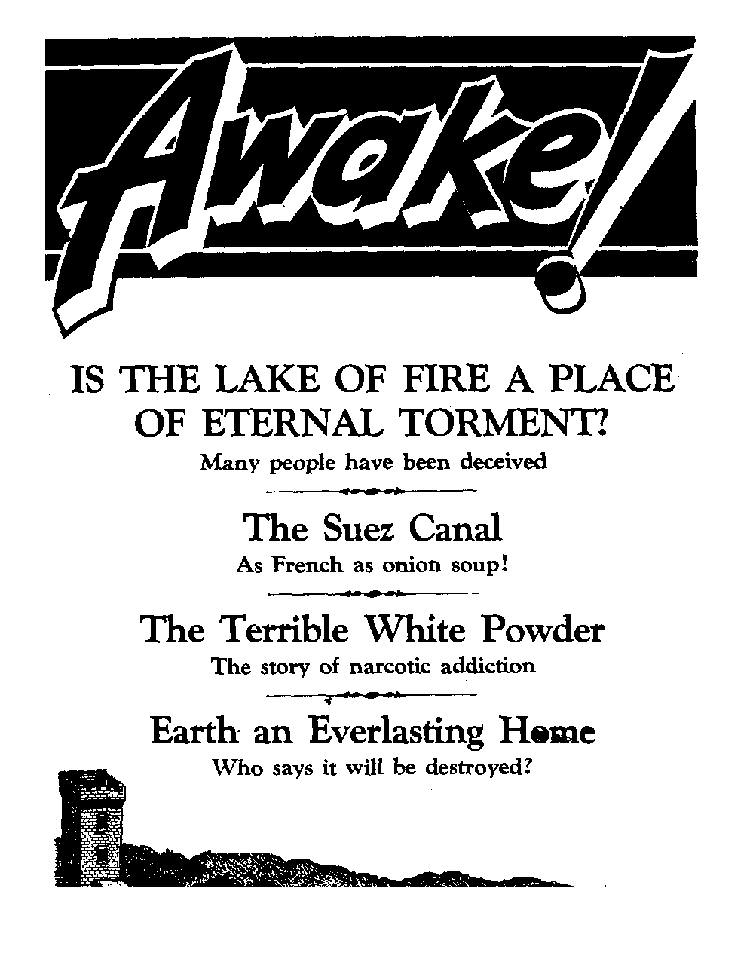
IS THE LAKE OF FIRE A PLACE OF ETERNAL TORMENT?
Many people have been deceived
The Suez Canal As French as onion soup!
The Terrible White Powder
The story of narcotic addiction
Earth an Everlasting H®me
THE MISSION OF THIS JOURNAL
News sources that are able to keep you awake to the vital issues of our times must be unfettered by censorship and selfish interests. “AwakeI” has no fetters. It recognizes facts, faces facts, is free to publish facts. It is not bound by political ambitions or obligations; it is unhampered by advertisers whose toes must not be trodden on; it is unprejudiced by traditional creeds. This journal keeps itself free that it may speak freely to you. But it does not abuse its freedom. It maintains integrity to truth.
"Awake I” uses the regular news channels, but is not dependent on them. Its own correspondents are on ail continents, in scores of nations. From the four corners of the earth their uncensored, on-the-scenes reports come to you through these columns. This journal's viewpoint is not narrow, but is international. It is read in many nations, in many languages, fay persons of all ages. Through its pages many fields of knowledge pass in review—government, commerce, religion, history, geography, science, social conditions, natural wonders—why, its coverage is as broad as the earth and as high as the heavens,
"Awake lM pledges itself to righteous principles, to exposing hidden foes and subtle dangers, to championing freedom for all, to comforting mourners and strengthening those disheartened by the failures of a delinquent world, reflecting sure hope for the establishment of a righteous New World.
Get acquainted with “Awake!” Keep awake by reading "Awake!”
WO""'*
Published Semimonthly By WATCHTOWER BIBLE AND TRACT SOCIETY OF NEW YORK, INC. 117 Adams Street, Brooklyn 1, New York, U. S. A. N. H. Knorb, Preeident Grant Suitsu, Secretary
Printing this isaue: 2,000,000 Five cents a copy
Other larteutei in which “Awake!” Ie leblhhed: Semlrnnthly—Afrikaans, Finnish, Frencb, German, GreeH, Hollandisl), Norwegian, Spanlah,
Sweflieh-
Monthly—DanUlr, Japanese, Portuguese, Ukrainian.
Yearly Bubscrlpdori rat+y
QfBttS far semimonthly editions
Arwrlca, U.S., 117 Adams St, Brooklyn 1, NA. »1 AMtrall*. 11 Bflrarford Rd.. Stratiifleld, N.B.W. 9/‘ CaniAa, ISO Brtdgelacd Ata., Park Road P.O.,
Toronto 10, Ontario
Emlanf, 34 Craven Terrace, London W. 2
New Zealand, fi.PO. Box 30. Wellington, C. 1
Stith Africa, Private Bag, Eiandsfontein, Tvl.*
Ninthly editions cost half the alwo rata.
Remittan ms should be seat to office In your country In compliance with regulations to guarantee safe delivery of money. RemltlanceB are accepted at Brooklyn from countries where no office la located, by International money order only. Subscription rates in different countries are here stated In local currency. Nutl** Of expiration (with renewal blank} is oent at leant two issues before subscription aspires. Chang* *f aldrau when sent tn onr office may be expected effective within one month. Send your old as well as new address.
Entered as aecond-clasj; matter at Brooklyn, N.Y. Printed in U.S.A.
CONTENTS
Revolt Does Not Stop Freedom of Worship 3
Is the Lake of Fire a Place of
Eternal Torment?
The Terrible White Powder
One Addict’s Story
How Much National Advertising
Will $25,000 Buy?
Quenching Thirst the Curious Way
Hawaiian Beans and Seeds to Wear
Suez Canal—as French as Onion Soup
Stolen: One Hole
Lifesavers to the Rescue
Hospitals, Please Take Notice!
Heart Disease Increases Among Women 24 "Your Word Is Truth"
Earth an Everlasting Home
Jehovah's Witnesses Preach in All
the Earth—The Bahamas
Do You Know?
Watching the World
D0ES N0T °F
an
By "Awakei — correspondent in Cuba !
BOUT 12:30 p.m. Sunday, the 29th of April, six large stolen gravel trucks entered the city of Matanzas, Cuba. Their occupants were a group of heavily armed insurrectionists bent on overthrowing the present government of Cuba under
President Batista. About sixty different persons were in the trucks, hidden behind sandbags. The trucks were gravel dump trucks and did not arouse any suspicion. They headed straight for the army post in the heart of Matanzas.
Stopping only about forty feet in front of the local army post the occupants immediately began to fire on the building. Soldiers defended the post. The battle raged more than an hour. Other government forces were notified, even the large military post in Havana. The Cuba air force was alerted and planes were on their way to Matanzas, about eighty miles from Havana. The post’s defense took deadly toll on the attackers. The dead mounted.
Many of the insurrectionists began to lose nerve and flee. Some, heavily armed, lost themselves in the city, while others fled to the outside, where the rurals led into close-by hills and mountains. By this time about ten armed army planes were circling overhead, their roaring motors adding to the tremendous consternation and the already supercharged hysterical conditions. As the last shots died down fifteen attackers were dead, while three soldiers were severely wounded.
The president of the country, General Batista, called an immediate cabinet meeting, as evidence indicated that the attack in Matanzas was not purely a local affair but only an expression of what revolutionary elements plan on doing throughout the island. The government then decreed that a 45-day suspension of constitutional guarantees was necessary to enforce order.
Circuit Assembly of Jehovah’s Witnesses
At the same time as this violent event in the city of Matanzas something else that is interesting was taking place within the same city. A circuit assembly of Jehovah’s witnesses was being held less than ten blocks from the very trouble center
where the shooting occurred. On Saturday, the second day of the assembly and one day before the bloody attack was made against the military building, two young lady publishers were presenting the two magazines from house to house. At one home a bitter opponent of Jehovah’s witnesses began using vile language against the witnesses, hit one of the young sisters on the cheek and cut her face. Her brother, working across the street, tried to protect the girls *and the man attacked the boy.
A crowd began to gather and the three young publishers started running to the convention hall. The crowd ran after them. When they reached the convention grounds the local congregation servant, a special pioneer, was grabbed by the mob and beaten unconscious. While blows were being rained on this brother a policeman happened by and fired two shots into the air and the mob scattered. The brother was taken to a hospital.
Then the district servant and the circuit servant, together with others, one of whom was an actual witness of the mob violence, went to the police station to enter a complaint. The policeman who had stopped the mob refused to sign the complaint or even charge any mobster with disorderly conduct However, one of the brothers who was present is a very good friend of the highest military official in Matanzas and he immediately told the police that he was going to this official to demand an immediate investigation.
This had its effect. The policeman stated that he would be glad to sign the accusation, and he did so. Strangely, about this very moment the leader of the mob entered the station with a lawyer and said he wanted to charge Jehovah’s witnesses wi^h trying to extort $10 from him at his home by these two young girls. All the bystanders, including the police, ridiculed this complaint. Then the policeman who originally appeared to be the man’s friend, and probably was, ordered him held prisoner.
The brother who had mentioned going to a higher military authority did go and he saw this official. This army officer appeared to be greatly surprised and promised that on Monday morning the following week he would personally right whatever wrong had been done and that this mobster and others in the mob would receive a just punishment.
After that Saturday-aftemoon incident the assembly finished the day according to schedule, with many brothers benefited from the fine program. Then came Sunday. The district servant, his wife and several other brothers were staying in the hotel directly in front of the military post. When the shooting started after 12 noon all occupants had to leave the hotel by a back entrance. They were allowed to take only the clothes they had on. The brothers went to the hall, all of this taking place with bullets zinging overhead and machine guns with their deadly staccato in action.
It was expected that surely now as 3 p.m. rolled around and the shooting had stopped, the local authorities would stop the assembly. The board of directors of the fine auditorium held an emergency meeting and decided that Jehovah’s witnesses could continue their assembly if the police did not care. So amid great revolutionary activities, dead bodies being gathered up, many being arrested, the district servant began his talk on the timely subject “Surviving the Fears of This Generation.” Very few if any strangers were present. They were too scared even to stick their head out of a window. Nevertheless the assembly continued its regular schedule through the last talk by the district servant.
It is almost certain that any other type of assembly or meeting would have been canceled, but it was not done in this case. Surely Jehovah God is with his people.
wwWODAY when an ilf American speaks
1 of a person's be-irigl‘burned up” he means that the person has become extremely indignant. And when he says, “She got my goat,” he means that a woman irritated or annoyed hjpi. Again, when he speaks of a “lady-killer” he refers to a man who fascinates the womenfolk.
However, it could be that a few hundred years from now when one reads these expressions he would take them literally, because they may have lost their colloquial and metaphorical meaning. With the passing of the years meanings of words change and they lose their figurative meaning or take on an entirely different one, at times even an opposite meaning. This accounts for archaic expressions and is the reason why new translations of the Bible were needed to replace the older King James and Douay versions of the Bible. This we shall find is the case with the Biblical expression “lake of fire.”
That language change is germane to our subject is recognized by a leading spokesman for the Roman Catholic Church, the “Doctor” Rumble. Writing in the New Zealand Tablet, June 9,1954, he states that the use of the Hebrew word aheol and the Greek word hades to denote the place of eternal torment is archaic and that these words originally had a much broader meaning and referred to the “netherworld.” According to Rumble this is why Monsignor Knox at times translates sheol
is the
a place of
Aue/b ad,“H»u
Pictur'd as Awful Reality"<23ta^ “Popa Warns Jurists; Hell Real, Eternal"
and hades as “grave” or “place of death.”* He then quotes Monsignor Knox’s translation of Luke 12:5, “Fear him who has power not only to kill but to cast a man into hell,” to prove that there is a hell of eternal torment for the “damned.”
However, Knox did an incomplete job of his translation, for he did not indicate what word he here translated "hell” so as to distinguish it from the Greek word hades, which has the thought of the “nether-world” only if we consider this the condition or state of the dead, or grave-dom. In consulting the popular modern Revised Standard Version we find a footnote indicating that “hell” translates the Greek word gehenna. So according to Rumble and Knox gehenna is really the place of eternal torment for the damned. Is that the meaning of gehenna, and did Jesus use it with that meaning in mind? Or could it be that here again a change of meaning is involved: the word denoting one thing to Jesus in his day and another thing to Knox, Rumble and others in our
* Knox translates hades “place of death." twice and “heir’ eight times.
day? What do the facts of history and the Bible show?
What Gehenna?
Jesus used this term gehenna eleven times all together and James used it once, for a total of twelve times that it occurs in the Bible. It is a Greek transliteration of a Hebrew expression and refers to the "valley of the son of Hinnom,” which is first mentioned at Joshua 15:8. It was situated just outside the south and west walls of the city of Jerusalem. The National Geographic Magazine, December 1952, page 840, in its article on “Bible Lands,” featured a beautiful picture of this valley and explained that it was "the shallow Valley of Hinnom (Gehenna), once the scene of child sacrifice to the god Moloch and later an ever-burning refuse heap.”
This valley was not always shallow. In ancient times it was steep, narrow and ragged. According to tradition King Solomon had a music grove in a portion of this valley, the part known as Tophet. No doubt during the time Solomon was faithful the vocal and instrumental music with which this grove resounded included paeans of praise to Jehovah. However, when Solomon became unfaithful he erected altars to the god Moloch in this grove.
In later years, particularly during the reigns of the wicked kings Ahaz and Manasseh, the grove Tophet of the valley of Hinnom was filled with the cries of children being sacrificed to Moloch. This idol was a huge hollow brass image within which fires were kept burning, the children thus being burned alive. It seems that this barbarous form of idolatry plagued the Israelites even before they came out of Egypt, for God repeatedly warned them in his law to Moses that they were not to engage in this worship and that any parents that did were to be stoned to death. Concerning this pagan form of worship Jehovah had Jeremiah say: "They have built the high places of Tophet, which is in the valley of the son of Hinnom, to bum their sons and their daughters in the fire.” Because of this pagan worship Jehovah warned that instead of the valley of Hinnom it would be called “the valley of slaughter: for they shall bury in Tophet, till there be no place.”—Jeremiah 7:31, 32.
The religious practice of offering human sacrifices, and especially children, is an ancient one and authorities tell of hundreds of children being sacrificed at one time to pagan deities. Parents would offer their choicest treasures, their own children, either to appease or to gain the favor of such monstrous pagan gods. But Jehovah emphasized that he never commanded such a thing and that it had never even entered his mind. That faithful worshiper of Jehovah, King Josiah, put an end to this gruesome practice. He had the idol destroyed and had the area turned into a dumping ground for Jerusalem’s garbage. To help destroy the garbage, brimstone or sulphur was added and so fires were kept burning all the time. Thus it truly was “an ever-burning refuse heap.”
Included in the city’s offal that was thrown into this valley were the carcasses of unclean animals or those that had died of themselves. Likewise, the bodies of executed criminals were thrown into this lake of fire, as not deserving of a resurrection and therefore not given a decent burial. However, let it be noted that nothing alive was ever thrown into this valley. It was with this background in mind that Jesus used the term gehenna.
Pertinent here is the footnote on Mark 9:43, 45 of the Catholic Confraternity version, which shows that the words “Where their worm dies not, and their fire is not quenched,” do not appear in verses 43 and 45 “in the best Greek codices [although
they do in the Douay and Monsignor Knox’s versions], but the text concerning the sufferings of the damned is found in verse 47. It is a quotation taken from Isaiah 66:24.” Apparently in their zeal for eternal torment the copying monks put these words three times in the mouth of Jesus although he had uttered them only once.
As for Isaiah 66:24's telling of “the sufferings of the damned," what that text actually does say is: “And they shall go out and see the carcasses of the men that have transgressed against me. Their worm shall not die and their tire shall not be quenched: and they shall be a loathsome sight to all flesh,”—Dowry.
What Gehenna Pictured
Is there any suggestion, not to say anything of a plain statement, of suffering, of torment, in this text, Isaiah 66:24? Not at all. What are seen are not men writhing in a Dante's inferno, but only carcasses, loathsome, disgusting and abhorrent, of the men who transgressed against Jehovah. It does not say that men do not die or that the “souls” of men do not die, but that the worms do not die. The valley of Hinnom doubtless had ledges on its sides, and so at times bodies thrown into it did not reach the flames of gehenna but landed on these ledges. Such bodies would then be consumed by the worms. So the two statements “their worm shall not die” and “their fire shall not be quenched” have no thought of torment but both express the same thought of complete destruction.
That Jesus intended these expressions to be taken as figures of speech rather than literally can be seen from the context of Mark 9:42-47. He was saying that if our hand, foot or eye caused us to sin it would be better to sever it from our body and enter the kingdom of the heavens with one foot, hand or eye than to keep both of these and be thrown into Gehenna. Do we for a moment think that Jesus Intended us to take his words literally? Of course not! Rather he meant that if any possession or habit, even though as dear to us as our very limbs or our eyes, caused us to sin we would have to get rid of it. So let us not do violence to the rest of the Bible and to reason by endeavoring to take his remarks about undying worms and unquenchable fire literally.
That this Gehenna or lake of fire pictures destruction is also to be seen by Revelation 20:14: “Death and hell were cast into the lake of fire. This is the second death.” A second death? Yes, to distinguish it from the first kind of death that came to us as a result of Adam’s sin. Those dying the second death will have no resurrection but will remain dead forever. The lake of fire pictures annihilation, extinction, extermination. “The dead know not any thing.”—Ecclesiastes 9:5.
Note here also that death and Hades are thrown into the lake of fire. Are they personalities that can sin and be punished in a literal lake of fire? No! But when we understand that the lake of fire pictures destruction, then all is clear. Since Christ will rule until the last enemy Death is destroyed, it can properly be said that Death will be thrown into the lake of fire. And when all those in the memorial tombs upon hearing Jesus’ voice come forth to a resurrection, thus emptying Hades, it can be said to be thrown into the lake of fire, for it also will be destroyed.—1 Corinthians 15:25, 26; John 5:28, 29.
Everlasting Punishment and Torment?
But perhaps someone will ask, Did not Jesus speak of everlasting punishment, and does not Revelation tell of some being tormented forever? And what about the rich man in hell?
Regarding the rich man and Lazarus, a careful study will show that this is a parable and not a historical incident.1 For one thing nothing is said about the rich man’s being bad or Lazarus’ being good. In fact, the Jews in their Gemara have a similar parable.
As for Jesus’ reference to “eternal punishment,” mentioned at Matthew 25:46 (Knox), the Greek word rendered “punishment1 is kolasis. It literally means a pruning or cutting off, and therefore the New World Translation renders the above phrase "everlasting cutting off.” The wicked will not suffer pain forever, but "they shall be as though they had not been.” Their punishment is death and it will last forever in that they will remain dead for ever.—Obadiah 16.
As for Revelation 20:10, which tells of some being "tormented day and night eternally” (Knox), to understand this expression we must first recognize that Revelation is written in highly figurative language, We would not think of taking literally its references to War, Famine, Death and Hades’ riding horseback, would we? Then neither should we take literally the references to Satan, the beast and others’ being tormented for ever and ever.
The Greek word here rendered "tormented,” basanizo, comes from a root that has many meanings; it being also the root of the name given to ancient jailers because they made trial of prisoners and it also meaning the Lydian touchstone, which was used to test the genuineness of gold and silver. This highly figurative language, therefore, tells that the wicked, including Satan the Devil, will be eternally held in the bondage of destruction and that their destiny will serve throughout eter-
* For details see The Watchtower, February 15, 1954. nlty as a touchstone testifying to the genuineness of Jehovah’s sovereignty.1 Yes, in a book of symbols reference to torment is also to be taken symbolically.
The New York Sun, December 23,1948, had a front-page picture of an eight-year-old boy whose mother had held his hands over a flaming gas jet as punishment because she thought he had stolen ten dollars. The boy’s hands had been so seared that it was necessary to amputate his little finger. For this she had been jailed and held because of being unable to furnish $1,000 bail. People were properly outraged at a mother’s inflicting such inhuman treatment upon her child. Yet hundreds of millions of people hold that God will sear, not only the hands, but the whole bodies of billions and that, not just for a matter of seconds or minutes, but throughout eternity. Does it make sense? Does it?
“God is love.” And justice is the foundation of his throne. His Word tells us that with him is the fountain of life and that "the gift of God is eternal life.” Life would not be a gift if we could not reject it, but reject it we can. The opposite of life is death and so we find that the Bible puts life in contrast with death, not life in bliss with life in torture. “The Lord preserveth all them that love him: but all the wicked will he destroy.” According to Webster to destroy means "to bring to naught by putting out of existence.”—1 John 4:8; Romans 6:23; Psalm 145:20.
The lake of fire is not a place of eternal torment but a symbol of destruction. Misconceptions regarding it instill morbid dread and dishonor God. The truth about it is both reasonable and comforting and magnifies Jehovah’s supremacy and justice.
subcommittee of the United States Senate heard 346 witnesses in thirteen cities give 8,600 pages of sworn testimony on the illegal drug traffic in the United States. Their testimony was so shocking that the subcommittee promptly recommended that the penalty for violation of the narcotic laws be greatly increased. Congress acted on the recommendation and passed a bill that allows the extreme penalty of death (if the jury recommends it) as punishment for people who sell or give heroin to any person under eighteen years of age. On June 9 the law was sent to President Eisenhower for his approval. He approved it July 18. What had prompted such drastic action? The subcommittee had uncovered the fact that the United States’ drug problem is the worst in the Western world. Illicit drug traffic has trebled in the United States since World War II. The nation's 60,000 addicts amount to one for every 3,000 persons throughout the land!
The new law resulted especially from the legislators’ concern over the ease with which teen-agers, at least in certain neighborhoods, can obtain heroin. Heroin is a powerful narcotic derived from opium. This white powder‘is the drug used by 80 percent of all United States’ addicts.
When the congressional investigators visited New York, an eighteen-year-old boy told them that he had been introduced to heroin at a Christmas party and had become a burglar to maintain the costly habit. His 21-year-old sister testified that she had become addicted when she grew tired of nagging her husband to give up narcotics. The 23-year-old husband said he had become an addict out of thrill-seeking curiosity. The spectators at the hearing were shocked to hear the young wife say that she had been offered heroin three times within a few days, while pushing her baby carriage along a New York street.
In recommending the severe new antinarcotics legislation, Senator Price Danie), who headed the investigating committee, said drug traffickers are “selling murder, robbery and rape," that “their offense is human destruction as surely as that of a murderer,” and “in truth and in fact, it is ‘murder on the installment plan,’ leading not only to the final loss of one life but to others who acquire this contagious infection through association with the original victim.”
The new law requires a fine of up to $20,000 for illegal possession of narcotics, plus a two- to ten-year imprisonment for the first offense, from five to twenty years on the second offense, and from ten to forty years on the third. For the illegal sale of narcotics there is a $20,000 fine, plus five to ten years’ imprisonment on the first offense and ten to forty years on the
October a. isse
second. No suspension of sentence, probation or parole is to be allowed.
Why So Vicious?
One reason why the dope trade is so vicious is that it usually leads to other crimes. If an addict is able to obtain an ample supply of his narcotic he may continue to do highly skilled work and show no evidence of the habit except for the needle ma»ks on his arms and legs. But when he is unable to get his drug he becomes excitable and nervous. He sleeps fitfully. His muscles twitch and his back and legs cramp. He is hot one minute and cold the next. On the second day he is restless in the extreme. He retches and vomits. By the end of the week he is comfortable, but is still weak and nervous, and may complain of insomnia. The fear of this ordeal drives addicts to commit crimes to obtain money for the narcotic to which they have become addicted.
The head of the United States Bureau of Narcotics says that the average addict spends $10 a day on dope. Dr. Herbert Berger, chairman of the Committee on Alcoholism and Narcotics of the New York State Medical Society, says $30 to $100 is not unusual.
Where does the addict get such sums of money? Through bookmaking, burglary, policy slip running, pilfering, shoplifting or prostitution. Worst of all is the practice of initiating other persons, even school children, into the narcotics habit so that the commissions on the sales will assure the addict’s own supply. The senators said that “crime in the United States would be substantially reduced if drug addicts were taken off the streets and placed in appropriate institutions for treatment or detention.”
“Treatment” sounds fine, but all too often the addict gets only detention. The 1955 Annual Report of the New York City Department of Correction says that even in New York addicts “go through the period of violent withdrawal in isolated cell units but with no medical treatment whatsoever.” At only one of the city’s prisons can they “undergo withdrawal under medical supervision but with no routine medical treatment.”
But no matter what methods are used, only a small number of addicts stay completely well. The New York Department of Correction’s report says: “No known method of treatment has been productive of more than a handful of successes.” Dr. Berger says that for such addicts jail “is not a cure. Unfortunately none is known.”
How the Situation Developed
During the 1890-99 decade, when all kinds of opiates could be bought as freely as a bag of groceries, there was one opium addict for every 300 persons in the United States. They worked about as well as other people, and gave little trouble, except that they were injuring their health and that thousands who sought freedom from this slavery failed to get it.
Physicians agitated for restrictions, and by 1912 every state except one had laws that in some way regulated the sale of narcotics. However, real addicts could still get their supplies legally, without much trouble or expense.
In 1915 a more stringent law became effective and hundreds of addicts were cured by deprivation. After that physicians who prescribed narcotics for the preservation of the addict’s health, or to enable addicts to continue to earn their living (as well as other physicians who may not have had such noble reasons) wound up in the penitentiary. Deprived of narcotics, addicts who had held jobs for years became sick. They lost their jobs and their source of
income. Clinics were established where they could get the drugs that would keep them going, but practically all of these had closed by 1923. Dr. Kolb, former chief of the United States Public Health Service’s Division of Mental Hygiene, says this was partly because of poor management, but chiefly because “addiction had become a crime, by legal definition.”
The good effect of the strict narcotic lajys is that addiction dropped from the 1890-99 figure of one in every 300 members of the population to, by a decade ago, only one out of every 10,000. The bad effect is that narcotics have thus become a profitable business for the lawless elements, who have a definite reason to profit from addiction’s growth. And addiction is now becoming increasingly serious. The number of addicts has multiplied three times in the last ten years, from one in 10,000 persons ten years ago to one in every 3,000 persons today!
Further, the legal approach strikes at the distributor, but does not help the addict. The attorney general of the State of New York, while supporting strong legislation against dope peddling, has also called for an “enormous expansion and development” of research projects, of facilities for treatment, of help after treatment, and even of an experiment in restricted legal distribution of narcotics.
The Wrong Approach?
In line with this last suggestion, some people say that the whole idea of jailing addicts is wrong. Dr. Laurence Kolb said in a Saturday Evening Post article: “There is nothing about the nature of drug addicts to justify such penalties” as the law now applies, and that these penalties “only make it difficult to rehabilitate offenders who could be helped by a sound approach.” He feels that addicts who cannot be cured could, under proper controls, “be given opiates for their own welfare and for the public welfare too,” and that then their need to turn to crime to get the money with which to buy narcotics, on the illegal market would be ended.
The people who propose this solution say that opiates themselves do not stimulate their users to crime, but have exactly the opposite effect. They say that while cocaine causes anxiety, opium relieves it, and that opium actually makes a person less likely to commit a crime while under its influence. As addicts have put it: “You have no guts, it brings out the yellow in you, and a man can slap you in the face and you won’t resent it; but you do things there are no risks in.”
People who think the idea of jailing narcotic addicts is wrong point to the apparent success of a different system in Britain. There doctors are free to prescribe narcotic drugs when they find that the opiate cannot safely be discontinued, or when the patient can lead a useful, normal life when a certain minimum dose is given, but cannot do so without it. What is the result of this policy? Britain, with a population of 50 million, has only 279 known addicts!
Conclusions
That the American problem is serious is an obvious fact. There are fewer addicts now than when there were no legal restrictions, but those who still use narcotics often are driven to crime to pay for their dope. The problem is made more difficult by the fact that many who become addicts are people who were already experienced in crime before becoming addicted. Imprisonment alone has not solved the problem, although a marked decline in narcotic violations has been reported in areas where
heavy fines and long prison sentences have been imposed. Nor have treatments for this enslaving habit really proved successful. The extent of addiction is growing, and no real solution seems to be tn sight.
Good it is to know, however, that such conditions soon will give way to both mental and physical peace in the new earth that God's Word, the Bible, promises He will create tn our time!—Isaiah 65:17.
One Rddlct’s Story
Twenty-three years old end eight years an addict— that is Frankie’s story. Frankie, who comes from a good family and Uvea in the suburbs, has twice been jailed for addiction, once when he stole from the police chief's house to get money for dope.
Frankie was interviewed by Jess Steam, New York Daily News reporter who wrote that the addict's trips to New York for heroin were so regular that he bought a commutation ticket in order to ride cheaper. He needed the money for dope, Frankie said
Y? How much do his drugs cost? “I make $90 a week as an electrician's helper, and I need another $25 or so to buy what I need.” Where does he get the money? From his father, '*the only one in the family who has not given up on me. I can nearly always go to him and get an extra $10 or $20, saying I need it for a date.” ,
Frankie's father probably does not believe him, but he fs afraid that if he does not give his son the money he will go out and get It another way. "Sometimes I feel ashamed to think I'm deceiving the only person who has apy faith In me/* he admitted, "but I've never felt so much shame that I haven't felt the need for the stuff more.”
Frankie showed few outward signs of addiction, except for the needle marks on his arms and his inability to look the reporter In the eye. He had thought of getting into a New York hospital for teen-age addicts, but did not think his buddies had benefited from It.
% Are addicts dangerous? *Tve known lots of addicts,” he said, "and I've never known one that did anything violent—unless, of course, he was interrupted while he was stealing, or something like that.” Do peddlers give dope to youths to get them started? Frankie said: “I think the smart pushers don't try giving it to the kids now; most kids today would get suspicious of something they got for nothing, and pushers know that kids that get hooked will hook other kfcfc. IC makes their work easy for them.”
WHAT DO TV-ADS COST ?
<L Twenty-five thousand dollars is a lot of money to the average man. But how much is it in the advertising world? How many color pages in Life magazine would $25,000 buy? How many half hours on television? How many, black-and-white pages In This Week magazine? How many one-minute selling messages, using forty-eight of America's leading radio stations? The answer, according to a recent advertisement, is: “$25,000 won’t buy you a color page in Life—you’ll have to find $7,740 more.” As for television, you are not in the league at all with $25,000. "Published figures tn a leading trade magazine estimate the weekly production cost of a medium priced half-hour show at $33,000. The time will be extra.” Your $25,000 cannot even buy a full black*and-white page in This Week magazine. You must add $4,180 to get a page. It can buy only thirteen one-minute selling messages, using forty-eight leading radio stations. Four times that sum, or $100,000, "will buy 6 color pages In an excellent women's magazine with over 4 million circulation”; ”$250,000 is almost enough to buy 5 color pages in two leading Sunday supplements, with a combined circulation of about 18,000,000”; and ”$500,000 will buy an average TV half-hour nighttime show once weekly on a major network—but only for 7 weeks.”—The New York Times, April 30, 1956.
HOW curious is the way some of nature’s creatures quench their thirst! Some drink through their skin. Some have to sleep for months until it rains. One of nature’s creatures digs its own wells. Others store up or conserve water in novel ways. Curiously enough, there are animals that do not seem to have any thirst; at least they never take a drink in their lifetime!
Imagine quenching your thirst by just taking a walk in the morning air. That is what a small lizard in Australia does. Called thorny devil, it is nine inches of oddity in lizard form. Thorny lizard looks like a piece of cactus plant that broke off from the main stalk and walked away. Spikes give it a grotesque appearance. No handicap is this in the sandy regions where he wins his living, for he drinks through his skin. The more skin surface, the better the drinking! Writing about thorny devil and his moisture-absorbing skin one naturalist says:
“He catches the dew. For this reason it is necessary for him to have as large a skin area in proportion to his content as possible. The many spikes and protuberances give him this large skin area, and with this
he catches the small dew which fails at night The whole skin is absorbent, as can • easily be demonstrated. While I was in the bush, I had three of them tied to one of the guy-ropes of my tent and often amused myself by putting a drop of water on one or other of their backs. The drop disappeared as if Into blotting-paper. That is how these little creatures drink.”
Sleeping Through the Drg Spells
For humans a rainy day is fine for sleeping. For many of nature’s creatures the bright, dry day is best for sleeping in. When things are damp a land snail feels energetic. When things are dry the land snail worries about keeping moisture in his body. Some crawl under objects lying on the soil. Others keep their body moisture by cutting off evaporation. They make for themselves a tough membrane of dried mucus. With this they seal over the opening of their shells. Then the snails cozily sleep out the dry spell in their self-made humidors.
Reminding us of the story of Rip van Winkle is the African and South American lungfish. But its sleeping exploits are not fictional, as were Rip van Winkle’s. The eellike lungfish lives like any other fish except that it rises to the surface to breathe. During the dry season the lungfish’s watery home may vanish. Trapped in mud
the lungfish sees disaster ahead unless it can keep its body from drying out.
So Mr, Lungfish burrows into the mud for a good sleep. But first he makes from his skin glands a cocoon of dried slime. This substance completely envelops the lungfish’s body except at the mouth. Now the lungfish does not have to worry about drying out; it contentedly goes to sleep, knowing that some day rain will come into its life. Even if the mud becomes hard as cement, that is all right with the dozing lungfish. What if the lungfish is imprisoned for months? No trouble at all to nature’s Rip van Winkle, for it sleeps out the longest dry spells—from one to five years if necessary! When the rainy season comes, immersion in water wakes up the lungfish. It breaks out of its self-made humidor wrapper and it livens up in its watery paradise.
To the elephant, going to sleep is hardly the way to face a water shortage. Why not do something about it? is the way the elephant feels. So the elephant does the logical thing: he digs a well. When a river goes dry in Africa, elephants dig holes in the apparently dry bed. Rarely do they fail to find what they are looking for. According to Mervyn Cowie, director of Royal National Parks of Kenya, elephants “scrape away the sand with their trunks in a slanting hole, deep enough for the water to percolate through and form a small pool, sometimes four feet below the surface.”
After the pool is formed the elephants suck water up with their trunks and squirt it into their mouths. Reserve tanks must be filled; then the elephants lumber off, allowing thirsty lions, zebras and giraffes to quench their thirst at the newly dug well.
One of Nature's Riddles Solved
Time used on digging wells could be more profitably used is the way the camel feels about the matter. Drink enough to last; that is what the camel believes to be the best policy. Fifteen gallons at a time is a moderate-size drink for a thirsty camel. A camel well charged with water can exist for eight days or longer without a refill. Just where the camel stores his water was, until just recently, one of nature’s great riddles.
Ancient lore had it that camels stored water in their humps. But humps are filled with something else. Filled with fat, the humps are the camels’ portable pantries from which they draw nourishment when other food is not available. But where is the water stored?
The most popular theory was that the camel had specialized stomachs for storing water. It was thought that for a human to get a drink, in the absence of an oasis, it was enough to kill a camel, slitting him open to get to the water tanks. All this, of course, is not true.
To find out how camels could go so long without water, Dr. Knut Schmidt-Nielsen of Duke-University directed a year’s study. The work was done in the Algerian Sahara. Last year Dr. Schmidt-Nielsen reported his findings. The camel’s unique ability turns out to be the result of extraordinary gifts that are not shared by any other animal that is useful to man in arid parts of the earth.
No tanklike compartments for the camel! Instead the report showed that they conserve every drop of water in body tissues. When water is needed for digestion and for evaporation, it comes from the camel’s tissues, from the spaces between his muscle cells and from the cells themselves. That is the unraveled riddle.
One of the camels used in the study ate only hay and dried dates for 17 days. It decreased in weight from 660 pounds to 458 pounds. Then this ship of the desert took in 20 gallons of water and increased his weight by 30 percent. He was outdone by another camel that drank 30 gallons in ten minutes —12 quarts a minute!
The camel has many other gifts: he does not pant, never breathes with his mouth open and he does not cool himself by evaporation. It follows, then, that his body temperature must rise above normal in hot weather. It does. This was the most surprising result of the research. In hot weather his body temperature can rise from 90 degrees F. to 104 without ill effect. When the limit of 104 degrees F. is reached, sweating sets in to keep the body temperature from rising any higher. “Even then,” says Dr. Schmidt-Nielsen, the camel “does not drip with perspiration.” Its skin always feels dry.
Water for Other Desert Denizens
Waterless deserts are often fairly rich in animal life. But how do the creatures quench their thirst? Some tap vegetable canteens—juicy plants, such as the cactus. If the desert tortoise wanders into waterless territory he has no worries; for this creature is a walking canteen himself. He has sacs under his shell In which he carries his water. One pint lasts for a season.
As rice is vital to the economy of many countries, so a certain general type of rodent is basic to the economy of many deserts. In the southwest United States a rodent of this type, the so-called kangaroo rat, is the desert’s bread, butter and water. Practically all desert creatures eat and enjoy the kangaroo rat. The desert fox gets both his food and drink by making the kangaroo rat his regular menu. Fortunate for the fox that he can get a well-balanced meal in one bite!
What about the kangaroo rat himself? The little creature can live in the driest regions, even in such places as the sand dunes of Death Valley. A few years ago Dr. Schmidt-Nielsen studied this animal. He found out that this ratlike animal never quenches its thirst in the usual way, if it has any thirst. Never does it drink; seldom does it eat juicy vegetation. Its main food is dry seeds. How does the little animal keep from drying out?
The Duke University zoologist found out that the kangaroo rat stays in its burrow by day, where air is a little more humid than it is outside. “The protection of the burrow by day provides just enough margin to enable the kangaroo rat to maintain its water balance and live in the driest of our deserts,” reported the zoologist.
But even more important is the fact that the kangaroo rat has a built-in watermaking plant. The digestive system of the desert rat manufactures water (HSO) by combining the hydrogen in food hydrocarbons and oxygen from the atmosphere. Besides this the kangaroo rat’s only sweat glands are in the pads of its toe, and its kidneys are amazingly efficient. All this makes him the succulent little dish he is for the rest of the desert denizens.
Probably the desert rat’s ability to go a lifetime without drinking a drop of water would make the camel shudder or at least envious. But the desert rat’s gifts are hardly more marvelous than those of the camel, the elephant, the lungfish or the lizard with the blotting-paper skin. All these curious ways of quenching thirst speak eloquently of the Creator’s greatly diversified wisdom. “O Jehovah, how manifold are thy works! In wisdom hast thou made them all.”—Psalm 104:24, Am. Stan. Ver.
Hawaiian Beans and Seeds to Wear
By “Awake!" conre>pand*nt in Hawaii
EARS ago the Hawaiian people used tapa for clothes, with shells, flowers and seeds for decoration.Thls ancient craft of making seed jewelry is being revived today, and we find that leis, chokers, and earrings made of beans and seeds native to Hawaii are still even more suitable for wear with Hawaiian dress than modern costume jewelry. So now many Hawaiians are gathering seeds and making their own costume pieces to fit their particular fancies.
"8? What makes Hawaii the center of the seed jewelry industry is the type of trees, vines and shrubs that grow there. Many trees have flowers similar to those of edible-fruit trees, but instead of producing fleshy fruits the “fruit” consists of various pods containing seeds that are hard and durable, varied in color and shape, and capable of being polished to a high luster—just the thing for the seedjewelry craftsman.
% A favorite among the ancient and modem Hawaiians is the nut of the kukui or candlenut tree. In days long past this nut was gathered especially for the oil-bearing nut meat inside, used for candles and lamps for lighting. In fact, kukui is the Hawaiian word for lamp. If a seed lei is desired the nuts are selected and two small holes are made in them and then they are buried in the earth to let the ants eat out the inside. This also serves to turn them from brown to a desired jet black. After sufficient time for curing they are then cleaned and smoothed with a fine file and sandpaper. Some of the nut-meat oil can be used in the final polishing. The finished necklace, looking like polished ebony, with smaller matching earrings, is striking indeed. 8? Another great source of interesting materials is the variety of palm nuts growing in Hawaii. A very popular one is the monkey nut. These, when husked, are shaped like a miniature coconut, with "two eyes and mouth” on the pointed end, just like their larger relative. When polished they are a rich, shiny brown.
*3? The nut of the Manila palm is another of rare beauty. When ripe on the tree they hang in brilliant red clusters. To get down to the actual nut several layers of fiber must be removed. After several months of curing or drying the final coat can be filed and sanded off to reveal a beautiful white nut with brownish-maroon veins. When highly polished and lacquered they Indeed look like marble stones, very durable and highly prized for chokers and earrings.
“8? Once in a while a lady might be seen wearing a pear-shaped pendant resembling an ivory claw. This is the nut of the Blue Latan palm and is quite rare. Some have dyed these a delicate green, and one has to look closely to see that they are not real jade.
*8? Those who might like something gray will be interested in the Kakalaioa seeds, often called Hawaiian pearls. The seeds are round, about the size of the end of the thumb and very hard, with fine horizontal lines visible on some. These can be waxed or dipped in clear lacquer to bring out their beauty. Strung alone they are strikingly beautiful, or for a pleasing contrast they can be combined with wild canna seeds (black), with the false Wiliwili seeds that look like red pills or cherry pits, or with the Black-eyed Susan, a tiny seed smaller than a pea, vermilion in color with a black dot or eye.
TE There is a host of other varieties equally interesting, such as Job’s-tears, a tear-shaped seed with a ready-made hole through the center; jet-black soapberry, sea bean and sheep’s eye. Some claim there are between one and two hundred varieties of seeds that may be gathered in Hawaii. Almost a hundred of these have been collected and fashioned into novel jewelry pieces. Perhaps with a bit of skill and ingenuity you too can turn seeds into articles of lasting beauty.
ISRAEL
CAIRO
SUEZa
Fitih water
Cana
THE SUEZ
is the biggest, richest man-made ditch in the world. It is twice as long as the
Panama Canal—a canal 105 miles long, 500 feet wide and 46 feet deep. Being the prin-
cipal gateway to the East, carrying three times the traffic of the Panama Canal, it is by far the busiest and the greatest of the world’s ocean highways. Last year ships flying the flags of forty-eight nations slipped through the narrow, lockless, sea-level canal at a rate of more than forty-five a day, for a grand total of 14,666 ships. Middle East oil made up more than 75 percent of the northbound traffic, while ores, metals, spices and other cargoes accounted for the rest.
Though registered in Cairo as an Egyptian corporation, the Suez Canal Company that cares for the canal is as French as the Eiffel Tower or onion soup, if you please. The canal was built mostly by French engineers, largely with French francs, and sixteen out of the thirty-two directors are French. France owns a good percentage of the company’s shares and is a key signer of the 1888 Convention of Constantinople, under whose terms the canal is operated. The Suez Canal Company employs 188 pilots of various nationalities
Ftrdon bfidgt
Lake Timwh
and about 600 administrators and technicians—most of them French, The fabulous 100-million-dollar-a-year business is conducted by remote control from a coolly aristocratic, five-story building at No. 1 Rue d’Astorg, Paris.
Although situated in Egypt and obviously French in character, the Suez Canal is, nevertheless, the “spinal cord,” the lifeline, of the British Empire, the link connecting India, Australia, New Zealand, Singapore, Hong Kong and the British settlements on the east coast of Africa with the mother country. Great Britain, therefore, is the principal user, with about 28 percent of the canal traffic being British. It can easily be seen why the British are interested in the canal and would fight to keep it open.
The Suez ditch knocks 5,000 hazardous miles off the Cape of Good Hope route from London to Bombay, a saving of 43 percent. A ship traveling from the United States to an Indian Ocean port has some 6,600 miles less to go. A round trip from Boston to Bombay pays $7,600 in canal tolls but saves eighteen days’ time, $46,000 in operating expenses. The canal puts Europe within easy reach of grain, tea, copra and jute, the ore, rubber and spices of the
East, It opens a convenient chute through which the West can pour its machinery and cement, its paper, textiles and other consumers’ goods. From its first business year, when 486 vessels passed through the canal, to 1955, when 14,666 ships carrying 115,000,000 tons used the short cut, the story of the canal has been one of success.
Canals Before Christ
But the Suez Canal is not the first work of its kind constructed in the same locality. A large canal from the Red Sea to the Nile is known to have existed from at least the sixth century before the Christian era to the latter part of the eighth century A.D., when it finally became choked up and useless. To what extent this canal was used for navigation is not known. From very early times Egyptian vessels are known to have frequented the ports of southern Arabia and Ethiopia, receiving ivory, spices, aromatics and woods.
Another canal, called the Canal of Zarou, is said to have been navigable as far as the city of Zarou and was used by kings to send expeditions to Sinai and Syria. A bas relief, on one of the walls of the temple at Karnak, from the time of Seti I, shows this ruler entering triumphantly into Zarou. In this picture the canal is seen running through the center of the town. In the Roman period the channel was extended to Ostracine, a port on the Mediterranean.
Still a third canal was dug by Ptolemy Philadelphus (285-246 B.C.). Strabo tells us that Ptolemy built a lock with a double gate at its entrance in order to prevent the water of the sea from contaminating the fresh water of the Nile. There is no way of knowing how long this canal remained navigable, though some writers believe that it was not used during Cleopatra’s time (31 B.C.). The emperor Trajan is said to have repaired the Canal of the Pharaohs A.D. 98 and cleaned it out and made it navigable. It remained open, according to Cledat, for about a century but was altogether abandoned in the reign of Constantine,
A Gateway to Riches
The fabulous Orient, which was bringing untold wealth to England and Holland, created an insatiable appetite in France for a fair share of the East’s fortune. France was a great power in the Mediterranean and a short cut to India would be more than desirable. While England and Holland struggled for control of the Cape route, France turned her attention to the Suez as her best chance of competing with her rivals.
England paid no attention to the French. In fact, it is doubtful if she was even aware of the French negotiations. While England was not herself interested in the Suez route, she was determined, at all cost, to prevent its development. And it is understandable why she would oppose a Suez route at that time. France roamed the Mediterranean practically unchallenged. England had political and commercial interests in the East, especially in India, and was in no mood to expose these possessions to French competition. Moreover, England was tied down with a monopoly of trade with India by the Cape route and was forbidden to operate in the Mediterranean. So quite naturally her attitude toward building a canal was none too pleasant. Queen Victoria’s Britain tried, with all the diplomatic pressure, rough talk and plain chicanery it could muster, to kill the canal scheme. France was te learn how bitter, how tortuous and how illogical England’s opposition could be.
Ferdinand de Lesseps, who spearheaded the canal project, was the center of Britain’s attack. De Lesseps, almost singlehanded for more than twelve years, fought against odds and opposition that would
have crushed a lesser man. He faced undaunted the wrath of England, at times Austria and even his own countrymen. All Egypt became inflamed against the project when it was rumored that the Red Sea was much higher than the countryside, that cutting a canal through would cause the sea to inundate the land and destroy the nation. Darius and Ptolemy II, it is believed, both discontinued their work on a canal because they thought the Red Sea to be higher than the land area. French engineers, however, surveyed the area and revealed that there existed practically no difference in the levels of the seas and that the land of Egypt was virtually safe from disaster.
On November 30, 1854, de Lesseps obtained the concession for the canal, which was followed by a second concession, dated January 5, 1856. This concession set forth in detail the basis upon which the international company in charge of the canal, known as Compagnie UniverseUe du Canal Maritime de Suez, was to operate, and it also took into account the recommendations of the international commission appointed by the viceroy of Egypt—the first concession being too general. The concession was to run for ninety-nine years from the date of the opening of the canal, and at the expiration of that period would revert to the Egyptian government.
In face of threats of violence from England work on the canal was formally begun near Port Said on April 25, 1859. Hardly a month passed when the Grand Vizier demanded that no further work be done on the canal without the sultan’s authorization. The viceroy of Egypt ordered a stoppage at once of all operations and withdrew Egyptian workmen from the canal zone. When work continued with the Europeans that were on hand the British launched a blistering protest that brought all work to a halt.
These were trying times for de Lesseps. One day while he was conversing with the emperor he was asked why everyone opposed his canal scheme. “Sire," replied de Lesseps, “it is because everyone believes that Your Majesty does not wish to support it.” The emperor thereupon assured him support and protection. This marked the turning point in French policy. Other nations quickly agreed to the project thereafter.
Forced labor was used. About 40,000 men were employed, and, although only about one half of that number worked on the canal, thei’e were always 20,000 on their way to and from their homes. When dredges and other powerful machines were used work moved along much faster. Many portions of the canal were made easily enough, but at other points the excavation demanded an immense amount of labor. In one place the workmen had cut a passage ninety feet deep and 200 feet wide through sandstone rock, a great achievement a century ago. It was thought at first that the canal would take about five years to build, at the cost of $30,000,000. But because of political and commercial opposition it took ten years to complete, at a total cost of $148,500,000.
At its completion the Suez Canal was a sea-level ditch most of the way, with long one-way stretches. For about seventyseven miles it was 327 feet wide at the surface, 72 feet at the bottom, and 26 feet deep; for the remaining miles it was only 196 feet wide at the surface, the other dimensions being the same.
While keeping the canal open is comparatively easy, getting traffic through is not so simple. The operation is a matter of split-second timing. One company official explained: “Taking a liner or a battleship through our canal is a job as delicate as making watches. It requires good judgment, plenty of skill and years of experi-
ence.” Run one ship into the sand and traffic between east and west may be bottled up for weeks.
The Grand Opening
scheduled for November 17, 1869, faced a delay when a ship ran aground in the channel. Just about the time de Lesseps was to dynamite it, it floated free. Delegations from the whole world met at Port Said for the ceremonies. No less than 160 vessels were in the port, all gaily decorated with flags. After the fireworks’ display and tent ceremonials, the yacht l’Aigle slowly entered the narrow canal, carrying the great promoter de Lesseps as well as Empress Eugenie of France. Sixty-eight vessels followed. They were the first to make the voyage from the Mediterranean to the Red Sea via the Suez Canal. It was obvious that England had lost a battle.
As soon as the canal became vital for England’s trade with India it was inevitable that it should pass under her control. The Khedive Ismail of Egypt, being greatly in debt, desired to sell 176,752 shares, which made him a junior partner in the enterprise. England’s Prime Minister Benjamin Disraeli moved with great haste, borrowed £3,976,582 {nearly $20,000,000) from the House of Rothschild and closed the deal without waiting for parliamentary sanction. While this was not exactly constitutional, it was, nevertheless, a brilliant investment. The shares are well worth more than that today, and for the past fifty years the annual dividend has seldom been less than 20 percent of the original purchase price. Thus in one clean overnight sweep England became a formidable force in the canal zone.
However, a nationalist movement protested against foreign influence shortly thereafter and rallied under the slogan “Egypt for the Egyptians.” Shareholders feared that Egypt would repudiate her debts and abolish English control of the canal. So England occupied the zone in 1882. This military occupation continued for seventy-two years.
…