Awake!, July 22, 1956
Download: PDF — Awake!, July 22, 1956
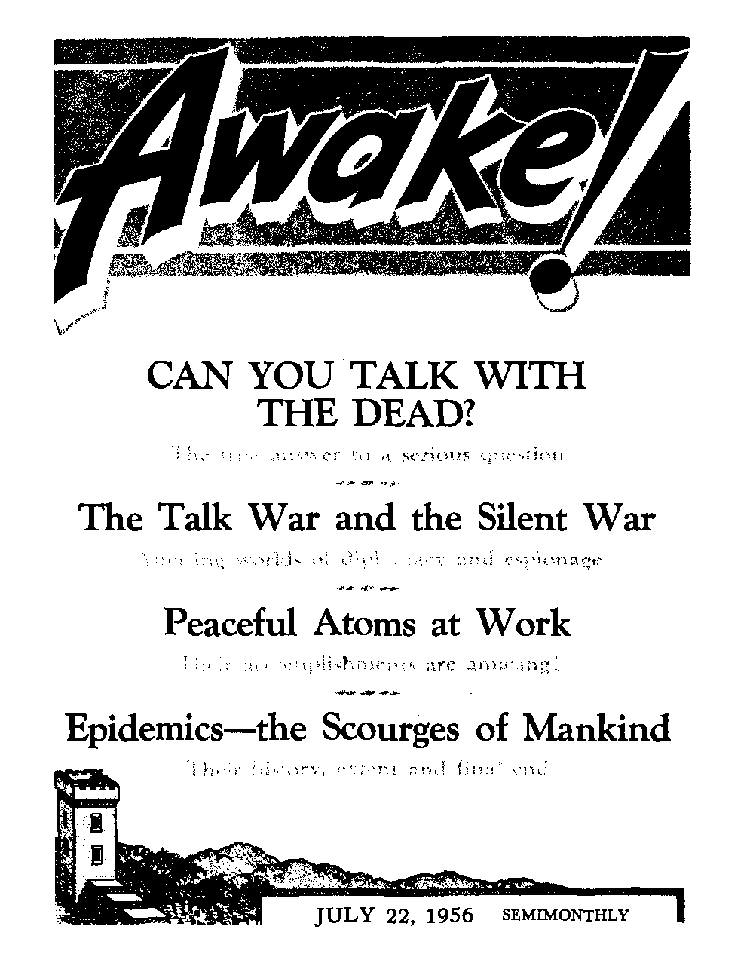
\Z'
CAN YOU TALK WITH THE DEAD?
i he cr io a c;r• e?>t*i
The Talk War and the Silent War
' = \v.vL.U oi A’rj’5 ::nd evfionage
Peaceful Atoms at Work
Epidemics—the Scourges of Mankind
THE MISSION OF THIS JOURNAL
News sources that are able to keep you awake to the vital issues of our times must be unfettered by censorship and selfish Interests. “Awake I” has no fetters. It recognizes facts, faces facia, is free to publish facts. It Is not bound by political ambitions or obligations; it is unhampered by advertisers whose toes must not be trodden on; it is unprejudiced by traditional creeds. This Journal keeps itself free that it may speak freely to you. But ft does not abuse its freedom. It maintains integrity to truth.
“Awake 1” uses the regular news channels, but is not dependent on them. Its own correspondents are on all continents, in scores of nations. Frdln the four corners of the earth their uncensored, on'the-scenes reports come to you through these columns. This Journal’s viewpoint is not narrow, but is international. It is read in many nations, in many languages, by persdns of all ages. Through its pages many fields of knowledge pass in review—government, commerce, religion, history, geography, science, social conditions, natural wonders—why, its coverage is as broad as the earth and as high as the heavens.
“Awake I” pledges itself to righteous principles, to exposing hidden foes and subtle dangers, to championing freedom for all, to comforting mourners and strengthening those disheartened by the failures of a delinquent world, reflecting sure hope for the establishment of a righteous New World.
Get acquainted with “Awake!” Keep awake by reading “Awake!”
PUBLISH!!, SEMIMONTHLY BY WATCHTOWER BIBLE AND TRACT SOCIETY, INC.
117 Adama Street Brooklyn 1, N, Y., TL 8, A,
N> H, Knorr, PteHtfent Grant Suiter, Secretary
Printing this iatue; 1,760,000
Five cents a copy
•ttef laniiMn la vhhh "Awiti!” h psbllihed: Semimonthly—Atrlhaans, Finnish. French, Gefniao, JtaJiAiL Norveslan, fipauhh, Swedish, Monthly—Dmiah, Greek, Japanese, Portuguese,
Ukrainlin.
Offices Yevly subscription rite
America, U.S., 1U Adame BL, Brooklyn 1, N.Y. $1 Aittralla, 11 Sererfnrd Bflo BtralNleld, N.S.W. 8/-Ctnads, 150 BrldgeJand Are., Park Road P.O.,
TorticCu 10, fl
England, 34 Craven Terries, London, W. 2 T/-
New Zuland, G.P.O. Box go, Wellington, C. 1 7/-Soith Africa, Private Bag, Elsodsfontelh. TvL 7/-
fltmlttnnots should t* rat to office Io «Hm-tif in cnmpllanco Mth regiilatlMis to guarantee late delivery of money. Bemhlanees are accepted at from xwnirlftj wiwe jjp tJPce is kvaied, by tntematlDftal money order only, Bnbacriptlcn rates iti different countries are here stated in local currency. Natl re of expiration (with retwwal blank) Is aent at least two Ikues before eubflcriptlnn ei-pifw. Chwf* at aidrw* when sent to our office mayt be expected effective within one month. Send your old as well ai new address.
Entered as Second-class matter at Brooklyn, N.Y. Printed Id U SA
CONTENTS
The Wisdom of Helpful Listening
Laughing at the Law of Averages
Can You Talk with the Dead?
Enough!
The Talk War and the Silent War
Something New in Airplanes
It’s Simple for the Cow
Peaceful Atoms at Work
Just a Smoke Screen?
Can Handwriting Tell on You?
Avoiding That Transparent Personality 2D
Epidemics—the Scourges of Mankind 21
A Safer Path for Healing
“Your Word Is Truth”
A Clergyman's Fear of Hell
The Book of Freedom
Jehovah’s Witnesses Preach in All
the Earth—Austria
Do You Know?
Watching the World
WISDOM
> MAN has an instinctive desire to be help' ful. More than that, for his own emotional well-being man needs to give expression to generous impulses. This instinctive desire to be helpful might be adduced as one of the proofs that man was created in the image of God, the great Helper and Doer of good deeds. Of course, in some this instinct is stronger than in others, as is apparent in the generous way in which some respond to appeals for help. Such show themselves to be true friends and brothers to their neighbor, for “a friend loves at all times, and a brother is born for adversity.”—Proverbs 17:17, Rev. Stan. Ver.
Selfish persons are prone to exploit this instinct to be helpful in others. Especially has religion been used by many to take advantage of this need to give, to express generosity. Fraudulent charities also reap much gain therefrom, even as do those who pose as being indigent or handicapped when they are not. Incidentally, should someone have taken advantage of your generosity or liberality, do not feel overly chagrined at it, for better it is to be taken advantage of than to be stingy or unduly
I tfe HELPFUL; J LISTENING
S ......<!;■?
suspicious. Better it is to make a mistake of the head than one of the heart.
While many thus selfishly exploit man’s instinctive need to give, others have wisely utilized it for unselfish ends. Thus we are told of a prison warden who won over dangerous criminals by appealing to this instinct in them. He would ask these criminals to do him certain favors and, strange as it may seem, thereafter they became easier to handle and even became his friends. Try it sometime on one who may seem to hear you a grudge. It will require humility and tact but the results will most likely surprise you.
Perhaps the most frequent way in which most of us give expression to our instinctive desire to help is by offering advice to one who may be disturbed, in a quandary as to what to do or rebelling at his lot. And good advice, in line with the principles laid down in God’s Word, can be very helpful. However, it should be borne in mind that it does not always follow that a person suffering mental distress immediately needs advifce and much of it. More often than not such a person is unable to accept advice, much less see its merit and how he can best apply it.
At such a time we need more than merely a sincere desire to be helpful. We also need patience, tact and loving understand-
Ing, sensitive mental discernment. Then the words of wise King Solomon apply: "God is in heaven, and you upon earth; therefore let your words be few.” (Ecclesiastes 5:2, Rev. Stan. Ver.) Perhaps more than anything else that is needed at such a time is a patient, loving and understanding ear; one that is willing to listen. The distressed one may even need encouragement to bring himself to express just what is troubling him. Then also is a time for remembering that “love is long-suffering and obliging,” and that “it bears all things, believes all things, hopes all things, endures all things.”—1 Corinthians 13:4, 7, New World Trans.
By exercising loving patience and selfcontrol we aid the distressed one to express himself, thereby bringing his worries and problem out in the open, which is what he very much needs to do. No doubt he has been judging his problem in the light of his own knowledge and experience and in a one-sided way, because he himself is so bound up with it. He may therefore have gone over it again and again in his mind but made no progress because of his going around in circles, as it were, losing all perspective. But upon expressing his thoughts in the presence of another he becomes aware of his true situation, is able to see his weaknesses or the cause of the difficulty and able to see how his problem appears to others. And should his problem be that of a guilty conscience, he is helped by his confessing his faults to another. That is why God’s Word counsels: “Openly
afess your sins to one another and pray for one another.”—James 5:16, New World Trans.
Another advantage gained by having the troubled one express himself, indicating the wisdom of helpful listening, is that thereby emotional tension and stress are released, making it less likely that he will do something foolish or rash. Thereby he also makes room for other ideas, for the helpful and constructive and tactful suggestions that the helpful listener will eventually offer. In fact, his own mind may even suggest the right solution to his problem then. Also, by his own emotional tension’s being lessened there is less likelihood of strong conflict between his own view of matters and those presented by the helpful listener.
And finally, by helpfully listening instead of at once eagerly offering advice, not only shall we become better acquainted with the troubled one's problem but we shall have time to reflect and draw from the recesses of cur memories that which will prove to be of the greatest help to the one whom we would aid. Yes, whenever we find our instinctive desire to be helpful making us eager to offer advice, let us restrain ourselves and note whether or not it would be wiser first to do some helpful listening.
“When words are many, transgression is not lacking, but he who restrains his lips is prudent. The tongue of the righteous is choice silver,”—Proverbs 10:19, 20, Rev. Stan. Ver.
LAUGHING AT THE LAW OF AVERAGES
In Edinburg, Indiana, Joe Lain has decided to forget about the law of averages —at least when fish are involved. He was boating with a friend on Sugar Creek when a two-and-a-half-pound small bass jumped into his boat and flopped around. *'That wouldn’t happen again in a million years,” said Joe. No sooner had he gotten those words out of his mouth when a two-pound bass landed in the boat beside the first
something about mpn [hoi ikr«w:> death? And therefore can you talk tdlh the dead?
Materialism insists that at death man actually dies, he ceases to exist, and therefore you cannot talk with the dead. And it holds not only that the dead are extinct and will always remain extinct, but that there is no spirit world, no God, no angels and no demons.
Spiritualism claims that at death man only seems to die; that there is something about man that survives death and that under favorable conditions a go-between, known as a “medium,” can arrange for you to talk with the dead.
Tending to support the position of spiritualism are the results procured by members of the British and the American Society for Psychical Research, particularly during the last quarter of the nineteenth and the first quarter of the twentieth century. Among the eminent British and American scientists that interested themselves in the subject and came away either convinced that there was survival after death or at a loss to explain what they saw were Sir Oliver Lodge, Sir William Crookes, Dr. W. J. Crawford of Queens University, Belfast, Ireland, Dr. Richard Hodgson of Cambridge, Dr. W. F. Prince, William James of Harvard and Prof. James H. Hyslop of Columbia University.
Among the foremost mediums of modem times was D. D, Home, who died in 1886. He amazed distinguished audiences throughout the United States and Europe by such feats as floating in air, or levitation, by causing objects to float through the air, by playing musical instruments without touching them, etc. He welcomed scientific investigation and was never proved fraudulent. Aside from spiritualism his powers were never given a satisfactory explanation.
Rivaling Mr, Home, if that is possible, was Mrs. L. E. Piper, described as “America’s Most Famous Medium" in the American Mercury, May 1950, at which time Mrs. Piper was still living, being ninety-one years old. Among the many items related about her is the one concerning Mrs. Oliver Lodge, who had lost her pocketbook some days before Mrs. Piper arrived in England. Mrs. Piper at once told her where she had misplaced it. On one occasion Professor Hyslop called, wearing a mask and taking his seat behind her without saying a word. She at once called out his name and that of his father and then proceeded to tell all manner of details regarding his family, all of which were true.
At the request of British scientists she made special trips to England, where she gave many sittings for leading scientists there, even as she had for leading scien-
tists in the United States. Scientists took 3,000 pages of testimony in the course of forty years and spent more than $150,000 trying to prove her wrong, but not once were they able to detect any fraud. She could describe the exact movements of persons living long distances away and time and again told facts to persons regarding their affairs that they had not known at the time. Time and again her belongings Were searched and detectives followed her, but never was a clue found as to how she gained all this amazing information.
In addition to mediums’ being able to cause objects to float, as did D. D. Home, and being able to divulge information not obtainable in ordinary ways, at times mediums also produce a protoplasm known as ectoplasm. The Encyclopaedia Britannica tells of this ectoplasm’s having been photographed. At times it appears in the form of a dead relative and even simulates his voice. At the time of such a seance where the ectoplasm has appeared scientists have weighed it and the medium and have found that the ectoplasm weighed as much as the medium had lost in weight.
Professor Hyslop, in his book Contact with the Other World, states that “history shows that every intelligent man who has gone into this investigation, if he gave it adequate examination at all, has come out believing in spirits,” even as he had done. That was thirty-five years ago. Leading scientific work in the United States today is being done by Dr. J. B. Rhine at Duke University, and while neither he nor all his colleagues will go on record as unanimously and unequivocally supporting survival after death, they have definitely established “an extra-physical element," and are still open to conviction as regards survival after death.—The Evening Star (Washington, D.C.), February 6, 1956.
Automatic writing, the ouija board, the crystal ball, astrology, clairvoyance and clairaudience are all claimed to have furnished proof for survival after death. Spiritualists also point to the fact that nearly all the religions of the world teach survival after death and that it goes back to earliest times. Some spiritualists even make the claim that the Bible teaches spiritualism.
The Bible on Survival After Death
Members of the British and American societies for psychical research are convinced that there are facts for which a materialistic philosophy absolutely has no explanation. Spiritualism claims that the facts prove that there is survival after death and that the living can talk with the dead. What does the Bible say? The Bible’s position is that at death man actually dies, that there is no survival after death and therefore you cannot talk with the dead.
To begin with, the Bible shows that a soul is simply a creature and so refers to the lower animals as well as man as souls. Man therefore fs a soul, he has soul only in the sense that he has life. That is why we read that at creation “man came to be a living soul.” Yes, “be” not “receive,” a living soul.—Genesis 2:7; 1:20, 30, New World Trans.
The soul, Adam, was warned that if he ate of the fruit of a certain tree he would die, cease to exist. He ate and was sentenced to return to the ground from which he was taken. Before Adam was created there was no soul Adam; he did not exist. After he returned to the ground he ceased to exist; there was no soul Adam. (Genesis 2:16, 17; 3:17-19) A living soul might be likened to a candle that is lit. As long as it is lit it can light other candles, even as man, as long as he is living, can reproduce his kind. When the light goes out it ceases to exist, even as when man dies he ceases
to exist. The oxygen is there' and the candle, but no light. And so with man, the body and the oxygen are there but as a living soul he has ceased to exist.
Since both man and beast are souls and die as souls it follows that earthly souls are not immortal. And so we find the plain statement, “The soul that sinneth, it shall die.” (Ezekiel 18:4) And that is why we read that in death there is neither consciousness nor activity and that in death man has no pre-eminence above the lower animals. (Ecclesiastes 9:5, 10; 3:19-21) Life is a gift from God, and a gift implies the privilege of rejecting it. That is why God told the Israelites: “I have put life and death before you, ... you must choose life in order that you may keep alive.” —Deuteronomy 30:19, New World Trans.
As for immortality, the Bible shows that God is very selective about bestowing this quality. He himself is immortal. And he gave his Son immortality at his resurrection, Paul writing that Jesus was the only one then having immortality, that is, aside from God. (1 Timothy 6:16) However, Paul also showed that immortality was a prize that anointed footstep followers of Jesus Christ would receive in the resurrection, further proving that they do not possess it at the present time: “For this which is corruptible must put on incorruption, and this which is mortal must put on immortality.”—1 Corinthians 15:53, New World Trans.
A Case of Mistaken Identity
If death means extinction, then how can we explain all the phenomena previously referred to, which spiritualism claims to be proof of survival after death and for which materialism has no answer? The Bible shows that it is a case of mistaken identity. Personalities are involved, not those of humans once on earth, but invisible, wicked spirit personalities, wicked angels or demons, the head of whom is Satan the Devil. Many today, however, ridicule any reference to a personal Devil and demons as a medieval superstition.
But why should it seem difficult to accept what the Bible has to say about wicked invisible personalities? Does it not plainly show that God, though invisible, exists, and does it not repeatedly make reference to invisible creatures termed angels? And do we not read of the Devil’s tempting Jesus in the wilderness? Those temptations could not have come from Jesus’ own mind. Besides, in one of them Satan offered Jesus all the kingdoms of the world “If you fall down and do an act of worship to me.” Could Jesus fall down to his own thoughts? Ridiculous! And does not Peter describe the Devil as "a roaring lion, seeking to devour”? (Matthew 4:9; 1 Peter 5:8, New World Trans.) He was once a righteous spirit son of God who made himself into Satan the Devil by his ambitious and wicked rebellion against God, as shown at Ezekiel 28:12-16, Similarly with the demons.
Angels are repeatedly referred to in the Bible as the “sons of God." These sons of God shouted for joy at the creation of earth, (Job 38:4, 7) Some of these sons of God were so enamored of the beautiful women upon earth before the flood of Noah’s day that they left their heavenly places, came to earth, materialized as humans and took such human wives as they chose. The result of that union was a race of giants that filled the earth with wickedness and violence.—Genesis 6:2, 4, 5.
All this is supported by the words of Jude and Peter: “The angels that did not keep their original position but forsook their own proper dwelling-place [God] has reserved with eternal bonds under dense darkness for the judgment of the great day.” “God did not hold back from punishing the angels that sinned, but, by throw-
ing them into Tartarus, delivered them to pits of dense darkness to be reserved for judgment; and he did not hold back from punishing an ancient world, but kept Noah, a preacher of righteousness, safe with seven others/*—Jude 6; 2 Peter 2:4, 5, New World Trans,
Since the Deluge, no longer able to materialize as they once could, these wicked spirit personalities, termed “demons” in the Bible, Wave kept in touch with humans by means of witches or mediums and have claimed to be the spirits of humans once living on earth. Jehovah’s law by Moses forbade any Israelite to turn himself into a witch, a spirit medium, or a foreteller of events or even to consult any such, on the penalty of death. (Leviticus 19:31; 20:6) One of the reasons why King Saul was rejected and met an untimely death was that he consulted a witch, and supposedly got in touch with dead Samuel.—1 Samuel 28: 3-25; 1 Chronicles 10:13, 14.
Jesus, when on earth, came in touch with persons obsessed by such demons time and again. Some would claim that such were merely cases of insanity, but the Bible record does not allow for any such conclusion: “They brought him all the ailing ones afflicted with various diseases and severe complaints, demon-possessed and lunatic and paralyzed persons, and he cured them.” These demons recognized Jesus, saying to him, “What have we to do with you, Son of God?” (Matthew 4:24; 8:29, New World Trans,) Christians are repeatedly warned not to have anything to do with spiritism or demonism. To trifle with them brings on Jehovah’s displeasure and eventual destruction at his hands and may even now result in insanity. —1 Corinthians 10:20-22; Galatians 5:19-21; Revelation 22:15.
Fulfillment of Bible prophecy indicates that at the present time Satan and his de^ mens are confined to the “land of Magog,” in the vicinity of this globe. (Ezekiel chapters 38 and 39) At the battle of Armageddon, so close at hand, they will be hurled into an abyss for a thousand years, chained in deathlike inactivity. Loosed for a little time to permit their testing of mankind, these demons, together with all wicked humans, will then suffer annihilation, destruction, the second death.—Revelation 16:14, 16; 20:1-3, 7-9, 14, 15.
So do not be deceived by any claims that you can talk with the dead, which are based on the false premise that there is survival after death.* Avoid spiritism as you would poison. As for your loved ones who have died, God’s Word holds out the hope that you may see them in his New World, to which they will return by a resurrection: “Do not marvel at this, because the hour is coming in which all those in the memorial tombs will hear [Jesus*] voice and come out.”—John 5:28, 29, New World Trans.
* For a more complete consideration of this subject See the Watch Tower Society’s 96-page booklet What Do tha Scriptures Say About "Survival After Death-”?
ENOUGH!
One wandering Indian priest may look twice before he gives a blessing again. A traveling Indian holy man recently gave the traditional blessing to a housewife who fed him; ‘May you be the mother of seven sons.” Soon afterward a mob formed and beat up the holy man. At the hospital the Hindu holy man learned why he was beaten up and why the woman he had blessed led the attack: the housewife already had nine children.
THE talk war goes on every day. So does the silent war. The major battles in the talk war are fought over the conference table. The major battles in the silent war may be fought anywhere. News of the talk war regularly appears in print. News of the silent war usually comes to the public’s attention only when there is a major defeat. The recent visit of Soviet leaders to Britain threw more light on the talk war, and the disappearance of a frogman threw the spotlight on the silent war.
At the Geneva summit conference Sir Anthony Eden invited Russian Premier Bulganin and party secretary Khrushchev to visit England's shores. On a sleek new cruiser, accompanied by escorting destroyers, the Soviet leaders arrived to talk.
Much of the official talking took place on Downing Street. To encourage Russian frankness the talks were kept under strict wraps. A round of banqueting followed. At first everything went fairly smooth. The Russians talked peace. Premier Bulganin declared that the purpose of the visit was to “try to do away with the obstacles that have arisen, to try to build up confidence among our countries, confidence that in time will grow into real friendship.”
But there are targets in this war of talk; these are propaganda victories. Since the West had backed out of several of its own proposals on disarmament, Premier Bulganin shot for a bull’s-eye. He first sent a verbal blast at the U.N. subcommittee on disarmament, saying that it might as well be renamed the “subcommittee on concealing the arms race.” He said the West’s conduct on disarmament is “a riddle.”
Smiles and cordial speech are essential in many battles of the talk war. But the iceberglike reception that the Soviet leaders received in Britain must have sent a hopeless chill through Khrushchev. At a dinner arranged by the top leaders of the Labor party, Soviet policies came in for some criticism. Khrushchev lost his temper. He turned savagely on all about him. When the dinner broke up Khrushchev refused to shake hands with a top Labor leader. Ill-feeling pervaded the arctic atmosphere. With a cold stare Khrushchev said: “It is far more difficult to discuss things with you Labor leaders than with the Conservative government of this country." .
By losing his temper Khrushchev did not help his propaganda cause. For his hot temper all but destroyed one of Moscow’s best current lines—that Socialists and Communists are really brothers at heart, both working for the same objectives.
Khrushchev also destroyed that personal image of himself as a jolly, goodhearted
peasant Instead he showed up his true colors; he built up an impression of a man of fury who cannot stand criticism or opposition of any kind. Declared Labor leader Aneurin Bevan: “The man’s impossible!”
On another occasion Khrushchev’s temper reached the boiling point, or, more aptly said, the H-bomb point. During a speech at Birmingham a Briton clenched his fist at Khrushchev. Soon Khrushchev sent back this, atomic blast: “I am quite sure that we will have the guided missile with an H-bomb warhead which can hit anywhere in the world.” Threatening talk about the so-called “ultimate weapon” was hardly the kind of talk that Britons expected to hear on a state visit.
The Results
What did the talks accomplish? As to German reunification, the talks brought no agreement. On disarmament the talks yielded nothing specific. On East-West contacts there were many high-sounding phrases—popular ammunition in the war of talk—but no specifics mentioned. As to the Middle East, Britain’s position remained unchanged. It is true that Khrushchev said that Moscow would halt arms shipments to Arab states if all other countries did so too. But by saying this Khrushchev meant that the British-backed Baghdad Pact should be abandoned. Britain is not prepared to pay this price.
Observers believed that the chief gain of the talks was that they gave each side a better insight into the other’s thinking.
As to which side gained most in the talk war, there was a difference of opinion. The New York Herald Tribune said: “[The Soviet leaders] had hoped to achieve personal popularity which could have caused much mischief between Britain and her ally the United States. In this they failed.”
The New York Times summed it up this way: “The two ‘traveling salesmen’ failed. The triumphs to which they had become used in Yugoslavia, India, Burma and Afghanistan qould not be repeated in Britain. This time the Russians blundered. . . . The fact that Khrushchev lost his temper several times, antagonized his hosts, alarmed neutral opinion everywhere, and set back the Communist campaigns for popular fronts with Socialists proves that the Russians were not prepared for the reception they received.”
However, London's Daily Telegraph thought that the Russians had not gone away without a propaganda victory: “The communique issued at the end of the talks is an important Russian propaganda triumph. The fact that Sir Anthony Eden conceded nothing is far less significant from the point of view of Russian or satellite consumption than that his name should be coupled with Marshal Bulganin’s at the end of a long, amicably worded document. For the purposes of the Russian propaganda machine this document, couched in exactly the kind of language to which Pravda readers are accustomed, is as useful as a 20-year treaty of friendship, Set side by side with smiling photographs, it will doubtless convince the Russian and satellite peoples that Britain, along with India, Burma and the rest, has fallen for Moscow’s new siren song.”
From the British point of view a most important success of the talks was the smoothing of a path for an expansion of trade in nonstrategic materials between the two countries. Trying to get the strategic list abolished, Khrushchev said: "We don’t ask you to sell us guns or warships. As a matter of fact, if you want, we could sell you some of our cruisers.”
The Missing Frogman
There was no doubt that Britain was interested in cruisers, especially new ones such as the Ordzhonikidze, which was riding
anchor in Portsmouth harbor. The Soviet cruiser intrigued the British.
On April 29 the British Admiralty made an announcement. It said that an underwater expert named Crabb had disappeared in the Portsmouth harbor. The repercussions throughout Britain would not have been volcanic were it not for the fact that the frogman disappeared near the Soviet cruiser.
The British press speculated that the frogman had been spying out the underwater secrets of Russia’s new cruiser for British naval intelligence. There was even speculation in some quarters that the United States had prompted British intelligence to do the snooping!
What happened? Was the British frogman caught red-handed? Or was his death accidental? It is a mystery. A Soviet note said that “seamen on board the Soviet ships” only “observed a frogman floating between the Soviet destroyers.”
Britain apologized to Russia for the snooping near the Soviet ships. The British note expressed regret for the incident and said that the British government knew nothing about the frogman’s operations.
To the British public Sir Anthony Eden said: "It would not be in the public interest to disclose the circumstances in which Commander Crabb is presumed to have met his death.” There was good reason for keeping the facts of Crabb’s in-starred venture silent.
The Silent War
The consensus is that Commander Crabb was a casualty of the silent war. The silent war is the war of undercover spying. Cloak-and-dagger operations are being carried out all over the earth. Defeats in the silent war often come Into the news, as did the story of the missing frogman, the two Soviet attaches caught trying to buy Information from British aircraft workers and the discovered spy tunnel in Berlin.
Snooping on warships is just one feature of the silent war. it is common. Authoritative sources state that when the British squadron visited Leningrad, Soviet frogmen were often seen near the ships. Some Soviet visitors on a British aircraft carrier had concealed cameras; one visitor carried his camera in a paper bag. It was also reported in London that British frogman Crabb did some swimming near the Soviet cruiser Sverdlov when she was at Portsmouth last October.
Never before have so much money and energy been spent on espionage. The United States spends undisclosed millions of dollars on its Central Intelligence Agency. Britain regularly appropriates the equivalent of $14,000,000 a year for its secret service; more is spent through the Foreign Office. The Netherlands was found spending money not long ago to get information from the United States National Security Agency. West Germany is rebuilding its intelligence service and has many agents in Berlin, where a streetcar ride can get them behind the iron curtain. Russia sets the pace in spying. Officials estimate that the Soviet Union spends $2,000,000,000 a year just to support Communist-front organizations that provide “cover” for spies.
Russia gets much of its information the easy way; agents simply read Western newspapers, technical magazines and scientific journals. So most spy work today is done by analysts behind desks. But the use of secret codes, smuggled letters, rendezvous in the dark and beautiful women still continues.
And so while diplomats talk peace, the silent war goes on. It will continue until every form of this world’s wars and all those mixed up in them are destroyed by God’s war of Armageddon.—Revelation 16:14, 16.
jflBh^^STUBBY, bullet-shaped, flfty-five-WyAjHBMEoot jet was unveiled by the Unit-
States air force on April 16, and displayed as the fastest combat plane in the world, capable of speeds unofficially estimated at up to 1,500 miles an hour. This “manned bullet,” callSl the Starfighter, has wings only 7i feet long, weighs about half the weight of a standard fighter and costs about half the price to manufacture, despite its being equal or superior to them in all basic features.
< It is equipped to unction as a day or night bomber, for tactical support or ground attack, and can carry atomic bombs, if necessary. It files its best in altitudes above 30,000 feet, and has a maximum range of about 1,800 miles. "This is the most advanced plane of its type ever developed," said air force chief of staff General Nathan F. Twining.
< How does this compare with what the Russians have ? Air force officers are almost positive that the Starflghter outclasses any plane made today. However, the Russians did come out with something recently that caused a great stir among the British. When the Soviet’s top cop, General Ivan Serov, flew to London to arrange for the official Soviet visit there, he came in a jet liner that sent British commentators panicky. Some called the Red jet “a world beater." The London Daily Mail said it was "more advanced than anything likely to be available in Britain or the U. S. for at least three years." < According to Moscow specifications the Soviet jet liner has a cruising speed of 500 miles an hour, a range of 2,000 miles, at an altitude of 33,000 feet. It carries a crew of six plus 50 passengers in first-class comfort, Russian style, or 70 passengers tourist style. The plane made the trip from Moscow to London, a distance of 1,564 miles, in a little over three hours, at an average speed of 450 miles an hour. In cases of emergency the plane can maintain flight at
wi____
an altitude of 15,000 feet on one of its two very large jet engines. A British air force officer who flew in the plane said that "it flew beautifully." «’ However, when British air experts got a good look at the Soviet plane, called the TU-104, they were nowhere near as panicky as the British public and commentators. For example, former chief executive of British European Airways, Peter Masefield, remarked: "It may certainly be a good Russian product, but I don’t think it a very good airplane. It would hardly pass muster in shipyards around here for its riveting."
*• American air experts were, perhaps, even less impressed. The Soviet plane has its twin jet engines buried in the wings, which is unpopular in America. Buried engines are considered an extreme Are hazard. Almost as objectionable is the idea of building a jet airliner with only two instead of four engines. Western designers like to split their power among four, six or eight engines, which provides a greater margin of safety and dependability vital to commercial operations.
«. Perhaps what deglamorized the Soviet propaganda-prize airliner was the sight of oxygen masks under the pale-blue seats. The TU-104 is apparently only slightly pressurized. Passengers would be subjected to an antiquated procedure of wearing masks in high altitudes, which the Western traveler definitely frowns Upon. The British feel safe in saying that the Soviet jet liner will offer no competition outside the Soviet Union. Within Russia, the Soviet passenger has no better choice.
It's Simple For The Cow
- “Look at cows and remember that the greatest scientists in the world have never discovered how to make grass into milk."—Michael Pupin, quoted in the New York Times Magazine, May 8, 1956.
THIS generation has -
crossed the threshold
of an exciting new age—one in which atomic power is a reality. The atom is already at work building better homes, more productive farms, new industries and healthier lives for mankind. Even now it is being credited with saving more lives than were destroyed in the atom blasts at Hiroshima and Nagasaki. It is also saving an estimated hundred million dollars annually for United States industry. Atoms are increasing production, improving products, controlling industrial processes and lowering operating costs.
Atom-generated commercial current has started to flow. Soon now eight atomic power plants will reach completion in the United States, and in Great Britain a ten-year provisional program is in effect for the building of twelve nuclear power stations. At least five nations have atomic power plants built, in construction or in the planning stage, with peaceful ends in view. The British stations are expected to produce cheaper power than the most efficient conventional plant. A single one-inch cube of uranium metal can produce energy equal to three million pounds of coal. This tiny cube could light the city of
Chicago for a whole day, or the average home for 9,000 years.
The Nautilus and the Sea Wolf, the first atomic-powered submarines, are paving the way for the use of atom energy to drive merchant and passenger ships, to fly airplanes and pow-‘' er locomotives. These atomic submarine cities can be a.fjsiven at high speed around HIBe world under water sev-Seral times, without once Sveoming up for air or refueling. In them every mechanical function is being powered by atomic energy.
■■ Atomic power keeps the
rooms warm, the refrigerators cold; it boils the water men use to cook and shave with; it air-conditions their quarters, provides the light and runs the machines. It is also providing priceless information for industrial power.
Right now atoms are a major source of revenue for 350 U. S. business establishments. Over a thousand American industries use atoms daily in factory and shop operations. Uranium production is a $100-milHon business. More than 30 million dollars’ worth of Geiger counters and other atomic instruments are manufactured yearly in the United States. About $100 million of private funds are spent annually on atomic research. Many big corporations have special workshops devoted exclusively to atomic study and development. More than a million American lives are directly supported or governed by the still-infant atomic industry. In terms of invested capital, however, it is not so infantile. It is now one of the largest industries in the United States.
The Working Radioactive Isotope
While use of atomic energy to make cheap industrial power is still future,
atoms are already being used in just as important a work—in producing radioactive isotopes. A radioisotope is an atom that gives off penetrating atomic rays, but in all other ways behaves like an ordinary atom of the same element. This enables it to be tagged and detected among large numbers of ordinary atoms just as easily and quickly as a ticking clock can be found in a dark room. Inasmuch as the rays cannot be felt, seen, heard or smelled, supersensitive detecting instruments, such as Geiger counters, are used to pick up the rays and translate their meaning to man. These rays in ultraminute quantities are capable of penetrating several inches of matter. Radiations from radioactive cobalt, for example, can go through two feet of steel. The thicker the matter the harder it is for rays to penetrate. Eventually radioactive atoms become stable atoms. Some lose half of their life in just a few seconds, others will remain active several thousand years.
There are about 1,300 isotopes and, of these, some 800 are radioactive. But only about fifty of these have proved to be highly useful. Radioactive atoms are so precious that an entire shipment, without its shipping container, might weigh just 1/5000 of a pound. Yet to protect those who handle or use the packaged atoms from the various rays that they emit, a shielding is necessary that might itself weigh as much as 1,400 pounds. In eight years the Oak Ridge National Laboratory sent out nearly 50,000 shipments of isotopes to factories, laboratories, hospitals and universities. Most of these were sent within the United States, but more than 2,800 went to fifty other countries.
How the Atom Helps in Medicine
Experts say that radioisotopes have done more for medicine, in improving understanding of the body’s functions, than anything since file invention of the microscope or the discovery of germs. By simply mixing a little radioactive calcium with ordinary calcium, all the calcium can then be traced wherever it goes inside of a man, an animal, an insect or a growing plant, for one to learn what happens to it and how it behaves. Tagged atoms reveal what elements go to make up the eye, what foods contribute to growth, what foods give strength, build limbs or create fat
It was hoped at first that radioisotopes would be a formidable weapon against cancer. But so far no cancer cures have resulted, although some cancerous growths have been halted and pain lessened. Radioactive elements, however, can be extremely dangerous if they remain too long in an organ. Serious complications can set in. In fact, even cancer can result.
Radioiodine is helping doctors to locate thyroid disorders quickly. It has also proved an effective treatment for them. Radioactive phosphorus and arsenic are useful by revealing the location and size of brain tumors. Live sodium has been found helpful in studying blood circulation, and strontium in treating external lesions. Leukemia is being attacked with radiophosphorus. Radiocarbon aided doctors to understand the safety of using dextran as a blood substitute. In the Korean war dextran was preferred because it was easy to make and, as one authority stated, it offered “no risk of giving a patient yellow jaundice or hepatitis, occasionally spread by human plasma.”
Dr. Charles Dunham, of the Atomic Energy Commission’s Biology and Medicine Division, is reported in The National Geographic Magazine as having said:
“For doctors and medical researchers, radioisotopes provide an almost magical tool for learning more about how the human body works and how its functions are altered by disease. Vitamins, minerals,
sugars, medicines, and even secretions of the adrenal glands can be tagged with radioisotopes and traced in the body to learn where they go, how they are utilized by the system, and the changes they undergo. It is almost as though the body were made transparent Injecting radiosodium into the body has revealed, for example, that salt travels so fast to the tissue fluids that some of it emerges again in perspiration in only 75 seconds; It goes more slowly to fluids of the eye and spinal cord, slower still to bones and teeth.
“To test how efficiently a patient’s heart is pumping blood, radioactive material may be injected into the blood stream and its course traced with Geiger counters. Radioiron has been used to tag red blood cells to learn where they go in the body. Bedridden persons sometimes have poor circulation in legs and feet, with a risk of blood clots forming. If radiosodium is injected into the blood stream, the clicks of a Geiger counter will show how fast blood is reaching the right foot as compared with the left. If an artery is blocked, a Geiger counter may help locate the site of obstruction by revealing where blood flow is shut off.”
The good that is being accomplished with live atoms in the Held of medicine alone has been said to be well worth the billions of dollars spent so far on the atomic energy program, and much more.
Atoms at Work on the Farm
On the farm the peacetime atom is playing a vital role. Radioisotopes make it possible to know precisely what part of the fertilizer goes to what part of the plant, and when. Atom tracers also tell what part of the animal’s body utilizes what nourishment, and in what proportion. A member of the Atomic Energy Commission, Sumner T, Pike, said: “Tagged atoms placed in weed-killing chemicals trace the penetration of the poison, providing clues as to the permanence of the effect; tagged selenium is being used to study selenium poisoning in western cattle, and other tagged atoms have shown that oak trees graft together at the roots and that this may be connected with the spread of the oak wilt disease."
Atom tracers are supplying the fanner with knowledge unobtainable any other way—knowledge on how to cut down on feed costs, how to increase crop yields and speed plant growth. The study of cattle nutrition with the help of hot atoms makes it possible to determine accurately the type and quantity of minerals that cows need in their diets to build bones and muscles and also to combat diseases. Antibiotics mixed with isotopes are being used to fight mastitis, one of the major disease threats to the dairy industry. Radiocalcium is used to show how calcium is used in growth. One report says: “If an unborn calf gets too little calcium by normal processes, it draws what more it needs from the mother's bones, showing that both bovine and human mothers should have plenty of calcium in their diets during pregnancy.”
Knowledge acquired through tracer studies provides the farmer with a surer weapon against pests and insects. Tagging beetles with live atoms enables the scientists to learn the life habits of the pests. Flies, mosquitoes and even movements of worms have all been traced by feeding them radioactive material and then following their wanderings with a Geiger counter. These studies have given man a tremendous advantage in his fight against enemies of crops.
Atoms at Work in Industry
However, it is In industry that the civilian atom is developing most rapidly. About 300 United States firms are using the atom to inspect metal parts of the product they
make. About 250 others firms are using atomic gauges to measure and control the coating they put on such things as paper and galvanized iron. Assistant to the director of the Atomic Energy Commission Isotopes Division, Edwin A. Wiggin, asserts:
“In some cases, radioisotopes are doing things in factories that would be impossible by any other means. One widespread use is in making constant measurements of the thickness of Pliofilm, paper, linoleum, plastics, rubber, tin, or steel manufactured in continuous sheets fed out from between rollers. If the sheet is too thin, the product may be spoiled; if too thick, the manufacturer may lose money. Previously, the only way to check thickness was to stop the machine and cut out a sample. But radioisotopes can gauge thickness continuously without the need of stopping production. Below the moving sheet is placed a source of radioactive material and above the sheet a detector. Increasing the thickness of the sheet decreases the radiation that gets through to register on the detector. Any variation shows up quickly. Adjustments can be made at once.
“Wear resistance of floor wax has been measured by mixing radioisotopes with the wax, then spreading it on linoleum. Comparing the amount of radioactivity before and after a certain amount of wear shows precisely how much wax has worn away. Wear of auto tires has been measured by incorporating in the tread a material containing radiophosphorus, then detecting with a Geiger counter the minute amounts of the tread worn off in short test runs.
It also helps show the amount of wear on tires when a car is accelerated or suddenly braked, and the effects of various road surfaces.”
The automobile industry is learning surprising things about the wear of cylinder walls, connecting rods, piston rings and about the quality of lubricating oils by radioisotope experiments. Oil companies are using tracer atoms to locate underground formations that may contain oil. Atoms are also used to signal the arrival of various liquids flowing through pipelines. Pipeline companies and oil companies use radioactive atoms to locate leaks and stoppages. Hie live atom enables a manufacturer to keep an extremely accurate watch over his product.
What the Future Bolds
Hie peaceful uses of the atom are limited only by man’s imagination. Dr. Lyle B. Borst, professor of physics, visualizes a 7,000-horsepower locomotive that could easily travel twice around the world without refueling once. Eleven pounds of uranium would keep its motors going for an entire year. The atomic airplane is already under development, according to Robert LeBaron, chairman of the Military Liaison Committee to the Atomic Energy Commission. The atom-driven plane could go around the world several times without refueling. LeBaron declared: “I think there is a reasonable chance that atomic power may be one of the principal sources of air power within 15 or 20 years or less."
Only careless handling or management can spoil the atom’s promise for a better future.
JUST A SMOKE SCREEN ?
« At Wausau, Wisconsin, a 22-year-old motorist was recently accused of taking 70 quarts of motor oil from an auto agency without paying for it. But the young car owner told police he had a valid reason. He said the agency sold him a used car that turned out to be, In his own words, “an oil-burning lemon.” And he said he took 70 quarts of oil to keep the car running.
ways man has devised to try to find out the pdtsonality of his fellow man. Some go by the shape of the head, some by the shape of the mouth and nose, some by a person's
body build, some by a person’s smile, some by an individual’s preference in colors and some by the style of one’s handwriting. Those who analyze handwriting for personality traits believe that they have the best method. They firmly believe that your handwriting tells on you.
These handwriting analysts are called graphologists. They say that the brain directs the movement of the hand so that handwriting is a barometer of mental, emotional, spiritual and physical traits. These handwriting experts believe, then, that what you write is a record of your personality, a mirror in which is reflected characteristics, abilities, thoughts, emotions, talents and ambitions.
From a study of handwriting, graphologists conclude that persons with certain mental traits write in a certain way; thus a thrifty person is not likely to write with a large sprawling hand, leaving wide margins and much space between words. Likewise the extravagant person is not likely to write in a small, cramped style, leaving little space between words and for margins.
Fortunetelling is not the graphologists’ business—this the true graphologists make emphatically clear. The graphologist says he scientifically analyzes handwriting, and
that the interpretation of handwriting is an art requiring much study and practice.
Critics Aplenty—but Gaining Prestige
Many tests have been made to determine the accuracy of graphology. The tests have proved rather inconclusive; some were favorable, some unfavorable. The fact that graphology is being used more and more by business houses and by banks as a means of determining reliability of their customers suggests that graphology has gained in prestige. In one experiment a graphologist obtained specimens of seventy-three handwritings from eighteen business firms, without knowing the writers. He diagnosed fourteen of them as "dishonest.” In all of these he was correct.
As striking as some experiments have been, most psychologists in America regard the interpretation of handwriting as little better than fortunetelling. Their attitude is one of skepticism and distrust. In Europe, however, a number of prominent psychologists have taken sympathetic interest in experimenting in the field of handwriting. Graphologists say that those psychologists who are skeptical are that way because they have not seriously studied handwriting.
In the past tew years a number of American psychologists have come forth to say that they view graphology as seriously as IQ and ink blot tests. Dr. William R. Perl, chief clinical psychologist at Fort Leavenworth, Kansas, says that graphology "has
scientific value by far exceeding the bounds of what . . . can possibly be established by any kind of quantitative investigation.” So there are psychologists who champion graphology and who maintain that graphology—now in its frontier stage —can be developed into a real branch of science.
When they analyze handwriting, graphologists like to have the specimen written in ink and on unlined paper. They like to have at least fifty words written, together with one’s signature. When the graphologist receives the specimen, he goes to work.
How Graphology Works
Though there is a wide difference between methods used by graphologists, one of the most widely used is the collecting of isolated signs, each sign having a definite meaning. For a sign to mean anything the graphologist must find several signs that occur repeatedly and that indicate the same trait. Here are just a few of the questions that a handwriting analyst might ask when he receives a specimen.
Is the writing upright or sloping? If the letters slant to the left, that is, if they topple over backward, it is said to be a sign of introversion, of an analytical, scientific mind, of a reserved and cold nature. If the letters slant to the right, that is, if they lean forward, it is said to be a sign of extraversion, that the person is sincere, generous and affectionate. If the handwriting shows no slant and is vertical, it is regarded as a sign that the writer has a very good mind and good reasoning powers.
Is the slant of the lines upward or downward? If the lines slant upward, this is supposed to be a sign of ambition, energy, optimism and enthusiasm. If the Lines slant down, it means just the opposite, that the writer is despondent, depressed, sad and not very ambitious.
Is the writing angular or rounded? If the tips of the letters are mostly sharpcornered, the graphologist believes this to be a sign that the writer is very active, self-confident, a quick thinker and perhaps somewhat irritable. If the tips of the letters are mostly rounded, this may indicate that the writer is good-natured, peaceloving, calm, gentle and leisurely.
Is the writing large, small or of average size? Little can be told from average-size handwriting but if the writing is very small, it is viewed as a sign that the writer has fine intelligence, good power of concentration and deep thinking ability. If the handwriting is very large it is supposed to mark the writer as being enthusiastic, high strung, temperamental, generous, courageous, excitable and usually a possessor of a strong voice.
Is the writing compressed or spread out? Compressed handwriting is regarded as a sign that the writer is reserved, individualistic, too economical and retiring. If the handwriting is spread out, the writer is supposed to be friendly, sociable, generous and a good mixer.
Is the spacing of the lines close together or far apart? If far apart, the analyst may regard this as a sign that the writer is broad-minded, generous, sociable and extravagant. But if the spacing is close together, it may be a sign that the writer is ungenerous, economical, dogmatic and tenacious.
Is the writing rapid or slow? Rapid writing is viewed as a sign that the writer is emotional, responsive, enthusiastic, talkative, a possessor of a good imagination and a sense of humor. Writing that shows slowness is viewed as a sign that the writer is patient, cautious, thought&fi, unemotional and sparing in words.
Is the writing individualistic? Some writing shows many signs of being individualistic; for example, using circles instead of dots over the i’s. This kind of writing is supposed to mark the writer as being nonchalant, fastidious and self-conscious.
Is the pen pressure light or heavy? Heavy pressure on the pen is taken to mean that the writer is strong-willed, selfconfident, materialistic, fond of eating and that he has a strong sex nature. Light pressure on the pen may indicate modesty, refinement, lack of forcefulness and that the writer has a weak sex nature. It can easily be seen that the ball-point pen can be most vexing to a graphologist, as all lines remain the same regardless of the amount of pressure.
Are the t’s strongly barred? Bar crossing of t’s is taken as a very important sign by graphologists. Strong pressure on the crossbar is said to reveal strong will power; light pressure, lack of will power. If the T-bar does not quite get there, it may be a sign that the writer seldom does either: he procrastinates. Absence of T-bars may be a sign of weakness of will.
Are the letters carelessly formed with no care in crossing the t’s? If so this can be a sign that the writer is impulsive, incautious and indiscreet.
Are the u’s, o’s and d’s mostly open or closed? The graphologist believes that open a’s and o’s are similar to open and closed mouths. The person who tells what he knows has little to hide, so he must have his mouth open or partly open in talking, just as he must have his a’s and o’s open or partly open in writing. A person who can keep a secret has to keep his mouth closed just as, so graphologists believe, he keeps his a’s and o’s closed. So if these letters are mostly closed It is taken as a sign that the writer is reserved, uncommunicative and very cautious, whereas if they are mostly open, it may mean that he is frank, truthful, open-hearted and outspoken.
Is the punctuation strong or lacking? Well-marked punctuation is viewed as a sign that the writer gives attention to details.
Of what style are the finals of the words? Here the graphologist thinks that if the finals are turned well up and rounded that it indicates generosity. Short finals may mean economy. If there is little trace of a final, it is regarded as a possible sign of miserliness.
How are the loops made? If they are large they may mean that the writer is materialistically inclined. If the lower loops are just single lines, this is thought to be a sign of mental individuality. If they are triangular loops, it may be that the writer is opinionated.
Is there a flourish under the signature? The analyst views a flourish with great interest. Though a short flourish could indicate a sign of will power, an unmeaning flourish is usually taken as a sign of love of admiration, that the writer considers himself to be an important person.
After the graphologist checks these and other points, he begins a building-up process. The various signs must be set off one against the other and a balance struck. The result, they say, is a reasonable personality portrait of the writer.
Obstacles to Accuracy
Many psychologists, of course, cannot accept graphology. They find too many factors that are not or may not be taken into consideration by the one interpreting the handwriting. For one thing, they say that the terms used by graphologists are often too loose and vague and quite unsatisfactory. They also say that verbal self-contradiction appears frequently in the analyses and that the terms used sometimes obscure rather than reveal personality.
One psychologist who has had extensive experience in graphological research says that handwriting can tell little about age, sex, physique, intelligence, ability and special aptitude. Honesty can be determined in a negative way, it was said, because handwriting shows how strong the resistance to temptation is. Moreover, the graphologist’s own limitations are apt to obtrude themselves in his interpretations. He has blind spots, prejudices, rigidities.
In the book Studies in Expressive Movement^ the authors, one of them an assistant professor of psychology, write concerning the obstacles involved in interpreting handwriting accurately: “The factors which determine the final form of the script, however, are exceedingly complex, and include the system of penmanship taught, the objective conditions of writing, the age of the writer, the spontaneity of his writing, his temporary mood and state of health, as well as his enduring personal make-up. Difficulties must, therefore, be expected in establishing correspondencies between the script and the writer’s personal traits. , . .
“In general it seems that personal characteristics which are reflected in handwriting are not reflected in proportion to their importance in the subject’s life, or else, it takes superhuman skill to read the accents aright.... It seems quite probable that there are distinct limits to the revelations which script can make even to the trained eye; but the nature of these limitations is still not fully understood.”
…