Awake!, June 8, 1956
Download: PDF — Awake!, June 8, 1956
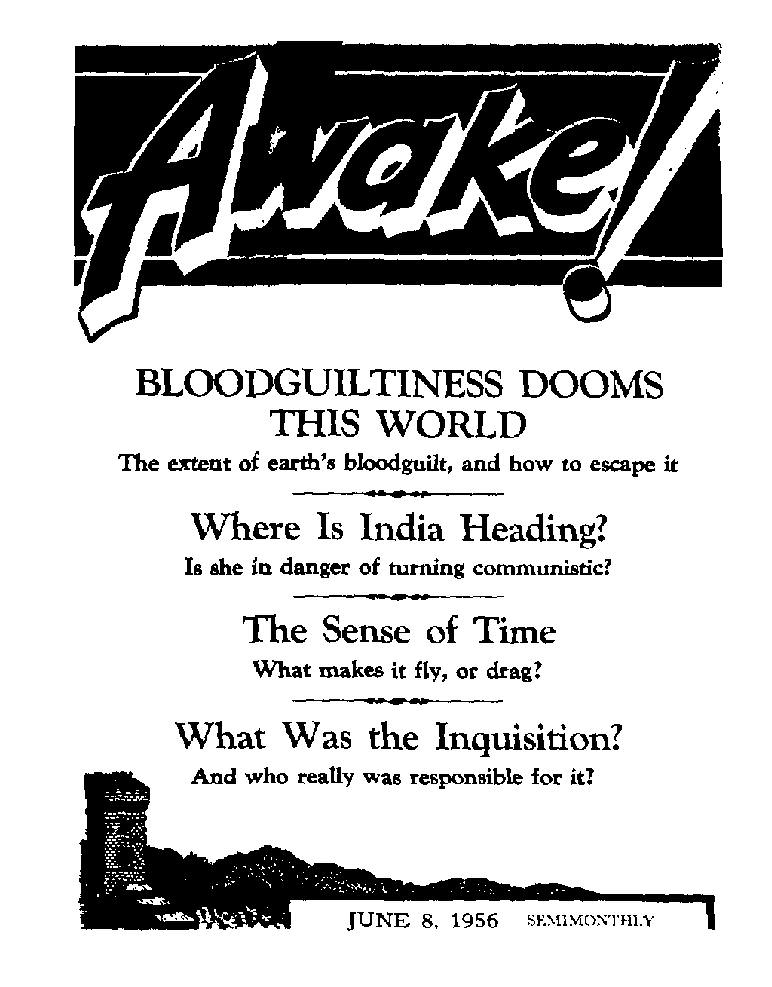
JUNE 8, 1956 SEMIMONTHLY
THE MISSION OF THIS JOURNAL
News sources that are able to keep you awake to the vital issues of our times must be unfettered by censorship and selfish interests. “Awake!" has no fetters. It recognizes facts, fates facts, Is free to publish facts. It is not bound by pohtictd ambition/ or obligations; it is unhampered by advertisers whose toes must not' be trodden on; it is unprejudiced by traditional creeds. This journal keeps itself free that It may speak freely to you. But it does not abuse its freedom. It maintains integrity to truth.
"Awake I" uses the regular news channels, but is not dependent on them. Its own correspondents are on all continents, in scares of nations. From the four corners of the earth their uncensored, on-the-scenes reports come to you through these columns. This journal’s viewpoint is not narrow, but is international It is read in many nations, in many languages, by persons of all ages. Through its pages many fields of knowledge pass in review—government, commerce, religion, history, geography, science, social conditions, natural wonders—why, its coverage is as broad as the earth and as high as the heavens.
“Awake I” pledges itself to righteous principles, to exposing hidden foes and subtle dangers, to championing freedom for all, to comforting mourners and strengthening those disheartened by the failures of a delinquent world, reflecting sure hope for the establishment of a righteous New World.
Get acquainted with “Awake!” Keep awake by reading “Awake!”
Pc bushed Semimonthly by WATCHTOWER BIBLE AND TRACT SOCIETY, INC. II? Adams Street Brooklyn 1, N. Y,, U. S. A.
N. H. Knobr, President Grant Suiter, Secretary
Printing this issue: 1,750,000
Otksr lasoufu is which “Awake!” 1i iibllihed: Srtlmontkly—Arrfkaauy, Finnish. French, German. Holludlab, Iulian, Normalan, Spanish, Bwedlrii. Monthly—Danish. Greek, Japanese, Portuguese, Ukrainian.
Offices Pearly mtacrlptloo rate
America, U.S., li t Adams St., Brooklyn 1, N.Y. SI Airtrail*, 11 Beresford Rd., Strathflcld, N.S.W. 8/-Canada, 150 Bridgeland Are., Park Bead P.O.,
Toronto 10, Ontario fl
Enilani, 34 Craven Terrace. London, W. S ?/• Hew Zealand, O.P O. Bor 30, Wellington. C. 1 17-Suth Africa, Private Bag. Handstonteln, Tvl. 1/-
Flve cents a copy
Remittances should be sent to office in pour country tn cnmplUnee with regulations to guarantee eate delivery nt money. Bemlttances are accepted ar. Brooklyn Prem countries where no office is located, by international money order only. Subscription rates In different countries are here stated in local currency. NotlM of expiration (trllb renewal blank) is sent st least two Issuer before subscription expires. Chaope of addrsu when sent to nur office may be expected effecthe within one month, Seed your old es well as new address.
Bnlered ar sr-twod-dSsy mattnr at Brooklyn, N.T. Printed in U.S.A.
CONTENTS
Bad Associations and Useful Habits
Bloodguiltiness Dooms This World
Where Is India Heading?
Problems of Unity and Living Standard 10
The Sense of Time
Why Time Speeds with Age
Can Time Stand Still?
Reappraisal of the Missing Link
Number One Killer Executed
Notes and Quotes on Delinquency
A Toothpaste Containing Fluoride
What Was the Inquisition?
The Auto-da-fS
Is His Church Dying?
“Your Word Is Truth"
Do You Believe in Miracles?
Jehovah’s Witnesses Preach in All
the Earth—Leeward Islands
Do You Know?
Watching the World
Vorjrtn# KXXVU
Brooklyn, N. Y.. June-8, 19W
BftOTAssoavr\TiONS
^>4* U ra&L
’^incL^
^JlRDS of a feather, according to an old saying, flock together. Even more appropriate to our discussion here is the statement that all the animals in one pack share the same bunch of fleas. The first saying implies that you associate with the kind of person that you yourself are. The second warns that you are under pressure to adopt the customs of the people you know. Both warn us that we should choose our friends well. The Bible agrees, saying:
‘Bad associations spoil useful habits/1 —1 Corinthians 15:33, New World Trants Most people recognize this principle. Mothers recognize it. when they express concern about their children’s playmates. Parents recognize it when they are anxious a bout the friends with which their teen-age daughters associate. Youths demonstrate it when, to keep from being called a coward, they do things they never would do otherwise. Adults submit to similar social pressure when they go into debt to keep up with their neighbors, or join a particular dnurch because of its size and respectability rather than because of its doctrines.
We ah know that we are influenced by the ideas, morals and behavior of our friends, but few people realize just how strong this influence is. Recent experiments have uncovered amazing facts about it
The experiments involved 123 groups of college students who were given what they were told were tests in visual perception. They merely had to state which of three lines on one card was of the same length as a single line on another card. Anyone could do this. In fact, under normal circumstances they would pick the right line more than £19 out of every 100 times.
But this test was not conducted under normal conditions. Actually it was a test of social pressure, rather than of visual perception, and all but one person in each group of participants had been told to give unanimously wrong answers at certain specific times. The real purpose of the test was to find out what people would do when they could plainly see that one thyig was true but everyone else said just the opposite.
What do you think happened? Would people believe their eyes? Would the crowd’s pressure affect them? Well, three out of four persons tested began making errors! They accepted the majority’s
June a, 195*;
wrong judgments 36.8 percent of the time. Even when the difference in the length of the lines was increased to seven inches, the point was never reached where every person experimented upon would reject the majority’s deliberate error every time!
Another thing of importance was discovered. It was found that when just one other person also went against the major-'ity and gave truthful answers, the accuracy jumped amazingly. When the person who was the subject of the experiment had only one other person in agreement with him, there were only a fourth as many errors as when everyone else had given the wrong answer. Solomon E. Asch, reporting on the experiments in the November Scientific American, said: “As long as the subject had anyone on his side, he was almost invariably independent, but as soon as he found himself alone, the tendency to conform to the majority rose abruptly.”
Commenting on Professor Asch’s disturbing report, Scientific American said it indicates “that to have the courage of one’s convictions is a rather rare quality. In the face of apparent group pressure many people will disbelieve their own senses.” Yet it illustrates several vital principles.
First, as mentioned above, it shows that we must Choose our friends well. If we are going to be influenced by them anyway, certainly they should not be people who would tempt us into immorality, or into . rejecting God’s way and accepting the way of the world. The Bible is very clear on this when it says: “Do not become unevenly yoked with unbelievers. For what partnership do righteousness and lawlessness have? Or what fellowship does light have with darkness?” Certainly these experiments prove this principle to be sound! —2 Corinthians 6:14, New World Trans.
Second, these experiments illustrate why it is so necessary to stick firmly with those who will help us to stand for truth and right. If just one associate can give such strength to stand for truth against a majority that is wrong, we can understand why we are told to stick firmly with the true congregation, “not forsaking the gathering of ourselves together” “but encouraging one another,” “comforting one another and building one another up.” —Hebrews 10:25; 1 Thessalonians 5:11, New World Trans.
Third, the importance of determination is clearly illustrated. Remember that one out of every four persons subjected to this experiment did stand firm. Twenty-five percent did not submit to the pressure to agree with the erroneous judgments of the majority. How can you have an equal spiritual determination? First, by being firmly grounded in the faith, and then after that by benefiting from the strength of right association, and by heeding the warning to beware of wrong examples.
But still another principle is involved. It is that we must set the right example for others. We must recognize our obligation to them, and let our example provide them with the strength, encouragement and assistance that we want them to provide for us. The Proverbs say: “Iron sharpeneth iron; so a man sharpeneth the countenance of his friend.” Each is a help, benefit and encouragement to the other. The Bible also says: “Woe to him that is alone when he falleth; for he hath not another to help him up.” Is your good example providing that needed help for others? —Proverbs 27:17, Ecclesiastes 4:10.
So it is wise to select friends whose influence will be sound, whose example will help you toward useful habits. And, more than that, be a good friend, not passing along a bad example to others, but being a help rather than a hindrance to them in their efforts to go the right way.
Hott? Wh e n a n d h aw?
How can you escape
the blood that has drenched the earth?
ft on on your part will preserve you.
A MURDER was being committed in the A United States at the rate of “one killing every 40.3 minutes/’ and New York city alone was claiming "a victim every twenty-four hours/* according to the Federal Bureau of Investigation records for the first six months of 1953-
But this is an infinitesimal amount of warm blood spilled when compared with the manslaughter caused by careless driving of automobiles or by other accidental causes. The butchery committed by automobiles on United States’ highways has tapped the loss of lives in all wars fought in America; and when it comes to injuries, motor accidents outstrip the bloodiest war.
The Revolutionary War lasted eight
years and cost 4,435 American lives. Auto-
mobiles last
more than that
days.
The War of 1812 lasted three years, with 2,260 UJS. deaths; the Mexican War cost 13,283 American Jives. But deaths in both those wars were equaled on United States* roads in just five months of 1955. From 1775 to 1955 some 1,130,393 American lives were lost in all wars that the United States was involved in. But between 1900 and 1955 cvcr 1,149,414 Americans died as a result of highway accidents. All this is a terrible spilling of blood thdt man must give an account for before the Supreme Judge of the universe, who is the Giver of life, namely, Jehovah God.—The U.S. News <£ World Report, February 3, 1956.
Eut this frightful toll of blood is a drop compared with tliat which has soaked the earth in her thousands of wars, besides religious inquisitions and crusades prior to 1914. However, since 1914 more human blood has been poured out than ever before in history, not only in private, individual killings and accidental killings, but more so in collective killings, in the two greatest carnages of all human experience, World Wars 1 and II. And now mass preparation is made for the dreaded third world war, which promises to be the greatest spiller of blood, the most costly of all in human fives, because the world H now armed with atomic or nuclear weapons of mass destruction.
While both sides to the wild sprees of human butchery try to wash their hands clean of bloodguilt in the water of various self-excusing arguments, yet God is judge. Before him an all-embracing bloodguilt rests on all mankind, on both those who directly did the shedding of blood and those who lent their support morally or materially. The God of justice lays upon people a joint responsibility in respect to bloodshed. So all people share in a community of responsibility for the blood that has drenched the earth.
In this respect the skirts of religion are not clean, for in these massacres the religious leaders of all the nations at war, even the clergy of Christendom, have prayed to their religious gods for heaven’s blessing upon their own military forces. On April 1, 1939, Eugene Pacelli, the pope of the Roman Catholic Church, telegraphed General Franco and thanked him for a “desired Catholic victory,” in which 1,200,000 men, women and children were slaughtered; most of these victims were Catholics.
When Adolf Hitler made his triumphal entry into Austria, in March, 1938, after his absorption of Austria, Cardinal Innit-zer was among the first to visit him and pay him honor. Not only did Cardinal Innitzer “Heil Hitler” in his own handwriting, and write Cardinal Bertram of Breslau that the Austrian hierarchy would continue to co-operate with Hitler, but he caused the swastika flag to be raised on the Vienna cathedral.
What followed is well known. This same Adolf Hitler, whom the cardinal blessed, led the world into the most sanguinary conflict ever known. He supervised the butchering of over 5,000,000 Jews in scores of concentration camps, over which his S.S. troops reigned supreme. He condemned Jehovah’s witnesses to death because of .their faith in God and the uncompromising stand they took in their worship. Upward of ten thousand of them were thrown into his concentration camps, many of them died in gas chambers, others were beheaded, some were shot and othex's hanged. Only 8,000 survived. Hence to modern-day Christendom the prophetic words addressed to unfaithful Jerusalem apply: “Also in thy skirts is found the blood of the souls of the innocent poor.” —Jeremiah 2:34, Am. Stan, Ver.
Russian Blood Purges
Closely at the heels of Hitler’s sickening bloodthirstiness and bloodguiltiness follows the Russian communistic regime, which receives the blessing of the Russian Orthodox Church and its clergy. Authentic reports state that during the farm collectivization program in Russia 10,000,000 peasants were either massacred or starved or deported to slave labor camps to die. Stalin’s blood purges of 1936 to 1938 shocked the civilized world.
Vladimir Petrov, former top agent of the Soviet in Australia, told of the drastic purges throughout Europe and Asia by the Russian government. “As an N.K.V.D. [later name of secret police] officer in Moscow in 1936, 1937 and 1938,” he says, “I lived through the most fantastic reign of terror imposed by a modem government on its people, and a bloodbath almost too fearful to be believed. I estimate that two million Soviet citizens must have been shot without any proper trial or examination of the stereotyped charges against them in the nightmare years of 1936, ’37 and ’38. This hideous carnage was sheer madness by any standard of right and justice . . . The purges were a calculated policy which seemed to make sense on the basis that expediency is the only law.”
Petrov further says: “I handled hundreds of signals to all parts of the Soviet Union in the following form:—‘to N.K.V.D. Frunz, Khirgiz Republic: “You are charged
with the task of exterminating 10,000 enemies of the people. Report results-by signal.”—Yezhov.’- ” The reply would be: “I reply to yours of--The. following
enemies of the Soviet people have been shot.” Petrov tells how they worked “day sind night trying to keep up with the mass liquidations” and to meet their set quotas. “The quotas of victims for each district and town were fixed at N.K.V.D. headquarters in Moscow. I remember one order to the town of Sverdlovsk for 15,000 ‘enemies of the people’ to be exterminated." Executions were carried out by shooting or the victims were simply thrown into old mine shafts as the quickest method, and left to die.
lii the Katyn forest of Poland 15,400 Polish army officers and intellectual leaders were found murdered. This while that part of Poland was under Russian occupation in 1940. Speaking not of Stalin, but of Khrushchev, Malenkov, Mikoyan and Bulganin, present heads of the Russian government, the New York Times of February 20, 1956, had this to say: “The men who denounce Stalin now were trained by him and their hands are as bloody as were Stalin’s with the blood of innocent millions.”
It is under this present regime that thousands upon thousands of Jehovah’s witnesses now languish in prisons. Many of them have been murdered for refusal to give up their faith in Jehovah God. The lifeblood of those who were slain because of their faithfulness in testifying to the name and goodness of the Almighty God cries out to him. “Listen! Your brother’s blood is crying out to me from the ground,” God says. Referring to slaughter like this the inspired account says: “I saw underneath the altar the souls of those slaughtered because of the word of God and because of the witness work which they used to have. And they cried with a loud voice, saying: ‘Until when.Sovereign Lord holy and true, are you refraining from judging and avenging our blood upon those who dwell on the earth?’ ” The answer to those cries is soon to come when all the nations guilty of such things will have the lifeblood stamped out of them at Armageddon, the war of the great day of God Almighty.—Genesis 4:10; Revelation 6:9, 10, New World Trans.
Bloodguiltiness of the Western World
But bloodguilt does not rest upon the Russians alone. All nations stand guilty before God. The author of the book The UN Record states: “The keynote of Yalta was expressed in a single word by Roosevelt, who said he had seen the devastation wrought by the Germans in the Crimea and was ‘bloodthirsty.’ ” “At the Teheran conference, a little over a year earlier, Churchill had been offended by Stalin's proposal to shoot 50,000 German officers and was not mollified when Roosevelt jocularly suggested a compromise whereby only 49,500 would be shot. At Yalta Roosevelt was not joking when he expressed hope that Stalin again would propose a toast to the execution of 50,000 German officers.”
This same authority says that “such a world champion exterminator as Jenghis [Khan] must have been slightly envious when Churchill and Stalin agreed that the problem of accommodating five or six millionrefugees from Germany's lost territory in what remained of that country could be alleviated by killing more Germans. ‘We have killed five or six million and probably will kill another million before the eaafi of the war,’ said Churchill. 'Or two million,’ Stalin interjected.”
Just two days after the Yalta conference closed, on the night of February 13, 1945, 2,000 American and British heavy bombers dropped their bombs on the city of Dresden, in easrem uenumy, a city that was swollen with refugees from the east and west, a city of museums, cathedrals and hospitals, containing no important military installation whatsoever. Swiss and other observers estimated that 100,000 men, women and children were slaughtered in that raid. That figure reminds us of another scene in Asia, when American planes released the first atomic bombs on Hiroshffna and Nagasaki, leaving behind a frightening desolation and 100,000 dead.
JUNE 8, 1956
In his report to President Truman on the San Francisco conference, Secretary Stettinius remarked: “Some forty million human beings, armed and unarmed,” had been killed in two wars in a period of some ten years. The Korean war cost the United States 33,417 dead. As for the opposing side, the United States Secretary of State John Foster Dulles declared: “The North Korean army is virtually extinct and the Chinese and North Korean Communist armies have sustained about 2,000,000 casualties, and of the 10,000,000 people of North Korea one out of every three has died from war ravages and inhuman neglect, which their rulers have imposed.”
In other parts of the world where the quest for power continues the earth is soaked with human blood. The riots in India and Africa, the civil war in Argentina, all tell of bloodguilt. The scourge of Colombia as recent as January, 1954, was marked by a wave of murders. More than a hundred men were slaughtered in less than six months. In a-small two-street town with a population of only 5,200, twelve murders were committed in six weeks. Twenty others were carried out in surrounding areas, some of these by the violent method of beheading.—Time. January 18, 1954.
Let the nations and the worldly organizations that feel no sense of guilt before God remember that God is judge. For centuries the blood of innocents has been shed, arid evil deeds have been covered; but the time has come for Jehovah God to tear off the covering and disclose all the wickedness that has been done by man. The prophet Isaiah says: “For, behold, Jehovah cometh forth out of his place to punish the inhabitants of the earth for their iniquity: the earth also shall disclose her blood, and shall no more cover her slain.” —Isaiah 26:21, Am. Stan. Ver.
Those who would survive the divine vengeance of Armageddon must flee this system of things now and come over to the Christian theocratic organization. They must confess their sin of bloodguilt to God and appeal to him to have mercy through his great High Priest, Jesus Christ, who provided the ransom sacrifice for all mankind. Thereafter they must prove to God that their repentance is genuine by keeping fast to their refuge within his provision and theocratic organization.
Jehovah’s witnesses have done this. They have declared themselves absolutely neutral toward the sanguinary combats of this world. Also they have taken their stand for God’s covenant concerning the sanctity of blood, not to violate it by the transfusing of blood, to keep themselves from any willful bloodguilt in God’s sight. Their eyes have been opened to see the bloodguiltiness of all the world and they want no share further in it nor in paying the penalty for it with this world at Armageddon.
If you wish to be protected from the death of the bloodguilty, join the hundreds of thousands by coming over to the God-ruled organization and seeking refuge inside the New World society. Then “it may be ye will be hid in the day of Jehovah’s anger” to enjoy life on a paradise new earth.—Zephaniah 2:1-3, Am. Stan. Ver.
t^EWS and commentary hit the world press as the two top Soviet leaders, Nikolai Bulganin and Nikita Khrushchev, salaamed up and down India for eighteen days in the closing weeks of 1955. The significance of the visit and the controversy generated by their speeches were; widely discussed: The far-reaching and persistent attacks on Britain and the United States by the two leaders betrayed a sinister design to undermine the influence of the Western nations.
Some Indian thinkers with Western education were at first prone to dismiss the utterances of Bulganin and Khrushchev as merely signs of good salesmanship. Without doubt, though, the vast majority of the people derived unmistakable pleasure from the tongue-rattling. But as days went on other events compelled the press and the Indian public to take a second look at the deep mark left oq the country by the Soviet visit. The same people who had vied with one another in extending their hospitality in return for the great welcome that Prime Minister Nehru had received in the Soviet Union were now asking;
Was India riding a razor’s edge where a slight tilt might send her into an abyss of chaos and make nonsense of her policy of independence at home and abroad? Will the poverty trf the masses, the problems or unemployment, the low standards of living, the ignorance of the common man respecting the intricacies of politics and the unpopularity of the ruling party with the intellectually awakened middle classes create an atmosphere that will whip the Indian masses up into the fury of a nationwide revolution whereby a communistic regime would be established?
On the other hand, are the realization of the most important targets of the First Five-Year Plan and the ambitious nature of the Second Plan real bulwarks Against communism’s getting the upper hand? Are religion’s hold on the masses, the social traditions of caste and the joint family system enough to stem the rising tide of communism?
Various Views
These conflicting fears and questionings may well be considered alongside the following pronouncements. “If within ten or fifteen years India is still an independent country, that is all we want,” said John Sherman Cooper, U.S, Ambassador to India, January 31, 1956.
The Soviet First Secretary Khrushchev in September, 1955, declared: “If someone would interpret our smile to imply an abandonment of the teachings of Marx, Engels and Lenin, he would be deceiving himself most cruelly. Socialism will eventually be victorious. To this end we shall not wage any war. Peaceful competition is enough. We shall see who is right”
In his address to India’s National Development Council, January 20, 1956, Prime Minister Nehru commented: “Some people charged us with coming under the influence of communist planning; others charged us with coming under the influence of somebody else; people never im-
agined that we are trying to come under the influence of our own mind and thinking, while we were profiting from other people’s minds, thinking and experience.”
And to this we might add the statement made by Dr- A. L, Mudaliar, vice-chancellor of Madras University, January 22, 1956: “India had not allowed its essential outlook on life to be changed by the sojourn of foreigners. India may embrace many a visitor who comes as a guest but it does not thereby embrace the ideologies which such visitors may choose to cherish or even be anxious to spread.”
It should be recognized that in India there is a savor of genuineness about the manifestation of popular good will, for large gatherings of men and women are nbt rare. The presence of three million people at the welcome to the Soviet leaders in Calcutta alone may be considered “unique and one which was not likely to be repeated anywhere in the world.” But many illiterate peasants who had trekked miles to these tamashas could have had little idea really why they had done so, nor could many more know exactly what they were leading to. Moreover, India has an old tradition of fairs, festivals and carnivals. They have been there in many forms, which attracted millions of devotees.
Problems of Unity and Living Standard
The Indian community, Hindu and nonHindu, is a vast mass of 360 million souls, 80 percent of whom are illiterate and living mostly in its 700,000 villages. In the political sphere, India during its early history was subdivided into small and large principalities governed by good or bad rulers. Whatever unity was achieved was short-lived. When India attained its freedom in 1947 and drafted its first Constitution in 1950, the different Indian states were either merged or acceded to the Indian Union. In the first flush of independence the leaders were apt to take the unity of the country for granted. But events have proved that this unity is only skin deep and no more.
When the government announced its decisions on the linguistic demarcation of states, the scramble for territorial advantage showed itself in all its hideousness. A country-wide turmoil flared up. To restore order the government had to resort to force, 76 persons being killed and 7,000 being arrested in Bombay alone, after five million dollars’ worth of property had been destroyed. It was a bad show, a triumph for emotionalism. The criticism that “communism has always tried to weaken India by parceling it into little linguistic states” merely seeks to cover up the political immaturity of India’s peoples, who still have a long way to go to achieve real national unity.
When the former United States ambassador to India pleaded strongly for increased financial aid to this country he said: “Eighty percent of the population of India had been asleep for 5,000 years but now were beginning to want better things. They are saying we are not going to live under the same conditions as our fathers. The stirring of this great giant is the most significant thing that is happening. It will be a dangerous thing if they don’t get what they want. They will listen to someone who will promise swifter action.”
India’s leaders urge that the economic problems of India be considered as human problems, that the basic necessities of life of millions might be met. “We have no time to play—our basic objective is to satisfy the needs of the people,” said Prime Minister Nehru.
Sounding a warning that democracy in India might not survive a few more Five-Year Plans is columnist Dr. Krishnalal Shridharani of New Delhi. He considers the next five years as “crucial.” He ob-
served, too, that "both Amerfca and Britain are becoming more and more unpopular In this country.” "America, which fired the Imagination of a whole generation of Indians some 50 years back, is no more regarded as a model in Delhi. Most of India’s planners, therefore, have subconsciously adopted Russia as a model,” he commented.
Those whose way of life is influenced by private enterprise therefore view the nationalization of the Imperial Bank of India, then of the country’s airlines and just recently of the 165 Indian and foreign-owned life insurance companies as a pointer to communism. There are others, though, who are still confident that democracy will survive in India. To them the successful implementation of the Second Five-Year Plan is regarded as essential to combat the danger of India's goingj'Rcd.”
Evidently taking note of this possibility, Dr. Rao, director of the Delhi School of Economics, recently admitted that “if a large number of people went communist no one would blame them as there was no country in the world with so sharp differences of living standards and so much abject poverty, although they would not do so merely for the sake of the communist ideology.”
Religion No Bulwark Against Reds
To pierce through and perceive the Indian mind, one must examine the culture and the religion of the people, which are intertwined. Here might be detected a warning against a too easy conclusion that the hold of religion on the masses would be a deterrent against India’s going "fted.” It might well be remembered that millions of Roman Catholics in Europe and over 600 million Buddhists have not been a bulwark against communism, but have meekly given themselves over to it. Also, many Indian religions are such that they can accommo-
(tete an ffutoner of contradiettons, even to the extent of not believing In God. What is to prevent them from accepting communism?
Since it is claimed that “the present leaders of the communist cause have become the most enthusiastic exponents of the ‘Pancha Sheer [or peaceful co-existence], a product of the policy shaped by Indian thought,” some wonder if communism has not thereby “accepted defeat at the hands of Indian ‘culture’.’’ Indians believe that “the diehardism of Russian Marxist philosophers is declining as they come into contact with other peoples and beliefs.” They also believe that “the liberal democratic spirit has emptied itself of its early ‘sacrificial faith’ and ardour”; that time has come for India’s political thipkers to offer fresh hope to a fearful and confused world.
Elaborating on this point, Delhi’s Shankar's Weekly, February 12,1956, declared; "Not only because of our traditions but because of the fact that the Southeast Asian region is developing in a particular manner taking the best out of both power blocs, it is meet that we should attempt to synthesize Marxian with the liberal democratic spirit, A rising cadre of Indian intellectuals in the present situation might well set the lead in evolving a new and harmonious pattern to a world in chaos.’*
The question still remains, Where is India heading? Many seem to feel that as long as Nehru is at the helm of state affairs India will not go communistic. But they argue that towering personalities are seldom succeeded by men of like caliber, and history has shown that neither religion rror culture can be sufficient deterrents to stop the onward rush of the Red tide. Then, will India be the next Communist victim?
Time alone will tell.
the standing still of time is even conceivable-
In considering some of the properties of time, it is interesting to note first that the stream of time possesses at least one unique property, and that is, time always moves in one direction only. Just as with an auto driven down a one-way street, time always moves forward toward the future, never backward toward the past; time can never be
The Sense of
reversed. Time being irreversible, we can live only in the present; the moment just preceding now is past; it is history. The moment immediately before us is in the future.
What one has done in the past can never, never be retrieved. It is as impossible to retrieve the past as
IME ranks high among the senses with which earthly creatures are endowed. Every event from the cradle to the grave leaves its footprint on the sands of time. “There is ... a time to be born, and a time to die; a time to plant, and a time to pluck up that which is planted; ... a time to break down, and a time to build up; a time to weep, and a time to laugh; a time to mourn, and a time to dance;... a time to get, and a time to lose; ... a time to rend, and a time to sew; a time to keep silence, and a time to speak.” (Ecclesiastes 3; 1-8) In heaven, too, angels experience the passing of time. An angel sent to comfort Daniel was detained twenty-one days by the prince of the kingdom of Persia. (Daniel 10:13) And with Satan also time exists, for “he knoweth that he hath but a short time.”—Revelation 12:12.
Universal as time is, yet no man living is able to define it. It is as indefinable as space is, or as gravitation, or as life itself. It is as unfathomable as eternity. No one knows when the stream of time began or when it will end, if ever. Nevertheless, time does possess properties that are fathomable. Its apparent rate of flow can be increased or it can be decreased at will. Yes, it is for a child to return to yesterday and not eat the green apple causing his distress today. A regrettable deed done in the past is stamped on the pages of history; only Jehovah God can blot it out. Likewise, the good deed one does today will stand throughout eternity. The past is lost; we have no control over it; it is constantly drifting backward away from u$.
Not so, however, with the future; it is constantly flowing toward us and some control of it is possible. Just as the driver of a car can avoid obstacles apparently moving toward him as he travels down the road, so, too, while living in the present we can avoid the obstacles and pitfalls of the future. As the proverb says: “A wise man feareth, and departeth from evil.” —Proverbs 14:16.
Often you may have heard people sayr “Oh, how fast the time seems to fly.” Or, contrariwise, they may have said: “This day is so long I do not know what to do with myself,” Again, have you not often heard children lament how slowly the days seem to drag on, or the aged person admit how rapidly the years are slipping by? Why is it that time seems to pass more rapidly with one person than with another? Why more rapidly during certain
periods than at other times? Is not time one and the same experience for all persons? Obviously, it is not
An old adage states: “A watched clock moves slowly.” That adage is true, as anyone can testify from experience. Conversely, to a person who is so raptly engaged in some interesting and profitable work that he does not have time to observe the clock time passes rapidly. Give a child of tender years some seed to sow and a garden to Tend, After planting the seed he will soon be heard to inquire: "How much longer must I wait until the flowers come out?” Or he will wonder why it takes so long for the fruit to ripen. He expects results immediately, because he is “watching the clock,” so to speak. To him time passes very slowly.
You, yourself, may have at one time or another laid your hands upon what to you was a most interesting book. You opened it and began to read its pages. Perhaps it was so interesting that you simply could not lay it down until you had read every page, reading all night long. To your amazement the night had passed without your knowing it. Why? Because you did not think of time; your mind was blank to the sensation of time; you did not have time to “watch the clock.”
Whether one is reading an interesting book, or being engaged in an interesting conversation with a group of people, or being busily employed with one’s hands in profitable work, or delivering a speech in which one is completely absorbed, or anything else whatsoever that directs the mind away from the sensation of time, to him time passes rapidly because he is unconscious of its passing. It passes slowly only when one is conscious of the fact. Thus, to a person suffering much pain in a hospital, or one forced to idleness in solitary confinement, or one in deep distress, time seems to pass very slowly.
Schoolbooks have taught that human creatures possess five senses. They go on to name them as being sight, sound, taste, smell and touch. Modem science adds at least fifteen more to these five basic senses. To mention but a few, note that humans possess a sense of temperature, a sense of balance (which keeps one in an upright positjon when walking an board a rolling ship), a sense of distance (a kind of radar sense that blind persons develop), and, last but not least, a sense of time. The importance of this latter sense becomes obvious when one considers that, without it, one would not know what year it is, what day of the week it is or what hour of the day it is. One would not know whether he is living in the present, in the past or in the future. Nor would he know when his workday is done and his wages are due. What a dreadful world it would be were there no sensation o£ time'.
Why Time Speeds with Age
You may have observed how time seems to drag on and on with children, but; as the years add up, quite the reverse seems to be the rule. Have you ever wondered why this is so? To understand the reason for it, consider two short experiments that demonstrate the fundamental physical law causing the anomaly.
Seat a person in a dark room. After a brief time turn on a light of very low intensity, say, a small six-watt lamp. After he observes the light for a moment increase the intensity by turning on another six-watt lamp. A very decided increase in the amount of light will be noticed immediately.
Now, repeat the experiment by beginning with a much stronger light, say one of six hundred watts. Should the intensity of the light again be increased by the same amount as before (six watts), the increase in the brightness will go unnoticed, even
though the amount of the increase was exactly the same in each case.
Another experiment, this time with sound. Place a person in a very quiet room. The ticking of a watch he will hear distinctly. Now move him into the midst of a noisy boiler shop. Will he be able to hear his watch there? Of course not, even though his watch ticks away just as loudly as before.
The reason for the strange effect upon the senses, as demonstrated by these experiments, is that there is here in operation an important physical law by which all the senses are governed. For identification purposes it is known as “Fechner’s law,” or otherwise as “the logarithmic law of sense perception.” Notice how it operates toward the sensation of time.
Ih the foregoing experiments consider what happened in the case of light. When the six-watt light was increased by an additional six watts, it represented a full one hundred percent increase in the intensity of the light. Not so, however, with the six-hundred-watt light; the six watts added represented only one percent increase in the intensity of the light. Fechner’s law states that it is the percental change, rather than the intensity itself, that determines the degree of sense perception. This logarithmic law is constantly in operation, often without one’s being aware of it.
Applying Fechner’s law to the sensation of time, its effect upon the young and the old becomes apparent at once. Thus, to a child one year old, adding another year to his life represents a full one hundred percent increase in his life’s experiences. To him, therefore, a year seems to be a long, long period of time, because it represents so much of his total life. However, when the same increase of one year is added to that of a centenarian, for instance, it represents only one percent of his total life’s experience. Hence, to the centenarian one year seems like a short period of time because it represents so small a part of his total life. The older a person becomes, therefore, the faster time seems to fly.
An interesting sequel follows this physical law, namely this: human creatures are promised everlasting life on earth in God’s kingdom, which is now dawning. All persons who obtain Jehovah’s approval in that kingdom will never need to die. Now, what effect will time have upon these people when they become, say, five hundred, a thousand or ten thousand years old? Will time hang heavy on their hands then? Fechner’s law, along with other evidences, answers definitely No. Life will be so interesting, so absorbing, so blessed and happy then that there will be no occasion for time to drag on and on. Instead, the pleasant, paradisaic environment, together with the passing centuries added to one’s life, will cause time to be a most pleasant sensation.
As another sequel, it may be conjectured that since spirit creatures also experience the passing of time and since they have been in existence eons of time before man was created, could it not be that time passes with them at an entirely different rate than it does with creatures on earth?
Can Time Stand Still?
The inquiring mind may wonder, Since there is an apparent change in the rate the stream of time flows because of one’s environment and age, should it not be possible in some manner to cause time actually to slow down or even to stand still? Amazingly enough, there are sound scientific reasons for concluding that the actual slowing down of time is entirely within the realm of possibility. Time’s standing still, however, can only be approached and never attained. Such a conclusion may seem to be an absurd one. There is a way, strange as it may seem to be.
It was not until the year 1887 that light began to dawn as to how the stream of time may be made actually to change its rate of flow. In that year an American physicist, A, Michelson, began an outstanding experiment in measuring the velocity of light. Michelson and his associates attempted to prove that earth’s motion through space has an effect on the rate light travels. It was then believed that light is a wave motion in the all-pervading “ether,” and, just as a wind in the atmosphere will affect the speed of an airplane, so, too, the equivalent “ether wind" produced by earth’s motion should affect the velocity of light. After the most diligent efforts and the use of highly sensitive measuring instruments, no detectable change in the velocity whatsoever could be found.
The experiment appeared to be a dismal failure. A first-rate scientific riddle there posed itself for these scientists to solve. Although the experiment failed in its original purpose, nevertheless, the failure proved to be a success in disguise not suspected at the time. After years of research and study it finally resulted in the now world-famous “relativity theory” as conceived by Dr. A. Einstein. It explained why Michelson’s experiment failed. Einstein’s theory stands today as a monument to the achievements of modern science. Its basic tenets have been proved true a thousand times over in atomic laboratories. It is this theory that embodies the concept that time indeed can be altered.
Omitting the highly technical details involved, suffice it to say that the relativity theory comprehensively relates the essential elements of space, time, mass and energy to motion, hence the name “relativity.” Time plays an important role in the theory. It is, as it were, a fourth dimension. The importance of the time element may be seen in an illustrative example demonstrating the relativistic principle.
Imagine a rocket ship available that is capable of flying at the speed equal to 87 percent of the velocity of light. Suppose this rocket to be powered by atomic energy and that you engage to use it for a week’s vacation on a flight through space. You arrange with your employer for the necessary time off and you get ready for the flight. In preparing for the flight you are particularly careful to include with your baggage a good watch and a calendar so you will be sure to return on time and thereby not disappoint your employer. The day arrives for the flight to begin, and so you take off, telling your friends that you will be back in exactly one week. You depart and enjoy your flight up in space, and as you count the days you finally arrive at the week’s end and so you return to your starting point.
You land expecting to see a host of your friends at the airport to greet you. But, to your disappointment, not a one is in sight. You wonder why. Finally you report to your employer for work. When your employer sees you he vehemently scolds you for remaining away so long. He might say to you: “See here, you requested only one week off from, work for vacation, but, instead, you remained away a full two weeks. I have in mind to discharge you for it.” And he would be quite justified in his action. Why so?
Although both you and your employer were correct in your timekeeping, the watch you were using while on vacation actually slowed down during the flight. The slowing down was not because of any mechanical trouble with your watch, but, according to the relativity theory, it was because of the high rate at which you were traveling through space. The rocket ship and everything in it paradoxically contracted in the direction of Bight to one half of its normal length relative to a body not in motion. You were living one half as fast, your
watch was running one half as fast, and the mass of the rocket ship and everything in it had doubled, as seen by an earthly observer. While you were in flight the stream of time paradoxically slowed down to half its normal rate compared with that on earth. Such are the strange consequences that follow when traveling at a rate comparable to the velocity of light, according to the relativity theory.
Absurd as the consequences may seem to be to an eai th-bound creature, yet the relativity theory has sound scientific backing. To mention just one evidence supporting the theory, it may be noted that atomic physicists, when working with their electron accelerators, must constantly recognize the relativistic fact that the mass of a body actually increases with its velocity. Thus when an electron is accelerated in a betatron to 87 percent of the velocity of light, its mass becomes twice as great as when at rest, as is measured by the magnetic force required to turn its path. When accelerated to 99 percent of light’s velocity, its mass becomes seven times as great as when at rest. As the velocity continues to increase, the mass also increases without limit as the velocity approaches that of light. Evidently there is no earthly force great enough to create velocities equal to that of light, for the reason that an infinite amount of power would be required.
In so far as time is concerned, its rate of passing actually slows down in exactly the same proportion as the mass is increased. It can be proved mathematically that any force whatsoever capable of increasing the mass of a body will at the same time increase the length of the period between any two events on the body. This for the reason that mass and time are directly related to each other, strange as it may seem to be. The lengthening of a period between events is equivalent to a slowing down of time. It is seen, therefore, that were it possible to increase the rate of motion of a body to that of the velocity of light, then the stream of time would stand still; it would cease to flow. To do so, however, is an earthly impossibility.
As a corollary to the relativity theory it can be demonstrated mathematically that should a body in motion be capable of speeding at approximately 99.9999 percent of the velocity of light, then time would be slowed down to such an extent that one day of space travel would be the equivalent of a thousand years on earth. Since Jehovah God is the Creator of light, could it not be possible, therefore, that the Scriptural statement at Psalm 90:4, “A thousand years in thy sight are but as yesterday,” has a literal application as well as a symbolical one?
We are now living in the last days of “this system of things.” A day of judgment is in progress. How one uses his time, therefore, may well determine his everlasting destiny, whether it will be life in the new world now dawning or everlasting death in Gehenna. Whether one is dead or alive, the stream of time will continue to flow on and on forever; it will never end. An eternity of joyful life will be the heritage of all who attain the new world, and an eternity of death for all who do not. Seek Jehovah now and you too may live in a world where time will never end.
REPRAISAL OF THE MISSING LINK
*2? Evolutionists, still trying to find the missing link, recently had the consoling opinion of zoologist Dr. Konrad Lorenz. Said the scientist: “I believe I've found the missing link between animal and civilized man. It is us."
By “Aw«ik*l’' ccrrupcndent Ari Mwrfiiui
Mauritius, an island in the Indian Ocean east of Madagascar, has neither lions nor poisonous. snakes, yet until ten years ago it had a less spectacular but elusive night invader that could claim more victims than usually do lions, snakes, automobiles and wars all put together. This invader caused twenty-three percent of all the deaths. Indeed it was public enemy number one. Could it be identified? Could it be tracked down and exterminated? Who was it, anyway? The wanted criminal was the agent that spread the dreaded disease malaria.
How does one get malaria?
Just as the mistletoe parasite attaches itself to the apple tree and derives nourishment from its host, so microscopic parasites, the malaria organisms, invade your blood stream, attach themselves to the red blood corpuscles, feed on and finally destroy them. But how do they get there? Certain of the many species of mosquitoes become the agents that transmit the malarial parasites from man to man.
Motivated by his insatiable thirst for blood, the malaria mosquito bites someone who has the disease, sucks the parasites and becomes infected himself. About ten days later his bite is capable of injecting some of the now greatly multiplied parasites into your blood stream, thus completing the vicious cycle. The parasite intends you to be his permanent host. He multiplies and devours your blood cells, thus causing regular recurring fevers and progressive weakness.
Given favorable circumstances, such as follow heavy rains, millions of mosquitoes can breed in a few days, spreading mercilessly the malarial parasite, with accompanying havoc to health and life.
Attacking the Killers
To fight this insidious foe, in 1948 a team of men, as part of a well-planned program, determined to study the habits of the mosquitoes. They purposed to identify the carrier of the malarial parasite, and then to use every possible means to destroy him. They named two kinds of Anopheles mosquitoes, funestus and gambiae, as the chief suspects. It was noted that while both bred in swamps and sluggish water, the former invaded human dwellings in the evening, and having helped itself to a full meal of human blood, it would retire to a nearby wall or ceiling to digest it. The gambiae mosquito, while more often found in cow sheds, was found in human dwellings too.
The principle of attack on the mosquitoes was to spray all inside surfaces of every such possible resting place with a lethal dose of insecticide—in most cases DDT. The insecticide was applied not only to the walls and ceilings of houses, but also to churches, temples, warehouses, fac-’ tories, outhouses, and even to cattle sheds and goat sheds. Crews of men armed with motor and hand-operated sprays worked with great thoroughness to treat every dwelling, without exception, over large
areas. Others maintained careful check on the mosquito population. The killing effect, especially at first, was'dramatic, and the people were more than satisfied as day by day they swept away the dead and dying mosquitoes.
Within three years the previously very common funestus mosquito, believed to be the chief carrier of the malarial parasite, had been completely exterminated from the island—truly an astonishing achievement! Human deaths from the disease had greatly decreased. A most fortunate circumstance for his pursuers, of course, was the habit of funestus of resting on the walls of human dwellings.
The second suspect, the gambiae mosquito, had different instincts and had survived the great spraying campaign. Actually he prefers cow blood and usually dines and rests outside in the evening. So large numbers had not encountered the deadly wall surfaces.
It was decided to attack him by depriving him of breeding places, suffocating him by oil-spraying water surfaces, paralyzing him with DDT and by draining the marshes that are so essential to him. A small area was demarcated for an experiment and it was a success. However, an astonishing fact revealed itself. Elsewhere on the island, in the absence of his late brother funestus, the gambiae mosquito was, as formerly, breeding by the millions, yet without causing malaria in humans. This fact and his known strong attachment to animals tended to cause doubts as to his degree of guilt. So the campaign against him was abandoned.
Shortly thereafter the Medical and Health Department was able to record qualified success, namely ‘that the eradication of malaria had been virtually achieved and that transmission of the disease had practically ceased.'
One might ask why the extermination of one species of mosquito, while others survived, should mean so much. The answer is simple. Before transmission from one human to another can take place it is essential that the malarial parasite find a mosquito in whose body it can develop and multiply during a certain ten days of its life cycle. The funestus mosquito had been just such a host. Now, in his absence, many humans still carried the parasite in their blood stream, but the transmission of the disease had been interrupted. The manmosquito-man cycle had been broken.
Preventing a Recurrence
Now, just as most communities are organized against the hazard of fire, both to prevent it and to fight it if it occurs, so Mauritius maintains a vigilant antimalaria service. The presence of so many human carriers still represents a potential danger, and so every suspected case is investigated and those who are proved to be carriers are treated. Additionally, it is suspected that in certain favorable conditions the gambiae mosquito can be a transmission agent. So the spraying of houses and draining and oiling of water surfaces continue on a limited scale. Special precautions are taken around the seaport and airport— the only two possible places of mosquito entry. In case of an isolated outbreak of malaria, the fighting organization, equipped with sprays, insecticides and larvicides, can go into operation without delay.
The malaria death roll has been reduced from 3,534 in 1945 to 27 in 1954. The disease is under control. The funestus mosquito, proved agent in spreading the malarial parasite and number one killer in Mauritius, has been tracked doym and executed, providing just a small example of what can be done when people do work concertedly together, as they will under God's direction in his new world.
“One MiUfcm DaHaffuenta^
<L One million delinquents In the United States In 1955, but two million delinquents by i960— that Is the forecast made by Benjamin Fine, education editor of the New York Times in his book One Million Delinquents. Fine’s book gives several definitions of a familiar phrase; one of them is: “Juvenile delinquency might be defined as antisocial behavior, outside of the patterns ol normal misbehavior, which is so extreme as to endanger society aii& the delinquent." The book says that crime la far ahead of the country’s population rate of growth: population has increased 5 percent since 1950 while crime has leaped ahead 20 percent in the same period. Worse yet was this figure: in 1953 adult crime rose 1.9 percent, but child crime rose 7,9 percent. The statistics in Fine's book suggest that a society is not holding its own when 50 percent of those arrested for burglary (in 1953) were under 18 years of age.
How Children Learn
C Children learn by imitating adults. Thus a Federal Bureau of Investigation agent recently warned a Michigan homemaker’s conference: “When a father calls up a friend and asks him to fix a traffic ticket, he forgets that Johnnie may be listening with his radar ears.’'
Ttnte on Their Hsndr
C. Both modern laws and parents contribute to giving children something truly dangerous—too much time on their hands. This is one of the reasons cited by Judge Elijah Adlow of the Municipal Court of Boston for juvenile delinquency'. “Modem youth has.a great deal of time on its hands. Actually, a shortsighted legislative policy has forbidden young people to engage in many'pursuits which once afforded opportunities for wholesome employment- I have seen prosecutions under the Child Labor Law which did more harm, than good.” Most parents, Judge Adlow explains, “overlook the part which strict discipline, scanty allowances, and hard work played In their moral and physical upbringing/’ Today’s parents, says the judge, “not only relieve them of the little tasks or chores which once were a part of a boy's life, but they even frown on the performance of any manual labor, particularly for hire. The industry that was once encouraged In youth as a virtue is now regarded as an interference with the right to enjoy life."—The Atlantic Monthly, July, 1955.
When DeUaqucnev Begfcu
C, At what age do traits of delinquency appear? Said one authority: “A potentially dangerous delinquent can usually be discovered at about 8, his behavior becomes obviously delinquent at about 11.*’—Newsweek, November 9, 1953.
The Bible and an Educator
<, An educator has made a statement that sounds much like a Biblical commandment. The Scriptures at Proverbs 23:13, 14 (Am. Stan. Ver.) say: “Withhold not correction from the child; for if thou beat him with the rod, he will not die. Thou shalt beat him with the rod, and shalt deliver his soul from shed." Dr. Eugene B. Elliott, Michigan Superintendent of Public Instruction (1948), put it this way: “The fiat of the hand applied to the soft, round part of the child’s body doesn’t do him much harm and often does him much good?' —New York Times Magazine, December 5, 1954.
A Toothpaste Containing Fluoride
Tooth decay appears to be particularly widespread in the United States. Because of this many different kinds of elements have been added to toothpaste, with the hope of decreasing it. There have been ammoniated, chlorophyll and anti-enzyme toothpastes, A recent report tells of another, which appears to be the most promising to date and which contains tin or stannous fluoride. It has been tried out for several years and both adults and children have benefited from its use. This is in contrast with drinking fluorinated water, which benefits only children.—Science News Letter, January 28, 1956.
5^0 ANY people know little about the Inquisition. Many others think they know something but have numerous wrong ideas. Still others, fearing to disturb personal peace, wish to remain ill-informed. Trying to dear up matters, a Roman Catholic priest, speaking to students at Brooklyn College, recently said: “The difficulty lies in the failure to understand what the Inquisition was.” He explained that the church did not bum people at the stake; the government did that. Where, then, lies the responsibility for so many deaths?
…