Awake!, May 8, 1956
Download: PDF — Awake!, May 8, 1956
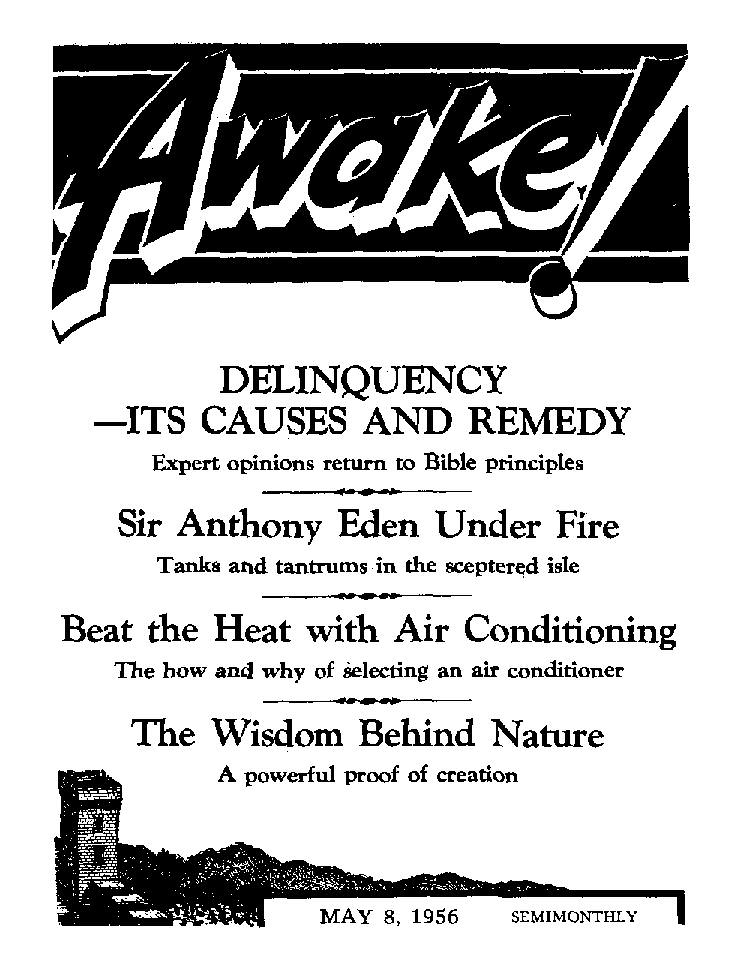
DELINQUENCY -ITS CAUSES AND REMEDY
Expert opinions return to Bible principles
Sir Anthony Eden Under Fire
Tanks and tantrums in the sceptered isle
Beat the Heat with Air Conditioning
The how and why of selecting an air conditioner
The Wisdom Behind Nature
A powerful proof of creation
THE MISSION OF THIS JOURNAL
News sources that are able to keep you awake to the vital issues of our times must be unfettered by censorship and ielfish interests. “Awake I” has no fetters. It recognizes facts, faces facts, is free to publish facts. It is not bound by political ambitions or obligations; it is unhampered by advertisers whose toes must not be trodden on; it is unprejudiced by traditional creeds. This journal keeps itself free that it may speak, freely to you. But it does not abuse its freedom. It maintains integrity to truth.
“Awake I” uses the regular news channels, but is not dependent on them. Its own correspondents are on all continents, in scores of nations. From the four corners of the earth their uncensored, on-the-scenes reports come to you through these columns. This journal’s viewpoint is not narrow, but is international. It is read in many nations, in many languages, by persons of all ages. Through its pages many fields of knowledge pass in review—government, commerce, religion, history, geography, science, social conditions, natural wonders—why, its coverage is as broad as the earth and as high as the heavens.
“Awake I” pledges itself to righteous principles, to exposing hidden foes and subtle dangers, to championing freedom for all, to comforting mourners and strengthening those disheartened by the failures of a delinquent world, reflecting sure hope for the establishment of a righteous New World.
Get acquainted with “Awake!” Keep awake by reading “Awake!”
PnBUSnw 8SMIM0NTHIT Hr WATCHTOWER BIBLE AND TRACT SOCIETY, INC.
117 Adama Street Brooklyn 1, N, Y., U. 8. A.
N. EL Kkobb, Fr«<£ten#
PrJntihfi thie issue: 1,750.000
Otb* lin|iu» In wftlth “Awnk*!" h
St>hMflth|y—Afrikaun. Firm tab, French, (termio, HolJandfei), lUIian, Nonregiap. Spanish, Bwediib, lUirtNy—D«.Wu Grtt>, Japanese, Portufune, dcnlciio.
Office* Yearly Btibtifriptlm rale
AimtI**. U.S,, U7 Adams BL, Brooklyn 1, N.Y.
Aartralto, 11 Beresford Rd,, fftratirttald, N.S W S/~
Canaft, 150 Brldgeland Ate., Park Boid P.O,,
Toronto 10, Ontario ||
Ee*lindt 84 Craven Terrace, lyrndoo, W. 2 7/-
Unt Zealand, ftM. Boi 30, Wellington, 1 7/-fieeth Africa, Private Bag, ElandsfonteiD, Tri. 7/*
Gbant Suites, .Secretary
Five cente a CQpy
Enlcrtd a* becoruJ-class matter at Brooklyn, N.Y., Act1 of March 3,
RMiHtMMs should he sent to office in yens- country Io compliaiKe wifi) regulations to auirante* «sfr delliefy of tnottr. SralttaDcef are accepted a: Brooklyn from coonirle* where no office Is located, by in tern*Lienal money order only. Subscript-Ion rate* to different countries are bere stated to local rarrency- Mofl« wf axpiraflM (with rerwwil blank > is sent at least two Issue* before subscription n-rdres. Chante of addms when sect to our offie« may be expected effective within one month. Bend your old as well as new addrerw,
1871?. Printed In U.S.A.
CONTENTS
The Fad for Nonsense
Delinquency—Its Causes arid Remedy
The Parental Example
Preaching to the Ends of the Earth ■
Araucano Indians
Tax Officials Thought They Had Him
The Wisdom Behind Nature
The Marvel of Life
Beat the Heat with Air Conditioning
Mandioca, the Bread of Paraguay
Bribing Dogs with Dog Biscuits Sir Anthony Eden Under Fire Browbeating the Beetle?
“Your Word Is Truth”
Mother and Father Worship Unscriptural
Jehovah’s Witnesses Preach in AU the Earth—Southern Rhodesia Do You Know?
Watching the World
7ke
N EVER before in history has so much nonsense appeared R in print. There is a fad lor non- V sense. A nonsense fad turns people away from what Is true, righteous, upbuilding and of serious con-jcem; it turns people aside to false stories. So strongly has the nonsense fad gripped the masses that nonsense has become a nation’s best-selling subject.
In January a book was published in ’ the United States called The Search for Bridey Murphy. In March the book had soared to the number one spot on best-selling lists. Yet what Is this book about?
It is a book written by Morey Bernstein, an amateur hypnotist.. This hypnotist put a Pueblo, Colorado, housewife in a trance. The housewife’s name is Virginia Tighe, but to avoid publicity she prefers to be called Ruth Simmons, While in a trance, Ruth Simmons was asked by the hypnotist to go back to her childhood. Then he asked her to go back before her birth. Suddenly the housewife began talking about Bridey Murphy.
Ender hypnosis Ruth Simmons said that she had lived once before—in Ireland from 1798 to 1864. She said her name then was Bridey Murphy. Briefly, this is what Ruth
J£>nsEnse
Simmons said about Bridey:
Bridey lived with her parents S in Cork, Ireland. They lived in a wooden house. Bridey married Sean Brian MacCarthy and moved to Belfast. There her husband taught Jaw at Queen's University.
Bridey died in 1864. Ruth Simmons claims that she is Bri dey, having been reborn into the United States in 1923.
Out of the trance, housewife Simmons said she did not know where the story came from. Puzzled herself, she said: "I would like to know the truth.”
Hypnotist Bernstein thought the Bridey story proved reincarnation—a doctrine of pagan religions teaching that the soui is separate and distinct from the body and passes at death into another body either of human or of animal form. But writer Bernstein admitted he was grasping at a straw when he said: “Our case is not strong—in fact, it’s weak because not enough checks out."
"Not enough" was a classic understatement. Two newspapers and Life magazine sent correspondents to Ireland to check on Bridey’s story. The sleuthing, according to Time magazine of March 19, 1956, "turned up more blarney than Bridey."
Following are some of the discrepancies
Afxy S, J950
.1
the correspondents found: No Cork city directory mentions Bridey’s family. Bridey said she lived in a wooden house, but almost all the homes in Cork are built of stone or brick. No record was found of the school Bridey went to. Bridey said she had a metal bed in 1802, but iron bedsteads were not introduced into Ireland until at least 1850. Bridey’s mother read to her from a book called “The Green Bay.” But a complete catalog of books of the nineteenth century does not list such a book.
Bridey’s husband taught law at Queen’s University, but Queen’s University did not come into existence until 1908. Bridey’s husband wrote for the Belfast News Letter, but no back issue proves it. Bridey lived on Dooley Road, but the Belfast city librarian said there never was a Dooley Road. The church Bridey went to was not founded until 1911—about a half century after Bridey died.
As to many of the Irish words used by Bridey, scholars laughed at them as being any kind of Gaelic. Bridey used the word Britisher, but every Irish authority consulted by Life said the word is an Americanism. Bridey said she played the lyre, but an Irish musician said the lyre has never been known in Ireland. Bridey’s husband was named Sean Brian MacCarthy, but Bridey pronounced Sean in a way no person in Ireland ever does. And the middle name of Ruth Simmons’ real-life husband, correspondents found, is also Brian.
Some things about Bridey’s story check out all right, such as the mention of some customs and a description of the Irish countryside. What did the scientific experts think about Bridey’s story? Life magazine, reporting on the opinion of scientific experts who use hypnotism in medicine, said in its issue of March 19,1956, that the experts agreed that Bridey sprang from Ruth Simmons’ -unconscious memories.
The report said in part: “A hypnotized subject can display uncanny inventiveness in supplying whatever is asked of him because he draws on all the resources of his subconscious memory. ... It should not be assumed that just because he is in hypnosis, a subject must always tell the truth. He will often fabricate. . . , There is nothing in Bridey Murphy’s story that cannot be explained either on the basis of occasional coincidence or on one’s subconscious memory of overheard conversation from someone well familiar with Ireland. . . . Actually, Ruth Simmons has admitted that her real parents were both part Irish.”
The Search for Bridey Murphy is a search for nonsense. When a book containing ah absurd story becomes a best seller, a fad for nonsense is on. Feeding the mind on nonsense is bad enough, but The Search for Bridey Murphy has done more: it has spawned a boom in magic, in the occult. Necromancy has been glorified. Hypnotism has become somewhat of a fad. But hypnotism by amateurs can be dangerous.
The fad for nonsense is a fad for falsehood. The book about Bridey is now being used to try to prove a pagan doctrine. The Bible shows reincarnation to be a false doctrine. But a 19-year-old boy in Shawnee, Oklahoma, instead of reading God’s Word, read The Search for Bridey Murphy. Now he is dead. Before he shot himself with a rifle he left a note saying he was going to investigate the reincarnation theory.
So it is with the fad for nonsense. Though the Bible tells us to fix our thoughts on things that are true, righteous, lovable, well spoken of and that are of serious concern, people today are fixing their thoughts on whatever is absurd, weird, occult, dangerous, pagan and untrue. As foretold for the “last days,” people have turned “their ears away from the truth” and so have “turned aside to false stories”—to nonsense.—2 Timothy 4:4, New World Trans.
ITS CAUSE AND REMEDY
Whai causes juvenile delinquency? Whal Is its remedy? These questions disturb parents and baffle experts. Tte more intelligent views* however, indicate an amazing re-I k turn to prin-
VI ciples long
V ago stated
■ for us in
■ the Bible*
NY very useless comments and ny very sound suggestions have been made on the serious modern problem of juvenile delinquency. Obviously delinquency’s causes are many and the solutions are not simple ones. Yet there is a basic cause and a basic solution. And deiinquency will decrease to the extent that this basic cause is eliminated and this solution applied. The basic cause is the world’s lack of obedience to God’s principles. The solution is to return to His Word and to the wise principles it sets out
Does that sound too simple? If you think so you will be amazed to know just how closely many of the experts* comments on delinquency parallel Bible principles.
Those who have made a study of delinquency say that one of its major causes is a lack of love in the family, and especially a lack of parental love for the children. Judge Sarah T. Hughes of Dallas, Texas,
explained: '’Nothing is more conducive to child delinquency than a monotonous, day by day existence where the child is never encouraged, or where he is never sure of himself and those around him?’ Judge George W. Smyth of New York’s Westchester County adds: “An element of oversight, carelessness, disinterest or ineptitude in the discharge of parental duties appears in almost every case?'
What Biblical principle, if followed, would eliminate this problem?
The Bible places the responsibility for the child squarely upon the parent. It allows for no oversight on
the parents’ part. It does not even grant the parents the right to shunt the child off to a Sunday school or some other place of instruction for its religious training. Rather, the parent is responsible for both the physical and the spiritual well-being of the child. Of God's words the parent is told: “You must also teach them to your sons, so as to speak of them when you sit in your house and when you walk on the road and when you lie down and when you get up?’ —Deuteronomy 11:19, New World Trans.
Do you do this? Have you eliminated this major cause of delinquency from your family? Do you show love, kindness, consideration and a real interest in your child? Do you make him sure of himself and of the affection of those around him? And do you properly lead him in the right path, rather than letting him wander off into the wrong one? You do if you are properly following the Bible’s principles.
The Parental Example
Then, too, students of delinquency recognize that the parents’ morals have a vital and far-reaching effect upon their children. This is true even in apparently simple things. Former Senator Robert C. Hendrickson of New Jersey put it this way: “There is a definite relationship between a child’s concept of law and order and adult attitudes toward income-tax evasion, traffic ticket fixing and the simple instructions to a child to tell the bill collector mama isn’t home, when she is.”
Real Bible believers have long known this. They know the importance of right examples. They know that many such examples were given them in the Bible. They know the danger of being like the false religionists who Jesus said “say but do not perform,”—Matthew 23:3, New World Trans.
The Christian knows that his children probably will follow the example he sets. He knows that if he tells lies the little ones in his house probably will too. He remembers that among the seven things that are an abomination to Jehovah are “a lying tongue,” “an heart that deviseth wicked imaginations” and “a false witness that speaketh lies.” And, further, he knows that, not only murderers and fornicators, but “all liars” are among those who will go into the second death, from which there is no resurrection. Thus he sets the right example for his children respecting law, order and honesty.—Proverbs 6:16-19; Revelation 21:8.
Family Love
Another cause of delinquency is a lack of contentment and love between the parents. Judge Camille Kelley of Memphis, Tennessee, says: “Separated parents contribute their full quota to a child's delinquency. By separated, I mean not only the divorced; I am speaking also of the parents who have broken every pledge . . . yet who still live under the same roof to harass the very life and joy out of their children.”
Of course, there is no room for such actions among those who really take their privileges and responsibilities seriously. In the first place, they will have made a wise choice of a mate, choosing a life partner “in the Lord,” who will also apply Bible principles, rather than marrying an unbeliever who would not conform to them.—1 Corinthians 7:39; 2 Corinthians 6:14.
Then both the husband and the wife, each recognizing his own Christian responsibility, will put forth every effort to conform to the rewarding Biblical arrangement that does lead to peace and unity within the family. Wives will remain in Christian subjection and husbands will continue loving their wives as their own bodies. Neither will have said: “Oh, that doesn’t work.” Rather, they will have made it work, and each will help the other to remain faithfully in God’s service. This, together with their high moral standard and unified Christian interest, will have given their marriage a firm basis of real unity.—Ephesians 5:21-25.
Respect for Authority
Yet even more is required. Respect for authority is necessary. Judge Thomas J. Courtney of Cook County, Illinois, tells that "underlying youth’s activity in crime is a prevailing disrespect for all law and constituted authority.” He says: “We must compel respect for law and order. Youth must be made to feel the consequence of his misdeeds.”
There is some disagreement on this matter. Where does the real Christian parent stand on it? He himself recognizes authority. He does not stubbornly cling to his own way rather than obediently conform to God's instructions. Instead, he recognizes the authority of the Bible, of God and of God’s Son, Christ Jesus. And he conforms to the instructions that they have given. Thus the right example of recognizing and conforming to authority is set before the child.
Further, the child is taught to respect the parents' authority. Though 'some modem educators disagree, the Christian parent knows that the Bible wisely says: “Foolishness is bound up in the heart of a child; but the rod of correction shall drive it far from him.” “Withhold not correction from the child; for if thou beat him with the rod, he will not die.” Yet the Bible-believing parent is not overbearing, but he tempers his sound authority with love and justice, remembering the divine instruction: “You, fathers, do not be irritating your children, but go on bringing them up in the discipline and authoritative advice of Jehovah.”—Proverbs 22:15; 23:13, Am, Stan. Ver,; Ephesians 6:4, New World Trans.
Above all, the parent must exercise authority consistently, not being harsh one day and negligent the next; not permitting disobedience when he feels like it and wondering why it happens when he does not.
Ambition and Outside Interests
Other causes of delinquency were related by Dr. Eugene Davidoff and Elinor S. Noetzel of the Syracuse, New York, Psychopathic Hospital: “Ambitious parents who do not know their children’s capabilities and try to fashion them into grooves for which they are unfitted, excessively yielding parents who cannot control their children, and lack of instruction as to how to associate with others—these are but a few of the many important etiologic factors in the situation.”
Where do appliers of Bible principles stand in this regard? They are not overly ambitious for their children, but are concerned more with the children’s spiritual accomplishments than with material ones. Thus they do not ambitiously push their children into social or economic grooves for which they are not fitted.
Dr. Harry A. Overstreet added a related point: “Too few homes have parents whose interests go beyond the four walls of the home. . . . Children should live in an atmosphere of great concerns, where parents really care about the deep distresses of people and about ways in which to increase the happiness of others.”
What people have the greatest concerns, the greatest and most vital interest in the happiness of others? Why, the people who are preaching the good news of God’s established kingdom! Their constant concern is with helping others out of the world’s deep distresses into the real happiness of Christian New World living. The whole family group rejoices at blessings received in this activity, discusses its common successes in it, has a unified interest, is well-knit, and indeed has a real purpose in life.
Bad Examples
Judge Jacob Panken of New York said that no child escapes injury from television programs that interestingly depict antisocial conduct, crime and murder. And psychiatrist Frederic Wertham explained: “Comic books are definitely harmful to impressionable people—and most young people are impressionable. . , . Comics definitely are factors in children’s glorification of the wrong attitudes toward sex and violence.”
All along the Bible-believing parent has known the danger of bad examples, as well as the value of good ones. He knows that “bad associations spoil useful habits.” And he has read: “Let fornication and unclean-riess of every kind or greediness not even be mentioned among you, just as it befits holy people, neither shameful conduct nor foolish talking nor obscene jesting, things which are not becoming?’ Why? Because, since the mind directs the activity, filth is not the proper thing for the mind—neither for the parents’ mind nor for the child’s. Thus the Christian parent is selective in his entertainment and in that of his child, and is careful about his own attitude toward such things and about his child’s attitude toward them.—1 Corinthians 15:33; Ephesians 5:3, 4, New World Trans.
MAY 8, 1956
But you cannot protect your child from all bad examples, you say? That is true. But this is where love, training, right example, parental and juvenile respect for authority and the common love for God that we have thus far discussed show their results. The Christian child knows right from wrong. He knows he is held accountable for his course by both his parents and his God. He does not want to displease either his parents or his God, nor to bring disrespect or reproach upon the name of his God or upon the reputation of his Christian parents.
As Dr. Robert C. Taber of the Pennsylvania Governor’s Committee on Children and Youth said: “In discipline, I feel we need to hold children accountable. We do a disservice to them otherwise. Marriage, job and parenthood require accountability.”
The children of parents who have really applied Biblical principles have learned the difference between right and wrong, know why they should take the right course, and they take it, thus becoming an honor to their parents and their God. So, again, such parents happily find that through applying Biblical principles they have already overcome another of the major causes of modern-day delinquency.—Proverbs 20:11.
The Real Solution
Where lies the blame for the lack of love, lack of honesty, broken homes, disrespect for authority, overly ambitious or excessively yielding parents, the lack of instruction on how to associate with others, the lack of outside interests, the bad example set for children today and the children’s lack of training for responsibility? It lies in one thing and one thing only—in the lack of obedience to God and his Word.
And why is there such lack of obedience to God? Why is there such widespread rejection of this simple solution? For one reason and one reason only—the rulership of today’s world by Satan the Devil, the adversary of truth and justice. After all, the Scripture at 2 Corinthians 4:4 tells us plainly that it is the wicked “god of this world” who has blinded the minds of unbelievers. And the best way to overcome this rebel’s corrupting influence is really to apply God’s righteous principles first to your own life and then to your children’s lives.
Even today Bible-believing Christians often are amazed at how their application of simple Bible principles has already accomplished the very things that the “experts” say must be done if delinquency is to be defeated. But even further, by your applying these principles first to yourself and then to your children you will prepare both yourself and them to survive the rapidly approaching destruction of Satan’s wicked rule. Then, under the blessings of God’s righteous new world, delinquency will no longer stalk the earth. Just principles will be applied by all who remain living.
Conforming to such Biblical instructions, therefore, unquestionably proves to be the wisest and most profitable course to take!
PREACHING
TO THE
EIDS
OF THE
EARTH
TAKE a map of the world and follow the fortieth parallel around the earth and you will be surprised to leam that only South America, aside from the Antarctic, has continentallandthat far south. To preach to the end of Chile is really to preach to the ends of the world.
Here far under the belly of the earth is a sportsman’s .paradise. Fishermen from many parts of the world chine to this area to fish for the trout and salmon that abound in the hundreds of crystalclearlakes. Here can
be found mineral water and numerous hot springs, as well as icy waters fed by snow-capped volcanoes and glacier ice. Skiers, those in search of peace and solitude, nature and fresh-air lovers ail come here. This once desolate and frigid south is fast becoming “civilized” andinhabited. Luxurious hotels are springing up in places where guests can see and live in the enchantment of natural scenery. Summertimes are becoming popular. Trains going south to the lake regions are so crowded with tourists that one can scarcely find standing room on them.
For a summer cruise guaranteed to remove all animosity toward a torrid sun, all one need do is to travel by boat from Puerto Montt down through the enchanting “Canal Region” to the world’s most southern city, Punta Arenas. The boat passes through channels so narrow that a stone can be tossed to either side without strenuous effort. On this journey one can see thousands of islands decked in grayish-green, a haunting sight, one that you might expect to see on the moon. Here are spouting whales and the jagged peaks of glaciers. The thought of still being on earth leaves you or amazes you, because it is almost inconceivable that such desolate and enchanting beauty should exist In our modem world. But here it is untouched by civilization.
It takes seven sailing days to cover the distance between Puerto Montt and Punta Arenas. A stretch of 700 miles divides Puerto Montt, Chile’s most southern rail terminal, from Santiago, her capital city. The climate in this region of Chile is Jar from being ideal for the preaching of the good news of God’s kingdom or for any other purpose. Especially is this true during the winter season. Even though it does not snow, the winters are long and trying. It begins to rain in April and continues until September, averaging from 60 to 120
inches annually. In some regions it may rain continually from thirty to forty-five days, with the temperature just above freezing.
The winds that blow off the snow-capped peaks of the Andes Mountains or from the frigid waters of the Humboldt Current that comes up the coast from Cape Horn make the rain unbelievably cold at times. One can dress with all-wool clothing and still the cold will seep into his bones and make him shiver. For heat in the humbler homes charcoal is put in what appears to be a flat dishpan and this is set out in the wind to burn until it is a mass of red coals; then it is brought in and set in the middle of the room or near the guest’s feet. This produces a surprising amount of heat, but care must be exercised as to ventilation because of the poisonous fumes. The modern homes have fireplaces or a heating stove, while the new business establishments are installing steam heat or hot water.
Araucano Indians
Mention of Chile would be incomplete without calling attention to the valiant Araucano Indians, who resisted the Spanish conquerors for centuries. The Incas of Peru once invaded their territory but were driven back. When Pedro de Valdivia met them In battle he stated that he had never seen men more valiant in war. The Araucanos preferred to die than to be taken captive. When their chieftain, Caupollcan, was captured by Hurtado de Mendoza the Indians resented their chief’s choice. They thought he should have fought to the death. He was looked down upon as a coward for permitting himself to be captured. Mendoza thought to break the morale and resistance of the Araucanos by killing Caupolican and raising him high on a sharp stake, but the act boomeranged. This caused the Araucanos to rally to their cause. And it aroused a bitter hatred far their ex-chief. Even his wife shared the militant mind of fight to the finish. She renounced her husband as a coward and denied the son she had borne him, because he had allowed himself to be captured.
Only after two centuries of continual fighting were the Spaniards able to subject the Araucano chiefs and warriors. However, the conquering weapon was not war. Rather, the Spaniards introduced among the Indians the white man’s vices. This so corrupted them that it totally demoralized their will to fight and destroyed them as a fighting unit. With his resistance gone, the Indian fell as an easy prey.
At present there are an estimated seventy-five thousand Araucanos, along with a few other tribes, who still live according to their own social laws and standards on the reservations set aside for them by the government. These Indians look very much like Eskimos in appearance, but their origin has not been satisfactorily traced. They have practically no architecture. They live in thatch huts, which they call rucas. They have no written alphabet of their own, so their religious beliefs are not very definite, families and groups differing as to certain details and traditions. Generally they believe in the immortality of the soul and reincarnation. Their “godhead” is multiple. They have their own legend about a global flood and the survival of but a few. They practice divine healing through witchcraft and make supplications to their god for rain and crops by a ceremony in which lamb’s blood is used. They use the symbol of the cross, which no doubt was brought to them by the ambassadors of Roman paganism.
A system of writing the language has been worked out by missionaries, using the Spanish alphabet. The language is known as Mapuche. Portions of the Greek Scriptures have been published and Prot-
estate and Catholic missions have been established in an effort to convert the Indians to some religion of Christendom and make them adopt the ways of the white man. Some progress has been made toward educating the younger generation, but as a whole the Araucano Indian can see little reason to take up the highly competitive ways. Why should he copy those who appear to thrive on keeping the Afaucanos in a constant state of semistarvation? What glory is there in being a harsh, brutal master? That is what the Indian feels his master is. He labors for his master as a tenant on large properties, where his wages are sometimes as little as five cents a day, along with a miserly portion of food and some other minor concessions that are begrudged him. The white man’s ways hold no appeal for him.
Most of the Araucanos feel that they have been robbed or cheated of their lands and pushed back into the rocky places that are no good. Their treatment has been much the same as that doled out to the North American Indian. That the Araucanos can compete with anybody if given an opportunity is shown by the progress made by certain ones of them who occupy important positions- in the government as well as in the business life of Chile. Then there is the world-famous opera singer, Rayen Quttral, who has given prestige to the race she represents.
There are a few of the Araucano Indians adjusting their lives to New World living. And no doubt there will be some of them among the great crowd mentioned with approval in God's Word that will pass through Armageddon and live in the new world.
While this good news of God’s kingdom is attractive to many here, nett all think the same way about it. The false religious shepherds oppose it, while the other sheep of Jehovah love it. As elsewhere, the Kingdom message has made people of good will toward God see that there is a great deal of difference between Jehovah’s witnesses and the various sects of Christendom. Honest-hearted people are asking questions and are seeking Bible answers. And they find Jehovah’s witnesses more than eager to help. This free service on the part of Jehovah’s witnesses cuts the clergy to the quick, because they are not the kind that preach without price.
In this land that is truly down under, trees of righteousness are taking root and we await a bumper crop. Here as missionaries we feel the full impact of Jesus’ words: "You will be witnesses of me both in Jerusalem and in all Judea and Samaria and to the most distant part of the earth.” —Acts 1:8, New World Trans.
"Tax. Qfafaieiali 'Tkou.gkt 'Tkeij k/ad. kfim
C, Fifty-year-old BUI Hughes was haled before the bankruptcy court on charges of bookmaking and falling to pay tax on the proceeds. But Instead Hughes, a shipyard worker, proved to the court his capacity for thrift. On his $56-a-week salary he saved $16,800. It can be done. And here is how he did it: "Never ate candy, never smoked, never drank, never went out with women, shaved with hlB brother’s razor blades, charged his grandmother 12 per cent interest on money she borrowed, worked a night shift and borrowed his father’s shoes while the latter slept to save shoe leather, went thirteen years without buying a new suit, never bought a single Bower, limited his lifelong movie going to one picture, ate everything on the table even If he didn’t want it, patched everything, including his underwear, never took a holiday trip that cost more than 56 eents.” Someone should have asked Hughes what he now proposed to do with his money.
THE WISDOM BEHIND NATURE
ITS ORDERLY DESIGN PROVES CREATION
pre'q^dt*rtg'.}s>iica 4^