Awake!, December 22, 1955
Download: PDF — Awake!, December 22, 1955
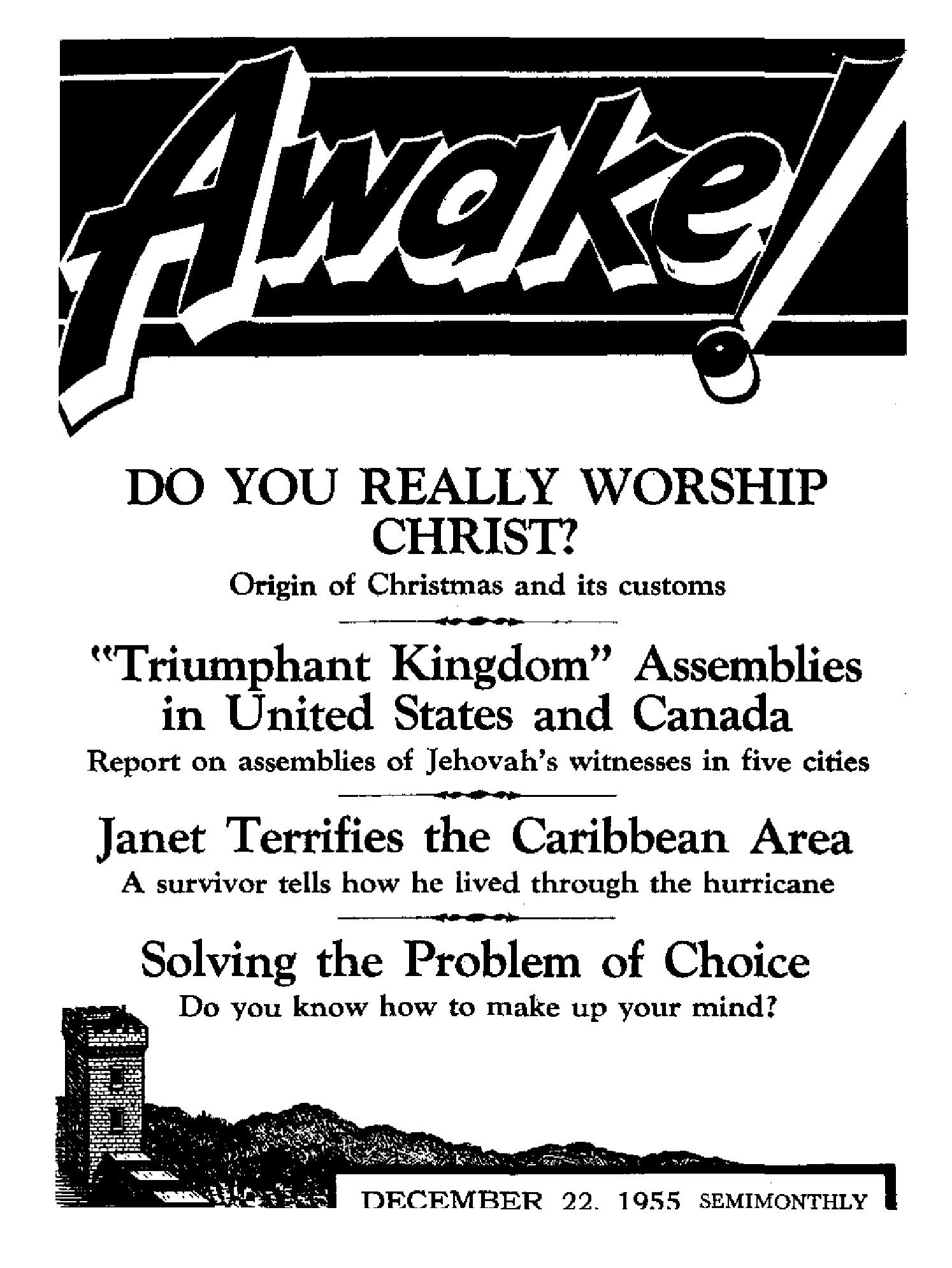
THE MISSION OF THIS JOURNAL
News sources that are ab^0 to keep you awake to the vital issues of our times must be unfettered by censorship and selfish interests. “Awake 1” has no fetters. It recognizes facts, faces facts, is free to publish facts. It is not bound by political ambitions or obligations; it is unhampered by advertisers whose toes must not be trodden on; it is unprejudiced by traditional creeds. This journal keeps itself free that it may speak freely to you. But it does not abuse its freedom. It maintains integrity to truth.
“Awake I” uses the regular news channels, but is not dependent on them. Its own correspondents are on all continents, in scores of nations. From the four corners of the earth their uncensored, on-the-scenes reports come to you through these columns. This journal’s viewpoint is not narrow, but is international. It is read in many nations, in many languages, by persons of all ages. Through its pages many fields of knowledge pass in review—government, commerce, religion, history, geography, science, social conditions, natural wonders—why, its coverage is as broad as the earth and as high as the heavens.
“Awake I” pledges itself to righteous principles, to exposing hidden foes and subtle dangers, to championing freedom for all, to comforting mourners and strengthening those disheartened by the failures of a delinquent world, reflecting sure hope for the establishment of a righteous New World.
Get acquainted with “Awake!" Keep awake by reading “Awake!"
PCBt-isnEit Semimonthly Dr WATCHTOWER BIBLE AND TRACT SOCIETY, INC.
117 Adams Street
Brooklyn 1, N. Y„ U. S. A. GaANT Suiter, Secretary
Five cents a copy
fleralrtarrwi should be sent to office In lour country in compliance with regulations to guarantee safe delivery of money, kemltlances are accepted st Brooklyn from countries where no office la located, by international money order only. Subscription rates In different countries are here stated In local currency. Not Its of expiration (with renewal Bianki Is sent at least too issues before subscription empires. Change of aditrou when sent to our office may be erpectsd effective within one month. Send yorw old as well as new address.
Act of March 8, 1879. Printed io U. B. A.
N. H. Knorb, Presigent
Printing this lame: 1,525,000
Lanoaatai Is whlgh th1> magulna It pabtlshU: Bomimonthly—Afrikaans, English. Finnish, French, German, Hollandlsh, Norwegian. Spanish, Swedish.
Monthly—Danish, Greek. Portuguese, Ukrainian.
Offices Yearly subscription rate
America, U.S., II? Adams St,, Brooklyn 1, N. !■ 11
Aartralla, 11 Beresford Rd., stralhflelfl, N.S.W. 8/-Cgnidi, 40 Irwin Are., Toronto 5, Ontario 81
Eelland, 31 Craven Terrace, l<ondon, w. 2 ?/-
New Zealand, G.r.O. Boi 30. Wellington, C. 1 ?/■ Soatfc Stria, Frdrsfs Bag. Slindafsoteln, TrL
Entered as secrcd-class matter at Brooklyn. N.Y.
CONTENTS
Women Preachers Ascend the Pulpit 3
Do You Really Worship Christ?
Origin of Christmas and Its Customs 5
Requirements for True Worship
He Knew the Answer
Janet Terrifies the Caribbean Area
Eyewitness Report
"Just One Step from Rome"
Solving the Problem of Choice
Amid the Ruins of an Empire
"Triumphant Kingdom” Assemblies
' in United States and Canada
West African Christian Assemblies 21 “Your Word Is Truth”
Should Women Preachers Teach Men? 24
Jehovah’s Witnesses Preach in All
the Earth—South Korea
Do .You Know?
Watching the World
Index to Volume XXXVI of Awake.'
Women Preachers Ascend the Pulpit
THE age-old question of whether women should preach from the pulpit or not is finally coming to a head. The pendulum is at last beginning to swing favorably toward the women. But the end is not yet.
For years women have tried to ascend the pulpit, but without success. They have accused men of practicing segregation and discriminating against the “weaker vessel, the feminine one.” They have charged that objections prohibiting them from using the pulpit are personal and not Biblical. They dubbed the * ‘feud’ ’ the * ‘battle of the sexes,” an open war on female prerogatives. Why should women be restricted from the use of the pulpit? they inquire. Did not Christ put them very near the center of things? Did not women play a mighty, role in church history as martyrs, organizers and spiritual guides? Are not women today the ones who do most of the collecting of money through church suppers, bingo games and rummage sales? Are not women the greatest financial contributors to the church? Why, then, should they not be permitted on boards that decide what to do with the money?
By not granting women equal voice and privileges with the men in the congregation, Miss Madeleine Barat, secretary of the World Council of Churches’ commission on the life and work of women in the church, charges, the twentieth-century church has made “second-class citizens” of the women. She complains that while “there are more women church members than men, and the women are more active in the church organizations," yet “the vestries, the boards of directors, finance and trustees, are in the hands of the men.” She concludes her argument by saying: “We are not pressing the orthodox, Anglican, or Episcopal groups to throw open their pulpits to women, but we pass on what is being done from one Presbyterian to another, or one Methodist to another. And it is most precious—this information.”
And what is this information? Namely this: That more and more women are being granted the right to preach from the pulpit. According to the latest church figures there are at least 5,791 ordained or licensed women ministers in the United States. The federal population census for 1950 puts that total even higher, at 6,777, or 4.1 per cent of the nation's clergy.
Of those serving as pastors of local churches, about one tenth are in denominations affiliated with the National Council of Churches. Almost two thirds of all of the Protestant women ministers are in four bodies: The Church of God, the International Church of the Foursquare Gospel, the Volunteers of America and the Methodist Church. In the case of the Methodist Church women are ordained as local elders but are not admitted to membership in conference. The woman local elder who is assigned to a pastorate can do everything the male minister does but has no claim to a church. This, say the ladies hopefully, is a thing to come.
The Presbyterian Church was. one of several denominations not permitting women in pulpits. The other “major denominations” are Roman Catholics, Episcopalians, Lutherans, Southern Baptists and Mennonites. However, at the General Assembly of the Presbyterian Church in the United States of America, held in Los Angeles, California, May 19 to 25,1955, it was overwhelmingly .approved that women be ordained as full ministers. Almost a year prior thereto the World Presbyterian Alliance voted in favor of ordaining women as ministers.
The committee presenting the resolution to the Presbyterian annual general assembly stated that it had studied in detail the “biblical, theological and sociological issues’* involved, and found that the Bible “neither provides specific direction for nor prohibits the ordination of women”; therefore, it concluded that there is no theological ground for denying ordination to women simply because they are women.
Dr. Ralph Waldo Lloyd, outgoing moderator of the Presbyterian Church, U.S.A., and president of Maryville College, Maryville, Tennessee, said: “The life of the church will be enriched by opening the office of minister to women. In a church which seeks to eliminate artificial discrimination, it is not consistent to forbid women to serve wherever the spirit of God may seem to call them.” He stated that Presbyterian pronouncements asking for a nonsegregated society and a nonsegregated church “are strong and right, but our practice is weaker than our pronouncements.** “Twenty-five years ago,” he declared, “women were accorded the right to serve as ‘ruling elders,’ ” and today more than 3,000 of them are serving in that capacity as governing officials of their congregations. In light of all this, why should women be prohibited from the use of the pulpit?
The New York East Conference of the Methodist Church agreed to endorse efforts to put women in the pulpit. Other bodies that ordain women are the Congregational, Evangelical and Reformed, Friends, Free Methodist, Nazarene, Disciples of Christ, Evangelical United Brethren and Brethren Churches.
What about Judaism? There has never been a fully ordained woman rabbi in the long history of Judaism. But last June Dr. Barnett R. Brickner of Cleveland, Ohio, in his presidential address to the Central Conference of American Rabbis proposed that women be ordained as rabbis. Dr. Brickner declared that the Reform movement had “pioneered” in granting equality to women; that they “not only sit on our boards, but soon one of the oldest Reform congregations will elect a woman as president.” His reference doubtless was to Mrs. Hugo Dalsheimer of Baltimore, Maryland, a vice-president of the Baltimore Hebrew Congregation and now in line for the presidency. Dr. Brickner noted that women “have a special spiritual and emotional fitness to be rabbis, and I believe,” he said, “that many women would be attracted to this calling.”
So the pendulum has begun to turn, the pattern is definitely fixed, a toehold has been gained and no doubt will be exploited by the women to the fullest extent. Few men or women any more ask whether it is right for women to seek religious posts that would place them in positions of authority over men. They sincerely think it is their prerogative. What does the Bible have to say on this point? For the answer turn to page 24 and read the article “Should Women Preachers Teach Men?”
“Do you really WORSHIP CHRIST ?
Despite ail the glow, glitter and glamor of Christmas many people find this festive occasion shallow, They find it exhausting mentally and spiritually. Andso after the hectic battle to purchase and exchange gifts, to send Out Christ
is your Christmas celebration shallow and worthless? How much of it is real worship of Christ? During the remainder of the year do you live up to the profession you make at this season? Let the Bible help you answer.
have been thirty-four years old. —Luke 3:23, New World Trans.
This October date agrees with the fact that at the time of Jesus* birth shepherds were “living out of doors and keeping watches in the night over their flocks” This
mas cards, to decorate trees and homes and to spend extravagantly to keep the dinner table richly supplied, these persons wonder what all this has to do with the worship of Christ, But few have the courage to face the question squarely: Is Christmas really a stimulus for furthering the practice of true worship?
If Christmas is a basis for true worship, then it would have to be based on fact, on truth. Yet do we find that the day widely celebrated as Jesus* birthday is based on truth? Does the Bible say Jesus was born on December 25? No, rather it proves that Jesus was born in October. How so? Because, according to the custom of his time, Jesus began his ministry at the age of thirty. “Jesus himself, when he commenced his work, was about thirty years old.*’ He preached exactly three and one-half years and was put to death on the passovjar, which is always the day of the first full moon after the spring equinox; that is, usually in early April. Now six months from the passover brings us to the early part of October, when Jesus would would not have been the case had Jesus been born in the cold of December. So we find that the date that forms the nucleus for the Christmas celebration is wrong. Can we really believe that true Christian worship is based on a falsehood? Said Jesus: “I have come into the world, that I should bear witness to the truth.** Christ’s followers must also bear witness to the truth.—Luke 2:8; John 18:27, New World Trans.
Origin of Christmas and Its Customs
Not being the date of Jesus* birth, what is December 25 and how did Christmas get started? The Catholic Encyclopedia, under the heading “Christmas,” tells us that it originated as a Roman Catholic mass; hence the name “Mass of Christ*’ or “Christ’s Mass/* But since the uncorrupted Christians of Jesus* and the apostles* day did not celebrate Christmas, from where did the Roman Catholic Church get the holiday? The same volume answers: “Christmas was not among the earliest festivals of the Church. Irenaeus and Ter-
tullian omit it from their lists of feasts. . . • The well-known solar feast, however, of Natalis Invieti, celebrated on 25 December, has a strong claim on the responsibility for our December date.”
It was on that day, December 25, that the' ancient Roman pagans celebrated the birthday of their god Mithras, a day called Natalis Invieti—the rebirth of the winter sun, unconquered by the rigors of winter.
Why was this pagan date adopted by the Roman Catholic Church? Historian Hislop in his The Two Bdbytons says; “It may fairly be presumed that, in order to conciliate the heathen, and to swell the number of the nominal adherents of Christianity, the same festival was adopted by the Roman Church, giving it only the name of Christ.” A'pagan holiday thus masquerades in Christian costume.
More revealing information comes from The Catholic Encyclopedia: “In the Scripture, sinners alone, not saints, celebrate their birthday.” Also: “In England, Christmas was forbidden by Act of Parliament in 1644; the day was to be a fast and a market day; shops were compelled to be open; plum puddings and mince pies were condemned as heathen. The conservatives resisted; at Canterbury blood was shed; but after the Restoration Dissenters continued to call Yuletide ‘Fooltide.’ ”
“Fooltide” Still
We have to admit it; Christmas fools people; it is still “Fooitide.” What happens at Christmas time? Drunks abound. Gluttons greedily stuff themselves. Morals sag. The masses succumb to the high-powered propaganda of commercialism. Can one think anything else than that Christmas is a time when fools abound? Even those whose conduct is not improper, unbecom-. ing or foolish are deceived. They are fooled into believing that Jesus was born on December 25, when he was not. They are fooled into accepting Christmas as Christian when basically it is pagan. Christmas fools people into believing that Christ authorized the greatest commercial holiday in Christendom, whereas he never commanded that his followers celebrate his birthday, only his death.
But what is most dangerous is this; Christmas fools people as to what true Christian worship really is. How does it do this?
Christmas causes people who are already too busy with mundane pursuits to neglect the spiritual. Jesus illuminated the gem of true worship when he said: “Happy are those who are conscious of their spiritual need, since the kingdom of the heavens belongs to them.” But Christmas, despite its increased church services, fools people into believing just the opposite, that happy are those who are conscious of their material need.’ Jesus always placed the spiritual first; Christmas places the material first.—Matthew 5:3, New World Trans.
And so Christmas fools people. It fools them into spending almost every dollar that they can scrape together to buy presents to trade back and forth among friends and relatives, all the while believing that this is bringing some kind of honor to Christ. But is it? Acknowledging that the exchange of presents and of Christmas cards, as well as the use of holly, mistletoe and yule logs, is not of Christian origin, The Catholic Encyclopedia says: “Pagan customs centering round the January calends [the first day of the ancient Roman months] gravitated to Christmas.” Further explanation reveals that the customs of the Roman new year “survive as Christmas presents, cards, boxes.”
With such a pagan background it is little wonder, then, that Christmas fools people into forgetting Christ. What do the children and grownups look forward to at Christinas? To give to Jesus, to practice
his principles, to honor his name? No, but they look forward to a present for themselves, Many are the sad disappointments at Christmas. But not because Jesus did not get a present, rather because they did not get the present they wanted or they got no present at all- Christmas deludes people into putting a premium on selfishness.
The so-called wise men or astrologers we read about in the Bible did not establish true worship by their offering presents to Jesus. They were demon worshipers condemned by God; they could not rightly set the pattern for true worship. And besides, those astrologers did not give Christmas-style: they gave to Jesus and did not exchange presents among themselves.
Unquestionably, Christmas fools people. It deludes them into thinking that the customs of pagans can be blended in harmlessly with Christianity. It is a great deception: "For what partnership do righteousness and lawlessness have? Or what fellowship does light have with darkness? Further, what harmony is there between Christ and Belial? Or what portion does a faithful person have with an unbeliever?’* "Learn not the way of the nations, , . . For the customs of the peoples are vanity/’ —2 Corinthians 6:14, 15, New World Trans,; Jeremiah 10:2, 3, Am. Stan, Ver,
Since Christmas fools adults, how much more so does it fool children! Throughout the year parents punish children for telling falsehoods. Yet parents abet the Santa Claus lie. Is it any wonder that many children, when they grow up and learn the truth, begin to believe God is a myth too? One little fellow, sadly disillusioned about Santa Claus, said to a playmate: “Yes, and I’m going to look into this ‘Jesus Christ’ business, too!” Christmas is dangerously deceptive. It undermines Christianity and obscures the principles of true worship.
Requirements for True Worship
Instead of teaching children pagan practices and falsehoods, true worship requires that parents teach their children the truth from God's Word. Instead of learning how to use toy flame-spitting tommy guns, children should learn how to use the Bible. They need to learn about God’s kingdom and how Jehovah, through his Son Christ Jesus, will end all the woes brought about by the god of this world, Satan the Devil. But how can parents train their children in the way of true worship when they themselves are not conscious of their spiritual needs? Thus it is the parents* duty to learn the requirements for true worship.
Did the early Christians while away time trimming Christmas trees or parading about in a Santa Glaus suit? No, they knew that Jesus and his apostles never dabbled with the ancient Roman festivals, such as the Saturnalia held on or about December 25. "During the Saturnalia,” says one authority, “the courts and schools were closed, and military operations were suspended so that the army might celebrate. It was a period of good will and jollity, devoted to banquets, the exchange of visits, and the giving of presents. . . . Much of £he traditional merry making of the Christmas season seems to have developed from the earlier pagan festival.” (The New Funk <£ Wagnails Encyclopedia under "Saturnalia”) Because the early Christians shunned the popular merrymaking festivals, they were thought to be peculiar, antisocial. Thus E. G. Hardy in his book Christianity and the Roman Government speaks of "the absolute refusal of the Christians to join in any religious festival” or "to illuminate their doors at festivals.”
True worshipers today, like the early Christians, shun holidays of pagan origin and follow in the steps of the One who set the pattern for true worship: "To this course you were called, because even Christ suffered for you, leaving you a model for you to follow his steps closely?’—1 Peter 2:21, New World Trans.
Who follow Christ’s steps “closely”? Certainly not those who practice the heathen customs of Christmas! But it is those/who do the things Christ did. It is those who place the spiritual above the material. It is those who follow the Bible’s command for clean living: “Let fornication and uncleanness of every kind or greediness not even be mentioned among you, just as it befits holy people, neither shameful conduct nor foolish talking nor obscene jesting, things which are not becoming.”—Ephesians 5:3, 4, New World Trans.
Yes, who do follow Christ’s steps closely? It is those who obey the command of Christ Jesus by doing the work he foretold for this time of the end: “This good news of the kingdom will be preached in all the inhabited earth for the purpose of a witness to all the nations, and then the accomplished end will come/' And it is those who bring this good news to the people just as Paul and the rest of the apostles did: “I did not hold back from telling you any of the things that were profitable nor from teaching you publicly and from house to house.” “Every day in the temple and from house to house they continued without letup teaching and declaring the good news about the Christ, Jesus.” How different true worship is from the shallow customs of Christmas!—Matthew 24:14; Acts 20:20; 5:42, New World Trans.
Exchanging presents with friends is not the giving that stems from true worship; it brings no praise to God or Christ. But the spiritual giving that the Bible commends, indeed commands, is the highest kind of giving. It truly honors God and Christ: “Through him let us always offer to God a sacrifice of praise, that is, the fruit of lips which make public declaration to his name.”—Hebrews 13:15, New World Trans.
Any honest-hearted person can learn this way of true worship. Jehovah’s witnesses, who are engaged in this highest form of spiritual giving, will be glad to help you follow Christ's footsteps closely, at no cost to yourself. More knowledge of true worship and its blessings is yours for the asking.
To tread the pathway of true worship requires effort. It is not easy, “Narrow is the gate and cramped the road leading off into life, and few are the ones finding it.” But the rewards are unspeakably grand and lead to everlasting life in Jehovah’s new world. So practice true worship. Share in the grandest work of all: spiritual giving. Then time, once squandered on unchristian Christmas, will be used to your everlasting welfare and happiness.—Matthew 7:14, New World Trans.
Jf* Knew fAe
The Newark, New Jersey, Sunday News runs a column “Watching the Crowds.” In the issue of August 28, 1955, writer Edward. Hipp relates the following: ‘'Man
I know was quietly waiting for a subway trolley at Davenport Ave. when an elderly woman addressed him. 'When are they going to stop this silly business naming all the hurricanes?’ she asked. ‘Now they’ve finished with Connie and Diane, Edith is in the offing, and goodness knows where they’ll stop. What do you suppose they’ll do about naming the storm to mark the end of the world?’ The subway car pulled in at that moment. As our man climbed aboard he looked over his shoulder and replied, with a straight face: 'Maybe Arma, lady? You know, short for Armageddon,' ”
WOMEN are reputed to be the weaker sex, but if so Janet was an exception, for she was no weakling. During her life she had within her power the lives of thousands, disposing of their property at will. She held undisputed sway from the tiny islands of Barbados and Grenada to the towering mountains of Mexico. Janet was a murderess. Janet was the queen of her kind. Janet was a tremendous hurricane!
Such an important "person” could not come unannounced. So, from the moment she started her mad career' the radios of many nations followed her voyage of conquest, giving timely warning to ali in her path. The fame of her destructive ride through Barbados had preceded tier. So, from British Honduras' capital port of Belize northward to the pretty coastal town of Corozal, into the Mexican territory of Quintana Roo, and on across the Bay of Campeche to the cities of Veracruz and Tampico, preparations were made to receive this most unwelcome visitor.
Already during the month of September Mexico had been struck by Janet’s death-dealing sister hurricanes, Gladys and Hilda. On September 5 Gladys had brought torrential rains and terror to Mexico City, leaving as many as 40,000 families homeless and inundating large areas of the city. At least two children were killed (other people died during rescue activities or from exposure! and many women and children were left stranded on housetops from 1 a.m. until relief workers got to them as late as 4 p.m. Then, in the wake of Gladys’ destruction, hurricane Hilda had struck with all her fury, adding to the ruin.
But Gladys and Hilda were followed by mighty Janet. Dissatisfied with the unchallenged power that her 115-mile-an-hour winds had given her over Barbados and other small Caribbean islands, she added strength to strength and crashed upon the Centra] American mainland with winds roaring to a peak of 157 miles an hour!
With all her force this shrieking monster struck the Mexican towns of Xcalac and Chetumal in the territory of Quintana Roo, and Corozal in British Honduras. Xcalac, a coastal town of 1,000 inhabitants, was wiped right off the face of the earth, while Chetumal, with a population of 10,000, also became a picture of complete devastation. Thousands cf refugees crammed into the only three buildings still standing, the municipal palace, the school and the smail] hotel. The two drugstores were completely buried by the waters, and there was no medicine during the first critical hours. More than 200 were dead, and military authorities reported that there were neither streets nor even a “pattern of a town in Chetumal,” There was only the vast pile of wreckage, with the stench of death everywhere,
Janet ripped her way on across the Yucatan Peninsula and the Gulf of Campeche and struck Veracruz at 10 a.m., on September 29, Despite a record precipitation of over twelve inches, Veracruz did not prove to be in the direct center of Janet’s path, and thus the damage was less than had been anticipated.
To the north, however, Tuxpan was entirely flooded. The waters covered the central market, the principal streets and part of the residential sections. Water rose to a dangerous twelve-and-a-half-foot level, covering telegraph poles and cutting off all modes of communication.
But the greatest damage was to Tampico, flooded since September 9 by hurricanes Gladys, Hilda and now Janet. On October 1 reports stated that this town, the home of 110,000 people, had less than seventeen blocks still above water. Rear Admiral M. E. Miles, U.S, navy relief director, reported that two square miles in the heart of Tampico was the only area not flooded for forty miles in all directions! From rescue planes many people could be seen clinging desperately to their rooftops, waiting to be evacuated, and some 60,000 persons were concentrated in the small area of dry land, waiting to be airlifted to safety.
The Example of Corozal
Meanwhile, Janet had not bypassed British Honduras. The fate of the British Honduran town of Corozal, situated just across the border from destroyed Chetumal, is typical of the destruction this terror left in her wake.
Approaching Corozal from the south, the road runs along the sea wall where refreshing breezes play through a bordering grove of palm trees to the dreamy music of the Caribbean surf. That is, it did.' Janet pitched the wall into the raging sea, washed away half of the road, and left a broken wilderness as far as the eye can see.
The picturesque houses of this town of 3,000 people are made of sticks covered with a white plasterlike clay called marl, which glistens in the tropical sun under a cool thatch roof. The larger homes, stores and hospital are wooden structures, while just a few buildings are constructed of cement or concrete. That is, they were! Today not ten houses remain standing, the large hospital is kindling and the pier is no more.
The Roman Catholic church, which once echoed with prayers to “Our Lady of Guadeloupe,” beseeching her to prevent hurricanes, has now become the graveyard of the saints it once housed and its cement walls are an untidy heap of rubble. The only public buildings remaining intact are the town hall, which is a recent reinforced concrete structure, along with the police station and the courthouse. The town was ninety-nine per cent destroyed. Corozal is a town that was!
When Janet struck, our correspondent was at Belize, ninety-six miles to the south. When the tragic destruction became known, many of the inhabitants of Belize grew anxious for the safety of loved ones in the disaster area. Especially was this true of the witnesses of Jehovah, who knew that a new congregation had just been organized in Corozal. Were any of the brothers dead or injured? Did they have food, water or clothing? Were their homes and the Kingdom Hall still standing? The Belize brothers hurriedly loaded an automobile with food, water, clothing and tools, and with these supplies they reached the desolated town before nightfall.
Eyewitness Report
What follows is the eyewitness report of the conditions our correspondent found in Corozal.
“One of the sisters lives with her family two miles out of the town, which distance she and some of her daughters walk each week to attend the meetings. We met her in front of the broken remains of her home that had been destroyed early in the storm. For hours the whole family had stood out in the torrential downpour of rain and debris while she nursed a fever-stricken baby in her arms. We comforted her and left some food. They would spend another night in the open, as all were in the same plight and no homes remained to provide shelter. We wondered what it would be like in Corozal.
“As we entered the town, few indeed were the buildings left standing. Almost all were mere piles of poles and wood that spilled onto the streets to join the tangle of electric light poles and wire already there. Janet did not just blow the houses down, she literally blew them to pieces, soaked them with rain and deluged them with the angry sea. Some people were vainly searching for their lost and scattered possessions while on another pile of debris a pathetic dog stood guard over a splintered mass of wreckage that had once been his master’s home. And the building used for a Kingdom Hall? Nothing but a heap of boards, smashed benches, broken glass arid soaked literature. But had anyone seen our brothers?
“We found two pioneer sisters, and while one was unhurt the other was suffering from a blow on the head resulting from the collapse of the building in which they had sought shelter, her small daughter had also received cuts on her head, neck and hands. From them we learned that the other brothers were safe except for one sister, who had been killed.”
In the Midst of the Storm
But what about the storm itself? And what was it like to survive a hurricane? The answer to these questions was provided by a full-time pioneer minister whose vivid report explains what it is like to be struck squarely by the fury of such a death-dealing storm. He says:
“During the afternoon of September 27 we took what precautions we could, and as night fell most of the brothers congregated in a store owned by one of the witnesses and situated by the sea front. Around 10 p.m. the winds started to blow fiercely from the northwest and steadily grew in force until, by 12:30 a.m., we could see that the store would not withstand the onslaught of the storm. So, all left except the brother and myself as we made one final effort to save the building, the roof of which was now being blown to pieces. Failing, we were forced to join the others in a stronger building across the street. Today the sea breaks where once the store stood.
"By this time we were no longer interested in the store, for the building in which we and the others had taken shelter began to creak and groan as it lurched under the impact of the wind. Then it happened! The roof fell in, the walls crumpled and the building collapsed to the triumphant roar of the hurricane. Although knocked to the ground, I managed to escape with the loss of only a shoe. Through the black night with the rain and the wind beating around me I struggled across the street to shelter in the doorway of another store and regained my breath, believing myself to be the sole survivor. As I watched the wooden buildings splinter and fall the screams of injured and frightened people came faintly to me above the thunder of the storm. By this time the sea was rising rapidly and I made my way as quickly as possible to the higher ground at the back of the town.
“Then came a blessed lull—the eye of the hurricane. It was during this respite that the brothers and others that I had left for dead effected their escape, that is, all except the one sister who had been pinned down in the wreckage and killed. They owed their lives to a bed and bench that had prevented the walls from crushing them. Not seeing me, they thought I also had been buried beneath the debris?’
But the eye of the hurricane soon passed, and, the report continues, “Now the wind came from the southeast stronger than ever before, and what had withstood the first pounding crashed in surrender to this second attack from the opposite direction. The winds now coming from the sea dashed it over the land, and the sea completed the destruction of all within its reach,
“About 5:30 the next morning, just as it was getting light, I emerged from the little house where I had eventually found shelter and returned to the town, or rather what had once been the town, to see if any had survived. Imagine the joys when the brothers and I met and thanked Jehovah that we were alive and might continue to praise him. Though we escaped with only our lives and a few salvaged possessions, we were determined to continue in our witness work, showing people how to survive the still greater storm of Armageddon/’
Reconstruction
And what were the results of Janet’s night of madness in the area of Corozal? Eleven dead, over seventy-five injured, the crops, plantations and fruit trees either badly damaged or destroyed, and the town of Corozal left with little more than a name. ■
Material relief flowed into the area from many nations. This relief for physical distress was greatly appreciated. But hidden in the minds of the people is another result of Janet's journey—spiritual suffering. Many are asking: “Why did our saints fail? Was the Lady of Guadeloupe sleeping? Was this, as three special religious services implied the following Sunday, one of the mysterious acts of God?” For, as one perplexed Indian woman said: “The harder we prayed, the worse the storm got?’
So, more essential than rehabilitation of the land is the correcting of false doctrines and the sowing of the seeds of true worship in the minds of the people. Of more value than the dollars contributed to a hurricane fund is the true faith supplied by Jesus and his apostles. More important than the reconstruction of homes is the building of a lasting hope in a new world of Jehovah’s making. To this end the New World society in the stricken area is determined to exert its every effort!
Just One Step From Rome
At the recent national convention of Episcopal Young Churchmen in Northfield, Minnesota, an old issue came up; Are Episcopalians Protestant? Time magazine, issue of September 12, 1955, reported: “Episcopalians consider therm selves Catholic, believing that their church as much as Rome is the true spiritual heir of St. Peter. To stress this point, some Episcopalians prefer not to call themselves Protestants at all. At Northfield the delegates considered a motion recommending that ’Protestant’ be dropped from the title of the Protestant Episcopal Church. But the Young Churchmen voted it down, 172 to 127, expressed their position in a song (to the tune of God Bless America)'. T am an Anglican, I ani P.E., Not a high church, Not a low church, But Catholic, Protestant and free. Not a Presby, Not a Loothern, Not a Baptist, white with foam. I am an Anglican Just one step from Rome.’ ”
S0LVIH6 THE NNLEM Of CHOICE
By “Awnk«r' conttpondent In Puerto Keo
T IS difficult to believe that even a donkey could be so foolish as an old proverb would have us accept. It portrays an ass standing midway between two equally inviting bales of hay, and it is conceded that the animal would starve to death because of having no specific reason to choose one bundle or the other. To go to the left would involve a loss on the right. To go to the right would involve an equal loss.
We live in a world where we must forego many pleasures in order to enjoy others. There is always the necessity of choosing at every step. Some choices are easy, but others are hard. How, when we must choose between two or more alternatives, can we make intelligent decisions?
There are several types of decisions. Understanding them will help us in understanding the whole problem of choice. First there is the preference type of choice. We know that loss always hurts, and the perplexity of the problem that we face may be that we want both outcomes. Of course, when the issue is unimportant the choice will not be too difficult, but when it is of major importance there has to be a willful act to decide. There is 4 slow dead heave of the will. In this preference type of choice the mind, at the moment of deciding, triumphantly drops the other alternative completely or nearly out of sight. When we make a preference type of choice the issue is not one of weighing facts, but a weighing of the values involved.
Worry easily enters into problems of choice. Sometimes both alternatives are held clearly in view, and the very act of murdering the vanquished possibility makes the chooser realize how much he is making himself lose. He is deliberately driving a thorn into his flesh. This tendency to pass back and forth from one alternative to another creates bodily tension. When the tension is not immediately relaxed, the choice becomes more difficult, with the degree of assurance low. This conflict type of choice often arises when we are compelled to decide between a strong impulse and a rational moral motive.
The third type, the complete decision, avoids this bodily tension. With it there is a tendency to fixate the chosen alternative, concentrating, fixing the gaze upon it The complete decision uses up much less strength and energy. It keeps the chosen alternative before the mind and excludes the thought of the other. Misgivings are put aside.
Yes, it is possible to shut out misgivings from the mind. We rationalize our thoughts and behavior and convince ourselves that we are wise and right. It is altogether proper to call up and hold firmly before
our minds the sound substantial reasons that dictated our choice.
Reason provides the explanation or justification for our choosing one alternative above another. It induces and confirms the belief that we have made the right choice. It influences the will, leading up to the point of action. Reason by itself wants nothing; it is disinterested. Impulse decides which consequences will be preferred. So reason weighs the facts or values and impulse acts upon these to make a sound choice. “Just let your word Yes mean Yes, your jVb, No.1’—Matthew 5:37, New World Trans.
Laziness begins as often as not in the mind of one who does not know how to choose. Many jobs accumulate, and you hear him say: “I just do not know where to begin.” This indecision causes his mind to waver in bewilderment. There is one way out. Begin at once. Small or big, take one thing and allow the mind to deal with it, to complete it Get it done and bury it forever in the past. Get it done, or at least report progress. This good habit when formed will help you overcome laziness due to indecision. Pay attention to the work to be done. Follow the path of complete decision. Remember that a big pile of stones can be moved by picking up one at a time.
Making Mature Choices
The threshold over which we must pass from childhood to maturity and adulthood is a difficult one. A certain independence of parental control is needed. Not a physical separation, nor rebellion and disorderly conduct, but rather the responsibility to make personal choices and decisions. In reaching out toward adulthood one’s attitudes will change. Children tend to take the short view, not thinking before acting, whereas mature adults take the long view. allowing intelligence to move in and control emotions and Impulses. The use of intelligence helps us to choose wisely. It gives us the ability to foresee remote results of our actions, our decisions, and to adapt our choices and our behavior to remote ends. It enables us to face reality without recourse to escape mechanisms.
The mature person has a sound method of isolating his problems of choice, seeking facts on which to base his final decision. He finds that merely talking with others about his problem often is a powerful stimulus for thinking, since it calls attention to details that, but for such means of communication, would be overlooked. It gives rise to innumerable questions, it starts investigations. So, in making important decisions the adult looks behind, ahead and all around before acting.
By study and by applying the things that we learn to our daily problems, we progress in the art of making sound decisions, and thereby reduce the amount of energy that is wasted on unnecessary fretting. Remembering our imperfection, we will not object to being corrected for making a wrong choice from time to time. But as we press on toward maturity our choosing will become more intelligent.
The greatest choice to make now is that of dedicating our lives to the One who invites us to “choose life,” and then to remain firm in our determination to fulfill that dedication. Do not, like the ass, be unable to choose between the old world and the new. Using your God-given reason, make your decisions count, making them complete and firm, preferring God’s way to man’s, putting aside any conflict when loyalty to God is at stake, faithfully fulfilling your dedication to do God’s will. When his leadership is accepted and his instructions conformed to, then the major problem of choice has been solved.
By “Awak»!” corrai pendent Tn Peru
HERE it was! Spread out before our eyes lay the ruins of the largest pre-Columbian | metropolis in the Western Hemisphere.
At the height of its glory more than two hundred thousand inhabitants walked through its narrow passages, worked in its great citadels, played in its patios and sunken gardens. Silently we contemplated what remained of the one-time capital city of the Chimus, a race whose civilization dims the glory even of the great Inca Empire. Yet, half a millennium or more ago this great empire bowed beneath the iron heel of the totalitarian Incas, who themselves a little more than a century later were crushed beneath the even crueler domination of the Spanish conquistadors under Francisco Pizarro.
C, A student of archaeology had accompanied me to this interesting site, and as a general introduction he read to me from a map that he had made: “The prehistoric city of Chan-Chdn is situated about four kilometers to the northwest of Trujillo, and occupies an extension several times greater than that of the present city of Trujillo [population, 80,000]. . . . Since Chan-Chdn is in no way similar to modem cities, it requires some study to be able to understand its organic structure. . . . From extant remains we. may describe Chan-Chdn as a city composed of walled-in wards or citadels . . . great pyramids of adobe or huacas, enormous cemeteries and many constructions of an accessory character outside of and between the larger units/’
C, Naturally, I asked why the city was divided into these large walled-in sections or citadels, and my companion explained that no one really seems to know. “In fact," he said, “you might say tjiat there is i different theory for every investigator. Some seem to believe that in each citadel there lived a different tribe, with their chief, method of administration, and so forth. Others say, ‘Oh, no, that couldn't be so; each citadel was the home of a separate profession.’" According to this latter theory the people who lived in one walled-in section would make pottery, those in another would do the metal work, and so on.
C. My guide pointed out that the houses seem very small, and said that one German archaeologist, judging by other ancient ruins and by European architecture, came to the conclusion that a family could not have lived in one of these houses. So, this man said Chan-Ch&n was a huge fort and that soldiers lived here, one or two to the room. However, he did not go into some of the interiores of Trujillo where, right now, many poor families live in no more space. My guide pointed out that probably the people only slept in the houses and cooked out in the open space.
C, After examining these houses, we walked several miles through the dust and adobe remains of this once great city, pausing at many points to admire remarkable friezes with a variety of designs that revealed a highly developed artistic sense. We passed ancient cemeteries and human remains dug up, by the huaqueros, or treasure seekers, in their perpetual search for gold. And always everything was in a straight line. The Chi mu architects above all else were masters of the straight line. There was, for example, one wall fifty feet high and more than fifteen hundred feet long; straight as a ray of light.
C, It is said that the Incas conquered these well-organized people only after damming up and changing the course of the rivers that descended to the coastal plains. Weakened by the lack of food and water, the Chimtis were defeated, taken captive and their city left almost abandoned. When the conquistadors arrived some 130 years later Chan-ChAn was already a desolate city. Now the glory of its inhabitants is all but forgotten. Their great city is a dust-blown ruin. Standing here, one is again impressed with the fact that of all man’s efforts there is only one kind of wealth that remains, and that that is a wealth that is within the reach of all. It is the wealth that comes from serving the true God, the great Creator, Jehovah. Thus we are again reminded that His rewards, not human accomplishments, are the only things that remain permanent and sure.
IT WAS July, 1953. Tens of thousands of Jehovah’s witnesses were pouring forth from Yankee Stadium at the close of the third day of their New World Society assembly, when a friendly police officer said to a witness: “You people are just kidding yourselves when you think that all of you can come together in one place such as this. You’re getting to be altogether too big for that. The next time you’ll have to have one convention on the West Coast and one here in the East.”
Well, had he been present at the closing session of that New World Society assembly he doubtless would have smiled, for he would have heard the president of the Watch Tower Society, Nathan H. Knorr, say just that, only instead of two he told of a whole series of conventions to be held in the United States, Canada and Europe during the summer of 1955; thirteen, in fact, it proved to be. (A number, incidentally, indicating that Jehovah’s witnesses are not at all superstitious.) The first five of these “Triumphant Kingdom” assemblies were held in the United States and Canada, at Chicago, Illinois; Vancouver, British Columbia; Los Angeles, California; Dallas, Texas, and New York, New York,
What their religion gives them makes the witnesses the happiest people on the face of the earth. Thus one Ferguson, writing in the conservative London Observer, Sunday, July 31, 1955, said among other things about them: “It is the youth of
the participants, all of whom are, by their own rules, ordained ministers, which strikes one so forcibly.... The second is their orderliness and tidiness, a characteristic which has been commented on with astonishment by the American press, in view of a recent convention in New York. Finally, one is impressed by their good humour and good nature, which seem somewhat af odds with their rather terrifying beliefs.”
Knorr’s Talks and the Releases
The Scriptural counsel presented at the “Triumphant Kingdom” assemblies was designed to give Jehovah’s witnesses a better appreciation of what is required of
them in the way of Bible study, gospel preaching and Christian conduct; to stimulate them to better and more activity, and to strengthen their faith, brighten their hope and increase their love. Lasting from Wednesday through Sunday, the five assemblies held in the United States and Canada were similar in content. In fact, except for certain extemporaneous remarks by the president and the vicepresident, all the addresses were from manuscripts especially prepared by the Society. Forenoons, except for Sunday, were given over to preaching publicly and from house to house, and in each city a tremendous witness was given. The very wearing of their bright-red and yellow identification badges resulted in their witnessing every time they went on the streets. On one morning, generally Friday, a mass baptism was held.
“Triumphant Kingdom” was the theme and never did assemblies of the witnesses have a more confident ring. This was especially true of the five discourses the president delivered, which were climaxed by the release of a new publication. On the very first day of the assemblies Volume II of the New World Translation of the Hebrew Scriptures (which takes in the Bible books from First Samuel to Esther) was
ankee Stadium during an assembly session released at the end of the stirring keynote address, “The Triumphant Message of ‘The Kingdom.’” Among the telling points he made in that discourse was that the Kingdom message of Matthew 24:14 refers exclusively to the good news of God’s kingdom established in 1914.
On the second day of the assembly the president thrilled his listeners when he released the 384-page ministerial training manual Qualified to Be Ministers, a book full of valuable instruction for every feature of the Christian ministry. In the discourse that led up to this release he showed, among many other things, just what are the Scriptural qualifications for ministers and that the best proof of one’s ordination is the result of one’s preaching, human “letters of recommendation.”
On Friday evening, the third day, in the talk “Triumphant over Wicked Spirit Forces,” N. H. Knorr highlighted the danger that spiritism presents and exposed its un-scriptural premise of survival after death. At the close of his remarks he released another greatly appreciated new publication, the 96-page booklet What Do the Scrip-
twres Say About "Survival After Death"?
On Saturday Knorr again gave the assembled witnesses cause for keen delight with the release of another valuable Bible study aid, the 384-page beautifully bound book You May Survive Armageddon into God’s New World. This came at the end of his powerful talk “Jehovah Is in His Holy Temple,” in which he showed that since 1918 Jehovah Is at his temple judging and that the world’s turmoil is due to its failure to keep silent before him in respectful recognition of that fact.
Sunday saw the climax of the assemblies with the public talk “World Conquest Soon —by God’s Kingdom,” which in each case was preceded by a very fine musical program presented by the convention orchestras. With rapt attention and keen delight the audience followed the speaker and applauded time and again as he pointed out the weakness of a coexistence based on fear and showed why God’s kingdom must conquer, how it will do so and why it will be soon. At the conclusion a printed copy of the speech was distributed to all, making the fifth release of the assemblies.
About an hour later Knorr gave the closing remarks in an extemporaneous, heart-to-heart talk. Especially did he warn of the two-pronged attack of Satan, on the one hand persecution, and on the other temptations to worldliness and the snare of materialism. His relating of a tremendous building program, with costs running into the millions, brought the conventions to a close on a high pitch of enthusiasm.
Other Program Features
Accompanying N. H. Knorr to each of the five assemblies were the vice-president, F. W. Franz, and M. G. Henschel, one of the board of directors and the president's secretary. Among the talks that Franz gave was “Avoiding the Wine Press of God’s Wrath,” in which he showed that God’s wrath is coming upon Christendom because of its spilling innocent blood and that to avoid the wine press of Armageddon one must exercise faith in Christ’s blood and associate with the New World society. Also “Cautious as Serpents Among Wolves," wherein he enunciated the principle of war strategy that justified the use of fact-hiding by God’s servants in ancient times.
Among the talks Henschel gave were “Be Filled with Accurate Knowledge” and “Guard Your Christian Trust.” In these talks the importance of not just knowledge but accurate knowledge and what a great trust the Christian ministry is were kindly yet forcibly brought home to the listeners.
Other speakers discussed the need of improving one’s ministry and the desirability of the goal of the full-time ministry, likening it to a gift of precious jewels to be had for the asking.
The need of Christian ministers of Jehovah to be well informed was stressed in such talks as “Your Personal Study," and, to use a metaphor, to be good soldiers in Jehovah’s army they were urged to keep on “Waging the Right Warfare.”
Nor was Christian conduct overlooked. How youths can avoid delinquency by giving heed to God’s Word was shown in “Youth’s Place in the New World Society," and why God’s Word lays so much stress on sexual morality and how we can keep clean were brought home in “Christian Worship and Preservation of Virtue.” The two talks castigating gossiping were especially enjoyed. Clearly they showed the harm gossip does.
The need of keeping active and the value of work were stressed repeatedly, one of such talks being "Activity and Life versus Inactivity and Death.” The need also for showing genuine hospitality and the many different ways it can be shown were
stressed as well as the fact that, while knowledge of itself puffs up and benefits us nothing, true love builds up all with whom it comes in contact. And preparing the candidates for immersion was the discourse “Why One Must Be Baptized/1 while the evening before a talk on what dedication really should mean to one was presented, so that all contemplating baptism the following morning could have a night to think it over.
The assembly program also made provision for the relating of interesting experiences by missionaries and other ministers; for hearty singing to the accompaniment of large and well-trained orchestras, and as is fitting with a Christian assembly each day's program was opened and closed with prayer.
Chicago—Comiskey Park
While the essential information and the releases were the same at the various assemblies, each “Triumphant Kingdom” assembly had its own characteristics for one reason or another. The first was held at Comiskey Park, Chicago, Illinois, June 22-26. The speaker’s platform was fringed with a gorgeous display of shrubs and flowers, transforming it into a “gigantic Kingdom Hall of Jehovah’s witnesses.” as one newspaper termed it.
The publicity given by the press was remarkable. Two large-size dailies had special editions for Jehovah’s witnesses, devoting pages to convention pictures and write-ups, and convention talks made frontpage headlines, such as “Witnesses Told Hope of Survival” and “Bible Called Answer to Juvenile Delinquency.” All together, 4,445 column inches appeared in the papers relative to the Chicago assembly. Radio stations gave good coverage and two television programs were presented, one being sent out over a network of thirty-six Stations, which gave glimpses of the convention, the rooming work, street witnessing and an interview by the president, N. H. Knorr.
The first day saw an attendance of 17,735, which climbed to 42J16 for, the Sunday afternoon public lecture. At the mass baptism held at Washington Park 620 were immersed. Witnesses came from forty-two states and seven foreign countries, making it truly an international assembly. The weather was ideal and when newspaper reporters asked Knorr about it he said that he attached no religious significance to it; after all; the farmers were needing rain!
Vancouver^the Empire Stadium
The “Triumphant Kingdom” assembly at Vancouver, British Columbia, held June 29 to July 3, made good use of the Empire Stadium. The witnesses had worked hard to scrub it clean from top to bottom and then set up a beautiful platform, causing one of the papers to remark that the stadium now had a “religious atmosphere.” That Chicago’s ideal weather had no religious significance was seen by what took place at Vancouver. There the weather was cold, three days out of the five it rained heavily, on one day even snow and hail falling.
But as the newspaper headlines recorded “Rain fails to dampen enthusiasm of 11,641 [first day’s attendance] witnesses of Jehovah.” “Braving heavy showers to attend the final rally of the five-day convention here, 22,000 [actually 21,877] Jehovah’s witnesses jammed Empire Stadium Sunday afternoon to hear the final address of Nathan H. Knorr.... The convention was the biggest ever held in Vancouver.” And in spite of poor weather some 500 were baptized in the stadium’s pool.
The press had a friendly atmosphere cm the whole, although it did not compare with Chicago’s as regards column inches. Regarding the beliefs of Jehovah's witnesses one reporter wrote: “They are against war, will not salute the flag of any nation, and while recognizing governmental authority, place the law of God above any other.” Incidentally, British Columbia has a ratio of one publisher to every 124 of the population, almost four times as favorable as the rest of Canada.
Los Angeles—Wrigley Field
It was a city-wide transit strike that gave the witnesses attending the Los Angeles, California, “Triumphant Kingdom” assembly, July 6-10, an opportunity to rise to the occasion, and rise they did. Brothers with autos provided free taxi service, buses were hired that provided free transportation, and that to places thirty-five miles away! So by ten o’clock each night at the latest, all conventioners were on their way home.
The assembly was held at Wrigley Field, which had also been used by Jehovah’s witnesses for their national assembly in 1947. The setting for the speaker’s platform was so elaborate that nothing short of “colossal” could adequately describe it. Here also the assembly was international; in fact, so many had come from the Latin-American lands to the south that special meetings were arranged for in Spanish. Newspapers devoted close to 2,000 column inches to the assembly and the public was informed about Jehovah’s witnesses also by three television programs and two radio broadcasts.
California has more than twice as favor-, able a ratio of publishers to population as does the United States as a whole, one to 400, and that this is not due merely to the many witnesses that have moved to California was apparent from the number baptized at the assembly, 1,014. Some 19,000 attended the first session and for the public lecture 36,290 were on hand, a very gratifying number, especially in view of the transit strike. As in Chicago, the Weather was fine in Los Angeles.
Dallas—the Catton Bowl and
the Livestock Pavilion
At Dallas, Texas, July 13-17, two “Triumphant Kingdom” assemblies took place side by side; one in English at the famed Cotton Bowl, second-largest stadium in all the South, and the other in Spanish at the livestock pavilion on the Fair Park nearby and to which all the witnesses in Latin America were invited. The three speakers from headquarters, Knorr, Franz and Henschel, repeatedly addressed both assemblies, for which a two-language program had been printed and both gatherings took on an international character by reason of the many witnesses from foreign lands in attendance. According to the Dallas Times Herald, this assembly at the Cotton Bowl was "one of the largest religious gatherings ever held in the state.”
…