Awake!, November 22, 1955
Download: PDF — Awake!, November 22, 1955
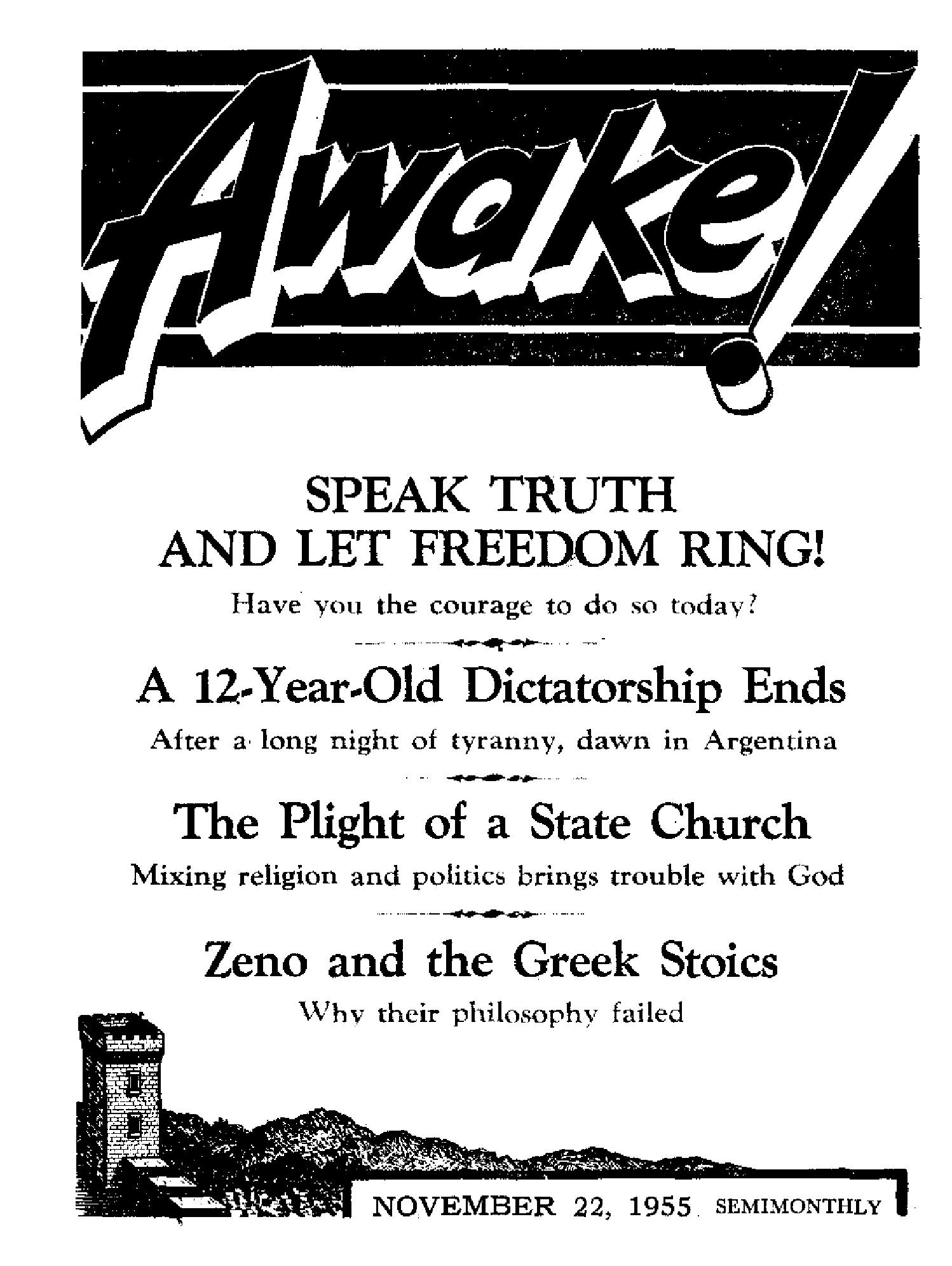
THE MISSION OF THIS JOURNAL
News scurces that are able to keep you awaka to the vital issues of our times murt be unfettered by censorship and selfish interests. “Awake!” has no fetters. It recognizes facts, faces facts, is free to publish facts. It is not bound by political ambitions or obligations; it is unhampered by advertisers whose toes must not be trodden on; it is unprejudiced by traditional creeds. This journal keeps itself free that it may speak freely to you. But it does not abuse its freedom. It maintains Integrity to truth*
“AwakeI” uses the regular news channels, but is not dependent on them. Its own correspondents are on all continents, in scores of nations. From the four corners of the earth their uncensored, on* the - scenes reports come to you through these columns. This journal's viewpoint is not narrow, but is international It is read in many nations, in many languages, by persona of all ages. Through its pages many fields of knowledge pass in review—government, commerce, religion, history, geography, science, social conditions, natural wonders —why, its cover* age is as broad as the earth and as high as the heavens.
“Awake!” pledges itself to righteous principles, to exposing hidden foes and subtle dangers, to championing freedom for all, to comforting mourners and strengthening those disheartened by the failures of a delinquent world, reflecting sure hope for the establishment of a righteous New World.
Get acquainted with “AwakeI’1 Keep awake by reading “Awake!"
PEBU41HSD SiMlMOHTHLT Bt WATCHTOWER BIBLE AND TRACT SOCIETY, INC.
117 A<Um« Strict Hnn'klyu 1, N. Y., TL 8. A.
N. FL esohu, Preridcnt Cmamt Suits*, Heoraitttii
Printinfl this Imum; 1,525,000
U wfetita mtaclM l« laMdMC StalBtotUr—UrtiMB, ftnciit, Tnoch.
iltrvm, HoUuSbb. Xjrw«ji»c, £pMlita. flwtdisb. Hatti? - Dftairt. Viwl. FgrtafiiMc. UinloUC.
Mm Y«*Lr nil
HttriM. ILS.. 113 iiUsz4 St,. BmclCjn 1. N.I. fl ftwfrlllc. 11 B«Wor4 Ud., itmtAiU. N.B.W. i/-CaMdlL <0 Mo Art . ftnet* 3, OnUfU fl EmOwU, SI Crtrtc Ttn-uw, Lc»wc, w. 2 T/-
N«w ImM, O.t.O ■« so, VtLiutoa, r 1 T/ SHtk SfriM, PrhiU Big, SlKiWn^la, T’J. 7/
Five cents a espy
*IW nt 1*1 Mi AdoM bt #4*1 <• A» fa TW t»* tty is Mn*)fanet wt2i rwlitUtu u iwutn M_'i Mhwr tf ■moo. Ufjfilr.Uiw in tttwUS M BtmNt* Cmc cmhiHm whrrt eg cfla J* loetML t/ taucMtina] acmv unkr air. Sfefacrfatka nt* fa Ifatrwi cwetriiM tre feeiw rtiiiad la tout tutifc7 Mcllaa if urinUa (r/Ji rtaml blink) !■ mi it nut tw iitue* btfert *xt*eci^tfao »i Urw. CfcioH fa *Mrw TtMi *»; fa ow Mt* ■UU bt USKtld rfiCtlr* within Duett raw cW u writ u tww MSnu.
teunri m weoi^-duc wittrc u StjuUjt* N * vt fa Mirctt 3, IS7» MbM fa I' I a
CONTENTS
The Vatican a Bulwark
Against Communism?
Writer Boycotted for Criticizing Churches 4
Speak Truth and Let Freedom Ring!
A Year-Old Dictatorship Ends
Successful Revolution
The Busy Taxi Driver
The Plight of a State Church
Uganda, the Gem of Africa
Beer—from Ancient Babylon
! to Modern Industry
t Zeno and the Greek Stoics
“Your Word Is Truth”
God's Wisdom vs. Man's
Jehovah’s Witnesses Preach in All
the Earth “Germany
Do You Know?
Watching the World
The Vatican a Bulwark Against Communism?
IT IS becoming increasingly popular to refer to the Roman Catholic Church as a “bulwark against communism." Recently, the vice-president of the United States, Richard Nixon, embellished the familiar phrase. He called the church “one of the major bulwarks against communism and totalitarian ideas.” Though his statement went unquestioned by the masses, there were a few who challenged it. One of them was Dr. John A. Mackay, president of Princeton Theological Seminary, who said: "At the risk of being termed a bigot, I am compelled sorrowfully to say that the exact opposite is true.” Obviously, someone made a misstatement. To find out who we have but to test the Vatican’s bulwark.
What do we find? Said Dr. Mackay: “Two decades ago the Roman Catholic church made concordats with the totalitarian rulers of Italy and Germany, Benito Mussolini and Adolf Hitler.” Our first test of the bulwark reveals Vatican collaboration with totalitarian tyrants. Testing further, we find that practically the whole world condemned the invasion of Ethiopia, but the Italian clergy as a whole not only voiced no opposition to Fascism but openly endorsed Mussolini’s conquest of Ethiopia, 19 archbishops and 57 bishops saying: “Catholic Italy thanks Jesus Christ for the renewed greatness of the fatherland made stronger by Mussolini’s policy." That policy was totalitarian.
“Today the Roman Catholic Church,” said theologian Mackay of the Vatican’s bulwark in Spain, “has a concordat with, and is the chief supporter of, Francisco Franco, the totalitarian ruler.” It was just last year that the Vatican awarded Franco its highest pontifical decoration—the Supreme Order of Christ! Yet it was Franco who rejoiced at the conquest of the Philippines by the Japanese. And it was Franco who rejoiced when the Vatican, soon after Pearl Harbor, opened diplomatic relations with Japan. Thus the Vatican has climbed not only on the Franco, Nazi and Fascist totalitarian bandwagons but on the Japanese totalitarian bandwagon, climbing down only when the wagon lost its band.
What kind of bulwark has the Vatican built against communism? Catholic countries, of all countries, should be exemplary bulwarks against communism. Yet what do we find? As Dr. Mackay puts it, the lands that are predominantly Catholic are actually “breeding grounds for communism.”
It is true in Latin America, where some 90 per cent of the people are Catholic.
It is true in France, where priests have gone to work in factories to try to win back communism’s converts. Result: The “worker priests” did not expect to see concrete results for several generations. But there were unexpected results: Not a few of the priests fell victim to Red propaganda and turned Communist! Where was the bulwark?
And where is the bulwark in Italy, where one third of the Catholic population votes Communist? In spite of the pope’s threat of excommunication, the Communist party grows, last year by 180,000 members —most of them baptized Catholics!
Where, then, is the Vatican’s bulwark? Our test reveals that it is a myth.-Ever since the days of murderer Constantine, the Catholic Church has collaborated with totalitarian dictators. In Catholic lands the church has been no bulwark against communism. Why? Because it has refused to follow Christ’s example. Instead of offering dictators the "Supreme Order of Christ,” Jesus had nothing to do with them, saying; "My kingdom is no part of this world.” —John 18; 36, New World Trans.
UAcltat Hoy cotta d fiot @rltlciyng Hkitiekai
Dr. George W. Lane, who writes a column for many newspapers throughout America, has sometimes discussed the matter of gambling in churches. In the San Jose News of January 22, 1955, Dr. Lane brought up the subject of not only gambling but also smoking in churches: “Last year our American Medical Journal refused to accept any more advertising from tobacco companies. ... If a branch of science, such as medicine, feels that way, then what do you readers think should be the attitude of churches? Do you believe that churches should endorse anything that is harmful to human health or happiness ? Should the churches even lend their indirect support to any substance or custom that sets a bad example before youth?’’
Then Dr. Lane commented: “Some clerics bitterly attack me for even raising sucli questions. Recently the aged bishop of a certain church ordered my column canceled by the leading newspaper in his state under threat that he'd boycott that paper among all his parishioners if my column was still printed. And my column was dropped! Four other newspapers in other parts of the U.S.A, also dropped my column at the same time.
"Nowadays many churches, as well as colleges, are growing so open-minded that they will smile tolerantly at almost any kind of behavior if they think they can gain a cash donation from that sinner. ‘Sometimes an open mind is too porous to hold a conviction’ runs an old adage that is still quite correct. ‘There’s so niuch bad in the best of us and so much good in the worst of us that it does not behoove anybody to criticize his neighbor,’ is a prevailing motto of these too porous minds who try to rationalize. But the essential purpose of morality is to criticize: If any habit or custom causes children to stumble, or directs them into wrong, then all educators, religious as well as secular, should criticize.’’
“COPVDUCH”
At Seattle, Washington, it seems that the expression “copycat,” meaning one who imitates the ways of another, may have to be amended to “copyduck.” For the Dugan family have a mixed-up duck that copies the ways of the family dog. This duck is so befuddled that it tries to do everything the dog does—he even chases cars. But the duck has one serious trouble in playing the role of a “copyduck.” The family dog loves spaghetti, but every time the duck tries to eat it, the same thing happens. The duck gets the spaghetti all twisted around his bill and nearly goes crazy.
is the first casualty." But what truth
is emerging today despite war, bans or censorship causing freedom to Hng throughout the land? Have you the courage to speak it?
TEN million times a day or more on the editorial page in the Hearst newspapers appears the word TRUTH in all capital letters. Yet for more than half a century these papers have been documentarily accused by presidents and writers alike of having deliberately published falsehood. And one of the two major newspapers of Russia, which is now devoted to distorting the facts and printing barefaced lies, is named Pravda, which when translated into
“A more modest institution, but one whose works have been placed along with astrology and spiritualism on the Vatican’s Index of Prohibited Books, the Christian Science Church, advertises Mrs. Eddy’s Science and Health as ‘the truth that makes free.’ ” Adolf Hitler, advocate of the Big Lie, had also said: “You cannot keep the truth buried forever. Truth is bound to emerge" (Times, September 24, 1939), and from Madrid, on June 21, 1945, the Associated Press reported that “Truth, Spanish Style, [is] Franco’s Aim.” The Associated Press itself is dedicated to nothing but “Truth in News.”
our language is “Truth."
Marshall Field’s favorite slogan was: “Read
Religious sects and cults, both pagan and so-called “Christian,” which have claimed a monopoly of truth and believed the fable that the end justifies the means, have waged wars and barbaric crusades and have committed flagrant murders in the name of truth. “More recently under the imprimatur of Cardinal Spellman there appeared a pamphlet entitled Freedom of Worship. In it is proclaimed the belief that ‘the Catholic Church is the only organization authorized by God to teach religious truth? But Father Coughlin, a less modest propagandist, declared in his Social Justice (November 14, 1938): ‘The only source of truth is Father Coughlin? There was no protest from the Vatican.
the truth in the Chicago Sun?J One word appears on Harvard University’s shield: Veritas (Truth). The Advertising Federation of America is rather ironically also dedicated to “Truth.” Viewing the news for what it is, columnist Samuel Grafton writes: “Truth is on page 37.”—Quotations are from George Seldes’ book, TeU the Truth and Run, pages 281, 282.
With so many persons, institutions, organizations, societies, religions, etc., claiming to possess truth, a matter that scientists, historians and philosophers have speculated about and presented theories on for ages, it is a wonder why freedom does not ring, why doubts, fears, trepidations and anxieties sweep the earth; unless of course
the truth that the world possesses is not really truth; that its light is not light but darkness. As the Master of knowledge once said: “If in reality the light that is in you is darkness, how great that darkness is!’’ The world’s present plight is described as one of darkness: “For, behold, the darkness shall cover the earth, and gross darkness the people.” As J. J. Rousseau declared: “All men were created free, and now they are everywhere in chains.” —Matthew 6:23, New World Trans.; Isaiah 60:2.
This world has, technologically speaking, accomplished miracles on land and in the air. But said Adlai E. Stevenson to an audience at the Columbia University Bicentennial Conference June, 1954, "despite all of this wisdom, this exertion, this goodness the horror of our time in history is that things are worse than ever before. There is no peace; we are besieged, we are rattled. Perhaps we are even passing' through one of the great crises of history when man must make another mighty choice. Beset by all of these doubts and difficulties, in which direction then do we look?” Stevenson answers: “We look to ourselves—and we are not ashamed.” We look “to individual Americans, to their institutions, to their churches, to their governments, to their multifarious associations—and to all the free participants in the free life of a free people. And we look, finally, to the free university whose function is the search for truth and its communication to succeeding generations.”
Yet this great body readily admits it is “besieged,” “rattled,” without “peace,” filled with “doubts and difficulties,” and that "things are worse than ever before.” Strange this paradox, is it not? Because where there is truth there should also be freedom, peace, liberty. Where there is light there should also be security and direction. The world has none of this. It is bewildered, frustrated, perplexed, which is conclusive proof that it is without light, without the real truth. Its many institutions and periodicals labeled ‘-‘Truth” do not have this truth in them. Darkness is accepted for light. And the people continue to grope about for a way out.
Describing present conditions, Isaiah wrote: “We look for light, but, behold, darkness; for brightness, but we walk in obscurity. We grope for the wall like the blind.” “Truth is fallen in the street, and uprightness cannot enter. Yea, truth is lacking; and he that departeth from evil maketh himself a prey.” Jeremiah simply stated: “Truth is perished.”—Isaiah 59:9, 10, 14, 15; Jeremiah 7:28, Am. Stan. Ver.
What Truth in Newspapers?
Where to look for truth today is a problem. And how to distinguish it from falsehood is another problem. Where is it to be found? In newspapers? In radio and television broadcasts? In the mounting deluge of periodicals and books? Hardly. Franklin D. Roosevelt, when president of the United States, blasted the “free press” with this .truthful sentence: “An amazing state of public misinformation exists in the United States.” Dr. George Gallup called Americans "the least well informed.” In a public address editor Louis B. Seltzer of the Cleveland Press referred to the United States as “a nation of economic illiterates.” Is this not partly the reason for the nation’s fears, even its illiteracy? Emerson wrote: “Fear always springs from ignorance.” Virgil defined fear as: “The proof of a degenerate mind.” If ours is the age of enlightenment, there should be no fear. But alas! fear is everywhere, mocking this world’s claim to enlightenment.
One of the best-informed men of our time, Sir Norman Angell, had this to say, as reported in the New Republic on June 2, 1941: “With our vast and complicated paraphernalia of making things known, for telling the world the news, the world somehow manages to miss just the news that is often of the most vital significance, with direct bearing upon today's policy; indispensable to life-and-death decisions; news which relates not to matters of opinion and controversy, but to actual events.” Perhaps, even more brutal in his expressions was Thomas F. Ogilvie in his Jersey Times (February 26, 1949), where he wrote: “Until America develops an educational system that teaches citizens to spot the phony columnists and commentators, and not to parrot the propaganda they read and hear, the people cannot be truly educated. Without the light and truth, wise and proper decisions are impossible. The shame of America is that Americans, despite all their technological marvels, know more things that are not true than any other people on earth.” Rather shocking to find this true in a nation that boasts of a free press.
Defenders of the hash now served as truth like to shift the blame on the people for this deplorable state. The people, they say, “get the newspaper press they deserve. Or want. The people do not want to be informed, they want to be amused, and that is why they spend fifteen hours listening to the comic programs on the radio for each hour they spend listening to news broadcasts or any sort of educational programs.” Furthermore, a survey conducted by the American Newspaper Publishers Association revealed “82 per cent of the men and 70 per cent of the women reading the comic ‘Dick Tracy’ while only 28 per cent of the men and 25 per cent of the women read ‘even one paragraph of the most important news story that day? ” Pageant for October, 1950, declares that hours totaling more than “52 waking days” out of a year are spent by adults before television sets. And as a rule the vast majority of these hours are consumed in entertainment programs. The reaction toward news andeducational features is lethargic.
What Truth?
What truth escapes the attention of the people? The same truth that rocked the world in the first century after Christ. Vital truths were being proclaimed that affected the lives and destinies of all peoples, yet they went unheeded. When the Bearer of light and truth stood before the Roman ruler Pilate, he stated that his purpose for coming to earth was to “bear witness to the truth,” and that “everyone that is on the side of truth listens to my voice.” Pilate replied: “What is truth?” but did not stay to hear the answer, because he was not particularly interested. Millions of persons today, just like Pilate, pose the question, but do not wait for the answer, because they do not have any particular love or devotion for truth. They are too self-centered, egotistical and proud to hear what truth is.—John 18:37, 38, New World Trans.
Nevertheless, Jesus did give the answer, not to Pilate, however, nor to the haughty people, but to lowly men who followed him. In prayer to God he said: “Your word is truth.” Centuries before, King David prayed: “O Lord Jehovah, thou art God, and thy words are truth.” These men spoke of God's written Word the Bible as truth. It is God’s Word, his message of truth as proclaimed in the Bible, that is a "shield and a buckler," to his slave; 'a lamp unto our feet, and a light unto our path? It is God’s Word of truth that has been tossed into the streets and that has perished from the land. It is for this truth that there now exists a spiritual famine. Dr. John H. McComb admitted that Christendom “is literally famished for the Word of God.*' Dr. Pitt stated: "Disillusion, frustration and cynicism have engulfed the clergy and the laity.” The president of Harvard University recently declared: "We have not been well taught about religion and there is as a consequence a very widespread religious illiteracy and correspondingly little religious practice.” The foretold spiritual famine at Amos 8:11 has engulfed the land. —John 17:17, New World Trans.; 2 Samuel 7:28; Psalm 91:4; 119:105; 117:2, Am. Stan. Ver.
On the masthead of the papers controlled by press lord Roy Howard appears the slogan: "Give light and the people will find their own way.” But from its pages the light does not emanate that sets people free and lets freedom ring. Jesus said to his disciples: “If you remain in my word, you are really my disciples, and you will know the truth, and the truth will set you free.” “Undeserved kindness and the truth came to be through Jesus Christ.” It is this truth that is vital, that sets free, that lets freedom ring. Censor this truth and there is no truth, no freedom. Ruth McKenney declared that “man has no nobler function than to defend the truth.” Particularly true is this regarding Bible truth, because the destiny of all mankind hinges on its proclamation.—John 8:31, 32; 1:17, New World Trans.
"But who in a world where people believe the newspapers still seriously believes in the Bible?” asks Denis de Rougemont in his work The Devil’s Share. “It is a fact that modern man experiences less difficulty in lending faith to the lies of the day than to the eternal truths transmitted by holy books.” But regardless of that fact, there emerges today an organization, the New World society, whose avowed purpose is to speak Bible truth. Not the “truth” of the countless bewildered religions of Christendom and heathendom, but the truth of Christianity, as Jesus and his apostles spoke it—Bible truth. It has already revealed itself as a tremendous force for freedom, freeing great crowds of people out of all nations, kindreds and tongues; releasing them from the bondage of false religion to New World freedom. “For such freedom Christ set us free. Therefore stand fast, and do not let yourselves be confined again in a yoke of slavery.”—Galatians 5:1, New World Trans.
It is mandatory to speak truth to maintain freedom. To Israel returning from Babylonian captivity God issued this command: “Speak ye every man the truth with his neighbor; execute the judgment of truth and peace in your gates." The apostle Paul repeated this same counsel to those embracing Christianity: “Speak truth each one of you with his neighbor,” he said, “because we are members belonging to one another.” In no other way can doubts be dispelled and suspicions and fears removed. Only by cultivating a deep love for truth will one be courageous enough to speak it. As Montaigne once said: “I speak the truth, not so much as I would, but as much as I dare; and I dare a little more as I grow older."—Zechariah 8:16, Am. Stan. Ver.; Ephesians 4:25, New World Trans.
Only the spoken word of God can give mankind the free mind that William Ellery Channing defined some hundred years ago, that mind “which jealously guards its intellectual rights and powers, which calls no man master, which does not content itself with a passive or hereditary faith, which opens itself to light whencesoever it may come, and which receives new truth as an angel from heaven.” How many in this world have minds that fulfill Channing’s definition? Not many. Is not this its failure? Speak Bible truth, therefore, and freedom will ring!
A 12-Year-Ola
P^Ends!
By '’Awake F correspondent in Argentina
SPRING in Argentina this year brought along with it something more than blossoms and milder weather. It put an end to a long-drawn-out night of tyranny. Perdn’s regime came to a very sudden and almost unexpected end and a sigh of relief was heard throughout the country.
Before we enter into the recent happenings a little history will prove helpful. In 1941 the presidency of the nation was in Ramdn J. Castillo’s hands, and his bad government was being severely criticized, due mainly to its pro-German tendencies and very bad administration. Toward the end of the year, to maintain his position he declared a state of siege. This state continued till a military revolt ousted him in 1943. The joy it caused many was to be but short-lived.
The military junta changed presidents with alarming rapidity, becoming relatively steady under President Ramirez who, after some time, was succeeded by President Farrel. Ip the first stages of this revolution Juan Domingo Peron was a figure of small importance. However, it was agreed that he would take the lowly and unimportant job of secretary of labor. He was quick to use this post to win the support of Argentina’s laborers by decreeing higher wages and better working conditions. By October, 1945, he was vicepresident, but the conditions of the govem-ment had already changed the former joy of some into tears of desperation as a worse government set in.
About one thousand of the most prominent lawyers of the country had been arrested, together with judges, newspapermen and politicians. A strike by students caused Perdn’s arrest by the army, but his next move was to call in the workers, who declared a week-long, nationwide strike, forcing the military leaders to free Perdn. This was the dark day of October 17,1945, when Peron was brought back stronger than ever to the government house to dictate the course of the nation for ten tragic years.
He was elected president of the nation in direct violation of the constitution, which provided that neither the president nor the vice-president could be re-elected till a period of six years had intervened between the previous office. Thereafter he began profiting on the sorrow and hunger of the peoples of Europe by buying grain and beef from the producers at fixed, not market, prices and selling them to those nations at exorbitant prices. With these profits he began nationalizing railways, telephones, airlines, buses, etc., paying what he considered a just price. Meanwhile he declared that all ships that had for a long time been docked in the country due to war conditions had become national property.
Just before being elected president he married actress Eva Duarte. She would be with him during the remaining few years of her life. Hers was truly an iron hand in a silken glove and was more feared by opposers than Peron himself. Her speeches were strong and full of slang, which attracted the workers. She presided at Perdn’s former office, the labor ministry, and had a pretty good control of everything
going on. She distributed abundant gifts to the needy and received “voluntary” contributions from all big firms. Any firm that would not “voluntarily” contribute to her fund for social welfare would soon find inspectors on their premises who would have no trouble in finding some violation of the municipal or governmental laws. They would apply a fine and sometimes close down the establishment. These gifts to the needy people always paid off when big public demonstrations were needed.
Exit Freedoms
Free press disappeared and by 1951 La Prensa, called the most important Spanish-language newspaper in the world, was taken over for criticizing a railway strike. Control of newsprint provided abundantly for official papers, but drastically cut the provisions for liberal ones. Radio was just a tool in the government’s hands. Congress was a rubber stamp in the dictator’s power. To suit his needs and whims Congress would just as soon pass a law as revoke it.
The constitution was rewritten to suit his policies and to make it possible for him to continue in power. It made all private interests and property subject to the social interests of the country, therefore making everything unstable and insecure.
A decree with the pretended purpose of keeping a registry of all religions was issued early in Perdn’s presidency, but its sinister purpose was soon to be seen. Although the constitution guaranteed free exercise of religion, all religions had to register, giving the addresses of all meeting places and churches and the names of their officers and of all ministers. Jehovah’s witnesses complied with this law and were soon to see its object. A peaceful Christian meeting during an assembly addressed by the Watch Tower Society’s president, Mr. N. H. Knorr, held on its duly registered premises was interrupted and some five hundred present were taken to the police station, registered and released in the early hours of the momingof April 4,1949. Shortly after this the Society was notified that it was not granted registry, which meant, in other words, that it could not act as a religion in the country. This was followed by a decree from Argentina’s president himself withdrawing the legal status from the Society. Upon appeal, another decree confirming the first one was issued. It was a hard blow designed to wipe Jehovah’s witnesses out of action. Great were the expressions of joy from both the Catholic Church and Protestant groups at this action against the only people really bearing the Almighty’s name.
But what about the witnesses? At that time there were 1,135 ministers on the average. They had to go underground to continue their preaching work. Six years of underground activity have increased their numbers to a peak of 3,865.
The Catholic Church was to realize that this instrument of oppression they had supported was a two-edged sword, for Peron used this same instrument in banning Catholic meetings and processions, deporting priests and in every way possible making the Catholics realize that their former friend whom they had supported was now a bitter foe.
Successful Revolution
Several attempts were made by the opposition to overthrow the government, but these failed. Last June 16 saw a sanguinary attack upon Buenos Aires and the government house, causing many deaths, bqt it too failed. However, Peron decided to present his resignation, but did not proceed to do so in the constitutional way, which would have been to do so before the Congress. He presented his resignation to the Peronista party. A grand demonstration was staged on August 31 by the CGT (General Confederation of Labor) and the workers went to Plaza de Mayo to request that the resignation be withdrawn. Simultaneously, the puppet congress met and decided that' Peron stay. Thereupon Perdn spoke to the crowds and incredibly invited them to kill five for every one of them that might die, generally building up an atmosphere of hatred and vengeance.
The answer did not delay and on September 16 another revolution broke out according to first news in the city of Cordoba, near the center of the country. More news soon came in saying that the naval base at Rio Santiago, near Buenos Aires, had rebelled, and also that in the provinces of Corrientes and Entre Rios some units of the army had rebelled. Fighting broke out and in some of these places the rebellion was quashed, but no sooner had this been done than other forces rebelled—Bahia Blanca on the south, Tucuman to the north. The fiist news was that the fleet was loyal and was steaming up to help the government, but then it started shelling and bombarding Mar del Plata, a summer resort where the submarine base is. This did not take long to fall into the revolutionary's power. Then the army rebelled in the west, in Mendoza, San Juan and San Luis. The fleet came up to the Rio de la Plata and issued an ultimatum that, if by 1 p.m. Monday, September 19, President Perdn had not resigned they would bombard Buenos Aires and the oil refineries at La Plata, fifty kilometers to the southeast.
Just as the time was passing, announcements over the Argentine radio network were made by the commander of the loyal army saying that in view of the ultimatum they would accept dealing with the rebels. Soon a letter written by Perdn himself was read over the radio presenting his resignation. A truce was called. Negotiations started Tuesday evening on board the flagship, and unconditional surrender by the loyal armies put an end to Perdn’s ten-year-old dictatorship. Thus three days’ fighting sufficed to put an end to a seemingly endless nightmare, and Perdn’s machine built upon blood and oppression crumbled in ruins.
General of the army Eduardo A. Lonar-di was named provisional president. In a simple speech over the radio he promised that the rights attained by the workers would be respected and that freedom of speech, worship, press and assembly would be fully restored. He entered Buenos Aires triumphantly on Friday, September 23, and was given a very enthusiastic reception. The Argentine people invaded the streets waving Argentine and Uruguayan flags. All the buildings were decked with flags, some of the Vatican State, and cars paraded all over the city. People could not hold in their joy and ran around shouting Libert.ad!—an indication of how much they desired freedom.
A mammoth manifestation, greater than any Peron had ever managed to produce even by force, was held in the historic Plaza de Mayo while the provisional president was sworn in. After the ceremony President Lonardi spoke in a simple, pleasant way to the people, emphasizing that justice and love were to be the motives of his temporary government. He invited the press to criticize him freely, and again emphasized that freedom for all religions, freedom of assembly and freedom of speech definitely would be restored.
The general opinion is that there is much hard, delicate work ahead of this government. The Peronistas are not taking this sitting down, and unrest and uprisings have taken place in several sections of the country, obliging the army to intervene and in no mild terms. Yet hopes are high that the situation in the country will take a definite turn toward more freedom.
However, this turn to relative freedom should not enslave people into ignoring the call to real freedom, which call is from above and is being constantly sounded throughout the country by Jehovah’s witnesses in harmony with the prophetic pattern at Leviticus 25:9-13 (New World Trans.): "You people should cause the trumpet to sound in all your land . . . and proclaim liberty in the land to all its inhabitants-’’
By "Awaka!" correspondent tn Trinidad
ONTO the otherwise tranquil movement of life in beautiful tropical Trinidad hurtles its daily paradox, the hustling taxi 'driver. In striking contrast with the tempo of activity in general he is seen everywhere furiously dashing to and fro seeking fares and discharging his passengers. His is Trinidad’s busiest profession.
Although the island of Trinidad is small, It has a large population that does a lot of traveling. Scheduled transportation runs only at certain times during the day, and many wish to travel at other hours if they can get something to carry them. It is to fill this transportation gap and also to offer stiff competition to the railway and bus companies that this island’s colorful taxi drivers enter the picture.
J.! By far the greater number of taxis are individually owned and operated by the owner or a hired driver. For the shorter runs and service in town the small British cars are mostly used, and whole processions of them can be seen racing along the bus and trolleybus routes vying with the buses and one another for fares. To the observer it seems that every other car is a taxi, and it is, there being over 4,500 registered in 1953 and many more since, if.’ With taxi fare to San Fernando, thirty-five miles
and a “drop” in Port of Spain costing merely six cents, it can be imagined what a scramble there is for business. Besides, many drivers are hired and are expected to turn over eight or more dollars daily to the owner of the taxi, In addition to making their own living. Of course, tourists are considered fair game with an open season on them all the time.
Opposite the railway station in Port of Spain where taxis to San Fernando stand; it is a common thing to see two or thre«;drlvers all trying to induce a prospective passenger into their respective taxis. One inducement is to have a “decoy” in the taxi to make it appear that the load is about made up so that the car will soon start its trip. Eventually the depoy gets out to make room for the final passenger.
The cutthroat competition has a very bad effect on the driving habits of the average taxi driver. Every rule of safe driving is broken, with skill and luck being depended upon in dangerous situations. The driver passes on curves, on hills, at intersections; in fact, he will overtake and pass anywhere and everywhere he thinks there is the remotest possibility ■of doing so. The local accident and death rate is not to be envied.
For all his faults, however, the taxi driver does render a valuable service to the Trinidad public and serves it often where other services fail. He is industrious, and works hard and long hours for his daily bread. He shows a certain spirit of independence in making this job for himself. Watch him hopefully speaking to the passers-by. “South, Chief?" “South, Madam?” Then, his load made up, he roars down the road, the busy taxi driver in the peaceful little island of Trinidad.
The Plight of a State Church
By “Awake!” correspondent in Norway
HERE is no escaping it, the 930-year-oJd Norwegian State Church has come into a plight—a plight partly caused by her dose relationship to the state. On the one hand she has the membership of a population that shows complete indifference toward the church, and on the other hand she is financially dependent upon a state that has recently begun maintaining that it should have the right of determining her doctrines, as well as paying her expenses.
The present plight of the church can be boiled down to two big problems: What can be done with her drowsy sheep? And what should be done about her relationship to the state?
At times clergymen mention this plight, at times they propose remedies, at times they ask whether they themselves are to blame; but never are they allowed to forget their predicament. Always some new crisis emerges, or some embarrassing facts come to light, to be publicized toy the press or by the state. For instance, on a Sunday morning last January two re-[>orfers from Aktuell, Norway’s biggest picture magazine, visited two of the largest churches in Oslo, and in their January 29 issue told what they had found. On its front page their magazine asked: “Have the Norwegian People No Need for Religious
Sendees?” The point was stressed with pictures of the nearly empty churches. In the first church, with a capacity of 1,000, only fibout 20(j people were present, while only 50 churchgoers had found their way into the other church, with the same capacity.
The reporters were struck with the fact that they did not find a single youth in either church. *'A great part of the churchgoers tottered into the church with cane in hand,” the magazine observed, and it estimated that the average age of the people present must have been well over fifty years. It said that the hard fact “is that the services of the Church no longer appeal to the people,” and added: “The Church is becoming a colossus on clay feet: it does not have the solid foundation of fervent worshipers any vigorous organization must have. The Church may continue to exist by virtue of grants from the State Budget, of course, but then only as an empty shell, an institution accepted out of sheer indifference.”
Bishop Kristian Schjelderup of Hamar said in 1950: “We clergymen should simply ask of ourselves if the reason for the unbelief in our message of God might not partly be due to us, who preach it. If Church and Christianity shall be regarded as a force by modern man . . . then we must descend from our lofty position—we must come down from pulpits and educational platforms—and go out where life is lived, out to seeking the needy people.”
Another obvious reason for the public apathy is that clergymen often neither believe nor preach Bible doctrine. The fall in Eden, the Flood and the Bible miracles are regarded as sheer myth and legends. Instead of teaching the creation account of the Bible, these clergymen resort to the evolutionist fables of man descending from some apelike animal. Thus, things like this happen:
A teacher in cne of Oslo’s colleges, a minister, last year was asked where Cain got his wife. At first the teacher stood baffled. Then came the unintelligent answer: “Probably he married a man-ape, of which there certainly must have been many at that time.” No wonder the younger generation fails to show up in the churches, when the ministers preach from a book in which they themselves have no faith, and when they do not even know that Cain had sisters!—Genesis 5:4.
These clergymen do not even preach according to their own creeds! At least, not if one is to believe a survey made in 1950 by an orthodox clergyman, Olav Valen-Sendstad, Ph.D. Analyzing fifty-seven sermons given over the Norwegian state' radio during one year, he found that out of the fifty-seven sermons 22.8 ]>er cent were false to church doctrine, 50.9 per cent were of no interest, 14 per cent were problematic, while only 12.3 per cent fell into the category he listed as true.
Of the false sermons Jie said that besides talking contrary to God’s Word they had mentioned Jesus Christ in such vague terms that the name “Jesus” might as well have been replaced with the names of Mohammed, Buddha, Socrates, Kant or any other ‘'great” name. At least, the contents and meaning of the sermons would not be disturbed by this, he said.
His survey won nationwide attention and was received with joy and much comment by numerous anticlericals in Norway. The clergymen who were attacked, however, did not come out and defend themselves publicly. As usual, they found silence the better weapon.
Should the State Rule the Church?
When questioned about why the church and state should be so closely associated, clergymen usually defend this association by referring to their interpretation of Romans 13:1, saying that the “higher powers" mentioned there are the state. During the war this interpretation caused some trouble, however. Most of the clergy remained loyal to King Haakon, who had fled to England, while a minority served Norwegian Nazi fuehrer Vidkun Quisling. Both factions asserted that they were serving as the “higher powers”—and what was to be made of that?
In postwar years clergymen have tried to impose some qualifications upon their false interpretation of what the “higher powers" are, so that, for instance, Nazis and Communists could never be regarded as such even if they for med a regular government. But the clergymen have, incidentally, kept their mouths closed as to the position of Norway’s present Labor government, which in no respect could be dubbed a proreligious regime. Evidently the task of operating a state church in today’s rapidly changing world is not easy!
Then in 1953 came the violent Norwegian hell-fire debate. An orthodox theological professor threatened his radio listeners with hell-fire. Public reaction against the threat was spontaneous; a bishep stated that the hell-fire doctrine was contrary to the religion of love—and the fight was on! (See Awake’ June 22, 1954.) The debate, which was carried on in the public press for more than a year, gave the clergy a rare opportunity to tell the public what they meant on hell-fire. But as a rule they took no stand whatsoever. They were silen 1 The people’s respect for these clergymen did not increase after that.
As a result of this struggle between powerful personalities within the church; the government ordered professor in law Dr. Frede Castberg to define the state’s authority in its relationship to the church. Castberg wrote a learned treatise to the effect that the state might abolish hell-fire teaching in public schools and could handle questions of faith and confession without asking the bishops, or could even act against their advice if it so preferred.
In a debate with the professor, internationally known Bishop Eivind Berggrav stated that there was "no question of the fact that the Church was being directed by the State.” And of course not! Nominal head of the church is Norway’s 83-year-old monarch Haakon VII, but the real power in this constitutional monarchy resides with the Cabinet and the Parliament, meaning that the real head of the church is the state.
Castberg, in his treatise, was only drawing the consequence of this—and .thereby caused rage, nervousness or gloom among the country’s state-paid clergymen. There was some clergy talk of separating the church from the state, but the general feeling was that the bulk of the ministers were too fond of their regular salaries to take such a drastic step. Besides, they apparently reasoned that the Labor government would not go to extremes in its dealings with the church. And at the present time that seems a safe guess to make.
Scriptures Command Separateness!
But the most serious aspect of the situation has been totally overlooked by the learned dignitaries of the church. While they have been busy fighting to maintain a position of power for their church they have entirely ignored the Bible’s warnings against worldly entanglements:
"Quit being fashioned after this system of things.” "Do not be loving either the world or the things in the world. If anyone Loves the world, the love of the Father is not in him.” “If you were part of the world, the world would be fond of what is its own. Now . . . the world hates you.” “My kingdom is no part of this world.” —Romans 12:2; 1 John 2:15; John 15:19; 18:36, New World Trans.
And make no mistake, the “world” here mentioned does not mean “the man in the gutter,” but means “this system of things,” including kings, presidents, parliaments and all other stately institutions. This fact was ignored by Bishop Berggrav when, during his debate with Professor Castberg, he stated: “Till this day the relationship between the Norwegian Church and the State has been like a happy marriage. Will this marriage continue a happy one? One thing is certain, none of the parts want a divorce. It is up to us if this relationship is to continue.”
However, the real church should be espoused, not to the state, but to Christ. For a professing Christian church to enter such a worldly relationship is spiritual adultery, as the disciple James says in straightforward terms: “Adulteresses, do you not know that the friendship with the world is enmity with God? Whoever, therefore, wants to be a friend of the world is constituting himself an enemy of God.” —2 Corinthians 11:2; James 4:4, New World Trans.
No wonder the church has her troubles. Friend of the world and married to the state, and hence, an adulteress and an enemy of God! No wonder she is in a plight! Are you wondering what the end of her plight will be? Then turn in your Bible to Revelation chapter 17 and read of the end of all the false religions that have taken this unclean role by entering into spiritually immoral church-state relationships.
UGANDA, THE GEM OF AFRICA )
By ‘'Awaktl'1 correspondent in Northern Rhodesia
"A FAIRY tale . . . A wonderful new world.” Thus Churchill, who visited Uganda years ago, described it in his book My African Journey,
Uganda is a British Protectorate and about the size of Great Britain. Due to its having an average altitude of four thousand feet and one sixth of its surface being covered by water, It has a pleasant climate in spite of the fact that it lies astride the equator. The vegetation is luxurious and while many of its areas are still / impenetrable forest others have been cleared for cotton, Uganda's chief product, and for coffee and tea.
Uganda's most conspicuous form of vegetation, however, is the banana tree, which, with its large leaves, grows so huge as to hide most native huts from view. Many types of banana are grown, from small sweet ones the size of a linger to large coarse ones fifteen inches long, which are cooked to form the staple food for Africans here.
As a change from bananas the African Ugandan likes his flying termites. He tricks the termites into thinking rain is falling by placing an ingenious contraption over their anthills, or rather, their termite hills. This causes the termites to pour forth and the hungry African picks them up, pulls off their fragile wings and devours them with gusto, alive and uncooked!
But let no one conclude on the basis of that that the Uganda Africans are uncivilized. On the contrary, Uganda’s five million Africans are well advanced. For the most part they are clothed according to Western standards, women favoring long gowns of brilliantly colored prints that reach to their ankles. The bicycle is very popular, more than a million tires being imported annually. the rcipon rails, wnere the source of the Nile was discovered back in 1862, 3,850 miles from its mouth on the Mediterranean.
There is much big game in Uganda. The elephant is the supreme game animal, and others are the buffalo, waterbuck, hartebeest, many varieties of antelopes and, of course, the lion. The black rhinoceros and the leopard are partially protected, while the white rhinoceros and the gorilla are completely protected.
Today hunting is done for sport, for game trophies and to get ivory, but at the turn of the century the wild game of Uganda was a real threat to the early settlers. Thus in The Man-Eaters of Tsavo we read of a man-eating Hon attacking a railway station (this was at the time the railway Une was first being pushed into Uganda and Kenya). The lion began tearing off the corrugated sheets of iron on the roof of the station and later entered a railway carriage where three Europeans were sleeping, and seizing one of them in its mouth, leaped through the window and had its meal in the "bush" a quarter of a mile away.
Today travel in Uganda is quite safe. At Entebbe, on Lake Victoria, is a fine international airport, and from that city an 11,000-mile network of roads serves all parts of the country. One of these roads leads to the "Mountains of the Moon/’ a range towering up to 16,794 feet, only a degree or so north of the equator and yet carrying glaciers and perpetual snow. The slopes are covered with gigantic vegetation, wonderfully colored and fantastically shaped.
Primitive Africans claimed that the burned-out volcanoes in the Uganda mountains were the homes of tribal gods. At the Murchison Falls where the Victoria Nile becomes the Albert Nile a black goat is sometimes sacrificed to appease the "Spirit” of the falls.
Uganda's economic condition is very sound and an unusually large proportion of its income is spent on education. When the hydroelectric plant at Jlnja is completed it will make even more progress, as that plant will provide all the power needed for both Uganda and adjoining Kenya. A few miles upstream are
The work of Jehovah’s witnesses has gained a foothold recently in Uganda and since so many thousands of Africans elsewhere have embraced the worship of Jehovah God, it is hoped that many here also will turn away from tribal demonism and learn of the one true Spirit, Jehovah God.
ACCORDING to an ancient Assyrian cuneiform tablet unearthed in the ruins of Nineveh and translated in 1926 by the late Paul Haupt, professor of Assyr-iOlogy at Johns Hopkins University in Baltimore, Maryland, a part of the cargo on Noah's ark was beer. The Bible, however, is silent on this point* A clay tablet written by an ancient Mesopotamian scribe, about the time Abraham was born, reveals that brewing was then a highly respected profession, and that women were master brewers of the .day* Cuneiform records belonging to the British Museum show women as managers or sales “ladies” and in many cases operating their own breweries.
In 1935, scientists from the University of Pennsylvania, digging in Mesopotamia, unearthed records of breweries that antedated Abraham's time by several centuries. “There can be no doubt/' says Albert Neuburger in his book The Technical Arts and Sciences of the Ancients, “that the art of preparing it [beerJ dates back much further still/' Kobert strongly asserted that the descendants of Ham the son of Noah introduced the art of brewing into ancient Egypt
When Abraham sojourned down into Egypt he undoubtedly was surprised to find beer as the national beverage of the Egyptians. Beer was a popular drink in Egypt right down to the very last of the Pharaohs. It was made in a mash tub, of barley steeped in water, and raised by fermented crumbs of bread. When freshly
NOVEMBER 2955 made, it was soft and pleasant to the taste. Diodorus claimed that the Egyptian brew was #‘not greatly inferior to wine in odor and potency* ” (Diooforus, I, 20) They had developed a great variety of beers to satisfy almost every taste* There were sparkling beers, sweet beer, iron beer, dark beer, light beer, perfumed beer, spiced beer— cold or hot, beer of thick, sticky millet There were as many varieties of beer as there were of wine.
Brewing was a highly-respected and well-developed industry. Regarding their quality beer, John P. Arnold in his critical work Origin and Hisjory of Beer and Brewing, page 73, says: “We see that the brewing industry of ancient Egypt, 1400 years before our era, had arrived at a higher stage than it had in either England or Germany 1000 years after the commencement of our own era.”
So Important was brewing in ancient Egypt that women brewers became temple priestesses and the brew was considered worthy to be offered in libaticn to the gods* Egyptians when praying for the dead always petitioned that there be a sufficiency in heaven “of bread and beer.” One hundred and forty-four jugs of beer were offered at the
great temple of Medinet Habu, The size of these beer jugs is not definitely known, but it is judged by authorities to have held a. good deal more than a gallon. About 500 barrels of beer a year were used for sacrificial purposes—this was only for a few temples. It is very possible, says Arnold, that four or five times as much was consumed. Raineses HI esteemed beer so highly that he sacrificed 30,000 gallons a year to the gods. This was choice beer made at the royal breweries by Egyptian priests.
Beer was considered not only a food for men and gods, but a medicine as well. The Ebers papyrus, compiled by Egyptian pharmacists 3,500 years ago, listed 700 prescriptions of which 100 contained beer. For indigestion the fruit of the dgam tree, believed to be an olive, in a glass of beer was prescribed, to drive the ailment out of the body. Tehvi (a laxative) mingled with beer was claimed good for colic. Assyrian physicians prescribed beer as a medicine to induce relaxation.
Beer became Egypt’s favorite drink of sociability, a wholesome, friendly beverage. College boys and Egyptian women were far from being abstainers. Sallier Papyri states that “every evening the smell of beer . . . (that) scares men away” was on the breath of college youths. Another ancient record shows a father exhorting his son “to content himself with two jugs of beer and three loaves of bread.” Pictorial representations and frescos taken from the tombs show Egyptian women to be 1 great beer drinkers.
The Israelites Brewed Beer
The descendants of Abraham may have known how to make beer long before their sojourn into Egypt. If not, they certainly knew the art by the time of their exodus. William Smith, in his Dictionary of the Bible, declares that the Jews knew: “1) Beer, which was largely consumed in Egypt under the name of zythos—made of, barley.” An interesting observation is made by Arnold, who says: “Whether we compare them [the Jews] with the Egyptians, Babylonians or Assyrians, or else with the Hittites, the Phoenicians or other neighbors of theirs, we shall always find that in the consumption of intoxicating beverages, abundantly able as they were to procure them, they could always be found on the side of moderation, and this not because the use was forbidden them but rather because the moderate use of alcoholic beverages was permitted them.” James Death in his unusual book The Beer of the Bible attempts to prove that the “leavened bread” of the Bible in reality was a Hebrew malt beer, a fermented bread beer. However, there is nothing in the Bible to support this conclusion.
Greeks and Romans and Brew
The Greeks, who were habitual consumers of wine, made little of beer. Aeschylos (born 525 B.C.) wrote very unflatteringly of Egyptian beer. The Danaids coming from Egypt were greeted by the king of Argos with the words: “You will find us Greeks a manly race, not drinkers of barley mead.” Plinius also spoke out against Egyptian beer, saying: “Alas! what wondrous skill, and yet how misplaced. Means have absolutely been discovered for even making water intoxicating.”
The Romans, on the other hand, considered beer a special luxury. Julius Caesar was a great admirer of beer. Plutarch, A.D. 50, and Suetonius, each of whom wrote of Caesar, tell us that after he had crossed the Rubicon, 49 B.C., he gave a great feast to his leaders at which feast the principal beverage used was cerevisia (beer). And the biographers of Lucullus tell us that at Caesar’s magnificent entertainments beer was served to his guests in golden goblets of the most costly device.
.Wonks Brew Beer
From Caesar’s time down through the Middle Ages nearly all breweries were operated as craft enterprises of the monasteries. The Encyclopaedia Britannica, Vol. 3, says: “All monasteries, even strict Dominicans, had their brew house.” The historian Ekkehardus informs us that in the tenth century the monks of St; Gall received daily five quart measures of beer, besides cider, perry or wine. Salem declares that in the fifteenth century monks brewed two kinds of beer in the convents, one for the priests and an inferior beer for the convents. The familiar word “kloster-bier” (convent brew) .heard today is the best possible proof that the convents have done much in times past to develop the art of brewing.
“Church ales” or beer festivals were forerunners of the modem church bazaars and church drives for funds. To assure a peak attendance, special brews were made up. The beer was downed and the gay festivities were held within the precincts of the parish church. The word “bridal” stems from the old bride-ale. The custom at weddings was for the bride to fill the mugs of the guests with beer as she accepted their gifts, hence bride-ale or bridal, a forerunner of the modem wedding party.
Beerhouses dr taverns were places where matters of importance were discussed, and legal decisions and business bargains were closed by a good mouthful of ale. The Norwegian code, the Frostathings log, IV, chapter 58, declares: “In three places do the people meet, at church, at the thing (court or popular legislative assembly) and at the samcunda (drinking feast),” or beerhouse, and in-these three places transactions became legal. The old Saxons would consider matters of great importance only after drinking beer. And Charlemagne dictated personal instructions on how to brew beer for his court. He showed greater concern for his brewmasters than he did for his councilors.
The Romans brought beer to England. William of Malmsbury says that the best brewers in England at the time of Henry II were to be found in the monasteries. England’s first Queen Elizabeth insisted on quality beer. When she traveled she sent couriers ahead to test the ale in the towns she was to visit. If it did not reach expectations, she had her own supply expressed from London in time for her arrival. Mary, Queen of Scots, demanded a good supply of beer. Even after being confined as a prisoner in Tutbury Castle she gave specific instructions regarding her craving— beer. The coronation of Queen Elizabeth n in 1953 was distinguished by special brews prepared for the occasion.
Beer Comes to America
Beer was being brewed in North America long before the Pilgrims arrived. In fact, when Christopher Columbus made his final trip to-America in 1502, he found the natives of Central America making first-rate brew “of maize, resembling English beer.” A historical account reveals domestic brewing in the lost colony of Virginia as early as 1587. And eight years before the Pilgrims landed there was a commercial brewery on Manhattan Island. The shortage of beer on the Mayflower was why the Pilgrims landed at Plymouth. Otherwise, they would have traveled farther south. A journal of the voyage reveals in an entry dated December 19, 1620, that the small vessel sought harbor ahead of schedule because “we could not now take time for further search or consideration; our victuals being much spent, especially our beere.”
Some of the most prominent men of early American history were brewers. Samuel Adams, known aS the “Father of the Revolution,” defender of “natural” rights of men, signer of the Declaration of Independence, operated a brewery that he inherited from his Puritan father. Thomas Jefferson thought so much of beer that he sent to Bohemia for brewers who would teach the art to Americans. George Washington’s personal recipe for making beer is still preserved in his handwriting at the New York public library.
…