Awake!, September 22, 1955
Download: PDF — Awake!, September 22, 1955
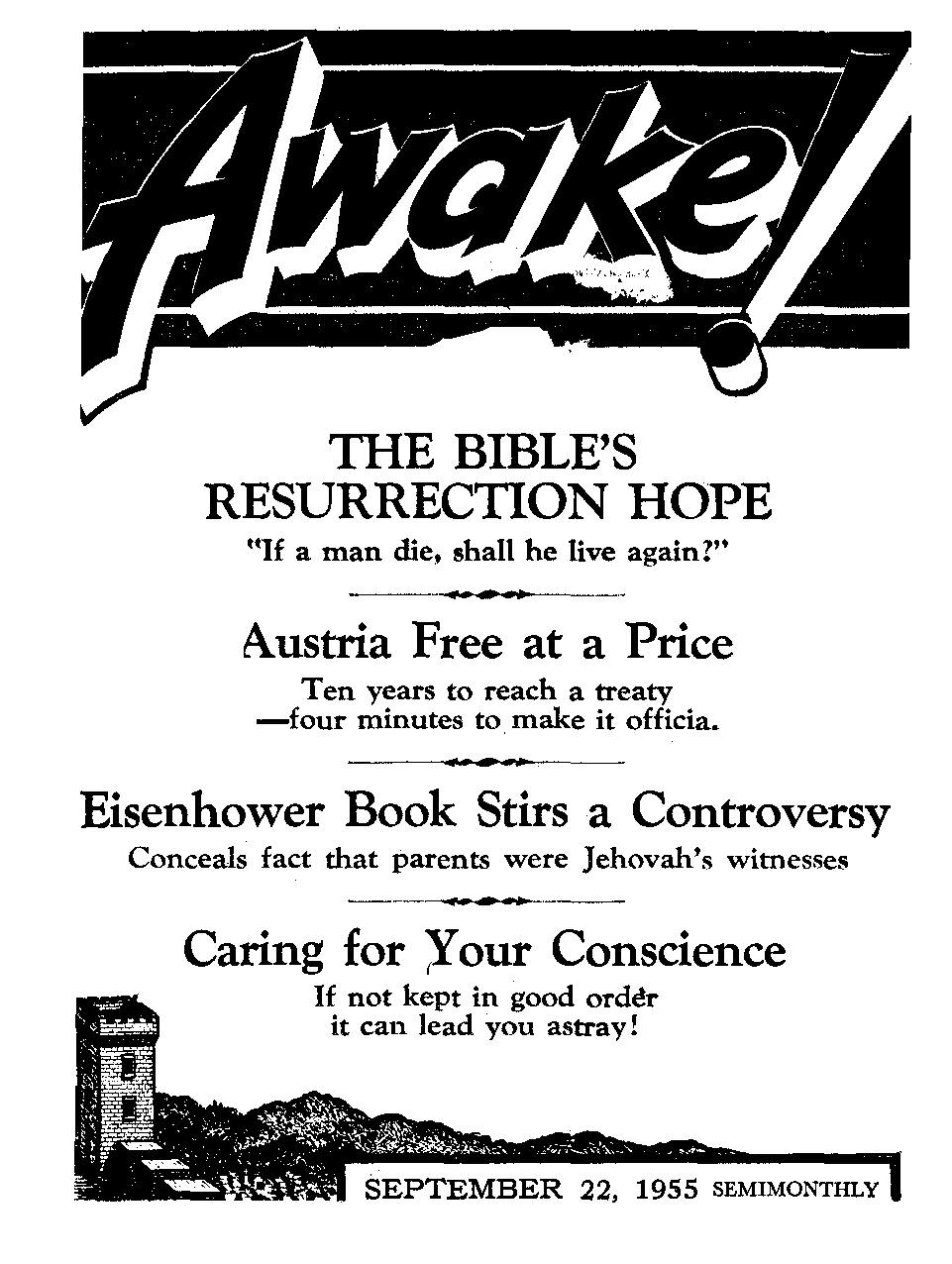
THE BIBLE’S RESURRECTION HOPE
"If a man die, shall he live again?*
Austria Free at a Price
Ten years to reach a treaty —four minutes to make it officia.
Eisenhower Book Stirs a Controversy
Conceals fact that parents were Jehovah’s witnesses
Caring for Your Conscience
If not kept in good orddr it can lead you astray!
THB MISSION OF TH^fl JOURNAL
News sourcos that ore ebh to keep you awoke to the vital ieeuee of our times muat bs unfsttorwf by censorthlp and telbth intoroto. "Awake I" has no fetters. It racogntass facto, faces facto, to frea to publish facto. It to not bound by pohtical ambitions or obligations; it U unhampered by advertisers whose toes must not be trodden on; it to unprejudiced by traditional creeds. This journal keeps itself free that it may speak freely to you. But it docs nqt abuse its freedom. It maintains integrity to truth.
"Awake 1” uses the regular news channels, but to not dependent on them. Ito own correspondents are on all continents, In scores of nations. From the four corners of the earth their uncensored, on-the>scener reports coma to you through these columns. This Journal's viewpoint to not narrow, tut to international. It to read In many nations, in many languages, by persons of all ages. Through its pages many fields of knowledge pass in review—4 nt, commerce, religion, history,
geography, science, social condLaoiia-, natural wonders—why, its cover* age to as broad as the earth and as high as the heavens.
"Awake F* pledges itself to righteous principles, to exposing hidden foes and subtle dangers, to championing freedom for all, to comforting mourners and strengthening those ,dtoneartened by the failures of a delinquent world, reflecting sure hope for the establishment of a right* eous New World. ,
Get acquainted with “Awake I” Keep awake by reading “Awake!"
»*<_**'■*
Pdblishid 8bmimonthly By WATCHTOWER BIBLE AND TRACT SOCIETY, INC.
117 Adam* Street Brooklyn 1, N. Y„ U. 8. A.
N. H. Knobs, Pretideni Giuttr Sniss, jSecretary
Printing thi* iMuei 1350,000
Ungai«M I* «*llk tklt li piHtiM:
BentimonUUy—Afrikaans, Englfih, Finnish, Frcncb* Gctmtn, Bolludlib, NorwigiatL ftptnlsb, Swedish. McfetW—Dtnhh, (ireek. Fonuctnie* UkrUnlu.
[iff! cm YeirbJ tubstripticti nt*
Ataerlrt, U.S., 11? Ad*Mto 8L, Brooklyn 1, N.Y. fl
A tat rail*, 11 Br^stord Rd., Stoithn^J, N.8.W. S/-
Cvnda, 40 Into Ave., Toronto ft, OnUrU |1
34 Cnrei Ttnw, Lowteft, W. 3 ?/-
Naw Z«d*H<, G.P.O. Bt>x 30, WtUlnrton* C. 1 ?/• AfrtaA friiMU Bai, EJaadstoaiato, Tri- ?/-
Five cent* a copy
t&atttu«a« ihwdil b* sent to ofltei to row urai-try in eo®pli*tie« with refulaticnu to <i>anuit«a ltf» deUterj of money. RwiltUncai an tested »t Brooklyn from counirfa where »o office It looted, by LnwrotUoti*) tnoney erder only. Subralpttai rates In differ cmmtrlca bh here »tated to i«tl ctmney. «f uolntEta) (with renewal blank> U not it 1*ut two tauei before uitari^tton ti-pim* Cftairflt *f iidiw whin mt u w oOa >uy b« expected effective wiihto one month* Stud yow eid u well m new iddreu.
Hattred bi M0Ottd-dBtf setter <t Brootirn. If.T,
Mt «f Mun* S, 1BTI. Printed h 0,1A
CONTENTS
Eisenhower Book Stirs a Controversy 3
The Secret of Billy Graham’s Success 4
The Bible’s Resurrection Hope
Austria Free at a Price
Honor for Parents Checks Delinquency 12
Men Wore Rings First
Making Religious History in Africa
Beauty Spot of Indonesia
Plan to “Modernize” Bible Unscrlptural 19
The Story of Chocolate
Cuban Catholics Divided in Worship
Civilization's Confusion of Values
The Struggle for Rice
Caring for Your Conscience
Jehovah's Witnesses Preach in AU
the Earth—Haiti
Do You Know?
"Your Word Is Truth"
Names in Heaven’s Book of Life
Listening In on the Bees’ Secrets
Elsenhower Book Stirs a Controversy
MANY people who read the book The Great American Heritage: The Story of the Five Eisenhower Brothers, published in the United States last June, will find difficulty in understanding its somewhat vague approach to their parents’ religion. Both Newsweek and the New York Times took the book to say that the parents’ major church affiliation was with the River Brethren, The New York 'Sunday News, perhaps sensing the facts, said: “Both parents were genuinely religious. What church they belonged to is immaterial.”
Especially will people who read the facts in Jehovah’s Witnesses—The New World Society that was published at almost the same time wonder why The Great American Heritage mentions only the ‘writings of Pastor Russell’ and the meetings of the “Bible Students,” but does not say that this was merely the pre-1931 name for Jehovah’s witnesses, that for fifty years the mother of the five Eisenhower brothers had been one of Jehovah’s witnesses, that for twenty years beginning in 1896 the group now known as Jehovah’s witnesses met in the Eisenhower home, and that during most of that time their father, David Eisenhower, conducted the Bible study.
The Chicago Daily News wondered why this information was omitted from a book that made much of this being a religious family. Not only did it wonder, but it also took the effort needed to find out why. In a four-column article that it published on June 23 it said: “The author of a forthcoming book about President Eisenhower and his four brothers says their mother’s religious affiliation with the Jehovah’s Witnesses sect was omitted at the request of Milton Eisenhower.... At Pennsylvania-State University, where he is president, Milton Eisenhower sent word through his assistant, Larry Dennis, that he has 'no comment* on the statements by Komitzer [the book’s author] and Covington [Jehovah’s witnesses’ general counsel] regarding the Witness deletion. Dennis reported by telephone that the query ‘upset Dr. Eisenhower a bit.’"
And well it might have done so, for the Chicago Daily News’ article quoted attorney Hayden C. Covington as saying: “For several years now the Eisenhowers have in one way or another attempted to minimize their being raised by parents who were Jehovah's witnesses.” It further stated: “Komitzer said the Witnesses’ affiliation is 'a very ticklish and irritating subject’ with the Eisenhower brothers. He said he discussed it at length with them in preparing his book. He said his book was ‘edited by Milton and the President. It’s their record.' ”
As Watch Tower director Milton G. Henschel explained to the Chicago Daily
News the following day, Mrs. Eisenhower’s activity with Jehovah's witnesses is “not a big issue with us, and we’re not trying to ride on Mrs. Eisenhower’s coattails. We know what the truth is, however. Ida Eisenhower was one of the most energetic preachers in Abilene, Kans. At our national headquarters in Brooklyn, we have pictures of her preaching?’
It is unfortunate that when a book speaks of the "religious atmosphere” that pervaded a home that "was a house of worship?* the author must explain, as this one did in the Chicago Daily News? article: "I like very much the truth and the facts.... If I were writing an interpretive biography, perhaps it would be different. But the entire book is theirs, edited by them?’
The Secret Of Billy Graham's Success
For six weeks Billy Graham crusaded in Glasgow, Scotland, attracting more than >70,000 Glaswegian listeners. When Graham’s voice was piped out to 700 churches and town halls, many more, including thousands in Ireland, listened. An Irish newspaper remarked: “Billy Graham has taken Ireland by storm.” But there was one Briton whom he did not take by storm. That was British novelist, critic and playwright J. B. Priestley, who forthrightly commented on the reason for Graham’s success in Britain. Was it hunger for religion? Priestley said no; It was hunger for a show. Explained Priestley: “There is a vacuum that must be filled. Politics, to exist for them at all, must be a show. Patriotism is a show with an expensive regal cast. . . . And now, with the arrival of the streamlined Billy Graham organization . . . religion is a show. ... The truth is that now the British crowd is more easily enticed and dominated by mass communications, showmanship, ballyhoo, than the American crowd is. The Americans have had a great deal more of it, and for years were far more responsive to it, but while there is in them still n strain of the gullible and hysterical, there is also the work of a powerful antibody, a strain of the skeptical, the cynical. . . . But the newly arrived British bring witl them into thia world of mass communications, shows and ballyhoo, a certain innocence, belonging to an earlier age. . . . Their minds are wide open as well as being empty.”—Time, May 9, 1955.
RADIATION CAN BE DANGEROUS
It has long been taken for granted that, as a result of radiation, a poisonous substance Is produced and carried by the blood. There was, however, only indirect evidence to prove this. Now for the first time there is direct evidence.
In its issue of April, 1955, Science told of experiments at Brookhaven National Laboratory, Upton, New York, conducted by Dr. Abraham Edelmann. Dr. Edelmann exposed rats to X rays. Then he injected their serum into unexposed rats from which the adrenal glands had been removed. The rats, of course, would die with these glands gone, but the point is this: the rats injected with the serum from the irradiated animals died sooner than those injected with serum from unirradiated animals. Another discovery was that the effects of the toxin in the serum add up with the effects of direct radiation. Hence mice that received radiation plus serum from irradiated rats had a much higher death rate than mice receiving just the same dose of radiation. So evidently, as has long been suspected, the blood from irradiated animals does carry something poisonous.
dead himself as well as fore-
THAT the dead should rise has always seemed incredible to many. Thus the worldly-wise Greeks of the first century who gathered on Mars Hill to hear the apostle Paul listened with respect until he spoke of the resurrection of Jesus: “Well, when they heard of a resurrection of the dead, some began to mock, while others said: ‘We will hear you about this even another time? ” Is the Bible’s hope of a resurrection of the dead too incredible to telling his own resurrection from the dead. Recognizing the seeming incredibility of the dead’s rising again Jesus stated: “IX) not marvel at this, because the hour is coming in which all those in the memorial tombs will hear his voice and come out?* The apostle Paul at 1 Corinthians, chapter 15, clearly establishes that Christ Jesus was raised from the dead, listing the various times he was seen and by whom, on
be believed in? If not, then why and on
one occasion by upward of 500, and shows
what basis will there be a resurrection? Who and what will be resurrected? Where and when? —Acts 17:31, 32, New World Trans.
“If a man shall he live again?" Some 3r5OO yean ago, Job, a >uf-ferlng yet patient man of God, aiked that question, and many, many have asked h since. What i> the answer?
From beginning to end the Bible clearly and emphatically presents the resurrection hope. Abraham had faith “that God was able to raise men even from the dead?* Daniel was promised a resurrection: “Go your way till the end; and you shall rest, and shall stand in your allotted place at the end of the days?' Representative of the faith the Jews of Jesus’ day had in the resurrection are the words of Martha regarding her deceased brother Lazarus: “I know that he will rise again in the resurrection at the last day?’—Hebrews 11:19; Daniel 12:13; John 11:24, Rev. Stan. Ver.
And Christ not only proved from the
that Jesus’ resurrection is a guarantee of the resurrection of others,—Luke 20:37; John 5:28, 29, New World Trans.
The Dead Actually Dead
t Some religious organizations have little to say about the resurrection of the dead. No doubt this is because they teach that the dead are not dead, and so, if they are not dead, then why a
resurrection? This problem is posed in 555 Difficult Bible Questions Answered, “a book of reference for all denominations,*' and published by the Christian Herald: “If the saved go directly to heaven after death, why a resurrection followed by a judgment day?” Unable to answer the question the book states that by seeking for “the why and wherefore, we are seeking a deeper revelation of God's purpose than he has
Bible “that the dead are raised up,” but been pleased to give us.”
The Bible, however, presents us with no such baffling paradox. The term “resurrection” translates the Greek word anas'-taste, which means a standing up again from death* Death is the penalty God decreed for disobedience and means nonexistence. “You are dust, and to dust you shall return,” Adam was told. And so we read that “the fate of the sons of men and the fate of beasts is the same; as one dies, so dies the other.” Also, that “the living know that they will die, but the dead know nothing.” Because death is a state of unconsciousness it is poetically described as sleep.—Genesis 3:19; Ecclesiastes 3:19; 9:5, Rev, Stan, Ver,
Nor Is this the opinion only of Solomon, as some would have us believe. Paul argues that if there is no resurrection of the dead then Christians “are of all men most to be pitied.” But that would not be the case if at death they went to heaven, either directly or eventually by way of a purgatory. Also note that none that were raised from the dead ever had anything to say about either the joys of heaven or the pains of a purgatory or a burning hell. Can we imagine they would have kept silent had they had such an unusual experience ?—1 Corinthians 15:19, New World Trans,
But what about man's immortal soul? someone may ask. God’s Word plainly tells us that at creation “man became a living soul," that the lower animals are souls, and that “the soul that sinneth, it shall die.” The teaching of an immortal soul was borrowed by apostate Christians from the Greek philosophers who based their theories on pagan religions. Yes, only because the dead are actually dead, asleep, unconscious, nonexistent, does the Bible's resurrection hope make sense.—Genesis 2:7; Ezekiel 18:4, 20.
The Why, What and How of Resurrection
Why has God made provision for a resurrection? So that in spite of our first parents* sin his purpose regarding earth and man might be realized, namely, to have the whole earth a paradise and populated with righteous creatures. Of course, God could have wiped out Adam and Eve and created another human pair, but then he would have violated his great sabbath or rest day, which the Bible shows to be 7,000 years long, or else he would have had to wait until its end.
Besides, from the book of Job it is apparent that the Devil had boasted that he could turn all creatures away from God and righteousness. By permitting Adam and Eve to continue to live and to rear children, God knowing that some of them would remain faithful to him, he could prove the Devil to be a liar. To reward these with everlasting life would require a resurrection, as they were dying due to Adam's transgression. And so that God could be consistent and yet free these from Adamic condemnation he provided a sin offering, namely, Jesus Christ, who is “the Lamb of God that takes away the sin of the world.” —John 1:29, New World Trans,
Having noted why a resurrection and its basis, let us now consider just what is resurrected and how. Certainly It would not be the same substances of the physical body that has returned to the dust, for its atoms have become parts of other things, such as vegetation, which, upon being consumed by animals or humans, have become part of them. Rather, it is the individual, the “soul,” with the same personality, that is brought back to life. It has the life pattern that is formed by the factors of heredity, environment, individual choice and the power of God's spirit, provided the individual has come ip contact with it and submitted to it
This personality is dependent upon the body and therefore it ceases to exist when the body dies. That is why the Bible speaks of souls, whether good or bad, going to Hades, the abode of the dead, gravedom. Having a hope of being resurrected Jesus could confidently say to God: “You will not forsake my soul in Hades.’'—Acts 2:27, New World Trans.
How is the individual, the “soul,” with the personality, the life pattern, resurrected? We might best answer that question by means of an illustration, that of a phonograph recording. The factors combining to make the life pattern are like the sounds recorded on a blank phonograph record that stands for the brain, primarily. At the same time God is having a master disc made of the same life pattern on his marvelous memory. At death the phonograph record is broken as it were, and what was recorded thereon would be forever lost were it not for the duplicate-recording made by God. In the resurrection God makes a blank record, a human body, and then stamps on its brqin the life pattern he has recorded. Upon giving life to that body the result is an individual that will recognize himself and be recognized by others as having previously existed.
While it requires faith to believe that God can do this, it should not overtax our faith in view of man’s ability to record mechanically the appearance, voices and actions of men by means of the motitin-picture machine and the sound recorder. Of course the body that God gives each one in the resurrection would be a reasonable facsimile of what he was in the first place, barring deformities.
Who? Where? When?
Whom will God resurrect? All that have ever lived? No, for we are told that “all the wicked will he destroy,” and that the wicked “shall sleep a perpetual sleep, and not wake.” God will resurrect only those who have shown themselves worthy of everlasting life or who have not forfeited their opportunity to demonstrate themselves worthy of life. Jesus made this distinction, saying: “Do not become fearful of those who kill the body but can not kill the soul; but rather be in fear of him that can destroy both soul and body.” Yes, while man can kill the body, the phonograph record of our illustration, there is still the hope of a resurrection from the dead. But when God destroys both soul and body, he also wipes out the record of the life pattern from his memory, he destroys the master disc, .and then there is no hope of a resurrection.—Psalm 145:20; Jeremiah 51:57; Matthew 10:28, New World Trans.
Of those resurrected some will receive a heavenly and spiritual resurrection and others an earthly, a human resurrection. The heavenly resurrection is termed "the first resurrection,” first in time, in importance and in glory. Christ Jesus was the first to experience it, “being put to death in the flesh, but being made alive in the spirit,” on the third day- He promised his followers that they would share heavenly glory with him, a reward, however, that will be realized by just “the hundred and forty-four thousand, who have been purchased from the earth.” These will be associated with Christ Jesus in judging, ruling and blessing all the families of the earth as the spiritual seed of Abraham. All others resurrected will come forth to life on earth. —Revelation 20:5, 6; 1 Peter 3:18; Revelation 14:3, New, World Trans.
There remains but one more question: When will the resurrection of all these take place? From Bible chronology and such prophecies as that of Matthew, chapters 24 and 25, and Revelation, chapters 11 and 12, it appears that those of the body of Christ who were sleeping in death experienced the first resurrection in 1918. Since
then those of that body still on earth will at death experience an instantaneous resurrection, to them the words applying: f‘We shall not all fall asleep in death, but we shall all be changed, in a moment, in tile twinkling of an eye.1' This will continue until the last of the 144,000 has received his heavenly reward.—1 Corinthians 15:51, 52, New World Trans.
As for the rest of mankind, their resurrection will have to wait until Armageddon, "the war of the great day of God the Almighty/* makes an end of this wicked old system of things and a "new heavens and a new earth*’ in which "righteousness is to dwell” are established. First to return to earth will be those who proved their integrity toward God before Christ's comings such as Abel, Noah and Daniel. They will be among those whom Christ will "make princes in all the earth.*' And it is reasonable to conclude that those not of the 144,000 who keep integrity at the present time and who go into death will likewise receive an early resurrection.—Revelation 16:14,16; 2 Peter 3:13, New World Trans.; Psalm 45:16.
These, together with those who will survive Armageddon because of 'seeking Jehovah, righteousness and meekness/ will make this earth a paradise, preparing it for the gradual return of all those still dead but in the memory of God. AH these, upon coming forth, win be given an opportunity to prove themselves worthy of everlasting life on earth and those who pass the final test at the end of the 1,000-year reign of Christ will enjoy everlasting life in that new world.—Zephaniah 2:1-3.
To sum up: The Bible's resurrection hope is not too incredible for belief by reasoning persons. It makes sense because the dead are actually dead. It is possible because God’s power is unlimited. It is based upon the sacrifice of Jesus Christ, which relieves mankind from the condemnation brought upon them by Adam’s transgression. Its purpose is the realizing of God's destinies for earth and man, namely, a paradise filled with righteous humans. Not the willfully wicked but only those in the memory of God will be resurrected, a comparative few to life in heaven, the rest to life on earth. What will be resurrected is new physical bodies but with their former personality, the life pattern they formed of which God has the record or "master disc.” And finally, Bible prophecy shows that the "first resurrection” to life in heaven is nearing its completion and that shortly now, after Armageddon, the resurrection to life on earth will begin.
Ignorance Among The Educated
•q> It is a paradox of this modern world that children can graduate from school woefully deficient in knowledge. But the grim fact remains that along with crime and juvenile delinquency, ignorance among the educated is on the increase. At a recent meeting of the heads of 400 private schools, Dr. John F. Gumm ere, head' master of the William Penn Charter School of Philadelphia, warned that evidence of an appalling lack of knowledge among many students was increasing. Unless more emphasis was put on liberal arts, he said, education in general would suffer, As an example of the ignorance prevailing, he cited the case of one American school where al! the ninth-grade students were asked to name just ten of the forty-elght states. Only one third of the students could do so. Declared Dr. Gummer e: “If the specialist is one who knows more and more about less and less until he gets to know almost everything about practically nothing, some modem students are getting to know less and less about more and more until they know practically nothing about almost everything.”—New York Times, March 6, 1955.
JUietria
By "Awtiktl1' correspondent In Autfria
ON May 15, 1955, in the Belvedere Palace the Austrian treaty was being signed Outside were large but not vast crowds, and their pleasure was restrained rather than exuberant. The Bible proverb, “Hope deferred maketh the heart sick,” was well illustrated in Austria. They had waited long, much too long for the freedom promised them as far back as 1943; and their disappointments have been many during the past ten years of negotiations. So, when news was finally released of their independence, said a diplomatic correspondent, “they were happy—but not boisterously so,” There were shouts: “We are free!” —free primarily of seventeen years of occupation by foreign troops, first by the Nazis and then by the conquerors of World War IL Austrians were glad to see this iron yoke of servitude come to an end, even if it did cost an enormous price. Sh was ready and willing to pay more for h$ freedom.—Proverbs 13:12.
No other peace treaty in all history took so many years to develop and to come to its final culmination—some ten years. And perhaps no other treaty was rushed through more critical stages in four days and became official in less time—in four minutes, the exact time of the signing of the document by the foreign ministers.
It has been a long, tiresome, trying journey from the Moscow Declaration, November 1,1943, to these meaningful signatures at the marble hall of the Belvedere. Nearly 400 separate sessions were necessary to complete the agreement. And besides these,
So that you might better appreciate the
Austrian viewpoint and their restrained emotions when the treaty was finally realized, it is necessary to consider briefly some of the history and political developments that led to their independence:
Austria was once the heart or key to all central Europe. Some fifty-six million people were embraced in her empire. She was rich, mighty and flourishing. The change came after World War I. The conquerors carved the world according to their liking. Austria was left with only 32,365 square miles'of land and a little more than 6,933,000 inhabitants. The treaty of Saint Germain in 1919 fixed these boundaries and placed Austria on the road to ruin. It was considered the “Sunday punch,” the knockout blow that Tendered Austria permanently ineffective, obsolete, defunct as a world power and as a competitor in the commercial and political world.
Unexpectedly and quite surprisingly, the Austrian people weathered the storm, licked their wounds to a healing point, and quite miraculously triumphed over the political and economic crisis into which they were plunged. They more than triumphed. They excelled their own expectations to a point where the Austrian schilling was called the “dollar of the Alps!”
With this magnificent resurgence of life and power, Austria won sympathy and friends. Her culture and art, relegated to extinction, once again emerged into prominence.
f!he Pall of Hitlerism Devours Austria
In 1938, Adolf Hitler, would-be world conqueror, by force annexed Austria as his first victim in his quest for world domination. The name of Austria was blotted oft the map. However, in the hearts of millions, Austria lived, if only in symbol. It was not until the Moscow Declaration of November 1,1943, that there was any reason to hope for a revival. It was on this day that both the Russian and Allied powers declared the annexation of Austria by Germany null and void and expressed their wish to see Austria restored free and independent as a nation. Austria was hopeful, even though in bondage to Hitlerism. She waited patiently for her day of liberation. Western powers encouraged her to endure —for said they, “Austria will be free again
At last, Hitler was defeated! The war was over! Austria was jubilant! Her liberation was nigh. Dr. Karl Renner, the first man of the improvised Austrian government, published on May 15, 1945, the "provisional constitutional laws” In order to guarantee legal safety and the continuation of justice.
But Austria’s future was still shrouded in uncertainty. She was occupied by the Russians and the Allied forces. The promised liberation appeared to lag. The “liberators” were not willing to liberate. They wanted booty, reparations for war, etc. It became apparent that Russia was not eager for any peace treaty. She sabotaged all efforts toward that end. Every now and then the Moscow delegation would make a spurious move toward agreement, but refused to provide the other occupying governments with an "exact text” of a treaty they would be willing to sign.
In fact Russia*s foreign minister Molotov at Berlin last year bluntly said “no” even when Austria and the three Western occupying powers agreed to accept all Soviet conditions. Soviet forces must remain in Austria, shouted Molotov; as an afterthought, he said, until a German peace treaty was signed. Such reluctance to negotiate a treaty gave rise to disappointment, cynicism, and finally to bitterness. Hope deferred made Austrians sick.
Oh, there were tentative gestures of reconciliation with the Austrian people. Not only were the Russians willing to exchange ambassadors, but also to give up their share of the costs of occupation. The United States had giv^n up her share some six years prior thereto, without any fanfare. In fact no occupying force would have been necessary in Austria had Russia accepted the treaty already negotiated.
But there were other reasons for the continued occupation. Moscow controlled 551 properties in the Soviet zone—properties that were seized as “German assets” after World War II, Russians operated 200 retail shops, 240 industrial establishments and 111 farm enterprises. About 10 per cent of all production in the Soviet zone went to Russia. Austria has become a major oil producer of Europe since the war, but the most of this was being shipped to Russia. The oil booty alone that Russia bled from Austria since the war is reliably estimated at some 17 million tons or about $290,000,000 worth! These were some of the hidden reasons behind Russia’s reluctance to negotiate a treaty.
Vienna unwittingly found herself a four-power island in the Russian zone, patrolled by four-men-in-a-jeep units. All her civil affairs and her bills had to be presented to and approved by the Allied Counsel. This proved both costly and terribly unproduc-
tive. A victim of world tension, Austria continued as a bridge between East and West. The unpleasant treatment received, the attendant poverty and unemployment, made no friends for the Soviet Union, nor for the West in Austria. Having no reason to be occupied, the Austrians resented occupation.
The Silver Lining
Suddenly the scene changed. Russia abruptly chaifged tunes. In a surprise move Chancellor Julius Raab of Austria was called to Moscow to talk over the “undecided” questions. A few days later a telephone rang at the People’s party headquarters in Vienna. Raab was calling from Moscow. His voice was triumphant. “Austria will be free!” he said. “We will get back our homeland in its entirety. The war prisoners and other prisoners will see their fatherland again.” The news spread. All Austria burst into Strauss waltzes and victory marches!
With the greatest hurry the Belvedere Palace and the castle Schoenbrunn were prepared for the historic moment—May 15, 1955, the day when the signing of the treaty was to take place. Five days before, however, Russia would not agree with the West on paragraph 35, that had to do with German property. United States foreign minister John Foster Dulles refused to come to Vienna unless there was full accord on all points of the treaty. The atmosphere was charged; conferences, tense. Neither side would budge from its position. Precious time was being wasted. Would this occasion, too, end in a stalemate like so many others? The final moments were exciting and dramatic. The Russian minister bowed. He nodded that he would yield and allow the disputed text to be taken into the treaty.
Vienna broke into an uproar. It became the converging point of foreign ministers of the occupying nations. Secretary of State Dulles stated with an air of satisfaction: We have attained full harmony on all points. Austria’s foreign minister Figi’s remarks were full of excitement: “We made it! Tomorrow the signing takes place!” Lord Chancellor Raab of Austria with a voice of grateful appreciation merely said: “All is well that ends well.”
The last four hectic days Russians made real concessions. They conveniently disposed of all obstacles they themselves had raised in ten years. They agreed on the withdrawal of all occupational troops immediately after the signing of the state treaty, “and in any case not later than December 31, 1955.” They agreed to return the oil fields and refineries of eastern Austria, in exchange, however, for 1,000,000 tons of oil annually for the next ten years. They also agreed to accept $150 million in goods as the, price for returning the 300 factories they seized as former “Nazi properties.” Also for a “slight recompense” they agreed to turn over the Danube Shipping Company, its shipyards, docks, vessels and port installations; and to return about 450 Austrian civilians serving sentences In Russia and some 350 prisoners of war. The report promised: “After the withdrawal of the Soviet occupation troops from Austria, not a single military prisoner or detained civilian person of Austrian citizenship will remain in the territory of the Soviet Union.”
Translated into dollars and cents, what does all this mean? According to Brendan M. Jones, it means that “the state treaty gives Russia a lien on the Austrian economy amounting to $320,000,000. Adding the minimum estimate of $200,000,000 for industrial equipment removed by the Russians, their total loot from Austria will amount to at least $810,000,000. Thus,” says Jones, “despite the declaration in the state treaty that qp reparations shall be
exacted of Austria, she is faring rar worse at the hands of the Russians than did Finland, an active ally of Nazi Germany. Finland, in a 1948 reparations agreement with Russia, had to pay the Soviet $226,500,000 in goods at 1938 prices, and managed to liquidate the claim in four years.” —The New York Times, May 22,1955.
Perhaps what Russia coveted more than Austria's oil and material resources was her pledged neutrality/ “not to join any military alliance or permit military bases on her territory, and [a promise that she] will pursue a policy of independence in regard to all states.” With this bait Russia intends to isolate smaller nations from the “free world,” and if possible create a “neutral belt” or block across Europe dividing East from the West. The success of this venture is still unpredictable. The main and decisive battles are yet to be fought— let us hope—at the conference tables of the world.
Honor For Parents Checks Delinquensy
< Commenting on the absence of Juvenile de- । linquency among teen-age Chinese-Americans. , The Saturday Evening Post of April 30, 1955, wrote editorially: “Not long ago, a New York city Judge wrote to the New York Times saying that not in the seventeen years he had* | been on the bench had a Chinese-American 1 teen-ager been brought before him on a 1 Juvenile-delinquency charge. The judge said I that he queried his colleagues on the matter 1 and they, too, expressed their astonishment. : They said that not one of the estimated 10,000 । Chinese-American teen-agers, to their knowledge, had ever been haled into court on a depredation, narcotics, speeding, burglary, vandalism, stickup, purse-snatching or mug-glng accusation. A check with San Francisco, where there is a large colony of Chinese-Americans, tells the same story. The same holds true of Chicago, where the police report l ‘excellent’ behavior on the part of Chinese-American youngsters.
< “P. H. Chang, Chinese consul general In New York city, was asked to comment on this warm and amazing return. He said simply, T have heard this story many times from many judges. They tel? me that none of our people are ever brought before them for juvenile delinquency. They were surprised, but I was not. Why? I will tell you why I think this is so. Filial piety, the love for parents, is a cardinal virtue my people have brought over from the China that was once free. A Chinese child, no matter where he lives, is brought up to recognize that he cannot shame his parents. To do so would relegate him to worse than oblivion, for his parents would disown him. . . . Before a Chinese child makes a move, he stops to think what the reaction on his parents will be. Will they be proud or will they be ashamed? That is the sole question he asks himself. The answer comes readily, and thus he knows what is right and wrong.’ ”
A cashier at a New York dty theater recently tried a novel way to deal with robbers. When a gunman appeared at the box office window and demanded the money in the cash drawer, cashier Margaret Schiess asked him: “How many, please?” The bandit shouted loudly: “Hand it over!” “Orchestra or balcony?” asked Miss Schiess. The gunman shouted: “I’m not kidding,” as a customer approached. “One side, please,” said the cashier, “you’re holding up the line.” That, evidently, was mere than he intended to hold up. The bandit fled.
MEN WORE
mention a few. “A
MEIN, not women, were the first to wear rings, according to authorities. Men wore rings on various fingers for various reasons. In fact, they wore rings on all fingers, on both hands and on almost every joint. And they wore as many as sixteen at a single time on a single hand! Some of their rings were feather-light, while others were of great weight. A ring is described by Sir Gardner Wilkinson that contained twenty pounds’ worth of gold! Fashion called for lightweight rings in the summer and heavy rings for the winter and a specific ring for every day of the week, of every month, of every year. Men vainly and proudly wore their finger jewelry according to style.
The ring, however, has a history about as endless as the circle itself. From bygone years the ring’s circular form became a symbol of eternity. The Pharaohs of Egypt contended that the ring was a “heavenly sign that life and happiness and love had no beginning and no ending.” To the ancients the ring’s various shapes, sizes and symbols were filled with awesome mystery, magic and superstition. Rings were emblematic of power and authority, of love and envy, of life and death. Almost every occasion called for a specific ring. There were betrothal rings, mourning rings, friendship and fellowship rings, magic rings, love rings, wedding rings, cure rings and mortuary rings—just to
ring more than any other form of jewelry,” said an authority, “is designed to support the total, weight of human emotions and stand by as emblem of joy, woe, and all the intervening shades of feeling that make up the sum of- personal relations.”
Perhaps no ring is as popular as the
engagement or wedding ring. It says those “three little words, T love you,’ ” better than a man can ever say them—at least, so say advertisers. The wedding-ring business has blossomed today into a billiondollar'sentiment. So great has been the demand for wedding rings in recent years that in 1944 jewelers knew a shortage of over a million wedding rings. Strangely enough, estimates say there are more than five times as many wedding rings sold as there are weddings!
The wedding-ring ceremony came into use in Christendom about the year 870. However, authorities do state that it was in use by the Hebrews many centuries prior to Christianity. The Israelites wore rings not only on their fingers, but also in their nostrils and ears. In his third book of Antiquities, Josephus (A.D. 37-95) mentions the use of gold rings by the Israelites after they had passed through the Red Sea. The men had made the golden calf from their own and their wives’ rings and other ornaments. And it is presumed that some of these were wedding rings. However, neither the Bible nor the Talmud speaks of the ring as symbolic of marriage.
Wedding Rings
Primitive man considered an unmarried man only half a man. The wedding circlet was suggestive of the completion of both the male and female in marriage. The ancient Egyptians placed the ring on the wife’s finger as a sign that she was entrusted with the custody of the house. Paul Berdarder informs us that "our earliest ancestors thought a rope tied around part of the body would keep the soul from escaping. When a man captured his mate, he tied cords around her waist, wrists and ankles to make sure her spirit was held under his control. Later a permanent ring of ivory, flint or amber took the place of the rope to symbolize obedience of the wearer to a higher power.” The wedding band was also a means of showing that the woman was not for sale, that she had already been purchased. The wife was bought for a price and the ring was proof of the purchase. Later the bride enjoyed the dignity of having this same ring presented to her at a wedding ceremony.
For centuries only one ring was used for the engagement and the wedding ceremony. Later, the second ring was added to signify that the bridegroom’s intentions were honorable and still valid. This was a plain, simple band in symbol of the union. Diamond rings were not used for engagements or wedding bands until more recent years. Diamonds were thought only for the rich. They were worn as an ornament, not as an engagement stone. The average person, however, frowned on the diamond as an unnecessary luxury.
The use of the diamond as an engagement-ring stone stemmed from the old belief that the diamond was unchangeable, everlasting, and that it best reflected the sparkle in the eyes of young lovers. T diamond was known as an emblem of constancy. More popular, however, than the diamond were iron and gold bands. The bride wore the gold band at the ceremony, but she replaced It with the iron band when at home. Gold bands were for public display, but iron bands were for. everyday use. Toward the close of the Middle Ages engagements and marriages were so closely related that the wedding ring and the betrothal ring were merged into one band. And as time passed, the engagement ring became less a symbol than fashion.
The double-ring ceremony may have stemmed from the gimme! ring, which was emblematic of love and friendship. This ring consisted of two rings closely locked together, but capable of being separated so that two lovers or friends could each wear, in a sense, the same ring. There was a time, too, that the ring given upon betrothal was a seal ring that the wife wore after marriage, while the husband Wore the wedding ring. Before 1940 only 15 per cent of the bridegrooms received rings. But the idea mushroomed to such an extent that after the outbreak of World War H the double-ring ceremony increased to 60 per cent. And with the Korean war that number leaped another 10 per cent. There are no indications that it will stop .there.
Ring on What Finger?
One thing sure about the engagement and marriage rings, they were not necessarily worn on the third finger of the left hand in the beginning or until the passing of many centuries. In the Salisbury missal directions are given at the marriage for the ring to be put "first on the thumb, after on the second finger, then on the third and lastly on the fourth finger.” The left hand was chosen because it was less used. Some say it symbolizes the wife’s subjection to her hueband. James R. McCarthy In his book Rtnsis Through the Agea says: “The Roman Catholics did not use the left hand for the betrothal or, marriage ceremony until the middle of the eighteenth century, and the Victoria and Albert catalogues show that in all pictures of marriage from the thirteenth to the sixteenth century (excepting among the Spanish) the wedding ring was worn on the right hand. With few exceptions, the puptial ring was placed on the right hand of the bride in ecclesiastical ceremonies in France right up to the fifteenth century, and it is said that even today many ceremonies in Scandinavian countries feature the use of the right hand.”
In England it has long been the practice to use the left hand and the fourth finger. Arabs, too, used the left hand, but put the ring upon the first finger. King Friedrich Wilhelm XU prepared a list of his wife's rings, and made this notation: “Our betrothal ring, on the little finger of the right hand.” Some say the Jews placed the engagement ring upon the index finger. During the reign of George I of England the thumb was used. In India the wedding ring has long been worn on the thumb.
Why wear the ring on the third finger? No one good reason Is given. Greeks believed that a sympathetic artery stretched from the heart directly to the ring finger. Of course, medical science has thoroughly debunked that superstition. Blood flows to all fingers alike. None are intimately connected with the heart
The ring’s greatest battle for existence was when the Puritans during the Commonwealth of England (1649’1659) attempted to ban the ring at wedding ceremonies, charging that it was a pagan custom. Their position was extreme and unscriptural, since the Bible discloses the use of rings. However, their pressure was sufficient to outlaw it from among their own ranks, 'but when they invaded the backyard of the Jewelers and goldsmiths and the ring-wearing matrons, the whole thing exploded with a fury of upsetting a hornets' nest. Even clergymen joined the howl, and some of these contended that marriages were illegal unless performed with the ring. The Puritans retreated. The ring ceremony stuck. And today rings and diamonds are enjoying a sparkling heyday, the like of which has not been seen in all history.
COMMON-SENSE HANDLING OF SNARUNQ DOQS
C Do you have occasion to go from house to house regularly or from time to time? Then perhaps more than once you have wondered what Is the best thing to do when a snarling dog resents your presence and tries to interfere with your mission. If so, then you will be interested In the six suggestions that the United States Post Office Department has given out to its postmen:
<L 1. Do not pet dogs. Many dogs resent such familiarity ... 2. Do not make quick, sudden movements ... a dog may bite in nervousness or fear. 3. Do not strike at a dog, since he then thinks it's okay to strike back. 4, Do not run from dogs. 5. If a dog stops you in your path by snarling at you: Stand still and give him time to smell you. Talk to him and continue talking to him as you walk straight ahead toward your destination. 6. Show respect for a dog. who only is doing his duty, and nine times out of ten he will, in turn, respect you.
C, While the foregoing suggestions may not solve the problem in every instance, there always being the likelihood of meeting up with a dog that seems to have a spirit of perverseness and hates people, their obvious common sense recommends them to all who go from house to house, be they the milkman, the postman, a salesman or one of Jehovah’s witnesses.
Making Religious History in Africa
ly "Awaksf" in Narth*ri Itbarffiia
“/^HURCH history in Africa will be made this evening when evensong is held on Nkana rugby ground, with the Archbishop of Canterbury preaching the sermon,” said the Northern Nexus last April 19. It had called this visit to Northern Rhodesia’s copperbelt by the head of the church of England "an event of greatest significance for this part of the world,” one "without precedent" and that was obviously "arousing the greatest Interest." V At the gathering on the Nkana football field, evensong was conducted in all the pomp and ceremony that his church could muster around the presence of (he archbishop of Canterbury and the bishop of Northern Rhodesia. Preparations were indeed impressive. In the center of the football field a richly colored platform had been assembled. Under a crimson dome, ornamented with a gold-colored cross, stood a cream-colored altar with blue trimmings. On It was set another cross amid six candlesticks electrically lit.
“S From the general layout it was obvious that more than the seven or eight hundred in attendance had been expected. (The attendance figures were not reported by the press.) Further, the number of Africans In attendance was surprisingly lew, not more than one third of the Europeans in the audience. Apparently such Impressive display of religious grandeur held little attraction for the African section of the community, which far outnumbers the white population here.
V Following the earlier parts of the ceremony, the archbishop outlined the many problems facing men of this age, and made pointed reference to the fact that the problems of the copperbelt were not unique, but rather common the world over. Basically the problems were not economic but spiritual. The conflict and difficulty was not between colors, but between cultures and social groupings. During his twenty-minute discourse he made three Bible quotations. The first, given amidst this splendor and grandeur, loudly bespeaking wealth and riches, was Jesus’ words from Matthew 19:24: "That a rich man shall hardly enter into the kir.gdctp of heaven."
The archbishop referred to strikes in Britain and to the recent strike in the copper-belt and to other difficulties. As a remedy for the difficulties facing men he quoted 1 Peter 2:17; "Honour all men. Love the brotherhood. Fear God." The next part of his speech was highlighted in the next day’s newspaper headline: "Federation ‘can save Africa.’ ” He said that God had "given quite an extraordinary responsibility" to the new African Federation, and that it could become "a glorious country.” Kt’ These remarks made at Nkana football stadium may be interestingly connected with a press conference Dr. Fisher had attended the previous day. When asked by the Central African Post reporter what Christ would say If he came to Northern Rhodesia, Dr. Fisher had replied: "If Christ came to Northern Rhodesia, or to London, or anywhere else today, He would say practically nothing about the kind of exciting questions of i>olitics and social questions that face us. He said nothing about, such matters when He was in Palestine, and there were very acute questions then— even the question of self-government between the Jews and the Romans. There was plenty of poverty; in fact conditions there, and here, and in fact anywhere, were almost entirely similar. All we have today is a modern dress on Clings. He said it was much better if you were poor than if yoa were rich. He stated extremely simple fundamental truths of life. They apply exactly today.” One cannot help feeling that the archbishop would have done well to have followed the example of Jesus Christ that he so accurately here summarized: V To make this occasion even more historic, the archbishop could have stated the Bible teaching of this world’s end and the establishment of a new world under the kingdom of heaven as the remedy for the problems of mankind. However, it was apparent from the many press reports of his speeches that he was more concerned with the racial situation and the social conditions that Jesus Ignored than with the announcing of the kingdom that Jesus preached.
have another last look. Really, it was not Eden at all. It was a spot in Indonesia, unsurpassed in beauty, unmatched by its sheer natural loveliness.
Eden, as you know, was designed, styled and dressed by the Master Designer himself, Jehovah God the Creator. It can hardly be expected that man in his present state of imperfection could duplicate it. But Bogor’s botanical gardens, the beauty spot of Indonesia, if anything, very closely compare with the original Garden, at least, so we imagine.
Two hundred and fifty scientists from foreign countries have been attracted to this unique rendezvous of applied science to contribute their works of research for the well-being of mankind, nutritiously, medicinally and economically. The cultivated beauty of these surroundings is simply breathtakingly beautiful. It goes to show what men could do with a little patience and effort; that this whole earth could be transformed into a paradise home just as easily as was this 225-acre garden park. Its delightful atmosphere testifies as to what a glorious footstool this earth will be after Armageddon. Sites like these cannot but inspire the Lord’s other of Bogor, which is situated on the lower slopes of Salak, an almost extinct volcano. The climate here is damp but warm, perfectly suited to the luxurious growth, hi this delightful park are to be found at least 10,000 different species of plants under cultivation from the tropical and subtropical zones. Mighty monarchs of the forest, tiny plants with delicate flowers, graceful clusters of weeping willows decorating the shores of the Tjiliwang River, which wends its way through this flourishing Edenic hideaway, supplying refreshing waters by means of its many pleasant brooks and branches; exquisite varieties of orchids, lush green grass, ornamental trees and shrubs all combine to make this a place of paradisaic charm.
From the moment one enters through the gateway to behold this symphony of beauty to the final departing step, he is gripped with excitement and attention. The lofty kanari tree, which produces seeds that taste like almonds, catches the eye and like a well-mannered host introduces the garden with graceful elegance. The tree’s beauty is enhanced by a coverage of climbers—stems that reach to the tops of the trees from where they send down long, limp, pendent shoots resembling cords. Like a garment these stems drape to the ground where they take root and creep on to -another tree. The climbers work upward by means of air roots, If not properly cared for, they will take complete possession of the trees. The juice from the climBer’s incised green and yellow variegated leaves is used for medicine and coloring matter.
In this garden can be seen a practical institution where man has combined scenic beauty with useful ends. Trees and shrubs serve many purposes. The Lamarinda tree, for example, is a joy to the eye, and at the same time its fruit is used in preserves and is an excellent cooling, laxative drink. It is the same with the Kingtip tree and other trees. The small Kingtip. produces fruit pulp used for sweetening purposes. A variety of gutta-percha, gum-producing trees, dot the area. The gum is used in electrical insulating and dental work. Other trees loom up: the champac, its yellow fragrant flowers yield the champaca oil; the tjengkih, its dried flower bud gives mankind the aromatic spice that we call cloves; the sumac family of trees, the pistachio and the varnish tree, all in addition to their decorative value produce fruit or oil extremely valuable to mankind.
Characteristic of the tropics is the graceful palm, reEiring a simple stem with a terminal crown of leaves. The fruit of the coconut palm is a most important product of the tropics. Its dried meat yields coconut oil from which a variety of products are made. TJie leaves furnish thatch and straw used in weaving hats, etc., and inflorescence sap can be obtained, which by evaporation yields the chocolatecolored gvla djawa or Java sugar. The shell and husk serve as receptacles and ornaments and are also used as fuel.
Along elevated slopes of this rolling terrain Eire the groves of the pine family adding a dash of odoriferous flavor to the sense of smell, while numerous birds chatter away among the foliage of this natural habitat. Magnificent specimens of eucalyptus trees with their lemon-scented leaves dot the area; majestic giants of Borneo, Sumatra, Malay, Java and Indochina all silently testify haw bountifully Jehovah has provided for humanity.
Here under heaven’s blanket of blue is to be found cm exquisite array of all types of, orchids cultivated experimentally for sale and export. Their showy flowers of usually three long petals come in varieties and colors that excite admiration. There are charming aster beds, and along the streams are sections of bamboo in closely set groves, their slender tops bushing gracefully out in giant bouquet-fashion. The hollow bamboo stems are very useful for building, for furniture, for poles and canes. Young bamboo shoots make their appearance at the dinner table in the form of a tasty vegetable dish.
Lending themselves to the serenity and tranquillity of this terrestial paradise are the many beautiful pond gardens, floating their respiratory roots that develop island saucerlike leaves sprouting pretty flowers. The water lily and the papyrus both flourish here. Along the shores Eire clusters of strange grasses and shrubs. And in shady damp retreats the marsh orchid thrives along with other seclusion-loving fellows.
As Adam Eind Eve no doubt never forgot their Edenic paradise, so those who visit Bogor’s gardens are lastingly impressed with pleasant memories. Just to pass through the gardens is to be refreshed. Here in awesome surroundings one cEin meditate freely. The mind is elevated with kind, constructive, wholesome thoughts; thoughts of praise and appreciation, of love and adoration to God. To wsilk among fragrance-flowing flowers and under the lofty trees is to walk silently with God. As the poet Bryant wrote: “Stranger, if thou hast learned a truth which needs no school of long experience, that the world is full of guilt and misery, and hast seen enough of all its sorrows, crimes and cares, to tire thee of it, enter this wild wood and view the haunts of Nature. The calm shade shall bring a kindred calm, and the sweet breeze that makes the green leaves dance, shall waft a balm to thy sick heart.’’
How true! Away from “civilization” in Bogor’s botanical gardens there are no fears. The world of crime and competition, of distrust and hate is the unreality. Here beneath heaven’s covering each kind and variety of plant life performs its various functions quietly and harmoniously to the unchangeable laws of God, readily responding to the proper care of its caretaker, man. Beneath each tree there Is peace. Among the profusion of tall hollyhocks and sweet-smelling jasmines, or among the Soft hues of the gladiolas or the budding, blooming, blending roses, all is charm and loveliness. So shall it be in God’s new world.
Selfish rulers have neglected our earth, but by God’s unfailing promise Armageddon’s survivors will make it glorious to their delight and to the vindication of Jehovah’s name.
PLAN TO "MODERNIZE" BIBLE UNSCRIPTURAL
By teaching doctrines not found in the inspired Scriptures, that they abound with Scriptures, clergymen have added to the Word X errors, that they not only contradict the in-of God, But recently a prominent churchman ¥ spired Bible but they are contradictory within suggested a very literal addition to the Bible * themselves, that no Apocrypha writer claimed and also a literal taking away from it, all part X Inspiration, that no Apocrypha book was ever of his plan to “modernize” God's Word. The ¥ quoted by Christ or the apostles and that no London News Chronicle, March 8, 1954, re- * apocryphal book was accepted as part of the ports the words of Keith Chivers, former edi- X Bible canon by the early Christians.
tor of the Church of England newspaper: ¥ <T Bible-modernizer Chivers would do well to C "Let us change, not just the language, but ¥ read Proverbs 30:5, 6 (A« Amer. Trane.)’. the contents of the Bible. There are a host of ¥ “Every word of God is tested; he is a shield to passages, and even whole books, which might X those who take refuge in him. Add not to his be cut out altogether. And then-—much more ¥ words, lest he call you to account, and you be exciting—we could choose other material to X proved a liar," If that warning is not “mod-put in. In that anthology of pre-Christian writ- X ern” enough, churchman Chivers can refer to Ings which we call the Old Testament, I would ¥ Christ Jesus' words: “I, Jesus, sent my angel axe (for example) the brilliant little work of ¥ to bear witness to you people.... I am bearing Nahum, which has scarcely any religious ¥ witness to everyone that hears the words of value.” Churchman Chivers then suggests tak- 4 the prophecy of this scroll: If anyone makes Ing out the Song of Solomon and the first ten ♦ an addition to these things, God will add to chapters of Ecclesiastes, What would he put X ' him the plagues that are written in this scroll; In their place? “We should not have to go ¥ and If anyone takes anything away from the outside the existing Apocrypha." ¥ word of the scroll of this prophecy, God will
fl, Apparently churchman Chivers does not ¥ take his portion away from the trees of life." know that the Apocrypha are not part of the ¥ —Revelation 22:16, 18, 19, New World Trane.
The Story of
CHOCOLATE
By "Awokel" correspondent In Gvalemala
OUR centuries ago there lived a great chocolate lover by the name of Montezuma. 1 Being emperor of the Aztec Indians, Ke had ample wherewithal to buy all the chocolate his heart craved. And did his heart crave chocolate This was his chocolate drink made by crushing the cacao or cocoa bean, beating the fluid to a froth of honey thickness and adding vanilla. So fond was the emperor of chocolate that he had no less than fifty jars prepared for his own dally consumption. Two thousand more jars were prepared for his household. There was a soda fountain on an illustrious scale!
…