Awake!, June 22, 1955
Download: PDF — Awake!, June 22, 1955
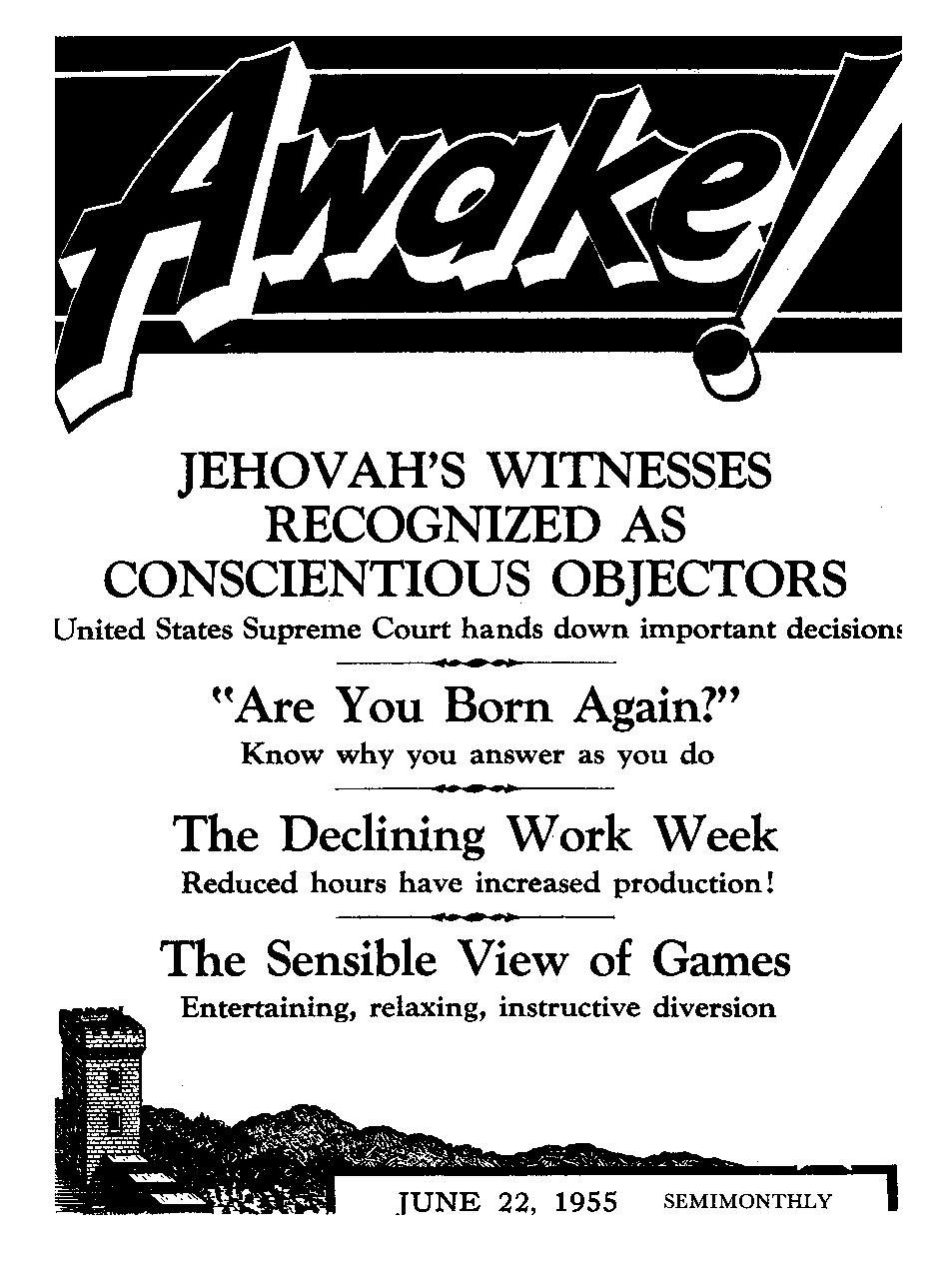
JUNE 22, 1955 SEMIMONTHLY
THE MISSION OF THIS JOURNAL
News sources that are able to keep you awake to the vital issues of our times must be unfettered by censorship and » elfish Interests. “Awakei” has no fetters. It recognizes facts, faces facts, is free to publish facts. It is not bound by political ambitions or obligations; it Is unhampered by advertisers whose toes must not be trodden on; it is unprejudiced by traditional creeds. This Journal keeps Itself free that it may speak freely to you. But it does not abuse its freedom. It maintains integrity to truth.
"Awake I” uses the regular news channels, but is not dependent on them. Its own correspondents are on all continents, in scores of nations. From the four comers of the earth their uncensored, cn -the - scenes reports come to you through these columns. This Journal's viewpoint is not narrow, but is international. It is read in many nations, in many languages, by persons of all ages. Through Its pages many fields of knowledge pass in review—government, commerce, religion, history, geography, science, social conditions, natural wonders—why, its coverage Is as Broad as the earth and as high as the heavens.
“Awake I” pledges itself to righteous principles, to exposing hidden foes and subtle dangers, to championing freedom for all, to comforting mourners and strengthening those disheartened by the failures of a delinquent world, reflecting sure hope for the establishment of a righteous New World.
Get acquainted with “Awake!” Keep awake by reading “Awake;”
rt SLISHED SCMIHOKnn.T Hr
WATCHTOWER BIBLE AN® TRACT SOCIETY. INC.
117 Adam# Street Braoklja 1. N. Y., U.S.A.
J.', II. n.'JOkn, Giiast Scum, fccrela-v
>*riM1no IHUt: 1,46C.000
Elva casta a copy
tiHoai*** la vhlek Ikli nuoirlw I< yWI.M*. HeClmetrN; Afritmet, Flnrriti . FnT.'ti.
(kmr, HpIIumIhIi. XurJtfcij
— l>thLv\ Gratis.
OT.-k itarijf A’Umprirt; rule
Affintft, 0,4., ’ 1 r s*.. B"k0;Vi! i, X Y. fl A«$1rtfh. <1 BejYttird to , S’>.w. J?/.
Cut Ma, 4<! Irvin Are . Tcfcntj' b, U’.'rii I: EM It Rd, H Crmii Terrien. IzrCri, W 2 '/ Mm ZealaM. G P 0 B'x P. Wdll^ftca. C ? 7/-
Alita, Private Bat, Kandifi.ri>Jp. Tri ;y.
Rmltttom vnf 1« cJfce la pmr oh*
ijj it torip'itrct! with rtiMladCM tn cubtro* -»f* |<x crj *f Jt-nS?tan:c* mt at
Br.vkM fr>tn where r.o v.Tkt is
by InterM'Wa: r<rej «rder ivly th&wfclb
In ■uffe-mt totmirH nrr here 6tati*i in l>*ai ftvrerey itallii of ispbotiri ivritt blink L« •'tv nt irivt ian laws befcre autvrrtnta et
Umh of veal ft xr <<J<
■tv be ci period ctTocUvc otic v^nth herd jr*1 I'M rd' an ii*Ti
KiilrH a;; fzrond clMn Mutter 4| Bnrtdim NY. Ac >>f Hatch 3 rrivirt Im V R a
CONTENTS
Jehovah’s Witnesses Recognized
as Conscientious Objectors
"Are You Born Again?’’
Do Mosquitoes Like You?
Quetta Quakes
The Declinir.g Work Week
Less Hours, More Work. G neater Output 15 And He Lived!
Seeing Germany
Specialties of Austria
Jaywalker Gets Kick in Pants
The Sensible View of Gaines
Games and the Bible
Wh o De vi a ted ?
‘Your Word Is Truth"
Tae Trinity Myth
Jehovah's Witnesses Preach in All
the Earth Canada
Do You Know?
Watching the World
Jehovah’s Witnesses Recognized as Conscientious Objectors
United States Supreme Court rates that they are such under the Selective Service laws
ON March 14 of this year the Supreme Court of the United States handed down decisions on four cases involving Jehovah’s witnesses. All four cases concerned the status of Jehovah’s witnesses under the Selective Service Regulations pertaining to mili tary service. Three of the cases were decided in favor of the witnesses, one decision was adverse. The classification of conscientious objector was the issue in each of the cases.
Hayden C. Covington argued before the court on behalf of Jehovah’s witnesses. He is the legal counsel for the Watch Tower Society, the legal agency that acts for Jehovah’s witnesses. For the government different attorneys from the department of justice handled the cases. Oral argument was presented to the Court on February 1 and 2, 1955. The principal points at issue and the high lights of the Court’s decision in each of the cases are presented in the fallowing summaries.
7'fte Sicurella Cane
Anthony Sicurella has been identified with Jehovah’s witnesses since he was six years old. Ordained when seventeen, he has served as a minister of this religious group for many years. But the draft board rejected his claim as a conscientious objector and classified him 1-A, subject to induction in the armed forces. He appealed. He was investigated by the Federal Bureau of Investigation, and its report was favorable to Sicurella. The, hearing officer of the Department of Justice found him sincere and recommended that he be given the conscientious objector classification, but the department ignored this and advised the appeal board to deny his claim because he “failed to establish that he is opposed to war in any form,” since he believes in selfdefense and the defense of his brothers and the ministry. The appeal board, followed, the advice of the department and denied the classification; Sicurella was called up for induction and, when he refused to enter the army, the case went, to court, eventually reaching the Supreme Court.
Since it is admitted that Sicurella is associated with a religion ’hat holds conscientious objection to participating in the wars of the nations, that he sincerely shares these beliefs, and that they are based upon the Bible and his belief in a Supreme Being, there is no basis in fact for the denial of the conscientious objector claim, and for the boards to deny it was arbitrary, capricious and contrary to the law. Nor is his claim properly invalidated by his belief in self-defense. That is something quite different from participation in wars among nations.
These points were threshed out in the lower courts, but when the case reached the Supreme Court the Department of Justice injected an entirely new issue into the case, speculating that the claim was denied because Jehovah’s witnesses believe in theocratic war, and hence they are not opposed to war in any form. By theocratic war the witnesses mean the wars that Israel long ago fought at Jehovah’s direction, or wars that Jehovah’s invisible hosts fight, such as the impending war of Armageddon. Covington hit this maneuver hard in his reply brief and in oral argument before the court, and actually the door was opened to give a broad and sweeping witness concerning Jehovah and Christ and the impending battle of Armageddon. The government tried to show that if Sicurella and the witnesses were in favor of theocratic or God-commanded wars they might conceivably favor some of the wars among the nations, and suggested as examples the Crusades. But certainly Jehovah’s witnesses do not view such cruel and barbaric massacres by false religionists as God-directed; rather they were Satan-inspired. No theocratic wars have been fought since Israel’s time centuries before Christ, nor will be again until Armageddon, and in this impending cataclysm Jehovah’s visible servants on earth will not physically fight. So the government’s arguments were founded on speculation and imagination.
The high court was not drawn off into such mental meanderings. Its decision, written by Justice Clark and joined in by Chief Justice Warren and Justices Black, Douglas, Frankfurter and Burton, stated: “Throughout his selective service form, petitioner emphasized that the weapons of his warfare were spiritual, not Carnal. He asserted that he was a soldier in the Army of Jesus Christ and that ‘the war weapons of the soldier of Jesus Christ are not carnal.’ With reference to the defense of his ministry, his brethren and Kingdom interests, he asserted that ‘we do not arm ourselves or carry carnal weapons. ... I do not use weapons of warfare in defense . . . of Kingdom interests . . .’ In letters to the local Board he reiterated these beliefs. On their face, these statements make it clear that petitioner’s defense of ‘Kingdom interests’ has neither the bark nor the bite of war as we unfortunately know it today. It is difficult for us to believe that the Congress had in mind this type of activity when it said the thrust of conscientious objection must go to ‘participation in war in any form.’ ”
But the government urged that Sicurel-la’s statements must be taken in the light of the teachings of Jehovah’s witnesses, and so they submitted articles published by the witnesses showing that they are not pacifists, inasmuch as they do not oppose theocratic wars. In this connection the Supreme Court said: “Granting that these articles picture Jehovah’s witnesses as antipacifists, extolling the ancient wars of the Israelites and ready to engage in a ‘theocratic war’ if Jehovah so commands them, and granting that the Jehovah’s witnesses will fight at Armageddon, we do not fee! this is enough. The test is not whether the registrant is opposed to all war, but whether he is opposed, on religious grounds, to participation in war. As to theocratic war, petitioner’s willingness to fight on the orders of Jehovah is tempered by the fact that so far as we know, their history records no such command since Biblical times and their theology does not appear to contemplate one in the future. And although the Jehovah’s witnesses may fight in the Armageddon, we are not able to stretch our imagination to the point of believing that the yardstick of the Congress includes within its measure such spiritual wars between the powers of good and evil where the Jehovah’s witnesses, if they participate, will do so without carnal weapons. We believe that Congress had in mind real shooting wars when it referred to participation in war in any form—actual military conflicts between nations of the earth in our time—wars with bombs and bullets, tanks, planes and rockets. We believe the reasoning of the Government in denying petitioner’s claim is so far removed from any possible congressional intent that it is erroneous as a matter of law.”
So the Supreme Court reversed the court below that had found Sicurella guilty. This is a sweeping decision. It means that, not just Sicurella, but everyone that sincerely holds the beliefs of Jehovah’s witnesses is a conscientious objector under the Selective Service law. But they must prove and demonstrate their sincerity by knowing the teachings and preaching them and living up to them.
The Gonzales Case
Joe Gonzales was reared in the Catholic faith, but severed connections with it at least by 1948, when he married one of Jehovah’s witnesses. In 1949 he became active as one of Jehovah’s witnesses, and was ordained in February of 1950, one month after he registered under the selective service laws. Later that year he became a pioneer or full-time minister, doing his ministerial work during the day and working forty hours a week on a night shift at a steel plant. All this time he
was in a deferred classification because of dependents, though he had also filed his claims as a minister and a conscientious objector. Then in 1952 he was reclassified 1-A. His appeals brought no correction. The hearing officer noted that his sincerity was not questioned, and said he was a sincere witness for Jehovah and as such was a conscientious objector. Yet he recommended denial of this claim, and the Department of Justice recommended denial of it to the appeal board, doubting his sincerity because he “became a member of the Jehovah’s witness sect one month after his Selective Service System registration.”
In oral argument before the Supreme Court Covington hit hard the government’s contention that Gonzales was not a sincere conscientious objector because he was a new convert. Actually, Gonzales was an active minister, though unordained, months before registration, and after registration and classification in a deferred status, when he was in no danger of induction, he became ordained and a full-time pioneer minister, so sincere that he devoted a hundred hours a month to actual preaching, and this in addition to holding down a forty-hour-a-week job in a steel plant. Then about two years later he is changed to 1-A, and the Department of Justice advises the appeal board that the man is too new a convert to be sincere and his claims should be denied for this reason. But that is not the worst of it. Gonzales was not informed of this completely new objection to his claim and as a result was unable to reply to the charge of insincerity, a charge never raised by the local board, who never questioned his sincerity at all. Yet the appeal board, on advice of the Department of Justice, tried him behind his back on the charge of insincerity and convicted him. This unfair and unjust action was vigorously attacked by Covington before the Supreme Court.
And the justices took issue with the government attorney on this point. Chief Justice Warren wanted to know if the newness of a convert precluded sincerity. When government counsel said Gonzales was slow starting his preaching activity, one of the justices asked what the usual speed of conversion was, and he could not say, showing he had no criterion to go on in judging Gonzales too slow in changing from Catholic to one of Jehovah’s witnesses. When one becomes a Catholic convert he is not immediately ordained a priest, is he? And if Gonzales was only trying to dodge the draft in claiming to be a conscientious objector, why change to an unpopular minority religion like Jehovah’s witnesses, where prejudice would act against him? Would it not be more logical to remain with the powerful and influential Catholic organization and claim conscientious objection? Individual Catholics can do this, and without battling the prejudice that confronts Jehovah’s witnesses. The government tried to argue that Gonzales could have the local board reopen his case after the appeal board’s rejection of his claim, and then he could argue the new charge of insincerity. But the Supreme Court, in its decision in favor of Gonzales, ruled: “We believe these remedies to be too little too late.” And in condemning the failure to give Gonzales a copy of the Department of Justice’s recommendation to the appeal board, the majority decision,' written by Justice Clark and concurred in by Chief
Justice Warren and Justices Douglas, Black and Frankfurter, said:
“The facts here underscore this necessity. The Department in its recommendation emphasizes that the petitioner was of a Catholic family and concluded that petitioner’s ‘affiliation with [Jehovah’s witnesses] has been too recent and too closely related to his draft status to warrant the acceptance of his conscientious objector position as genuine. The fact that registrant became a member of the Jehovah’s witnesses sect one month after his . . . registration . . , lends weight to this conclusion.’ But petitioner contends he was a member of the Witnesses before he registered, and there is testimony that he had not been of the Catholic belief since 1948. Nor was this facet of the case explored at the Department of Justice hearing. If petitioner had been afforded a copy of the recommendation, he might have successfully contradicted the basis of the Department’s conclusion or diminished the forcefulness of its thrust. The record also discloses that the local Board apparently placed little emphasis on the lateness of petitioner’s conversion, inquiring instead about the tenets of the sect and petitioner’s employment in the steel plant. On agpeal, it was logical for petitioner to direct his attention to these matters. But the Department of Justice based its rejection of his claim on the proximity of petitioner’s conversion to his registration for the draft, a contention of which he had no knowledge and no opportunity to meet. The petitioner was entitled to know the thrust of the Department’s recommendation so he could muster his facts and arguments to meet its contentions.”
The Simmons Case
When Robert Simmons registered he was not one of Jehovah’s witnesses and was given 1-A. This was in 1948. He later married and was given a dependency deferment, which ended in October, 1951, when he was again put in 1-A. But in 1949 he began studying with Jehovah's witnesses, in 1950 he became an active preacher, and in October of 1951 he was ordained. Hence he put in his claims as a minister and a conscientious objector. Both claims were denied and appeal brought no relief. The denial of the conscientious objector claim was arbitrary and capricious, because the claim was properly made in good faith and was based upon belief in the Supreme Being. No evidence in the file disputed these essentials. But the main issue in the case is the fact that when before the hearing officer he was denied a fair summary of the unfavorable evidence in the FBI file on him.
The file contained reports that before his conversion he had been "a rather heavy drinker and crap shooter in and around local taverns and pool halls,” and there were claims that he was a wife-beater. None of this was at issue as far as Simmons knew. At the hearing he was asked whether he still hung around pool halls, and answered no and asked what other unfavorable evidence was in the FBI file. The hearing officer evaded, and merely asked his wife how he was treating her, and she answered, “Fine.” Actually, it is a testimony to Simmons’ sincerity that he abandoned such conduct since his conversion, and the hearing officer acknowledged his sincerity. In argument before the Supreme Court, Covington showed this and also attacked the unfairness of not revealing to Simmons the charges against him in the FBI report so that he could defend himself against them, some of which were based only on hearsay. Also with much animation and force he showed how ridiculous it was for the trial court to quash a subpoena for producing the FBI report in court so the Judge could tell whether a fair resume had been given by the hearing officer's vague queries and hints. A fair resume of unfavorable evidence is required for the registrant, but if the file that is summarized is not examined how can anyone know the resume is fair? It is about as ridiculous as trying to judge whether a book review is fair without reading the book, Covington declared.
The government attorney said Simmons failed to qualify as a conscientious objector because his conversion came too near pressure from the draft and also because he beat his wife. Yet his conversion began three years before his reclassification in 1-A, and there is no evidence of wifebeating since his conversion. He changed for the better. There was no evidence proving insincerity, and no charge of insincerity by the local board or the hearing officer. And one of the Supreme Court justices remarked that wife-beating was irrelevant to the issue of conscientious objection.
On the key issue of providing a fair resume, the Court’s decision in favor of Simmons (again written by Justice Clark and joined in by Chief Justice Warren and Justices Douglas, Black, Frankfurter and Burton) stated: “That petitioner never received a fair resume of the unfavorable evidence gleaned by the FBI seems hardly arguable on this record. As to his alleged gambling and drinking, the hearing officer merely told petitioner that he was reported to have been hanging around pool rooms. And as to the reported incidents of violence and abuse toward his wife, the hearing officer, in an apparent aside, advanced only the general query to petitioner’s wife, asking her how petitioner was treating her now. A fair resume is one which will permit the registrant to defend against the adverse evidence—to explain it, rebut it, or otherwise detract from its damaging force. The
remarks of the hearing officer at most amounted to vague hints, and these apparently failed to alert petitioner to the dangers ahead. Certainly they afforded him no fair notice of the adverse charges in the report. The Congress, in providing for a hearing, did not intend for it to be conducted on the level of a game of blindman’s buff. The summary was inadequate and the hearing in the Department was therefore lacking in basic fairness.” Since the case was decided on this point, it was unnecessary, the Court said, to rule on the issue of producing the FBI file in trial court for the judge to examine to determine whether a fair summary of adverse evidence had been given the registrant.
The Witmer Case
Philip Witmer was reared by parents who are Jehovah’s witnesses. When eleven years old he himself began studying their publications. He holds their beliefs and conscientiously objects to participation in the wars of the nations. He publicly preaches the message of Christ’s kingdom. After registration at different times he indicated his claims as a minister and conscientious objector, and also requested deferment because of agricultural employment, indicating that in that way he would contribute to the war effort. There was no evidence in his file invalidating his conscientious objector claim, but it was denied. After his personal appearance before the local board it did not reopen his case and reclassify him, which the regulations require. The hearing officer said he was a sincere and active witness, and recommended that he be classified as a conscientious objector. But the justice department advised that the appeal board deny the claim, since he was willing to contribute to the war effort by farming, and the board followed this advice.
In oral argument before the Supreme Court Covington showed there was no basis in fact in the file for denying the conscientious objector classification, and certainly willingness to farm did not disqualify, as the government expects conscientious objectors to contribute to the war effort in various ways. Abraham Lincoln said farmers contributed in a vital way. The regulations do not rule a man is not a conscientious objector if he indirectly contributes to the war effort. The government favors that, but here they say willingness to do that destroys the man’s claim. They would have him object to participation not only in war but in farming as well! Actually, Witmer’s willingness or unwillingness on this point is irrelevant to his conscientious objector claim, as is the fact that he made other claims for exemption on other grounds. There being no basis in fact in the file for denying the conscientious objector claim should have caused a reversal of Witmer's conviction. Nevertheless, the Court majority ruled there was basis for questioning his sincerity and the conviction stood. Justices Douglas and Black dissented.
These cases got wide publicity in the national press, and the three decided in favor of Jehovah’s witnesses will influence other cases. Upward of two hundred prosecutions awaiting these decisions will be dropped by the government. Many cases pending in the Federal Circuit Courts of Appeals must be reversed by those courts and ordered dismissed because of these rulings. Already the Supreme Court itself, because of its March 14 decisions, on March 28 ordered dismissal of five other prosecutions of Jehovah’s witnesses. It has thus indicated the course for lower courts to follow to ensure Jehovah’s witnesses “equal justice under law.”
and of being '‘begotten of God.” To what do these expressions refer and regarding whom? Can one be a Christian and yet not have experienced these things? Are they indispensable to salvation?
The Bible speaks of being “born again,” “born of God,” a “new birth'
t'S'.v
WO witnesses of Jehovah were preaching from house to house in the drab Williamsburg section of Brooklyn on a Saturday afternoon last February.
At one door a well-dressed Spanish gentleman invited them in, asked them to be seated and at once asked: “Are you born again? Are you born again?” While the spokesman for the two readily answered yes to the question, usually a witness of Jehovah tactfully counters by asking a question himself (even as Jesus did on occasion), such as, “Just what do you understand by being born again?” Or he may proceed to explain to the householder that he is a dedicated Christian minister who has received God’s holy spirit and that one could be such a Christian minister and yet not be born again.
That one could be a dedicated Christian and yet not be born again runs counter not only to the position held by the smaller sects who make an issue out of being born again, but also to the view generally held in Christendom. According to most Bible commentaries, such as the Interpreter’s Bible, being born again is synonymous with being a sincere Christian. Who are born again? How? And why? How can one tell whether he is born again or not?
As a human creature Christ Jesus was first born of Mary and laid in a manger at Bethlehem. And when was he born again? At the Jordan, at which time he said: “Look! I am come to do your [God’s] will,’’ giving public testimony thereto by being baptized. There God brought him forth as a spiritual Son by bestowing his holy spirit upon him, it descending in the form of a dove, and by audibly acknowledging him as his Son, even as we read: “This is my Son, the beloved, whom I have approved.”—Hebrews 10:9; Matthew 3:17, New World Trans.
At this time Jesus was given a conditional right to life as a spirit creature in the heavens, dependent upon his proving faithful under test. So for three and a half years “he learned obedience from the things he suffered.” And after his having proved himself faithful "as far as death, yes, death on a torture stake,” “God exalted him to a superior position and kindly gave him the name that is above every other name,” so that now he “is the reflection of [God’s] glory.” So Christ Jesus was the first to be born again. He was born again by God’s spirit operating upon him to give him a conditional right to life in the heavens, heavenly life being the purpose of his being born again, or its goal.—Hebrews 5:8; Philippians 2:8, 9; Hebrews 1:3, New World Trans.
However, it was Jehovah’s will, not only thus to exalt Christ Jesus, but to have a number associated with him, for him to be "the firstborn among many brothers.” Hence since Pentecost others have been born again, for “unless anyone is born again, he cannot see the kingdom of God.” —Romans 8:29; John 3:3, New World Trans.
How Born Again
Since all these are sinners, for them to be bora again they must ‘repent and turn around, something Jesus did not have to do, as he was not a sinner. But that is not enough, for by their own efforts they have no standing before God as Jesus did as a perfect man. They can, however, have such a righteous standing imputed to them by exercising faith in Jesus’ blood that was shed for them. On the basis of their exercising faith in Christ’s blood and dedicating themselves to do God’s will, God declares them righteous and brings them forth or acknowledges them as his spiritual sons with the hope of life in the heavens with Christ.—Acts 3:19; Romans 5:1.
Since this being born again is dependent upon their knowledge of God’s will and purpose toward them as revealed in his Word, and upon the action of God’s spirit upon them,- it is said that these are “born from water and spirit,” the water being a symbol of God’s Word. (John 3:5, 6, New World Trans.; Ephesians 5:26) That the literal water of baptism is not the thing that marks one’s being born again is apparent from Cornelius’ experience. He received God’s holy spirit, thereby being born again as a spiritual son of God, before he was baptized.—Acts, chapter 10.
Being born again brings with it many responsibilities. It requires of one that he “bear witness to the truth” even as Jesus did. It also requires bringing forth “the fruitage of the spirit,” which “is love, joy, peace, longsuffering, kindness, goodness, faith, mildness, self-control.” It also means the avoidance of the practice of sin.—John 18:37; Galatians 5:22, 23; 1 John 3:9, New World Trans.
The Scriptures also speak of those having been born again as “begotten of God,” as having “received a spirit of adoption as sons” and as “a new creation.” Compared with all those eventually gaining salvation these are but, as Jesus calls them, a “little flock,” just the 144,000 that the apostle John saw standing on Mount Zion with Christ Jesus, the 144,000 that were sealed from the twelve tribes of spiritual Israel. —Romans 8:15; Revelation 7:4; 14:1, 3, New World Trans.
Salvation for Others Also
Only 144,000 born again and to receive the heavenly reward? Yes. Does that mean that only so few will ever gain salvation? Not at all, for John saw not only 144,000 sealed but also “a great crowd, which no man was able to number, out of all nations and tribes and people and tongues.” These also experience salvation, for they are heard saying: “Salvation we owe to our God, who is seated on the throne, and to the Lamb.” Those born again with Christ Jesus will serve as kings, as priests, as judges and as the seed of Abraham that will bless all the families of the earth, namely, the rest of mankind who will gain salvation, including the great crowd that John saw. Yes, God’s original purpose regarding the earth and man will yet be realized. He will make earth a paradise inhabited with righteous creatures. “The earth shall be full of the knowledge of Jehovah, as the waters cover the sea,” and God “shall wipe away every tear from their eyes; and death shall be no more; neither shall there be mourning, nor crying, nor pain, any more.”—Revelation 7:9, 10, New World Trans.; Isaiah 11:9; Revelation 21:4, Am. Stan. Ver.
That is why those who are born again are described as “a certain firstfruits of his creatures,” indicating that there will also be afterfruits. And since Christ Jesus is “the firstborn among many brothers,” it follows that those faithful servants of God who preceded him would likewise not be among those born again, would not be among those whose destination is the kingdom of heaven. That is why Christ Jesus said that of all those born of women there was none greater than John the Baptist, yet “a person that is a lesser one in the kingdom of the heavens is greater than he is/’ However, all such faithful ones who preceded Christ will not be without their reward, for they will be made “princes in all the earth/’—James 1: IS; Romans 8:29; Matthew 11:11, New World Trans.; Psalm 45:16.
From the fulfillment of such Bible prophecies as those found at Matthew chapter 24, 2 Timothy 3:1-5 and Revelation 11:15-18 we can see that we are living at the “end of the world,” the end of this old wicked system of things, and the beginning of the new system of things or new world. That is why a great crowd has made its appearance now—persons who will survive the destruction of this old world at Armageddon to enter a world of “new heavens and a new earth” in which “righteousness is to dwell,” even as Noah and his family survived the destruction of the antediluvian world to enter a cleansed earth. Into that new earth will come not only the “great crowd” tut also their offspring together with those resurrected from the “memorial tombs,” first and chief of which will be the faithful men of old beginning with Abel and reaching down to John the Baptist.—2 Peter 3:13; Hebrews, chapter 11, New World Trans.
Regarding Jesus, John the Baptist said: “That one must go on increasing, but I must go on decreasing.” Today the number still on earth who have been born again is decreasing while the number of those having earthly hopes is increasing. According to the 1955 Yearbook of Jehovah's Witnesses, there are about 580,498 dedicated Christian ministers of Jehovah but only 17,884 who profess to be of the number born again.—John 3:30, New World Trans.
In the light of all the foregoing, how would you answer if asked, ‘Are you born again?”
JZUte lfou?
Ti? With the advent of summer, along come hordes of mosquitoes. When you go out on a picnic you may notice that mosquites seem to single you out for repeated attacks whereas your friends may appear relatively immune. "How can this be?” you think to yourself. You wonder whether mosquitoes are partial, whether they prefer the flavor of one person’s blood above another’s. This is the way it is: The mosquito settles down to work on the human epidermis. In about two seconds of drilling she has achieved a breakthrough. But since the mosquito cannot reach the veins where blood runs in appetizing quantity, she injects from her salivary glands an irritant that causes blood to rush ,to the scene: then the mosquito goes into reverse and siphons out the blood, drinking her fill. Now not everybody is allergic to this Irritant- Thus Dr. William Bolton, American Medical Association director of health education, says: “Rich and poor alike, everybody gets bitten. It's just that some people don’t react the way others de to the fluid from the mosquito’s salivary glands which she injects to help her draw out blood. This fluid is what causes the itching in some people, but doesn't bother others.” So mosquitoes like not only you, they like everybody.
Quetta Quakes
By “Awoke!" correspondent in Pakistan ’
((/"VUETTA rocked again: 7 killed. Heavy I y^damage to houses.” So read the head- , lines of the Pakistan daily newspaper, Dawn, February 20, 1955. |
To the inhabitants of Quetta this quake called to mind the disastrous earthquake of I May 31, 1935, which quake leveled Quetta in । the early hours of the morning, causing an ' estimated 40,000 persons to lose their lives | and a city to disappear overnight. Now, after twenty years, Quetta and surrounding villages 1 had again been rocked by an earthquake of । almost like intensity.
As if to sound a preliminary warning, the I slumbering city was rudely awakened by a severe tremor at six in the morning on Feb- I ruary 12. Lasting about a minute, this shock , dragged thousands out of bed in a mad scramble to the open places. Described as the worst । in a decade, ten more tremors were felt within fifteen minutes. Note the eyewitness account: | wr “You are rudely awakened on February 19 al 3:48 a.m., by a low, deep rumbling sound I that increases to a mighty roar. Can it be thunder? No, for it is right beneath you. * Can It be—yes, it is the dreaded salt alia, the earthquake! The earth is now quaking all around you—walls shake, windows rattle, । crockery, pictures and mirrors crash to the floor. I
“Your one thought is, get outside, save yourself. All is pitch black. You stumble in the I darkness, your heart pounds. Where is the door? Parents are frantically groping for ’ their children. At last the door. It opens, it , hasn't jammed, and now you are outside.
“You hear a wailing all over the city. | Screaming women and children are everywhere. Dogs are barking furiously. Small I walls crash around you and you thank God that the buildings themselves still stand. Now I that you are outside you breathe a little more freely even though the tremors still continue. You hastily dash back for a blanket, for at , 5,500 feet Quetta is cold at 4 a.m. You join others sitting around hurriedly lit fires and | talk in low tones, not knowing what may follow. I
"Daylight comes and so we take a quick tour of the city to survey the damage. Shop- I keepers In the main shopping area are busy cleaning up the debris. Work in the main has come to a standstill. Hotels, caf£s and restaurants are heavy losers. Now we enter the bazaar area. Here some houses made of sunbaked mud have collapsed completely. Everywhere are groups of people telling of their miraculous escapes provided by a kind Providence. Allah's name is constantly being invoked and a call goes out to the faithful to assemble and plead with Allah to spare them from further anguish. And wherever you look tents are being erected.”
<[ According to later reports “several villages in the neighborhood of Quetta had been wiped out.” “Relief work by government and other public organizations was immediately undertaken and food was distributed among the poor. Patients in hospitals were taken out of their wards. Outgoing trains were packed with panic-stricken people.” "Prime Minister Mohammed Ali has appealed to the generous public to render assistance to the victims of the recent earthquake in Quetta.” “About twenty-five per cent of the mud houses collapsed in the villages around Quetta. The remaining ones are now absolutely unfit for residential purposes.”
< Many marveled at the small loss of life. This was due, however, to the fact that after the quake of 1935 only buildings of approved earthquake-proof design were allowed to be built. According to a geologist the intensity of this earthquake was severe, eight on the earthquake scale, the one of 1935, nine, the highest intensity being ten, indicating complete destruction.
41, As to the cause of the quake geologists “are of the opinion that the recent tremors around Quetta were caused by stress in the earth’s crust and not by volcanic pressure. The experts said that there were frequent movements in the earth’s crust around Quetta. The shocks were felt when a fault in the rocks gave way resulting in a powerful impact.”
<£ To those understanding Jehovah’s purposes as revealed In his Word, earthquakes, such as this one in Quetta, are but one of the features of the "sign" of Christ’s second presence and the consummation of this wicked system of things, even as foretold by Jesus nineteen centuries ago.—See Matthew 24; Mark 13; Luke 21.
lUR
fl®
??rpHERE is no substitute for hard 1 work,” said Thomas A. Edison.
“Genius,” he said, “is one per cent inspiration and ninety-nine perspiration.” Ready to agree with him is steelmaster Charles M. Schwab, who declared: “Hard work-is the best investment a man can make.” American poet and essayist Emerson spoke out similarly: “The sum of wisdom is that the time is never lost that is devoted to work.” And hard work devoted to the service of the Creator is certainly never
lost. The apostle Paul assures us, saying Always have “plenty to do in the work of the Lord, knowing that your labor is not in vain in connection with the Lord.” “For God is not unrighteous so as to forget your work and the love you showed for his name.” So, hard work still has some high and lofty worthwhile recommendations.
—-1 Corinthians 15:58; Hebrews 6:10, New World Trans.
Work is a friend, not an enemy. Clock watchers, who fear work or doing too much work, seldom work hard enough or long enough. They miss the joy there is in an exhilarating exercise. They labor for the love of money and not for the love of working. Their days usually drag, their work suffers, and they are not really happy. Most of them, in fact, are found to be quite miserable, last to start and first to quit work.
42-HOU wf*S«iW
I?!®!
They do not fMcst^ftihind accepting pay ^m^tor work they have not iWlone. They cannot see that
W^Wj^*' .~this is dishonest. It is taking frppife. money that does not belong to "them. Unfortunately there are as yet no legal ways to punish a “time thief.” He must continue in own misery or rise above it by
^^.making a friend out of work.
To work is to live, and to live is to work. “If anyone does not want to work, neither let him ; eat,” said Paul. To shun ■ . work as a loathsome dis-*
ease is to be ignorant of
#<*{•
its many virtues. A recent survey threw light on an already well - established fact: that man must work if PA he is to be sane-
ty happy. The studyrevealed the status of a group of reiwed^etr, who were without financial troubles, and who could travel and live in-depcndently. of their relatives and friends.
These men found that after just a few months of leisure their lives were entirely blank and empty. “I get1 up in the morning and I have nowhere to go, nothing to do,” said one. Another wrote to an employment agency: “More than anything I want a job, anything, just give me something to do.” Others had mental breakdowns. None were altogether contented with their retired state.—2 Thessalonians 3:10, New World Trans.
History of Hours and Rules
The prevalent division between hours of work and hours of play, vacations and retirement, was virtually unknown through-
out the long ages of prefactory history. Anthropologist Melville Herskovits says in support: “The notion of a vacation is unique to our society—that is, the distinction we draw between the expenditure of time and effort in painful activity—‘work’—and that which goes into pleasurable activity, or 'non-work? ” Inventions such as the conveyor belt, production line, the time clock, which have greatly increased the work strain, have in no small degree been responsible for the present division of work hours and play.
The question of “how many hours to work” became urgent in the early factories some 150 years ago, when machines began to set the working tempo. Even as far back as 1562 working conditions were minutely regulated by Jaw. Workers were hired by the year. In fact, the present agitation for an annual wage harks back to the English law of some three hundred and eighty years ago.
However, the years immediately preceding the “industrial revolution” that brought the change-over from home to factory work, from manual to machine labor, were years that gave rise to long hours and hard work. Low wages forced women and children into factories, where they sacrificed more than two thirds of their lives trying to make ends meet. Employers assaulted labor cruelly. Typical of the labor legislation of that time was a law passed in Great Britain in the first decade of the nineteenth century that limited factory working hours of children under nine years to 12 hours a day! William Pitt, prime minister of England, proposed in his Poor Law Bill that children should start work at the age of five. In factories and in mines children worked from 14 to 18 hours a day! Often they slept in the factories or fell asleep beside the machines during working hours. When law provided for a twelve-hour day or a sixty-nine-hour work week, industrialists raised a howl that sounded as if the doom of English industries had come.
In the United States the birth of labor unionism was during an era that marked the decline of labor conditions. The year 1789 saw the forming of the first trade union in the United States, and 1791, the first strike, that of some carpenters who struck for shorter hours and against a reduction of wages. They were not complaining about the 40-hour work week of today. In the beginning of the 1880’s, bakers devoted as many as 112 hours to their trade a week; sewing-machine operators, 93 hours; carpenters and joiners, 72 hours; conductors of street railway, as high as 102 hours; some workers at pig-iron blast furnaces, 84 hours, etc.
Ten years later the situation was considered greatly improved. Missouri still had an 84-hour week for bakers; in Maine there was still a 72-hour week for electricians; for stationary firemen, Wisconsin still had the 14-hour day; dressmakers still worked 70 hours in Illinois; sewing machine operators, 84 hours in Missouri; for keepers in blast furnaces, the 84-hour week was customary in the whole of the United States; iron molders worked 84 hours in Alabama; and coal miners 72 hours in Virginia; pressmen worked 84 hours in North Carolina; railroad brakemen worked 79 hours in Indiana; freight conductors, 84 hours in Maryland; locomotive engineers, 81 hours in Michigan; locomotive firemen, 75 hours in Indiana and Colorado.
Investigating Labor Conditions
Labor pressed for better working conditions. In 1845 the first official investigation of labor conditions was made by a special committee of the Massachusetts legislature. One report showed where, “in the summer season, the work commenced at
5 o’clock A.M., and continued till 7 o’clock P.M., with half an hour lor breakfast and three-quarters of an hour for dinner.” At the Eagle Mills, Griswold, Connecticut, 15 hours was the daily working time. At Paterson, New Jersey, women and children went to work at 4:30 a.m.t and did not quit till 7 p.m. Workers were fined for being found dirty at work or when found washing themselves in the factory. The fine was about half their daily wage. If a worker in a spinning factory became ill and could not find a satisfactory substitute for the day, he often had to pay for the steam that was “unnecessary produced,” which might be as much as half his weekly earnings. Workers were compelled to buy from company-controlled stores at prices far above normal. If they rebelled against this practice they were severely punished.
Work rules were cruel and exacting. The following rules were posted on the wall of a Massachusetts’ factory: “The mill will be put into operation ten minutes before sunrise at all seasons of the year. The gate will be shut ten minutes after sunset. It will be required that every person employed for no certain length of time will be required to give at least four weeks’ notice of intention to leave (sickness, etc.) or forfeit four weeks’ pay. [How anyone could give four weeks’ advance notice of possible sickness challenges intelligence.] Anyone who by negligence or misconduct causes damage to the machinery, or impedes the progress of the work, will be liable to make good the damage for same. Anything tending to impede the progress of manufacturing in working hours, such as unnecessary conversation, reading, eating fruit, etc., must be avoided. . . —[Signed] Amasa Whitney, Winchendon, Massachusetts, July 5, 1830.
It was primarily these conditions that caused unionism to flourish. Workers everywhere began to group together in a concerted effort to better working conditions and lower the hours, The progress of their endeavor is reported to us by Shlakman, who, according to Jaffe Stewart, shows the decline in hours from the beginning of the nineteenth century to the present day. Women worked from 70 to 80 hours a week in the early part of the century. Then at the time of the Civil War the average length of the work week in nonagriculture dropped to 60 and 70 hours. It was lowered again in 1909; the work week in manufacturing industries was some 51 hours. This figure fell rather consistently to 42 hours in 1930; under the influence of the depression a low point of some 35 hours a week was reached in 1934. The present United States Fair Labor Standards Act sets 40 hours as the length of the work week to be paid for at regular rates; time and a half is required to be paid for any hours in excess of 40. Thus in a century and a half the hours of work a week have actually been cut in half.
Less Hours, More Work, Greater Output
At the turn of the last century it was believed that the more hours one worked the greater would be the output. Ernest Abbe in Germany made the first scientific analysis of hours and output and found that “it wasn’t so.” After a certain number of hours, fatigue poisons forced output down, while spoilage and accident rates went up. According to Stuart Chase, Abbe “concluded that 75 per cent of all German factory workers would produce more if they worked fess. In terms of energy and attention they would of course work harder.” Chase says that these initial studies "were abundantly confirmed in World War I, when it was found that women in British munition factories could turn out more shells in eight hours than in ten. A whole new concept of the effects of fatigue on output began to invade industry, and further reduce hours.
Scientific management thus joined tradeunion pressure, and legislature reform, in shortening the work week.”
Workers Have Feelings
The classic studies of Mayo and Roethlisberger of the Harvard Business School, in the Hawthorne plant of Western Electric, said Chase, showed that “output was strongly influenced by the feelings of the worker about the job.” A test group of workers*‘‘responded more to the sense of feeling important, than to changes in hours, wages, rest pauses or other working conditions. When they felt that they were being consulted, and were no longer cogs in a vast impersonal pecuniary machine, their output soared!” The survey conducted by the Institute of Human Relations at Yale disclosed that “90 per cent of the workers in the automobile plant analyzed disliked their job, but hung on because of the high pay and security.” Many assembly line workers responded with appreciation when given rotating jobs, which made work more bearable. So management is slowly beginning to recognize that, while man is a “biological machine” designed for work, he nevertheless has feelings that must be reckoned with; that “dead weight production is no longer the goal in mechanized societies, but rather a balance, where the worker performs his duties both in the factory” and at home and in the community.
No one will deny that labor unions have greatly contributed toward better working conditions. Wages have increased, hours have decreased and labor conditions are by far more tolerable. Yet unions are not without fault. While they have been a blessing in some respects, gaining for man greater rights and freedoms, yet they have also been a curse to him by restricting the field of opportunities. Through the closed shop “caste system” arrangement employment is limited, in many fields of industry, to just a few within the caste, making it virtually impossible for youth to gain employment in these places. While seniority rights shield the aged, they expose the rising generation to bitter resentment against a system that does not provide opportunities for the full expression of his abilities, but confines him to a seniority system that moves at a snail’s pace.
So labor unions are not without spot. They have their faults. Corruption in them matches that found in politics, if such is possible. And what man really needs, labor unions cannot provide him. For regardless of their power they cannot stop wars, eliminate crime, disease or death. To attain these goals—a world free of corruption— man must work the works of God. It is His kingdom that guarantees perfect working conditions for all. “Thou openest thine hand, and satisfiest the desire of every living thing.”—Psalm 145:16.
In Bradford, England, last March 5, an eighteen-year-old steeplejack was working atop a seventy-flve-foot factory chimney when falling stonework smashed the scaffolding and sent him hurtling toward the ground. The fall did not kill him, hut he landed stunned in a water tank forty feet below. He did not drown because the falling stonework punctured the tank and allowed the water to drain away. However, firemen arrived just in time to pull him out of the tank before he was killed by the gas that swirled up after the falling stonework also damaged a gas main. Young Harrison’s injuries from his three close calls with death? Shock and three small cuts.
By A*i J" ccrratpondant Jn Ga rm any
WHAT visions the mention of Germany brings to mind! A child thinks of robber knights and defiant-looking castles. An art lover thinks of the birthplaces of old well-known works and their famous masters, of renowned concert halls, of operas, operettas and the music of Beethoven and Mozart. A historian thinks of Charlemagne and the “Holy Roman Empire,” of Martin Luther nailing his theses on the door of the Wittenberg church and of the Diet at Worms where he was forced to answer his charges. A historian also pictures John Huss being sentenced to death and burned at the stake. He thinks of the Thirty Years’ War, and certainly of the first and second world wars and of the even more recent division of Germany and the erection of the iron curtain across this land.
The scenery? It is just as colorful and full of variety as the history is. Between the Baltic Sea on the north and the 9,000-foot peaks of the Bavarian Alps are sand dunes, moors, islands, meadows, small mountain ranges, rivers, inland lakes and famed forests. Truly this is a vacationland of great variety.
Thousands of visitors to Germany this year will be attending the international assembly of Jehovah’s witnesses to be held in Nuremberg, August 10-14. If you will be among them, then this article will tell you something about the country you will visit. However, if you cannot be there, then come along with us anyway on an imaginary trip to some of the places that you might visit.
Entering Germany from the south, you might see the Black Forest near the country’s southwestern tip. Here one railway, the so-called Black Forest railroad, winds its way through more than sixty tunnels between Offenburg and the heights of Triberg. The scenery here changes so often and so abruptly that the eye can hardly keep up with it. Car drivers through this section are especially reminded of the Black Forest Hochstrasse, or high road, that runs the entire length of this section at an altitude of approximately 2,600 feet.
Also here in the south is the lake of Constance (Bodensee), which is one of the most desirable vacation goals in all Germany. Whether you see it for the first time from the highway or from the railway, by day or by night, it will be a memorable experience. The city of Constance gained world fame through the Council of 14141418 where noted reformer John Huss was sentenced to death and burned at the stake.
Farther to the east, but still along Germany’s southern border, are spectacular alpine views. Then, running north from Fuessen is famed Romantische Strasse, or the romantic road. On it you pass through an unending variety of scenery: cities with gabled houses from the Middle Ages, castles, citadels, dreamy-looking market places, and of course 2,000-year-old Augsburg. To the east of the Romantische Strasse is Munich, a Bavarian city named for the monks who founded it during the Middle Ages. This gateway to the grandeur of the Bavarian mountains also is well worth the visitor’s time.
The Goal: Nuremberg
The first settlement at the ancient city of Nuremberg was in the middle of the eleventh century. The towers and the parts of the city walls that still stand stem from the fourteenth and fifteenth centuries. Noted painters, sculptors and the like had their homes here and art prospered. Nuremberg has often been mentioned in recent years, too, for here on the edge of town Hitler erected a monumental structure reminiscent of the insane ideas of Nero. It was to be a witness to the “thousand year” or “everlasting” Reich. A specially built railroad station made it possible to move in more than 100,000 persons daily, then to transport them away again. On the annually held party days formations of troops would march before the “Fuehrer” to receive his commands delivered from a high, stately structure that has 144 imposing pillars.
Here in April of 1939 Hitler proclaimed to the world that the “Party Day of Peace” was to take place on September 2 of that year, but by September the war was under way. Then, on September 30, 1946, as the conquering powers were pronouncing judgment upon the Nazi war criminals in this very city of Nuremberg, nine thousand real peace lovers here met in Christian assembly under the motto “Fearless Against the World Conspiracy.” These persons, Jehovah’s witnesses, whom Hitler had sworn would never leave his concentration camps alive, were at this assembly receiving a small foretaste of the blessings that have since been bestowed upon them and that are yet to come in Jehovah’s new world.
When, in 1953, Jehovah’s witnesses again met on these grounds, the attendance grew to an amazing 55,000. Their third assembly here, to be held August 10-14, will see further public witness given in defiance of the conspiracy against Jehovah God and his King, Christ Jesus. A happy throng of con-ventioners will assemble here for this summer’s most important event.
Frankfort, Mainz, Wiesbaden
From Nuremberg these conventioners will travel by train up through Wuerzburg to Frankfort on the Main. In the Middle Ages Frankfort was the place of the election of German kings, and from the sixteenth century it was the coronation site of the emperors. The National Parliament met here in the year 1848-49. Although defeated in her bid to be the nation’s capital, her favorable location has made Frankfort a leading commercial, banking and traffic center.
Frankfort is only a short distance from Mainz, a city long-famed for its mighty cathedral. But the cathedral now stands in ruins and the debris of what is left, plus the little that has been rebuilt, presents a gloomy picture of despair. Mainz was also the home of Johannes Gutenberg, whose development of printing sparked a new era of knowledge, both secular and Biblical. A museum gives interesting information about his epoch-making accomplishments.
In the same area, but north of the Rhine River, slightly elevated in the Taunus hills, lies the world-famed health resort, Wiesbaden. Here you'will find the German branch of the Watch Tower Society, where more than a hundred energetic workers provide Jehovah’s witnesses in Germany with the necessary instruments for their preaching work. Nearby you can board a river steamer at Wiesbaden-Bierbrich for a very impressive trip down the Rhine to Cologne. Here are the mountains and valleys, impressive rock cliffs and the old castles and ruins that have made this part of the river so popular in music and song.
Fulda, Ruhr, Berlin
Fulda, to the east of the section we have been visiting, reminds us of the beginnings of Catholicism in Germany. Irish and Scottish monks had been the first to make Germany part of Christendom. Yet it was St. Boniface, buried at Fulda, who is given credit “for binding the conquered land for the gospel fast and permanently to papal Rome.” The conference of German Catholic bishops annually meets here at his grave. It was this group of bishops who in August, 1940, said that “the Catholic Church in Germany is indebted to German [Nazi] troops for victorious advance and defense of the German homeland.”
North of Cologne is the Ruhr, the major industrial territory, and in northern Germany there are such cities as Bremen with its famed market place and beautiful Gothic-style city hall, Hamburg with its imposing city hall built upon eight thousand foundation stakes, and Lubeck with its Holstentor (one of the remaining city wall gates) that stems from the Middle Ages.
Separated from the rest of Western Germany is the city of Berlin. Since foreigners who have no Russian visa cannot use the ground approaches to the city, it must be approached by air. A comparatively young city, Berlin indeed has been affected by the second world war as perhaps no other city has. “Iron curtain,” “airlift” and "freedom bell” are expressions that convey definite ideas that come into mind at the mention of this former capital of Germany. Here, too, tourists get a glance behind the iron curtain from Potsdamer Platz, where East and West meet.
Yes, from the alpine heights of the south to the ports on the North Sea, there are many interesting things to see and do in Germany. But by far the most interesting and important activity this year will be the international assembly of Jehovah’s witnesses in Nuremberg, August 10-14. Here tens of thousands of German witnesses for Jehovah will play host to several thousand of their brothers from other lands.
It was just ten years ago that a few thousand of Jehovah’s witnesses were released from Hitler’s torture camps. Now there are 48,000 of such preachers of the Christian good news in Western Germany alone. These energetic witnesses for Jehovah' will consider it a thrill to be hosts to their brothers who are coming from other places to participate with them in the activity of this Christian assembly, and their visitors are eagerly looking forward to witnessing the zeal of their German brothers. Indeed, this assembly will prove an encouragement to the German hosts and an inspiring experience for their many guests. Yes, mention Germany to one of these prospective conventioners and his thoughts will immediately turn to his eager anticipation of assembling with his Christian brothers in that land and of participating with them in their Christian service. And his anticipation will be well rewarded at assembly time!
Specialties of Austria
…