Awake!, June 8, 1955
Download: PDF — Awake!, June 8, 1955
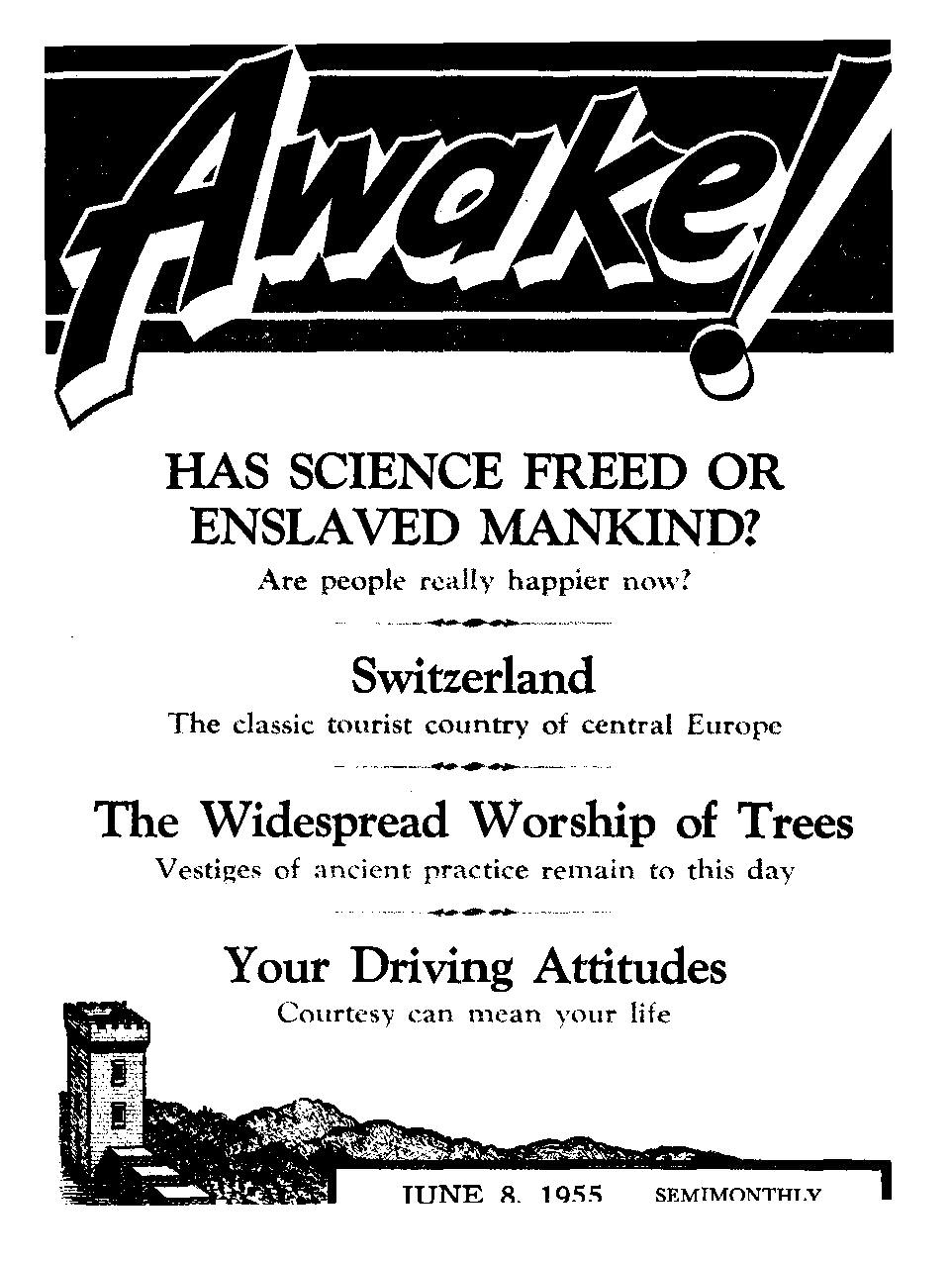
IWpn
THE MISSION OF THIS JOURNAL
New* source* that are able to keep you awake to tb» vital issues of our time* must b* unfettered by censorship and selfish Interests. "Awake!” has no fetter*. It recognize* facte, faces facts, is free to publish facts, ft Is not bound by poUtical ambitions or obligation#; if is unhampered by advertisers whose toe* muat not be trodden on; It Is unprejudiced by traditional creed*. Thi* journal keeps itself free that it may speak freely to you, But it does not abuse its freedom. It maintains integrity to truth.
"Awake 1” uses the regular news channels, but is not dependent on them. It* own correspondents are on ail continents, in scores of nation*. From the four corner* of the earth their uncensored, on-the-acenes reports come to you through these column*. This journal’s viewpoint is not narrow, but 1* international. It is read in many nations, in many languages, by person* of all age*. Through it* pages many fields of knowledge pass in review—government, commerce, religion, history, geography, science, social conditions, natural wonders—why, its coverage is as broad a* the earth and as high as the heaven*.
"Awake I" pledge* itself to righteous principles, to exposing hidden foes and subtle dangers, to championing freedom for all, to comforting mourners and strengthening those disheartened by the failures of a delinquent world, reflecting sure hope for the establishment of a righteous New World,
Get acquainted with "Awake!'' Keep awake by reading “Awake!”
PuBiittHip SKJdi wr-NTJiir By
WATCHTOWER BIBLE A MB TRACT SO C LETT, iNC
ITT Str«i 1* N. Y * D. S. A.
N. H. Kitou, Prwidenf Geaht Scitie,
Prirtt/AB fwua; 1,325,000
Lmwkm in wlilkh the warlM k aemiaauttljf—VriMtEr. fcidUh, Hrulslj, frenrh
Hbllairttah, Nor tin. Kptnvb. jHUMl'sn, MantHj - LtatW?. Pcrfunn'. L’br^Lr.lir
AN<k», •■$.. :K a^miw St., S'3r>|cin I. Pi * V-Awfeilli. 1. Ber^f»rJR4. fawthfc.d, W.S.W, Ff Gm«4l, 40 Irvin Aye. Ttronto 6. ImUrii Si EhMMM. 34 frvt* LotIchj. W - Ti (•nth AfIm, Frtnu Eu, r 0
Trtiiwj.il 7#
R«nrun«H sHuli b« Mrt tv •C5-* jw ra*»-IT to fwprance wftn 'eplMbna tv jvm-ih’.m ^<-\Tiry of E r*y ftewlUit?™ an* at
BtMkijL T:»ni c^tiiut sye rth ii '.oxtrd by tnrrr-MkttH ri u ic dl'ftrtci roviM'** are si urf fit ixaf (hrruKT M u^ritlvv fvjlhrtr*«*| -divii it Mnt j'. |r 1*1. Ivc MibacrlpliOT) ei
pi’fi. CHrH *f tMrat w«a tent 44 ** cffr* nky be etpvrtid mt air, can Reuth. ijccd your o1,i tn «•;; ar m* lAliw.
ihtnW u imcM RM^r it En*y>n. V, f r* Hjmi 3, }g7|, P*’»ttri Sr F. 5 A.
CONTENTS
Behind the Merger of the A.F.L.
and the C.I.O.
Ilas Science Freed or Enslaved Mankind? 5
The Ancients Played It First
Faff in the Swiate
Jamaica Changes Its Goverrunent
Incredible Advances in Archaeology ■ 12
Your Driving Attitudes
Refund Extraordinary
Sorrow in Sierra I.etme
No Comment on the Moral
Switzerland
T?ie Widespread Worship of Trees
Tree Worship Today
‘ Your Word Is Truth”
In What Body Did Jesus Appear?
Jehovah’s Witnesses Preach in
All the Earth—Argentina
Do You Know?
Watching the World
Behind the Merger of the A.F.L. and the C.I.O.
WHEN little Johnny punched big Billy in the nose, their friendship ended.
That blow erupted into a family feud that lasted for almost two decades. Now after twenty years both families see the need cf forgetting their differences and becoming mutual friends. Their truce became headline news. In effect, that is the story behind the split and the merger of the A.F.L. and the C.I.O.
In 1881 representatives of five national unions, representing some 45,000 members. met in Pittsburgh, Pennsylvania, to form the American Federation of Labor (A.F.L.). Their purpose in joining together was “for their mutual self-protection against unfair and abusive legislation which could not be solved at the bargaining ‘able but only in Congress.” Being rather loosely organized, the various craft unions would often be involved in bitter jurisdictional disputes.
Almost fifty years after the federation was formed, a growing number of labor leaders within the federation felt that the organization was too slow in organizing the industrial areas and that its method of organizing men according to trade or craft was not the best for that purpose. The jurisdictional question became a big issue. Two reports were presented to the labor convention. The majority report upheld craft jurisdictions-, the minority report that would have guaranteed industrial unions against raiding by craft unions was presented. A vote was taken. The minority report lost, 18,024 to 10,933. John L. Lewis, then vice-president of the A.F.L., and other labor leaders were displeased with the outcome of the vote.
According to A. H. Raskin, “the division began when John L. Lewis punched the late William L. Hutcheson of the Carpenters Union in the nose at the A.F.L. convention in Atlantic City in 1935. Behind the punch was the sense of frustration the advocates of industrial unionism within the federation harbored against the iron rule maintained by the craft union forces.” To free themselves from this "iron rule,” the advocates of industrial unionism, spearheaded by John L. Lewis, met in Washington on November 9, 1935, and set up the Committee (later Congress) of Industrial Organizations (C.I.O.). The late William Green, president of the A.F.L., accused the industrial founding unions of seeking to force acceptance of a minority vote and charged that the C.I.O. was a rival federation. Lewis tossed another blow by resigning as vice-president of the A.F.L. Green tried to heal the breach by “alternating pleas with threats.” But the wound would not heal. Finally, the council suspended the ten unions then in the C.I.O. And the feud was on! After a wave of strikes and bloody battles, the C.I.O. organized many of the
mass-production industries, establishing itself as a formidable rival federation.
Twenty Tears Later
Almost twenty years have passed since the rift began. The men most responsible for the original split have died or retired. The lone survivor is John L. Lewis, and he lives in isolation. The present leaders feel no need to keep alive the hatreds that inflamed relations twenty years ago. Besides, much more can be gained through unity. Both groups are aware that their differences have greatly diminished their effectiveness at the polls and in legislature.
Organized labor has lost its political grip of the depression years. And since 1940 it has been fighting a holding action, unable to get the changes in the Taft-Hartley labor law so much desired. Even the political tone of a Democratic Congress is not so friendly as labor would like. Labor’s once powerful voice has been reduced to a whisper in the White House. And, too, there are other reasons favoring a labor “cease fire.” Stagnation and complacency in labor ranks could be more efficiently corrected. The labor leaders concluded “better bury the hatchet than be found scalped by it."
Merger and Reaction
So with these thoughts in mind the joint A.F.L.-C.I.O. Unity Committee met to explore the possibility of achieving organic unity between the two federations. After several fruitful meetings it was the unanimous decision of the joint committee “to create a single trade union center in America through the process of merger.” On February 9, 1955, the “unity compact” or merger became a reality. Some 15 million members were welded into an integrated body, becoming the greatest single labor force this side of the “iron curtain.”
John L. Lewis, one-time big man in both organizations, received the news of the merger with a “no comment.” Senator Uster Hill, chairman of the Labor Committee, said: “It's good. It’s good for the members of the unions, good for labor-management relations, and good for the country.” But Representative Ralph W. Gwinn, a member of the House Education and Labor Committee, differed with him, saying: “I don’t believe we have any evidence to show that great concentrated power of any group, especially a political group, is good. More especially, if that group is designed to exercise monopolistic power and compulsion.” A.F.L. president, George Meany, and president select of the new united labor movement, argued back: “Our goal is just the opposite,” said Meany. “We are trying to make gains for the many. The combined membership of the A.F.L. and the C.I.O. amounts to about 15,000,000 of the country’s 62 million workers, or less than 25 per cent. Simple arithmetic shows this could not be considered a monopoly.”
At present the impact of the merger can only be conjectured. But from all indications it will certainly be greater in the field of politics and legislation than in labor-management relations.
The only discordant note sounded by a union leader amid the general applause for the merger plan came from the president of the C.L.O Transport Workers Union, Michael Quill. He called the unity plan a “surrender,” and demanded that Walter P. Reuther, president of the Congress of Industrial Organizations, “quit the presidency.” Reuther’s simple reply was: “May the Lord forgive Brother Quill, for he knows not what he doeth.”
And from the childish way the feud began and was nursed along and the present reactions to the merger by various leaders, we sometimes wonder if any of them know what they do.
FREED
nope not.
tad?
Ar. w» fr««r chin. Ag.”? Kov. our been «nhanc*d, our ml nek ,<8| med. fr.tr by th. advancement dr Or hav. w. fallen into greater b or a r.wlt of tci.nct? This article ant
GOD made man free. But Satan the Devil enslaved him. Christ freed mankind from the spiritual bondage in which it was hopelessly entrapped by becoming a ransom for mankind and by shedding light upon life and incorruption through the good news. But it was man who brought greater physical bondage upon himself by enthroning a new savior. Man bowed to knowledge and raised up science as his god.
Science set out to free mankind from physical drudgery through its many inventions; especially through its creation of the “iron monster,” the “Machine Age.” Instead of a savior, the “monster” has evolved into a cruel taskmaster, an enslaver of mankind, The many inventions of recent years have been greatly instrumental in lessening man’s appreciation of God and the boundless treasures locked up in nature. It has caused men to look to men—to science —for the answers. But what has happened to freedom? Where are the friendly villages, the independent farms and the peaceful forests of a generation ago? Have these lost their refreshing beauty and meaning? Have these become only so much cordwood, so many barrels of oil and tons of steel? Are these to be evaluated as just so many millions of automobiles, refrigerators or television sets? Has our progress been so great r see beauty in fleecy rest in the setting sun with-some materialistic value to
f the coming of spring lost its thrill; Ie* frarm summer rain its meaning? We
When Science Waved Its Wand
Not many generations ago most of North America was unexplored territory. There were no large cities, towering skyscrapers or booming industries. Men lived in a land that breathed with freedom. As far as the eye could see stretched a land without fence or sign. The woodsman moved back the forest. The plowman readied the land. Pleasant days and the harvest were his reward. A rugged individualist was the early pioneer. He loved justice and fair play. He was a friendly neighbor, never too busy to pass the time of day or to lend a helping hand. There was time for a big family and to romp with children. There was also time for prayer and thanksgiving and time to live. There were no time clocks to punch or production lines to feed. There were no ulcers to nurse or nerves to soothe. The forests were stocked with food and the lakes with fish. There was plenty of pure water to drink and fresh air to breathe.
Then along came science with its “intellectual” living standards. Where the oak and the hickory once flourished, science waved its “magic wand.” In their places have arisen concrete cities, prefabricated houses, smoking industries, superhighways, power lines, barbed-wire fences, “No Trespassing” and “Danger—Keep Out!” signs.
Desert lands, rejected by covered-wagon parries and outlaws, have been transformed into laboratories and experimental grounds. On these wastelands are banished some of the world’s top-notch physicists, mathematicians, engineers, chemists and technicians. Inside reinforced concrete walls men and women sacrifice sunlit hours, home, family, children, youth, love and skill to serve the hungry monster, the production line. In turn science promises material possessions, speed and power. Like Esau the people have sold their “birthright of freedom” for a mess of pottage. Men have become slaves to the very machine "gods” that they have built. “Do you not know that if you keep presenting yourselves to anyone as slaves to obey him, you are slaves of him because you obey him?” Modern man resents being called a slave. But what else is he? Of course, he is not the old-styled slave that was driven into action with a whip. More subtle means are applied today.—Genesis 25:33; Romans 6:16, New World Trans.
Man has need of food, clothing and shelter. To get these he must follow the iron-bound routine or be without. But man is made to believe that he is free in his pursuit. That way subjugation is not so difficult. He must still awake to an alarm, punch a clock, serve the war machine, work in mines, factories, offices and obey regulations. The self-made man of a generation ago, who worked his way up “from rags to riches,” “the carefree individualist,” “the log cabin president,” all of these are as far removed from our modern civilization as is the hydrogen bomb from the bow and arrow. These have become museum or showpieces to be placed in conspicuous places for the rising generation to see and read about. One authority declared that they are “attractions for tourists and grateful topics for speakers at a loss for ideas on patriotic occasions.”
Lost Touch with Life
The smell of the warm earth, the touch of spring, the sound of birds and the wind, the friendly handshake, the understanding of children—even the contemplation of God and the sweet meditation of His precious promises—are slowly being sacrificed on the altar of an iron god called “intellectual existence.” Bowing to this god, mankind has gained power but has lost the quality of life. He lives in cramped apartment dwellings, walks on concrete, labors under artificial light, breathes stale air and drinks polluted water.
In this strange world he flies high above the clouds over oceans, which he seldom sees, visits strange lands and continents whose contours he perceives at best as fleeting shadows on the radar screen. He works behind cement walls where he splits atoms, launches rockets and matches wits with electronic brains. His bid is to unlock the unfathomable riches of knowledge held secret by nature; and to re-create and organize a world of his own, according to his own laws of reason, foresight and efficiency. The inspired wisdom of Solomon and Moses exposed the folly of such reasoning centuries ago, in these words: God “hath made every thing beautiful in his time: also he hath set the world in their heart, so that no man can find out the work that God maketh from the beginning to the end. I know that, whatsoever God doeth, it shall be for ever: nothing can be put to it, nor any thing taken from it: and God doeth it, that men should fear before him. That which hath been is now; and that which is to be hath already been.” “The • things concealed belong to Jehovah our God, but the things revealed belong to us and to our sons to time indefinite, that we may carry out all the words of this law.” —Ecclesiastes 3:11, 14, 15; Deuteronomy 29:29, New World Trans.
The ftew-style Pioneer
The inventions of science are not for the purpose of searching out that which is revealed so that men may do all the words of God’s law. Rather, they are erected for the purpose of extolling science. The pioneer of yesterday was for the most part a Godfearing man. But today’s pioneer exercises little or no faith in God. He is the scientist, the engineer and financier exploring new frontiers in his laboratory or workshop. His mental dogma is that “no problem is unsolvable, nothing is unattainable.” The words, “It can be done,” says Robert Jungk, “are probably more firmly anchored in the soul of the inhabitant of the newest world than the principles of democracy, and more binding than the commands of religion.”
Where has his presumptuous dogma led him? Wherein has he benefited? What has been its cost? An authority answers: “Scientific man has enthroned knowledge as his idol, and turned his back on God. He has begun a ceremonial dance to which there is no end. He must learn how to travel with more speed, to build bigger machines, invent more powerful explosives, produce more goods, teach his children more facts. Each development of science demands more science to maintain it, more to improve it, more to keep in advance of its use by our potential enemies. Scientific man is driven faster and faster by his system until he has no time left, no thought left, no appreciation left for man himself. He is dependent for his security on the increasing complication of a mechanistic organization which is already too complicated for him to control. His world is full of frustration, bitterness, strikes, and war.” —Of Flight and Life, by Charles A. Lindbergh.
The Word of God has declared that such would be the bitter end of man’s doing. “From what source are there wars and from what source are there fights among you? Are they not from this source, namely, from your cravings for sensual pleasure which carry on a conflict in your members? You desire, and yet you do not have. You go on murdering and coveting, and yet you are not able to obtain. You go on fighting and waging war. You do not have because of your not asking. You do ask, and yet you do not receive, because you are asking for a wrong purpose, that you may expend it upon your cravings for sensual pleasure." Victims of their lusts and cravings, men of science drift farther away from God and deeper into slavery, thinking they are freeing themselves with their many inventions. —James 4:1-3, New World Trans.
The Lust for More
As a result of their obsessions a different world has emerged. A world in which man has been reduced to a statistic. Like a useless tool he is discarded if he does not fulfill the exact requirement. On the production sheet he is classified as an unstable element and ruled out. Never before has the human species been subjected to such systematic and searching tests as today. Every ounce of energy is exacted from him to keep apace with modern living. The cry from every comer is for new, better and more developments.
Not even the farmer' can escape the swirling whirlpool of modem living. Farms have taken on the appearance of an immense factory. The stop watch, tape measure and motion study have replaced the horse and the plow. Through man-made laws of rationalization and intensification crops are harvested three and four times a year. Artificial insemination is rushed into service, because natural methods are too slow. The new technique allows no place for emotion. Animals are treated like machines. "We look upon our cows as machines,” explains a modern dairyman. “We put raw material in the form of nourishment into the machine and take out milk and butter. With our fast tempo of production the cows are generally ‘burned out’ after two and a half years. If we’d put them to graze for ten or twelve months they’d recover, but I have calculated that periodical disuse of the cows as milk machines is unprofitable. So I prefer to send them to the slaughterhouse and use the money buying young fresh cows.”
In the heightened pace of “intellectual living” only man and nature appear to be the weaklings and “slow pokes.” Robots and automatons move ahead. To squeeze more power and production out of himself, man equips his offices with thermometers that regulate the room temperature at a level scientifically calculated to produce maximum efficiency and productivity. High-bred thinking machines set the pace. Some of these are capable of printing 24,000 letters or numbers a minute; another can write a thousand lines in sixty seconds. The modem factory is equipped with productometers, motive profiles, psychographs, skiagrams and communication charts. Have these inventions freed man from the fetters of labor? Science will agree that only the nature of the labor has changed. Man uses less muscle power, but his nerves and spirit are put under new and constant tests and strains.
Dignity of Work Lost
The work in changing its features has lost its personality and dignity. In place of the hand worker has appeared the factory laborer. The pride of workmanship and achievement has declined as efficiency of production lines increased. Highly technical equipment has increased its dependence on its human masters. The more receptive and sensitive the instrument becomes, the more it implicates its controllers. With the creating, devising and designing of technical and complicated machinery man has simply built his own web in which he has enslaved himself. It is obvious now that he does not know the way out.
A personnel chief of a large firm stated: “I had a great respect for science and hoped to accomplish something genuinely helpful to our people. But what came of it? A sniffing around and an agitation, a silly fooling with questionnaires, statistics and dozens of tests. And in return there’s not a trace of healthy human understanding left. On paper the production in our factory seems to have risen through these methods. Despite the figures, I doubt it. But even if it were so, the price we pay is too high. Our factory has become a world without walls, without respect for individuality, without regard for private life.”
Said Lindbergh: “No standard of living is high when jobs become drudgery and hours dreary, when young men and women cannot afford a family, where children are walled off by brick from sod and sky, where vast numbers of people are so encumbered with mechanistic detail that the spirit has no chance to rise.” It is not strange, then, that God should view the wisdom of this “intellectual” world as foolishness. He says that he will shove the intelligence of the intellectuals aside.—1 Corinthians 1:19, New World Trans.
The old world is geared t'o move and live fast. It has no time for God or for his incoming new world. Like a glorified, mechanical soap bubble it soars hither and yon until the battle of Armageddon bursts it into nothingness. To follow will be the new world with its abolition of sin and physical slavery. This will not come about by the inventions of men, but will be accomplished by God through his instrument, the Kingdom. Under the Kingdom arrangement mankind will resort to a normal pace and joyous living.
TAN<KNtf
Ancient Principles Make Modem Games
GAMES are older than most people realize. But have not many games, such as canasta, just been invented? True, but from early times man showed keen ingenuity in devising game principles. Those principles, coated with the luster of refinement down through the centuries, form the basis for ever-popular games of today. So when one plays a game of cards or chess or checkers or backgammon or a board game in which chance determines the length of the move, basically, he is not playing a new game. The ancients played it first.
Do you like to play board games such as backgammon or "Monopoly,” in which you throw dice to determine your move? Well, if you should visit the Metropolitan Museum of Art in New York city you would see a board game used almost 4,000 years ago. It will make you feel very close to the ancient Egyptian. This game is called “Senit” and is just one of the many board games of ancient Egypt. The board is very odern-lookmg. It even looks bettcy than some board games of today. In Senit, the Egyptian player tossed four carved wands. The way they fell, crossed or pointed, determined the moves that the player was allowed to make. Senit was played on a board of thirty squares. In play the game re-mbled modern parcheesi and backgammon. Certain key squares, as in virtually every modern-day board game, brought advantages or disadvantages to a player landing on them.
Now modern man has turned out something quite novel: a game board on which more than one kind of gaine can be played. But the ancients had it first. For example, one of the most prized possessions of ancient Egyptians was a dual-purpose game box of cedar inlaid with panels bf beautiful blue faience. This attractive box not only served as a convenient container for the implements of the game, but also had layouts or “boards” on its top and bottom. On the underside of the cedar box was the board for the game of Tshau or Robbers. (Sounds like a rather modern game!) On the topside was the square layout for Senit, Clearly, games were very popular in ancient times. This is indicated by the fact that a picture of a draughtsboard or checkerboard was one of the oldest and most common signs used in their written language. Also the games played on it -are mentioned repeatedly in their funerary and religious literature.
Dice and Chess
Dice have been used from remote antiquity. They have often been associated with gambling games. But surprisingly enough there are many dice games that are not gambling games and that permit the exercise of a great deal of skill. Dice seem to have been known by all civilizations. Even the American Indians had them, and they
were known to savage tribes of Africa. According to Plutarch dice were a very early invention in Egypt. His statement bears weight, since the Egyptians introduced dice into one of their oldest mythological fables. Archaeologists have recovered dice from Egyptian tombs. Those discovered at Thebes were marked with small circles, representing units. Made of bone or ivory, they varied slightly in size.
Chess has long been called “the game of games.” This is probably because it is a game of sheer skill and requires intense thinking. Down through the centuries the game has been associated with deep-thinking people, with kings, with royalty, with generals. Just when and where chess originated is hot known. Says the Encyclopaedia Britannica: “The origin of chess is lost in obscurity. Its invention has been variously ascribed to the Greeks, Romans, Babylonians, Scythians, Egyptians, Jews, Persians, Chinese, Hindus, Arabians, Arauscanians, Castilians, Irish and Welsh.” From time immemorial chess has been popular in India. It spread to Persia and then to Europe, whence it came to America. As far as the game itself goes it has changed little with time. A refinement was made in the sixteenth century; but, as a whole, "changes in the way in which the various chessmen move appear to have been rare.”—The New Funk da Wagndlls Encyclopedia.
Checkers, Backgammon and Billiards
Practically everyone knows checkers or draughts. It is standard recreation in fire stations. It is played by railroad men, by sailors, by schoolboys and by graybeards. Yet probably few of these players realize how old the game is. It is so old that its origin is lost. Authorities generally agree that a similar game was played by the Egyptians as early as 1600 B.C., and that a form of it was popular in ancient Greece. The book The Complete Book of Games says: "Checkers or Draughts is an ancient offspring of Chess, played in Egypt and Nubia 2000 b.c., where the circular men had a knob on them almost like chess pawns.” Many are the forms of checkers. There are such varieties as Chinese, English, Polish, Spanish, Italian and Turkish checkers.
Another popular game of great antiquity is backgammon. It is played on a special board with pieces resembling checker men and with a pair of dice for each player. Backgammon, as mentioned before, is very similar to Egyptian Senit. Attesting to the great antiquity of backgammon is the fact that virtually no changes have been made in it since the days of Rome.
It is probably no surprise now to know that billiards, a game played with ivory or hard elastic balls, has its origin lost in the mists of antiquity. It is mentioned in- the will of a second-century Irish king. It was referred to by Shakespeare, and it was the fashionable game in France during the reign of Louis XIV.
The perennial games of children also are rooted in antiquity. Those board games loved by children of all ages, in which moves are made by a spin of an arrow or a throw of the dice, take us back to Egypt. Ball games are said to have been invented by the ancient Lydians. The ancient Egyptians had boomerangs. The boys playing marbles in the schoolyard little know that their game is of great age. (Very likely golf had its fundamental idea from a kind of marble game.) The board game with the three concentric squares, called nine-men’s morris, is usually looked upon as juvenile. It received its odd name in England because of its similarity to the morris (Moorish) dances. In Germanic countries it is called the Mill. The game is very ancient, having been traced to classic Grecian times and even much earlier.
Dominoes and Piaffing Gards
Both children and adults enjoy a game of dominoes. Something new? No, for they were introduced to Europe about A.D. 1700. That does not sound extremely old. But this fact is often overlooked: dominoes are actually just a refinement of dice— dice that have been flattened out into dominoes, the face of a domino representing the two numerals faced up on a throw of two dice.
Even as dominoes are just flattened-out dice so playing cards are just the royalty and other persons in chess flattened out into cards. 'Fhe origin of playing cards is somewhat obscure. Says TAe New Funk <£ Wagnails Encyclopedia: “There is evidence that they were in use in Egypt in the time of Joseph, but they did not appear among the Jews until after the return from the Babylonian exile. . . . The Chinese dictionary, Ching-tze-tung (1678), states that they were invented for the amusement of Seun-ho*s concubines in the year 1120 A.D.” About the fifteenth century cards became popular in Europe. One historian mentions that when Cortes conquered Mexicd King Montezuma took great pleasure in watching the Spanish soldiers play cards.
Early Italian and Spanish cards, instead of modem hearts, clubs, diamonds and spades, had swords to represent the nobility, chalices for the clergy, coins for the citizens and clubs or staves for the peasantry. Among devices used on card faces were horsemen, elephants, birds, bells, flowers, tumblers and a host of other subjects. Among Anglo-Saxons court cards became popular. These were made up of 52 cards in four suits of 13 each, king, queen, jack, and 10 cards, from 10 to 1. In time a full pack was expanded to 53. The new card was the joker, a card representing the court jester, a unique person because he could assume without rebuke any role he chose. Today the joker often plays a like versatile role.
Court cards were not always the vogue in America. In 1848 cards manufactured in New York, at least a good number of them, had neither kings nor queens. President George Washington had vanquished the king of hearts. John Adams took over the king of diamonds. On clubs there was Franklin and on spades Lafayette. The queens were Venus, Fortune, Ceres and Minerva; and the jacks had become Indian chiefs.
Modern card games are merely refinements of older games. Bridge got its name in London in the 1890’s, but the game was imported from Cairo; and the gafnes that were its ancestors were played in Turkey and Russia centuries ago. Even the newfangled canasta is but a form of rummy. And rummy is but a descendant of cooncan, and cooncan, in turn, came from a Spanish game of some 200 years ago called con quienf (with whom?). So one of the originators of canasta. Segundo Santos, had to admit: “We borrowed from games that had been borrowed from other games In a long illegitimate line that probably traces back a thousand years to China.” —Coronet, February, 1953.
So the next time you sit down to an absorbing game, chances are, whatever it is, the ancients played it first.
in Senate
Tg United States senators are noted tor their foggy, long-winded speeches. Recently, Representative Burdick of North Dakota complained about this penchant of the senators, saying: "You can never tell what the subject is, for they go into minute details from building a mousetrap to building an atomic bomb, and of course they're not experts at either.”
JAMAICA CHANGES ITS GOVERNMENT
*y “Awokel" MirMpendwit I* J«makc
N January 12, 1955, the British Caribbean Island of Jamaica held Its third general ___election under universal adult suffrage. This election resulted in a change In Jamaica’s government.
<, In 1944, after seventy-nine years as an English Crown Colony, Jamaica received an advanced constitution. The former system saw power exercised more by the English-appointed governor who could veto and override decisions made by the people’s representatives elected on a limited franchise. The newly introduced system gave voting rights to al) persons over twenty-one. and passed the making of policy into the hands of an executive council.
<j That 1944 election saw two major parties In the field, the People's Naticnal party <PNP/ and the Jamaica Labour party (JLP). The latter won ty a landslide. The second election was held in 1949, and also resulted in victory" for the Labour party, but wit.i a greatly reduced majority. What would the third election bring? Everyone eagerly awaited the contest in which Cve political parties and many Independents sought control of Jamaica’s destiny for the next five years. The.ruMng party pointed to Its achievements as proof that It should be retained In power, while the PNP called attention to the high cost of living and high number* of unemployed as evidence of the need for a change. IL also high lighted the fact that two ministers ui the government had beer Jailed for corrupt practices,
41 Jamaicans have a very keen sense of po-
liIleal humor; thus they will have a funeral S service for some defeated political opponent, or a predefeated burial as proof of their con-?• viction of his sure defeat. An effigy of the *£ opponent, In a miniature coffin. Is buried with £ full funeral rites, including marching and the < singing of religious songs.
£ < Further, shortly before election day most X sf the supporters of the PNP equipped them-*j* selves with brooms and swept many streets $ clean to emphasize :helr campaign slogan:
"Sweep them out.” It was a common sight -> for cars to be equipped with three or four '> brooms on their front and rear bumpers. Such ’? activity gave a touch of humor and also a chilling of rancor to a campaign that was * filled with fervent and enthusiastic appeals, X < Both sides expressed great confidence in * victory, but what would the electorate decide?
by January 13 the answer came. The People’s X National party po.led more votes than all * their opponents combined. The Labour party was second, and aH the other candidates were X eliminated. The former government had made £ great economic and development strides, but -> the people had decided for a change.
The new administration promised to wo"k $ toward full self-government within the next -> five years, as well as to push ahead with the X plans for federation with other British West X Indian territories. Foreign investments were $ invited, and the new regime's leader says that < the emphasis for the next five years will be on industrial development. His government j ha* promised to reduce the cost of living and '£ relieve unemployment.
Incredible Advances In Archaeology
(L Dr. W. F, Albright 1* an internationally known expert In Semitic languages and archaeology. When he recently addressed an audience at the State University of Iowa he emphasized particularly what he called the *'incredible'’ advances made since 1932 In the field of Biblical archaeology. What is the significance of all xhese advances? Declared Dr. Albright: “For all practical purposes we can say the historical background and the atmosphere of the Bible agree entirely with history a* substantiated by archaeological findings.” Following Albright’s talk. Dr. F\ T.
Barebuhr, profe&scr of Jewish studies at State University of 5owa, spoke: “With Dr. Albright and other scholars of lus kind, an era of utter SKcpticism and hyper-criticism of the Bible comes to its conclusion.1'- Des Moines Sunday Register, October 31, 1954.
ATTITUDES
YOUR DRIVING
Can Mean Your Life
Courtes
A ME F\a year
their telegrams. But their discourtesy at the steering wheel costs more than a hundred violent deaths a day.
Traffic conditions may be more than average humanity can cope with in safety and pleasantness. This does not mean that accidents cannot be held to a minimum. There are people who every day win safety awards for a record of ten, twenty, even thirty years, of driving without accidents. Some of these are taxi drivers.
You question these safe drivers for the ssociation, which has 35,000 members, voted to “wipe out the hot rod evil at its sources” by selling no more “souped-up” cars or motors or services to youths?
secret of their prowess. You find it is a . matter of personal attitudes. What are good, safe driving attitudes? Have you ever,';® examined to see whether you have them?>v| For example, what is your attitude in case^jj you are a young driver? In the Uni ted H States one out of six licensed drivers is m under twenty-five years of age, but this ■ group causes one out of four bad accidents. I Are you among those inclined toward ju- I venile driving delinquency? Are you a hot- I rod enthusiast? Did you contribute to the I upswing of traffic carnage in 1953 to the I extent that the National Automobile Deal- I
Do you relish the thrill of lightning starts, two-wheel turns and screeching stops like gangsters in the movies? Or do you relax in the good, solid prosaic satisfaction of knowing that your education and training in behind-the-wheel driving make you only half as liable to become in-• vplved in traffic accidents as the teen-ager jjyho tries to be a daredevil?
Whether you are an example or a men’ ace to society is purely a matter of your attitude. One young man, who sounds grown-up in tone, said: “Instead of showing strength of character, many teen-agers are too apt to follow the crowd in reckless driving.”
If you are not bothered with the adolescent’s attitude, what about the health problem? Some people are not in physical condition to be driving a car. They will not admit this fact. What about yourself? To be frank, this matter of looking into your
driving attitu^^W§^^:JS mate
gfealpal, inti-ion of dical one r’s
*?
■ >‘
by. They say you are “prone to accidents," and should practice extra' caution.
Little things, like how easily your attention is distracted, go a long way toward revealing your driving attitudes. As Herbert J. Stack, director of the center of safety of New York University, sagely puts it, “Unless we can reach the man behind the wheel no great good can be accomplished.” Human personality, he says, is the bafflement of the experts. Your driving attitudes are what count.
It has been suggested that a good index to your attitudes is the number of cars you have bumped or caused to bump you. Hou-close do ycu follow other traffic? Do you signal when you slow down or turn—and in time? Do you ignore traffic signals? Do you misjudge distances? Are you impatient with traffic? Do you make allowances for human reaction timing? For braking distances? Do you hog the road? Is your vision faulty—or do you know?
For every ten miles an hcur of speed you should allow at least one car length between you and the car ahead; if traveling at thirty miles an hour, allow three car lengths. Only in this way would you be able to stop if an emergency arose. Only if you are in the habit of walking out of windows and falling on your face three stories below onto a concrete floor is it all right for you to crash head-on into a parked truck at thirty miles an hour. The impact on your face is the same.
In 1951 the 9,090,000 accidents listed showed six out of ten were rear-end bumps. Six per cent were hard enough to kill. In New York state the average bump, in terms of personal and property damages, costs from $300 to $400. It was less in other states, but think of the nation’s throwing away S730 million a year on car bumps. That was more money than was earned by a hundred thousand average Americans that year. In one half of the world that $730 million is all the money earned by 7,300,000 people, and that is a great amount of money to pay out on car bumps!
Alert Perception
Clear perception has to do with something more subtle than how well you can see. It has to do with how well you avoid being fooled by drivers’ mirages. You might have lead about the driver who followed the red truck lights up hill and down. Suddenly he crashed into the solid steel wall of the truck’s rear end. Why? Because the truck had pulled off the road and stopped. The lights were small and the driver never noticed that they had stopped moving. In 1953 out of every hundred rear-end crashes fifty-three collided with trucks. It takes clear perception as well as clear vision on your part to guard against subtle dangers like these. The best tonic for deal-perception is careful attention, a “take-nothmg-for-granted” attitude. An attitude is anything you learn and cultivate into a habit.
Obviously one’s perception is not alert if he is under the influence of alcohol. “Drunken driving,” warned the American Automobile Association in 1950, “rapidly is becoming death’s chief handyman in road disasters.” The light drinker who has only “a couple of beers” or “one for the road” is no exception. Not only is he the classic example of a drugged driver, but what he has had to drink may have given him a “superman complex” carrying him away in his own estimation above the traffic laws and all protective regulations, righl into the graveyard.
Juvenile hot-rod parties, lubricated by a little alcohol, sometimes wind up in driving sprees, vicious bursts of speed and loss of rational driving control. Yet, until summoned to the hospital or the morgue it may not dawn upon the parents who it was that
let Junior off on a happy-go-lucky spree. The intoxicated driver has been called “the greatest single hazard on the highways.” Dr. Leonard Goldberg of Sweden’s Caroline Institute lists four condemning reasons why drivers should refrain completely: Alcohol (1) slows down reactions; (2) it creates false confidence; (3) it impairs concentration, dulls judgment; (4) it plays tricks on your eyes. Dr. Robert V. Seliger of Baltimore, Maryland, reports that in more than 50 per cent of automobile fatalities the use of alcchol was involved. “Even more startling,” Dr. Seliger said, "was the disclosure that the greatest number of killers at the wheel were in the so-called ‘moderate’ drinking class.”
Death and Speed
That neighbor of yours was just about as level-headed as they come. He drove fils car normally about forty to fifty miles an hour. That is, until he took a trip across the superhighway. He found himself on Jong straight runs, flat and seemingly endless. He did not realize that the speedometer in his big powerful car was stealing past 65, then 70, then 75. He kept looking carefully ahead. Nothing but mile after mile of repetition. Something about the steady, changeless movement hypnotized him. The speedometer crept up and up—
Until the obituary told the rest.
Subtle, is it not? He never was a speeder by habit. But others are—or were. “Everybody is asking what happened,” National Safety Council president Ned H. Dearborn remarked sarcastically. “What happened was that too many people didn’t give a whoop what happened, as long as they got where they were going—fast.” That was back in 1950. Evidently few people paid any attention to Dearborn, because in the succeeding years this bad, deadly habit continued.
But is the remedy to drive very slowly? No, you can drive so slowly that you become a nuisance. 'Hie New Jersey state police arrested one “mope” who, at twenty miles an hour, was blocking a line of cars four miles long. You can, indeed, drive too slowly for safety’s sake. In Connecticut two drivers were killed. One of them had waited several miles to get around a slowpoke driver. When he did take a chance, it was the wrong one, and he rammed head-on with the oncoming driver. Both died cm the spot. The slow poke? His car was not touched. And when the wreck happened he did not even stop.
A good sane speed of from forty to fifty miles an hour on average daylight road is what authorities long for, dream about, plead for, but seldom see.
What does it all mean to you? That the best way to live is to put courtesy into your driving, to examine your driving attitude, your alertness, your perception and your consideration for the nerves and lives of others. Remember, generally speaking, it is your attitude that determines how well you drive, or perhaps even how long you are able to do so!—Contributed
Refund Extraordinary
At Tarbes. France, mechanic Charles Filcn ordered a luncheon of champagne and oysters. Then something happened; the hungry mechanic started to choke and to cough. After several coughs up came art oyster containing 28 jiearls. Fortunately, Ihere was a jeweler at a nearby table who bought the pearls for 50,00(1 francs ($140) and the hungry man, with the extraordinary refund in his pocket, went back to his luncheon and ordered another round of champagne for the assembled company.
SORROW IN
■y *'Awak*P' <arr*tp«M»nt in Sitmr L»oh
<<QfORROW in the Land’—those words wen?
O lettered on a placard carried in the ar* derly strike parade through the principal streets of Freetown, Sierra Leone, on the morning of February 9. If there was sorrow at the time the sign was made, it was nothing to compare with the conditions to come.
The Artisans and General Workers Union and workers In the Transport Union had called for a general strike for higher wages, the first general strike in Freetown since 1926. Three days later the Daily Mail said: “The hooligans and gangsters of Freetown are taking advantage of the strike condition to forte the law of the mob on a civilised community. Yesterday they killed a man. In the unlawful attacks on the police, the docks and other centres yesterday, strikers were undoubtedly taking part but a Jot of the stone throwing and senseless breaking of windews was done by hooligans who have no interest in the strike at all." ’
The eastern police station was besieged and a senior police officer and a number of policemen were virtually held prisoner there by the rioters. Clashes between members of the police and the rioters started about midday and continued through most cf the afternoon. Rioters set fire to a police van that carried reinforcements, set fire to the station. then attacked the fire brigade, and wounded several of Its members. Finally, a contingent from the Sierra Leone regiment of the West African frontier force came to the police's rescue. V Wholesale stoning and looting broke out. More than £160,000 ($448,000) worth of goods it believed to have been lost. Street lights and windows were broken, cars stoned, and
SIERRA LEONE
■ water pipes and public water taps were so ! damaged that parts of the city were without ! running water. More than a hundred easual-l ties were taken in at the local hospital, seven-j teen of which were dead.
I Hie strongly barred doors of the shops J were broken open. Rioters surged inside, only j to emerge seconds later with bolts of cloth ' and personal effects of the shopkeepers. Often ! fights broke out among the mobsters as they 1 fought to protect their loot from their fellow I rioters. Then lorries would screech to a stop । and from them members of the jwlice riot j squads would emerge with steel helmets, • truncheons and shields for protection against ’ thrown rocks. Some of the police were armed 1 with rifles and fixed bayonets. The rioters I scattered, while some would he captured and । whisked off to police headquarters. Shots । could be heard periodically throughout the night as curfew orders were being enforced.
$ Responsible people of Freetown deplored I the state of affairs. The legitimate strikers i were not at all in favor of such hooliganism, i It damaged their lawful strike action and also । worked a great hardship on the citizens of । Freetown and nearby areas.
. f The strike was called off to "shew the - government and the people that we have noth-i Ing to do with the riots/’ And on Monday, I February 14, Freetown became comparatively I quiet again. A government statement said: । "After your return to work on the increase . of six pence already offered you, a special - Conciliation Committee will be set up. Govem-’ ment confidently hopes that this Committee J will succeed in bringing fresh negotiations I between the two aides to a successful conclu-j slon."
NO COMMENT ON THE MORAL
Clergymen, after they recount an experience, like to point out the moral. Could there be times when it might be embarrassing to point out the Inner meaning? It seems that way, at least with the experience of the archbishop of Canterbury. Geoffrey Francis Fisher, who went to hear the prisoners’ choir of Maidstone jail (Britain). He was impressed and asked how many of the prisoners had cnce been choirboys. "Believe it or not," the amazed archbishop reported to a teachers’ group, "practically the whole lot of them had been.” The archbishop concluded: “I can’t point any moral.”
matters in mind, come now on a visit to Switzerland. This will be our itinerary: the Lake Geneva region, the Valais, Berne,
Lake Geneva steamers, indeed a delightful experience. But we can also take one of the frequent fast electric trains running
JUNE S, 1955
along the lake shore and in just forty minutes arrive in Lausanne. Situated in one of Switzerland’s most beautiful regions, Lausanne is an ideal holiday center. The town is set on south-lying slopes of hills that fall gradually away to the lake. Across the opalescent waters rise the shimmering mountains of Savoy; to the right the skyline is cut by the lower undulating frontier mountains of the Jura, and the countryside is famous for its forests and vineyards, Lausanne is a city of steep streets and stairways, but there is no need for you to climb. The city’s funicular, streetcars and trolley buses will take you anywhere.
After visiting Lausanne, another twenty-five-minute train ride along the edge of the lake brings us to Montreux. Montreux has enjoyed the favor of generations of holidaymakers, especially from the British Isles, and it is indeed a beautiful spot with a very mild climate. After a night’s rest here, and after having visited the famous Chilion castle, one of the fast trains that runs from Paris to Rome takes us to the
Valais,
“a world enclosed by mountains yet open to all.” The River Rhone, ninety miles in length on Valais territory, is the backbone of the canton or district. A hundred or so smaller tributaries and valleys, some up to twenty-five miles long, fan out ribwise on either side. All along the Rhone lie towns that enjoy a temperate clime all the year round, commanding the flat, spacious valley that is crowned with rocks, castles and towers.
At every stage of the Rhone’s course a variety of means of communication—railways, alpine motor coaches, funiculars, aerial cable railways—curl up to the different mountain resorts, bringing into view quiet villages, peaceful lakes, little valleys, sun-kissed hillsides, deep gorges and wild torrents.
Zermatt is no doubt the most famous of the mountain resorts in the Valais. Let us go up and see it. When we get almost in sight of Zermatt we can gaze upon the 14,780-foot Matterhorn or Mont Cervin. This is an unforgettable discovery. We cannot take our eyes off it. It is no wonder that Zermatt has become so popular with all lovers of mountain scenery!
Thanks to the Zermatt-Gomergrat railway you can get up the mountains without effort, being hoisted to the height of 10,148 feet in the center of a fabulous amphitheater of summits, all reaching higher than 13,000 feet and with a dozen glaciers between them. As the sun sets its last rays produce a wonderful coloring upon the snowy peaks and the glaciers, and you stand in silent meditation with a heart filled with praise for its Creator.
But now we must go down again and proceed to Berne by way of Brig. The train from Brig (see the map) takes us gradually up the northern slopes of the Rhone valley until it runs into the nine-mile-long Loetschberg tunnel. We go through it and find ourselves on the northern side of the Bernese Alps. A distinct change is evident in scenery, partly conditioned by a colder climate. Soon, now, our train arrives in Berne, where we stay for a night’s rest and let the grand things we have seen and enjoyed sink into our memories.
Berne and the Bernese Oberland
You will be an appreciative visitor to Switzerland’s capital. Berne’s rows of sand-stone-colored houses and its quiet, dignified squares and cobblestone streets are enlivened by gay fountains with richly colored figures and splashing cool waters that are pleasing to both eye and ear. Like a blue ribbon the River Aare twists around the old city, seemingly still today fulfilling its original purpose of protecting the town from the outside world.
An English expert cm architecture, S. Gordon Joseph, says: ‘"Hie arcades are perhaps the most characteristic architectural feature of Berne. Other cities, of course, have fine arcaded streets but nowhere do they rank in extent and beauty with those of Berne, ... The arcades continue to play the role they have played for over 700 years—a covered way for pedestrians and a protection against snow, rain or hot sun for the shopper; a safe playground for children and—with their stone seats beneath the arches, like window-ledges—a sort of street-length loggia for gossip and relaxation.’’ It is the medieval aspect of the city that is perhaps of greatest interest to the visitor and that has earned Berne a place among the most famous cities of Europe.
While in Berne you are cordially invited to visit the Watch Tower’s branch in a modern building that houses a printing factory and fifty busy co-workers. It is situated at Allmendstrasse 39, which can be reached from the railroad station by any W-bus or No. 9 streetcar.
Leaving Berne, we go to the Bernese Oberland. After an hour's train ride through the valley of the River Aare and along the lake of Thun we arrive in Interlaken, which means “between the lakes," referring to the lake of Thun and the lake of Brienz. This town enjoys a unique situation at the foot of the majestic Jungfrau. FYom here a narrow-gauge railway brings us up to Grindelwald, a mountain village in a glacier valley, then to the Kleine Scheidegg and finally up 11,333 feet, to the Jung-fraujoch, Europe’s highest station. Jungfrau joch is more than 9,000 feet higher than Interlaken, and it is set in a sea of snow and ice. Here you will see the fifteenmile-long Aletsch glacier, which is the largest glacier in the Alps, and also the 13,000- to 14,000-foot peaks of the Bernese Alps. Here is also an ice palace for skating, or you can go for a sleigh ride pulled by polar dogs. We return to Interlaken through Wengen, another beautiful mountain resort, and Lauterbrunnen.
From Interlaken it is only a two-hour ride to Lucerne and
Centred Switzerland.
The lake of Lucerne is the center and at the same time the best-known part of this beautiful area. And on its shores is the loveliest town of central Switzerland, Lucerne itself, regarding which Mark Twain said: “This is the most charming place we have ever lived in for repose and restfulness.” With impregnable mountain walls as a rearguard, it is from here that the first confederates set out, barefoot and armed with axes and cudgels, to drive the glittering armies of Austrian and German imperial knights fighting for the Holy Roman Empire from the soil that belonged to the farmers and herdsmen.
From here we board the “Red Arrow," a fine excursion train of the Swiss Federal Railways, and enjoy a most delightful trip down to Lugano. Climbing toward the Gotthard we are aware that we are riding over an unusual railway, the whole track being one splendid engineering achievement, with its loep tunnels, its big bridges over deep precipices and its construction along the steep mountain slopes. At Goes-chenen we enter the nine-mile-long Gotthard tunnel. Fifteen minutes later we emerge to find ourselves in another world, as it were, south of the Alps. This is the same country politically, but we now find different names, a different architecture and different language characteristics and customs, for now we are in
Italian Switzerland.
We cannot describe here the beautiful landscape the train carries us through down to Bellinzona and Lugano, but must limit ourselves to the latter town because it is the main tourist center. Do you long for the attractions of the sunny south of Europe? Then this is an ideal place for you. Mountains rise from the sides of a lake of deep Mediterranean blue. There are quaint, fascinating old streets. Cypresses and palms raise their heads amidst an almost fantastic luxuriance of vegetation. The inhabitants are a gay southern people. There are romantic inns, a mild climate, balmy air and a golden sun whose rays transform rocks, mountains, water and sky into a beautiful symphony of colors. Every season of the year brings the visitor from northern climes an entirely new world to view.
Now we doub.e back for a three-hour ride, returning over the St. Gotthard to the lake of Zurich, and soon enter the Zurich main station.
Zurich, Then the Grisons
On leaving the station we are in the heart of this metropolis. Zurich, with 404,000 inhabitants, is Switzerland’s largest city. We stroll up the Bahnhofstrasse, Switzerland’s Fifth Avenue, and come to the lake of Zurich, where we can admire new ranges of nearby hills and distant mountains. Zurich is the commercial center of Switzerland. It has a long history, famous schools, and was one of the several starting points of the Reformation. Fine steamers piy the 25-mile-long lake, and there is loveiy scenery all around.
Also, we must visit the Grisons in the eastern part of the country. This is the largest canton of Switzerland, with a wide variety of both climate and population. It has a hundred and fifty valleys, turbulent streams, transparent lakes, the Swiss National Park, grim gorges, glistening glaciers and snow-crowned alpine giants rugged of outline and stem of features.
Returning to Zurich for your train that .will take you on to other lands, you are tired, but thoroughly happy. As you sit on the banks of the lake of Zurich in beautiful Belvoir Park, the wonders of nature that you have seen from Geneva to the Grisons pass before your eyes like an unending motion picture. You are thoroughly satisfied and grateful to the wonderful God whose lavish hand has spread over this earth such wonders for his creatures to enjoy. You are glad to know that such beauty will never be destroyed and that throughout Switzerland 3,500 witnesses to the Creator are going through the cities, the valleys and over the mountains, bringing to this land’s inhabitants a message that shows how God will permit them to keep this beautiful home forever.
Ln your travels through Switzerland you may not be able to visit all the places that have been mentioned here, but this article will give you an idea of the many interesting places that you can see. Remember, too, that while traveling through Europe as a delegate to the Christian assemblies of Jehovah’s witnesses, your friendly smile, your Christian behavior, and the respect and consideration that you show for the people in the countries you visit, plus your convention badge identifying you as a member of the New World society, will bear important testimony to the name that you bear.
…