Awake!, April 22, 1955
Download: PDF — Awake!, April 22, 1955
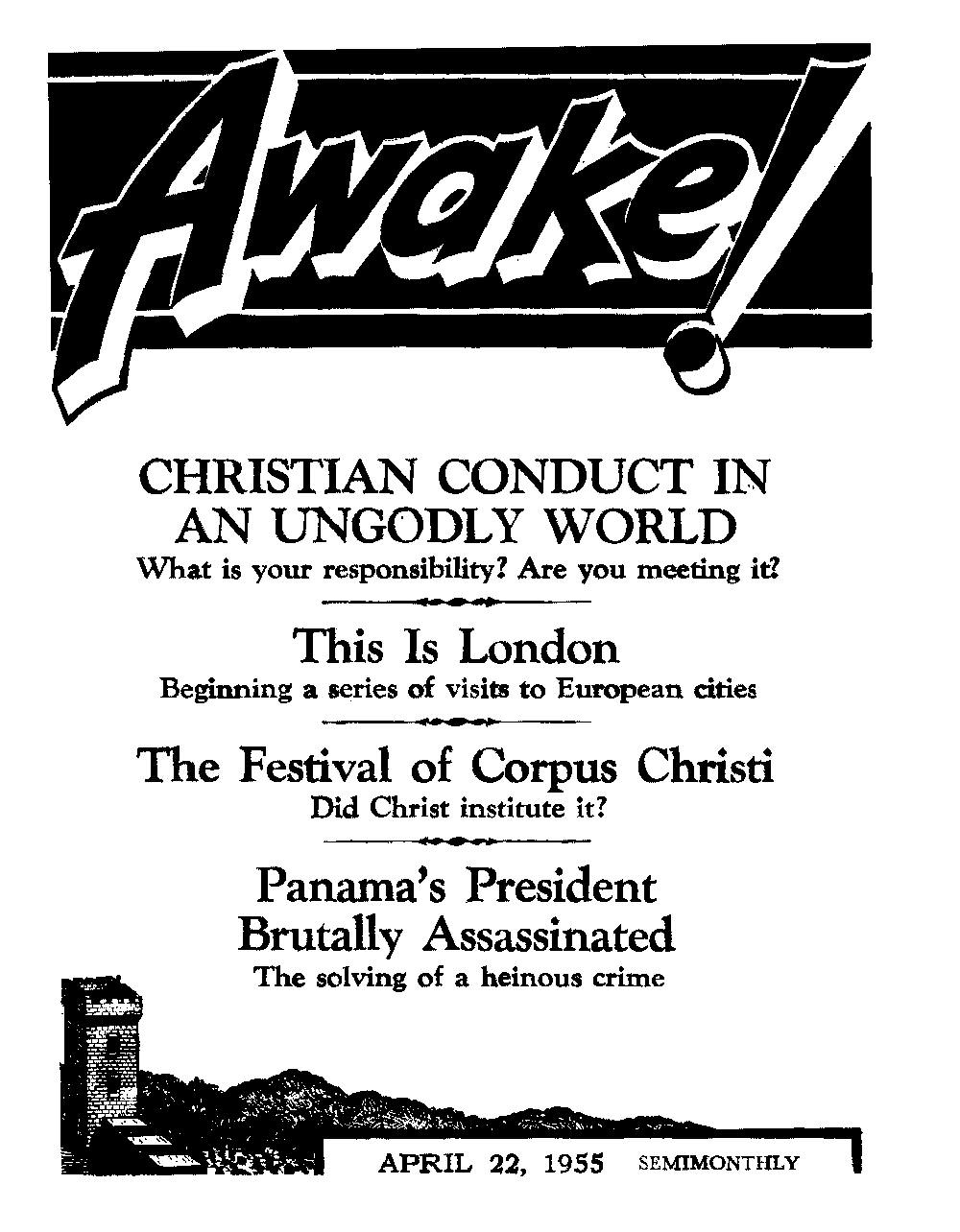
CHRISTIAN CONDUCT IN AN UNGODLY WORLD
What is your responsibility? Are you meeting it?
This Is London
Beginning a series of visits to European cities
The Festival of Corpus Christi
Did Christ institute it?
Panama’s President Brutally Assassinated
The solving of a heinous crime
APRIL 22, 1955 semimonthly
THE MISSION OF THIS JOURNAL
New* fcurccs that ar* able to k**p you awake to i* vital Imum of our -ttrne* mutt b* unfettered by cen*orehtp and »Zfi»h fntereete. “Awake!” ha* no fetters. It reoognize* facts, faces facts, 1* fr*» to publish facts. It is not bound by political ambitions or obligation*; It is unhampered by advertisers whose toes must nut be trodden on; it is unprejudiced by traditional creeds. This journal keeps itself free that it may speak freely to you. But it does not abuse its freedom. It maintains integrity io truth.
“Awake 1” uses the regular new* channels, but is hot dependent on them. Its own correspondents are on all continents, in score# of nations. From the four corner* of the earth their uncensored, on-the-scene* reports come to you through these columns. This journal’s viewpoint is not narrow, but is international. It is read in many nations, in many languages, by persons of all ages. Through Its pages many fields of knowledge pass in review—government, commerce, religion, history, geography, science, Social conditions, natural wonders—why, its coverage is as broad as the earth and a* high as the heavens.
“Awake 1” pledges itself to righteous principles, to exposing hidden foes and subtle dangers, to championing freedom for all, to comforting mourners and strengthening those disheartened by the failure* of a delinquent world, reflecting sure hope for the establishment of a righteous New World.
Get acquainted with “Awake!” Keep awake by reading “Awake!”
PrBr.t»HTtD S#MIWOJnTTt,T Bt WATCHTOWER BIBLE AND TRACT SOCIETY, INC.
117 Alam# Street Brooklyn 1, N. Y., U.S.A.
N. H. Kuo**, PretWent <J*.tHr Soil**,
Printing this iMiit: 1,323,000
L-utMHt l> Irttefc th It imvIm Is mikkU: SfElRCTUli# —ArnUiTM, Ifr'KlW, trench
'pHTtb.1 Hoi’anttWi. Ji’irwtttnr. Spwhl;, Mwihb DmWa, FtrfiiJnr, CkrMxxiw
Dflhvi Ytb'Lj aubfcrtpUan
RlWta, U.S.* Ill Adki*l 8! , IrrtMiljT 1. h Y. |l AitfraHa. 11 litmwd fid., ftrvAfrK. X 8 ?»
Cui4«. Av? . ToM/ito 6, Ortkrfo 81
En*CM»B. 31 i’r***i» Tcti« W 1 7a
(Mtli AfrlM, Priwu St*. P 0.
Trauma) T»
RifetH M aM0><! C1IM EitUT at IrwUyn, N. Y
F/v< copy
frmnhtMiH ihmK be mm rfee in your non fry in hmei pliant vitb je[ulatM"i to
ufr dr J T^ty N SpnltunrM am *c<r»cwJ ar
jirjaklyn fro* matM rhar* no i« 'aeairJ. by iXfriiatioi*! ikjtmj cclcr wly.
ratM la aiff rent twatrtat m hm awtd la tom Mfrrwwy, k*tlaa tt reatirttlblMltl
i* sev nt lw.it two U ’te* >f»rt aubatrtpdcc n-pL"«f Ckanfa *t aMrm «hrt> writ W «»r c*k» ruy b» txpwctad effceUwa wltbla cwm ■waUi t>r > yoir »W u itJ ai imw iMhm
Art Marrti 8* IBM) tn U. B. A
CONTENTS
Do You Fear Your Neighbor?
Christian Conduct in an Ungodly World 5
Panama's President Brutally Assassinated 9
Panama’s New Treaty
The Festival of Corpus Christi
An Earthquake for the Records
Your Limbs or Cigarettes—Which
Would You Choose ?
This Is London
Elephants Curb Hero-Worshipers 23
Drastic “Step Signal” for
Ixir.g-winded Speakers
Keeping the Muscles Healthy
Cooking in Cold Ovens
A Penetrating Look at the Religious
Revival
“Your Word is 'Truth”
A Religion Where Money Is No Object 25 Graduation of Gilead’s 24th Class
Do You Know?
Watching the World
DO YOU FEAR YOUR NEIGHBOR?
MOST people today fear their neighbor more than they fear God. Neighbor fear, a product of the Dark Ages, has grown into a hideous colossus and has become one of the most enslaving and truthsuppressing tyrants in the world. It can be more compelling than laws. No wonder it is the Communists’ chief tool! Declared former Soviet spy Nikolai E. Khokhlov: “The most important weapon of the Soviet Government against the citizens is the mistrust by one citizen of another.” (U.S. News & World Report, January 21, 1955) That comes as no surprise, but this might: neighbor fear, has spread to all parts of the world. Though a victim of this fear dwells in the most democratic of nations, he has lost his freedom. Warned Chief Justice Earl Warren of the United States Supreme Court: “If a man is free only to be what his neighbor wishes, he is not truly free.”
The mind rebels at the suggestion that one fears his neighbor. This is not strange, for it is an admission of bondage, and no one wants to be a slave to his neighbor. Let us be honest with ourselves and ask the question, What are signs of neighbor fear? There are at least three main signs: (1) Wondering what one’s neighbor will think; (2) falling into a state of mental conformity, and (3) fearing knowledge.
Now the first sign. Persons seized by neighbor fear allow their decisions to be influenced by a power other than sound reasoning. What is this power? It is a roadblock in the mind that checks all ideas and decisions with this question: What will my neighbors think ? Becoming subservient to a perpetual wondering what the neighbors will think is coming under the power of a dictator that kills the human spirit and makes one a robot.
This brings us to the second sign of neighbor fear: conformity. Those who fear their neighbors believe that they should accept any popular credence or creed whatever the cost. And the cost is always high. Sound judgment and reasoning suffocate and die. Thinking is difficult, so why think? It is much easier to do and believe what “they say.” True, not all . neighbor fearers allow their minds to atrophy completely. Some may even hold ideas of their own based on truth and righteousness. But when neighbor fear is present, it dictates that one hold secret or disguise his real opinions.
Conformity triumphs. It always threatens to brand one with the stigma of disloyalty if he thinks. Declared a noted justice, Judge Learned Hand: “I believe that the community is already in process of dissolution where each man begins to eye his neighbor as a possible enemy, where nonconformity with the accepted creed, political as well as religious, is a mark of disaffection [disloyalty].” Is your community truly free or is it "in process of dissolution"?
The third sign of neighbor fear is being unduly suspicions of ideas, yes, being fearful of knowledge itself. Fear of knowledge fosters ignorance, entrenches superstition, discourages advancement, quenches enlightenment and leads to narrow-mindedness. So this morbid fear or suspicion of ideas makes one close his mind even before he has opened it. This is ruinous.
But why fear knowledge? Because, though knowledge can destroy error, it brings about changes. What is feared is the undesirable side effect of the change. For example, a change might mean a loss of prestige, an upset in a profitable status quo or hostility in a family group. So selfishness prompts a fear of knowledge.
Recognizing the extreme peril of fearing knowledge, Dag Hammarskjold, secretarygeneral of the United Nations, gave a thought-provoking talk to scholars at the Charter Day dinner of Columbia University. Among the honored guests was Queen Mother Elizabeth of Great Britain. To this distinguished group the high U.N. official said (as reported in the New York Times of October 31, 1954): “We all of us are quick to recognize in principle the value of knowledge. Yet we may hesitate to do what is necessary in order to open wider access to knowledge for others or to deepen our own knowledge. Too often we even share in reactions that can be explained only by a fear of knowledge.... If we fear knowledge and act under the ban of such fear, is it not often because we fear change?
“We have seen among us the resurrection of practices and attitudes belonging to, indeed justifying the name of the Dark Ages,” continued the U.N. official. "A fear of knowledge, inspired by the wish to safeguard established interests, may for a time block an unavoidable development.
But, in so doing, it may create situations where change finally comes into being with the violence of an explosion." Then the U.N. secretary-general drove home this point: “No policy which cannot stand the test of full knowledge and free criticism will ever be safely based in the loyalty of the peoples.”
Do you fear to subject your own policy to “full knowledge and free criticism”? Neighbor fearers usually do. They have made themselves pawns in the hands of their neighbors. Interestingly, Judge Learned Hand once said: “I often wonder whether we do not rest our hopes [for freedom] too much upon constitutions, -■ upon laws and upon courts. These are false hopes. Liberty lies in the hearts of men and women. When it dies there, no constitution, no law, no court can even do much to help it.”
Do you fear your neighbor? Really, what a neighbor thinks matters little. Can he give you life? He cannot give you one day’s life. Only God can give life. So what counts is not what a neighbor thinks but what God thinks. And he will not think much of us if we fear neighbors. His own Word warns at Proverbs 29:25 (Knox Catholic translation): “Fear of man’s judgments will bring thee quickly to ruin.” The American Standard Version -says: “The fear of man bringeth a snare; but whoso putteth his trust in Jehovah shall be safe.’’
So dispel neighbor fear by fearing Jehovah God above all. As for your neighbor, Christ Jesus did not say to fear him. He said; “You must love your neighbor as yourself.” (Matthew 22:39, New World Trans.) Show your love by helping your neighbor conquer neighbor fear. Accept knowledge. Test it with reason and with God’s Word. Fight mind-enslaving conformity. Trust in Jehovah. Do this and you will never be among those miserable ones who fear their neighbor more than God.
APRIL J?£, 1955
thoughts of his heart was only bad all the time.” The apostle Paul foretold this wave of unchristian conduct and said that it was a sign of the last days. “But know this,” said Paul, "that in the last days critical times hard to deal with will be here. For men will be lovers of themselves, lovers of money, self-assuming, haughty, blasphemers, disobedient to parents, without gratitude, with no loving-kindness, having no natural affection, not open to any agreement, slanderers, without self-control. fierce, without love of goodness, betrayers, headstrong, puffed up with self-esteem, lovers of pleasures rather than lovers of God, having a form of godly devotion but proving false to its power.” He closes with this warning: "From these turn away.” —Genesis 6:5; 2 Timothy 3:1-5; Matthew 24:37-39, New World Trans.
Paul further explains why crimes that involve forms of personal degradation, such as rape, indecency and unnatural acts, have increased. Paul charges that materialism, spiritual irresponsibility and mankind’s lack of faith in God are the primary causes. The apostle argues: ‘‘Although [mankind | knew God, they did not glorify him as (Sod nor did they thank him, but they became empty-headed in their reasonings and their unintelligent heart became darkened. Although asserting they were wise, they became foolish and turned the glory of the incorruptible God into something like the image ot corruptible man and of birds and fourfooted creatures and creeping things. . . . That is why God gave them up to disgraceful sexual appetites, for both their females changed the natural use of themselves into one contrary to nature, and likewise even the males left the natural use of the female and became violently inflamed in their lust toward one another, males with males, working what is obscene and receiving in themselves the full recompense which was due for their error. And just as they did not ’approve of holding God in accurate knowledge, God gave them up to a disapproved mental state, to do the things not fitting.” —Romans 1:17-32, New World Trans.
Who is responsible for these despotic times? Satan, the god of this world, is. He is out to rule or ruin. The apostle John identifies tills foe for us, paying: "Woe for the earth and for the sea, because the Devil has come down to you. having great anger, knowing he has a short period of time.” (Revelation 12:12, New World Trans.) His pattern of action is clear in the earth—deception, distortion, corruption, destruction.
This generation’s religions become more perfunctory, conventional, worldly. Godliness has become okl-fashioned. Materialism is modern. Life, in its highest and lowest reaches, is cheap, sordid, vulgar. It says it wants peace and unity, but it harbors ill-will and hate. It criticizes stubbornness and faults in others, but ignores them in itself and its children. It says we need divine help, but it forgets that it is the pure in heart that will see God. It fails to see that it is not those who talk but those who listen that receive guidance; that a key to a new home is a new personality; that Christianity in deed could supply this need.
Early Christian Conduct
The course of first-century Christians was not marked out by Caesar, but by Christ. It was not an effort at "character development.” Rather it was a course that required accurate knowledge of God’s basic principles and righteous requirements, coupled with an honest desire and earnest effort to live by them, with a sincere love of God and neighbor. This course recognized the need for the operation of God’s active force in one’s life, since many righteous qualities are themselves actually fruits of the spirit. It meant a completely
changed thinking process from that of the former course in Satan’s system of things, a development of a new life pattern by daily strengthening of proper habits, leanings and mental attitude.
In no other way was the devout Christian more clearly distinguished from this degenerate world than in his concentration of interest in the new world of God’s promise. This old world meant absolutely nothing to him. He expected to see it end in the wrath of God. Peter himself emphasized this fact, saying: “Since all these things are thus to be dissolved, what sort of persons ought you to be in holy acts of conduct and deeds of godly devotion, awaiting and keeping close in mind the presence of the day of Jehovah, . . . But there are new heavens and a new earth that we are awaiting according to his promise, and in these righteousness is to dwell.”—2 Peter 3:11-13, New World Trans.
This new world Jesus ’ proclaimed and made alive in the hearts of men of sublime sincerity. These men took seriously what Jesus said and strove to live his words faithfully. They sought no reservations and recognized no compromises in his message. Jesus brought them a way of life that concerned their eternal welfare. His teachings were powerful and alive and exacted complete obedience. Those that followed him willingly dedicated their lives in an attempt to render this obedience.
As Christians they bowed to only one God, the God of the Bible, Jehovah. They pointed out that even kings as well as subjects must bow before him. If any conflict arose between a commandment of God and that of Caesar, there existed no doubt or difficulty in the Christian mind as to how to solve it. God always came first If Caesar’s command was inconsistent with God’s, it was thereby of no effect. It was as simple as that to those who believed.
Since their interests were fundamentally spiritual, their conduct was one of separateness from this ungodly world and its prevailing activities. This was not their world nor their way of life. They were good citizens, however, obeying the laws of the state that did not conflict with God's law, and keeping the peace. As members of the community, they were quiet, moral and loyal. The simplicity and purity of early Christian life were so remarkable, as set over against the corrupt manners of the time, as not to be believed, and therefore inevitably to be suspected as a cloak for hidden enormities of conduct. It was their conviction, however, in the grand hope of the Kingdom, the new world, that enabled them to accomplish this transformation.
Christian Conduct Today
It is precisely this same hope that enables twentieth-century Christians to undergo this same transformation. A Christian today lives for the new world. This old world means absolutely nothing to him. In fact, he expects to see it go down in the battle of Armageddon. Therefore, he has taken the apostle’s counsel to heart, which says: “And quit being fashioned after this system of things, but be transformed by making your mind over, that you may prove to yourselves the good and acceptable and complete will of God.” The active force of God is needed to effect a change in his thinking and conduct. He sincerely wants to change his old-world habits. “Wherewithal shall a young man cleanse his way? by taking heed thereto according to thy word.” The Bible, God’s written Word, is able to search out his inmost thoughts and direct his course, if he will let it. Failure to renew his mind leads into the corrupt mental state of this old world, which can only mean destruction.—Romans 12:2, New World Trans.; Psalm 119:9.
Becoming such a true Christian and leading a Christian life actually mean be-7
coming a new personality. Before one can successfully do this, he must get truth into his mind and heart and make it the motivating force in his life. To this end accurate knowledge of God’s requirements is necessary. These requirements of God extend into daily living. Everyday affairs of life should be governed by his mental attitude toward Christ. As Peter wrote: “Hence brace up your minds for activity, keep completely balanced and set your hope upon the undeserved kindness that is to be. brought to you at the revelation of Jesus Christ. As obedient children, quit being fashioned according to the desires you formerly had in your ignorance, but, in accord with the holy one who called you, do you also become holy yourselves in all your conduct.”—1 Peter 1:13-15, New World Trans.
Gossip and backbiting, thoughtless, tactless and unkind remarks must be avoided by the Christian. “A whisperer separateth chief friends.” He will steer clear of meddling in others’ personal affairs. He learns that disagreements and strife must be forgotten, that maliciously criticizing others’ shortcomings is very improper; that personal family dissensions and contentiousness should be overcome; that a balanced viewpoint must be maintained through proper moderation in eating and drinking, and that whether in the congregation or away from the congregation his association must always abound with love.—Proverbs 16:28.
The Christian’s own conscience, trained in God’s Word, determines his choice as to work and other such activities. When at work he is counseled not to cheat his employer but to give a full day’s work. He must remain a Christian when outside or inside the congregation. Godly conduct outside the organization is imperative. “Let as many as are slaves under a yoke keep on considering their owners worthy of full honor, that the name of God and the teaching may never be spoken of injuriously.”—1 Timothy 6:1, New World Trans.
Maintaining Proper Conduct
Christian witnesses of Jehovah must always remember that their conduct is an example to the old world of New World living. This conduct either reflects or detracts from the glory of God. Under no circumstance will a Christian compromise with uncleanness to appear a “good fellow.”
To be able to live up to the responsibility that rests upon a Christian, one must continually fill his mind with right matters, proper thoughts. This requires constant self-discipline in even the smallest matters of daily living. “Pursue peace with all people, and the sanctification without which no man will see the Lord, carefully watching that no one may be deprived of the undeserved kindness of God; that no poisonous root may spring up and cause trouble and many be defiled by it; that there may be no fornicator nor anyone not appreciating sacred things, like Esau, who in exchange for one meal gave away his rights as firstborn.”—Hebrews 12:5, 6, 14-16, New World Trans.
Maintaining a godly conduct in an ungodly world is not easy. It is hard work, in fact. But our load can be made lighter by applying ourselves, by continued personal study of God’s Word, by regularly attending congregational meetings. This is essential if we are to receive full direction of the holy spirit Paul admonishes us to assemble together that we may be refreshed and strengthened. To associate in a social way with those who do not hold to such high principles is very dangerous at this time of the end. “Do not be misled. Bad associations spoil useful habits.” So, associate with your Christian brothers; help, edify one another in love.—1 Corinthians 15:33, New World Trans.
Bear in mind Paul’s words: “This, therefore, I say and bear witness to in the Lord, that you no longer go on walking just as the nations also walk . . . but that you should be made new in the force actuating your mind, and should put on the hew personality which was created according to God’s will in true righteousness and loving-kindness. So keep strict watch that how you walk is not as unwise but as wise persons, buying out the opportune time for yourselves, because the days are wicked.”—Ephesians 4:17-24; 5:15, 16, New World Trans.
it
By "Awoke!” correspondent in Panama
ONE bullet did it! Two hours after found its mark that evening of January 2, one of the victims of the most heinous crime in Panama’s history, her president, Colonel Jose Antonio Remon Can-tera, lay dead in the emergency room of the Santo Tomas Hospital in Panama City. The celebration and merrymaking of the New Year, which had opened so propitiously for both Panama and its chief executive, abruptly ended as the country mourned the loss of its leader. The blow was as sudden as it was unexpected, for “in the country there was absolute tranquillity and the best order that the history of the nation records.”
So tp the happy celebrants that thronged the Juan Franco Race Track there was no warning resemblance in the merry crackle of their firecrackers to the deadly chatter of the machine-gun fire that was to claim the lives of three and leave three others wounded, one of whom died some days later. And as the crowds dispersed after the races to theaters or other destinations, the president and his entourage lingered on celebrating the victory of one of the president’s blooded horses, Valley Star. Silhouetted against the blackness of a warm tropical night were the president and his party on the brightly lighted balcony of the clubhouse of the Hippodrome. Friendly conversation was brusquely silenced about 7:30 by the snarling bark of a machine gun. “The firecrackers are back,” exclaimed one of the group. With the second burst of fire, having now found its range, one of the detectives fell to the floor. President Remon, leaping to his feet, protested, “Those are not firecrackers/’ and then fell mortally wounded face down on the balcony floor. A third burst from the machine gun and three more fell injured. Two of the presidential bodyguard leaped from the balcony firing in the direction of the gun flashes.
Hidden in the darkness, the assassin escaped, but an innocent victim, a swimming champion, was killed. Thus in a few crisp seconds Panama’s most mysterious crime was accomplished. The victims were quickly rushed to the hospital and all radio stations broadcast a request for all doctors to report there at once. The president succumbed in spite of the best efforts of modem medical science. 1
The entire nation was shocked. With the public announcement of President Remon’s death a state of siege was declared and the national guard (as the Panamanian police force is designated) calmly and efficiently dispersed the stunned and newsseeking populace from the streets and plazas and closed all places of amusement. The national airport at Tocumen was closed to all outgoing planes and special guards were posted on streets leading to the Canal Zone. At 1:59 a.m., January 3, the National Assembly convened in extraordinary session and suspended for ten days the constitutional guarantees of freedom of speech, press and assembly, to facilitate the investigation of the murder,' At the end of that period the state of emergency was extended for another ten days. At 3:05 a.m. the first vice-president, Jose Ramon Guizado, took the oath of office as chief executive.
Soon thereafter the new president with other friends and members of the family were at the American Air Force Base in the Canal Slone to meet the widow of the late Remdn on her return from Miami, where she was by invitation of the governor of Florida. Meanwhile efforts were not relaxed to ferret out and bring to justice the perpetrators of this cowardly but well-planned crime. The grief-stricken populace remained calm, but there welled up In the hearts of the majority a yearning to avenge their chief citizen, victim of this vituperable murder, whether it had been prompted by vengeance, hatred, envy or fear. The national guard and the secret police, working assiduously and in close co-operation, arrested and questioned several suspects only to release most of them as soon as their innocence was established.
In evidence that the entire nation was deeply stirred was the fact that many private citizens and business firms pledged additional thousands of dollars to augment the original $50,000 reward stipulated by the National Assembly for information leading to the identification of the cowardly killer. These pledges skyrocketed the amount to close to $160,000, which the Panama American said was probably the highest reward ever offered in the Western Hemisphere, perhaps even the entire world. Detectives came from the United States, Cuba, Costa Ried and Venezuela to help Panama’s own experts avenge the crime. For days all clues came to a dead end as the people anxiously milled through the streets in hope of definite word on the case.
But it was not until the fourteenth that that word came. At last the case was “cracked”! A young Panamanian woman had tipped off the secret police. Her own fiance, Jose Edgardo Tejada, Panamanian and former cadet at the Guatemala-Polytechnic School, had told her of having smuggled into the country on his return from school a machine gun, and further that, if anything should happen to him, “Rem6n’s assassin was Ruben Miro." Under arrest, Tejada admitted that he had smuggled a machine gun (a German-made Schmeisser) into Panama between midSeptember and early October and had sold it for $150 to Ruben Miro, a prominent Panama City lawyer. Miro’s arrest followed at once. Tejada further stated that on being told by Miro of the assassination plan he did not report it to the police because he had no proof to present and feared arrest for bringing the gun into the country illegally. To have a reason for not taking part in the assassination he stabbed himself in the right hand and absented himself from the city.
Further corroboration of the young woman's story came when officials revealed that a Roman Catholic priest, “Father" Carlos Perez Herrera, had been told by Carlos Miro, brother of the suspected assassin, that Ruben was planning to murder President Remdn. “Father" Herrera passed the word along to Remdn who did nothing more than repeat it to his close associates.
Ruben Miro, now under arrest, came forth with grave charges against the country’s chief executive, Ramon Guizado. Miro had “implicated the then President Jose Ramdn Guizado and Rodolfo Saint Malo, a business associate of Guizado, as the men with whom he plotted Remdn’s death in exchange for a post in the Guizado cabinet. Miro .. . told police he began plotting Re-mon’s death with Guizado and Saint Malo in mid-November of last year. He made it clear, however, that neither Guizado nor Saint Malo knew how he planned to stage the assassination."—La Nacidn, January 15.
With the implication of President Guizado as a criminal suspect, measures were immediately taken to protect him against any popular reaction and to avoid any new tragedies. His private residence was surrounded with armed guards, for, as the deputy commander of the national guard said, “The lid is being taken off a hot pot.” Gui-zado’s son and two business associates (one of whom was Saint Malo) were known to be under arrest. About midnight President Guizado sent to the National Assembly his request for leave of absence from his executive office “until there are clarified the charges made against me" and “so that the investigation may be carried out in the fullest possible liberty and impartiality." At 3:29 a.m. Saturday, January 15, the National Assembly convened, considered Guizado’s request, refused it, impeached him, removed him from the presidency that he had sworn to uphold only thirteen days previously, ordered his arrest and authorized the commander of the national guard to carry it out. The second vicepresident, Ricardo Arias Espinosa, was called to occupy the office of president of the Republic and was sworn in at 7:20 a.m.
The National Assembly appointed a commission to carry out a thorough investigation of the crime. After twenty-six days and nearly as many nights of assiduous labor the committee returned indictments against ex-President Guizado as the “brains” of the death plot to gain the high office of the presidency for himself; against Ruben Miro as the actual slayer to gain the office of minister of government and justice; and against twelve others as accomplices in the cold-blooded murder, Jose Ramon Guizado will be tried by the National Assembly due to his occupying the presidency for thirteen days, during which time he was accused of the dastardly crime. All the other defendants will stand trial before the ordinary courts of the land. Since Panama does not demand the death penalty for convicted murderers, the maximum penalty vpll be ten to twenty years’ imprisonment.
Conditions returned to normalcy. The Panama City Star and Herald said: “The small, flfty-one-year-old Republic has survived a tragic period with courage and dignity . . . and its congressional representatives, members of the National Assembly, dealt with the crisis promptly, acting within the framework of democracy to face the emergency immediately. . . . At each step along the thorny path they trod in their investigation they have had the full co-operation of the National Guard who have been alert and firm, ready and equipped for action."
Excellent decorum and respect'for law and order by the Panamanian people have characterized this trialsome time.
Panama’s New Treaty
ly **Awal»i” c«riMpand«M in Fhr«m
N January 25. 1955, a historic ceremony took place Jn the Presidential Palace in Panama City. A Treaty of Mutual Unde^ standing and Co-operation, together with its attached Memorandum of Understandings Reached, was signed by representatives of the United States and the Republic of Panama. It is designated the Remdn-EisenhowerTreaty. This new treaty replaces the one Panama made Just after it had gained her independence from Colombia- That was in 1903, and Panama at once granted a 10-mile strip to the United States for the canal.
Panama’s need for a new treaty had long been felt, but no one was willing to undertake the Job until Colonel Josd A, RemCn came to the presidency. Though Colonel Remfin did not claim to be a diplomat, he knew what he wanted for his country He had the courage, interest and determination to go after it and see it through to a successful conclusion. Un fortunately, Colonel Remdn did not Jive to en joy the fruits of his labors.
In a speech or. March 15, 1963, Colonel Remdn sparked the negotiations for the new treaty. Six months later he left for the United States to appeal for a new agreement. This proved to be the opening wedge. Many times during the next sixteen months it appeared that aJ would end in failure, but President Remdn never gave up. When discussions appeared to have bogged down or to have come to a standstill, he appealed to President Eisenhower, who personally intervened in behalf of Panama.
V If the United States has made an unusual amount of concessions in the new treaty, it must be remembered that she was given unusually broad powers under the original one. and that she has reaped the benefits of the canal lor more than forty years; whereas Panama, on the other hand, has reaped very little benefit from the operation of the canal although it is on her territory. True, many of her citizens are employed in the Canal Zone. Their salaries, for the most part, are spent for American products available through United States-operated commissaries, where they car receive any amoem of merchandise from outside the country duty-free. But under the new
treaty this will be changed and such commissary and import privileges of non-United States citizen employees of the Canal Zone agencies residing in Panama will be restricted. Also an income tax will be Imposed on all Panamanian citizens working In the Zone regardless of whether they live inside or outside the Cana] Zone.
Under the original treaty Panama received a yearly rental of $90,000. In 1936 an amended treaty was signed. Under it the annual rental was raised to S43O.0CO. Under the new treaty the annual rental has been increased to $1,930,000. Also certain lands that were previously acquired for canal purposes will be transferred back to Panama. Tn the city of Coldn. United States-controlled territory took in almost all of its beautiful beach area so that the natives had little access to beach facilities although the c’dy is almost completely surrounded by water. Under the new treaty all this beach area Is to be returned to the Republic of Panama. On the other hand, the United States is granted the use of certain areas in the interior for a period of fifteen years free of cost. These will be used for miii-lary purposes.
In accordance with the Memorandum of Understandings Reached, the United States has agreed to put into effect certain a drain is trative practices designed to benefit Panamanian commerce. This means that Panama will have a greater share in the business of selling supplies.
*1? Also “the United States will afford equaliiy of opportunity lo citizens of Panama for employment in all United States government positions in the Canal Zone for which they are qualified and in which the employment of United States citizens is not required.1’ Further, all positions in the Canal Zone are to be evaluated and classified “without regard to the nationality of the incumbent." In times past this has been a sore spot with Panamanians employed in the zone. They felt (hey were being discriminated against because of having a much lower wage scale; and their positions were classified differently from United States citizens employed in the zone.
Having gained an unusual aeries of concessions, Panama should benefit greatly from the new treaty.
Vvin Germany
but by no means silently! The faithful sing devotional hymns; “Lauda Sion Salva-torem” (Your Savior, Your Life) being the most familiar of the ones we hear.
N THE Thursday that follows Trinity Sunday (Feast of the Holy Trinity) one can be witness to a religious drama enacted in almost any city or village in Germany, or in any other European land where the Catholics represent more than just a small minority. The Catholic faithful hold on this day one of their highest religious feasts—that of Corpus Christi. It is celebrated in honor of the Eucharist. This feast actually lasts an entire week, but the "faithful’’ appear publicly on Thursday making their “confession of faith.” It is a legal holiday in German cities with predominantly Catholic populations, falling either in the month of May or June. On this day every Catholic who feels himself in any way compelled to confess his faith publicly has his opportunity to do so. He can join the procession held in conjunction with this festival, the starting point of the procession being one of the local church buildings. There, those intent upon publicly professing their religion make their appearance Thursday morning.
Already we can see the procession at the far end of the street; it comes slowly nearer
of CORP
Prayers are also audible. The sweet smell of incense penetrates into the noses of the spectators as the train of “praisesinging faithful” draws nearer. A cross, surrounded by a number of dedicated church flags, is carried reverently at the head of the parade before the festively dressed assistants with their incense.
Meanwhile the street has transformed itself into a sea of flowers. Over this fragrant carpet of flowers the train moves on. Now all eyes are fixed upon the four men in religious robes who are carrying a canopy held aloft on poles, the canopy supposedly representing heaven. Walking underneath, with measured steps, a priest holds the holy monstrance in both hands in front of him. The monstrance contains what is considered the holiest thing of the entire procession, the consecrated wafer, the symbol of this feast, which is supposed to be the body of the Lord. (Corpus Christi means “body of Christ.’’) The men stand-
ing on tine curb raise their hats; no one ventures to speak.
Following in the procession are people carrying burning candles, also pictures —pictures of deceased Catholics now esteemed “holy ones” by the church and pictures that are supposed to portray the apostles of Jesus. In fact, many Catholics actually believe that the deceased “holy ones” are present and that they perform loving service in connection with this high feast. Yes, it appears that in this procession all the effects and objects that usually serve In Catholic religious services alone inside the church buildings are carried into the streets to be publicly displayed.
Along the streets through which the holy train makes its way are four altars set up to face in the four directions. supposedly picturing the four Gospels. At each one of these altars a priest sings the beginning of one of the four Gospels, in Latin, afterward pronouncing a blessing over the Catholic folk. The four directions are supposed to allude to Jesus' commission to his followers: “Go therefore and make disciples of people of all the nations . . . teaching them.” After several hours the procession comes to an end; it has again reached its starting point at the church.
HAaf It It All About
If one of the spectators should ask what it is all about, everyone would be sure to tell him that this is the annual procession of the festival of Corpus Christi. But no one should ask further as to the meaning or the origin of this festival. Why not? Because no one, aside from the priest and a few experts on church history, could answer such a question. In fact many of the procession participants probably do not even know what the name Corpus Christi means.
What is actually the historical background of this Catholic festival? As regards such a festival one can find nothing in the Bible, although those supporting Catholicism are inclined to compare it with the procession that took place with the entrance of Jesus into Jerusalem at pass-over time. Since this festival has only been celebrated by the Catholic Church since the fourteenth century (A.D.), we should not be surprised to find that there is nothing about it in jthe Bible. The historical background is rather vague.
But where records are lacking, historians find sources in traditions and legends that have been transmitted by word of mouth down through die centuries. Around A.D. 1230 a nun named Juliana lived in Luettich. During the first year of her service as a nun she is said to have had a strange vision. The moon, displaying a dark spot or blemish on its otherwise brilliantly shining face, appeared to her repeatedly. No one could explain the vision. So it is said that Christ, himself revealed it to the nun. The moon represented the Catholic Church of that time, the blemish the absence of a festival that the "faithful” were to celebrate, namely, that of Corpus Christi.
Juliana told her vision first to a canon in Luettich named Johannes de Lausenna; later to Jakob PantaJeon, an archdeacon of Luettich. The case came before Robert, the bishop of Luettich, who A.D. 1246 commanded that this festival‘be- held in his entire bishopric. Later, after the above-mentioned Jakob Pantaloon, under the name of Urban IV, had ascended the papal throne, he sought to introduce the festival into the entire Catholic Church, but his death hindered him in the carrying out of h:s purpose. It was first later, on the occasion of a general church assembly in Vienne (France) A.D. 1311, held under the chairmanship of Pope Clemens V, that it was decreed that the festival should be celebrated by the entire Catholic Church.
U It Right?
According to this, Corpus Christi, one of the greatest and most prominent of Catholic festivals, has only a legendary beginning, Is this feast in reality celebrated to the honor and glorification of the Lord JeSus Christ, who sacrificed his perfect human body together with his life so as to ransom many from death? At any rate, he did not bind such a festival upon his disciples; and is it not noteworthy that the importance of this festival should first be revealed by him to a woman some 1200 years after his death? Why is not the slightest basis for Corpus Christi to be found in the Holy Scriptures, which contain Jesus’ instructions to his followers? What about this matter of “holy” effects and pictures that find usage in the procession of Corpus Christi? Jesus’ followers never brought holy pictures, burning candles, incense, etc., into use in their worship of God.
This festival of Corpus Christi is also celebrated to express the joy of the administration of the Eucharist. The Eucharist is the action whereby the bread and wine on the altar under the hands of the officiating priest are supposed to be transubstantiated into the actual body and actual blood of the Lord Jesus Christ. When God’s Word clearly explains (at Hebrews 9; 25, 28; 10:14), that Jesus sacrificed his body with its blood once and for all time, why, then, such a demonstration of perpetual sacrificing of his body in the form of literal bread in a monstrance carried around by a priest during the procession?
In the Christian Greek Scriptures of the Bible no report is found where Christians ever took part in such a procession. In order to support the procession of Corpus Christi reference is made, as has already been mentioned, to the entrance of Jesus into Jerusalem at passover time. At that time he rode upon an ass into the city of the temple, while a rejoicing and enthusiastic crowd of people greeted him, crying hosanna and spreading their clothes as well as palm branches before him on the way. This happened in fulfillment of a meaningful prophecy in the Hebrew Scriptures. (Zechariah 9:9) His disciples knew that with this the prophecy was fulfilled, and they saw no need to repeat it in any way.
But what about the confession of the Catholic “faithful”? Do they not show their faith when they take part in the procession, sing sacred songs on the street, pray and thereby let ridicule and contempt come upon them? Now, true Christian faith results from an accurate knowledge of the truth! (Hebrews 11:1) Where, however, is their knowledge, when they, for the most part, cannot even give an account of the meaning and the origin of the festival that they are celebrating? The apostle Peter said: “Always ready to make a defense before everyone that demands of you a reason for the hope in you, but doing so together with a mild temper and deep respect.” (1 Peter 3:15, New World Trans.) Through their participation in the Corpus Christi procession the Catholic “faithful” do not demonstrate a knowledge of the true Christian faith, but rather openly show they are in ignorance as regards the true worship.
The Scriptures show that Jehovah God has no pleasure in festivals that are celebrated in the name of a false religion. The Christian should continue to make confession of his faith, as Jesus and his apostles did, but this is done by, publicly and from house to house, preaching the happy message of God’s kingdom, and by studying the Bible together with people in their homes. (Luke 8:1; Acts 2:46, 47; 20:20, 21) Thus the Christian's proper confession of his faith is one that aids his fellow meh to gain true Christian faith through an accurate knowledge of the truth.
AN EARTHQUAKE FOR THE RECORDS
ANY people measure an earthquake's severity by the number of people killed. This obviously results in some extraordinary quakes’ being overlooked by masses of people. Such Is the case with an earthquake that hit Dixie Valley, Nevada, in December. Many persons hardly noticed it; many newspapers hardly mentioned it. Yet to scientists it was so outstanding that Professor David Slemmons, a University of Nevada earthquake expert, declared: ‘This quake was without doubt one of the most important ever recorded in the United States.”- The Fresno Bee, December 21, 1954.
U Dixie Valley is a meagerly populated area about the size of Manhattan Island, What did the quake do? It sheared off a mountain side and dropped several miles of valley by three or four feet. After the quake a reporter drove across the desert to the base of one of the faults (a break in a rock with part pushed up or down). There his amazed eyes beheld warm water gushirtg from the mountain fastness—this in a place where water never before had been found, at least in appreciable quantities. The stream raced along in the awesome, quake-caused gash, a trench which was from 12 to 30 feet across. Of the sears in the mountain one extended for 26 miles; another for 12 miles. These were not tiny scars. Said the San Francisco Chronicle (December 21, 1954): ‘The gashes along the base of the mountain look as it a giant had ripped the terrain with a jagged knife—mile after mile—and then had torn it apart with his hands.”
TH Earthquake expert Slemmons found part of a new fault where one side is 20 feet lower than the other side. He called this possibly one of the greatest vertical shiftings of earth ever recorded in the United States. (The San Francisco quake of 1906, by comparison, caused only a 3-fcot vertical displacement) No wonder Professor Slemmons remarked:
Had the quake occurred in a populated area, I hesitate to think of the death and destruction :t would have caused."
US So when Jesus foretold “earthquakes in ore place after another” as part of the sign of the end of this system of things, we should remember that he did not say the quakes would have to kill people io "count.”—Matthew 24:7. New World Traits.
ot ottos—iWkiok Would Ijou gkooso?
C It is a well-known medical fact that smoking a single cigarette will cause the blood vessels of the extremities of the hands and feet to constrict as much as fifty per cent. It is easy to see how such repeated constrictions could cause the eventual loss ot circulation in the tips of the limbs, which, in turn, could cause gangrene to set in, in turn necessitating amputations. This disease Is known as Buerger's disease. A report in the Reader's Digest by Roger William Riis tells of the reluctance of doctors to attribute Buerger's disease to cigarette smoking. Yet ir. one study of 1,000 cases of this disease, 1,000 were found to be smokers, although it is a comparatively rare disease and only about half of the adult population smokes cigarettes. In another study of 1,400 cases, every last one was found to be a smoker. In 100 cases that had been studied for ten years, all of them had the disease arrested when they stopped smoking. Then again, a physician reported that in 100 consecutive cases amputation was avoided In all but three cases, the three being the only ones that refused to stop smoking. One Buerger’s disease patient was told he would have to stop smoking cr have progressive amputations of hands and feet. Some years later, one of the doctors who had warned him of this was hailed on the streets of Chicago by an armless, legless beggar on a little wheeled platform, “Hey Doc! Remember me? Say, be a good scout, light a cigarette for me and stick it in my mouth, will you9” Which would you choose? Your limbs or the cigarette?
THIS
LONDON! A giant in cities.
A concrete maze through which the endless traffic whirls impatiently.
A maelstrom of humanity, sucking into oblivion the
ONDON
During the reign of Queen Elizabeth the city’s rapid growth caused such concern that in 1580 the queen’s proclamation prohibited building on ground that had not been built on before in the memory of living man. Neverthless, expansion continued until the Great
brief lives of millions who come and go like ships in the night. A vast tangle of bricks and mortar, flesh and bone, work and play, life and love that grips its people spellbound. So huge a city in so small a land, London is truly unique.
It is impossible to convey in words alone the heartthrob of this great city. Beginning as a clearing in a large forest, London is now the home of more than eight million people. Through the pages of its history move colorful persons sudh as Boadicea, the queen who led an armed rebellion and burned down Roman-held London A.D. 60, King Alfred the Great, of the Danes, who captured the city A.D. 886 and rebuilt its walls, and William the Conqueror, who defeated the British at the Battle of Hastings in 1066 and built the White Tower, which eventually became part of the Tower of London. In 1136 a fire gutted the city, destroying London Bridge, thought to have been built by the Romans in the first century. Rebuilt after the fire, it remained the only link across the Thames until Westminster Bridge was completed, in 1750. Now there are seven bridges serving central London alone.
Plague of 1665 took 90,000 victims. The following year the city was reduced almost to ashes by the Great Fire, which destroyed 13,000 houses and 85 of the 98 parish churches. A monument commemorating the Great Fire was erected near the spot where the fire started and today its spiral staircase still takes visitors to the top for a fine view of the city of London.
Since religion and politics have played so vital a role in
molding the nation’s destiny it is not surprising that they are represented prominently in its architectural gems. There is Westminster Abbey, qrowning place of all except two of England’s monarchs since William the Conqueror. Another is the seventeenth-century St. Paul’s Cathedral, Christopher Wren’s architectural masterpiece, with its celebrated dome, within which is the Whispering Gallery. Two persons standing diametrically 107 feet apart can converse in a whisper by directing their voices against the gallery’s wall. Equally well known are the Houses of Parliament on the Thames embankment. At one end stands the lofty clock tower of Big Ben. What the Statue of Liberty is to New York and the Eiffel Tower
to Paris, Big Ben is to London. Radio waves carry its booming voice around the world, bringing a touch of nostalgia to Britons far from home. Big Ben’s four faces are each twenty-five feet in diameter and the 14-foot-long minute hands weighing over 200 pounds keep time to within a second a week.
There can be few such monuments to royal intrigue as the Tower pf London. Three of Henry VIlI’s eight wives met their death on its scaffold, the site of which is marked today by a small paved square railed off with a chain. In 1674, beneath some steps in the Bloody Tower, were found the bones of the Little Princes, heirs to the throne, who were suffocated there in 1483 by their uncle, Richard IH. Henry VI was another of Richard’s victims, stabbed to death in a room in the Wakefield Tower. That room now contains the fabulous collection of crown jewels, a breath-taking array qf precious stones, unequaled in the world. Close by the Tower is Tower Bridge, another London landmark.
Parks and Museums
A visit to the places mentioned thus far would soon tire the visitor, and so a brief respite in one of London's parks would be welcome. Hyde Park, the best known and most frequented, is the largest open space in the west end of London. Throughout the year thousands of people walk, drive or ride horses through this spacious park. In the park is the Serpentine, an ornamental boating lake created by Queen Caroline, wife of George n. At its western boundary Hyde Park joins Kensington Gardens, where the atmosphere created by the many hues and abundant foliage of the trees and shrubs, the singing of the birds and the playing of the fountains would draw words of admiration from even the
severest critic of city life- Here, Christian ministers from the nearby branch office of the Watch Tower Society often take a morning walk before starting their day's work at eight a.m.
Should showers interrupt an outdoor excursion (and well they might, English weather being what it is!) the wise visitor ihay retreat indoors in one of London’s many museums and art galleries. The noted museum district is South Kensington, about a mile from Hyde Park Corner. Outstanding in the cultural field is the Victoria and Albert Museum. This contains, besides the National Art Library, a collection of sculpture, pottery and porcelain, examples of engraving and illustration, metalwork, painting, textiles, woodwork, period furniture and costumes.
Of greater attraction to the youthful visitor are the Natural History and Science Museums. In the former is found the national collection of animals, plants and minerals, and in the latter a collection that illustrates the application of science to the various branches of industry and includes interesting exhibits of machinery and scientific instruments. To the Bible student, however, the British Museum would be the greatest of all attractions, for it is there that the priceless Codex Sinaiti-cus and Codex Alexandrinus are found, among the foremost of Bible manuscripts. Also to be seen are Magna Carta, early copies of Wycliffe's translation, the Rosetta Stone, which contributed enormously to the understanding of ancient dead languages, and ancient clay tablets similar to the eleven documents from which part of Genesis was written.
Of London’s art galleries, the most prominent is the National Art Gallery in Trafalgar Square, which contains one of the best hung collections of paintings in the world. Just to the rear is the National
Portrait Gallery, its collection being mainly of historical interest Then there is the Tate Gallery on Millbank, alongside the River Thames.
Noted Thoroughfares and
Shopping Centers
Every city has its famous thoroughfares, its squares, avenues, crescents and boulevards, and in these, too, London abounds. Trafalgar Square, while described by some as the finest sight in Europe, has been termed by others *‘a dreary waste with two squirts,” a caustic reference to the two fountains that proudly play at the base of Nelson’s column.
East of Trafalgar Square through the Strand and into Fleet Street the visitor comes to London’s newspaperland. This is the home not only of the national dailies that circulate in millions of homes, but of every conceivable kind of news sheet, magazine and periodical. Still farther east through Ludgate Circus and St. Paul’s Churchyard is the district known as ‘the city? Only 325 acres in area, the ancient city of London was bordered by its walls, now reduced to fragmentary remains. In this area are the great banking houses, shipping companies, insurance and finance brokers and the multitude of offices and top-hatted, black-coated workers that make up this great commercial center.
In the West End, a nebulous area west of Fleet Street and including Westminster and Mayfair, are found most of the smart shops and hotels. Most of the other goodclass hotels are in three main districts, Bloomsbury, Bayswater and South Kensington. The largest of London’s hotels has 900 rooms, but most are much smaller than that Hotel prices have increased over recent years, the rate for comfortable rooms with breakfast now ranging from 21/- to
30/- ($3 to $4.50) per person. Rooms with a private bath are from 35/- ($5) up.
For Conventioners
Among the many visitors to London in 1955 will be some thousands of Jehovah's witnesses who are coming not only from all parts of the British Isles but from all parts of the world. Their interest will be centered at Twickenham, for it is in the Rugby Football Ground there that a five-day assembly for worship will be held from July 27 to 31, inclusive. The football ground will make a beautiful setting for the assembly, for it is well kept and pleasant in appearance. It has comfortable seating and ample room for the assembly departments and for the crowds that will attend.
Adjacent to the convention grounds are many other places of interest. Beautiful Kew Gardens, headquarters of British horticulture, grows 65,000 different varieties of plants. A short bus ride away is Hampton Court Palace, built by Cardinal Wolsey and later given to Henry VUI, and where, under James I, the conf erence • was held that resulted in the production of the Authorized Version of the Bible. Just across the Thames from Twickenham lies Richmond. Its hillside terrace gardens provide a delightful view of the winding Thames. In the seclusion of Richmond's Royal Park, remarkable because of its proximity to London, sensitive and graceful deer wander undisturbed.
London, while rooted in history, can also point to a fine example of man’s twentiethcentury ingenuity. It possesses the largest urban passenger transport system in the world. The easiest way to get about London is on the tube or underground, similar to New York’s subway or the Paris metro. All stations are posted with plenty of maps and diagrams to aid the traveler in getting to his destination. It does not take long to understand how to travel around this great metropolis. Charing Cross, the busiest of the stations, has 214 trains an hour passing through at peak periods. It is at a junction of the Northern Line that runs through the longest continuous tunnel in the world, 17 i miles in length. Supplementing the train services are London^ double-deck buses, operated by the same authority, London Transport. Greater London is honeycombed with a multitude of different bus routes that are co-ordinated with the underground system.
Twickenham is adequately served by London’s transport system. Many of the central bus routes go there or to other nearby places and two of the busiest underground lines serve the Richmond and Hounslow areas. From the central London stations of Victoria and Waterloo frequent trains run direct or connect with services to Twickenham station, which Is a few minutes* walk from the football ground.
Reverting to antiquity, what of 'Old Father Thames’? Undoubtedly an attraction to the early settlers, its value increased through the centuries to make London a vital port of world significance. Like all of God’s creations, its permanence stands in vivid contrast with the shifting sands of human achievement, so aptly stated in the words of a popular song: “Kingdoms may come, kingdoms may go, whatever the end may be, Old Father Thames keeps rolling along, down to the mighty sea!”
Elephanta Kuril Heru-Ulnrahipen
Hero worship is the practice of idolizing men; it is rendering "sacred service to the creation rather than the One who created.’* (Romans 1;25, New World Trans.} It is a vicious practice because it dishonors Jehovah God and degrades man. Heroworshipers often have to be restrained by police—sometimes even by elephants.
London’s jVews Chronicle (November 13, 1954) told about a hero-worshiping crowd in Melbourne, Australia, that made the police impotent and helpless: “An hysterical crowiT of 15,000 screamed and fought here today in a circus 'big top* when Hopalong
Cassidy, the Hollywood cowboy star, made a personal appearance. The show was called off after five minutes, as women wept, children were knocked down and trampled, and men fought for seats. Hopalong Cassidy’s cowboy outfit was torn from his back as he battled through the mauling mob to his car—he took 20 minutes to reach it, 40 yards away. ... As the crowd got out of hand circus attendants brought in two elephants to head off screaming children trying to get closer to their cowboy idol/*
…