Awake!, January 22, 1955
Download: PDF — Awake!, January 22, 1955
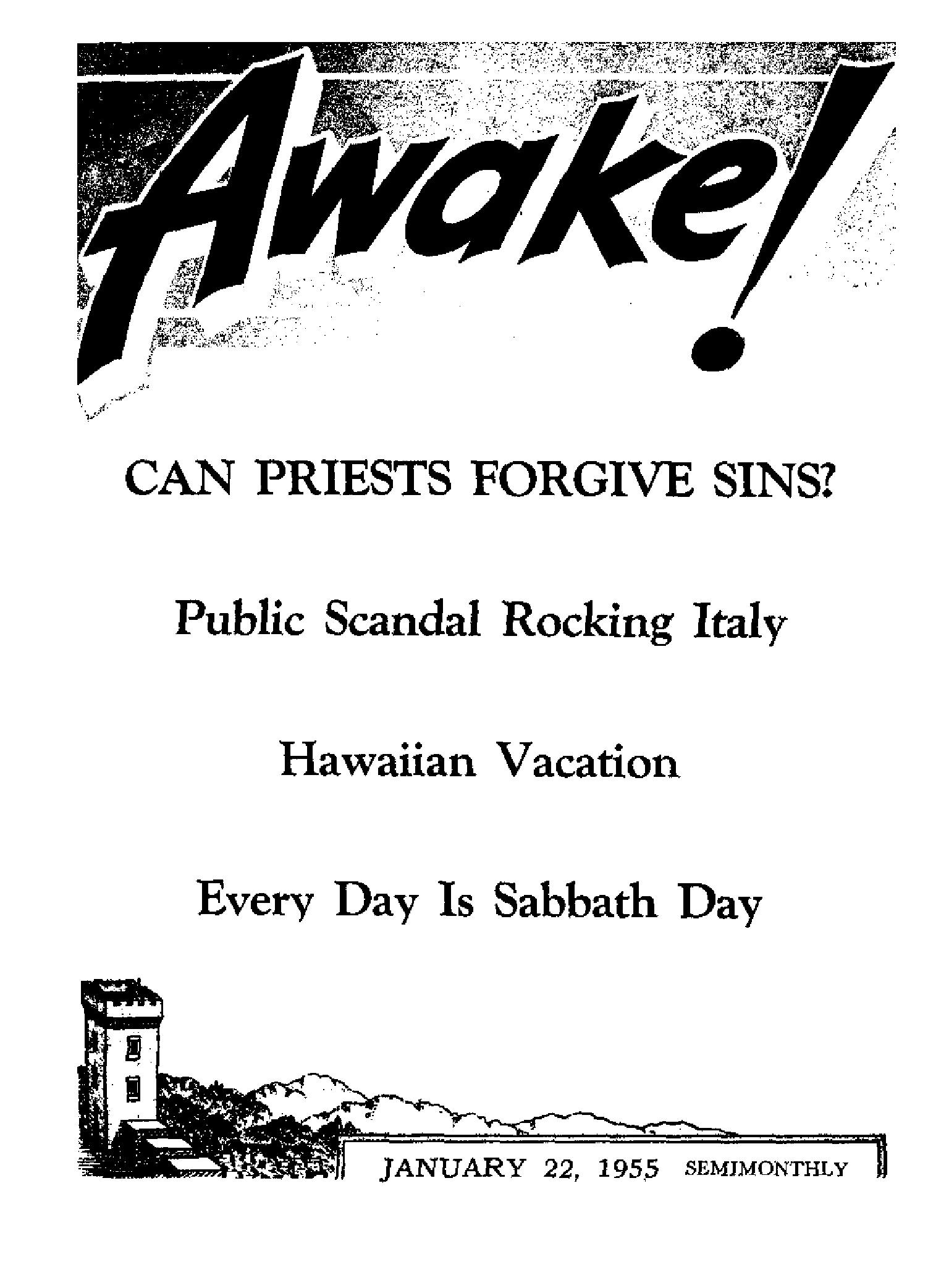
CAN PRIESTS FORGIVE SINS?
Public Scandal Rocking Italy
Hawaiian Vacation
Every Day Is Sabbath Day
THE MISSION OF THIS JOURNAL
News sources that are able to keep you awake to the vital issues of our times must be unfettered by censorship and selfish interests. “Awake!” has no fetters. It recognizes facts, faces facts, is free io publish facts. It is not bound by political ambitions or obligations; it is unhampered by advertisers whose toes must not be trodden on; it Is unprejudiced by traditional creeds. This Journal keeps itself free that it may speak freely to you. But it does not abuse its freedom. It maintains integrity to truth.
“Awake I” uses the regular news channels, but is not dependent on them. Its own correspondents are on all continents, in scores of nations. From the four corners of the earth their uncensored, on-the-scenes reports come to you through these columns. This Journal's viewpoint is not narrow, but is international. It is read in many nations, in many languages, by persons of all ages. Through its pages many fields of knowledge pass in review—government, commerce, religion, history, geography, science, social conditions, natural wonders—why, its coverage is as broad as the earth and as high as the heavens.
“Awake I" pledges itself to righteous principles, to exposing hidden foes and subtle dangers, to championing freedom for all, to comforting mourners and strengthening those disheartened by the failures of a delinquent world, renacting sure hope for the establishment of a righteous New World,
Get acquainted with “Awake!** Keep awake by reading “Awake!”
Published Semimonthly By WATCHTOWER BIBLE AND TRACT SOCIETY, INC.
117 Adams Street Brooklyn 1, N. Y. 'tJ. 8. A.
N. H. Knobs, President Grant Smuts, Secretary
Printed this Issue: 1,300,000
Five cents a copy
Lanfiuas in which the magulnc It gullhhM: BcmlmonUily—Afrikaans. Engliih, Finnish, French, Orman. Hollandlsti, Nurwalsu, Spinlah, Swedish, Monthly—Diplali, Greek, roruiioess, Ukrainian.
Offices Yearly aubicrlptlon Bate
AmorlM, B.S., 117 Adame St., Brooklyn 1, NY. SI Asitratli, 11 Beresford Rd., strwthrteld, N.S.ff. Sa Canada, 40 Irwin Are., Toranlo 6, Ontario 31
England, 34 Craven Terran, London, W. 2 Ta South Afrits, Private Bae, P.O. Biuditonteio,
Traaaraai 7s
Remlttaneai should be sent tn office in your country in compliance with regulations to ruarantee sale delivery of money. Remittances are accepted al Brooklyn from countries where no office Is locateil, by Internationa] money order only. Subscription rates in different countries ere here stated In local currency. Notice of expiration (with renewal blank) is sent at least two Issihs before sutHCrlptlon capites. Changs of addreis when sent to our office may be ennected efteetlre within coo month. Bend your old as well as new address.
Entered is aeond-cisaa matter at Brooklyn. N. Y.
Art of March 3, 1879. Printed in D. S. A
CONTENTS
Praying with a Wrong Purpose
Pearls from the Poor
Can Priests Forgive Sins?
Mithraism in Christendom’s Churches
Confessionals Lead to Corruption
Horror Story Terrifies Children
Is Confession Christian?
Hazel Hits Haiti
Made in Sheffield
“Your Word Is Truth”
Too Big to Explode
Every Day Is Sabbath Day
Ancient Alexandria
Jehovah's Witnesses Preach in All
Public Scandal Rocking Italy
the Earth—Norway
Hawaiian Vacation
Do You Know?
Marie Strikes a Foul Blow
Watching the World
M M M K3 to K3 to <5 oo m m w w
Volume XXXV!
Brooklyn, N. Y., January 22, 1955
Number 2
Praying with a Wrong Purpose
MANY persons pray with a wrong purpose. This is obvious from the many things that people ask for in prayer. Some ask God for wealth; others just ask him to win a football game. But a new kind of prayer that has provoked several questions is prayer to test the effectiveness of prayer. Sound strange? Then let the Los Angeles Times (August 15, 1954) explain about the experiments of preacher Franklin Loehr, director of research for the Religious Research Foundation: "Using plants as guinea pigs, the experimenters set about with meticulous care to conduct controlled tests to determine whether prayer had any measurable effect,” And so "the 150 members of the foundation have prayed and pored over some 24,000 seeds.” Preacher Loehr describes the seed-praying procedure this way:
“Use the prayer methods you are accustomed to, plus any other you want to try. Talk to the seeds, visualize them growing, think of them growing, express to them emotions of love and joy and life-sharing, invoke God’s blessing and power upon them, use the laying on of hands—not physically, so as to touch them, however. Give prayers to your seeds half a dozen or more times daily.”
Is this praying with a wrong purpose? Is it Scriptural to pray over seeds? Is it Scriptural to pray for the sole reason of measuring prayer’s effectiveness?
Nowhere in the Bible do we read of Christians’ praying just for the purpose of measuring prayer's effects. The true Christian, both in the apostles* day and now, knows that there is no need to test or measure the effect of proper prayer. Trying to do so could well indicate a lack of faith. Says Jehovah's Word: “Let him keep on asking in faith, not doubting at all, for he who doubts is like a wave of the sea driven by the wind and blown about. In fact, let not that man suppose that he will receive anything from Jehovah.” —Ephesians 3:20; James 5:16; 1:6, 7, New World Trans.
But now this matter of praying for seeds to sprout. What does a seed have to do with God's kingdom and the vindication of the holy name of Jehovah? Are we to imagine that the great God who runs the universe is concerned about a seed that glory-seeking individuals want to germinate just to see how effective prayer is?
According to nature, seeds may or may not sprout. So there is no glory due the boy in the following statement by preacher Loehr: “It seems impossible to predict at the outset who fis going to be most effective. In one family, a small son was most effective, and he prayed just once,” Why were the seed-prayers of the others not so successful? Is God partial? Or is the truth of the matter the fact that, according
to the laws of nature, we do not know which seeds will sprout? Says the Bible: “Early abroad, to sow thy seed, and let evening find thee still at work; which sowing shall speed better, none knows, or whether both shall thrive to thy profit” (Ecclesiastes 11:6, Knox) This scripture can be applied chiefly to the spiritual seed of the Kingdom, but it can also be applied to literal farming. What is advised is hard work, such as sowing and watering, because we do not know which seeds will thrive.
The important thing is not how well some seeds sprout but, in the matter of prayer, what is right. Jesus gave us the acceptable pattern: “You must pray, then, this way: ‘Our Father in the heavens, let your name be sanctified. Let your kingdom come. Let your will come to pass, as in heaven, also upon earth. Give us today our bread for this day.” (Matthew 6:9-11, New World Trans.) Note that Jesus placed Jehovah’s name and kingdom far ahead of personal needs. And even personal needs were limited to essentials! Is it essential to pray for a seed?
■ For prayer to be answered we must pray for those things that are in harmony with Jehovah’s purpose of a new world and with his written Word, such as for food, for forgiveness, for understanding, for family and for the destruction of the wicked. So, to preacher Loehr’s words, “We have some pretty impressive results, but we make no claims in these fields at present,” we say, in the words of the Bible writer James: “You do ask, and yet you do not receive, because you are asking for a wrong purpose.”—James 4:3, New World Trans.
THE Knights of Columbus said in the St Louis PostDispatch: “Christ empowered Catholic priests not merely to announce that sins were forgiven, but actually to forgive sins . .. And finally note that this authority is not confined to any particular kind of sins, but extends to all sins without exception.” This view is upheld by the Catholic Encycto-pedia, which says: “The pow
er to forgive extends to all sins: 'God makes no distinction; He promised mercy to all and to His priests He granted the authority to pardon without any exception? ”
PriestsJForqive Sins?
Io become informed. This article should prove enlightening.
Regardless of religion or nationality, salvation to life will depend
The means by which priests pardon sins is called the "sacrament of confession. ”
Confession, according to a Catholic catechism, “is a sorrowful declaration of our
sins to a Priest, in order to obtain Absolution [forgiveness] from him.” Auricular confession simply means confession into the ear of a priest.
However, is this teaching Christian, that is, was it taught by Jesus and his apostles? Can priests forgive sins? Documented records of religious historians plus an abundance of Scriptural testimony force this subject to an irresistible conclusion. One point appears unanimous among historians, that is, that neither the Jews nor the apostles nor the disciples practiced private or auricular confession. According to Samuel Barnum, Count de Lasteyrie, a French nobleman, in his History of Auricular Confession, “quotes from Tertullian, Chrysostom, Augustine, Basil, Ambrose, and other Church-fathers to show that among the early Christians confession of sins was made to God alone . . . that they held, as Augustine says expressly, ‘that man cannot remit sins,’—and that auricular confession, unknown to earlier Christians, was the work of popes and councils.” Tertullian, says Lord Bexley, “speaks adversely to auricular confession,” and “in all his references to confession never once describes confession as being made to a priest, but to God.” The Encyclopaedia Britannica, regarding auricular confession, declares that “for the first three centuries little or no mention is made of any such practice.” And McClintock and Strong’s Cyclopaedia concludes: “Auricular confession . . . was wholly unknown to the ancient Church.”
History shows that not until the Lateran Council A.D. 1215 was confession declared an official dogma of the Catholic Church and in the year 1439 in the Council of Florence it was added to the number of “sacraments.” Hence the auricular confession, says Domenica, “lacks nearly 1400 years to be a Christian and Apostolic practice.”
Great claims are advanced as to the moral and social value of confession. The Catechism of the Council of Trent asserts that confession not only removes the sinner’s present malady, but serves as an antidote against its easy approach in future; and that it likewise contributes powerfully to the preservation of social order. As to its moral value, the catechism says: “Abolish sacramental confession, and, that moment, you deluge society with all sorts of secret crimes—crimes too, and others of still greater enormity, which men, once that they have been depraved by vicious habits, will not dread to commit in open day. The salutary shame that attends confession restrains licentiousness, bridles desire, and coerces the evil propensities of corrupt nature.” In regard to this declaration, Cramp in his Text-book of Popery declares: “Seldom have so much misrepresentation and untruth been conveyed in so few words. The very reverse of these statements is the fact.”
Confessionals Lead to Corruption
This is certainly strong language, yet no stronger than has been used by many others who have directly known or carefully investigated the facts on this subject. John Henry Hopkins, bishop of the diocese of Vermont, in his book The History of the Confessional, writes: “Where has the boasted moral superiority of the Confessional been found in the countries which continued subject to the papal scepter? What portions of the globe were so noted for robberies and assassinations as the very territories of the popedom? Where were chastity and conjugal fidelity so lightly regarded? Where was, notoriously, so little restraint upon the worst passions of our nature, lust, malice, and revenge? Where was the administration of justice so uncertain, bribery so shameless, per-
sonal liberty so insecure, faction so fierce, cupidity so unscrupulous, despotism so cruel?” All these crimes were committed in Catholic lands where confession was decreed under pain of excommunication.
Lasteyrie, in his History of Auricular Confession, says Barnum, “devotes one chapter to accounts of the seduction of women in Spain by means of confession,” and mentions “the brief of pope Paul TV., January 18,1556, commanding the inquisitors of Granada to prosecute the priests whom the public voice accused of outraging the confessional.” Further, he says: “In 1561, 1564, bulls were issued by the same pope against the same evil. An edict published at Seville in 1563 gave rise to such numerous denunciations of confessors by females that it took 120 days to register them all, and the prosecution of the delinquents was abandoned on account of their prodigious number.”
Roman Catholic archbishop Kenrick is quoted by Edward Beecher in his Papal Conspiracy Exposed as saying: “We scarcely dare to speak concerning that atrocious crime in which the office of hearing confession is perverted to the ruin of souls by impious men under the influence of their lusts. Would that we could regard it as solely a conception of the mind and as something invented by the enemies of the faith for the purposes of slander! But it is not fit that we should be ignorant of the decrees which the pontiffs have issued to defend the sacredness of this sacrament” Little wonder, then, that McClintock and Strong’s Cyclopaedia declares: “Auricular confession is unquestionably one of the greatest corruptions of the Romish church. It tends to corrupt both the confessors and the confessed by a foul and particular disclosure of sinful thoughts and actions of every kind without exception.”
Is Confession Christian?
What about Roman Catholic claims that Christ empowered Catholic priests to forgive sins? The Question Box, a Catholic publication, states: “Auricular Confession is nowhere expressedly mentioned in the Bible,” but adds, “Christ Himself divinely commanded it by giving His Apostles the power to remit and retain sins.” Perhaps Roman Catholics can explain why it is that we do not find one instance where the apostles in their ministry, which covered a period from forty to fifty years, exercised this prerogative if they had it. Nowhere does the Bible say that the apostles or disciples forgave sins. Why this silence?
Did Peter forgive-sins? The Bible says No. In Acts, chapter eight, we find a very significant episode that clearly demonstrates that the apostles never exercised such a prerogative. A certain man named Simon offered Peter a sum of money for the gift of the holy spirit. Peter rebuked the man, saying: “May your silver perish with you.” The man begged for forgiveness. Did Peter forgive him? No. Instead of forgiving him for sins against God, Peter told Simon to pray to God for forgiveness. “Repent, therefore, of this baseness of yours,” said Peter, “and supplicate Jehovah that, if possible, the device of your heart may be forgiven you.” Here was a golden opportunity for Peter to exercise a prerogative to forgive sins if he had had it. Since he did not have it, he told Simon to pray to God for forgiveness.—Acts 8:1924, New World Trans.
Did Paul forgive sins? The Bible does not say so. He had splendid opportunities, too, to exercise that authority had he possessed it. But not having it, he could do no more than Peter, asking sinners to pray to God. At Philippi a jailer inquired of Paul and Silas: “What must I do to get saved?” Paul simply told the man: “Believe on the Lord Jesus and you will get
saved, you and your household.” Not one word was said about his having to confess to a priest or to any other man. Paul, in his letter to the Hebrews (7:23-25), argues that Jesus has no successors, needs no priests as mediators, that by virtue of faith in Christ’s sacrifice sinners can come directly to God through prayer; because Jesus acts as High Priest who is alive forever. "For there is one God, and one mediator between God and men, a man Christ Jesus, who gave himself a corresponding ransom for all.” Christ therefore fulfills the Levitical priesthood. He is man’s way to God and God’s way to man. Being alive, Christ needs no successor or priest to mediate for him.—Acts 16:25-34; 1 Timothy 2:5,6, New World Trans.
What did the most beloved disciple of Jesus, namely, John, have to say about receiving forgiveness of sins? John, like Peter and Paul, refers to Christ as the means of forgiveness. Said he: "If anyone does commit a sin, we have a helper with the Father, Jesus Christ, a righteous one. And he is a propitiatory sacrifice for our sins, yet not for ours only but also for the whole world’s.” "If we confess our sins [to God], he is faithful and righteous so as to forgive us our sins and to cleanse us from all unrighteousness.” “However, if we are walking in the light as he himself is in the light, we do have partnership with one another and the blood of Jesus his Son cleanses us from all sin.” The harmony and perfect understanding of the apostles on this point are undeniably apparent. —1 John 2:1, 2; 1:9; 1:7, New World Trans.
For the Catholic Church to quote James 5:16 as support for the sacrament of confession is to throw a boomerang, because James says (New World Trans.), “Therefore openly [not privately or in secrecy] confess your sins to one another,” that is, mutually, which would mean that when a sinner would confess his sins to a priest, the priest, in turn, would oblige by confessing his sins to the penitent. This, of course, is wholly contrary to Roman Catholic practice.
That men can go directly to God for forgiveness, without the need of any earthly priest as an intermediary, is clearly taught throughout the Scriptures. Jesus, for example, instructed: “You must pray, then, this way: 'Our Father in the heavens, . . . forgive us our debts, as we also have forgiven our debtors.’ ” He makes no mention of a priest. Who is it that forgives our sins? God himself answers: “I am Jehovah thy God, the Holy One ... I, even I, am he that blotteth out thy transgressions for mine own sake; and I will not remember thy sins.” To Jehovah the psalmist David confessed, saying: “I acknowledged my sin unto thee [Jehovah], and mine 1 iniquity did I not hide: I said, I will confess my transgressions unto Jehovah; and thou for* gavest the iniquity of my sin.”—Matthew 6:9,12, New Wortd Trans.; Isaiah 43:3,25; Psalm 32:5, Am. Stan. Ver.
Understanding John 20:21-23
But you ask: "How are we to understand John 20:21-23, which is cited in support of the Catholic doctrine?” This scripture, according to the New World Translation, reads: “Jesus, therefore, said to them again: ‘May you have peace. Just as the Father has sent me forth, I also am sending you.’ And after he said this he blew upon them and said to them: ‘Receive holy spirit. If you forgive the sins of any persons, they stand forgiven to them; if you retain those of any persons, they stand retained.’-” Please note, Jesus did not send them out to act as confessors. He merely assures them that the holy spirit would enable them to declare forgiveness; that Jehovah and not they would actually do the forgiving. That this is the correct under-
standing is assured us by none other than Jesus himself wno, after his resurrection, declared that “on the basis of his name repentance for forgiveness of sins would be preached in all the nations—starting out from Jerusalem.” That the apostles so understood Jesus* words is obvious by Peter’s reply to the question: “Brothers, what shall we do?” Peter told them: “Repent, and let each one of you be baptized in the name of Jesus Christ for forgiveness of your sins.” The good news that the apostles declared was that salvation was through Jesus Christ.—Luke 24:46-48; Acts 2:37, 38, New World Trans.
Discussing this point, Angelo Lo Vallo in his article “Were the Apostles ‘PriestConfessors* ?” says: “When the Roman Church interprets verses 20-23 of the 20th chapter of John, she customarily tells her adherents that Christ addressed these words to the apostles, who were the only ones present at the moment. In doing this she deliberately meddles with the facts of Scripture and leads her people astray. For even the Roman Catholic version of the Bible, the Douay, uses the term 'disciples’ and not 'apostles* in verse 19 as descriptive of those present on this particular occasion. In this instance the word 'disciple’ is a generic term that refers not only to the apostles but also to the other disciples, among whom were women such as Mary, the mother of Jesus, and the other Marys. Therefore, if the Roman Church wants to interpret this statement of Christ as meaning to confer the power to forgive or retain sins, then to be logical she will have to admit that all those present—including the women—obtained this spiritual power to remit sin.
“But the Roman Catholic Church cannot do precisely this, because she would then run the risk of being accused of borrowing from paganism and of establishing in the Church a new caste system of priestesses’ To circumvent this embarrassing difficulty, she arbitrarily restricts the term disciple as referring only to the apostles. Once she does this she stands contradicted by one of her own rules of Scripture inter-pretation—namely, that when a word, phrase, sentence, or text has more than one meaning, no one, not even the Pope himself, has the right arbitrarily to accept only one meaning and restrict its application to only one person or group of persons to the exclusion of all others. Thus, in this case, the Church must be adjudged guilty of violating this all-important norm, and consequently all arguments that she might advance in defense of her thesis must be rejected as entirely unreliable.
“Moreover,” says Lo Vallo, “if Christ, when He uttered these words, intended to make the apostles priest-confessors with a priestly character on their souls from which flowed a spiritual power to forgive or retain sins, then when and where did all this happen to Thomas and Paul? Thomas was absent on this momentous occasion; and Paul was not yet converted to Christ. No amount of theological hair-splitting will ever enable the Roman Catholic Church to solve this difficulty.”
So, by weighing all the testimony before us, we are forced to conclude, even as did Barnum, that neither pope nor bishops nor priests have the right or the authority or power to forgive sins, that sins are forgiven only through faith in Jesus Christ, that, as one writer said, “the so-called sacrament of confession is a mere human invention, unscriptural and anti-scriptural, unalterably and grossly immoral in its nature and tendency, fraught with the most imminent and dreadful danger, temporal and spiritual, to priest and to people, to the church and to mankind, for this world and for the world to come.”
MADE IN
Sheffield
'7^
By “Awake!11 corretpondent in Britain NGLISH mariners of old used to sing
day “hea pute< The haps
Hearts of oak are our ships . . To-he "hearts of oak" have become ts of steel,” and the land once refer its oak is now noted for its steel, ity of Sheffield has done more, per-than any other town to enhance this reputation, for wherever the word “steel" is mentioned, certain to be heard also is the name “Sheffield.”
From the quiet English countryside—the producer of oak—to this center of steel, with its streets and factories and chimneys and smoke, seems a far cry. But no, this mighty industrial city was born by trickling streams, in green cloughs and with the fresh scent of heather in its nostrils. Even today the beauty of its surrounding countryside has not been lost and, to quote a popular saying, Sheffield is but “an ugly picture in a beautiful frame.”
By the fourteenth century Sheffield was already known for its production of cutlery. Sheffield’s prominence today is due, not just to its fine cutlery, but rather to the value of its specialized steel and immense steel forgings. The important factor is the value of Sheffield’s special steel, such as steel that can be drawn out into wire strands one thousandth of an inch thick or steel able to stand the severest test in a modem jet engine or steel that must withstand steam at a working pressure of 1,400 pounds to the square inch. The price of some special tungsten steels is as high as eighty-five cents a pound. And it has been estimated that Sheffield’s annual one million tons of steel are equal in value to
the other fifteen million tons produced throughout Britain!
The Evolution of Steel
These modem Achievements have not come about suddenly. Says Mary Walton in her book Sheffield, Its Story and Its Achievements: “The industry which was to overshadow all the others grew slowly in its early stages. Huntsman’s invention of crucible steel took place about 1740, and steel manufacture was well established, on a small scale, by 1780, but it was not until after 1815 that the industry really got started on that sweeping and spectacular progress which carried Sheffield without interruption to her place as the City of Steel.
“On May 1st, 1161, Richard de Bush, as lord of the manor of Kimberworth granted to the monks of Kirkstead Abbey in Lincolnshire 'a site within the territory of Kimberworth (near Sheffield) for their houses and an orchard and four forges, to wit, two for smelting iron and two for forging it, whensoever they wished, and leave to dig for ore throughout the territory of the township, so much as would be sufficient for two furnaces.’ The smelting and forging would be carried on mainly in the open air, and not always in the same place, as primitive smelting required the full force erf the prevailing winds in the absence of effective artificial blast.
“The technical secrets of the Middle Ages were not committed to writing. All we know of the process of early iron smelting is that ore was put in a furnace and packed around with charcoal, and the fire kept alight by continual refuelling for several days; then the whole mass was allowed to cool down, and the lump of melted iron taken out at the moment which practice had proved to be best.
“Unfortunately we do not know what proportion of fuel to iron was used, or what was the state of the iron when it was judged best to take it out. The degree of heat, the amount of fuel, and the length of the smelting process would determine whether the resulting metal was pure iron or mild steel. Whichever was made, might be the result of choice or a degree of ignorance.”
Around the year 1700, there is a record of Henry Ball, a Sheffield steelmaker, who was engaged to “make slitt and gadd” steel It was evidently at this time that steelmakers began to reason that if hammering would rid the iron of some of its impurities then other methods might be found to purify it; and if iron would absorb carbon to make it hard, then possibly other elements could be added to make steel of the quality desired. No doubt this is how Benjamin Huntsman reasoned. Having been born in Lincolnshire, he settled in Handsworth (now a suburb of Sheffield) in 1740. By trade he was a watchmaker, and possibly his interest in steel sprang from his desire to create a good watch spring. Huntsman’s work can be said to have helped the development of that highgrade steel for which Sheffield is so famous.
Hand-hammering was superseded by the steam hammers that gradually grew to accommodate the sizes of forgings. But not in size alone did they grow, for these modern giants are as precise as they are powerful, a modem 800-ton hammer being able to crack a nut without damaging the kernel. But steam hammers alone were insufficient and only with the development of forging presses have the heaviest of present-day forgings been made possible. No less important are the forging plants that can shape masses several feet in diameter by exerting a continuous squeeze of 6,000 tons or more. These modem plants, together with their auxiliary cranes, rotating gear and other tools for manipulation, are equally a's fascinating to watch as the furnaces. It is in the large melting furnaces that the huge ingots of steel are produced. The spectacle of such a plant at work on hot masses of steel, upward of 200 tons in weight, is one to be remembered.
melting, Charging and Tapping
Whatever the requirement, the steelmaker knows how to “Charge” his furnace with the elements required. Normally, steel is melted from specially selected pig iron and scrap. This may be done by the “openhearth” method or by electric heat, since this yields steel very free from nonmetallic inclusions and which possesses increased resistance to shock effects. As the scrap and pig iron start to melt, sulphur and other impurities, through an acid process, are expelled. This is known as deoxidation. Now comes the time to “charge” the furnace with the special alloying elements. There are many of these: titanium, cobalt, columbium, chrome, nickel, molybdenum, manganese, to mention but a few. The requirements govern the choice and the steelmaker knows his mixture as a Yorkshire housewife knows her Yorkshire pudding.
Then comes the time to empty the furnace, a process known as “tapping.” White-hot, molten steel is rather like milk in appearance and just as easy to pour. But with 200 tons in the furnace a special lifting and pouring gear is necessary together with the workmen’s high degree of skill. The order to tap the furnace, however, comes from a metallurgist. A small sample, of steel will have been taken from the furnace to his laboratory. Then if his special tests show the steel has been charged correctly and if all the other processes are up to standard, he will give the order to tap the furnace. The steel is now transferred to a large bucket and taken to the ingot pits by overhead rails. Here the steel is poured into ingot molds and left to cool. Soon it will be converted into billets or bars for commercial purposes.
Hollow Forgings and Stainless Steel
One of the most interesting operations in modem steelmaking is the production of “hollow forgings.” Normally, when we think of a steam boiler we visualize many plates riveted together. But with the increase in the thermal efficiency of steam plants over the last few years there have come higher steam pressures and temperatures. Steam boilers have to be made stronger, and this has largely led to the abandonment of riveted constructions and to the substitution of forgings in a single piece, A celebrated achievement along this line was the production of twenty-four hollow-forged, seamless boiler drums for the transatlantic liner Queen Mary.
In making hollow forgings the furnace needs to be heated, charged, tapped and the ingot allowed to cool. When cold the ingot can be cut to length and a hole trepanned through it, thus completely removing its center. In this way it is possible to keep one end of a drum completely closed, the other having only a small manhole for inspection.
In 1914 the process of making stainless steel was discovered in Sheffield. It was Harry Brearley, born in Sheffield, who played an important part in its development and who, in fact, took out the American patent.
TubaLcain was a “forger of every sort of tool of copper and iron.” From earliest times metals have played a big part in man’s life, often to his own hurt. We may rejoice, however, in the knowledge that in the new world of God’s promise this planet's resources will be used in the peaceful purposes of its contented inhabitants and will find their legitimate places in beautifying the earth to the praise of its Creator, Jehovah.
Too Big to Eoplode
A United Press dispatch, dated September 21, 1954: A new book says America now has a “super-giant” hydrogen bomb probably powerful enough to knock out an entire nation with a single blow. A copyrighted, condensed version of the book, which was written by James Shepley and Clay Blair, Junior, of Time magazine, has appeared in the magazine U.S. News d World Report, The authors say that the missile has an explosive force of nearly forty-five million tons of TNT. And they add that “it seems more than probable that no people could survive” the impact of such a bomb.
Shepley and Blair say the estimated power of the bomb is so terrible that officials decided not to risk setting it off during the tests in the Pacific this spring. The government never has said publicly how much power it thinks the big bomb packs. But sources revealed last May that it was officially rated at between forty million and forty-five million tons. That would be twenty4our hundred times the force of the A-bomb that hit Hiroshima.
ANCIENT ALEXANDRIA
By "Awakal” correspondent in Egypt
_ JT WAS in 332 B.C. that Alexander the Great I built In the western part of the delta of the 1 well-known Nile River a city, and called it by his name. The city was situated on a strip of land between the Mediterranean Sea and the big lake now known as lac Mariout. After Alexander's death and the division of his empire, Alexandria flourished as a capital under the rule of the Ptolemies and came to be an artistic and literary center of the East. Before the time of Christ it could boast many temples and museums and a remarkable library that contained almost 700,000 volumes. Apart from this notable repository of knowledge, which was burned by the Romans in 48 B.C., Alexandria was also famed for its 400-foot-high lighthouse that was classed among the seven wonders of the world.
Alexandria was a center of Greek philosophy and a prosperous commercial city, dealing with the Mediterranean countries and the lands of the Far East, such as Ceylon, India and China. Its history can be divided into two important periods. The first covered nearly a thousand years, from 332 B.C. when the city was founded until it was conquered by the Arabs, A.D. 641. The second period extends from the Arabian conquest up through the present day.
During the city's early history it was the home of many Jews, who even had their own senate and judicial council. In the course of time these Jews forgot the Aramaic and Hebrew languages and spoke only Greek, which led to their being called Hellenists. On Pharos, a small elongated island near Alexandria, seventy-two prominent Greek-speaking Jews began the translation of the Hebrew Scriptures Into the Greek language. It was this translation that was used extensively by the first-century Christians in preaching to the Hellenist Jews and that was used by the apostles themselves. Today it is known as the Septuagint (or “LXX,” indicating the number seventy) version. Fragments of this translation are kept at the Cairo French Institute of
Archaeology and are of outstanding importance due to the fact that they contain the Tet-ragrammaton, or the four Hebrew consonants of the divine name Jehovah, amid the Greek text and are of either the second or the first century B.C.
It is thought possible that Alexandria received the message of true Christianity through Egyptians who had been present in Jerusalem at the time of Pentecost and there took in knowledge about salvation through Jesus Christ. However, the Alexandrians intermingled Christianity with pagan philosophies.. Athanasius, a bishop of Alexandria, played a vital part in the production of the Nicene Creed and the adoption of the trinity doctrine. False teachings brought divisions among the people, and religious division is very evident in Alexandria to this day. Among the city’s population of about a half million people there are many conflicting denominations, including Orthodox Coptics, Catholic Coptics, Greek Catholics, Syrian Catholics, Armenian Catholics, Protestant groups, and, of course, the Moslems, who are the greatest in number.
It was in 1930 that Jehovah’s witnesses began to proclaim to the many nationalities who live in Alexandria the good news of Jehovah’s established kingdom. During the first couple of years three people met in a home for study. Then two full-time missionaries arrived. It was necessary to use Bible literature in many tongues—carrying the literature in at least three languages whenever Kingdom publishers engaged in the house-to-house ministry. The work in this city has grown until today there are ninety-five active ministers sharing in the proclamation of the Kingdom good news. Despite opposition on the part of certain so-called Christian denominations, Jehovah’s name is being made known more and more, and additional sheeplike ones continue to abandon this world’s dying system of things to enjoy the peace and safety that come from Jehovah’s hand.
PUBLIC SCANDAL
ROCKING ITALY
CORR
PlaCES ENDANGERING ITALIAN DEMOCRACY!
By “Awake!” correspondent in Italy
THE biggest public scandal in the postwar era and in fact for many a year of Italian modem history is now rocking Italy. This scandal continually threatens the present government and may yet have grave unforeseeable consequences in the future. It is the topic of conversation everywhere. The ship of state is being rocked by the sea of malcontentment aroused by the Italian people? What has caused so much public clamor that even the international press has taken notice of it?
On April 11, 1953, the body of a young girl, Wilma Montesi, was found on a deserted beach near Rome called Tor Vaian-ica. After a brief investigation the police stated that she had died by accidental drowning. Because of much agitation by the press, where references had been made that the girl had been murdered, the district attorney's office opened a judicial investigation on the case. They too confirmed the report of the police and concluded that after a full investigation all insinuations and calumnious stories making their rounds were unfounded, and hence closed the case. Their report was dated January 3, 1954.
Sensational Revelations
But the matter was far from being closed. The press was in constant fermentation. Silvio Muto, publishing his own relatively unknown newspaper, made the allusion that Wilma Montesi died under criminal circumstances after having passed out at a narcotic party. Soon after the closing of the first judicial investigation, Muto, the newspaper reporter, was indicted for trial by the district attorney’s office for having placed in circulation false and defamatory statements. Just as this trial was about to begin, the district attorney’s office closed for the second time their judicial investigation as to the death of Wilma Montesi. This investigation had been started in order to calm public criticism. Again the conclusion was accidental drowning.
On the first day of the trial Muto sustained his innocence by naming two prominent persons in Roman society, Piero Pic-cioni and Ugo Montagna, as involved in the death of the girl. He referred to other individuals that could give the court more information on these individuals. Figuring prominently in his story was Anna -Maria Caglio, already well known for her statements to the press against Ugo Montagna. She seemed to be in a position to know, having been his mistress up until a short time ago. She claimed that she left him when she found out about his corrupt dealings.
The defense lawyers called on Anna Maria Caglio to support what Muto had written in his newspaper. Out came some stories that rocked Italy to its roots. Of out-
standing interest in her story appeared a hunting lodge near Rome named “Capo-cotta” that was run by Ugo Montagna, her former boy friend. Accounts of sex orgies, narcotic parties, etc., that had taken place at Capocotta came out that offended all sense of morality. She testified that involved in the case was a gang of dope smugglers using the isolated area near Capocotta and Tor Vaianica (where the dead girl’s body was found) for their smuggling activity.
According to Caglio’s story, once on April 29,1953, she was with Piero Piccioni and Ugo Montagna when they called at the ministry of interior. Ugo Montagna and Piero Piccioni went in to talk with the national head of the Italian police, Pavone, and having returned to the car Montagna is reported to have said, “I have taken care of everything." She claimed that this was in reference to the Montesi murder. Other incidents were recounted showing the close association of Montagna with high government officials. These sensational revelations had a stupefying effect on the people. Even more incredible and astounding appeared the fact that she had already told her story to the district attorney when he had investigated the rumors regarding the death of Wilma Montesi.
Many of her declarations had a dramatic confirmation during the trial from a report prepared by the carabinieri, the semimilitary police force of the government. Muto’s lawyers were demanding that the report of the carabinieri on Montagna be read, since it was in the files of the district attorney’s investigation on the Montesi case. Despite attempts on the part of the district attorney to prevent the reading of this report, the judge finally permitted it to be read in court. This sensational report showed the great influence Montagna had on various high government officials. Other well-known personalities were named as personal friends and business associates of Montagna. Among these was the personal physician of the pope, Count Galeazzi Lisi, the national head of file Italian police, Pavone, prefects, Piero Piccioni, and other lawyers and doctors. It showed that Ugo Montagna was the sole administrator of the corporation running Capocotta, having as a- business associate Count Galeazzi. Montagna was shown to have had a rather long criminal record, a spy for the Nazis and Fascists, then a companion of the Allies, procuring women of easy morals for his associates. This came not from some young, supposedly revengeful mistress but from a report signed by Colonel Pompei of the carabinieri!
The scandal took another melodramatic turn. The national chief of police, Pavone, resigned the next day after the reading of the Pompei report! On March 12, 1954, another report on Montagna in the district attorney’s file received from the treasury department of the government was read in court. This dealt with his business dealings and various associates in corporations formed, naming the individuals implicated. Some names had already been brought out by the report of the carabinieri. His income tax evasion was exposed.
Things were looking bad for Montagna, To stop any further incrimination against him and to warn the “higher-ups," Montagna called a press conference the next day, stating that should he talk: “This isn’t to exclude the end of the world. Each one will have to assume his own responsibility before the law and public opinion." With this declaration he released a list of names of those who frequently paid visits to Capocotta. On the list appeared names of royalty, generals of the army, air force and carabinieri, high government and police officials, deputies, prefects, lawyers, doctors, etc.
Accusations
AH over Italy interest was high on the case. What would happen next? Where would this chain reaction stop firing? Repercussions were heard in Parliament. To save face and stop the public clamor for action on the part of the government, the prime minister appointed a minister of his cabinet, De Caro, to conduct an investigation on departments of the government and their relations to the Montesi case and charges of corruption.
March 20, 1954, tension is high around the court building where the trial of Muto is still going on. Due to the dramatic turn of events heavy police reinforcements are seen around the building to control the jam of curiosity seekers anxious to learn what is being said inside the court building. On the witness stand sits Anna Maria Cag-lio voicing more sensational words: 1‘Unfortunately, I learned that the head of the band dealing in the traffic of narcotics is Montagna, who is connected with the disappearing of many women. He is the brain of the organization, while Piero Piccioni is the murderer!” These accusations made the political implication, already grave, take even a more serious turn, because the father of Piero Piccioni is the minister of foreign affairs and a leading figure in the Demo-Christian party, which has the majority in Parliament.
The public and the press were more keyed-up than ever in wanting to know what the truth was and who had caused the murder of Wilma Montesi. On all sides the demand was mounting for the judicial forces to take action and reopen the case concerning Wilma Montesi. It became apparent that Muto was no longer the one to be on trial. Finally, the district attorney asked the judge to suspend the Muto trial and to turn back to the district attorney’s office all the material dealing with the Montesi case and to reopen the judicial investigation for the third time on the death of Wilma Montesi. On March 23, the Muto trial was suspended and the third judicial investigation opened! This time a judge of the appellate court, Dr. Sepe, was given charge of the investigation.
Third Investigation and Arrests
As the months pass public interest follows closely the various developments of the Montesi affair. On July 1, 1954, the Minister of the Cabinet De Caro made a report on his findings in a stormy session of Parliament. De Caro refused to discuss the judicial aspects of the Montesi case until the judicial branch finished Its investigation. Only the conduct of governmental agencies was discussed. The most reliable newspaper of Italy, the Corriere Della Sera, stated that the results of the investigation were “very thin,” and probably did not satisfy anybody.
The press followed closely the investigation made by Dr. Sepe. Over 700 witnesses were called by him for questioning. Each day speculations could be found in the press on what probably was said and what might happen. Actors and actresses were called in to be questioned as well. Piero Piccioni is an Italian band leader who had received training in Harlem, New York, and was the first Italian band leader to introduce be-bop in Italy. Practically all strata of Italian life figured in on the investigation. During all his investigation Dr. Sepe made no announcements except to summon individuals for questioning or arrests of minor characters who had lied under oath.
On July 22,1954, Dr. Sepe handed to the district attorney’s office the first part of his report and then a second part on September 10, 1954. Over eighty-six large volumes containing the proceedings of the investigation were given on which an indictment could be based. At this time three
of the caretakers of Capocotta were arrested with one of their wives. It is Mt that their testimonies were the ones that broke the case, although their information was not given voluntarily. As yet no action came from the district attorney’s office. To prod this office along, and as a precautionary measure, Dr. Sepe had the passports revoked of Piero Piccioni, Ugo Montagna and that of the former police chief of the province of Rome, Saverio Pdlito. This indicated in which direction the investigation would now go and possible implication in the murder. Expectations were now running high that the end of the case might be in sight after almost a year and a half.
On September 11, 1954, Dr. Sepe made an unusual announcement that he was suspending his investigation until an indictment or other indications would come from the district attorney’s office. To the fore came more rumors and charges against the government that they were stalling and trying to cover things up.
Events began to precipitate and became melodramatic. September 19,1954, Attilio Piccioni, the minister of foreign affairs, resigned his office. He claimed that he could thus better defend his son against the false charges certain to be levied against him. Late September 21, 1954, Piero Piccioni was arrested at his home charged with the death of Wilma Montesi. Ugo Montagna was arrested for favoring the accused murderer and trying to cover Pic-cioni’s guilt. The police chief of the Rome province, Saverio Pdlito, who had directed the original investigation on the Montesi case, was not arrested because of his age but was charged the same as Montagna plus “having done this with the abuse of power and the violation of the duties of a public official.” So it seemed that the theory that Wilma Montesi died by accidental drowning was now definitely set aside.
Repercussions
Block-letter headlines appeared in the papers making these announcements. Police and troops were confined to their barracks ready for any possible rioting. The news spread like wildfire through the streets of Rome, as the people became more and more excited. Rapidly followed charges against about thirty other individuals who either testified falsely or otherwise sought to obstruct justice. Among these are some of the police officials who carried out the original investigation on the Montesi affair. More dramatic arrests are anticipated and there is no telling how far these may go.
The Communists, always exploiting every turn of this affair, brought the matter up again in Parliament and the Senate charging the government, during stormy sessions, of being morally unfit to rule the nation. In both houses, however, a narrow vote of confidence was obtained by the government. Yet the future of the present government does not appear very good. Already the Communists have gained much by this affair.
The international press has reported on the case, making unfavorable comments on the political setup in Italy. The Manchester Guardian stated that the Montesi affair had assumed the proportion of the famous “Dreyfus affair” of France during the last century. The Economist of London stated that a turn in Italian politics can be expected and not to the advantage of the Italian democracy.
At this writing Dr. Sepe is continuing his investigation questioning individuals indicted. The second phase of the investigation is expected to last for some time yet before the trial comes up. No telling, however, what further findings there may be.
By “Awake!11 correspondent in Hawaii
MOST of us have at some time had the desire to travel, to visit some of those “faraway places” we have read or heard about. And with our speedy modes of transportation in this day and age it is nothing for people to vacatioij far away from home in the hope of “getting away from it all ” at least for a short time. Usually, when one thinks of vacationing, the summer months pop into mind, but today the modern airlines have made it possible to take vacations any month of the year. Those who want to escape the chilling blasts of a cold northern winter can in a few hours' time be basking on a beach of a summer clime. Time was when travel was for the ultrarich, but with the introduction of tourist rates it is now possible for more and more persons to see a few of earth’s beauty spots.
One spot that is becoming increasingly popular with tourists and vacationers each year is Hawaii, a group of islands located in the blue Pacific some 2,000 miles off the western coast of the United States. Maybe you have longed to visit these islands, but just never could seem to afford it or find the time. But, then, there are always the “eyes of the mind,” and with a bit of imagination one can be carried far away. So let us take you on such a trip to Hawaii, isles of tropical beaches, sunshine, pineapples, lovely flowers and awesome volcanoes.
If you approach from the east you may near the islands just as the early morning sun is tinting the fluffy blanket of clouds below a rosy hue. Look sharply there to the left and you can see the faint outline of the island of Molokai through the early morning clouds. Now to the right, outlines of the island of Oahu are becoming visible out of the gray. Minutes more and you are sighting famous Koko Head and Diamond Head craters, and the stewardess announces that in five minutes you will be landing at Honolulu International airport, one of the busiest in the world. There happens to be a celebrity aboard, and so a troupe of singers playing ukuleles and accompanying hula girls is on hand for a real Hawaiian welcome. Around your neck is placed a lei or garland of flowers, a token of Hawaiian hospitality, and now you are “officially” there. Past the gate you stroll through the spacious airport lobby, and after your luggage is received a taxi whisks you off to a hotel of your choice-
As you ride along you are impressed with the mountains; they have green foliage all the way to their tops, and you are amazed that they are so close by. This makes you aware that Honolulu is built along a narrow strip of land between the mountains and the sea. It is a clear morn-
ing, but large, white billowy clouds are piled above the peaks, engulfing some of them. As you- get closer to the city you are quite amazed to find it a modern one with many automobiles, modern stores and shops along palm-lined avenues—far more up to date than you had anticipated.
Soon you are on the new arterial highway right along the harbor and in the heart of the city. At one of the piers you see the Luriine docked, a beautiful white queen of the seas that plies between Hawaii and the United States for the benefit of those who have time for a more leisurely vacation. Right beside it is the famed Aloha Tower at the foot of Fort Street, the main business artery. Its towering height welcomes many a ship into the “peaceful harbor,” which is the English translation of the word “Honolulu.”
Your driver enters Ala Moana Boulevard, right along the ocean, and motors past Ala Moana Park, with its beautiful green lawns studded with swaying palms. Between their stately trunks, whitecapped breakers beckon invitingly. On the left you catch sight of the heights sections, many homes dotting the slopes almost to the very tops. What a wonderful view they must get from there, you muse. Your thoughts are interrupted by your crossing over a bridge where, on both sides, are many yachts and smaller boats of all descriptions. You learn it is the Ala Wai Canal and Yacht Club, very picturesque indeed.
And now, after long anticipation, you are told you are approaching famed Waikiki, about which you have heard so much. Entering Kalakaua Avenue you pass by rows of ultramodern shops displaying gay “Aloha” prints, Hawaiian crafts of wood and odd curios. To the left the driver points out Lau Yee Chai’s famed Chinese restaurant with its distinctive oriental architecture. What are those attractive gardens on the right with the bright coral towers rising above the trees? Of course, none other than those of the widely advertised Royal Hawaiian Hotel. The Moana Hotel and the newly built Surfrider follow in rapid succession, and then there it is—Waikiki Beach, a long stretch of white coral sand dotted with figures in bathing attire lolling at ease, drinking in the tropical sunshine, And the water!—a most gorgeous hue of aquamarine spaced at intervals with whitecapped breakers rolling gently and evenly into shore. Just right for surfriding, as you were told. And then you see them, brown-skinned natives standing on surfboards, skillfully riding the waves, just as the travel folders showed. So this is Hawaii!
In the days to fallow you have the opportunity to take some of the many sightseeing tours. A “must" for every tourist is the drive past splendid estates, winding up through jungled Nuuanu Valley to a summit where a world-famed panorama, the vista from Nuuanu Pali, bursts suddenly into view. From about two thousand feet elevation you see the rolling slopes of windward Oahu, a carpet of greens dotted with banana and papaya groves, herds of dairy cattle, and coconut groves with the blue Pacific stretching beyond as far as the eye can see—truly a tropical paradise.
Maui, the Valley hie
From the glowing descriptions told by fellow tourists you conclude you must see some of the other islands too, and so a local travel agency makes arrangements for you to fly to the Big Island of Hawaii, from which the island chain gets its name. Conveniently you are scheduled with a stopover on the island of Maui. On the way the pilot flies low, skirting the northern shores of Molokai, and the stewardess points out the Kalaupapa settlement for
sufferers of Hansen's disease or leprosy located on a low peninsula cut off from the rest of the island by sheer cliffs, accessible only by boat or small plane. All along this island these steep, green-covered cliffs rise abruptly out of the sea, their sides broken by deep valleys with waterfalls at their heads. You cannot resist a few camera shots to add to your growing collection of color pictures.
You soon alight on Maui, the Valley Isle, and during your stopover there a visit is made to Haleakala—“House of the Sun.” This is the world’s largest extinct volcano. Its crater is 27 miles in circumference and 3,000 feet deep. To watch the brightening colors of dawn come over the crater rim above the clouds, out of a silence so deep it can be felt, is to experience one of the supreme moments in Hawaii. On the sides of this huge crater you see the famed Silver Sword cactus, a rare variety growing in only one other place in the world.
The Big Island of Hawaii
Anxious to see the Big Isle, you once more board the plane, and leaving Maui behind, you fly over the ancient and almost primitive Hawaiian community of Hana on the slopes of eastern Maui. It is not long until the peak of Mauna Kea, covered with snow, is sighted off to your right and, if the day is clear, active Mauna Loa can be seen rising far behind it. Your plane follows the coast line all the way to Hilo, second-largest city in the territory. The slopes are green with field after field of growing sugar cane. Hilo is called the orchid capital of the world because of the many Vanda orchids raised here for commercial shipment. Also, almost every resident has a plot of orchid plants growing in his yard. Further, due to much rainfall, everything here is fresh and green, ideal for the many large tree ferns to be seen almost everywhere. Your visit takes you about twenty miles through fem jungles to Kilauea volcano. Watching steam pour from deep crevices; peering into the deep fire pit, Halemanmau; scanning huge Mauna Loa in the distance, all this makes you realize that the volcanic islands of Hawaii are still a world in the making, and as a mere human you feel dwarfed indeed!
On the return trip to Honolulu you fly over the island of Lanai, leased by Hawaiian Pine and given exclusively to the raising of pineapples. The fields of plants far below, laid out in neat rows, make an unusual pattern and remind one of a forma] garden.
Time permits a short trip in the other direction from Honolulu to the oldest island of the chain, Kauai, the Garden Isle. Its age gave it a long start over its sister islands in the slow process of covering its bare surface with soil and foliage. This, with abundant rainfall, explains the luxuriance that gives it the name Garden Isle. Verdant mountains, sandy beaches, scenic rivers and flowing fields of sugar cane are a feast to the eyes, and, as a climax, your trip takes you to Waimea Canyon with its sharp peaks and steep slopes. Because of the horizontal rock strata of varied colors it is often called the “miniature Grand Canyon.” Higher up the mountains the road suddenly ends at Kalalau Lookout, a panoramic view looking 4,000 feet down to the sea.
As you prepare to leave Hawaii, a feeling of regret possesses you. You know you will miss the colorful flowers and scenery, the tropical palms and the beautiful sea, and the peaceful, easy-going way of life you have sensed here. As you watch the shore line fade away in the distance you carry with you many pleasant memories and hope'that some day you can return for a longer stay in Hawaii.
Marie Strikes A Foui Biow
By “Awake!” corr®*pQrtd»rtt in Japan
DUMBER “15” is what the Japanese called her, but the United States army and navy meteorological stations preferred the name “Marie.” This dainty title was attached to one of the most treacherous and destructive typhoons in the history of Japan.
…