Awake!, August 8, 1954
Download: PDF — Awake!, August 8, 1954
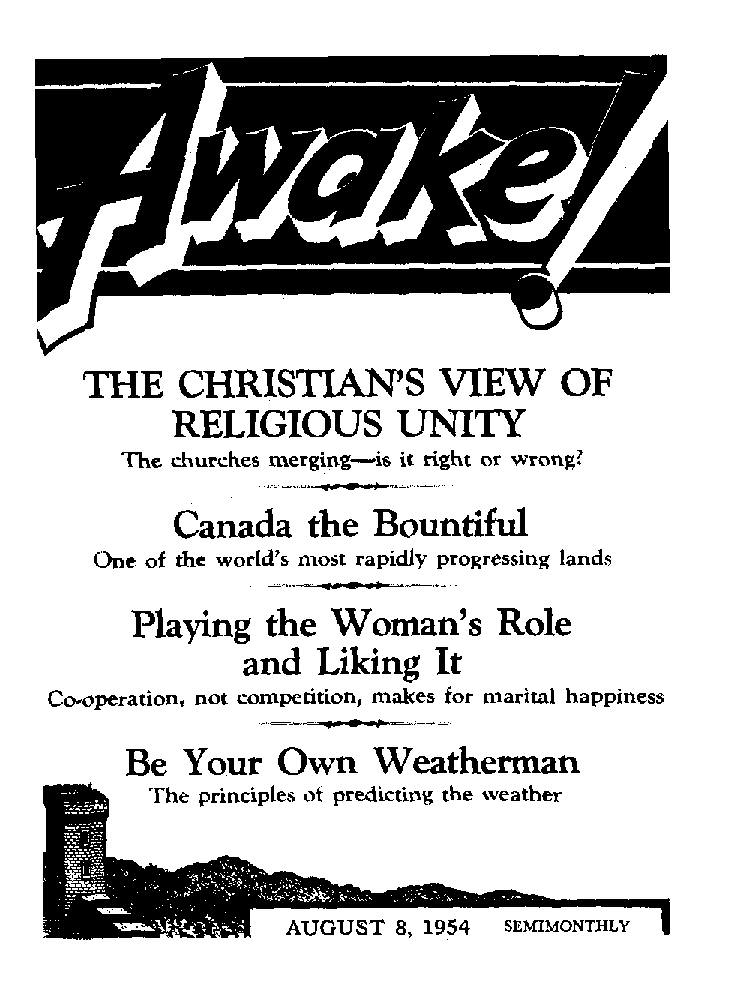
THE CHRISTIAN’S VIEW OF RELIGIOUS UNITY
The churches merging—is it right or wrong?
Canada the Bountiful
One of die world’s most rapidly progressing lands
Playing the Woman’s Role and Liking It
Co-operation, not competition, makes for marital happiness
Be Your Own Weatherman
THE MISSION OF THIS JOURNAL
News Bources that are able to keep you awake to the vital Utuev of our time* must be unfettered by censorship and selfish Interests. "AwakeP has no fettem It recognize? facts, faces facta; Is fires to publish facts. It U not bound by political ambitions or obligations; it U unhampered by advertisers whose toes must not be trodden on; it is unprejudiced by traditional creeds. This Journal keeps itself free that it may speak freely to you. But it does not abuse its freedom. It maintains integrity to truth.
"Awake 1** uses the regular news channels, but U not dependent on them. Its own correspondents are on all continents, in scores of nations. From the four corners of the earth their uncensored, on *the-scenes reports come to you through these columns. This Journal’s viewpoint is not narrow, but is international. It is read in many nations, in many languages, by persons of all ages. Through its pages many fields of knowledge pass in review—government, commerce, religion, history, geography, science, social conditions, natural wonders—why, its coverpage is as broad as the earth and as high as the heavens,
“Awake 1” pledges itself to righteous principles, to exposing hidden foes and Subtle dangers, to championing freedom for all, to comforting moymers and strengthening those disheartened by the failures of a delinquent world, reflecting sure hope for the establishment of a right* eous New World.
Get acquainted with “Awake!*’ Keep awake by reading “Awake 1"
Published Semimonthly by WATCHTOWER BIBLE AND TRACT SOCIETY, INC.
117 Adams Street Brooklyn 1, N. Y+, UP S, A.
N. H. Kkokr, Present Grans Stjitss, Secretary
Printino this issue: 1,250,000
Five cents a copy
Remittances should be sent to office in yo\ir country In compliance with regulation; to fuaranfee safe rtelirery of money. Remittances are accepted at Brooklyn from countries where no office is located, by Inteenationat money order only. Subscription rates in different countries art hen stated In local currency, Natice of expiration (with renewal blank) is sent at least two issues before [nrtwcrlptlon expires. Cbanie of address when sent io oi;r offer may be expected effective within on* month. Send your old aa well as new address.
Act of March 3, 1870. Printed 1.
Lanflvwt Is which thfo iM>|uln* b piblltttt: Semimonthly—Afrikuru, Kngllah, Finnish, French, German, MollunriUh, Norwegian, Spanhh, Swedish. Monthly—Banish, Greek, Portuguese, Ukrainian.
Mtees Yearly mbreriplion Rate
Anuria*, UX. 117 Arians St,, Brooklyn 1, N.Y, (1 Asifralta, 11 Bereitord Bd., StretWld, N.S.tf, 0i Canada, io Irwin At*., Toronto 5, Ontario SI En*lM<, 34 Cnren Terrace, London, W. 2 7 s
Stitt Africa, Print* Bag, P.O. BlamUfonteh,
Transvaal ?»
Entered as second -class matter at Brooklyn, X. Y
CONTENTS
The Need for Leadership
The Christian’s View of Religious Unity 5
True Guide Ignored
The World Council Aims at
Religious Unity
Toward the Wrong Goal
Canada the Bountiful
Predicting Weather in Reverse
Be Your Own Weatherman
Marvel of the Human Eye
Swedish Radio Censors Religion
Playing the Woman’s Role and Liking It 21
A World Without Insects Desirable?
"Your Word Is Truth”
The Creator of Peace and Evil
Jehovah’s Witnesses Preach in
All the Earth—Brazil
Do You Know?
Watching the World
Volume XXxv
Brooklyn, N. ¥., Aufjuit 8, 1934
Number IB
The Need for Leadership
T3DAY there is an urgent need for leadership. Because of its lack both the rulers and the common people are beset by doubt, fear, suspicion and anxiety. And in no place on earth is this lack of leadership more apparent than in Washington, D.C., the capital of the United States, which nation claims world leadership for itself. Concerning this need of leadership in Washington the Sunday editor of the New York Times recently said:
“To the visitor who comes to the capital these days, seeking light and possible leading, all of Washington seems a kind of Foggy Bottom. He encounters mists of uncertainty, clouds of suspicion, shadows of fear. What is foremost clear is that we are possessed in these difficult days by two great fears: the fear of depression and the fear of communism. There is a vast yearning for leadership. The nation is worried and this worry is reflected in the capital.”
Concerning this need for leadership the editor, Lester Markel, went on to say: “Leadership is needed to state and restate the great truths that have been obscured by the fogs; to bring light into the dark areas of ignorance and the darker areas of prejudice. A leader... must decide what is, according to his best judgment, the right course and he must follow that course regardless of the findings of the polls or the cries of the commentators,” Markel also observed that today there is no “Moses who can lead us through the Red Sea of communism.” Everyone that is at all familiar with the fear, suspicion, uncertainty and confusion that have been created in Washington by the triple threat of communism, McCarthyism and economic depression will certainly agree with the foregoing as to the lack of leadership.
Nor is there a lack only of political leadership. The lack of religious leadership is also obvious to all well-informed observers, such as Harvard president Nathan M. Pusey.,Speaking at the opening convocation of Harvard's Divinity School he said that “there is an almost desperate urgency” for fresh and convincing religious leadership to counteract the widespread lack of religious knowledge and faith. “We have not been well taught about religion, and there is as a consequence a very widespread religious illiteracy and corresponding little religious practice.” He stressed the lack of faith,—The News, Newport, Rhode Island, September 30, 1953.
Why all this lack of leadership? Why are the political leaders of the world unable to bring the people out of ‘the mists of uncertainty, the clouds of suspicion and the shadows of fear'? And why have the religious leaders failed to teach the people well about religion? Evidently because, in the words of editor Markel, they have failed “to state and restate the great truths.” For this failure they are without excuse.
Without excuse? Yes, for those truths are forcefully stated in the Bible, the Book having a wider circulation than any other, barring none. And that Book has been made understandable by the witnesses of Jehovah who daily use every means of communication at their disposal to bring that understanding to the attention of all, high and low. In fact, no one has been in better position to gain an understanding of these Bible truths than the president of the United States, who for many years had them brought to his attention by his own mother, who was one of Jehovah’s witnesses. Oh yes, give the Bible lip service —but to take its principles seriously, to study to understand its teachings and prophecies, that is another matter!
Why, even the religious leaders who profess to be Christian assure the people that the principles of the Bible cannot be applied to a modem age and that were anyone rash enough to try to do so he would land in a mental institution. So to where do leaders look? People magazine tells us:
“Capital Astrologers: Top Leaders Seek Her Advice—Jeanne’s Callers Include Mamie Eisenhower, Washington Officials. In a Washington that constantly scans the horizon for what’s ahead, Jeanne Dixon stands out like a beacon. Using a crystal ball, she has looked into the future, come up with so many astoundingly accurate predictions that today some of the capital’s top leaders and businessmen call on her regularly.”—March 10,1954.
This astrologer may be able to guess certain political and economic events of the immediate future but is she able wisely to advise those who come to her as to what they should do about it? Would there be a “Foggy Bottom” condition in Washington if she were really able to help Mamie Eisenhower and the top officials that come to her? No, she cannot supply the solution, she cannot point her callers to the way out, and least of all can she furnish any protection from Jehovah’s wrath, which his Word shows will soon be expressed against all those who ignore it.
Highlighting the folly of those who seek safety by consulting such astrologers are the words of Isaiah, written some three thousand years ago: “You have wearied yourself with your many counselors, now let them stand up and save you—those who map out the heavens, and gaze at the stars, and tell you month by month what fortune will come to you. Lo! they have become like stubble, the fire bums them; they cannot save themselves” nor those who come to them for counsel.—Isaiah 47:13-15, An Amer. Trans.
Jeremiah wrote like fitting words: “The wise men are put to shame, they are dismayed and taken: lo, they have rejected the word of Jehovah; and what manner of wisdom is in them?” Leaders who look to an astrologer for light instead of to God’s Word are blind. And if the blind lead the blind both will fall into the ditch.—Jeremiah 8:9, Am. Stan. Ver.; Matthew 15:14.
There is an able Leader at hand, a modern Moses to whom the people can turn if they will but look in their Bibles, the Greater Moses, whom Peter identified as Christ Jesus. Jehovah has put his spirit upon him and “he shall bring forth justice to the nations.” He will not only lead the peoples through the ‘Red menace of communism’ but also dry up that menace altogether, at the same time ending such other threats to man’s freedom as McCarthyism, fascism, totalitarianism and economic depressions. Why, this Leader will even do away with sickness, pain and death, and with man’s invisible enemies, Satan and his demons. Yes, look to this Witness, who is Jehovah’s Leader and Commander for the peoples, and “cease trusting man, in whose nostrils is breath; for of what account is he?” —Isaiah 42:1; 2:22, An Amer. Trans.
Why are today'* religions apparently more concerned with Interdenominational unity than with doctrinal purity, more concerned with tire than with truth? Why do the various denominations want to get together with other organization! that teach different doctrines? And what should it mean to you? These important question* are hen discussed.
WHEN nations feel that they are not strong enough to withstand their enemies they make alliances with other nations to gain the greater power of mutual strength. When an individual’s problems are too big for him to overcome alone he seeks help from others, the strength of unity. The religions, too, are seeking unity, forming councils, because even they feel incapable of successfully attacking their problems.
The strongest force behind this unity was the huge size of the missionary fields that the religions faced, and the fact that missionaries felt incapable of doing the job alone. Thus it has been said that political threats to religious and missionary freedom galvanized Protestant missionary societies into collective action. This unity of activity eventually led to the establishment of the World Council of Churches. That World Council is their organ of united expression, of mutual cooperation and action. Yet, though united in activity, religions still maintain their doctrinal differences. But is not doctrine an integral part of Christianity? Are the denominations at liberty, after merely acknowledging Jesus’ name, to go any way they wish, taking various denominational paths, disagreeing on basic doctrines? dividing over what Christianity means? preaching different requirements to different people? No! The Christian principle is very narrow-minded as far as doctrine goes. Paul wrote: “Even if we or an angel out of heaven were to declare to you as good news something beyond what we declared to you as good news, let him be accursed.”—Galatians 1:8.*
Christendom's Divided House
However, the so-called Christian religions in general have accepted many new things beyond what Christ and the apostles declared. They have not held to that narrow way of true doctrine. They claim that their multigabled house of divided doctrine is based on the solid foundation of Jesus Christ, while actually its vast wings have spread out to cover an enormous mound of decaying rubble borrowed from paganism. Room after room has been added,
*ln this article texts from the Greek Scriptures ("New Testament") are quoted from the New World Translation, and, unless otherwise noted, those from the Hebrew Scriptures ("Old Testament”) are quoted from the American Standard Version.
each denomination bringing in its own peculiar architecture of ritual and pattern of creedal dogma. Having spread ever farther from its original foundation, the structure of Christendom’s divided house has become weaker, its cracks wider and its divisions evident to even the casual passer-by.
But rather than tearing down the part that was not really built on Christ, the ecumenical movement now endeavors to patch up the whole building and to construct a false front of unity that will conceal the house’s structural weaknesses and architectural imperfections, giving the casual viewer the false impression that the narrow base of true Christianity is broad enough to support the conflicting doctrines of all these divided denominations.
They have high hopes for their structure, but the psalmist reminds us: “Except Jehovah build the house, they labor in vain that build it: except Jehovah keep the city, the watchman waketh but in vain.” (Psalm 127:1) What is his view toward these current attempts to unite Christendom’s divided house ? The Bible shows that Jehovah does not approve of alliances between right and wrong doctrines, and since these doctrines contradict each other some of them must be wrong. Those who would add improper things into Christianity were reminded by Paul that “a little yeast ferments the whole lump.” (1 Corinthians 5:6) Also, Isaiah 29:13 describes with disfavor those who draw near God with their mouth and honor him with their lips, but whose fear toward him is “a commandment of men.” It is these ideas and commandments of men that have prompted denominational divisions, and as long as they continue to teach such contradictory commands their merely claiming the name “Christian” will save neither them nor their interdenominational organization. Remember, Jesus warned: “Not everyone saying to me, ‘Master, Master,’ will enter into the kingdom of the heavens.”—Matthew 7:21.
The Urge to Merge
“God is a.God, not of disorder, but of peace,” and the right way of determining true doctrine is in the way he set out, through the Word he has had written for us, namely the Bible. (1 Corinthians 14:33) Apparently, however, some of the people who propose religious unity care very little about what God has said on the matter. While boasting that their unity is Godgiven, their concern is not with “What is truth?” but “How can we merge?” Thus, Charles Clayton Morrison said in The Christian Century, January 13, that he thinks “Christian unity need not wait upon the solution of the theological problems which bulk so large in the World Council program,” but that the question should be: “How can a united church be achieved, under Christ, which welcomes and embraces our differences?” The answer is simple, Under Christ it cannot. To be under Christ it must teach what he taught, rather than embrace the doctrinal differences that man has invented.
Proponents of the ecumenical movement remind us that there is just one gospel. In that they are right, but which one of these many denominations has it? The ecumenical movement thinks that they all do, but this is impossible, because that one gospel is not divided as many different ways as they are. The ecumenical movement takes as a theme text Christ's prayer, “That they may all be one,” but this entire text from John 17:21 shows that this oneness was as Jesus and the Father are one, and no one has yet shown where Jesus and the Father were at odds on matters of doctrine! The oneness obviously must be in truth, not just in organization.
In The Reformed Theological Review, published in Melbourne, Australia, Febru-
ary, 1954, one clergyman pointed out that the members of the World Council are so divided on doctrine that they have different opinions of what that organization’s requirement for membership means when it says its churches recognize "Jesus Christ as God and Saviour.” Some modem Protestants, members of the World Council, deny the virgin birth of Christ, while other denominations, also World Council members, would consider this denial heresy. Another example of their division: “Supposing the Reformation was right in its judgment on the sacrifice of the mass, how can a Lutheran or a Presbyterian encourage the celebration of such mass? How can, on the other hand, an Orthodox or an Anglo-Catholic encourage a celebration which he must regard as an adulteration of the true sacrament?” Obviously not both views can possibly be right.
The Narrow Christian Way
It would be impossible for an informed person to imagine Jesus associating with and lending support to those who taught false doctrine. It was the human traditions, the doctrines and ideas of men, that had split the Jews in Jesus’ day into various sects and had gotten them off the narrow way of pure worship. Jesus, far from associating with them, told the religious leaders who were teaching these divided doctrines: “You are from your father the Devil.” He called them hypocrites, blind guides, fools, said they were “serpents, offspring of vipers,” "full of hypocrisy and lawlessness.” He said he “came to cause division,” even splitting families over the difference between true and false worship. He said: “He that is not on my side is against me, and he that does not gather with me scatters.” He showed that no lukewarm attitude is sufficient for his followers: “I know your deeds, that you are neither cold nor hot. I wish you were cold or =.se hot. So, because you are lukewarm and neither hot nor cold, I am going to vomit you out of my mouth.”—John 8:44; Matthew 23; 10:35; 12:30; Revelation 3:15, 16.
The Christian way is narrow, not broad enough to cover the interdenominational activity of the world's church councils. The organizations that make up these councils have a zeal for God, but it is misdirected. Their concern is with unifying their organizations, rather than with seeing what is right and actually subjecting their ideas to the truth of God’s Word. They are like those Paul described; "For I bear them witness that they have a zeal for God; but not according to accurate knowledge; for, because of not knowing the righteousness of God but seeking to establish their own, they did not subject themselves to the righteousness of God.”—Romans 10:2, 3.
True Guide Ignored
In discussing the attempts at religious unity, Dr. William Adams Brown, in Toward a United Church, page 43, said that one attempt was made to unite the churches through a return to Bible principles, but, "unfortunately, it soon appeared that those who agreed in accepting the New Testament as their final authority differed as to what its teaching actually was.” But was that the Bible’s fault? Or was it their determination to hold to their previously conceived opinions that prevented them from agreeing on what the Bible said?
Men spell alike because they accept the dictionary as an authority. But these same men, who will conform their spelling to dictionaries that men wrote, will not conform their doctrines to the Bible that God inspired. Their refusal to conform to the Scriptures as final authority, and to come to unity on the basis of what the Scrip-
AUGVST s, isn
tures say, must of necessity betray as false their claim to be Christian, because those Scriptures certainly are the record of what Christ taught and what first-century Christianity and its true worship were before they became corrupted and split into so many different ways. The Bible, therefore, is the Christian’s authority, it must take precedence over all creeds.
Paul wrote to Timothy: “All Scripture is inspired of God and beneficial for teaching, for reproving, for setting things straight, for disciplining in righteousness, that the man of God may be fully competent, completely equipped for every good work.” Today’s religious leaders, however, have become like rowdy children that rebel, each going his own way, rather than like properly disciplined children, orderly in their obedience.—2 Timothy 3:16, 17*
There is no reason for this lack of doctrinal unity. Christ is not divided and he is ever present to teach those who are really his, having promised: “For where there are two or three met together-in my name, there I am in their midst.” (Matthew 18:20; 1 Corinthians 1:12, 13) The fact that their religious organizations are divided indicates that despite their loud claims of being Christian Jesus does not consider their gatherings to be 'in his name/ The holy spirit’s hand is not short today, but their vastly contradicting doctrines indicate that that spirit is not upon them, that they are inventing their own ideas instead of following its leading.
True Guide Applied
Those who have an accurate knowledge and have God’s spirit behind them do not need a tremendous organization to accomplish their work successfully. Their confidence, like that of Christ and the comparatively small group of early apostles and disciples, is not in huge numbers of people, but is in the power of Jehovah God.
Those who really are doing a work that is supported by God do not need to compromise their principles to get a huge voting block or pressure group to look out for their interests. Like the psalmist they say: “In God have I put my trust.” (Psalm 56:11) And it works. When confidence is placed there, a tremendous organization is not needed*
It enables a relatively small group like Jehovah’s witnesses to stand firm in Com-munist lands, while other organizations with far greater numbers capitulate to the Communist rulers. It enabled them to stand firm for more than ten years in Germany, while the other far larger religious groups went along with the Nazi state. It enables them to press forward in missionary work on a world scope, without the need for mutual aid that these other religions manifest. Pathfinder spoke of their “small but vigorous bands.” Zealandia, of Auckland, New Zealand, shamed its Catholic readers by saying that though Jehovah’s witnesses are a minority “nobody ever accused them of keeping quiet about their beliefs,” Life said: “Of U. S. missions in Africa, not the least influential are Jehovah’s witnesses. ’ ’ The PentecostaI Evangel said regarding the Witnesses’ activity in Africa: “They are pressing in everywhere.”
The general confusion of doctrine that exists among today’s so-called Christian religions does not exist among this group, for they simply follow God’s Word, like the. psalmist who said: “Thy word is a lamp unto my feet, and light unto my path?’ (Psalm 119:105) They want unity, but only with those who will accept and conform their beliefs and actions to God's truth, not with others who refuse to do so, whether the others call themselves “Christian” or not.
Thus Jehovah’s witnesses avoid interdenominational houses which are not of
God’s building, having seen that, though the various denominations often look alike from the outside, a study of the Bible, the blueprint according to which they should have been constructed, shows misfit oon-struction, false fronts and showy windows foreign to plan. It is because of this improper construction that their weakness has now reached the point that these denominations must lean for self-support on others whose doctrines they despise. But the Christian’s support is from above, from Jehovah. He will hold clear of association with those who lawlessly follow different doctrines, and will follow the divine command: “Do not become unevenly yoked with unbelievers. For what partnership do righteousness and lawlessness have? Or what fellowship does light have with darkness? ‘ “Therefore get out from among them, and separate yourselves,” says Jehovah, “and quit touching the unclean thing,” ’ ’ “and I will take you in,” ’ ” —2 Corinthians 6:14, 17.
The right course is to find out what God's Word says, to study it yourself, to take no man’s word, but to prove the matter unquestionably. That is the course the Watch Tower Society has taken, going back to the Scriptures to see what true worship really was before interfaith activity with paganism so corrupted it, Lt is getting back to the pure first-century Christianity, to the principles Christ actually taught, and it is receiving Jehovah’s rich blessings for doing so. Now that the denominations of this old world continue to take the wrong course of amalgamating with those who teach different doctrines, you are invited to change your course and to join with the vast multitudes who are separating from this old world’s religions and associating with Jehovah’s witnesses in this right , activity.
THE WORLD COUNCIL AIMS AT
RELIGIOUS UNITY
The Christian’s view toward this month’s assembly at Evanston
SOMETHING new has happened in our time. Within just over four decades the major Protestant and Orthodox religious denominations have come together into a permanent council, the World Council of Churches, which first met in Amsterdam, Holland, in 1948. The World Council’s second meeting will be a major news event when it is held this month at Northwestern University in Evanston, Illinois, U. S. A.
The World Council is part of a movement for religious unity, a movement whose ultimate goal is an all-embracing unification of at least the non-Roman part of Christendom. Called the Ecumenical Movement (“ecumenical” means “catho-olic, universal, world-wide”), this interdenominational activity developed from the nineteenth-century missionary and youth movements and the twentieth-century church conferences that were discussed in this magazine’s July 22 issue.
The World Council’s second assembly, August 15-31, will be an interdenominational gathering of representatives of almost all of Christendom except Roman Catholicism, which refrains from participating. Representatives from 161 member
churches in 48 countries are expected. Participating in the “Opening Service of Worship,” for example, will be Britain’s archbishop of Canterbury, a bishop of the Church of Norway, a representative of the Reformed Church of France, two Methodist representatives from the United States, and the archbishop of Thyateira, Metropolitan Athanagoras of the patriarchate of Constantinople. At this assembly these clergymen and those of many other denominations will be united in a wide scope of interdenominational fellowship.
The Theme
What will they discuss? Their theme is: “Christ—The Hope of the World," and their central task will be to come to an agreement and to issue a statement on what they consider to be the Christian hope for today’s world. This is not an easy task, for the degree of doctrinal division among these men is tremendous. The American viewpoint leans toward political problems, while the European view leans toward theological formulations. Many European clergymen think the return of Christ is the hope for the world; many American clergymen think that their efforts to institute right principles into social and political life present this hope.
One view was expressed by Swiss theologian Karl Barth at the World Council’s first assembly: “We are not the ones to change this evil world into a good one. God has not resigned His Lordship over it Into our hands ... By God’s design is not meant something like a Christian Marshall plan.” The other view, as stated in The Christian Century of January 27, includes those whose hope is no longer based upon the promises of Christ’s second coming, “and who would gladly delete it from the creeds and liturgies if not from the New Testament itself.” How will these clergymen, so widely divided in viewpoint, come to unity on stating hpw they think Christ is the hope of the world? The most apparent solution would be for them to accept some statement that so ignores the issue and so thoroughly holds to a middle ground that both sides can agree to it, expressing amazement at the extent of their unity, while not changing their contradictory viewpoints one iota.
Subtopics must also be considered. The first, “Faith and Order: Our Unity in Christ and Our Disunity as Churches," includes a consideration of the causes of religious division, with the goal, of course, of developing more unity. The second, “Evangelism: The Mission of the Church to Those Outside Her Life,” will include consideration, according to The Christian Century, of “what holds the churches back, and why they cannot break out as the modern apostolic bands Christ intended his church to be.” The third, “Social Questions: The Responsible Society in a World Perspective,” will consider the pressure that is brought upon religion to conform, then to lend strength and support to the prevailing social structures and political aims. Under the fourth subtopic, “International Affairs,” such subjects as the antagonisms between Soviet and non-Soviet societies, the atomic arms race and the U. N. will be considered. A fifth subtopic, “Intergroup Relations,” will take up the world’s racial tensions, and the sixth, “The Laity: The Christian and His Vocation,” will deal with the position of the denominations in the midst of the working world, and what methods and type of work they think the Christian should do.
Thus, seeing that the seventeen-day second assembly of the World Council of Churches has a big job set before it, the question is: How well will it do the job? It is almost certain that controversy will
arise; sharp criticism is to be expected. The problem of interdenominational activity will make some of the clergymen cautious, others impatient. Political issues may cause division, and some disagreements will probably arise on almost every subject. But the simple fact that the religions are getting together in such conferences is considered by many as “the unfolding of a new and promising chapter in church history.”
But will this attempt at unity, this new chapter in church history, be blessed by God? Despite all its impressive numbers and spectacular show, the ecumenical movement’s admitted failure to “break out as the modern apostolic bands Christ intended his church to be” indicates that something is wrong. What its proponents call the “great discrepancy between unity in Christ and disunity in the churches" really raises the question of whether the unity it has is God-given or man-made.
The Background
The Scriptures have a great deal to say about doctrine, but from its earliest beginnings the ecumenical movement has been willing to ignore differences of doctrine when these would prevent the accomplishment of its ends. When the nineteenthcentury student movement sought to develop a “unity which transcends national and denominational lines,” the peak of zeal for one’s doctrines was leveling off. The zeal that had prompted the reformers and various denominational leaders to stand strongly for their beliefs was being lost. More and more they were not Methodist or Baptist or Presbyterian because they had been convinced that that organization, above all others, had right doctrines, but because they were born into it, or converted to it out of convenience, or through other less convincing circumstances than those which had prompted the organization’s founders and early membership.
This view that doctrine was immaterial was brought into the Edinburgh missionary conference tn 1910, the forerunner of the World Council of Churches. From Edinburgh there "sprang a new willingness to respect and recognize wide differences and at the same time to work together . . . Edinburgh launched international, cooperative Christian endeavor on essential tasks without demanding prior theological consensus and by agreeing to hold in abeyance theological differences,” explained William Richey Hogg in Ecumenical Foun~ dations, pages 130,139. From its beginning that conference’s continuation committee was precluded from handling matters that concerned the doctrinal differences of the various denominations. They were to unite in missionary work, each to preach the truth as he saw it, not as investigation might prove it actually was! But since the same doctrine cannot be both true and false at the same time, when two denominations that disagree on doctrine work together in missionary activity, one is- obviously teaching falsehoods, and the other is in an equally dangerous position, supporting it in that teaching, accepting responsibility for the falsehood that is being spread. Thus their “theological differences” should come first, not be held in abeyance; they should find out what really is truth before going out to preach to others.
Other twentieth-century church conferences have similarly erred, have either shunned doctrinal differences altogether, or have approved only those views that everyone could agree upon, ignoring or omitting other relevant facts that are clear in the Scriptures. The World Council of Churches, a descendant of these earlier conferences, continues to repeat the same mistake. Its constitution says: "The World Council of Churches is a fellowship of
churches which accept our Lord Jesus Christ as God and Saviour.” That one statement is the only test for membership. Any other differences in doctrine, worship, organization and ecclesiastical order, whether based on the Bible or borrowed from paganism, are considered to be inconsequential! They boast of their “underlying unity in Jesus Christ,” while ignoring the fact that their branches are so warped, their doctrines so corrupted, that he would not even recognize them!
Toward the Wrong Goal
There are several reasons why the Christian will be very skeptical of such interdenominational efforts as the World Council represents. A folder entitled “Tell Us About the World Council of Churches,” prepared by that organization to explain its purpose, says: “The Wo^ld Council of Churches is like a compass. It seeks to point the way to fuller understanding between the 158 member churches in 43 countries [now 161 churches in 48 countries] , which make up its membership, and tries to suggest what the church can say to men and women in today’s hectic, atom-charged society.” But the Christian’s primary concern is not unity with 161 denominations; instead, he is concerned with a right understanding of the truth.
“The World Council of Churches is like a family,” the folder continues. “The members have a common loyalty and heritage, but they are not all alike and there is no reason to expect them to be. The many churches and nationalities each bring to the ecumenical move- 1
ment their own historic, academic and spiritual gifts.” But the -w—iL I illustration of a family is the ^UmIu wrong one for Christianity. Paul wMIh showed that the Christian congregation is like the human body, SSSS all parts working in unity for the benefit of the whole, not like a family which Jesus showed could be divided on doctrine, when he said: “I am come to set a man at variance against his father, and the daughter against her mother, and the daughter in law against her mother in law.” Truth is the important thing, not unity, and Christ showed that division must exist between those who have the truth and those who do not. Anyone who denies this is not following Christ.—Matthew 10:35; 1 Corinthians 12:12-14.
The folder also says: “The World Council of Churches is like a ship.” But the sailors on this ship have mutinied. “We’re still following the captain,” they protest; yet we hear them say: “He said, ‘Go east,’ so let us go west." “No," another intersperses, “I think north is best.” Others say: “Why not south? Does it matter so long as we all still say we are sailing in his name?” Yes, the World Council is like this ship that, while claiming to sail in Christ’s . name, is more concerned with the fellowship among mutinous sailors than about the true course God’s Word established.
What should one do about it? The Christian must shun interdenominational or interfaith activity entirely, looking instead to true faith. He must resist the tendency to lean on his own ideas, or to put too much confidence in denominational creeds made by men, and should take the wiser course of studying and trusting in the Word that was provided by God, the Bible. Its principles are sound, they are sure. They do not say that just any religion is right, I or that we should unify with
Imw those who preach other doc
trines, just to get a big organization. What it does say about this matter, however, is very much to the point, and is the subject SSSE of the preceding article.
the
By "Awake!" correspondent in Canada
to France, Germany and Spain combined.
The foregoing figures, however, may be somewhat misleading, for much of
CONTEMPLATE, if you can, a land greater in area than the entire continent of Europe, a land whose mineral wealth is so incredible it has never been systematically surveyed, a land where immigrants are welcome, a land where Jehovah God’s goodness is so bountiful that the annual wheat production alone would feed 100 million people, a land where fruit, fish, vegetables, meat and poultry would feed millions more, a land where the majestic grandeur of mountains, forests, lakes and distances defies adequate description. Yet Canada, this land of superlatives, astounding as it may seem, has only 15 million inhabitants, people whose hopes, welfare and prospects are among the finest this earth has to offer.
Among all the nations only Soviet Russia and China have a land area greater than Canada. The Canadian distances are staggering. For example: A person at Victoria, British Columbia, on the west coast is farther away from Canada’s easternmost city, Saint John’s, Newfoundland, than he is from Yokohama, Japan, on the opposite side of the Pacific. A Canadian at Montreal, nearly a thousand miles from the eastern seaboard, is still closer to Liverpool, England, than to Vancouver, British Columbia. Of the ten Canadian provinces, the largest, Quebec, is of itself equal in area
Canada’s northerly territory is uninviting if not actually uninhabitable. The northerly two thirds of the country has less than one per cent of the population. Yukon and the Northwest Territories, an area half as large as the United States, have only 25,000 inhabitants, the equivalent of a moderatesized town. About half of Canada is within the area known as the Laurentian or preCambrian Shield, which stretches from the eastern or Maritime provinces to the Rocky Mountains in the west. Laurentian Shield terrain is generally rough and rocky. It is heavily forested, fabulously rich in minerals and an unparalleled vacationland.
A traveler journeying from the Atlantic to the Pacific would commence in Nova Scotia and New Brunswick. Here a number of fertile valleys relieve the ruggedness of the .woods, lakes and rivers. Continuing westward he would cover many hundreds of miles into southern Ontario and Quebec, where the terrain largely is level, alluvial plains which provide wonderful farm land. Our traveler passing through northern Ontario would see Lake Superior, the largest body of fresh water on earth, actually 350 miles long. From here to the foothills of the Rocky Mountains stretch a thousand miles of the treeless western plains, one of the greatest wheat-growing areas in the world. From the foothills the majestic grandeur of the Rocky Mountains stretches four hundred miles to the Pacific. Some of the most stunning spectacles the Creator has provided for mankind are found among these mighty peaks. Their immensity and beauty beggar description. Colossal jagged summits, like the skeleton of a gigantic dinosaur, reach heavenward; eternal snows are on their heads; fresh and delightful blue-green mountain lakes, fed by age-old glaciers, mirror the glory of the snowladen peaks. Surrounded by such marvels, a man is overwhelmed by his own insignificance before the almighty Creator, Jehovah, who conceived and brought forth such magnificence.
Apart from the breath-taking beauty of the Rockies, the visitor is also charmed by the many wild creatures: friendly black bears, fierce grizzlies, mountain lions, moose, bighorn sheep and a host of others. Minerals, waterfalls, rich mountain valleys and some of the finest virgin timber in the world are to be found here. Yes, here Jehovah God has dealt with a lavish hand both in wealth and beauty. The traveler would then inch his way down the slopes of the Rockies to the shores of British Columbia and the Pacific.
History and Government
Canada was first settled at the beginning of the seventeenth century by the French, and the land was known as New France. The chief settlements were on the banks of the St. Lawrence River in what is now the province of Quebec. French power in North America was broken at the Battle of Quebec in 1759 when the British under General Wolfe defeated the French. The first four Canadian provinces were federated in 1867 by the British North America Act. By 1905 nine provinces had entered the confederation and the tenth province, Newfoundland, became part of Canada only in 1949.
The British North America Act of 1867 made Canada a self-governing dominion, but she was still subject in some ways to the law of Great Britain. The Statute of Westminster, 1931, removed these restrictions and recognized the dominions as “autonomous communities, equal in status, and freely associated as members of the British Commonwealth of Nations.” Canadian ties with Britain now arise chiefly from common allegiance to the Crown. That these ties are nonetheless strong is proved by the tremendous effort Canada made in two world wars to assist the mother country.
The government of Canada is very stable. It has never been overturned or seriously threatened by rebellion. There has not been a semblance of war in Canada since 1814, when there was a brief war with the United States. No guns are mounted anywhere along the almost 4,000 miles of the Canada-United States border. The amicable relations between the two countries are a lesson in good manners to many others.
People and Culture
Many who have learned about Canada through the cinema believe the country is full of Indians, wolves, dogsleds and red-coated Mounted Police. In fact, most Canadians have never seen a wolf outside a zoo. Even the Mounted Police do not wear red uniforms except at parades or as a tourist attraction. “Mounted” is now only a name; few ever use horses. Indians form an inconspicuous part of the population; dog teams have been largely replaced by airplanes and caterpillar tractors that pull sled-trains across the frozen tundra.
Canada has a highly developed civilization with all its attendant features good and bad. The two largest cities, Montreal and Toronto, have each more than a million inhabitants. In the entire British Commonwealth Toronto has the highest building, the biggest hotel, the largest university, and it now has a new subway system —the seventh underground transit system in North America. One third of Canada’s market is within a hundred miles of Toronto, one of the most prosperous communities on the continent.
Montreal is a little larger than Toronto, more cosmopolitan and far more a city of entertainment. Quebec City, capital of the French-controlled province of Quebec, is the only walled city in North America. The present wall and battlements were built in the early nineteenth century following the Napoleonic wars, Quebec is an interesting city. Its 164,000 inhabitants are ninety-seven per cent French speaking. The old, narrow streets are reminiscent of the older quarters of Paris or Rome. And there is a host of other beautiful cities almost too numerous to number. There is Ottawa, the capital of Canada, situated on the Ottawa River; Halifax,' an east-coast seaport; Hamilton, a bustling industrial city; Niagara Falls with its awe-inspiring waterfall; Winnipeg, the gateway to the west; Edmonton, the oil capital of the north; Calgary, a rip-roaring cow town; and Vancouver, the metropolis of the Pacific Coast.
The total Canadian populace has now reached fifteen million, an increase of three million since 1945. The Canadian people in general are tolerant, broadminded and progressive.* They are interested in liberty too. When Jehovah’s witnesses circulated two petitions for a Bill of Rights, more than one million signatures were submitted to Parliament demanding that the basic liberties of the pep-pie be protected. This was an outstanding expression of public opinion in favor of liberty.
In matters of religion the Roman Catholic Church claims to have 43 per cent of the Canadian people on its rolls. The leading Protestant denominations claim 47 per cent. It is admitted, however, by a recent survey in Maclean’s Magazine for December 15, 1953, that these figures are exaggerated by the inclusion of the names of many nominal members. This same publication, mentioning religious progress, declared that “today the greatest gains are being made by Jehovah’s witnesses.”
Agriculture and Industry
Agriculture is Canada’s primary industry and wheat is the greatest single crop. The bumper wheat crop of 1952 came to 687,-900,000 bushels. If this crop were placed in 100-pound sacks and laid end to end, the sacks would stretch 195,426 miles, or almost eight times around the world at the equator.
Lumbering and processing of forest products is Canada’s No. 2 industry. Three out of five pages of the world's newsprint come from Canadian pulp. In the mining field Canada is, for the Western world, the No. 1 producer of nickel, platinum and asbestos. (Soviet figures are unavailable.) Canada is the No. 2 producer of gold and aluminum. Immense iron deposits are now being developed. A giant aluminum development at Kitimat, British Columbia, will make Canada the No. 1 producer of this metal, though the ore will be shipped in from Jamaica. The very valuable metal known as uranium is being produced at
Uranium City and Port Radium in the Northwest ferritorles.
Canada now ranks Sixth among world industrial producers. Time magazine for February 4, 1952, remarked: “In twelve years, Canada has undergone the most impressive industrial development of any nation in the world, a surge of industry and prosperity that Wall Street’s conservative investment firm of Lehman Bros, calls ‘the biggest business story of this decade.’ ”
All of this development has a useful reflection on the lives of the people. Three out of five Canadian families own an automobile; five out of seven have telephones; nineteen out of twenty have radios. The average income per family of four is $4,000, the highest in the world, and $622 above the corresponding United States’ average. Family allowances are paid by the government to the parents of all children under sixteen years of age; unemployment insurance is provided for those out of work; old-age pensions are paid to all over seventy years of age.
Like every other country, Canada has problems. Her problems, however, are not immediately those of fear, poverty, insecurity or probable Invasion. Her problems are mainly those of expansion, enlargement and development. It is a country that is well governed, well administered, and whose people have above-average benefits. Yet, all this material prosperity does not prevent her people from hearing the good Kingdom message, and seeking after the true and eternal liberty and happiness that can come only through Jehovah God’s kingdom under his Son, Christ Jesus. Thus, more than one out of every 650 persons in Canada is having a part in witnessing for that kingdom, and daily more Canadians are learning how through it enduring peace, happiness and prosperity will come to all peoples of all nations throughout the earth.
PREDICTING WEATHER IN REVERSE
■■T IS a difficult proposition to foretell to-Itnorrow’s weather accurately, but how can Mthe experts deduce what the weather was like thousands of years ago? There are many clues,
<t Neville Richardson, writing for The Star Weekly, Toronto, February 28, 1953, says that by “knowing the climatic requirements of fossils of certain plants and reptiles, the scientists, upon finding these fossils, can determine pretty closely the type of weather prevailing in the days these plants and animals flourished. Analysis of pollen grains is considered to give an accurate picture of past climates. Every year plants shower their particles of pollen upon the ground. In old bogs, these pollen grains have been preserved* Digging down in-to a bog is like going into the correspondence in your desk drawer* The oldest material is at the bottom. The scientists can determine the species of the pollen with the assistance of caustic hydroxides. At a glance they can tell the relative abundance of pine, hazel, oak, spruce in a certain area at a certain time. They also have a fair idea of the climatic requirement of each of the species*
<■'. “At the present time, corals grow only in warm seas where the temperature never drops below 65 degrees. Presumably ancient corals required similar conditions for development, and so when coral formations are found in Alberta deposits, it can be pretty safely assumed that at one time in history the temperature in that part of Alberta never dropped below 65 degrees. In fact, the rich oil deposits now being developed in Alberta are associated with these formations* Tree rings, salt and clay deposits are also important guides to past climates and are avidly studied by the scholars/'
Be your Own
EOPLE are prone to be weather forecasters. They possess an inherent craving for information about the approaching atmospheric phenomena. The numerous current weath-- . ?er proverbs indicate
this craving. That is why the weather becomes a never-tiring topic of conversation. Everyone likes to talk about the weather. And even in this day and age of modern meteorology, there is no end of those who would match their skill against those experts with their electronic equipment, in an effort to predict tomorrow’s weather.
Before the government began providing a national weather forecasting1 service in 1870 through the army signal corps, everyone interested in the subject had to be his own weatherman. About sundown, the old-timer would glance up at the sky, briefly study the color of the sun, the cloud formations, the direction of the wind, and almost as quickly and as simply as that, he would predict what tomorrow’s weather would be. But to be doubly sure, he would rise early enough to see the sunrise, check again the color of the sun, the kind of clouds in the sky, the rising or falling temperatures, and that is all there was to it—he was confident of what the weather would be for the day. He was his own weatherman.
The simple formula was that the sun would create the weather, the clouds would foretell it and the winds would bring it. No matter what the weather does, he knew that it always lets you know beforehand. For example: If there were quickly moving clouds that lowered and irl-creased in number toward evening, accompanied by a falling barometer, if these same clouds became darker, mushrooming to the top and flattening out in anvil shape, this was a sure sign of a shower in the making. Dark clouds gathering on the horizon windward warned him of rain or snow, A rapidly rising barometer and steady winds indicated clearing skies. A cloudless sunset in winter meant to build up the fire and make sure there were plenty of blankets on the bed. But a hazy, semi-overcast sky in the summer meant a hot, miserable, sleepless night. If birds gathered together in trees or on the ground it meant that a storm was brewing. So the birds were “sitting it out” before a storm. If smoke curled downward and lingered near the earth it was a sign of a nearing storm. A large halo around the moon indicated rain. If the old-timer’s tooth would ache or his wife’s bunion annoyed her, it was a sign of bad weather, that is, if it was caused from a sudden fall in barometric pressure.
The winds also were full of meaning. A sudden change in wind followed by increasing cloudiness called for the umbrella tomorrow. Wind blowing in different directions at different altitudes indicated unsettled conditions. A strong morning wind often meant a change for the worse, as did a sudden rise in winter temperature. If cirrus clouds thickened and lowered it meant that there would be snow or rain within thirty-six hours. Another rule was that in dry weather all signs for rain fail; and in wet, winter months, the converse is true. So you see, the old-timer had his weather forecasting pretty much down to a science all his own.
But today, the business of predicting the weather is almost entirely in the hands of professional meteorologists, except perhaps for a few amateurs here and there who follow the fascinating study as an interesting hobby. The majority of the people of the civilized world, and particularly the modern-day city dweller, get their weather forecast through the morning paper, radio or television. Some take advantage of the telephone and dial the weatherman. But the extent of the average person’s knowledge of meteorology today is mediocre at best.
In ancient times forecasting the weather was done by reading the signs in the sky. The religious Pharisees of Jesus' day were apparently good at it, because Jesus contrasted their lack of spiritual discernment with their ability to predict clear weather and rains: "When evening falls you are accustomed to say, ‘It will be fair weather, for the sky is fire-red’; and at morning, ‘It will be wintry, rainy weather today, for the sky is fire-red, but gloomy-looking.’ You know how to interpret the appearance of the sky, but the signs of the times you cannot interpret.” (Matthew 16:2, 3, New World Trans.) Sailors and farmers, for whom the weather meant existence, became experts at reading the signs in the sky. The general truthfulness of the Pharisaical forecasts has become crystallized in the proverbs: “Red sky at morning, sailor take warning; red sky at night, sailor’s delight”; and “Mackerel sky, quickly wet or quickly dry.”
Meteorologists of today still rely considerably upon the general appearance of the sky in determining the weather’s next move. Of course, they are aided by receipt of observations from weather stations over several tnousanas oi miles, from ships at sea, and by a good many instruments, the most important of which are the wet and dry thermometer, the wind gauge and the barometer, which measures atmospheric pressure.
Recently, the United States Weather Bureau released information about a highspeed electronic weather computer. According to reports the “weather robot” will “by-pass the human equation in Weather predicting. It will take mathematical formulas and in ninety minutes it will turn out an answer from which meteorologists will be able to read temperatures, cloudiness, precipitation, or whatever is going to happen in the realjn of weather. If a skilled mathematician tried to solve the numerical data fed through the wires and tubes of the modern computer,” this report says, “he would be at the job seven years.” How accurate will this mechanical wizard-of-a-forecaster be? Dr. Harry Wexler, chief of the Weather Bureau’s Scientific Research Division, remarked in answer to the question: “At least as accurate as political prognosticators,” which is not saying much for the machine.
What Makes the Weather?
The Bible answer to the above question is that Jehovah God designed climatic changes. “Thou hast made summer and winter.” “For all the days the earth continues, seed sowing and harvest, and cold and heat, and summer and winter, and day and night, will never cease.” (Psalm 74:17; Genesis 8:22, New World Trans.) How was he able to accomplish this? By tilting our earth at 23| degrees from the perpendicular position. All climatic changes are caused by this apparently small circumstance. It is the inclination of the earth’s axis that causes the changes of the seasons. If the axis of the rotating earth were per-
pendlcular to the plane of Its orbit, there would still be alternation of day and night far all parts of the earth but there would be practically no change of seasons.
The sun is responsible for all heat upon the earth, and as a result Is responsible for atmospheric movement. Basically, the cause of all the winds that blow is the great heating of the atmosphere at the equator, and if these winds did not blow they would not transport the sixteen million tons of water that comes from the oceans and falls as rain every second on the earth. Effortlessly and without charge to man the atmosphere surpasses all the freight carriers that could ever be devised. The wise King Solomon described this cycle as follows: “The wind blows toward the south, and returns to the north. Turning, turning, the wind blows, and returns upon its circuit. All rivers run to the sea, but the sea is never full; to the place where the rivers flow, there they continue to flow.”—Ecclesiastes 1:6, 7, An Amer. Trans.
Another truth about the weather is brought to our attention by Jesus, who, when upon the earth, controlled the winds and waves. Jesus said: “The wind blows where it wants to, and you hear the sound of it, but you do not know where it comes from and where it is going.” (John 3:8, New World Trans.) This is very true, because the air you are now Breathing may have been over the polar icecap less than three days ago; or again it may have been over some blue ocean yesterday; or it may have come from a nearby mountain range just this morning. No one really knows. But wherever it was will determine to a great extent today’s weather.
Clouds are finely divided particles of water, as yet too minute to fall as rain; or they may be thin veils of ice crystals, as the cirrus clouds are. The reason that clouds often form at the top of rising columns of air is that warm air can hold more moisture than cold before it becomes “saturated” and can contain no more water vapor or moisture. There are some thirteen different cloud forms and varieties, but tomorrow’s weather can be easily determined by learning only four cloud types and their relationship to one another. They are cumulus, cirrus, stratus and nimbus.
As with all of Jehovah’s creations, the weather stimulates praise to Jehovah. Knowing the weather signs helps us to prepare for tomorrow’s weather, but knowing the signs of this time will help us escape through the storm of Armageddon fast coming upon this world and preceded by the storm warnings of present world conditions. If necessary be your own weatherman and read this sign.
MARVEL OF THE HUMAN EYE
Some authorities have said that insects can perceive a color that the human eye is blind to. Be that as it may, but the human eye sees all the colors that it needs to, indeed, a lot more than most people realize. Taking .the average person as an example, engineers of the General Electric Cornpany estimate that he can see some 500,000 different colors. Really marvelous! Yet that is only the average person. Experts in color perception, say the color engineers, can see about 1,000,000 different colors!—Science Digest, March, 1954.
Swedish Radio Censors
By “Awake!" correipondsnt in Sweden
N Monday, March 3, 1953, the Swedish Broadcasting Corporation broadcast a discourse about Jehovah's witnesses. The speaker was Erland Sundstrom, an editor in the Swedish Missionary Society (Svenska Missionsforbundet) and an avowed opponent of Jehovah’s witnesses. During his talk he called the teachings of Jehovah's witnesses “fantastic speculations,” "ecstacy” and "hallucinations.” He declared the witnesses as being "ignorant of the central Christian truths as contained in the New Testament.” No proof was forthcoming, just assertions and falsehoods.
…