Awake!, June 22, 1954
Download: PDF — Awake!, June 22, 1954
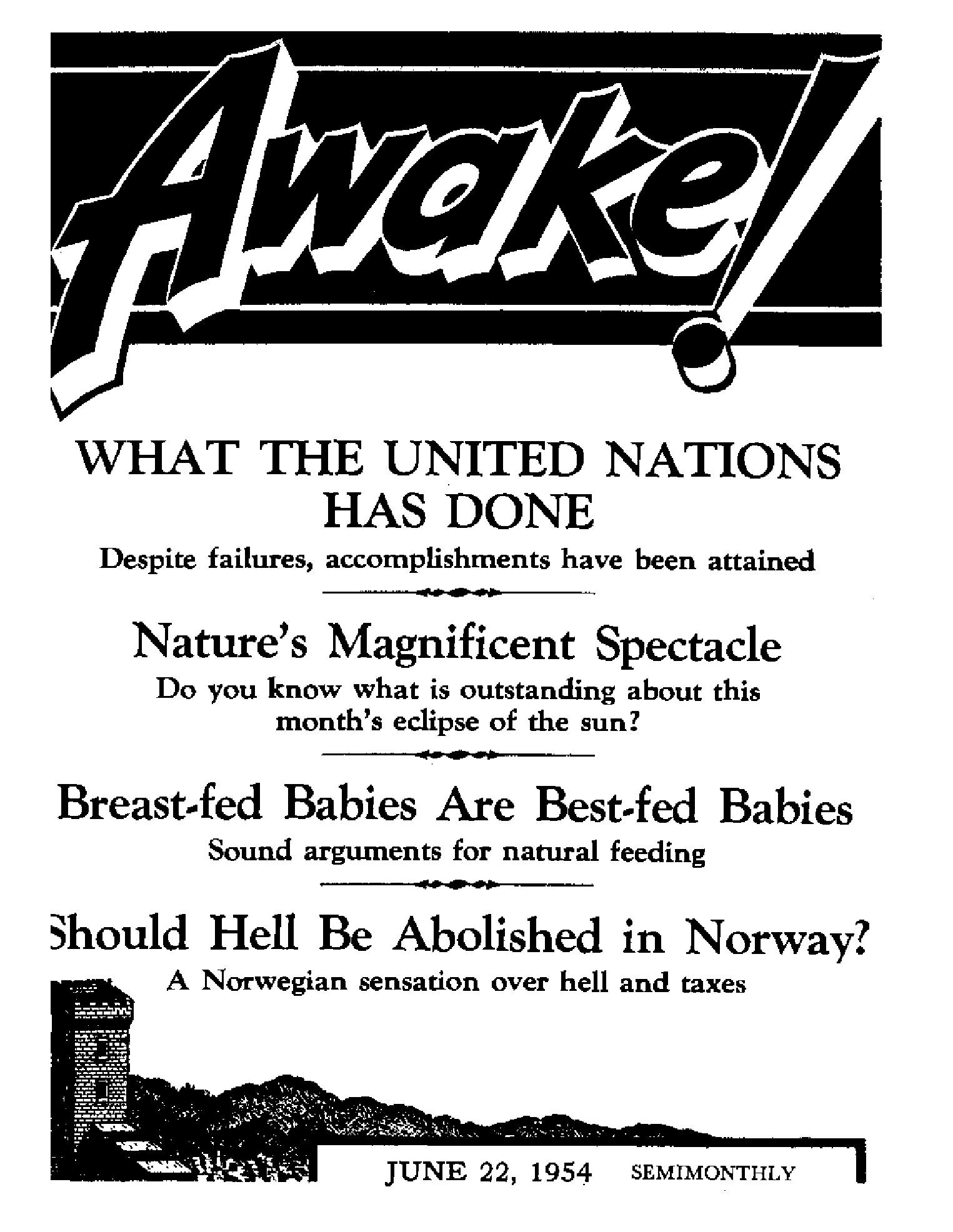
WHAT THE UNITED NATIONS HAS DONE
Despite failures, accomplishments have been attained
Nature’s Magnificent Spectacle
Do you know what is outstanding about this month’s eclipse of the sun?
Breast-fed Babies Are Best-fed Babies
Sound arguments for natural feeding
Should Hell Be Abolished in Norway?
A Norwegian sensation over hell and taxes
JUNE 22, 1954 SEMIMONTHLY
THE MISSION OF THIS JOURNAL
News source* that are able to keep you awake to the vital issue* of our times must be unfettered by censorship and selfish interest*. “Awake I" has no fetters. It recognize* facts, faces facte, is free to publish facts. It Is not bound by political ambitions or obligations; it is unhampered by advertisers whose toes must not be trodden on; it is unprejudiced by traditional creeds. This journal keeps itself free that it may speak freely to you. But it does not abuse its freedom. It maintains integrity to truth.
“Awake I” uses the regular news channels, but is not dependent on them. Its own correspondents are on all continents, in scores of nations. From the four corners of the earth their un censored, on-the-scenes reports come to you through these columns. This journal’s viewpoint is not narrow, but is international. It is read in many nations, in many languages, by persons of all ages. Through its pages many fields of knowledge pass in review—government, commerce, religion, history, geography, science, social conditions, natural wonders—why, its coverage is as broad as the earth and as high as the heavens.
“Awake I” pledges itself to righteous principles, to exposing hidden foes and subtle dangers, to championing freedom for all, to comforting mourners and strengthening those disheartened by the failures of a delinquent world, reflecting sure hope for the establishment of a righteous New World.
Get acquainted with “Awake!” Keep awake by reading “Awake!"
PnBLiBBKb Semimonthly Br
"WATCHTOWER BIBLE AND TRACT SOCIETY, INC.
HI Adams Street Brooklyn 1, N. Y., U.S.A.
N, H. Knom, Pre.ident Grant Seitsr, Seoreeary
Printing this issue: 1,250.000
Five cents a Copy
Ungaaii* h whl«h maiuln* li
Semimonthly—ATrikmtni. Efltiiah, Finnhn, French. HoUtnditfi, Nnrwtidftn, Ap*njah. Swedish. MonUily—Dinitih, Greek, Poruifirsr, Ukrainian Offices Rai*
V.J., 1. N.Y,
Autrallt' 11 Beresford Rd., AtralMtld, N 8-W. M Cahali, 40 Irwin Aft., Toronto S. Ontario *1 England. BA Craron Terrace. [<mdon, W. 2 7n Strife Atrlaa, Private jug. P.O £1 andiron tain, Tranarul
ft'MlttanM be aenl tx> nfflce In your twin-try jn corn pile Tim wUi» reguliilorn In giignnl** ufe delivery of mcmey. Horn]fiance* are acwpted *1 Brooklyn from countries where no office is locitod. by International money order only. Suborrlptlon ralfj Jn different counirfen n/n here niafetf fry Mt?*/ currency. Matic* of expiration (with renewal blank i is sent at leiat iwo issue* before mbacription pt pim. Chant* *f addrau When cent to our crflVe may h* *xt>o<?ted effective 1 (bin one month. Keivi jw old as well a* new addmi.
4* wMnd-tliM ntatier at Brooklyn, N. Y. Act of March 3. ^871. Printed in U R. A
CONTENTS
Needed—A Marshall Plan tor the Navajos
What the United Nations Has Done
Averts World War
Other Accomplishments
Nature’s Magnificent Spectacle
Even a Bird Should Know
His Phone Number
Australia's Underground Lakes
Should Hell Be Abolished in Norway?
Plywood
Breast fed Babies Are Best-fed Babies
Nursing Benefits Mothers Too Psychology—Its Schools Final Shot of the Civil War Let's Visit Java “Your Word Is Truth”
You Are Being Marked—How? Jehovah’s Witnesses Preach in
All the Earth—Bolivia Do You Know?
Watching the World
Volume XXXV
Brooklyn, N- Vl( June 22, 1&54
N umber 1?
Needed—A Marshall Plan for the Navajos
GENEROUS Uncle Sam, the great United States government, which has posed as the “Great White Father” of the American Indian for over a century, literally spent billions of dollars in a Marshall Plan (European Recovery Program) to save Europe from total collapse. Asia and the Pacific area, Latin America, the Near East and Africa all received of his hand. But for the destitute and needy of Uncle Sam's own ward, the American Indians, the “Great White Father” has nothing to give* His heart has been stone toward them for the past hundred years. Instead of giving, he now schemes to take away what little is theirs through treaty.
No wonder the minister of welfare of one of the Middle East nations, who recently visited the United States to study the nation's health and welfare programs, remarked, after visiting several reservations of American Indians of the Southwestern States: “I know why conditions are as they are in the rural areas of my country,” he said. “But I can't understand why there is so much poverty and disease among your Indians. You are the strongest, wealthiest and healthiest nation in the world. You spend millions of dollars help* ing improve conditions among the poorer peoples of the world. This is a basic tenet of democratic living and also tends to prevent communism, but you permit these same conditions to exist among your own
Indians. Why?” Questions like this the “Great White Father” finds difficult to answer.
Conditions in Navajoland
The Indian certainly could use some of Uncle Sam's generosity. When the Nation* al Committee on Indian Health of the Association on American Indian Affairs met in New York in the summer of 1953, the following report was issued, according to Howard A. Rusk, M.D.: “Pulmonary tuberculosis death rates among Indians are about five times higher than those of the rest of the population. Brain tuberculosis, especially in little children, is seven to twenty times as great. Pneumonia death rates run five to six times higher among Indians* In some Indian tribes, one-fourth to one-half of the school-age children have impaired vision resulting from the scars of preventable eye infections. The enteritis death rate among the Navajo and Papago children in Arizona is twenty times that of white children in the United States.”
Dr. James R. Shaw of the interior department's Bureau of Indian Affairs revealed that the average life span of Navajo Indians was “less than twenty years.” Whereas the statistics from the United States Public Health Service show that the life span in the white population of the United States now averages 68.4 years* Dr. Shaw further declared that “deaths from tuberculosis among Navajos in 1952 ran to 9.3 times the rate for whites; those from dysentery, 13 times; from measles, 29.5 times, and from gastroenteritis 25 times/’
The United States government boasts of its loyalty to treaties and peace pacts and of its willingness to uphold these treaties. But its treaty with the Indians it has never kept* In 1868 the “Great White Father” made a treaty with the Navajos, and in Article VI of that treaty guaranteed to them a teacher and classroom for every thirty children of school age* Today after these many years *'fifty per cent of all Navajo children receive no formal education whatsoever”; “seventy-five per cent of the Navajo Tribe is illiterate, as compared to Negro illiteracy of 16*1 per cent, foreign-born white illiteracy of 9.19 per cent and native white illiteracy of 1*5 per cent*” Reportedly “there are only fifty-three Government schools on or adjoining the Navajo Indian Reservation, with an attendance of 12,730 Navajo children and that approximately 12,000 Navajo children do not attend schools because the Government has failed to provide them/'—The Cowl for June, 1952.
This same authority states that “the. average per capita income for the Navajos is approximately only $81 per year, as compared with the national average of $861 per year”; that, including the value of home-grown products, food consumed by the Navajos is only about “$1 weekly for each person”; that over “one half of all Navajo deaths occur among children under five years of age,” and “that in spite of the extremely high rate of disease among the Navajos, there are only six Government hospitals, nineteen doctors, eighty nurses and three dentists serving the 65,000 Navajos spread over 30,000 square miles of desert land.”
The “Great White Father” might publicize his high standards of education to the rest of the world and boast of his bounties* But in his own land exists a people whose needs surpass those of many foreigners who have asked and received and some who have not asked but still receive of his aid and abundance* On account of the shameful neglect of the Navajo, his education and health, the unfulfilled treaty promises and provisions, any unfriendly nation might well say: “Why, then, do you look at the straw in your brother’s eye, but do not consider the rafter in your own eye? Or how can you say to your brother: ‘Allow me to extract the straw from your eye’; when, look! a rafter is in your own eye? Hypocrite? first extract the rafter from your own eye, and then you will see clearly how to extract the straw from your brother’s eye.” The “Great White Father” claims to be Christian* To Christians the apostle Paul said: “Certainly if anyone does not provide for those who are his own, and especially for those who are members of his household, he has disowned the faith and is worse than a person without faith.”—Matthew 7:3-5; 1 Timothy 5:8, New World Trans,
White Man Out to Scalp Indian
Instead of providing for his own, the “Great White Father” took away first the forests and farm land from the Indian and forced him into desolate reservations, which Will Rogers, Jr., called a “vast concentration camp of desert and nonirrigable land*” Next it was oil that the white man wanted. Now it is uranium. Various proposals are being presented before Congress of the United States to “emancipate” the Indian, “to remove his ‘ward’ status under Government trusteeship and send him into the white man’s society to compete.” Dorothy Bohn, chairman of the Indian Affairs Committee of the Cascade County Community Council, Great Falls, Montana, termed the proposals “another ‘land grab’ in the guise of ‘emancipation*’ ” What the
white man wants is not to free the Indian but to turn the reservations over to private exploitation. The day that this happens will mark the greatest scalping the Indian has received in a hundred years.
Representative Michael J. Kirwan of Ohio said that the Indian situation “is something America should be ashamed of.” But there are no signs of shame, and no doubt the Indian has little expectation of mercy and kindness. These are for others, but not for him. The Indian must wait on Jehovah God, who will rid the earth of all greedy persons and restore the earth to a paradisaic state. Then not only the Indian but all lovers of righteousness will rejoice!
What the United Nations Done
Experts say the popularity of the United Nations is definitely on the wane. Skepticism about its future is voiced. People are demanding to know what the United Nations is doing to justify its existence. “Why hasn’t it done more?’’they ask. “Nine years have passed since it went into operation. That should be sufficient time for it to prove itself. But what has it done besides talk?”
Many persons were led to believe that the United Nations would be some sort of a “cure-all" exercising magical powers that would in a sensational way transform this world into a Utopian dream. These individuals became disillusioned and disappointed in the United Nations. Commenting on this very point, ambassador to the United Nations Henry Cabot Lodge, Jr., said: “The U. N. was oversold in 1945. Exaggerated claims for it led to exaggerated disappointments. The U. N. was presented to the American people as a panacea for all ills, as something which would bring about the millennium overnight. There is, of course, no panacea,’’ said Mr. Lodge, “and no manmade device can bring about the millennium.”
Despite the wide publicity given to the activities of the United Nations, opinions differ violently as to its value, especially in the United States. For example: Former United States President Truman called the United Nations ‘the best hope for peace.’ He further said that “we can win the peace only by continuing to work for international justice and morality through the United Nations.” But Governor J. Bracken Lee of Utah disagrees with Mr. Truman. He calls the United Nations “a snare and a delusion.” Now President Eisenhower comes along and says that the “U. N. has become a sheer necessity.” While representative Burdick of North Dakota warns his fellow Americans to “watch well the United Nations for, as now constituted,” he says, “it is Enemy Number 1 of free America.” Another sour note about the United Nations comes from the former national commander of the American Legion, who went so far as to say to a'cheering national Legion convention at St. Louis that “the United Nations is dead. It was a fraud in its inception, a hypocrite in its operation.” These are but a few of the contradictory statements made
by those in public office, Is it any wonder that the people are confused?
A Changed World
It would be an untruth to say that the United Nations is today everything the nations hoped it would be at. the time of the signing of the Charter in San Francisco in 1945* The world is not the same today as it was then* It has taken on a definite change for the worse. When the United Nations was conceived it was believed that at the close of World War II the major nations would write peace treaties with the defeated nations, and that these peace treaties would become the possession of the United Nations; that she would take over the peace thus made and maintain it. But what happened? Only one peace treaty was made and that was with Italy, In 1952 another one was made with Japan, but Russia refused to honor it with her signature. None others materialized. No peace treaty has ever been signed with Germany or Austria. Instead of peace treaties, the United Nations was handed a divided world filled with suspicion and -fear. This was its abnormal beginning.
Nevertheless, the United Nations has done more than just talk—it has accomplished many things. For example: In 1945, at the time of the signing of the United Nations Charter, there were an estimated 800 million persons living under some form of government in which they had little or no part—mandate, colonial status, or the like. Of those 800 million Mrs. Eleanor Roosevelt declares that."670 million now have their own governments —Indonesia and Pakistan are examples.” The United Nations helped accomplish this.
World War
There have been other successes too. Shortly after the second world war all nations that had their troops in Iran withdrew them, that is, all but Russia. Russia Insisted on keeping her forces in Iran. Iran means oil. Oil is what Russia needs badly. Iran is far too weak to cope with the situation. The rest of the world, especially the Western nations with interests in Iran, Persia and Arabia, felt very uneasy. Suppose Russia were to take possession of Iran and her oil fields, what was there to stop her from moving on into Persia and Arabia, and even on into India? Nothing. That is why the presence of Russian troops became a threat to the peace and security of the world.
But what did Iran do? She appealed to the United Nations. The United Nations told Russia that under the terms of the Charter she had no business in Iran. Within five months Russia withdrew all of her troops from Iran. But what if there had been no United Nations to appeal to—then what? It could have meant a shooting war, a beginning of World War III.
Down in the Dutch East Indies, where the Dutch have ruled for more than 300 years, some seventy million Indonesians demanded their independence The Dutch flatly refused to grant it. Dutch soldiers began to move in to enforce law. War appeared inevitable. But the Indonesians took their case to the United Nations. Patiently, over conference tables, the explosive issues were ironed out. The Republic of Indo nesia was established. The Dutch army returned to Holland, War once again was averted. But what if there had been no United Nations to turn to, to mediate, to negotiate, to conciliate—then what? War? As Dr. Ralph J. Bunche, director, United Nations Division of Trusteeship, said about the United Nations: “There is endless talk, there is acrimony and anger, but there is also often agreement. But in any case, who would question that the babble of many tongues in heated, even angry debate, is a heartening substitute for the deadly
thunder of war? Better always to argue than to shoot.”
StiU another instance is mentioned where the United Nations was instrumental in averting war. In 1948, India and Pakistan argued over the rich lands of Kashmir. Skirmishes broke out for its possession. Both sides began to draw up armies for a showdown. An appeal was made to the United Nations. The United Nations ordered a “cease-fire." A truce line was drawn. While the situation is still unsolved, better a stalemate than an actual war.
In Palestine a war was in progress between the Arabs and the Israelis when the United Nations stepped in. It hammered out the series of armistices that stopped big-scale fighting. The situation in Palestine is still extremely tense and a long way from being solved. But is not a truce a great deal better than a shooting war?
“What about Korea?" you ask. The United Nations provided for a North and South Korea—the North was to be communistic and the South democratic, according to choice. The dividing line was the 38th parallel. When North Korea invaded South Korea, the United Nations took immediate steps to repel the aggressors. After three years of bloody fighting a truce was finally worked out. A cease-fire was ordered. The North Koreans are back where they started. Millions of people have been made homeless. The casualties on both sides have been many. But even at that, the war could have been worse. It could have spread to Japan, Formosa and the Philippines.
No doubt, Dr. Ralph J. Bunche, Nobel-prize-winning educator and head of the United Nations department of trusteeship, had these happenings in mind when he said that the United Nations can stand on its record and needs no crusade to “sell” its benefits to mankind. Dr. Bunche added: “I feel quite strongly that had there been no U. N. in this difficult postwar period since 1945 we almost certainly would have been tn an atomic World War TIT long ago." We also have the expert opinion of United States secretary of state, John Foster Dulles, on this matter; Mr. Dulles stated that despite the “weaknesses” of the United Nations he believed that “we would be in, or committed to, another world war if it had not been for the United Nations.” On at least six occasions it is claimed that the United Nations’ actions have “reduced the threat of World War ni.”
Other Accomplishments
But war and the threat of war are not the only concerns of the United Nations. In fact, the activities of the United Nations can be likened to a giant iceberg, with only a tenth of its works rising high enough for many to see, while the other nine tenths remains below the surface of sensational headlines. For example: Through its third major organ, the Economic and Social Council, the United Nations grants humanitarian, technological and financial assistance. Afghanistan has experienced an economic revolution because of a little technological knowledge made possible through the United Nations. Technical advice has increased the vanishing protein diet among the Haitians, produced more rice for the Asians, built new roads in Greece and modem airfields in Iran. It has also paved the way for low-cost housing in Israel. Since July, 1950, technical knowledge and skills have been made available in a variety of ways to some 110 countries and territories.
The World Health Organization (WHO) is leading a global fight against disease. It conducts specific aid projects in more than fifty nations, the most widespread health program in all history. It fights tuberculosis, malaria and venereal disease, the kill-
era that destroy ten million people every year. It has wiped out cholera in Egypt, which for centuries had had periodic epidemics; it fights typhus in Afghanistan, infantile paralysis in India, yellow fever in South America and yaws in Thailand. It has brought malaria under control in Greece.
To millions of poverty- and disease-stricken children throughout the world the United Nations International Children’s Emergency Fund (UNICEF) gives aid. In its brief history it has vaccinated “50 million European children against tuberculosis; has supplied leather for million pairs of shoes; has shipped 200,000 blankets to children in Greek refugee camps. Every day UNICEF gives an ‘extra’ meal to nearly 8,000,000 children and expectant and nursing mothers. It has provided cotton for dresses and suits for 250,000 children in Japan, and in the Philippines it is supplying milk and other protein foods for 146,000 children.” It has examined nine million youngsters for yaws, a disfiguring tropical disease, curing two and a half million with penicillin. It has also protected ten million children from malaria.
Along this same line of aiding the stricken peoples of the world the United Nations International Refugee Organization (IRO) supplied food, clothing, medical care, schools and vocational training to refugees and their children. “Aboyt one and three-quarter million refugees have been resettled in some 40 countries; 100,000 have been returned to their homelands; and some 250,000 still are receiving assistance. . . . The UN’s Food and Agriculture Organization (FAO) is working to increase food production 110 per cent in the next 25 years. In one country alone—Egypt—it has doubled production per farmer. To devastated and underdeveloped countries FAO has introduced, among other things, hybrid corn and other improved seeds; the latest veterinary techniques; deep-well irrigation and swamp drainage; quickfreezing and refrigeration to reduce food waste; forestry development and conservation; and technical assistance to increase production and quality of food, particularly rice, the staple food of about half the human race.”
This is just a small part of the United Nations’ story. “A complete description of UN accomplishments,” said Douglas Fairbanks, Jr., vice-president, American Association for the United Nations, “would fill thick volumes.” But perhaps even this brief outline will demonstrate in a small way the power, influence and scope of the United Nations in the world today. The charges that it is a “has been,” is “dead” or is just a “debating society” can be disproved by its past record, despite its many failures and shortcomings. The fact that twenty-one nations are applying for membership in the United Nations and none of the sixty want to get out should be sufficient to disprove the charge that it is a “white elephant.”
But it has not brought peace. The fear of war still hangs heavily over the earth. As one of the United Nations’ able representatives stated: “It has not brought— and will not bring—the millennium.” The millennium awaits the action of Jehovah God. That millennium will come. It will not be plagued with internal strife, will not be limited in its scope, and will solve all of mankind’s ills, because it, rather than the United Nations, is man’s only hope.
Gird yourselvesj and ye shall fee broken in pieces. Take counsel to get her. and it shall come to nought; speak the word} and it shall not stand: for God is with us, —Isaiah 8:9, 10.
AWAKE/
Magnificent
The last solar eclipse to cross North America and Europe until the year 2151!
HOW many of us would be willing to travel half way round the world to behold a spectacle for a hundred and fifty seconds? Not many of us would. No doubt even a lesser number would be willing to spend thousands of dollars to witness this occasion without some assurance that the spectacle would take place and be visible to the eye. But many scientists have done just that. They have traveled half way or more round the globe, and have spent thousands of dollars without even getting a good glimpse of the leading performers in the drama. But those who have been fortunate enough to see the performance say that it is “unquestionably one of the most magnificent spectacles offered by nature.'* That spectacle—a total eclipse of the sun!
As far back as the summer of 1952'astronomers were examining maps for a suitable spot to get a glimpse of this rare phenomenon, which is not due to be seen until June 30, 1954, and then only for a few brief seconds and over a very restricted area. Tons of equipment, cameras, telescopes, etc., are being moved to a suitable location in the center of the path of the moon’s shadow. Buildings have been erected along
the shadow’s pathway for scientific research and study. Scientists desire to measure the effects of the eclipse on radio transmission, weather and cosmic radiation. They also want to check the effect of the eclipse on th& mysterious aurora borealis. There will be studies of skylight, of fluctuations in the earth’s magnetic field, and measurements of radio waves that come from the sun. The usual spectrographic observations will not be neglected. The United States Air Force hopes to measure the width of the Atlantic Ocean by watching the solar eclipse on June 30. The Air Force and the scientists want to be certain they will not miss this eclipse, for it will be “the last one that crosses North America and Europe until the year 2151.”
Each year there are at least two eclipses of the sun, but neither of them need be total. It may be three or four years before a worth-while eclipse makes an appearance on the earth. And since eclipses have a habit of traveling over oceans or uninhabited areas, astronomers must travel if they wish to see them. And, of course, if there are clouds during the crucial moments of totality, the trip and effort are wasted. Tons of equipment and instruments must be dismantled andsent back home unused. The average duration of total eclipse a. year may be only a minute, but at no
time is it more than’ seven minutes and forty seconds. Even for .those situated in the umbra or total shadow of the approaching eclipse the entire spectacle will be over in two and three-quarters hours.
The unusual thing about the coming eclipse of the sun is that it will be an international eclipse, seen by many peoples the world over. Russians as well as Egyptians will be looking up as the bright sun slips behind the moon. Cubans and Canadians, Alaskans and Finns will all be able to witness at least a partial eclipse. Almost everyone in the United States will be able to get a glimpse of the sun partly hidden by the moon, provided, that is, they awake early enough. The eclipse will have its beginning at sunrise in northeastern Nebraska and the moon’s total shadow will race swiftly across the southern tip of South Dakota at about 2,000 miles an hour, then enter Minnesota and the upper peninsula of Michigan; on it will race across the center of Lake Superior into Canada, and over to Labrador. From there it crosses the North Atlantic Ocean, southern Greenland, Iceland, Norway, Sweden, Lithuania, Russia, the Caspian Sea, Iran, Afghanistan, Pakistan, and will end near Jodhpur, India, as the sun sets.
Those in the path of the total shadow will behold one of nature’s most glorious spectacles, that is, if there are no clouds to obscure the view. The corona, or the sun's outer shell of gas, normally invisible t0‘ the human eye, will burst into view, exhibiting brilliant colors—red near the sun’s surface, yellow and pearly white farther out. The landscape will be deep red, fading into orange and yellow above the horizon. Trees will appear leaden, the faces of observers livid. Fringed by the corona, the moon will hang in the sky, an immense ball. The sky will darken, bright stars and planets will become visible at midday.
Birds will flock together as at evening time. Chickens will hurry to roost. Even the wind will appear to quiet down as at sunset. Out in all directions from the black disk of the moon will stretch the irregular streaks of the sun’s corona. Some of these streaks reach out over five million miles. The corona is so delicate and so breath-takingly beautiful that almost all who see it for the first time gasp with surprise and delight. Neither words nor photographs can describe its awesome beauty. One admirer declared that “if it were possible for us to maintain life on earth without the sun’s bright rays, no civilized person seeing the corona would ever want to let it go.” A few brief minutes of totality, and then the corona fades as suddenly as it came. The silver rim of the sun creeps out from behind the black moon. The earth slowly becomes its natural self again.
On the moon the corona could be seen for two weeks at a time, because the sun is above the horizon that long. By simply hiding the sun behind a finger or other obstruction the corona could be viewed with all its brilliance. But on earth where we have atmosphere to beget a bright sky, a professional astronomer can hardly hope to see and observe the corona for more than thirty minutes in all his professional life.
Two weeks later, on the evening of July 15, 1954, another spectacle will take place. This time the earth will come between the sun and the moon, although the moon will not enter completely into the earth’s shadow. Thus we shall see a partial eclipse of the moon.
What causes an eclipse of the sun or the moon? Primitive people of days gone by believed that the sun was being viciously attacked and swallowed by a dragon. As recently as February 25, 1952, in the Khartoum, Sudan, the Africans beat drums and slit the throats of bulls as sacrifices dur-
ing the total eclipse, which for them “was a manifestation of God Of devils.” Among the less credulous and more informed, eclipses are known to be caused by shadows. When a dark object is brought into the vicinity of a source of light, it will cast a shadow. This is what takes place in our solar system. The sun provides the light. The planets and their satellites are the dark objects that east shadows away from the sun. Our earth is so situated that it comes at various times into the shadow cast by the moon; when it does, it is then that we have a solar eclipse. However, if the moon’s diameter were decreased a scant hundred and forty miles a total eclipse of the sun would be impossible! But when the moon plunges through the earth’s shadow there is then an eclipse of the moon.
The first necessary element for a solar eclipse on earth to occur is that the sun, moon and earth form a straight line. This rarely happens, because the paths of the earth around the sun and the moon around the earth are constantly changing. This influences the length of the shadow of the moon and also its direction with reference to the earth. If the sun, earth and moon were all moving in circular paths in the same plane and at uniform speeds, then our eclipses would all take place at regular intervals and be visible as total or partial in fixed localities. Though progress has been made, there still exists an element of uncertainty in determining the exact time of the totality of the eclipse, as well as the place and the duration, because as yet an exact determination of the path of the moon is not known. The moon's course poses one of the most complicated problems known to the astronomer. There are times when the moon's shadow may extend 18,000 miles beyond the earth’s surface and again at other times its shadow may fall short of the earth’s surface by more than 20,000 miles. The diameter of the moon’s shadow path intercepted by the earth may vary from its maximum of 163 miles to a vanishing width when the shadow is just long enough to reach the earth’s surface.
It is when the moon is nearest and the sun farthest away that the moon’s shadow is longest and the path across the earth is widest. Only those who are inside this narrow strip across the earth will on June 30 witness a total eclipse of the sun and receive the full impact of nature’s magnificent spectacle.
Even a Bird Should Know His Phone Number
The day the blue budgerigar fluttered on to the lactory chimney started an embarrassing fortnight for bricklayer Frank Whittingham. For Frank, 45, took it home to Mum in Brookwood-road, Wandsworth. One breakfast time it chattered: “Pudding and pie, kiss the girls, made them cry.” Frank was amazed and told his work mates. For days he turned up at work with stories of the Incredible things said by the blue budgie. But they just laughed. When Frank announced: “He's told me his name and phone number. He's Joey Myers, from Renown 2961,” it was too much for them. “Getaway,” said his mates. But all day long Joey kept chattering, “Renown 2961, 2961/’ in such a posh voice. For peace and quiet, Frank phoned the number. Mrs. Kathleen Myers, Joey’s owner, of Hurlmgham, Putney, answered. And Frank laughed: “1 don't have to ask you if you have lost Joey. You sound just like him.” So yesterday Joey went home. Last night Mrs, Myers said: “I had taught him our phone number, but I’d almost given up tape that ta remembered it since he flew away.”—London Daily Mirror, March 10, 1954.
Australia's Underground Lakes
By “Awakal" cOrrMpondsnt in Auitralia
iHROUGHOUT Australia there are many mighty underground lakes known as the | Artesian Basins. Almost anywhere on the land above them useful and continuous supplies of water can be obtained by sinking boreholes. Outback life would be virtually impossible without them.
The Murray River Basin is estimated to have an area of 107,250 square miles. The intake area covers about two million acres and receives an annual rainfall of twenty-three inches, none of which runs off even in the j wettest season. It is absorbed by both the mio- । cene limestone and the underlying sands and grits.
In the Grippsland Basin a borehole tapped 1 a flowing supply of 350,000 gallons a day in ] coarse gravel at a depth of 1,780 feet. Others । include the Swan Coast Plains Basin of 11,200 square miles, the Eucla Basin of some 68,460 square miles and the Desert Basin of 129,000 square miles. The Great Australian Basin is 1 believed to be the largest in the world, occupy- 1 ing about one fifth of the whole continent, or 1 some 600,000 square miles. J
Few people appreciate how underground | water is stored and replenished. Artesian ba- । sins do not have to be replenished by local । falls of rain, as they have vast catchment j areas sometimes hundreds of miles from the j site of the bore. The former government geologist of south Australia says: “The very com- 1 mon popular belief in underground 'streams of water1 occupying narrow channels com- 1 parable with the beds of surface streams is 1 almost wholly wrong. In general other condi- 1 tions exist and it is fortunate for those who 1 have to rely on subterranean supplies that such J is not the case, since a small restricted chan- | nel would be depleted rapidly by an artificial । draught. The storage of water in earth’s crust । is effected by the filling of cavities, spaces, j or openings of different kinds, which owe their । form, size and continuity to the textural and structural features of the particular rocks present at each locality. The general term ' applied to these water-bearers is 'aquifer.'” 1 —Underground Water in Australia, page 10, * by L. Keith Ward. 1
i <[ Much of the credit for the discovery of Australia’s subterranean water supplies must go to T. E. Ravleson. He expressed the view that rain and river waters would be proved to be stored in the interior of Australia. First proof of the accuracy of his predictions was provided when, in 1880, a borehole sunk between the Darling and Paroo Rivers yielded flowing water.
<[_ An investigating committee in 1945 pointed out that the quantity of water discharged from all of the bores in Queensland since the first hole was drilled in 1884 would be enough to lower the water level in the 30,000 square miles of Queensland’s intake beds by only five feet, even if there was no rain during the sixty years between 1884 and 1945 to replenish the supply.
<L The temperature of the water in the deepest parts of the Great Basin is very high. At several places it gushes out at boiling point accompanied by hissing jets of steam. In his article Mr. Ward describes the conditions necessary to provide a good flow of water from an artesian bore: “1. There must be an adequate rainfall to supply water to the aquifer. 2. The relatively porous rocks constituting the aquifer must be so disposed as to admit the water and allow its passage. 3. There must exist less porous rocks or relatively impervious rocks, so disposed as to confine the water within the more porous beds, 4. The porous beds must be so inclined that the intake is sufficiently high above the level of the bore site to compensate for the loss of pressure due to frictional resistance, leakage and the artificial draught. 5. There must be no easy escape for the water at a lower level than that of the bore site.”
<_ Undoubtedly, Australia’s system of underground lakes numbers among the provisions of a bounteous Creator. Thoughtful persons thank him for this precious supply of water. They thank him, too, for the life-giving water of truth that flows even out into these isolated areas, wetting parched throats that will also join in the happy chorus of praise to a wonderful Provider.
HELL
By “Awakd" correspondent in Norway
NORWAY has a very literal Hell. It is a little station town to which English-speaking tourists used to buy round-trip tickets. Surely something to show when coming home!
The place does not arouse any associations among Norwegians, however, their word for “hell” being helvete.
And this helvete is the hell Norway has been talking of for the last year, the fiery, sulphury lake of fire and brimstone belonging to the revivalist preachers. Does it exist or not? Is it a place of anguish and torment for souls of the deceased, or is it a big lie used by old Egyptian priests as well as by modern fanatics? And should the national broadcasting be used for hell-fire preaching or not?
Such have been the questions asked and debated in the press and among clergy and laity. A bishop has been “investigated” and “cleared” on account of his view on hell-fire, and the position of Norway’s state church has been weakened, so much so that voices from both fighting camps were heard talking of separating Church and State in this country where they have been closely united for 900 years.
It all began when radio listeners all over the country suddenly had cold shivers go up and down their spines as the sharp and unpleasant voice of 74-year-old theology
professor Ole Hallesby was / x* L*-/ heard crying out: “How
€ is it possible for you un-
* > converted one to ga to bed
in the eveninswei1 at 6856 X# —y°u wh° d° not know
whether you will wake up in your bed or in hell?” “You know that if you fell dead onto the floor in this very mo-ment, you fell right down into hell!”
This was said during a religious service transmitted from the Grand Hall of Nor-
way’s Inner Mission House on Sunday, January 25, 1953. Such material is, of course, served at any revivalist meeting, and orthodox Professor Hallesby has been preaching it during a long life, but these gruesome threats of death and hell being sent through the radio was something new. Norway was shocked.
And for the next days and weeks Norway said so. The press was flooded with indignant protests. A psychiatrist was quoted from a book he had written on mental disorders: “Hell-fire preachers . . . are pathologists. The hell-fire preacher is a most able torturer.” The anticlerical Oslo paper Dagbladet interviewed the Dean of Oslo Cathedral, J. 0. Dietrichson, who said: "Development has reached the point when we no longer are able to preach the belief of a hell with eternal torment in a physical sense.” Evidently hell has undergone a change in the mind of some liberal clergymen!
Giving some of the background on hell, Egyptologist Peter Bendow told of another change, belonging to the dim past. The ancient Egyptian religion at first had no place of torment for the dead, but later the priests saw to it that their religion was changed so as to contain such a hot place. Their motive: They wanted an effective means to scare people into donating values to the priests!
A Bishop Is "Cleared”
Then one of Norway’s bishops made a new sensation. Six days after Professor Halles^y’s threats of hell over the air Bish’ op Schjelderup of Hamar, in a newspaper article, stated that the dogma of hell was most problematic, and said: “The Scriptural basis of the doctrine is very disputed, and it is a fact that the origin of the doctrine is neither Jewish nor Christian . . . it came into later Judaism, probably from Persia. . . , Jesus may at times have used the expression ‘gehenna’ to emphasize the seriousness of life and the ‘possibility of perdition’ . . . But Jesus certainly never meant to teach of an eternal hell. . . . According to my opinion the teaching of eternal punishment in hell does not belong to the religion of love.1’
This in fact constituted a declaration of war against the powerful Inner Mission Society, of which Professor Hallesby was president. And the orthodox Inner Mission leaders confidently began fighting. They had taken scalps of liberal-minded clergymen before, and now they were to take a new one. Or so they thought.
Taking to the warpath in their traditional fashion they sent word to their numerous members in the diocese of Bishop Schjelderup to begin a disloyalty campaign against the bishop. At the same time Professor Hallesby wrote in Aftenposten: “I am a personal friend of Bishop Schjelderup, Therefore, it is hard for me to write this . , . but during the last 150 years no Norwegian bishop has publicly denied the Confession of the Church.”
One of his faithful disciples, the rector of the Inner Mission Bible School, followed up with a statement in the religious daily Vdrt Land: “He [Schjelderup] has placed himself outside the society of the confessional Church.”
All this, of course, was the same as saying that Bishop Schjelderup should be dis-fellowshiped from the church, and the bishop as a consequence of this wrote a letter to the Department of Church and Education demanding to know whether a bishop in the state church had to preach hell-fire.
Why write the department? Why turn to politics as an authority on religious doctrine? Because Norway’s church is a state church, with the king as the head of the church. And in this constitutional monarchy the king means the government, which in turn means the department. So it came to be that the pressed bureaucrats of the Labor government were to determine what should be taught as the pure and genuine doctrine of hell.
The anticlerical newspapers demanded that hell should be abolished. It was a disgrace for a civilized nation to believe in such nonsense, was their theme. And be sides, was not the king, that is, the government, head of the church? Why not use its power now and change the doctrine of the church as well as “clear” the bishop? Professor in law Frede Castberg wrote a learned treatise to the effect that the state might change the doctrine and ceremonies of the church any time it wanted. And anticlerical Dagbladet backed him up, angrily saying that the Inner Mission wknted the state to pay the expenses of the church but have no authority! What the government did was to ask the opinion of the rest of the bishops and of the two theological seminaries of the country.
On February 19, 1954, the result of this “investigation” of hell and the bishop was published. The two theological seminaries disagreed openly, which was to be expected, as Professor Hallesby during some thirty years taught at the one of them and Bishop Schjelderup is a graduate of the other. Of the bishops, only one thought that Schjelderup had broken his vow of office and taught contrary to the confession. Result: The bishop was “cleared.”
The state so decided. And hell was not abolished in Norway. It was only “watered down,” so that one might believe anything about it.
Hell-preaching and Tax Evasion
So Professor Hallesby did not get the scalp of the bishop. Instead, through a-strange chain of circumstances, he lost his own.
By his recent actions he had become an item of public interest. The newsmen were after him. When he, for instance, during a talk in the church at a little fishing village on Norway’s west coast pointed toward the churchyard and declared, “Out there lie 10,000 people who have gone to hell!” this was dutifully reported in the newspapers. The public reaction was strong.
Then the Oslo paper Verdens Gang began taking an interest in the fiscal affairs of the professor. On October 7, 1953, the paper carried the sensational headline: “Hallesby Uncovered as Tax Evader.” At first the professor tried to explain away his economic irregularities as sheer trifles, but subsequent articles in Verdens Gang brought out that he had given false declarations to the revenue authorities during a period of ten years, deducting 11,724Norwegian crowns more than entitled to do. On November 12, 1953, Professor Hallesby “voluntarily” resigned as president of the Inner Mission Society. The fight was over. He had lost his scalp.
It made quite a Scandinavian sensation! Especially shocked were the tens of thousands of religious people in Norway who had regarded this man as their spiritual leader, much in the same way as Catholics would be inclined to view their pope.
As for Hell
Most people in Norway no longer believe in it. “Hell is here on this earth, if anywhere,” is the common saying. In fact, that is not so far from the truth. The Bible teaches hell to be the same as the Common grave of mankind: "There is no work, nor device, nor knowledge, nor wisdom, in the grave Fhell, Douay Version], whither thou goest. . . . The dead know not any thing.” —Ecclesiastes 9:10, 5.
The only Greek word translated “hell” in the Norwegian Bible, Gehenna, is a symbolic expression of total destruction, as modern doctrinal research of the Bible has clearly shown. It could not carry a meaning contrary to everything the Bible elsewhere teaches on the condition of the dead.
The Bible, however, was very little mentioned during the past year’s debate on hell in Norway. Even the clergymen said little about God’s Word. Instead, most of their discussions were on what the dogmas of the Nicene Creed and the Augsburg Confession said and meant. But clergymen and anticleriqals alike could have profited by a simple study of the Bible on this question. Had they undertaken such a study they would have discovered that Norway need not abolish hell-fire after all, as such a thing never existed. Never, that is, except in the imaginations and tales of false religious leaders.
Then there came to Jesus from Jerusalem Pharisees and scribes, sayiny: “Why is it -your disciples overstep the tradition of the men of former times? ...” In reply he said to them: . you have made the word of God invalid be
cause of your tradition. You hypocrites, Isaiah aptly prophesied about you, when he said: 'This people honors me with their lips, yet their hearts are far removed from me. It is in vain that they keep paying respect to me, because they teach commands of men as doctrinesMatthew 15:1-9, New World Trans.
HI_Y WOOD
By "Awdkel" correspondent In Canada
r[ Solomon’s day, the Bible relates, the 1 timbers from Lebanon used in building the | temple were floated southward as huge | rafts. (1 Kings 5:8, 9) This age-old method of g water transport is still used in Canada to | bring millions of logs to the mills and facto- 1 ries where they are made into products of all 1 sizes, shapes, weights and properties—into | plastics and papers, toothpicks and pit props, 1 and, not the least in importance, into strong Is and durable plywood. il
TJ No newcomer is plywood, for one authority l| reports that a process of holding together thin layers of wood was known as far back as the S days of Egypt’s Pharaohs. Today, though, ra Canada’s plywood is made chiefly of Douglas a fir from the forests of British Columbia, as- » sisted by mahogany from Africa and the S Philippines. a
Tg Plywood, as the name designates, is a S wood product constructed in layers running H at right angles to one another and bonded ■ together with a durable adhesive. The center g layers are known as the core; the two out- S side layers, for which only the better grades S of wood are used, as the faces. Plywood’s S value is that it comes in larger sheets than^ M do regular boards, is stronger in relation to I its thickness, and resists wood's natural ten- g dencies to shrink, swell and warp- ■
A puny human, taking a peep inside a ply- n wood factory, is amazed to see the mighty ma-chines that handle monstrous logs with ease, ■ producing from them the fine veneers used w in plywood manufacture. The most common || method of producing these thin layers of wood ■ is the rotary cutting method. The log is secure- ra ly clamped horizontally in a massive lathe, 1 then rotated against a sharp knife, which S moves gradually forward to shave off sheets § of veneer of a predetermined thickness. The S knives, varying in length from three to over § twelve feet, can tackle giant logs up to 110 s inches in diameter and with unerring ease S shave off smooth veneers as thin as one sixty- g fourth of an inch. 1
The veneer is then clipped automatically 1 to various sizes, and defects are removed. The & veneers are dried, sorted and then glued to- * gether. To glue them the inside layer or layers are coated with adhesive and placed inside the two outer layers. This “sandwich” is then dried under pressure. Various types of glue are used. A cold-setting type fixes things firmly in four to six hours. A hot-setting type sets in four minutes, and another kind, phenol formaldehyde, is used under temperatures as high as 340° Fahrenheit to* produce a bond that is resistant to alcohol, oils, gasoline, and either salt, fresh or even boiling water. Plywood bonded with this type of glue is used in boat building, aircraft manufacturing, and by the builders of prefabricated homes.
The plywood is usually cut to standard measurements of up to four feet in width and up to eight feet in length, though special pieces have been provided that were longer than a railroad boxcar! Thickness, too, can vary, from a thirty-second of an Inch to two and a quarter inches. Generally plywood is from three to seven plies, but sometimes it is made with as many as fifteen plies.
It is truly an inspiring experience at the beginning of spring to be near one of the rivers used for transporting such logs downstream to the sawmills. The logs are piled during the winter, and as soon as the ice melts they begin their long, hazardous journey. Inspiring? Indeed! Think of. the wisdom of the Creator who made this material that is strong enough to withstand severe strains, yet light enough to float on water! Truly a wonder plant he made, part of which you eat, part you use as medicine, part of which provides you shelter and even clothing. It beautifies the landscape, holds the soil together, shades from the sun, and protects and feeds the animal friends. It provides the tone to music, the oxygen you breathe, and provides, through the paper that is made from its pulp, the medium for the recording of pure thought and the dissemination of true knowledge.
Man manufactures much from trees, but this is possible only because a material provided so liberally by the Creator lends itself so readily to man’s use. And plywood is merely another useful by-product to add to the long list of benefits derived from this one of Jehovah’s masterpieces—the tree. To him goes the credit!
BREAST feeding is a difficult and monotonous task for many mothers. Others, however, find it an indescribable joy. For the first few months the nursing mother becomes the slave of the child, who must be fed every three or four hours. At the same time she has to look after her household duties. She has less time for recreation, social activities, traveling and outside work. In exchange, she has the priceless opportunity of becoming intimately acquainted with her baby, the joy of giving him more health, strength and beauty. On the other hand, the technique of bottle feeding is well developed and its results can be excellent. It is admittedly more convenient for the mother, and advantageous to the doctor. So mothers and expectant mothers inquire, Why breast feed? What are the advantages? Is it worth the effort and inconvenience incurred by the mother?
Doctors everywhere are unanimous on this one point, that breast* feeding, like childbearing, is an essential organic function. They all agree that every mother should feed her baby, as her own milk is far better for the infant than any manmade substitute. Breast feeding makes for a happier mother and a stronger and healthier child. The famous New Zealand specialist, Dr. F. Truby King, states: “There is a special and intimate relationship between the milk of the mother and the needs of her offspring.” The New York health commissioner for good reason referred to mother’s milk as the “baby’s birthright.” Herman Bundesen, health commissioner of
Chicago, called the breast-fed baby the best fed. Here is why.
The elements in breast milk are perfectly balanced to promote proper development of the infant. It contains proteiiis of the same nature as those constituting the body of the child. Breast milk is much easier for the infant to digest than cow’s milk; it is of exactly the right temperature and without harmful bacteria. Mother’s milk is an absolute preventive against constipation, because mother’s milk is a liquid food and cannot solidify in the intestinal tract, while cow’s milk is a solid food within the infant’s stomach. The breasts also adjust with marvelous accuracy the precise quantity and the composition of the milk to the changing needs of the infant and the requirements of growing human tissues, bones and blood.
Cow’s milk is adjusted to the needs of the calf, not the human. It contains too large an amount of protein and inorganic salts, and it lacks iron. It is not so easily digested, contains many bacteria and it is pasteurized, which destroys some of its good qualities. However, cow’s milk when mixed with water and milk sugar is an excellent food for children, in spite of its defects. Even the tiny body of an infant has the remarkable ability to adapt itself to an unnatural diet.
Dr. C. Anderson Aldrich, director of Rochester Child Health Institute, asserts that mother’s milk “has definite preventive and therapeutic value.” Colostrum, mother’s milk during the first five days of her infant’s life, contains three to four times as many antibodies and antitoxins as breast milk secreted later. This shows that Jehovah the Creator designed colostrum to give the infant a good start in life. Not to nurse the infant is to deprive it of this healthy beginning. Consulting nutritionist Adelle Davis counsels mothers: “If you do not wish to nurse your baby at any other time,” she says, “be humane enough to nurse him during his first five days of life.” Dr. Alexis Carrel adds: “If your baby is breast fed, it has from three to ten times a better chance of surviving that dangerous first year!”
Fewer Diseases, Lower Mortality
For mothers who are not convinced of the superiority of breast feeding, perhaps a comparison of a few statistics might be helpful. Studies show that the breast-fed infant is by far healthier than his bottlefed brother or sister. He has fewer allergies, a longer immunity to many diseases, notably fewer skin and digestive disorders, fewer respiratory infections, better muscular development and a greater resistance to cancer and polio.
Dr. Charlotte Naish of Cambridge analyzed a hundred cases. She had delivered these babies and kept track of every call made on them for sickness during their first year. She reports that ‘bottle-fed babies required more than five times as many doctor’s calls for sickness as the breast fed. Moreover, 73 per cent of the breast fed did not require any visit at all, to compare with only 91 per cent of those bottle fed.’ In a group of 46 bottle-fed babies born with a stomach obstruction, five died. Of a hundred breast-fed babies with the same disease, none died.
This doctor, a practicing pediatrician, also investigated a series of infants suffering with enteritis and “found that almost 75 per cent of the babies who had been breast fed for a month or longer recovered from the illness, whereas more than 60 per cent of the infants who had never been breast fed failed to recover."
Dr. Clifford G. Grulee’s studies show that of all the babies suffering from infections over 66 per cent had been completely bottle fed and only 6.7 per cent wholly breast fed. Of babies who died of respiratory infections, ‘96.7 per cent had been wholly or partially bottle fed and only 3.3 per cent completely breast fed.’ In his survey of 20,000 children “the mortality of the artificially fed children was ten times greater than that of those breast fed.”
The Jefferson hospital in Philadelphia is reported to have kept the newborn child near the mother, who feeds him on demand. In the first ten months that this plan was in operation there was not one case of illness among these babies. These statistics, however brief, should suffice to provoke serious concern in expectant mothers.
Besides reducing the mortality rate, breast feeding strengthens a deep bond between the mother and child. The breastfed baby associates food with love and cuddling. It enjoys to suck, nuzzle and root for its food. Rubber nipples generally used do not have the same formative influence on the face and the throat as mother’s. Mother’s nipples are “perfectly adapted to the lips and tongue of the baby. Most rubber teats,’’ says Dr. Carrel, “are nothing but caricatures of it.”
Suckling is described by the doctor as “a hard task” for the infant. “It is the first physical effort to which man is subjected. This effort brings about the optimum development of the jaws; the nose, and the roof of the mouth. It enhances the beauty of the visage and the quality of the voice.”
Other authorities assert that artificial feeding is partly responsible for the protruding upper jaw, recessed chin, ill-formed nose, flattened mouth arch, which many children have today. They say that these malformations along with bad tonsils, teeth, pharynges, ears and sinus may all some day be traced to artificial feeding.
Many doctors believe that breast feeding gives to children greater bodily endurance and nervous equilibrium. A revealing study on how significant infantile happiness might be in later life was made in London and analyzed by Frieda Goldman in the Journal oj PersonaMi/. More than a hundred "average” persons participated in the tests. The group that had received breast feeding were found to show “a pronouncedly optimistic jiersonality' with a positive interest in the world and people about them. The group deprived of breast feeding were likely to be pessimists. They were typified as "quarrelsome, unsympathetic, more apt to take the attitude that ‘the world owed them a living.' ” Eric H. Erikson, Margaret Mead and R. Money-Kyrle in their studies of primitive tribes found that “generous suckling and late weaning are related to generosity, optimism and co-operative, peaceful behavior, whereas ungenerous suckling and early weanings coincide with arrogance, aggression and impatience, a tendency to collect and hoard food, competitiveness and quarrelsomeness, attitudes of acquisition and retention, love of property, hostility, suspicion and nostalgic sadness.”
Nursing Benefits Mothers Too
Babies, however, are not the only ones that benefit from suckling. “Breast feeding contributes to achieving physical and mental development of women” as well, says Dr. Carrel, There are fewer eases of 'maternity blues” among nursing mothers. .Mothers of bottle-fed babiep often complain June gr, tsr.; of feeling dissatisfied, nervous and depressed. But this feeling does not occur so often among mothers who nurse their young. “When mothers have proper food, rest, and exercise, their health is distinctly improved by nursing their baby,” reports Dr. Carrel. “After childbirth, the contractions of the womb brought about by suckling prevent the occurrence of hemorrhage. Also they hclj'i the organ to return to its norma] condition. As menstruation ceases, breast activity gives a period of rest to the ovaries. . . . While feeding their babies, mothers learn a great deal about how to live. Also about the ill effects of tobacco, alcohol, and coffee, which enter the blood and directly affect the child. They have to lose many bad habits. They cannot afford to be nervous or temperamental. An intelligen t woman derives great profit from suckling in connection with her present and future health.”
…