Awake!, November 22, 1953
Download: PDF — Awake!, November 22, 1953
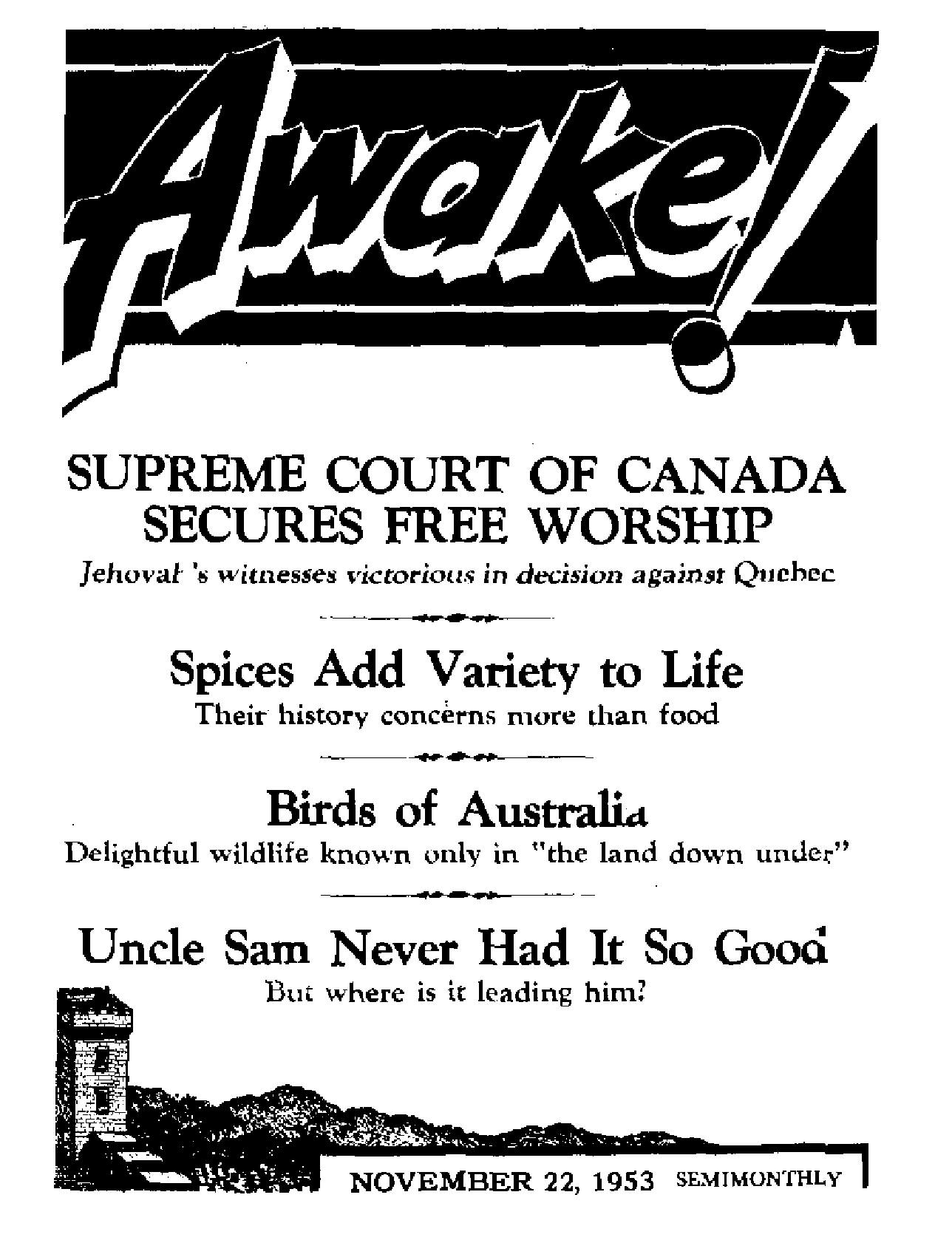
SUPREME COURT OF CANADA SECURES FREE WORSHIP
Jehova/ s witnesses victorious in decision against Quebec
Spices Add Variety to Life
Their history concerns more than food
Birds of Australia
Delightful wildlife known only in ’the land down under”
Uncle Sam Never Had It So Good
But where is it leading him;
NOVEMBER 22, 1953 semimonthly
THE MISSION OF 1 HIS JOURNAL
NeWV source that arc able to keep you awake to fha vflial toauca of our time* murt be unfritctwd by ceniorehlp and eelfish intarcats. “Awake F* hae no fetters It recodnizee facts, faces facta, to free to publish frets. It to nc% bound by political ambitions or obligations; it to unhampered by advertisers whose toes must not be trodden on; It to unprejudiced by traditional creeds. This journal keeps itself free that It may speak freely to you. But it does not abuse its freedom. It maintains integrity to truth.
“Awake 1” uses the regular news channels, but to not dependent on them. Its own correspondents are on all continents, in scores of nations. From the four corners of the earth their uncensored, on-the-scenes reports come to you through these columns, This journal’s viewpoint is not narrow, but to international It is read in many nations, in many languages, by persons of all ages. Through its pages many fields of knowledge pass in review—government, commerce, religion, history, geography, science, social conditions, natural wonders—wny, its coverage to as broad as the earth and as high as the heavens.
“Awake I” pledges itself to righteous principles, to exposing hidden foes and subtle dangers, to championing freedom for all, to comforting mourners and strengthening those disheartened by the failures of a delinquent world, rejecting sure hope for the establishment of a righteous New World.
Get acquainted with “Awake!” Keep awake by reading “Awake!”
Pdbtished Semimonthly By WATCHTOWER ‘BLE AND TRACT SOCIETY, INC.
117 Adems Street Brooklyn 1, N. Y„ II. S. A.
N. H. KN Obe, -Prerid^nt Grant Suiter, Seeman/
Printing this issue; 1,1jV,000
linaupn-In whlcfc the smuIm it pvllithU: HemtnonthlF—AfrLkwMH, Enriiata, Finnish, French, (Jerttian, Hiilaufftii). Ncirweiliti, Spanish, Swedish, Monthly—Dtnlib, Qrwlt, rortufueee, Ukrainian.
Offlcts yBariy subscription Bait
Amrits, U.S., 117 Adams St, Brooklyn 1, N.Y. *1
Alrtralla, 11 Beresford Rd., Strithfleld, N.B.W. St CiMda, 40 Irwin'Ait., Toronto 5, Ontario *1 Engl Mid, 34 Cr»ren Terrace, London, W- 2 Sort* Africa, PriiatoBsA, P.O. Elandafcmtdr, Trane vs al 7*
Entered A* Etcand-ttoss nutter at Brooklyn, N. Y,
Five cents a copy
Nemlttsflou should be sent to office in Four country in ttrtnpliatiM with reEiilstloni to suntan tee safe delirery nt money. Remlttonoea are accepted al Brooklyn from countrier where no office Is located, by International money order only. Subscription rates In different countries are here stated in local currency. Motta of expiration (with renewal blank) ii sent at least two tanea before subscription expiree. Change Of addreu when sent to our office may be expected effecUre within oc? month. g«id your old so well as new iddrou.
Act of March 3, 1879. Printed In U. 8. A
CONTENTS
Supreme Court of Canada Secures
Freedom of Worship
Freedom of Worship Act
Censorship Law Condemned
Press Welcomes Victory
Blood, “a Pr^ious and Dangerous Fluid” 12
Birds of Australia
The Sport of Hawaiian Kings
Uncle Sam Never Had It So Good
Predictions Point to Prosperity
Jet Streams: Meandering Air-Rivers
Spices Add Variety to Life
Archenemy of Germs
■The Indians of North America
“Your Word Is Truth”
A Resurrection by Metempsychosis?
Jehovah's Witnesses Preach in All the Earth—Greece
Do You Know^
Watching the World
Volume XXXIV Brooklyn, N. Y.t November 22, 1953 Number 22
SUPREME COURT OF CANADA SECURES FREEDOM OF WORSHIP
Jehovah's Witnesses Victorious in Startling Decision Against Quebec
By “Awoke!” correspondent in Conada
CQ A LARGE bonfire on Parliament Hill should celebrate the Supreme Court of Canada's decision in the Saumur case; a bonfire worthy of a great occasion. Few decisions in the history of Canadian justice can have been more important. Few courts can have done better service than this to Canada. None has placed Canadians who value their inheritance of freedom more deeply in its debt. , . . The deliverance cannot be celebrated with the bonfires it deserves.” This enthusiastic approval was voiced by Judith Robinson, well-known Canadian columnist, writing under the heading “Equal Rights to All.” Like many other freedom-loving Canadians she was jubilant over the vital decision just rendered by the Supreme Court of Canada in favor of Jehovah’s witnesses.
October 6, 1953, was the historic occasion. Canadian News Services and radio broadcasts were electrified by epoch-making news from the Supreme Court. Within a matter of minutes the wires were hot with the story. What were they saying? What was all the excitement? “Freedom of Religion Upheld. Jehovah’s Witnesses Win Fight over Quebec Order.” “Witnesses of Jehovah Win Decision Affecting Some 800 Cases in
Quebec.” These were typical of the screaming front-page headlines carried in major newspapers in Ottawa, Toronto, Montreal, and other Canadian centers.
Press, radio commentators and columnists caught up the story and it reverberated like magic from coast to coast. Why all this rejoicing among the Canadian people? Because their liberties were in question, and a major victory for freedom had just been won! They had watched with deepest concern the intrepid stand of faithful witnesses of Jehovah who had maintained integrity despite an unprecedented heresy hunt and bitter persecution in the Roman Catholic-controlled province of Qqebec. Their stand was now vindicated by a favorable decision of the Supreme Court of Canada, which condemned the illegal censorship imposed by the city of Quebec.
For twenty years this fight had continued, round after round. This test case alone had been six years reaching its final decision. In addition to legal battles, Jehovah’s witnesses have suffered lies, slander, misrepresentation, loss of jobs and businesses, wrecking of homes, beatings, stonings, filthy jails, kidnaping, mobs and riots. Arrests and prosecutions had reached the appalling total of over 1,500, of which number 800 were still pending.
NOVEMBER 1953
What caused all this? Why is it that peaceable Christian ministers who carry on their missionary work without molestation in every other part of Canada should be subjected to such bitter, burning hatred in Quebec? The answer can be simply given; because of Catholic opposition to the right of Jehovah’s witnesses to preach the gospel of God’s kingdom to the good people of Quebec.
Exactly twenty years ago, in October, 1933, Quebec City passed a censorship bylaw specifically aimed at stopping Jehovah’s witnesses from distributing Bibles and Bible literature. The bylaw provided:
It is forbidden to distribute in the streets of Quebec any book, pamphlet, booklet, circular, tract whatever without having previously obtained for so doing the written permission of the Chief of Police.
An attack on this bylaw was begun by Jehovah’s witnesses in 1947, with a view to having it declared an illegal suppression of freedom of worship. The trial continued for nearly two weeks. The city tried to turn the case into a heresy trial by introducing matters irrelevant to the law and asking the judge to deny the legal rights of Jehovah’s witnesses on account of their beliefs. They even sought to prove that Jehovah’s witnesses are not a religious denomination and do not have the rights guaranteed by law to such bodies. To this end they adopted the incredible procedure of calling clerics from other religions to tell the judge, in effect, what to do. Can cleric and a Catholic priest giving opinion evidence on the law before a secular judge? By this testimony Quebec City hoped tb deny freedom to Jehovah's witnesses, but the effort was a laughable failure. (An account of the trial appears in Awake! January 22 and April 8,1949.) Judge Casgrain dismissed the case. Appeal was then taken to the Quebec Court of Appeal, which confirmed the dismissal on a split decision rendered May 13,1952. The final appeal to the Supreme Court of Canada was argued for seven days, beginning December 9, 1952. (See Awake! April 8, 1953.)
Historic Decision
Yes, it really was history in the making! Why? Because the decision in this case affected not only the parties, not only the hundreds of Jehovah’s witnesses on trial in Quebec, not only the thousands outside of Quebec; but every religious organization, every newspaper, every political party, indeed, every citizen of this great nation.
Not only the citizens, but the very Federal Constitution, the interrelationship of all the provinces of Canada to the Dominion government, was on trial. One might say the nation was on trial.
Small wonder, then, that constitutional lawyers were watching the outcome with gravest concern^ Small wonder, then, that Jehovah’s witnesses were earnestly and fervently praying to the God of the universe, Jehovah, to direct a victory, that they might have freedom to worship Him according to the dictates of their own con-
you imagine a Jewish rabbi, an Anglican sciences and live peaceably with all men.
The kmg-awaited ilay of decHau on October 6, 1953, the opening of the Supreme Courts autumn term. A hiEhed and crowded ctnirtroom. tense with the drama of the occasion, greeted the nine justices who tiled into court with solemn dignity wearing their traditional tricorne hats and scarlet robes trimmed with white ermine.
What would the decision be? Would Canadian liberty be pushed back two hundred and fifty years according to the wishes of Quebec City? What would become of the 800 pending cases? Would persecution of faithful Christian witnesses of Jehovah be increased? The audience listened, keenly concerned.
The chief justice first announced that judgments were going to be delivered. What would he say? In measured and sonorous tones he began: ’’Saumur u. City of Quebec and the Attorney General of Quebec: the appeal is . . . allowed with costs.”
Jehovah’s witnesses had won again. Their second major victory for civil and religious liberties in the Supreme Court of Canada in three years. The prayers of Jehovah’s people had been heard. It was with much gratitude that they moved out of the courtroom.
Victory came for this righteous cause with no uncertainty. The five-judge majority held that it was absolutely illegal for the City of Quebec to use the censorship bylaw to interfere with the distribution of religious literature by Jehovah’s witnesses. Indeed, four of the majority, Justices Rand, Kellock, Estey and Locke, held the bylaw to be unconstitutional; that there was no power in the Province to legislate on freedom of press and worship. What a thrilling climax to the more than twenty years of fighting, and six years on this one test easel It was a vindication of the position of Jehovah’s witnesses, which
had been treated wltii C attempt by nmv (tffitiolfi and courts in C tec.
Jehovah** IFiCnesae* J
to Be a ReHgiout Denomination
The city attorneys pretended that because Jehovah’s witnesses do not follow the practices of the big churches of Quebec they are not a religious denomination. If not a religious denomination, they would be denied the guarantees of freedom of worship. This controversy over the elementary right of Jehovah’s witnesses to' have the same recognition as other religious denominations has continued Ln Quebec for many years. It is true that Jehovah’s witnesses do not follow the practice of the larger denominations popularly regarded as orthodox. However, according to the preaching >nnd methods of Christ Jesus and the apostles In the early Christian church, Jehovah’s witnessed arq strictly orthodox. According to the Bible they are orthodox.
Which view would prevail? Which would become the law of the land? The restricted and prejudiced views of the Quebec attorneys or the broad and general provisions of the law? The fanciful sophistries of Quebec’s lawyers did not mislead the majority judges of the Supreme Court. The first question whb definitely settled by the Supreme Court by a clear finding that Jehovah’s witnesses are a religious denomination and therefore entitled to the same protection as all others.
Read now the judgment of Mr. Justice Locke, who quickly disposed of this weak-kneed and prejudiced argument.
Part of the evidence tendered on behalf of the appellant was that of Mr. H. C. Covington, a minister of the religious organization known as Jehovah’s Witnesses ... In describing the nature of the religious belief of Jehovah's Witnesses and of their activities he said Irj part:
"Jehovah's witnesses are an unincorporated body of missionary evangelists, their primary purpose being to preach the gospel of God* Kingdom throughout the whole world. aS a witness, In execution of the commission re-
corded tn Matthew 24114* and this btjdy la a missionary society preaching Throughout the whole world r In every country under the sun, save and except Russia.
“Jehovah’s witnesses preach the gospel as missionary evangelists world-wide, including Quebec, by calling from door to door, doing missionary work, visiting the people and explaining to them about God’s Kingdom as the only hope of mankind.”
In his forthright and unmistakable manner, Mr, Justice Locke rejected the ridiculous contention of the province. He said further:
I see no difficulty in interpreting the simple and clear language ... To claim that those who believe in God and in hts Son Jesus Christ do not hold a religious belief and that to profess that belief and attempt to communicate it to others, in the manner which the Jehovah’s witnesses believe they are commanded to do by the Bible, is not exercising a religious profession and an act of warship is, in my opinion, untenable.
To solidify the decision and prove indisputably that Jehovah’s witnesses are a religious denomination having the same rights as all others, Mr, Justice Kerwin, himself an Irish Roman Catholic, wrote:
It appears from the material filed on behalf of the appellant that Jehovah's Witnesses not only do not consider themselves as belonging to a religion but vehemently attack anything that may ordinarily be so termed but in my view they are entitled to "the free exercise and enjoyment of [their] Religious Profession and Worship/*
Mr, Justice Kellock added to the conclusive determinations of this question by holding in the present Saumur appeal:
The respondent [City of Quebec] strenuously argued that the Jehovah's witnesses were not entitled to rely upon the Act as they were not a "religious denomination” within the meaning of the statute. It was further contended that because the appellant had refused to apply for a licence under the by-law, this amounted to an "act of Licentiousness” or a practice inconsistent with the peace and safety or the province.” I am of opinion that neither contention is tenable.
These determinations establish conclusively and beyond question that Jehovah’s witnesses are a religious denomination.
Freedom of Worship Ad
Prior to this history-making case, most Canadian legislators, lawyers and judges would have said that there were no written guarantees of freedom of religion In Canada. During the litigation a most unusual discovery was made. There was found a forgotten Bill of Religious Liberty that was still in force. This Bill was enacted in 1852, and just one hundred years later, in 1952, Jehovah’s witnesses presented It in argument before the Supreme Court of Canada for the first time.
Where had this guarantee come from? Why had it been enacted? How was it forgotten? At the time of its enactment in 1852, there had been a tremendous religious controversy between the Catholics and the Protestants. The statute was designed to put an end to the fears of each side that the other would destroy It. In 1867, at the confederation of the first four provinces, this law was continued in force. Since that time the statute appears to have been forgotten. It had not been printed in the statute books of Ontario for forty years. In Quebec it had been reprinted but never used. This ancient law provides as follows:
WHEEEAfi the recognition of legal equality among all Religious Denominations is an admitted principle of Colonial Legislation; be it therefore declared . . , That the free exercise and enjoyment of Religious Profession and Worship, without discrimination or preference, so as the same be not made an excuse of acts of licentiousness, or a justification of practices inconsistent with the peace and safety of the Province, is by the constitution and laws of this Province allowed to all Her Majesty’s' subjects within the same.
In the terms of the above statute there are two aspects: there is the guarantee of free exercise of religious worship; and the guarantee cannot be made an excuse for acts of licentiousness or practices inconsistent with the peace and safety of the province.
The city had urged the court to hold that the practices of Jehovah’s witnesses in preaching publicly in print as well as orally could not be considered an exercise of worship protected by law. Worship, they said, had to be in churches. In effect, this
argute that unJy iheit way of wcrebip, that is, inside a building, ia protected. This very narrow view would destroy Christianity itself,
Mr, Justice Kellock completely rejected this argument, saying that the provincial attorneys argue
■ . . that "the free exercise and enjoyment nt Religious Profession and Worship’7 in the statute does not cover mure than the carrying on of religious exercises in some place of worship. In that view the statute would have nothing to say with regard to such a matter, for example, as the dissemination of religious views or material, e.g., the Scriptures themselves, outside such places of worship. I do not think the statute Is tn he so narrowly construed. - . . The Christian religion would hardly have survived had it permitted itself to be circumscribed in accordance with the argument of Mr. Beaulieu I provincial attorney J. From the beginning It has propagated It self by the written as well as the spoken word. The Scriptures ihem-selves are a sufficient illustration of this. That S reparation by such means was not. however, mlted to the Scriptures is a matter of common knowledge.
Mr. Justine Kerwin also discussed the right of Jehovah’s witnetities to preach publicly and in print rather than confining themwlves to cathedrals and buildings. He said:
The Witnesses attempt to spread their views by way of the printed and written word as well as orally and stale that such attempts are Eart of their belief . . . But, if they have a J gal right lu attempt tn spread their beliefs, as 1 think they have, the expressions used by them in so doing, as exemplified in the exhibits filed, do not fall within the first pert of the exception,
This quotation clearly shown the view of another judge who has found that the oral and written preaching of Jehovah's witnesses is a lawful exercise of worship.
Mr. Justice Locke, in a very forceful, direct manner, said:
The appellant Ui the present matter has exercised what, in my opinion, Is his constitutional right to the practice of his religious profession and mode of worship.
The judgments are clear that Jehovah’s witnesses in publicly preaching, both orally and by means of written sermons, are only doing what Christianity has done for centuries. Such public preaching the Supreme
Cunt hM now deefend to be protected os a lawful exercise of freedom of worship;
dctfoiCieo of Jetorah’a JWtnww* Aoi
Meta o/ Lievnttou»ntM at /neoHdtefrnf wtth Peacf and Safety*
The Freedom of Worship Act guarantees free exercise of religion but does not protect “acts of licentiousness or practices inconsistent with the peace and safety of the Province.” The Quebec attorneys contended at great length that because of this restriction Jehovah's witnesses could not be protected under the statute. They said that criticism of the Roman Hierarchy constituted “acts of licentiousness,” and refusal tn abide by the illegal censorship law was “inconsistent with the peace and safety of the Province.”
Mr. Justice Kerwin carefully analyzed this contention and showed it to be unreasonable. We quote his words.
The Witnesses attempt to spread their views by way of the printed and written word as well as orally and state that such attempts are pari of their belief. Their attacks on Fell-Sion generally, or on one in particular, do not ring them within the exception ,f*0 as the same be not made an excuse for licentiousness or a justification of practices inconsistent with the peace and safety of the Province." While several definitions of "licentious*’ appear In Standard dictionaries, the prevailing sense of that term is said to be “libertine, lascivious, lewd.” To certain biblical expressions the pamphlets, etc., of Jehovah’s wfmcsfiefi which they desire to distribute attach a meaning wfifch is offensive to a great majority of the inhabitants of the Province of Quebec. But If they have a legal right to attempt to spread their beliefs, as I think they have, the expressions used by them in so doing, as exemplified in the exhibits filed, do not fall within the first part of the exception. Nor In my opinion are their attacks "inconsistent with the peace and safety of the Province" even where they arc directed particularly against the religion of m^st nt the Province’s residents. The peace and safety of the Province will not be endangered if that majority do not use the attacks as a foundation for breaches of the peace.
And so another desperation argument Of the Province wax also rejected. Jehovah’s witnesses were declared by the judges to come within the pro visions of the Free-
dom of Worship Act—they are a religious denomination, their activities are a lawful exercise of worship, and are neither "acts of licentiousness” nor "inconsistent with the peace and safety of the Province.”
Empty Traffic Argument Unmasked
All the above reasons having failed them, Quebec’s attorneys next tried with tongue in cheek to pretend that this bylaw forbidding distribution of literature without a police permit was not designed for censorship but for traffic control. Could any sane person pretend that a man distributing literature takes up less space on the street if he has a license in his pocket than if he lacks such permit? The bylaw had nothing to do with street traffic, but it was passed to "get” Jehovah's witnesses. The weaknesses of this pretense are made apparent by Mr. Justice Estey, who pointed out the rather significant fact that
. . . the by-law was passed in 1933 at a time when Jehovah’s Witnesses were being brought before the courts of the Province,for various offences, and in the course of the hearing of this appeal it was stated and not contradicted that distribution under this by-law has been refused only to Jehovah’s Witnesses.
“But,” you might say, "the conclusions about the bad faith of Quebec’s attorneys are only the views of Jehovah’s witnesses!” By no means! Mr. Justice Bertrand of the Quebec Court of Appeal discussed this "traffic” argument, saying:
The attempt of the said City of Quebec to present its by-law as a simple measure of protection against the blocking of the streets and public places obliges us to be naive to the point of believing their protests are in good faith. There is no question in the mind of Justice Bertrand that this argument was made in bad faith.
Nor is there any question in the mind of Mr. Justice Kellock, who also took a few sledge-hammer blows at the transparent pretension that the bylaw was really related to traffic.
Clearly, therefore, the by-law Is not directed to the mere physical act Involved in the handing to another of a document but has In view the contents of the document and the desirability or otherwise, in the view of the chief of police, as to Its circulation. A document refused a licence would, not involve anything more from the standpoint of obstruction of the highway or the impeding of those using it, than one with respect to which a licence is granted, and both documents, if discarded by the recipients, would equally be a source of litter. The by-law, however, is not concerned with such matters. Nothing more Is needed, in my opinion, to discern the real nature and character of the by-law, namely, to provide that some material may reach the public using the streets, while the rest may not
. . . the by-law can be used, as it has been, to deny distribution of its literature to one religious denomination, while granting that liberty to another or others. The by-law is equally capable of being applied so as to permit distribution of the literature of one political party while denying that right to air others, or so as to refuse to allow the selling In the streets of some newspapers while permitting others. In any or all of these cases, the same physical acts would be involved. Nothing more is needed to demonstrate, in my opinion, that such a by-law was not enacted "in relation to” streets but in relation to the minds of the users of the streets;
In these days when there is so much hypocrisy as well as both national and international double-talk and double-dealing, it does one’s heart good to find a man in high position speaking fearlessly, impartially and in fairness to all. As is obvious from the reasoning of Mr. Justice Kellock, the censorship bylaw could not be magically changed into a traffic bylaw, and the most valiant efforts of Quebec’s attorneys were a failure.
Censorship Law Condemned
Away back in the year 1694 (A.D.), under the reign, of William HI, censorship was abolished in English law. And, yet, here we find the Quebec attorneys, just two hundred and fifty-nine years behind time, trying to justify the reimposition of censorship; for censorship was the admitted use and real purpose of this bylaw. Could they succeed in turning the clock back two and a half centuries?
A TV d V S’ f
Mr. Justice Rand of the Supreme Court, a real charnjrion of civil liberty, mode a careful study of this question of censor’ ship. He first discussed its history.
What the practice under the by-law demonstrates is that the language comprehends the power of censorship. From its inception, printing has been recognized as an agency of tremendous possibilities, and virtually upon its introduction into western Europe It was brought under the control &nd license of government. At that time, as now In despotisms, authority viewed with fear and wrath the uncensored printed word; it is and has been the Wte noire of dogmatists in every field of thought; and the seat of Its legislative control in this country becomes a matter o£ highest moment.
This really goes to the root of the case. Despotism cannot stand the uncensored word. True religion or good government in a democratic state need never fear criticism. it is only misgovernment and false religion that must be afraid of free discussion. Mr. Justice Rand also emphasizes that real democracy cannot exist under censorship.
The Confederation Act recite* the desire of the three provinces to be federally united Into one Damlnkm ’'with a constitution similar in principle to that of the United Kingdom?’ Under the constitution, government la by parliamentary institutions, Including popular assemblies elected by the people at large in both provinces and Dominion: government resting ultimately on public opinion reached by discussion and the interplay of ideas. If that discussion Is placed under license, Its basic condition is destroyed' the government, us licensor, becomes disjoined from the citizenry. The only security is steadily advancing enlightenment, for which the widest range of controversy is the sine qua non [essential condition!.
govenunart cf free men. It shows the necessity of public education by free public discussion. Public opinion, upon which democratic government rests, can be funned only if that public opinion can feel the free play of the currents of ideas that are abroad.
TTils expression parallels a similar statement of the famous American judge, Oliver Wendell Holmes, who said that “the ultimate good desired is better reached by free trade In ideas—that the best test of truth is the power of the thought to get itself accepted in the competition of the market, and that truth is the only ground upon which their wishes safely can be carried out. ”
Jehovah’s witnesses believe in that free trade in ideas for both themselves and everyone else. Their ideas are true. They are willing to have them stand in the open market of ideas. A similar thought was voiced editorially by the Ottawa Journal (October 7, 1953):
The truth Is that no Idea can be much good if it seeks suppressed freedom to uphold it, and no idea, religious or otherwise, ran be much good unless It be able and eagerly willing to meet and defeat enemies In the free market of ideas.
Censorship destroys that open expression. It starves ideas, warps the mind, destroys scholarship, cuts off the free flow Of Information. Public discussion is a flowing stream; censorship, a dam creating
This deep and thought-provoking statement well expresses the philosophy underlying free
stagnation and every kind of disease. It affects pamphlets, books, periodicals, newspa-
pers, in fact, every form of public ex press ion. Very few Canadians realized how close they were to losing this vital and fundamental liberty. All can be grateful that the majority members of the Supreme Court have quashed the tremendous effort of the Quebec authorities to re-establish censorship. The judgment has prevented destraction of two and a half centuries of progress.
Freedom of Worship
Beyond Provincial Power
Is freedom of worship a local matter of small importance, or a fundamental national right? If it is local, then the province of Quebec can make laws restricting of even destroying it. If it is of national importance, then only the Canadian federal government can deal with it.
The province argued that it was a purely local matter within provincial jurisdiction. Mr, Justice Locke pointed out:
If the argument ia sound, then the holding of religious services by the adherents of any faith designated by the Legislature [of the province! may be prohibited.
Can the Canadian people realize the dangers inherent in the Quebec argument? Even the right to hold church services would be in jeopardy. The Quebec argument could turn Canada into another Spain, where no churches other than Catholic are allowed to be built! Jehovah's witnesses are building a bulwark against such evil That bulwark protects the freedom of all.
A number of the judgments were eloquent in placing primary liberties such as freedom of speech and worship on the highest plane of constitutional importance.
Mr. Justice Rand said:
. . . freedom of speech, religion and the inviolability of the person, are original freedoms which are at once the necessary attributes and modes of self-expression Of human beings and the primary conditions of their community life within a legal order. . . . That legislation “in relation” to religion and its profession is not a local or private matter would seem to me to be self-evident: the dimensions of this interest are nationwide; it is even today embodied in the highest level of the constitutionalism of Great Britain; it appertains to a boundless field of ideas, beliefs and faiths with the deepest roots and loyalties; a religious Incident reverberates from one end of this country to the other, and there is nothing to which the "body politic of the Dominion is more sensitive. . . . From 1760, therefore, to the present moment religious freedom has, in our legal system, been recognized as a principle of fundamental character; . . . religious belief duty and observances were never intended to be included within that collocation of powers [allotted to the provinces].
Mr, Justice Estey also placed religious liberty on the highest plane. He described it not only as a legal right, but as a sacred right, saying:
The right of the free exercise and enjoyment of religious profession and worship is a personal, sacred right for which, history records, man has striven and fought. Wherever attained they have resisted restrictions and limitation thereon in every possible manner.
These judgments are clear and definite on removing from provincial authority the power to destroy religious liberty.
Press Welcomes Victory
The decision was enthusiastically received by the press in this country. Readers of Awake! will be interested in excerpts from the editorials.
A Verdict for Freedom of Worship
In upholding the right of the Witnesses of Jehovah to distribute literature in the streets, without restriction, the Supreme Court of Canada has lifted a load from the conscience of this country. Liberal-minded citizens of all religious affinations and both major language groups have long been uneasy about tendencies toward indirect persecution of opinion. In Quebec especially, this decision in the case of Mr. Laurier Saumur should result in the dismissal of some 800 similar cases involving charges under municipal bylaws. It means that no community anywhere in Canada can require advocates of religious views to be licensed. The ruling is one of several court decisions in recent years by which civil liberty has been clarified within the provinces or throughout the country. ... In a free country, the few must be allowed to try to change the opinions of the many, whatever the issue. Canadians can be proud that their courts are showing themselves vigilant against the intolerance that would whittle freedom away. [Evening Citizen, Ottawa, October 7,1953]
Freedom of Religious Propaganda
There will be approval of the majority ruling of the Supreme Court of Canada asserting the sect’s right to propagate their faith by the
dtatritatfon af pamphlets pabUc streets. [Toronto Juwaiag Tetegnm, October & 10533
FREEDOM or Beu^
The Supreme Court of Canada, In a majority Judgment of considerable significance, has established an Important principle underlying civil liberties In Canada. , . . the judgment asserted that no inferior jurisdiction, such a* Province or municipality, may abridge the rights and liberties which constitutionally belong to every citizen of the country, regardless of residence. , A voir important point was made by Mr. Justice Kellock when he drew attention to the fact that the bytaw was so openly drawn that it might be applied in many different ways. He said that it established no rule except that nothing but what was permitted by the censor (as the police chief in effect was) could be distributed. The contents of the document were the deciding factor. The same bylaw could be applied against political parties and news papers. It is apparent that to grant such broad powers to a single municipal official would be a gross infringement of elemental civil rights, whether or not the power was ever used. It could never have been Intended by those who framed our constitution, (Globe and Mali, Turon to, October 8, 1933]
Freedom or Religion
An Important principle, that a man must be allowed to practise his religious beliefs, Is upheld in the supreme court’s close ruling in another case Involving the Witnesses of Jehovah, . , , And maintenance of that principle is one which must be applauded, . . . To interfere with a man's worship is evil. The fact that the sufferer may adhere to beliefs not generally popular Is beside the point. [Herata, Montreal, October 7, 10531
Freedom of Religion assured
The majority decision of the court, holding (hat members of the Jehovah’s Witnesses sect can lawfully distribute their pamphlets in the streets uf Quebec despite the provisions of a civil by-law, goes a long way towards assuring Canadians the liberty to practise their religion openly and freely in ail parts of the Dominion. [Toronto Daily Star, October 9, 1953]
Columnist Gerald Waring described the ease as something that "has helped strengthen rights that are supremely important to all Canadians.”
Victory and It* Results
Readers will be able to see that this decision is the conclusion of a long-drawn-out and hard-fought battle. The majority judgment means that Jehovah’s witnesses and all other religious groups now have freedom of worship, freedom to distribute
BUds; printed sermotia, magazines, haztf bills and other reUgkas literature. Itmeaus also that police censorship cannot interfere with religion denominationa The judgment also protects the right of citizens to hear the arguments and contentions of other citizens without police Intervention, The judgment serves additionally as a wall-deserved rebuke to those Quebec authorities who think freedom should be for themselves and for no one else.
Jehovah's witnesses are Christians. Their solo desire is to be free to preach without molestation, and to do so peaceably, The Catholic Church has the right to preach, and Jehovah's witnesses do not interfere with that liberty. The Supreme Court has now clearly established that Jehovah's witnesses also have the right to preach and that this should not be interfered with by the Catholic authorities. If the authorities refrain from such interference, they will avoid needless controversy that reflects no great credit on themselves or their church.
Jehovah's witnesses are preaching Christian truth In obedience to the commend* ments of Jehovah God and Christ Jesus. They will continue to do this in an earnest and dignified manner. Their message is one of love and hope. They do not hate anybody or seek to do ill to anybody. If they did not love the good people of Quebec, they would not go to so much trouble to open the Bible to them. They wish to point all people to the wonderful hope held forth in the Scriptures. They appeal to all honest and God-fearing people in Quebec and elsewhere to turn to God's Holy Word and learn of His righteous purposes toward humankind. By so doing men of good will will team the way that leads to everlasting life. "Now this is eternal life; That they may know thee, the only true God, and Jesus Christ, whom thou hast sent.”—John 17:3, Lkrnay.
BLOOD, "A PRECIOUS AND DANGEROUS FLUID”
THAT the medical profession is being alerted regarding the dangers associated with blood transfusions Is apparent from a perusal of professional periodicals, both In the United States and in other lands, A case in point is the letter of Dr, S. H. Waddy, FJLFJP.S., that was published in the British Medical Journal, February 21, 1953, under the heading, “The Dangers of Blood Transfusion," What occasioned the letter was a highly technical discussion on blood in that journal, and which attracted his attention only because of his being acquainted with one of the coauthors. Continuing, Dr. Waddy wrote:
<L “Do not these highly technical articles on blood emphasize what a dangerous treatment transfusions may be? Frequent discoveries of antibodies and genotypes not previously suspected should make one wary of administering blood except as an urgent necessity. The great number of transfusions now being given on one pretext or another must enormously Increase the risk of conflicting antibodies endangering life whgn a subsequent transfusion may be a necessity.
<L “Statistics seem to prove that there is an immediate advantage in using whole blood, but, in view of the highly technical and skillful investigations which constantly are discovering potential dangers and which are demonstrated to us by complicated formulae, ought we not to regard a transfusion of blood, not as a routine measure, but as a dangerous major operation? The Christian pronouncement of nearly 2,000 years ago, ‘It is more blessed to give than to receive/ may well be true as regards giving and receiving of blood. The recipient, perhaps, is being conditioned for future unknown dangers—but what of the donor? The generous donor is willing to give blood to ‘save life/ but I do not think that gallons of this precious and dangerous fluid shoyld be wasted as a routine administration in operative technique. If a pint of blood is essential for recovery, or merely the more rapid recovery, of the patient, then surely the blood cannot be obtained from the donor without cost, Wolstein said, in 1791, when condemning blood-letting, the fasiilon of his day, ‘Blood is no water—it is the juice of
I life; a juice which after each venesection Nature replaces rapidly, but in a raw, unprepared, watery, spiritless state/ We have learned much about the ‘juice of life' since Wolstein’s day, but no doubt his clinical ob-< servation was correct, as also that of Mar-shall Hall, who denounced the same practice, j calling the lancet ‘a minute instrument of ;> mighty mischief/ Some time ago when doing a short locum for a friend [that is, substitute J ing for him in his practice] I saw two pa-tlents, man and wife, labelled as suffering from rheumatism. Neither had ever had any serious illness, but each appeared to be de-bilitated and only very slowly convalescing, i; They complained of great tiredness and lack | of energy and indefinite aches and pains, which evidently suggested the 'diagnosis* of (rheumatism. They said that neither had felt well since their last donation of blood. They were universal donors and both had been called upon, and had responded willingly, many times.
“I am not satisfied that the sacrifice of the <; donor is as harmless as is generally supposed, I nor am I satisfied that a transfusion is always a good thing for the recipient. I would only submit myself and members of my own family to a transfusion if I considered it an ab-5; solute necessity, and this must be the criterion for my patients. What can I tell the would-be j donors who ask my advice? I do not wish to discourage them, nor do I wish to embarrass the workers in the blood-collecting squad, but I do feel that it is time we exercised extreme economy in the use of blood, other <: persons' blood, and ensure that it is used only for the purpose for which most persons think they give it—to save life/'
C Dr. Waddy’s points are well taken, for I the blood is indeed a precious fluid—“the life ? is in the blood/’ the Bible tells us—and may truly be a dangerous fluid as regards taking another's into our own blood stream. If all doctors limited their professional procedures to that which they would do for themselves and their families, there would undoubtedly be a significant decrease in the number of blood transfusions given.
OF AUSTRALIA
the egg of Australia's next-largest bird, the cassowary.
in particular can delight our eyes, charm our ears, Quicken our Imagination, and
Although not as large as the emu, this bird is of stouter build, with thicker, stronger
often, when we are disheartened, they can comfort and inspire us with q profound love of life. Much of Australia la one large aviary of beauty and color, melody and song coming from tiny birds no heavier than a pennyweight, to large birds heavier than a man. In this land of birds seven hundred different species are represented. Few countries rival Australia in an air or ground display of feathered fauna.
The emu is the largest of Australia's birds. It takes second place only to the ostrich as the world's largest bird. Its build is similar to that of an ostrich, having a very long neck with a small head, entirely out of proportion to the rest of its body. From the soles of its large feet to the tip of its head the emu averages from Ave to six feet. Having only a small pair of “flippers,” it has to depend solely upon its long, heavily built legs to keep it uut of danger. The emu in full flight has attained
* speed upward of thirty miles an hour. The female bird lays between seven and eighteen eggs, each weighing a pound UMflVj and a half! What a breakfast that egg would make!
Large, you think? It rates only second in size to legs. This fellow has a kick like that of a horse and has been known to damage the front of a motor car, when met up with on the road. It is possessor of a lustrous black plumage and is noted for Its beautifully colored scarlet-and-pink wattles, which hang from its neck. Many have tried to tame It by catching It while young, but most efforts have proved unsuccessful, undoubtedly because of its enormous capacity for food and Ils very uncertain temper.
Here is a bird with a sense of humor,
Mr. Kookaburra, known In Australia as laughing jackass, bushmen's clock or settlers' clock. This hird is known for its laughing ability. Truly It can laugh off practically any situation. Rising early with the first light of dawn, it greets each new day with a hearty laugh. To the Australian bushman it acts as a clock, hence the appellation, bushmen’s clock. Its laughing seems to be infectious, for when one of these merry-makers starts to laugh, all in the neighborhood will join in the chorus, till the bushland, for a great distance around, echoes and re-echoes with wild merriment.
Usually this bird has a very inquisitive nature, and when anything new presents itself “Jacky" will be there to see
for himself just exactly what is happening.
It is a very common sight to see as many as half a dozen kookaburras sitting on posts around a cultivation paddock or following up the plow to get the insects and beetles as the fanner is breaking his ground. It is a particularly good friend of the farmer, because of its destruction of pests, and is liked and protected by almost everyone. Its beak is about the biggest part of it. With this weapon it batters its victims to death before swallowing them. Sometimes with a small snake or reptile half swallowed, its stomach apparently fills and it dozes off, waiting for the first half to digest so it can resume its meal. However, “Jacky” never grumbles about his role in life, and, as if in fulfillment of the wise proverb “Never let the sun go down on your anger,” he invariably says “good night” with a final hearty laugh.
The “Monkeys” and
“Intellectuals” of Bifddom
To most persons parrots are always a source of delight and amusement. They are the “monkeys” of the Australian avifauna. Parrots are indescribably beautiful, for almost every color imaginable is represented in the six different families inhabiting Australia. Dr. Leach describes the blue mountain parrot, or rainbow lorikeet, as “a noble bird, gorgeously appareled.” One really has to see this bird to appreciate how beautiful it is, clothed in a coat of feathers ranging in color from green on its back to purple-blue on the head, with the underside orange, yellow, red and many other shades.
Parrots have well been described as “the monkeys of bird life,” for to see them at play, sometimes swinging upside down from the branches, at other times “kissing” one another or performing a dance for the benefit of their admirers, reminds one of a cageful of monkeys at the zoo. When the eucalyptus is in bloom in some areas the screeching and chattering of all the various kinds of parrots become almost deafening.
Another family closely related to the parrot is the cockatoo. There are many species of cockatoo in Australia, the best known being the sulphur-crested white cockatoo. These are fa verities as household pets and live to a good old age, the Australian Encyclopaedia, Vol. 1, saying some are known to have lived one hundred years. Like all other species of parrot they have a hooked beak and a brush tongue. “Do they bite?” Do not be foolish enough to put your finger in their jaws to find out. White cockatoos have been known to bite holes in a wire-netting cage and effect their escape from captivity. When tamed they can be trained to speak.
One of the most beautiful and rare and probably the most intelligent of all the world's wild creatures is the lyrebird. It is one of the most gifted vocalists and, without a doubt, an unequaled mimic in the bird world. This bird is naturally shy and it is only with great difficulty and extreme caution that one may catch a glimpse of it. Mr. Pratt, in his book The Lore of the Lyrebird, pages 46 and 47, describes how it displays, thus; “When he erects his lovely tail, the plumes rise and spread fanwise in one sweeping movement until they assume a static position forming an acute angle with the line of his back, whereupon the tips of all except the Lyre-shaped plumes (which remain laterally extended) droop gracefully forward and downward and partially screen his head from sight of an observer confronting him from a level altitude.” When not displaying, the bird carries its tail like a closed fan horizontally behind it. It never erects or spreads its tail except when about to dance or sing. It is able to move each one of its sixteen display plumes separately, in any direction, to move the
whole sixteen in unison, to qiread all ar some of than In a fan, to erect or depress them separately or in unison.
As a mimic it is outstanding, being able to mimic all other birds in its locality and eVen many of the sounds made by man-Timbermen have often been sadly disillusioned by it, believing they have heard someone chopping or sawing near their camps, but when investigation is made, the cause of the sounds seems to have disappeared into thin air.
The bowerbird is another well-known mimic. This bird builds for itself a playhouse for sporting purposes. This house is built up on a mat of twigs, fems and grass over an area about three feet square and is honjeshoe-shaped. At each end of this tunnel are deposited all the bright objects the bird may see in its travels, such as parrot feathers, pieces of tin, bleached bones, shells, colored rags and anything else that glitters. The bower is also the place where the male bird woos his mate, showing off his finery and executing many remarkable actions, dancing in and out through the bower or playing by chasing each other through it.
There are migratory birds that leave Australia about March to visit Manchuria, Siberia and the Himalayas. The fork-tailed swift neats in Japan and the Himalayas, and the sea curlew favors the extensive swamps of Siberia, where it nests, raises its young and in three months undertakes the return journey, bringing with it the new additions to the family and introducing them to their homeland.
The crane is worthy of mention, for it is the highest-flying bird in Australia and can sometimes be observed as a mere speck in the sky, or it may be even outside the range of vision, unless a pair of field glasses are used. When flying high it makes a deep trumpeting noise. Perhaps the most noted feature of this bird is its ability as a dancer, movements being performed by a whole flock at once.
This account would not be complete without a word about those beautiful songsters of the butcher bird and magpie families. These are most popular, no doubt, because of their melodious songs and bead habits. In the noting season these birds become ferocious and will attack eagles, hawks and even man with equal tenacity, as naturalists have found to their sorrow when collecting their egg?. Nor could we forget the great monarch of the Australian skies. America has its bald eagle and Europe has its golden eagle, but not to be beaten in air superiority, Australia, tOQi has an eagle soaring through her clear skies on tireless wings.
The Australian eagle, well known as the wedge-tailed eagle, is among the largest In the world. Comparing the golden eagle and the wedge-tailed eagle, Gould's Haffd-booJt to thr. Aufliniiian Birds, Volume 1, page 9, has this to say: “In size they are also nearly alike but the lengtherfed and wedge-shaped tail gives tn the Australian bird a far more pleasing and elegant contour/’ The Australian eagle is of blackish-brown color with deadly hooked beak and a pair of dangerous-looking talons. It Is liked and protected by many because of its usefulness as a rabbit destroyer, but it is not above carrying off a young lamb.
One cannot help but think how kind and loving is the great Creator who filled the earth with gorgeous creatures, provided pleasing sights and sounds, made possible infinite variety and provided that man should enjoy all these. “The flowers appear on the earth; the time of the Binging of birds is come, and the voice of the turtle-dove is heard in our land/’ exults the Song of Solomon (2; 12, A»i- Stan. Ver.). Indeed such winged creatures and the pleasure they bring are a happiness to man and a blessing from Jehovah!
The Sport of Hawaiian Kings
By *4AWn4tB|T' wntipondeitf tn Hawaii
Perhaps no other sport is so typically Hawaiian as that of surfriding or surfing. It is indeed fascinating to watch those agile figures balancing themselves skillfully on the surfboard, riding ever so gracefully ahead of blue-green waves and feathering white surf. No less fascinating is the actual experiencing of this thrilling sport.
<L No one seems to know for sure Just where or when surfing originated, but when the Polynesians migrated to Hawaii they brought it with them. Hawaiian royalty of old engaged in this pastime so much that it has been called the “sport of Hawaiian kings/’
< Three things are needed for successful and enjoyable surfing: a surfboard, the right kind of waves and the skill of the rider. Old-time boards were made from koa, wili-wili or breadfruit wood. The average length of oldtime boards was eleven or twelve feet and the width about two feet. Modern boards are longer, some being sixteen feet. And instead of being of solid wood they are more likely to be of hollow construction, making them lighter to paddle and more manageable. The Ideal wood for surfboards has been found to be redwood, because of its light weight, strength and economy.
C Only on certain days when conditions are just right is it “good surfing.” Like good fishermen one must get the “natural feel” of the sea to know when it is right. Submarine conditions as well as the wind have much to do with waves and long rides into shore. Would you like to take an imaginary ride on the surf In this fascinating sport? Get a board and come along! To travel out to the “zero” area, or the place where waves are bora, you lie flat and face down, paddling the board along with a swimming motion of the arms overside, always heading into or at right angles to smaller Incoming waves. This alone requires practice and skill of balance just to stay on the board, with plenty of arm muscle as the chief power.
Now you have arrived at the right place to catch a wave. The board is paddled around
to face the shore and you keep watching back over your shoulder for those ground swells indicating that a wave is forming, The best and longest rides are always gained on waves
that are caught before they break. Skilled surfers will bother with no others. It Is In these brief moments just as the wave is forming that the skill of the surfer is tested. One must lie back far enough on the board to avoid “pearl-diving,” or having the nose of the board go under water, and yet not so far back that the board will drag or slow down and be passed up by the wave. Now you look back and the water is beginning to “pile up” behind you, and you begin to paddle vigorously to get your board moving at a speed to keep ahead of the oncoming wave. Now it is the right moment and you nimbly rise to your feet, with hands still gripping the sides of the board to steady yourself. You shoot ahead as you gain the full thrust and momentum of the wave—you have caught it!
<L A long and successful ride depends upon your skill In keeping ahead of the wave and not becoming embroiled in the churning white surf just behind you. Experts have learned that a faster ride can be had by steering the board at an angle rather than straight ahead of the wave. Many a beginner loses his balance, he and the board parting company before the ride is finished. Now you feel that you are slowing down and are in danger of being by-passed, so you squat quickly and paddle frantically with your hands to pick up more speed to keep ahead of the churning power behind. You are nearing the shore and slowing down as the wave is diminishing and losing its drive in its stumblings over the coral sands beneath.
<L You have successfully completed your ride. You have mastered the wave and a sense of exhilarating triumph and pleasure sweeps over you. In fact, you have enjoyed it so much that you are ready to turn your board around j and start the work of paddling yourself back । to match your skill again. Now you know why I Hawaiian^ enjoy this sport so much, the sport I of Hawaiian kings.
Never Had It So Good
AMERICA’S prosperity became a slogan during the 1952 presidential campaign. Farmers and factory workers, business* men and housewives were reminded that they ‘'never had it so good." But the people did vote for a change. Why? Did they recognize their prosperity to be inflationary, born in the flames and fears of war? What is the source of Uncle Sam’s “good times"? Will they last? And just how good are they? Let us examine the record.
The United States has less than 7 per cent of the world’s population, yet in 1952 the nation manufactured 52 per cent of the world’s mechanical energy, and used it to produce 65 per cent of the world’s manufactured goods. Some $350 billion was the total market value of all goods and services produced in 1952; ftie greatest outpouring in all the nation’s history. Also retail spending was at Its peak—$215 billion. And consumers managed to salt away .more savings In 1952 than ever before—a handsome sum of $18,5 billion.
Peacetime unemployment was at the lowest mark In history (1,700,000), and employment at its highest peak (62 million jobs) in 1952. Wages too were good.
The manufacturing wage was $71 a week; another alltime .high. The nation’s personal income purse swelled to a record $235 billion; a gain of $9 billion in a single year. Yes, from all appearances, Uncle Sam was never quite so prosperous and comfortably fixed—he
never had it so
where does all this prosperity come? Eisenhower gives tliese answers:
1 "Today our initiative, imagination and productive system are once more tied and shackled to war and the prospect of war. Our economy is a war economy. Our prosperity la a war prosperity. The Administration has never found the way to create the conditions necessary for hitfi employment without the prop of International conflict or international tension.” (New York Timee, November 2,1952) In other words, the good times that the United States la enjoying are fostered by the very thing hated most—war. In fear of war Uncle Sam has reached down into his pockets and come up with billions to protect himself. These billions meant work for millions. Pay checks were cashed. People began to shout 'Santa Claus has come to town!’ as they did in the city of Barnwell, South Carolina, when the $1.5 billion hydrogen-bomb plant was ordered to be built there. Other Industries began to boom. As to how greatly Uncle Sam’s living conditions have been affected by this spending spree, consider further.
The latest figures show that there are about 42,682,591 cars in the nation. Seventy out of every 100 people driving cars bought them within the past two years. There is "one passenger car for every 3.6 persons in the country, and that’s prosperity.” Last year these cars used 33,250,000,000 gallons of gasoline and traveled 382,994,000,000 miles. People are taking more trips and spending more on
vacation^ The American Automobile Association predicts that some 66,000,000 persons will spend up to $9,240,000,000 on vacations alone in 1953. A Texan wisecracking over the traffic problem and prosperity in a western city offered a remedy: “Podner,” he said, “why don’t you rule all Cadillacs off the streets during rush hours?” The reply was: “If you did that, how would we working people get home?” Plane and train travel is away up* And the modern trend is toward less work, greater comfort and more relaxation. To this end a whole new array of electrically operated push-button equipment has been manufactured for farm and home.
Housewives dreaded the Monday wash. Today it is a process of pushing button’s. Over 3,000,000 washing machines and 600,000 driers were produced in 1952. Some 3,400,000 refrigerators and over a million home freezers were manufactured. Accent on entertainment and comfort flooded the market with 5,000,000 television sets; air-conditioning units are away up in demand, tripling their sales in the last four years. The American consumer spent 200 per cent more on furniture in 1951 than in 1937. Electricity and gas are becoming standard items in every home. Truly, the housewife has never had it so good. How about the fanner?
…