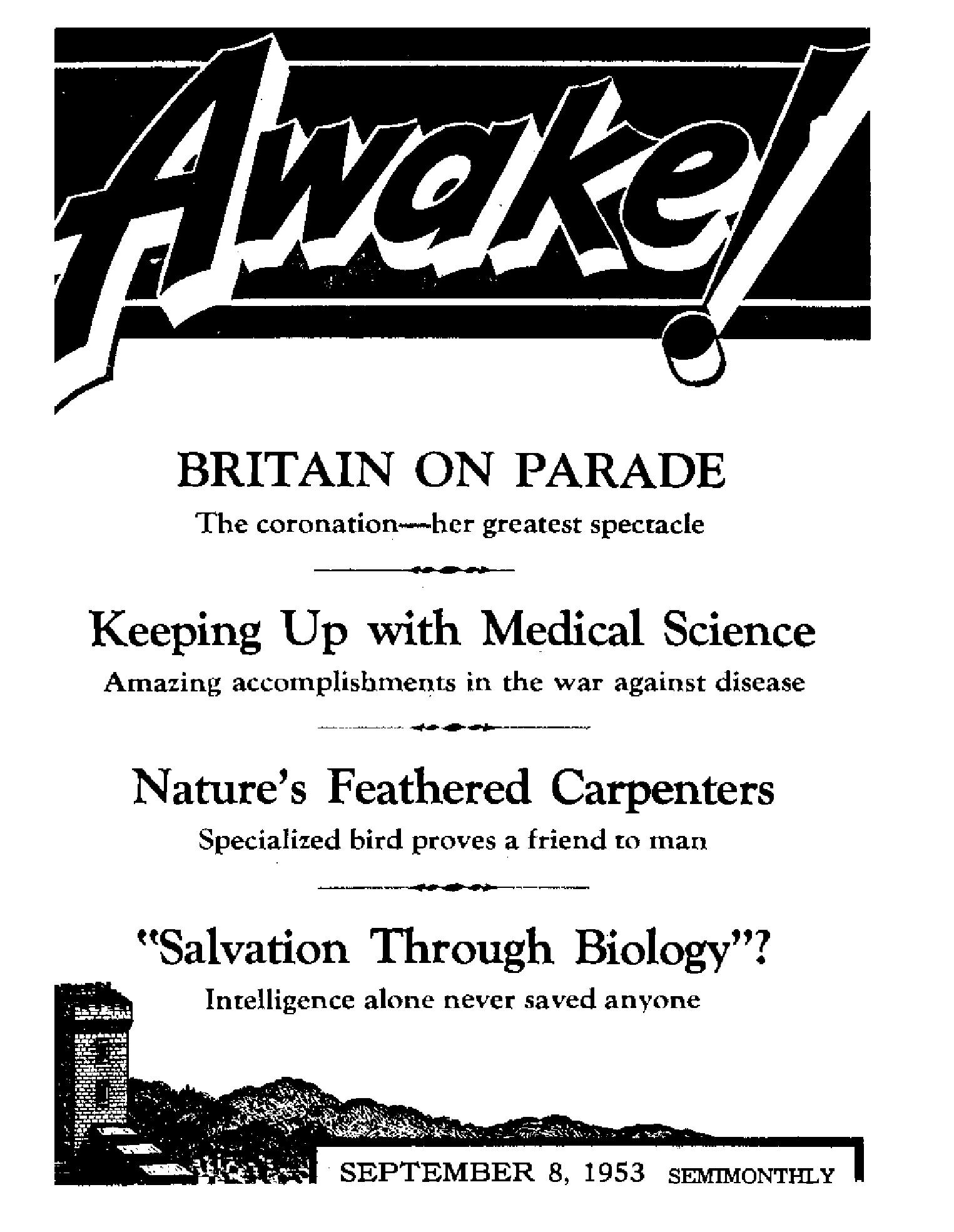
Awake!, September 8, 1953
Download: PDF — Awake!, September 8, 1953
THE MISSION OF THIS JOURNAL
News sources that are able to keep you awake to thtr vital issues of our times must be unfettered by censorship and selfish Interests. “Awake!” has no fetters. It recognizes facts, faces facts, is free to publish facts. It is not bound by political ambitions or obftdstfons; ft is unhampered by advertisers whose toes must not be trodden on; it Is unprejudiced by traditional creeds. This journal keeps Itself free that it may speak freely to you. But it does not abuse its freedom. It maintains integrity to truth,
“Awake!" uses the regular news channels, but is not dependent on them, Its own correspondents are on all continents, in scores of nations. From the four corners of the earth their tmcenaored, on*the-scenes reports come to you through these columns. This Journal*® viewpoint is not narrow, but is international. It is read in many rations, in many languages, by persons of all ages. Through its pages many fields of knowledge pass in review—government, commerce, religion, history, geography, science, social conditions, natural wonders—why, its coverage is as broad as the earth and &s high as the heavens.
"Awake I” pledges Itself to righteous principles, to exposing hidden foes and subtle danger®, to championing freedom for all, to comforting mourners and strengthening those disheartened by the failures of a delinquent world, reflecting sure hope for the establishment of a righteous New World.
Get acquainted with “Awake!” Keep awake by reading "Awake!1*
Publishzn Semimonthly By WATCHTOWER BIBLE AND TRACT SOCIETY, INC.
117 Adama Street Brooklyn 1, N. Y^ TJ. S, A.
N. H. Knorb, Prerident Obamt Boithb, Secretory
Printing fhlt lesue: IJ 60,MO
Five cent* » copy
LtniiMM li which the muulne H piblhVd: Semimonthly—Afrikaans, English, Finnish, French, German, HoltatuJlsti, Norue etan, Spanish, Swedish. Monthly—Danish. Greek, Portuguese, I’krulniim.
fteMlttenM* should be ant to oC&c* in your ww-try in compliance with regulations to CWutee safe delivery of money. Remittances are accepted at Brooklyn from countries where no office is located, by international money order only. Subscription rates in different countries are hen stated In local currency. Motlu ri rxylritlin (with neniwsl blank) Is sent al least two issues before subscription expires. Cha^io of afireti when aetit to our office may be etpected effective within one month. Herd your old as well u new ad<tress.
Act ri March B, 1070, Printed In U. B. A-
Offices 5«ar]j subscription Rate
AMVlca. U.S,, 117 AlUrne fit., Brooklyn 1, N.Y. *1 Aistrafli, 11 Beresford Ed, Strithflelri, NEW. fig Canada. 40 Irwin Are., Toronto 5, Ontario SI Enliana. 34 Craven Terrace, UjndMi, W, 2 7s Stith AfNth, Private Baj, P.O, Elantfrfofiteln,
Trapsmal 7f
Enteral as second-clew matter st BiMklyn. N. Y
CONTENTS
“Salvation Through Biology”?
Sketching Primitive Life in Mindanao
Britain on Parade
Colombia's Luxury Item
Court Concedes Witnesses Not Peddlers
Lightning Flees New.York
They Walk on Fire!
Hands That Retain Their Skill
Nature's Feathered Carpenters
“Your Word Is Truth"
Preventable Cancer Deaths
How Will Christ Return?
Heart-to-Heart Facts
Jehovah’s Witnesses Preach
The Weather, Disease, and People
in All the Earth—Thailand
Keeping Up with Medical Science
Do You Know?
High Value Placed on Bible
Watching the World
Volume XXXIV
Brooklyn N. ¥., September % 1W3
Number 17
"Salvation Through Biology”?
CONCERNING our time the prophet of Jehovah, Isaiah, long ago wrote:
1‘Darkness shall cover the earth, and thick darkness the peoples.” (Isaiah 60:2, An Amer, Trans.) That prophecy also applies to the modem scientists when they attempt to diagnose what is wrong with mankind and endeavor to prescribe a remedy without consulting God’s Word.
Among the many remedies offered by scientists for the improvement of man and the solving of his problems is that of human genetics. And while many scientists and doctors are devoting their time and energies to this science and many books and magazines are published on the subject in various languages, it must be admitted that to date comparatively little has been accomplished. Highlighting this fact was a speech made to a convention of geneticists by Dr. E. T. Wentworth, president of the Medical Society of New York State, in which he stated: “We must face the fact that with respect to most major afflictions—heart disease, cancer, muscular disorders, mental diseases and deficiencies—we are still very much in the dark, both as to causes—genetic or otherwise— and as to treatment. The two are not unrelated. For there is every likelihood that failure to understand the cause may largely explain failures in treatment.”—American Journal of Human Genetics, December 1952.
Some scientists, however, have great hopes for this rather new science if only more attention were given to it. Thus Professor E. A. Hooten, Harvard anthropologist, at a meeting of scientists in Cleveland, Ohio, after hearing other scientists boast of their marvelous computation machines, held that modern man was outpacing himself, and that he “would be better advised to breed some intelligence into his own species than to congratulate himself on building synthetic intelligence into machines of destruction”. He pointed out that the incidental benefits of atomic research such as radioactive isotopes used in medical diagnosis and treatment did not weigh very heavily against the power of atomic weapons to destroy mankind. While admitting that very little was known about human genetics, he nevertheless maintained that if one hundredth of the money that was spent on atomic research had been spent on the study of human heredity, a promising program for “salvation through biology” could be approached. —New York Times, April 11, 1953.
Conceivably, increased knowledge concerning genetics could help mankind. It is known that heredity does play a part in mental ailments, although authorities differ greatly as to the extent, some holding as much as eighty per cent and others as little as ten. And it is recognized that the allimportant factor in longevity is heredity.
Even if much Intelligence could be bred into the human race, would that bring about “salvation’*? The Nazis tried to breed a super race, and certainly as far as human intelligence was concerned Nazi Germany was not behind other lands. But did that make Germany an ideal country in which to live?
Russia and her satellites have many scientists. They have the atom bomb at their disposal and many American jet pilots claim that the Russian jet is superior to their own planes. It takes intelligence to do that, and yet with so much intelligence in both the East and the West the cold war has not been solved nor has it caused the United Nations to be a success. Obviously, breeding more intelligence is not the answer.
Or consider the crime situation in such an intelligent nation as the United States. Surely few countries have better schools and colleges, engage in more scientific research, have more radio and TV stations and more newspapers and magazines than does the United States. Yet in spite of all these advantages, that country leads the world in crime and, in fighting it, spends $25,000,000,000 annually, or $165 for every man, woman and child. In the last ten years, among youths the crimes of burglary, robbery with weapons and assault have doubled, whereas in the last twenty-five years the population of state and federal prisons has multiplied seven times as fast as the population of the nation. These facts were brought to the attention of the Middle Atlantic States Conference on Correction by Judge C. E. Moylan, of the Supreme Bench of Baltimore, Maryland. —New York Times, April 19, 1953.
Intelligence alone is not the remedy. An intelligent criminal is far more dangerous than a moron. Actually modem men, and especially the geneticists, are trying to pull themselves up by their bootstraps. They ignore God’s counsel and Instead follow the wisdom of this world, which states: “Know then thyself, presume not God to scan; the proper study of mankind is man.”
If man’s salvation lay through biology, then man would not have reached his present sorry state, for there was a time when he was mentally, morally and physically perfect. (Deuteronomy 32:4) “God made mankind upright, but they have sought out many contrivances.” (Ecclesiastes 7:29, An Amer. Trans.) Man allowed selfishness to enter his heart and it is this same selfishness that has brought man to his present impasse. What is needed is education and training in unselfishness, in doing to others what one would have done to himself. To get that spirit into his heart man needs outside help, from God and his Word, for Jehovah God is the perfect expression of unselfishness.—Matthew 7:12; 1 John 4:8.
That this is true wisdom and brings results, results not obtainable from mere scientific know-how or even human genetics, has been demonstrated by Christians who, having dedicated themselves to Jehovah God, are taking the Bible seriously and making practical application of it in their lives. They form a New World society that is free of the ignorance, the hatreds, the prejudices, the greed, the immorality and the hypocrisy that mark this old world. By means of the understanding of the truth of God's Word they have renewed their minds and put on new personalities. —Romans 12:2; Colossians 3:5-10, New World Trans.
And not only that, but in view of Jehovah’s past performances and present works they have the utmost confidence in his promises to give them eternal life, something that no geneticist would be so rash as to promise.—John 8:51; 11:26, New World Trans.
OAf PARADE
By "Awaktl" In Britain
ip’ORONATION Crazy,” “Greatest Show on Earth” and like expressions lit the headlines of the British press as the jreat day drew near. Tremendous preparations were under way for months before he actual coronation day of Elizabeth II. [t was evident that this was going to be something exceptional in the way of coronations. From the moment that the date ivas first announced there began colossal preparationy in the metropolis, and indeed throughout every town and hamlet in Britain. This was to be a momentous occasion and those who did not wish to join in the fun were looked on as kill-joys. For months workmen were engaged in erecting what seemed like permanent seating stands along the processional route, which betokened something on a grand scale, catering for the multitudes that were to come from overseas and all parts of the British Commonwealth. There were curly signs that the coronation of Elizabeth II was to be conducted on an elaborate scale unprecedented in the long history of the British monarchy.
For some days before the coronation, potentates from the far-flung colonies were arriving and thousands of people of many tongues were in the streets. Reflecting on this, a cartoonist in one of the London papers showed a small boy watching people of many lands pass by, and seeing a typical Englishman with a brief case, the boy asked his father, J,What is that, Daddy?” The reply was, "An Englishman.”
Decorations and bunting of evpry description draped the big stores—and the HtUe stores too—and they vied with one another to put on the best and most original show. There were flags galore, flowers were profuse, and the open spaces created by Hitler’s bombs only served to give room for the erection of more stands. It seemed that the “old lady” was to be shown to the world at her best.
Conscious of the caprices of the English climate, many of the decorations were designed to resist the onslaught of wind and rain, and just as well too, for when the day arrived it proved to be one of the coldest and wettest days of the summer.
To cope with the huge crowds additional police were drafted from the country and some 6,000 were billeted In Kensington Gardens and elsewhere. For days before the coronation the streets were packed with sight-seers and traffic congested the roads until the police threatened to close the West End to thousands of private cars. Since then it is claimed that sight-seeing coach tours have carried upward of half a million people. The preeornnatlon boost by the newspapers and radio brought the people to town.
Everything had been done to create an atmosphere of loyalty to the crown and to muflle for the. time the disturbing sounds
of the guns in Korea, the bandits in Malaya, the Mau Mau in Kenya, and the restive natives in other parts of the colonial territories. This was to be a spree; rising prices, high taxation, rationing, economic and political crises were forgotten in the desire to introduce a little color and make this a time of rejoicing. True, there were some dissenting voices: those who thought it a waste of money at a time when the country could little afford it; those who thought it was being overdone; and the Scottish faction who objected to the title Elizabeth n on the ground that Elizabeth I was not queen of Scotland. But all protests were drowned in the spirit that had been created by all the arts of propaganda.
Religion's Role
The role of the church in the proceedings provided a good opportunity for the leaders to show the part they play in the operation of church and state. Church dignitaries tried hard to stress the solemnity of the occasion, and, although the doctrine of the “divine right of kings” was officially abandoned many years ago, they talked much of the queen’s divine appointment, even describing her as “The Lord's Anointed”. In all this the Church of England was joined by spokesmen of other religious denominations, and although the queen swears allegiance to the Protestant religion, the Catholic Cardinal Griffin requested mass to be said for her in all the Catholic churches on the day before her coronation. The people in general, however, showed little sign of being moved by the religious aspect of the occasion, but concentrated on the ‘good time' it provided.
The specially erected seats along the route ensured a good view for those who could afford to pay, but the majority who planned to see the procession knew that they would have to take their chance somewhere along the route, and with fanatical determination the early comers began to stake their claim to a place on the wet pavement, there to remain for as long as forty-eight hours before the cavalcade passed their way. Not just ones and twos but thousands did this. The press reported an old lady of 73 who started her vigil at eight o'clock Sunday morning, remaining there through Sunday and Monday nights and on to the day. She had been training for months “toughening up" for her wait. When it rained, she used to go into her garden and let the water pour down on her. She had been training her voice too. “I’ve been to football matches to get my lungs in good fettle," she said.
While the multitudes were taking up their positions it became apparent that the English weather was up to its tricks. There was “a weather cocktail with nearly every ingredient but snow”. There was promise of hail with, possibly, thunder. The dauntless spectators, however, donned their raincoats, huddled under their blankets, and adopted a “we don’t care if it snows” attitude.
Colorful Coronation
Coronation day, Tuesday, June 2, dawned cold and gray, and those who were not going to the “show" were early disturbed by the crowds making their way to the route. The early morning news told of one million people’s having been brought to the West End before 5:00 a.m. by London Transport’s special “rush hour” arrangements. Thousands more came in by private cars, which were not allowed into the area. Loud-speakers were carefully hidden in the trees on the route and from these music-while-you-wait was provided from 5:30 a.m.
While crowds thronged the processional route the vast majority heard the proceedings on the radio or viewed them on television. The success of the television program is said to have put England’s TV on the map, but the d$y has not yet arrived to transmit color, “—and this time,” as one reporter commented, "the colour had really been put on in broad strokes?’ From his position outside Westminster Abbey he described “the rich scarlet tunics, and fat creamy drums and silvery bayonets, and brown horses . . . and medals enough to fill all the shops in Regent Street, and in fact, so many hues and so many glitters that if we had had time for it we would have felt sorry for the people who were seeing all this glory as so much black and white on a television screen.”
For the peers of the realm this was their chance to get out of their lounge suits and really dress up. “They wore cloaks of scarlet and yards of shining gold braid, and rainbow hats, and colours so improbable that the spectrum itself has never even heard of some of them/’ “Honey, the colour of!” said an American to his wife in the crowd, “We’d never dare to wear clothes like that on Broadway. Just take a look at that guy in the crimson dressing-gown.” The crowds cheered “the brewers’ horses drawing the Speaker’s Coach”, and they cheered all the more happily because those stolid animals, unfamiliar with Abbeys, overshot the proper mark and had to circle all the way back again. They cheered “the inevitable dog” that crossed the road against all regulations.
In Westminster Abbey, where England’s kings and queens have been crowned for centuries past, the traditional coronation service was conducted, led by the Archbishop of Canterbury and supported by many berobed church dignitaries. Much of the ceremony is enshrouded in the mists of antiquity and some is admittedly of pagan origin.
The ceremony over, there began the two-mile procession that thousands had stood for hours in pouring rain to see, and what was termed “history passing in a golden coach”. One visitor from overseas said? “I have marveled at the beautiful, fascinating, scintillating, gorgeous, astounding, display.” This was surely the greatest pageant in English history created by 12,-000 home, Commonwealth and colonial troops resplendent in their colorful uniforms; famous personages, overseas rulers, and the queen and her husband in the ancient and ornate state coach gilded with 18-carat gold, and which held Queen Victoria on a coronation day long ago, drawn by eight gray horses—the whole forming a fairy-tale spectacle that had to be seen to be believed.
There were incidents throughout the long hours of waiting that enlivened the crowds. A tremendous reception was given by the cheering crowds to one hitherto little-known visitor. To quote a press report: “She didn’t mind the rain, this queen from the South Seas. She didn’t mind the cold, this monarch from a sunnier land. She loved the crowds, the crowds loved her—Queen Salote of Tonga. Hers was the only landau with its hood down. She refused to put it up, but drove through the deluge laughing, waving—and soaking. Next to our Queen she was the hit of the procession.”
With the return of the queen to the Palace at 4:30 p.m. there ended a seven-hour program that started about 9:30 a.m, when the procession to the Abbey began. But the day was not over, and the people thronged the main streets of the West End and congregated in a crowd estimated at 50,000 outside the palace chanting “We want the queen”. Several appearances on the balcony were made to acknowledge the cheering multitude. At 9; 00 p~m, the queen broadcast a message over the radio.
The drizzling rain continued but thousands wended their way to the Thames Embankment where a spectacular fireworks display was given from the South Bank site of the 1951 Festival of Britain. In Hyde Park a giant bonfire was lit and many others glowed from hills and prominences throughout the country.
Optimism for the Future
This was only the beginning of a gala season with state banquets and official celebrations on a lavish scale alongside more modest back-street parties organized by the people themselves. There are those who believe that this is the beginning of a new Elizabethan age that will match the romantic and adventurous age of the first Elizabeth. The long reign of Elizabeth Tudor is, perhaps, the most outstanding in British history, bringing to mind the names of Drake, Raleigh, Shakespeare and others who contributed to the achievements of “Good Queen Bess's glorious days”. Four hundred years ago the prestige of Britain was on the ascent, but the tide has turned and she has been hit hard and impoverished by the events of this generation, and as a wqrld power, in common with other nations, is on the wane.
There are those who deplore any suggestion that the old country is “done for”, but the fact remains that we are at the end of this old-world order, and all the dressing up and finery will not stay the march of time. The coronation has touched off an attempt to use the young queen as a rallying point for fresh endeavor to unite the Commonwealth and Empire. It has been said: “The most important thing in our national life is the monarchy. For it binds us together, politically divided as w£ may be, at the deeper level of human love.”
But those who are looking for a new Elizabethan era of prosperity are unfamiliar with the prophecies of Scripture concerning our day. A coronation of Bible mention has taken place, and Christ Jesus has been enthroned as King of a kingdom that will shortly bring to men of good will the peace and happiness that a long succession of human monarchs has never been able to secure. With eyes fixed on the true “Lord’s Anointed” and the new world of righteousness over which he will reign, those who hope to be his subjects can never be dazzled by the pomp and pageantry that has for so long provided the outward show in this present system of things. All honor to earth’s rightful King.
Those Animals in the Language!
It is intriguing how animals make up a part of our vocabulary, Foxy people can ferret out all the wildcat schemes so they never have to go on wild goose chases. Politicians like to pigeonhole requests that do not please them. When people are extremely pigheaded and mulish we often think they must be playing possum. Because the hoggish person always wants the lion’s share, he usually gets the horse laugh instead. Who has ever seen a hawk-eyed or eagle-eyed marksman miss the bull's-eye? A catty person is mean, but he may get cattier during the dog days of July and August, It is often said that some men are henpecked by their wives; maybe it is because they act piggishly. A night owl likes to stay up late, perhaps reading all night. No wonder his books may be dogeared! Did you ever see professional dancers do the fox trot? or a swimming champion perform the swan dive? Until recent times the mink enjoyed a good name, but because of notorious political corruption the “mink coat" lost its glamour.
So anyone buying “mink coats" to bribe officials may wind up with white elephants. And today, Biblically speaking, people may be sheeplike or goatish.—Matthew 25:32, 33.
By "Awokit" »rr«apvftdv<«f in
LAZONED on the heraldic arms of the Canton of Vaud, Switzerland, are the proud words "Liberty etpatrie^ (“Liberty and Fatherland”). Today, when the liberties of the people are being weighed in the balances almost everywhere, ft behooves this fair section of Switzerland to take care lest its liberty be merely limited to its insignia, and be not the liberty that free people enjoy—the liberty that stems from freedom of conscience, expression and religion, Recently, in a very subtle and unpretentious manner these freedoms underwent a vicious and undemocratic assault. And it has been only by a persistent determination and will that an unpopular minority, Jehovah’s witnesses, have secured these rights by courageously defending their position in the high courts of the land. It is of benefit to briefly examine the history of these cases and Witness how freedom is defended and won.
Jehovah’s witnesses preach in Switzerland as they do elsewhere. TTiey announce the kingdom of God and the incoming new world of righteousness as the only hope for mankind. This they do by preaching from door to duor or by offering literature on the streets. Whenever people manifest interest at the door, a witness will leave Bible literature explaining Bible doctrine, etc. These publications are never sold. If the householder wishes to contribute toward the expense of the publication received, she is free Lu du so. But never is the placement of literature dependent upon a payment. If the people desire the literature but are not able to contribute, it Is left with them free on the promise that they will read It. Jehovah’s witnesses are ministers.
They are not engaged in any commercial enterprise. Their Christian missionary work is carried on at great cost to themselves in money and time. Their main objective is humanitarian, that is, they want all mankind to get an accurate knowledge of the truth as explained in the Bible so that they may receive God's approval and live.
IL would require a warped imagination to Interpret such ministerial activity as peddling, and thus require such ministers to obtain h peddler’s license. For years the Canton of Vaud maintained that such preaching was not peddling; also the High Court of Appeal in a 1931 ruling stated that Jehovah’s witnesses could not be classed as peddlers, because theirs was not h commercial enterprise but ministerial work.
Iii 1933, however, things changed. The Cantonal Law on Commercial Trading was revised. A clause in the law read, in effect, that peddling would include the offer of merchandise, whereby the price, without being demanded, was left to the discretion of the buyer. Some have asserted that this statute liad been purposely so worded to restrict the activity of Jehovah’s witnesses. But the official report in the Stenographic Bulletin of the Great Council (the legislative body of the Canton) contains no mention of this. In fact, this report shows that the revision of the law was requested by the business people for their own protection and for the protection of their customers, and had nothing to do with Jehovah’s witnesses.
However, the office of the state attorney hi Lausanne seemed to think differently. He thought it could be applied against Jehovah’s witnesses, so trouble began. In
1948 the district court m Payeme sentenced a minister of Jehovah’s witnesses for violating this law. The case was appealed and sent to the cassation division of the High Court. Here the lower court’s decision was upheld. By so deciding the High Court degraded the dignified work of preaching to that of peddling. With that a struggle for freedom to teach and preach began, which struggle extended over a period of almost five years.
A Battle for Truth and Right
As time went on it became obvious that Jehovah’s witnesses were determined to contest the decision of the High Court. They felt that that which God grants no man has a right to limit or restrict; that God’s law is supreme; that the command to preach God’s kingdom stated in the Bible is imperative, and that the Swiss Constitution protects and guarantees the right of the minister to preach, teach and worship God according to the dictates of his conscience. Jehovah’s witnesses maintained that the law (peddler’s law) applied only to commercial activity and did in no way apply to them. With this firm conviction they continued even as before in their preaching work. Numerous citizens of the Canton of Vaud rallied to their side. These citizens became indignant at the misapplication of this peddling law. But the only way the issue could possibly be cleared up was by one’s not giving up in his freeriess of speech. This would enforce the consequences. It did. It was not long before the issue was spotlighted in the courts of the land.
The first case came before the district court in Vevey on July 13,1949. Two ministers of Jehovah’s witnesses were arrested under this peddling law. The judge heard the evidence and dismissed the case, stating that the law could not be applied -to ministers. The second case of a similar nature came up before the district court in Chateau d’ Oex, where, upon hearing the evidence, the case was dismissed. Here again in a well-rounded-out opinion the judge stated that the peddling law could be applied only to commercial activity; that it could in no sense of the word be applied to ministers who preach from house to house; that to apply this law to preaching would amount to an extended interpretation of the law, and would infringe upon the constitutionally guaranteed right of freedom of worship. This of course is what Jehovah’s witnesses contended all along. But what made this decision so outstanding was the fact that it did not in any way conform to the decision of the High Court.
This same district court had a similar case to consider on February 22,1950. The state attorney was present at this trial. In his speech before the court he accused Jehovah’s witnesses of pursuing subversive aims, which he endeavored to prove by reading a letter that stated that Jehovah’s witnesses obeyed God more than men. Perhaps the state attorney was not aware at the time that those were the words of Peter and John, apostles of Jesus Christ. (Acts 5:29) We wonder if he would have accused Jesus and his apostles of being subversive for making a statement like that. Nevertheless, the attorney’s accusations were easily refuted, and the court promptly returned a judgment of not guilty. This time the state attorney appealed the decision of the High Court, which adhered to its former decision and reversed the judgL ment of the lower court.
The battle to preach and teach without a license appeared dim and- hopeless indeed! But Jehovah’s witnesses pressed on. They know that freedom is not won by those who quit but by those who contend for the faith. So it was inevitable that another case should come before the district
stamp it as unsa
factory. Another acquit
court In Lausanne. Here again, to the surprise of all, the district court ruled an acquittal. It had the courage to call in question the decision of the High Court and tal followed on March 28,1952, on a similar charge. At this trial a Protestant minister appeared as a witness. This clergyman accepted two books at his door from the minister of Jehovah’s witnesses, and had given him a voluntary contribution of Fcs.4.-. This Protestant minister told the court that the minister that called at his door did not call on him to sell books, but to discuss religious questions with him, and that, this young man (one of Jehovah’s witnesses) had given the distinct impression of an evangelist and not a peddler. The state attorney did not appeal this ease either.
In the district court at Rolle, the state attorney again verbally attacked Jehovah's witnesses as showing lack of respect for law, because they would not abide by the High Court's decision, but continued to preach. What this attorney did nnt take into account was that many of these district judges did not abide by this law either. Were they too showing a disrespect for law and order? Or were they fighting for the rights guaranteed by the Swiss Constitution? The court in the decision of this case stated that if the accused should be obliged to take out a peddler's license, then he would be considerably restricted in his religious activity. Therefore, the court did not honor the High Court’s decision, and dismissed the case. The state attorney promptly appealed the decision, and now for the third time since the framing of this peddling ordinance, the High Court was faced with deciding whether it could be applied to ministers who preached from house to house; and for the third time the High Court ruled that the law could be so applied and so reversed the lower court.
TAe Turning Point
At this point the fight seemed hopeless for Jehovah’s witnesses. It was not long after the above case was decided that another case developed in the lower court. Again the lower court would not honor the High Court decision, and dismissed the case. The state attorney this time, encouraged by the previous victory in the High Court, appealed again. The case was transferred to the district court of Algle. This court too dismissed the charge. Back to the High Court of Appeal went the case for final judgment. For the fourth time in five years the court was faced with deciding the same issue. Th is time the court was composed of a new set of judges who dug down to the bottom of the question, and on January 26,1953, unanimously decided that the activity of Jehovah’s witnesses cannot be viewed as peddling. With that the state attorney's appeal fell flat. It was rejected.
Now glancing over the five-year-old legal battle in behalf of freedom of worship, over eleven court cases have been fought in this canton alone since 1948. Eight of these were decided in favor of Jehovah’s witnesses. The three that were lost were lost to the same judges, who would not alter their prejudiced opinions. The triumph came when the High Court reversed Ils decision in favor of Jehovah’s witnesses.
establishing of the g
ne ws.' -Philip-
It took five years, great expense, and much suffering and time to win. back and establish this right. The praise for this victory goes to Jehovah. The witnesses of Jehovah in Switzerland can properly become sharers of the words of Paul, who said: “All of you being sharers with me in the undeserved kindness both in my prison bonds and in the defending and legally plans 1:7, New World Ttom.
SEPTEMBER S, 1953
By “Awok®!” corrMpondtnf in Burma 1
'K/flSFORTUNE after misfortune so accentu- | 1 ates man’s insecurity that he is apprehen- t sive of anything unusual. Being ignorant of ? the truth, he has frequently felt that his mis- [ fortunes were the result of some deity or some * ancestor who was offended and who must be [ appeased. The same sharp sense of guilt that [ spmetlmes drives men insane has also prompt- » ed many unnecessary religious ceremonies and t rituals, even cruel means of penance and ap- } peasement. The Tamils of India suffer under | one such system. They being poor and greatly ! beset, their suffering should certainly be J enough to "atone” for any supposed or real ] sins, even if such suffering were necessary, ' but it is not so in their minds. Take, for ex- | ample, the springtime feast they hold In honor i of the goddess Mariamon in Kamayut and { Kambe in the suburbs of Rangoon, Burma. | Here common folk, not paid performers, who ♦ have prayed for the aid of the deity and wish ► to punish themselves for their sins, actually J pierce their bodies with spikes and walk on l Are. !
<[. For about a month they have fasted, living | on only milk and fruit. The day of purification | now arriving, they go to a temple for washing » and to have the spikes hooked through their L t flesh. Some are actually pierced through from J cheek to cheek, or even have a spike through j their tongue which protrudes out of their J mouth. They walk in state to the special tern- J pie where the feast is being held, and by about | 10 a.m. they are trooping along from all di- t rections, some with a few spikes, some with } numerous little silver hooks stuck to the body j In designs, and others with other weird means j of self-punishment. |
d When exhaustion threatens to overcome j them the drums beat louder and support is | given by their companions. After the activ- i ities within the temple, the evening ceremony, * starting about 5 p.m., provides the climax. A } procession is staged, led by the image of the j goddess Mariamon, which is brought around | to the empty space close to the temple, and l placed at a vantage point from where she can * “see” her faithful fulfill their torturous vows. * <L The climax approaches! The fire was lit several hours ago In a pit about two feet deep, five feet wide and twenty feet long, with a separate compartment at the far end filled with water so the runners can step into it last. The coals are now spread out evenly. The heat la great enough that if one is standing against the breeze he does not wish to go very close, and even those who are raking the live coals are doused with bucket after bucket of cold water.
<1. Now there is suppressed excitement. The candidates line up for the final discharge of their vows. A priest throws something on the coals and apparently utters a prayer. The candidates are .becoming uncontrollable, jumping, hopping and twisting, as if prodded to hurry on. Tourists have their cameras ready, and—There they go! A sturdy-looking man wearing a garland of marigolds takes the lead, making quickly one, two, three, four, five, six long strides and, plunge! into the water at the end. Hot on his heels comes a young man carrying a four-year-old child on his shoulders. The child clings tightly and cries, as this man walks slower, A third just bolts through. The next one barely reaches the water pit and faints Into it. Attendants carry him to first aid. The next man has a large image of his deity supported over his head by spikes to his body. He approaches proudly, puts a foot forward to feel the coals, hesitates, then makes a start, but is soon out again. What a catastrophe! A bad omen. The audience is sure something unwanted will happen now!
C But others are pushing in. They are agitating to get through the little entrance, and the ushers have a difficult task indeed making them take their turn. The men go over the coals. The women who come later must walk around them, but they seem to be in even more of a frenzy than the men. No blisters are evident on the walkers' legs. The use of any protection is denied. They believe it comes from a god, and it may well do so, a god of false devil worship, a demon. This false worship does not succeed, however, in allaying the fear of guilt. Christ provided the true ransom for sin. Self-torture does not. Rejoice that such inhuman false worship will soon end!
aturci
rAP, tap, tap! Tap, tap, tap! One of la tore’s carpenters s hal'd at work. Suddenly come the :rack of a rifle, the flutter of feathers arthwnrd. Picking up the lifeless form of downy woodpecker, a sad-faced child isks his father why he shot this pretty >ird. Back comes the grownup’s an-
wer: ,+Do you think it’s good for a tree o be punched full of holes?” The child had bought the woodpecker to be good; the frnwnup had thought this peeking bird to )c had. Who was right?
The woodpecker has an intensity of pur-jose that la amusing to behold. But when ve examine some of the trees Ite has vorked on and note deep holes, even trees mneycombed with small holes, it is alarm-ng. However, upon closer inspection we lotice that the woodpecker prefers to drill )ut a nest in dead trees, or decayed, un-lealthy parts of living trees. Being a rath-jf intelligent bird, as birds go, the woodpecker builds its home the easy way and :hus does not make a point of excavating he hardest wood it can find. Here and ;here a few nests arc dug in living trees, out tree fatalities are few. So the big worry ibout woodpeckers is entirely unfounded.
But since woodpeckers can drill out a nest in two to three weeks, why are they Incessantly hammering on the bark? Because this carpenter' work is their occupation! The chief occupation of any bird is the search for food, so let us watch one of nature’s carpenters at work. There is a redheaded woodpecker! If he does not see us first and scurry over to the other side of the tree, we can find out something alwit his occupation. Clamped firmly to the tree, he is drilling at one spot trying to dislodge something. Why, it is a deeply hidden grub known as a borer. As soon as Uie tunneled grooves in which the borer lives have been exposed, a long slender tongue darts In and the grub is dislodged and dpvMirpd. Thus nature’s feathered carpenter is unique? it destroys insects and grubs hidden in trees that other birds could not possibly kill!
These feathered carpenters do more than kill insects. They remove the dead, rot-prtxkiclng wood and thus promote the growth of healthy trees. They rarely disfigure a healthy tree. So a gun aimed at these feathered friends of man Is really aimed at our trees, for man has no effective control over deeply hidden tree insects. To be sure, these hard-working carpenters of the bird world render to man a service that he could ill be spared. They deserve man’s fullest protection and encouragement.
Nature’s carpenters comprise a big family, More than four hundred species of woodpeckers are known. These birds are almost cosmopolitans, for they inhabit ell wooded portions of the world except Madagascar and the Australian region. Wherever they are they seem to manifest an alert, almost human, interest In life. They
appear to delight in producing sounds with their bills. And they usually do not show hysterical fear of man, although they are wary.
The “Carpenter’s” Equipment
Woodpeckers fly in a peculiar wavy, galloping manner, but it is their highly specialized equipment for getting a living that intrigues us most. One may well wonder how this bird hammers all day with its beak without the impact from the heavy blows injuring the brain, the eyes, the ears, or other delicate parts of the head. The answer is that the wise Creator provided them not only with a stout beak having a chisel-shaped point but also with just the right amount of compensation to absorb the shock from the heavy blows. Another amazing feature of a woodpecker is its tongue. After drilling beneath the bark and locating the hidden prey with astonishing accuracy, the woodpecker hurls its harpoonlike tongue two inches or more beyond the tip of the beak to reach the most elusive of insects. Insects find it next to impossible to escape, as the woodpecker’s tongue is not only barbed but also coated with a sticky secretion that holds them fast. More sure than a police raid on a bank-robber’s hideout is the knell of doom to the insect whose security in a bark-lined haven ends with the machinegunlike staccato of a hungry woodpecker knocking at the door.
The way these feathered carpenters sit parallel with a tree trunk, sometimes upside down if the exigencies of the moment demand it, whets our interest. These birds usually have four toes that are well adapted to clinging to the side of a tree, but the tail also plays a vital part. It is composed of stiff feathers ending in sharp spines that can be pressed against the bark and so serve as a prop to hold the bird in an upright position while striking hard blows with its beak. The beak, of course, is an allround carpenter’s tool; it can gouge, spilt, chip, pry and drill. After viewing these fascinating birds with their specialized equipment, one cannot help but echo the words of Genesis 1:31 concerning God’s handiwork that “it was very good”.
Some Colorful Carpenters
Green woodpeckers display gorgeous plumage and are among the most interesting of European birds. They love to play havoc with ant hills, into which they dig great holes with their powerful bills. In the United States the woodpecker that is seen in the open more often than any other is the redheaded woodpecker. This colorful bird has a red head and neck, whitish ui> derpart, and bluish-black body. It prefers the dead tops of forest trees, but if it lacks these natural sites, it will build its home in what man has offered as a substitute—telephone poles. In drilling a nest, both male and female take turns. The “carpenter” off duty is allowed “twenty minutes for refreshments”, consisting of grubs, beetles and perhaps a few cherries. Then it promptly returns to work when “time is up”.
The second-largest woodpecker in North America is the pileated woodpecker. With its hammerlike bill, this robust “carpenter” drills to the heart of the tree to invade colonies of great carpenter ants. It is a case of a bird carpenter eating an insect carpenter. As many as 2,600 ants have been found in the stomach of one pileated woodpecker! Another intriguing bird is the red-cockaded woodpecker, which has the uncanny ability of choosing specific trees for its nesting site. That is, it always digs its nest in a living pine tree. But wise lumbermen do not cut a tree that has a nest of this bird in it. Why? Because if they do they will have their labor for nothing: the tree has a dead heart! This “car-
penter” drills a small entrance hole directly in, usually glanting slightly upward until it reaches the soft dead wood; then the bird drills straight down for about a foot. It makes an ideal nest. But how the little woodpecker knows in advance that the tree has a dead heart has not yet been revealed.
The ivory-billed woodpecker has often been called the boss carpenter of the bird world. Its ''chisel” is absolutely de luxe; it is like a glassy ivory dagger nearly three inches in length. The male of this largest of North American woodpeckers also has a flaming red crest at the back of the head, which makes it one of the most animated feathered objects in nature. It Is sad that this magnificent bird is now one of the rarest of woodpeckers. Virgin forests are demanded by the ivory-bill for sustenance; the complete lumbering of such habitat seems to doom the bird to go the way of the dodo. Man, In the past, relentlessly shot this extraordinary bird without particular cause except curiosity and a desire for Lhe feathers or beaks. But that this big, handsome bird is king of the feathered axmen is verified by the book Birds of jtnwwM. Here is the story of a man who wounded an ivory-bill and confined it in his hotel room:
“Tn less than an hour I returned, and, on opening the door, he set up a distressing shout, which appeared to proceed from grief that he had been discovered in his attempts to escape. He had mounted along the aide of the window, nearly as high as the ceiling, a little below which he began to break through. The bed was covered with large pieces of plaster, the lath was exposed far at least fifteen Inches square, and a hole large enough to admit the fist opened to the weather-boards; so that, in less than another hour he would certainly have succeeded in making his Way through.”
If woodpeckers do a little mischief now and then by drilling where they should not or by eating cultivated fruit, it is because commercial-minded man has deprived those birds of much of their natural habitat and has overlooked the importance of preserving some wild fruit-bearing shrubs. Even the sapsucking woodpeckers that cause perceptible damage to living trees have their value.
Nature's feathered carpenters may not possess the stately dignity of the heron, the singing powers of the thrush, or the graceful flight of the swallow, but they do have the distinction of being hard workers and substantial, interesting citizens of the bird world, rendering us an Invaluable service. What endless hours of fascination the gaily colored bird creation will provide, man in the paradise earth of Jehovah’s new world J
PREVENTABLE CANCER DEATHS
€. According lu the American Cancer Society. 70.000 cancer patients lost their lives unnecessarily last year. Officials of the society said 70,000 patients liad been saved but it could have been 140,000 if the cancers had been treated earlier. To illustrate that there arc many unnecessary deaths, the society gave* figures for the present and possible cure rates of cancer “At present cancer of the female generative sites is cured in 30% of the cases, could be cured in 80%; cancer of the lung now cured in five per cent of cases, could he 50?; ; breast cancer now cured in 35%, could be cured in 70% of cases; cancer of reel inn now cured in 15%, could he cured In 75% of cases; Cancer of the mouth now cured in 40%, could be cured fn 65% of cases; akin cancer now cured in 85%, could be cured in 95% of rases."—Science News Letter, May 2,1953.
Heart-To-Heart Facts
TTE human heart pumps five to six quarts of blood every minute. During an average life span the heart pumps 200,000 tons of blood’ Weighing about ten ounces, the average person’s heart is about the size of his fist. In one minute it beats about 72 times. When resting, the heart pumps blood at 55 feet per minute; when running fast, the heart pumps blood at 450 feet per minute. To do this tremendous work the heart uses up in one day enough energy to raise a 150-pound man the height of the Empire State Building!
7’ The heart also plays a vital part in our vocabulary. When one feels dejected, he is said to be downhearted or sadhearted. An employer wants people to work wholeheartedly, not halfheartedly. A kind, generous person may be openhearted, freehearted, bighearted, J kindhearted, tenderhearted, warcrfhearted, $ goodhearted, or softhearted. A display of fear \ may mean one is fainthearted, weakhearted, pigeonhearted, or chickenhearted. Evil men ? are blackhearted; sincere men, singlehearted. J A courageous person may be stronghearted, •I stouthearted, or llonhearted. We call the cruel, J; unfeeling person coldhearted, hardhearted, stonyhearted, ironhearted, flinthearted, or
\ marbiehearted. The cheerfully gay person is I; not heavyhearted but lighthearted.
\ V Thus the heart in its larger sense denotes i, the seat of the emotions of love and hate, / desire, joy, sorrow, courage, loyalty and fear. S No wonder ,fJehovah seeth not as man seeth; \ for man looketh on the outward appearance, Ij but Jehovah looketh on the heart’’!—1 Samuel J* 16:7, Am, Stan. Ver.
J Brooklyn Bootlegger On City Property ■
<L With the high ,U. S. taxes on Liquor, bootlegging—making illegal whiskey on which no tax is paid—is booming. Traditionally this is a side occupation in mountain valleys, but when the aroma of mash floated over a section of Brooklyn in March, federal agents did some investigating. Their nosps led them to. a two-story water-front warehouse where they found a $50,000 still capable of producing 2,500 gallons of alcohol and fleecing the government of $52,000 in taxes each day. The city’s financially stricken Board of Transportation was in deep gloom, however, for this raid merely added to its deficit. It owns the building and was being paid $225 rent for it from a <fgood tenant" who had paid promptly.
J the weather.
WEATHER affects one inemaxiy. me ucoi mental work is done in late winter, early spring, and fall; the worst, in summer. It is even said that more crimes are committed throughout the world in warm years than in comparatively cool ones. People look better to one another and to themselves on a fair-weather day when the barometer is rising.
Weather and climate affect most diseases. Cancer has its highest death rate in temperate latitudes, but the death rate declines sharply the closer one goes to the tropics. In the authoritative book Clinical Tuberculosis Dr. A. M. Forster says that those suffering from TB receive benefit from a stay in a climate where the air is cold, and adds: *Tt is too universal an observation to bear contradiction that patients do better in a mountain climate than they do at the equator.”
DISEASE & PEOPLE
t xvucumauv icvcf js a severe problem in the \ stormy belts of the temperate zone; it is vtr-? tually unknown in tropical regions. Leprosy Ji flourishes in the tropics, but in northern areas *t‘ of the world it makes no headway. Some doc-/ tors believe diabetes is a by-product of a climate that drives its people too hard. Malaria thrives In tropical and subtropical parts of the ? world. Climates with stimulating seasons im> pose a severe strain on the heart. The death < rate from appendicitis falls steadily as the ? distance from the tropics increases. The cool, stormy areas of the world, usually believed jl to be the healthiest, actually have the highest / incidence of colds, pneumonia, and other respiratory infections. The worst months for *. colds: January, February and March. Con? elusion: Some diseases like it cold; others ;■ like it warm.
ease that especially eats away the face, forehead, arm pits and buttocks, is caused by a terribly virulent virus. But the formidable virus succumbed when penicillin entered the fight
Penicillin did not for long
ALMOST daily we are reminded that the atomic age, still a youngster, is begetting fantastic weapons. Not as often are we reminded that the 11 antibiotic age", also a youngster, is begetting weapons equally fantastic. It began just twelve years ago with penicillin, the first “wonder" weapon. Whoever thought when the wnrd ’'penicillin" first appeared that, in almost every language, it would be about as widely understood as “aspirin”? Yes, in a single decade progress in medical science has. changed the heal 111 of the world.
Prior to 1935, an attack of pneumonia was a critical affair. One third of all patients fatted to survive. There were no specific medicines. Then through the work of Fleming, Florey, and Chain, penicillin came to the fore, and the deadly sting from pneumonia was removed. Seldom, perhaps, is it realized, especially among the younger generation, that without penicillin, the sulfonamides, and the newer antibiotics, pneumonia would revert to the pitiless killer it wan in the past. But penicillin has also been a boon to mankind in the war against scarlet fever, boils, diphtheria, syphilis, meningitis, strep throat, tonsillitis, and wound infections. This “wonder” weapon rains its hammerlike blows against disease by both killing bacteria and slowing their growth.
Another of penicillin's dramatic triumphs has been found in Haiti, where the dreadful disease called yaws is being eliminated. It has been estimated that almost one third of Haiti’s population of 4,000,000 had this disease. Yaws, a contagious disfight the battle alone. In 1944 streptomycin appeared—winning a 1952 Nobel prize for Dr. Selman Waksman—to add its slugging blows against undulant fever, tuberculosis and pneumonia. Three years later Chloromycetin joined the attack against the above-mentioned diseases plus anthrax, peritonitis, plague, typhoid fever and virus pneumonia. Progress came with such amazing speed that 1948 brought aureomycin into the front lines fighting oil the foregoing diseases plus amebic dysentery, typhus fever, Rocky Mountain spotted fever, trachoma, Q fever and urinary-tract infections. Another all-round gladiator joined the fight in 1950 when terramycin appeared, useful against all the aforementioned diseases.
The Fiff fit Against TH
The TB organism is a shrewd and ancient foe of man. TB no longer is the "Great White Plague" that dwarfed all other killers less than a century ago. Still about 100,000,000 persons throughout the world suffer from TB; about 3,000,000 to 5,000,000 die annually. The antibiotics delivered lome crushing blows to the TB foe, but it was not until 1952 that the most powerful weapon against the TB organism appeared. A research team at New York’s Sea view Hospital tried a new drug, a chemical called isoniazid, on 92 “hopeless” TB patients. Of this “hopeless" group, some died, some are still improving and some are now back at home, living normal, useful lives. A Seaview specialist summed up
isoniazid this way: 1 ‘It’s just the best single weapon man has found against TB—not miraculous, but useful and even lifesaving. Isoniazid was science's first Sunday punch/*
But strains of tubercle bacilli soon learned to live with isoniazid, and some doctors worried that the new bacilli might lead to more difficult-to-cure varieties of TB, However, Dr. Gardner Middlebrook of Denver’s National Jewish Hospital recently declared, after conducting tests, that the new bacilli proved to have lost the old virulence and they seemed to have lost the ability to grow and reproduce in healthy tissue. He declared isoniazid “the most remarkable chemotherapeutic agent yet discovered for an infectious disease of man”,
Remarkable progress has been made by medical science against syphilis. Prior to 1943 a cure meant about two years of treatment with arsenical drugs combined with bismuth. With penicillin the treatment was reduced to about seven shots. This latest weapon is a new penicillin distinguished by unprecedented staying power called bi-cillin. People Today (issue of May 6, 1953) reported that a single shot of bicillin brought successful results in 95 per cent of test patients. It also said "a single bicillin shot will protect an influenza patient against complications like ‘strep’ throat and pneumonia, do the work of several penicillin shots”. Though exaggerated, the words of one top ear, nose and throat specialist are interesting: “One more antibiotic and I’ll be out of business.” J
The War on Malaria
About 300,000,000 cases of human malaria develop each year; of these about one per cent are fatal. So devastating was this disease that in 1942-43 malarial casualties among military personnel in the southwest Pacific far exceeded the number of enemy-produced casualties on both sides! Since 1638 malaria has been treated with quinine. In 1930, German chemists synthesized atabrine, which was more effective than quinine and less toxic. During World War U a synthetic substance related to atabrine called chloroquine was found to be much more effective in suppressing some forms of malaria than atabrine. Doctors finally came up with primaquine, which can destroy the “hiding” parasites in tissues and reduce the relapse rate from about 30 per cent to less than 1 per cent. Regarding this drug, Science Digest, November 1952, stated: “Moderate quantities will soon be available for civilian use.”
The hormone drugs, cortisone and ACTHf have recently held the spotlight for the treatment of rheumatic fever and similar diseases. They were found to be valuable chiefly for the temporary relief of the symptoms.
Other Accomplishments
Incredible feats of medical and surgical skill are performed almost daily. In much the manner that manufacturers have developed spare parts for autos, surgeons are now able to replace many worn-out or destroyed parts of the body. In about one out of 40,000 births a child is born without an esophagus, A surgeon at Children’s Hospital in Los Angeles “built” an esophagus in a three-day-old baby born without one. He accomplished this by cutting out a six-inch segment of the baby’s large intestine and transplanting it.
In the field of heart surgery, amazing progress has been made. A 13-year-old boy had a hole in his heart about the size of a half dollar, which surgeons patched with pieces of the fibrous sac that encloses the heart. “Deep-freeze” surgery has been successfully employed. This method puts the human body in a state of virtual suspended animation by lowering its temperature 25 degrees or more. The patient loses consciousness when the body temperature reaches between 88 and 84. At about 71 degrees the patient is reedy for surgery. By this method blood from the main artery to the heart can be shut off for as long as fourteen minutes, making surgery on a "quiet” heart possible. Seventy-five years ago the primary aim of surgery was the removal of diseased organs. Today the emphasis is on preserving the function as well as the curing of disease.
An amazingly large number of adult persons have had a sewing job done on them, after operations or the closing of wounds after accidents. Many of the remarkable operations today would not be possible if it were not for the improved suture (sewing) material and needle design. So skill in medical sewing rapidly improved. In some people the aorta—the main artery leading from the heart—is constricted, hourglass fashion, and there is a famine for blood. This is corrected when the surgeon cuts out the constricted artery and replaces it with a new part, a sewing job of the most difficult kind.
Yet in spite of all the marvelous progress that medical science has made, it seems that man knows very little after all. Leading medical authorities unanimously agreed in 1953 at the first Western Hemisphere Conference of the World Medical Association that "the advances of the past really have demonstrated how little man truly knows about his own personal life processes”.—New York Times, April 26, 1953,
Doctors in this atomic age, with all its powerful radioactive elements, its chemical wonder drugs, its hormone drugs, its remarkable surgical skills and its potent antibiotics, still cannot do what the Great Physician of 1900 years ago did. Christ Jesus performed cures without surgery, wonder drugs or pills. But even those he restored to health eventually died, either of old age or of disease. So something more vital than miraculous cures was needed. That is why Christ Jesus went ‘‘preaching the good news of the kingdom”, besides curing every kind of disease, (Matthew 9;35, New World Trans.) Christ knew that what man needed above all was God’s kingdom, His primary work was preaching, not physical healing. But the cures he performed when on earth were a sample or picture of what he will do for obedient mankind in the new world. Why not rely, then, upon the One who knows everything about man’s personal life processes, the Creator, Jehovah God? For His kingdom alone will bring in freedom forever from disease and death.—Revelation 21:1-4.
…