Awake!, August 8, 1953
Download: PDF — Awake!, August 8, 1953
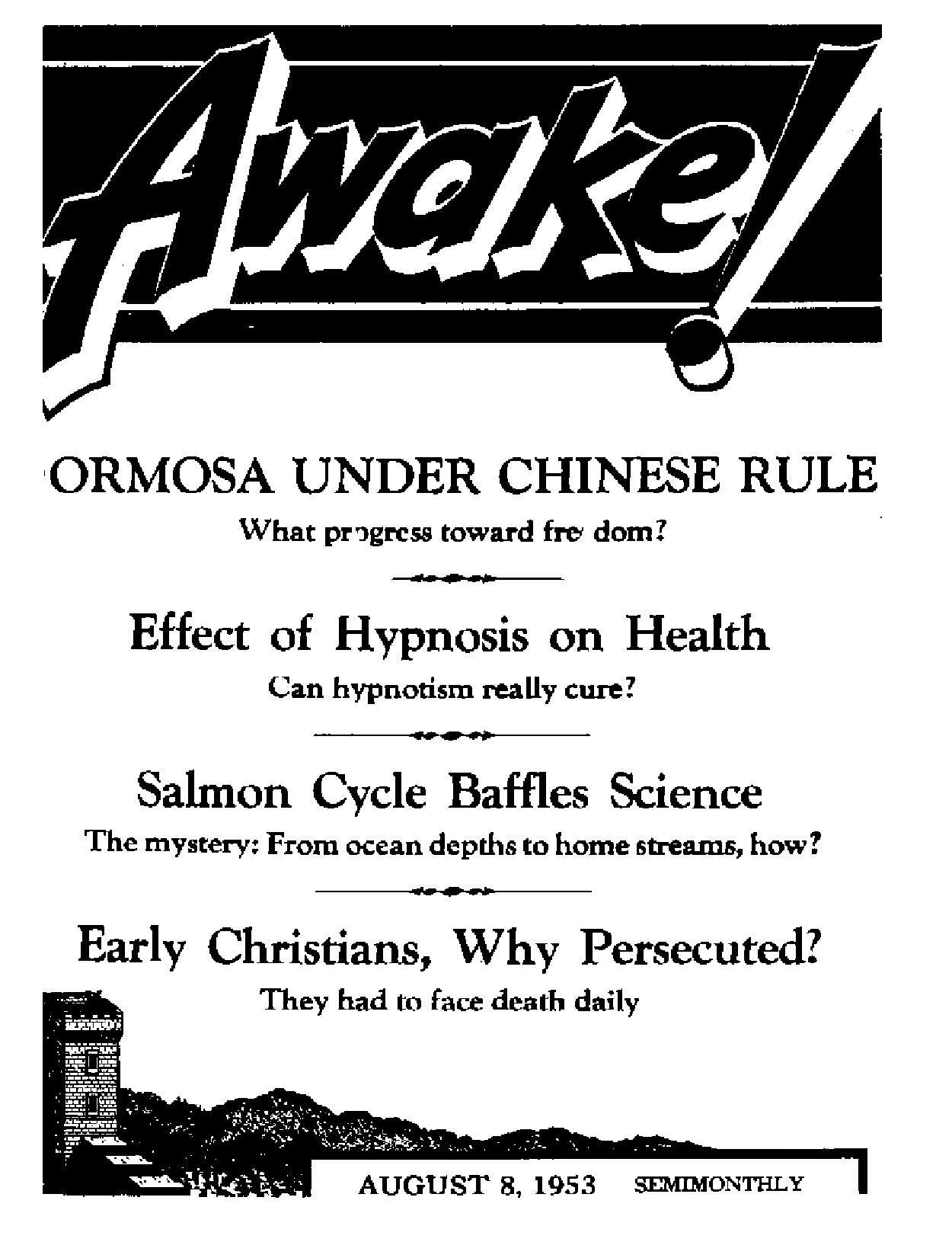
ORMOSA UNDER CHINESE RULE
What progress toward fre dom?
Effect of Hypnosis on Health.
Can hypnotism really cure?
Salmon Cycle Baffles Science
The mystery: From ocean depths to home streams, how?
Early Christians, Why Persecuted?
They had to face death daily
AUGUST 8, 1953 semimonthly
THE MISSION OF THIS JOURNAL
News sources that are able to keep you awake to the vital loues of our times must be unfettered by censorship and selfish Interests. “Awake!” has no fetberv, It recognizes facte, faces facts, Is free to publish facts. It Is not bound by political ambitions or obligations; ft Is unhampered by advertisers whose toes must not be trodden on; ft is unprejudiced by traditional creeds. This journal keeps Itself free that it may speak freely to you. But it does not abuse its freedom. It maintains integrity to truth.
"Awake 1” uses the regular news channels, but is not dependent on them. Its own correspondents are on all continents, in scores of nations. From the four corners of the earth their uncensored, on*the*scenes reports come io you through these ccJumna. This journalviewpoint is not narrow, but is international. It is read in many nations, in many languages, by persons of all ages. Through its pages many fields of knowledge pass in review—government, commerce, religion, history, geography, science, social conditions, natural wonders—why, its coverage is as broad as the earth and as high as the heavens.
“Awake I” pledges itself to righteous principles, to exposing hidden foes and subtle dangers, to championing freedom for all, to comforting mourners and strengthening those disheartened By the failures of a delinquent world, reflecting sure hope for the estabOshment of a righteous New World.
Get acquainted with “Awake!” Keep awake by reading “Awake 1”
Published Semimokthlt Bt watchtower bible and tract society, inc.
117 Adama Street Brooklyn 1, N.Y,, U. 8. A.
N. H. Knqhs, President GlaFt Suiter, St^retary
Printing thi* issue: 1,150,000
Five cents a copy
Bamlttastat should ha sent to cldcs in w country tn compliance with regnlatloGS to guarantee safe delivery of money. Remittances uv accepted at Brooklyn from countries where no office li located, by international money order only. Subscription rates Id different Countries are here stated 1b leal currency. fl*Uea of Miration I with renewal blank) is sent at least two is-ttjea belote subscription expires. Change of addrm when sent to our office may be expected effective within cm moatL Band your old eg well at naw addimc
Y Art rf Manb 3, W Printed In V. 8. A.
Ungnm is vhirfi Ufa «W|«lnd It Semtmofitily—Afrftami, English, Finnish, French. QftrmiD, HoHandlih, NonreeUn, spiulsh, Bwtffigh. Monthly—Dani al), Gnek, PortugOMf, Ukrainian,
OfflMt Yearly jnbrerlptlffli Bate
Amariu. U.S-. 11* Afluna St.. Vrokfru 1. NY. |1 A HtrallL 11 Burford Bd,, etntWld, N. S.W, 8b Canada, 40 Irwin Air., Toronto 5, Ontario fl EwiIml 34 Cr&raD Terr*M, London. W. 2 7a SMtlt Afri**, Private Baa, P.O, fflindirwttln.
TransrAil fa
StotsrM *3 Meond-elw matter at ffrcwtlyr^ ff.
CONTENTS
Your Ambition: Wholesome or Hollow? 3 “Comfortable** Preaching
Formosa Under Chinese Rule
Jehovah's Witnesses of Taiwan
Early Christians, Why Persecuted?
Jehovah’s Witnesses Do Not
Hate Catholics
Salmon Cycle Baffles Science
Effect of Hypnosis on Health
Harm by Amateurs
Miscellaneous Crimes
Maracaibo, a Boiling pot
German Husbands May Get Last Word 23
Chile’s Religious Battle Royal
“Your Word Is Truth*'
Identifying the Human Soul
Jehovah's Witnesses Preach
In All the Earth—Turkey
Do You Know?
Watching the World
Your Ambition: Wholesome or Hollow?
TO HAVE an^ambition is desirable* To tost that ambition is also desirable.
For, indeed, ambition may be either abhorrent or admirable, hollow or wholesome. In each case It la a fervent desire for personal advancement. Yet If that elevating desire is excessive, then it may be nothing more (han selfishness masquerading us a benefactor. Therefore an intelligent appraisal of one's tanbiLiun is enlightening.
There are, however, persons in the world without ambition, but they are stagnant. Life itself becomes monotonous for such ones, and they resort to killing time. Then there orc persons who are born with silver spoons in their mouths: heirs to fortunes, possessions, titles and thrones. In a large measure their ambition is realized at birth —if mere enjoyment of such a luxurious state becomes the mainspring in their lives. Still others are born without penny or pound but with an exuberance of ambition. Ambitions abound in the world, but there arc certain favorites.
An unquestioned favorite is, of course, the ambition to make a “name” for oneself, an ambition popularized long ago by Nimrod, And it was this tantalizing ambition that shaped the plans for the building of the tower of Babel. "They said, 'Come on, lot us make a name for ourselves by building a city and n tower whose top reaches to heaven*”’ (Genesis 11:4, Moffatt) The
AUGUST 8, 1353
ambition for self-fame was not the one God desired man to posses. Jehovah himself stamped it "hollow" on the pages of history by frustrating the efforts of the aspiring builders.
Ambition for fame is idolizing oneself. It Is hollow and it can be tragic. Many are the "war heroes" who, after having returned to civilian life, fee! forlorn and dejected beaffuw? the fame associated with a brilliant uniform bedecked with sparkling medals has suddenly vanished.
Many people can enthusiastically choose a vocation after they have asked themselves the crucial question; How much prestige goes with it? Ie not the ambition, then, really fame and not the occupation itself?
Popular magazines have published charts showing the relative amount of prestige attached to each prime profession* The minister came out on top. After graduating from a seminary school, he goes to worfc with the title “Father” or JJKever-end" and has prestige even before he gives his first sermon. How unlike Christ Jesus who would not even accept the title "Good Teacher"! “Why do you call me good? Nobody is good, except one, God."—Luke 18:19, New World Ttotm.
Moreover, there are many who become ministers of popular religions because it is an easy way of converting souls into cash* And so the ambition for wealth and flnan-
cial security has become popular too. The very prevalence of this ambition is a sure sign of the “last days”, a time when there would be no such thing as financial security,—2 Timothy 3:1, 2; James 5:1-3*
Ah, but some may not aspire to fame or wealth. Much preferred is power! Thus there is an abundance of Napoleons and Hitlers in the world today. But power still is the ambition of one whose aim is just to sit behind an impressive desk barking crisp orders to respectful subordinates. In this quest for power, as in the ones for fame and wealth, one must often push down, beat down and choke out the other man.
In speaking of ambition King Esarhad-don of ancient Assyria probably overleaped his ambitiqns. In his annals he wrote: "I am powerful, I am all powerful, I am a hero, I am gigantic, I am colossal.” He even sounds hollow, as if he were a reviewer appraising the latest gaudy Hollywood spectacle!
Man’s paramount ambitions, are they hollow? The Bible answers: “Wise men die; the fool and the brutish alike perish, and leave their wealth to others. Their inward thought is, that their houses shall continue for ever, and their dwelling-places to all generations; they call their lands after their own names.” (Psalm 49:10,11, Am. Stan. Ver.) Men aspire to be rich, but the ambition is hollow, as hollow as the heart of an echo. For what comfort is it for men to leave wealth to others, sometimes to those for whom they never intended it, and who rejoice at their death? Men conquer lands and even give them their name. No profit is this, for a space six or seven feet long and three feet wide is still sufficient to hold the greatest conqueror in the old world!
No wonder wise King Solomon evaluated all man’s endeavors as “vanity and a striving after wind”. But there is one worthwhile, wholesome ambition: “The conclusion of the matter, all having been heard: Fear God and keep his commands; for this concerns all mankind.” (Ecclesiastes 12:13, An Amer, Trans.) This is the wholesome ambition: to seek fame for Jehovah’s name! It is an ambition open to all mankind, not to just a select few. Life in Jehovah’s new world of righteousness will indeed be wholesome! Why be satisfied with anything hollow?
“Comfortable” Preaching
^Retiring Professor Halford E. Luccock, who taught sermon preparation and delivery (Homiletics) at Yale Divinity School, gave, in April, a series of lectures on today’s comfortable preaching. He condemned the ‘‘Rocking Horse Sermon” that "moves but does not go on, always charging but never advancing*'; the "Con-fectioner*s Sermon” that is "like a wedding cake, a great, airy structure with candy chateaux, gardens of angelica, true lovers* knots of sugar and hearts of purest whipped cream”; and the "Jericho Sermon”; "Some preachers , . . seem to have implicit faith that if they march around the outside of a subject seven times, making a loud noise, the walls will fall down. They rarely do?* He warned against the current view of religion as a "sort of glorified aspirin tablet”, and said: "Some preachers have discovered a new verb which seems to have superseded the old ones [such as] agonize . . . fallow . , , sacrifice. It is the lovely verb rekur.” He suggested that this type of preacher must think the Biblical admonitions say: fTf any man will come after me let him relax** and "Go ye into all the world and keep down your blood pressure**. Such sermons have no major issue. They consider religion merely a drug for the mentally distressed or an aid for those in trouble, and certainly they show a lack of appreciation for the life-and-death im* portance of sound Christian truth.
cORMOSxi ' UNDER <H/NESE RULE
Will it grant constitutional freedoms to Jehovah's witnesses?
TJE Dutch called the island Formosa, meaning “beautiful island”. The natives call it Taiwan, meaning “abundance”. Lying across the Tropic of Cancer, it is indeed a garden of exotic beauty, with majestic mountains, fem-clad valleys, varicolored flowers. The two rice crops a year are supplemented by an abundance of bananas, pineapples, papayas, melons and less-known fruits. Over the years the people of Taiwan have indeed enjoyed an abundance, whether under Chinese or Japanese rule. They have basked in prosperity, well acquainted with freedom from want, if not with the other freedoms. Would they ever enjoy, in addition, freedom from fear of oppression by dictatorial overlords?
With the close of World War II there came changes. The aggressive Japanese were ^driven back to their home islands and the government of the Republic of China took over Taiwan. The Taiwanese people had no say in this, for it had been decided for them by the “Big Four”. They hoped for a return of prosperity and greater freedom on the island of abundance.
Soon the hordes of communism were overrunning the Chinese mainland. Chiang Kai-shek’s government was forced to flee to the last Chinese outpost, Taiwan. The Communists prepared for a mass assault on the Island. But, then, in the latter part of 1950, President Truman stepped in and told the Communists they must come no farther. And now “deneutralized” Taiwan is an island fortress, guarded by American guns, warships and planes. Its population of 6,500,000 Taiwanese has been swollen by the influx of some 1,000,000 Chinese from the mainland, and these must support a Chinese army of more than half a million
The island of abundance faces a complexity of problems. Not the least is the language problem. Although the seven mountain tribes have broken off from such pastimes as head-hunting, they are still divided by their tribal languages, of which there is no written form. Down on the rich coastal plains, where the majority of the people live, Taiwanese and Japanese are spoken interchangeably. The newly arrived Chinese, living mostly in the great modern city of Taipei, speak Chinese and some English. Speech may be a jumble of several languages. It is not uncommon to hear Chinese, Taiwanese, Japanese, English, all mixed into one sentence. No wonder the government is pushing a vigorous campaign of teaching Chinese as the national language! With it goes a campaign to eliminate Japanese customs and influences. But one still hears the lilting Japanese folk songs floating on the evening air.
What Progress Toward Freedom?
When the United States of America took Taiwan under her protective wing, it became necessary for the Chinese government to show herself fully worthy of this patronage. With wartime conditions continuing, the task is a difficult one. However,
the government has worked hard to throw over feudalists traditions, introduce democratic reforms and advance to a position of respect alongside other nations of the West. The Chinese appear to have made sincere efforts to better the lot of the people. This is to their credit, and is also a tribute to the energy with which the United States has co-operated in the program of advancement.
Feudalism has been largely eliminated, large estates having been divided up and sold to new tenants on long-range easy payments. Exorbitant farm rents have been reduced, the peasant being guaranteed approximately two thirds of his crop, over and above the portion that must be paid as rent The Chinese government has vigorously prosecuted a “land-to-tiller" program for the return of the land to the farmer who actually works it. Premier Chen Cheng claims that when this program is completed, the farmer will have to pay as taxes and other expenses only ten per cent of the main crops harvested.
An effort is also being made to raise the living standards of the quarter-million fisherfolk who toil off the shores of Taiwan. Opportunities for the education of their children are now provided, also an insurance policy (more practical than offering prayers and incense before the sea god Machu), and the government is constructing new harbors and new boats. Other classes of the people are also receiving attention. Vocational guidance is being provided in the schools. With Uncle Sam’s assistance, new industries and factories are springing up.
The Taiwanese themselves would have preferred self-rule to Chinese rule; but the Chinese government is trying to reassure them on this score by placing many native Taiwanese in responsible positions. Taxes are still heavy, due to the need for supporting and equipping the large Chinese army as it prepares to,fight its way back to the mainland. If conditions have not yet returned to the heyday of Japanese prosperity, the Taiwanese may console themselves in the knowledge that they are far better off than they would be under Communist rule, and. that the present government appears to be making a sincere effort to amend past mistakes and improve the lot of the people.
One More Mistake to Be Remedied
There was one big mistake the Japanese made during their occupancy of Taiwan, and unfortunately the Chinese government has been tardy in remedying it. This mistake is the denial of freedom of worship and assembly to the Christian grbup known as Jehovah’s witnesses.
This denial was to be expected under the dictatorial Japanese regime, but why the Chinese government should have continued the oppression where the Japanese left off is hard to understand. The very fine principles enunciated in the new Chinese Constitution include the following, under Chapter II, “The Rights and Duties of the People”: “The people of the Republic of China are equal according to the law, therq being no distinction as to sex, race, class or party.... The individual’s bodily freedom will be protected.... Within twenty-four hours of arrest, he must be brought before court for trial.... The people have freedom of speech, lecturing, writing and publishing ... freedom of religious belief... freedom of assembly and organization.”
Jehovah’s witnesses in Taiwan have been denied these freedoms.
This continued suppression of sincere Christians hardly squares up with the principles enunciated by President Chiang Kai-shek in his Good Friday speech of 1953: “As Christians we are the soldiers to protect truth, justice, democracy and freedom. We should be able to distinguish between
right and wrong, good and evil, and should accept all hardships and ordeals.... We must copy Jesus’' revolutionary spirit to shoulder the responsibilities of reform of society. We must be truthful and uncompromising in our struggle against the evils in society. We must set ourselves as examples in the establishment of a society in which each and every one of us can enjoy freedom and equality. This is our responsibility at the moment and also our eternal sacred mission.”
Why, then, has the Chinese government of Taiwan been so slow to lift the ban on Jehovah’s witnesses in that land?
Jehovah’s Witnesses of Taiwan
In the island of abundance, Jehovah’s witnesses are the same as Jehovah’s witnesses all over the world. They love to study the Bible, they love to tell its wonderful message to others, and their faces are aglow with the living hope of God’s kingdom. They have been through persecutions, plenty. They first heard the truth from two Japanese pioneer witnesses who preached throughout the island back in 1936, were later imprisoned by the Japanese, and died, faithful to the end, from the harsh treatment in prison. But the seed they planted in Taiwan has brought forth abundantly.
At first the going was hard. Within three weeks of being baptized, the first Taiwanese witness was imprisoned by the Japanese. That was January, 1937. During the remainder of the Japanese control of Taiwan, he seems to have spent more time in prison than out of prison, but whether “in’’ or “out” he kept preaching the Christian message for which he was being persecuted. The prison tortures were constant and excruciating. Worst torture of all was the electric glove, an iron glove that was placed on the hand, and through which a series of electric shocks was administered until the victim writhed with agony. But torture would not make this faithful Christian recant his belief in Jehovah the Almighty God, and in Christ’s kingdom for the blessing of all mankind.
Integrity brings its rewards. One by one, others of the Taiwanese people listened, believed and took their stand for God’s kingdom, only to take their share of the persecutions as well. The truth prospered and increased. Soon the entire village where the original minister lives had become solid Jehovah’s witnesses. Other individuals, other entire villages accepted the message of God’s kingdom. The truth spread from the valleys into the mountains. Today there are more than 900 active ministers.
Under Chinese Rule
At last the regime of the persecuting Japanese crumbled and departed. How Jehovah’s witnesses of Taiwan rejoiced to see the arrival of the Chinese! More and more flocked to the organization of Jehovah’s witnesses, confident that freedom of worship would now be their lot. In 1948 alone, 260 new believers received baptism. Graduates of the Watchtower Bible School of Gilead arrived to aid them in their organization. Steps were taken to have the Watch Tower Bible and Tract Society properly registered with the Taiwan Provincial Government. But until this year of 1953, such registration has not been granted. Why?
Persecution flared up again, but this time under the Chinese. Without any satisfactory explanation being given, the two Gilead missionaries were deported. On July 24, 1949, fifteen ministers, two of them women, were arrested and they were held in concentration camps for periods ranging from one week to fifteen months. Despite the clear statement of the Chinese
Constitution that a charge must be made within twenty-four hours of a person’s arrest, no charge was ever made against these Christians, nor have they been told to this day the grounds for their arrest. All fifteen of these Christian ministers, including the women, were cruelly tortured by beatings, the electric glove or by other means in an endeavor to force a “confession”. As true Christians, all held fast to their faith.
We could cite details of these persecutions, but will not do so, as it is believed the Chinese government is now making a Sincere attempt to eliminate such cruelties, and fully measure up to the stature of a modern, enlightened state. Moreover, during the period of convalescence of the most severely injured ministers, other officials showed them great kindness, and helped them on the road to complete recovery. Some of these officials even became Jehovah’s witnesses. Even so, they could not completely mend the broken body that the circuit minister of Jehovah’s witnesses carries with him today as he performs his Christian duties in Taiwan. It is hoped these bodily persecutions against Jehovah’s witnesses are only a hangover from fast-disappearing feudalists days.
However, other persecutions have continued down until the year 1953. These are connected mainly with the denial of freedom of worship and freedom of assembly to Jehovah’s witnesses. Time and again Jehovah’s witnesses of Taiwan have applied for registration as a religion, and for the right to build proper assembly places for worship. Time and again their applications have been shelved. All the facts concerning Jehovah’s witnesses, their work, their purposes, their beliefs, have been placed before the government.
No longer has the government any. excuse for believing the false reports that
Jehovah’s witnesses are communistic, false rumors that cirdilated in Taiwan at the same time that the New York Times of June 30, 1950, was reporting the Communists’ liquidation of 10,000 Jehovah’s witnesses in Poland under the heading, “Poles Arrest Jehovah’s Witnesses as Spies Directed from Brooklyn.” Jehovah’s witnesses cannot be spies for America and for the Communists at the same time, can they? The fact is that Jehovah's witnesses are not interested in any brand of politics. In the 127 countries where they are now working they are interested only in preaching the wonderful good news of God’s kingdom of righteousness as man’s real hope for peace and happiness on earth. The humble people of good will listen.
Is it because most of Jehovah’s witnesses in Taiwan are to be found among the humbler tribespeople that the government hesitates to grant recognition? If so, they should remember that it was the common people who heard Jesus gladly, and that his first disciples were merely plain fishermen. If the humble people of Taiwan are hindered in following in Jesus’ footsteps, the government is taking on itself a great responsibility before Almighty God.
Taiwan now has a new governor. It is sincerely hoped that he will review all the facts concerning Jehovah’s witnesses that have been made available to his government, and that he will honor the constitutional guarantees of freedom of worship and assembly by granting recognition to Jehovah’s witnesses. This indeed would be a further indication of the sincerity of the Chinese government, and Awake! looks forward to reporting on this favorable action in due course.
Taiwan, will you come out openly and unequivocally on the side of freedom of assembly and freedom of worship for the Christian witnesses of Jehovah God?
EAKLY CHRISTIANS
'W&y 'Pvtaecutecl?
0 UTSTANDING in
_____ the annals of Ro-i man history is the per
secution of Christians. They were hated and despised; they were loathed and detested. Yet, paradoxically, Rome was noted for its tolerance toward most religious sects and cults. Why, then, were Christians so hated, when even Jews were often contemptuously tolerated? Were the great majority of Christians perpetually persecuted just because of the alleged charge of Nero that they burned Rome?
To read one of the earliest pagan references to Christianity is enlightening. It was written by Tacitus, who was born during the reign of Emperor Nero and who eventually distinguished himself as a great historian. In his Annate (xv. 44) probably published after A.D, . 115, and written shortly before that date, he describes the fire of Rome A.D. 64:
“But no human resource, no imperial munificence, no propitiation of the gods, banished the slanderous belief that the fire had happened by order. To crush the rumour therefore Nero provided as culprits, and punished with every form of severity, persons who were hated for their abominations and generally known as Christians. This name had originated with one Christus, who had been put to death by the procurator Pontius Pilate in the reign of Tiberius. The pernicious superstition had been suppressed for a time; but was breaking out again, not only in Judaea, where the trouble had started, but even in the City, where everything foul and shameful from any source collects and
finds a following. Self- W II R confessed Christians w ©
were arrested first;
then on their evidence vast numbers were convicted, not on charges arising from the fire, but for hatred of mankind.”1
Tacitus, being a pagan, naturally displays a glaring contempt for Christianity. However, his account is noteworthy in that the “vast numbers” he mentions were convicted, not under the trumped-up charge of arson, but for “hatred of mankind”. It would have seemed singularly difficult to initiate criminal proceedings on such a charge, especially when Christians were commanded by Christ to love their neighbor as themselves! What, then, was the basis for the alleged "hatred of mankind” complaint?
Antisocial Kill-Joys
Because Christians did not absorb themselves in the conventional social and religious pursuits of that age, they were believed to be “haters of mankind”. In fact, history tells us that the conscientious Christian could attend no public festival and celebrate no holiday. Hardly any trade could be found that was not in some way connected with pagan religion. The popular view was that Christians were antisocial kill-joys. But perhaps the most effective agent of exasperation was the extreme forms taken by Christians against the sexual laxity of the day."
Imagine not celebrating holidays! That in itself was probably fuel enough to brand the Christians “antisocial”. But when the Christians took potent action to keep
themselves clean from the boundless immorality of the day, that was the last straw. That the Christians put the damper on all pleasure must have been the idea possessed by every gladiatorial fan. Indeed, the prime pastimes of the day were the butchery spectacles! While whole towns would swarm to the bloodcurdling games, what was the position of the Christian? The writings of Athenagoras, an Athenian and Christian (probably dated about A,D, 177), answer when he states that “Christians refuse to go to gladiatorial shows”,1 For failing to support these games, how the Christians must have been branded as against all fun!
Imagine the Roman gladiatorial fans talking up yesterday’s big kills. An underdog upsets a veteran. At the markets, on the streets, and in the baths, the news would be discussed. Yet the Christians could not have become enthusiastic about the wicked spectacles; they undoubtedly spoke against them. How could they do otherwise? Christians would not even fight in Rome’s imperial armies. If they gave their lives for Caesar, what would they have left to give to God?
So secular history tells us: “A careful review of all the information available goes to show that, until the time of Marcus Aurelius [ruled A.D. 270-275], no Christian became a soldier; and no soldier, after becoming a Christian, remained in military service.”1 Consequently, Christians must have been called “unpatriotic” and “cowardly" and other vicious names. So hated were the Christians that the Jews at Rome told the apostle: “As regards this sect it is known to us that everywhere it is spoken against.”—Acts 28:22, New World Trans.
What was the early Christian’s attitude toward Roman political life? “Their contempt for certain official appointments, their unwillingness to take part in the manifestations of the city’s public life”* also explain the charge “hatred of mankind”. Surely it is obvious that the Christian had & way of life undeniably different from his pagan neighbor in regard to politics, religion and pleasures of the day.
Moreover, when the number of Christians increased in a community, the pagan element experienced an economic crisis. Why? Because profitable temple revenue and markets in offerings for pagan sacrifices would drop to alarmingly low levels. The Christian influence upon pagan commercial life was, to say the. least, disquieting. The Ephesian silversmiths realized their economic crisis when, by the mouth of Demetrius, they declared that “the danger exists not only that this occupation of ours will come into disrepute but also that the temple of the great goddess Artemis will be esteemed as nothing”.—-Acts 19:27, New World Trans.
Once when the apostle Paul expelled a demon from a girl, a lucrative fortunetelling business went on the rocks. The girl, no longer under demon control, lost her predictive powers. And her exploiters and masters, enraged because their easy income had vanished like a bursted bubble, dragged Paul and Silas before the civil magistrates, complaining: “These men are disturbing our city very much.” (Acts 16:20, New World Trans.) Thus the fortunetellers, the traffickers in prostitution, and even those who pursued the legitimate trade of image-carving could see their business on the doorstep of bankruptcy when the number of Christians increased.
Also deeply felt in a community would be the disturbance of family life when a member of a pagan family joined this "accursed sect”. But Christ had foretold this very thing: “For from now op there will be five in one house divided, three against two and two against three. They
win be divided.” (Luke 12:52, 53, New World Tran®.) It is no Wonder the mobs turned with savage fury upon the Christians as “haters of mankind”, for domestic peace was disrupted.
The Charge of “Atheism”
"Finally, the common cry raised against them was that they were atheists. They had no idols; they despised the gods of ancient Rome.*’4 To be sure, Rome was noted for its bewildering variety of idols and deities. Yet Christians would not worship one of them; they could only despise the gods of stone and metal. Christians explained how preposterous were the popular stories of the gods. Ridiculing the metal gods, Tertullian (A.D. 1607-230) remarked: "Ask Hie spiders what they think of your gods, and their webs tell you. Today a god, tomorrow a pan; as domestic necessity melts and casts the metal.
Subjects of the Roman empire were expected to he loyal to the official state religion, which early came to mean primarily the worship of the emperor. To deny his divinity was unthinkable—except to a Christian! So Christians were soon branded as “atheists”, but not the Jews. Why? Because the Christians "were fundamentally distinct from them [the Jews! in that they were universalists and fell bound to declare openly and somewhat aggressively that the gods of the State were no gods at all, that men worshipped them in ignorance."* Therefore Christians were called not only “haters of mankind” but "atheists” as well; and though they believed in urte God, Jehovah Most High, they still were "atheists”.
Death for Christiana
It is evident, then, that the vast majority of early Christians suffered persecution “not on charges arising from the Are’*, However, Nero, that bloodthirsty tyrant,
AUG (JST 8» 1863
reportedly did attempt to throw the odium of the act, of which he himself was beginning jo be accused, upon the Christians. Arrested by the imperial police, the Christians thus charged do not seem to have appeared before the tribunals at all. They were massacred without trial and with all the refinements of diabolical cruelty,
Nero-gave a garden party on the grounds of the Imperial palace. For the pleasure of his guests, Christians were wrapped in skins of wild beasts and torn to pieces by devouring dogs. Others were smeared in pitch, that, when daylight faded, they might, like flaming torches, serve to dispel the darkness of night and Illuminate the course of the charjot races. Presently Emperor Nero himself appeared, resplendent in marvelous costume, driving his own chariot through a iane of living, burning Christians, amid the thunderous applause of his guests and the shrieks of women burning to ashes, all of which supplied sweet music fur his ears.
Nero’s decree of death for the Christians seemed to have set a precedent that continued, with fluctuating intensity, till the year A.D. 313. During this time “a legal denunciation was sufficient to draw down this threatened danger, and the true Christian, who would not apostatize or even make a pretense of apostatizing, had to face continually the prospect of martyrdom”.3
From the Roman standpoint, Christians dteserweef to be thrown to the )ions in the arena. '‘Christians to the lions” was the popular demand of the masses who crowded the public shows and games in the amphitheaters. Popular accusation was the chief agent of conviction.
It is strange that, with few exceptions, the Roman government did not particularly exert itself to hunt Christians out. On this point the famous rescript of Em-
peror Trajan is illuminating. He wrote to the governor of Bithynia: “Do not go out of your way to look for them. « indeed they should be brought before you, and the crime is proved, they must be punished [with death].”" If the government considered Christians openly dangerous, then it would have been the emperor’s bounden duty to search them out. But it was left up to the people. Hence, the pagan populace was as responsible for initiating persecution of Christians as the government.
In spite of the popular feeling, many Romans in high official positions became Christians. This is evidenced by the decree of Emperor Valerian: “Senators and prominent men and Roman knights are to lose their position and moreover, to be stripped of their property; If they still persist in being Christians after their goods have been taken from them, they are to be beheaded. But members of Caesar’s household are to have their goods confiscated and to be sent in chains ‘by appointment’ to the estates of Caesar.”4
Since the emperor’s edict was so carefully worded, there must have been numerous conversions of prominent citizens to Christianity. Caesar’s own household was included in the law! How it must have upset Caesar’s peace of mind when some of his household became Christians’ In truth, it happened. For the apostle wrote: “All the holy ones, but especially those of the household of Caesar, send you their greetings.” (Philippians 4:22, New World Trans.) Yes, even in the household of that diabolic wretch Nero there were Christians! Caesar’s own bodyguards were not unacquainted with Christianity. “My prison bonds have become public knowledge in association with Christ among all the praetorian guard and all the rest.” (Philippians 1:13, New World Trans.) Paul, at the hub of the Roman empire, could not have been placed in circumstances better calculated to spread Christianity!
The Real Reason
Briefly, what was the reason for Christian persecution? Christ Jesus gives us the precise answer: “If the world hates you, you know that it has hated me before it hated you. If you were part of the world, the world would be fond of what is its own. Now because you are no part of the world, ... on this account the world hates you.” —John 15:18, 19, New World Trans.
That is the reason: Christians were "nd part of the world”. True Christians today are “no part of the world” either, for they know that Jehovah’s new world is at hand. It will be ushered in when Satan’s old world is ushered out at the impending war of Armageddon. (Revelation 16:14, 16) Then the burden of hatred and persecution of true Christians will be lifted forever.
LIST OF AUTHORITIES HEREIN CITED
i Rise of Christianity, by Ernest W. Barnes, 1947. pp. 306, 331, 333.
2 Pagan Background of Early Christianity, bv W. R. Halliday. 1925, pp. 25, 26. ’
3 The Church of the Early Centuries, by Professor Amann, pp. 35, 43.
* Christianity in the Roman Vi’srM, by Duncan Armytage, 1927, pp. 50, 78, 79, 92, 93.
Harvard Classics, 1909, vol. 9. p. 428.
Jehovah’s Witnesses Do Not Hate Catholics
•J? Writes one subscriber: “Yesterday I made a return visit upon a man who inquired, ‘What do you think of the Catholics’’ I asked him, ‘What do you think of them?’ He replied: ‘Well, I don’t know, but I heard that Jehovah’s witnesses hated them.’ Upon which I said: ‘I’ll tell you what we really think of them. We love t^em enough to go from house to house, hour after hour, day after day, year after year in every country on earth, to tell them of God’s kingdom and point them to the way they might take to live forever in happiness, and that in spite of anything they or anyone else may do to us because of doing so. Do you love them that much?' ’’
ly uAwab>!" uiTrtipandanl in Canada
SALMON to the overage person i$ simply a red-fleshed fish; to a fisherman, a silver-sheened beauty nf the deep; to a scientist, an intriguing enigma, an evor-fascinating subject for study.
After many years of research, much remains to be known about the salmon: where and how it spends Its life al sea, how far It roams, what guards it from getting JastT what infallible timing device directs its compass course when its life cycle calls it to the spawning grounds, how It fights its way to upstream rendezvous, sometimes for hundreds of miles, through rapid and over watertall, without food. These still pose as problems that baffle the best of scientists.
Salmon are anadromous, that is to say, they spend their life in the ocean but run upstream to spawn In fresh water. The little salmon remain in the fresh water fur varying periods of time, according to species and water temperature, then start their long journey to the sea. Once they enter the ocean their whereabouts is shrouded tn an impenetrable mystery until they return to start life's story all over. Generally speaking there are only two types of salmon. The Salmo solar, of the Atlantic, is a single, distinct, red-fleshed species, and it ia always sold fresh, never conned. Its nearest relative in the Pacific is the Salmo gairdneri., which is really a trout and not a true salmon. These are called steelheads. 'Hiey are a game fish and greatly prized by fishermen. They wei^ i as much as sixty pounds, live from five to eight years, rank fifth in protein content and first in fat, and their flefih varies from dark red to pure white. This is reportedly the only Pacific salmon that spawns more than once, all others being one-cycle fishes.
Salmon, like nil fish, are covered with slime, a mucus that not only reduces (fiction and enhances speed and cose of action, but also serves as a protecting chemical coat against «?a lice and other marauding marines. If for some itason this film 19 rubbed off, injury sets in. A salmon's age is determined by its scales, which display yearly rings the same as does a tree.
A study of these elusive flnstere reveals the amazing fact that salmon travel in races and live in populations, each exhibit* ing distinctive characteristics. They cannot be mixed and traded like cattle in grading pens. They travel in populations numbering millions, and spring-spawned races will always return to become other spring-spawned races: it Is likewise with those of the fall runs. What accurate timekeepers these submarine travelers are! Back to their own home stream they go, passing hundreds of diverting channels until they reach the exact rivulet of their starting point. If, due to some accident a race cannot reach its destination, they die without spawning. A race is never found
jWGLFST P, 1953
in the wrong watershed. The three main spawning system^ along the British Columbia coast are the Fraser, Skeena and Naas rivers. The Fraser watershed alone covers an area of more than ninety thousand square miles.
Widespread research has been conducted and waterways have been cleared with a view to perpetuating the salmon industry. Tugging has been done to establish where the salmon go, how far they travel, and to tap the secrets of their life at sea. It is generally considered that they follow the feeding grounds, but until more is known of the habits of other fish and marine growth upon which salmon feed, the mystery will remain unsolved. Tagging, which is done either by celluloid disk, or by the complete removal of a certain fin each year, and by rewards paid to fishermen for reporting their catch, has not conclusively established their migrations. Automatic television diving bells are now available to the biologists for further research. However, it is now known that fish can travel up to twenty sustained miles a day, and salmon have been caught in midocean, a thousand miles from shore. There was a time when commercial fish hatcheries were operated, but these have been discontinued, presumably because it is found to be most successful to develop the natural spawning grounds where the salmon may be reared in their own elements.
Why do salmon go to sea? So they may have access to the rich food supply in order to build up the required oil reserve to make the long return spawning run, for nature has furnished them with the , warning instinct that they must come home to die. Hence, in due season, each in turn is gripped by the uneasy, inescapable urge for the one supreme event in their lives, parenthood. This voiceless call brings them streaming in countless millions from the ocean depths, along the shores and unerringly into their own water system from where they came as youngsters, now to return as prime, virile salmon.
Running the Gauntlet
Predators of the sea respond to this annual roundup. Theirs, however, is not for the lofty purpose of the salmon who are by now rich in oil and ripening spawn. These come to rip, feast and gorge in gluttonous assault upon the homebound salmon. So we find seals, sea lions, gulls and sharks closing in for the kill; and last, but certainly not least, is the commercial fisherman, each one feverishly taking his toll of this rich harvest of the sea, Juli capacity being the only recognized limit.
As they congregate in the mouth of the main rivers the schooling salmon mill around for days before making the final run. It is here they suffer their greatest casualties, while accustoming themselves to the drastic transition from ocean to fresh-water temperatures and the increased oxygen of the mountain streams.
Finally they make the plunge, and once in the rivers they automatically stop feeding; no living bacteria are found in their digestive tracts. Here again their Designer exhibited marvelous wisdom, for where would millions of fighting, leaping, diving fish find food in a river? On they go, hurdling barriers of swirling rapids, jagged rocks and waterfalls, pausing in quiet pools here and there long enough to rest, and then fighting on again until their goal is reached, or death overtakes them. Many are trapped by Indians who depend on them for winter food. Bears and eagles likewise join in this wholesale thinning of their ranks. Thus those that survive finally come to their starting point in the far-flung hinterland reaches that comprise the spawning grounds. Some have battered their way for hundreds of miles against incredible odds to come to the resting place of their
fathers. Lake Labarge in Yukon T^ritory is 1,1300 miles from the sea, yet it is the spawning ground for sockeye. Some travel distances up to three thousand miles.
With the arduous journey over, domestic life begins as the female selects her mate and spawning commences. First she hollows out her nest, or redd as it is called, which she does with fin and snout until each nest is over a foot in width and depth. Meantime her partner fights off enemies such as char, trout, etc., which ever wait in readiness to devour the spawn. Then she lays about 500 eggs in each redd until 4,000 to 5,000 eggs have been deposited, the male spreading his fertilizing milt over them during the same operation.
Truly, as a maternal housekeeper Mra Salmon is most industrious, but the price of success is her life. By this time bruised and beaten, their oil supply depleted, the protein from their once strong muscles gone, the males have developed beak like snouts. Some have tremendous razor-humped backs, and with their erarwhile silver-green beauty sadly deteriorated, they appear dull, ragged and emaciated. The sockeye male at this stage turns a rusty red. They bn rely muster strength for this final climactic function, and as soon ns this is performed they drift aimlessly and die, thereafter sinking to the bottom where their decaying carcasses become food for the millions of baby fry soon to emerge from their hidden nurseries. Thus, for a time each year the race is represented only by the millions of eggs tucked away in the loose gravel beds beneath a thousand flowing streams. Salmon literally give all, that others may live.
Finally, in due course, the restless, seething mass of spawn comes to life as another race springs into surging existence Id make its own demands for living space. But from the dawn of life, aa the little fry wiggle their way to the surface, they are in trouble. They have no baby-sitters, receive no parental assistance, and maintain life only at the cost of perpetual vigilance. Multitudes of enemies appear immediately In the form of birds, crabs and foraging fish; droughts expose them to death in the sun, while freshets sweep them prematurely into the sea. Actually less than five per cent of all spawn become adults, the balance falling victim to natural hazards such windfalls, log jams, birds, and other predators. The little fishes find themselves in a most unfriendly world.
Survival or Annihilation
In addition to the above hazards must be considered the commercial aspirations of men. The International Pacific Salmon Fisheries Commission has urgently warned that if present wasteful logging operations continue, if mine and mill operators pollute the steanw with poisonous waste materials, if hydroelectric projects keep on damming the rivers, and if over-fishing is allowed, then it will be only a mutter of time until there is not one red-fleshed fish left in the ocean.
In 1913 a tremendous rock slide tumbled into the bYaser River canyon, almost cutting the river off. This slide became the graveyard of millions of sockeye that could not force their way past the surging current and jagged boulders to their spawning grounds. However, in 1944-46 at the cost of a million dollars, the world's largest fishways were built to overcome the barriers. Doubtless as a direct result of this project the salmon industry has been able to stage a comeback, and the 1952 run has been [pronounced very successful.
During the summer of 1951 a similar slide in the still almost impenetrable wilderness along the Bab me River, a tributary of the Skeena, almost cut this system off. This slide, in comparison with the one at Fraser River canyon, ia reportedly far
AUGUST U,
IS
more difficult, dangerous and expensive to repair, but the timely action of the Federal Department of Fisheries has, at least temporarily, restored the salmon run, and thereby avoided a repetition of the previous disaster.
Meanwhile, the fishing fleets comprising thousands of men and boats range the sea and scour the depths to bring to the surface the golden harvest that finally finds its way via tin-can transition to the grocery counter where the housewife has only to say: “A can of Canadian salmon, please.”
The Salmon Industry
The modern fishing industry is a thriving business that demands and utilizes every known product of the manufacturing world from shoestrings to diesel engines and radar equipment. Present modern fishing vessels are sea queens compared with the laborious hand-rigged equipment of the past. And moderr{ processing plants are models of cleanliness and efficiency in which the fresh fish are machine-cleaned, -cut and -packed by one sweeping motion that leaves almost nothing to be done by hand. Not all salmon is canned, however, because much is also smoked and salted, and thousands of tons is put on the market fresh or frozen, and rushed by refrigerator car to become your delicious, sizzling salmon-steak dinner,
Salmon are at their best when schooling in the salty coastal waters just prior to their spawning run. Thereafter they quickly diminish in protein and fat to second-and third-grade quality. For this reason they are strictly graded and distinctly classified, and for the same reason the purchaser should carefully examine the label for identification. All export salmon is rigidly government-inspected.
Within recent years Canada has experienced
an unprecedented boom in business which has driven her dollar value beyond the reach of many countries less favored. This of necessity created an unfavorable trade balance, yet in spite of this the demand for salmon has continued, and it is reported that the 1951 crop brought the British Columbia salmon industry sixty million dollars.
Should anyone yet be inclined to disdainfully sniff at the thought of the lowly salmon, then just recall his exceptional performance and his nutritional value. As a navigator he unfailingly reaches port without chart, compass or barometer. As a master mariner he was an expert when scientists still "wore knee pants”, and in spite of their most modem research equipment his maneuvers still leave them baffled. As a food he ranks high.
Who so marvelously supplied the salmon with skill? Surely not evolution, for such distinctive regularity is not bred from blind chance. And so, to those who are inclined to lightly brush aside as of no consequence these questions the original question posed to Job might be reiterated: “Where were you when I laid the foundations of the earth? Declare, if you have insight.” (Job 38:4, An Amer. Trans.) And again, as in Job's day, the wise ones are silent. Consequently, it must be conceded that the one who minutely balanced the universe is also the one who streamlined the salmon and packed him with the necessary equipment to carry on far beyond the knowledge of man. It is by this same Master Workman that the earth and its human administrator abides forever. Therefore, and despite the much-concerned Fisheries Department of the federal government, it is most likely that the salmon will survive to remain a source of pleasure to earth's permanent inhabitants.
and more hypnotherapy, while others un-equivoc illy and categorically denounce it. Let us examine the evidence and hear the testimony on both sides.
That hypnotherapy has been used with much effect cannot be denied. The New York Times, November 28, 1949, told of hypnosis piercing a nine-year mental blackout of Mrs. John N. Norton, a woman amnesiac, and helping her to recall her past. As Emily Kobalanski she disappeared from her home in 1940, but the farthest back her memory went was to a fainting spell she had in 1942, She had thereafter started out life anew, assumed a name and subsequently married. In endeavoring to pierce her past she went to a physician who placed her in a hypnotic state in which she was able to identify herself. She was restored to her family, who immediately recognized her. Other like cures have been reported.
The New York Times, August 31, 1952, reported a very unusual cure by hypnotherapy: that of a boy in England suffering from a rather rare skin ailment known as “fishskin disease”, so named because the skin becomes rough, dry and scaly. This particular cure aroused much interest and comment among British medical circles last summer. But this need not seem improbable, for many skin ailments are caused by nervous states which, in turn, may be due to mental conditions.
More and more dentists are using hypnotism and the matter is being currently dels conscious and relaxed; it can be used when there is allergy to usual anesthetics; not only does it serve as an anesthesia or analgesia but, when used, there is a minimum of bleeding and pain afterward. Those opposed, however, point to the time consumed, as well as to the facts that it has limited possibilities and is still in the experimental stage..
Bernheim, Liebeault and others at Nancy, France, the world’s capital of hypnotic therapy, have made an impressive record of cures, not only of cases involving mental and nervous states but also physical conditions. For example: complete cure of chronic lead poisoning; total cure of rheumatic paralysis of forearm and right hand; a cure of a tubercular condition.
Esdaile, an English surgeon practicing in India in the 1840’s, was one of the pioneers in using hypnotism as an anesthetic. He employed it in more than 2,000 cases, 300 of which involved ipajor operations. He himself, however, referred to it as mesmerism, the name by which hypnotism was known before Braid, an English surgeon, named it hypnotism.
Then there is the use of hypnotism in helping persons to overcome bad habits, such as sex perversions, alcohol, tobacco, etc., by means of posthypnotic suggestions whereby the subject is told that he will no longer enjoy doing such things, that, for example, every time he would drink liquor or smoke a cigarette he would get sick.
AUGUST S, 1953
Similar to this is the use of hypnosis to cause adults and children to overcome shyness, Jack of confidence, stage fright and suchlike, aiding them in their work and studies. And the New York Times, May 4, 1952, told of tests that demonstrated that under hypnosis a person can learn three to four times as quickly as in the normal state and that five seconds can be stretched out to seem like five minutes.
Barm Done by Stage Hypnotists
But there is another side to this story. For every cure of amnesia by hypnosis the press reports, it also has a report of harm done by some stage performer. Thus the Lawrence, Massachusetts, Daily Eagle, January 17, 1953, in front-page headlines reported: "Exhibition of Hypnosis Creates Hysteria at Ipswich High School. Scores of Students in Sleeping Stupor as Result of Show. Medical Aid Called to Revive Youths Affected by Professional Demonstration.”
The London News Chronicle, December 5, 1951, had the following to report on this matter: "Hypnotized Girl Ill 4 Weeks. Hypnotized at a public demonstration in Airdrie (Lanark) Town Hall 27 days ago, 14-year-old Margaret Proctor was still in hospital last night. . . . Two other girls, hypnotized at the same time as Margaret, were affected. Elizabeth Higgins, aged 16, dropped off to sleep for short periods over several weeks when anyone sang ‘Dreamer’s Holiday’. Her friend Isa Cox, aged 14, had recurring trances.”
And the New York Times, June 18,1952, had still more serious. cases to report: “A 12-year-old British girl still suffers from the effects of being hypnotized three years ago, a House of Commons committee was told yesterday. Furthermore, said Dr. Somerville Hastings, a draftsman hypnotized in 1950 falls asleep whenever someone whistles the tune, ‘So Tired’.” Dr. Hastings, who is a member of parliament as well as a Fellow of the Royal College of Surgeons, "cited these incidents as proof of the damage of stage or vaudeville hypnotism. The Commons committee is preparing a bill to regulate stage hypnotism in Britain and to make it an offense to perform any act of hypnotism unless by special permit.”
Highlighting the same danger, stage hypnotism, a consultant writing in the Journal of the American Medical Association, June 25, 1949, stated: "Neurotic symptoms can be created readily by direct suggestion in the average adult. But since children are more suggestible than adults, the potential harm is even greater.”
While only the more sensational effects are reported in the press, there are other bad effects that may result from the activities of the stage hypnotist, such as a certain kind of posthypnotic suggestion. A patient came to his doctor with the complaint that wherever he went he saw a big black dog following him. The doctor was unable to help him until he discovered that the man had been at a performance by a hypnotist who had him running around the stage, while in hypnotic trance, pursued by a phantom big black dog. While he remembered nothing of this upon coming out of the trance, yet the dog kept following him. The doctor at once put the patient in a trance to remove the posthypnotic suggestion. However, it took several more seances before the phantom dog no longer bothered him.
Harm by Amateurs
Not only can the stage performer do immeasurable harm, but so can the amateur hypnotist who would cure people, who dabbles in hypnotic therapy. Science Digest, March 1953, under the heading “Beware of Quack Hypnotists”, gave a number of warning examples. A hypnotist
cured a housewife of her insomnia; later she discovered the cause, a tumor on her breast. It had spread unnoticed because nature’s warning signal had been silenced by hypnosis.
A young trombonist developed a paralysis in his left arm. A hypnotist cured it but later his leg became paralyzed. Again he sought relief from the hypnotist and obtained it only to later discover that his voice left him. Trying it once more, the hypnotist cured his aphonia, but a month later he was totally blind. Obviously the symptom and not the cause was being treated. Yes, the Creator intended pain, insomnia and suchlike symptoms to be danger signals that something is wrong. Merely silencing the fire alarm does not put out the fire.
This aspect is even more serious in cases involving conduct aberrations. A specialist may seemingly cure a patient’s desire for whiskey, but if he does not get at the underlying cause the patient most likely will turn to drugs, and hypnotic therapy is unable to cure drug addiction, that is, not in itself alone.
Cannot Be Too Careful
The amateur does not realize what a powerful instrument he is dealing with, while the stage hypnotist does not care, he being concerned only with his profits, which depend upon his prestige and which he builds up by using ruthless and sensational methods to get dramatic results. R. H. Rhodes, one of New York’s foremost authorities on the subject, in his book Hypnosis, Theory, Practice and Application, repeatedly emphasizes the importance of renormalizing the hypnotized subject. “Failure to do so may lead to a continuing effect of the suggestion manifesting itself at a subsequent and perhaps inopportune time.” And again, “If this precaution is neglected, the suggestion may acquire posthypnotic force, with unpleasantness to the subject over a long period of time.”
Estabrooks, of Colgate University, in his Hypnotism, tells that in bringing a subject from the lightest to the deepest stage he brings him out of the trance each time before proceeding to the next deeper stage. “A much slower approach to be sure, but one which gives the operator ample opportunity to size up his subject and to adapt his attack to any peculiarities the subject may have.... On occasion subjects do curious things which can be very disconcerting to an operator.” Most operators, he observes, would consider him overcautious,
A subject may refuse to wake up, or upon waking may go into hysteria, or may insist on going to sleep whenever the operator glances in his direction. Even if the subject awakens by himself, the operator should tell him that he is wide awake and feeling fine. “This very simple precaution may appear a little silly in many cases but it is always well to be sure.”
One of the strongest of warnings regarding the dangers associated with hypnotism voiced by those who make use of it was that one given at the second annual scientific meeting of the Society for Clinical and Experimental Hypnosis^ September 29, 1951, by Dr. Harold Rosen of the Johns Hopkins University School of Medicine. After telling his listeners that many dangers were involved in the use of hypnosis, including that of precipitating suicide of the patient, he, according to the New York Times, September 30, 1951, further, observed:
…