Awake!, July 8, 1953
Download: PDF — Awake!, July 8, 1953
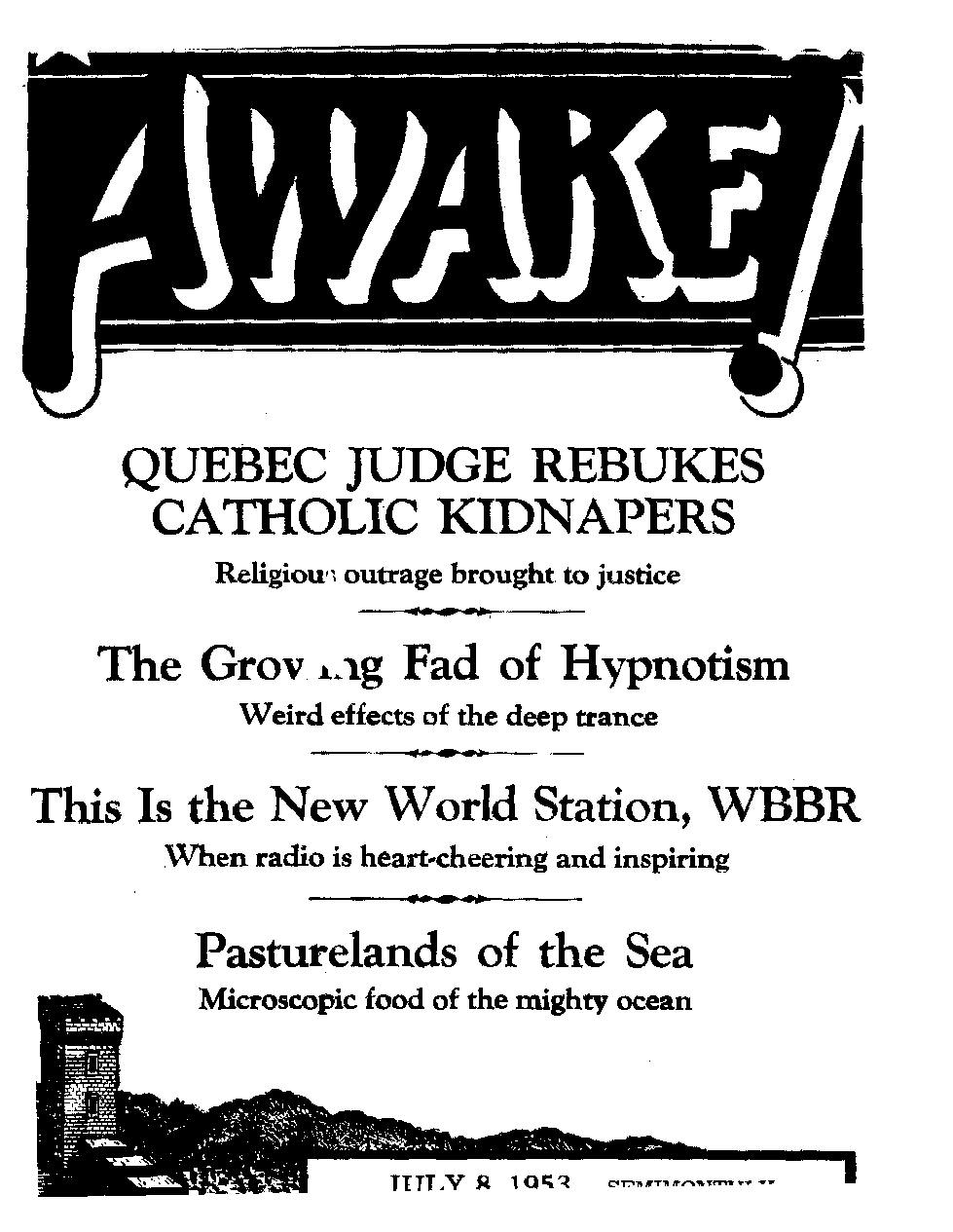
QUEBEC JUDGE REBUKES CATHOLIC KIDNAPERS
Religious outrage brought to justice
The Grov iAg Fad of Hypnotism
Weird effects of the deep trance
This Is the New World Station, WBBR
When radio is heart-cheering and inspiring
' —.................— N *0 ..........—. .............-
Pasturelands of the Sea
Microscopic food of the mighty ocean
TTTT.V « 10^
THE MISSION OP THIS JOURNAL
New* source* that are able to keep you awake to the vital leauea of our times must be unfettered by censorship and eeHsh interests; “Awake P* has no fetters. It recognizes facts, faoea facta, Is free to publish facts. It la not bound by political ambitions ar obligations; it Is unhampered by advertisers whose toes must not be trodden on; it Is unprejudiced by traditional creeds. This Journal keep* itself free that it may Speak freely to you. But it does not abuse its freedom. It maintain* integrity to truth.
M Awake I** uses the regular news channels, but Is not dependent on them. Its own correspondents are on all continents, in scores of nations. From the four corners of the earth their uncensored, on*the-scenes reports come to you through these columns. This Journal’s viewpoint Is not narrow, but la international It Is read in many nations, in many languages, by persons of all ages. Through its pages many fields of knowledge pass in review—government, commerce, religion, history, geography, science, social conditions, natural wonders—why, its covers age is as broad as the earth and as high as the heaven*.
"Awake l’k pledges itself to righteous principles, to exposing hidden foes and subtle dangers, to championing freedom for all, to comforting mourners and strengthening those disheartened by the failures of a delinquent world, reflecting sure hope for the establishment of a right-ecus New World,
Get acquainted with “Awake 1” Keep awake by reading “AwakeP*
PUBLISHED SEMIMONTHLY BT watchtower bible and tract society, INC,
117 Adams Street Brooklyn 1, N. Y., U. 8. A.
N. H. Knobh, President Ghant Suitbq, Secretary
Printino this iwue; 1,000,000
Lanootyti In wide* the m*hzIh» t» tabliifirf: Bemlrwithly—AfrlkM.n*± EneUth, Finnish, French, Gtrmn, HoUkndifb, NorwecLin, Spanish, Swtdlab. Monthly—DwnMli. Greek, rwtnjucst, Ukninlin.
Gillen T'etrly atibgcrlpUon Bx«
Aawlfti, U.S., 11T Adam St, Bwkljn 1, N.Y, $1 A*rtnQ|jr 11 Beresford Bd.r StratWcld, N.S.W. Ru CAnafo 40 Indu Are., Toronto 5, Ontario fl Eaffani, 34 Crireti Terrace, Lnniijn, W. 2 fs Sort* Afrlu, Prieto Buj, PO. El and at on to to,
Trannul T*
Five cents w copy
fftstttanv** Mraaid be seat to office io FOtr etm-try in compliance with tofutolitois to fuarantoe safe deUrer? of money. Rcmittancca an UECptod at Brooklyn from tmmtriea where no office lx loatod by loLeraatlonal money order only. Subscription rates in difft'rtnt cuuntrleo are here stated in local currency. Notloo «f t»iratl«n (with renewal Hank). If sent <st Ltwi two faiua before aubocrirrtiou n-pkew. Clttnge ef rntdrea wtses Hat to w offiw may be expected effectfrc within 4ue month. Bend your old oa well as new adders*.
EntorwJ u nanrf'diu metier at Brooklyn, H- f,
Art <rf Mirth 3, 1819. Printed Id V. S. A,
CONTENTS
Quebec Judge Rebukes Catholic Kidnapers 3
The Growing Fad of Hypnotism
"Suggestibility”
The Most ‘Feelthy Fifties’
This Is the New World Station, WBBR 9
Programs on WBBR
Are You Too Busy?
New York—Easy to Get To
Coins Tell a Pagan Story
Pagan Foundations, Literally!
Pasturelands of the Sea
Attending a Funeral in Japan Nature’s Bulled Treasure
Diamond Rivals
Our Confused Standards of Measurement "Your Word Is Truth”
"How Are the Dead to Be Raised Up?” Jehovah’s Witnesses Preach In All the Earth—Puerto Rico
Watching the World
XI WAKE/
“Now it is high time to awake’'—Romans 13:11 &
Volume XXXIV
Brooklyn, N, Y., July 8, 1$53
Numbei* 13
Quebec Judge Rebukes Catholic Kidnapers
TIE world has heard of the disgraceful persecution of Christian ministers of Jehovah’s witnesses in the Roman Catholic-controlled province of Quebec. One of the most outrageous incidents recounted in these pages was the kidnaping at Joliettp, Quebec, of two young women ministers who were driven to Montreal and abandoned by their abductors after an unsuccessful attempt to put the young ladies ih prison. Legal proceedings were started against the kidnapers, which resulted in their being roundly denounced by a French Catholic judge for their cowardly and outrageous attack upon Jehovah’s witnesses.
At the time of the incident (see Awake! April 8, 1950) the Watch Tower Society made a careful investigation of the matter and was able to identify some of the kidnapers. Request was made to the attorney general of Quebec, Duplessis, to have the criminals prosecuted, but he never even acknowledged the registered letter that was sent. Accordingly, civil actions for damages were started on behalf of the two ministers, Olive Lundell and Winnifred Parsons, as a means of bringing the criminals to book. If the attorney general refuses to enforce the law, which he is duty bound to do, Jehovah’s witnesses, as lawabiding citizens, do their best to help maintain order.
The cases against the kidnapers came up recently before Mr. Justice Andre Demers of the Superior Court, who, with great fairness and demonstrating a just sense of outrage^ condemned the kidnapers to pay damages, and delivered a severe reprimand for their disgraceful, criminal acts. The damages assessed were $600, which is a. small amount judged by most standards; but in fairness to the judge it must be pointed out that damages in Quebec law are very small and the amount awarded is in keeping with the usual allowance in damage actions.
In rendering judgment Mr. Justice Demers reviewed the facts of the kidnaping, pointing out that the two lady ministers were pushed into a taxi against their will and taken from Joliette to Montreal where an effort was made to lodge them in prison. The taxi driver tried to pretend that he was only a poor man trying to earn a living and who had been hired to drive some people to Montreal. The judge quickly swept away this transparent falsehood, pointing out that “no one can, by pretending he is a taxi-driver, take part in a criminal offence and then defend himself on the ground: T was only earning my living/ When a crime is committed and one helps those who are in course of committing it, one is an accomplice and equally guilty.
“The court has been greatly < scandalized by the illegal and criminal conduct of this group of individuals who deprived two defenceless young women of that which they hold most dear: the right of each individual to personal liberty.
"It is regrettable that in this affair the organizer or organizers were not brought before the courts to receive their just punishment. The three defendants in the present case are only pale nonentities. It is perhaps important to remark that there cannot be found in the jurisprudence of this province any case the same as this. This land of America has always been a land of liberty. Our ancestors did not fear to brave a perilous sea, rigorous winters and dangerous enemies to establish themselves here. It would be regrettable if after three hundred years of freedom it would be in danger of being destroyed by the very sons of those pioneers who cleared and settled our great country and who even spilled their blood to improve it.
“We are bound to remark to the defendants and to all who participated in this criminal offence and who were not parties to this case that they made themselves liable to criminal prosecutions of great seriousness. It would be good for them to read section 297 of the Criminal Code which provides imprisonment up to twenty-five years for kidnaping.
“The plaintiff has a right to damages for insults and outrages which she has suffered, for the deprivation of her liberty and the assault of which she was the victim?' In addition to damages the court also issued an injunction “enjoining the defendants from interfering with the free exercise of the lawful activities of the plaintiff in the City of Joliette; the whole with costs’*.
While the damages were not much, by the time the criminals pay the court costs, the damages and theib own lawyers, the whole affair will have proved quite educational to them. Little did they think as they arrogantly carried out the scheme of the priest who organized this outrage that they would be brought to book for their cowardly actions. The decision has also served to vindicate the lawful Christian work of Jehovah’s witnesses and to demonstrate that honest Catholics, with a sense of justice such as Mr. Justice Demers’, are disgusted with the actions of their compatriots who would stoop so low.
Through proceedings of this kind other people have recognized what a beneficial effect the fight of Jehovah’s witnesses is having on maintaining law and order as well as keeping open the door of liberty of speech, press and worship. The Edmonton Journal remarked under the heading “Intolerance Condemned’’: “This judgment should do much to renew the safeguards of religious freedom and prevent renewal of persecution against the witnesses or anyone else. Realization that the law protects the rights of even the smallest and most unpopular sects and that interference with them may bring damages and perhaps even a prison term should exercise a restraining influence on the intolerant and the violent.”
Jehovah’s witnesses appreciate the righteous decisions of liberty-loving men who recognize the justice of their demands for freedom to preach the truth. Primarily, however, they are grateful to Jehovah, their God, who has given them his Word and who has promised them protection and who, in fact, is protecting his faithful name-people against the most powerful and unprincipled attacks. “I have put my words in thy mouth, and I have covered thee in the shadow of mine hand, that I may plant the heavens, and lay the foundations of the earth, and say unto Zion, Thou art my people.”—Isaiah 51:16.
HYPNOTISM is becoming ever more prevalent, especially in the United States. It is being used more and more for entertainment purposes by professional stage artists and neighborhood amateurs; it is being used more and more by psychiatrists and psychoanalysts in treating patients who have mental, emotional or conduct problems; more and more obstetricians and dentists are using it as an anesthetic; and more and more educators are using it to help backward students.
What is this hypnotic phenomenon? How can its incredible things be accounted for? Is there any danger or risk involved in being hypnotized? Is it a form of demonism or associated with the magical arts? What are the facts?
While hypnotic phenomena have from earliest times been a tool of the practitioners of false religion, and particularly pagan religion, having come down to us through the ancient Egyptian and Chinese priests, the Persian magi, the Indian yogis and fakirs, and while it is often associated with mental telepathy and with clairvoyance, yet it does seem possible to draw a fine line of distinction between hypnotism and spiritism.
A thing can be demonic without being a direct manifestation of evil spirits or demon power. For the most part it would seem that the words of James 3:15 (New World Trans.) could be applied to it: “This is not the wisdom that comes down from above, but is the earthly, animal, demonic.’*
While hypnotism In one form or another was practiced by the ancients, it was not until the latter part of
the eighteenth century that the Western world became interested in it due to the activities of one Mesmer, a physician who, expelled from Vienna because of his theories, practiced in Paris. He was very successful in treating diseases by making passes over the body, which, he claimed, caused “animal magnetism** to pass from him to the patient. His method came to be known as mesmerism. In spite of his success, or because of it, the board of the French Academy of Medicine, on which at the time happened to sit the American Benjamin Franklin, investigated him and denounced him as a fraud.
Mesmerism did not die with Mesmer but was developed by others. In the 1840*s Braid, an English physician, discarding the theory of animal magnetism, named the various effects that the mesmerists were able to obtain at that time hypnotism, from the Greek word hyprtos, meaning "sleep”. The use of hypnotism spread throughout Europe, Nancy, France, becoming the fountainhead of hypnotic therapy.
Natural Somnambulism
That hypnotic phenomena are not necessarily in themselves a manifestation of spiritism becomes apparent when we note how similar its deepest phase (there being four or five phases or stages) is to natural somnambulism or sleepwalking and sleep talking. Says the Encyclopedia Americana. "The somnambulist has been known to walk from one part of the house to another, to climb steep roofs or walk along ridges, to solve intricate mathematical problems, to write letters or work upon pictures, to attempt murder or suicide, etc.” Whatever the cause, mental, emotional or physical, it is held to be related to hysteria and epilepsy.
Obviously we have another mind besides the waking or conscious mind, for the sleep walker remembers nothing. His ears deaf to ordinary sounds, his eyes blind though wide open, yet there is 'a direction of voluntary movements in most trying circumstances that is marvelous'.
While there is much doubt as to what actually takes place, as well as many conflicting theories, it seems reasonable to conclude that in hypnosis the conscious or objective mind is caused to recede and the subconscious, subjective or the "unconscious” mind (as one authority terms it) is brought to the fore.
Inducing Artificial Somnambulism
Hypnotism has been defined as "a state of exaggerated suggestibility induced by artificial means”. Various methods are used to induce this state. The stage artist employs a number of tricks either to overwhelm his subjects or throw them off guard.
Those whose purpose in using hypnosis is therapeutic scruple at such methods, well knowing the harm that may be done by them. For them it is not a matter of who has the stronger will but merely that of the subject’s being willing to co-operate with the operator. Their key is complete relaxation, which is brought about by monotonous sleep talk spoken in a low, slow yet firm tone of voice. Gradually the subject finds himself having a “faraway” feeling, a sense of numbness in his limbs, and a peculiar lethargy or spirit of laziness comes over him. Another popular method is that of asking the subject to fall backward- There are many other methods, all of which seem to be alike effective.—Hypnotism^ Estabrooks.
After about five minutes of sleep talk the subject may find that when dared to open his eyes he is unable to do so. Some more such talk and he may find himself unable to lift his hands or raise his feet; still more such talk and he may be unable to rise from his chair. The inability to go contrary to the will of the operator is thus gradually spread and tested from the little muscles to the large ones. Told to rotate his hands, he finds himself doing so and unable to stop.
A subject who has not been able to assert himself, or has had no inclination to do so (had he at any stage been able to resist he would have awakened and ended the hypnotic trance), usually can be brought into the deep trance state, and which state is marked by hallucination and amnesia. In this state he can be made to do almost anything, depending upon the skill of the operator, and of which he almost invariably remembers nothing.
His five senses wiJJ note what the operator tells him tq note and will ignore that which he is told to ignore. Open a bottle of ammonia and tell him it has a lovely odor and he will sniff at it with delight; on the other hand, give him a bottle of the rarest perfume and tell him it stinks and he will turn from it in disgust. Tell him that wine is kerosene and ft will make him sick to the stomach to drink it; tell him water is champagne and he will actually become drunk from drinking water. Tell a music lover he is hearing a concert and he will describe the music he hears; make the most terrifying sounds and assure him all is quiet and he will not hear a sound. Tell a subject he feels nothing and he will ignore a strong electrical charge; touch him with a pencil and tell him it is a red-hot poker and he will scream with pain and may even show a red mark or blister. Yes, in trance not only the voluntary nervous system is subject to suggestion but also the involuntary or sympathetic nervous system.
While a person m deep trance can be made to hunt pink elephants with a broom or fish for whales, he cannot be made to go against deep-seated convictions; that is, not directly, A teetotaler will refuse to drink whisky. A socialist told to preach on the merits of capitalism will preach on the merits of socialism.
Another effect obtained by hypnosis is catalepsy, a term used to describe a disease that causes a waxy rigidity of the limbs so that they can be placed in various positions dnd so remain for a time. In catalepsy a subject's body can be made so rigid that his head can be placed on one chair and his feet on another and his abdomen will support the weight of a man.
How is this possible? In treating the form of insanity known as dementia praecox, doctors have used a drug, metra-zol, to induce convulsions, which are so violent that in 25 per cent of the cases they break some of the bones in the spinal column. Obviously, if by metrazol the sympathetic nervous system can make the muscles stronger than bones then it should not seem impossible that hypnotism can do the same, since the sympathetic nervous system is so responsive to hypnotic suggestion.
Further, in deep trance illusions can be foisted on the subject. Tell him he is a dog and he will walk on all fours and bark; tell him he is a politician and he will orate; tell him he is a five-year-old and he will not only act but also answer questions exactly as a five-year-old would, a fact borne out by intelligence tests.
When a person is deeply hypnotized he is in touch or rapport only with the operator who brought him into that state. He heeds no other. However, the operator can transfer the rapport to another person merely by telling the subject that he will do so. Whether or not the subject actually does not hear others or merely ignores them may be open to question, authorities claiming that it is a matter of choice. However, the press recently told of a young woman about to bear a child, who when put into the trance state heard only what the operator told her, Ignoring entirely the words of the nurses as well as those of her husband. It would hardly seem that under such circumstances a woman would ignore the voice of her husband.
“Suggestibility”
While it is claimed that sex has nothing to do with suggestibility, yet the facts seem to indicate that girls and young women are more likely to respond than boys and young men. Neurotic, imaginative^ hysterical and introverted persons, as well as sleepwalkers and sleep talkers are quite suggestible. Stubborn or bullheaded persons usually are more difficult, and it is practically impossible to hypnotize children under five, imbeciles and insane persons.
Ninety per cent can be brought into the first stage of trance, at least after a number of tries, but only 20 per cent, regardless of the skill of the operator or the method used, can be brought into deep trance. Why nobody seems to know. The explanation is that this is because of certain personality traits that are unknown and cannot be influenced. This would lend added weight to the position that hypnotism is not necessarily a manifestation of spiritism.
Mass hypnotism is also possible. Not just the kind Hitler used, although such use of oratory is closely related to and involves the principles of hypnotism, but also the hypnotizing of groups of persons into various stages of the trance. Thus America’s foremost stage hypnotist, Polgai, at the Texas Woman’s College in 1944, hypnotized 153 persons out of an audience of 160, an amazingly high average. He often hypnotizes 200 persons at a time and claims that in some 20 years he has hypnotized a million persons.
A skillful hypnotist can hypnotize many subjects while they are sound asleep and even waking persons who are opposed to being hypnotized, although this requires a disguised technique. By ostensibly taking one’s blood pressure the operator could cause the reluctant one to relax and by subtly talking sleep without any reference to hypnotism such a one could be brought Into the trance state.
The use of phonograph recordings for Inducing the hypnotic state has become quite popular. For such purpose often a special recording is made for a certain subject, although in one instance the playing of a Swiss yodeling recording, which was represented as a hypnotic record to a group, caused one of the listeners to go into hypnotic trance, He expected to be hypnotized, happened to be a good subject, and his imagination did the rest.
Doctors use such drugs as ethyl chloride, nembutal or sodium amytal on patients who seem to be especially difficult to hypnotize. It is necessary to use such drugs only once; after that they readily go into trance by the usual methods.
Hypnotic power, in spite of its popular appeal, is not being used on radio and TV. Why not? Because it might be too successful’ How many accidents would be caused by car drivers’ falling asleep? How many fires by those smoking tobacco and falling asleep? And what about those who failed to wake up? Or went into hysterics? Who would be on hand to wake these up or to attend to them?
In view of the foregoing it must be apparent to all, and it is admitted by authorities on the subject, that in the hands of the unskilled or amateur, the careless or unscrupulous, the power of hypnotism can represent a real menace. For further information we refer the reader to subsequent articles on even more amazing aspects of hypnotism.
fte Most Feelthy Fifties
Here, without need for further comment, J we cite from the column “It Happened Last [ Night" by Earl Wilson In the September 25, ! 1952, New York Post: *
“Somebody's got to blow the whistle on the | breakdown of American decency. More bums ; and scum are fouling up life today than at j any time since killers and kidnapers were J making with the bang-bang. I've been on the ♦ berserk Broadway beat for 10 torrid years, ) and on newspapers for 27 years. My eyes [ —and nose—are good. Never have I seen t so many vice lice—so much tomcatting—such j hordes of fallen females, panderers, hop he ads, J phonies and abnormals as deface America t now.... God help us, abnormality Is becom* { ing normal." }
Two more months slid by but the subject < was not dead. He said on December 3: “My Broadway column is just having its 10th birthday. It was born at the start of World War II—a right bawdy era. But the Forties were Epworth Leagueish beside the Feelthy Fifties. ... A Middle Westerner who agrees with me that abnormality is getting to be normal, even out there, says: 'It’s no longer quaint to be queer/ . . . ‘Feelthy peectures1 are peddled by Cadillac on Broadway now. . . . Of course, my own Beautiful Wife tells me I'm daffy about the whole thing. 'There's no more sin than ever—Just more columnists and commentators screaming about it,’ says she. 1 disagree. Anyway, in an earlier decade, these facts would have shocked people more. . . . And the decade is still young. I don’t like to think about the Slimy Sixties”
This Is the New World Station
Generally thought to be merely an entertainment medium, radio can be much more. It can exert a tremendous influence an the lives of its listeners, either for good or for ill. It can shock into action or lull to sleep, stir hatred or build faith, flash a warning or bring a message of peace* In short, it is a great potential for enlightenment if used in the right way.
With the advent of television, many predicted the decease of radio within a short time. It is now readily acknowledged by those who have studied the matter that radio is here to stay. There are 105 million radio sets in American homes today and the public is buying more new radios than ever before. Figures show that more people listen to the radio now than before TV hit the market*
Despite its great potential, it must be admitted that radio is not being used to its full effectiveness as a beneficial medium. In countries like Great Britain, where radio stations are government-owned and operated, there is no competition and as a result advances in broadcasting techniques are slow and there is little variety in programs. On the other hand, Ln the United States, where stations are operated primarily by commercial concerns, who sell time to advertisers, there is overcommercialization. One commercial announcement after another drives the listener to mentally tune off the commercial or completely turn off the radio* It can readily be said that commercial jingles greatly jangle the listeners’ nerves.
More than that, commercial stations are afraid to speak out boldly on any subject for fear of offending a potential advertiser.
Newspapers may express their frank views on the eolto rial page, but broadcasters, never. When a controversial program is carried over a station, the announcer invariably makes a nan-committal announcement stating; “These views do not necessarily express the opinion of this station?’ After all, their object for being in business Is to gain and retain sponsors. No sponsors, no Income. It is as simple as that. Listen critically to commercial broadcasts and see how much talking is done but how little Is said that is truly beneficial.
The primary programs that attract listeners are those that entertain. Top-quality entertainment is not too plentiful. As a result much is broadcast that is meaningless, pointless, not overly entertaining, but very time-taking. Musical programs present an overdone sufficiency of jazzy or hillbilly selections with an emphasis on songs glorifying passionate love. Music is one of radio’s most enjoyable features, but much of it is not very listenable.
Many religious programs present the emotional haranguing by some overwrought clergyman whose programs remind one of the crying of a currently popular American singer. Human philosophy and psychology ate preached by the ream of script, but simple Bible instruction is rare.
Station WBBR Is Different
There is, however, cne station that does not fit into the above description. That station is WBBR, Brooklyn, New York, Being noncommercial, it does not have to cringt Ln fear of sponsors. Its object is, not to gain popular appeal, but to inform those of good wiU concerning God’s new world. WBBR says something and does not apologize for it. The most-skilled comedian on a commercial station cannot make today's bad news good. However, WBBR brings to its listeners the heart-cheering message of God's new world, his kingdom which is now so near at hand. Such programs in* still hope, faith and love in the hearts of those who sigh and cry because of the turmoil In the world.
We are sure you will agree that it is pleasant to have friends drop in to visits especially when they are good friends who show true Christian love and friendship. WBBR is a real friend to its many listeners because it is interested in them and does them the greatest good by bringing to them knowledge that will lead to everlasting life in the new world. (John 17:3, New World Trans.) Such good news is upbuilding to all members of the family. It is no wonder that WBBR is invited into so many homes as a welcome guest,
Early in 1952 a poll was taken within the listening range of WBBR and it was found that 14 per cent of the 164,562 persons contacted had listened to the Watchtower programs. This means that, of the 15£ million potential listeners in the area it serves, 2,170,000 persons have heard the station. Of this number, many “hear, and say, It is truth”.—Isaiah 43:9.
Programs on WBBR
WBBR programs appeal to many listeners. Fine recorded music, generally in the light concert class, neither jazzy nor “long hair”, brings enjoyment to lovers of good music The Watchtower Concert organ, located in the largest of the three studios, brings delightful music Into the living rooms of many. Also a favorite is the singing of the WBBR Watchtower Male Chorus, a group of 20 voices raised in songs of praise to Jehovah. WBBR’s newsroom gathers reports erf world events from the wires of International News Service and presents them on the program “Watching the World”. General public service presentations, such as '"Through Feminine Eyes”, “Farm and Food News” and ‘"Safety Items”, bring listeners information on homemaking, gardening, safety, etc.
Licensed as an educational station, WBBR fulfills its purpose by presenting many educational programs. These, however, are not a dry, tasteless presentation in formal, stilted manner, but pleasingly informal, interesting, practical, up to date, and wide in scope. Here is a schedule of some of the feature programs:
SUNDAY
6:30 am Thouflhti far the Day
7:00 items from Here and There
BtM The Watshtewer Organ
8:30 As We See If
9:00 The Sunday Morning Forum
9:45 WBBR Watchtower Male Chorus
10:00 A Young Minister Speaks
10:40 Things People Are Thinking About
4:00 pm Fashions in Mualo ..
4:30 "Around the World with Jehovah’s wit
nesses'’
5:15 Theocracy's Increase Report
6:00 Dinner Concert
6:30 The Bible Made Plain
WEEKDAYS
6:10 am "Your Word is Truth”
6:30 Thoughts for the Day
7:00 At ths Breakfast Table (Monday-Friday)
7:30 Watching the World—News
7:40 Your Bible Questions Answered
5:10 pm
6:00
6:30
7:00
TUESDAY THROUGH FRIDAY
Know Your Bible Dinner Concert Know the Meaning Home Bible study
Variety in material and style of presentation makes the programs listenable and instructive. A Scripture text for each day is read and discussed on “Thoughts for the Day”. “The Sunday Morning Forum” is a round-table discussion of topics of current interest by persons representing the scientific, Catholic and other viewpoints. Youthful ministers from all parts of the United
States are invited to be guests on the program "A Young Minister Speaks". Each weekday morning listeners enjoy hearing Bob and Mary, a young married couple, whose conversations "At the Breakfast Table” have made theirs a favorite program with many. Seven o’clock in the evening means it is "Home Bible Study Time”, when listeners are invited to drop in on a family group as they discuss God’s Word. The character portrayals make the study live as questions and arguments are raised and answered.
To give ah adequate description of the programs is impossible. To appreciate them, they must be heard. If you ever have the opportunity to hear WBBR, be certain to do so. Then you will know for yourself that there is no station like WBBR.
As an illustration of how listeners enjoy hearing the New World station, here is part of a letter received from a New Jersey listener:
"We would like to add our voice to the many thousands of those of your listeners and express our congratulations to you for a fine, well-rounded-out program. Its variety and natural informality in the presentation of information makes it easy to say, You have hit a new high in New World broadcasting! Its variety keeps any listener from tiring and its informality allows the mind to relax and open itself to the ideas presented.”
A steady flow of mail is received from listeners expressing their appreciation. A very large percentage of these request Bible literature, which is offered free to listeners, and many send in Bible questions that they want answered. Thus WBBR is doing much good and Is aiding many on the road to everlasting life.
The script from one WBBR program, "Things People Are Thinking About,” is mimeographed and distributed to ministers throughout the United States and other countries. At the present time it is being presented on approximately 90 radio stations in various parts of the world.
Special Test Broadcast
On January 25, this year, WBBR broadcast a special test program for the purpose of learning how far it could be heard. Congregations of Jehovah’s witnesses in eastern and central parts of the United States and Canada were informed in advance of the broadcast from 4:15 to 6:00 a.m. (E.S.T.), those hours being selected so that other stations would generally be off the air and would not interfere with WBBR’s signal. Those hearing the broadcast were asked to notify WBBR. The results were very gratifying. A total of 817 letters were received. The Watchtower station had been heard in 25 states in the United States and throughout a large area of Canada. Many expressed their delight at being able to hear the Kingdom message over their radios.
WBBR is a powerful voice for bringing the good news of the Kingdom into the homes of thousands. The New World station is accomplishing its educational purpose, because, as a result of its broadcasts, many have come to a knowledge of God’s Word, have dedicated their lives to do God’s will and now, together with WBBR, are raising their voices in praise to Jehovah.
Are You Too Busy?
A magazine entitled "Think” carried this thought: "‘There is no business, no avocation whatever, which will not permit a man who has the inclination to give a little time every day to study.—Daniel Wyttenbach.”
New York
WHY shouldnT it be? Its port Is what made It a great city. It rests approximately at the center of a solid urbanized belt extending from Washington, D.C., to Hartford, Connecticut It faces Western Europe across the world’s most-traveled shipping lane. It has the greatest frequency of sailings of any port In the world, Is a terminal for twelve railroads, forty bus lines, a hub for the highway spokes of the East, and a major world aviation center. And though it is at the eastern edge of the country, one out of every ten people in the United States Ilves within 50 miles of New York—as many people as live in all of Canada!
C. First in this land of Fords and Chryslers are the city's tunnels, bridges and highways. The George Washington bridge crosses the Hudson from New Jersey with a 3J500-foot span, the world’s second-longest. The Lincoln tunnel en* lets the midtown area near Times Square. To the south the Holland tunnel, a 9^277-foot tube opened in 1927, is now used by 15 million cars a year. Pointing toward the city from greater distances are Connecticut's Merritt parkway, the New Jersey turnpike and the more-distant Pennsylvania turnpike. These whiz their riders great distances without even so much as signal lights or cross traffic, with so few obstacles to rapid travel that their speed laws must be rigidly enforced.
C The finest of airports are located around the edges of the city. Newark on the southwest and LaGuardia on the east have recently been supplemented by the monstrous five-mlle-iong, iwoand-a-half-mile-wide New York International airport where, 15 miles from mld-Manhattan, most overseas flights land. At peak capacity it will handle 1,000 flights daily.
€, Bus travel received an added impetus In 1950 when the new $24-million Port Authority bus terminal, the world’s largest, was opened a block from Times Square in mld-Manhattan. It is 800 feet long, 200 feet wide, and consists of four levels plus a basement, a mezzanine and a three-acre roof parking lot. Buses enter directly from the Lincoln tunnel, totally ignorIng city traffic. 77ie terminal can accommodate 2^500 such buses and well over 100,000 travelers dally, C Trains come Into either Grand
Central station, Pennsylvania station or one of several other stations of railroads that end on the New Jersey side of the Hudson and ferry their passengers across the river. Grand Central handles about 550 trains a day, all of which must enter the station through a long four-track-wide tunnel. No other great railroad station in the world has so few approaching main tracks, and during rush hours trains are only twenty seconds apart! Pennsylvania station has more than five miles of tunnels. Two go under the Hudson, four under the East river to connect with Long Island. Its waiting room Is 150 feet high—the equivalent of a 15-story building!
<£ All these facilities, phis direct express trains and planes, often make this city easier to get to than others that may be nearer by. This month these will be put to good use by Jehovah's witnesses converging on New York from the United States, Canada, Latin America, Europe, Asia and Africa. Great transports will land at New York International airport; monarchs of the sea will dock a mile from Times Square; special trains win flash down shining rails along the Hudson and Into the two-and-a-half-mlle tunnel under the glitter of Park Avenue to Grand Central station, while others roar through Hudson River tunnels into New York, Great buses will unload at the new ter mlnal and the private Greyhound stations, and autoists will come over turnpikes, elevated roadways, tunnels and great bridges. All will have one purpose in mind. They are coming to New York, not for its tourist attractions, but for the eight days of July 19-26, when Yankee Stadium will be a center of Bible education and theocratic training, where the foundation will be laid for future expansion of gospel-preaching. They are not getting to New York without difficulty, but their efforts will be well rewarded. Can you appreciate that fact? Only if you come to such an assembly and experience it for yourself, You are invited.
Coins TeH a Pagan Story
HEN boys of ancient Rome flipped coins, the exclamation was “heads or ships”. It has not changed very much in almost two thousand years. Today it is ‘heads or tails”. But whichever side comes up, one thing is certain: the history of coins is a continuous picture gallery of rulers and gods with pagan religion predominantly influencing designs and inscriptions.
Atatandtf Hi* Groat
Who was the first man to be commemorated on coins? Perhaps one of the earliest of men to be honored in such a manner was Nimrod, the first man to be made a god after the Flood. The Greeks had a fabulous creature, which played an important part in Greek mythology, called the centaur, half man, half horse. That imaginary creation, as is generally admitted, was intended to commemorate the man who first taught the art of horsemanship. On this point Hislop's The Two Babylons states: “Who so likely to get the credit of producing the horse as the great huntsman of Babel, who no doubt enlisted it in the toils of the chase.” Then Mr. Hislop reveals a startling fact: “But that creation [the centaur] was not the offspring of Greek fancy. Here, as in many other things, the Greeks have only borrowed from an earlier source. The centaur is found on coins struck in Babylonia showing that the idea must have originally come from that quarter,” Who then would most likely be represented by this early Babylonian coin but Babylon’s founder, Nimrod, the arrogant “mighty hunter before the Lord”?
In ancient Greece each city-state placed the figure of its patron deity on its money. Probably they served as a kind of celestial police guard against clipping and counterfeiting, for only the most sacrflegicua rogue would think of harming them. In course of time there was established between coins and religion an association so intimate that, before the middle of the fourth century B.C., it had come to be looked on almost as a matter of course that the types of coins should be religious in subject.—Evolution of Coins, bv Georce MacDonald.
Greek Portraits on Coins
To picture a living man upon coins was a sacrilege to the Greek way of thinking. Nonetheless, by 350 B.C, there were already signs of the near approach of a day when mortal men would be accorded seats in Olympus, the chief abode of the gods, even in their lifetime. Indeed, some forty years before this the Thasians had offered to make a god of the stout old Spartan king Agesilaus, only to be contemptuously told that, if they wanted him to consider the proposal, they had better begin by making gods of themselves.
Until the dose of the fourth century B.C. portraits on coins were practically unknown. It had long been, though, a
sacrifice to de*
Grecian custom to offer parted heroes. The result time of Alexander the Great’s accession, it had become a well* established convention that a coin should have on its obverse or front side the head of a divinity, After the death of Alexander the Great, he became first a here and then a god, and his portrait was placed on coms. He thus became the first historical personage whose portrait on coins can be recognized with absolute certainty.
that by the
was
Babyioiflon eoln «hp«lRg lot top)
Though Alexander the Great was not officially deified during his lifetime, it is obvious that from the deification of a monarch just dead to the deification of his living successor is little more than a step. Ptolemy was among the earliest to be hailed as a god. But it was not until the next generation that the worship of the reigning monarch was formally established as the state religion. Then it became the custom for living monarchs to be deified, and gradually their portraits came to mark the coinage of their reigns.
Roman Portraits
The coins of Rome at their very outset were specifically religious in character. The reverse side was occupied by a prow of a ship, symbol of the vaunted sea power of the Roman Republic. But the obverse was reserved for the head of the divinity: Janus, Jupiter, Hercules, Mercury, etc. Hence, on the Roman playgrounds, boys tossed “heads or ships’*. The strength of the hold that pagan religion had gained over coins was clearly manifested in 268 B.C., when silver coins began to be issued. The obverse of the earliest denarii bore the head of Roma, while on the reverse, riding as if to battle, were Castor and Pollux, the patron divinities of the knights. Roma gradually lost her monopoly of the obverse and gave way to the heads of other gods. Great Romans of the past occasionally appeared, but not until the days of Julius Caesar was the head of a living Roman placed upon coins struck within the city.
There is a very interesting denarius that vividly brings home the inflated pride that the murderers of Julius Caesar took in their achievement On the obverse is
Brutus' own portrait with his name. The reverse shows the cap of liberty, flanked by two daggers. As if to obviate all risk of misunderstanding, “The Ides of March” is added beneath.
From the time of Augustus forward, until the fall of the Roman empire, the normal obverse type is the head or bust of the reigning emperor. Some rulers boasted of divinity; others did not particularly dwell on the subject. History says that Alexander the Great’s acceptance of divine honors was only half serious. Some emperors even talked facetiously about their divinity. On his deathbed, Emperor Vespasian pulled out a coin and remarked to his son Titus: *Tm turning into a god, I take.it.” *
Camouflaging the Pagan Element
During the reign of Constantine the Great, many so-called Christian symbols were blended with the pagan and put on coins. Thus A.D, 326, the year after the Council of Nicaea, there was struck a piece having the head of Constantine and the reverse side bearing the standard of the cross. Does this mean coins went Christian? No, for the cross itself is of pagan origin! (See Awake! October 8, 1951.) The New Funk and Wagnails Encyclopedia says under “Constantine I’1: “He retained the traditional pa^an title of Pontifex Maximus, . . . and his coins still bear the figures and the names of the old gods?’
During the reign of Julian the Apostate, the so-called Christian coins disappeared and paganism’s undisguised head was emblazoned on coins in the form of Egyptian deities. But Justinian n went back to striking coins with a bust of Christ surrounded by the words: “King of Kings.” The bust of Christ is not found upon coins again until the day of the iconoclastic emperors was over. These emperors reverted to the pagan cross for their “tails” side. However, A J>. 842 the bust of Christ was re-storeu almost at once. Only now Christ is given a different pose: “he is shown placing the crown on the head of the emperor,” thus conveying the illusion to everyone that the emperor rules by divine right. —Evolution of Coins.
By and by the virgin appeared on coins, sometimes with hands outstretched in prayer, sometimes with a “holy child” seated upon her knee. The earliest coin on which the virgin appears with the child is a silver piece of John I (969-976), which bears the descriptive title "Mother of God”. The reverse is entirely occupied by the following inscription: “Mother of God, most glorious, he who putteth his confidence in Thee never cometh to naught.” This title, however, is not given by the Bible to Mary, and in regard to the pagan origin of such mother worship The Two Babylons states: “The Babylonians, in their popular religion, supremely worshipped a Goddess Mother and a Son, who was represented in pictures and in images as an infant or child in his mother’s arms. From Babylon, this worship of the Mother and the Child spread to the ends of the earth. . . . Under the name of the ‘Mother of the gods/ the goddess queen of Babylon became an object of almost universal worship. ‘The Mother of the gods/ says Cleri-cus, ‘was worshipped by the Persians, the Syrians, and all the kings of Europe and Asia, with the most profound religious veneration/ ”
Pagan Pattern Persists
Coins of France during the reigns of the Carolingian kings frequently pictured a temple, supposed somehow to symbolize Christianity. During the Middle Ages, the patron saint usually took the place of the local divinity; however, the underlying pagan principle was still there. And at the time of the Sixth Crusade, a papal legate accompanied Louis IX and was horrified to find “Christians” of Acre and Tripoli minting coins bearing the name of Mohammed and dated according to the Mohammedan era.
The coins, then, from Constantine on, have they followed a Christian or a pagan pattern? Explains the Encyclopaedia Britannica (under “Numismatics”): “From Constantine, the pagan element in the coinage declined. Little of Christianity, however, took its place.” But apparently the pagan element never declined.
Regarding the popular practice of placing portraits of reigning sovereigns on coins, the book Evolution of Coinage explains: “It will be clear that this was, in its essence, a legacy from the Hellenistic age, through the medium of the Roman empire.” When the very first coin act passed the United States Senate, it provided that the head of the president should appear on all coins. Indeed, a number of pattern pieces were struck, showing President Washington in various types of dress from that of a Roman emperor in toga and laurel crown down to his own uniform and wig.
Congress later, however, concurred in deciding that the likeness of a president on the coins savored too much like pagan Rome and other monarchies, and that an emblem of liberty would be more suitable for a republic. Hence, goddesses of liberty in various forms appeared on United States coins. However, in modern times the goddess of liberty has been gradually discarded and presidents have been appearing on regular-issue coins. Thus Presidents Lincoln, Jefferson, Roosevelt, and Washington appear on the one-, five-, ten-, and twenty-five-cent pieces respectively. A few years ago Lady Liberty was removed from the fifty-cent piece and replaced with a portrait of Benjamin Franklin; hence all coins minted by the United States government today bear the likeness of some famous person. Unde Sam has wound up with a pagan pattern that Congress originally decided against!
Can we say, then, that the pattern in coins has changed much since the days of Babylonish coins commemorating Nimrod, since the days of Alexander the Great and Julius Caesar? In answer, note the words of one of the foremost authorities on the evolution of coins, George MacDonald, who stated: “So therefore, as types are concerned, the coinage of. Greece had reached a stage of development beyond which the world has scarcely advanced today.” Whether it has “advanced” any, you be the judge!
Coins have thus served well to perpetuate and glorify the names of men, for after portraits and even triumphal arches have crumbled, coins are the only record that survives. Even the motto on United States coins “In God We Trust” was suggested by a clergyman with the sole purpose of recording for posterity the fact that this was a Christian nation. But Is It Christian today with its divided religions, its racial prejudice; its immorality, its trust in H-bombs? George Washington made the legendary cherry tree popular, but the plums more common in politics now are jingling coins! In view of this, perhaps the famous slogan could well be amended to read, “In This God We Trust.”
True Christians today do not put their trust in the dollar, pound, franc, peso or any other form of money. They know that it can be valueless overnight. Such a day is close at hand. (James 5:1-3) Soon Armageddon’s battle will wipe out this paganized world, along with all its false gods. True Christians serving Jehovah, the God who made heaven and earth, will survive into a new world of righteousness wherein love will supplant the insatiable greed for glory and money, and wherein there never will be a need to write another chapter on the subject: “Coins Tell a Pagan Story.”
Pagan Foundations. Literally!
When the Israelites moved into Canaan were they commanded to borrow prestige from that land's demon religion? No! Listen: ‘Destroy their altars, and break their statues, and cut down their groves [sacred poles], and bum their graven things. Neither shalt thou bring any thing of the idol into thy house, lest thou become an anathema, like it. Thou shalt detest It as dung: and shalt utterly abhor it as uncleanness and filth, because It Is an anathema.”—Deuteronomy 7:5, 26, Douay.
Has the so-called “Christian religion” of today followed that instruction? No! When British professor Ernest A. Rudge of West Ham Municipal College discovered 130 strange stones marking an ancient cross-country trail, he noted that many had been built into the foundations of old Saxon churches. Something mystical was involved, for the stones were shunned after dark, and one legend said that three times the builders of a church brought one down from a hill and the Devil carried it back. Finally they built the church on the hill and the stone stayed. Said Time: ''Inspired by these tales Dr. and Mrs. Rudge dug into church history. They found that Pope Gregory the Great, in a letter to his missionaries in 601 A.D., told them not to destroy such stones when they found them in pagan Britain. Instead, he said, they should build their churches upon them, so that the centers of new Christianity might enjoy the prestige of a more ancient faith.” Rather than detesting them as dung, he wanted them warmly embraced, but the persistence of the early pagan reverence for them is tangible evidence that God knew more about maintaining pure worship than did Gregory!
C stu^ace' “In this vetti"
T* । AiNU cai ran&e alone it is esti-
* Q'T 11 P V mated that every square
1 mile of salt water contains upward
TTn/2 § of sixteen tons of planktonic skele-
EA
tons. And there are innumerable forms that have no shells.”
The growth of the plankton is fierce in intensity and astronomically great in numbers. Vast areas of ocean are covered with a living blanket of cells. Mile after mile
TECHNICALLY speaking, no water is wholly free of living organisms. A glass of what might appear to be crystal-clear sea water is actually alive with myriads of microscopic and transparent living plant and animal organisms. What is more, these microscopic creatures are of rare and unsuspected beauty, “a beauty so totally dissimilar to that which distinguishes the larger and more familiar residents of our planet that there is really no standard of comparison.”
Furthermore, there is no known body of water where these living organisms do not occur. Huge quantities of microcrustaceans have been found to exist on ocean floors and an overabundance of algal creatures were located In polar regions and in pools of melting snow. Virtually all water, tropical or temperate, cold or warm, is rich in plants and animals, most of which are microscopic in size. To this teeming population Victor Hensen of Germany proposed a collective name—Plankton, which is from a Greek word, meaning "wandering".
This massive population is made up of minute jellyfish, miniature shrimp, snails and worms, which provide the pasturelands for fish such as herring, sprat and mackerel. So rich and plentiful are these pastures that creatures like the Greenland whale, which often attains a length of fifty feet, feed solely upon them. Their abundance is just as great 600 feet down as at of water may appear red or brown or green, the whole surface taking on the color of the infinitesimal grains of pigment contained in each of the plant or animal cells. These are matched by other outbursts of microscopic plant life of the plankton. In the sea, as on land, spring is a time for the renewal of life. The surface waters become a vast nursery. The eggs and young of many of the bottom animals rise to the surface of the sea. The average egg production from each female creature in the plankton is probably about a million a year. Most of these are eaten before they ever grow up; this adds up to a tremendous food supply for such fishes as the mackerel and herring. The little acorn barnacles that grow on rocky coasts may produce "as many as 20 tons of babies a year for each mile of shore”, and the barnacle is but one of the many animals that live there. One cod spawns several million eggs annually, which become part of the plankton.
Plankton Discoveries
Despite their quantity, scientists have found, too, that plankton hunting "could involve them in just as much difficulty, hard work, and disappointment as hunting for bigger game". Professor H. B. Moore of the University of Miami stated that unlike birds or butterflies, whose parentage is clear or can be easily traced, matters in the sea are far less simple. "To begin with,” said the professor, “most plankton animals .,. are extremely difficult to keep alive in captivity. Accustomed as they are to the cushioning of the ocean waters, they may conceivably bruise themselves fatally when they bump into the walls of an aquarium. Or perhaps we do not yet know the right food to give them, and they just starve. Many of them ., . have mouths so small that they could not swallow anything bigger than a few thousandths of an inch across. When you add to all this the fact that many of the most exciting animals come from deep, cold waters into which daylight never penetrates, where the pressures are tons to the square inch, you will see why so many of them are killed even before we can bring them to the surface in our nets. To keep them alive in the laboratory is a problem. It is understandable, then, why so few of the animals found in the plankton have been watched through their whole life cycle,”
However, recent scientific discoveries have turned up several unbelievable facts about the plankton. For one thing they nave found that planktonic globigerina ooze covers an area “of nearly 50,000,000 square miles” of ocean bed! That perhaps the loveliest of ail protozoans are the Radiolaria. Like living snowflakes their most exquisite shapes are a constant source of pleasure to the collector. Sea urchins and starfish are among the most colorful inhabitants of the sea. Urchins are round like pumpkins but striped like some watermelons. Scientists have found that when a baby starfish decides to leave home a stalk begins to grow out of the back of the adults body. On this a delicate bud sprouts, and from it emerges a tiny baby starfish. The fine stalk finally breaks off and the baby begins its downward plunge to the bottom of the seas, while the old body and arms swim away and in time die.
The Phronima has a few ingenious angles of her own. She takes over a discarded house of another plankton animal, a tunicate. This house, or tunic, is a trans* parent barrel made, surprisingly, of celiu* lose. Professor Moore states that "the Phronima creeps into this ready-made plastic barrel, and, by paddling water through it with her legs, achieves very effective jet propulsion. At the same time the barrel makes a splendid nursery for the babies. They are as safe from attack as human babies behind the glass windows of a hospital ward; yet the streams of water pumped in by the mother bring them a steady supply of the minute food which they need".
Another amazing discovery Professor Moore and his colleagues made was that when the eggs of the Salpidae hatched and the young grew up they were "different animals from their parents—so much so, in fact, that they originally were described as a different species. What is more, this second generation does not lay eggs. Instead, it grows a long chain of buds, which finally break off to grow up into the egglaying generation again. The situation is about the same as if a greyhound had puppies which turned out to be dachshunds, and these dachshunds grew extremely long tails which broke off and grew into greyhounds. Absurd as it sounds, this is what happens, and which are we to call the parent of which?”—The National Geo* graphic Magazine, July, 1952.
Phosphorescent Plankton
Still another phenomenon that baffles scientists. The one-celled animals known to zoologists as the Dinoflagellates deserve mention. It is due chiefly to their presence that the sea becomes phosphorescent at night and, where the animals are in great number, assumes a deep tinge of brilliant red during the day. These minute animals
no larger than a speck in diameter are observed under the microscope as “selecting their food from the surrounding medium, revealing that they have their preferences, just as have higher animals whose bodies are composed of billions of cells”. William Crowder in his article on “Living Jewels of the Sea” goes on to say that “the color, the beauty, and the intensity of the light emitted by so small a creature have been subjects of considerable investigation, but the secrets are still unrevealed. It has been possible, of course, to isolate the chemical compounds causing this light, yet of their ultimate' nature practically nothing is known”. The tiny ostracode crustacean Cypridena emits light so powerful “that one .part of its luminous gland in about two billion parts of water will impart a visible glow to this medium”. If man “possessed an organ giving the same proportionate Volume and degree of illumination, he would be capable of lighting up the business area of a city like Washington, D.C.”—The National Geographic Magazine, September, 1927.
Noctiluca Lives Forever
Unique among the plankton and among the world of living things, Noctiluca is the only known animal that never dies, that is, from so-called natural causes, such as old age. Otherwise, it lives forever! Its coveted secret of perpetual life lies in its method of reproduction. Crowder explains this marvel this way:
“At a certain stage in the life of the individual a division of its body takes place. A constriction is first formed in the cell wall around the middle of the sphere, this constriction rapidly growing deeper and finally separating the animal into distinct and equal parts. Each of these parts in turn becomes a smaller but exact duplicate of its single prototype. That is to say, what was originally one adult mother cell has resolved itself into twin daughters. When the twins grow older they likewise divide, and the cycle continues.... However, this method of reproduction by fission, as it is termed, does not go on indefinitely without variation; for in some succeeding generation two individuals will meet, a fusion of their cell substance will occur, and the pair will appear to coalesce into a single unit, thus apparently reversing the process of division. Sooner or later the fused cells develop prominences or- buds on the surface of the sphere. These ultimately become detached and swim away as zoospores, or young Noctilucas, who, when they grow up, will again carry on reproduction by division in the manner first described.”
…