Awake!, June 22, 1953
Download: PDF — Awake!, June 22, 1953
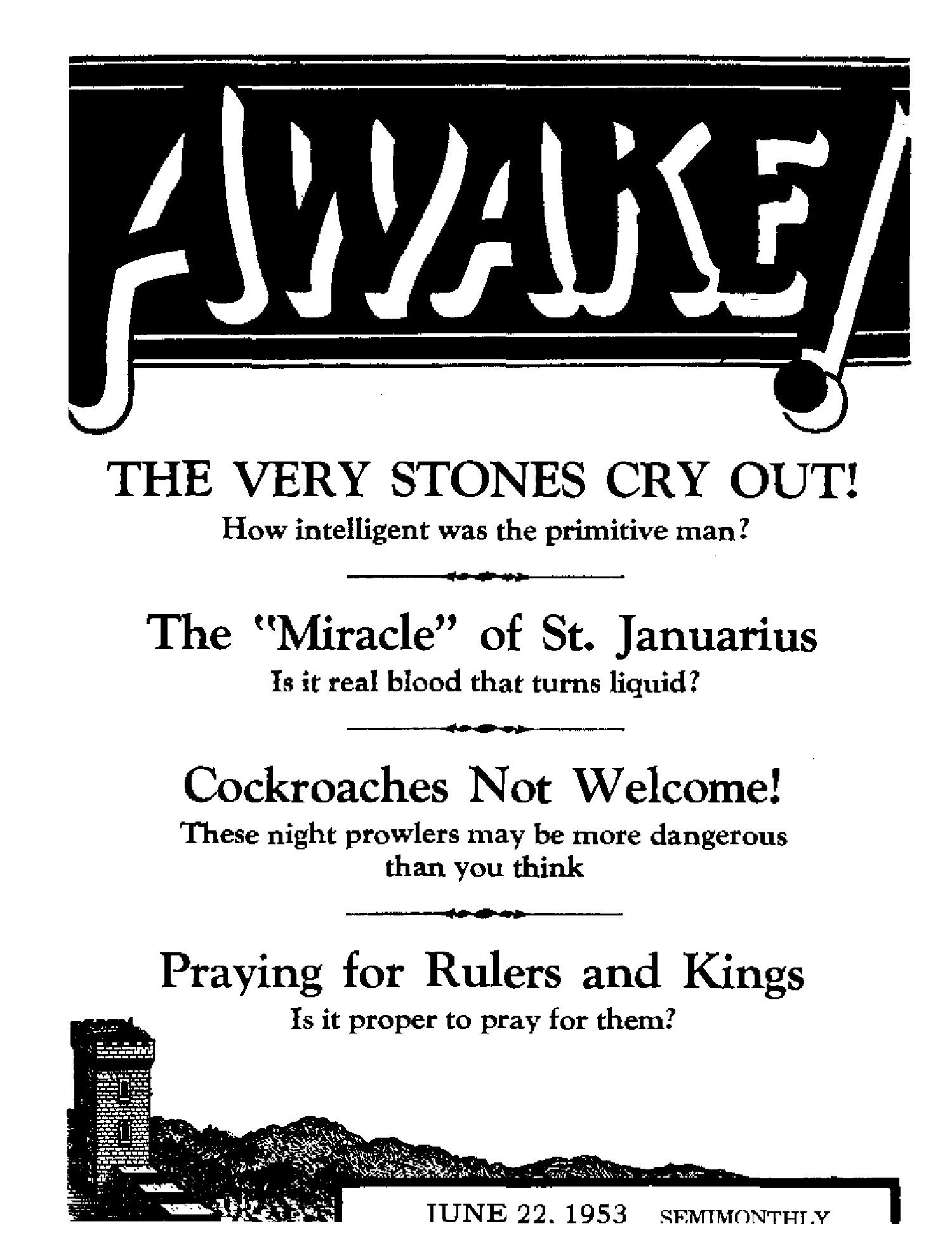
THE VERY STONES CRY OUT!
How intelligent was the primitive man?
The "Miracle” of St. Januarius
Is it real blood that turns liquid? --
Cockroaches Not Welcome!
These night prowlers may be more dangerous
than you think
Praying for Rulers and Kings
Is it proper to pray for them?
TUNE 22. 1953 sfmtmontftt.v
THE MISSION OF THIS JOURNAL
News sources that are able to keep you awake to the vital Issues of our times must be unfettered by censorship and selfish interests. “Awake!” has no fetters. It recognizes facts, faces facts, is free to publish facts. It is not bound by political ambitions or obligations; it is unhampered by advertisers whose toes must not be trodden on; it is unprejudiced by traditional creeds. This journal keeps itself free that it may speak, freely to you. But it does not abuse its freedom. It maintains Integrity to truth.
“Awake I” uses the regular news channels, but is not dependent on them. Its own correspondents are on all continents, in scores of nations. From the four corners of the earth their uncensored, on-the-scenes reports come to you through these columns. This journal’s viewpoint is not narrow, but is international. It is read in many nations, in many languages, by persons of all ages. Through its pages many fields of knowledge pass in review—government, commerce, religion, history, geography, science, social conditions, natural wonders—why, its coverage is as broad as the earth and as high as the heavens.
“Awake 1” pledges itself to righteous principles, to exposing hidden foes and subtle dangers, to championing freedom for all, to comforting mourners and strengthening those disheartened by the failures of a delinquent world, reflecting sure hope for the establishment of a righteous New World.
Get acquainted with “Awake!” Keep awake by reading “Awake!”
Published Semimonthly By WATCHTOWER BIBLE AND TRACT SOCIETY, INC.
117 Adame Street Brooklyn 1, N. Y., U. S. A.
N. H. Knorr, President Giiant Scitbk, Secretary
Printing this Issue: 1,000,000
Five cents a copy
ftaiilitan«*$ sdiuuid be sent to office In your country in compliance with regulation^ to gnaranlee safe delivery nf money. KemiitanfEs are accepted hi Brooklyn from enuntries where no office is located, by inierrutt Lrsna) money order only. Hubarrlptlon rates In different countries are here stai.erl in local curreney. Notice of expiration OJtil renewal blank I h sent ut least two issues before autacrlptiun ex pices. Change Of address when sent to our ofllee may be expected effective within one month. Rend ymir aid an well us new address.
Act of March 3, 1W. Printed in U. S.A
Lun»H> In whkh this mifaiini li piNBIitd: Semimonthly—Afrikaans, English, Finnish, French, l^fnian, Hollandieh, Norwegian, Spanish, -Swedish. Monthly—Danish, Greek, Portuguese, Ukrainian.
Offices Yearly subKcriptlrm Rule
Amtrlca, U.S-, 117 Adams St., Brooklyn 1, N.Y. $1 Australia, JI Beresford Rd., 9tratiifteld, N.8.W. Ss Canada, 40 Irwin An., Tor an tn 5, OnUrlo $1 Eafltni, 34 Craven Terrace, London. W. 2 7 s
Soith AfrlM, Private Bat, P.O. Eiandafonleln, lYan&vMl 7 s
Entered as sernntl-class matter it BrwkEyn, N. Y
CONTENTS
The Never-ending Battle for Your Mind 3
The “Miracle” of St. Januarius
The Testimony of Science
The Very Stones Cry Out!
Astronomy and Writing
Crop Rotation and Fermentation
Refrigeration and Ceramics
Cockroaches Not Welcome!
(Clean Homes Can Be Infested
Are Roaches Dangerous?
A One-Day Walking Tour of New York 16
Words to Carry the Correct Meaning 18
Sex on the Newsstand
The Tollgate Is Back to Haunt You 21
Taxes on a Grand Scale
“Your Word Is Truth”
Praying for Rulers and Kings
Jehovah’s Witnesses Preach in Ail the Earth—Northern Rhodesia 27
Watching the World
Volume XXXIV
Brooklyn, N. V,, June 22, 1853
Number 12
The Never-ending Battle for Your Mind
SO YOU think you are an independent thinker! Well, you may be right, and you may be a hundred per cent wrong. Powerful forces are battling incessantly for the conquest of your mind, to checkmate reason, and to make pawns of the brain cells that do your thinking. The ammunition fired at your mind is propaganda. It may be true, it may be false; it may be harmless, it may be dangerous.
But do those who entertain these ideas, whether true or false, really make up their own minds, or have they been made to think what someone else wanted them to think? Looking back through the corridors of history, one can see a long trail of battle casualties. Myriads became casualties in Hitler’s “master race” propaganda campaign. Hitler, adept at pumping secondhand thinking into the minds of men, wrote in Mein Kampf: “Through clever and constant application of propaganda, people can be made to see paradise as hell, and also the other way round, to consider the most wretched sort of life as paradise.” Hitler was a genius at treacherous propaganda, but Stalin out-propagandized Hitler. Hence the mind of man is just as vulnerable as ever. That is why psychological warfare is such a potent weapon today. It is used by both the East and the West. Surely, the pen is mightier than the sword.
Your mind is constantly under fire from the propaganda of the printed page. Blitzkrieg attacks, prolonged assaults, ambushes, and fifth-column tactics are employed. The newspaper, innocuous though it may seem, has the power to benumb reason and control thinking. News can easily be twisted. All newspapers have policies, political or otherwise, and they have pet aversions too. Hence, “coloring” the news is widely practiced. “Color” becomes downright dazzling in editorials. So overwhelming is it that one authority on propaganda, George Seldes, in his book The Facts Are, devotes a chapter to the subject “How to Read the Editorial Page”. A laconic chapter it is: just the word “Don’t”! Those who read them, then, must be on the lookout for slants that may or may not be right.
But never think for a moment that just because the morning newspaper has kindled a fire or bedecks a garbage can it has ended its career as a force in doing people’s thinking. In truth, to a surprising extent, writers of magazine articles and even books are dependent on the daily paper. Every writer has somewhere in his study a file of newspaper clippings dealing with those subjects in which he specializes. Out of that file comes a fair proportion of the facts upon which his books or articles are based. Finally, those books or articles exert a tremendous influence on those who read them. Thus, if original news is “colored”, the distortion is passed on to you by many means. You will be ambushect by propaganda if you are not on the alert.
Books are excellent sources for enlightenment. But too many people think there is something godlike about a person who writes a book. Too many people give themselves up completely to an author, as if he were Infallible. In conversation, they? would not swallow every word, but the printed page holds them in awe. And propagandists make the most of it. So while one should give a sympathetic reading to an author, yet do not believe it all until the thoughts have been examined and approved in the light of reason and logic, for what one reads is not necessarily so.
However, the printed page is only one of hundreds of methods used to subdue your faculty of thinking. From dawn till dark our eyes and ears are bombarded by the cbmmercial propagandists. Billboards urge us to retain our complexions, attend a thrilling movie, and shun B O and halitosis by gulping mammoth doses of chlorophyll. But too often instead of getting chloro-phylled, our mind gets chloroformed. For even with nightfall the attack abates not. It only gathers momentum when the neon signs come to glittering life. Even the signs that formerly went to sleep at night give you a round-the-clock bombardment. A reflective coating on a sign works miracles: headlights of automobiles light it up as if it were made of a million cats’ eyes. So alluringly fascinating! Who is on guard?
It is of no use to shut our eyes, for when we get home an even more insidious battie for control of the mind takes place. You are bombed from the air by radio and TV. Children are the first casualties from these “air raids”. They now toddle off to kindergarten reciting beer commercials better than they do Mother Goose rhymes.
As you prepare your defense in this never-ending battle, remember that booby traps are cluttered everywhere. Going out to the movies? Notice how subtle propaganda is sometimes woven into the plot.
The unwary soul may pick up an innocentlooking cartoon, only to have it explode the right viewpoint instead of the wrong. If cartoons and newspapers existed in Jesus’ day as they do now, we wonder how he would have been portrayed? As a red? Most probably! And how many people would swallow it? Most, probably.
Propaganda from the pulpit and political platform can ambush you But the Street Journal tells of the new fifth column: “The clever psychologists who mastermind the efforts to sell you such things as toothpaste, cigarettes, deodorants and beer are beginning to resort to methods formerly tried only on disturbed mental patients.” The technique is to ferret out people’s hidden prejudices and yearnings. To probe the public mind, the experts use psychiatric methods on human guinea pigs. This psychiatric or mental science is not entirely new. It was used in a comparatively crude way during the second world war, by professors who prepared “black propaganda” for use against the people of enemy countries. Now propagandists may use it to fool their own people! And, as the Wall Street paper reveals, this evil science is now entering a new stage of development that is horrifying to contemplate. Will it transform the public mind into a helpless pawn of the advertisers and propagandists ?
As long as Satan’s evil world exists, the battle for control of your mind is never-ending. But you can erect a mental bulwark. Constant vigilance is its foundation. Then build up an invulnerable defense by filling your mind with knowledge, the truths from God’s Word. “Wisdom is a defence.” (Ecclesiastes 7:12) Heed that Word of God and you will be on the winning side. Satan and his dupes will be checked out in decisive defeat at Armageddon. And the battle for your mind will end—in complete triumph for you!
AMONG the many religious organizations claiming to be the one true church is the Roman Catholic, To support her position she lists, among other things, the power to perform miracles. While most of these are said to have taken place in times past, the claim is made that certain ones have continued to our day. One of the better known of the latter is the supposed liquefying of the blood of St. Januarius, which occurs in connection with three annual feasts held in Naples, Italy. It is claimed that these have taken place more or less regularly ever since the year A.D. 1389, or for almost six centuries now.
The cathedral Capella del Tesoro, at which these miracles take place, is on such occasions packed. On the altar is exposed a silver bust of Januarius, said to contain his skull. The priest shows the throng a small shrine, resembling a carriage lantern made of glass and silver, inside of which can be seen two vials, one of which contains a hard red substance, supposed to be the congealed blood of Januarius. From time to time the priest turns it upside down to see whether any change is taking place in the dark-red substance.
All the while the people are praying, earnestly begging Januarius to cause the miracle to take place. That group of poor women so conspicuous because of being so demonstrative are known as the “aunts of St. Januarius”. Should the miracle be delayed they become very noisy and violent in their gestures and cries to Januarius that a miracle take place. The red substance becomes liquid, it increases in volume and even foams. The priest calls out “'ll miracolo e lotto!’’ and displays the shrine to the people, who crowd the altar rail to kiss it. Sometimes the miracle takes place within two minutes, but sometimes it will take almost an hour.
Who was this St. Januarius? Honored as the patron saint of Naples, his name was Gennaro, and while myths and legends abound as to the date and place of his birth and his miraculous escapes, such as are recorded in the Bible regarding the three Hebrews and Daniel, the Catholic Encyclopedia tells us that “regarding his history and life, we know next to nothing”. He is believed to have suffered martyrdom in the persecution under Diocletian around A.D. 305. It is said that he was beheaded and a poor woman gathered some of his blood and placed it in a glass vial.
Eighteen times a year this miracle is said to happen: daily for more than a week beginning with the Saturday before the first Sunday in May; for eight days beginning with September 19, the supposed date of Januarius’ martyrdom; and on December 16. Rarely does the miracle fail in the May and September expositions, but in that of December 16 the “blood” remains solid more often than not. It is also claimed that on several occasions the relics of St. Januarius were responsible for stopping eruptions of Mount Vesuvius, thereby saving many lives.
Concerning this miracle the Catholic Encyclopedia goes on to note: “Let it at
once be said that the supposition of any trick or‘deliberate imposture is out of the question.” And two Catholic writers, Wet-zer and Welte, in Kirchenlexikon (Church Lexicon), state: “As a natural explanation of this fact, established by numerous eyewitnesses, the most different hypotheses have been set up. None of these, however, has been sufficient to explain the matter, and the only thing left is to admit that God in a wonderful way really enlivens and rewards the faith of the Neapolitan people.”
The Testimony of Science
To date the Catholic Church has not permitted scientists to make a chemical analysis of the “blood”. The Catholic Encyclopedia admits that “Professor Albani claims to have reproduced all the phenomena with a compound made of powdered chocolate and the serum of milk”. And also lamely confesses as. regards scientific testimony: “Unfortunately, however, allegations have often been made as to the favorable verdict expressed by scientific men of note, which are not always verifiable. The supposed testimony of the great Chemist, Sir Humphrey Davy, who is declared to have expressed his belief in the genuineness of the miracle is a case in point/*
Some rather enlightening circumstantial evidence as to the genuineness of this miracle is contained in Paganism in the Roman Church. Therein the historian Th. Trade tells that in 1799 when Naples was occupied by Napoleon’s soldiers the French general and his staff together with a large crowd were gathered to witness the miracle of St. Januarius. When the blood remained hard, and the people became bitter against the French, convinced that their saint was hostile to the French, the general sent a note to the priest in charge of the ceremonies, which read: “If the blood does not liquefy within ten minutes I will order you to be shot!** Before the ten minutes were up the frightened priest cried out <fR miracolo £ fatto!” and, indeed, the miracle had taken place!
Incidentally another historian records that the Neapolitans were so displeased by this that they disposed of St. Januarius as their patron saint, feeling that he had become a friend of the French, and put Antonius in his place. But when Antonius failed to avert the eruption of Mount Vesuvius, he was dismissed and the Neapolitans restored Januarius to his old position as the patron saint of Naples.
Throwing further light on the scientific attitude toward the miracle of St. Januarius is the account that appeared in the Hibbert Journal telling of the experience of Frederic Newton Williams, L.S.A., L.R.C.R., a well-known fellow of the Lin-nean Society:
“When at Naples several years ago, I visited the municipal hospital; and after going around called at the hospital dispensary to have a talk with the American pharmacist under whose superintendence the department was. While there, a young acolyte from the Cathedral of St. Januarius came in and asked the pharmacist for the usual mixture for use at the feast which was to take place the next day, the first Saturday in May. With a smile and a few words of banter, the pharmacist prepared a mixture of ox-bile and crystals of Glauber salts (sulphate of soda), and, keeping the written message, handed the mixture to the messenger to take back to the Cathedral sacristy.
“After thus dismissing the acolyte, the practical pharmacist simply remarked to me that miracles took place nowadays, and this one was prepared in a hospital pharmacy with very satisfactory results. The next morning the pharmacist and myself sat in a cafe and watched the solemn procession of the liquefied blood from the church of Santa Chiara on its way to the cathedral. Thanks to my genial companion, the ‘miracle* was quite successful. He also explained that at the celebration which takes place on December 16 in the cathedral only, without the procession, the liquefaction is slower on account of the cooler weather.”
Further throwing light on the subject is the comment of John Douglas, who as bishop of Salisbury wrote the following in The Criterion: “I am informed.. * that a composition of crocus martis and cochineal will perfectly resemble congealed blood; and by dropping the smallest quantity of nitric acid among this composition, its dry particles will be put in a ferment, till at last an ebullition is excited, and the substance becomes liquid.” He then goes on to show how the vial holding the blood is so constituted as to make this possible. Being in the shape of an .hour glass, the acid could remain in the lower part while the congealed blood is in the upper. When turned upside down by the priest during the exposition, the acid would come in contact with the “blood”, thus causing it to liquefy.
Reason and Scripture
But regardless of the merits of the scientific explanations above given, the case for the miracle of St. Januarius is extremely weak. Admitting this weakness is none other than the Catholic Encyclopedia, which states on the subject: “Probably the most serious difficulty against the miraculous character of the phenomenon is derived from the circumstance that the same liquefaction takes place in the case of other relics, nearly all preserved in the neighborhood of Naples, or of Neapolitan origin. These include relics which are affirmed to be the blood of St. John the Baptist, of St. Stephen the first martyr,...and others.”
Is it reasonable to conclude that the blood was gathered of John the Baptist at the time of his beheading, and of Stephen at the time he was stoned, and preserved down to this day? Yet on such premises are based the reputed liquefaction of their blood. Is it reasonable to conclude that the blood of St. Januarius was preserved when nothing definite is known as to date of his death and the manner in which he died? The Catholic Church boasts of gaining converts as a result of the miracle of Januarius, but is it reasonable to hold that God has to use such stunts to cause thinking men to dedicate themselves to his cause? And why only St. Januarius and a handful of others? Why should only their blood be preserved, and why should only it be so powerful? And why single out, of all the cities in the world, Naples? And why .should the blood fail to liquefy so often on the December 16 exposition?
Is there any evidence that Naples is more Christian than any other city? It should be, in view of all the miracles performed there for the past almost 600 years! The fiction of the liquefying of the "Milk of Our Lady” and of the fat of Thomas Aquinas is readily admitted. Why not admit the fiction of the liquefying of blood?
The reputed miracle of St. Januarius and any other miracle, even if genuine, does not entitle the Catholic Church to the claim to be the true body of Christ. The true Christian congregation long ago put away such dependence upon miracles, they being only for establishing it at the beginning or in its "babyhood'*. It proves its title solely by its loving adherence to God's Word and the kind of fruits it produces. —Luke 6:43, 44; 1 Corinthians 13:8-11; 1 Timothy 3:15, New World Trans.
THERE are two schools of thought regarding the origin of man* One teaches that he is a direct creation of Almighty God, formed in perfection with intelligence imparted to him at the time of his creation. The other maintains that man gradually ascended from a brutish state of lower animals to his present high and civilized condition. The first is taught by the Bible; the second by evolutionists. For centuries a. bit ter battle has raged between the two schools of thought, but recent discoveries by archaeologists confirm the Bible*
All evidence, whether traditional, technical, archaeological or Biblical, points to the plains of Mesopotamia as the cradle of civilization. No civilization, Eastern, Indian or Chinese, can compete with this land in the antiquity of its peoples. Here archaeologists have dug down to the virgin soil and in their findings have dealt with the earliest of mankind. “It was expected,” wrote P* J. Wiseman, C.B.E., “that the more ancient the period, the more primitive would excavators find it to be, until traces of civilization ceased altogether and aboriginal man appeared.” However, “neither in Babylonia nor Egypt, the lands of the oldest known habitations of man, has this been the case.” It was a shocking surprise, said Sir Leonard Woolley of the British Museum, expert archaeologist, to find the very opposite to what was anticipated, namely, “the high state of civilization existing in early times.” Dr. Hall writes In his History of the Near East: “When civilization appears it is already full grown.” Regarding the earliest Sumerian settlements in southern Babylonia, Dr.
L. W. King, in Sumer and Akkad> states: “The race by which they were founded appears at that time to have already attained to a high level of culture.” Sir Leonard Woolley wrote in The Sumerians^ page 37: “It is astonishing to find that at this early period the Sumerians were acquainted with and commonly employed not only the column, but the arch, the vault, and... the dome, architectural forms which were not to find their way into the western world for thousands of years.”
But nowhere is there to be found evidence of a slow development of the human mentality and the emergence of primitive man from his so-called “brutish” state as taught by evolutionists. The “stone age1’ is found to be rich and gifted with the art of sculpture. Extraordinary skill is revealed in their mechanical and chemical treatment of metals. A well-developed written language appears. Culture is of high degree. Nothing crude or brutish is found in any of their arts or sciences. Comparisons with many of the works of today display, in fact, retrogression, instead of evolution. Stated Rimmer: “It is not too much to say that the farther back we go into Egyptian antiquity, the more perfect the arts and culture in general seem to be.”
The cumulative evidence contradicting thegradua 1-development-o f-civilization theory has grown to such substantial proportions that the theory cannot be maintained. P. J. Wiseman contends, in his New Discoveries in Babylonia About Genesis, that “soon after the Flood civilization had reached a peak from which it was to recede- Instead of the infinitely slow development anticipated, it has become obvious that art, and we may say science, suddenly burst upon the world”. For example: Of the eighty pyramidal tombs in Egypt, Cheops is the largest and most important. What is most remarkable about this pyramid is the way in which mathematics enters into its technical construction.
In the seventeenth century Sir Isaac Newton studied this aspect, but it was not till the nineteenth century that the majority of the underlying problems were solved. Albert Neuborger, in his book The Technical Arts and Science of the Ancients, says: "The mathematical relationships show what astounding knowledge of mathematics and astronomy the ancient Egyptians possessed, and how well they knew the way to apply it to their most striking monumental works. " The four sides of the pyramid accurately coincide with the four cardinal points, and this fact has led some to believe that they were intended to ascertain the dates of the equinoxes. According to Neuburger, the builders of the pyramid knew the "famous ratio jt = 3.14159 of the circumference of a circle to its diameter thousands of years ago; moreover, they applied it in their mechanical arts; it was not rediscovered in later times till the Dutch mathematician Ludolf van Ceu-len calculated it in the sixteenth century’1.
The science of modem astronomy teaches that the solar year of our earth written in decimal form is 365.242242 days. The architects of the pyramid knew the exact length of the solar year, "even to the tenth part of the second." It becomes obvious that the men who planned the pyramid, who cut its stones to fit with perfection, who organized the transportation of more than 85,000,000 cubit feet of masonry, were not the peculiar bushy-hair apelike men with pigmy-size brains pictured by the evolutionists. Rather we see a fully developed man of extraordinary ability, genius and skill.
Further: Over 4,000 years ago the Babylonians had already formulated the fundamental laws of mathematics—laws "which were not rediscovered by the Greeks until fifteen hundred years later”. Edward Chiera, late professor of Assyriology of the University of Chicago, wrote in his book, They Wrote on Clay, that so advanced were the Babylonians "that many an Assyriologist gets lost in trying to analyze a list of figures, the interrelations of which he will never be able to grasp unless his mathematical knowledge is greater than is generally the case.... For the complicated calculations which were the joy of the Babylonian mathematicians, the sexagesimal system may even have been superior to the decimal.... Actually, the whole system was so effective that it has imposed itself upon the world. Few people realize that we still follow it in some cases. We still divide the circle into 360 parts, the hour into 60 minutes, and the minute into 60 seconds".
Dr. Otto Neugebauer of Brown University, known the world over as an authority on ancient mathematics, stated that Babylonians knew much about algebra, even "actually experimented with special cases of logarithms". On page 33 of his book, The Exact Sciences in Antiquity, he states: "Returning to the Old-Babylonian period we find many more witnesses of the numerical skill of the scribes of this period. We find tables of squares and square roots, of cubes and cube roots, of the sums of squares and cubes needed for the numerical solution of special types of cubic equations, of exponential functions, which were used for the computation of compound interest.” This authority is convinced that the "Pythagorean” theorem, which is that the sum of the squares of the lengths of ttfe sides of a right triangle equals the square of the length of the hypotenuse, was known more than a 1,000 years before Pythagoras. It must be admitted when we are faced with these facts that to be able to Calculate in this manner necessitates a well-developed, intelligent mind, which would immediately exclude monkeys, chimpanzees, so-called ape-men and even the Stone Age men of the evolution theory.
Astronomy and Writing
Babylonians are called the fathers of astronomy. Every single phenomenon was noted by them with such great care that they were able to notice even the changes caused by the precession of the equinoxes. Eclipses of the sun, moon and stars were so carefully1 described that it is claimed that part of the ancient chronology has now been fixed “without fear of mistake by just such occurrences”. “It is an extraordinary fact,” says Chiera, '‘that modem astronomers have not yet been able to accumulate a series of astronomical observations as long as the Babylonian. For the longest-known series of modem observations—that at Greenwich—was begun only in 1750, And the Babylonians had crude observations for many centuries before their official series began.”—They Wrote on Clay, by Chiera.
Until recently it was generally believed that writing was an “infant” among the arts of mankind. Now the pendulum has swung in the opposite direction, and the present tendency is to claim it among the most ancient of arts. There are approximately a quarter of a million cuneiform clay tablets distributed among the various museums of the world, and these testify of a well-developed society among the ancients.
Cities were planned. Towns were organized. These were governed by a legal code. There were schools, libraries and hospitals. From well-thought-out* plans forts were built with projecting towers.
Supplying large cities with sufficient water presents problems, which the ancients overcame. King Hezekiah is credited with building a tunnel that still receives the water of the Siloam spring. This tunnel, according to Neuburger, “is 1,776 ft. long, and has a curved shape approximately like a capital S..., It must certainly be regarded as a masterly achievement of technical science at that time to have started a tunnel of such length and of a curvilinear shape from opposite ends and to have directed the workmen in such a way that the two sections exactly met. A task of this kind would present certain difficulties even in our day. Unfortunately we do not know how the problem of getting the right direction for the two parts was solved.” The evolution theory of a slow progress of early man in the light of these facts is a disproved assumption, and the idea that an infinitely prolonged period elapsed before civilization appeared cannot stand.
Mechanical and
Chemical Wisdom of the Ancients As for the technical trades and skill of the ancients, the mounds of Mesopotamia and Egypt abound with evidence. For example: Vast quarries of Turra near Cairo prove that from an early date open working had been given up in favor of shafts. There are indications that bronze was first made in the valley of the Euphrates, where it was known about 2000 B.C. The Bible speaks of Tubal-cain as “an instructor of every artificer in brass and iron”.
(Genesis 4:22) This no doubt was mure than a thousand years before the Flood-The expert workmanship in ancient Egyptian necklaces and rings tells of the mechanical and chemical methods that were ingeniously used in treating metals, especially precious metals. Gold leaf was as thin as that made in the eighteenth century of our era. Berthelot found from measurements that such gold leaver of the twelfth and thirteenth dynasties (about 20001800 B.C.) “were only .001 mm, thick (about 4/100000 of an inch). Silver, like gold, was also hammered out to thin sheets (.001 to .0025 mm.)". Gold was used for filling teeth. Cement was also used. Wire made from precious meta Is w as formed into ornaments. According to Saville, it was often used to fasten loose teeth. Copper wire and cables were already in use.
The arts of both soldering and welding were known before the time of Glaocus. who lived around the year 700 B.C. Welded pieces that date back to thu year 1490 RC. were found Among the excavations at Thebes. (Wilkinson, II, page 258) Neu-burger wrote that the “actual process of soldering probably hardly differed at all from the modern method”. Tin-plating was effected by dipping objects in molten tin, and was so skillfully done by Ute Gauls that tin-plated articles could not be distinguished from silver ones. To the many accomplishments of the goldsmith must be added the chryselephantine work, that is, overlaying statues with gold and ivory. This is now a lost art.
The plane and the lathe are preserved in their original form from the ancients. The Lathe is mentioned by Pliny (VTL 198), and a great number of findings testify to the work performed on it. “It can only be surmised,” said Neubumen “that its appearance was something like a grindstone, and that it was a bow-lathe which is probably derived fmm the ancient Egyptians.
It still survives in Europe in the ‘turn bench' of the watch and clock makers.” (See Useful Arts and Handicrafts, by Leland and Ward, Vol. 2.) At a meeting of the Iron and Stool Institute at Birmingham it was admitted that “in spite of modern scientific progress the metal of the 1,600-year-old pillar at Delhi (Kutub) was still superior to anything we could produce today; it was freer from inclusions even than Swedish charcoal iron”.
Crop Rotation and Fermentation
Both the Hebrews and the early Egyptians were acquainted with manures and modern methods of crop rotation. PHny tells of fields used for pasture lands one year and cultivated the next; that Romans took special care In plowing their land, mostly crossways, and sometimes “plowing the same field seven times”, Tcrcntlus Vano (116-27 B.C.) wrote in his De to rusl ica: “When ploughing is being done for the third I hue after sowing, little boards arc attached to the share, thus covering up the sown seed in the rows and making furrows in which the rain-water may run off.”
Fields of rye. barley and spelt were harvested and the crop was turned over to the brewery industry. According to Diodorus, the Egyptinn god Osiris is supposed to have introduced into Egypt about the year 2000 HL1, a beer made of malted rye, which he states could almost vie with wine in pleasantness of taste and power. Recent researches by Hrozny show where ancient Babylonians also brewed beer from rye, barley and spelt. The original furrn of beer was from bread and is stiff “found nowadays in many parts of Russia as feudal.
Egypt flourished with vineyards. No fewer than six kinds of wine were known, Aristotle reports that wines were dried in skins, and then taken out in lumps, which were dissolved in water for drink-
ing purposes. The aroma from the wines was of such delicious flavor that it was said to be impossible to desist from drinking them.
Oils and fats were made into a great variety of products. Ointments having very different properties, made by mixing oils and fats with perfumes of every kind, were common. Perfumes were in forms of oils, solids or powders. At this early age sticks of paint were made. Eyelids and the eyebrows were colored. The orange-red cosmetic used to color the fingernail was prepared from the henna plant.
Refrigeration and Ceramics
Among other things, the most important methods used today for preserving were also practiced by the ancients, that is, cold storage, salting, drying and excluding the air. The Jews evidently used snow to cool their drinks. (Proverbs 25:13) Ice-cellars are mentioned in an ancient Chinese collection of lyrics, which dates back earlier than the first millennium B.C. The process for making ice artificially was known to the ancient Indians. The Egyptian women of the fifth century B.C. used the method involving vaporization to make their homes more comfortable in the summer heat. As to the quality of their refrigeration Neu-burger writes: “Preserved fish from ancient Egyptian times have'remained unimpaired up to the present day.... In some cases they still look nowadays as if they had just come out of the water. The skin is shiny and has color, and in the eyes one. can still clearly discern the iris.” —The Technical Arts and Sciences of the Ancients.
This same authority shows that their , refrigeration was no less remarkable than their brick making. In the fifth chapter of the book of Exodus, mention is made of the making of bricks in Egypt by the Jews, and it is stated that straw was used in this process. The way in which the straw was used remained a mystery for a long time. Recently it was found that “the addition of organic substances, and particularly of straw, to loam, which was afterwards dried, caused the breaking strength of the bricks so obtained to rise from 84 lbs. to the square inch to 269 Ibs. to the square inch: hence the strength of the brick was increased by 244 per cent”.
During this same period of time, blue and white strips of glass were made. Their unbelievable skill in this field is found in their production of artificial eyes. These artificial eyes were made of all sorts of substances, and Were in some cases compounds. The iris and pupil consist of glass; the sclera (white skin of the eye) of a metal alloy, ivory, pearl, feldspar marble or else entirely of glass. These were placed in mummies, as well as in statues. Whether artificial eyes were made for living creatures is not definitely known, but Ebers considers it not improbable. Artificial stones made of colored glass fluxes were cleverly mixed with genuine stone jewelry. The hardness of these artificial stones equals that of the strass, or imitation diamond of today, and it is speculated that these stones were made in the same way.
In the field of textiles, the ancients manufactured silks and dyes with unsurpassed skill. Moses wrote of the beautiful hangings of the tabernacle (Exodus 26), which were expertly designed, skillfully made, and artistically magnificent. Herodotus tells about the mail-shirt of Amasis: “What excites our wonder in it, however, is every single thread; for the threads are not coarse, and yet each one consists of 360 single threads, which can all be distinguished/’ Asbestos threads were sometimes added to ordinary threads “in order to obtain fireproof garments”.
From almost any field of technical arts and sciences one wishes to select, the accu-mulatlve evidence furnished by the science of archaeology testifies that primitive man was not only acquainted with these arts but exploited most of them to their utmost. Early man’s astonishing abilities, his astronomical, mathematical and physical knowledge, prove him to be not only enlightened but highly intelligent and cultured. Neither the Bible nor Egyptian or Babylonian excavations know anything of brutish cavemen evolving into civilized peoples. These ancient stone and day records testify to the authenticity of the Bible account that “God created man in his own image, in the image of God created he him; male and female created he them”. (Genesis 1:27, Am. Stan. Ver.) This truth will endure forever.
would be repelled by the beastly insects.
Obviously, then, cockroaches have become domesticated, in the sense that they have accommodated themselves to the environments of civilization. With 1,200 species known (there are many wild ones), even the colder parts of the world have their domesticated variety. Five common species inhabit the United States. However, the largest and fattest cockroaches grow in the tropics, although many an American housewife, particularly in the South, may dispute this statement, the
PRACTICALLY no housewife needs an introduction to Mr. and Mrs. Cockroach. And why? Because these detestable insects, once eminently tropical, now are cosmopolitan, being found in virtually every nook and cranny of the world. All that many persons have to do is to switch on their kitchen lights some night, and they will be there. Alas though! By the time a courageous housewife has grasped her broom, grabbed her spray gun or applied shoe leather, the speedy night prowlers have made good their getaway by scurrying into inaccessible crevices. Indeed, the uncanny ability of the cockroach to make these quick getaways only intensifies the housewife’s creeping and icy disgust for these prowlers. And we do not blame her. Even a stouthearted Spartan
Texas-sized roaches being already too big for her!
Domestic cockroaches are finicky about their appearance. Would you believe it? They like to appear beautiful and clean, and if watched, they will be seen constantly making efforts to beautify their person, licking their legs and antennae in much the same manner in which a cat washes its paws.
There is something about the cockroach’s habits and characteristics that intrigues the naturalists. Then, too, they rank as one of the most ancient of all winged insects. Its ancestry is traced back to the coal age, there being 200 fossil species known. So it is not strange that these defiant night prowlers are often recom-tended as the most suitable type for commencing the scientific study of insects.
Cockroaches belong to a family in which the legs are specially suited for running, as anyone knows who has tried to step on one. They have a short head, flat face and are always looking slightly downward. Most species are somberly colored in black or brown. Surprisingly, there are varieties that exhibit an elegance of form and beauty of coloration. The tropics have these “glamorous" ones. Heightening the roach's generally frightful appearance are its long threadlike antennae or feelers which, together with its crackling appearance, are horribly hideous enough to give housewives that creepy feeling.
ISver&Niffkt Life
Being rather inquisitive insects, cockroaches like to know what is going on in the pantry, cupboard, kitchen sink and table, desk drawers, etc., and so at night they carry on their reconnoitering. And you probably know the cockroach leaves his calling card: droppings and an odor of which he is the sole proprietor, The cockroach’s BO is caused by glands in the hind-body. In some, these glands are very large and diffuse a strong “underarm" odor. Perhaps the cockroach has not learned about the latest marvel of civilization—chlorophyll!
Practically nothing gives the cockroach indigestion; it is all-devouring. Of course, they have their preferences. Such delicacies as these rate high: leather, ink, paint, hair, sweetened matter, paper, clothing, paste in book bindings, shoes, bones, dead insects, and cereals. Really, their appetite is voracious. There are recorded instances of sleeping sailors on ships bound from the tropics having fingernails gnawed by roaches. It must be strangely disconcerting to wake up in the morning manicured by a cockroach!
The common cockroach lays its eggs arranged In a horny case, opening at the top and shaped like a purse, which she carries about with her for some time, protruding from the end of her abdomen. Finally, Mrs. Cockroach deposits the egg capsule in a crevice in the walls or below the floor. Result: a new family. The youngsters shed their skin several times before it finally hardens and gets dark like their elders'. It is not long before children become grandparents, for the German cockroach is full-grown in four and a half to six months; the American cockroach, in one year. No wonder mammoth sizes are frequently seen!
Being a formidable enemy of the bedbug, the cockroach does an excellent service in reducing that bug*s numbers. (Who would ever think of importing cockroaches to exterminate bedbugs?) But the roach is still detested. Perhaps this is because he is just too filthy, offensive, foul, and abominable himself, despite his futile self-washings.
Clean Homes Can Be Infested
It is commonly thought that cockroaches live only in dirty surroundings and that homes invaded by them must be inhabited invariably by people careless in their cleaning habits. Such is not really the case, because these insects are all-devouring. They do not have to eat scraps of human food to live. But carelessness in cleaning does make a home susceptible to a roach invasion. Yet a house can have that wellscrubbed look and still have the pesty night prowlers. All that has to happen is for one of the night-flying kind to enter an open window and deposit an egg-case containing about 16 eggs, and perhaps by the next morning tiny roaches will be scurrying for cover. Since they are so fond of darkness, the first invasion may get by unnoticed. Sometimes, though, a brand-new house becomes abundantly stocked with cockroaches just through a mass night migration from an oversupplied, nearby house.
A re Roaches Dangerous?
This is a question that has long been debated. Suspicions that cockroaches are disease carriers have always been prevalent, but nothing has been definitely pinned on them. Even now their case is not conclusive. However, Science News Letter, issue of February 5, 1949, reported on the tests at the University of Minnesota School of Public Health which revealed that a food-poisoning bacteria called Salmonellae may be carried by the cockroach. These tests proved that cockroaches are capable of acquiring, harboring and spreading one type of this dangerous bacteria. The most frequent outcome of a salmonella infection is common food poisoning, which may involve acute diarrhea, vomiting, and severe abdominal pains.
Cooking will kill the salmonella germs, but the ever-present possibility is that food may be poisoned after cooking. So if the cockroach carries the germ, then its eating habits could be most dangerous. For these insects love the kitchen table! Perhaps a cake or pie has been left uncovered on it. Mr. Cockroach, delighted to find such an enticing meal and never knowing moderation, gorges himself so swinishly that, just, like the ancient Romans, he must regurgitate his food to make room for more. Here, of course, is where the contamination of the very food the roaches are eating is possible. And then the obnoxious habit of leaving their droppings on food and dishes in the pantry is another source of possible contamination.
Tests proved that germs could remain alive on the insect for as long as 78 days. And since it could contaminate food and dishes merely by coming in contact with them, even when a roach is dead the evil it did may live on. It was also proved that bacteria can remain alive on glass dishes for 34 days, on cornflakes for 62 days. Of course, these tests only indicate that experimentally raised and infected cockroaches can act as carriers. Whether or not cockroaches actually do this has yet to be proved. But to ensure the health and mental tranquillity of the family it might be well to hang up the “Cockroaches Not Welcome” sign on your door. But how?
Well, once established in a house, it is impossible to starve them out or get rid of them with soap powder. And only a highly skilled person who likes being a night owl can kill cockroaches with his feet. Then it takes much practice because of the scudding zigzag locomotion displayed by the roach in its quick getaways. Hence, extermination by using shoe leather is not only unreliable, but hard on the feet. Besides, it gives one a creepy sensation to squash a fat cockroach.
The best method of extermination is poison. According to York Research Corporation, product testers for the American Hotel Association, the most effective killer of household insects is chlordane. This is a brown syrupy liquid with a wet-wood smell. This is the killer ingredient in many brand-name insecticides. Chlordane should be applied along crevices formed by comers and baseboard, along water pipes, under refrigerators, etc. By using a mechanic’s oil can with a long spout bent at the tip, it will be possible to squirt roach-killer into these hard-to-get-at places. Complete cockroach eradication calls for absolute cleanliness and absence of dampness. Finally, no food scraps should be left around either in the kitchen garbage pail or on the sink drainboard. Doing all this may keep the cockroach from calling and thus dispel the nightmares of many a housewife.
A One-Day Walking Tour of New York , J
TIE cheapest or the most expensive sightseeing can be done in New York, Elaborate guided tours may be taken, or for a few dimes and a slight Investment in shoe leather you can spend days being entertained and educated, seeing and doing interesting things. Condensing this into a one-day hike, let us put on our most comfortable walking shoes and start early —as early as we can—with map and magazine in hand. First we will take the subway or bus to South Ferry, the southernmost tip of the island, here to choose one of three boat trips. For about ?2.50 we could take a sight-seeing boat all the way around Manhattan, under great bridges, past towering buildings and by the piers where great liners dock, but this three-hour trip, though interesting, would not fit Into our one-day schedule. A shorter trip is the 70c boat ride to the Statue of Liberty, where we can climb into the lady’s crown for an excellent view of the harbor. But for only ten cents we can take a round trip on the Staten Island ferry, riding down across the busiest harbor in the world, watching the towers of the financial district drop behind as we pass barges, lighters, tugs, a freighter or two, and perhaps even a great ocean liner heading for its mid-Manhattan berth.
Returning from our “voyage” we stretch our legs northward, going a few blocks up Broadway, past offices of most of - the steamship lines, to Wall street and the financial district. We move down Wall a block and find ourselves at Federal Hall museum, the House of Morgan and the Stock Exchange. This -small section of now-towering buildings on narrow, alley like streets laid out by the early Dutch composed the entire village of New Amsterdam —the original city of New York, Wall street marked its northern boundary 1
<[ Returning to Broadway we go north (right) six more blocks to pass the famed Wool worth building, once the world’s tallest. In the triangular park that It faces is ancient City Hall. It is also at this park that the dilapidated old Third Avenue elevated ends. We follow under this elevated line a few blocks to get to Chinatown and the Bowery. After lingering to windowshop on the narrow streets of Chinatown, we follow the el’ on up the Bowery to Delancey street, where we turn right four blocks to Orchard to watch the animated sidewalk storekeepers of the Jewish section loudly ply their trade. Going north (left) up Orchard we come to Houston street (say it like "house”, not the Texas city), where in a small grassless park middle-aged men bowl without tenpins, rolling the balls to see who can get nearest to the jack at the end of the rink.
<£ The tiring walker can here take the IND subway two stops to Washington Square and meet us there, or can come along as we walk left (west) on Houston beyond the elevated, on across Broadway, and turn right (north) on East Broadway to Washington Square. It is here, under Washington Arch, that Fifth Avenue takes root and grows northward. The square’s eight-acre area, once a potter’s field, became the center of the city's most aristocratic neighborhood, and later the habitat of almost every important American writer and artist. In the spring and fall walls of buildings around the south and west sides are used by neighboring Greenwich Village artists for their famed sidewalk exhibitions. The “village”, with its hodgepodge of crooked streets and some of its old Bohemian atmosphere still remaining, is to the square's west and north.
<[ In Washington Square we board a Fifth Avenue bus, making sure that it is one that goes up the east side of Central park. While we rest aboard the bus we note that, like all of New York, Fifth avenue is given to sudden changes. There are a few blocks of elegant hotels, then a wholesale district, then in quick succession we pass the Empire State building at 34th street, the library at 42d, Rockefeller Center at 50th (which we will visit later), the fashionable Fifth Avenue shops and Central Park. Along the park we see a new aspect of New York—the homes and apartments of the extremely wealthy. We get off at the Metropolitan Museum of Art at 82d street, the finest and largest in America. We are interested not only in the 6,000 paintings, the medieval armor ^nd other unusual collections, but also in the Egyptian wing to the right of the front door. Here modes of burial and paintings on ancient Egyp-
tian tombs show their pagan belief In immortality, the effort taken to make the “soul” comfortable in the future world, and in one room a funerary papyrus shows the wicked dead being burned In a caldron by a demon. The Taw Cross 19 also evident.
Directly across Central park is the American Museum of Natural History at 79th and Central Park West. Eighty-two years of research and $30 million worth of collections have been used to transplant the visitor into wild sections of the world to view animals in their native habitat. For 95c we can attend a most interesting program and become familiar with stellar bodies in the domed hall of the adjoining Hayden Planetarium, Both museums are free, hut they close at 5 p.m.
The midtown section can be toured at a different time, or the subway will take you from the natural history museum back to this area. If it Is an especially clear day, you may wish to go to the top of the Empire State building to view the city. This will cost $1.20. A block west, at 34th street and Broadway is Macy's, the world's largest store. Eight blocks north on Broadway Is Times Square at 42d street. If you want to skip the Empire State building, or if you are taking the entire trip in one day, it might be well to start here. The brilliantly lighted Great White Way is, of course, best at night. There is nothing with which ^o compare its monstrous signs to see how big they really are unless you count the windows by the side of some of the larger ones and compare their height with the number of stories in various buildings in*your home town. Walking through the Times Square area up to 49th street, we turn right (east) for one loij&^lock to Rockefeller Center, where 15 building^house the consulates of 20 nations, the editorial departments of dozens of magazines, and the offices of 1,000 leading business firms. The RCA building’s elevators are the world’s fastest; the 6,200seat Radio City Music Hall, the world's largest indoor theater. A “behind the scenes” visit to NBC’s broadcasting studios
costs 75c, or a tour through the Center's buildings and to the observation roof seventy floors above the street costs $1.40. You may see yourself free on a television screen at the RCA exhibition hall on 49th street.
C. Two blocks farther east is tree-lined Park avenue where we view the more luxurious mode of New York living and the famed Waldorf-Astoria hotel. Turning right (south) on Park avenue we must go to the left or right around
Grand Central station, to get inside. The casual eye, however, does not see the monstrous underground rail yard that makes this the largest and most costly terminal in the world. It is so big that 26 of its tracks are directly under 48 others. Trains enter this huge underground terminal by burrowing through a four-track-wlde, two-and-a-half-mile tunnel directly beneath the very tree-lined avenue we just walked down. Thus, where thousands of tourists first enter New York, we conclude our day’s tour. If we made it all in one day, we did well.
<L There are many other things to see and do in New York. Guided tours are conducted through the U,N. building^; cost $1,00. The zoo is in Bronx park. Huge airports may be seen, historical spots visited. But by far the most amazing coming event will be the assembling of Jehovah's witnesses from the world over at Yankee Stadium, July 19-26. That tens of thousands of people should, at their own expense, travel from all parts of the world to hear Bible lectures, and , contribute their labors toward operating a tremendous nonpaid convention organization is astounding in itself; but when it is recognized that these men of many nations, races and colors are all working at unity while the representatives of these nations squabble and bicker a few miles away at the U.N., the unity of true Christianity should impress even the most skeptical of observers. When Jehovah’s witnesses met in Yankee Stadium in 1950, to the amazement of officials, 123,707 people actually did attend one Bible lecture! This coming summer’s great multitude of true worshipers will unquestionably be the greatest sight to see in this city of sight-seeing. You are invited to be with them. Will you accept the invitation? Come any time from July 19 to 26 inclusive.
words have constituted the tools of thought and expression. In the original language of the first pair in Eden, we can well imagine that the names given to the many varieties of animal creatures constituted word pictures of these creatures, expressing in sound the general over-all impression of their appearance on the perfect mind of Adam. Even in imperfect creatures this God-given ability to transfer the impressions of the mind into vocal sound can be observed. As an instance consider the young child’s first impression of a locomotive so aptly expressed as a “chOo-choo”.
Skill and versatility in the use of these language tools are acquired only at the cost of constant effort and practice over a considerable period of time. There must be positive consideration of the matter, for we are living in times when the worn-out patter of radio and press is dished up as a ready-made language that calls for no mental effort, no personal choice, but simply memorization, as in the case of the catechism-trained parochial scholars. How much thought do you give to the words you employ from day to day? In the realm of words do you often find yourself using the wrong tool for the job, or a worn-out tool for some project requiring the utmost precision? Do you take sufficient interest in your speaking jobs to be keenly concerned about knowing and rightly using the proper tools for the various aspects of your speech activities?
To the man or woman who reverences the great Creator, words take on a much same Creator endow man with the gift of speech? Does he not declare himself: “So shall my word be that goeth forth out of my mouth: it shall not return unto me void”? (Isaiah 55:11) And did he not reveal his only-begotten Son under the honored title * ‘The Word”? How fitting, then, that we should strive to cultivate the attitude expressed by the inspired servant of God: “Let the words of my mouth, and the meditation of my heart, be acceptable in thy sight, O Lord.”—Psalm 19:14.
Actually, words should become to the sincere worshiper of God the vehicles of kindness, truth and praise. By means of them we commend God to our fellow men, and through our proper use of them we are commended by God. Of Jesus it was foretold hundreds of years before his first presence: “Grace is poured into thy lips.” (Psalm 45:2) True to the prophecy, those who heard his words on earth spontaneously testified: “Never has another man spoken like this.” (John 7:46, New World Trans.) Surely something for us to aspire to! And the more so since today the real and present danger to earth’s multitudes is that they are, through lack of knowledge, hastening on toward disaster at Armageddon,
Imperfect though human language has> become, yet it can with the help of God’s invisible force or holy spirit be made to convey knowledge to others. But today we do not await a miraculous gift of expression. Rather we work hard and strive to be imitators of our great Commander, Christ Jesus. Briefly, this will require our
giving careful attention to such qualities of language as tact, simplicity, accuracy, fluency, earnestness and generosity.
Tact and Accuracy
Tactfulness means, among other things, a suiting of the spoken word to the occasion. Thus we avoid blundering, clumsy expressions that grate on the ear of the listener and arouse in his mind a hostile background that will be difficult to eliminate. When comforting a bereaved person it simply would not be fitting to refer to the "corpse” that was their dear one, when the expression “remains” would afford a kindlier approach to the topic. We are here reminded that our spoken words will fail of their purpose unless the listener can partake of them and relish them, or at least appreciate them as being something beneficial to him. Probably you have tasted saltless porridge, and have noted that the immediate reaction was to reach for the salt shaker. How wise therefore the admonition to “let your utterance be always with graciousness, seasoned with salt, so as to know how you ought to give an answer to each one”.—Colossians 4:6, New World Trans.
…