Awake!, May 22, 1953
Download: PDF — Awake!, May 22, 1953
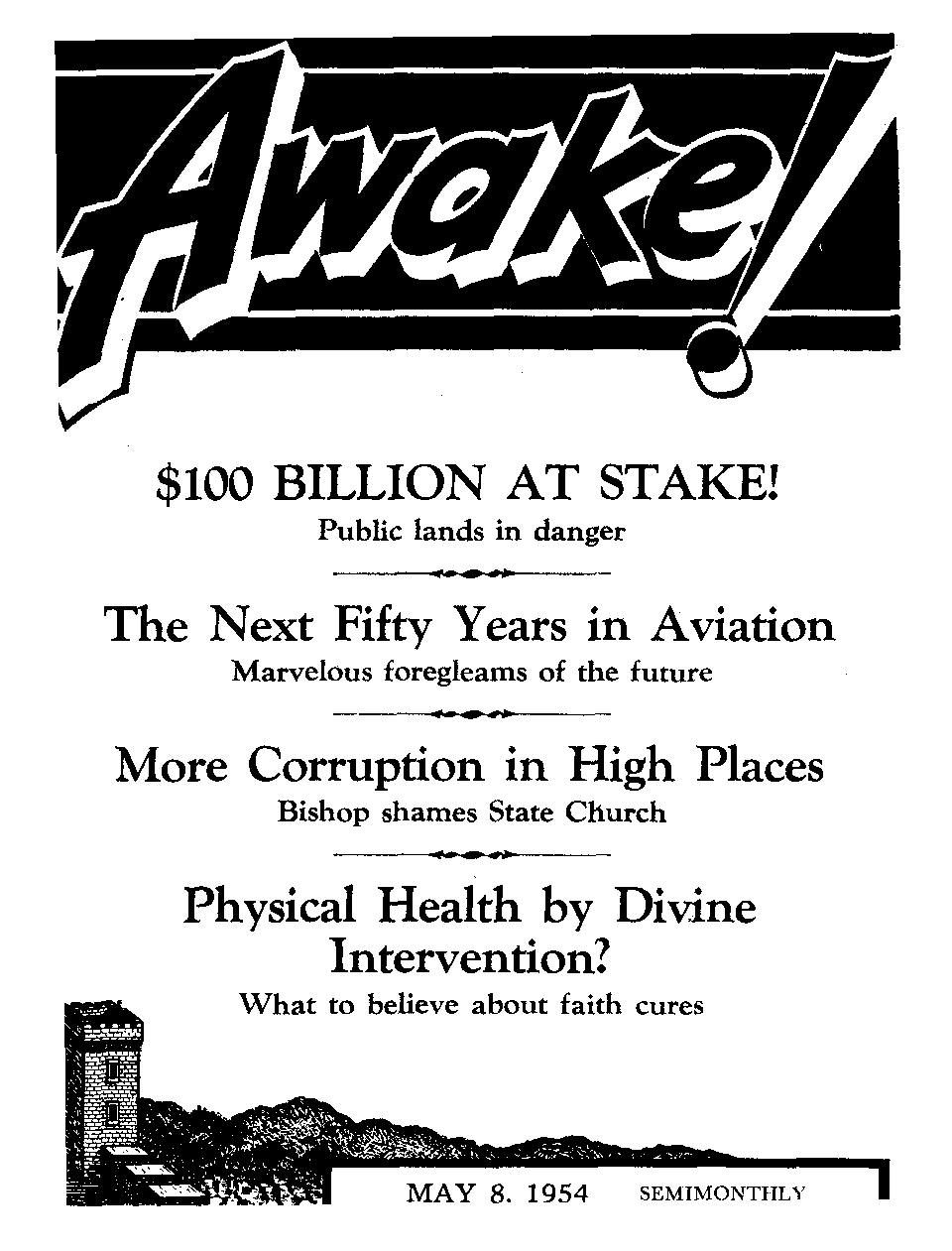
$100 BILLION AT STAKE!
Public lands in danger
The Next Fifty Years in Aviation
Marvelous foregleams of the future
More Corruption in High Places
Bishop shames State Church
Physical Health by Divine Intervention?
What to believe about faith cures
THE MISSION OF THIS JOURNAL
News Boqrces that are able to keep you awake to the Vital issues of our times must be unfettered by censorship and selfish interests. “ Awake 1” has no fetters. It recognizes facts, faces facts, is free to publish facts. It is not bound by political ambitions or obligations; it is unhampered by advertisers whose toes must not be trodden on; it is unprejudiced by traditional creeds. This journal keeps itself free that it may speak freely to you. But it does not abuse its freedom. It maintains integrity to truth.
“Awake 1” uses the regular news channels, but is not dependent on them. Its own correspondents are on all continents, in scores of nations. From the four corners of the earth their uncensored, oti'the--scenes reports come to you through these columns. This journal’s viewpoint is not narrow, but is international. It is read in many nations, in many languages, by persons of all ages. Through its pages many fields of knowledge pass in review—government, commerce, religion, history, geography, science, social conditions, natural wonders—why, its coverage is as broad as the earth and as high as the heavens.
“Awake !’* pledges itself to righteous principles, to exposing hidden foes and subtle dangers, to championing freedom for all, to comforting mourners and strengthening those disheartened by the failures of a delinquent world, reflecting sure hope for the establishment of a righteous New World.
Get acquainted with “Awake!” Keep awake by reading “Awake!”
I'uburhkd s&mihont'hlf Ur
WATCHTOffl’R BIBLE AND TRACT SOCIETY, l.N'c’
117 Aciaius Street J Brooklyn 1, N- Y., U, 8. A,
X. H. KrjuRR, Pfwrfcftf Grant Sviteb, Secretary
Printing this issue-. 1,250,000
Five cents a copy
lamagts Itt which Ihts wiagazHa is >ihllsk«d: F/nrt Frrm-h, (^man, BblUifniiMi, Nomgun, Spanish, swvrlish. Monthly ■ lia'ibh. Porl.itgursr. Ttrsinlan
OfTIppH: Vi'orly HiihscTiptinft Hain
America, U.S-, 1]? ist.. Rwklyn !, N.Y, $1 11 , SJjaNJdtf. 5,Atf, £k?
Canada, 40 Jruin Aw.. Tomtitu •’, Ontario $] England, :<4 Craven TmaCf. London. W. 2 7s SwlA Afrta, J’rh'jir Bng P.O. KI a misf onto in,
Tr^ns^aa-1 7“
Knlcrrtl a* second eiftys matter al BrntWpn, N'.
tfiwM he xwf to in jew court-
Kj- m wiwito to
yufe rlrlfrt'Ty of money. Keen 11 ton wa are arcupterf al Rrooltlyn fr’nm cijiiiitrtM UM™ no office is lottatH. Iiy jn>ni:tt.innal mptirj’ ortim- only. F-tihMTiption rfKr'? in iywaH"* nrf- lipff rtai*il in locni
rwriwy. JtoUto nJ turpirMiM iuiih awm) Wank i is aent- al least two iton.es before u,i.iL>‘crip|h>n w pirns. Change of address ftltrn io our tiffin may l>e expected effective within one mbnth. Send fora* tfld 4tx as jipw urtctross.
Y Ait of March 3, IRTfl. brimM tn U. S A
CONTENTS
The Most Practical Approach
Profits Make Miracles Suspect
A Hundred Billion Dollars al Stake!
Capitalizing on the
“Too Hot for a Sermon”
S
Mind-Body Relationship
The Next Fifty Tears in Avia lion
fl
Bebop Trips Translators
Caracas Cuts Collisions
“Your Word Is Truth”
More Corruption In High Places
Physical Health by Divine Intervention?
The Brain and Brain Power
16’
Jehovah's Witnesses Preach
The Modern Scientist: ‘Illiterate
in All the Earth—Costa Rica
and Irresponsible’
id
Do You Know?
2S
The Anima] with a Million Mouths
Watching the World
2.9
The Most Practical Approach
rpiIE United Nations organization has X been hailed by many as1'man’s greatest achievement in international co-operation.’ However, anyone who heard its program "United Nations—On the Record,” which presented a resume of speeches made in the United Nations during 1953, as broadcast over a network of radio stations on January 2, 1954, would find it difficult to become very optimistic about either its past record of international co-operation or the prospects for it in the present year.
Far from co-operation, it is conflict, friction and competition that seem to have been the themes stressed during the past year. Among the voices heard on this program was that of China’s representative, who said that “the question which the General Assembly should consider is not the admission of red China but the expulsion of the Soviet Union.” Russia’s Vishinsky sarcastically dwelt on the subject of peace by referring to America’s pact with Franco’s Fascist Spain, for the building of "bases which have an obvious objective.”
Britain’s Selwyn Lloyd lashed out against those in free nations who would brand every effort at negotiation with Russia as “appeasement.” Iraq’s spokesman complained of the terror and bloodshed in Morocco and Tunisia and asked whether the people in those lands are expected to "sit idly by while their liberties are being strangled.”
Pearson of Canada observed that it was a “sure knowledge that weakness in this world is a temptation and not a protection,” which was not saying much for the United Nations, The narrator then touched on other matters that were discussed by the United Nations during the past year, Chinese troops in Burma, Arab refugees in camps, racial conflicts in Africa, Trieste, etc., after which the newly elected president of the General Assembly, Mme. Pandit, was heard: “We must discover a means of directing our resources and researches of science into peaceful instead of destructive channels. We must learn to co-operate effectively in Safeguarding peace.” Mme. Pandit states that "we must,” but admits that they have failed in the past eight years to discover the way to peace. Eisenhower was heard speaking in a like vein: the “fearful atomic dilemma” must be solved.
Why, in spite of all the time, money and energy spent; why, in spite of all the professional, scientific and propaganda assistance extended to it; why, in spite of its elaborate departmental setups and widespread activity, did the United Nations’ record for 1953 present such a dismal picture?
Ihiplying an answer to this question are the words of the secretary-general of the United Nations, Dag Hammarskjold, also heard on this program: “Ultimately peace
can be achieved only as the result of positive development of the attitude of individual men and women toward life and their neighbors. Only in true surrender to the interests of all can we reach that strength and independence, that unity of purpose, that equity of judgment which are necessary if we are to measure up to our duty of the future, as men of a generation to whom the chance was given to build in time a world of peace.”
Mr. Hammarskjold comes close to the truth. Before peace between nations can be expected peace must be inculcated in the individuals of those nations; there must be peace between individuals; there must be unselfish interest in others.
But, pray, who are working at creating or producing in the individual person this positive attitude toward his neighbors? Who are advocating this surrender in the interest of the common good? Do we find this being done by the political leaders? No, for they are preaching nationalism and self-interest. Is it being done by the religious leaders? Not by them either, for they but mirror the prejudices and passions of their political allies while each one of them looks for gain from his own quarter.—Isaiah 55:11.
Then, is it expecting too much of men, this advocating of a positive attitude toward their neighbors and self-surrender in the interest of others? No, it is not, for such things are being practiced on an international scale by the members of the New World society of Jehovah’s witnesses. They are practicing ‘loving their neighbors as themselves’ and ‘doing to others as they would have others do to them,’ which is, in fact, what Mr. Hammarskjold is asking for.—Matthew 22:37-39; 7:12, New World Trans.
And how have they been able to accomplish this, the ‘only way to ultimate peace' ? By recognizing the supremacy of Jehovah God, as well as of God’s Word and law. By taking the Bible seriously in spite of all the talk by clergymen that it advocates a camel-train philosophy impractical in this diesel-engined civilization; by recognizing that the principles enunciated in the Bible are timeless and that the same wise God who created man also provided him with a guide that he cannot ignore with impunity.
Yes, the world shakes its head in disappointment and chagrin at the endless and futile debates held under the aegis of the United Nations, and trembles at what the future might bring. But it also shakes its head in amazement at what it sees Jehovah’s witnesses accomplishing behind Iron Curtain countries in spite of bans and bitter persecution, and what it sees them do at their international assemblies, such as the one held in July, 1953, at the Yankee Stadium, New York city, where representatives of ninety-six lands from the four corners of the earth and from many different races dwelt together in peace and unity for eight days.
Jehovah’s witnesses employ and apply the principles taught in the Bible. The United Nations ignores them, being too timid even to give lip service to the Ai-mighty God for fear it may offend some who deny his existence. Judging by the results, whose approach to peace is practical?
“We must regretfully conclude that the Security Council cannot at present be relied upon to cope with any aggression other than a minor one in which the interests of the great powers are not engaged.”—Sir Gladwyn J ebb, recent British representative at the United Nations, March 18, 1954.
who boasts of his generosity and care for his children when at the same time, to fulfill his own ambitious desires, he turns over their wealth, parks and playgrounds to unscrupulous men for private exploitation? Is it not, therefore, shocking to hear that the American taxpayer may have just such a father in the present administration? In its profuse professions of concern for the people, it voices in the same breath its approval of “giving” or transferring to states and private interests some of the people’s most cherished lands for private exploitation. At least, so say the leaders of the opposing party.
' During the heat of the 1952 presidential campaign, the Republican candidate remarked that he would favor transferring public lands to states and private owners. Giant oil, mining, lumber and cattle interests pricked up their ears. They rallied to the support of the Republican campaign. Now, in return for their services (votes), they are ready to collect all the nation has locked up in her federal empire.
Transferring the nation’s natural wealth to states or private owners is no simple problem. But it can be done and is being done. Already the long-disputed offshore oil properties have been transferred from the federal government to several states. Powerful private interests prefer the state or states to control the wealth, because they know that they can more easily dominate a state government than they can a ty, because of the precedent that it established, For example: Plans for the S458,-000,000 public dam in Hell’s Canyon on the Snake River have been withdrawn, paving the way for private owners to take over. Big lumber companies are clamoring for the 56,000 acres of the nation’s most magnificent virgin timber tied up in the Olympic National Park. Cattlemen have bills in
Congress to grant them access to grazing meadows in the national forests. There are pressures from private housing contractors where the boundaries in national parks are not settled; in another location pressure is exerted for the building of dams and reservoirs as a part of a hydroelectric scheme; in others oil and mining interests or the armed services are demanding the right of entry. Each is demanding a share of the profits.
The Coveted Prize: $100 Billion
But just how much does the federal government own that it could possibly sell or give away? “As of April, 1953,” according to Wallace Stegner, “the Federal government owns 458 million acres of the continent proper, and on this land it owns and operates scores of storage and flood-control dams, pumping stations, and power stations. Through a public corporation it owns also the whole vast development of the Tennessee and its tributaries. Through the Forest Service, National Park Service, Bureau of Land Management, and other
federal bureau. This oil transfer directly agencies it administers 139 million acres
of national forests, 147 million acres of grazing land, 12 million acres of defense installations, and 9 million acres of Indian reservations. It also owns ninety-five per cent of the total area of Alaska. The acreage in Federal lands in 1951 was twenty-four per cent of the area of the nation; West of the Rockies, about half the land was government-owned.” More than 2,000,000 cattle, 92,000 horses and almost 7,000,000 sheep forage on this land. During 1952 the sale of selected logs from the national forests brought the government $63,722,000; forage fees from the states of Colorado and southern Wyoming, another $1,078,578; and hunting and fishing license fees totaled $4,546,327. On federal property are firs that are higher than a twentystory building, a fortune in fish and wildlife and areas that may be rich in metals and oil. No one accurately knows the value of this land, but when Commissioner Straus had a detailed analysis made, the man who was retained for the job quit when his estimates got above $100 billion, saying that after appraisals got that high they became meaningless. If the federal government can be made to sell or give away some of this public domain, the pickings are going to be lush indeed!
Uncle Sam Is His Own Greatest Landlord
Perhaps by understanding how the federal government acquired this property and why it has placed certain restrictions over it, one will first appreciate why previous administrations were reluctant to expose it to private enterprise. Uncle Sam became his own landlord, not by choice, but quite unintentionally. In fact, at one time he tried to give away all his property but no one would have it.
When foreign governments through the Louisiana purchase, Texas annexation, Mexican cession, the Oregon treaty and the Gadsden purchase relinquished vast territories west of the MfaaiMippi to the United States, title to the vacant and unappropriated land went to the federal government. Uncle Sam became a landowner. The new states that were formed out of such territory received various grants upon admission to the Union, but in all other respects the title to the unappropriated property within their borders remained with the federal government.
Originally these lands in federal ownership embraced two-thirds of the continental area of the United States. The policy of the government was one of disposal. What the nation needed was population and the development of its resources. So the land was free to anyone for the taking. There was no thought of the federal government’s becoming a property owner or an administrator, nor even a custodian. The government merely acted as an agent through whom title to the property could be passed to private hands. Over its entire history, the federal government has disposed of more than a billion acres of the public domain. Its disposal of public lands was at an average rate of seven million acres a year over the past century, but this has not always been fast enough to suit those who think that it should release all its holdings.
At one time all of this property was within reach of private enterprise. Why it is not today, private owners have mainly no one to blame but themselves. In years past they have turned out to be miserable managers of earth’s soil and resources. Grasslands they overgrazed, timber they recklessly turned into planks and two-by-fours, farmlands were overworked. Erosion was allowed to set in. Treasured topsoil floated down rivers in muddy floods or went up in dust storms. When the land was exhausted of jts value private owners moved on, leaving behind waste and devastation.
It was mainly this plundering of natural resources that caused the federal and state governments to move in and conserve for the nation’s interest some of its remaining resources. Conservation laws were passed. Grazing and timber-cutting practices were restricted to support a sustained yield of forests and grasslands. In 1830 the medicinal springs of Hot Springs, Arkansas, were set aside as a national reservation to protect them from passing into private ownership and exploitation.
National parks had their beginning when on September 19, 1870, members of the Washburn-Doane expedition were discussing the wonders of the Yellowstone region. They knew that the area would someday become a mecca for tourists. Some suggested that it would be “profitable” to take up land surrounding the principal phenomena and exploit them as commercial enterprises, Cornelius Hedges, a member of the party, objected to this point of view and expressed his desire to see that the wonderland of Yellowstone never be allowed to pass into private ownership, but that it should be set aside for the use and enjoyment of all the people. The other members of the expedition quickly accepted this more unselfish and appreciative line of thinking and .all of them agreed to work to make it an accomplished fact. The idea was so popular that in less than two years the Act of Dedication creating the Yellowstone National Park received the signature of President Grant.
What those early pioneers desired was well expressed in the law that provided that the Yellowstone region be “a public park or pleasuring ground”; a provision making mandatory “the preservation, from injury or spoliation, of all timber, mineral deposits, natural curiosities, or wonders within said park, and their retention in their natural condition”; a provision for making mandatory the protection of the fish and game in the park area against “wanton destruction” or “capture or destruction for the purpose of merchandise or profit?’ Actually a provision was desired to protect areas from private enterprise.
From time to time other lands were set aside for national parks, each park containing some outstanding feature that the nation desired to preserve for the education and enjoyment of all people. Yosemite Valley, the Grand Canyon, Crater Lake, the Olympic forests, each possessing distinctive sites of national importance, became national parks or playgrounds. Today, some 40,000,000 persons flock to these scenic and historic preserves. In these parks there remains some semblance of the unspoiled natural vastness, of scenery and of wildlife that existed when America was discovered.
Fortunately the nation has had a few unselfish, farsighted men who protected these resources from private exploitation. The large part of the federal land purchases in the past twenty years has been of overgrazed, eroded or otherwise submarginal land that private interests exhausted. Now with almost nowhere to turn, private interests have set a covetous eye on the natural riches bound up in the nation’s parks, monuments and reservations.
Pressure Groups at Work
The Bureau of Land Management in the Interior Department and the Forest Service in the Department of Agriculture are under constant attack from stockmen, lumbermen and oil men—all urging transfer of forest or park lands to private owners or to the states. One observer warns that “conceivably, concerted attacks at this time could overturn the whole policy of federal management.” He cautions further that “the grazing lands, including those within the national forests, are in danger;
public power is in danger; and the 160-acre water limitation within reclamation project is in danger?* He goes on to say that “maybe these riches will ultimately be restored, but they will probably return gutted, eroded, and mined out, when they are of no further use to private owners. Then the nation can try to restore them/’
For private interests to demand the last remaining wilderness areas represented by the national parks and monuments betrays an utter disregard for the people’s welfare. These “playgrounds'* have been specifically set aside for the pleasure of the nation’s children, and were not to be exploited to satiate the desire of any enterprise. But Dr. Ira N. Gabrielson, president of the Wild Life Institute, warned that “chiselers of public lands” were at work to influence the new administration. These “chiselers” are determined to invade these carefully guarded areas as soon as “the public goes to sleep.” And from all indications they feel that that expected moment has arrived. What the present administration will do remains to be seen, but recent developments are not too promising. Douglas McKay, secretary of the Interior, in charge of the public domain, stated that “some changes might be expected in resources policy.” What these changes might be is anybody's guess. But one Western conservationist stated that these changes will most likely amount to “skim milk for the taxpayer, higher rates for the power User, and cream for the private utilities.”
As hopeless as the situation may appear to the common observer, the Bible assures us that plunderers, destroyers, greedy persons, wasters and despoilers will be brought to final account at the battle of Armageddon. The true Father of our earth, Jehovah God, gives us his word that he is going “to bring to ruin those ruining the earth,” (Revelation 11:18, New World Trans.} After Armageddon mankind's Everlasting Father, Christ Jesus, will restore the earth to its original Edenic beauty. Then plenty will exist for all, leaving no cause for senseless spoiling of the earth for commercial greed. Carelessness and neglect will be unknown.
Not just a handful of parks will be set aside for mankind to enjoy, but earth’s metals, minerals, timber and wealth will be properly managed and devoted to the promotion of contentment and the spreading of paradise to every comer of the earth, transforming the whole earth Into a beautiful global park for the eternal enjoyment and preservation of man. What a glorious hope the future holds!
GENTLE GIANT
A Catholic magazine entitled “Information’’ (August, 1953) carried the following item under the heading “Gentle Giant”: “Maybe it could only happen in Brooklyn, and maybe even there only on a hot and humid New York day. But when the priest entered the pulpit to announce that it was too hot for a sermon everyone breathed a huge sigh. It was then the good Father and a loyal Brooklyn Dodger fan asked the people to please pray for Gil Hodges, Brooklyn first baseman. Fortunately, for Hodges, he was neither lately deceased nor dying but even worse. He was in the midst of a terrible batting slump. The massive 200-pound Hodges was not hitting his weight. This, of course, is tragic for any ball player, but when the ball player is acknowledged one of the finest gentlemen in baseball, a real Catholic gentleman, then, certainly, a few extra prayers are right in order.” Are not such religionists like those James spoke of who ‘ask, and yet do not receive, because they are asking for a wrong purpose'?—James 4:3, New World Trans.
I THE NEXT FIFTY YEARS
in
eat hot meals and feel perfectly comfortable in sub-zero climates.
VIATION’S future is L about as unpredictable as women’s fashions, perhaps even more so.
Some fifty years ago a magazine writer concluded that “the limits of success have been reached with this type of flying machine [meaning, of course, the airplane].” Now we know how inaccurate his prediction was. Right along this same line, Captain Eddie Rickenbacker, president and general manager of Eastern Air Lines, said that during World War I they thought the old, rickety flying crates of 1918 were “as nearly perfect as planes could be.” Today these ‘nearly perfect planes’ are choice museum pieces. And too, as recently as World War II, the giant B-29 American bomber was hailed by engineers as being the peak in aviation. But before the war ended the B-29 was obsolescent. Its 30,000-foot ceiling was too low, its speed too slow. Even present-day commercial transports can outmaneuver fighter planes of the last war.
Modern jet aircraft streak through the sky at speeds faster than sound, pull out of power dives intact under pressures that could crumble steel, and climb to unbelievable heights of 60,000 feet in a few minutes’ time. Passengers of today traveling in air liners sup their soup on tables that are vibrationless while cruising at eight miles a minute, walk up and down stairs and lounge in luxury eight miles above the earth, listen to staticless music above raging storms, breathe normally in thin air, Almost ail of these accomplishments have been made possible by relatively recent discoveries in aviation. Even female fashions have not changed as radically, nor they been as revolutionary.
have
from from
The present trend in aviation is propeller-driven craft to jet flight, piloted planes to guided missiles. Experts say that if these complex and brainstaggering problems are solved, there is no telling what aviation’s future may be. Prognostications over the past half of the century have demonstrated how futile and frustrating is any serious attempt to predict the shape of things to come. However, the direction in which aviation is heading and the goals that might reasonably be attained are clearly indicated by past accomplishments. As a word of caution, often unforeseen circumstances intervene and alter or completely change the design of things. So no prediction is related with any positiveness. .
Jets to Dominate Future
Authorities, however, do feel certain that within the next five years jet liners will be crossing the Atlantic. These will streak from New York to London in six hours, to compare with the present twelve hours with several stops. Fred B. Lee, Civil Aeronautics Administrator, is convinced that in another ten years air travel will more than double. Some 400,000,000 people will be flying yearly. They will be taking two and three trips a year instead of one. Traveling will be cheaper. Flying will be accepted as implicitly as the automobile, the telephone and the electric light are today. The Pullman train will be a thing of the past. Speed will eliminate the need for sleeping berths on airships. Flights will be of shorter durations and at higher altitudes, thus decreasing exposure to accidents.
Ten years from today it will be common for Londoners to shop and spend their week ends in New York city and for New Yorkers to spend theirs in California or Alaska. In flight, passengers will entertain themselves with color television or the latest movie. Some will prefer to lounge ground in the plane’s capacious compartments or to mount a stairway to the flight deck for a tour of the radio room and quarters of the engineer and the navigator. Airplanes will be pressurized and airconditioned, eliminating almost entirely air sickness.
At the airport helicopters with room for at least forty passengers will act as taxis. Private helicopters will compete with the family car. Something new will be the “helicopter house trailer,” which will combine transportation and relaxation. The "flying house trailer” will take off from the backyard and gently settle down in some quiet mountain escape or at the seashore. You will have brought house and equipment with you.
The convertiplane, a combination of airplane and helicopter, will also be a common sight in another ten or fifteen years. These planes will rise straight up like helicopters and fly forward like conventional planes. Their principal use will be for short hops between cities. Distances from two to three thousand and more miles will be served by the stratocruisers. The 1970 stratoliner will resemble the British-made Delta, which is a triangular-shaped craft that gets its name from the fourth letter of the Greek alphabet. At that time presentday models will still be around, but jets will dominate the skies.
Within the next twenty years, electronic devices will do most of the flying. Experts say that pilots will merely go along for the ride and to make the few human decisions that the “black boxes” and the pushbuttons cannot make, as yet. Radar will become the pilot’s eyes at night or in bad weather, guiding and automatically taking precautions against collisions. “Flying blind” will be a thing of the past. A combination radar-and-television device will show the pilot exactly where he is every second of his journey. This device will guide the plane from city to city, find the airport, and lower the plane to the earth with the same ease as does an escalator with shoppers from the mezzanine to the main floor.
Instead of carrying massjve landing gear, which literally weighs tons, future airplanes will be without wheels. When coming in for a landing, radio will synchronize the speed of the landing plane with a landing car that will travel along on tracks. The plane will settle down into its cradle without a jar at about 100 to 150 miles an hour and will come to a jarless, gentle stop at an airport building. -The same cart will be used to launch the plane.
Greater Power, More Speed
The experts predict that twenty years from today power and speed will still be major factors in aviation. Within twenty years the turbo-jet engine will be exploited to its limits, developing power sufficient to thrust planes twice the speed of sound. After that the ram-jet power plant will take over. This engine requires atmospheric oxygen for combustion, but it does not have a compressor as does the turbojet. Therefore, the engine must be set in
motion at such a speed that the air rushing into the forward end causes a pressure increase of three to four times that of the outside air, then the expanding gases from the burner will be driven rearward and the plane will be thrust forward. After the ramjet era, pure rockets will be used for propulsion beyond the earth’s atmosphere into space. The rocket carries its own liquid oxygen.
The more conservative authorities believe it will be some time before sufficient power can be generated cheaply enough to justify supersonic air travel. According to C. W. La Pierre, general manager of General Electric Company's Aircraft Gas Turbine Division, the world's largest manufacturer of jet engines, it is doubtful if that era will arrive before 1970. To propel a 125-passenger transport through the sonic barrier would require at least twice the power available in the largest jet bomber known today. The fuel requirement would be staggering.
On November 21, 1953, Scott Crossfield flew a swept-wing rocket plane, developed by the Douglas Aircraft Company, twice the speed of sound—1,327 miles per hour! The plane’s power lasted only three minutes, and during those three minutes it consumed three tons of fuel! Hardly a month later, on December 16, 1953, Major Charles E. Yeager climbed into an experimental rocket plane and streaked through the sky at 1,600 miles an hour! What tomorrow’s record will be is anyone's guess.
Despite the many obstacles in the way of supersonic travel, Hall Hibbard, engineering vice-president of Lockheed Aircraft Corporation, remarked that he was “positive that in 25 years the transport airplane will be supersonic.” Just as convinced is Donald W. Douglas, president of the Douglas Aircraft Company. He wrote: “Supersonic speed, unlimited range, electronic operation and navigation of aircraft are clearly ahead. Advance in metallurgy and design, already here, or in the offing, will make possible conquest of the sound and heat barriers.”
Atom-Liner a Solution
Many authorities believe that the solution to the fuel problem lies in harnessing the atom for commercial use. Advancements along this line appear encouraging. But experts caution against overoptimism. To protect passengers from dangerous radiations it is estimated that at least 100 tons of shielding would be required. Despite this fact, some experts feel quite optimistic. Dr, Plesman, president of KLM Royal Dutch Airlines, stated that an atomliner could be designed and flying by 1975. It would weigh over 150 tons and carry over 180 passengers. It could stay in the air almost indefinitely, and its speed would exceed 900 miles an hour. Its cost would be $25,000,000, to compare with $2,000,000 for present-day transports. But its low operating cost would more than offset the initial investment. But there are many complex problems to be ironed out before the atom-liner becomes a reality.
Gazing at the crystal ball of aviation's future, Dr, Wernher Von Braun, chief of Guided Missile Development Division at Redstone Arsenal, sees even more astonishing developments. He said that “fifty years from now oceans and continents will be crossed with atomic-powered airliners at supersonic speeds. Propelled by ramjet engines, these planes will cruise at altitudes of 12 to 15 miles and speeds in excess of 2,000 miles per hour. . . . The ramjet liners will be needle-nosed and their fuselages and wings will be skinned with steel, monel or titanium alloys to withstand heating through air friction.”
What will these atom-powered planes look like? Well, they will look like an ordinary jet plane, because jet propulsion will still drive the plane forward. The nuclear reactor will simply take ever the work of the combustion system. “Heat from the reactor, located in the fuselage, would enter the combustion chambers of the engines, where it would function like ignited jet fuel. The engine would operate just as it does today, except that the terrific nuclear heat would produce far greater power,”
Will atom power then propel man into space, perhaps to the moon? Dr. Wemher Von Braun thinks that “by 2003, man will have set foot on the moon and plans will be under serious consideration for the exploration of the nearer planets.” Igor I. Sikorsky, engineering manager of Sikorsky Aircraft Division, writes that “the approach to interplanetary travel and at least flights out of and beyond the atmosphere into space, will very probably be started during the next fifty years.”
But as for perfect unanimity on aviation’s future, there is not any. One authority will emphatically say “yes” as to the development of atom power, supersonic flight and interplanetary travel; while just as emphatically another will say “no.” And, too, human predictions seldom take Into consideration Jehovah God and his purpose toward our earth. God’s purpose is to make this earth a paradise, and If that begins to take place within the next fifty years, man may lose all desire to fly in the stratosphere, to the moon or to other planets. Who knows, with an eternity before him he may find greater pleasure walking through the soft grass of a paradise earth than flying over it at supersonic speeds. Living at the close of this system of things, any kind of crystal-ball gazing is a rather hazardous business.
Nevertheless, the accomplishments in the field of aviation over the past fifty years well demonstrate the potentialities locked up in the human mind. Should not all these “marvels” teach us that New World living will be wonderful—even beyond all human expectations and imagination? It should. The next fifty years no doubt will be one of the greatest periods of all time. Happy will be the people who will live to see AD. 2004.
Caracas Cuts Collisions
t Caracas, Venezuela, is a city much smaller in size than Havana, Cuba. Yet Caracas has more automobiles than Havana. And the ears in Caracas go fairly last, too, even whizzing along narrow streets on precariously steep hills. But tn spite of the many autos, the rapid driving and narrow streets the accident
rate is comparatively low. How is this paradox explained? Because the city’s traffic laws are strict and are applied without a moment’s hesitation. These laws, respon
sible for cutting auto collisions, appeared in the August, 1953, Issue of the Americas magazine:
“First, the car on the right has the right of way at any intersection. As a result, you never go before a judge because of a collision at a crossing* The one on the left simply pays for all damage, and also pays a fine. There are no arguments and no time lost in court. Second, whoever hits another car from behind is always responsible. It makes no difference if the leading driver neglected to signal for a turn. Every car must keep at least ten yards behind the next. Finally, no one may drive after drinking alcoholic beverages. On Sundays, when the dangerous roads to the beaches are jammed with cars, the 'traffic prosecutors’ stop each vehicle and put a special glass device in front of the driver's mouth* If the indicator turns red, he has consumed alcohol and cannot go on driving* He must leave the car and come back another day, A terrible nuisance, but many lives are saved.”
CofWT/ty
HIGH PEACES
By llAwak«!” Correspondent in Sweden
SOME time ago an article appeared in Awake!
under the title “Corruption in High Places?* It told about certain unfortunate happenings in Swedish Court circles and also in the judicial sphere of government. Another case has now attracted unheard-of attention in Sweden, even wide publicity in other lands. Not just legal proceedings are now involved, but even the State Church!
So grimly electrifying was the disclosure of the case that the public press called it not only an unequaled affair in the history of Swedish law courts but also a terrible blow to the State Church’s reputation. Said the Gbteborgs Handelstidning, November 5, 1953: “It is a scandal and a shame without equal/’ Some declared that the time had come to bring everything out into the full daylight: “The truth must come to the fore in all circumstances, even if it is disgraceful. The moral and religious slackness, the lack of discretion, and the plotting attitude that have been shown in this affair demand that radical steps be taken, if general distrust is to be avoided.” —Stockholm Aftonbladet, June 12, 1953.
The feared distrust came after all. People began to speak of an open church crisis. Writing in the Stockholm Dagens Nyheter, December 17, 1953, one of the biggest dailies, Sven Lagerstedt, a welbknown headmaster, said that we must see “the falsity of the veneration for the Church and her servants that nas been created by the fear of man.” This, he said, “has confronted us with the question whether the priestly office is at all needed/’ He questioned whether the time had not come to do away with the priestly office as such, because the church is nowadays just a worldly institution and that “the disfiguring, corrupting varnish” of the church has nothing to do with true Christianity as found in the Bible.
Morbid Desire for a Bishopric
A short review of the history of the church organization in Sweden will show the background of the happenings. The Catholic Church entered Sweden in the tenth century. By the twelfth century she already had established seven dioceses. Until the thirteenth century the inhabitants were asked to express their desires, because the ancient Swear had stated in their local laws that the voice of the people was always to be considei’ed when rulers were elected. But this was later done away with. The Catholic bishops played an important role in politics until the Reformation in the sixteenth century. When Sweden joined the Protestant movement the bishop sees were retained, but from then on they had only “spiritual” authority. The law of the church, which was given in 1686 by the then-autocratic king, provides that the clergy of the diocese are to elect three candidates for the bishopric, the king (now the government) appointing the one who is deemed most suitable. Through extension of territory and dividing of dioceses the number increased. It is now set at thirteen, the foremost of. which is the archbishop see at Uppsala. This place has been the religious center of Sweden since time immemorial.
MAY 8, 1.95
The office of bishop has always been a keenly desired one. It carries with it many privileges not afforded secular office holders. As often before, there was a heavy fight for the office of bishop of Strangnfis. It seems that this time a greater number than usual were suffering from the jokingly called “morbus episcopalis,” illness caused by the desire to become a bishop. Among those suffering from this “illness* was Professor Dick Helander of the university at Uppsala. After a first failure to be nominated among the proposed three, Helander succeeded at a second election. About Christmas time in 1952 he was finally appointed by the government.
Now it was known that before the election a great number of anonymous letters had reached most of the clergy in the diocese advocating that Helander be nominated. In these letters Helander was praised; his competitors were belittled. Such things had happened before at elections; but this time the matter was reported to the police for investigation. Many church-shaking circumstances then came to light.
The bishop, meanwhile, applied for leave of absence and later for sick leave. He stayed abroad for a while. His leaves became prolonged, the last one because he was "suffering from psychic insufficiency with depressive symptoms.’’ While the bishop was in low spirits the police investigation dragged on. Efforts were put forth by the newly appointed bishop and other churchmen to get the church-embarrassing case buried in the tomb of silence.
A Bishop Exposed
But the facts of the shocking case refused to lie quiet. At the final hearing at Uppsala, on December 10, 1953, the public prosecutor galvanized the court by disclosing what the investigation had revealed: “Bishop Helander himself has penned, written out in full and circulated the libelous letters!’’ Since the bishop denied all this, the court ar first believed him. However, as the proceedings went forward, step by step, bit after bit of the shield around him was broken down. When the court finally delivered its sentence, on December 22, 1953, it summed up the facts that were held to prove the guilt of the accused bishop. Among them was the incriminating fact that his thumb print had been found on some of the letters. The bishop was sentenced to forfeiture of his office. He appealed this sentence to the court of appeals at Stockholm.
In his last speech the prosecutor be-seeched the court to consider that since this was a case against a servant of the church, it made it more serious than if it had been an ordinary person on trial: “A prerequisite, in order that the preaching of the servants of the Church may bear fruit, is without doubt that what they preach should also mark their actions and ways. As an applicant for the bishopric, Dick Helander has not hesitated to use clandestine weapons in order to fight for the see which he evidently longed for so intensively, although he himself had stated that he was placing the choice in the hands of God and of the voters. Far from the humility, which he has so often preached, he has filled the anonymous letters with panegyrics in honor of himself. But not that alone. To these panegyrics he has added such testimonies against his neighbor that can hardly be in harmony with a Christian disposition of mind. That the intention behind these testimonies was to cast suspicion upon a neighbor who was a fellow competitor for the bishopric is an additional charge against their author. Helander has placed another burden upon his shoulders by his attitude during the court case: tergiversations, efforts to lead up a wrong track, evasive answers and sheer untruths. It had been more becoming
if he had stood forth and shouldered his guilt.” The prosecutor felt it a heavy duty to prosecute in this case because the proceedings “exposed so much baseness, where one had expected to find loftiness.”
What Did His Colleagues Say?
The darkest chapter in this case, so far as the church herself is concerned, wrote a daily, was that the other bishops were silent. The archbishop, when asked for his opinion, contented himself with saying: “A formerly unknown dissension has been revealed in the clerical office, and happenings within the Church have been causing offense in wide circles.” Not until the sentence was rendered did some of the leading churchmen express themselves. Said the bishop of Gothenburg, Bo Giertz: “The Church is mourning, as a mother is mourning for her child. There remains only to accept the fact. We have occasion to examine ourselves because of the plotting mind and lack of brotherliness that has been shown. . . . Helander’s actions cannot be explained on the basis of normal experience. One has here either to reckon with a hardness of heart that must seem utterly improbable to Dick Helander’s old friends, or else one must ask oneself if there might not be some psychical defect.” But others were retorting that if he were a mentally sick man, how strange that the clergy had recommended him for the bishopric!
“Many Sins to Confess”
Describing the case, the bishop of Vaste-ras, John Cullberg, said: “What has happened must be taken as an isolated occurrence in the life of the Church.” Many, however, were pointing out that the case was not just an isolated occurrence. One priest, editor of the periodical Stiftskroni-kan (chronicle for the diocese), at Gothenburg, wrote: “The Church is to be blamed. There is not much to be gained by finding a scapegoat. The sad story has laid b^re such things within the theological faculty [at Uppsala] and the Church and her clergy, that we, one for all and all for one, must confess our partnership to the guilt. There are more elections for the bishop’s office than the one at Strangnas that have uncovered our lack of spirituality. And what is true with regard to elections for bishoprics is often true also with regard to ordinary elections of priests. Slander and scheming, disputes between different factions, half truths and sheer lies ... all this mixed into a ‘witch’s brew’ that is often being served in such connections. Here priests and church-goers have many sins to confess.”
If the priests and the church-goers would confess these their sins, as the Stiftskrbnikan suggested, it would, of course, be well and good, but many are thinking, first that such confession would come rather late, and further that the talk about it dpes not have an honest ring. The Stockholm Morgon-Tidningen, as reported in the Aftonbladet (December 23, 1953), drew a comparison between the main character of the gospels, Jesus, the poorest among the poor, and those men today, 1,900 years later, who claim that they are his followers, and who are now “fighting with bloodshot eyes for promotion to an office that gives them 35,000 kronor I $7,000] per annum.” The newspaper did not find any likeness.
Regarding the convicted bishop, one daily wrote that “his fall was great because so many had put confidence and hope in him.” How true this is when applied to the whole church system! The religious leaders have been regarded by many almost as gods and their systems of teaching as infallible, something that simply must not be criticized. But already the magic nimbus is being removed. This case has been for many an eye opener.
may s, 1954
The Brain and Brain Power
BRAIN power is said to be made up of at m least seven things: memory, speed of Jt perceiving, facility in handling numbers, flu- [ ency with words, reasoning with words, visual ! imagination and seeing general relationships. ( ' Does brain power ever stop growing? One M authority has said: "It grows most rapidly w during the first ten years of life, then steadily loses momentum. By the time many people ; are twenty, growth in brain power has stopped. People who keep studying, reading, thinking, however, continue to add to their » brain power until about fifty years of age surely, maybe longer.” But if there is no impairment of the brain, why should brain pow- ; er ever stop growing? The truth is that it. W appreciably stops growing when the activities that develop brain power are neglected. Since } most people cease serious study and thinking { at about the age of fifty, it appears that their W brain power has stopped growing—and so it Ij has to a large extent. Man was originally created to live forever; hence there is every j reason to believe that mental growth never }} completely comes to an end. i
<L Thus it is not really strange that a lead- I ing authority in the study of the aging process, Dr. Nathan W. Shock, in expressing his <« views on mental growth in a feature article in U.S. News <£ World Report (October 23, m 1953), declared: “I don’t think growth of the mind, in the sense that we are using it, ever j j stops. It shouldn’t. ... I think mental growth m must of necessity go on throughout a life- < time.” To the question, Is there any point at | which the mind would be expected to turn 1 down? this leading authority answered: “I would expect that the limiting factor again is jjj the adequacy of the blood vessels which sup- ffi ply the brain with oxygen and glucose—because as far as we know that is all it takes to run a brain.”
ft. Man still does not know very much with any degree of certainty about the functioning of the human brain. One thing that he certainly does understand is that ‘the little gray engine? is incredibly economical to operate. If it were possible for man to make a mechanical brain capable of functioning as the human brain does, he would have a herculean problem on his hands: how to cool and house the machinery! Explaining this, Science News Letter for September 5, 1953, said: “Most of the Mississippi River would probably be needed to get enough water to cool an electronic ‘brain’ as capable as a human brain. And it would take a Pentagon-sized building [the world’s largest office building to house the machine. The building would be crammed with wiring and tubes, and would use up as much electrical power as that consumed daily by this city, servo-mechanism engineers at Minneapolis-Honeywell estimate. Capable as electronic ‘brains’ are, the engineers stress, they do not come close to matching the human brain. The most elaborate models may some day equal an ant’s brain, however, they estimate.”
ft An ant’s brain—the best man can do! And they are not even sure they can make one as good as that! Already electronic "brains” are bulky. What a vast structure would be needed to house a man-made brain as good as that of the tiny ant’s! And if the facts could be reliably ascertained, a man-made “brain” capable of matching the human brain more likely would need a dozen Mississippi Rivers to cool it and a dozen Pentagon-sized btnMfngs to house it!
The Modern Scientist: ‘Illiterate and Irresponsible’
ft. When writer Ritchie Calder spoke before the British Association for the Advancement of Science, he accused modern scientists of being illiterate. Why? Since they do not express themselves intelligibly to ordinary people, they are hostages of their own professional language. Not only that, but scientists are irresponsible, he said, because they do not accept the responsibility of explaining how their work would affect the lives of ordinary people. Declared the writer: "They are content to leave their discoveries on the doorsteps of society like foundlings, without concern as to how they are used, misused, or not used at all." —Science Digest, December, 1953.
ONE of the oddest things alive is the animal with a million mouths. Indeed, it is so incredibly odd that few people really know that it is an animal. Most people believe it is some seaweedlike plant. This is not strange since science itself was puzzled for centuries over the queer animal that has no arms, no legs, no head, no brain, no sense organs, no heart and no blood—the sponge. Despite its believe-it-or-not structure this animal is not handicapped in winning its living. For the sponge has myriads of mouths, tiny pores into which it sucks water. The food and oxygen that the water contains are used and the exhausted water expelled. Most of the sponge’s pinholelike mouths are so tiny that they cannot be seen by the naked human eye, but they are there. Indeed, an animal with not one mouth but a million!
But just what is a sponge as a housewife knows it? It is simply the cleaned skeleton of the animal that once lived attached to the sea bottom. The skeleton of the bath sponge is formed of spongin, a substance resembling silk. How did man ever learn that some sponges have such a useful skeleton? Probably as a result of finding cast-up specimens with the skin and flesh partly rotted away from the more durable skeleton.
So it is not really strange that in ancient times sponges were a fairly common article. Ancient Greek soldiers used sponges to pad their helmets. At a very early date Greek fishermen learned to go down into the sea and pluck sponges from the reefs. So common were sponges for the Romans that they used them on wooden handles for mops. In Roman Jerusalem the sponge was very common; so we read that when Jesus was impaled at Calvary, "a certain one ran, soaked a sponge with sour wine, put it on a reed, and began giving him a drink.” (Mark 15:36, New World Trans.) But in spite of the fact that the sponge was used from early times it took centuries before man understood much about the singular animal with a million mouths.
Aristotle, who lived during the fourth century B.C., was the first to give a scientific account of the sponge. He taught that the sponge was half animal, half plant and that the sponge sucked in water through its large holes. But the Greek philosopher was wrong. For 2,000 years after Aristotle’s time naturalists and scientists were wrong, the sponge was still an enigma, a riddle that could not be unraveled. Not until the early years of the nineteenth century did man begin to learn the truth about the sponge. In 1825 Dr. Robert Grant, a Scotch naturalist, established its true animal character. It was Grant who first discovered that the sponge is really an animal with a million mouths. He proved that the sponge sucked in water, not through its relatively few big holes, as had been supposed, but rather through its tiny pores.
Stationary, Yet Globe-girdling
Belonging to a big family called “Porif-era,” sponges come in some 2,000 different species. Sponges are found in all seas and at all depths, from the shore margin to several miles deep, certain species even occurring in fresh waters all over the globe. When alive they are of all shapes, sizes and colors. Some sponges are snow white, some grass green, and some sky blue, some red and some yellow. The variety in the shape of sponges is amazing, there being shapes like cups, vases, spheres, tubes, branched treelike growths, baskets and fans. And for added variety some sponges are even shapeless, no two being exactly alike. In size these extraordinary animals may be as tiny as a pinhead or as tall as a man, and in weight they may vary from a grain to over a hundred pounds. ,
Are there papa and mamma sponges? Yes, in some species. The females produce eggs that develop into single cells. At the right time these eggs are washed out of the parent’s body in the flood of water ejected through the larger openings. These hatch into free-roving little animals. However, in most cases sponges reproduce by a vegetative growth, a budding-off of tiny sponges from the parent. Young sponges are energetic and have the wanderlust. They scurry about in the sea, their youthful activity widely distributing a fixed and stationary animal. Of course the adventurous life for Junior Sponge is short. He soon decides to settle down—to the bottom of the sea. Once attached to a rock Junior Sponge is content ever after to let the rest of the world flow by.
How Sponges Breathe and Eat
The taking in of oxygen and nourishment is now the sponge’s big concern in life. But how does the sponge generate the power to suck in water so as to get its food and oxygen? Well, the sponge's tiny pores or mouths on the outside lead into a network of tubes or canals large and small. These canals are lined with hairlike projections called “flagella.” Like little living lashes the flagella beat the water. Each stroke of each flagellum draws and pushes a little water ever inward into the sponge’s canals. Thus the whiplike flagella produce a current that is a veritable life-giving one to the sponge, bearing to its inner cavities not only oxygen but also vital organic and vegetable matter upon which a sponge feeds. At the junction of the little canals a delicate membrane catches and filters out the food. After dining upon the tiny tidbits the sponge must get rid of the used water. But how?
If one will observe a bath sponge he will note neat round holes on the upper surface that are just big enough to allow a man to put in his little finger. These holes are not part of the sponge’s million mouths. Rather, they are called “oscula” or “vents.” Through these vents the sponge expels the exhausted water. Usually the vents are very few in number, some species having only one. The cavity from which a vent opens is called the “cloaca” or main drain. So from the main drain out through the vents goes the exhausted water.
Now how does the sponge prevent used water from polluting the intake water? Certainly the hungry sponge can get no nourishment by sucking in the same water again! Also the exhausted water is not only devoid of oxygen but filled with poisonous waste matter and carbonic acid. So the sponge, even with its million mouths, if it had to suck in the same water again and again, would die of suffocation and starva-
tion. Fortunately for the sponge it had a Master Designer, who foresaw all the possible problems of a sponge’s life: the Creator provided the sponge with a marvelous hydraulic engine so efficient that it can separate used water from its new supply!
Comprising a sponge’s hydraulic system are its various canals and main drain. These form a pressure chamber from which jets of water escape through the vents. Pressure is kept up by the continuous work of the whiplike flagella, the force pumps of the sponge’s hydraulic system, sucking in water through the pores and delivering it in a continuous jet from the vent. Now for a sponge the longer the Jet of water expelled from a vent, the purer will be the intake water. Water in the sea is rarely absolutely still, even at the bottom on a windless day. Yet if the bath sponge expelled a jet of water for only six inches, foul water would settle down to pollute about three quarters of the intake water. So to assure itself of a constant supply of pure water the sponge ejects the exhausted water to a height of about four feet! As with a garden hose the distance a jet of water will go depends upon the nozzle or size of the opening. Here, then, is another marvel of the sponge: It has -been shown for certain sponges that the diameter of the vent is that which will carry the water to the greatest possible distance for that make of sponge.
The Sponge Has Visitors
Once a sponge settles down to a stationary life it may have visitors. Certain tiny shrimp, looking for a place to live, may take up residence within the sponge’s canals, making of them a veritable marine apartment house, rent free! And there are other marine animals that sponge off the sponges. Certain crabs, badly in need of housing, methodically cut out material from a sponge, using their chelae or claws as cutting tools. Like a man with his caravan or trailer is the dramid crab with his portable sponge house. But this portable residence, which the crab totes about for life, has a special purpose: the living sponge house so well camouflages the crab that, unless on the move, the crab can be spotted only by the closest observer!
Another visitor to the sponges’ seabottom realm is man. He is particularly interested in about six species, sponges that are marketable. From the Mediterranean and the Red Sea come the finest quality sponges, the most durable and the softest. The United States gets about 90 per cent of its sponges from waters around Florida, which contain a variety of sponges, the better grades being sheep’s wool and yellow sponges. When sponges are brought up from the deep by divers they are by no means ready for use. Covered with a rubbery skin and pores filled with a slimy sticky substance, the life matter, the sponge must go through quite a complex process, being pressed, squeezed, cleaned, washed, dried, and sometimes bleached.
…