Awake!, December 22, 1952
Download: PDF — Awake!, December 22, 1952
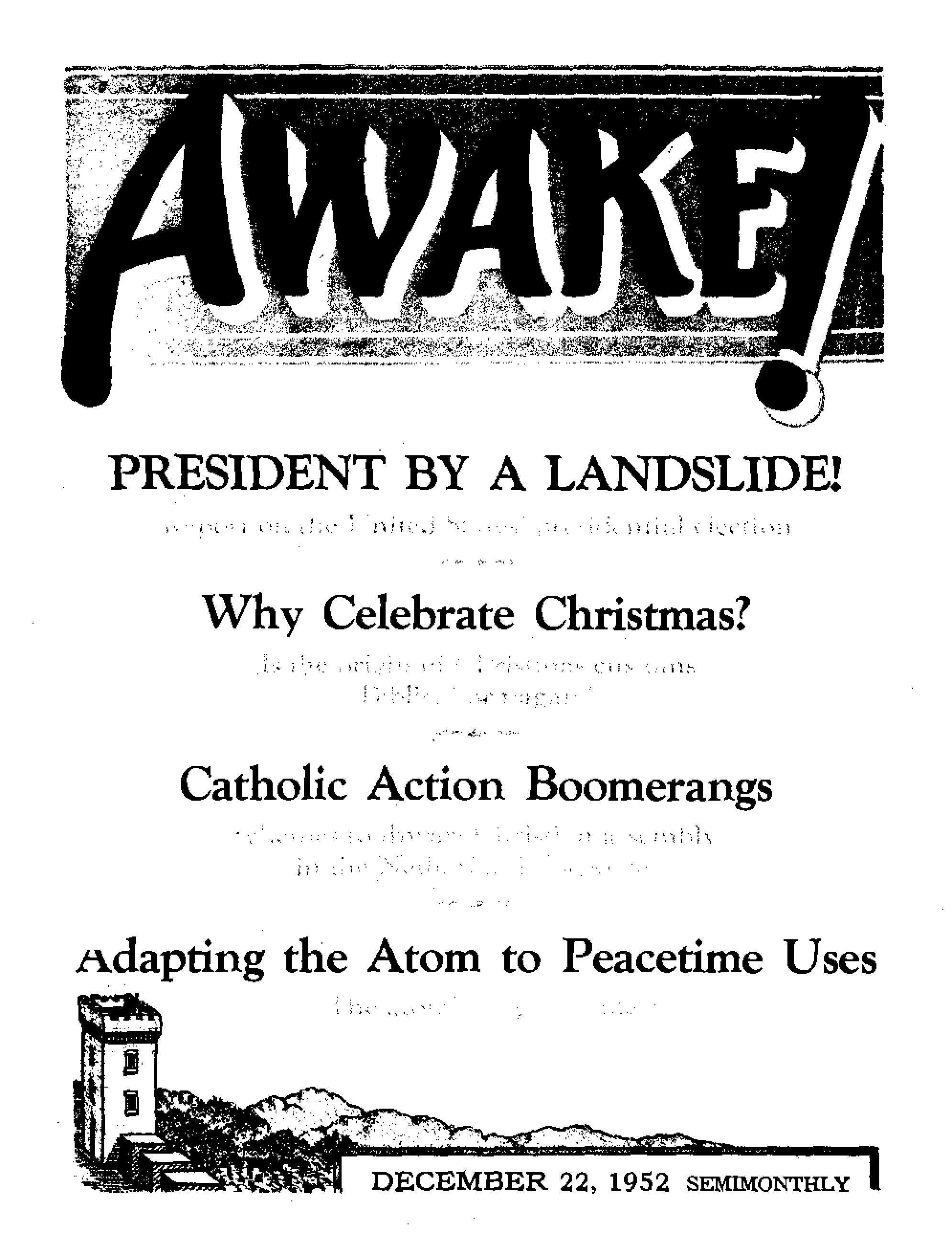
PRESIDENT BY A LANDSLIDE!
Why Celebrate Christmas?
j. > i ' 7 C : , : ‘ J , ' ""i 1 ■ r. C H > ' ■ L
Catholic Action Boomerangs
I f
/adapting the Atom to Peacetime Uses
THE MISSION OF THIS JOURNAL
News sources that are able to keep you awake to the vital Issues of our times must be unfettered by censorship and selfish interests. “Awake!" has no fetters. It recognizes facts, faces facts, is free to publish fact. It is not bound by political ambitions or obligations; it Is unhampered by advertisers whose toes must not be trodden on; it is unprejudiced by traditional creeds. This journal keeps itself free that it may speak freely to you. Hut it does not abuse its freedom- It maintains integrity to truth.
“Awake 1” uses the regular news channels, but is not dependent on them. Its own correspondents are on all continents, in scores of nations. From the four corners of the earth their uncensored, on-the-scenes reports come to you through these columns. This journal's viewpoint is not narrow, but is International. It is read in many nations, in many languages, by persons of all ages. Through its pages many fields of knowledge pass in review—government, commerce, religion, history, geography, science, social conditions, natural wonders—why, its cover* age is aa broad as the earth and as high as the heavens.
“Awake I” pledges itself to righteous principles, to exposing hidden foes and subtle dangers, to championing freedom for all, to comforting mourners and strengthening those disheartened by the failures of a delinquent world, reflecting sure hope for the establishment of a right* eous New World.
Get acquainted with “Awake* Keep awake by reading “Awake?*
Published Semimonthly Jjr watchtower bible and tract society, INC.
Brooklyn 1, N. Y., U. 8. A.
117 Adams Street
N. H. Knobb, President
Printing this (suit: 076.000
lihgiagit lit which the 1i P«bl lihid:
SemlmoilUilj—Afrikaans, English,. Finnish, French, German, Hollandlnh, Narweuau, Spaulrti, Swedish. Monthly—Danish, Grenk, Portuguese, Ukrsinlari.
flfflces Yearly autsicrtotion Bate
Ativlca, U.S-, 117" Adawe Sit, BreoWyn 1, 5.F. $1 AiMimJf, Il BerssfoM Bel, SiTaiJhflrfdi, N-S.W, CitniAa. 40 Irwin Are., ToronUj 5, IhiUrla *1 Ewtland, 34 Craven Terrace, London, W. 2 7a Smth Afrit*. Private Bas, P.O. Elandsfunteln,
Transvaal 7s
Qilaht Suites, Secretary Fiva cents a copy temlttineM should be sent to office in Jour country in compliance with reguliticms to guarantee safe rfellTen,- ot itiQncy. HemittAiiceB are accepted al Brooklyn from court tries where no office is located, by international money order only. Subscription rates In different Ciiuntriex are here stated In local currency. Nutlet af ex»lratlen (with renewal bisnki Is seat at least two issues before subscription es-plret. Cha tip «f addrn) when s*nt to pur office maf be deflected effective within one tutus th. Seisrt your old as well ax new address.
Ehleretf it jecruKt-eJaffl tsiftw *1 BrrokJytv N. Y Act <rf Wirch 3, 1871). Printed In U. S, A.
CONTENTS
Comments on U. S. World Policy
What Water Can Do
President by a Landslide!
Why Celebrate Christmas?
Catholic Action Boomerangs
Past Attitudes
Do You Take This Politician?
Pagan Origins
Adapting the Atom to Peacetime Uses
Medieval Myths
Isotopes for Industry
‘'Your Word Is Truth"'
Isotopes for Agricultural Uses
The “Seventy Weeks’’
Isotopes for Medical Use
From Cane to Sugar
Religion in the Turkish Village
Watching the World
Judge and Marriage
Index to Volume XXXIII of Awake!
Volume Xxxfil
Brooklyn, N. Y., December 22, ‘1952
Number 2*
Comments on U. S. World Policy
ACCORDING to John Foster Dulles, expert on foreign affairs and former republican adviser to Secretary of State Dean Acheson, the U. S. “is today less liked, more isolated and more endangered than ever before in its history”. This, he explained in Philadelphia, April 14, is because since World War II "we have not given out of compassion or because of love of our fellow men”. “Our vast public loans and grants to other nations have been made,” he said, “not because we wanted to make them, but because we have been told that we had to make them in order to achieve certain political objectives?’ Continuing: “The gifts have not carried a message of sympathy and good will but rather expressions of annoyance, grumbling and carping criticism. The result is that we have not gotten what we bargained for?’
Even when U. S. support was successful many justly cried “shame”. Dr. Herbert Kitchen of Buffalo’s First Unitarian Church explained on April 22, 1951, that freedom-loving peoples throughout the world have turned against the United States because of such things as “our support of Franco’s Spain and our putting of power in Greece back into the hands, not of the valiant fighters for liberty for the people, but of the corrupt and effete tenth of one per cent of the ruling class that has exploited and impoverished the populace”. Then, he said, “We are surprised and bewildered when other peoples struggling against similar inhuman conditions fail to take us at our own evaluation as emancipators of the slaves, champions of freedom and liberators of the oppressed?’
He described the Chinese as “a people pushed beyond the limits of endurance by hunger, poverty and exploitation, who rebelled against the war lords centered around Chiang Kai-shek”, and said, “Millions of our wealth was poured out to bplster a tottering regime, repudiated by the people, while graft and corruption, according to our own investigations, absorbed it?’
He swung a telling blow with the statement: “We owe it to ourselves and to our fellow men to remember one towering fact: that the chief reason why the false and dangerous doctrine of communism is spreading in the world is because poverty, degradation and social injustice is the lot of two-thirds of the people on our planet, and communism steals the initiative and offers them food and a roof over their heads, while our answer more and more is just words about the benefits of democracy, but accompanied by armaments instead of a chance to live with dignity and decency which those people crave?* Loathing and opposition to communism, he pointed out, defeat their “own ends if
hose ends are sought by welcoming as >ur allies the ones who practiced the same :rimes against humanity, but who do it n the name of the status quo”.
A similar situation existed in Russia, iccording to “Rev.” Leopold Braun, the jnly American Roman Catholic priest in hat land from 1934 to 1945. Speaking at i Knights of Columbus breakfast in New ifork he said on January 27: “Organized jootlicking and appeasement hid from the (American people the truth about what ivas happening to the millions of dollars’ north of aid that we gave to Russia.” He barged: “The American people were ■ooled into believing that our wartime aid to Russia was aiding the Russian people, when instead it was implementing the harsh and brutal regime of Stalin and the Politburo.”
If an oppressive government webe weak, obviously it would use its power first to put down internal opposition, and U. S. dollars strengthen not just “good” governments, but any who will oppose the current enemy, no matter what the policies of the government aided. This was shown when the U. S. aided communism while it fought nazism, and now helps other totalitarian lands stay in power if they will oppose communism. When Tito broke with the current enemy it mattered not whether his people actually wanted him. Life magazine said: “Right now he is on our side, against Stalin. U. S. taxpayers are therefore helping him: well over $200 million worth of economic and military aid in two years, and probably more to come.” Life called him “ally, not friend”, and explained ; “The world coalition against Kremlin imperialism cannot aspire to political uniformity. As leader of this coalition, the U. S. must learn to live with strange bedfellows without falling in love with them. Of these, Tito is not much stranger than Franco or Ibn Saud.”
Yet Arthur Bliss Lane, former American minister to Yugoslavia and ambassador to Poland, pointed out in the Saturday Evening Post, January 5: “We may hide behind the cryptic diplomatic phrase that our support of Tito is a ‘calculated risk.’ By juggling with this catchword, which at best is an admission that we are evading moral principles, we are trying to convince ourselves that we are bolstering up Tito in his fight against the Kremlin. What we are actually doing, however, is to bolster up Tito in his fight to enslave the Yugoslav people. We are building up him and his coconspirators into a regime which, enriched by our financial support and military equipment, will be in a position to destroy any possible attempt which may be made in the future by the people of Yugoslavia to regain the democracy which they have lost. . . . We have no right to continue to impose on them the cruel bonds of a communist machine.”
In wartime innocent civilians trapped on the battlefield are often butchered in the cross fire without a chance. Similarly today millions are caught in the trap of cruel governments kept in power by U. S, aid. It may seem to be a military necessity, but it certainly does not convince oppressed people that democracy is their savior!
Draw me not away with the wicked, and with the workers of iniquity; that speak peace with their neighbors, but mischief is in their hearts. Give them according to their work, and according to the wickedness of their doings: give them after the operation of their hands; render to them their desert. Because they regard not the works of Jehovah, nor the operation of his hands, he will break them down and not build them up.—Psalm 28:3-5, Am. Stan. Ver.
WITHOUT democracy there frequently is tyranny, for rulers with absolute power are rarely just rulers. One of the shortcomings of democracy (as all human governments have shortcomings), how* ever, is that the people, who themselves must rule, can rarely be specialists. They would trust their health only to specialists. They would not tinker with a fine timepiece unless they were trained in that field. But these same people must decide which foreign policy is superior, whether an isolationist or an internationalist policy is better for the nation and the world, and which candidate has the solution to major national and world problems. They must, in short, decide on questions that confound the experts,^so that they can appoint the man with the most nearly correct solution.
For this reason the statesmen, the men of highest thought whose skill is in managing the affairs of state, must become politicians—men who can convince voters, appeal to emotions and accomplish their own ends to stay in office. The United States recently witnessed an outstanding example of politicians in action. Rivaling in interest value any baseball world series, it began when Senator Kefauver threw his coonskin cap into the ring and ended only
when Governor Stevenson conceded victory in the early morning of November 5. It flooded the eyes and theears, and surged right into millions of homes time and time again through the modern miracle of television. The candidates, for president and vicepresident, plus their helpers, President Truman and Senator Taft, gave fifteen hundred speeches and traveled 187,000 miles, running up a campaign cost "conservatively’* predicted in advance at $85,000,000!
Stevenson's Methods
The campaign speeches were a high point. Adlai Stevenson relied on their content; Dwight Eisenhower, on their mood. The first tried to persuade his hearers; the second, move them. Both methods can be effective. A specialist is impressed by the mind; the majority of voters by the heart. Stevenson said: “Maybe I’ll be defeated, but this kind of campaign will eventually be accepted. And the reason is that people really want a change—a change not in parties but in the whole approach to public office and politics/' “One of the first objectives of a candidate . . . should be to get his views across, show the voters where he stands and where he’s going/’
Amazingly enough for a politician, Governor Stevenson apparently did just that. He disagreed to some extent with his predecessors. He disagreed with Texas’ view on offshore oil* He disagreed with the American Legion’s pressure tactics, and he disagreed with the South on civil rights* When he disagreed, he said so. Finally, he disavowed democratic Senator McCarran. In his final pre-election speech he said: “Talking sense is not easy. It means saying things that sometimes people don’t like
to hear; it means risking votes, and candidates are not supposed to do that. ... I remember the night in Dallas when I spoke to Texans of my views about tidelands oil. I remember the crowd in Detroit on Labor Day when I said I could be the captive of no one but the American people. I remember the evening in the railroad station at New Haven when I identified a powerful democratic leader as not my kind of democrat. I remember the American Legion convention when I said that those who have served this country must always be Americans first and veterans second, and that our free enterprise system must include free enterprise for the mind. I remember audiences down South listening to what I had to say on the subject of civil rights/'
His major point was that he had talked straight, even on controversial issues, while his opponent, Stevenson charged, "has adjusted his position, state by state, section by section* to the demands of the local political machines.”
In criticism of General Eisenhower, Governor Stevenson quoted Lincoln's words: “Nor do I believe that we can ever advance our principles by supporting men who oppose our principles.” But the democratic candidate accepted Truman's support, and, according to this theory, he implied Truman’s principles were his own.
It has been suggested that Stevenson was reaching for the intellectual vote through thoughtful speeches spiced with irony, through his marvelous capacity for understatement, and that Truman was reaching for the rabble-rousing element; the two men playing both ends against the middle. Whatever the plan, it did not work.
Eisenhower's Methods
The successful campaign waged by General Eisenhower revolved around his personal integrity. It was to convince the vot-ere that, though his party had no recent record to point to, their candidate was a man of sufficient integrity, morals and experience; a man who wants peace, recognizes evil, desires unity; a man with’faith in God and in the future, and that such a candidate would make a good president.
It was admitted that he was uninformed in many fields of government, so, rather than extensively discuss the issues of national policy, he generally exploited the issues that had high emotional content —the dread of war, the fear of Communist subversion, revulsion against corruption.
The New York Times magazine said, October 19: “Turn him loose on simple, down-to-earth dogmas such as honesty in government and the casualties in Korea and the setting seems as natural to him as the drill field or the big chateau at Rocquen-cort. On the other hand, his pronouncements on farm programs, natural resources, foreign policy, etc., are delivered like unfamiliar quotations from a textbook and get only a meager and dutiful response.”
Said the Times, November 2: "Eisenhower's campaign was largely a personal one—an appeal to the people to give him the presidency and he would give them an administration that was fair, just, honest and friendly. He offered few specifications of the policies that he would follow if elected.”
Both sides stood on the "record”. The democrats said, "You never had it so good”; the republicans pointed to the corruption in the democratic regime. A Republican National Committee pronouncement published in the New York Daily News (October 29) said: "Since Harry Truman became president there have been 22 major scandals involving the White House, 78 major scandals in the Department of Agriculture, 48 major scandals in the Bureau of Internal Revenue. ... If you add other agencies the total is well
over 200... . The whole moral fiber of our government has been infected with Pen-dergastism. And the Truman administration has tried to keep the lid on. President Eisenhower will give honest government.”
How? The general promised on October 4 to “bring into Washington’s executive departments and to appointive offices men and women who are incorruptible” and who would “in turn choose their subordinates that are incorruptible, and you won’t get this: A corruption in government, duplication, extravagance, waste and working one against the other,’ because they will work for one thing, the government and the people of the United States of America, and not for their own self-aggrandizement”.
Where he would find such politicians was not so clear. The magic test to actually locate them was not explained. But he will now have the chance, and it is certainly hoped that he will succeed. Yet, the Dallas Times-Herald, which supported him, reminded: “We are gratified by this election, but, in fairness to him, those who voted for him need not expect him to be a miracle man.”
Korea, Negro Vote, Communism
The Korean war was another major point of the campaign. The democratic candidate said the administration's policy was basically sound; the republican said it was a “negative” one of containment. He struck a telling political blow when he proposed a trip to Korea, if elected, and said he would “forego the diversions of politics and . . . concentrate on the job of ending the Korean war”. Truman retorted : “Now he’s been my military adviser ever since I appointed him Chief of Staff. If he knows a remedy it’s his duty to come and tell me what it is and save lives right now.” Apparently many voters wanted to try Eisenhower’s suggestion that the “miserable stalemate there must be freshly reviewed by fresh minds", but they probably also agreed with Governor Stevenson that the “root of the Korean problem does not lie in Korea—it lies in Moscow”.
The struggle for the Negro vote also played its part. New York’s republican Governor Dewey charged democratic vice-presidential candidate Sparkman with running on a strictly “white supremacy” ballot in his home state. Then the democrats asked in the New York Daily News, October 29, if the republican candidate thought a “last-minute visit to Harlem and a halfhearted declaration about 'working toward the elimination of segregation’ ” would wipe out his acceptance of such segregationists as Jimmy Byrnes. Three days later the Republican National committee retorted in the same paper that Democrat Sparkman had voted “against every civil rights proposal that has been considered in his sixteen years in Congress”, and listed twenty-three instances of this. In Harlem (New York’s, famous Negro section) President Truman said, “All you’ll have to do is look at... the Congressional Record” to see “who are the opponents of civil rights”. Of course, he did not expect his audience to dig out old copies of the Congressional Record to see that democrats had voted against them, too.
Both sides tried to connect the other with communism. When someone discovered Senator Nixon’s private fund (despite his television plea, he was the only candidate who would not make his income tax returns public), he said: “The Communists, the left-wingers, have been fighting me with every smear that they have been able to do.” Then, on the other side of the fence, when republicans said good times were based on spending for war, Stevenson said this paralleled “other voices . . . saying the same things to us.,. the voices of the most evil and malignant force loose in the world today—the force Of communism”. Neither party actually said the other was Red, but both implied that their critics parroted the Communist line.
“You, Sir, Are the Worst...”
Vilification, slogans, well-turned phrases and political mud were the stock in trade of politicians on both sides. A good slogan, a pertinent expression, can drive a point home, but they can also be accepted too readily by those who are untrained in the art of politics, who are unable to recognize the slogan’s flaw. Anyone who voted on slogans alone would have been confused.
Note this sampling: Eisenhower spoke of his “great crusade”. Truman called it “the great disenchantment". Eisenhower criticized Stevenson’s humor, said conditions are not a laughing matter. Stevenson replied: “My opponent has been worrying about my funnybone. I’m worrying about his backbone.” The republican “truth team” labeled Truman a “political cuckoo”, “laying eggs ih another’s nest” and claiming credit for things Eisenhower had done. Truman called the republicans “moral pigmies”. The “truth team” accused him of the “big lie technique”. Vice-presidential candidate Sparkman got into the act, calling them the “pathetic dinosaur of Old Guard republicanism”. Stevenson said Eisenhower’s was a “campaign by platitude”, and republicans said, “Adlai means Trumanism—with a Harvard accent.”
Misrepresentation continued. The president went to one extreme when he said the general was “willing to accept the very practices that identify the so-called ‘master race’ although he took a leading part in liberating Europe from their domination”, and the republicans went to the other when they said he was accusing the general of anti-Catholic and anti-Jewish sentiments. Rather, he was commenting on the men Eisenhower had accepted into his .ranks.
Also, Stevenson’s “high level” sagged when, in Massachusetts on September 19, he said concerning Eisenhower’s use of Oliver Cromwell to illustrate his “great crusade”: “It obviously could not be because Cromwell sent his Roundheads on a bloody crusade against the people of Ireland with religious persecution, starvation and the sword as his weapons.” Mention of Cromwell among the Irish in parts of Massachusetts can often start a fight, and whether “Ike’s” use of Cromwell was wise or not, Stevenson’s dignified speeches failed to hide an unsavory motive behind injecting this religious persecution issue.
Neither party came through the campaign with clean skirts. If the world felt alarm at such goings-on, at the smear tactics and condemnation of policies and personalities, it should remember that the United States goes through this once every four years. When it happens, both parties claim more than they have actually done, and each usually accuses his opponent of being worse than he really is. Newsweek’s president said, November 5, “From the very first this was a most confusing campaign.”
By the time it was over the voters were getting groggy, but there was no doubt about the final vote. Whether it was the disgust at corruption, the fear of communism, Eisenhower’s promise to go to Korea, objection to Stevenson’s telling what he thought, or merely the fact that “I like Ike” was more than a campaign slogan, the nation went to the polls and endorsed its national hero. Twenty years of democratic rule had ended. General Eisenhower won a thirty-nine-state landslide to become, on January 20, the thirty-fourth president of the United States.
BOOMERANGS
By "Awake” correspondent in the Netherlands
S IT wrong to preach the good news of Christ in sections where Catholics are in the majority? Catholic action says it is wrong. If the good news of Christ disturbs the Catholic clergy, then what should one do? Catholic action says one should not preach. If a preacher calls on a good Catholic with the gospel of Christ, is that an intrusion into the private life of that party? According to Catholic action, it is. Is it permissible at any time to call into Question the actions of the Catholic Church? Catholic action answers it is not permissible, not even when authorities are of Catholic source. Does Catholic action justify shameful mob action against Christians? Yes, it does. The Catholic press and the clergy-inspired mobs of Venlo support these conclusions.—See December 8 Awake! for an account of what happened at Venlo,
The Roman Catholic paper Te Elfder Ure did not agree with the methods of mob violence, boycott, pressure, etc,, that the Catholics in Venlo (the Netherlands) used; nevertheless the paper thought it proper “to try to prevent the public appearance of Jehovah’s witnesses along decent, democratic ways'’. Is there anything decent in preventing Christians from assembling and worshiping God? Is there anything democratic about forbidding Christians to assemble in public or in any other place? Is not this very suggestion antidemocratic and anti-Christian?
Jehovah’s witnesses do have a different view from that of the Catholic Church, Dtf22, 1952
but does that mean they cannot assemble in Catholic districts simply because they are in the minority? Is not Catholic tolerance for minorities, or is it just for majorities? The Friese Koerier of June 7 had an interesting comment: “If it is indeed true that a Roman Catholic is forbidden by his conscience to attend a meeting of Jehovah’s witnesses, what danger was -there to fear anyhow? Whoever is sure of his case certainly will not let his conviction sink away because dissenters testify te the contrary among themselves. And why that fear of the -public nature of the assembly in which no Catholic was going to have a part anyway?”
The clergy would have no fear of a meeting of a public nature, if they were sure of their position, if they were sure of their flocks, if they were sure of their principles of faith. Nor would the clergy fear if their flocks were properly fed, had they been told the truth, had they not been fleeced so terribly by the clergy and duped into poverty anti servitude. If the clergy are honest they will admit that the only reason they oppose assemblies of Jehovah’s witnesses is that they recognize the starved condition of their congregation and they fear lest the hungry be attracted to the pure truths of the Bible offered freely at such assemblies.
Catholic clergy objected when Jehovah’s witnesses assembled at Venlo, and many voiced their objection, as did one mobster that demonstrated te front of the assembly tent. He cried out: “What are they doing in Venlo?” Someone with more judgment
answered: “What are our missionaries doing in Abyssinia?” Meaning, What are Catholic missionaries doing in nonCatholic lands? If Catholic cities be only for Catholics, and Catholic lands for Catholics, why not Protestant cities for Protestants and Protestant lands for Protestant, heathens for heathens, and so on? Why do not Catholic papers condemn their own practice of sending missionaries into lands solidly Protestant or heathen?
To condemn Jehovah's witnesses in the way they preach, the Catholic Church is condemning the apostle Peter’s ministry, because Peter preached to others than those of his own faith. The Catholic Church would have to condemn the methods used by the apostle Paul when he went into districts where no Christians were. Was the apostle wrong in going to Ephesus, where the inhabitants were worshipers of Artemis? Was the shameful action of the Ephesians in causing unlawful mob hysteria justified bn the grounds that Paul preached Christianity in a city of Artemis worshipers? Was this mob action justifiable just because Paul preached something different as admitted by the mobsters, “This Paul has won over a considerable crowd and turned them to another opinion”?—Acts 19:26, New World Trans.
Catholic Action might answer Yes, but the city recorder of Ephesus had more sense when he said: “For we are really in danger of being charged with sedition over today’s affair, no single cause existing which will permit us to render a reason for this disorderly mob,” (Acts 19:40, New World Trans.) Nor do defenders of the Venlo disgrace have a single reason for justifying that shameful mob action.
Not All Doors Closed
The Limburgs Weekblad resorted to labeling Jehovah's witnesses as “nihilists”.
Said the paper: “Nihilistic as Jehovah’s witnesses are they could have expected to find all doors in Venlo closed.” This propaganda trick was to first label Jehovah's witnesses a pesky, nihilistic sect and then venture upon these grounds to deny them the right to evangelize, with force if necessary. But not all doors in Venlo were closed to Jehovah’s witnesses; in fact, there were a good many prominent doors wide open with the welcome mat out in front. For example: The owner of “Nation -aal”, the manager of the swimming pool, the owners of the bus transit systems, all knew that they were doing business with Jehovah's witnesses. None of them objected. Their breathes of contract and oral agreements did not begin until clergy pressure and danger to their commercial business were threatened by Catholic-inspired action.
When the Catholic press pointed an accusing finger at Jehovah's witnesses, calling them nihilists, they merely disrobed themselves, exposing themselves as such. According to Webster’s unabridged dictionary, nihilism is, “A doctrine which denies, or is taken as denying, any objective or real ground of truth,” or, “The doctrine which denies any objective ground of moral principles,” or, “The doctrine that conditions in the social organization are so bad as to make destruction desirable for its own sake, independent of any constructive program or possibility.” This in no way applies to Jehovah's witnesses, because they accept the Bible as basis of truth, the foundation for their teaching and conduct; that is what they preach. “It is written” or “Thus saith Jehovah” is what they say. Roman Catholic circles ignore this as the sole basis of truth and view the authority-undermining action of the Venloners as their salvation. This
smacks of nihilism. Jehovah’s witnesses advocate a constructive program, namely Christ’s kingdom.
Furthermore, if all the doors were closed to Jehovah’s witnesses, why should the Catholic clergy and press express fear and deplore the activity of Jehovah’s witnesses from door to door? Perhaps they realized that the doors were not as slammed shut as they would have liked them to be. Truly, if the clergy believed what they were telling the people they would not have had to make themselves ridiculously conspicuous by trying to arouse public emotion and endeavoring to drive the witnesses out of Venlo. It is regrettable that an organization that calls itself * the “mother church” should be represented by such persons and have to stoop to such barbarous practices.
The Boomerang
A student after observing what had taken place was moved to write: “As nondenominational I must say the following from the heart: Does the Catholic clergy permit itself to be so quickly influenced by another religion? Does it stand so weakly in its faith?” The answer no doubt can be found in Jesus’ words. Did he not say that those who both heard and obeyed his words built their house on a rock foundation and would not> suffer loss from any storm, but those who heard but did not heed actually built their faith homes on sand and would be easily disturbed? In fact, he concluded his sermon on the mount saying that such a house built on sand would collapse. And Jesus goes on to say this: “And this is the judgment: Because the light is come into the world and men loved darkness rather than the light. For their works tvere evil. For every one that doth evil hateth the light and cometh not to the light, that his works may not be reproved. But he that doth truth cometh to the light, that his works may be made manifest: because they are done in God.” —Matthew 7:24-27; John 3:19-21, Douay.
Another very enlightening boomerang comes from the paper De Vlam^ which says: “Rome borrows—just as any other Christian church—the missionary commission from the New Testament. This commission applies to every Christian. The minister, who visits nonmembers in.their homes, evangelizes. The Salvation Army evangelizes . . . This evangelization is a duty. Also so by Jehovah’s witnesses. Every evangelist concerns himself with the religious conviction of his fellowman. The conversion is a personal matter . . . The Roman Catholic Church recognizes her missionary task by the arranging of conferences for non-Catholics in districts not predominantly Catholic.
“This intrusiveness’ applies especially, however, as concerns peoples who are not at all Christian. What right does the Catholic Church have—according to standards set by De Tijd—to intrude upon the religious ways of the Mohammedan, the Buddhist? If such meddling is not permissible, why then does Rome lament the expulsion of Roman Catholic missionaries out of China? .. . Continuously it appears that Roman Catholic circles hold a double moral of freedom. They demand rights for themselves, which they—if need be with violence if one claims to possess the power to that end—withhold from others. Therefore, the disturbance in Venlo is so extremely important and revealing. Therefore, it ought to be a warning for every non-Catholic. What today is done to Jehovah’s witnesses . . . can overcome another 'minority’, which attempts to penetrate into the South. That is the core of the matter and the rest is cheap talk.”
No more need be said.
Responsibility After Voting ;
Especially in election years we hear regu- ■■ larly that it is one’s duty to vote. The impli- > cation is that in this way the people select J their rulers. They do not. All they can do is i put their stamp of approval on one of several previously chosen men, and if all candidates > are c^shonest a billion ballots would not improve the government. Witness the out' standing example of recent choices for sheriff in Muskogee, Oklahoma. If you did not like < the present sheriff you had these choices: < Jess Crossland, arrested 50 times for bootlegging ‘ between 1945 and 1948, but who avowed, “I haven’t sold a pint in four years.” Ex-sheriff Eddie Briggs, ousted from office ‘ in 1949, when he was convicted of conspiring to sell wholesale liquor without a federal tax stamp. Fred ’'Slim” Payne, former county liquor kingpin, who was convicted with Briggs in 1949.
Wisconsin Share’s McCarthy's Sins
-- "The result of this election is an appalling thing,” said Leonard F. Schmitt, the man who lost. “The effect upon me personally is utterly unimportant. I did not enter this campaign because I sought or needed a job. What is important is that a man with the most corrupt record ever made by a Wisconsin senator is overwhelmingly endorsed by Wisconsin voters.” Was his viewpoint prejudiced? Then listen to Life magazine, September 8: "McCarthyism is a loijn of exaggerated campaign oratory; it is also abuse of the freedom of speech we enjoy in this country , . . reckless accusation . . . slander.” : Why? Because McCarthy is lavish in his charges, casting them in- every direction, but is woefully short on proof with which to reel them in.
- His apologists say he is uncovering communism. No one could object to charges he wouk^ prove, but his reckless flood of unproved charges weakens confldenee in the U, S. world-wide. Unproved character assassination drives just men from government, opening the way for the base and corrupt, providing the very weakening influence that communism likes to see. For example, he never did get around to telling the public who those 205, more or less (the figure fluctuated like a March thermometer), ’‘card-carrying Communists” or Communist sympathizers in the government were, A men with just one eye open could see that if McCarthy had such a list and was fighting communism he would turn it in so these Communists could be ousted before doing democracy more damage.
McCarthy is not the only man in Washington who dislikes communism. A major reason why the president would not accept McCarthy’s charges and the Tydings Committee would not approve them is that his idea of a "Red” is perverted to the point that anyone who disagrees with him is ‘parroting the Communist Daily Worker’s line’, and to where he thinks Time magazine fs red, along with the New York Post, Washington Post, St. Louis Post-Dispatch and the Portland Oregonian, If such a ‘guilt by dislike* theory prevailed, none would be safe!
x Now, according to the Bible's principle, Wisconsin's republican voters have accepted responsibility for this type of rule, by supporting him in the September 10 primary. Paul told young Timothy not to make hasty appointments so he would not become responsible for the sins of bad appointees, (1 Timothy 5:22) Whether McCarthy's policies are good or bad, Wisconsin’s republicans have accepted responsibility for them.
Individual Responsibility
Much is said these days about political honesty, but all too frequently the people are responsible for the politicians’ attitude, as Oscar L. Chapman, secretary of the interior, pointed out in New York, May 24: "The sins of governments are nothing but the sins of individual human beings on a larger scale. If in our hearts there is intolerance, fear, suspicion, greed and a desire to get something for ourselves regardless of the effect on our neighbors, we cannot expect that the things that our government does will be any different.”- ‘Just voting' Is not enough as long as the people themselves do not divorce greed and graft. Politicians are no better than the people who support them.
Adapting the Atom
to Peacetime Uses
T)0 many believe that atomic energy is synonymous with total destruction. They know only of the atom as a fantastic weapon of war. What these people do not kpow is that this invisible atom which threatens the destruction of civilization might well be the beginning of a grand era, if used rightly. With the smashing of the atom an almost infinite source of energy was tapped for mankind's use.
It is theorized that there is enough atomic energy locked up in a piece of coal to take the Queen Mary across the Atlantic and back again! If the nuclear energy bound up in an ordinary railroad ticket were released there would be sufficient power to operate a heavy locomotive several times around the earth! In a pound of water there is enough atomic energy to heat to boiling temperature over a million tons of water’. A breath of air is claimed to have enough nuclear energy to keep an airplane off the ground for almost a year; and a handful of snow contains sufficient atoms to heat an apartment house for more than a year. That is, if the mass of these atoms could be converted completely into energy. So far, only uranium and plutonium can be so utilized, and only about one-tenth of one per cent of the theoretical energy in these can be released.—Truths Men Live By and The Advance Science Magazine, 1934.
Till now this energy has been directed almost 100 per cent to destructive purposes of war. However, there are indirect benefits of atomic energy which are already beginning to revolutionize medical practice, industry, and agriculture. These come through the radioactivity produced in atomic furnaces. War and preparation for war do not interfere with such efforts to convert the atom to peacetime usest since only an infinitesimal fraction of the atomic energy production is required to save and improve lives, in contrast with the billions needed to destroy them.
The constructive products of atomic energy are of two kinds, both created by the controlled nuclear fission within an atomic pile. One is power in the form of intense sustained heat which may some day be harnessed to supply whole cities with cheap electricity. A by-product is a great variety of new radioactive materials called radioisotopes, which are simply the radioactive forms of ordinary elements like carbon, iron or cobalt, which are easily detected with Geiger counters.
By tagging chemical substances with radioisotopes, they can be traced as they move through the body of an animal or the pipe line of an oil refinery* The variety of processes traceable with radioisotopes is almost unlimited. The labeled atoms can be traced through any perplexing combination of reactions and systems. For example: The radioactive atom can be traced from fertilizer to plant, plant to animal, animal to man, etc. The radioactive isotopes can be followed from carbon dioxide
to glucose, to fat. Dilutions or chemical changes of tracer isotope make no dlf-ferefice; it still can be traced through a complicated chemical reaction in the metabolism of the body, through an entire biological cycle or through any other physical or chemical process, and still maintain its identity. So sensitive is this form of analysis that it is often possible to detect as few as 100,000 atoms—about a billion billionth (1O1S) of a gram.—Federal Science Progress, May 1947.
The atoms are tagged or labeled for as long as the radioactivity lasts. The term “half life’* specifies the time required for the radioactivity of an isotope to fall to one-half its initial value. The half life of ri Iff erent materials varies widely: for uranfum-238 it is 4.67 billion years; for radium it is 1,690 years; for polonium-210 it is 136 days, while for another isotope of polonium (214) the half life is only about a millionth of a second.—Constructive Uses of Atomic Energy.
This method of tagging and tracing chemical substances with radioisotopes is now considered the most important development in science since the invention of the microscope, and it has already found practical application in industry, agriculture and medicine.
Isotopes for Industry
Radioactive measuring devices have been developed which automatically correct industrial densities in the manufacture of paper, linoleum, paint and foam rubber. The sensitive instrument is made to measure the paper’s gloss, or the porosity as in foam rubber. With the aid of the “beta ray thickness measuring device” it is possible to measure materials only millionths of an inch thick. This device will prove valuable in maintaining quality-production control. The thickness of material can be determined by bouncing electrons off a coated surface or by passing a beam through the material to be measured. A radiographic device may be used for detecting flaws in metal castings, through the same sort of signals from the isotopes, which do not come in actual contact with the product.
The Shell Development Company laboratories in Emeryville, California, are using exploding atoms to measure the effectiveness of new lubricants for tomorrow’s machinery and automobiles. Standard Oil of California tests the lubricating qualities of oils in engines equipped with radioactive piston rings. Infinitesimal particles of metal wear off the rings, drop into the oil and, since they are “hot” (radioactive), the wear can be accurately measured and tested. Radioactive rubber is used in B. F. Goodrich test tires. The radiation counter measures the exact amount and distribution of rubber left on the pavement during skids, sharp turns and quick stops. Testing company laboratories are using isotopes to determine how different products stand up under wear. Radioactive floor waxes and paints are subjected to vigorous tests, then checked with a Geiger counter to see how much radioactivity, and thus how much wax or paint, rubbed away.
Engineers are also using isotopes as tracers to study more theoretical problems, such as what happens to the components of oil when broken down in “cracking” plants. Steel plants are using the same techniques to learn how different metals combine in the production of alloys. Other fundamental problems confronting the research metallurgist that can be solved by radioactive tracers are related to “oxidation, diffusion vapor pressures, and the kinetics of reaction in solid alloys, such as age hardening, quenching, annealing, and homogeneity of powder mixtures”__Iso
topes for Industry, by P. C. Aebersold.
Isotopes for Agricultural Uses
Agricultural research workers have found isotopes a remarkable tool for studying the problems of plant diseases, such as tobacco mosaic virus, the uptake of phosphate compounds and fertilizers from soils, and the most fundamental and puzzling process of all—photosynthesis.
Photosynthesis, the mysterious process whereby plants make use of the sun’s energy to convert carbon dioxide into sugar, is being studied at the University of California with the help of radioactive isotopes. Fertilizer containing radioactive phosphorus is being used to test growing plants. The amount of radioactivity found in the plants thus fertilized indicates just how easily each kind of fertilizer gives up its phosphorus, how it reacts to various soil types and how it can best be applied. In, addition, isotopes are being used to trace the metabolic processes of cows and the migrations of mosquitoes, which have made large areas of rich grazing land useless to ranchers.
Radioactive forms of certain metallic elements like molybdenum-, zinc and iron are being fed to plants to find out precisely what minute quantity of these elements is required for normal growth. Atomic radiation is being used in an attempt to reduce the insect population by sterilizing the bugs. All this knowledge is expected to lead to better crops and more abundant food for the world, and provides an outstanding example of how atomic energy is already being harnessed for the beneficial uses of mankind, toward ends that may eliminate in time some of the major causes of poverty and strife among nations.
Isotopes for Medical Use
A group of Northwestern University doctors headed by the noted brain surgeon, Loyal Davis, announced a new atomic way of detecting and locating brain tumors with the atomic counting machine, the isotron. Heretofore it took weeks of painful tests to determine whether the disease was present, and even then the results were not always dependable. Now the malignancy can be detected painlessly within two hours. Eye disease called keratitis, in which a film growing over the eyeball causes blindness, is treated with radioactive strontium. Radioactive iodine in the treatment of certain kinds of thyroid cancer has proved successful. Radiophosphorus has proved effective in treating skin cancers and certain blood diseases. In the near future radioisotopes are expected to be used in the sterilization of drugs and foods.
Atomic Heat and Electricity
Last November in Harwell, England, atomic-heated water flowed through pipes providing heat for some eighty rooms in an office building at an estimated saving of $7,420 a year. The atomic furnace would need stoking only once in about thirty years.
Useful electric power from atomic energy was produced for the first time in history in December 1951. Heat energy was removed from a breeder reactor by a liquid metal of a type not revealed, and this energy produced enough steam pressure to drive a turbine. The turbine, in turn, generated more than a hundred kilowatts of power, which supplied a lighting system and operated pumps and other equipment. Experts are predicting atomic-heated homes for the real estate market before 1962,
Work on a nuclear-powered submarine is well under way and completion of the project is predicted as early as midsummer of 1953. Atomic-driven aircraft is seen by scientists and aeronautical engineers as being capable of long, sustained flight, capable of high speeds as well as almost unlimited range. The plane is conceived to be able to circle the globe so swiftly that it would always be under cover of night
If it is possible to manufacture atomic-powered submarines, aircraft and warships, then it is just as practical to create nuclear-powered commercial airplanes, ships and locomotives, and to harness the almost limitless power of atomic energy for other peacetime uses. As for atomic-driven automobiles, they are at present difficult to envision because of the lead shielding required to protect the passengers from re on. The weight of this shielding has been placed at fifty tons. That is far too much weight for hauling around a 150-pound man.
However, there is no question of the practicability of atomic power plants. At present the costs and the hazards of operation are obstacles to commercial use which are not completely surmounted. None can as yet say with certainty when atomic energy will take the place of coal as a source of electric power, but it can be said that the atom’s future is bright. The atom is here to stay.
f-'S':"1 ■'
Religion in the Turkish Villag
= By1 ‘Awa k«! ’' co rres pond ant in 1 u rkey
; The purpose of this article 1$ not to ridicule any ’ person because of his religious convictions. Our ■ desire is to disclose some of the religious prac-. tices in the Turkish village and to observe how * these practices affect the lives of millions of village dwellers in this land. Observations made are 1 without prejudice toward anyone* regardless o[ his religion, and for the most part are those or native writers who are acquainted with the customs and traditions of the people.
THE setting of this article is in the land of Turkey, where the majority of the people are Moslems. Our attention is drawn to life as it is in Turkey, not as it exists in the big cities such as Istanbul or .Ankara, but in the smaller villages. Some might contend that in the larger cities the people are corrupted or modernized, as they say. So our attention is drawn to the village where the people, not yet modernized, do practice their religion as they have been taught from of old by their religious leaders. Here it can be better seen and understood how Moslem practices affect the lives of millions in this land of Turkey.
In the village is located a mosque. Every
Friday the Moslem priest (hoca) comes to the mosque where he begins to preach. “Yea, Moslem community, God the Almighty says in the Quran. ...” Then, from the first word to the last one, the subject of his sermon is hell-fire, purgatory, burning, torture and torment. After the sermon Moslems leave the mosque trembling. One writer expresses the scene: “They all tremble in every limb when they leave the mosque. Everybody thinks only about the time when he will be burning in the hell.”
But what is the purpose of such lugubrious ceremonies? In answer we have only to remember that before the mosque there is always a carpet, which, after such ceremony, no Moslem passes by without placing upon the rug “the money right of the hoca”. A rather curious thing is the fact that the more the clergyman terrifies the community with this “purgatory” of his, the greater benefit he reaps from it. A Turkish Istanbul newspaper reported that during Ramadan (Mohammedan fast) the places in the mosque were being sold, and even a 'black market* was introduced. (Cumhuriyet, June 4, 1952) By being steeped in such dreadful fatalism, these village Moslems are hindered from exercising their power of reason. The hell-scare ceremonies are used to support the Clergymen.
In addition to the doctrine of hell being used by the clergy, there are two other teachings which seem to serve as a basis for Moslem doctrine and clergy support. They are namaz (prayer) and abdest (ablution). A Moslem writer asks: “But namaz and abdest, one may wonder, is that the only basis of the Moslem doctrine?” There are Moslems who say, and some of them really seem to believe it themselves, that when the time for prayer and ablution approaches a man who is at the point of death has to get up for that purpose; all operation has to be postponed; “yes, even when a woman is in childbed, the head of the baby is already there, the other part is not seen yet, but it is time for namaz. The woman has to’get up and perform her ablutions and namaz in that particular position. If she does not, the baby and the mother will no more have their daily bread.” The same writer reports the following: “A neighbor who was listening that day to this sermon began to thrash with a stick his wife who was at the point of death. ‘What is the matter with you, neighbor, are you going crazy?’ 'No, I am not crazy, on the contrary, today I have become clever/ he said.
‘Today at the mosque I became angry, You were there too. What did the priest say?
Instead of lying like this she would better perform her narhaz/ "
Judge and Marriage
In the village the priest is in reality the judge. Everybody submits to his judgment. Opponents are brought before the priest and are made to kiss his hand. Afterward the priest says: “The gavur [non-Moslems, unbelievers] have no conscientiousness. Moslems are the only conscientious human creatures God has created.” That means that the “court” is now in session. The operation does not last long, hardly more than five minutes. After the judgment has been given 'the priest usually will say again: “The only conscientious human creatures God has created are the Moslems.” Then in a very serious tone he jvill add: “The greatest blessings of God will go upon those who perform their ablutions and then drink a little of this . , . dirty water.” The opponents then leave, but first they both must give the priest a present, which is usually two pounds of sugar and sometimes cigarettes.
From his role as a “judge” in the village he might be called upon to perform a marriage as priest. Although the Koran, which he regards as holy, forbids the use of alcohol, it recognizes the right of a man to have more than one wife. This has presented many problems, because existing laws forbid bigamy. Women have become articles of merchandise which can be bought and sold as if on public market.
Many marriage engagements take place in the early years of one’s life, sometimes at birth. But babies thus engaged must be born on the
same day, same week or at least the same month. When the engagement takes place presents are made to the ‘betrothed’, and the father of the fiance pays half of the price for the wife that day. When daughters are born fathers are said to leap for joy, shouting: “Oh, I see a thousand liras!” Generally, girls are engaged when they are ten or twelve years of age. Their fiance may also be of the same age. The only thing that reaUy seems to matter is the price. The engagement is called “yarim nikah” (half marriage) and is celebrated by the priest, who also bears witness that the half of the price has been paid.
However, such an engagement is not absolutely necessary. There are two kinds of marriages: (1) Official marriage and (2) marriage without any other formality than the bookkeeping operation between the two fathers, this latter method being the more popular one. Regarding the latter method, you may buy as many women as you desire, or, better perhaps, as your purse permits. The price in the village runs between 500 and 1,000 liras per wife. In many cases the father-in-law, having received an advance, sells his daughter to another client. In other cases the daughter, carefully educated by her father, gets married and goes to her husband. Then, after a couple of days, she returns to her father and the latter finds another husband. Often a father, after being paid for his daughter, will arrange to have her ‘kidnaped’ from her first husband and delivered to another. As a matter of fact, in many cases a father will arrange in advance two marriages at once for his daughter. These combinations are frequently accompanied by armed frays between neighboring villages.
To a certain extent, marriage has become a sport with the people. It is reported that in one little village a woman 25 years of age “has already changed six husbands, another one at the age of 35, eight husbands”. In the same little village it is reported that “there are 20 men having two wives, and other men in the neighbor village having three to four wives”. The children born in these harems are either not registered at all or “one of the wives takes out a marriage license and all the children of the harem-keeper are registered on this very same license”.
As to the official marriage, it can be done with a previous engagement The wedding will then take place in two or three years, just the time for the fiance to gather the other fifty per cent of the price he has to pay to his father-in-law. When this is done the fiance’s parents visit the girl’s father and say: “Death exists, torment exists, now that we are alive let us marry these children, thus fulfilling God’s command.” In Turkey, coffee is generally served when one pays a visit. But on that particular night no coffee is served, because that would mean that the proposition is already accepted. Acceptance, of course, is impossible without bargaining.
A wedding might continue for a week or even longer if there are several weddings at the same time. During this week, the men and women have a good time, but separately. Men enjoy themselves mainly by hunting and wrestling. On the wedding day the Moslem priest leaves the mosque and goes to the cemetery. There he opens the Koran and prays, waiting for the betrothed. They arrive, accompanied by the whole village. Special prayers are then said and the bride is brought to her husband’s home, where she has to wait for him. The latter comes home at night and enters the room where his wife is waiting for him.
The people are taught that if nobody listens to the conversation between the newly married couple on their wedding night the baby will come into the world deaf. When
the lady peeking through the keyhole is convinced that the new husband is not impotent, not a prisoner of the evil spirits, as they say, she beckons with the hand to a man standing at the door, who shoots a gun* The whole village, waiting for the sound of the shot, say,
(“Thank God!”) In his book, Kbyiimden {From My Village) t pages 13-15, the Moslem village teacher, Mahmut Makal, relates that a young husband, Memich, caught a cold during all those interminable ceremonies, especially at the cemetery, and as soon as he entered the room where his wife was waiting for him, he—well, he fell asleep. So the man at the door could not 'shoot the gun* The entire village became alarmed. All the men of the village arrived, entered the room, and, in spite of all his resistance, they took Memich to the priest whose duty it is to dislodge all the evil spirits* “The priest maybe understood the situation, but if he understood it or not he seemed to have done his duty?’
Birth of a Child
When a wife is about to give birth to a child no medical assistance is sought. In fact, the village is without such. Moslem women would never resort to such “remedies”, as they call it* At most a midwife would assist. But that is rather rare too. The usual manner is to have the child with the help of two or three neighbors or even alone! “If the delivery tarries and the woman has great pain, the husband washes his hands immediately and the woman has to drink the dirty water*” When the child is born the neighbors will put the child on the father’s shoulder and ask him: “Are you heavier than your burden is?” If the father wants his child to be happy, he must answer: “My burden is heavier than I am.” If it is a boy they pull the father’s right ear. Then the priest is invited. He shuts his eyes, opens the
Koran and puts his finger on one of the pages. That is the way to find a name for the baby* Then the father has to perform his ablution and whispers three times the ezan (calling to prayer) as well as the name of the child. The mother has to remain in bed for forty days. She does not suckle the babe until she hears “three ezans”.
In many villages they believe in the so-called AZ-Karisi (the vermilion woman). That is supposed to be a female evil spirit. They claim they know what she looks like. This is the way they describe her: “Her face is entirely black, her lips thick, her hair is long and disorderly, her teeth are like pickaxes. * . * She has one lip on the ground, the other in the sky,” This woman is a terrible enemy of the mothers and their babies. It is supposed that this evil female spirit looks forward to killing them. The women must never be left alone* A Koran has to be put on the bed of the mother and the child. The light must never be put out in the room. Indeed, these primitive village^dwellers are enveloped in fear and superstition. During the past few years effort has been put forth to overcome some / of these terrible conditions, but much of it still remains*
…