Awake!, July 22, 1952
Download: PDF — Awake!, July 22, 1952
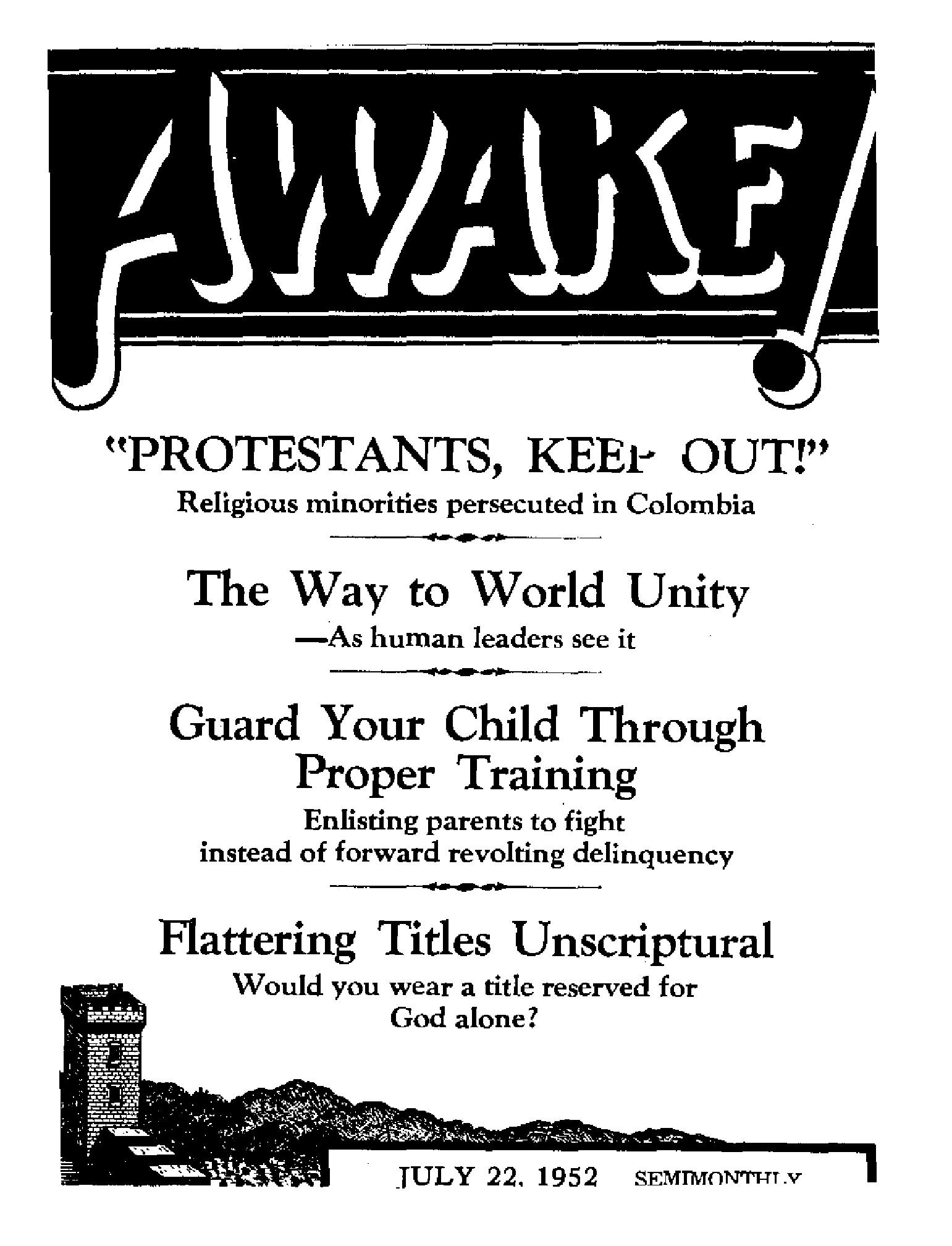
"PROTESTANTS, KEEP OUT!”
Religious minorities persecuted in Colombia ——■— ——------
The Way to World Unity
—As human leaders see it ------w . — -
Guard Your Child Through Proper Training Enlisting parents to fight instead of forward revolting delinquency
Flattering Titles Unscriptural Would you wear a title reserved for God alone?
JULY 22, 1952 semtmontpjt .v
THE MISSION OF THIS JOURNAL
Newi source* tbit are able to keep you awake io the vital Issues of our times must be unfettered by censorship and selfish Interests. "Awake!” has no fetters. It recognize* facts, faces facts, is free io publish facts. It is not bound by political ambitions or obligations; It is unhampered by advertisers wnoss toes must not be trodden on; it is unprejudiced by traditional creeds, This Journal keeps itself free that it may speak freely to you. But kt does not abuse its freedom. It maintains integrity to truth,
11 Awake I” uses the regular news channels, but is not dependent on them. Its own correspondents are on all continents, in scores of nations. From the four comers of the earth their uncensored, on*the-scenes reports come to you through these columns, This journal's viewpoint is not narrow, but is International, It is read in many nations, in many languages, by persons of all ages* Through Its pages many fields of knowledge pass in review—government, commerce, religion, history, geography, science, social conditions, natural wonders—why, its cover* age is as broad as the earth and as high as the heavens.
"Awake 1” pledges itself to righteous principles, to exposing hidden foes and subtle dangers, to championing freedom for all, to comforting mourners and strengthening those disheartened by the failures of a delinquent world, reflecting sure hope for the estabfishnAnt of a right* eous New World.
Get acquainted with "Awake!11 Keep awake by reading “Awakel"
Pfbmriiep Semimonthly Uy WATCHTOWER BIBLE AND TRACT SOCIETY. INC.
117 Adams Street Brooklyn lh N. IT. S. A.
N, H. Kkouh, Brant Mfitkh, Secretary
Prjntta[j this Iiiub; 975,000
Five cent! a copy
Lln|il|t> U whlH tfch ■uruIm Is Mblhksd; Semimonthly^ Afrlltauii, RntHih, Finn bit, French, QernAn, Hnllaiidiah, Nor*«l*nh Spanish, finffith. Munthly—Danhh, (Irerk, ForUigune, C kr*Jn Un.
Office Yr*fly nuhsCripHw Katt
AffltrJia, ILS., 117 Adaim fit., Bron kirn 1, SY. |l Aiitrilii, 11 Btrffonj Rd., MmhJteld, S.B.ff. fit Canada, 10 Irwin Are., Toronto A, Oniirli fl Eniland, o4 Crsren Terrace, London. W. 2 7s Soith Africa, Print? Baf, P.O, Elandffwtfln,
Truii'Tial 71
JU^Ittaam KhoultS be ent to D0n In row com-Uy in compliance with rrtulaUonu to tuarint?? sate dr Limy of mr*ifr Rcmluancea *re atraptert al Brooklyn fron tvuntrlea where no office U located, by international money order only, BubMTipti&ri raff* jo different count tire are here staled Ln local rurrtney, Nvtio* *4 uplrittai {with renewal blank) ii «nl at leul Iwo istue* before jutHcrlptlnu ri-plrei. Chait* >1 aMresi when wut 10 oirr office may be expected effective within one month. Bend your old m well as new address.
Eulered 1$ secniirVclass matter at Brooklyn. N. Y Art of Mirdi 3, 1ST9 Printed In V. fj. A
CONTENTS
Political Landlords in Outer Space
Guard Your Child Through Proper Training 5
"Protestants, Keep Out!”
The Government’s Position
The Catholic Position
Both Sides Err
A Greeting from the Land of
the Midnight Sun
Watching the "North Pole”
Your Cola Drinks
The Way to World Unity—As Human Leaders See It
Religion and War
The Black Christ of Esquipulas "Your Word Is Truth”
Flattering Titles Unscriptural
Citizenship Granted Despite
Conscientious Objections
Mrs. Uemura Writes to Mrs. Ridgway 28
Watching the World
Volume XXXIII Brooklyn, N. Y., July 22, 1952 Number 14
Political Landlords in Outer Space
THE art of land-grabbing has outgrown our planet. During antiquity and the Middle Ages the reaches of Europe and Asia kept conquest-minded men completely occupied. Then for the period of exploration, the vast American continents offered diversion until the Monroe Doctrine officially ended this amusement in the early nineteenth century, In modem times the dictator idea has witnessed the swallowing up or dominating of weaker powers by the stronger ones; so that now, for security reasons, the world is basically divided into the Red Comin-form (Soviet Russia and her satellites) and those nations more or less allied in the interests of liberal Western democracy. But now, alas, it appears that a plain, simple dictator has little more land to grab, without incurring risk of a world war, unless he goes—up!
This was drawn to the public’s attention by Colliers of March 22,1952, in its special issue dealing with man’s alleged coming conquest of outer space. One of the articles, written by Oscar Schachter, deputy director of the legal department of the United Nations, asked: “Who Owns the Universe?” So far along is talk on interplanetary rocketry that this writer, a lawyer versed in international law, has already been plagued with questions as to who would own what, once the various nations succeeded in launching rocket ships into space. He clearly itemized the prominent difficulties—governments that might want to stake off claims to portions of space itself, desirable means for taking possession of and maintaining areas of a foreign planet, the securing of a single nation’s right to fully exploit a valuable deposit of natural resources there which the same nation’s representatives discovered, the need for identifying space ships with a certain nation of earth and that nation’s subsequent responsibility for its craft. A fundamental problem raised is the necessity of determining how far up a nation’s sovereignty extends. Mr, Schachter thinks this can best be solved by limiting the altitude of national sovereignty to the height at which aircraft, including balloons, can be operated* As for outer space, he would apply the principle of “freedom of the seas” and make that “no man’s world”. As to the nations’ getting along together on the surfaces of other planets, he spoke about the necessity for rules and agreements*
It may seem very distrustful to even mention this, but if a rocket ship were destroyed by another in interplanetary space or a crew from one nation were ambushed by another on a foreign planet, it would be easy to get rid of the evidence, certainly easier than when freebooting Sirs Francis Drake and John Hawkins sent Spanish ships to the bottom in the sixteenth century. In view of the manner in
which the different governments get along on the earth, is it likely their diplomats would fare much better if transported “out of this world”? Is it more likely that Russia would give up the “Iron Curtain” idea on Mars, or that she would try instead to ring in the whole planet or a chain of planets ? True, other planets might be brought into NATO by somewhat extending the borders of that organization; but would it make matters more peaceful and trustful simply by bringing our entire solar system into the cold war?
But the most amusing facet to current speculations by political “landlords” anxious to extend their real estate is their very conception of who owns the universe. The highest authority they have sought is international law. Just as they have done toward earthly matters, they show their intent to handle cosmic affairs without consulting the great authoritative source of universal law, the Bible. Therein Jehovah God’s servant Job counsels today’s would-be planet plunderers; “How can a man be right with God? If he should be willing to debate with him, he could not answer him once in a thousand times. . .. who ever resisted him and succeeded?” —Job 9:2-4, An Amer. Trans.
The modem politicians who think little of lives where land is involved (be that land on earth or Jupiter) and who dream now of sojourning around the solar system in the restless spirit of the explorers of yore, usually ignoring God entirely and attaching no importance to his Word, might figure out what God would say to them when he said the following to his faithful worshiper Job: “Where were you when I laid the foundations of the earth? Declare, if you have insight. Who fixed its measurements, for you should know? Or who stretched a line over it? Can you bind the chains of the Pleiades, or loosen the girdle of Orion? Can you send forth Mazza-roth in its season, and lead forth the Bear with its satellites? Do you know the laws of the heavens? Or do you appoint the arrangements of the earth? Can you lift your voice up to the clouds, that a flood of waters may cover you? Can you send forth the lightnings that they may go and sav to you, ’Here we are!' Who put wisdom in the inner parts, or who gave insight to the mind?”—Job 38:4, 5, 31-36, An Amer. Trans.
For vanity, power and selfish glory, harsh rulers have for centuries fumed and stormed and raged back and forth over the land until they have made the earth a ruin and piled carnage behind them. God’s purposes? Everlasting peace and life on earth? What have they heard of such things? Time now only to extend their rule and benefits to other planets. What must God think of them? “Throned in heaven, he laughs, the Lord mocks at them; then in wrath he speaks to them, scares them with his fury.”—Psalm 2:4, 5, Moffatt.
Dominant political leaders always disdain fear in public. They speak fearlessly of projected experimental flights into outer space. They can afford to. They will not be going along. They will find others for that. But no proxy will be available for them when God’s fury comes against ’ them in strength at Armageddon for their final lesson in universal law. At that time, too, those that have used science and other fields to aid selfish oppression will likewise vanish from the scene forever in utter, sorry confusion. Their confusion has begun already, for how else could they talk of going to other planets when science itself admits the earth is the only one suitable for life? It is just as well they have forgotten this, for Christ Jesus advises that eternal life here will be only for another type of people: “Happy are the mild-tempered ones, since they will inherit the earth.”—Matthew 5:5, New World Trans.
Guard Your Child Through er
ON February 5, 1951, Probate Judge Harry Albright of Bellaire, Ohio, was facing America's No. 1 problem—juvenile delinquency. Before him stood a boy, a mere babe, but with a police record of twenty-eight offenses. The judge said the lad had stolen a car, broken into a private home, sqt fire to papers around the Bellaire police station, pinched all the keys from a used car lot and distributed them up and down the street, and burglarized a number of business places. To top this record the boy pulled a sixteen-dollar burglary of the Belmont Federal Savings and Loan company with his brother. What follows will make you want to laugh or weep, depending upon your knowledge of criminology. The desperado’s age was seven; his brother's five. “What would you do with a seven-year-o Id ban k burgl ar ? He ’s too young for reform school and too ornery for children’s home,” said Judge Albright. Just an exceptional case, you say. Not so.
A crime wave swept through Boston. Robberies, rapes, assaults, thefts were flashed night after night over the radio. Finally, one evening came the report: “Boston police in their battle against the crime wave have made an important arrest, holding three criminals!” “The criminals,” said the announcer, “are 11, 12 and 13 years of age!”
A baby-faced desperado aged seven and his two pals stole government documents, and committed twenty robberies. The youngest stuck his tongue out at the government agent and said: “You can’t do anything with me! I'm under seven.”
On October 1, 1951, in Irvington, New Jersey, the police arrested three youths^ who were veterans in their ill-chosen profession of burglary* The youngest engineered the jobs. His buddies paid him off in candy and movie tickets when a job was well done. Their ages were twelve and thirteen and their leader’s, six!
A digest of Charles J. Dutton’s article appearing in the Kiwanis magazine, June 1946, says: “In the latter part of the 1930's, when the police spoke of juvenile delinquency they meant youths from 16 to 18 years. Today, they mean "kids’, from seven to 15 years. Not only has the age limit fallen; the type of crime has grown worse. Such wild and savage destruction, sadistic cruelty, vicious vandalism were unknown ten years ago. Something has happened . * . and the police do not like the picture. What alarms law-enforcement officials today is the savage type of destruction they face. When children go wrong, they behave as if possessed. If these young offenders take over an automobile, they cut up the upholstery, stick nails in the tires or cut them, break everything they can. If they get into a school, church or dwelling, they destroy anything within reach.”
In August 1951, the Skidmore Elementary School in Columbus, Ohio, tasted the vicious assault of youth* About sixty windows had been smashed, desks ransacked, walls and floors of the rooms were splattered with ink, a piano was damaged and furniture and cabinets were battered^ A county rural school in Burke, New York, was completely wrecked * last Halloween night In another town, churches were invaded, organ pipes cut, pews upset and windows smashed. The police chief looked at the ruin and said: “Kids! Five of them! They spent two nights in here. The oldest was almost fifteen, the youngest around eight. Ever see anything like it?” At Mount Vernon, New York, January 23, 1949, vandals entered the graveyard and overturned, uprooted or otherwise damaged twenty-two headstones and one marble madonna. Several headstones were smashed to bits. Choose any city you wish, the story is the same. Rampant destruction, damage amounting to hundreds of thousands of dollars.
Another thing that troubles the police is the sadistic streak in many of these children. Psychologists say that children love animals. But what will psychologists say of a group that stole dogs, took them into the woods, put wires around their necks, hanged them to a tree, and lighted a fire under the suffering animals. Those children were all under fifteen.
The Rise in Crime
Murder? Yes, many. Assaults? Hundreds, by youths with a vicious disposition, upon other children, Sadism of a type one used to think only the student of abnormal psychology would ever encounter.
On September 5, 1951, a 15-ycar-old boy told police he knifed his best friend to death at a revival tent meeting because “he hit me with a songbook”. “I felt I had to do it. I’m not sorry.” Another boy, 16, killed his friend for tickling his feet while he napped. A 13-year-old cop-hating girl with a rock beat 6-year-old James Bruce to the point of death and said, “I ain’t sorry for what I did.”
How can one explain the case of the 15-year-old girl in a Connecticut city, who, while her mother was at work, used the house for a brothel, the inmates being high school girls and the patrons boys from the same school? In Zanesville, Ohio, nineteen teen-agers admitted participating in illicit sex relations in cars, alleys, and country lanes, while a 14-year-old girl in St. Charles, Missouri, told police she had been intimate with men in a series of group parties. (Coronet, February, 1951) In the spring of 1950, near Bakersfield, California, twenty girls, all under 21 and the youngest 13, were arrested for posing in the nude for lewd photographs. In the big-city sections many beautiful teen-agers group together into she-wolf packs for street fighting, bone-breaking “stomping” bouts, facescarring knife battles. Some act as junior gun molls to outwit the police. At sixteen these girls are crime-hardened, willing to try anything, any kind of Violence, theft, extortion, and promiscuity. Some dress in stolen mink coats, are alcoholics and dope addicts. Many are mothers before they reach fourteen!—New York Times, October 2( 1950.
Are these isolated cases? Let the figures published by the Department of Justice answer. The year 1944, to compare with 1929, shows the following increases in crimes committed by boys from ten to eighteen: murder up 47 per cent; rape up 69 per cent; assaults up 71 per cent. Sex crimes other than rape had risen 61 per cent. For girls of the same age range, sex offenses and prostitution rose 375 per cent. Drunkenness mounted 174 per cent. Children now commit 56 per cent of all crimes.
The New York Times of April 20, 1952, reports that “one-tenth of the 1,000,000 children apprehended annually by the police are sent to jails”. Also that New York city’s child delinquency increase is “20.3 per cent in 1951 over the year before, for the rest of the state the increase was 14.3 per cent over the 1950 total”. “To the juvenile courts o^er the country come 300,000 children each year.”
What is to blame for this outbreak of violence among children? High among the reasons the police assign is “the lack of discipline in homes and schools”. The child does' not receive the proper training. In Ohio, a lawyer argued desperately before a three-judge court for a 16-year-old confessed killer: “I know what’s wrong, and so do you gentlemen. Too damned many bridge-playing mothers. Too damned many cold suppers for son and father to come home to. Too much afternoon and evening drinking.”—Pageant, April, 1949.
Many suggest this as a remedy: Whenever a child destroys property, be it a school, car, or a graveyard, let the parents be made to foot the bill. When the child is arrested, let the parent too be brought into court and fined for neglect Without any exception the parent should be fined for allowing a young child to be out after dark. Discipline should be restored to the home, and to the school, “Somebody ought to be putting what we call the fear of God into the children of America.”
The Right Training
The parent and not any church organization nor any sectarian or Sunday school is the one responsible for instructing the child. So important in God’s sight was such proper parental training of children that it was made a requirement of fathers before they could receive any service appointments in Christian congregations. —1 Timothy 3:2, 4, 5, 12; Titus 1:5, 6,
Parents were commanded to take their children with them to the congregation. (Deuteronomy 31:11-13) In such assemblies the child was made to listen and be submissive to parental control. Children were not left to themselves. “A child left to himself bringeth his mother to shame.” (Proverbs 29:15) Neglect of proper training breeds juvenile delinquency, which in turn brings shame upon the parents.
Parents will set the example In clean living and Kingdom service, even as Christ set a proper example for us. (1 Peter 2:21) In such activities their children will come along as companions. Such service together creates a strong bond between parents and children. Parents should not act as harsh dictators, but should be close companions with their children, play with them, talk with them, work with them. Love your child and your child will love you. Be indifferent and the child will be indifferent. Instill confidence, respect and trust in the child and it will in turn respect and trust you. Then you can help him over obstacles that might otherwise trip him headlong into delinquency.
Correcting the Child
Concerning the relation between the boy Jesus and his parents it is written that Jesus “was subject unto them”, (Luke 2:51) That is a good example for children. God’s command is, “Children, be obedient to your parents in union with the Lord, for this is righteous.” (Ephesians 6:1-4, New World Trans.) But, like adults, children do not always follow the good counsel of God’s Word. Correction stronger and more impressive than words must come. “He that spareth his rod hateth his son: but he that loveth him chasteneth him betimes.” (Proverbs 13:24; 22:15) The “rod” represents parental authority. It may or may not take the form of physical punishment, depending on the varying circumstances. Christian parents must present their children with a living example and with a consistent, morally wholesome set of values; otherwise, all the preaching in the world to the child will be greeted with amused cynicism, for “they know us for what we are”. Mark the inspired words: “Train up a child in the way he should go: and when he is old, he will not depart from it.”—Proverbs 22:6.
R«llgicu« Minority Peri*cut*d tn Colombia
64T)ROTESTANTS! Do not enter this _L home! We are Catholics. We do not
need your propaganda.” Signs containing those words are found posted on thousands of homes in Barranquilla, Colombia's foremost seaport city. Throughout the land “Communism” and “Protestantism” are synonymous to the great mass of Catholic population. Children are encouraged to learn and teach others a 19-stanza song against the Protestants, Among the sentiments this song expresses are:
“We don’t want the Protestants,
They have come to Colombia to corrupt us.
We don’t want the Protestants, Who soil our fatherland and our faith. With a plate of food you corrupt the poor ones that hunger;
You can expect to pay for it in the next life with torments.
In hell you will find Satan your father.” Add to this, stonings of Protestant church buildings, boycotts, mobbings and murders, and you will have a condensed picture of what is taking place in Colombia, South America, in 1951-1952.
In Bogota, the Southern Baptist Church dedicated a new brick building for religious services on December 22, 1951. Regarding what took place, a cablegram sent to the U. S. Baptist headquarters stated: “Church attacked twice by priest-led mob Saturday December 22nd and Sunday December 23rd. Building badly damaged. Several people slightly wounded. Police present but inactive. All missionaries safe.” Reporting on this incident, the foreign mission division of the National Council of Churches of Christ in the U. S. A. stated: “The attackers were led by the Rev. Florencio Alve-rezt S.J., a Bogota Catholic pastor, and the stoning broke 131 panes of glass and inflicted head injury on the co-pastor of the church.” The United States ambassador, Waynick, who witnessed the entire affair, lodged a strong protest with the Colombian government.
Telling of other incidents, Presbyterian Life (February 2, 1952) reported: “A Canadian missionary and a Colombian lay evangelist were on their way to a church member’s house near Cambao when two policemen and four townspeople attacked them, destroyed their Bibles and papers, beat them brutally, and forced them into the swift running Magdalena river. On December 31, a pastor of Ibague . . . was seized and imprisoned without reason.”
On March 20, at Ibague, Colombia, two priests led a procession of over 1,000 children from the Catholic churches to the Presbyterian church, cheering “Long live the Virgin! Death to the Protestants!” Reporting on this incident, The Christian Century (April 23, 1952) stated: “There they led the children with more shouts and yells. When they were sufficiently worked up, the priests told them to throw stones at the church. For a half-hour the priests walked back and forth among the children, urging them on with shouts while they smashed over 60 panes in the stained-glass windows, splintered the doors and wrecked the pastor's study. When aU the panes but
one were broken, a priest shouted, 'Keep on! Throw more! There is still one big pane left!' Some of the children were so worked up that they cried: 'Let the Protestants come out. We’ll kill them!' When nobody appeared, the priest ran up and down shouting: 'They’re afraid to come out! They’re afraid to come out!' When all the windows were broken, the mob dissolved. Some of the children were so frightened at what they had been led to do that they had already fled.”
In the city of Armenia on April 13,1952, armed individuals entered an evangelical church, interrupting the services by shouting and firing upon the people. One woman was hit by two shots and seriously hurt. A child was struck in the face with a bullet
The Chicago Tribune^ of March 4 and April 20, told of the report of the Evangelical Confederation of Colombia, a group of 17 Protestant denominations, on 23 instances of persecution which took place between February 15 and April 17, or in two months. Among those listed were some of the foregoing as well as the following incidents: "Police and civilians tried to destroy a Protestant family by burning its farm home. Twenty-five other Protestant homes were burned and some confiscated. Houses were searched and Bibles destroyed. Police broke up services in a private home and seized a church and manse and turned them into barracks for themselves. The communications ministry banned four Evangelical radio programs in Bogota.”
Continuing, the report also mentioned the dynamiting and burning of the home of Esther Maurd, a North American Pentecostal missionary. The native principal of an American school was jailed for three days and then released with the explanation, "Sorry, it was a mistake." In Tolima, an evangelical church was burned. In Magdalena, a man was placed in" stocks. In Valle, three girls, children of Protestant parents, were made to kneel during recess periods because they failed to attend Sun-day^mass.
Far more numerous than the above incidents, which have occurred in large cities, are those taking place in the rural areas. And according to the executive secretary of the Evangelical Confederation of Colombia, not more than one-fourth or one-fifth of all the cases are even reported. Some reports tell of attacks on women and girls; one report told of a young Gospel worker being emasculated. Since 1948 more than 100 Protestant congregations have ceased to function because of persecution.
Repercussions
Repercussions caused by the foregoing have been widespread. According to a Herbert L. Matthews, writing in the New York Times, April 2,1952, “Persecution of Protestants [Is] an Acute Issue in Colombia. Although a majority of Catholics decry incidents, they resent missionary sects." After pointing out that there are only 25,000 Protestants among Colombia’s ten million, he observes: "The controversy has at least had the benefit of making the
Colombians think and argue about religious toleration and freedom of worship and they are beginning to realize that other countries place a broader definition on these principles than they do.1 El Tiempo, perhaps the most widely consulted newspaper, although 100 per cent Catholic, has repeatedly decried the outrages committed against oth-
er religions and has openly championed freedom of worship. One of its editorials had this to say: “We consider the campaign against Protestantism, above all in the aspect of violence, is against the democratic principles as set forth in our Constitution, and for that reason we criticize those who direct or stimulate such outbreaks of intolerance, openly antagonistic to the liberal criterion.”
Right after the Spanish priests had incited 1,000 Catholic school children to stone a Presbyterian church building in Ibague, the local newspaper condemned this action by printing as a “proclamation” on its front page the following words from Mark 9:41: “Whoever causes one of these little ones who believe in me to sin, it were better for him if a great millstone were hur^j about his neck, and he were thrown into’the sea.”—Cath. Confrat.
The Richmond Times-Dispatch, in telling of an advertisement appearing in the Washington Evening Star at the instance of the Association of Evangelicals, stated: “The advertisement showed pictures depicting destruction of a Protestant chapel at Campo Hermosa and reprinted an editorial from the Liberal party newspaper El National of Barranquilla, dated October 2, 1951, The editorial mentioned the dynamiting of a Protestant church near Cali, killing one person and injuring others, and discovery of the dead body of a Protestant minister tied to a tree. Denouncing these and similar incidents, the Colombian newspaper took to task a Father Jordan. It said he blessed daggers in Malaga, calling them ‘blessed weapons when drawn in the defense of the Catholic religion.’ ”
Concerning the Colombian situation, The Christian Century, one of the foremost Protestant U. S. weeklies, stated, April 9, 1952: “Mob outbreaks against Evangelicals are becoming more and more frequent. It is impossible to tell whether more blame rests on incitement by Roman Catholic priests or the habit Colombian civil authorities seem to have contracted of looking the other way when mobs form. Not long ago a mob in Bogota,-the capital, stoned most of the windows out of a beautiful Baptist church which had just been dedicated. Baptist leaders asked the United States government to protest to Colombia, but if any such protest was made it evidently left little impression.”
Then, after telling of the Ibague incident, thearticle went on to say: “After the attack on this Presbyterian church, the government radio station broadcast a demand, allegedly written by Bogota professional men, that Colombia halt all further Evangelical propaganda. Protestants, it said, are ‘disturbing public order’ and their activities are ‘disgracing Colombia among the community of nations.’ We venture to think that a large part of the community of nations will not feel that the ‘disgrace’ attaches to Colombia’s Evangelicals. Washington may again be asked to protest, but if it does we do not expect the action to accomplish much. But Roman Catholic authorities in this country and Europe should wake up to what such outrages are doing to the reputation of their church in the eyes of the enlightened portion of mankind.”
The Government’s Position
What is the government’s attitude toward the religious situation? The Conservative government in power solidly backs up the Catholic Church and a real churchstate rule holds sway. According to the New York Times, April 2, 1952: “It would be wrong to think that either,the Colombian authorities or the vast majority of Colombia’s people look with anything but dismay at attacks on Protestants. Even these people, however, are deeply hurt at the idea of foreign missionaries, who are
mostly North Americans, coming here to convert this profoundly Catholic people to Presbyterianism, Seventh Day Adventism, or whatever it may be?'
The excuse is given by officials that “these spontaneous primitive reactions were prompted by the presence of propagandists contrary to the Catholic tradition of the country”* The acting president, Urda* neta Arbelaez, declared that the “Constitution permits and tolerates the peaceful practice of all religions. But there is an undeniable resistance of our people against every practice that is contrary to their Christian fervor and much more so when many of those pastors have been at the service of sectarian propaganda against the government”.
However, the president's declaration as regards pastors’ lending themselves to the service of “sectarian propaganda against the government” may be founded on facts. Admittedly, the vast majority of the Protestants of Colombia are members of the Liberal party or its sympathizers. Reports show that although Protestant clergymen may not have taken as open a part in politics as have the priests, they have, nevertheless, encouraged voting for the Liberal party leaders and hence must share some of the blame for the persecution that is being brought upon them. They have mixed in the affairs of this world contrary to the example and admonition of Jesus, who stated that his kingdom was “not of this world”.—John 18:36.
El Siglo, Conservative organ, has continually excused the religious violence as being provoked by propagandists from North America. A distinguished Colombian, referring to the same matter, stated: “And to think, that this government of ours still permits these infamous Protestant pastors to brazenly walk around selling Bibles in the villages. * . . and to think that there is not one of our officials that puts these vagabonds in jail or that prohibits their entry into Colombia!”
The government does seem to have followed a policy of discouraging Protestantism through indirect opposition that has reaped results. Though not deporting the missionaries that are in the country, the foreign relations office flatly refuses to issue visas for replacement of those that leave. Another significant fact is that no one can recall anyone’s being jailed as a result of the attacks on the Protestants and their churches. One mayor, however, was fired in a town where a church was dynamited. In the cities the officials usually take some action that fizzles out; in villages and rurals no action is taken.
The Catholic Position
According to Mr. Matthews’ article in the New York Times, previously quoted from: “Colombia is startlingly like Spain in many respects. Spanish fanaticism runs through the church and politics and indeed many of Colombia’s clergy are Spanish. Her church is therefore less liberal than the Vatican, which is permitting Protestants and the Colombian Liberals to point with telling effect to Pope Pius’ statement to the Romanians last week. In it Pope Pius defined freedom of worship as permitting both public and private worship, which is not the case with Protestants in Colombia.
“A noted Jesuit, Father Eduardo Ospina, , argued that [the Colombian Constitution] means freedom for any individual to follow the dictates of his conscience and exercise of his belief within his place of worship, but . . . not. . . public propaganda outside the temples. Distributing Bibles or flysheets is not an act of worship. Freedom of propaganda is not guaranteed by . . . the Constitution.”
By mixing in politics to get her Conservative party back into power the Catholic Church has disgusted many sincere
Catholics. To counteract her loss of prestige and followers she is using Catholic action to beat down her enemies. As foreign nations have been invited to aid Colombia in its strides forward toward a more modem way of living, international relationships have had their effects upon Colombia’s inhabitants. Where advanced education exists people are more tolerant toward persons of opposite views, including religious ideas.
This has not been to the Church’s liking, and so she has tried to justify her anti-Protestant campaign by educating the people to the idea that there are just two forces lined up against each other—Catholicism and Communism, Uneducated Catholics actually believe that literature explaining the Bible must be communistic, since it is not Catholic.
That Colombia is a Catholic country will not be disputed, although it is difficult to ascertain just what per cent of the population really is Catholic, During last year’s census many people were not asked what their religion was, it was just taken for granted that it was Catholic. Then, too, many hypocritically, or because of fear to say anything else, profess Catholicism,
To what extent the people of Colombia have cause for fear can be seen from the following experience: As a young missionary lady was visiting with a girl in the doorway of her home in Bogota, two men passing by became interested in the Bible literature being offered, and one of them accepted a free copy of a magazine explaining the Bible. A policeman appeared and confiscated the book the girl had contributed for and wanted to know what the man knew about the missionary work. Upon his reply that he didn’t know anything about it, the policeman struck him across the face and snatched the magazine from his hands.
What will be the outcome of the religious situation remains to be seen. As of the present the persecution of nonCatholics is an issue bitterly viewed and debated. But with the anguished cries of persecuted Catholic leaders in Communist lands still fresh in their ears, many persons are unable to comprehend the intolerant position of the Catholic Church in Colombia. While pleading mercy from Communist governments she deals out harsh treatment to those that dare exercise their Godgiven right to worship according to the dictates of their conscience by associating with non-Catholic religions.
Both Sides Err
C "I And no fault in your criticisms of the Roman Catholic Hierarchy/' said a reader's letter in the March 12, Christian Century, "I think, however, of the absolute stupidity of our Protestant churches. The church means much more to a Catholic than to a Protestant. Why don't we analyze the reasons for this? I have always been bored with the average Protestant service. The collection takes up so much time. The notices take up so much time. The organist playing through an entire hymn takes up so much time, The sermons carry so much dead wood. They repeat the daily paper, the radio and television.” We might also add that the attendants learn so little' Both sides have need for real Bible education, and yet many reject the very ones who bring that to them at their homes.
A Greeting from the Land of the Midnight Sun
By two Watchtower Society mltalonariet in Norway
ES, the northern tip of Norway is an interesting land. If you want to see the sun shine continuously for three months, or if you want to be without its light for
three months; or if you are interested in a northern people, their conditions of living, their religion or the expansion of the true religion, then come to Finmark. We have come here, and it is well over a year since we arrived, and we are not disappointed,
Finmark is located about 400 miles from the Arctic zone. Like most of Norway, it is a mountainous country with plenty of fjords. In square miles it is larger than Denmark, but it has only 60,000 inhabitants. The people live in small scattered villages and cities. The population is made tip of Norwegians, Laplanders, and Finns. The Lapps or Saamisk people are a small, dark-complexioned race full of life and curiosity. For example:
When visiting their home one should be prepared to answer a lot of questions. The older women never seem to tire asking. They begin with, Who are you? What is your name? How old are you? Why are you here? Where did you come from? Are you married? Single? etc. This could go on for hours! If your visit is to prove successful, it would be best to answer all questions.
To eke out a living is a difficult problem for the northern people. Most of them are fishermen, and to make a living they have to work hard and many hours under difficult and dangerous conditions. But fishing can be amusing and interesting too.
The best season for fishing is in the spring of the year. Hundreds of small and large fishing boats crowd the harbors. Each boat is well equipped with fishing tackle, supplies and other equipment. Fishing is done in crystal-clear water. The hook is lowered, and if the sea is not too deep one can see all kinds of fish, how they come up to the hook, nibble the bait, and when they are hooked. All this hastens the catch so that a boat of four tons can be filled in five or six hours by five men using nothing but hooks! That’s fishing! Larger concerns have many different gadgets and inventions not seen elsewhere, such as a radio and depth meter, giant-size nets, etc. A few months ago one crew caught around 200,000 pounds of fish with one catch! One hundred tons of fish in one net! The modest fisherman, however, owns only fishhooks and perhaps some small nets. With these he makes his living. However, not all the land’s 60,000 inhabitants are employed this way. Many Lappish people raise reindeer. These animals-are easy to keep. They find their own food in the summer and winter. Reindeer hide is used for clothing and the fiesh is sold for a high price. Five people can make a comfortable living if they own a herd of 250 reindeer.
If you ever plan to come to this land of fishermen and reindeer we suggest that
you bring along with you a good supply of vitamin tablets. In order to resist the long cold winters an added boost from vitamins is a great help. During the winter the sun is missed for three months and thick darkness settles over the land. Street lights are used the whole day and the moon is seen beaming in the middle of the afternoon!
The Midnight Sun
Around the beginning of February the sun begins to show signs of life. Days begin to grow lighter and longer. The day when the sun peeks above the horizon for about a half-hour the whole world seems to come to life. Nature rejoices! People everywhere are in good humor, greeting and speaking to each other. Life seems important. People want to live. They plan. They work. They are happy. Everyone feels as if being just released from a long stay in a dungeon cell. We missionaries who have just experienced our first winter here for the first time appreciate what sunlight means to man. From then on the days grow brighter and brighter with more light and warmth. Finally it reaches its climax in the middle of June, shining through days and nights, and then it is crowned by the name "The Midnight Sun**. In this way it pays back to us what we missed during winter, making our summer wonderful indeed! But it is a short summer, only three to four months in length. The average temperature runs between fifty and sixty degrees Fahrenheit, which makes farming quite impossible. In some few places only potatoes have been raised, but not with good success. The largest part of Finmark is plain rock mountains and hills without vegetation. It is not a surprise to meet a child that has never seen a block of wood or a tree. Usually in September we say good-by to our beautiful summer, and then come the autumn rains and the long winter with its darkness, cold and snow. The temperature drops to fifty and more degrees below zero in the wintertime. But with a good, heavy fur coat all is well.
Religion in Finmark
Here in the cold north religion has done little to warm the hearts of the people. Most of the people belong to the church of the state, but there are a number who are adherents to the Lestadian religion. This religion comes from the north of Finland and Sweden, being established around 120 years ago by a priest whose name was Lestadius. He believed in “hell-fire” and the immortality of the human soul. So do his followers today. They have their own books and their own way of living. To them flowers^ music, curtains to dress the windows, bright colors, anything and everything that tends to make the home a little more comfortable and enjoyable, are forbidden. They dress in dark-gray and black clothes. A good preacher, say they, cannot use a shirt with a collar, and as far as neckties are concerned, oh, my! they belong to those unbelieving ones who still want to dress up to please the ungodly nations. What they said after seeing our American-made ties, you can imagine!
Their religious meetings consist mainly of “getting the spirit”. During their prayer meetings lights are put out. Then all go under a big carpet which is brought into the hall for this purpose. There under this carpet they pray to their god, confess their sins, and speak in “tongues”. The uneducated are usually the ones that worship this way. They live far out in the country for the most part, but a few are found in the small villages and towns. They are a people that enjoy being by themselves.
In this land of the midnight sun and no sun there is a great need for light, the spiritual light of understanding of God’s Word, the Bible. The spiritual darkness
that has settled over this land is dark indeed! During our stay here we have had many encouraging experiences. We find distances between places a major obstacle. But by our using bicycles, boats and skis we have been overcoming this barrier with good success.
A little over a year ago we were skiing to a little village beyond many big mountains and hills. A strong snowstorm and a blistering cold wave fell upon us unexpectedly. We were eight miles from the nearest village when the storm broke loose with all its fury. It was impossible to ski because of the fresh snow. The blizzard was blinding; the cold, unbearable. Fortunately we stumbled onto a telephone line, which we followed. By slapping our hands and swinging our arms in every direction and by drinking hot coffee every now and then we were able to keep from freezing. Upon our arrival we were told that ninety per cent of the villagers were Communists. We told the people we were interested in one thing, preaching God’s kingdom as mankind’s only hope. A public meeting was arranged. We were amazed to see the hall completely filled. There were more than ninety-five in attendance! A few months later we were told that the Communist percentage had dropped considerably, in fact, it was down to fifty per cent. When we came here we found three publishers. A year later with joy we can report fifteen. Now there are companies of Jehovah’s witnesses on the top of the world, in the cities of Vardo and Kirkenes.
From the city of Vardo, which is a stormy and windy place built on an island in the Arctic ocean, comes this encouraging report: “Yesterday, we had a public talk and a day which again proved people are interested in God's kingdom. The talk was planned for eight o’clock, but what terrible weather had fallen at that time! It was unspeakable! It seemed as if all of earth's snow was being emptied at one time on our little city of Vardo. It seemed incredible for anyone to venture outside. What about the scheduled public meeting? Nobody would come, so we thought. We waited in the warm hall as the icy wind howled furiously outside. To our amazement the door came open. People began to come! By two’s and three’s they came, until the hall was crowded! The public talk was given, which was followed by a Bible study. Everyone present was thrilled. What a blessed, unforgettable occasion!”
In Kirkenes, a distance of sixty miles from Vardo toward the border of Russia, comes this report: “It is encouraging to see how fast some people can take their stand for the truth. Two months ago in house-to-house work we met a man who seemed very sincere and interested in the Bible. He obtained the book ‘Let God Be True'. A week later we called back on him and at once started a study. Now, after each study, he keeps saying: 'Why haven’t I seen these things before, which are so clear and easy to understand?’ Then in the same breath he will say: "Yes, I know. Those religious leaders do not study the Bible as you do and, therefore, they cannot help their sheep to get an understanding of the Bible.’ This man is a happy, enthusiastic publisher for the Kingdom now. The villagers know him as one of Jehovah’s witnesses. So do we.”
So the good news of the Kingdom is being preached in “all the inhabited earth for the purpose of a witness”. (Matt. 24:14, New World Trans.) We are very happy to have a share in it. We realize there is much to be done here as in other parts of the world before the accomplished end. But we are determined by the undeserved kindness of God to stick to our work until he says it is enough.
wawawo inas ‘WNairia wim*
I 9 ly two Watchtower
Society mittionarle*
in Norway
Catching Polar Bears
<1 Mr, B----, who is an old veteran at catch
ing polar bears, told us about his job, "Going to our hunting grounds we have to sail as far north as possible to the very edge of the polar ice. There we just wait and the bears appear* Believe it or not,” said Mr* B----, “they come
toward the boat boldy without being afraid of people* Of course,” he continued, "that is because the wind is carrying our scent away from the animal* But once the animal detects our scent he becomes hard to find* The bear does not seem to believe what he sees but what he smells* We often get very near to the animal, a distance of a few feet before we finally act to kill or capture it* When I was a boy selling animal skins and fat was good business, but not anymore* Today polar bears are caught mainly for the world’s many zoos*” By contrast, in Jehovah God’s new world men and animals will live together in peace.
Priest and Clergy Here
<L The priests and clergy fight against the Kingdom work here as they do in other parts of the world* Some weeks ago we had the pub-
| lie talk given, "Hell Used as a Scare,” After J the lecture a priest stood up in the audience | and said that the Bible supported the teach-| ing of “hell-fire”. He neither gave nor cited j scriptures to prove what he was saying* His | explanations were so completely Inconsistent ; and unreasonable that the whole audience laughed at him* In the audience were many of his own flock* After seeing what a “fool” he h made of himself in the presence of all, their eyes were opened to what the truth really is, and the priest has not seen them In church since* These teachable ones are learning the truth of the Bible with Jehovah’s witnesses* <L In spite of our short summers and long and cold winters, the north has a beauty all its own. The awe-inspiring northern lights [ and the midnight sun alone are enough to enchant many so that they do not feel at home anywhere else but in the north. We feel that fever in us tool Not only because of na-< ture, but principally because we have met so many good-will persons whose minds are di* [ rected toward a new and righteous world. And it seems that there still are many who will take their stand for the new world so ciety in the near future* Therefore, we hope we can continue in saying to those who still are in the darkness, "Go forth!”—Isaiah 49:9,
Your Cola Drinks
<L At a hearing of a United States House Committee investigating the use of chemicals in food, held in Washington, D*C*, September 19, 1950, the following information was revealed by a Dr. Clive M. McCay, professor of nutrition, Cornell University, who for three years during World War II was head of nutrition research for the United States Navy (and so can hardly be classified as a food faddist). The popular cola drink is a "strange mixture of phosphoric acid, sugar, caffeine, coloring, and flavoring matter”. The amount of phosphoric acid is *055 per cent, giving cola drinks an acidity or pH of “2*6 or about the same as vinegar”* Why doesn't a cola drink then taste like vinegar? Because of the sugar added* But why so much phosphoric acid? Evidently to keep the water sterile, as no bacteria can live in such an acid solution. The solution of phosphoric acid in cola drinks is so strong as to cause human teeth to become very soft within two days. In fact, it is strong enough to dissolve nails and limestone* And the very substantial amount of caffeine in the cola drinks without doubt has a direct bearing on the prevalence of gastric ulcers* According to Dr. McCay, "We would not use cola beverages if we could escape it, in the Navy or anywhere else”; and, unfortunately, there is no way for the public to hear about these facts as information on them "is very restricted literature, it has not ever been able to get into the press”*—Chemicals in Food Products, pages 87'96, H. Res* 323, U* S* Government Printing Office, Washington, D* C*, 1951*
THE Bible shows that unity will come only under the reign of Christ, but this world under Satan has no faith in this divine promise. Foremost among the schemes that the worldly leaders advocate in the stead of the Kingdom is the United Nations. Note how many hail it as the only hope.
In a joint Christmas message to the U, N., Secretary General Trygve Lie and the then president of the General Assembly, Dr. Herbert V, Evatt, said, on December 23, 1948: “Peace on earth and goodwill to men must be made living realities. We must make them living realities through the United Nations."—New York Times, December 24, 1948.
The New York Times of September 17, 1950, quoted these men as follows. Cordell Hull; “Upon the success of that organization [U. N.] depends the fulfillment of humanity’s highest aspirations and the very survival of our civilization." Sir Alexander Cadogan: “Until someone has produced a better plan, the United Nations is the only way of salvation." Charles E. Wilson: “The United Nations will live only as individuals give it life, through their support, their pa
tience, and their conviction that there is no other way.”
Dr, Herbert V. Evatt, when he was president of the General Assembly, said, on April 5,1949: “The United Nations has not failed the people of the world. The peoples of the world have faith in the United Nations. It is their chief instrument in the struggles to create a world based upon justice. Nothing else is a substitute for it; nothing else can be a substitute for it.” —New York Times, April 6,1949.
John Haynes Holmes, prominent New York city clergyman, said: “We have failed often enough, in Hague conferences and leagues of nations. We can’t afford to fail again. The United Nations is our last chance to achieve enduring peace.” (New York Times, October 24,1949) That it will be the last chance that men alienated from God will have of putting .an international alliance in the place of God’s kingdom seems to be confirmed by scriptures.—Isaiah 8:9-13; Matthew 24:15; Revelation 17:1-18.
Clergyman Ralph W. sockman, New York city, said that the U, N. offered the “best hope of peace”, but added: “With all its organization and its new home now arising in our city, the United Nations lacks a soul—and this is what religion through the churches must give it There must appear a spiritual and moral leadership rising above economic and political situations?' (New York Times, October 24, 1949) The above-cited seventeenth chapter of Revelation shows worldly religion riding the beast and guiding it, just as Sockman yearns for it to do. From its past record it appears that any “soul” or "spiritual and moral leadership” worldly religion could give the U. N. would be about as mythical as the pagan-taught "immortal soul” such religion has unscripturally assigned to the creature man.—Psalm 78:50; 89:48; Isaiah 53:12; Ezekiel 18:4, 20.
Todsy’i Humpk» Dumpty—WXo can put it togalhcr attain?
P On October 24, 1949, when the United Nations cornerstone dedication ceremonies were held, President Truman said: "We have come together today to lay the cornerstone of the permanent headquarters of the United Nations. These are the most important buildings in the world, for they are the center of man’s hope for peace and a better life. This is the place where the nations of the world will work together to make that hope a reality/1—New York Times, October 25, 1949,
t/nited Nations Divided
But the nations have not worked together there, and the hope has not been made a reality. After speaking of the imposing structures comprising the U. N. headquarters the New York Times of May 10,1952, said in an editorial entitled "The Outline of na Dream”: "This is no insubstantial fabric of a dream; it is so solid and costly and eye-filling as a material structure that it is hard to doubt its permanence as an institution. It is permanent in the sense that the dream will endure. The human race has embarked on a search for an insurance system against the scourge of war, and it will not give up until this aim is achieved. . . * Certainly the sense of permanence is enhanced by the permanent setting. The buildings constructed and planned are a splendid affirmation of confidence in the future of the organization. But it goes without saying that the lasting structure is not this magnificent glass house—whence so many stones are thrown! The rock on which permanence must be built, the steel and cement of which it is compounded, are not material but spiritual elements. The United Nations will live only if the governments and people of the world have the everlasting perseverance to make it live.”
Philippine statesman Carlos P. Romulo, who was president of the U. N. General Assembly in 1949, pointed out the magnitude of the task facing the United Nations, when he said, on April 28,1950: "What we have been trying to do in and through the United Nations is to unite the many factions and blocs of nations, with their differing traditions and cultures and their diverse and sometimes conflicting national and regional interests, into one world society, one universal community. We have been trying to heal the cleavages and divisions of a thousand years, in the belief that real security and freedom and prosperity today cannot be achieved on anything less than a global scale.... The world stands in need today of unity, not uniformity.”—New York Times, April 29, 1950,
But why the U. N, has failed to bring this unity General Romulo had pointed out a few months earlier. On October 17,1949, he stated: “Our technological achievements have literally made the world smaller, but they have not drawn the nations close enough together to unite under a common allegiance to humanity. We have harnessed the power of the atom, but we have yet to bridle the passions of men and the ambitions of nations firmly enough to make war obsolete. . . . The critics who take the United Nations to task for having failed to give substance to the dream of one world gloss over one important fact. The U. N. was not equipped to make the peace.
That was a privilege which the big powers reserved to themselves.” After showing how this was done through the big-power veto, he adds: “The ink was hardly on the Charter when the big powers split into two camps. Since then unanimity has been the exception rather than the rule.”—New York Times, October 18, 1949.
On July 28,1947, General Dwight Eisenhower said: “It looks more and more as though the United States will have to accept a two-world concept when we have been working for a one-world plan.”—New York Times, July 29, 1947.
Similarly, President Truman indicated the hope now was for unity of the free nations, not world unity of all nations, when he said, on June 5, 1949: "Our great hope for peace and prosperity lies in the developing sense of unity among the free nations of the world. We have learned full well that no nation can live to itself alone. We have also learned that when the free peoples of the world stand united they are unconquerable. ’’-New York Times, June 6^1949.
Two years earlier, on July 4, 1947, Truman sought to assess the causes of disunity and how to overcome them: “Unfortunately, a number of countries maintain barriers against the flow of information and ideas into, or, out of, their territories. Many of them restrict international travel. Some of them, behind barriers of their own creation, present to their citizens carefully selected or distorted versions of the facts about other countries. They teach and broadcast distrust and scorn of their neighbors.
“These activities of organized mistrust lead the people away from peace and unity. They are a far cry from contributing to the full and free exchange of knowledge and ideas which we need if we are to have a peaceful world. The first step to end ignorance and suspicion would be to stop propaganda attacks upon other nations. The second step would be to let down the barriers to information, ideas and travel. The final step would be to co-operate with other nations who are so earnestly endeavoring to increase friendly understanding among men.
“Here at the home of Thomas Jefferson, who dedicated his life to liberty, education and intellectual freedom, I appeal to all nations and to all peoples to break dov^ the artificial barriers which separate them, I appeal for tolerance and restraint in the mutual relations of nations and peoples. And I appeal for a free flow of knowledge and ideas that alone can lead to a harmonious world. The fourth requisite of peace is that nations shall devise their economic and financial policies to support a world economy rather than separate nationalistic economies.’’-New York Times, July 5,1947.
World Government Inevitable
On August 14, 1948, a dispatch from India reported: “Prime Minister Jawaharlal Nehru said today that the world eventually would ‘commit suicide’ unless some form of global federation was evolved in which Anglo-Americans and Russians and others agreed to live in peace. In his first exclusive interview since India attained her independence one year ago tomorrow, Pandit Nehru called upon the great powers to make sincere efforts to settle their disputes instead of making ‘deliberate attempts to annoy’ each other. Giving the opinion that the danger of a third world war had lessened somewhat recently, he saw the powder keg, nevertheless, still smoldering because Britons, Russians and Americans were not making a real effort to resolve their differences. ‘Some kind of world government is bound to come either in our generation or the next/ he said. ‘Otherwise the world tends to commit suicide. In what
…